 This is the final posting to the Down & Outbound blog. For you few, the very few subscriber/friends you won't notice much change in the volume of your inbox since I've only been averaging a posting a month (for over four years). There are several reasons to end it permanently:
— Because I haven't been working in Midtown Atlanta since the summer of 2019, I stopped riding public transportation in Atlanta. My two hour daily commute roundtrip consistently provided mass transit anecdotes mixed with grumblings about what it is like being a brave pedestrian in metro Atlanta. With all this grist and frustration being removed from my life, it left me with less to write/complain about.
— Though I still believe in the importance of public transportation especially in the way it helps the environment, I think the Pandemic has pushed the public transportation issue down into the weeds for the foreseeable future. Ranting about scooters well, . . . seems kind of trivial at this point.
— Overall, I am uninspired about metro Atlanta's future plans about transportation. Has even one additional mile of rail service anywhere been added in the decade while I was a commuter? In contrast, colossal interchanges, an express lane for automobiles on I-75 and more "studies" have dominated the budgets.
Archive of Popular Posts
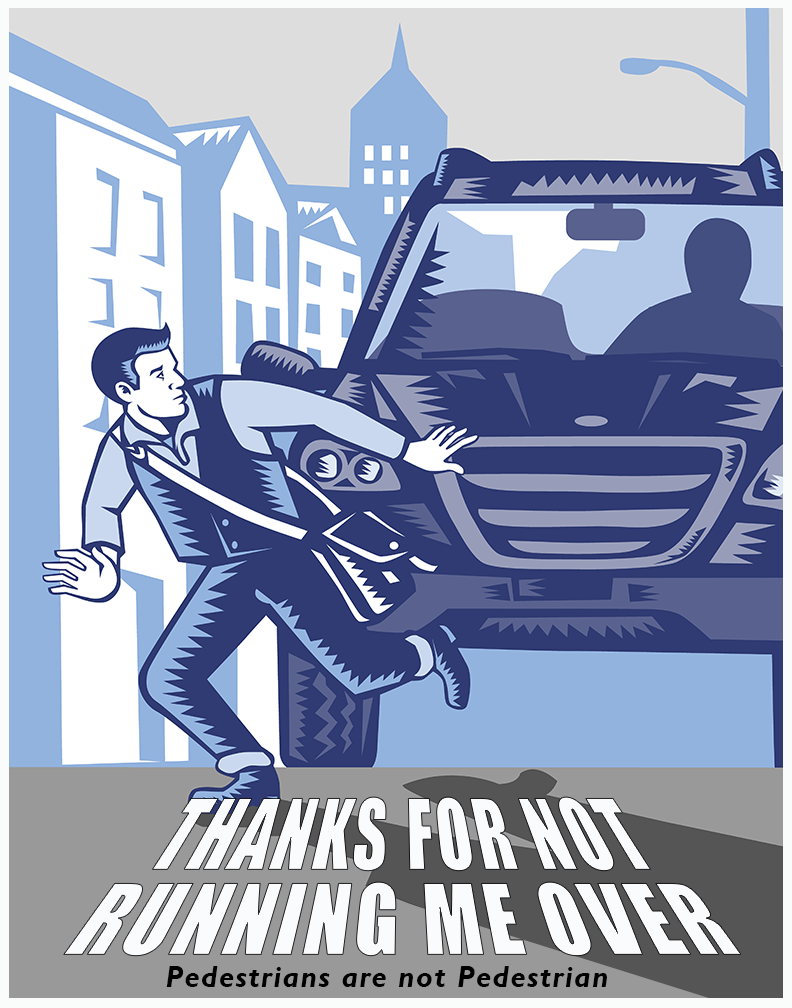
The site will stay up in case you want to order a Down & Outbound: A Mass Transit Satire book or the gorgeously printed D & O Thanks for Not Running Me Over Poster. The book is still for sale at Amazon, Alibris and on my own virtual popup book shop Destination: Books The site will also continue be the archive where you can also revisit some of its "more popular" postings, such as: 
— May 1, 2020. "We've All Experienced This Look on the Subway." Why Dr. Deborah Birx's reaction to Trump's suggestion that we should try injecting ourselves with bleach looks so familiar to commuters.
— February 6, 2020. "Sixteen Metric Tons: A Climate Parody". A song about air pollution.
— October 30, 2019 and November 13, 2019. European Transportation Options Parts 1 and 2. A pictorial account of public transportation in Venice, Berlin, Prague and Treviso Italy.
— The MARTA Book Club. A series of postings on what people read while on Atlanta public transportation. These live on my companion blog about books (which still marches on.)
And thanks for reading the blog!
—–TITLE: Train Logistics and Coincidences
DATE: 09/03/2020 10:53:34 AM —–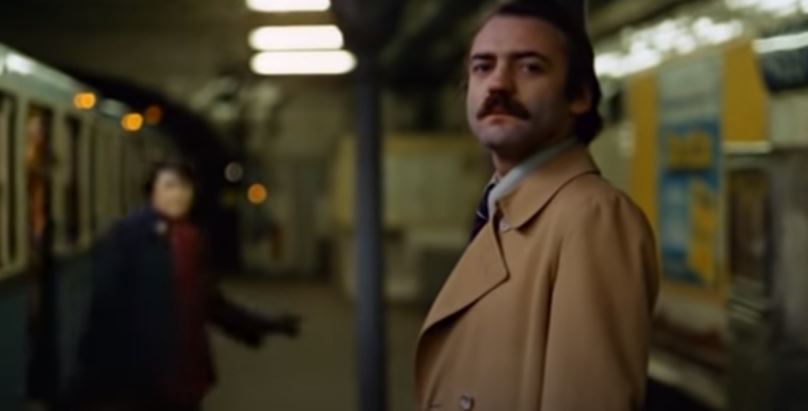
By coincidence last week, I stumbled on to a movie and a book where trains play a prominent role in the storyline. They even share an educational component:
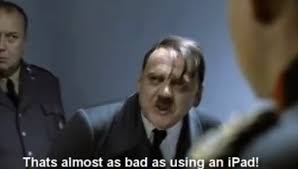 Wim Wenders, The American Friend. Wenders directed this 1977 German-French film starring Dennis Hopper and a young Bruno Ganz the late, great actor who portrayed Adolf Hitler in “Downfall”, but is currently well known for all those Hitler memes.
"The American Friend" is set in Hamburg and Paris, and Ganz plays a dying man who is recruited indirectly by Hopper to be an assassin. Ganz carries out his first assignment in the Paris subway system and then with assistance from Hopper, he tosses a couple of men off the train while traveling from Munich to Hamburg. Later after the deed, Hopper poses a math problem to Ganz over beers, “If you throw a gangster out of train going eighty miles an hour, and then you throw a second one, (and you know the distance between the two discarded bodies), how much time passes between the two events if the train doesn’t change speeds?”
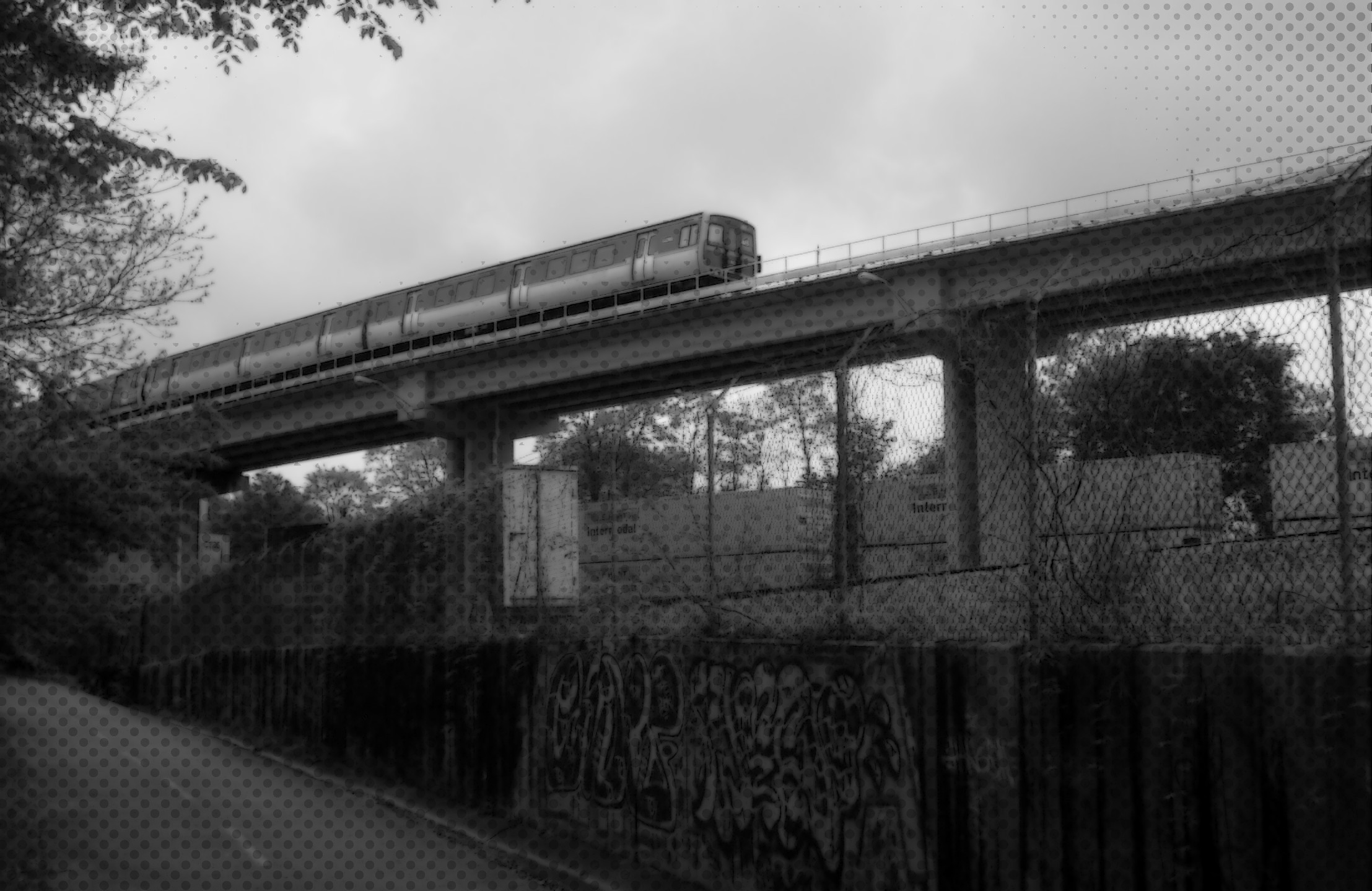
W.G. Sebald’s The Emigrants. The German-born Sebald (1994-2001) is one of my favorite writers over the past few years. Sebald often includes trains and train stations in his narratives. Black and white photographs – like they came out of an old family album – are always part of a Sebald book. One of the chapters entitled “Paul Bereyter” is about a retired schoolteacher who ends his life on a December night in 1984 by laying down on a curve of the railroad track. (Shown here)
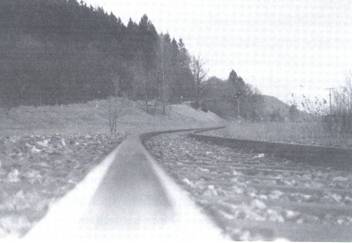 The narrator is one of Bereyter’s students and he recalls how much “railways had always meant a great deal to him (Bereyter) – perhaps he felt they (railways) were headed for death. Timetables and directories, all the logistics of railways, had at times become an obsession with him…I thought of the stations, tracks, goods, depots and signal boxes that Paul had so often drawn on the blackboard and which we had to copy into our exercise books as carefully as we could.”
Readers of Down & Outbound: A Mass Transit Satire can appreciate how these two works might have appealed to me. The main character of D & O works in “mass transit counter-intelligence” and writes in the form of a “personal journal of case narratives which he hopes to eventually turn into a television script.” However, the similarities end there, as I am no Wim Wenders or W.G. Sebald. The last sentence sounds like a possible book blurb.
—– KEYWORDS: The American Friend, Wim Wenders, Bruno Ganz, W.G. Sebald, the Emigrants, Dennis Hopper TITLE: Appreciation DATE: 07/27/2020 08:21:54 PM —–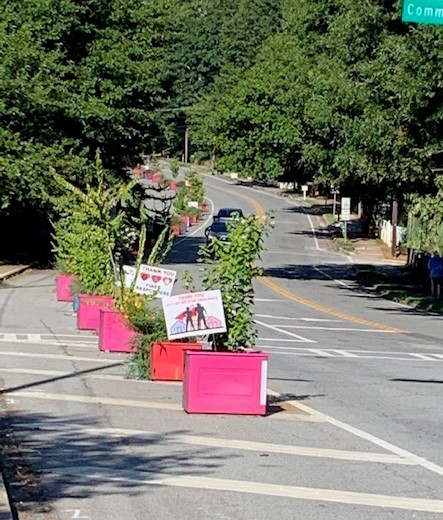
In 2018, these big plastic planters in hideous purple, blue and orange colors were added to busy Dekalb Avenue to slow the traffic from Atlanta into Decatur. I don't how effective they were in calming traffic but nothing slows traffic like a pandemic. These plastic planters have met with some derision from local residents including this protest song.
Planted among the dead plants, volunteer flowers and distressed trees are countless signs of appreciation for people wearing masks, for people who stay at home, for Decatur city employees and for first responders. All worthy, no doubt.
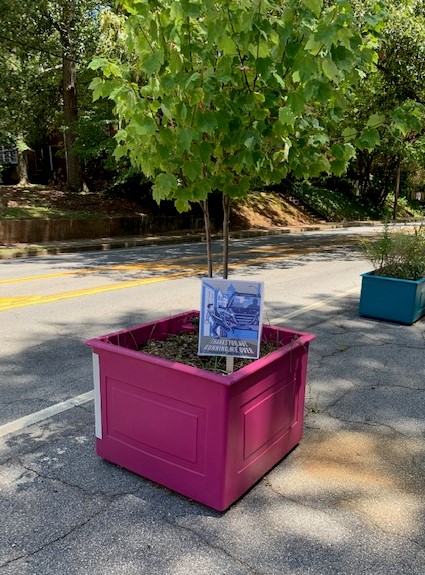
Therefore it seemed appropriate to add a poster from the Down & Outbound collection as well.Unfortunately, since people don't always understand dry humor it has already been removed. But no problem I have plenty of them (for sale too). 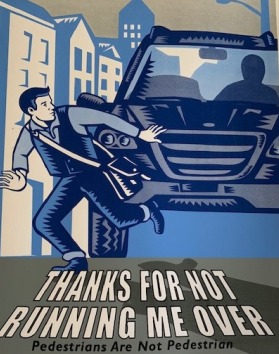
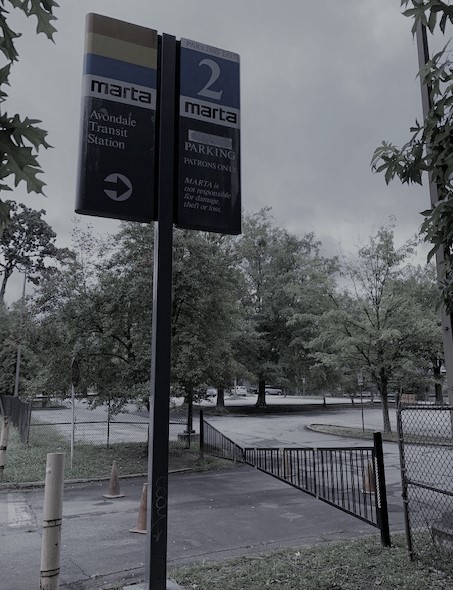 Before the COVID-19 pandemic in March, this small parking lot near the Avondale Station here in Atlanta would be filled before 8:30 in the morning. Now if you drive in there, one has the uneasy feeling of: "Am I even supposed to be here?"
KEYWORDS: MARTA (Metropolitan Atlanta Rapid Transit Area), ridership, COVID-19, pandemic TITLE: Remembering the Dream Team DATE: 05/25/2020 09:25:46 AM —–
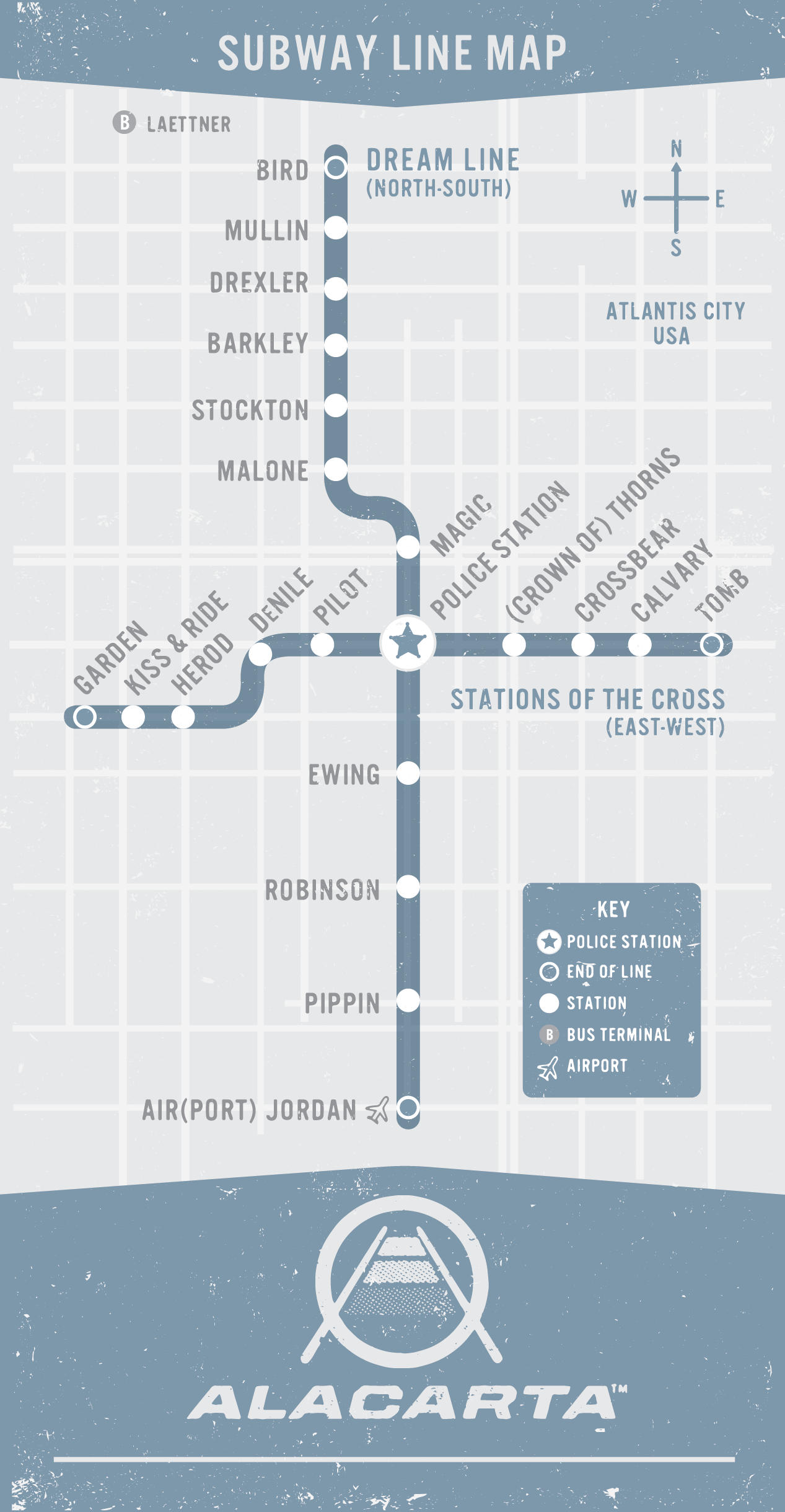
Inspired by the recent ESPN series "The Last Dance" about Michael Jordan and the Chicago Bulls dynasty, this posting is an excerpt from the 2016 book Down & Outbound: A Mass Transit Satire (available online only from Destination: Books or Amazon). The map shows the fictitious Atlantis City Transit System known as ALACARTA, which stands for the Always Lovely Atlantis City Area Rapid Transit Authority*.
The North-South Dream Line
The stations on the north-south line (aka The Dream Line) had originally been named for the neighborhoods where they were located, but were renamed by the Atlantis City Council to honor the 1992 Olympic Dream Team that won the gold medal in basketball and restored pride to our hoops-loving nation. Led by the NBA stars Michael Jordan and Earvin “Magic” Johnson, the team featured 11 players who would later become members of the Pro Basketball Hall of Fame. It is no coincidence that the Stockton and Malone stations and the Pippin and Air Jordan stations are adjacent to each other, just as John Stockton and Karl Malone played side-by-side for the Utah Jazz and Scottie Pippen played with Jordan for years on the Chicago Bulls. The Dream Team re-established America's supremacy in basketball, which had previously suffered setbacks in international competition. Just outside the city’s perimeter (defined by the eight lanes of interstate that loop the city) there is Laettner station, a large bus stop disconnected from the rail line—named after Christian Laettner, the only college player on the Dream Team and the only team member not to be elected to the Pro Basketball Hall of Fame. To make the buses connecting the Dream Line stations easier to remember, the route numbers correspond to each player's uniform number.
The East-West Cross Line
The Stations of the Cross Line, or Cross Line for short, runs east to west. As if repenting for renaming city neighborhoods for basketball players, the Atlantis City Economic Task Force suggested capitalizing on the nation's growing interest in religion by creating a Christian-themed line to stimulate the city’s tourism industry. Unfortunately, neither this nor the additional activities devised to stir up interest, such as the creation of religious festivals, and press releases about miracles, brought tourism dollars to the city coffers. Maybe the names were too focused on Easter. Eventually, the lengthy names of the original stations such as Garden of Gethsemane or Pontius Pilate were simplified to address this issue. Besides who would want to live near Judas Station? Kiss & Ride was much more palatable to the locals.
*Any resemblance to Metropolitan Atlanta Rapid Transit Authority is mere coincidence. For more about the book, see the trailer video at http://bit.ly/2hgCOtO
TITLE: We’ve All Experienced This Look on the Subway DATE: 05/01/2020 09:40:55 AM

It took me a few days to figure it out, but Dr. Deborah Birx's reaction to President Trump's "musing" about possible treatments for COVID-19 reminded me of a moment that all subway riders have experienced. You're just on the train trying to mind your own business when another rider exhibits bad behavior: cursing loud on their cell phone, yelling maniacally about poor train service, or specifically asking you questions about disinfectant. ( "Yeah, you with the big scarf. I'm talking to you." )
Fortunately, Dr. Birx is a savvy woman. Under no circumstances do you make eye contact with this person.
—– EXTENDED BODY: —– EXCERPT: —– KEYWORDS: —– ——– AUTHOR: Murray Browne AUTHOR EMAIL: murray.browne905@gmail.com TITLE: Public Transportation Support STATUS: Publish ALLOW COMMENTS: 1 CONVERT BREAKS: wysiwyg ALLOW PINGS: 0 BASENAME: public-transportation-support UNIQUE URL: https://thebookshopper.typepad.com/downandoutbound/2020/04/public-transportation-support.html DATE: 04/23/2020 09:02:31 AM —– BODY: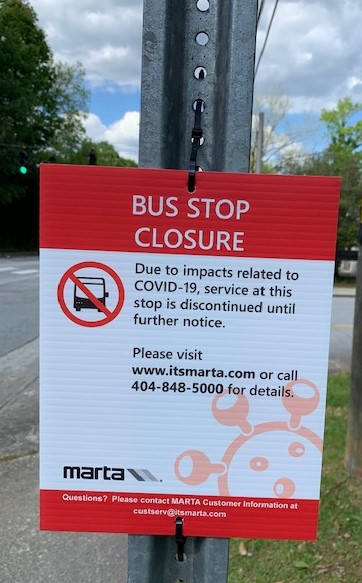 The phase "Down and Out" only begins to describe the public transportation situation here in Atlanta and other major cities. Deep cuts in service including reduced schedules for trains and the elimination of bus routes come as little surprise. As one who commuted daily on the Metropolitan Atlanta Rapid Transit Authority (MARTA) trains for over a decade, a large portion of the ridership were service workers, students, and people traveling to and from the airport for work or travel. And we all know what that situation is right now.
Though I rarely ride anymore, (or drive for that matter these days since retiring last year), I feel for the MARTA financial situation. In a way, it's similar to the support I have for my local restaurants, the neighborhood hardware store, indie bookstores, and charities. So I ponied up for a couple of Breeze transit cards via their website. In the olden days I used to carry an extra Breeze card with me loaded with a couple rides in case I was solicited and felt the person was being honest about their need for help to get to work or home. (But on more than one occasion, I'd offer the card to the person asking for transit fare and the reply would be, "No, I'd rather have the money." Hmmm.)
It seems irrelevant whether I will use the cards or "gift" them as this is nothing more than a small, symbolic sense of duty to the memory of my commuter past combined with the future-Earth-Day-kinda hope for a fewer cars, cleaner air and less noise.
—– EXTENDED BODY: —– EXCERPT: —– KEYWORDS: MARTA closures, downsizing, supporting public transportation —– ——– AUTHOR: Murray Browne AUTHOR EMAIL: murray.browne905@gmail.com TITLE: MARTA Army STATUS: Publish ALLOW COMMENTS: 1 CONVERT BREAKS: wysiwyg ALLOW PINGS: 0 BASENAME: marta-army CATEGORY: Down & Outbound (the book) UNIQUE URL: https://thebookshopper.typepad.com/downandoutbound/2020/03/marta-army.html DATE: 03/25/2020 09:15:29 AM —– BODY: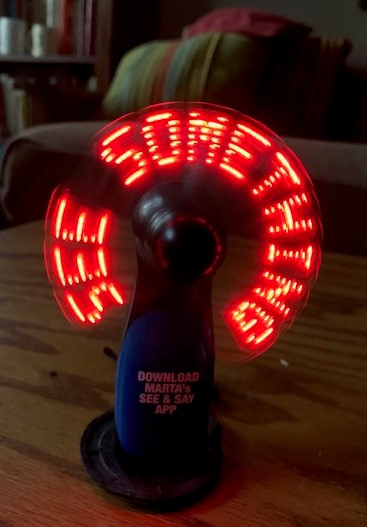 The MARTA Army is an independent grassroots action group, committed to enhancing the ridership experience on public transit in Metro Atlanta. Since the MARTA Army recently solicited suggestions for their book club, may I recommend Down and Outbound: A Mass Transit Satire?
Even though a satire based on the public transportation experience seems at odds with an organization that — for the lack of a better word — cheerleads public transportation in Atlanta, I disagree. The underlying nature of satire is optimism. Unlike comedy which accepts flaws, satire expects better or believes things could be better (optimism). Both MARTA Army and D & O share the same goal that better mass transit is vital for our community, but our approaches are different. The MARTA Army does good works like improving bus stops, D & O takes a more "See Something" and "Say Something" approach to identify problems. 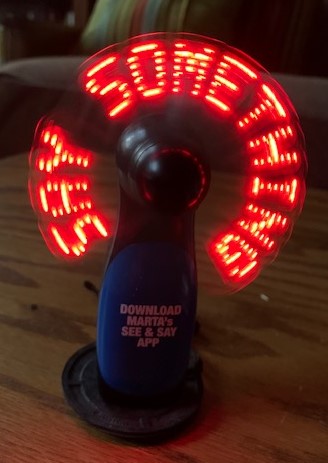
In the likely event that you soldiers of the MARTA Army have arrived here looking for something to read, I hope you will proceed to the Down & Outbound Store. Never underestimate the power of unorthodox alliances.
—– EXTENDED BODY: —– EXCERPT: —– KEYWORDS: —– ——– AUTHOR: Murray Browne AUTHOR EMAIL: murray.browne905@gmail.com TITLE: New Urbanist Memes STATUS: Publish ALLOW COMMENTS: 1 CONVERT BREAKS: 0 ALLOW PINGS: 0 BASENAME: new-urbanist-memes UNIQUE URL: https://thebookshopper.typepad.com/downandoutbound/2020/03/new-urbanist-memes.html DATE: 03/02/2020 09:33:57 AM —– BODY:
Through the magic of algorithms and nestled in-between many internet ads for printer ink (I recently bought some at Office Depot) I am now connected to the New Urbanist Memes for Transit-Oriented Teens on Facebook. It is a moderated collection of transit-oriented humor and commentary, mixed in with reports around the world about various issues surrounding mass transit. You don’t have to be a teen to belong or should I say the algorithm is not savvy enough to determine that I am not a teen anymore (does immaturity count?). Still I consider myself interested in alternative transportation despite discontinuing the daily slog to work.
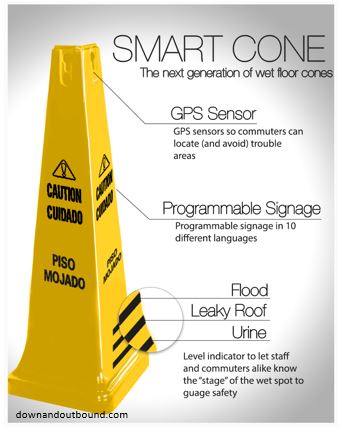 Since New Urbanist Memes is thematically similar to my Down & Outbound website, I recently cannibalized some of my previous work on Smart Cones from Down & Outbound: A Mass Transit Satire and made a submission. After it posted, I received about 100 comments, mostly centered around my misspelling of “gauge.” This reponse exceeded the entire viewer traffic to the Down & Outbound blog since its inception in 2017. New Urbanist Memes gave me a brief sense of validation and belonging.
Book Selling Note
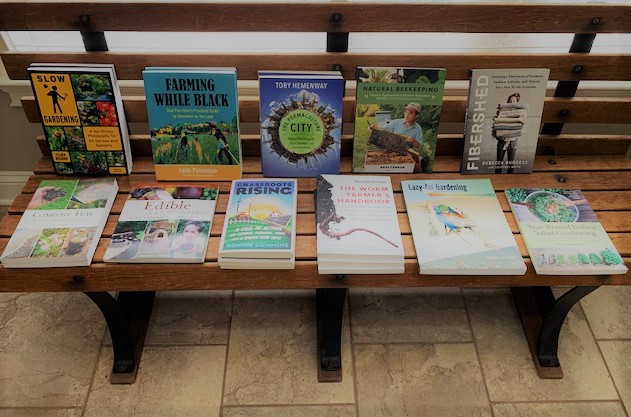
Copies of the book Down & Outbound will be on sale at the Destination: Books popup book stall on Saturday, March 7th and again on Saturday, April 4th at the Freedom Farmer’s Market at the Carter Center here in Atlanta. Destination: Books will be carrying many books on organic gardening and sustainability as well as a few others relating to transportation.
The undeniable fact that a person living in the United States puts 16 million metric tons of carbon dioxide annually into the atmosphere combined with the folk classic "Sixteen Tons" has inspired this parody. I wrote these lyrics with some very helpful tweaks from my longtime friend, the composer James Alfred Thigpen. The connection between a song describing the life of coal miner and damage that coal is doing in the environment was not lost on me. If you're not familiar with the original song written my Merle Travis in 1947, and made famous in 1955 by Tennessee Ernie Ford, here's a refresher video.
16 Metric Tons
Some people say that climate change is a hoax
A fantasy created by uneasy folks
Flooding and drought ain’t evidence
A weak mind says it’s all coincidence
REFRAIN
You makin’ 16 tons and where you gettin’
Another day closer to Armageddon
So please don’t go an’ ask me to change my ways
I’ve lost my soul to the fossil fuel haze
I woke one mornin’ when the sun didn’t shine
The air was all heavy with particles fine
I couldn’t figure what else to do
So I kept on pumping out my CO2
REPEAT REFRAIN
I woke one mornin’ it was drizzlin’ rain
Must be too much of that gassy methane
‘Cause th’ cows are pootin’ and pipelines leak
And I’m sorry to say, the levels ain’t peaked
REPEAT REFRAIN
If you see this comin’ you’d best abide
A lotta folks won’t, so expect to be fried
One fist is coal, the other one’s oil
Throw ‘em together, an’ the planet will boil
REPEAT REFRAIN
Final Thoughts
I have seen the 16 Metric Tons of CO2 per person in the U.S. figure cited various sources but recently it was cited in the World Economic Forum's Chart of the Day. A metric ton is a few hundred pounds heavier than the "traditional" 2000 lb. ton weight. For more background on the song visit Wikipedia.
Obviously, I don't have the rights for the music, but lyrics-wise parody usually falls under fair use. If someone wants to use my lyrics to make a point, (while performing – including YouTube) so to speak, they are welcome to use them, but proper attribution is always appreciated. (Murray Browne, murray-browne.com) . In the unlikely event a musician makes and sells a recording, then that would require further discussion. Bitly link for this post: http://bit.ly/2S4uuTM
Nonetheless, the song resonates. Apparently popular among Amazon Warehouse employees and over the years it has been covered by the likes of Johnny Cash, Tom Jones, ZZ Top, Leann Rimes, and The Platters. I like this folksy rendition from Josh Turner Guitar.
—– —– KEYWORDS: Sixteen Tons, Sixteen Metric Tons, parody, Tennessee Ernie Ford, Josh Turner Guitar —– ——– TITLE: Reading Bits and Other Followups UNIQUE URL: https://thebookshopper.typepad.com/downandoutbound/2020/01/reading-bits-and-other-followups.html DATE: 01/08/2020 08:16:25 AM —–

A few things I have been reading lately seemed relevant:
Barely Maps
 Back in September, I mentioned that Down & Outbound became a Kickstarter supporter for a book project by Peter Gorman entitled Barely Maps. The project is a personal account of the cyclist and graphic designer's 11,000 mile bike trip across the United States and southern Canada. The end result is the gorgeously printed Barely Maps: 100 Minimalist Maps (2019). It's similar to an artbook with dozens of illustrations including a set of Intersections, where Gorman outlines the quirky, weird intersections of select U.S. cities. You can read a complete review of the book on my companion thebookshopper.org blog or visit Gorman's website at barelymaps.com.
Democracy and Public Services (Transportation)
 Astra Taylor's book, Democracy May Not Exist, But We'll Miss It When It's Gone (2019) is a multidisciplinary and historical look at the where democracy stands as we the first quarter of the new century. Although you could say things are looking a little bleak for democracy, Taylor reminds us that "democracy begins where you live" including protecting the environment. She writes:
"Ultimately, more than 350 cities announced plans to break with national policy and honor the international accord. No longer advising people to go back to the land, environmentalists increasingly recognize the role cities must play if they hope to achieve sustainability Several earths would be required for everyone to live in a suburban home with a two-car garage, which means dense cities – compact, efficiently designed, and public service rich — will be crucial to livable low-carbon future. "(Taylor is citing the work of Daniel Adana Cohen.)
And Ending on a Lighter Note
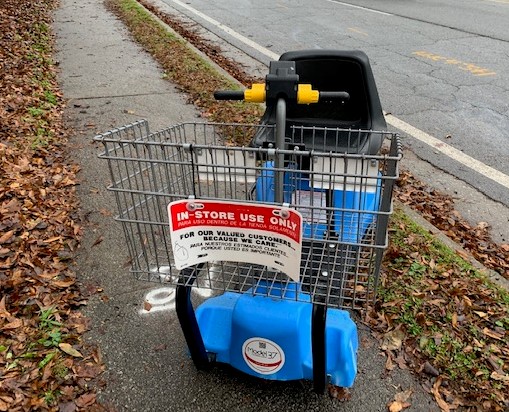 A couple of weeks ago around midnight on a Saturday night, my eye caught a "vehicle" scooting down my street in Decatur (GA). I live on a busy street with lots of traffic and even at that late hour automobiles pass by regularly. The vehicle had no lights or reflectors, but a large, older man was wearing white sweatpants (or pajamas?), a jacket and stocking cap was tootling along one of the lanes. I feared the worse for the scooter rider or an unsuspecting motorist and called the non-emergency police number. The next morning the scooter was abandoned a block away and it turned out it was a motorized shopping cart from a Walmart store which is about 3/4 of a mile from where I live. You cannot underestimate how people like their scooters.

—– TITLE: Transportation Solutions Lab
Two-year old Myrick Poore (my grandson) is working daily on solutions to transportation problems in his living room lab. The first one deals with the problem of how can buses be better used to combat traffic congestion that would appeal to those who cannot give up their cars.
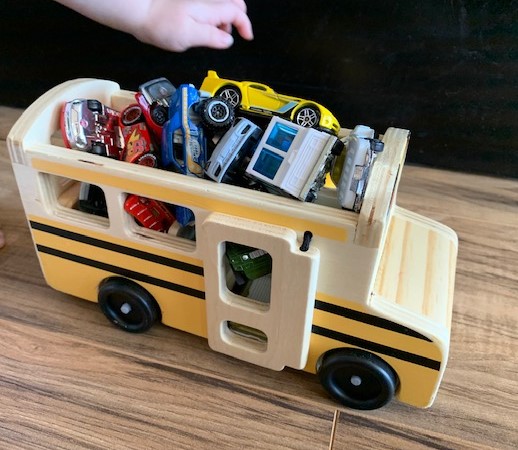
His second project is combatting traffic jams caused by highway construction, which involves removing barricades at optimal times.

No doubt that these "hand of God" type of solutions require some modification. But Myrick has time.
TITLE: European Transportation Observations: Part 2 DATE: 11/13/2019 08:46:24 AM
After spending four weeks in Europe using public transportation, trains and my own two feet to get around in Venice, Prague, Berlin and Ljubljana I pulled together random thoughts about those experiences. In Part 1, I wrote about Italy and Prague now in Part 2, I am adding some anecdotal observations about Berlin and Ljubljana, which is the capital city of Slovenia.
Berlin, Germany
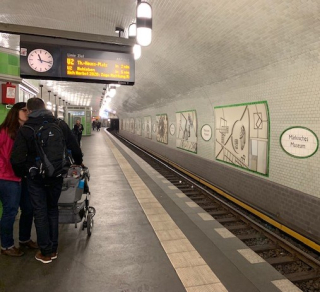
The four-hour train trip from Prague to Berlin was much more relaxing than taking a short flight on the airlines. Not only do you pass several bucolic spa cities in Southern Germany, but the scenic Elbe River is a constant travel companion much of the way as well. But arriving at the Berlin’s enormous glass and steel Berlin Central Station or Hauptbahnof (Berlin Hbf) I was shocked from my train reverie by the size and magnitude of the transportation hub. The Berlin Central Station was completed in 2006 on the former site of the Lehrter Station, which was originally constructed in 1876 and heavily damaged in World War II.* The two levels of Hauptbahnof connects local train transportation (top level) with the regional train service (bottom level). Fortunately, my older daughter Cynthia, who lives in Berlin, greeted my partner and travel planner extraordinaire Denise Casey and me and led us to our AirBnb apartment in the Kreuzberg section of the city. Otherwise we might still be wondering around this "train metropolis."
When the Berlin Wall was built, Kreuzberg was a district surrounded on three sides by East Berlin and for years remained rundown before being inhabited by more bohemian and artist types. There was a heavy Turkish influence as well because of the Turks who emigrated to Germany to work in the factories in the 1960s could live there cheaply. After reunification, the 3oth anniversary was earlier this month, Kreuzberg retained its counterculture heritage but has been part of the gentrification controversy. We spent most of our time in Kreuzberg and the buzz and activity on the streets has a certain energy that sets it apart from other boroughs of Berlin (from what I’ve been told.)
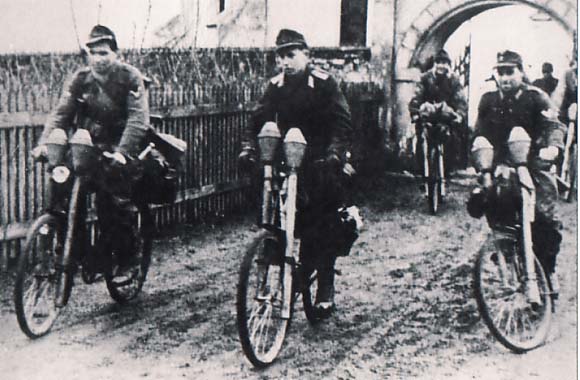
In addition to the trains and buses which run constantly, there are plenty of cyclists in Berlin. The bike lanes and paths blend “too seamlessly” because I had to specifically look for the designations such as different color bricks or sidewalk lanes marked by reflector buttons so riders wouldn't yell at me, "Achtung, Bitte". Berlin has long, hard winters, and the cyclists had a gritty aura that showed their toughness. I half-expected to see a cyclist carrying a Panzerfaust. (* See footnote at the end of the posting for the full explanation and digression.)
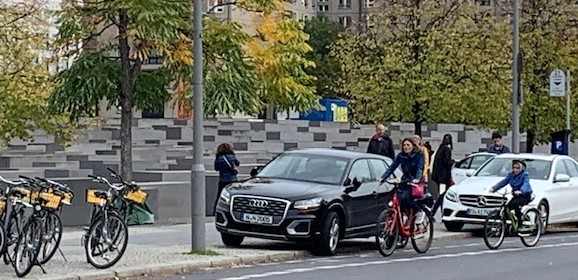
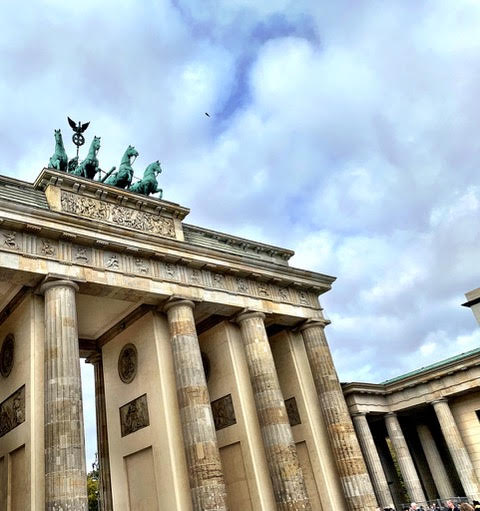
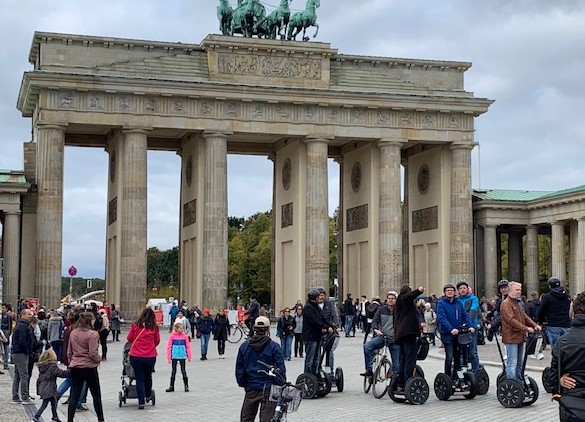
After a few days, Denise and I felt comfortable getting around by ourselves and we took the subway to the central part of the city to see the Brandenburg Gate and the Memorial to the Murdered Jews of Europe (shown here with cyclists on Hannah-Arendt Strasse.)
Ljubljana, Slovenia
There are limited rail and air travel options between Berlin and 
Ljubljana so we flew from Berlin to Zagreb, Croatia and took a shared van service called GoOpti to get to Ljubljana. Once you are in this medieval city that is built on the peaceful Ljubljanica River, your transportation needs are few since you can walk to the most sites in the city within twenty minutes.
The central part of the Ljubljana is strictly limited to pedestrians and bicycles. Only a few automobiles are granted access relying these clever little obstacles (shown below). I am so easily entertained; I could watch these for hours.
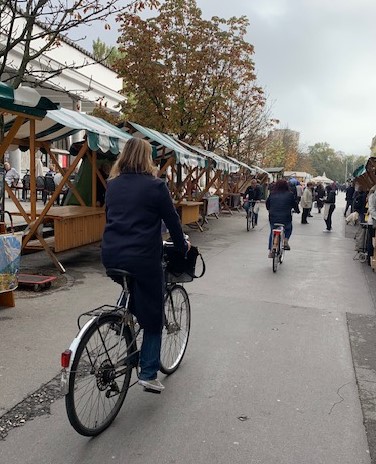 E-scooters are starting to appear in the city, but our food guide who was an avid cyclist is hoping they don’t take hold. In Ljubljana, I was wary at first because the way the cyclists darted in and out among the pedestrians effortlessly. The cyclists who dressed in normal clothes and followed the guidelines I mentioned when describing the cyclists in Treviso, Italy. (See European Transportation Part 1.)
We were in Ljubljana for a week and we wanted to see other parts of Slovenia. Slovenia is a relatively small country and we used Ljubljana as a base, because it takes less than two hours to drive to the glacial Lake Bled to the north (shown below) or the alpine shepherd’s village of Velika Planina or the Adriatic seashore town of Piran, which we did. It was the only three days we drove during the almost four weeks we were abroad. (Slovenia has good roads and the drivers are not particularly aggressive.) Unlike other European countries Slovenia does not much of a regional train network and when we left the country to return to Treviso, Italy for our eventual flight home, we used the GoOpti service again.

—– KEYWORDS: Public Transportation in Ljubljana, Cycling in Berlin, Panzerfausts, Antony Beevor, Transportation in Slovenia —– ——– AUTHOR: Murray Browne AUTHOR EMAIL: murray.browne905@gmail.com TITLE: European Transportation Observations – Part 1 DATE: 10/30/2019 07:07:11 PM —– BODY:Panzerfaust Footnote *
Part of my Berlin experience was influenced by reading Antony Beevor’s The Fall of Berlin 1945 (2002) before I arrived in the city. This detailed account of the Soviet Army’s crushing defeat and punishment of Nazi Germany in the final months of World War II, is pure misery porn. Beevor’s book it describes the suffering of millions of German civilians and the horrors that the Soviet army put on the German population, partly in retribution for Nazi atrocities against the Soviet Union in 1942-44. Two accounts in the book stick in my mind: 1.) How the German civilians hid in the subways like Lehrter Station to avoid the heavy Soviet bombardment of the city (The Red Army even zeroed their artillery on the station entrances so if the civilians tried to get out temporarily get food and water it was only at great peril. And 2.) The Germans use of Panzerfaust, an anti-tank weapons resembling rocket propelled grenades that German soldiers riding bicycles would use to attack Soviet tanks with effective results. In this less than perfect photo of the Brandenburg (shown below), I found the helmeted tourists riding Segway-like vehicles amusing especially considering the Panzerfaust heritage. This may seem to be an odd narrative juxtaposing war stories and tourists on scooters, but since Berlin is a city that has been wrestling with its past, it seemed relevant.
After spending four weeks in Europe using public transportation to get around Venice and several nearby cities, Prague, Berlin and Ljubljana (Slovenia) I pulled together some random thoughts about those experiences that are anecdotal in nature. I begin with Italy and Prague in Part 1 and then move to Berlin and Ljubljana in Part 2.
Venice
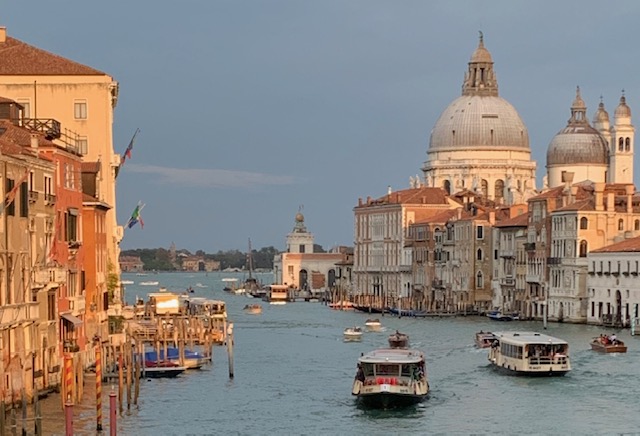
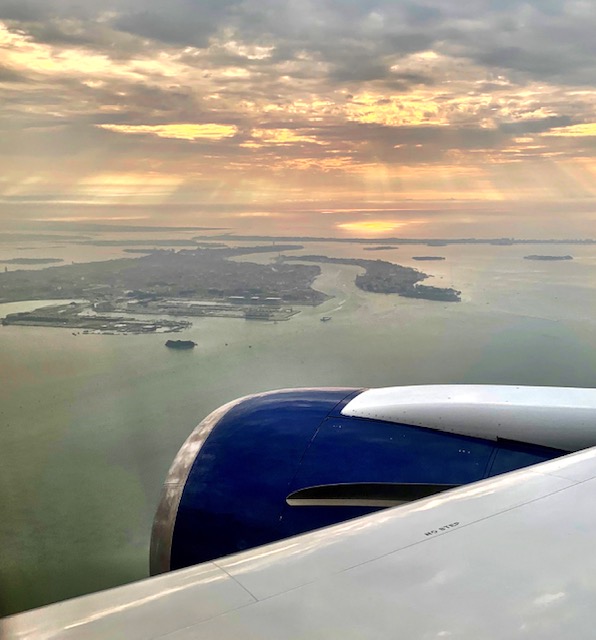 When flying into Venice, no matter how tired your are, you immediately awaken to the fact that this is a public transportation network like no other. To get from Marco Polo Airport to the city you must take a water bus and dock at one of many “boat stops” on the way.
There are no cars or trucks in Venice and one must rely entirely on boats and your own two feet. Since hundreds of canal bridges populate the city, there are very few bicycles and e-scooters to contend with on the streets and sidewalks.
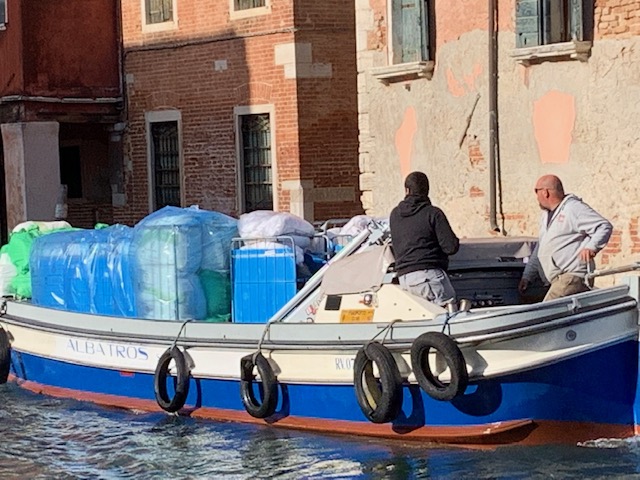
What struck me was that every function you expect from a car or a truck was provided via boat whether is was an ambulance boat, a fire fighting boat or a boat hauling goods or garbage. Why these boats didn’t collide was a mystery to me, and it reminded me of all those cyclists in Amsterdam I witnessed a few years ago crisscrossing each other without incident. (And yes, I did do a gondola ride but only for about five minutes just to cross the Grand Canal.)
Treviso, Italy
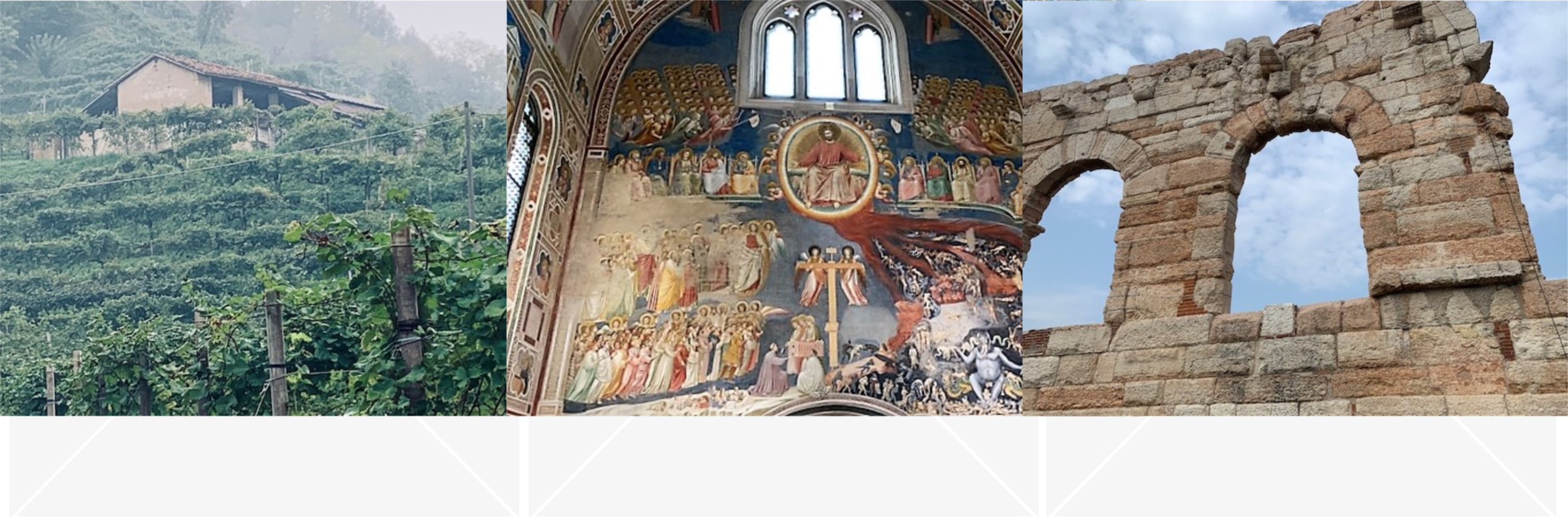 Treviso, Italy is part of the Veneta and is only 30 miles north of Venice. It serves as a regional rail hub to cities such as Verona, Padua, and Conegliano. Regional trains ran regularly thoughout the day and evening so it is fairly easy make day trips – vineyard tours outside of Conegliano, the Scrovegni Chapel in Padua, and the Colosseum in Verona (shown left to right in the above collage). The train stops at smaller cities on the way, and one must be vigilant because these stations are not always announced. An added benefit is that on the back of your ticket there was a graphic reminding me how train travel was the best mode of transportation for the environment when compared to automobiles and planes.
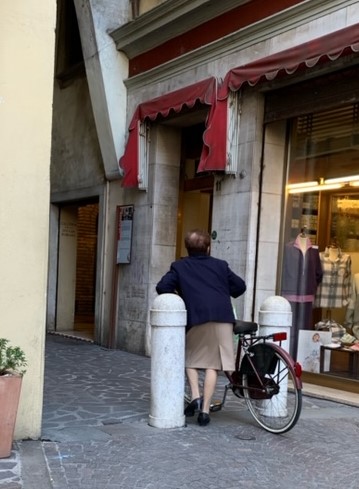 Treviso is pedestrian-friendly in the center city because access by automobile is limited. Also, it is a fairly flat city with narrow streets and cyclists – sans bike lanes – effortlessly dart in and out among pedestrians (but not recklessly). Based merely on my observations, there were other unwritten rules among the cyclists encapsulated by the snapshot of this older woman who unknowingly embodied the following guidelines:
No Helmets – only children with their parents wore helmets.
No Spandex – cyclists wore their regular daily clothes. Just because many Italians like to dress fashionably did not prevent them from riding bicycles.
No Shame in Walking Your Bicycle – Older riders were not hesitant to dismount and walk his or her bicycle up a hill or in a congested area.
No Age Limit – It was not unusual to see riders in their sixties and seventies riding slowly but effortlessly in the center city.
No Fancy Bikes – These bikes were more functional in nature with front baskets and back baskets and fenders to prevent muddy splashes on those nice clothes.
There is a city bus system in Treviso, but since my traveling partner and trip planner extraordinaire Denise Casey stayed in the center city, we didn’t need to use it. You can walk anywhere in center city in 20 or 30 minutes including the Treviso train station. This short video gives one some sense of the vibe.
Prague, Czech Republic
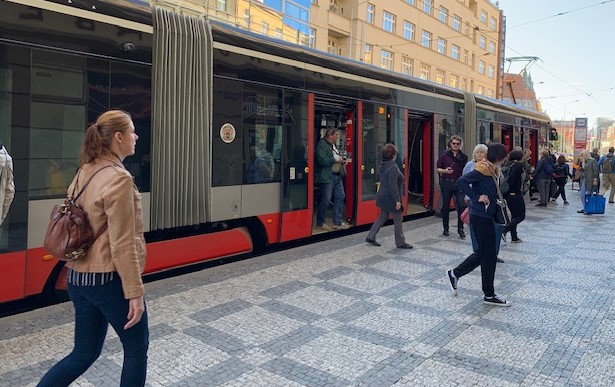
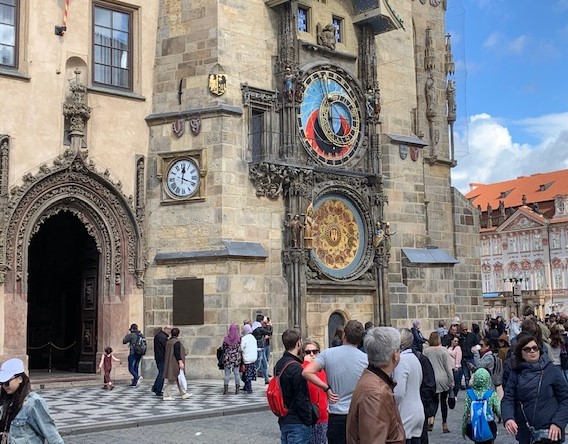 Prague relies on its electric trams and a major subway with three main lines. Our tour guide remarked that the only thing Soviets did right was build a subway system that commuters could get from the outskirts to the main centers of the city in a few minutes. (It is fifth busiest subway system in Europe in terms of ridership with trains running every two to three minutes at rush hour.) Since we were staying in the nearby Mala Strada, we quickly mastered the tram system, which we used regularly to take us back and forth to the more touristy Old Town and sites such as the Astronomical Clock. I regret not checking out some of the stations in the tunnels, but it was never necessary because the trams were enough for us to get around.
Like the drivers in my hometown of Atlanta– even though traffic is slowed and not has heavy – as a pedestrian you had to make eye contact with the motorists even if you were in a crosswalk. I almost got paved into a cobblestone street near the Prague Castle.
There was some cycling and the e-scooters in Prague as well, but I am not sure those e-pests will be widely accepted. I saw a few people riding e-scooters on cobblestone streets and their heads were bobbling so much I thought I saw a few teeth fly out.
At the end of our stay, we took the tram directly to at the Prague train station where we boarded a train for a four-hour trip to Berlin.
KEYWORDS: public transportation Venice, public transportation Treviso, public transportation Prague TITLE: Barely Maps: A Book DATE: 09/19/2019 03:09:02 PM
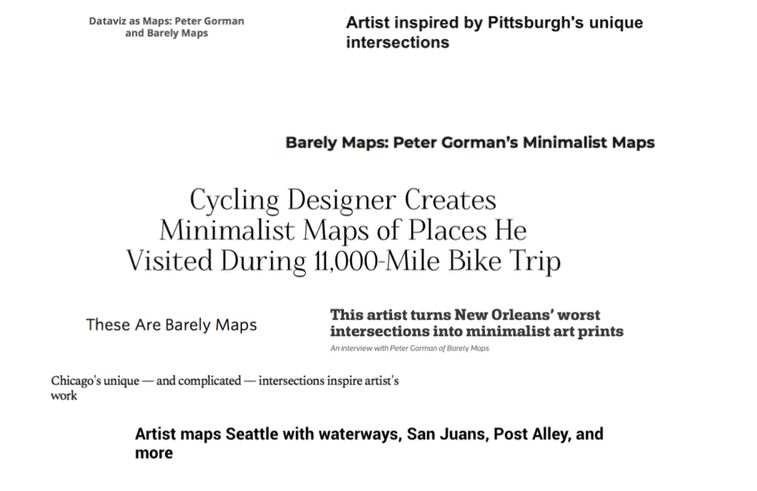
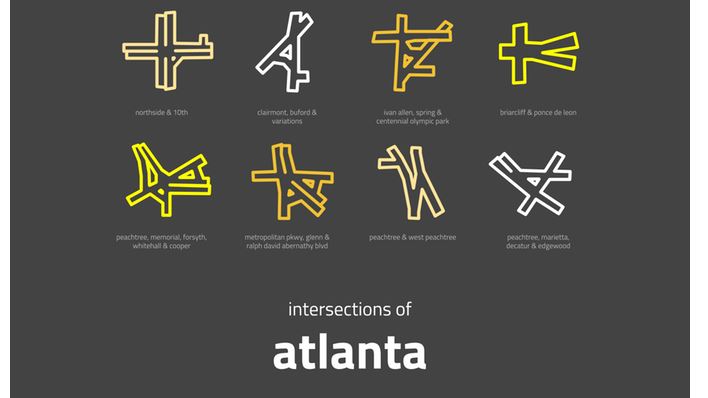 Based on our combined interest of a.) alternative transportation b.) graphic representation of information (as an old Tufte disciple) and c.) the entrepreneurship of creating a different type of book where form follows function (such as Down & Outbound: A Mass Transit Satire), we contributed to the Kickstarter Project called Barely Maps. Check out the complete story here.
Pledges end September 25th, but they the project already made its goal. We look forward to getting our book later on this year.
TITLE: Scooters in the News UNIQUE URL: https://thebookshopper.typepad.com/downandoutbound/2019/09/scooters-in-the-news.html DATE: 09/05/2019 08:01:35 AM
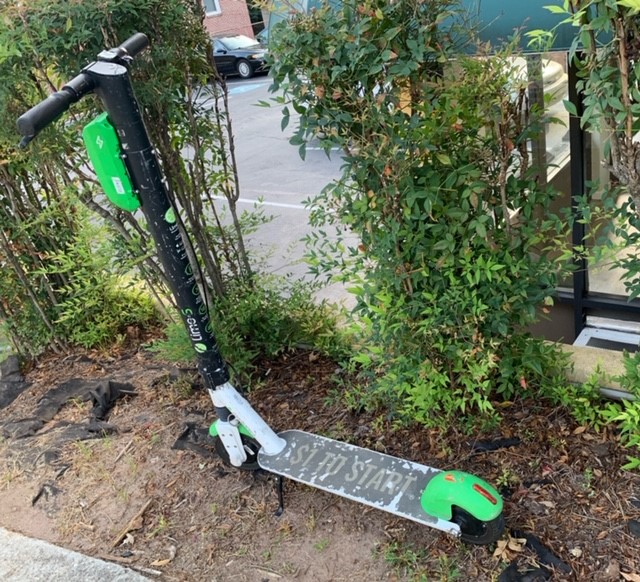 Readers of this blog know that when I am walking, electric scooters are not welcome on sidewalks and as a motorist and a fellow human being, I fear being part of or witness to a serious accident involving a scooter on a street. You can call it envy because of my own lack of balance (and thus I am excluded from the Lime club), but when I see a 185 lb. person scooting 15 miles an hour with no helmet in traffic, I shudder, not gaze wistfully. Given the durability of a scooter — estimated between one and three months — gives me further anxiety when I see scooters weaving amongst traffic and pedestrians. See this article for details.
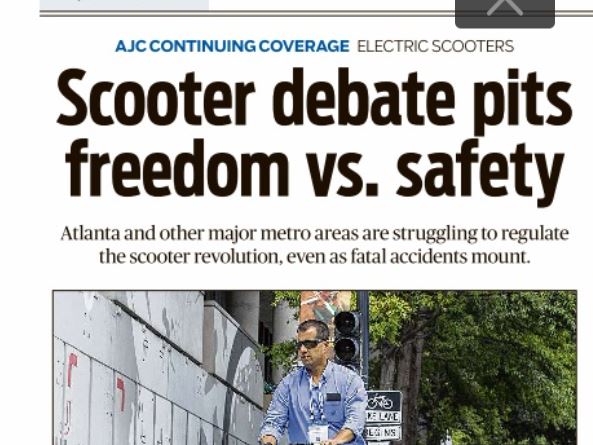
Atlanta Journal Constitution Article
The Atlanta Journal-Constitution ran a long feature article in the Sunday, September 1st edition, which covered many of the issues surrounding the use of scooters in Atlanta. I’ve highlighted one excerpt that challenges the much-marketed assumption that scooters replace car trips (they replace walkers as well). Of course, there is a lot of big money pushing these assumptions. Lime is financed by Uber and Google-Alphabet.
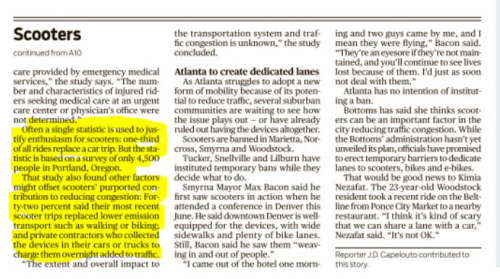
(Click on article to enlarge)
KEYWORDS: Scooters, Atlanta Journal Constitution, safety of scooters, ecology of scooters TITLE: My Last Month on MARTA: Inspiring Art DATE: 08/28/2019 12:13:49 PM
How do you factor inspiration's role when writing a blog, publishing a book, or posting little photo essays about a experience that is as ordinary as going to work each day? Over this past decade of commuting, these activities have been part of my Metropolitan Atlanta Rapid Transit Authority (MARTA) experience. Writing and creating has been a coping mechanism for the frustration of the experience, but it also has been a positive shared communal activity with many of my fellow Atlantans, unlike attending a stadium-sized sporting event (an artificial sense of community).
From those daily commutes, I did begin to appreciate that there are plots, characters and themes, and these snowballed into what became Down & Outbound: A Mass Transit Satire. Once I finished writing the book, I had some closure, resigning myself that MARTA “is, what it is” and as the saying goes — “it” usually isn’t very good. Satires really are the work of optimists as they point out the fallacies in hopes of things will be better. Imagine my disappointment.
Down & Outbound will be making one its rare public appearances at the Georgia Book and Paper Fair at the Decatur Book Festival. I will be working at the Destination Books pop-up book stall all day Saturday, August 31st and Sunday, September 1st. (Details here) Stop by and we can discuss this further. Perhaps you can buy a book (any book), and may be you can apply to be the next president of the MARTA Book Club.
—– EXTENDED BODY: —– EXCERPT: —– KEYWORDS: MARTA Book Club, Down & Outbound at the Decatur Book Festival —– ——– TITLE: My Last Month on MARTA: The Sidewalks DATE: 08/14/2019 07:54:50 AM
 I have maintained throughout this blog, that one of the main, lesser known reasons that people do not choose MARTA, is that once they get off the station — summer heat and humidity aside — that walking on the sidewalks is a miserable experience. In January of 2018, I dedicated an entire posting on Ten Ways Midtown Torments Pedestrians and I can say that in the last 18 months there has been no improvement and with the addition of e-scooters to the streets and sidewalks, the experience is even more unpleasant. Crumbling sidewalks, deafening loud construction, closed sidewalks, vodka trucks stopping on sidewalks, motorists cutting off pedestrians, crosswalks with either faded or no paint contribute to the dysfunction. Making it even worse are those futuristic depictions that transportation nirvana is just around the corner.
 My daily walk along Tenth Street from the MARTA station across the I-75-85 overpass is the lowlight of the shitty experience. ( Georgia Tech has the right idea for providing a shuttle for students and staff.) It was along this stretch that I was knocked to the pavement by an automobile making a right turn.Sometimes I take the 14th street bridge, which is wider, but crossing at Techwood or Spring Street is deceptively dangerous and a work colleague of mine was struck there last winter. He was seriously injured with a concussion to the point that he missed work for several months (but thankfully he has recovered).
Again, public transportation pundits, always like the point to the cost of gasoline as the gating factor to determine ridership in MARTA, but the year the I-85 bridge collapsed in flames, MARTA ridership decreased. Why? My theory is if people rode MARTA maybe it was an okay experience, but if they had to walk anywhere in Midtown that summer they probably felt that it wasn't worth the hassle and opted for even a longer car commute.
A Bridge Too Far? Open House on Proposed Improvements
It's too late for me, but Midtown Alliance and City of Atlanta are holding an open house on Thursday, September 5, 2019 to gather input on some of the proposed conceptual designs for 10th Street Bridge Multi-Modal Enhancement Project. But is it too late? Maybe I should take the train down there for old time sake and advocate for the future.
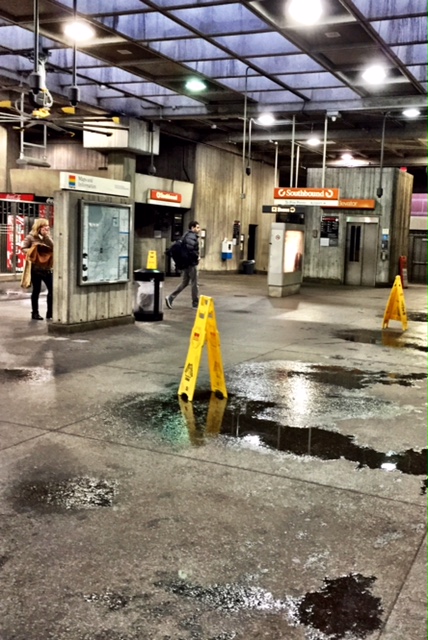
Below is the proposed vision of MARTA Midtown station and the current Midtown station after a heavy rain.

—– EXTENDED BODY: —– EXCERPT: —– KEYWORDS: MARTA Midtown Atlanta, Pedestrian Safety —– ——– AUTHOR: Murray Browne AUTHOR EMAIL: murray.browne905@gmail.com TITLE: My Last Month on MARTA: Intro STATUS: Publish ALLOW COMMENTS: 1 CONVERT BREAKS: wysiwyg ALLOW PINGS: 0 BASENAME: my-last-month-on-marta-intro UNIQUE URL: https://thebookshopper.typepad.com/downandoutbound/2019/08/my-last-month-on-marta-intro.html DATE: 08/05/2019 09:26:18 AM —– BODY:
After 10 solid years of commuting roundtrip from Decatur to Midtown using MARTA ( Metropolitan Atlanta Rapid Transit Authority) I am calling it quits or rather I am retiring from my daily commute. So as I make my final regular trips on the train, I will share some random thoughts in a series of postings.
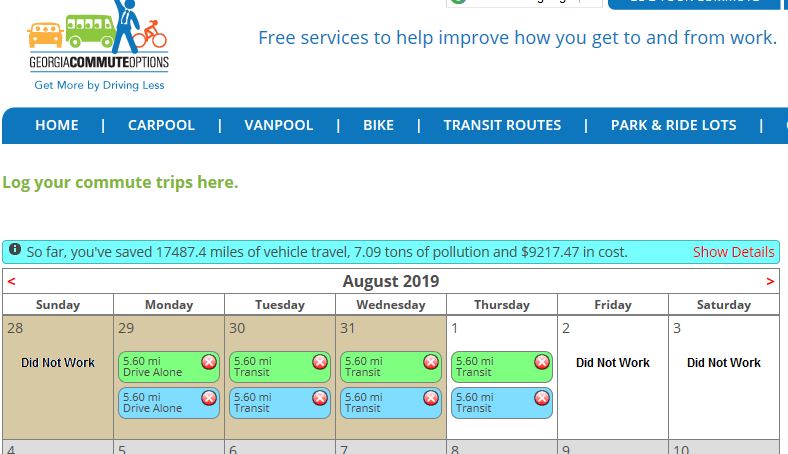
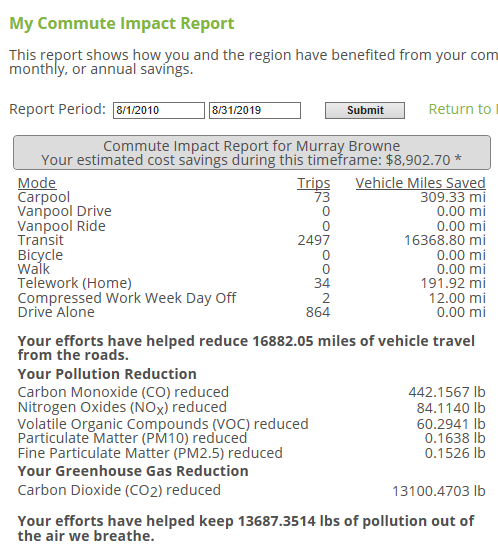
I am a little bit of a data guy so I logged most of my trips on Georgia Commute Options, and I even won a few gift certificates and a gorgeous commuter participation trophy for blogging. But it has been more rewarding than that. As the numbers show, in a small way I saved money, put thousands of less miles on my car, and kept 7 TONS of pollution out the air.
What the numbers don't show is that my employer paid for a partial monthly pass and by walking to and from the stations, I have probably kept more tonnage from accumulating around my waist. One of the main factors, is that I am not a big fan of sitting in traffic and much prefer reading on a train. (I am the lame duck President of the MARTA Book Club – another posting to follow). For the most part I avoided MARTA buses as the sitting in traffic with automobiles for an hour on those hard, hard seats made my back sore.
 My quick summary of the MARTA experience is when I started riding in 2009 it was okay, then it got worse, then Keith Parker took over as CEO and it got better (and more solid financially) to about the same level as it is today. Safety-wise it's okay, but Atlanta is a big city and you have to be aware of your surroundings and the electrical system is aging, and things catch fire from time to time.
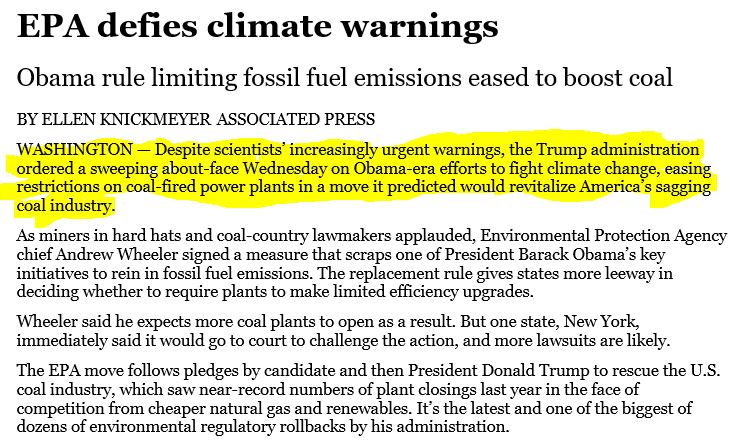
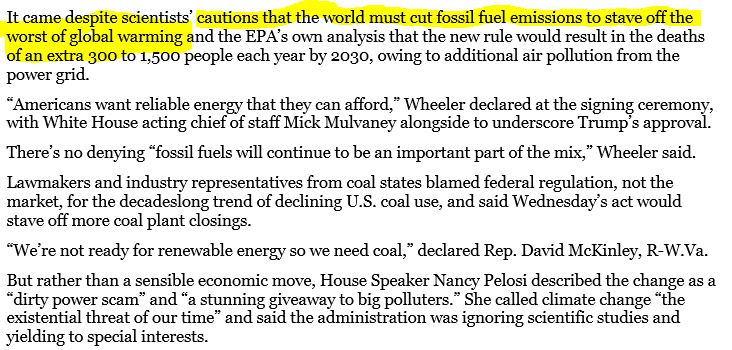
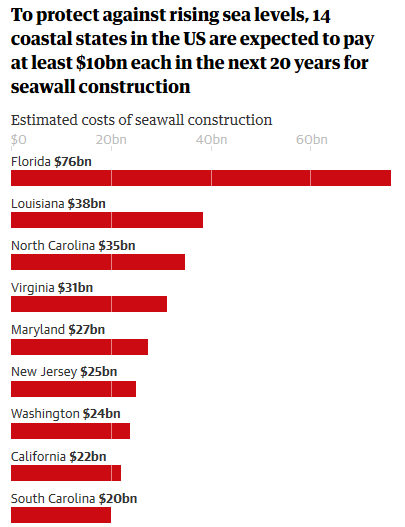
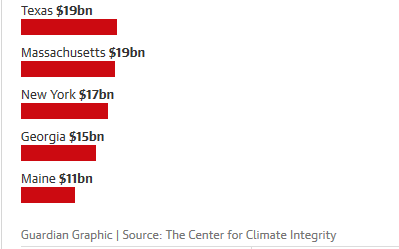
These two news items appeared on the same day during the week when President Trump announced his re-election bid in Orlando, Florida. The first was an Associated Press story that appeared on the front page in the June 20th edition of the Chicago Tribune. The second graphic was an article that appeared in The Guardian about the costs of seawalls to keep certain coastal states from ending up under water.
Check out which pivotal state in the 2020 election is projected to pay the most in seawall construction as a result for continued reliance of fossil fuels.
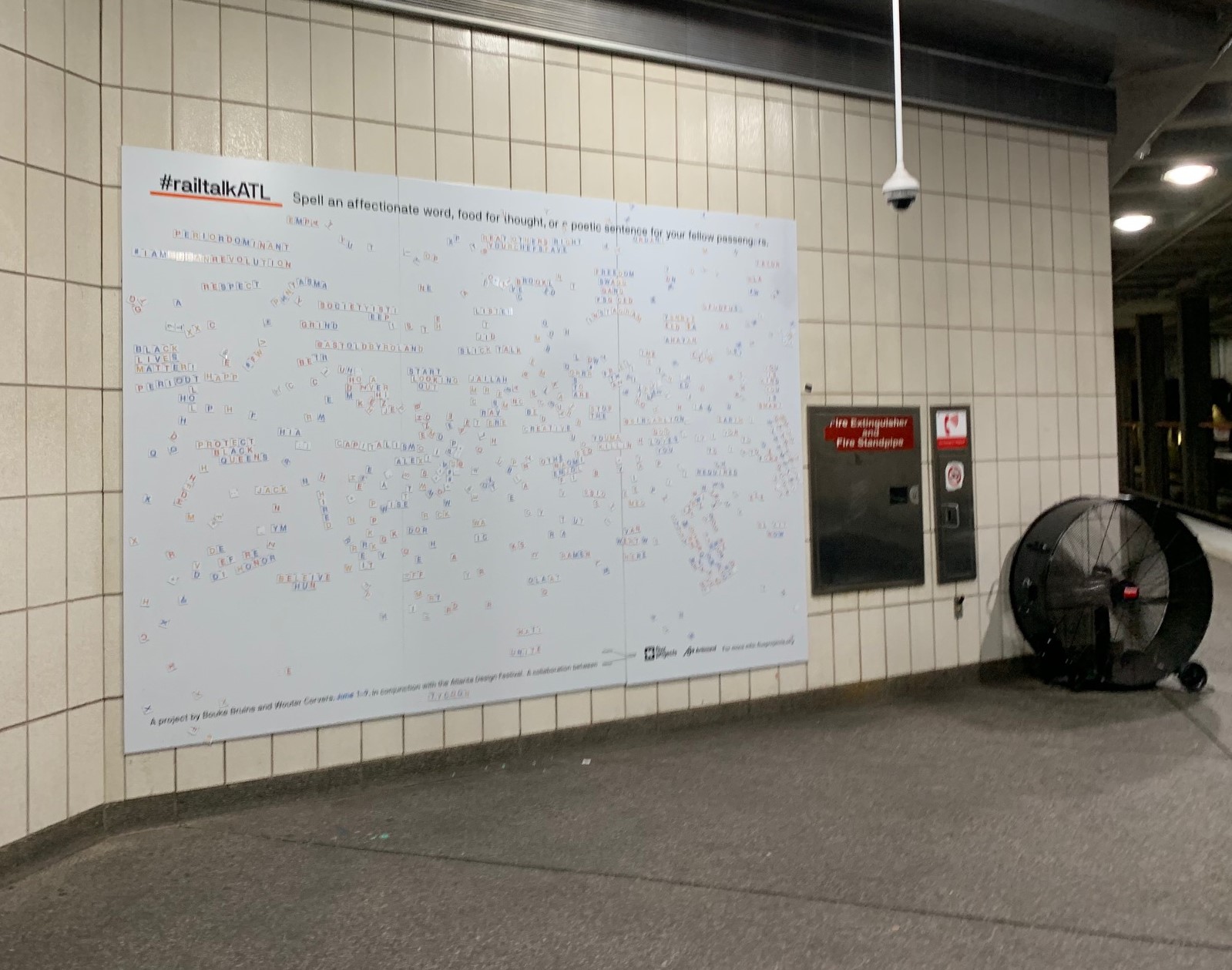
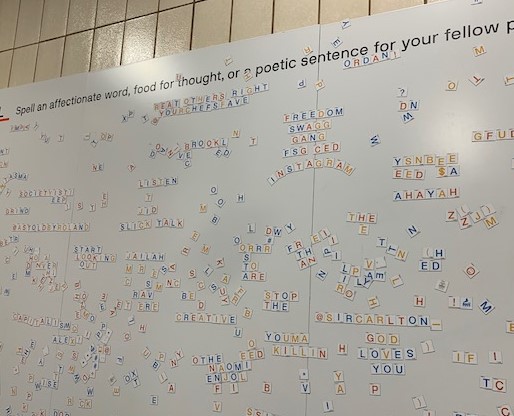
Recently at the southbound platform at Atlanta's Midtown Station, MARTA put up a large white board with magnetic letters encouraging commuters to “spell an affectionate word, food for thought, or a poetic sentence for your fellow passengers.” These kind of initiatives (this one is called #railtalkATL) never hit me right. Instead of giving me warm and fuzzy feelings about public transportation worth sharing, my initial reaction was: “Don’t these people who think this stuff up have better things to do like keeping the trains running consistently?”
Apparently, judging from the affectionate words and thoughts shown here, my fellow commuters felt much the same.
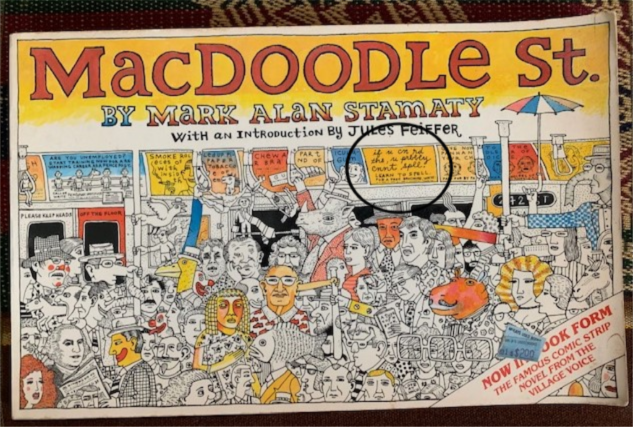
I was thinking of rearranging the letters to:
If u cn rd
ths u prbbly
cnnt spll
This joke comes from the cover of a collection of cartoons called MacDoodle Street (1980) by Mark Alan Stamaty (note the circled text). But before I could act, the white board was removed. See? Atlanta is coming together as a city.
—– EXTENDED BODY: —– EXCERPT: —– KEYWORDS: Mark Alan Stamaty, MacDoodle Street, #railtalkATL —– ——– AUTHOR: Murray Browne AUTHOR EMAIL: murray.browne905@gmail.com TITLE: A Super Bowl of Jehovah Witnesses STATUS: Publish ALLOW COMMENTS: 1 CONVERT BREAKS: wysiwyg ALLOW PINGS: 0 BASENAME: a-super-bowl-of-jehovah-witnesses UNIQUE URL: https://thebookshopper.typepad.com/downandoutbound/2019/05/a-super-bowl-of-jehovah-witnesses.html DATE: 05/28/2019 07:32:02 AM —– BODY:

Earlier this month, MARTA stations were overrun with Jehovah Witnesses who were in Atlanta for a three-day global convention on May 17-19th. Attendance at Mercedes-Benz Stadium was estimated to be 46,500 people, which depending how you look at it is somewhat equivalent (when multiplied by 3) to the Super Bowl invasion earlier this year, but with less fanfare.
There were several differences though: a.) MARTA didn’t really “talk up” their pre-event preparation like they did for the Super Bowl, b.) Well-dressed ambassadors patrolled the rail platforms and led the throngs around Five Points (shown in the photo above) and c.) the riders were not intoxicated and thus there was an absence of piss puddles, which we often see and smell after major sporting events.
Satire Meets Reality
For those few readers of Down & Outbound: A Mass Transit Satire, this blog’s namesake, this should ring with some familiarity. In the fictitious town of Atlantis City where the book is set, the train stations of the East-West line have been renamed after the Stations of the Cross. This renaming was based on an Economic Task Force's suggestion to capitalize “on the nation’s growing interest in religion by creating a Christian-themed line to stimulate the city’s tourism industry.”
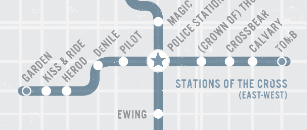 In the novel, more hijinks ensue when a man known as The Bad Samaritan and his followers ride the subway helping people on the condition that they retract any may-God-bless thank yous from appreciative commuters. After one incident when the Bad Samaritan helps a woman who has collapsed on sidewalk outside the Calvary station to get to the hospital, he asks when she blesses him, “Do you mind keeping your worldview on the power of God to yourself?”
Of course, the Atlantis City religious community found such conditions unacceptable and soon began distributing literature:
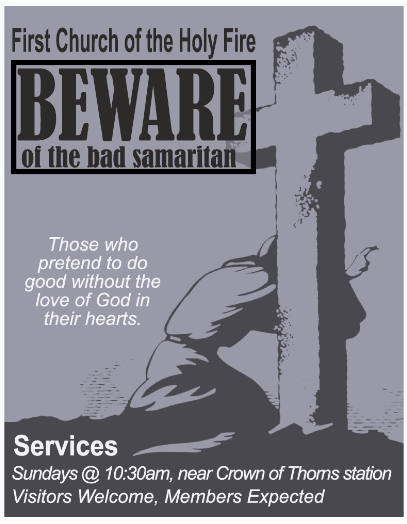
For purchasing information for the book, which includes 15 color mini-posters like this one, visit downandoutbound.com.
—– EXTENDED BODY: —– EXCERPT: —– KEYWORDS: —– ——– AUTHOR: Murray Browne AUTHOR EMAIL: murray.browne905@gmail.com TITLE: The MARTA Book Club – A Transit Tradition STATUS: Publish ALLOW COMMENTS: 1 CONVERT BREAKS: wysiwyg ALLOW PINGS: 0 BASENAME: marta-book-club-transit-tradition UNIQUE URL: https://thebookshopper.typepad.com/downandoutbound/2019/03/marta-book-club-transit-tradition.html DATE: 03/23/2019 08:20:38 AM —– BODY:
On my other blog — a blog of personal musings about books an book culture called The Book Shopper, I have been periodically tracking what people are reading while riding a Metropolitan Atlanta Rapid Transit Authority bus or train. I call it — The MARTA Book Club. For nearly a decade the MARTA Book Club has been metro Atlanta’s premier transportation book club (first posting November,2009). One reason is that membership is easy. There are no meetings, no dues, no organization, no T-shirts and no one determines which book everyone must read. The only requirement is to read a book while on a train or a bus or waiting for a train or bus. Very individualistic.
Here’s a list of what members have been reading while riding MARTA in recent months:
Galapagos: A Novel by Kurt Vonnegut
The Songs of Distant Earth by Arthur C. Clarke
Trouble Brewing by Susan Page Davis
White Death by Clive Cussler 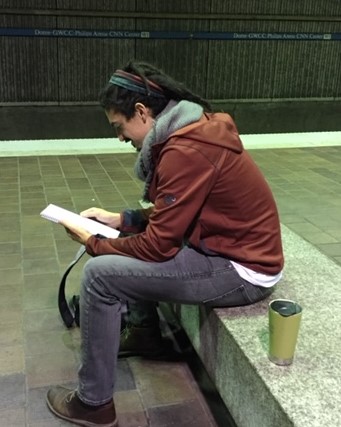
Unshakeable: Your Financial Freedom by Tony Robbins and Peter Mallouk
In Defense of Food: An Eater’s Manifesto by Michael Pollan
85 Days: The Last Campaign of Robert Kennedy by Jules Witcover and Senator Edward M. Kennedy
The Fatal Shore: The Epic of Australia by Robert Hughes
In a Sunburned Country (Australia) by Bill Bryson
Early Riser by Jasper FForde
D-Day Illustrated Edition: June 6, 1944: The Climatic Battle of World War II by Stephen E. Ambrose
The Seventh Babe by Jerome Charyn
The Solace of Monsters by Laurie Blauner
Year One by Nora Roberts
Fidel: A Critical Portrait by Tad Szulc
Infinite Jest by David Foster Wallace
The Bible
Personal: A Jack Reacher Novel by Lee Child
Guards! Guards: A Novel of Discworld by Terry Pratchett
The Storm Before the Storm: The Beginning of the End of the Roman Republic by Michael Duncan
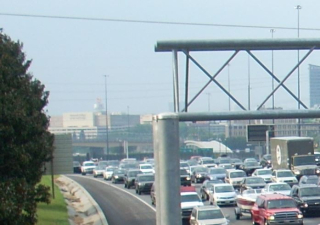 There is a healthy selection of books, but we are disappointed when nearby Gwinnett County voted down an opportunity to join the MARTA Book Club by 54 to 46 percent margin last Tuesday. We would have welcomed them to the fold, but we guess short-sighted residents there prefer sitting in never-ending traffic and contributing to the deterioration of the environment with their fossil fuel consumption.
But one of best strategies to combat ignorance is to read, (and think) and that’s what MARTA Book Club does.
(A variation of this posting appears on The Book Shopper Blog: Personal Musing About Books To peruse the previous 33 MARTA Book Club postings dating back to 2009 visit here.)
—– EXTENDED BODY: —– EXCERPT: —– KEYWORDS: —– ——– AUTHOR: Murray Browne AUTHOR EMAIL: murray.browne905@gmail.com TITLE: Video, About the STATUS: Publish ALLOW COMMENTS: 0 CONVERT BREAKS: wysiwyg ALLOW PINGS: 0 BASENAME: video-about-the-1 UNIQUE URL: https://thebookshopper.typepad.com/downandoutbound/video-about-the-1.html DATE: 03/17/2019 11:19:02 AM —– BODY:
Not only does the Down and Outbound Store sell the Down & Outbound: A Mass Transit Satire but there is Thanks-For-Not-Running-Me-Over poster from the book available as well.
Purchasing the Book
Amazon

Down & Outbound is available here on Amazon for $11.95 + shipping and handling.
Alibris

Down & Outbound is available at Alibris via my Alibris storefront at destination.alibrisstore.com Current market price is $10.99 plus shipping & handling.
In the Atlanta Area
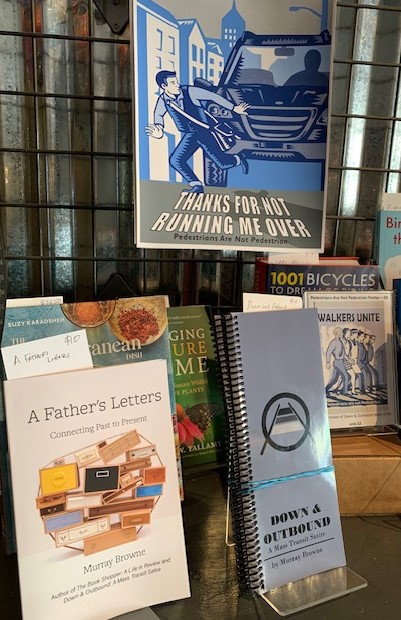
Down & Outbound is available at any Destination: Books popup sale. (Don’t be afraid to ask if is not displayed) See Destination: Books for where we will show up next.
Destination: Books does have a sales kiosk at the Journeyman Bike Shop in downtown Decatur and the book is available there. You can purchase the book and poster together for only $10.
The book is also available at Downtown Books & News in downtown Asheville, North Carolina in the zine section of their store.
Paypal
If you’re one of those people who prefer NOT to order through Amazon or Alibris, the publisher Muted Horn Communications offers an alternatives. To purchase Down and Outbound: A Mass Transit Satire for just $10 each with NO shipping and handling charges, send me your email address (mine is listed below) and I will send you a Paypal payment request. If you want 4 or more books, it’s $6 a book with NO shipping and handling charges. (Good for resellers because there is no consignment paperwork).
Muted Horn Communications/ Murray Browne
murray.browne905 AT gmail.com
Purchasing the Poster

– 11″ by 14″ , 4 color, screen print
– Heavy stock paper
– Printed by Atlanta’s Danger Press, one of the top printers (T-Shirts, posters) in the Southeast.
– Shipped in an aesthetically pleasing crush-proof tube.
– $8 each + $4 Shipping and Handling. (If you want to send 2 posters to the same address the total is $20)
Offers good for the Continental U.S only. Books and posters shipped separately.
Muted Horn Communications, LLC
Copyright 2016, 2017,2018, 2019,2020,2021,2022,2023,2024
Synopsis
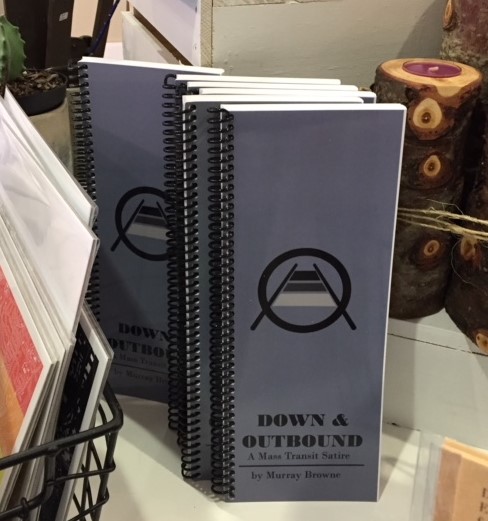
 In the subterranean world of mass transit there are two, separate, yet equally marginalized groups: the riders who use public transportation and the city officials who routinely persecute them. There are stories from the mass transit counterintelligence until InLine whose primary purpose is to keep the masses who use the ALACARTA (Always Lovely Atlantis City Area Rapid Transit Authority) in line. Led by Inspector Romney Miller, InLine investigates any problem that interrupts the flow of commuters. Miller relies heavily on his team: Shade, a master of disguise, and Chu-Chew, a borderline video surveillance addict. As their caseload increases, InLine must battle the serial anarchist known as Red Ass, (his tag is at the right) but their work is made even more difficult by the ALACARTA bureaucracy, which serves not the public, but their own secret agendas. When the city becomes paralyzed with a transportation crisis, where will Inspector Miller place his allegiance?
Description
- 11 inches by 4.25 inches (with a comb binding, which allows the transit rider to read while holding the book in one hand and grabbing the “oh-shit” strap with the other.
- 124 pages (24 color) written in 15 bite-sized episodes which fits into the reading lifestyle of a busy commuter. Original artwork such as posters, menus, flyers, advertisements etc. that are designed to represent “objects found” or “observations” that illustrate some aspect of the content.
- Smaller illustrations such as logos and graffiti tags as well as a dozen small black & white photographs are interwoven with the text reflecting the subterranean world of the book’s narrator.
- An art-object look and feel.
ISBN 978-0-692-72620-4
Copyright ©2016
—– EXTENDED BODY: —– EXCERPT: —– KEYWORDS: —– ——– AUTHOR: Murray Browne AUTHOR EMAIL: murray.browne905@gmail.com TITLE: Notes from Transportation Camp STATUS: Publish ALLOW COMMENTS: 1 CONVERT BREAKS: wysiwyg ALLOW PINGS: 0 BASENAME: notes-from-transportation-camp UNIQUE URL: https://thebookshopper.typepad.com/downandoutbound/2019/03/notes-from-transportation-camp.html DATE: 03/05/2019 07:37:36 AM —– BODY: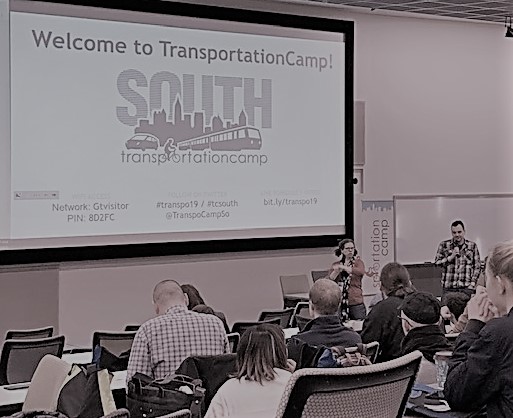
The TransportationCamp South Conference* was held on February 9th on the campus of Georgia Tech University here in Atlanta. I attended so I could mingle among like-minded individuals though I usually don’t say much. This year was an exception because I attended one session hosted by the Metropolitan Atlanta Rapid Transit Authority (MARTA) social media folks who wanted feedback on MARTA’s efforts with social media. I had some opinions about their performance s as did others. Here are my takeaways:
- As I suspected the MARTA phone application is limited in its usefulness. The only time I ever use it is track a bus route when I am taking a bus instead of the subway, but those traveling icons on the phone screen are not reliable. I learned that the buses are not on an automatic GPS system similar to the ones on Uber or Lyft, but rather it uses some kind of radio technology that is subject to outages and it is not automatic.
- The MARTA Facebook page is NOT designated as the place for up-to-date information about outages and problems. Facebook complaints are kind of bad MARTA PR, so there is a tendency to keep them to a minimum. For real time complaining and outage reporting, use MARTA Twitter’s account for that kind of sharing. (But I’m not on Twitter!)
- MARTA does track complaints about service etc. There was some debate among those in attendance whether MARTA should respond to each comment with something like “Your feedback is important to us…” instead of just crickets. Either way those complaints are tabulated and reported up the administrative food chain.
- MARTA really staffed up day and night for the Super Bowl Weekend, which kept delays and problems at a minimum. The MARTA representatives admitted that this same kind of service is not available during normal ridership. The costs are prohibitive. Thus, my satirical piece (see the January 22nd posting “Expectations for Super Bowl Fans Riding MARTA Subway Trains”) is founded in truth. The whole MARTA and City of Atlanta marketing plan was to tout the city’s great transportation system, but the day after it was “business as usual” and as regular riders know “business as usual” is not always so good.
I will give a little bit of a shout-out to the MARTA social media people who fielded the questions from those who attended the session. The staffers listened, they were candid as they could be in their response, and thus they deserve some respect and sympathy.
* Shown in photo are Professor Kari Watkins from Georgia Tech (left) with David Emory of Conveyal one of the event sponsors. Note how the TransportationCamp is spelled as one word.
—– EXTENDED BODY: —– EXCERPT: —– KEYWORDS: TransportationCamp South, Transportation Camp South, MARTA, Super Bowl —– ——– AUTHOR: Murray Browne AUTHOR EMAIL: murray.browne905@gmail.com TITLE: Related Articles? STATUS: Publish ALLOW COMMENTS: 1 CONVERT BREAKS: wysiwyg ALLOW PINGS: 0 BASENAME: related-articles UNIQUE URL: https://thebookshopper.typepad.com/downandoutbound/2019/02/related-articles.html DATE: 02/12/2019 06:07:44 AM —– BODY: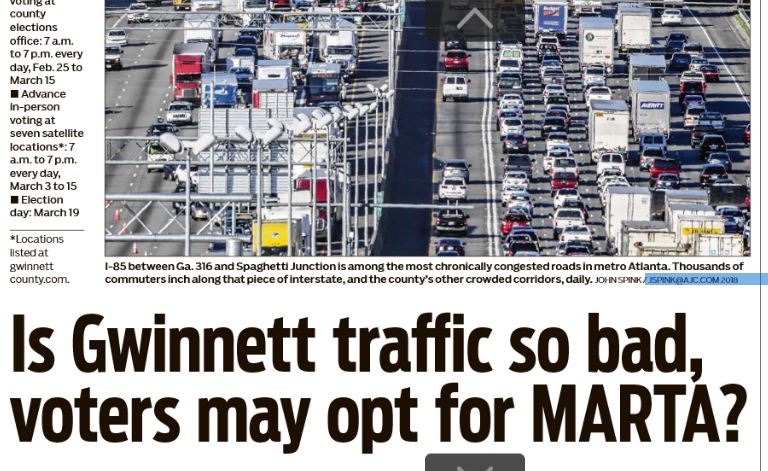
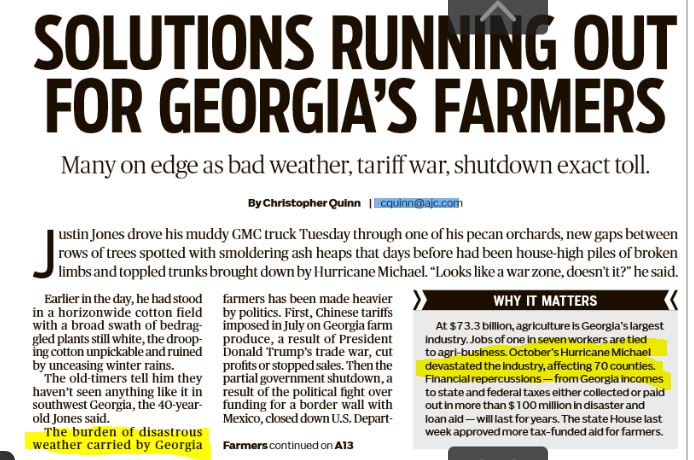
A couple of headlines from the Sunday, February 10, 2019 edition of The Atlanta Journal Constitution. One is from the front page about the widespread destruction of Georgia's crops during Hurricane Michael caused in part by climate change (though the article doesn't say that, but if you scroll down to an earlier October 17th posting…) and the other from the Metro section is about whether Georgia's second most populous county Gwinnett is going to vote to expand mass transit. The article focuses on people's long commutes with no mention of the cleaner air or lessening the need to burn fossil fuels, which is contributing to climate change. Just connecting the dots. Voting for Gwinnett MARTA expansion is March 19th.
Expect constant delays.
Expect constant apologies for constant delays over the loud speaker, but with little or no additional information.
Expect to be panhandled.
Expect electronic train arrival signs to be either not working or incorrect.
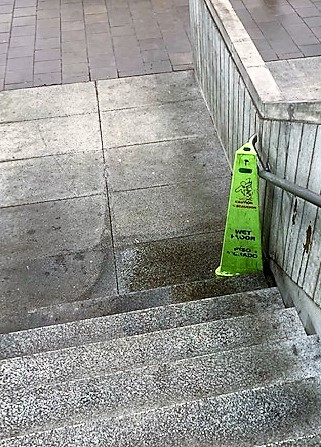
Expect puddles of urine in the stairwells decorated with wet cones.
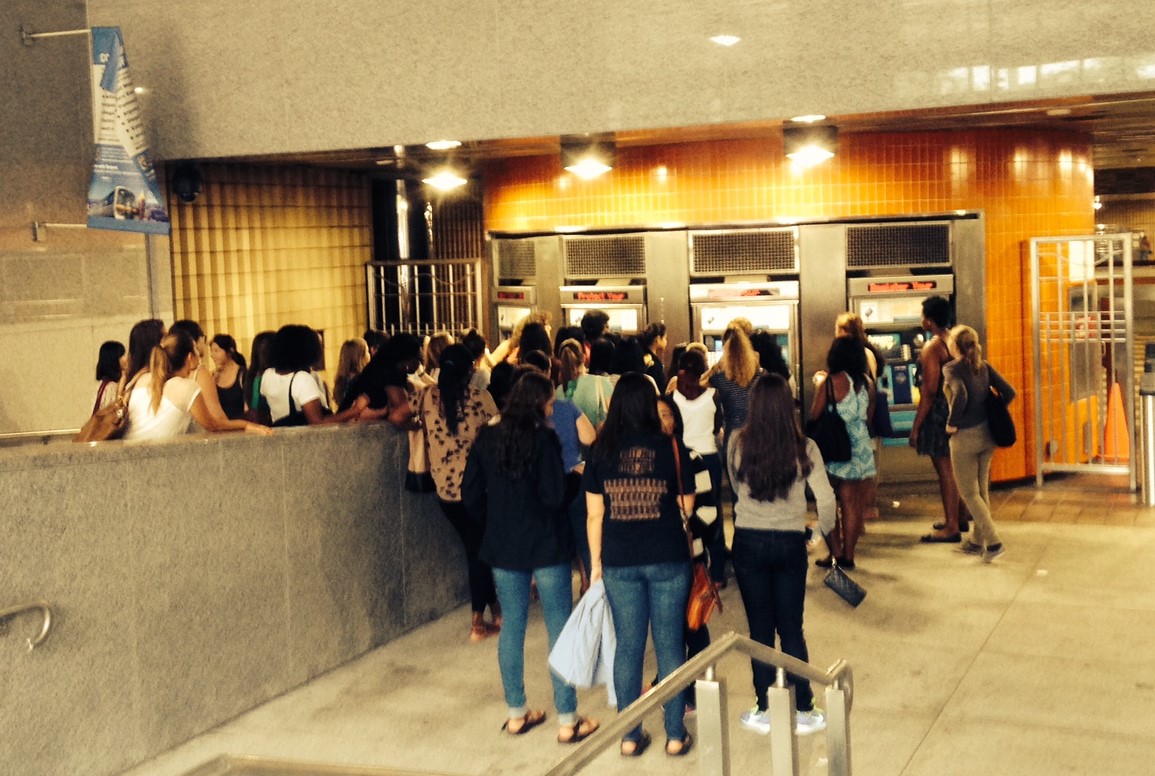
Expect crowded subway trains.
Expect passengers to lean against crowded subway doors that prevent the trains from leaving.
Expect this to cascade to further backups on the platforms, which leads to more crowded subway cars, which won't leave because riders are leaning on doors, etc. etc. (e.g. The night of the 2018 College Football Championship)
Expect to be treated like a daily Atlanta commuter.
Despite all this, thank you for choosing MARTA and have a wonderful day.
—– EXTENDED BODY: —– EXCERPT: —– KEYWORDS: Super Bowl MARTA, Metropolitan Atlanta Rapid Transit Authority. Tips for riding subway in Atlanta, Los Angeles, New England —– ——– AUTHOR: Murray Browne AUTHOR EMAIL: murray.browne905@gmail.com TITLE: Contact Info STATUS: Publish ALLOW COMMENTS: 0 CONVERT BREAKS: wysiwyg ALLOW PINGS: 0 BASENAME: contact-info UNIQUE URL: https://thebookshopper.typepad.com/downandoutbound/contact-info.html DATE: 01/13/2019 11:14:01 AM —– BODY: You can reach the “editor”, creator and destroyer of this website by emailing murray.browne905(AT)gmail.com
Here's a short article from the Atlanta Journal Constitution, December 20th written by Bill Banks about the City of Decatur where I live and walk the 10-15 minutes to the train station four days a week for the last 9 years.
Though miffed by the sudden arrival of EScooters in the city last October without prior notification, Decatur commissioners believe the technology is, according to City Manager Peggy Merriss, “consistent with the city’s strategic plan and community transportation plan.”
The scooters, also called “dockless mobility scooters,” “longboards” and “stand up electric scooters” (and less savory designations by those in opposition), are marketed as a convenient solution for short trips. Merriss believes there’s truth here and that potentially the scooters “can get people out of cars and contribute to better air quality.
“I don’t have an issue with them, if used appropriately,” she added. “They are not toys, and there has to be education, enforcement and role modeling.”On Dec. 17 the commission authorized the city manager (Andrea Arnold will take over for Merriss beginning Jan. 1) to execute an interim operating agreement for using the scooters. This interim agreement has room for flexibility and probably will take another month to finalize. But the eventual goal, Merriss said, is to pass an ordinance by the first quarter of next year.
Some key points the in the interim manifesto include keeping the vehicles on bikes lanes, streets and bike paths while prohibiting their use on sidewalks. Also, the age limit is 18, helmets are mandatory and usage is limited to daylight hours (although this could expand). Each company is limited to 50 scooters within the city, and strict parking regulations apply—currently scooters are often parked in clumps on sidewalks, or occasionally singly and abandoned.
“There are some cities in the state that have banned them,” said Mayor Patti Garrett. “We don’t want to go that route. The big problems are irresponsible drivers, underage drivers, people riding double and, in one case, I heard somebody say, ‘I don’t know how to stop this thing!’
Merriss said she doesn’t have a precise number but guesses there are over 100 scattered throughout Decatur’s four square miles. Most belong to Bird Rides and few to LimeBike. On Wednesday a third company, the “JUMP by Uber” launched scooters in Atlanta.
Though a short article it touches on several related issues about transit:
- "First and last mile connectivity" is a transit wonk catch phrase that the scooter industry has used in marketing to convince people that scooters are a remedy for transit woes. (Anecdotally, I have yet to see a commuter ride a scooter to or from an adjacent neighborhood to the Decatur train station.)
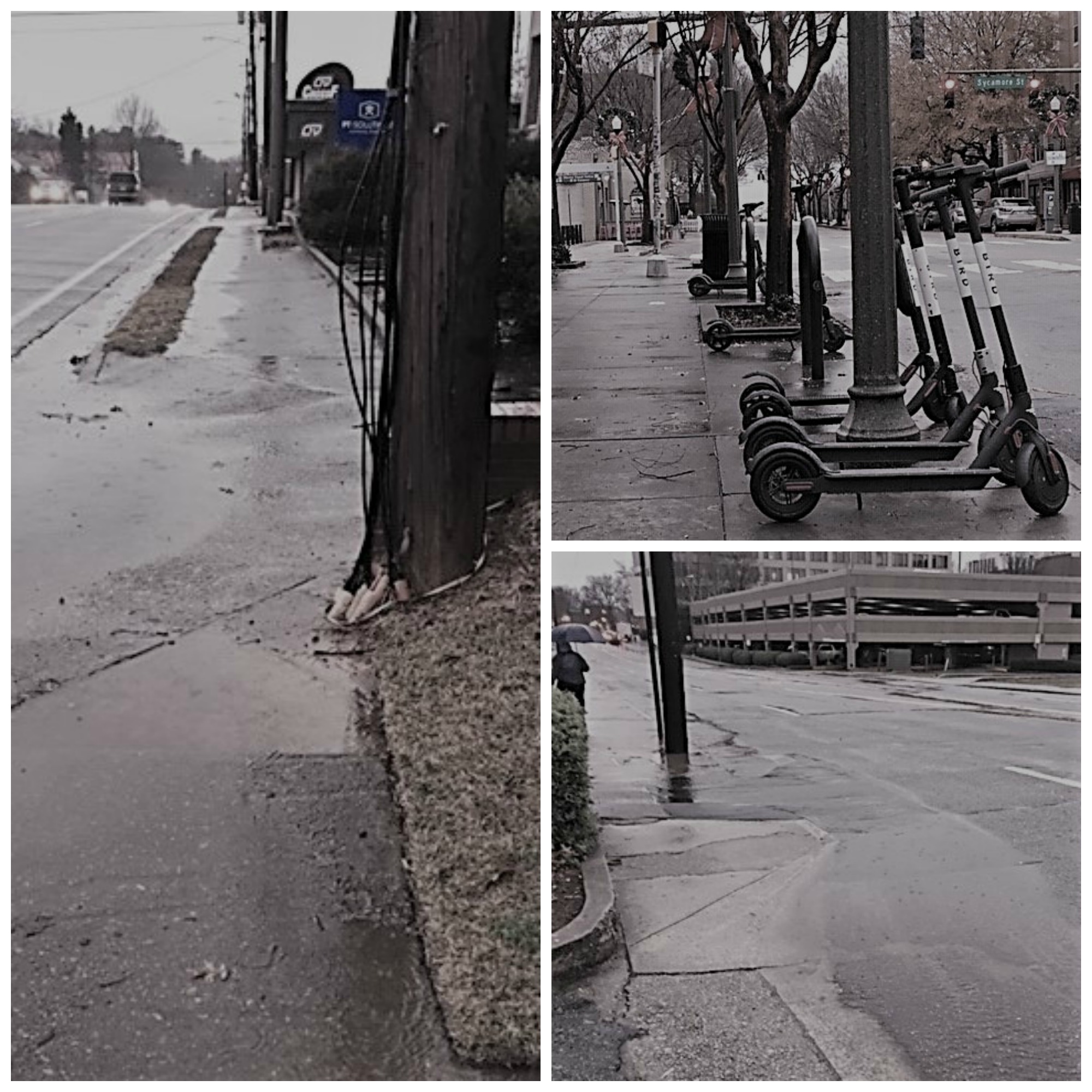
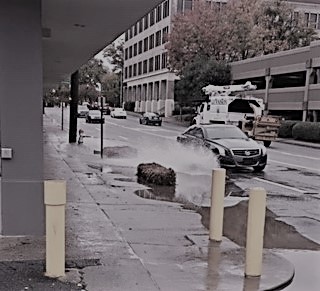
- The sidewalks, especially on Church street are narrow and broken and underwater when it rains (shown here).Of course automobiles constantly buzzing at 35 miles an hour doesn't improve the walking experience. Plans are for improvement to slow the traffic but that has been promised or proposed for years. (Last word is that easements were being obtained.)
- New developments in Decatur including the proposed one called the Quarters on Church Street near Glenlake Park seem to be an antithesis to make Decatur more walkable or sustainable by dumping additional motorists from the proposed 43 unit development onto an already very busy street. Even if the developer puts in a wide sidewalk — the development connects to nothing but narrow, broken, and flooded sidewalks.
- On a larger scale, isn't this development and scooter regulations indirectly a carbon issue? A developer cuts down large mature trees and more traffic is potentially dumped on the roads and more scooters dominate the discussion. This is really climate issue because everything is a climate issue. Below is the headline from the front page of the January 11, 2019 New York Times. Maybe its not as indirect as we have been thinking.


—– EXTENDED BODY: —– EXCERPT: —– KEYWORDS: Decatur Georgia, Scooters, walkability —– ——– AUTHOR: Murray Browne AUTHOR EMAIL: murray.browne905@gmail.com TITLE: Scooter Humor STATUS: Publish ALLOW COMMENTS: 1 CONVERT BREAKS: wysiwyg ALLOW PINGS: 0 BASENAME: scooter-humor CATEGORY: Scooters CATEGORY: Street Scenes UNIQUE URL: https://thebookshopper.typepad.com/downandoutbound/2018/12/scooter-humor.html DATE: 12/20/2018 08:28:55 AM —– BODY:

I have become obsessed* about scooters but in an unhealthy way — like riding 15 mph on a motorized scooter without a helmet on a sidewalk strewn with wet leaves. I really dislike them. I've even written a joke about it: "The only thing that keeps me from clipping the brake cable on every parked scooter I pass, is doing prison time for manslaughter."
Here's the one major irony of scooters. They often are parked on narrow sidewalks blocking the path of pedestrians and can become a nasty obstacle to those on motorized wheelchairs. The irony is that the ramps on curbs that allow motorized wheelchairs to cross the street are the same ramps that allow scooters to use sidewalks. Funny, but nobody's laughing.
*check out the DownandOutbound Facebook page for more scooter vitriol.
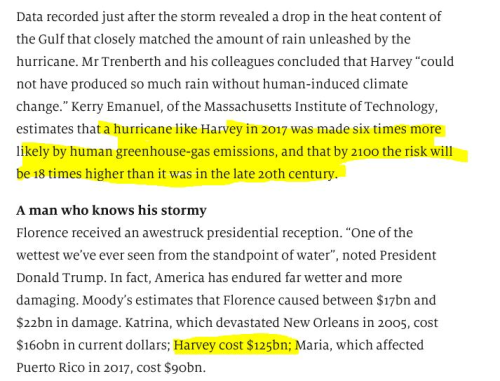
—– EXTENDED BODY: —– EXCERPT: —– KEYWORDS: —– ——– AUTHOR: Murray Browne AUTHOR EMAIL: murray.browne905@gmail.com TITLE: Price Comparisons: Hurricane vs. Public Transportation STATUS: Publish ALLOW COMMENTS: 1 CONVERT BREAKS: wysiwyg ALLOW PINGS: 0 BASENAME: price-comparisons-hurricane-vs-public-transportation CATEGORY: News Clips CATEGORY: Science (Climate) UNIQUE URL: https://thebookshopper.typepad.com/downandoutbound/2018/10/price-comparisons-hurricane-vs-public-transportation.html DATE: 10/07/2018 08:51:33 AM —– BODY:The other day I was reading this article from the September 20th edition of The Economist while riding a crowded MARTA train:
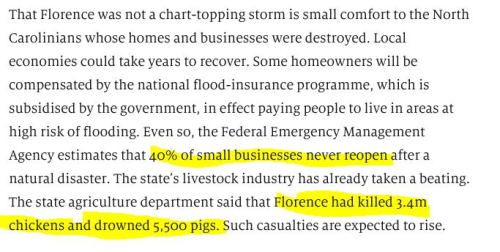
And that's not all — then there is the loss of poultry and pigs:
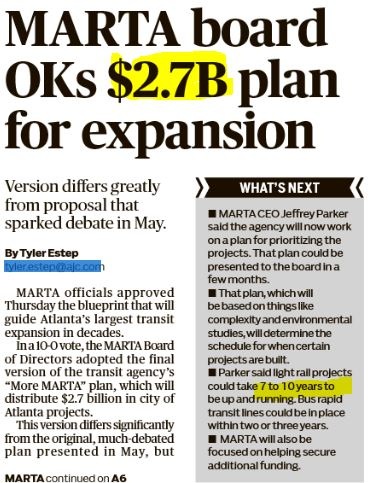
You could buy a lot of greenhouse gas-reducing public transportation for that kind of money and maybe save yourself the expense of a hurricane or two:
But either way, those chickens are not coming back…
—– EXTENDED BODY: —– EXCERPT: —– KEYWORDS: Costs of Hurricanes, Cost of Hurricane Florence. Chicken deaths from hurricanes, —– ——– AUTHOR: Murray Browne AUTHOR EMAIL: murray.browne905@gmail.com TITLE: Is This Abandoned Bicyle Street Art? STATUS: Publish ALLOW COMMENTS: 1 CONVERT BREAKS: 0 ALLOW PINGS: 0 BASENAME: is-this-street-art CATEGORY: Cycling CATEGORY: Street Scenes UNIQUE URL: https://thebookshopper.typepad.com/downandoutbound/2018/09/is-this-street-art.html DATE: 09/09/2018 09:58:48 AM —– BODY: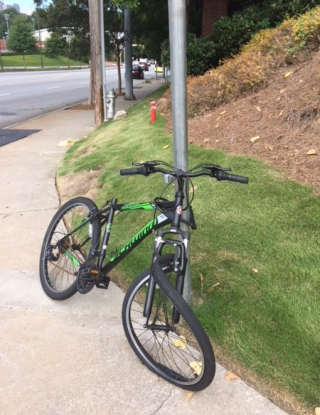
When I have to share the already narrow, crumbling sidewalks of Midtown Atlanta with speeding, silent scooters, ridden by well balanced, carefree, young people, I will I admit I have evil thoughts about vandalizing the offending vehicles. And I am not only one, as reported in the August 18, 2018 edition of The Chicago Tribune.
—– EXTENDED BODY: —– EXCERPT: —– KEYWORDS: —– ——– AUTHOR: Murray Browne AUTHOR EMAIL: murray.browne905@gmail.com TITLE: Black & White Photos of Commuters STATUS: Publish ALLOW COMMENTS: 1 CONVERT BREAKS: wysiwyg ALLOW PINGS: 0 BASENAME: black-white-photos-of-commuters CATEGORY: Books CATEGORY: Subways UNIQUE URL: https://thebookshopper.typepad.com/downandoutbound/2018/07/black-white-photos-of-commuters.html DATE: 07/15/2018 10:25:30 AM —– BODY:"You could say the scooters have created a buzz — not necessarily the good kind — in select cities. In Cleveland, city officials ordered Bird, another dock less scooter-sharing company, to remove its equipment, citing safety concerns and a lack of city permits that would allow the scooters to be parked on the sidewalk, The Cleveland Plain Dealer newspaper reported.
But in cities like Los Angeles, scooters have been set on fire, tossed off balconies and even dumped into the ocean — a backlash that is a melange of anger over so many tech companies popping up in Southern California and anger that they’re clogging up public spaces, according to news reports . That has resulted in cities in California limiting or outright banning the scooter-sharing services, the Los Angeles Times reported."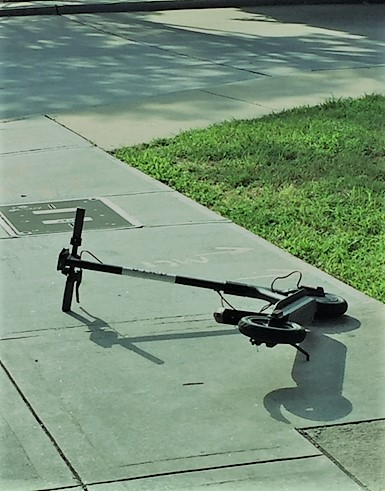 "Help me, I've fallen," said the scooter, but I stood by and did nothing.
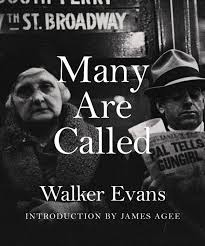
In the late 1930s and early 1940s, the famous photographer Walker Evans took black and white photographs of riders on the New York City subway. The book Many Are Called includes 89 of these photographs with an introductory essay by James Agee. It was not published until 1966 because Evans was initially concerned that since these passengers were photographed secretly without their permission, there were issues surrounding privacy and worries about possible legal problems. Moreover, the idea itself was not particularly well-received at the time by publishers and galleries and was mothballed along with Agee's introductory essay until Evans began to revive the project in 1958 (Agee died in 1955).
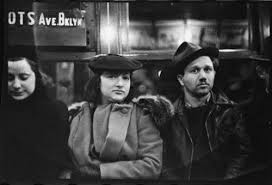 Agee immediately understood the significance of Evans' s work because riding a subway as a commuter (even today as then) is one of the few times that people let their guards down revealing "a wound or nakedness" that we often conceal from others. Until I studied the words and pictures of Many Are Called I didn't realize that this is the underlying reason that people do not like to be stared at on the subway. You should always avert your eyes — gaze at the oracle that is your cell phone, read a book or peer into the dark tunnels instead. Avoid looking at people when they are the most weary and vulnerable.
—– EXTENDED BODY: —– EXCERPT: —– KEYWORDS: Many Are Called, Walker Evans, James Agee, subway photographs —– ——– AUTHOR: Murray Browne AUTHOR EMAIL: murray.browne905@gmail.com TITLE: Anniversary of the I-85 Bridge Collapse STATUS: Publish ALLOW COMMENTS: 1 CONVERT BREAKS: wysiwyg ALLOW PINGS: 0 BASENAME: anniversary-of-the-i-85-bridge-collapse UNIQUE URL: https://thebookshopper.typepad.com/downandoutbound/2018/04/anniversary-of-the-i-85-bridge-collapse.html DATE: 04/07/2018 11:21:24 AM —– BODY:

March 30th, 2018 was the first anniversary of the I-85 bridge burn and collapse here in Atlanta. We all remember where we were when we saw the black plumes belching over the late afternoon skyline. As I was taking a MARTA train from downtown Atlanta to my home Decatur, I gazed northward and I said to myself, "Must be a hell of a tire fire somewhere." Well, I was kind of correct.
This was supposed to be the opportunity for MARTA to "show its stuff" etc. Capture the hearts and minds of the Atlanta commuter, so to speak. At the end of the year I went to one of those transit conferences hoping to connect with liked-minded people, but really these breakfasts are just business leader schmooze sessions. This one was held at the W Hotel in Midtown and I was one of the few people who actually took mass transit to get there and you could hardly get into the place because the valets were overwhelmed trying to park cars. Nice cars. Expensive cars. No PT Cruisers.

No amount of bacon, runny scrambled eggs, and multiple PowerPoint presentations could redeem the experience, but I did learn one little fact about the bridge collapse and subsequent transit crisis — MARTA ridership dipped in 2017! Yeah, thousands of drivers had to find new ways to get to work for a couple of months and at the end of the day MARTA could not keep that momentum. No one really addressed that interesting fact. Sometimes they say off-handedly that the low price of gasoline is the main factor, but I disagree. My explanation is twofold. You can ride MARTA a few times and think it's decent, but ride it consistently for a few weeks and you'll notice that the schedules are sporadic, and you will have the experience of standing on a platform for 20 to 30 minutes waiting on train during rush hour. At some point, you will be panhandled or preached to while on the train. And then once you are at your destination, you take your life into your hands trying not get run over as a pedestrian. You will consider yourself lucky if there is sidewalk or it's not closed by construction barricades.

—– EXTENDED BODY: —– EXCERPT: —– KEYWORDS: —– ——– AUTHOR: Murray Browne AUTHOR EMAIL: murray.browne905@gmail.com TITLE: Churchill on the Subway STATUS: Publish ALLOW COMMENTS: 1 CONVERT BREAKS: wysiwyg ALLOW PINGS: 0 BASENAME: churchill-on-the-subway CATEGORY: Film CATEGORY: Subways UNIQUE URL: https://thebookshopper.typepad.com/downandoutbound/2018/02/churchill-on-the-subway.html DATE: 02/08/2018 07:10:41 AM —– BODY:

In this scene from movie "The Darkest Hour" Winston Churchill, played by Gary Oldman, queries riders on the London Underground whether Great Britain should sue for peace or fight the Nazis on the beaches, the landing zones, fields and streets etc. It was the emotional zenith of the movie, but as it turns out totally fictitious. Rats.
—– EXTENDED BODY: —– EXCERPT: —– KEYWORDS: The Darkest Hour, Winston Churchill, Subways —– ——– AUTHOR: Murray Browne AUTHOR EMAIL: murray.browne905@gmail.com TITLE: Big SUVs and Small Cars STATUS: Publish ALLOW COMMENTS: 1 CONVERT BREAKS: wysiwyg ALLOW PINGS: 0 BASENAME: big-suvs-and-small-cars CATEGORY: News Clips UNIQUE URL: https://thebookshopper.typepad.com/downandoutbound/2018/01/big-suvs-and-small-cars.html DATE: 01/26/2018 07:31:32 AM —– BODY:
This morning's reading notes:
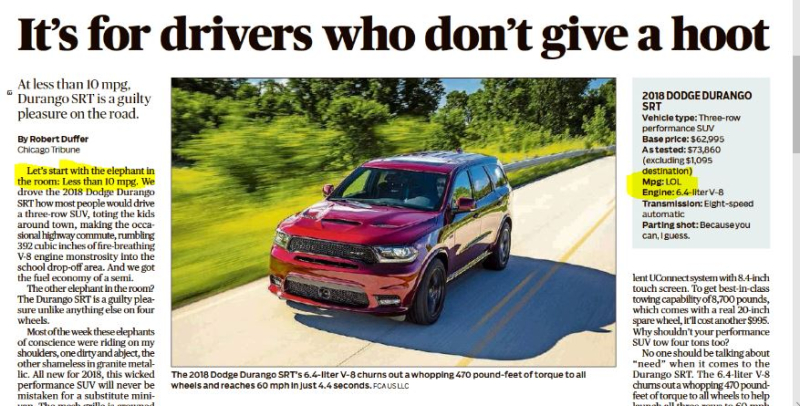
Followed by this quote:
"The small car is worn like shoes or pants. It transforms the motorist into a super pedestrian and renders him nauseating to all occupants of real cars."
— Marshall McLuhan in the essay, Inside the Five Sense Sensorium (1961)
—– EXTENDED BODY: —– EXCERPT: —– KEYWORDS: —– ——– AUTHOR: Murray Browne AUTHOR EMAIL: murray.browne905@gmail.com TITLE: Ten Ways Midtown Atlanta Torments Pedestrians STATUS: Publish ALLOW COMMENTS: 1 CONVERT BREAKS: wysiwyg ALLOW PINGS: 0 BASENAME: ten-ways-midtown-atlanta-torments-pedestrians CATEGORY: Pedestrians UNIQUE URL: https://thebookshopper.typepad.com/downandoutbound/2018/01/ten-ways-midtown-atlanta-torments-pedestrians.html DATE: 01/01/2018 10:03:16 AM —– BODY: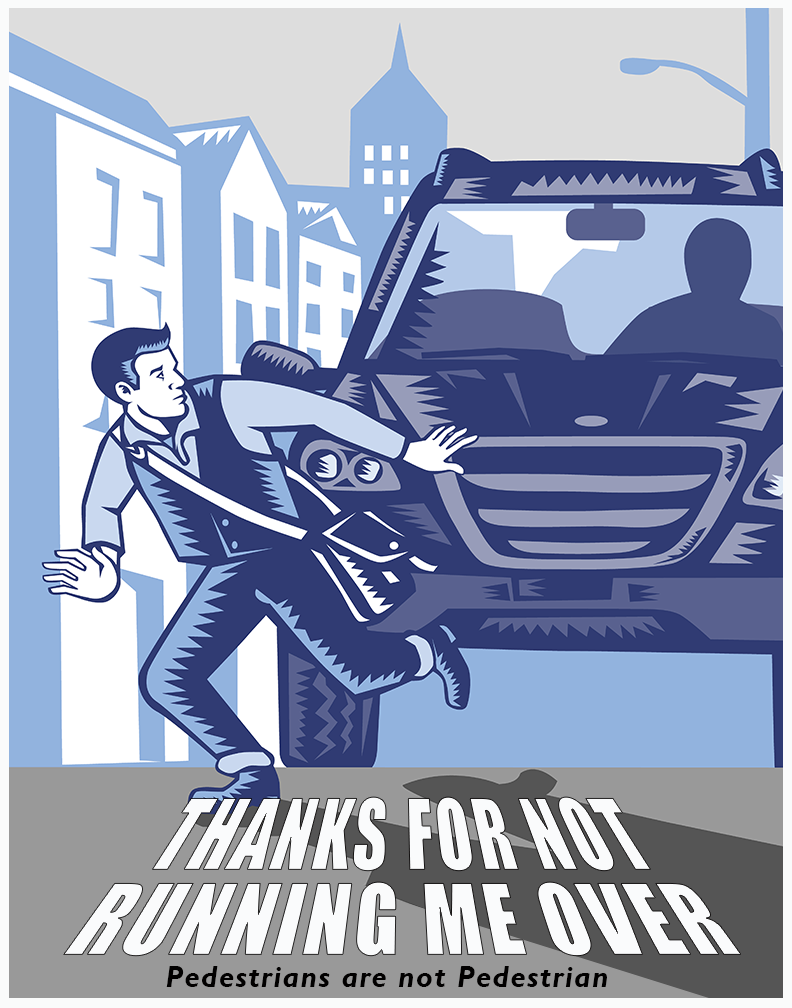
One. Building construction obliterates sidewalks for months at a time.
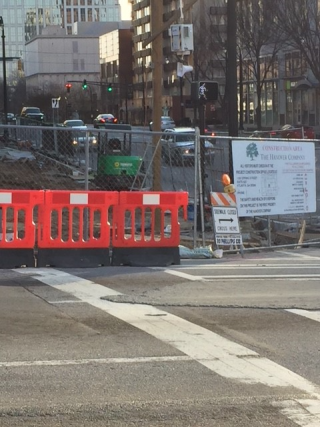
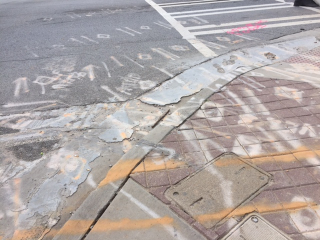
Two. The crosswalks near these construction sites have long been erased or painted over by unintelligible, utility company hieroglyphics, which can be interpreted by only a select few. (If a graffiti artist defaced public areas this way he or she would be arrested.)
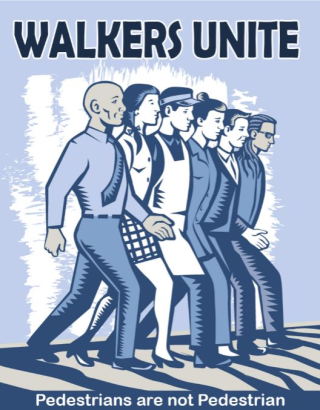
Three. Yelling at a motorist does no good because they cannot hear you in the din of Midtown traffic. Dirty looks and non obscene gestures are more effective and does not place one in immediate peril. Such vehicle-pedestrian confrontations inspired this poster, which is available at downandoutbound.com.
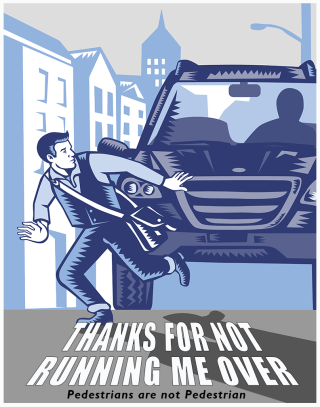
Four. Driving and texting, though unlawful, is so commonplace that at waiting for a crosswalk light one often makes a game of counting consecutive violators. Entertaining but not comforting.
Five. Automobile detritus (bumpers, side view mirrors, headlights) and other urban trash like this decapitated sign often make passage on the sidewalk difficult.
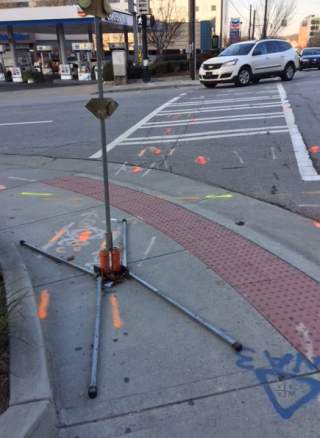
Six. The 10th Street bridge: Narrow, filthy, noisy.
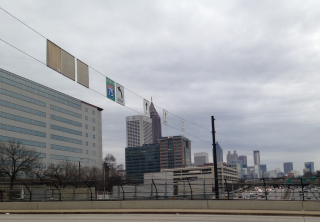
Seven. Cyclists often ride on the sidewalks. Understandable in some sense, but still scary.
Eight. Street lights — even decorative ones — are often out of service for weeks at a time.
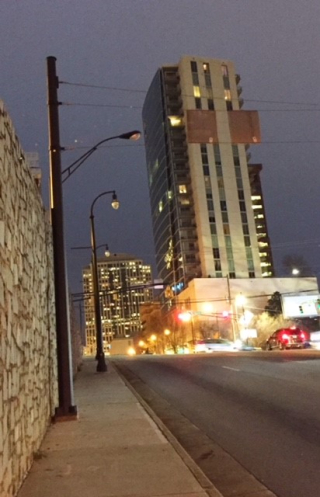
Nine. On sunny days, notice the brown haze hovering on the horizon. We are breathing that.
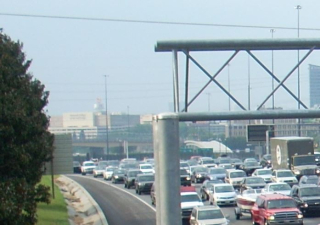
Ten. Have I missed something? Please add your #10 to the comments.
From the director of Percolator, a new film about the Decatur MARTA Station…
—– TITLE: Share the Sidewalk DATE: 10/15/2017 10:03:37 AM
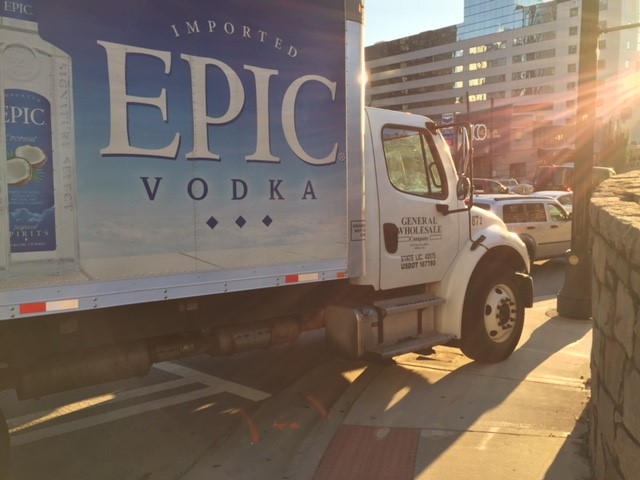
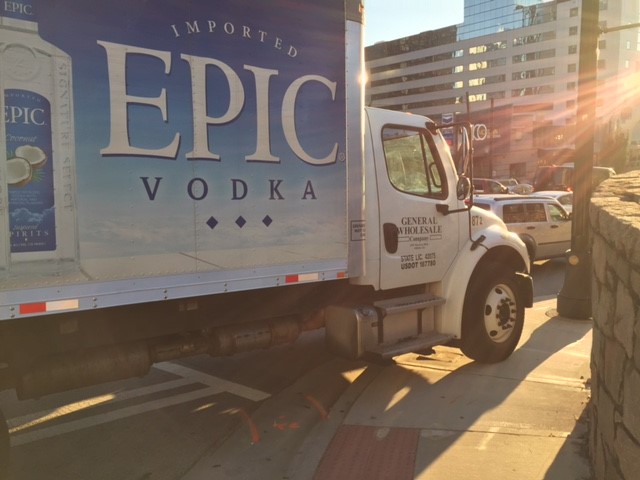
I know that motorists are often asked to "Share the Road" with cyclists, and cyclists often ride on sidewalks (which is understandable in some instances, but dangerous to pedestrians), but when drivers insist that we share the sidewalks is when I take it personal. This vodka truck came right at me on a Midtown Atlanta sidewalk last week. Join me in boycotting Epic Vodka.
The sad part is that this really didn't shock me as both sides of 10th street sidewalk from the Midtown MARTA station to across the I-75/85 bridge are nothing but dangerous.
KEYWORDS: Atlanta Pedestrians, Pedestrian Safety, Epic Vodka AUTHOR EMAIL: murray.browne905@gmail.com TITLE: Crosswalks: Good, Bad and Ugly DATE: 10/07/2017 08:02:44 PM
Street wise pedestrians know that decorative, "fun" crosswalks are badly outnumbered by faded crosswalks, crosswalks covered with utility petroglyphs, and crosswalks that have turned into potholes.
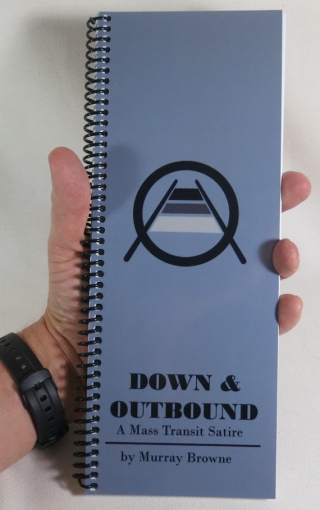 In a rare public appearance, discounted copies of my book Down & Outbound: A Mass Transit Satire will be available for perusing and sale at the Root City booth #528 at the Decatur Book Festival being held September 2nd and 3rd. This is your opportunity to experience a book about the absurdities of public transportation, which has been specifically designed for those who ride buses and subway trains. (You can read it with one hand. See video below.) At the booth, which will also have cards, notebooks and other writerly accessories, you can experience how Down & Outbound's soft plastic comb massages the tender spot between your thumb and index finger while you read. This book tickles.
"Will the reclusive D & O author be available?" you ask.
Only late Sunday afternoon at the Baptist Church venue, but not as an author but as a Festival volunteer during the Ernie Johnson appearance. Maybe I can get the famed sportscaster to hold my book. Hmmm. Good idea.
TITLE: Climate Change’s Biggest Problem DATE: 05/30/2017 07:00:30 AM
As I read Rob Walker's article "How to Trick People into Saving Money" in the May, 2017 issue of The Atlantic magazine, I drew a connection to behavioral economist Daniel Eckert's thoughts about saving money and how it relates to saving the environment. Walker writes, "Americans difficulty saving, Daniel Eckert* told me recently, is a textbook example of how brains wired to reckon with short-term threats and opportunities struggle to think about long-term consequences – and struggle even harder to take current action to stave off future disaster."
Perhaps that is where the solution to slowing down climate change lies, tricking people into saving the environment.
*Footnote: Walker's article covers how Walmart is marketing a Moneycard type app to get their customers who don't normally save, to stash away money. Eckert oversees Walmart's financial service businesses.
—– Behavioral economics, Rob Walker, The Atlantic Magazine. Climate change challenges, Daniel Eckert —– TITLE: Burning Memories #2 DATE: 05/07/2017 10:58:11 AM
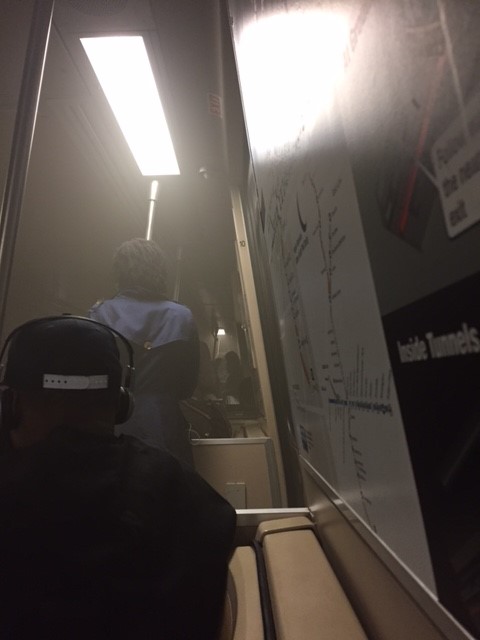
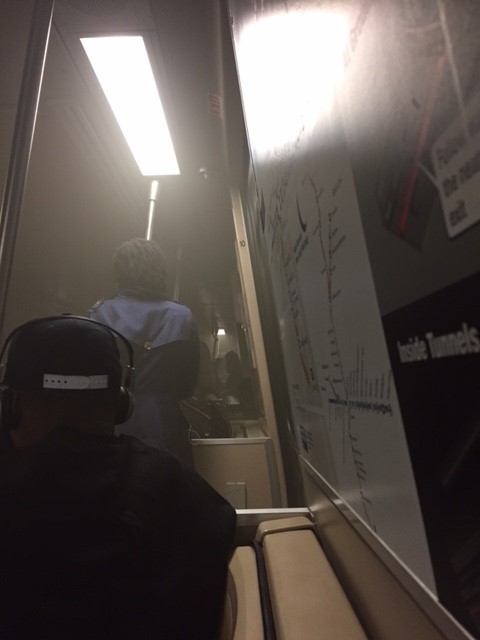
On Thursday, May 4th, I was on the Metropolitan Atlanta Rapid Transit Authority (MARTA) train that filled with smoke during my evening rush hour commute. I ended up having to evacuate the train and take a tunnel catwalk back to the Midtown Station. The Atlanta Journal-Constitution reported the following Saturday that, "MARTA Police and Emergency Management said an arc of electricity from a high voltage rail — not a fire — apparently created smoke that filled the train." My re-occurring thoughts include:
- Where there is smoke there is fire. Not sure how that "not-a-fire" explanation works.
- What caused the arc of electricity? MARTA trains are notorious for electrical outages especially during heavy rains.
- As mentioned in a previous posting, if you ride MARTA regularly enough, something like this – where a train breaks down or an incident with a passenger causes major delays — happens every other month. (It was the second time in 6 days where I had to evacuate a train.)
My prediction is that once the I-85 bridge is repaired, commuters will return to their car driving ways, especially since gasoline prices remain low and they will know that the MARTA experience often requires passenger patience.
MARTA train fire, Midtown, electrical outages, MARTA ridership, I-85 TITLE: Public Transportation in Atlanta DATE: 04/16/2017 03:53:54 PM
A few days before the I-85 bridge collapse in Atlanta, this article "The Real Fiction of Public Transportation" appeared in Like the Dew: The Journal of Southern Culture.
—– like the dew, public transportation in Atlanta —– TITLE: Tips for New Riders DATE: 04/05/2017 07:01:56 AM
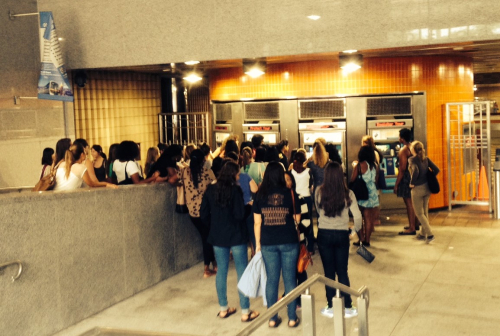
Because of the I-85 bridge collapse, the Metropolitan Atlanta Rapid Transit Authority (MARTA) is experiencing a major increase in subway ridership. (This is what it takes to get people to try public transportation in Atlanta.) Many of these new riders might be unfamiliar with this mode of transportation so here are five helpful tips from someone who has ridden the rails for years:
- Expect minor annoyances. such as delayed trains, people/bikes blocking doorways, panhandlers (despite the rules it still goes on) and inaccurate signage. About every other month, there will be a major breakdown — electrical outages, medical emergencies and the like and you could have the misfortune of being on board at that time. This could last for an hour or more. You can wait, switch to a bus, walk, call a friend, or bite the bullet and use your Uber of Lyft app. It happens. Not every day or week, but if you ride long enough…
- You will witness little acts of kindness among riders, (giving up a seat, pointing someone in the right direction) but you can't have your face in your phone all the time in order to see this. Yes, there is rudeness too, but the former outnumbers the latter.
- Don't assume when you leave the MARTA station it is safe to walk. It's a war between drivers and pedestrians out there. As you wait at the faded crosswalk you will notice how many drivers are on their phones and texting. It is frightening. (Remember this the next time you get behind the wheel.). Pedestrians have the responsibility to cross at the right time and place. You have to be alert at all times. If you are struck by a car, you might be right, but you lose.
- Re-read Tip 3.
- Order a copy of Down & Outbound: A Mass Transit Satire. Nothing like humor to pull you through hard times.
KEYWORDS: Tips for riding MARTA TITLE: Burning Memories DATE: 03/30/2017 07:09:33 AM —–
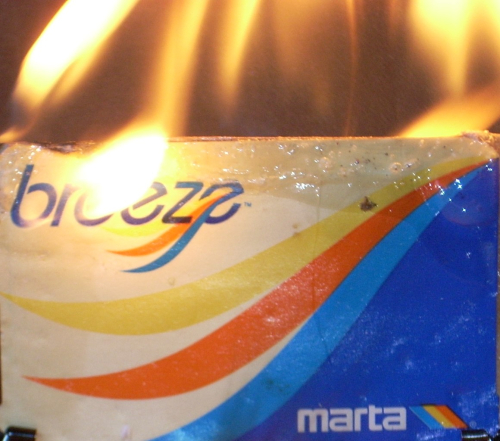
This is a vivid reminder that Friday, March 31, 2017 is the last day you can load rides on the blue Metropolitan Atlanta Rapid Transit Authority (MARTA) Breeze Card. They have been replaced with the new, chipped MARTA Silver Card. Veteran MARTA riders will immediately recognize that this inflamed card is not the blue card, per se, but the temporary ride card which has long been abolished.
Still for me, the early Breeze cards were my first public transit card that I carried around on a daily commute. You always remember your first.
Here's a screenshot further explaining the transition.
TITLE: There’s That Word Again —–
Poor pedestrians — especially compared to the Chicago Bear quarterback situation.
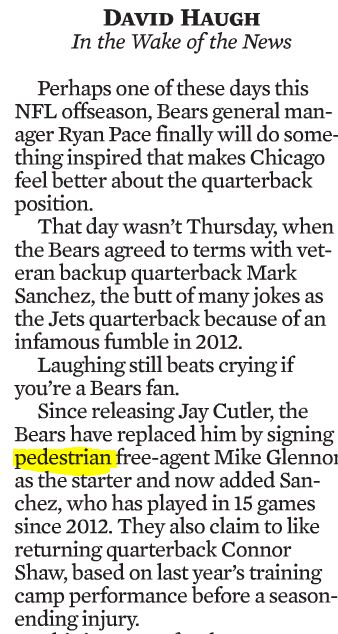
Excerpt from the Chicago Tribune, March 23, 2017 – evening digital edition.
—– DATE: 02/07/2017 01:25:26 PM
Columnist Mary Wisniewski writes about the controversy surrounding the transit musicians in yesterday's Chicago Tribune.
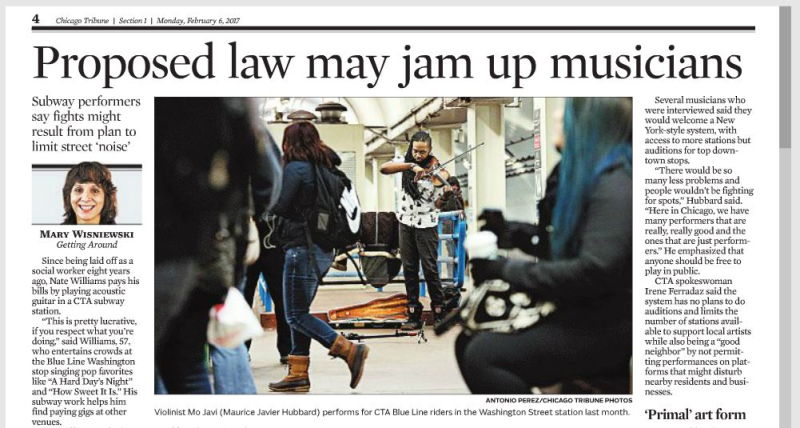
Coincidentally, one of the chapters (#110 Flash Band) in Down & Outbound: A Mass Transit Satire covers the same territory when a small orchestra known as Subterfusion plays an impromptu concert and the "authorities" try to stop it. Here's a poster from the concert (and the book):
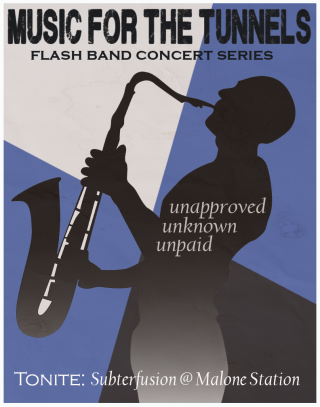
TITLE: Artistic Subway Stations DATE: 01/29/2017 09:01:04 PM –
Check out the video of the art behind New York City's Second Avenue Subway system. Atlanta residents may be familiar with one the artists – Vik Muniz. The High Museum in Atlanta did a large Muniz exhibit last year, which was sensational. To see installations like these when you ride the subway everyday would certainly soften anyone's daily commute.
—– KEYWORDS: Vik Muniz, Second Avenue Subway System, New York City, MTA TITLE: Smart Wet Cones (A Photo Essay) DATE: 01/18/2017 07:01:52 AM —–
Don't underestimate the new transportation technologies. We're not referring to self-driving automobiles or more comfortable subway cars, but the commonplace (not pedestrian!) wet cone. Previously, these plastic pillars of caution could easily fall into delinquency when not being kept busy. Hanging around train stations looking for trouble — getting into trouble.
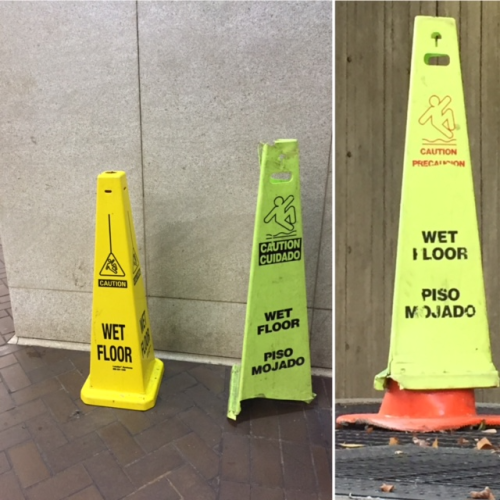
But now with the new Smart Cones, a by-product of Down & Outbound: A Mass Transit Satire. designed by Tim Poore, Smart Cones can remove some of the guesswork out of daily commuting.
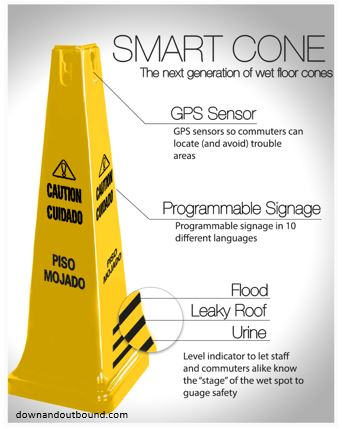 This product will take the mass transit arena by storm (instead of appearing when it storms).
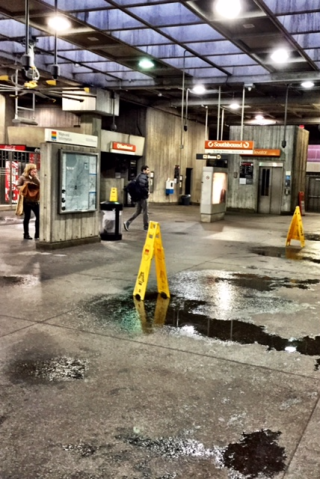
Smart cones are even being developed to serve as elevator attendants.
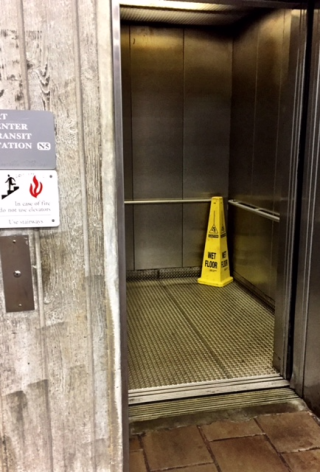
It's nowhere but up for the wet cone.
TITLE: Traffic Dancers DATE: 01/07/2017 10:27:32 AM
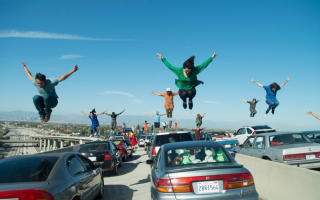
After seeing the traffic dancers in the movie La La Land (left), I keep waiting to see dancers pop out of their cars in Atlanta traffic jams (below), but it's not happening. Part of the "embrace the traffic" mentality.
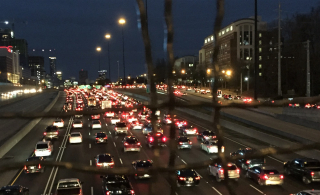
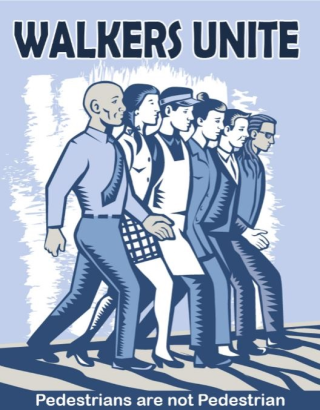
Another example of the marginalization of the word "pedestrian" comes from the recent December 19th issue of Sports Illustrated. In an article about Peyton Manning, Ben Reiter writes: "The last game Manning ever played was similarly pedestrian: 13 of 23 for 141 yards, no touchdowns, an interception and a lost fumble. That game though was Super Bowl 50."
TITLE: Embrace the Traffic DATE: 12/01/2016 07:03:20 AM e reason why we have so many cars on the road is our willingness to accept it…
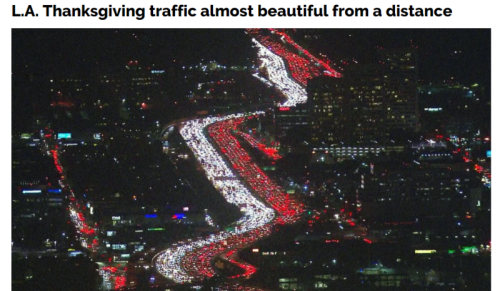
Here's the link to the article.
—– TITLE: Mass Transit Apology DATE: 11/05/2016 10:21:34 AM

Once you have waited in a crowd for a nonexistent bus after the train line has shut down, most official apologies seem pretty lame.
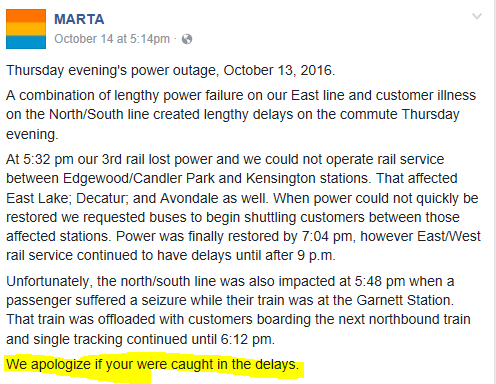
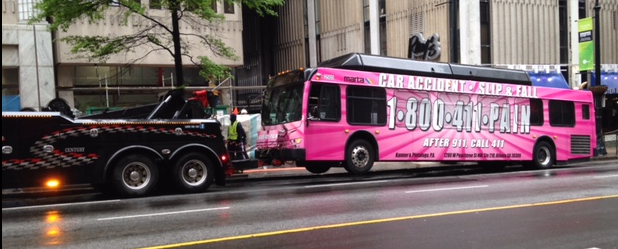
The ultimate zebra crosswalk from Germany. If you type "zebra crosswalk" in Google search you may find similar interpretations.
TITLE: Pedestrian is the Word DATE: 11/01/2015 12:30:44 PM
How the word "Pedestrian" itself is marginalized. Let me count the ways:
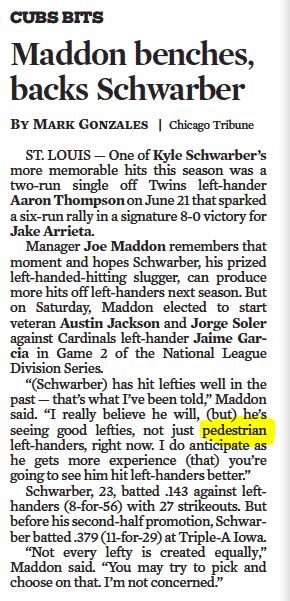
"After winning here Saturday, Florida almost certainly will take the division. It can play defense, but its offense is pedestrian…" (Mark Bradley, sports columnist Atlanta Journal-Constitution, (11/1/15)
Thus born was the phrase "Pedestrians are not Pedestrian."
TITLE: Security & Safety DATE: 10/24/2015 09:17:16 AM
Here are some examples of signage that we have become almost oblivious to — surveillance is good for you or makes you feel secure.
Then there is one that drives home how it benefits YOU!
Not making this stuff up. These signs are so ubiquitous I don't think we pay any attention to them anymore.

TITLE: Birmingham Train Station DATE: 09/22/2015 09:54:46 AM
Maybe if subway stations resembled modern airports more people would use them…

—– TITLE: Attitudes about Mass Transit DATE: 09/13/2015 08:28:02 PM
This came from an online story that discusses the future of Metropolitan Atlanta Rapid Transit Authority in nearby Gwinett county:
http://atlantaprogressivenews.com/2015/08/17/organizing-begins-to-bring-marta-to-gwinnett-county/
“People are coming from other parts of the country where riding transit is not a big deal. We are trending toward younger people riding transit, so we have to prepare for that future,” Sheldon told Atlanta Progressive News in a phone interview.
Gwinnett has seen rapid growth and changing demographics that has made it more diverse, with a twenty percent Latino, 26 percent Black, and eleven percent Asian population that is more accepting of mass transit.
On the other hand, there are some older, more conservative, and White voters, who do not believe rail is an efficient use of tax money, and who are not comfortable riding MARTA.
“People are coming from other parts of the country where riding transit is not a big deal. We are trending toward younger people riding transit, so we have to prepare for that future,” Sheldon told Atlanta Progressive News in a phone interview.
Mother Blames MARTA For Son's Stupidity
Inspired by the book Down & Outbound: A Mass Transit Satire, this blog was (from 2016 to 2020) a repository of notes, thoughts, and visuals about public transportation, pedestrian life and attitudes about alternative modes of transportation and in the bigger picture – climate change. ( You know, it's all connected).
This site will remain up, but regular postings are discontinued.
—–
 murraybrowne.org
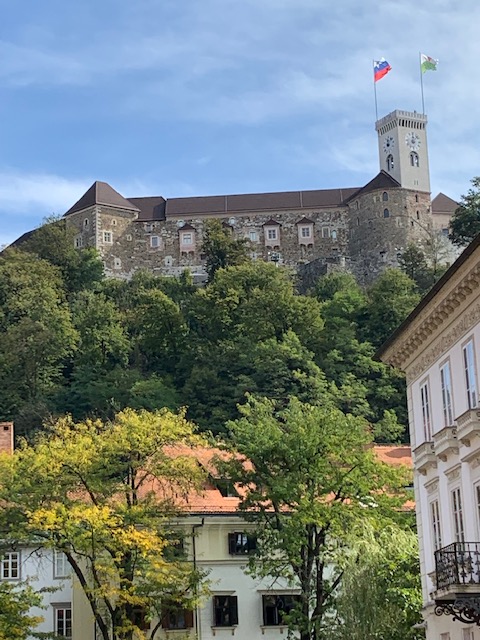
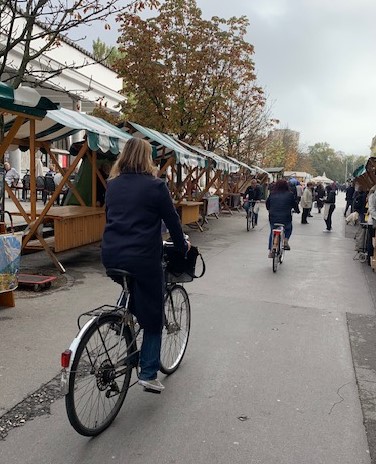
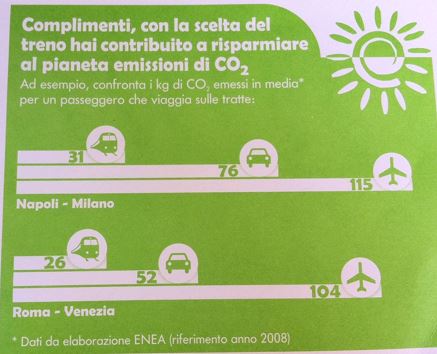
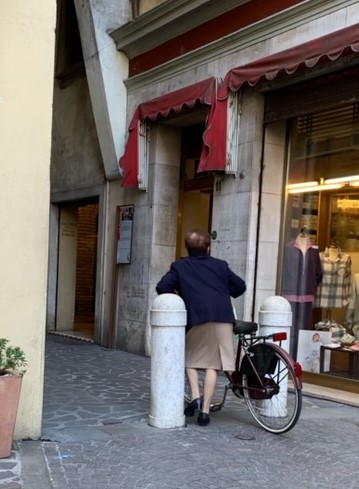
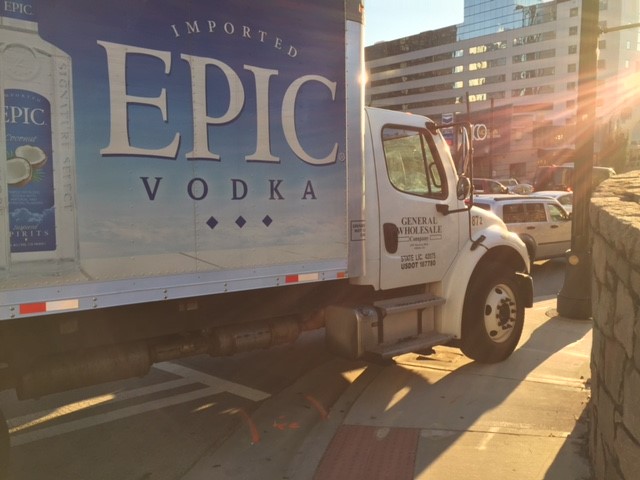
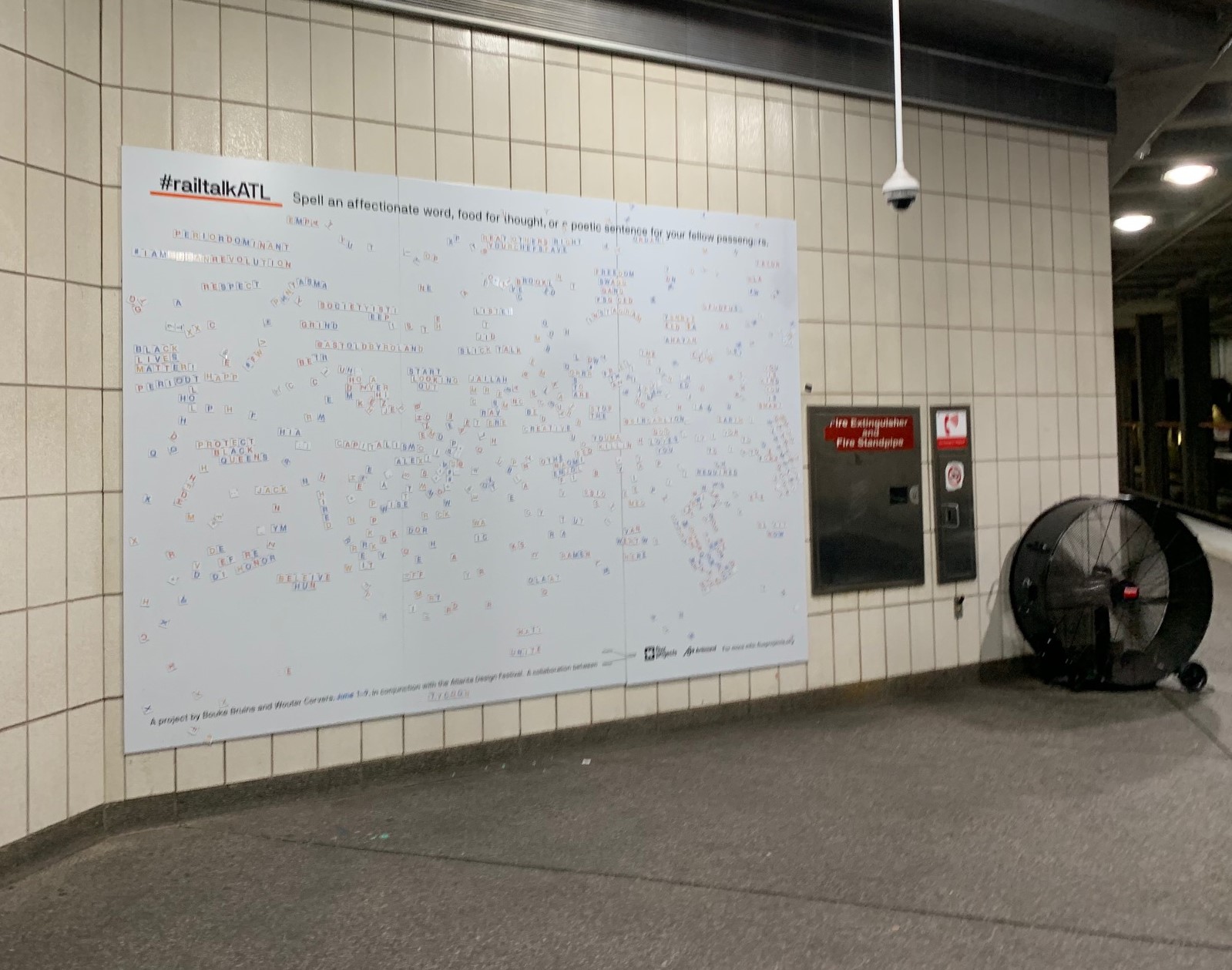
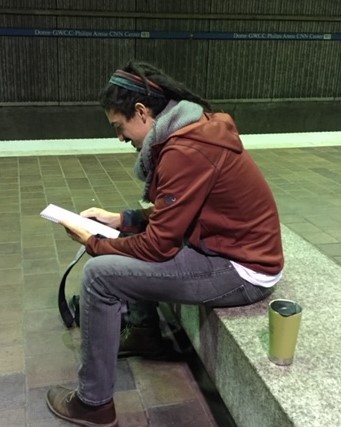

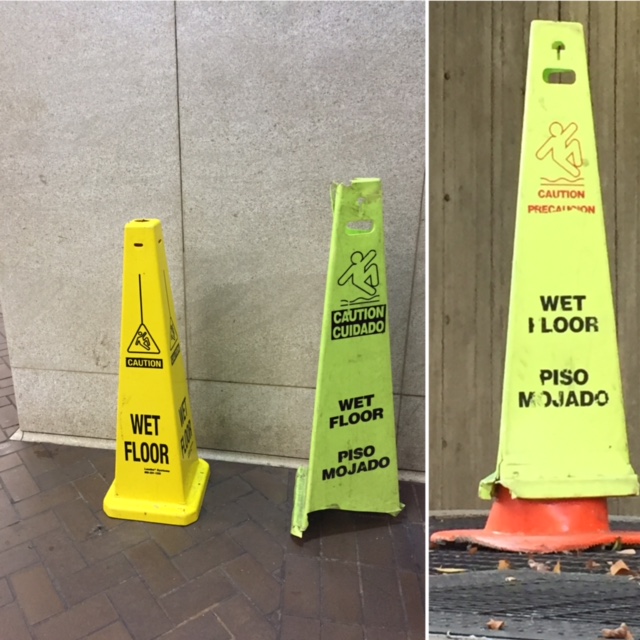
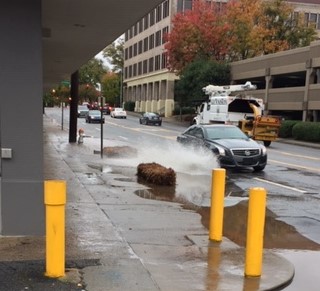
Leave a comment