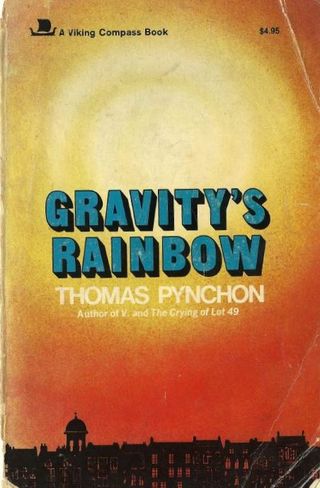
Gravity’s Rainbow Support Group (GRSG)
Narrated by Murray Browne
About
Founded in the midst of the 2020 pandemic by two Indiana University classmates from the 1970s and lifelong friends, Francis Walker and Murray Browne started this book “club” with the Thomas Pynchon’s 1973 Classic Gravity’s Rainbow. Recognizing the pleasure of reading and discussing a book without the normal book group headaches (getting people to agree on the book, people reading the book etc.) we decided to keep a good thing going.
Following our reading of GR we moved on to other books following the credo set forth by Maria von-Ebner Eschenbach (1830-1916) who once said “People who only read the classics are sure to remain up-to-date.” Well, we have been trying to do so for over 6 years. At the bottom of this page there are links to the dozens of other books we have read from 2020 to 2026.
However, this page is dedicated to Gravity’s Rainbow and can be looked as a guide to understanding and appreciating the novel. These notes were originally produced in 2020, but have been revised for clarity and searchability in June, 2026.
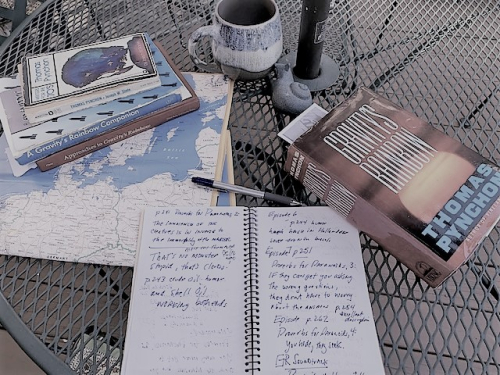
Introduction
Thomas Pynchon’s 1973 novel, Gravity’s Rainbow is a difficult book to read and especially challenging to read alone. Its narrative structure skips around, digresses and requires some understanding of history, science, psychology and mathematics to gain a toehold on its meaning. On the other hand, it’s imaginative, clever, humorous, challenging, and provides insight to the world as we know it. The goal of the reading group is to share the burden of this novel, allowing people to talk about the book without boring spouses and partners, friends, and innocent bystanders who might be foolish to inquire about “what you are reading” while standing in line at the coffeeshop. Also, after reading Gravity’s Rainbow you are allowed to use the adjective “Pynchonesque” at your leisure.
More importantly, the purpose of this page is to collect notes of the Gravity’s Rainbow Support Group (GRSG). Warning: this page will not always be coherent. For a more coherent take on the book, visit the essay, “A Screaming Comes Across the Sky: Rereading Thomas Pynchon’s Gravity’s Rainbow,” which appeared in Dog Days Classics section of the Tropics of Meta, Historiography for the Masses.
Background Sources
There are several recommended sources that assist you in understanding the book:
Prlnt
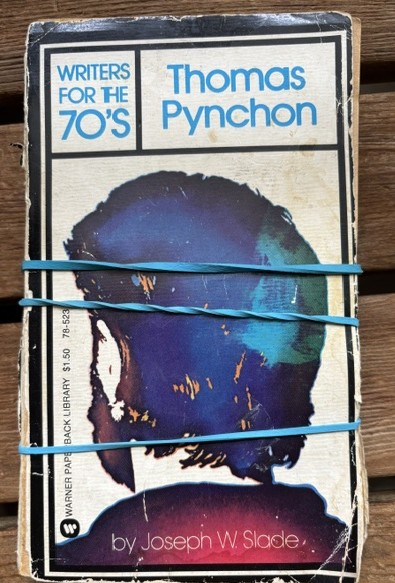
- Writers for the 70s: Thomas Pynchon (1974) by Joseph Slade. This is one of the better guides, a pocket paperback which gives an overview on all of Pynchon’s writing up through Gravity’s Rainbow. I found my copy in a potpourri and antique store in Lindsborg, Kansas of all places. You can find copies on line. Trivia note: the other authors in this series were Kurt Vonnegut, Carlos Castaneda and Richard Brautigan. Hmmm.
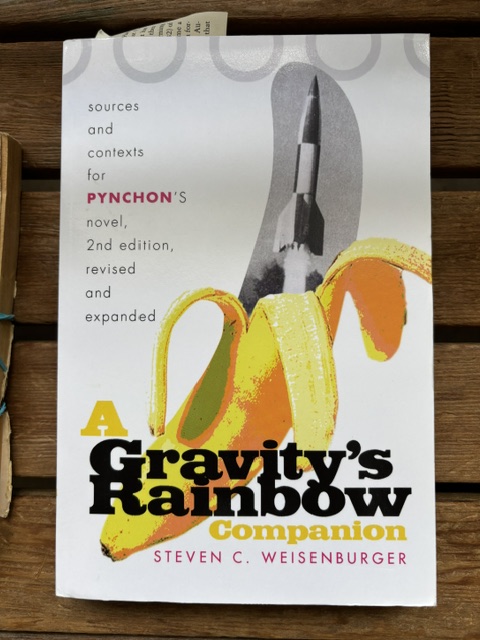
- Gravity’s Rainbow Companion: Sources and Contexts for Pynchon’s Novel (1983) by Steven Weisenburger. There is a newer edition with about 20 percent more material (I am told) than this highly detailed breakdown from the early 80s that I am familiar with. The episode-by-episode synopses, which I have distributed via postal mail have come from the first book. My copy of the book has been disintegrating, but it is invaluable. I have no idea where I found my copy, but the new edition published in 2006 is available but pricey and available at the Destination Books online book shop (sponsor of the website).
- Approaches to Gravity’s Rainbow (1983), edited by Charles Clerc and published Ohio State University Press. This is a series of essays where each contributor (including the aforementioned Joseph Slade) concentrates on some aspect of the novel. A little scholarly. I am not exactly sure where I found this book. Maybe I saw it at the Wichita State University library and ordered it.
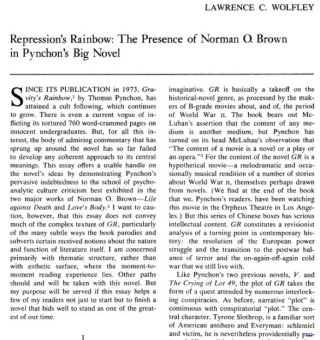
If you can somehow find it read Lawrence C. Wolfley’s “Repression’s Rainbow: The Presence of Norman O. Brown in Pynchon’s Big Novel.”The scholarly article appears in The Modern Language Association-Publications. October, 1977, Volume 92 #5. You may be able to access or purchase it at JSTOR.
Internet
The major website about Gravity’s Rainbow https://gravitys-rainbow.pynchonwiki.com/ has some valuable resources : The Alphabetical Index includes the 300+ characters who appear in the 760+ page book, and a page by page annotation (but it is not as through as the Weisenburger book), and the character map E-R diagram which shows the relationship of the some of the main characters. Unfortunately, it does not display easily. Also, many of the links on this website are dead and out of date. There is also a link to Richard Poirior’s (Pynchon’s most sensitive critic who wrote the best general introduction to GR according to Wolfley), entitled.”Rocket Power.”
A Word About The Style
One of the aspects of this novel that makes the book a challenge is Pynchon’s style and wide use of the analepsis, “a literary technique that involves the interruption of the chronological of events or scenes of an earlier occurrence” (Merriam Webster’s definition). What makes it even more challenging is that these “shifts in focalization, all without any of the spatiotemporal markers by which writers conventionally signal them to readers (Weisenburger). One GRSG member pointed out that this is the same technique used by William Faulkner in such novels such as The Sound and the Fury. Adding to the confusion is Pynchon’s use of ellipses. I was recently reading an essay by Paul Chaat Smith that complained about a friend’s elliptical writing style: “Stream-of-consciousness rambling and contempt for sentence structure are surefire indications of sloppy thinking and worse writing, of an undisciplined mind, of feckless anarchy.” Even if you don’t think Pynchon is being sloppy (and I don’t), it does make the book more difficult to read.
Warning: Episode 9 (pp. 47-53) and Episode 14 (pp. 90-113) are especially nasty with the analepses.
Places in GR
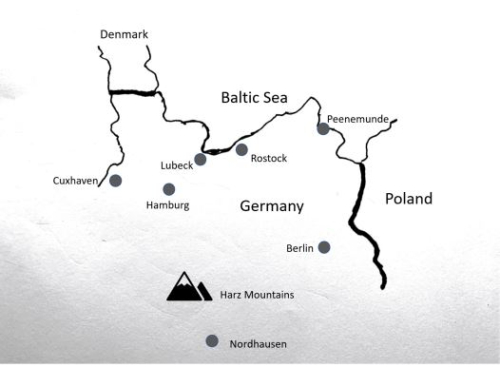
Although the book spends time in London, Nice, France and other locales around the world, the majority of the book is set in northern Germany.
Themes
As Charles Clerc can attest to there are many approaches that one can take to understand the book to chose from:
Historical. Set at the end of World War II, September 1944 to September 1945, the book is kind of an historical novel as many of scenes have a factual correctness to them. (Pynchon studied The London Daily Times and borrowed extensively details about what was going on.)
Paranoia. How multinational corporations control the world – especially IG Farben.
In Part Two, Pynchon introduces his Proverbs for Paranoids.
- Proverbs for Paranoids, 1: “You man never get to touch the Master, but you can tickle his creatures.”
- Proverbs for Paranoids, 2: “The innocence of the creatures is in inverse to the immorality of the master.”
- Proverbs for Paranoids, 3: “If they can get you asking the wrong questions, they don’t have to worry about the answers.”
- Proverbs for Paranoids, 4: “You hide, they seek.”
- Proverbs for Paranoids, 5: “Paranoids are not paranoids because they’re paranoid, but because they keep putting themselves, fucking idiots, deliberately into paranoid situations.”
Film and Cinema Motif
Beginning with the ellipsis boxes that designate the different episodes that separate the text in each chapter, there is a heavy influence of films and moviemaking in GR. Beginning with some of the characters of the book:
Gerhardt Von Göll – aka Springer which is German for “chess knight” – the “knight who leaps perpetually across the chessboard of the Zone.” Von Göll is a German filmmaker, which Pynchon pays homage to classic German expressionist films such as Metropolis. He makes makes a short film for the Allies about the Schwarzcommandos, black tribesman from the Herero tribe in Southwest Africa who worked on the German rocket program. It’s intended as a propaganda film, but turns out to be true.
Before the war Von Göll also makes the erotic film Alpdrücken (German for nightmare) with actress Greta Erdman (aka Margherita and Gretel). The movie has a profound effect as Greta is raped by co-star Max Schlepzig during the filming of the orgy scene filming (Schlepzig could be Von Göll ?) and she ends up having a child Bianca. Another character Franz Pölker is seduced while watching the film. Franz returns home to have sex with his wife Lena and they conceive of a child Ilse. Pölker is a rocket engineer who is forced not to question what he is doing in order to see Ilse.
Other examples: there is the movie reference to King Kong in the beginning of Part 2 – Merriam C. Cooper to Fay Wray “You will have the tallest, darkest man in Hollywood. ” and In Part 3 the Dorothy’s quote from the Wizard of Oz, “Toto, I feel we are not in Kansas anymore.”
Moreover, the Clerc book, the author devotes an entire chapter to “Film in Gravity’s Rainbow”.
Science and Technology
The V-2 Rocket
“The V-2 rocket Vergeltungswaffe Zwei) was literally the vengeance weapon.” (p.71 Clerc, Tololyan). “England was struck by 1,115 V-2s, and Antwerp,…was hit by 1,265 more. In London the toll was 2,340 dead and 6,000 wounded… In the end, the most accurate judgment is perhaps that of the British scientist who suggested that ‘the vast A-4 project had been conceived not out of military expediency but to quench the innate German sense for romanticism.’ Pynchon’s vision is predicated on a similar judgement, so that the V-2 looms large in Gravity’s Rainbow as the focal point of a grisly romance between men and technology.” p.45 Clerc, Toylyan).
The V-2 is also known as the A-4 program and that may because it refers to the rocket design itself. V-1 was a different type of weapon more of a cruise missile than a rocket. It was being fired on England beginning of June, 1944 from France, but it did not have a great range and when the Allies overtook France that ended the use of that weapon. But September of 1944 was the first V-2 rocket launch. The V-1 actually caused more death and casualties and was also referred to as the buzz bomb. Ironically, there was replica of the buzz bomb in my hometown of Milford, Illinois. Check this out.
Since the V-2 is the focal point – the quest of the book or in the opinion of Slade, “the protagonist of the story…an annunciation of the new technology (p. 178).”
The Rocket has two aspects. Conceived for death, ostensibly evil, it offers life. It is a “star” an “angel” a “Text.” It is the means by which man can escape Gravity and Earth itself. It is the pinnacle of man’s technology, symbol of a new state, or at least, a new city, the Raketen-Stadt.”
Many of the characters are directly involved: Franz Pokler (chemical engineer at Peenemunde and Nordhausen), Lt. Tyrone Slothtrop (Rocketman), Enzian (the Herero pilot of the Schwarzkommandos, and Blicero-Wasserman, one of the main commanders of the project.
My Mild Obsession
In 2026, I visited the British Imperial War Museum, which also had a V-2 rocket in its lobby, but I did not find out why it was painted green. A couple of interesting facts is that it confirmed that Londoners feared the V-2 more than other air attacks because the bomb “cut out”. In other words you could not hear it fall.
Also I believe that more factory workers (mostly in concentration camps) died building the V-2 than Londoners dying from the rocket.

Mild Obsession 2 :Wernher von Braun
It begins with the quote that is on the first page of Gravity’s Rainbow:
Nature does not know extinction. All it knows is transformation.

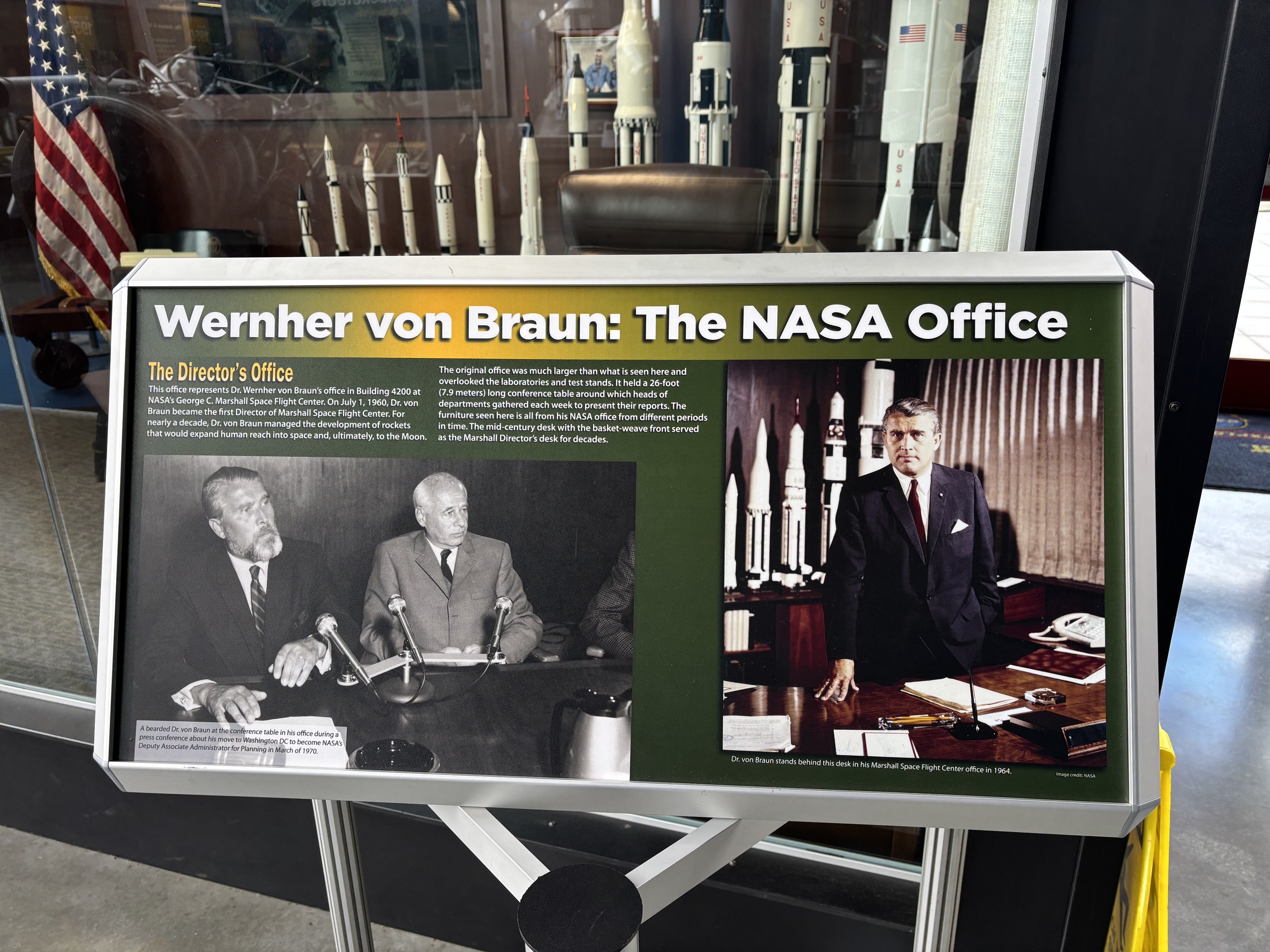
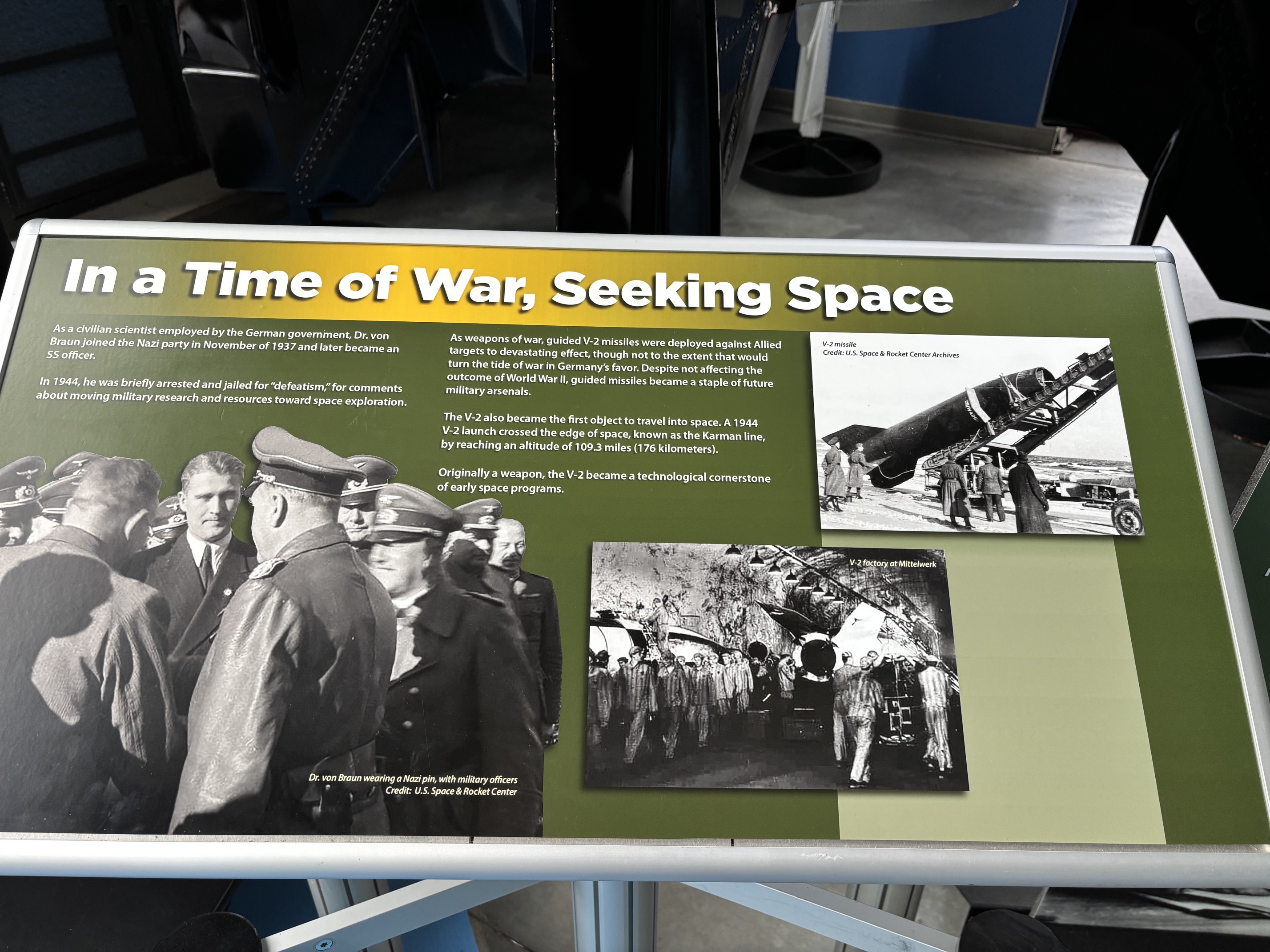
In a nutshell, Wernher von Braun (1912-1977) was one of the leading German rocket engineers who worked on the Nazi rocket program. As the defeat closed in on the Germany in 1945, von Braun and approximately 100 members of his rocket development team surrender to the Allies. They were taken to White Sands, New Mexico where they continued to test, assembled, and supervised the launching of captured V-2s for high-altitude research purposes. There is a major exhibit about their work at the New Mexico Historical Museum, which I visited early in 2026.
Note that von Braun’s first name is misspelled.
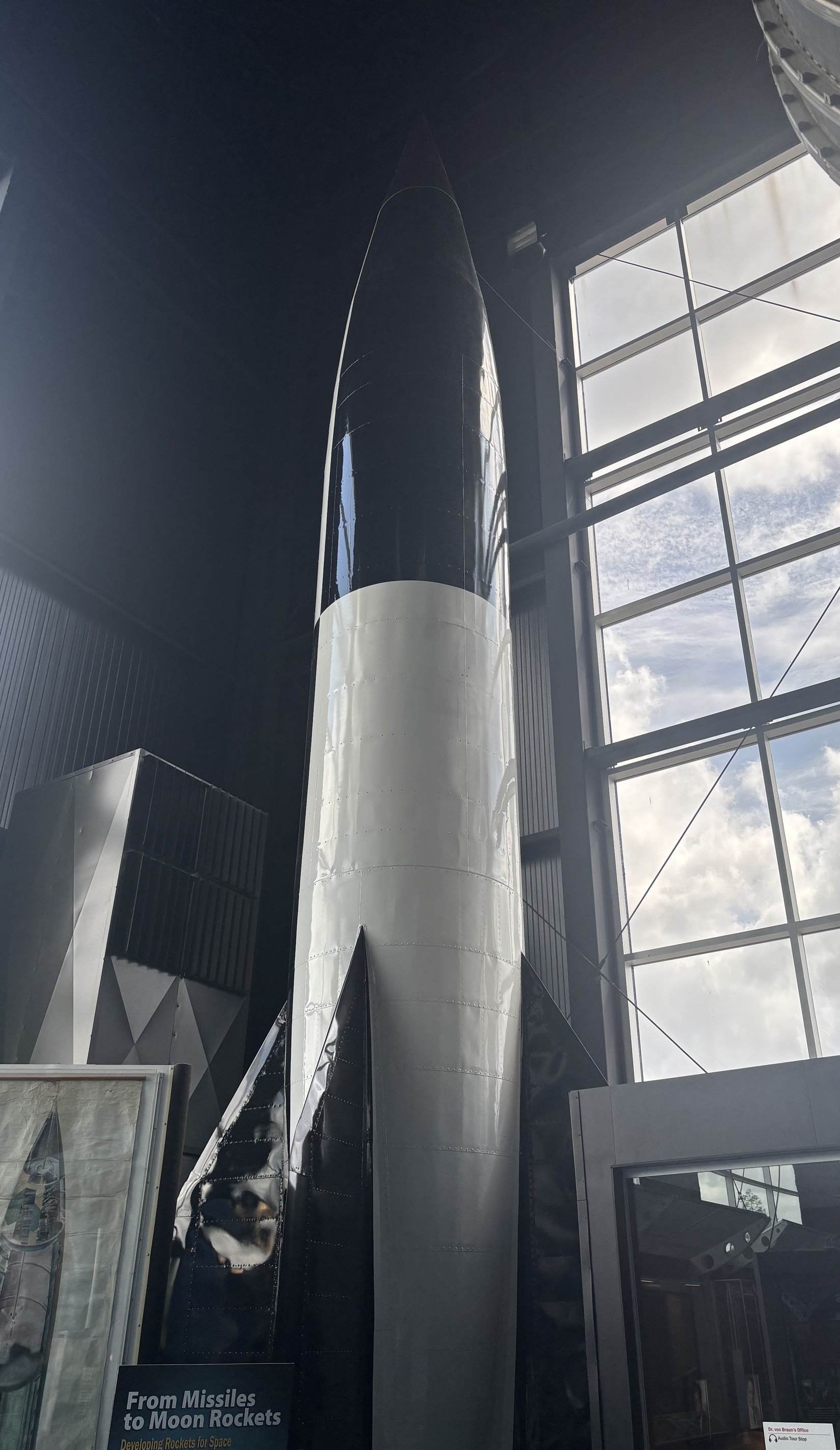
In 1952, von Braun moved to Huntsville, Alabama to work in the U.S. Army ballistic program, before that program shifted out of the military to work on the space rockets to meet the challenge of the Soviets who had launched Sputnik. When I visited the Air & Space Museum in Huntsville in 2025, I noticed that the issue of von Braun’s work in Germany was part of the exhibits. There is even a polished V-2 next to von Braun’s office.
Meeting Notes – June 20 to October 20, 2020
Francis and I met via Zoom 5 times while reading this book. What else did could we do. This was in the peak months of COVID-19.
This is Francis’s third time reading GR but the first time since the late 1970s and this was my second time. My first reading was in the early 1980s. Good news! We both agreed it’s easier reading the second or third time. Perhaps you know what you are up against or since you know the basic plot it’s a little easier to hang in. For me, this time I had the guides (mentioned above) and that kept from being totally lost for long passages.
Gravity. What does the title Gravity’s Rainbow mean? “Gravity is, after all universal: every bit of matter exerts a force on every other.” (Clerc-Friedman, p.75) Does the rainbow just indicate the shape (a parabola like the flight of the V-2 rocket. Gravity is invisible, meaning invisible forces? Rainbows have many colors, so is GR a book of the host of invisible forces that are upon us every moment. From Francis:
So, I (Francis) have been thinking a bit more about gravity and color and Pavlov. We sometimes use gravity to tell us about time (like an hourglass, or like waiting for a ball or frisbee thrown in the air to come down, or waiting for the other shoe to drop. We, also, sometimes use color to tell us about time. It is hard to do with the gray English skies (a recurring theme you pointed out that helped me see this connection), but at the ocean we can tell by the colors if it is morning, noon or evening and we can tell by the flash of an bomb or lightening that an explosion or thunder will follow–or the red of a rocket burning that a missile is on the way. I think that’s why he likes Pavlov, it is the time locked nature of two stimuli (a bell and food) that creates the conditioned response. He seems fascinated by the possibility that perhaps things could go in reverse.
How do we cope with these invisible forces? Paranoia (a subset of which is conspiracy theories). Myth and religion, which reminded Francis of a couple of quotes: “There is something feeble and a little contemptible about a man who cannot face the perils of life without the help of comfortable myths.”- Bertrand Russell. And another from Boris Pasternak: “As for men in power, they are so anxious to establish the myth of infallibility that they do their utmost to ignore the truth.” Here in time of COVID-19, we struggle to understand why one person is struck down with the disease and another is not. (like in the battlefield, why is one killed by a bullet and the other person next to him is not.) There are tough things to ponder. William Osler once said, “To be uncertain is to be uncomfortable, but to be certain is ridiculous.”
A discussion of the evil of large corporations discussion: including IG Farben, Krupp, Anthony Sampson’s The Sovereign State of ITT, which was published in 1973 the same year as GR. Another book that may be of interest is The Order of the Day (2017) by Eric Vuillard, which is a brief history about the titans or German industry who supported Hitler as early as 1933, which solidified his power. An excellent book. William Manchester’s The Arms of Krupp is also highly recommended.
For some good background reading about this same period of history I found these two books most useful:
Johnson, Paul. In Modern Times: The World from the Twenties to the Nineties (Revised) New York: Harper Perennial, 1992 (more specifically the chapter “Superpower and Genocide.”
Roberts, Andrew. Masters and Commanders: How Four Titans Won the War in the West, 1941-1945. New York: Harper Perennial, 2008.
Brief discussion of the Second Law of Thermodynamics which states that the total entropy of an isolated system can never decrease over time, and is constant if and only if all processes are reversible. Isolated systems spontaneously evolve towards thermodynamic equilibrium, the state with maximum entropy. “Entropy is time’s arrow,” attributed to Arthur Eddington. This reminded me of joke that was posted on the door of physics professor where I worked. “Time flies like an arrow, but fruit flies like a banana.”
Much of this discussion centered around the essay I was working for Tropics of Meta entitled “A Screaming Comes Across the Sky: Rereading Thomas Pynchon’s Gravity’s Rainbow,” which was published on August 10, 2010. We talked more about paranoia and what roles multinational corporations
One of the topics discussed was on the nature of time. Francis pointed out these passages from GR:
Three hundred years ago mathematicians ere learning to break the cannonball’s rise and fall into stairsteps of range and height delta x and delta y allowing them to grow smaller and smaller, approaching zero as armies of eternally shrinking midgets galloped upstairs and down again the patter of their feet growing finer, smoothing out into continuous sound. ….They would peer at the Askania films of Rocket flights, frame by frame, delta x by delta y, flightless themselves, ….film and calculus, both pornographies of flight. (p. 566)
Temporal bandwidth” is the width of your present, your now. It is the familiar “Δt” considered as a dependent variable. The more you dwell in the past and in the future, the thicker your bandwidth, the more solid your persona. But the narrower your sense of Now, the more tenuous you are. It may get to where you’re having trouble remembering what you were doing five minutes ago, or even—as Slothrop now—what you’re doing here, at this moment…… (p. 509)
Each moment has its value, its probably success against other moments in other hands, and the shuffle for him is always moment-to-moment. He can’t afford to remember other permutations, might-have-beens—only what’s present, dealt him by something he calls Chance…. (p.613)
..get him a power base in Berlin, he’s already hep to the Strobing Tactic, all you do is develop the knack (Yogic, almost) of shutting off and on at a rate close to the human brain’s alpha rhythm, and you can actually an epileptic fit! ….. –Page 648 This is a reference to the character Byron the Bulb.
After Gravity’s Rainbow

Upon finishing Gravity’s Rainbow, Francis Walker (left) and I continued our “book club” of reading books together and talking about them. Many of them were very good. Others not so much. We even published our notes — enough that you may determine whether you want to read or purchase the book or not.
We are not critics or university literature professors — we are more what Virginia Woolf called a common reader — one who reads for personal enjoyment and emotional connection.
The books are listed by the year and order that we read them that year. We begin with 2020, but after GR, we had only the strength and bandwidth to read two more books that year: Denial of Death by Ernest Becker and Pnim by Vladimir Nabokov.
Links to Notes the Reading Notes
- The GRSG 2026 Reading Notes
- The GRSG 2025 Reading Notes
- The GRSG 2024 Reading Notes
- The GRSG 2023 Reading Notes
- The GRSG 2022 Reading Notes
- The GRSG 20-2021 Reading Notes
murraybrowne.org
Copyright 2025, 2026, Muted Horn Communications LLC
Contact: murray.browne(AT)gmail.com

