GRSG 2020-2021 Reading Notes

Preamble
The original Gravity’s Rainbow Support Group (GRSG) began in May of 2020 as kind of reading group (more like a duo of college classmates who have recently retired) to mutually encourage each other to read more challenging books that we probably would not have read on our own. Every month, we meet virtually (sigh), but we prefer imagining holding meetings in a a church basement that has all the trappings of a real support groups: bad coffee, stale doughnuts and smoking.
It began in 2020 with Thomas Pynchon’s 1973 novel Gravity’s Rainbow, but it worked so well we extended to two other books that rounded out 2020 Pnin (1953) by Vladimir Nabokov followed by The Denial of Death (1973) by Ernest Becker. Notes, quotes, and auxiliary sources on these two books can be found here before moving on to the rest of 2021.
Pnim by Vladimir Nabokov
After months of reading Gravity’s Rainbow we agreed to go something light and short.
While reading Vladimir Nabokov’s 1953 humorous novel Pnin about the teaching life of a Russian émigré in a fictitious small New England college town, this line stood out among the many noteworthy passages:
“With the help of the janitor, he (Pnin) screwed on the side of a desk (in his new office) a pencil sharpener – that highly satisfying, highly philosophical implement that goes ticonderoga-ticonderoga, feeding on the yellow finish and sweet wood, and ends up in a kind of a soundlessly spinning ethereal void as we all must.”

This reference to the Ticonderoga pencils and those old pencil sharpeners brought back memories of the classrooms of my high school (built in 1912) that mounted similar sharpeners in the back of each room near the “cloudy blackboards.” Also, my father had a similar one mounted in our garage where I could grind a pencil to the finest point of procrastination before tackling my Algebra homework.
Nabokov’s evocative prose provided additional respite, as I visited the online Made-in-Chicago Museum of Manufacturing to look for pictures of pencil sharpeners. (Thanks to the curator Andrew Clayman for granting me the permission to use the photo of the Giant sharpener made by the Automatic Pencil Sharpener Company.)
The Denial of Death by Ernest Becker
Beginning on December 1st we started the first half of Ernest Becker’s The Denial of Death (1973).
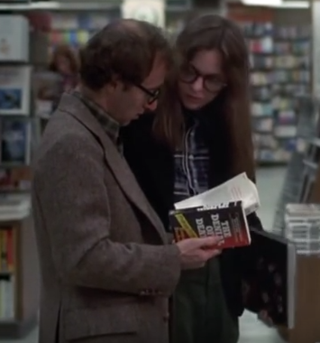
There is a connection between GR and The Denial of Death, which were completed within a few years of each other, which extends beyond Woody’s Allen’s reference to the film Annie Hall, when Diane Keaton calls Allen out about how all of his books have the word, “death” in them.
How did a book like Becker’s ever win a Pulitzer? No one knows for sure. Becker was at Berkeley in the 1960s and was extremely popular among the students (much more than his fellow faculty members.) His book was cross-disciplinary and was a book that also on the radar of the clergy. The book did seem to encapsulate the work of many thinkers — especially psychotherapy and Sigmund Freud.
What does neurosis mean? We discussed how “neurosis” has been something that has been out of vogue for a quite some time. Part of the reason is that medical professionals were unable to define neurosis. (Something like Woody Allen = neurosis doesn’t really work.) It illustrates that many Becker’s explanation of how our repression of death factors into psychotherapy. Much of it is not really accepted nowadays, but Becker always brings up interesting sources and ideas worthy of discussion.
Why does a near death experience interrupt our perception of time?\ There was discussion about various theories including “the speed of thought.”
Speaking of its relationship to Gravity’s Rainbow, is Slothrop a Becker heroic figure. We think maybe so. More discussion.
We liked The Denial of Death, but not sure Becker’s posthumous Escape from Evil (which is considered a better and shorter book.) Otto Rank’s Art and Artist is another book that has come recommended.
The work of Norman Brown factors heavily in Becker’s Denial of Death. Lawrence C. Wolfley’s bridged the gap between Becker and Pynchon in his article “Repression’s Rainbow: The Presence of Norman O. Brown in Pynchon’s Big Novel.” The scholarly article appears in The Modern Language Association-Publications. October, 1977, Volume 92 #5. You may be able to access or purchase it at JSTOR.
The Republic of Suffering: Death and the American Civil War (2008) by Drew Gilpin Faust
One of the reason this book was selected is it also had the word “death” in the title not unlike our previous selection (The Denial of Death). As the death tolls from COVID-19 continued to rise naturally it reminded us of the horrific death tolls of the Civil War. So much so, as we grappled with what is the moral of the pandemic, that it spawned the essay, “The Current Republic of Suffering” which was published by the Tropics of Meta blog in February of 2021. We won’t repeat the theme of that piece here, but there were many other noteworthy observations.
This topic seems especially timely, given that we as Francis says are currently “sentenced to not dying” meaning that our lives are focused on not dying and minimizing exposure to the potential deadly virus. It reminds me of the quote from Woody Allen’s 1975 movie “Love and Death”.
Isn’t all mankind ultimately executed for a crime it never committed? The difference is that all men go eventually, but I go six o’clock tomorrow morning. I was supposed to go at five o’clock but I have a smart lawyer. Got leniency.
Literature of the Civil War
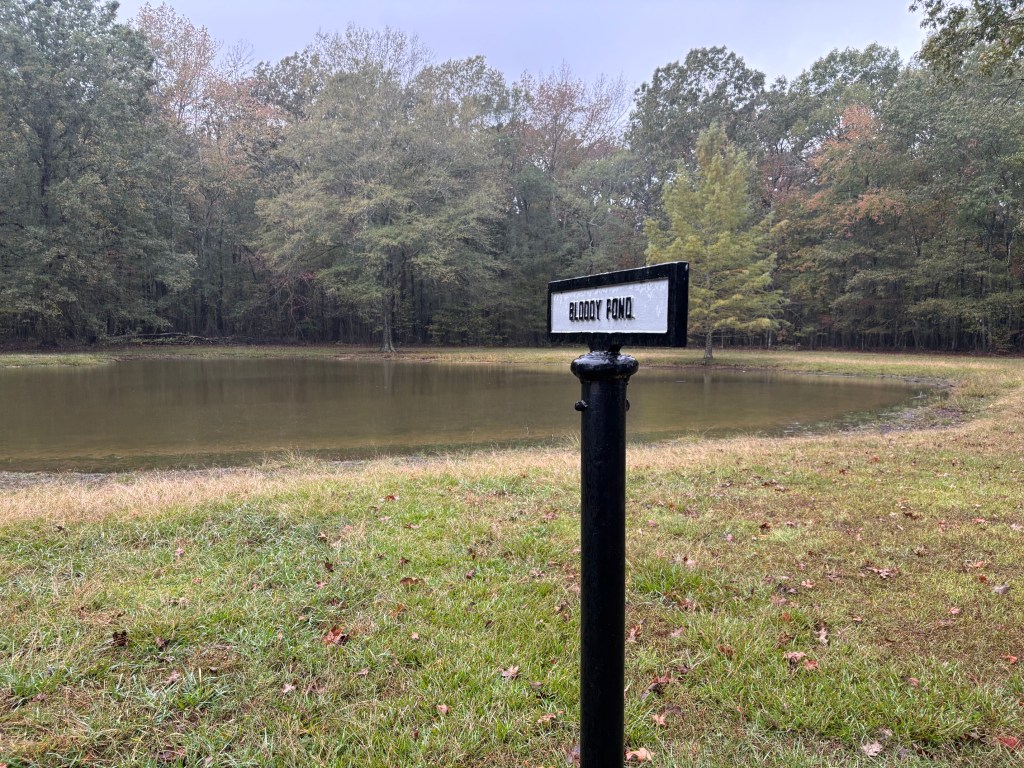
Faust makes the point that there was a dearth of American writers who actually wrote about the war who were actually in it. One exception is Ambrose Bierce, author of the satirical The Devil’s Dictionary and numerous short stories set on the battlefield. Bierce suffered severe head would at the Battle of Kennesaw Mountain just outside of Atlanta (potential field trip?). Coincidentally, Francis and I visited Shiloh almost 20 years ago where there is marker for Bierce at the battle’s infamous Bloody Pond. Faust also writes extensively about the poets Emily Dickinson, Walt Whitman (who served in the hospital in Washington D.C.), and Sidney Lanier.
This photo of the Bloody Pond taken in 2025 by Murray when he revisited another friend.
War Memorials
Confederate War Memorial at Shiloh.
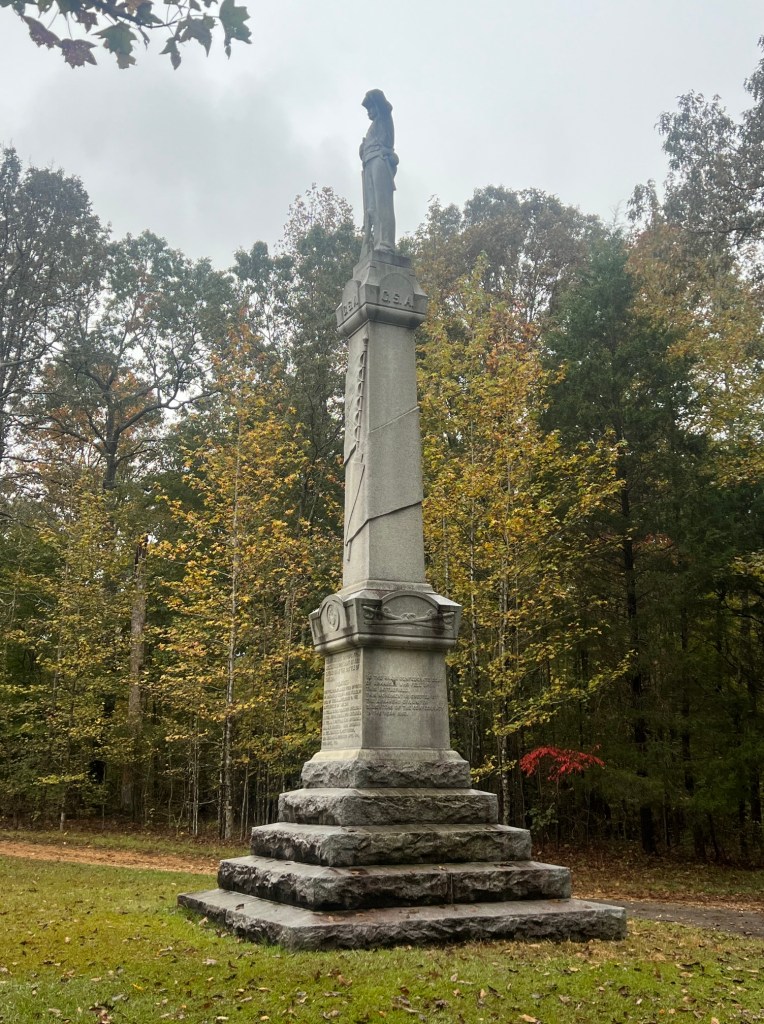
As many Confederate War Memorials are being removed and rightly so because they are sad, cruel, painful reminders for blacks in America, Faust explains why there are more Union memorials than Confederate statues on battlefields is that the North had the money to construct them and no interest in memorializing the Confederates. (The Battle of Atlanta Cyclorama Painting was originally painted for northern veterans). Resources were not available until the early part of the 20th century and as we know that the feelings the South had about the Civil War unresolved and buried in the Lost Cause rhetoric and memories of relatives who fought in the war. (Just like the debate we have today about the Vietnam War.)
This is in contrast the flurry of Confederate War Memorials that were erected in the 1960s, which were more directly in defiance of the Civil Rights Movement. One of the most well-known is the Stone Mountain bas-relief of Jefferson Davis, Robert E. Lee and Stonewall Jackson that was carved into Stone Mountain outside of Atlanta the 1960s (I saw it as a kid “under construction” in 1966 when we visited the city on vacation.) The Park opened exactly on day of the 100th anniversary of Lincoln’s assassination.
The meaning of memorials are both nuanced and loaded and the Faust book provides the origins of those meanings. ( If you really want to read a powerful book about the subject that strikes closer to home read Viet Thanh Nguyen’s 2016 book Nothing Ever Dies: Vietnam and The Memory of War ).
Accounting and Surviving
One of the more moving chapters of the book is the account of the herculean efforts of the Federal government, the military, private organizations and individuals to recover the dead and unaccounted that were spread throughout the South shortly after the war. (See the aforementioned Tropics of Meta piece).
Two quotes come at the end of the book. The first often is attributed to Joseph Stalin: “A single death is a tragedy; a million deaths is a statistic.” Gilpin tempers Stalin’s callous rationale (his Great Purge in the 1930a was responsible for an estimated million dead) when she writes, “how to grasp both the significance of a single death and the meaning of hundreds of thousands.”
Her book does this.
Absalom, Absalom (1936) by William Faulkner
The aim of every artist is to arrest motion, which is life… and hold it fixed so that 100 years later, when a stranger looks at it, it moves again.
-William Faulkner
GRSG selected this book based on a review of Michael Gorra’s The Saddest Words: William Faulkner’s Civil War (2020) by none other than Drew Gilpin Faust which appeared in the September, 2020 issue of The Atlantic.
Reading Faulkner is a challenge and his stream of consciousness style is compared to Marcel Proust (the French admire Faulkner) and James Joyce. Like Pynchon, I adopted the same reading strategy of reading the chapter plot synopsis from SparkNotes first followed by read the chapter.
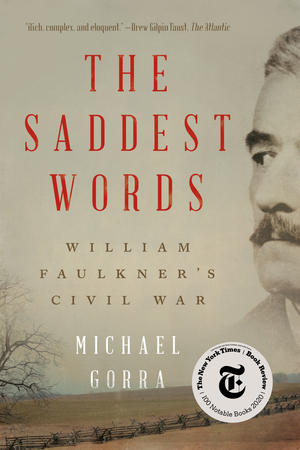
Thinking about reading Faulkner? Get this book as a companion.
Though I had read Light in August in another book group 40 years ago and I was assigned Absalom, Absalom! in college (which I didn’t read), I really knew very little about him. I didn’t even know how to pronounce Yoknapatawpha, the fictional Mississippi county where Faulkner set many of his books. Here’s a clip from Faulkner himself:
Here’s another famous Faulkner quote who worked in the Oxford post office and wrote instead tending to the needs of his customers. Upon quitting he said:
“I won’t ever again have to be at the beck and call of every son of a bitch who’s got two cents to buy a stamp.’
March 12th. The Reading Group is 2/3 the way through Absalom, Absalom!, the point in the novel where Wash Jones scythes Thomas Supten. Here’s a list of things we discussed:
According to Gorra, Shiloh was Faulkner’s favorite Civil War battlefield and less than a two hour drive from his home in Oxford, Mississippi. As a young Civil War buff I recall that Southerners referred to it as the Battle at Pittsburg Landing.
When the Confederate Cavalry Raider Earl Van Dorn raided and burned the huge Yankee supply depot in Holly Springs, Mississippi in December, 1862, it force Grant to pull back from his Vicksburg Campaign. This started the Yankees foraging and raiding livestock and the farms in the South. Until then they refrained from doing this under orders from Lincoln. Later Sherman adopted the same strategy in his March to the Sea. Speaking of which, Sherman created the “40 Acres and a Mule” for freed slaves, not as a kind of restitution, but to keep freed slaves from following his troops. The irony of ideas.
Faulkner in general did not write stream-of-conscious for his black characters. Also he was the first Southern white writer in the early 20th century to even acknowledge the wide spread miscegenation (white slaveholders/black slaves) that was endemic in the South at that time. This reminded one a quote from Richard Schuyler’s dedication of his 1931 novel Black No More.
This book is dedicated to all Caucasians in the great republic who can trace their ancestry back ten generations and confidently assert that there are no Black leaves, twig, limbs, or branches on their family tree.
Discussions of Faulkner include the human propensity and desire to dominate other classes and races. This links back to a previous GRBG book, Ernest Becker’s The Denial of Death, where one of the themes of the book is that human repress their own mortality (instead of sex) by dominating other peoples including killing them to hide from their own inevitable death. Speaking of repression, the South’s repression of the evils of slavery led to the breakdowns and deaths of many Faulkner’s characters. He was brutal in these descriptions.
In Gorra’s book there are a few comparisons to Faulkner and Margaret Mitchell’s Gone with the Wind, which was published in the same year as AA!, he writes:
Faulkner hated the ‘moonlight and magnolia’ tradition to which Margaret Mitchell’s bestseller belongs and claimed he should have gotten twice what she had for the movie rights. He added that his own book was about ‘miscegenation’: there were no takers.
March 29th. In our final discussion devoted to Faulkner, Francis definitely like the book better than I did. Not to say, I disliked the book or didn’t appreciate its legendary status, but Francis spoke specifically about how he liked the Faulkner stream-of-consciousness style mixed with concrete passages of clarity. Speaking of Faulkner having the stuff of legends, check out this essay by Dave Nash, “How to Make a Myth–A Review of Absalom, Absalom.” Nash explains why Faulkner used the biblical title for the novel (The South parallels Absalom.)
Related quotes about, from and inspired by Faulkner:
He must learn them again. He must teach himself that the basest of all things is to be afraid: and, teaching himself that, forget it forever, leaving no room in his workshop for anything but the old verities and truths of the heart, the universal truths lacking which any story is ephemeral and doomed — love and honor and pity and pride and compassion and sacrifice. Until he does so, he labors under a curse. He writes not of love but of lust, of defeats in which nobody loses anything of value, of victories without hope and, worst of all, without pity or compassion. His griefs grieve on no universal bones, leaving no scars. He writes not of the heart but of the glands.
and
I refuse to accept this. I believe that man will not merely endure: he will prevail. He is immortal, not because he alone among creatures has an inexhaustible voice, but because he has a soul, a spirit capable of compassion and sacrifice and endurance. The poet’s, the writer’s, duty is to write about these things. It is his privilege to help man endure by lifting his heart, by reminding him of the courage and honor and hope and pride and compassion and pity and sacrifice which have been the glory of his past. The poet’s voice need not merely be the record of man, it can be one of the props, the pillars to help him endure and prevail. — both from Faulkner’s Nobel acceptance speech
You write a story to tell about people, man in his constant struggle with his own heart, with the hearts of others, or with his environment. It’s man in the ageless, eternal struggles which we inherit and we go through as though they’d never happened before, shown for a moment in a dramatic instant of the furious motion of being alive, that’s all any story is. You catch this fluidity which is human life and you focus a light on it and you stop it long enough for people to be able to see it.” (The most salient characteristic of life is its coerciveness: it is always urgent ‘here and now’ without any postponement. Life is fired at us point blank.) — Jose Gasset “Faulkner in the University”
Only the descent into the hell of self-knowledge can pave the way to godliness.― Immanuel Kant, The Metaphysics of Morals
Favorite selected quotes from Absalom, Absalom:
Doubtless the only pleasure which he (Mr. Coldfield) had ever had was not in the meagre spartan hoard which he had accumulated before his path crossed that of his future son-in-law;—not in the money but in its representation of a balance in whatever spiritual counting-house he believed would some day pay his sight drafts on self-denial and fortitude.
He (Sutpen, the self-made man) had been too successful, you see; his was that solitude of contempt and distrust which success brings to him who gained it because he was strong instead of merely lucky.
and then Wash Jones sitting that saddleless mule before Miss Rosa’s gate, shouting her name into the sunny and peaceful quiet of the street, saying, ‘Air you Rosie Coldfield? Then you better come on out yon. Henry has done shot that durn French feller. Kilt him dead as a beef.’ ” (like Conrad—Heart of Darkness—”Mr. Kurtz, he dead”).
…each look burdened with youth’s immemorial obsession not with time’s dragging weight which the old live with but with its fluidity.
(and thank God you can flee, can escape from that massy five-foot-thick maggot-cheesy solidarity which overlays the earth, in which men and women in couples are ranked and racked like ninepins; thanks to whatever Gods for that masculine hipless tapering peg which fits light and glib to move where the cartridge-chambered hips of women hold them fast);—not goodbye: all right: and one night he walked up the gangplank between the torches and probably only the lawyer there to see him off and this not for godspeed but to make sure that he actually took the boat. Faulkner anticipating the Beatle’s Happiness is a warm gun, or maybe he is just describing how people write history with their loins….
So they took the steamboat North again, and more gayety and excitement on the boat now than Christmas even like it always is when a war starts, before the scene get cluttered up bad food and wounded soldiers and widows and orphans.
to talk about wounds in the Confederate army in 1865 would be like coal miners talking about soot.
Battles lost not alone because of superior numbers and failing ammunition, and stores, but because of generals who should not have been generals, who generals not through training in contemporary methods are aptitude for learning them but by the divine right to say “Go there” conferred upon them by an absolute caste system; or because the generals of it never lived long enough to learn how to fight massed cautious accretionary battles.
And the unforgettable exchange between Charles Bon and Henry Sutpen, which is perhaps the climax of the novel. “So it’s the miscegenation, not the incest, which you can’t bear.”
Stillwell and the American Experience in China, 1911-1945 by Barbara W. Tuchman
Francis had mentioned Barbara Tuchman’s book Practicing History: Selected Essays (1981) in previous GRSG meetings and even sent me a copy. Francis mentioned that he had used this Tuchman book in teaching his medical students the importance and the techniques of taking patient histories. As one who is working on the history of his father (looking at his war letters), I had an interest in reading this book. Francis had not read the book in decades and revisiting a book can be illuminating. This book–published in 1971 – did not disappoint either of us.
Meeting Notes of April 16, 2021
Tuchman deconstructs what makes her such a good history writer who enjoyed a wide readership. Thinking of the reader in terms of language and clarity of writing. (She says the research is the easy part; writing is more difficult.) She does not throw the kitchen sink at you, but says the good historian must be selective. There is an element of wit and humor in her writing, but never at the expense of the narrative. Practicing History is divided into 3 parts. Part One is about history writing with many examples of her own work. Part Two is reprints of things she wrote in the late 1960s about Israel and the beginning of the First World War. (She won the Pulitzer for The Guns of August about the first month of the war.) Part Three is more about History.
Francis sent along his favorite Tuchman passages, which reinforced our observations:
1) It is exactly this quality of perceiving truth, extracting it from irrelevant surroundings and conveying it to the reader or the viewer of a picture, which distinguishes the artist.- Tuchman
2) Historians provide a one-way screen on the past through which one can see man, at one time or another, committing every horror, indecency, or idiocy that he is capable of today. Tuchman
3) The best picture and the best history, he said, are those “which exhibit such parts of the truth as most nearly produce the effect of the whole.” Tuchman
4) Especially in an alien setting like China—but the rule should hold true for all historical writing—I try never to introduce a place name without locating it in relation to some place already mentioned, nor introduce a person without describing some attribute that will fix him in the reader’s mind. Tuchman (I noted that both Rick Atkinson and Shelby Foote do this very well.)
5) I think this development is part of the anti-excellence spirit of our time that insists on the equality of everything and is thus reduced to the theory that all facts are of equal value and that the biographer or historian should not presume to exercise judgment.- Tuchman
Her references to another Pulitzer book that she wrote — Stillwell and the American Experience in China, 1911-1945 (1971)- inspired us to include the Stillwell book in our reading regime. (I got my copy for $1 at the Friends of the Library Book Sale when we used to have sales like that.) Tuchman explains that Stillwell was just the perfect entry point to write about the era of China and America. (not unlike Neil Sheehan’s A Bright Shining Lie: John Paul Vann and America in Vietnam). One note is our discussion is that events like The Insurrection at the Capitol on January 6 will be best handle by the historians. Everything is to close and too jumbled. It will take an historian ten or 15 years down the road to sort it all out.
Warning: Stillwell is a long, long read. Sometimes you feel you are hacking through the jungles of Burma. She is a very meticulous researcher and writer and these details while give amazing validity to the diplomacy between China and United States and how it shaped the globe shortly after World War II. You get a strong sense of the Chinese people and how the Communists prevailed over the Nationalist leader Chiang Kai-Shek, who was mostly consumed with staying in power and was more interested in stockpiling resources (U.S military aid) that trying to defeat the invading Chinese.
Stillwell was amazing leader who had brains, courage and the will to see things through against almost insurmountable odds. He might have been a more well-known and esteemed figure like Eisenhower, Patton or MacArthur but he died soon after the war.
The Periodic Table by Primo Levi
Monsters exist, but they are too few in number to be truly dangerous; more dangerous are the common men, the functionaries ready to believe and to act without asking questions. – Primo Levi WQ
Levi (1919-1987) was an Auschwitz survivor who wrote about his experiences soon after the war in If This Is a Man. The Periodic Table was published in 1975. Basically, he tells a story or personal story based of the properties of one the elements in The Periodic Table. I had read the book decades ago and always wanted to revisit it and Francis, being a man of science agreed. We both thought this was one of the best books we had read in the Gravity’s Rainbow Support Group, which has been going on for over a year now.
One strange coincidence about this selection is that Levi, survived Auschwitz by working as a chemist. The company that “owned” the Bono chemical works next to Auschwitz was IG Farben, who Pynchon focuses on somewhat in Gravity’s Rainbow when he refers to the large German corporations that profited from the war.
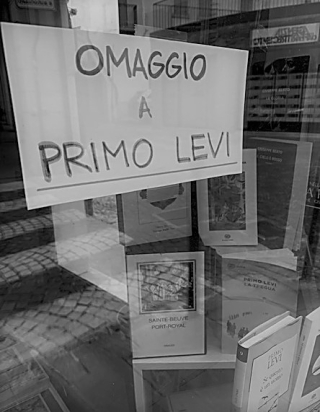
A bookshop in Treviso, Italy promoting Levi’s works.
Favorite Passages from The Periodic Table.
He (Dr. Muller) was not the perfect antagonist, but, as is known, perfection belongs to narrated events, not to those we live. Primo Levi—The periodic table page 215 (on page 34, he describes the impurities in zinc as that which gives it life in the real world…something the chemist can work with…)
…And because, where there is damage, there is sin, and where there is sin, there is a sinner. Primo Levi, The Periodic Table page 207 (where there is an …ism, there must be an …ismer) FWalker
Ariadne’s thread. Page 208 Primo Levi, the Periodic table—(the clue, which is followed guides one to the solution/answer). (on page 204—he describes thrashing about in the dark, looking for a solution, until one finds a slight glimmer and follows it…contrasting with crashing around in a cave, with the ceiling progressively narrowing as you move forward, until, abashedly you climb out backwards on hands and knees….On 203, he describes my kind of stories—the foot soldiers who discover solo not in large corporations or group efforts….. Primo Levi, The Periodic Table and see page 76 for his definition of the “glimmer”: “There is nothing more vivifying than a hypothesis.”
Trustworthiness, is the most constant virtue, which is not acquired or lost with the years. One is born, worthy of trust, with an open face and steady eye, and remains that way for life. He who is born contorted and lax remains that way; he who lies to you at six, lies to you at sixteen and sixty. The phenomenon is striking and explains how friendships and marriages can last …Primo Levi The Periodic Table page 20
….and finally their came the customer we had always dreamed of who wanted us as consultants. To be a consultant is the ideal work, the kind you derive prestige and money without dirtying your hands, or breaking your backbone or running the risk of ending up roasted or poisoned. All you have to do is take off your smock, put on your tie, listen in attentive silence to the problem and they you will feel like the Delphic Oracle. You must then weigh your reply very carefully and formulate it in convoluted, vague language so that the customer also considers you an oracle, worthy of his faith and the prices set by the Chemist’s society. (chapter: Nitrogen page 175, Primo Levi The Periodic Table—which then follows with him looking for a source of Uric Acid scrabbling around collecting chicken shit).
Anyone who has the trade of buying and selling can be easily recognized: he has a vigilant eye and a tense face, he fears fraud and considers it, and he is on guard like a cat at dusk. It is a trade that tends to destroy the immortal soul…there have never been philosopher wholesalers or storekeepers. Page 169 Primo Levi the periodic table
Page 44: primo levi—the periodic table. He spoke grudgingly of his exploits. He did not belong to the species of persons who did things to talk about them (like me)..
The sacredness of the recipe….(once established people don’t dare mess with it, particularly those who don’t understand it) 158; page 154: It is the (humans) spirit that dominates matter, is this not so? (this is why he threw himself into his work trying to sort out varnish that had transmuted into orange livers…) Primo Levi The periodic table.
Prometheus had been foolish to bestow fire on men instead of selling it to them: he would have made money, placated Jove, and avoided all that trouble with the vulture. Primo Levi The periodic table page 143
Page 110—Primo Levi disparages A. Starace, who the translator points out was the secretary of the Italian Fascist National Party for many years and who, distinguished himself in his stupid zeal with which he strove “to Purify” the customs of the Italians, particularly their tendency to adopt foreign terms as their own, such as the terms “hotel” or “foyer”. In The periodic table.
Page32; Primo levi describes the person who lives vicariously through his superior—the admin sec, the asst. chemist. Etc. who represent authority without possessing it themselves….
Other quotes from Levi from Wikipedia Quotes (WQ)
Better to err through omission than through commission: better to refrain from steering the fate of others, since it is already so difficult to navigate one’s own. Primo Levi WQ
“A country is considered the more civilized the more the wisdom and efficiency of its laws hinder a weak man from becoming too weak and a powerful one too powerful.” Primo Levi WQ
“We who survived the Camps are not true witnesses. We are those who, through prevarication, skill or luck, never touched bottom. Those who have, and who have seen the face of the Gorgon, did not return, or returned wordless.” Primo Levi WQ
Those who deny Auschwitz would be ready to remake it. Primo Levi wQ (see Voltaire—those who can make you believe absurdities can make you commit atrocities.)
To be considered stupid and to be told so is more painful than being called gluttonous, mendacious, violent, lascivious, lazy, cowardly: every weakness, every vice, has found its defenders, its rhetoric, its ennoblement and exaltation, but stupidity hasn’t. Primo Levi WQ
Finishing on a lighter note- The infamous Element song from Thomas Lehrer.
Cultural Amnesia: Necessary Memories of History and the Arts (2007) by Clive James
Culture memory is difficult: too much detail. Cultural amnesia is easier.
— James on Arthur Schnitzler
James’s Introduction-Overture
The polemicist has the privilege of unifying his tone by leaving out the complications. I have tried to unify it while encompassing the whole range of a contemporary mind.
In Austria the quota system was built into every area of society as a set of laws, limits and exclusions. As an inevitable result, in Austria even more than in Germany there was a tendency for scholarship and humanism to be pursued more outside the university than inside it.
Nina Berberova
In the book she tells the story of the Writers’ Library, the bookshop in Moscow where the books of the old intelligentsia were traded for food after the Revolution.
Raymond Aron
The essential trick was to offer the intellectuals the opportunity to continue their careers if they kept their protests suitably muted. The first result was a widespread but tacit collaboration. When you consider the mental calibre of the people involved, Paris under the Occupation thus becomes the twentieth century’s premier field of study in which to reach the depressing conclusion that even the most liberal convictions buckle very easily under totalitarian pressure, unless there are extraordinary reserves of character to sustain them. (Raymond Aron was in England and had escaped)
Hitler had dropped the equivalent of an atomic bomb on at least six million perfectly innocent people—a weapon more than sixty times more powerful than the one that obliterated Hiroshima. Stalin had dropped the equivalent of an atomic bomb a hundred times more powerful on his own citizens. Those bombs had gone off in comparative silence, but Aron had understood the repercussions.
Marc Bloch
It is commonly and truly said that young people who want to set the world to rights learn later to be grateful that the world is not worse than it is; but if they were convinced of that too early, we would lose their critical effect, and the world would be worse still.
Profundity can be attained by embracing principles with no basis in science. The occult and the mystically profound are perennial short cuts to a supervening vision: a world view without the world. Extreme authoritarianism is only a step away.
(Note:GRSG did Marc Bloch’s book later in 2021.)
Chamfort ( who got the guillotine for his efforts at being realistic)
The Revolution had given birth to ideological malice in a form we can now recognize, but it was not recognizable then. Chamfort was the one who supplied the lasting definition of fraternité: “Be my brother or I will kill you.” That, in fact, was the joke that killed him: he was arrested soon after making it.
Murray: I have currently reading Ministry for the Future by Kim Stanley Robinson, which has a similar quote: “You can tell them they must change their ways. If they don’t we will kill them.”
Ideology
Modern history had given us enough warning against treating simplifications as real. The totalitarian states….had been propelled by ideologies and what else was an ideology (…) other than a premature synthesis. (“an oversimplification/slogan, I think” says Francis).
A page from the Robinson book
Second Meeting
Our Wednesday, August 18, 2021 there was a lot of discussions about aphorisms.
Francis and I both like aphorisms (and Clive James does too). Francis recommended The Oxford Book of Aphorisms by John Gross, is the one I think is the best on this topic. I recommended Eva Brann’s DoubleThink Double Talk. (reviewed in The Book Shopper blog here). Francis knew about Brann and we have decided to read Brann’s Homeric Moments later this year.
Golo Mann and Tacitus
Golo Mann (Thomas Mann’s youngest son) both appreciate the elliptical style of the Greek historian. “They make a desert, and call it peace.”
The true high worth of Tacitus depended on his always being aware that tragic events had been the result of accidents and bad decisions and the depth of the tragedy lay in the fact that the accidents need not have happened and the decisions might have been good.
(Farce is nearer tragedy in its essence than comedy is. Samuel Coleridge 1833)
Also: One becomes a seer in the safest possible way: retroactively. One predicts the past as a dead certainty.
“By an effort of the imagination, the historian must put himself back into a present where the future has not yet happened, even though he is looking back at it through the past. “ Clive James on Golo Mann
“We are all allowed to predict the future: it is one of the imagination’s privileges. But predicting the past is a mischievous habit, and Golo Mann was the first to spot just how pervasive it was becoming, as historians presumed to impose upon events a baleful shape that had stolen into their minds: a shape that was a self protective reaction to the events themselves—one more version of the small man’s revenge for helplessness.” More Clive James on Golo Mann
The final line in the James piece talks about how beliefs can be a weak precursor to ideas. “It’s a belief, and precedes its attendant ideas as the stomach ache precedes the vomit.”
Other Notable Entries from the Book
Lewis Namier
“One would expect people to remember the past and to imagine the future. But in fact, when discoursing or writing about history, they imagine it in terms of their own experience, and when trying to gauge the future, they cite supposed analogies from the past: till, by a double process of repetition, they imagine the past and remember the future.”
Arthur Schnitzler
An essay about stupidity using the movie Where Eagles Dare as a prime example.
Michael Mann
An essay on the poor dialogue in movies (citing movies with DeNiro and Pacino) and the production values and the look of the movie are more important.
W.C. Fields
The master of tight dialogue, which is a lot like aphorisms.
We also talked about Climate Change/Catastrophe ending the call on another aphorism
“We like believing the best because nothing need be done about it, and the worst, because nothing can. “– James Richardson
Next up is Marc Bloch’s The Historian’s Craft.
The Historian’s Craft by Marc Bloch
What we are currently reading often leads to what we read next. Such is the case of Marc Bloch who piqued our interest in Clive James’ Cultural Amnesia. Bloch (1886-1944) was a French historian who served in World War I and then joined the French Resistance in World War II at the age of 55 in 1942 and somehow managed to write this primer of “reflections on the nature and uses of history and the techniques and methods and those who write it.” While many French intellectuals laid low during the occupation (Sartre, Camus) or left the country (Raymond Aron), Bloch stayed in France. Sadly in 1944 he was captured by the Germans, tortured and then executed. Clive James in his essay about Bloch writes extensively about choices the intellectuals made.
This book is for those hard core historians or those who wish to be historians. It’s much more technical than a similar book — Barbara Tuchman’s Practicing History. Fortunately, this book is short (it was uncompleted and gathered up from his notes) but we both found us marking many passages of interest. Here’s a list (everything in quotes is directly from the book. Our comments/thoughts are interwoven with it).
Page 4 and later in Page 110: “Christianity is a religion of the historian (4) and “it was the collation of the stories of the Gospel which gave us a rise to Biblical exegesis.”
Page 14: Quoting first Fustel de Coulanges and then before him Bayle: “History, the most difficult of the sciences”. Much of the book references other historians in the 19th Century historian Michelet (who coined the Renaissance era) and Bloch often mentions Voltaire.
Page 17: “It is useful to ask oneself questions, but very dangerous to answer them.”
Page 19: “I submit it for what it is and no more: the memorandum of a craftsman who has always liked to reflect over his daily task, the notebook of a journeyman who has long handled the ruler and the level, without imagining himself to be a mathematician. “
Page 27: (For some, time is but a measurement or arbitrary dividing line). “In contrast, historical time is a concrete and living reality with an irreversible onward rush. (like life, according to Jose Ortega Gassett, fired at us point blank) It is the very plasma in which events are immersed, and the field within which they become intelligible.”
Page 35—“In a word, a historical phenomenon can never be understood apart from its moment in time. “
Page 29: ….”this idol of the historian tribe may be called the obsession with origins”
Page 31: “Christianity (and Judaism and maybe Islam) are in essence historical religions…”
Page 34: Much to the despair of the historians, men fail to change their vocabulary every time they change their customs.
Page 35: Old Arab Proverb “Men resemble their times more than they do their fathers.”
Page 43: “Misunderstanding of the present is the inevitable consequence of ignorance of the past. But a man may wear himself out just as fruitlessly in seeking to understand the past, if he is totally ignorant of the present”
Page 44: (The order of inquiries into history do not necessarily correspond to the sequence of events). (Maitland says we read history backwards and reconstruct it forwards)
After all: “…..it is always by borrowing from our daily experiences and by shading them where necessary that we derive the elements which help us restore the past.” “It may happen, in a given line, that the knowledge of the present bears even more immediately upon the understanding of the past.” “For the natural progression of all research is from the best (or least badly) understood to the most obscure.”
Page 50: “The student of the present is scarcely any better than the historian of the past.”
Page 65: Cross examination of historical documents—(it doesn’t happen by sitting and waiting for an inspiration….) ”Naturally, the method of cross examination should be elastic, so that it may change its direction or improvise freely for any contingency, yet be able from the outset, to act as a magnet drawing findings out of the document.”
Page 79: “The most naïve policeman knows that a witness should not always be taken at his word… Similarly, it has been many a day since men first took it into their heads not to accept all historical evidence blindly.”
Page 98: The hierarchy of historical fabrications….
-Outright fraud, forgery, error….. (recognize forgeries and their motivations)
Advanced notices of a planned event, written ahead of time to be sent in as reports from the field.
-Innocent interpolation in documents based on missing data that the writer added for either verisimilitude or completeness.)
Page 100: “The absurd rumor was believed because it was useful to be believe it.” (Bloch says we tend to count eras by centuries but that is not necessarily a good practice.)
Page 102: “Whence came the fatal shot which precipitated the riot in front of the Office of Foreign Affairs on 2/25/1848? And, from whence in its turn the revolution was to result? Did it come from the troops or the crowd? We will never know……..”(not unlike the origin of the virus at Wuhan) “But wasn’t the shot simply the last little spark? It is important to understand circumstances—not necessarily every precise detail.” (Does the presence of an accurate eye-witness really matter?)
Page 107 -110: Bloch on the “the role of propaganda and censorship… may be exactly the reverse of what is expected. The prevailing opinion in the trenches of WW1 was that anything might be true, except what was printed. The men put no faith in newspapers, and scarcely more in letters…. for these too were heavily censored. From this there arose a prodigious renewal of oral tradition, the ancient mother of myths and legends…Wiping out bygone centuries (of communication) ….to the means of information and the mental state of olden times before journals, before news sheets, before books. ….(It was the cooks and the carriers who filled in.) They…were situated on the crossroads of all units and could even speak to drivers of the regimental service corps—quartered in the vicinity of staff headquarters (the staff who never communicated with the lower ranks). …Like peddlers, jugglers, pilgrims and beggars of days of yore—…..they create the culture media for false news. (For some reason…) We have faith in that narrator who, at rare intervals, brings us distant rumors over a difficult road.”
Page 112: “There are in the world scholars whose good nature has worn itself out in seeking a middle ground between antagonistic statements.”
Page 138: “There are two ways of being impartial: that of the scholar and that of the judge. They have a common root in their honest submission to the truth. The scholar records, better still, he invites, the experience, which may, perhaps, upset his most cherished theories. The good judge, whatever his secret heart’s desire, questions witnesses with no other concern than to know the facts, whatever they may be. For both this is the obligation of conscience which is never questioned.”
Page 139: “Now, for a long time, the historian has passed for a sort of judge in Hades, charged with meting out praise or blame to dead heroes. We cannot but believe that this attitude satisfies a deep-rooted instinct. The words of Pascal are more to the point: ‘We all play God in judging: this is good or this is evil.’ “
Page 140: “…Are we so sure of ourselves and of our age as to divide the company of our forefathers into the just and the damned? How absurd it is, by elevating the entirely relative criteria of one individual, one party, or one generation to the absolute, to inflict standards upon the way in which Sulla governed Rome, or Richelieu the States of the most Christian King.”
When the passions of the past blend with the prejudices of the present, human reality is reduced to a picture in black and white. Montaigne: ‘Whenever judgment leans to one side, we cannot help distorting and twisting the narrative in this direction.’”
Page 143: “Even in action, we are far too prone to judge. It is so easy to denounce. We are never sufficiently understanding. “
Page 195: Napoleon: ‘There is nothing so rare as a plan.’ “We should seriously misrepresent the problem of causes in history if we always and everywhere reduced them to a problem of motive.”
The Homeric Moments: Clues to Delight The Odyssey and the Iliad by Eva Brann
he GRSG agrees that reading Eva Brann’s Homeric Moments: Clues to Delight in Reading the Odyssey and the Iliad (2002) was not as challenging as reading Gravity’s Rainbow. For Murray, it was similar experience to reading the Faulkner’s Absalom, Absalom where you had to read the plot summary, then the chapter and then follow along with analysis like the Gorra book. If only I been such a diligent English major in college, I could have had a B average. While reading Homeric Moments, I was also reading W.H.D. Rouse’s 1937 translation of The Odyssey.
Brann does a lot of riffing in Homeric Moments and as a reader you must accept that. (It’s not a criticism thing it’s just a style you have to be comfortable with.) We think of her as the professor teaching Homer to young students and things are constantly popping into her head – with all kinds of connections. Singling out themes and connections into 48 chapters and then referring those chapters by numbers was a brilliant strategy. You could see the connections and refer to the other chapters without breaking the flow of the text.
On Epic Poetry
“This triplicity of authorship—Muse, Homer, Odysseus—together with the duplicity of the chief actor, makes the Odyssey the most complexly told tale I know. It is complicated though not bottomless, but rather clear and decodable.” — Eva Brann
On Teaching Classics to a Younger Generation
“Anyone who has read the Iliad with young students knows it is glory that grips and puzzles them. It puzzles them because their modernity requires them to think that only the deed and not its large shadow should matter, and it grips them because it is their suppressed longing. And that their glory should become visible in prizes— women (or mutatis mutandis, men), chariots, and golden cups—and audible in songs the world sings—would give them the deepest satisfaction.” Eva Brann
“Learning begins when development ends, for growing into oneself absorbs all the cognitive energies which, once “identity” is achieved, are free to turn to the world. For how can we learn if it is not we who are there to learn? We either change or grow wiser, but not both. “ Eva Brann
Comparing Homer’s World to Ours.
Here is what Eva Brann says about Homer’s world:
The axiom behind such reading, the rather minimal, though by no means uncontroversial working hypothesis, is that the poet made a world that we are authorized to enter and enabled to inhabit by the mere title of our humanity; for all the lands of the imagination live in a territorial union that imposes no passport checks or import duties on the traveler. Less fancifully: If you’re human, Homer is home territory. And later on she says: All this would hardly need saying were it not a serious theoretical claim that other societies and eras do have different mentalities, mind-sets ultimately incommensurable with ours. (Francis: I think Marc Bloch would not dispute this.)
Interesting to note that the Cyclops were a relatively primitive people and society (indigenous?) that were eventually ransacked by the more civilized Greeks. Something that has gone on for time immemorial.
The roles that the Gods play. Gods are immortal, but not eternal. (Brann) They really do what they want to do. We still have people “praying” for the victims. It reminds one of Kurt Vonnegut Jr. who wrote “God is the laziest man in town,” who sits back and does nothing.
Game of Thrones has nothing on The Odyssey in terms of graphic violence. From Book XXII “The Battle in the Hall” when Odysseus’ main rival Aninoős gets his:
Then he (Odysseus) let fly straight at Aninoős: he was holding a large goblet in both hands, an about to lift it for a drink…The arrow struck him in the throat, and the point ran through the soft neck. He sank to the other side, and the goblet dropped from his hands. In an instant a thick jet of blood spouted from his nostrils; he pushed the table away with a quick jerk of his feet, spilling all the vittles on the ground— meat and bread in a mess.”
You can only imagine that the audience liked these action sequences.
Act of Lying
Quote from Brann: Who is there that has managed a lot of life sagaciously and has not told controlled lies? But Odysseus does not lie to himself, as does noble Achilles, nor does he lie for himself in a mean and narrow sense. He lies royally, as a king sometimes must who is returning a people in part run wild to its old and just constitution.
Brann (page 33). “Achilles is, in his own estimation, a man of truth, while Odysseus is an accomplished liar.”
However, Odysseus did NOT lie for his own personal gain. He did it more to protect people. (Penelope, the swineherd)
The Strengths and Weaknesses of Odysseus
Yes, although Odysseus is a hero, we see his faults as well. (All the men that served with him on the ships ended up dead.) And during his Odyssey we see that he was not exactly faithful to his wife Penelope during his “business” trips, but… Not exactly the most merciful guy.
For Achilles, it was good for his hero image as he died young. This is often true of musicians, athletes and movie stars (River Phoenix, James Dean, Kurt Cobain, Heath Ledger, Lou Gehrig). JFK’s allure is because he died relatively young.
Brann says in pages 31-34 that the Iliad and Achilles is for the young man and The Odyssey is about “long life, its multiplicities, experience, and its single-minded purpose is the theme..”
The Women
The Helen thing is, more just a couple of things: (I didn’t realize that Odysseus had made a booty call while in Troy.)
Francis: “I think she reminds me of some of the more pitiable women celebrities of today–privileged but also limited by their appearance in that it blinds them and others as to their weaknesses–and yet, even when they are past their prime they still feel obliged to post selfies of themselves in bikinis–unveiled as it were…”
(This is what the old men think about Helen): “They all wish she (Helen) were gone, danger that she is to Troy, but they also love to see her; she seems to go, contrary to decorum, unveiled.”
“Amidst all this sadness Helen goes to work, witch that she is, with her Egyptian drug, “pain-killing and wrath reducing,” that makes one forgetful of evils. It is only after having dropped this tranquilizer into their wine that she tells the young son and the old husband that risky story of Odysseus the beggar.”
(Also–the tapestry she was weaving was all about her–which captured, who, in her view, was its center.)
Calypso calls out the double-standard that the male gods get to do what they please with women, but women must remain faithful. Should have Penelope be waiting for Odysseus with a rolling pin?
Brann quotes about women: “There is a fame of women as well. Generally speaking, the Iliad is, after all, a memorial to the value an entire people has chosen to place on one of its women. “
“But it is not Helen, Briseis, Circe, Calypso, or even Nausicaa who are the bearers of the “fame of women.” It is Penelope whose fame is particularly sung in the Odyssey.”
“To persuade ourselves that such solid good sense was then and ever after not only compatible with, but a condition for, lovableness, we may leap two and a half millennia forward to Jane Austen’s women.”
Fictitious Places?
For the most part, the places mentioned were imaginary. You can try to figure them out exactly, but really it doesn’t matter. Only Crete and Ithaca are places on the map, but there are probably a few others.
“….Odysseus picks that up and gracefully names Hermes as his own god, “who endows with grace and glory the works of all men”—surely the most modern words ever spoken by a supposedly feudal king.”—Eva Brann
Memories of Battle
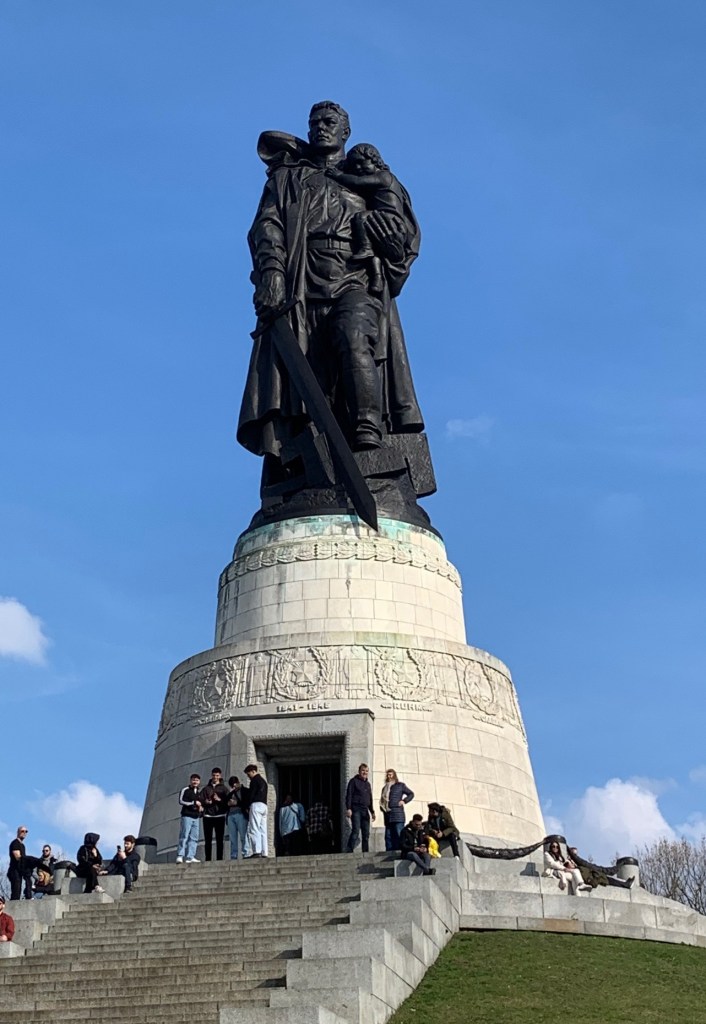
Soviet War Memorial in Berlin Germany to honor Soviet soldiers.
The Odyssey is similar to Drew Gilbin Faust’s The Republic of Suffering, (an earlier GRSG selection) because many of the characters must deal with the memories of war. Those back in Ithaca struggle to define what happen in Ilium.
“…the Odyssey, which is the compensating catchall, a tightly woven container of the whole war as it is relived in the memories of wives, veterans, and singers.” Eva Brann
“The word nostos is familiar to us in “nostalgia,” “return-ache,” a word coined in a medical treatise of 1688 for the debilitating sadness affecting mercenaries long away from home.” Eva Brann
“Thus the Iliad is like a memorial wall on which the warriors, living and dead, of both sides are inscribed. In the Odyssey there are only half that many names; though its world is larger, its population is sparser.” Eva Brann
The discussion of war memorials and the removal Confederate War memorials has always been a topic of discussion with The Republic of Suffering and now with The Odyssey. On the one hand they do cause pain for many and that cannot be trivialized, but to have NO memory of past historical events?
“In this adventure Odysseus has his first experience of three cooperating evils: his own finite energy, his crew’s distrust, and the directed hatred of Poseidon. He learns a strange fact about the world: When authority and trust fail, the elements are freed to become rambunctious.” Eva Brann
Heroes and Legacy
What moves men of genius, rather, what inspires their work, is not new ideas, but their obsessions with the idea that what has already been said is not enough. Delacroix 1822 (genius)
On Character: I think both Odysseus and Penelope were not satisfied with what others might consider good enough. (Francis)
“Odysseus, who is in fact called “hero” only once in the Odyssey (29), is a remarkable exception to glory seeking, being for the ten-year duration of his odyssey quite purposefully out of sight and out of hearing—as Telemachus succinctly says: “unsightable, undiscoverable” (aïstos, apustos). I think he can be so unheroic because he is perfectly secure in the sufficiency of his hero’s fame, as Achilles never seems to be.” When he finally uncovers himself” ….. (we see his)… “flexibility” as we say, and the attendant features of wiliness, tact, ingeniousness, ready charm, and occasional formidableness. For these are all traits for managing circumstances so as to protect the essential Odysseus “ Eva Brann
Penelope: “ …. very own epithet, said of her by others often and by herself once: “thoughtful” (echephron), “mindful” with the fullest force, which signifies being in complete possession and control of one’s mental powers. I think the word has a kind of sober glory about it for Homer.” Brann
Our Discussion: But then there are heroes that live a long time grow in stature: almost become more majestic: Kareem Abdul Jabbar (as opposed to Kobe Bryant) but someone like Michael Jordan and Anthony Bourdain have not grown in stature with age.
Legacy is something that is discussed by news casters, sports pundits, but does the person really have that much control over their legacy or do they think about their legacy when they act. A prime example is Colin Powell who recently died. There were the obituaries of “he was born, he grew here, he was the Secretary of the Defense.” And then there are follow-ups about Powell’s legacy, which according to Maureen Dowd of The New York Times and The Economist is not so sterling.
An Inventory of Losses by Judith Schlansky
Though she perhaps better known as the award-winning graphic artist for the book Atlas of Remote Islands, the German writer Judith Schalansky is also a novelist and as essayist. An Inventory of Losses is a series of related essays, (not a collection which can be sometimes piecemeal and uneven) where she ruminates about things that have been lost (people, places, buildings, writings) or some combination thereof. “Being alive means experiencing loss,” she writes.
The timeline of how I found about this book is a little unconventional. It began after reading Kate Zambreno’s review of the book in The New York Times and I brought a copy of the book to my daughter Cynthia in Germany in October– who like Schalansky lives in Berlin. (She seems like the kind of person who could have joined Cynthia and me at the Pynchon-inspired Muted Horn bar) Intrigued I also picked up a copy of Schalansky’s Pocket Atlas of Remote Islands, scaled down version of her original full-sized Atlas of Remote Islands (2009).
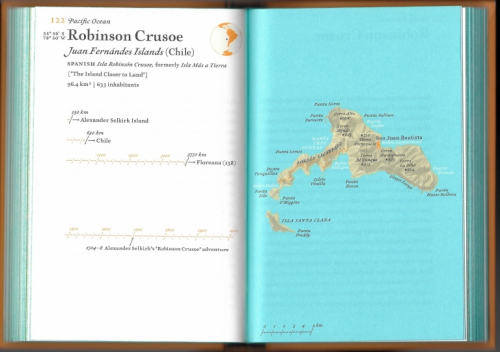
Upon returning, the GRSG selected Inventory. I did not read the book in its entirety for a second time, but I did reread the Preamble and Preface, which was more meaningful after reading her Pocket Atlas book.
But enough with the chronology, “the most unoriginal of all the organizational principles being only a simulation of order, writes Schalansky (p.20).
As Zambano’s review suggested, the book is uneven. Some pieces are intriguing and powerful. Others leave you scratching your head and not caring. Here are the better ones:
Preface
For us at GRSG, the preface is most interesting since it underlines some of the issues that we have discussed in other books such as the Homer books especially in terms of fame and legacy. “The caesura of death is the point where legacy and memory begin” (p.13). Who knows better than Achilles, Odysseus and Eva Brann who wrote in Homeric Moments, “Death is a sort of lesser life and fame its one enhancement.” (p 175)
“Apparently, in the mid-seventeenth century, the British parliament seriously discussed burning the Tower of London archives to extinguish all memory of the past and start life over again, at least according to Jorge Luis Borges in a passage I have been unable to locate. “
Francis comment: Goethe wrote that “Writing up history is one way of getting rid of the past” but erasing it is also a tempting option and it appears it is not exclusive to totalitarian regimes. But anyone who has ever taken notes for a meeting knows how even a subtle revision can help create an influential result–and one that may or may not accurately reflect the intent of the group.
Caspian Tiger
A gory, gruesome and ultimately sad tale of now extinct tiger, which is closely related to the Siberian tiger. Schalansky details the battle to the death of the two big cats in a coliseum like setting. The piece begins with an impressive almost Faulknerian description of the Caspian tiger’s habitat:
Griefswald Harbor
In this piece, Schalansky details the 25 km trek along the Ryck River that empties into the Baltic Sea. She grew up in the area which is also the home of the famous 19th century Romantic landscape painter Caspar David Friedrich whose most well-known painting is the “Wanderer Above the Sea Fog.” Many of Friedrich’s artworks were lost in a fire in Munich and the bombing of Dresden in World War II.
Encyclopedia in the Wood
The story of Armand Schulthess, who ran a ladies-wear company left Geneva and Zurich and purchase a sizeable grove a chestnut trees which he “gradually transformed into an encyclopedia in the wood organizing human knowledge by subject area and inscribing it on more than a thousand metal plates. ” (Much of the knowledge was sexual in nature).
Kinau’s Selonographs
In this piece, Schalansky narrates in the voice of Gottfried Adolf Kinau, an amateur astronomist-priest, who may have been also a botanist C.A. Kinau a botanist-selenographer (a selenographer specializes in the physical features of the moon.). There is some historical confusion of whether the person is one and the same.
This is the creative aspect of the piece as Schalansky writes from the Kinau that is both botanist and astronomer.
“The study of cryptogamia, long-neglected at the time and admirably revived by Krombholz only a short time previously, was an activity that would prepare me like no other for my subsequent field of endeavor: the unseen work of legacy preservation.” (Crypotgams is a plant or plant like organism that reproduces by spores not seeds.)
Francis quips: It may be quite some time before a sports broadcaster uses the term cryptogamia to describe the function of a Hall of Fame.
Homage to Catalonia (1938) by George Orwell
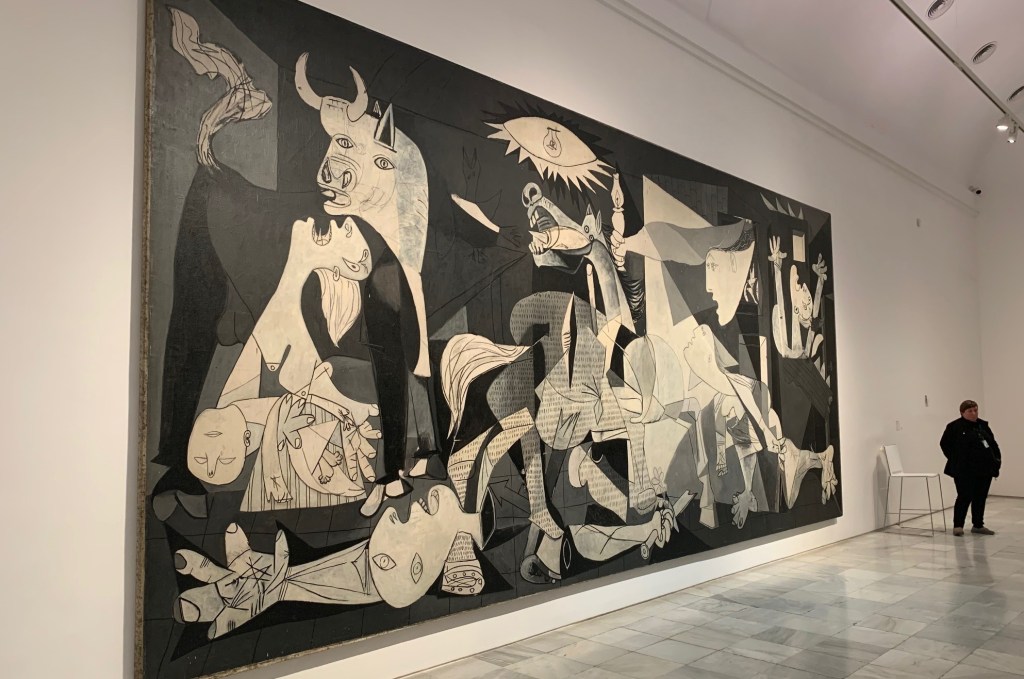
The GRSG read the Harcourt trade paperback published in 1952, which include a highly recommended introduction by Lionel Trilling.
Both Francis and I gave this book high marks as one of our favorites of the year. George Orwell (the pen name of Eric Blair ) is someone who from high school since everyone always wanted to do a book report on his classic Animal Farm because of its length and simplicity. We both read 1984 (1949), but I had very weak recollection except for an adaptation as a play, which I saw in Seattle years ago. More recently, Orwell was quoted in The Diary of a Bookseller by Shaun Blythell who quotes Orwell’s experiences working in a bookshop as excerpts (by far the best part of Blythell’s book) from Down and Out in Paris and London. In Homage to Catalonia, my opinion about Orwell has skyrocketed as a writer and a person. Calvin Trilling calls Orwell a “virtuous man who tells the truth.”
Orwell’s original intentions were to report on the Spanish Civil War as a journalist, but soon voluntarily joined the POUM, The Worker’s Party of Marxist Unity, an egalitarian militia that fought against Franco and the Fascists. The short book describes his life in the trenches, a brief leave to Barcelona where hostilities between the POUMs and the Stalinists/Trotskyites ended up in violence in the streets. (Shown above is a damaged church in Barcelona). Orwell returned to the front where he was wounded by a bullet through the neck. He managed to survive, but then was forced to leave Spain because the POUMs were being imprisoned. The book covers a relatively short period of time of time (January 1937 to July 1927) but Orwell’s descriptions of the scenes on the battlefield, his stay in the hospital, and the people of Spain, which he admires even though you wonder why. Chapter XI (pp 151-179) is a challenge to follow because of all the warring factions of Republicans, Nationalist and Communists. You could see that it was very necessary for Orwell to get this down on paper, but it can be a brief challenge for the reader. The rest of the book is riveting.
Francis had questions that he brought to the discussion and appropriate quotes to illustrate.
Key Cities Mentioned in Book
1) What is it that makes Orwell’s writing so compelling?
Maybe it’s because he is at peace with reality with all its warts and its complete independence from one’s view of it—a perception which is so easily influenced by one’s own flaws and biases.
Maybe it’s because of his familiarity of living in circumstances only minimally under his control (like Down and Out in London and Paris or Homage to Catalonia or The Road to Wigan Pier) and how important it is to be in phase with the reality one faces—and independent of the natural desire to see oneself at the center of it.
Note: In 2024, GRSG read Orwell’s Down and Outbound (our Notes are here.)
In his book Men of War, Alexander Rose writes about the danger of being a rookie soldier on Iwo Jima: “You might be, according to marine lingo “out of phase” (which means being left standing when everyone else dives for cover, walking, when everyone else is crawling, talking loudly when everyone else is whispering—anything that draws attention and fire, or makes one more vulnerable).”
Maybe it’s because he understands that intellectual freedom is not choosing from a menu of pre-specified ideas but rather observing and interpreting one’s own experience.
“When man acts, he is a puppet, when he describes, he is a poet.” – Oscar Wilde
Maybe it’s because he understands that plot and story line, so tempting to overlay on any narrative, are dramatic devices better suited to fiction than fact.
“Acumen is least likely to desert clever men when they are in the wrong.” –Goethe
Maybe one of his techniques it to never describe his expectations of the way things should be before they happen—nor to compare them with how reality surprises or disappoints after the fact. After all, isn’t the gap between expectation and reality simply an epiphenomenon illustrating a writer’s ignorance and lack of imagination— subjects too vast to interest serious readers? And aren’t all writers tempted to cover up these deficits by filling it in with convenient fictions and self-deceit?
“If I were a pagan, I would say that an ironical deity gave man the gift of speech so that he may be entertained by their self-deceit.” –Soren Kierkegaard
2) Is Orwell and Idealist or an Idealogue? What is the difference?
Well, an idealist can be defined as someone guided by ideals, but the connotation is that they are prone to place ideals before practical consideration. (Merriam Webster). An Idealogue is an often blindly partisan advocate or adherent of a particular ideology—sometimes an impractical idealist. The third option, used as an opposite of idealist, is a realist –defined as someone who recognizes what is real or possible in a particular situation and who accepts and deals with things as they really are. So, maybe we should just say Orwell is a realist who is motivated by ideals. One might possibly go as far as to say that Orwell understood that all humans shared common ground in realism and it is from that shared understanding where ideals could be conceived and advanced.
Here is what Orwell wrote that makes it pretty clear he would identify as a realist or idealist rather than an ideologue:
One had been in a community where hope was more normal than apathy or cynicism, where the word ‘comrade’ stood for comradeship and not, as in most countries, for humbug. –Orwell in Homage to Catalonia.

