The Complete Book Shopper Archive (2008-2025)
Beware: This is a core dump of the The Book Shopper blog. It’s not cleaned up and may never be, but I had to move everything off of Typepad (my old platform) in a short time. As Dante said: “All hope abandon, ye who enter here.”
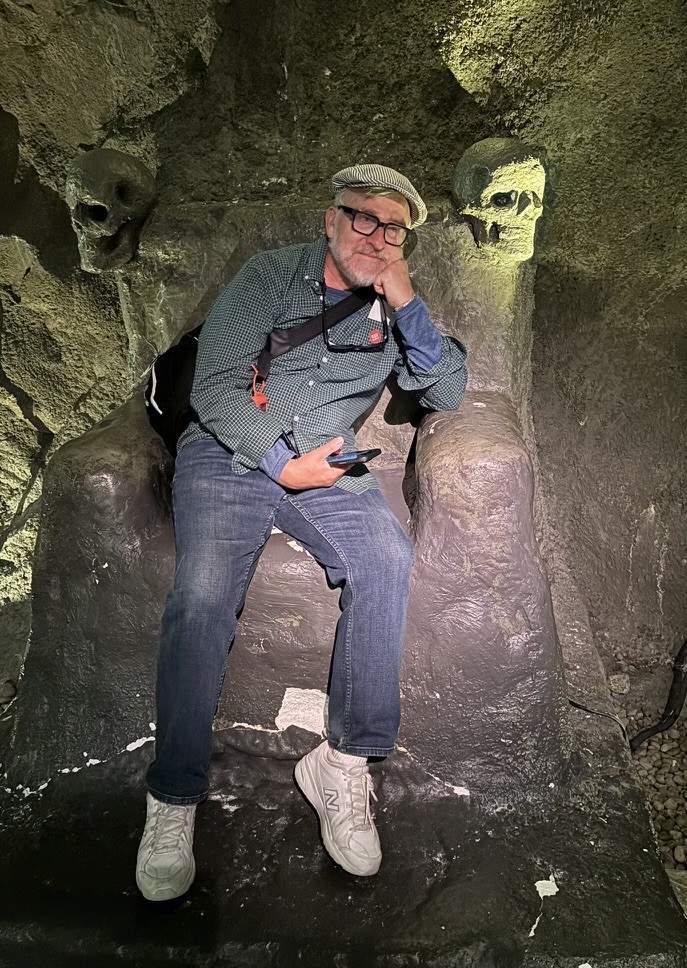
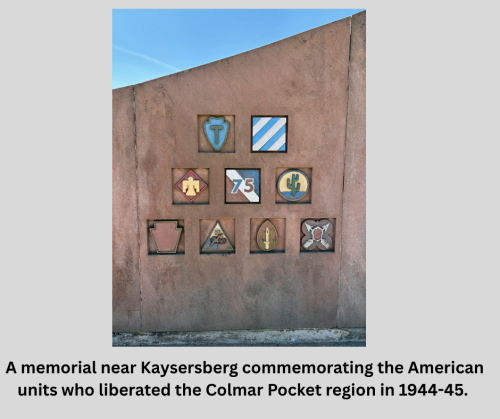
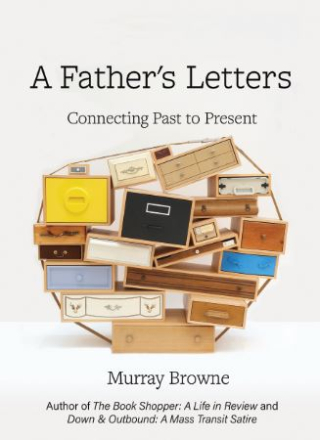 October marks the second anniversary of the publication of a Father's Letters: Connecting Past to Present. Not much sales-wise, but the book has had its moments.
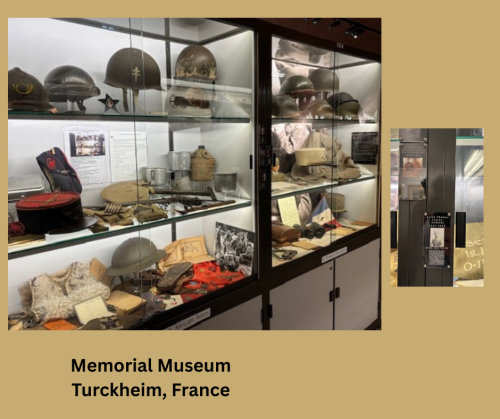
In June of this year my longtime partner Denise and I went to Turckheim, France a small village outside of Colmar in the Alsace region of the country. This was where my father fought in World War II eighty years ago and his experiences are detailed in one of the chapters of Father's Letters. Turckheim is the home of The Memorial Museum of Colmar and Denise and I visited it and as you would expect, I brought a couple of copies of the book. A young woman Angelique Freydrich at the front desk spoke perfect English and immediately welcomed us and the book. She gave us a personal tour of the museum and promised to show the book to the museum's archivist Laurent Klopfer.
Angelique said that the museum did not have as much information about the U.S. soldiers as they did the French and German combatants and she thought that my father's story would be a fine addition to the museum. The way it works is that they curators put a QR code with the soldier's portrait photograph. Visitors can click on the code and the whole story pops up on their phone. When I returned stateside, I contacted Angelique and Laurent and they made it easy for me to upload my father's narrative. (Click below)
https://musee.turckheim-alsace.com/en/cartel/glenn-reginald-browne-jr-1925-1985/
This experience made doing the whole book worthwhile. And I cherish the thought that my father is enshrined with the men who fought with him in World War II.
September 15, 2025 would have been my father's 100th birthday.
The Carlos Museum on the Emory University campus announced that its Bookshop will close permanently on September 29, 2025. The closing coincides with the retirement of Mark Burell, one of the visionaries who opened the shop 32 years ago and manages it to this day.
Mark and I go back even before I arrived in Atlanta in 2007. My longtime partner Denise moved to Atlanta ahead of me in January 2007 and visited his shop. Knowing that I was looking for a publisher for my The Book Shopper manuscript, she purchased a copy of Gabriel Zaid’s So Many Books* published by Paul Dry Books of Philadelphia. We recognized that this small book had the same kind of vibe as mine so eventually I reached out to Paul Dry. After a lot of editing and polishing by many people (led by Denise) it was published in 2009.
Atlanta is not much of a book-lover’s city, and Mark’s shop filled a need for a well-curated bookstore. It has been the only bookshop that I took out-of-town visitors to over the last decade and a half. Mark suggested many of the books that I bought at his store.
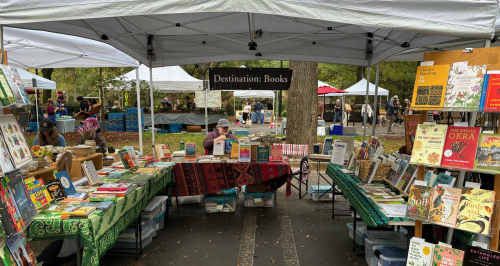
 During the pandemic Mark joined my retirement gig—the pop-up book stall Destination Books. From 2021 to 2024 we sold together at the Carter Center’s Freedom Farmers Market, weathering hot humid summers and chilly late fall mornings. All the time he was generous in showing me the ropes in dealing with publishers and book distributors. During the lulls in customer traffic, we chatted about books, travel, and films. He even let me borrow his DVDs of films by director Werner Herzog, so later I understood the origins of his strong Klaus Kinski-like reaction when some boor photographed a book only to (presumably) order it online. ("GET OUT OF HERE, I WILL NOT SELL YOU A BOOK EVEN IF YOU BEGGED ME!").
If you want more specific details about the Carlos Museum's decision to close the shop, visit their page here. But as for me, I want to extend a personal appreciation to Mark for how much I learned from him, not only as a fellow bookseller, but from the books he recommended. Although it was a small shop (though Mark really crammed in the inventory), its loss will leave a big hole in the Atlanta reading community.
I wish him the best in the next stage of his life. And if he wants any reciprocal advice from me, may l suggest that he read my 60-page retirement narrative A Father’s Letters, Connecting Past to Present.
* Coincidently, a new edition of So Many Books will be published in October by Paul Dry Books.
—– EXTENDED BODY: —– EXCERPT: —– KEYWORDS: Carlos Museum Book Shop, Paul Dry Books, Bookstore closings, Emory University, Mark Burell —– ——– AUTHOR: Murray Browne AUTHOR EMAIL: murray.browne905@gmail.com TITLE: From the Archive – Hiroshima and Hersey STATUS: Publish ALLOW COMMENTS: 1 CONVERT BREAKS: wysiwyg ALLOW PINGS: 0 BASENAME: from-the-archive-hiroshima-and-hersey UNIQUE URL: https://thebookshopper.typepad.com/the_book_shopper_atlantad/2025/08/from-the-archive-hiroshima-and-hersey.html DATE: 08/05/2025 08:44:21 AM —– BODY: From the deep recesses of The Book Shopper archive is a posting from July 16, 2020, about one of the least appreciated American writers of his generation John Hersey and his most famous and still timely book — Hiroshima.
https://bit.ly/Hersey_Hiroshima
—– EXTENDED BODY: —– EXCERPT: —– KEYWORDS: —– ——– AUTHOR: Murray Browne AUTHOR EMAIL: murray.browne905@gmail.com TITLE: Swiss Reading Notes STATUS: Publish ALLOW COMMENTS: 1 CONVERT BREAKS: wysiwyg ALLOW PINGS: 0 BASENAME: swiss-reading-notes CATEGORY: Bookstores UNIQUE URL: https://thebookshopper.typepad.com/the_book_shopper_atlantad/2025/07/swiss-reading-notes.html DATE: 07/16/2025 09:15:19 AM —– BODY: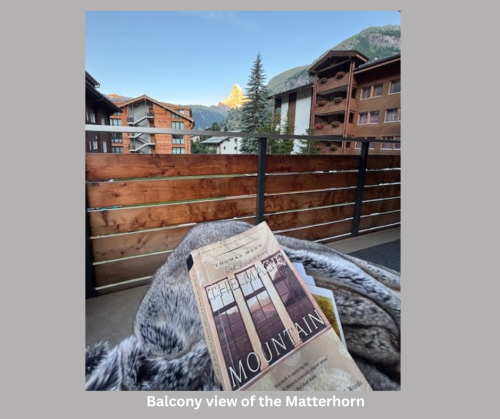
Last summer The Book Shopper visited Paris, Norway and Sweden and published notes for those excursions. In the same tradition, Denise and I just returned from spending almost a month in Switzerland—riding the trains, eating pork schnitzel, and accompanying our grandchildren to amazing playgrounds, but books and writers also play a part in our traveling experience and this year was no different.
Accompanying Books
When preparing to travel I always select a whopper of a book to accompany me. One never knows when there will an airline strike or a power outage and you are stuck for hours with nothing to keep your mind occupied except complaining. Therefore, you want to pack something thick and relevant. Last year it was Norwegian writer Karl Ove Knausgaard’s My Struggle Books 2 and 3. This year it was Thomas Mann’s 700-page classic The Magic Mountain.
Published just over a hundred years ago, Mann’s wide sweeping novel tells the story of Han Castrop who visits his cousin Joachim at a sanitarium in the Swiss Alps near Davos just after the turn of the century. Intending to stay only a few weeks, Castrop ends up staying for years (Welcome to the Hotel California). It’s a wide sweeping novel that transforms one to a place and time, while investigating universal themes such as illness and death and the divergent and dueling paths of humanism and religion.
To further motivate me to read this book, it was selected by Gravity’s Rainbow Book Group (partly because Thomas Pynchon has been compared to Thomas Mann).
I will spare you details here, but our reading notes can be found if you scroll down at GRSG Reading Notes 2025. I did finish the book the day after I arrived back to the U.S. and I wouldn’t say it was the best book I’ve read in a while, but one does get a strong sense of accomplishment for tackling one of the major works of a Nobel Prize laureate.
Book Shops
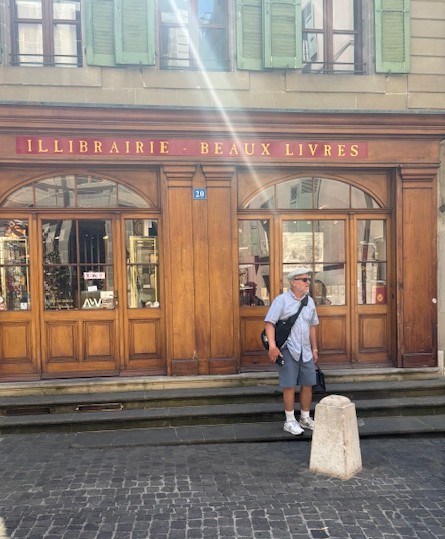
There was a limited opportunity for book shopping. First, there is always the logistical problem of having to haul anything you purchase in your back on the plane. Moreover, most of the smaller bookshops understandably limit their offerings to books written in French and German. One of the more interesting looking shops was in the old city section of Geneva shown here. Denise took the picture because I was basking in some meaningful light as if the Angel Gabriel was about to descend upon me to make a book recommendation. But alas, the shop was closed.
We made a day trip from Zürich to Bern and to specifically spend time in one of the country’s largest booksellers Buchhandling Stauffacher, which has almost an entire floor of English language books. After riding trains all over the country, I was intrigued to learn more about how these routes came about. An employee Michael directed me to The Best Swiss Train Rides written by Diccon Bewes. Train travel in Switzerland goes back to the mid-1850s and the author captures the charm of taking a small train trundling up a mountain along with other faster trains through other scenic areas. We never sat in an automobile during the entire trip.
 In Bern, Denise (shown here locked into serious book shopping mode) found two books she liked The Gilded Chalet: Travels Through Literary Switzerland by Padraig Rooney and Christian Kracht’s Eurotrash.
Unexpected Lit Experiences
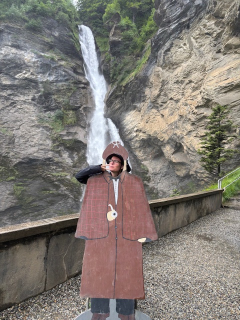 Before my arrival, I was aware that the small city of Meringen is a pilgrimage destination of Sherlock Holmes fame. Sir Arthur Conan Doyle himself vacationed in Meringen enough that he decided to end his Sherlock Holmes saga by having Holmes – locked into a death struggle with his arch enemy Dr. Morarity at Reichenbachfall, which looms just outside the town.
In this photo my older daughter Cynthia re-interprets the last moments of the great detective.
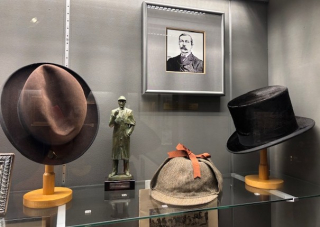 In Meringen there is a quaint little museum which includes a re-creation of Holmes study and collection of his favorite hats. One expected Benedict Cumberbatch/Robert Downey Jr./or Basil Rathbone himself to pop up and guide the tour.
I did not know that Thomas Mann spent the last years of his life in Zürich. Forced to leave his homeland of Germany in 1933, Mann spent time in Czechoslovakia and the U.S. before returning to Switzerland at the end of his life. He is buried just outside of Zürich and I thought about visiting the gravesite until I found out that the Thomas Mann Archives is housed more conveniently at the University of Zürich, which I visited on my last full day in Switzerland. Basically, the archive was just a couple of rooms but what it lacked in sized it made up of a motherload of scholarly materials.

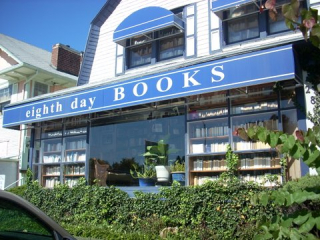 Last month Denise and I took our grandsons to their local library to sign them up for the summer reading program with swag, recognition and motivation to read. And I was thinking "I'm jealous, I wish I could be in a summer reading program."
But now thanks to the Eighth Day Books in Wichita, Kansas I can. I 've known the folks at Eighth Day Books since 2009. They even carried the original The Book Shopper: A Life in Review when no one else did. The store is owned and operated by Warren Farha who has a storefront house crammed with books. I've written a couple posts about them in the past. They used to publish a kick-ass book catalog which was an education in itself.
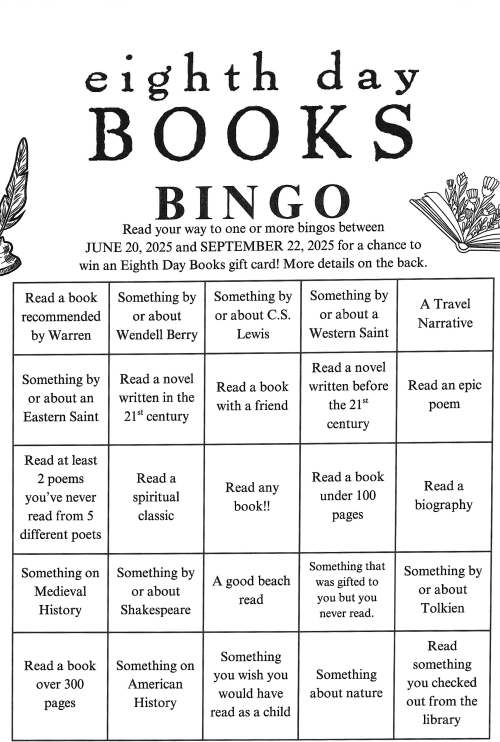
Now you can join a summer reading program for serious adult readers.
Here are the details from their Facebook Page.
Hello Eighth Day Readers!! Please join us for summer reading BINGO starting June 20th! Anyone is eligible to play. Please see the rules below as well as the BINGO card attached. Come to the store or call if you have questions!
EDB 2025 Summer Reading Rules1. Use the categories in the Eighth Day Bingo grid to help you decide your summer reading list!2. Any books read between June 20, 2025 and September 22, 2025 are eligible to count towards a bingo.3. A bingo consists of reading 5 books in five different categories that correspond to squares going across, down, or diagonal.4. For every bingo, you earn a raffle ticket that makes you eligible to win a $100 Eighth Day Books gift card, a $50 Eighth Day Books gift card, or an Eighth Day mug.5. Signup by submitting your name, email, and phone number at the Eighth Day front counter or by calling the store at (316) 683-9446. Once we have your info we will give you your bingo card or email it to you upon request.6. Everyone’s a winner! Anyone who signs up for bingo and reads at least one book this summer will be invited to a social at Eighth Day Books (Date and Time TBD) that will include an exclusive in-store sale!An Important Note: The goal of Summer Bingo is to encourage people to read as a community and promote fun, local discussions about good books. If you have questions about whether a particular book qualifies for a particular category, please feel free to ask us. Our goal is not to be super technical in what qualifies for a particular category! Also, we will accept bingo submissions on the honors system but will limit cards to one per customer.
Happy reading!
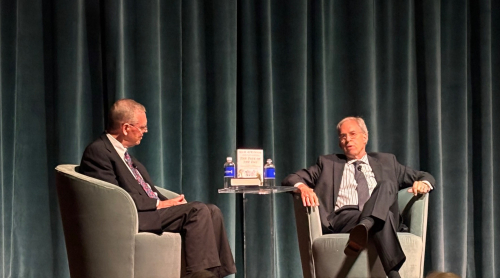
When & Where. On Thursday evening, May 22nd The Atlanta History Center hosted military historian Rick Atkinson in conversation with history professor Patrick Allitt. Atkinson was on tour promoting the second book in his Revolution Trilogy The Fate of the Day The War for America, Fort Ticonderoga to Charleston, 1777-1780
Attendance. The well-airconditioned McElreath auditorium seats 417 people and it was over 90 percent full. For non-AHC members you could purchase a ticket for $12 and you were not required to purchase the book, (but you can do that here). I already had my copy and I appreciated not having to purchase another book to see him, which is how things are done nowadays when a well-known author is on a book tour. The Atlanta History Center is in the middle of the affluent Buckhead neighborhood, and it was best dressed crowd I had ever seen at a book event. Several front rows were reserved for what I assume were the major donors, which remained empty until right before the program when they paraded up to take their seats. Many had drinks in hand.
Why I Went. Atkinson is also the author the Liberation Trilogy about World War II. My longtime partner Denise and I attended both of those lectures when he was at the Decatur Library years ago. He was knowledgeable and gracious and were able to chat with him briefly. I was hoping for the same experience at the AHC, but understood that probably wasn't going to happen. The affable and erudite Allitt teed up Atkinson with brief questions, but with Atkinson there are no short answers. Allitt asked Atkinson about how he managed to fold so many the details into the book such as the terrain, the weather, the foliage and Atkinson made it clear that he did not make any of it up. Atkinson reminded us that in the 18th century people wrote extensive letters (Brits and Americans alike). There are almost 200 pages of notes and sources at the end of the book.
The conversation lasted about 45 minutes with about 20 minutes for Q & A. There was a signing of books afterwards, but I did not wait around.
Someone from the audience asked Atkinson about Lin-Manuel Miranda's Broadway musical "Hamilton." Atkinson said he had seen the musical and it was a "a work of genius" and "a work of art, but not history."
Final Takeaways. Atkinson does resemble another military historian and storyteller Shelby Foote, the writer of the Civil War Trilogy and the star of Ken Burns Civil War series. Coincidently, Burns has a new six-part documentary on the American Revolution coming out this fall on PBS and Atkinson said that he was interviewed for the series. Below is a video where Burns and Atkinson share a stage on Concord's (MA) Carlyle High School talking about the upcoming documentary.
Perhaps the best judge of the quality of the evening was Denise, who had not read the book, but like the majority of the audience she was thoroughly engaged by Atkinson's storytelling. Moreover, there were lessons learned by all that origins of our country were bloody, violent, and the schism between the Loyalists the rebel Americans who wanted independence rivaled the more familiar War Between the States.
—– EXTENDED BODY: —– EXCERPT: —– KEYWORDS: Rick Atkinson book tour, Atlanta History Center —– ——– AUTHOR: Murray Browne AUTHOR EMAIL: murray.browne905@gmail.com TITLE: Memorial Day Archives Revised STATUS: Publish ALLOW COMMENTS: 1 CONVERT BREAKS: wysiwyg ALLOW PINGS: 0 BASENAME: memorial-day-archives-revised UNIQUE URL: https://thebookshopper.typepad.com/the_book_shopper_atlantad/2025/05/memorial-day-archives-revised.html DATE: 05/26/2025 09:06:19 AM —– BODY:
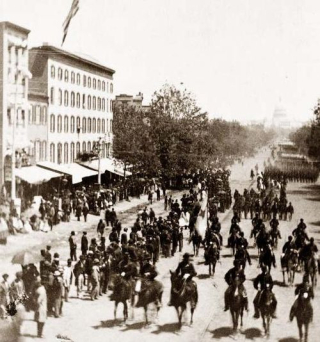 Last year I reposted the "Memorial Day Archives" which gives an account of General William Tecumseh Sherman's Army of the West joining the Grand Review in Washington in May 23 and 24th, 1865.
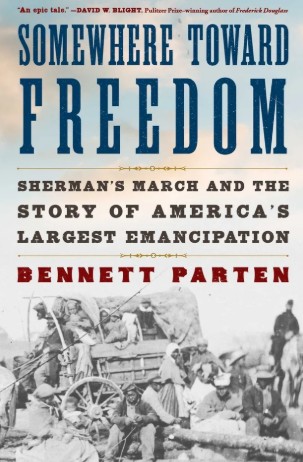
But this year there is an addendum to the post which comes from a history book I read earlier this year–Somewhere Toward Freedom: Sherman's March and the Story of America's Largest Emancipation (2025) by Bennett Parten.
As you would expect there are details about Sherman's March to the Sea, first to Savannah and then up through the Carolinas ending with the Joseph E. Johnston's surrender to Sherman in April, 1865. But the main thrust of the book is the logistics, and the little-known history of how the newly freed slaves joined the Army (or followed the Army). Some worked for the Union Army as cooks and builders and others were women and children (refugees) that followed near the Union Army, but were subject to deathly harassment by Confederate cavalry. Parten does not sugar-coat the suffering endured by the enslaved peoples.
What ties it into Memorial Day, is that the book closes with Sherman's Army of the West marching through the streets of Washington D.C. during the Grand Review, but Parten adds to its historical significance because behind Sherman's army were the freed families that had followed Sherman from Georgia through the Carolinas and Virginia had joined the parade. In the words of one observer, it was "more touching in some ways than the proud passing of soldiers."
In the Epilogue, Parten summarizes the campaign differently than militarily. He writes, "…like Yorktown, Gettysburg and Selma, Sherman's March to the Sea was a landmark moment in the history of American freedom."
A more complete review of the Parten book can be read if you scroll down at Reading Notes 2025.
—– EXTENDED BODY: —– EXCERPT: —– KEYWORDS: Somewhere Toward Freedom. Sherman’s March to the Sea, Bennett Parten —– ——– AUTHOR: Murray Browne AUTHOR EMAIL: murray.browne905@gmail.com TITLE: Rick Atkinson Is Coming…Rick Atkinson Is Coming STATUS: Publish ALLOW COMMENTS: 1 CONVERT BREAKS: wysiwyg ALLOW PINGS: 0 BASENAME: rick-atkinson-is-comingrick-atkinson-is-coming UNIQUE URL: https://thebookshopper.typepad.com/the_book_shopper_atlantad/2025/05/rick-atkinson-is-comingrick-atkinson-is-coming.html DATE: 05/19/2025 09:06:25 AM —– BODY:
One of the few authors I would make any effort to see will be at the Atlanta History Center on Thursday evening, May 22nd. My partner Denise and I saw the author twice at the Decatur Public Library when he was promoting the final two books of his Liberation Trilogy about America’s role in World War II. He was informative and gracious and signed a book for her father—-a World War II vet—with “Thank you for your service” which he cherished. (For details see this 2013 posting "Remembering Your Father with Rick Atkinson,"
We have already purchased our tickets in advance.
Atkinson is on the road promoting his Revolution Trilogy which began with the British Are Coming (2019) and now his latest book The Fate of the Day: The War for America, Fort Ticonderoga to Charleston 1777-1780, which includes the decisive victory at Saratoga in October 1777.
The photo of Saratoga is courtesy of Francis Walker one of the founding fathers of the Gravity’s Rainbow Support Group. This two-person reading club began in June of 2020 during the Pandemic to wrangle Thomas Pynchon’s signature novel (after all we had the time). We are currently reading The Fate of the Day and you can take a peek at our notes by scrolling here.
Our discussions have included how General George Washington did an about face on vaccinations. Originally, he was an anti-vaxxer but then realized that the benefits of vaccination far outweighed the negatives (just as they do today). The rate of how smallpox ravaged his troops compared to adverse reactions to inoculations, though primitive by today’s standards changed his mind:
—– EXTENDED BODY: —– EXCERPT: —– KEYWORDS: —– ——– AUTHOR: Murray Browne AUTHOR EMAIL: murray.browne905@gmail.com TITLE: Star Wars Tie-in STATUS: Publish ALLOW COMMENTS: 1 CONVERT BREAKS: wysiwyg ALLOW PINGS: 0 BASENAME: star-wars-tie-in UNIQUE URL: https://thebookshopper.typepad.com/the_book_shopper_atlantad/2025/05/star-wars-tie-in.html DATE: 05/02/2025 09:29:56 AM —– BODY:Among the most consequential decisions Washington would ever make was to reverse his earlier resistance to inoculating soldiers against smallpox, a disease he acknowledged as “the greatest of all calamities.” Outbreaks had devastated the army, including regiments retreating from Canada…. Crude inoculation, which required smearing active viral pus in a small incision on the arm or thigh, typically resulted in a mortality rate of less than 2 percent, and often much lower, compared to 15 percent (probably closer to 30%), and often much higher, for those sickened naturally. Yet inoculation required two weeks of preparation with purgatives and a proper diet, and then a month of isolation while the patient recovered. Page 88
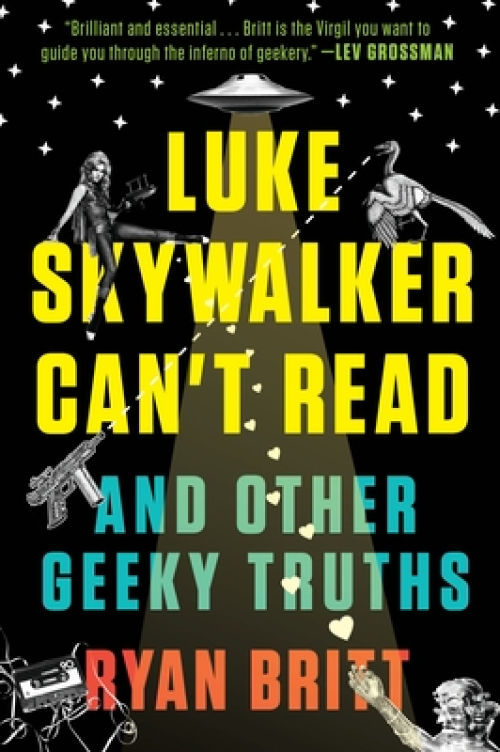
Considering May-the-Fourth-Be-With-You-Day is upon us; I cannot help but be reminded of this book, which I enjoyed so much that it made The Book Shopper’s Best Books Read in 2019 list (along with W.G. Sebald and Alastair Horne). Visit the recap here.
—– EXTENDED BODY: —– EXCERPT: —– KEYWORDS: —– ——– AUTHOR: Murray Browne AUTHOR EMAIL: murray.browne905@gmail.com TITLE: Lost in Book Art STATUS: Publish ALLOW COMMENTS: 1 CONVERT BREAKS: wysiwyg ALLOW PINGS: 0 BASENAME: lost-in-book-art CATEGORY: Books as Art as Books UNIQUE URL: https://thebookshopper.typepad.com/the_book_shopper_atlantad/2025/04/lost-in-book-art.html DATE: 04/09/2025 09:20:08 AM —– BODY: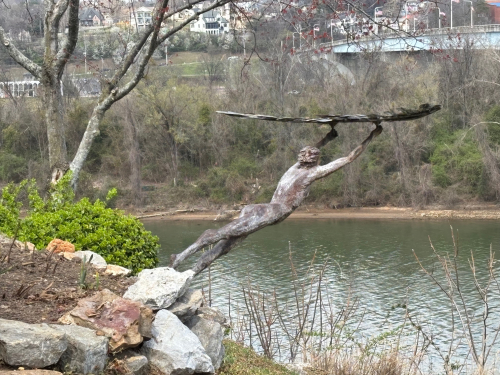
Last month my longtime partner Denise, our friend Maggie from Knoxville and I met in Chattanooga to catch up. We spent the afternoon strolling the Tennessee (River) Walk which is in the Arts District of Chattanooga. We stopped at the River Gallery and naturally one of the narrative sculptures by Daniel Lai caught my attention. To the unsophisticated museum goer such as myself, I immediately saw it as blog worthy "book art."
The piece shown is entitled Lost in a Book. More information about Lai (a self-taught artist of Chinese descent from Kuala Lumpur, Malaysia" with a PhD from the University of Tennessee) and his work are available at the gallery's web page.
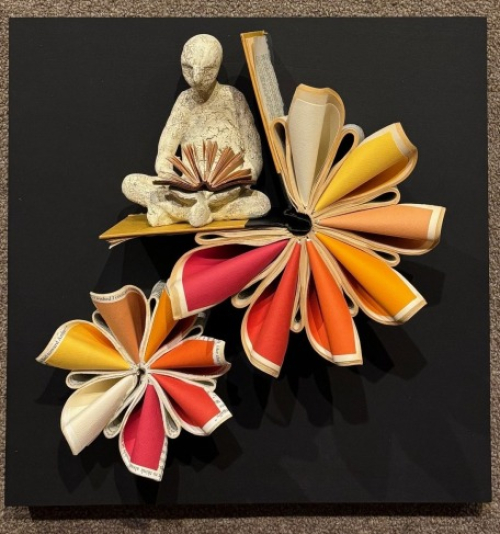
And if for more book art visit the blog's Book as Art as Book archives.
—– EXTENDED BODY: —– EXCERPT: —– KEYWORDS: —– ——– AUTHOR: Murray Browne AUTHOR EMAIL: murray.browne905@gmail.com TITLE: Since the Last Post STATUS: Publish ALLOW COMMENTS: 1 CONVERT BREAKS: wysiwyg ALLOW PINGS: 0 BASENAME: since-the-last-post UNIQUE URL: https://thebookshopper.typepad.com/the_book_shopper_atlantad/2025/03/since-the-last-post.html DATE: 03/12/2025 01:54:14 PM —– BODY: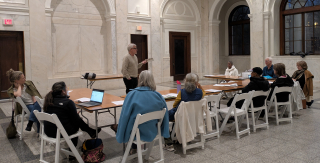 In keeping up with the times, here are some bullet points to what I have been doing since the last posting:
1. I completed the three-session workshop series, Writing Family History at the DeKalb History Center. I was fortunate to have several guest speakers willing to share their expertise. One was my cousin Jackie Fehrenbach from West Lafayette, Indiana, an experienced genealogist who addressed the group along with Tamika Strong from the Auburn Avenue Research Library. Both provided guidance on what sources are available to family researchers who are just starting out. In the final session Keith Chandler from my old Turner Broadcasting days shared his experience in putting his family history together in a book entitled The Five of Us. These are stories from a group of siblings growing up in Ferriday, Louisiana. What we lacked in numbers at the workshop sessions we made up in dedication and connection in the workshop's goal of capturing family histories.
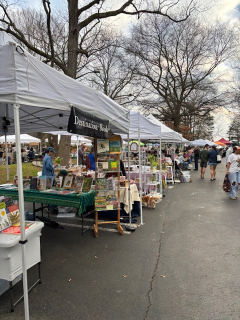 2. Early Spring is a busy time for me doing my Destination: Books popups at the Wylde Center in Oakhurst and The Carter Center’s Freedom Farmer’s Market. I work the tables selling many books on gardening and sustainability and any subject that is a degree of separation from those topics.
One thing I enjoy most about selling books is purchasing books for inventory. Always a book shopper.
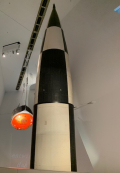 3. My book group, The Gravity’s Rainbow Support Group (GRSG) is closing on its fifth year of anniversary. Actually, it is not a group, but rather just an old college chum Francis (Indiana University) and I discussing books online. It began during the pandemic with Thomas Pynchon’s Gravity’s Rainbow (1973) and we’ve since moved on to a mix of literature, history and anything else we both fancy. Shown here is our mascot the V-2 Rocket, one of the main characters in the book.
The advantage of a two-person book group is that it is easy to agree on what to read next.
4. Gardening and Reading and Reading about Gardening. These activities calm my uneasy mind. One book that has struck a chord is A Gardener at the End of the World (2024) by Maine writer Margot Anne Kelley. Written during the Pandemic, it is a mix of gardening diary and Yankee common sense.
5. Minimizing my intake of news and social media.
—– EXTENDED BODY: —– EXCERPT: —– KEYWORDS: Gravity’s Rainbow, Genealogy, DeKalb History Center —– ——– AUTHOR: Murray Browne AUTHOR EMAIL: murray.browne905@gmail.com TITLE: Bloggers United STATUS: Publish ALLOW COMMENTS: 1 CONVERT BREAKS: wysiwyg ALLOW PINGS: 0 BASENAME: bloggers-unite CATEGORY: Book Reviews UNIQUE URL: https://thebookshopper.typepad.com/the_book_shopper_atlantad/2025/02/bloggers-unite.html DATE: 02/10/2025 09:27:31 AM —– BODY: A fellow Atlanta-based blogger Cal Gough posted a review of my A Father's Letters: Connecting Past to Present here on his personal blog. A retired librarian from the Atlanta Public Library system, Cal began his Book Lovers Blog in 2008, which he mothballed in 2024.
But you can't keep a good blogger down and Cal now posts regularly on his personal blog. He is a discriminating, prolific reader and he likes to share his insights.
He mentions in his review how I gave him a copy at the recent Decatur Friends of the Library Book Sale (available for purchase here). But it was more like I cornered him. He was trapped waiting in line to pay with his shopping bag of books. What choice did he have?
What most impressed me about Cal's review is how he captured the nuances of what I was trying to accomplish.
Thanks, Cal.
—– EXTENDED BODY: —– EXCERPT: —– KEYWORDS: Book Lovers Blog, Atlanta Father’s Letters review. —– ——– AUTHOR: Murray Browne AUTHOR EMAIL: murray.browne905@gmail.com TITLE: Baseball Biography to the Rescue STATUS: Publish ALLOW COMMENTS: 1 CONVERT BREAKS: wysiwyg ALLOW PINGS: 0 BASENAME: baseball-biography-to-the-rescue CATEGORY: Baseball UNIQUE URL: https://thebookshopper.typepad.com/the_book_shopper_atlantad/2025/01/baseball-biography-to-the-rescue.html DATE: 01/27/2025 03:29:55 PM —– BODY: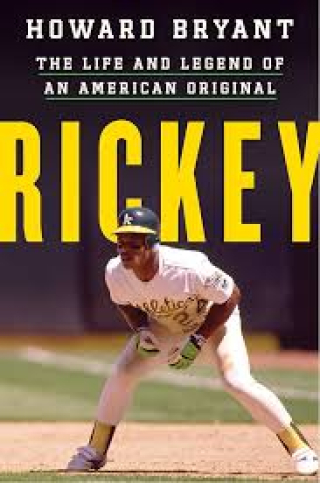
When compared to the off seasons of professional basketball and football, baseball has the longest period of dormancy with its listless weeks of player transactions and replays of the previous season. Between the World Series and Opening Day, there is little to fuel one’s baseball interest. Another megastar signing with the Dodgers? MLB network’s ad nauseum repeats of baseball movies? It is not enough to relieve me of my blahs.
My personal remedy is to crack open the best lengthy baseball book I can find. In previous years it has been Roger Angell’s book on David Cone, Jimmy Breslin’s book on the 1962 New York Mets, and one year it was David Maraniss’s biography of Jim Thorpe. I know at first the latter seems out of place, but Thorpe in addition to winning the decathlon in the 1912 Stockholm Olympics and being one of the early stars of professional football, also played parts of six seasons with the baseball New York Giants and Cincinnati Reds.
Initially, this year’s offerings looked bleak. I just couldn’t go back to Norman Macht’s three-volume history of Connie Mack the owner of the Philadelphia Athletics, which I started years ago. Macht provides excruciating details on Mack’s life and his teams. Mack holds the major league record with the most wins and losses as a manager (3731-3948) and the lengthiest baseball biography (~2000 pages).
But then I recalled reading a promising review of Howard Bryant’s biography of Rickey: The Life and Legend of an American Original and picked up a copy. I started the book in early December before Henderson died on December 20th at the age of 65. But rather than talk about Rickey’s twenty-five-year career with eight teams, and as a career leader in runs scored (2295), stolen bases (1406) and not surprisingly, caught steaIing (335) I prefer to focus on what makes this biography something that pulled me through the dead zone of the baseball winter.
Historical context
From the very opening chapters, what sets this baseball biography apart from most is Bryant’s diligence in mirroring Henderson’s career with the racial history of America is the 60s, 70s and 80s.
Born in Chicago on Christmas Day, 1958, Rickey’s mother Bobbie Ray soon returned to her mother’s home in Pine Bluff, Arkansas and eventually in 1968 moved to Oakland with Rickey and his siblings seeking a better life.
At the beginning of World War II, workers were such in demand in the shipyards around the Bay Area, that factories opened their doors and hired black workers. Many lived in Oakland, where the black population grew from around 8500 in 1940 to 40,000 by 1945. Eventually, the ship building facilities closed, but the blacks remained, and Oakland became an epicenter of the black community. By the time Rickey reached middle school, Oakland’s black population exceeded 120,000. Far from perfect, Oakland was highly segregated, but it was much better than the violence and the lack of opportunity in the Jim Crow South.
Oakland was home to The Pointer Sisters and the founders of The Black Panther Party Bobby Seale and Huey Newton, but the area also produced some of the greatest athletes in sports history—basketball Hall of Famer Bill Russell and baseball greats Joe Morgan and Frank Robinson. Aficionados of the sport will recognize the second-generation players who had very good careers as major leaguers: Dave Stewart, Lloyd Moseby, Gary Pettis, Bip Roberts, and of course Rickey Henderson. All these players grew up playing sports in Oakland.
Baseball Stories
But there is no shortage of baseball stories in Rickey. Not only is Rickey a colorful character, but Bryant takes great care in separating the man and myth and often refers to Henderson by his first name – just as Henderson often referred to himself in the third person. (In one game Henderson tells first baseman J.T. Snow to tell his pitcher to quit throwing over to first: “Rickey tired. Rickey ain’t running today.”)
Playing football, baseball and basketball in high school, Rickey could barely read until he was tutored by a Double-A teammate, the pitcher Mike Norris (who had a 10-year career in Oakland). In contrast Rickey had excellent math skills (obsessed by numbers) and was known in every clubhouse as a shrewd card player. He wasn't a high stakes gambler, nor did he take drugs, and he lived modestly. However, like many players Pay Equals Respect and being the highest paid player on the team or at your position was paramount.
Since Henderson played for so many teams in his quarter of a century career, you get glimpses into the friendships and rivalries. In Oakland as a rookie, Henderson credits Billy Martin for his early success as a base stealer although Bryant spares no detail on Martin's volatile and racist persona. Jose Canseco was overpaid and immature in Henderson's view. While with the Yankees (1985-89), Henderson had the respect of Don Mattingly but like all Yankee players suffered from indignities from Yankee owner George Steinbrenner (especially Dave Winfield).
Because Rickey was self-conscious of being inarticulate, he purposely kept the predominantly white New York sportswriters at a distance. In turn they often characterized him as hotdog for his bat flipping, pulling the jersey during his home run and catching fly balls with his infamous snatch-catch. Henderson was often characterized as lazy because Henderson would take himself out of the lineup especially a day game after a night game. But in his defense, Henderson knew the toll that base stealing took on his body and he wanted to preserve it (and he did, since he played 25 years). His love of the game was undeniable, playing two years of semi-pro baseball AFTER his last major league game.
The Legacy
What separates Bryant’s biography from most baseball books is that he addresses the Henderson legacy. He reminds us that Henderson was a product of this times, which include the early years of player free agency. The fans resented the burgeoning player salaries culminating in the 50 days strike in 1981. But a player like Henderson growing up in Oakland learned not to back down and play the game the way that he wanted to. (Or course the league now promotes more entertainment — more bat flips and action on the basepaths.)
Statistics often speak for themselves and can seem irrefutable, but Bryant goes beyond the numbers to show Henderson's greatness and but is undeterred on revealing Rickey's faults. Bryant allows the reader to judge for him or herself the merits of his personality and his baseball talents. It’s a book that give Henderson’s legacy a cornerstone. One certainly cannot opine about Rickey Henderson without reading this book. And in the bleak days of January and February season, it is my highlight reel of a baseball book.
A short but excellent interview with Howard Bryant when the book first came out.

Introduction
The Gravity’s Rainbow Support Group (GRSG) began in June 2020 as a “reading group” of two people. It was a support mechanism to plow though Thomas Pynchon’s Gravity’s Rainbow (a book you should never try to read alone) during the pandemic. The GRSG took some of the difficulty out of reading this challenging book and provided a way to keep two now-retired college chums (from Indiana University) Francis Walker of Winston-Salem, North Carolina and Murray Browne of Decatur, Georgia in touch. Basically, we decided to keep this good thing going. Undaunted we take comfort in the quote by Alfred Whitehead, written in 1955:
A man really writes for an audience of about ten persons. Of course if others like it, that is clear gain. But if those ten are satisfied, he is content.
This page is the sixth installment of our reading-discussion notes of books we assigned ourselves in 2025. Our reading notes include favorite quotes and passages and some of our discussion about the book. Don’t expect coherent prose or well thought out arguments, but our musings may provide insights to your own understanding and enjoyment of these books. We finish each posting with one of Francis’s sterling Amazon reviews.
Here are the lists of books read and discussed in previous years:
2020 Reading Notes Gravity’s Rainbow by Thomas Pynchon; The Denial of Death by Ernest Becker; Pnin by Vladimir Nabokov
2021 Reading Notes The Republic of Suffering: Death and the American Civil War by Drew Gilpin Faust; Absalom, Absalom by William Faulkner; Stilwell and the American Experience in China, 1911-1945 by Barbara W. Tuchman; Cultural Amnesia by Clive James; The Periodic Table by Primo Levi; The Historian’s Craft by Marc Bloch; An Inventory of Losses by Judith Schalansky; Homeric Moments: Clues to Delight The Odyssey and Illiad by Eva Brann; Homage to Catalonia by George Orwell
2022 Reading Notes The Age of Anger: A History of the Present by Pankaj Mishra; Mountains and a Shore: A Journey Through Southern Turkey by Michael Pereira; The Life and Opinions of Tristam Shandy Gentleman by Laurence Sterne; Grant by Ron Chernow; The Innocents Abroad by Mark Twain; The U.S.A. Trilogy by John Dos Passos (The 42nd Parallel, 1919, and The Big Money); Under the Net by Muriel Spark; Two Wheels Good: The History and the Mystery of the Bicycle by Jody Rosen; Red and Black: A Chronicle of 1830 by Stendhal.
2023 Reading Notes A Path Lit by Lightning: The Life of Jim Thorpe by Robert Maraniss; Heart of Darkness by Joseph Conrad; Algorithms to Live By: The Computer Science of Human Decisions by Brian Christian and Tom Griffiths; Force: What It Means to Push and Pull Slip and Grip Start and Stop by Henry Petroski; On Bullshit (2005) by Henry G. Frankfurt; Dubliners by James Joyce; TransAtlantic by Colum McCann; Regeneration by Pat Barker; Under the Eye of Power: How Fear of Secret Societies Shapes American Democracy by Colin Dickey; The First World War by John Keegan; Frankenstein by Mary Wollstonecraft Shelley; Galileo and the Science Deniers by Mario Livio.
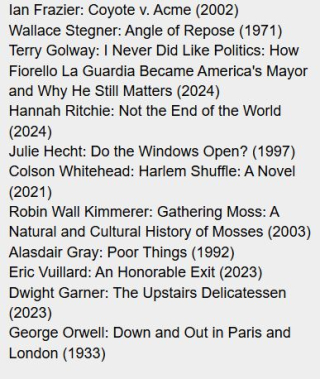
2024 Reading Notes Down and Out in Paris and London by George Orwell; An Honorable Exit by Éric Vuillard; Poor Things by Alasdair Gray; I Never Did Like Politics: How Fiorello La Guardia Became America’s Mayor and Why He Still Matters by Terry Golway; Angle of Repose by Wallace Stegner; Smoke and Ashes: Opium’s Hidden Histories by Amitav Ghosh; The Light Eaters: How the Unseen World of Plant Intelligence Offers a New Understanding of Life on Earth by Zoë Schlanger; From Empire to Revolution: Sir James Wright and the Price of Loyalty in Georgia by Greg Brooking; Hunger by Knut Hamsun; The Book-Makers: A History of the Book in Eighteen Lives by Adam Smyth; The March of Folly: From Troy to Vietnam by Barbara Tuchman; Death Glitch: How Techno-Solution Fails Us in This Life and Beyond by Tamara Kneese.
And now we move on to 2025:
Billy Budd by Herman Melville
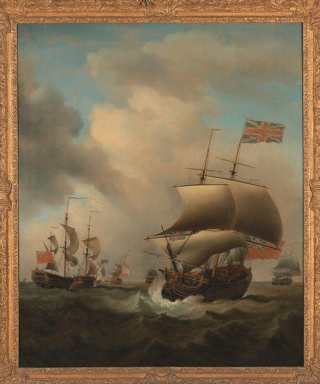 Written near the end of his life Herman Melville’s (1819-1891) Billy Budd was subjected to various minor revisions posthumously. Although Melville is now considered part of the canon of 19 th century American novelists with his leviathan Moby Dick Melville’s influence had sunk into oblivion until 1925 when D.H. Lawrence revived it.
On occasion the GRSG has included some of the classics —The Odyssey and Tristam Shandy, and Frankenstein in its reading repertoire. Why we selected Melville in this instance remains a mystery, but we did temper our commitment by selecting the novella.
Plot
Billy Budd, aka The Handsome Sailor is “a fine specimen of the genus homo who in the nude might have posed for a statue of young Adam before the fall” writes Melville (Chapter 18). He is in his early 20s, illiterate, naïve, and ignorant. He has a stutter which flares up when he becomes anxious. Often he attempts to hide his speech impediment by remaining silent in key moments. He is popular among his shipmates, except the insidious Master-of Arms-Claggart, whose is described as having “a conscience as being but the lawyer to his will, made ogres of trifles. ( Melville echoes a theme of German Philosopher Hans Vaihinger (1852-1933) who says that the mind waits hand and foot on the will). Claggart is envious of Billy (for some reason he didn’t like the cut of Billy’s jib) and falsely accuses him of mutiny. (Since the book is set around the Nore Mutiny of 1797, the British Admiralty is very sensitive about mutinies). After a brief naval engagement with a French frigate, Billy is brought before the educated, respectable Captain Vere, where Claggart accuses the unsuspecting Billy of treason. Provoked, the Handsome Sailor lashes out and punches the Master-of-Arms hard enough to kill him.
Making a short story shorter – Billy is found guilty of murder by a trio of ship officers and is hung at dawn the next morning.
End of story? Hardly, there’s much more to it.
The Writing
Reading Billy Budd, it understandable why Melville was considered a master of the 19th century fiction. The descriptions and thoughts of the main characters and an account of life in the British navy, which was the lifeblood of the empire, are impressive.
Here Melville describes the common seafaring man of the day:
“Their honesty prescribes to them directness, sometimes far-reaching like that of a migratory fowl that in its flight never heeds when it crosses a frontier.” (Ch. 8)
Melville reinforces the somewhat larger truth about those with careers in the military – they are really taught not to think for themselves but to follow orders. He writes
“Every sailor, too, is accustomed to obey orders without debating them; his life afloat is externally ruled for him; he is not brought into that promiscuous commerce with mankind where unobstructed free agency on equal terms- equal superficially, at least- soon teaches one that unless upon occasion he exercise a distrust keen in proportion to the fairness of the appearance, some foul turn may be served him.” (Ch. 17)
Trial
https://bookshop.org/widgets.js
Billy’s hearing is brief but loaded with meaning. First it is presided over by Captain Vere who was an eyewitness to the crime. Vere is portrayed as a fair-minded well-read commander. This description by Melville reminded us that Captain Vere’s taste in books is similar to those books selected by the GRSG.
“With nothing of that literary taste which less heeds the thing conveyed than the vehicle, his bias was toward those books to which every serious mind of superior order occupying any active post of authority in the world naturally inclines; books treating of actual men and events no matter of what era- history, biography and unconventional writers, who, free from cant and convention, like Montaigne, honestly and in the spirit of common sense philosophize upon realities.” (Ch. 7)
Although Captain Vere knew as an eyewitness that Billy’s attack on Claggart was more of an unfortunate accident than something premediated, he recused himself from the hearing. But once the verdict was reached, he justified the death sentence because he was worried that the sailors under his command would think him weak, if he didn’t remain firm in the punishment for mutineers.
Earlier in the book (Ch. 11) Melville suggests that instead of just using legal and medical experts to try someone for insanity:
Why not subpoena as well the clerical proficient? Their vocation bringing them into peculiar contact with so many human beings, and sometimes in their least guarded hour, in interviews very much more confidential than those of physician and patient; this would seem to qualify them to know something about those intricacies involved in the question of moral responsibility; whether in a given case, say, the crime proceeded from mania in the brain or rabies of the heart.”
At the end of the book, a chaplain tends to Billy, but Melville reminds us that chaplains are in the employ of the military not necessarily there to comfort the condemned.
Other sources
Other books were briefly consulted for their commentary of Billy Budd such as Harold Bloom’s collection of essays Interpretations and John Sutherland’s Lives of the Novelists. Interpretations ranging from the underlying homosexuality tensions between Claggart and the Handsome Sailor; Billy has a Christ figure; and Miltonian biblical references. Academics have had a field day with this novella. It served as a reminder to Murray why he never pursued a graduate degree in English.
As been our tradition, we finish with Francis’s five-star Amazon Review.
An Unlucky Tar
Billy Budd is an archetypal figure who, as an innocent young mariner, is non-violently shanghaied on to a ship of war in the early 1800s. The novella describes life among the hierarchy of male characters aboard her and the currents that determine the course of subsequent events. The reader is allowed to act as the judge of members of the crew and the extent to which any of them, and perhaps any of us, should be considered the masters of our souls or simply drifters in a sea of circumstance. Oddly, Melville based his story on a short verse he had previously composed but died with the work unfinished. Others completed it and decided to put the poem at the end in the manuscript, which serves as a touching requiem. Concise, focused and moving, the book is recommended for those wishing to explore the overt and tacit factors that drive human nature.
Tremor by Teju Cole
It is exactly this quality of perceiving truth, extracting it from irrelevant surroundings and conveying it to the reader or the viewer of a picture, which distinguishes the artist. – Barbara Tuchman (one of our favorite historians)
There are three classes of people; those who see, those who see when they are shown, those who do not see – Leonardo DaVinci
 A review in The New York Times Book Review and a comparison to one of Murray’s favorite novelists W.G. Sebald put Teju Cole’s 2023 short novel on our radar.
The narrator is Tunde a West African man working as a photography teacher at what presumbly is Harvard. Through Tunde the plot to meanders (and not necessarily in a bad way) through a number of topics such as art, appropriation of artifacts, and observations about death and the media.
For example, Tunde notes that “a lack of a good photo in the media means you are probably dead.” This longer quote fits right into the book Death Glitch which we read last year, especially when you consider how billionaires are the only ones with the means to “achieve” mortality.
Most of the human beings who have lived and died have left behind them no trace of how they looked, what their voices sounded like, how they moved, what they preferred. It is a vast oblivion but also a relief that we are not inundated with the faces and presences of the innumerable dead. We can move on with our twenty-first-century lives without having to watch videos of every eleventh-century inhabitant of Normandy or Java or Songhay. It was not until the invention and dissemination of photography that it became common for large numbers of people to have their likenesses recorded for posterity, a possibility that had previously been available only to the wealthy and powerful; and it was also only in that era as well with the invention of the gramophone that it became possible for anyone’s voice at all, no matter how eminent, to be recorded and heard after their death. The earlier privilege of remaining uncaptured, of dying with one’s death, was lost. Should the dead move around us like those who haven’t died? Should their presence be more material than those one sees in dreams? (p.52)
Certain chapters are devoted to certain topics and themes.
Chapter 5 – Is a “lecture” on painting that we are assuming Tunder is lecturing his students. Tunder compares J. M. W. Turner’s Slavers Throwing Overboard the Dead and the Dying (1840) and Landscape with Burning City (1500) by Herri me de Bles.
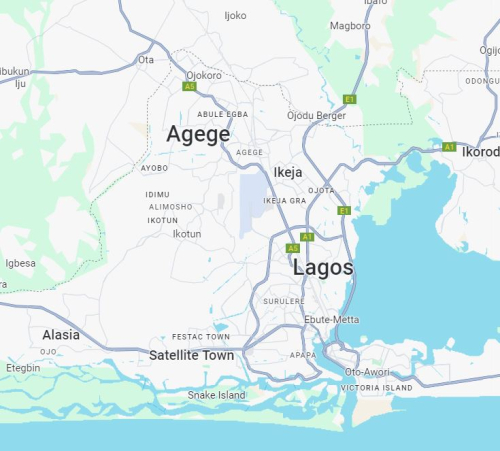
Chapter 6 – Tunde travels to Lagos in Nigeria and this chapter are mix of short scenes or vignettes center around the people of Lagos such as missionaries, sex workers, school administrators, cloth merchants, a man who tests caskets, and a graffiti artist to name a few. Each scene is self-contained but together they are a composite of city.
Chapter 7 – The theme of chapter 6 continues but switches to the geography of Lagos itself which is a city that has an unusual set of boundaries partially determined by it’s geography. Not only is on the Atlantic Coast but there is a large lagoon that dominates the city center and Victoria Island that is connected by several large bridges.
Impressions
One of our takeaways from the discussion is that Cole’s book is one of impressions. Photographers gather impressions and the resonance of those impressions depends on light, angle, construction of the elements. Writers can be impressionistic as Cole. Plot and character development are not the meat of this book but the narrator/Cole impressions are what make this book a very worthy read.
Some quotes and comments from Francis:
Here is an example of a sort of impression which is used to justify a pre-existing belief:
Page 71: “Another ancestral truth is the way the cells in his body respond when certain music enters him. Everything he would like to say about his experience of the world is encapsulated in certain songs, not popular at the center where he lives, not known to most of the people around him.”
Here are some examples of impressionism, which, by the way, I think apply to anyone who grows up in a major metropolis, be it New York City or Lagos:
Page 77: “Swift decision-making is characteristic of the people of the city where in two seconds and with a single haughty glance the women can determine the true price of a bolt of cloth and declare it either cheap or covetable.”
Page 78: “Throughout the city this talent for accurate and rapid distinctions between flavors, colors, scents, building materials, auto parts, and musical instruments is rampant and extends even to the caskets in which they bury their dead.”
https://bookshop.org/widgets.js
We wrap up with Francis’s Amazon review
Amazon Review: 4 stars
Does one seism fit all?
This is a story of impressions. The author shows their influence, echoing a theme expressed by Chauteaubriand (1768-1848): “As soon as a verity has once entered our mind, it gives a light which makes us see a crowd of other objects we have never perceived before.” The protagonist, a privileged, Nigerian-American photographer and teacher, approaches the creative process as Paul Klee did: “Art does not reproduce what we see, rather, it makes us see. And, in the book, it is more than just sight, as music, voices, environmental forces, and even intuitions are discussed. While the book demonstrates how such events can be virtually earth-shaking and disrupt comforting notions, the protagonist rarely further explores his or other’s responses to such impressions, sometimes overlooking his tendency toward confirmation bias. One is left wondering if every visual reminder of a tragic event requires an emotional response, if the ability of music to move listeners is truly inherited or simply learned, and the extent to which impressions may sometimes preclude a deeper understanding of human nature. Thoughtful, haunting, and provocative, the book introduces the reader to interesting places and people and eloquently echoes an aphorism of Karl Kraus (1874-1936): “Grasping the world with a glance is an art. Amazing how much fits in an eye.”
The Tell-Tale Heart and Other Writings by Edgar Allen Poe
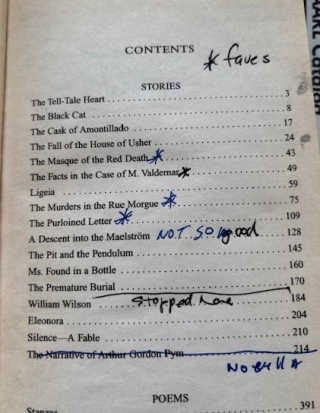
We surprised ourselves by picking another 19th century American author. Like Melville, Edgar Allen Poe (1809-1849) was a writer we read in high school, but neither of us hadn’t looked at since. We agreed to work from the list you see which included some of the standards that we vaguely remembered from our teens.
Overall we appreciated the genius of Poe. His intricate knowledge of certain topics (the dungeons of Spain, the Norwegian Coast and the streets of Paris) even though to our knowledge he never went to Norway or France. Poe suffered from many addictions gambling and alcohol and the effects of disease (he died of tuberculosis) gave him a macabre outlook on life and gave him a brand that has lived 200 years. (We have signed up for a web seminar from our alma mater Indiana University) on that topic.) Moreover, Poe writes with great detail (as does Melville and for Murray he had reread many passages to gather their meaning but one cannot help appreciating their wordsmanship. And learning new words as outré (bizarre) and phthisis (wasting away).
Francis found this passage describing Poe’s process from an essay entitled The Philosophy of Composition (It is rather long, and here he also goes into great detail about writing poems, but this part gives the reader a good idea of what he is after, and it is not a search for the truth or some higher philosophical goal, but rather the technique of creating an effect). Here’s an excerpt:
“I say to myself, in the first place, ‘Of the innumerable effects, or impressions, of which the heart, the intellect, or (more generally) the soul is susceptible, what one shall I, on the present occasion, select?’……”Having chosen a novel, first, and secondly a vivid effect, I consider whether it can best be wrought by incident or tone—whether by ordinary incidents and peculiar tone, or the converse, or by peculiarity both of incident and tone—afterward looking about me (or rather within) for such combinations of event, or tone, as shall best aid me in the construction of the effect.”
Story by Story Quotes and Thoughts
Not only is Poe quotable, but these stories reminded us of other works that we have read here at the GRSG.
The Black Cat
“Who has not, a hundred times, found himself committing a vile or a silly action, for no other reason than because he knows he should n
Note the parallel with this quote from James Geary in The History of the Aphorism: “There are certain mistakes we enjoy making so much that we are always willing to repeat them.”
The Cask of the Amontillado
Revenge not seen since….Billy Budd and reminiscent of the conspiracies that we read about in Under the Eye of Power in 2023.
“I looked at him in surprise. He repeated the movement—a grotesque one. “You do not comprehend?” he said. “Not I,” I replied. “Then you are not of the brotherhood.” “How?” “You are not of the masons.”
The Fall of the House of Usher
Poe describing the misery of its owner:
“…with an utter depression of soul which I can compare to no earthly sensation more properly than to the after-dream of the reveller upon opium—the bitter lapse into every-day life—the hideous dropping off of the veil.”
and in his death throes:
“…..that leaden, self-balanced and perfectly modulated guttural utterance, which may be observed in the lost drunkard, or the irreclaimable eater of opium, during the periods of his most intense excitement.”
This quote reminds us of the book, The Plant Eaters, which we read last year.
(here he is describing the spooky plants that decorate the house in a manner suggesting intent:
“This opinion, in its general form, was that of the sentience of all vegetable things.”
Liegia
“Why shall I pause to relate how, time after time, until near the period of the gray dawn, this hideous drama of revivification was repeated; how each terrific relapse was only into a sterner and apparently more irredeemable death; how each agony wore the aspect of a struggle with some invisible foe; and how each struggle was succeeded by I know not what of wild change in the personal appearance of the corpse?”
Similar to revivification and grave robbing that we read in Frankenstein (in 2023)and Poor Things in 2024.
The Masque of the Red Death and The Purloined Letter
Both crime stories are set in Paris with the same characters. 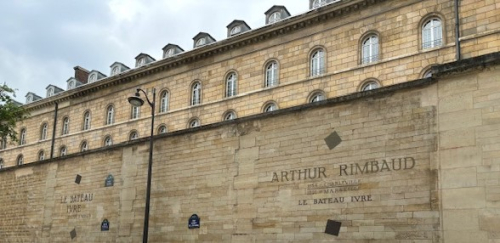
First there is mediocre French Police inspector, not named, but I think of him as a more serious Clouseau); here Poe gives him this attribute: “…..like him especially for one master stroke of cant, by which he has attained his reputation for ingenuity. I mean the way he has ‘de nier ce qui est, et d’expliquer ce qui n’est pas.’” (To deny what exists, and to explain what doesn’t.)
And then there is brilliant detective Dupin who reminds of how Sir Conan Doyle characterized Sherlock Holmes: “He is fond of enigmas, of conundrums, of hieroglyphics; exhibiting in his solutions of each a degree of acumen which appears to the ordinary apprehension præternatural. His results, brought about by the very soul and essence of method, have, in truth, the whole air of intuition.”
Doyle owes a lot to Poe.
The Premature Burial
“As often happens, when such refusals are made, the practitioners resolved to disinter the body and dissect it at leisure, in private. Arrangements were easily effected with some of the numerous corps of body-snatchers with which London abounds; and, upon the third night after the funeral, the supposed corpse was unearthed from a grave eight feet deep, and deposited in the operating chamber of one of the private hospitals.”
“Among other things, I had the family vault so remodeled as to admit of being readily opened from within….;Besides all this, there was suspended from the roof of the tomb, a large bell, the rope of which, it was designed, should extend through a hole in the coffin, and so be fastened to one of the hands of the corpse.”
As we read about the bell and the robe in: This Republic of Suffering and while we toured a Colonial Park Cemetery in Savannah at the GRSG annual meeting we heard similar stories from our tour guide.
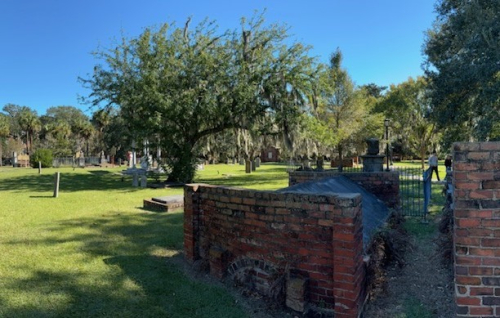
We wrap up with Francis’s four-star Amazon review
Raven-ings
In a somber mood, I dare try to capture the dreary depths of despair dotting the dreamscape of Edgar Allen Poe’s stories. These proceed from one tale of woe to the next, depicting dissolution of the flesh, nightmarish terrors, calculated cruelty, obsessive vengefulness, mystery and manic mayhem invariably highlighting the nuances of premortem agony. While I thrilled with trepidation at the prospect of rereading some of my favorites from childhood: The ‘Pit and the Pendulum’, ‘The Cask of the Amontillado’, and ‘The Fall of The House of Usher’, little did I recall the horror, madness and hideous premonitions of evil they contained. Nonetheless, I trudged on, marveling at the hauntingly familiar notes these macabre stories have since had on literature, motion pictures, and advertising ever since. Oddly, the least morbid of his works: The Purloined Letter and Murders in the Rue Morgue, pioneered the art of detective fiction and provided fertile fodder for copycats, including Arthur Conan Doyle. Recommended for anyone free of squeamishness and interested in Poe, a unique figure in American literature. His complete works, even for those left weak and weary from their perusal, provide plenty to ponder.
P.S. Poe
After finishing our discussion of the Poe short stories Francis and Murray did attend a virtual lecture on February 26th by Indiana University (our alma mater) professor Jonathan Elmer entitled Food for Thought | In Poe’s Wake: Travels in the Graphic and the Atmospheric. It was a 30-minute Zoom lecture followed by a Q & A based on Elmer’s book of the same name.
Its theme was Poe as a brand and how the author was originator of the detective short story and how he has remained relevant almost 200 years later. Two good examples are the Poe detective stories “Murder on the Rue Morgue” and “The Purloined Letter.”
Francis stayed on for the Q & A. Some of the slides were good, but Francis thought that Professor Elmer should have some video clips of some of the adaptations of Poe’s work
Every Man for Himself and God Against All by Werner Herzog
“A well written life is almost as rare as a well lived one.” — Thomas Carlyle 1882
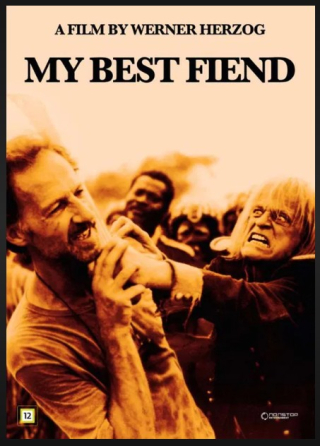
A fellow bookseller first mentioned the Herzog memoir because we were both fans of Herzog’s films especially Fitzcarraldo (1982), Aguirre, The Wrath of God (1972) and My Best Fiend (1999). The latter is Herzog’s reflections about his tumultuous relationship with the screaming Klaus Kinski with whom he made five films.
What made Every Man an interesting read for us is that Francis was not familiar with the films, but I had seen four or five of them over the year. My fellow bookseller even loaned me his set of DVDs. So, our reactions come from two different starting points.
We both agreed that this book is entertaining, insightful (more unintentionally than Herzog trying to impart some great wisdom upon us) and somewhat haphazard. Written in 2022, Every Man is a little too long and could have used some editing. But one of the strengths of this book is Herzog’s voice. It’s the same voice you hear in My Best Fiend and in the audio version of the book which another book friend recommended as an audio book as well. (Herzog is often sought after for narration work).
Here’s is a lengthy sample of Herzog’s voice and demeanor and a hint of what it was like to work with Klaus Kinski:
Dauntless
Soon after Herzog was born in Munich in 1942, his mother when found his crib covered in debris after an Allied bombing and soon relocated Werner and his older brother Tilbert – to the German-Austrian hinterlands. This auspicious beginning was precursor to a Herzog’s life of fearlessness. The family lived in poverty in a hovel with no running water, without adequate heat in the winter and food was scarce. They survived on the indomitable personality of the mother. Herzog writes:
“My deepest memory of my mother, burned into my brain, a moment when my brother and I were clutching at her skirts whimpering with hunger. With a sudden jolt, she freed herself, spun round, and she had a face full of an anger and despair that I have never seen before or since. She said, perfectly calmly: ‘Listen, boys, if I could cut it out of my ribs, I would cut it out of my ribs, but I can’t. All right?’ At that moment, we learned not to wail. The so-called culture of complaint disgusts me. (p. 30)
But the kids knew how to entertain themselves.
“Later, we children played around with carbide and made our own explosives. Setting off a detonation in a concrete pipe that ran under the road was the greatest feeling. We stood on the road above the pipe, and it felt distinctly peculiar to be lifted off our feet by a little explosion.
(Herzog’s father did not live with the family, but did have some influence on Werner intellectually.)
This extreme childhood certainly shaped him into the adventurer filmmaker that he was to become for the rest of his life beginning in his 20s. One story sticks in your mind when he was on Crete and invited to stay with a local when his host gave him the best room as is the custom. Herzog was awakened to the sense that the “something in the room was moving like champagne bubbles. In the light it turned out to be fleas, thousands of them, which I bore uncompellingly so as to not embarrass my hosts.”
This illustrates two important aspects about Herzog and this memoir. The nonchalant attitude he against any challenge by nature (volcano, fire, glacier, ) or anyone whether it be the madman Klaus Kinski or corporate financiers.
In this long clip from You-Tube from My Best Fiend, you get a sense of his calmness in the face of any adversity. And his decisiveness. The excerpts shows Herzog’s ability to make up his mind quickly.
…..(Herzog, after learning of the soon to explode volcano) told him in thirty seconds what was going on in Guadeloupe and asked him if he’d commission such a film. “All right,” he said. “Off you go, but I want you back alive. The bureaucracy’s too slow; we’ll do the contract afterward.” Two hours later, I was on my way to the West Indies. P.41
Creative Process
Passages that give some sense of Herzog’s creative process:
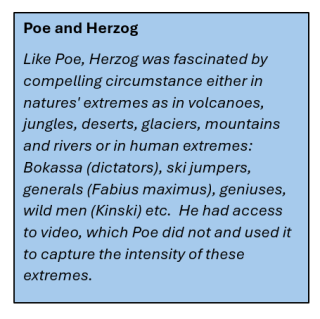 “A few years ago, I met probably the greatest living mathematician, Roger Penrose, and asked him how he proceeded, whether by abstract algebraic methods or by visualizing the problem. He told me it was entirely by visualization.” – page 35 (As in Tremor —which we read earlier this year—this is important: and in our recent discussion of Poe.)
Note: Einstein echoed a similar theme to the one above “On the importance of vision: If I can’t picture it, I can’t understand it. ” Attributed to Einstein by physicist John Archibald Wheeler in John Horgan’s article “Profile: Physicist John A. Wheeler, Questioning the ‘It from Bit’”. Scientific American, pp. 36-37, June 1991.
….in a meeting of all the parties plus lawyers, the representatives of 20th Century Fox were very cordial to me and called me by my first name. Then the suggestion was made that for safety’s sake the film be made in a “good jungle,” i.e., the botanical gardens. I asked politely what they thought a bad jungle was, and the atmosphere instantly froze. From that moment on, I was Mr. Herzog, and I knew I was on my own. -Page 190
“to this day I can only learn from bad movies” – Page 131
“I said that if this film failed all my dreams would be at an end and I didn’t want to live as a man without dreams.” – Page 195
One can appreciate that Herzog kept creative control of his projects with small projects and a small nucleus of film crews. (His younger brother Lucki handle the finances and the rights to Herzog’s work.) Small as we’ve seen recently with 2025 Oscars the two front runners for best picture were made on relatively shoestring budgets.)
And finally, Herzog as a filmmaker is not necessarily restricted by facts. He follows the dictums of other writers. Such as:
Gustave Flaubert “Of all lies, art is the least untrue”
Rabindranath Tagore “ Truth in her dress finds facts too tight. In fiction she moves with ease. Tagore was a chronicler often mentioned in another book we read Ghosh’s book on opium Smoke and Ashes last year.
The French novelist André Gide once wrote: “I alter facts in such a way that they resemble truth more than reality.” Shakespeare observed similarly: “The most truthful poetry is the most feigning.”
Another aspect of his creativity is that Herzog is keen on separating the work from the creator. Herzog talks back to those would criticize him for promoting another’s work because of its merit, instead of damning it for the sins of its creator. He writes:
“My answer here consists of two more questions, though the number could be indefinitely extended. Should we remove the paintings of Caravaggio from churches and museums because he was a murderer? Do we have to reject parts of the Old Testament because Moses as a young man committed manslaughter?” – Page 269.
https://bookshop.org/widgets.js
And in summary here is Francis’ 4-star Amazon review:
A rare slice of life
When Walter Bagehot wrote: “That the greatest pleasure in life is doing what people say you cannot do.” he may have had in mind someone like the filmmaker Werner Herzog. Reading his memoir, which is loosely organized by theme and chronology, I found much to appreciate. The writing is lucid, and Herzog understands that the further he reaches in the past the less his recall should be considered precise. He is fascinated with extremes, in nature and of human behavior, and he obsesses over how to show them to an audience, be it through movies, music, or photography. And for ideas he never had enough time to develop, he describes them for readers perhaps in hope they will take them on. The title of his book “Every man for himself…” speaks to his lack of caution which he admits sometimes imperiled the happiness of those closest to him. However, it underestimates Herzog’s remarkable ability to recruit loyal teammates on his many projects. And the notion that God was against all is ironic, given his numerous near misses with death: severe travel-related illnesses, experimentation with pipe bombs, and encounters with mobs, arrests by corrupt regimes, ski accidents, solo glacier treks, venomous snakes, and decrepit airlines. It appears that someone, if not the Almighty, at least a guardian angel, was on his side. Although the book runs too long, readers will find it unpretentious, engaging, and a startling account of setting seemingly impossible goals that come to fruition. Recommended for those curious about this prolific filmmaker and his eventful life, and for anyone wishing to vicariously experience uncommon places, unusual circumstances, and unorthodox people.
Werner Herzog Interview
By some strange coincidence soon after we finished Every Man for Himself and God Against Us All, 60 Minutes broadcast an Anderson Cooper interview with Werner Herzog, proving once again how GRSG has its pulse on the times.
Somewhere Toward Freedom: Sherman’s March and the Story of America’s Largest Emancipation by Bennett Parten
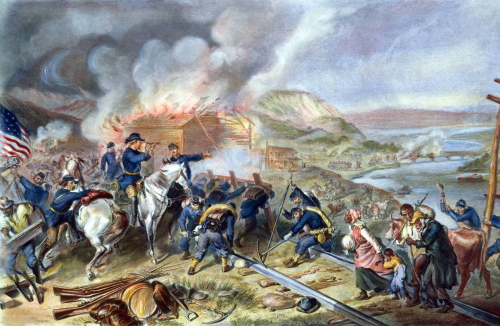
Our selection of Somewhere Toward Freedom (2025) should come as little surprise because is received prominent reviews in national publications and GRSG has read several books on the Civil War (i.e. Drew Gilpin Faust’s The Republic of Suffering and Chernow’s biography of Grant were two of our favorites). Murray’s interest in the Civil War began when he visited Shiloh with his family as a youth. Coincidently Francis and Murray visited Shiloh in summer of 1999 which include the Shiloh Church where Sherman’s encampment was run over by attacking rebel troops on the morning of April 6, 1862.
If this wasn’t enough there are over twenty entries in Civil War links section of The Book Shopper blog including an excerpt Milledgeville-born composer Alfred Thigpen’s Sherman: The Musical.
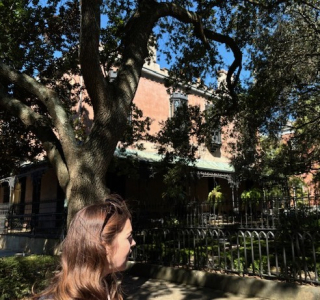 As much as I knew about William Tecumseh Sherman, we both knew next to nothing about this aspect of Sherman’s March. A few months ago, the GRSG annual meeting was held in Savannah, which gave us extra appreciation of this time in American history. We even stood outside the Green House of Madison Square in Savannah. Parten writes: “The city’s mayor, Richard Arnold, surrendered the city willingly, and Charles Green, the owner of the Green House, invited Sherman into his home as an honored guest. They weren’t anomalies. Throughout the occupation, Savannah lived up to its now-popular reputation as the ‘Hostess City of the South,’ lulling the soldiers into a false sense of security.”
The book does not begin with Sherman’s March to Atlanta, but rather begins after the city caught fire. Sherman had about 100,000 troops after the Atlanta campaign, but dispatched around 30,000 troops back to Tennessee to keep the John Bell Hood Confederates from retaking Tennessee. (This ended badly for Hood with resounding defeats in Nashville and Franklin, Tennessee.)
In November Sherman split his army into two columns the right column led by O.O. Howard that went Madison through Macon and the left column led by Henry Slocum that went through Macon and on to Statesboro. Officially the Sherman’s soldiers were supposed to be “foragers” and their were protocols that were supposed to be followed, but when foragers went rogue there was the more colloquial term “bummers” Parten writes: “so when soldiers arrived at a plantation, the scene devolved into a glorified scavenger hunt. Soldiers checked corner closets and storehouses, interrogated white families, and even went about looking for signs of uprooted dirt. “It was amusing to see the foragers going around prodding the ground with their ramrods or bayonets, seeking for soft spots, according to one Ohio soldiers.
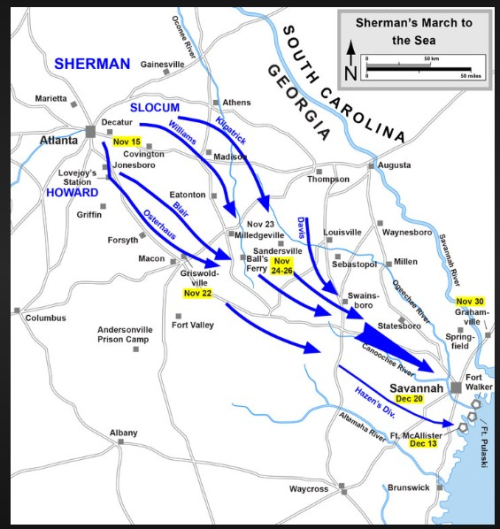
Parten relies on letters of Union officers and troops (remember in the Civil War people wrote letters). He gives accounts of camp life, the taking of livestock and goods from the Georgia countryside (including plantations). Sherman kept his word to “make Georgia howl” and reached Savannah around Christmas of 1864. The Savannah populace wisely left Savannah an open city as the few remaining rebel troops moved on to South Carolina.
But the main thrust of the book is the logistics and the little known history is how the newly freed slaves joined the Army (or followed the Army). Some worked for the Union Army as cooks and builders and others were women and children (refugees) that followed near the Union Army but were subject to deathly harassment by Confederate cavalry. The account of the brutal slaughter at Ebenezer Creek was especially tragic and graphic. A Union general Jefferson C. Davis (yeah, what a name) pulled pontoons over the creek so the Negroes (many women and children) following his column had to cross a frigid creek or face marauding Confederate cavalry anxious to kill them or sweep them back up to captivity.
The book is relatively short and it includes several useful maps. It also spends considerable length discussing the history of Port Royal, South Carolina. Federal gunboats recaptured the garrison early in the war and set it up a community for freed slaves. It received funds from Northern abolitionists and even schools for Black children were set up. But by the winter of 1864-5 freed slaves from Sherman’s March eventually overwhelmed the area and many died from starvation and exposure.
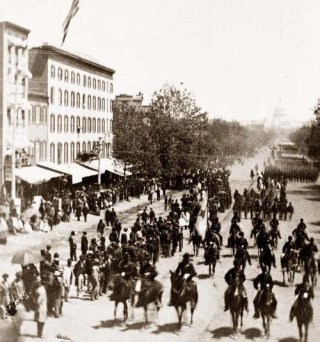 The book closes with Sherman’s Army of the West marching through the streets of Washington D.C. on May 24, 1865 in the Grand Review (more about that here), but Parten adds to it’s historical significance because behind Sherman’s army were the freed families that had followed Sherman from Georgia through the Carolinas and Virginia had joined the parade. Parten summarizes the campaign differently than militarily. He writes, “…like Yorktown, Gettysburg and Selma, Sherman’s March to the Sea was a landmark moment in the history of American freedom.
Murray’s assessment was that as a Civil War buff he had realized an important gap in his knowledge filled by the Parten book. On the other hand Francis and I learned plenty about Reconstruction from the the Chernow Grant biography we read in 2023.
https://bookshop.org/widgets.js
We finish with Francis’s Amazon Review.
Promises kept and broken
Armies have always attracted camp followers, but none before or since have attracted as many as Sherman’s union troops on their long march from Chattanooga through Atlanta to Savannah and then on to the Carolinas. This book chronicles the stories of the men, women and children fleeing enslavement with this army, the difficult choices they faced, the perils, some fatal, that they encountered, how they assisted Sherman’s forces and how they precipitated the first refugee crisis in American history. The author, taking the oft neglected point of view of the liberated people, faults the northern military, government bureaucracy and charitable organizations for their lack of insight and planning, ill-defined and changing policies, and inability to deliver on promises. The deprivation and suffering of the freed refugees is well documented. The shameful role of southern cavalry in attacking those freed men, women and children who could not keep up on the march is also made clear, as is the egregious behavior of one of a Union leader (oddly named Jeff Davis) who had murdered a former commanding officer and who purposefully ordered the destruction of bridges once crossed by his troops to strand camp followers on river banks, leaving them to the bitter retribution of the southern forces. The author’s most scurrilous comments are reserved for Andrew Johnson, Lincoln’s successor, ‘the drunken tailor from Tennessee’, who fought reconstruction. Although the subsequent success, albeit temporary, of reconstruction after this is mentioned, no credit is given to Ulysses S. Grant for its revival. Nor is it possible to gauge the appropriateness of Sherman’s advice to the formerly enslaved persons to not follow his army, as the difficulties of those who stayed behind are left undescribed. The book has a wealth of detail rarely covered in other accounts of Sherman’s march and is an engaging read.
The Pale King by David Foster Wallace
 We came about selecting this book in a roundabout way. Murray discussed working on an essay about jury duty while hiking with his friend Bill up in Chattanooga. Bill mentioned this passage (Section 22) in Wallace’s The Pale King (2011) where several characters dialogue about the responsibilities or lack of responsibilities:
“Americans are in a way crazy. We infantilize ourselves. We don’t think of ourselves as citizens-parts of something larger to which we have profound responsibilities. We think of ourselves as citizens when it comes to our rights and privileges, but not our responsibilities. – Section 19 page 130
I don’t think of corporations as citzens, though. Corporations are machines for producing profit; that’s what they are ingeniously designed to do. It’s ridiculous to ascribe civic obligations or moral responsibilities to corporations. Page 136
I shared this with Francis and he was willing to take the Wallace book on. In the spirit of full disclosure, I warned him about Wallace—who is best known for his tome Infinite Jest (1996)—And it is for this reason I have steered clear. But one of the tenets of the GRSG and other “top-tier, exclusive” book clubs is that they encourage you tackle books that you normally avoid. Of course we were founded in 2021 on Thomas Pynchon’s Gravity Rainbow, we are not afraid of tough reads like William Faulkner’s Absalom Absalom or Tristan Shandy by Laurence Sterne.
It is worth noting that Wallace (1962-2008)—against his wishes -was often compared to Pynchon in his writing style with much word play, humor, tangents and in the case of Pale King lots and lots of lengthy footnotes. This book was published three years after Wallace’s death (by suicide) by his editor who completed the manuscript.
There are several elements that make this book worthy:
Portrait of Bureaucracy.
Since the main setting is an IRS Regional Examination Center office in Peoria, Illinois. Wallace spares no detail in giving one the sense of This is especially relevant since we read this book in April 2025. In the middle of tax season. Elon Musk’s DOGE and the Trump Administration is in the midst of slashing the IRS workforce by about 20,000 workers. (By no coincidence this book was published around Tax Day in April 2011)
Some examples. There were many to choose from:
Page 17
Tedium is like stress but its own Category of Woe. Sylvanshine’s father, whenever something professionally bad happened—which was a lot—had a habit of saying ‘Woe to Sylvanshine.’
Page 29
IRS WORKER DEAD FOR FOUR DAYS Supervisors at the IRS’s regional complex in Lake James township are trying to determine why no one noticed that one of their employees had been sitting dead at his desk for four days before anyone asked if he was feeling all….
(Here is a recent real-life counterpart–From NBC news in August 2024: )A 60-year-old Arizona Wells Fargo employee scanned into her office on a Friday on what appeared to be an ordinary workday. Then, four days later, she was found dead in her cubicle. Denise Prudhomme, 60, was found dead on Aug. 20 in her office in Tempe, police said. Aug 29, 2024)
Page 82
“one tiny dronelike cog in an immense federal bureaucracy”
Page 84
If you know the position a person takes on taxes, you can determine [his] whole philosophy. The tax code, once you get to know it, embodies all the essence of [human] life: greed, politics, power, goodness, charity. To these qualities that Mr. Glendenning ascribed to the code I would respectfully add one more: boredom. Opacity. User-unfriendliness. (It continues…: Page 85 It is impossible to overstate the importance of this feature. Consider, from the Service’s perspective, the advantages of the dull, the arcane, the mind-numbingly complex. The IRS was one of the very first government agencies to learn that such qualities help insulate them against public protest and political opposition, and that abstruse dullness is actually a much more effective shield than is secrecy. For the great disadvantage of secrecy is that it’s interesting. People are drawn to secrets; they can’t help it. (in honor of the release of the Kennedy files…)
Page 87
Why we recoil from the dull. Maybe it’s because dullness is intrinsically painful; maybe that’s where phrases like ‘deadly dull’ or ‘excruciatingly dull’ come from. But there might be more to it. Maybe dullness is associated with psychic pain because something that’s dull or opaque fails to provide enough stimulation to distract people from some other, deeper type of pain that is always there, if only in an ambient low-level way, and which most of us spend nearly all our time and energy trying to distract ourselves from feeling, or at least from feeling directly or with our full attention…. but surely something must lie behind not just Muzak in dull or tedious places anymore but now also actual TV in waiting rooms, supermarkets’ checkouts, airports’ gates, SUVs’ backseats. Walkmen, iPods, BlackBerries, cell phones that attach to your head. This terror of silence with nothing diverting to do.
Page 242-247
“We are looking for cogs, not spark plugs” – from the IRS recruitment office scene, which is set in the snowbound Chicago during the blizzard of 1979.
Page 430
“It is the key to modern life, if you are immune to boredom there is literally nothing you cannot accomplish.”
Its Midwestern Flavor.
Francis and Murray both hail from the Midwest and we attended Indiana University at the same time. Part of the enjoyment was Wallace’s skewering of academics and his descriptions of the Midwest. Wallace lived in Philo, Illinois which is just outside of Champaign, Illinois where Murray lived for several years—and he drove through Philo many times. (The photo here was from Murray’s 2023 trip to Indiana-Illinois. The “vistas’ haven’t changed much except the wind) turbines
Section 22 which is almost 100 pages long is set in the narrator’s college days in Chicago and applying for a job at the IRS during the aforementioned blizzard in 1979.
One of the better chapters is Section 39 when Stecyk was being tormented in high school Industrial Arts by bullies, which was an apt description of the Industrial Arts classes in Murray’s high school. The agriculture classes in Murray’s high school were much the same. (They even had a boxing ring in the shop area.)
And then this passage from page 117 “You know? By dividing the lawn into like seventeen small little sections, which our mom thought was nuts as usual, he could feel the feeling of finishing a job seventeen times instead of just once. Like, “I’m done. I’m done again. Again, hey look, I’m done.”
An average 1040 takes around twenty-two minutes to go through and examine and fill out the memo on. Maybe a little longer depending on your criteria, some teams tweak the criteria. You know. But never more than half an hour. Each completed one gives you that solid little feeling. (Just FYI, it reminds me of how I used to get through swim team practice in high school–Francis)
“For those who’ve never experienced a sunrise in the rural Midwest, it’s roughly as soft and romantic as someone’s abruptly hitting the lights in a dark room. This is because the land is so flat that there is nothing to impede or granulize the sun’s appearance.” – page 262
Writing and description.
Wallace does not write in terse one-liners his black humor often comes in the description. These are liberally sprinkled throughout the book:
“the average taxi driver, a cynical and marginal species.”
“my mother looked like beef jerky”
“obtuse dullness is actually much more effective shield than secrecy”
“he had a pink timorous face of a hamster.”
Rotting Flesh, Louisiana ( a fictious IRS center) but it sounds like a place House Speaker Johnson comes from .
“She was about as exotic as a fire hydrant and roughly the same shape.”
The auditor with the glass eye at the IRS picnic who popped it out to use his empty socket to open beer bottles.
Minuses
Likewise, there are several elements that make the book problematic when it comes to making a recommendation to other readers. (It is an accomplishment to read, but overall not that difficult — you have to fight through the tedious parts.
It’s Length – 550 pages and often page after pages on one continuous paragraph. No chapter titles (Chapter themselves are referred to as Sections like the Section dividers in a government document.
Writing about boredom and bureaucracy can make for tedious reading especially when Wallace goes down deep rabbit holes of IRS regulations and IRS history. To combat this we found ourselves skimming chapters/sections these sections to move the plot alone. Wait there is no plot!
Remember this book was finished posthumously by his editor Michael Pietsch three years after Wallace’s death by suicide (Hence the descriptions of the mental institution between two characters (Section 46 -74 pages). Francis thinks that Wallace wrote this book where each chapter is a block on the for a wall, but those blocks had not been assembled yet.
https://bookshop.org/widgets.js
The Final Verdict
This comes from Francis who admitted the book grew and grew on him the more that he read it and he ended up giving it a Five Star Amazon. No grade inflation from Francis. His last 5-star review was.
Recreational re-creation:
This odd but engaging collection of sketches, of people and relationships in school, at work, and in life comprise this unfinished novel by David Foster Wallace. After his death, his editor selected the best and most easily aligned portions of his extensive draft notes. From them, he created an almost complete work which, if not a true novel, is at least a collection of short stories and vignettes with recurrent themes and characters, all portrayed with accuracy and insight. In them, the unflinching David Foster Wallace shines through, as evident in the following except: “Corporations aren’t citizens or neighbors or parents. They can’t vote or serve in combat. They don’t learn the Pledge of Allegiance. They don’t have souls. They’re revenue machines. I don’t have any problem with that. I think it’s absurd to lay moral or civic obligations on them. Their only obligations are strategic, and while they can get very complex, at root they’re not civic entities. With corporations, I have no problem with government enforcement of statutes and regulatory policy serving a conscience function. What my problem is is the way it seems that we as individual citizens have adopted a corporate attitude. That our ultimate obligation is to ourselves. That unless it’s illegal or there are direct practical consequences for ourselves, any activity is OK.” It remains a mystery how the author intended his sometimes conflicting, sometimes unrelated draft sections to fit in with the overarching backdrop of a fictional 1980s IRS office headquartered in Peoria Il. While the mystery will persist, it may be that he was patiently waiting for the ingredients of his novel, like a chef waiting for a complex recipe to mature, to lead him to a proper solution. Regardless, the bones of his novel are strong and well formed; and his unique style and discerning eye provide plenty of raw material for interested readers to flesh out their own final product, one which may help them better understand themselves and the origins of their impressions of life and the world. Highly recommended.
My (Murray) final thought was that I did feel a sense of accomplishment to read it, but it was not that difficult. Also, my two favorite Wallace pieces remain his essays on the Illinois State Fair “Ticket to the Fair” and “Shipping Out” an account of being on a luxury cruise.
The British Are Coming: The War for America, Lexington to Princeton, 1775-1777 by Rick Atkinson
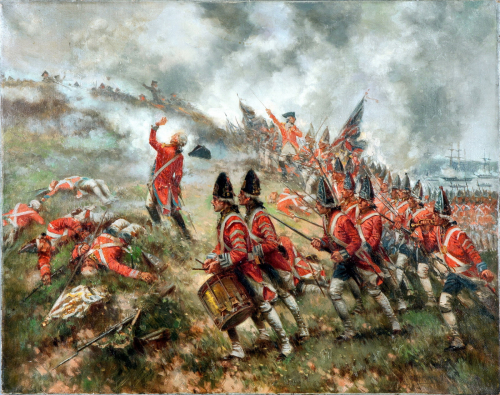
This is Volume 1 of Atkinson’s Revolution Trilogy. The book made our group’s list in a circuitous way. Murray was a big fan and reader of Atkinson’s Liberation Trilogy on World War Two which covered the American campaigns in North Africa, Italy and Western Europe. Murray’s meeting Atkinson twice at book signings did not lessen his admiration. (See “Mini-Review: Remembering Your Father with Rick Atkinson.” ) Given this history, it was no surprise Murray read the The British Are Coming when it first came out in 2019.
Atkinson’s first book of this trilogy did not disappoint either and when Murray heard that Book Two was near publication he put in an advance order through his pop-up book shop Destination: Books. One thing as a bookseller he can really appreciate the exquisite quality of these books: Fine printing, color inserts of paintings of the principals like the two Georges, Benjamin Franklin and paintings of naval battles and ground engagements. (The painting here of Bunker Hill by Edward Percy Moran isn’t one of them.) There are plenty of detailed maps, footnotes and a detailed index. The books are $40, but they far surpass books that cost nearly the same.
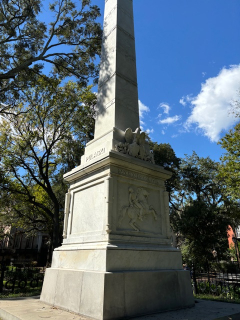 Since Francis finished The Pale King weeks ahead of Murray, he suggested maybe Francis would like to take a look at The British Are Coming. After all, last year we read two themed Revolutionary War books last year: Barbara Tuchman’s March of Folly, which devoted a third to how the King George III and his ministers’ miscalculations cost the British Empire the colonies and Greg Booking’s From Empire to Revolution: Sir James Wright and the Price of Loyalty in Georgia. Inspired, the GRSG held its annual meeting in Savannah and visited some of the historical sites including the memorable Pulaski statue in Monterey Square.
https://bookshop.org/widgets.js
Francis finished the book quickly and topped it off with a short five-star Amazon review.
This is a great book deserving of its awards and accolades. It has well-chosen corroborative detail, keeps up a marching pace, which keeps the reader engaged through land and naval battles, and switches points of view, developing simultaneous timelines with adequate depth so the reader feels to be part of each side both militarily and politically. It eschews hagiography and gives a balanced view of the valor, endurance, suffering, unfairness and remarkable characters, rich or poor, foot soldier, king or captain of the times. Recommended for all interested in history and for teens and pre-teens who nurse a spark of enthusiasm for learning the origins of the USA.
This immediately led to our next selection.
The Fate of the Day: The War for America, Fort Ticonderoga to Charleston, 1777-1780 by Rick Atkinson
This is the first time in GRSG history that we read a bestseller within days of its publication AND were able to see the author talk about his book while we were still reading it. Murray attended an event at the Atlanta History Center on May 22nd featuring a conversation with military historian Rick Atkinson (which is how he defines himself).
Atkinson mentioned at the AHC that the book is split into three main sections because it naturally “cleaved into three parts.”
Part I
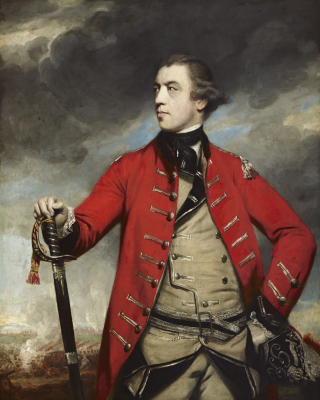 This begins with the battle for Fort Ticonderoga when British troops led by General John “Gentleman Johnny” Burgoyne and ends with Burgoyne’s surrender after the Battle of Saratoga in October of 1777. Atkinson, in his signature details, describers the two long lines of rebel soldiers bracketing the road. “No laughing or marks of exultation were to be seen among them, ”a Massachusetts colonel said of the American troops. “They had fortitude of mind to bear prosperity without being too much elated. This was one of the early turning points of the war because it fortified France’s involvement as an ally of the Americans. , There is some foreboding in Atkinson’s initial description of the campaign on page 35, “Burgoyne exuded the high-spirited complacency obligatory at the beginning of any military calamity.”
Page 232: Burgoyne after his humiliation at Saratoga stayed in British imagination. Kind of like Lew Wallace who wrote the famous novel Ben Hur fter the Civil War erasing the memory is that his Union troops were lost in the woods on their way to the Battle of Shiloh.)
In 1780 he would return to the theater, achieving greater success as a playwright than he ever did as a general. His light opera The Lord of the Manor had a fine run at Drury Lane, and The Heiress was a comic stage sensation, described by an admirer as “one of the most pleasing in our language.” After his death in 1792, at the age of seventy, he was buried in the north cloister of Westminster Abbey beneath a bare slab. (page 232)
Highlight (Yellow) and Note | Page 232: Bernard Shaw’s requiem for Burgoyne
The precise location was soon forgotten, but a century later he would be immortalized, after a fashion, by George Bernard Shaw in The Devil’s Disciple. “Burgoyne’s surrender at Saratoga,” Shaw wrote, “made him that occasionally necessary part of our British system, a scapegoat.”
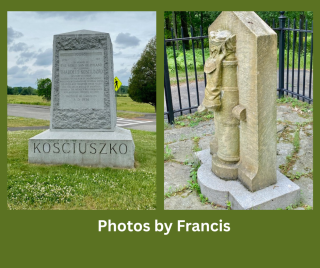 Adding to our interest in this campaign is that Francis has visited the Saratoga battlefields. There picture of Thaddeus Kosciuszko monument and the boot of Benedict Arnold are significant. Kosciuszko, a master of fortifications built the defenses that made Burgoyne’s escape impossible was little known outside of Revolutionary War buffs unlike Benedict Arnold who was known as traitor to his country. But what is not common knowledge is that Arnold while in fighting for the American was one its best commanders in the field. (The boot is significant because Arnold was wounded in the left leg twice. The second time at Saratoga (hence the boot memorial) but returned to active duty even though one leg was two inches shorter than the other. (Atkinson quipped that he wouldn’t spoil Arnold’s ultimate betrayal. “You’ll have to wait until Book 3.”
In Part One, Atkinson also give detailed grisly accounts of the battles of Oriskany (New York), Bennington (Vermont) and Germantown, (Pennsylvania). Battles I knew nothing about.
Part II
This section covers the war from the aftermath of Saratoga when the French officially entered the Revolutionary War on the side of the Americans. This is part of War is something we both knew very little about (even though when we read Tuchman’s March of Folly last year, the first third was about how King George III and England totally for a lack of a better term “screwed the pooch” in their policies towards the Colonies.
In these chapters 11-19 covering November 1777 to February 1779 gave details of how the French were more interested in putting it two their mortal enemy the English and tried to pull Spain into the war as well, but with limited success. Most of the French-British battles were naval battles: Ushant Island , a “craggy, fogbound speck of rock twenty miles off the western tip of Britany,” (July , 1778), the Battle for Newport Rhode Island (July-August 1778). Later the opposing fleets clashed in the English Channel, (August 1779) which thwarted France’s invasion of English soil.
John Montagu, the fourth Earl of Sandwich and first Lord of the Admiralty during the War. He was hardworking. Atkinson writes, “working at his desk through meals, he sometimes ate sliced meat between two pieces of break, which he held I one hand while he wrote with the other– the eponymous sandwich. Sandwich was a force in the buildup of the Royal Navy and later patronized the expedition of Captain James Cook who discovered the Pacific archipelago the Sandwich Islands or as it is known now as – Hawaii,
One of many Atkinson’s strengths is how he adds intriguing sidebars mixed with his prose.
“Brigadier General Augustine Prévost—known as Old Bullet Head from a disfiguring wound to the face suffered in the Seven Years’ War—had swept north from St. Augustine, bringing more than seven hundred additional redcoats and loyalist troops, plus a large contingent of loyal refugees who had been hiding in the south Georgia wilderness.”
Then some of us may have heard the Baron Friedrich Wilhelm von Steuben who gets credit for whipping Washington’s army into shape at Valley Forge in 1778 (the descriptions of the starvation, sickness and cold in winters at VF in ’77 and ’78 puts the reader in shock on how the Continental army survived.). Here’s an example of how Atkinson adds detail:
When frustrated or irate “he began to swear in German, then in French, and then in both languages together,” his secretary, Peter Du Ponceau, reported. If that failed to bring results, he would tell Du Ponceau, “Come and swear for me in English.” He soon learned two syllables in English—“Goddamn!”— and then a complete sentence: “I can curse dem no more.” Americans, he soon recognized, were unaccustomed to blind obedienc
And then there is the memorable scene when Voltaire returned from exile to meet Franklin. He was near death at the time. “When urged to renounce the devil he (Voltaire) replied, “Is this a time to make enemies?”
Atkinson in Atlanta
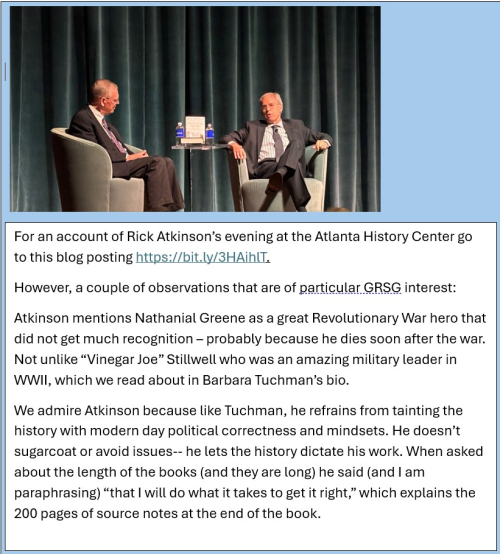
Part III
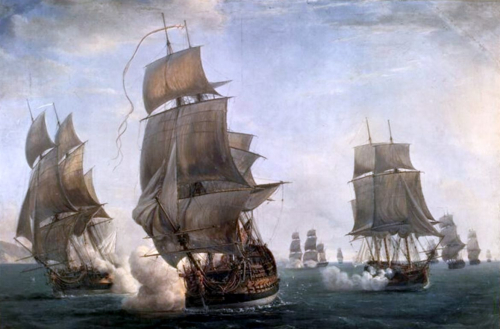
More of the same as Parts I and II: Bloody campaigns like War of the American Frontier when American troops marched up the Susquehanna River to destroy Indian tribes that were allies of the British. This includes destroying crops to starve out their enemies; more naval battles surrounding the Southern ports of Charleston and Savannah which both fell to the British. (Savannah was particular interest of us since we read the From Empire to Revolution: Sir James Wright and the Price of Loyalty in Georgia by Greg Brooking; and visited Savannah last year.
A couple of related observations that made this book a challenge to read (not because it was not well-written) but the subject matter strikes too close to today’s headlines. A couple examples come from Francis:
Page 277: Foreshadowing of DOGE?
One of the major recorders of the reign of George III, Horace Walpole, “was always ready with a diatribe, waxed on in scathing letters to various friends: The nation has leaped from outrageous war to a most humiliating supplication for peace…. Such accommodating facility had one defect—it came too late…. How one blushes to be an Englishman. To this he would add, ‘Children break their playthings to see the inside of them…. We have been like babies smashing an empire to see what it was made of.’
The king also pardoned a few hundred criminals on the condition they joined the army; … horse thieves, poachers, bigamists and at least one highwayman.” (page 462)
Page 308: Congressional foibles—way back when
“Congress resisted shoring up the nation’s revenue system with taxation. “Do you think, gentlemen, that I will consent to load my constituents with taxes when we can send to our printer and get a wagonload of money?” one delegate asked. The treasury consequently sent cash in great stacks to the army, along with shears to cut individual bills from the sheets of money…… on. “Do you think, gentlemen, that I will consent to load my constituents with taxes when we can send to our printer and get a wagonload of money?” one delegate asked. The treasury consequently sent cash in great stacks to the army, along with shears to cut individual bills from the sheets of money……”
In his visit to the Atlanta History Center, twice used expression “Not worth a Continental” This was a reference to the worthless paper that the Continental dollar had become. There was a lot of hyperinflation. Adding to the woes, the British printed counterfeit money which could be distinguished because it was printed on better paper with few misspellings. (As a kid I heard the expression that something “wasn’t worth a Continental damn” Hmm.
The other aspect of the book was that Atkinson’s grisly descriptions and of the disease and bloody battles–especially those at sea (most notably John Paul Jones capture to the British warship Serapis.) He said at his talk that he also wanted to show the brutality of war so readers would understand what those in combat went through.
This excerpt from page 584 of the book illustrates this:
“Illness was a way of life—and death—aboard ship in the age of sail. Of seventy thousand seamen in the Royal Navy this year, more than twenty-four thousand would sicken, a morbidity rate exceeding one third. During the Seven Years’ War, typhus and other diseases killed nearly half of the French mariners who sailed for Canada in 1757, and the survivors brought enough pathogens back to Brittany at the end of that year to also kill five thousand civilians. In the same bleak tradition, the ships that dropped anchor at Brest in mid-September bore eight thousand sick and dying French seamen, plus three thousand invalid Spaniards. So many corpses had been tossed overboard in English waters by the end of the voyage that residents of Cornwall and Devon supposedly would not eat fish for a month. The tally in Brest included 300 sick aboard both Palmier and Destin, 44 dead and 500 sick on Augustus, and, on Villede Paris, 61 dead and 560 sick. Of those still alive upon reaching shore, “a great many perished in no time,” a cadet from Picardy wrote. “I watched the covered wagons carrying the dead to their graves. They passed under my windows in a stream.”
https://bookshop.org/widgets.js
We were both relieved when we finished the book. Not because weren’t impressed with Atkinson’s work, but this is — for the lack of a better word — heavy reading. Our nation was founded in division and bloody violence and given current event here in the first half of 2025 doesn’t make it any easier.
We finish with Francis’ Four Star Amazon Review
Apocalypse Then
Vincento Ibenez wrote The Four Horsemen of the Apocalypse, a best-selling novel based on the horrors of WWI in 1916. In like manner, Rick Atkinson’s: “The Fate of the Day” illustrates how Plague, War, Famine and Death were elements common in both European and American venues in the 18th through 20th century. While the first book in his trilogy reads quickly and captures the landmark events which shaped the onset of hostilities, this book shows the rocky aftermath of lofty ideals colliding with hereditary rule involving limited communication, inexperienced soldiers and commanders, mercenary troops, naval blockades, shipwrecks, indecision, poor planning and delays. These, coupled with unwieldy economies, led to supply shortages, exposure to heat, cold and illness and futile campaign seasons. Episodic savagery and mistreatment spared no one including Native Americans, enslaved persons, impressed seamen and prisoners of war. Moments of military and political heroism, cowardice, stupidity, cupidity and genius also occurred, which all helped push events towards their ultimate resolution. Although as well-written and researched as its predecessor, I found this book a more difficult read, perhaps because of the extent of human suffering it describes. Was it too long? Possibly, but effort and suffering were molten elements in this conflict which had to slowly harden for a new nation to form. Documenting the toll it exacted serves a purpose. The now legendary exploits of John Paul Jones comprise the most riveting portions of this book, and, given the military stalemate of those years, explain why he stands out even today. This is American History, written large, ideal for readers interested in the origins of our country and its anti-autocratic zeitgeist.
The Magic Mountain by Thomas Mann
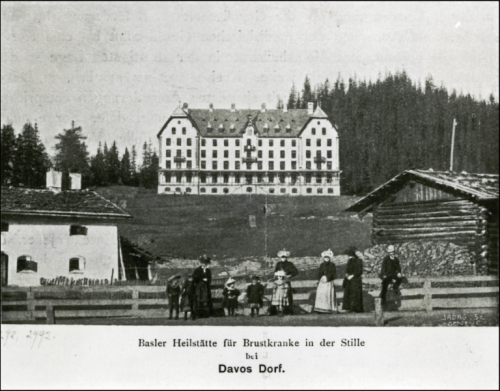
This is the 101st anniversary of publication of Thomas Mann’s classic novel. Not only did Mann win the Nobel Prize for Literature in 1929, but he has special connection to GRSG. In the book Writers of the 70’s: Thomas Pynchon, Joseph W. Slater explains the link between Pynchon and Mann:
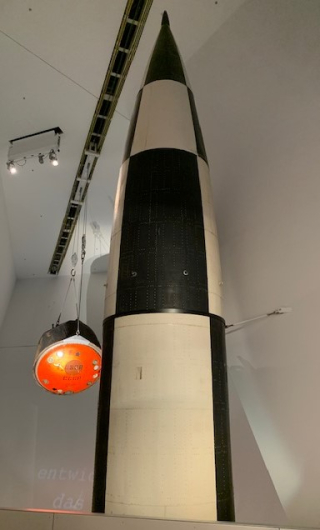
When Gravity’s Rainbow appeared, most critics dwelled on Pynchon’s similarity to Joyce. However, we should note that a more logical affinity would be with Thomas Mann, also a product of this period. In the irony of his narration, his mastery of the leitmotif, and his similarity of theme, Pynchon has much with common with Mann, who has many times been called a literary equivalent of Max Weber. It is perhaps no accident that the first appearance of the Angel in Gravity’s Rainbow takes place in the sky of Lübeck, Mann’s home.
Like Mann, Pynchon is interested in the polarities between the Northern and Southern cultures. In the fiction of both writers, North stands for rationality, discipline, civilization, alienation from nature; with South Are associated irrationality, freedom, nature, fertility.
Overview
Francis’ Amazon review provides an excellent overview of the book. Here’s Part 1 of “TB or not TB”
In 1912, Thomas Mann visited his wife, Katia, convalescing in the alps at a tuberculosis sanatorium in Davos Switzerland. It gave rise to the fictional Berghoff Sanatorium in “The Magic Mountain” long before Davos became a playground for barons of industry and heads of state attending The World Economic Forum. But even in that era, when people, not goods, were being consumed, and mycobacteria were the consumers, elite Europeans still formed cliques, intrigues and dalliances in the sanitariums that housed them as they recovered from an unpredictable illness.
The book introduces Hans Castorp as he visits Davos, sharing with readers his opinions on the behavior and conversations of its inhabitants. After his stay is unexpectedly extended, Hans, neither a hero or anti-hero, is seen as someone capable of enjoying comestibles, scenery, music and cigarettes and willing to learn from what he can gather from social encounters. As an amiable passenger on a ship of ambulatory consumptives, Hans provides Thomas Mann, the book’s author, a foil to sketch character, debate religion, philosophy and politics, discuss psychoanalysis, and explore romantic desire, suffering, death and time.”
The remainder of the review is at the end of this post.
Besides Pynchon
There were other reasons for selecting The Magic Mountain as Murray’s scheduled trip to Switzerland in June requires to read something voluminous and relevant to the places he was traveling. (For further explanation read “Swiss Reading Notes” from his Book Shopper blog.) Like Francis I had tried to read the book decades ago, remembering little except it was set in a sanitarium and it was supposed to be a metaphor for the world order in the turn of the 20th century.
We read the “new” (1995) translation from the German by John E. Woods. This translation of Mann’s works has made the book readable, and brought out of nuances of the language (including Mann’s description and humor) . This obit from The New York Times gives a full account of Woods as a translator and coincidently he was born in Indianapolis and his works are housed in the Lilly Library on the campus of Indiana University (our alma Mater).
Strengths
The Medicine
As you would expect, I defer to Francis on the medical aspects of the book. Francis wrote “Thomas Mann’s discussion of the biology of human tissues and the evolution of their cellular structure is remarkably well done and still quite accurate today.” He liked this passage about human skin.
“Your sculptural outline, if one can speak of it that way, is fat, too, of course, if not to the same extent as a woman’s. For our sort, fat normally is only a twentieth of total body weight; a sixteenth for women. Without our subcutaneous cell structure we’d all end up looking like some sort of wrinkly fungus…. Page 259 “Well, then—skin, you say? What should I tell you about your sensory envelope? It is your external brain, you see. Ontogenetically speaking, it has the same origin as the apparatus for the so-called higher sensory organs up there in your skull. You should know that the central nervous system is simply a slight modification of the external skin. Among lower animals there is no differentiation whatever between central and peripheral—they smell and taste with their skin. Just imagine it—the skin is their only sensory organ. Must be quite a cozy sensation, when one thinks about….

Since the medicine practiced at the sanitarium was led by Dr. Behrens his convictions on the treatments were a major influence. We learned about the pneumothorax treatments where the lung is intentionally collapsed, and the patients bond together with their “unpleasant whistle, harsh, intense…it reminds one of the music you get from one of those inflatable pigs you buy from the carnival (Mann humor p48).
“Pharmacology and toxicology are one and the same thing—we were healed by poisons, a substance considered an agent of life could, under certain circumstances, in a single convulsion kill within seconds.” ( p 568)
Philosophical and Political
At the beginning the Hans meets the Italian Settembrini an intellectual who values humanism and democracy. Later Mann introduces Naptha a Jesuit who has radical communist sympathies. The men frequently debate their respective positions. (for pages and pages) and Hans and his cousin Joachim frequently observe these often-fiery arguments.
Speaking of philosophical, one of the overarching themes is death. There is an extraordinary chapter (Danse Macabre) where Hans and Joachim visit patients that are near death is extraordinary for Mann’s graphic descriptions. Francis provided a quote from Somerset Maugham, which encapsulates such a theme, ” It is not true that suffering ennobles the character; happiness does that sometimes, but suffering for the most part makes men petty and vindictive. ”
Humor
The chapter when Hans’ Uncle comes to visit the Berghof to get his nephew released and after less than a week decides to leave because the way that Dr. Behren frightens him by suggesting that the Uncle stay. The running joke about Adriatica Mylendonk’s sty? The less than flattering descriptions of some of the characters.”; …”her red uneducated face was contorted with pleasure.” (Frau Stohr watching a movie, p.311)
Weaknesses
For the most part they are minimal.
The length the political discussion between Semterine and Napatha last quarter begins to drag (although their final confrontation in the last chapters erased that. Another plot albatross is the character of Mynheer Peeperkorn who is introduced late in the book as Clawdia’s lover. He is an older, retired colonial Dutchman with a bold personality, but kind of a rambling bore that dominates about 60 pages at a juncture of the book that you are ready to finish. Hans has romantic interest in Clawdia earlier in the book after she gives Hans a picture of herself on the day she is leaving the sanitarium. (Of course it’s an x-ray, which were a novelty back then and loaded meaning.)
Murray’s Magic Mountain Immersion

As mentioned earlier, part of the selection process for The Magic Mountain was my trip to Switzerland for three weeks in June. What began as just reading a book to become acclimatized to the region became an immersion — something you need to get through a 700-page book.
 It began innocently enough when I scratched Der Zauberberg on the front cover on the trade paperback. But it quickly snowballed while I read. In Zermatt from the balcony I could see the Matterhorn that was lit by the sunrise. These were crisp mornings requiring a blanket and thus I began to do my best Hans Castrop wrap-up and look out over the mountains. From the same balcony I could see the GGB Gornergrat Bahn pull out of the Zermatt station heading towards the glaciers at Gornergrat. (postcard photo)
One of best parts of Switzerland are the trains and Mann mentions the narrow-gauge trains that took Hans to Davos. The GGB Gornergrat GGB Bahn was the first electric train in Switzerland. It has been in operation since 1898.
It wasn’t until I had been in Switzerland that I realized that Mann died while living in Zurich in the final years of his life. (He was forced to leave Germany to escape the Nazis in 1933). He is buried in nearby Kilchberg Cemetery and I entertained thoughts of visiting the gravesite, but then I learned that the University of Zurich is home to the Thomas Mann Archives which was only a quick taxi drive away from where I was staying.
The archives are housed in a few rooms dedicated to some artifacts and a replica of his office. (scanned here from a complimentary postcard). I was surprised there was no one on site to discuss the novel, but that is what the GRSG is for. End of immersion.
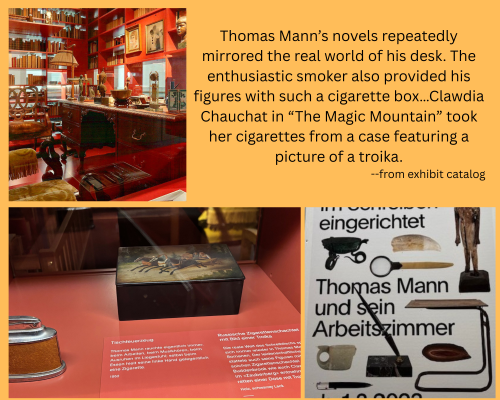
We finish with the remainder of Francis’ 5 Star Amazon Review “TB or not TB”.
…The “Magic” of the mountain can best be appreciated by what it lacks, what Jose Ortega Gasset refers to as “The most salient characteristic of life is its coerciveness: it is always urgent ‘here and now’ without any postponement. Life is fired at us point blank”. The absence of such pressure frees its inhabitants, who are distant from the work, cares, children and spouses they left behind in the flatlands. Additional magic is provided by this kingdom’s impeccable 5-star accommodation, sumptuous meals, and scheduled health and leisure activities. Their rhythmic repetition coupled with the uncertainty of anyone’s future ensures that residents focus on the essentials of rest and recovery.
The book, long, thoughtful and vividly written, takes the reader on a slow ascent into an upper world and its characters, and their hopes, awareness, virtues and follies framed in the global events of the era and the triumphs and tragedy of European history. At the end, it descends rapidly to the coercive flatlands, which have been unimaginably and un-magically altered in the interim. Highly recommended, especially for those comfortable with unhurried reading and a willingness to reflect on the past and the implications it has for nations and individuals today.
https://bookshop.org/widgets.js
Note: Photos of Davos and the portable pneumothorax machine are from the Aspetar Sports Medicine Journal. There is a good history of Davos in this article.
A Journey to the Western Islands of Scotland by Samuel Johnson

After the lengthy The Magic Mountain we chose something lighter in stature and page volume. Published in 1775 this book is a travel book about the trip that Johnson and his famed biographer Thomas Boswell took in 1773. Basically the 87-day journey starts in Edinburgh, on to St. Andrews along the Scottish coastline before swinging west to Inverness and then the Inner Hebrides. The author spends much time of the Isle of Skye and Mull before Boswell was due back in Edinburgh. Boswell, an accomplished writer in his own right, published his thoughts The Journal of a Tour to the Hebrides about Johnson and his trip in 1784 a few years after Johnson died.
This selection also makes sense because we seem obsessed with late 18th century British-American History. Why within the last year we’ve read From Empire to Revolution: Sir James Wright and the Price of Loyalty in Georgia by Greg Brooking; The March of Folly: From Troy to Vietnam by Barbara Tuchman; and Rick Atkinson’s The Fate of the Day. All three books devote considerable study to the British Empire of that era.
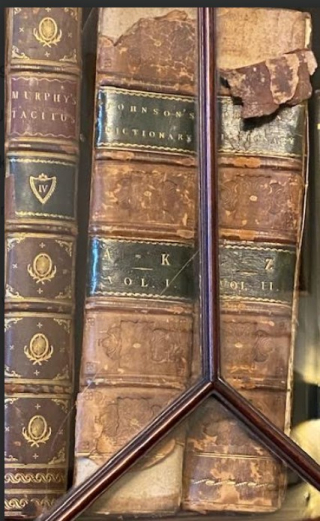 Also, we have made a habit visiting some of the literature’s heavyweights from Faulkner to Mary Shelley to Laurence Sterne during our GRSG years. And Johnson and Boswell are mainstays in the Norton Anthology of Literature, Johnson’s two volume A Dictionary of the English Language (1755) is still found in the best personal libraries. Johnson writes about the role of books “….As no man leaves his eloquence behind him, the new generations have all to learn. There may possibly be books without a polished language, but there can be no polished language without books.”
(Murray admits he doesn’t have a copy of the Dictionary, but he managed to keep his copies of the Norton Anthology of English Literature Vol. I from his undergraduate days at Indiana University. BTW, Francis noted that the in the passage describing the college of St. Andrews reminded him of our Bloomington days:
“Saint Andrews seems to be a place eminently adapted to study and education, being situated in a populous, yet a cheap country, and exposing the minds and manners of young men neither to the levity and dissoluteness of a capital city, nor to the gross luxury of a town of commerce, places naturally unpropitious to learning; in one the desire of knowledge easily gives way to the love of pleasure, and in the other, is
in danger of yielding to the love of money. -page 13 (“Unpropitious?” where’s my dictionary?)
The Writing of Johnson
This passage Johnson’s biography from The Norton Anthology describes why Johnson is considered one of the all time greats of his time:
“Any fair examination of Johnson’s best writings will demonstrate that for all its studied formality, Johnson’s prose possesses most of the virtues of his conversation…the search for truth in the wide field of human experience; and the wit and wisdom and energy of Johnson’s spontaneous talk are present in his prose.”
Johnson wit and wisdom
“that life consists not of a series of illustrious actions or elegant enjoyments, the greater part of our time passes in compliance with necessities in the performance of daily duties.” -page 14″
“French cookery pleases all foreigners but foreign cooking never satisfies a Frenchman page- page 40
The strong must flourish by force and the weak subsist by stratagem ..Misery is caused for the most part, not by a heavy crush of disaster, but by the corrosion of less visible evils – p. 67
Power and wealth supply the place of each other. Power confers the ability of gratifying our desire without the consent of others. Wealth enables us to obtain the consent of others to our gratification. Power, simply considered, whatever it confers on one, must take from another. Wealth enables its owner to give to others, by taking only from himself. Power pleases the violent and proud: wealth delights the placid and the timorous. Youth therefore flies at power, and age grovels after riches. – page 102
The Descriptions of Scotland
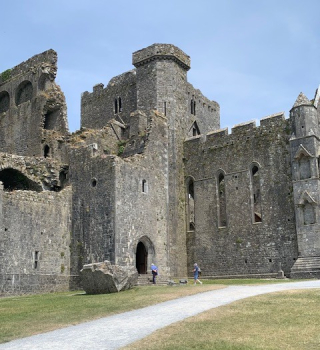 We admired his descriptions of treeless Scotland and the castles. Though neither of us have spent time in Scotland we have both been recently been to the Emerald Isle with castles and rocky coastlines. (Though we dare not say they are one and the same though Murray is of Scotch-Irish descent)
Lots of descriptions of castles and many of them were in ruins just as they are today. What we didn’t realize they were centuries old even then and often in ruins.
“A hut is constructed with loose stones, ranged for the most part with some tendency to circularity. It must be placed where the wind cannot act upon it with violence, because it has no cement; and where the water will run easily away, because it has no floor but the naked ground.”
Both these photos are from Ireland. Please forgive the power lines on the stone huts.
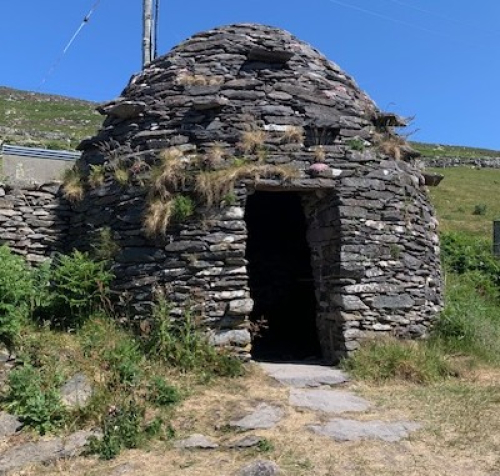
Scottish History – Feuds, Migration
Lots of kings, lords and clans. After all it is the land of Macbeth.
“Yet what the Romans did to other nations, was in a great degree done by Cromwell to the Scots; he civilized them by conquest and introduced by useful violence the arts of peace.”-Page 34
“This was a kind of irregular justice, which, though necessary in savage times, could hardly fail to end in a feud, and a feud once kindled among an idle people with no variety of pursuits to divert their thoughts, burnt on for ages either sullenly glowing in secret mischief, or openly blazing into public violence. Of the effects of this violent judicature, there are not wanting memorials.” – Page 53
Johnson and Boswell and Impedance
Boswell was a key factor in the Johnson book—both because he could communicate in the same language as the Scots and because he understood Scottish ways and customs. “(“Boswell’s frankness and gaiety made everybody communicative” – page 80 ). In our discussion–led by Francis– we discussed what is known as “impedance matching”.
Impedance matching is about an interface between two different sources, more commonly of power, but one can think of an information interface as well. For example, a utility power line uses transformers one steps up the power (voltage) at intervals to make sure that the voltage is constant and current flows through the line for long distances. More importantly, transformers are used to step down the voltage from the power line to one’s home, this is so the high voltage needed to drive the power line over long distances is lowered so it doesn’t blow out your rice cooker. Cooking oil is put on food so that when it gets put in a fry pan, the heat doesn’t instantly char the exterior of the food. Lens coatings are used to reduce the reflection of light off glass surfaces and more of it is transmitted, and ultrasound gel is used to make sure that the sound from the ultrasound transducer is transmitted through the skin to the tissues below rather than reflecting off the air pockets that form when skin is pushed by a dry transducer. A gear shift also acts as an impedance matcher—an engine cannot move a static heavy gear, which is why you use first gear, but then, once it gets going, 4th gear vehicle in 4th is ideal for using the engine’s torque. The correct gear transmits the power of the engine most effectively.
As for communication, more gets through when someone speaks the same language. Also, the human-to-human connection is better, say in the South, when someone has the right accent and has a slow tempo as opposed to say a New Yorker in the South with a northeastern accent who talks too fast (and vice versa too of course).
Thus Boswell-who was educated Edinburgh and Glasgow and spent time in the high social circles of Edinburgh and London was much more familiar with the Scottish peoples. Without him the people that Johnson interacted with would have never opened up to him.
Good physicians do their best to enhance two-way communication with patients and families, matching mood, seriousness of the issues discussed, loudness of voice, tempo and non-verbal cues.
Francis’ Five Star Amazon Review
Isles of the Landlocked
Maria von Ebner-Eschenbach wrote: “Those who read only the classics will always remain up to date.” For those unfamiliar with Samuel Johnson, this short this work serves as a great introduction s as a great introduction, explaining why he was so widely regarded as a scholar and a man of letters even to this day. Far more than a travelogue, this book provides a fascinating glimpse of life in Scotland in the 1770s. Johnson’s keen observation of natural beauty, lifestyle, medieval architecture stands out, and his writing is a model of efficiency. Refreshingly unencumbered by political correctness, he writes straightforwardly of ignorance, poverty, want and subsistence living without belaboring those so afflicted and giving full credit to good character and manners wherever he found them. Most insightful is his nuanced take on inequality: “Power and wealth supply the place of each other…Power, simply considered, whatever it confers on one, must take from another. Wealth enables its owner to give to others, by taking only from himself.” He outlines the dire effects of subsistence living, the constraints of being tied to the land in semi-feudal society, and why emigration and the freedom of the New World appealed so strongly to those still under the thumb of tribal chieftains and the void left by harsh religious reform in Scotland. Highly recommended.
Grendel by John Gardner
This book first caught Murray’s attention when he read an interview with the writer Charles Johnson in Issue 150 of The Believer magazine. Johnson waxed poetic about John Gardner as an influential teacher in his early novelist days. Gardner (1933-1982) was also a darling in Midwest English Departments. One book his more well-known books was Grendel (1971), which is the story of Beowulf told from the perspective of the Sasquatch-like monster. Since Murray had pulled out his tattered copy The Norton Anthology of English Literature, Volume 1 to look up biographical notes on Samuel Johnson and Thomas Boswell why not revisit Beowulf? He remembers reading Grendel a long time ago and scratching his head about it.
 Reading Grendel coincided with the GRSG’s annual meeting and retreat to Brevard, North Carolina. Accompanied by our wives, we hiked the Moore Cove Trail in Mount Pisgah Forest, but we were more concerned about managing the elevated “moderate?” terrain than experiencing a Sasquatch sighting. As you can see by the T-shirt logo the Brevard area embraces the Yeti as well as the white squirrel.
Flawed
We agreed that the book did not live up to its reputation. The main flaws include:
1.) Gardner dispenses with important narrative technique most importantly — setting. We never understand where this is happening and the time frame. Even Beowulf is never fully introduced, and we assume that he is the warrior that appears at the end of the novel to give Grendel as taste of his own brutality. Adding to the confusion the plot seems to skip around without really telling us what is going on.
2.) Perhaps Gardner believes that his reader will know the details of Beowulf, “the oldest of the great long poems written in English, probably more than 1200 years ago,” according to my handy Norton Anthology. According to Norton, Beowulf’s original readers “demanded of the listener a wide knowledge of heroic poetry.”
Is this is our bad? For being unworthy?
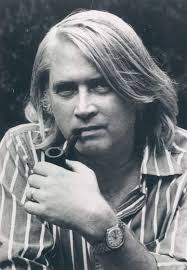 Well, we have read challenging books before (after all our namesake is Gravity’s Rainbow), Homer’s Odyssey even Faulkner’s Absalom, Absalom, but none of these books were so muddled. Perhaps if we had seen this author photograph from Gardner’s equally well known On Moral Fiction (1978) we would have known to steer clear. (Note to self: Never read a book from an author who smokes a pipe in his promo pix.)
3.) And as long as we’re piling on, Gardner was highly critical of Pynchon basically calling him “a fake” and predicting that Pynchon’s inflated reputation would probably not outlast the century. Pynchon’s latest novel Shadow Ticket is scheduled for release on October 7, 2025.
4.) And don’t even get us started on how “re-imagined” classics are not that imaginative.
Beyond Flaws
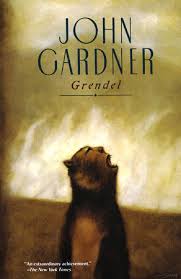 Nevertheless, there were a few aspects that give the books some timeliness. As we read this book on page 72-3 this passage stuck in our minds:
“The dragon (who is kind of Grendel’s advisor?) tipped up his great tusked head stretched his neck, sighed fire. ‘Ah Grendel! ‘ he said, He seemed that instant almost to rise to pity. ‘You improve them, my boy! Can’t you see that yourself? You stimulate them! You make them think and scheme. You drive them to poetry, science, religion, all that makes them what they are for as long as they last. You are, so to speak, the brute existent by which they learn to define themselves.”
In other words, humanity needs Grendels, and dragons and sasquatches to be “the brute existent by which they learn to define themselves.”
Grendel’s adversary the kingdom of Hrothulf with its kings/clans/thanes also reminds us of the current reign of King Donald:
“Rewards to the people who fit the System best, you know. King’s immediate thanes, the thanes top servants, and so on till you come to the people who don’t fit at all. No problem. Drive them to the darkest corners of the kingdom, starve them, throw them in jail or put them out to war…satisfy the greed of the majority, and the rest will do you no harm….And what if the workers are beyond your reconciliation? Cry ‘Law!’ ‘Common good’ and put on the pressure–arrest and execute a few.”
Now which author is being cynical.
Forgiveness
We must forgive Charles Johnson who pushed us in the direction of Grendel and take some responsibility ourselves because shouldn’t have known better that the writer one puts on a pedestal on our youth doesn’t necessarily translate to mature scrutiny. (See my review of rereading Catch-22)
And now for Francis’ Amazon Two Star Review
(his lowest ever for a GRSG selection)
A Swing and a Myth
This tale of Saxon commotion, awash in Brownian motion, captures the language of sagas of yore, drenched in gallons of blood and gore. It muses over warrior clan culture and hoarding wealth. A soap opera of conquest, betrayal and greed, it is occasionally engaging. Grendel, “….the brute existent by which they (his human enemies) learn to define themselves”, comes off as a repellent sociopath cut from the same cloth as humans but with some added features as well. Eventually, unforeseen mystical forces lead to an inevitable outcome. Time, fate, credulity and purpose are themes of note, but they seem secondary to the author’s primary aim, which is to re-invent the mood and style of an ancient epic. Jose Ortega Gassett once wrote that the measure of a book is the author’s ability to imagine his reader and to carry on a kind of hidden dialogue. While John Gardner, the author, creditably reimagines Grendel, his envisioning of this reader misses its mark.
—– EXTENDED BODY: —– EXCERPT: —– KEYWORDS: TemuCole, Billy Budd, Tremor, Billy Budd, Herman Melville, Sherman’s March, David Foster Wallace, The Pale King. Rick Atkinson, The Revolutionary Trilogy, John Gardner, Samuel Johnson —– ——– AUTHOR: Murray Browne AUTHOR EMAIL: murray.browne905@gmail.com TITLE: Latest Project STATUS: Publish ALLOW COMMENTS: 1 CONVERT BREAKS: wysiwyg ALLOW PINGS: 0 BASENAME: latest-project UNIQUE URL: https://thebookshopper.typepad.com/the_book_shopper_atlantad/2025/01/latest-project.html DATE: 01/04/2025 08:21:34 AM —– BODY:
During this month of January, while in hibernation, I have been devoting my energy (fueled by holiday cookies) preparing for a workshop I am moderating at the DeKalb History Center located in the courthouse, downtown Decatur. It started with my latest book A Father's Letters: Connecting Past to Present which came out early last year. In July 2024 I did a workshop about the book and with the encouragement of the History Center it has been expanded.
One take away from the previous workshop is that participants feel a kinship with the like-minded individuals, which makes for a good exchange of ideas and thoughts.
Moreover, this is the time of year that reminds people about families, and you may have a made a resolution that 2025 will be the year you are moving forward on capturing those important memories. This workshop can help.
For more details, including a syllabus visit the DeKalb History Center Workshop events page which includes times and the links to register.
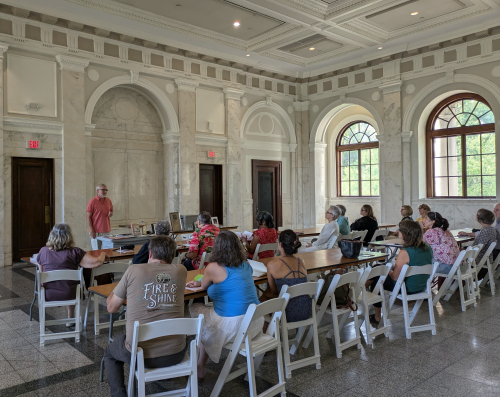

Looking through my list of approximately 30 books read in 2024, it follows the tenets established in previous years: a.) Unlike Best of Lists found in newspapers etc. I keep it very short, and I limit it to works I’ve personally read (no committee necessary; no compromising) and b.) and some theme usually emerges. Last year it was misery. This year my reading orbited around my five-week trip to Europe. Or I at least shoehorned those patterns into this list.
Another metric of a book’s impact is the number of index cards I utilize for my reading notes. For most books I read this year (listed on home page sidebar) it only takes a single card. Anything above that threshold merits consideration.
Karl Ove Knausgaard’s My Struggle Books 2 and 3 (6 index cards of notes)
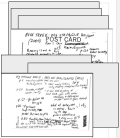
Books 2 and 3 of Karl Ove Knausgaard’s magnum opus My Struggle, I read the Book #3 (aka Boyhood) in preparation for my trip to Norway and Sweden. Despite one critic’s quip of “he’s interesting even when he’s boring” I opted for Book #2 ( aka First Love) to take with me while traveling. I always want to bring something hefty (over 500 pages) when I am on a long trip because one never knows about possible delays. People can get edgy and short-tempered in these situations, but if I have something decent to read, I can remain uncharacteristically calm.
Detailed reviews of both books are in earlier posts “Swedish Book Notes” and “Norwegian Book Notes”). After reading these two books I felt I had found my inner Scandinavian.

Paul Beatty Slumberland
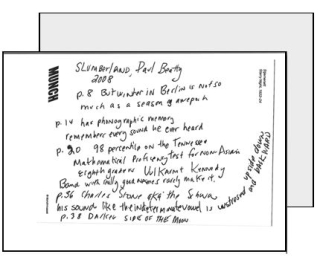 As one who has read two of his other books The Sellout and White Boy Shuffle, no writer consistently elicits fiendish laughs from me more than Paul Beatty. Slumberland (2008) is set in 1989 Berlin soon after the collapse of the wall separating East and West. Here's an accurate plot summary from bookbrowse.com:
“Ferguson Sowell, aka DJ Darky, wants to create the sonic Mona Lisa: a song that will bring together every partygoer with an irresistible toe-tapping beat. He debuts his near-perfect beat to his LA-based music collective, the Beard Scratchers, and they all agree that the song is only missing one thing: a guest appearance by a man they call "the Schwa"—Charles Stone, a legendary jazz player who disappeared to Europe decades ago. DJ Darky has one clue to finding Stone: a pornographic videotape with an undeniably Schwa-like soundtrack. He traces the tape to a West Berlin bar called Slumberland, where DJ Darky eventually takes a job as a 'jukebox sommelier,' collecting the most party-friendly tunes in the Western world.”
This is similar to the description I read in at a bookstore in Oslo (hence the European connection) and I could not resist purchasing the book, especially since my older daughter Cynthia lives in Berlin, and I have some familiarity with the city.
This is a book that celebrates people who have passion for bizarre music or musical history at least. Examples:
——Stone’s breakout EP was Darker Side of Moon which came out around the same time as Pink Floyd’s Dark Side of the Moon. Beatty writes "Due to clerical errors and acid-rock fans tweaked on microdots, the record did a steady if not brisk mail-order business."
——The ins and outs of producing soundtracks for porn films.
——Bands with really good names rarely make it.
——Skinhead collectors of Fascist music on 78s (old vinyl records) with titles such as “I Don’t Believe Hitler Can Fly; I Know He Can Fly, ” or "If Mother Won't Give You a Nickel, Ask Neville Chamberlain For a Dime."
——That Lawrence Welk once covered the The Beatles’ “A Hard Day’s Night”.
——Schwa leads a movement "to rebuild the Berlin Wall with music instead of concrete, barbed wire and machine guns 'n' shit."
Like his previous books, Beatty has pitch perfect satirical timing.

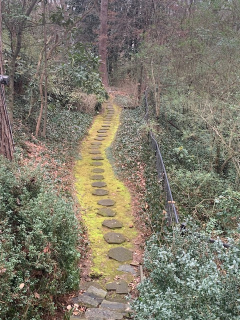 Robin Wall Kimmerer: Gathering Moss a Natural and Cultural History of Mosses
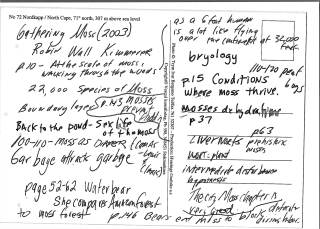
I often read books that I am considering carrying in my popup bookstore Destination: Books. The center of my inventory often centers on books on gardening, sustainability and related topics. The Gathering Moss book deep dives on everything moss, its history, its sex life, conditions where it propagate and some of its amazing properties such as its absorbency. Kimmerer informs us that moss was used as a diaper by Native American tribes in the West. The things you learn when you read.
Gathering Moss (2012) was written years before her bestselling Braiding Sweetgrass. I brought a copy Sweetgrass with me to Europe since Cynthia’s boyfriend Boris is very involved with Berlin’s Community Garden scene. Moreover, as a sound artist, I thought he would appreciate Slumberland as well, so I sent him a copy.
—– EXTENDED BODY: —– EXCERPT: —– KEYWORDS: Best Books of 2024, Karl Ove Knausgarard, Slumberland, Paul Beatty, Robin Wall Kimmerer —– ——– AUTHOR: Murray Browne AUTHOR EMAIL: murray.browne905@gmail.com TITLE: A Friend of The Friends of Eddie Coyle STATUS: Publish ALLOW COMMENTS: 1 CONVERT BREAKS: wysiwyg ALLOW PINGS: 0 BASENAME: a-friend-of-the-friends-of-eddie-coyle CATEGORY: Book Reviews UNIQUE URL: https://thebookshopper.typepad.com/the_book_shopper_atlantad/2024/12/a-friend-of-the-friends-of-eddie-coyle.html DATE: 12/10/2024 08:43:10 AM —– BODY:
 One of The Book Shopper’s charter members Dave from Seattle recently sent me two book reviews to post at my leisure on crime novelist George V. Higgins (1939-1999). He wrote both The Friends of Eddie Coyle (1970) and Cogan’s Trade (1974). I vaguely remember the former since I read it while I was high school, and I believe it received a fair amount of attention because the author was an Assistant United States Attorney in Boston at the time he wrote his debut novel Coyle.
Dave is eminently qualified. Not only does he obtain books with thrift in mind (as you will see in his review), but he is also familiar with the genre. His wife the poet/writer Laurie Blauner once gave him the boxed set of the Library of America’s Crime Novels of the 1960s for his birthday.
Coincidently, crime noir is enjoying a revival locally as A Cappella Books, a major Atlanta bookseller has added pulp fiction to its long list of Reading Clubs to start in January. The second book on the list—you guessed it!—The Friends of Eddie Coyle.
Here’s Dave’s thoughts:
George V. Higgins: The Friends of Eddie Coyle, 1970. Another book from one of our local Free Little Libraries. While not the sort of crime fiction in my usual rotation, I recalled praise for this one in the context of the filmed version done some years later. And I was not disappointed. The novel (the first for Higgins, who had been an Assistant US Attorney in Boston) is told almost exclusively in dialog, with minimal omniscient narration. The book works because it’s short and the dialog incredibly vivid. To be clear however, this is not pulp fiction—with apologies to Gertrude Stein, there’s most definitely a “there there” behind the dialog.
Like much good literature, I wouldn’t call The Friends of Eddie Coyle a fast easy read. To his credit, Higgins makes you work a bit. New characters are introduced mostly with fresh dialog—this may require you to go back a few times to get your bearings, but it is definitely worth the effort.
Reportedly, Higgins based his characters (and their way of speaking) on listening to hours of court-ordered wiretaps. In summary, one of the most vivid “you are there” novels I have ever read. Highly recommended with bonus points for frequent mention of Boston locations for extra authenticity.
George V. Higgins: Cogan’s Trade, 1974. Coincidentally, I came across the one in a different Little Free Library. The second novel from Higgins is decidedly less compelling. Though also told almost exclusively in dialog, the dialog here is more long soliloquies and less short interaction between characters. I kept losing track of who was who and who did what and where and when they did it. Recommended only for serious Higgins fans.
Thanks, Dave. Coming soon: Best Books Read of 2024.
—– EXTENDED BODY: —– EXCERPT: —– KEYWORDS: George V. Higgins. The Friend of Eddie Coyle, Crime Noir —– ——– AUTHOR: Murray Browne AUTHOR EMAIL: murray.browne905@gmail.com TITLE: Books Reflect the Mind’s Randomness STATUS: Publish ALLOW COMMENTS: 1 CONVERT BREAKS: wysiwyg ALLOW PINGS: 0 BASENAME: book-and-the-minds-randomness CATEGORY: Books as Art as Books UNIQUE URL: https://thebookshopper.typepad.com/the_book_shopper_atlantad/2024/11/book-and-the-minds-randomness.html DATE: 11/09/2024 08:54:19 AM —– BODY:
An exhibit entitled Rock, Paper, Scissors at the The Book as Art V.12, ended last month at the Decatur Public Library. Visiting the various installations reminded me of a quote from a book I just finished reading The Book Makers: A History of the Book in Eighteen Lives (2024) by Adam Smyth.
Smyth writes that in some cases book art may better represent the mind's non-linear associative wonderings. He quotes an experimental novelist and cantankerous man of letters B.S. Johnson whose book The Unfortunates was placed unbound in a box: "A better solution to the problem of conveying the mind's randomness than the imposed order of a bound book."
Here's a few books from the exhibit that made me wonder how books with their different designs can convey meaning beyond the pages:
A couple years ago at Book as Art, Vol. 10 there was even a better example of a book in a box from Dan Wood of Providence, Rhode Island.

Also in Rock, Paper, Scissors there was a table of books entitled Biography Unwritten. Book artist Toby Lee Greenberg created the biographies of inmates who were unjustly incarcerated for years before being found innocent. He writes a sentence or two about what their lives "might have been or what they missed." Instead of pages Greenberg has created a thin concrete cell block to represent the pages of their books. In the biography of Wilbert Lee, Greenberg writes "Missed twelve years of life, like pages being ripped from a book."
P.S. A slide portfolio of the entire exhibit can be found on this Decatur Alliance page. Also the Book Shopper website has a breakout of Books as Art as Books which has 42—count `em 42!—archival postings.
—– EXTENDED BODY: —– EXCERPT: —– KEYWORDS: The Book as Art V.12, Rock, Paper, Scissors, Toby Lee Greenburg —– ——– AUTHOR: Murray Browne AUTHOR EMAIL: murray.browne905@gmail.com TITLE: From the Democracy Archives STATUS: Publish ALLOW COMMENTS: 1 CONVERT BREAKS: wysiwyg ALLOW PINGS: 0 BASENAME: from-the-democracy-archives CATEGORY: Book Reviews UNIQUE URL: https://thebookshopper.typepad.com/the_book_shopper_atlantad/2024/10/from-the-democracy-archives.html DATE: 10/24/2024 08:29:26 AM —– BODY:
One of the more visited sites on the blog (and yes, I do keep track) is the October 2020 posting. "Tyranny, Voting and Making Love for the Last Time". It is a brief review of Timothy Snyder's short pamphlet of a book On Tyranny: Twenty Lessons for the Twentieth Century, (2017) and it includes an excerpt from the book. I sell them regularly at my Destination: Books pop-up booth.
(Snyder has a new book out On Freedom (2024) that one reviewer described as "a longer antithetical companion to the earlier book.)
I've read another one of Snyder's books Bloodlands: Europe Between Hitler and Stalin (2010/revised 2020). This formidable book was riveting, but depressingly awful because of its graphic descriptions of the 14 million people who perished at the hands of Hitler and Stalin in 1930s and 40s—especially in Ukraine. I did a write up entitled "My Random Bloodlands Notes" which I posted in the deep recesses of this blog—part of my personal archive.
Just a reminder to vote if you haven't already and remember the words of Astra Taylor's who said it best in her book of the same name—Democracy May Not Exist But We'll Miss It When It's Gone. For a lengthy interview with Taylor see An Imperfect Union, in Sun Magazine's November 2019 issue.
—– EXTENDED BODY: —– EXCERPT: —– KEYWORDS: Timothy Snyder On Tyranny. Bloodlands. Astra Taylor. —– ——– AUTHOR: Murray Browne AUTHOR EMAIL: murray.browne905@gmail.com TITLE: Europe Revisited with Jason Bourne STATUS: Publish ALLOW COMMENTS: 1 CONVERT BREAKS: wysiwyg ALLOW PINGS: 0 BASENAME: europe-revisited-with-jason-bourne UNIQUE URL: https://thebookshopper.typepad.com/the_book_shopper_atlantad/2024/10/europe-revisited-with-jason-bourne.html DATE: 10/11/2024 08:28:27 AM —– BODY:
In addition to the early postings about book-related travels in France, Norway and Sweden, motion pictures also had an unexpected impact on my trip last summer. More specifically the Bourne movies starring Matt Damon.
Inspired, I wrote a travel essay "Experiencing Travel with Jason Bourne", which appears on at the Tropics of Meta website. This is the 9th piece I have written for them over the years.
—– EXTENDED BODY: —– EXCERPT: —– KEYWORDS: Jason Bourne —– ——– AUTHOR: Murray Browne AUTHOR EMAIL: murray.browne905@gmail.com TITLE: Revisiting the Decatur Book Festival STATUS: Publish ALLOW COMMENTS: 1 CONVERT BREAKS: wysiwyg ALLOW PINGS: 0 BASENAME: revisiting-the-decatur-book-festival UNIQUE URL: https://thebookshopper.typepad.com/the_book_shopper_atlantad/2024/10/revisiting-the-decatur-book-festival.html DATE: 10/03/2024 08:36:55 AM —– BODY: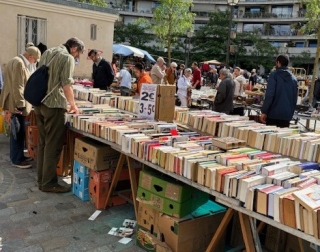 In years past, I posted extensively (here and here) about the Decatur Book Festival, but even before the COVID-pandemic I kind of lost interest in the event (also the Festivals have been downsized or cancelled), but this year I will be out there in a working/attending capacity.
On Saturday, October 5th, I will setting up a book stall in front of the The Journeyman on Claremont street between the First Baptist Church and the Courthouse. The Journeyman has accumulated quite a few used books and I am helping them re-create an environment for book shopping junkies – featuring long tables of $2 and $3 books. It will not quite as long as the table in the picture (I took that picture while I was at market in Paris –note the euro price tag) but you get my drift.
Throughout the year, I keep a booth inside The Journeyman for my popup Destination: Books. This Saturday, it is part of the Artist Alley which includes jewelry, crocheted plushies, art and photography prints and vintage clothing.
Speaking of vintage clothing, I am still debating which DBF vintage shirt to wear on Saturday.
They still fit!

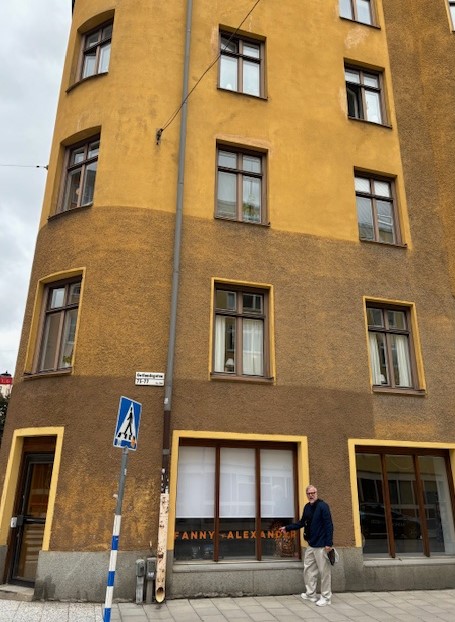
“But this is a different country, that’s why the little details are different.”
–Karl Ove Knausgaard, My Struggle Book 2
Accompanying Books
Since Book 2 in Karl Ove Knausgaard’s My Struggle is thick, the tome I began while still in Norway was still partially unread when I boarded the airplane in Stockholm to return to Atlanta. As I mentioned in the last posting much of the book centers on Knausgaard as a successful novelist living in Sweden but as a new father. Though he loves his wife and young family, he resents them because it takes him away from his writing.
The love story between Knausgaard and his second wife is more manic than romantic, but they seem to make it work. His domestic life reads a little banal, but somehow he makes it interesting enough by folding in comparisons between Norway and Sweden with help from his writer-friend Geir (mentioned in the last posting.)
“Sweden is a stupid, idiotic country…Stockholm has no soul, but it is fantastically beautiful…”If you said anything of that kind (in Sweden), you either were reactionary or Norwegian, in other words 10 years behind.”
On a broader level, it’s Knausgaard’s unapologetic views about writing is what I enjoyed the most:
Fictional writing has has no value, documentary narrative has no value. The only genres I saw value in, which still conferred meaning, were diaries and essays, the types of literature that did not deal with narrative, that were not about anything, but just consisted of a voice, the voice of your own personality, a life, a face, a gaze you could meet.
(Do blogs count?)
.. I wasn't very interested when it (an earlier book) was nominated for the Nordic Council Literature Prize, for there was one thing that I had learned over the past six months it was that all writing was about was writing. Therein lay all its value. Yet I wanted to have more of what came in its wake because public attention is a drug, the need it satisfies is artificial, but once you have had a taste of it you want more.”
(This explains why I monitor this blog’s page view statistics on a daily basis,)
Book Shops
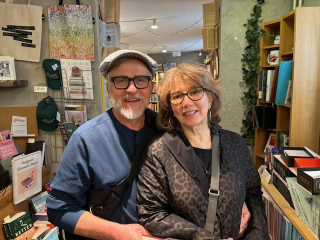 Denise and I visited only one bookstore while in Stockholm, but it was a worthy one. The English Bookshop is in the Södermalm District of the city. I purchased a copy of Norwegian Nobel Prize Winner Knut Hamsun’s novel Hunger (1890). Hamsun is mentioned several times is My Struggle, and Knausgaard himself is ticked off when a guest at this dinner party taunts him by calling him Hamsun.
Denise purchased a copy of a small book entitled Fika, which we learned is the Swedish tradition of having a break in the morning and the afternoons, which includes coffee/tea and a pastry. We didn’t want to risk offending our guide by not partaking in fika during a food tour. Here is our two-year old grandson Zack inhaling a slice of Princess cake. It was delicious. Zack learned this eating technique from his grandfather.
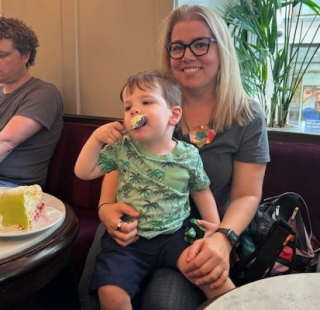
Near the bookstore we had lunch at Meatballs for the People, which our guide recommended. She made it clear that if you think real Swedish meatballs is something you get at Ikea, you are sadly mistaken. Real Swedish meat balls are made of various meats; reindeer, moose, elk and bear to name but a few. On your sampler platter they identify the origin of every meatball with a little flag. 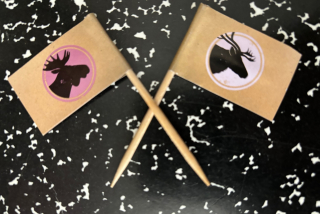
Unexpected Lit Experiences
Denise and I were unable to make it to Uppsala which is an hour north of Stockholm, where Ingrid Bergman wrote and directed in —which may surprise many— one of our favorite Christmas movies Fanny and Alexander (1982). Warning: if you listen to this clip, you risk getting a nasty earworm.
However, on the same day we were in the Södermalm District we did stumble across the Fanny and Alexander studio. It was Sunday, so there was no one around. I peered inside and it did seem like it was some kind of production company named after the famous film.
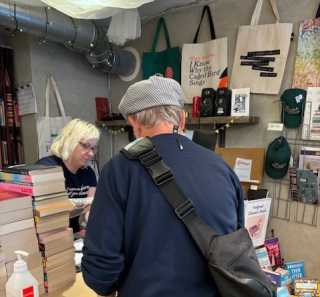 I did ask the female clerk at the bookstore for more details the studio but she knew little about it. Coincidently she said her name was Fanny named after the young protagonist in the film. But this was as close as we got the Swedish director.
And finally a special thanks to Denise, Lizzie and her family (husband Mike, Zack and Zoey) and my daughter Cynthia for making the trip through France, Norway and Sweden possible and giving me something to write about.


Accompanying Books
In preparation for my trip to Norway following a week in Paris, I began reading Book 3 of Karl Ove Knausgaard's six book magnum opus My Struggle ( written from 2009-2011). Even though I began reading it a few months ago, I cannot recall how I decided to read the book out of order. Set in southern Norway in the 1970s, Book 3 focuses on Knausgaard's childhood.
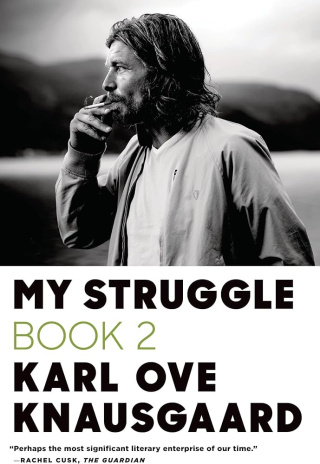 Knausgaard is major literary figure in Scandinavia and considered so in the U.S., but he is lesser known here. His books are autobiographical novels known for candor and their wide scope. He writes about exploring his suburban neighborhood with his best friend Geir – playing soccer, swimming and getting into boyhood mischief. Young Karl Ove must also deal with his abusive father, but that drama slowly builds throughout the book.
I finished Book 3 before I left stateside and liked it enough to bring a copy of Book 2 (again, what is my problem?) where Knausgaard is a successful novelist living in Sweden but as a new father he loves his wife and young family but resents them because it takes him away from his writing.
It is unclear whether My Struggle is an autobiographical novel or a memoir, but the author is a brutally honest narrator. (George Orwell once wrote that "an autobiography is only to be trusted only when it reveals something disgraceful.") He adeptly mixes commentary about writing and culture with his banal daily routine. Geir— who also becomes a writer but not a "successful" one— summarizes Knausgaard's ability like so: "he can spend twenty pages describing a trip to the bathroom and hold his reader spellbound."
However, I did not start Book 2 until I was taking the train from Paris to Berlin to join my older daughter Cynthia before the two of us went on to Norway. On this train trip, I lost my copy of The Myth of Sisyphus, that I purchased earlier in Paris. Could I have been pickpocketed when the train broke down and I was jammed shoulder to shoulder with the soccer fans who flooded the cities and rail lines? Hosted by Germany, the UEFA Euro 2024 tournament was in full match-on mode when I overheard the police in the Cologne train station cautioning travelers to be vigilant.
Book Shops
Cynthia and I did visit "a calm bookstore with international titles" Tronsmo Bokhandel located near the University of Oslo. Not only did it have a sizeable English language book section, but the entire basement area was devoted to graphic novels and such. I inquired whether they had Albert Camus’s autobiography First Man which is available as a graphic book, but unfortunately, they did not. In First Man, Camus gives an account of growing up in poverty on the streets of Algiers. I still remember the passage when he lies to his grandmother that he lost two francs in the family latrine (he used the money to enter a soccer game), and how ashamed of himself he was when he discovers later she had fished in the excrement with her bare arm looking for the money. This is an autobiography you can trust.
I settled for Paul Beatty’s Slumberland because I needed a replacement for my alleged pickpocketed Camus book— an anecdote I invented to hide my own absentmindedness.)
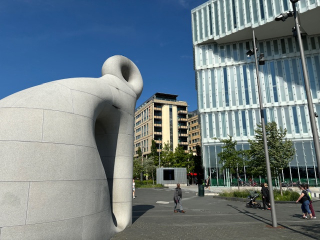 Cynthia and I also spent some time in the Oslo's Deichman Municipal Library (the building is on the right side of the photo) which was completed just four years ago. The place was buzzing on a Saturday afternoon, proving once again of the Field of Dreams adage: “Build it and they will come.”
Unexpected Lit Experiences
A ferry from the across the Oslo Harbor to Bygdøy Peninsula takes you to three museums: The Norwegian Maritime Museum, The Polarship Fram Museum and the Kon-Tiki Museum. The trio is huddled together and it is easy to visit all three places within a few hours.
The Fram Museum focuses the various polar expeditions including the Fram expeditions to the South Pole and the 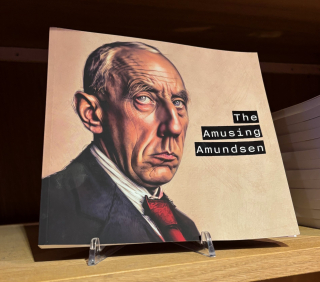 North Pole. The actual boat itself is in the museum. Part of the museum is dedicated to Norwegian explorer Roald Amundsen (1872-1928) who led the expedition that was first to reach the South Pole in 1911. The museum bookshop includes many history books, but what caught my eye was a book on the wit and wisdom of Amundsen who I guess was quite a quipster despite the sour demeanor.
The Kon-Tiki Museum focuses on the journeys of Norwegian ethnologist and adventurer Thor Heyerdahl (1914-2002) who intended to prove the possibility of ancient transoceanic contacts between Peru and Polynesia. In 1947, Heyerdahl and five others followed the Pacific currents to travel for a 100 days. Heyerdahl wrote a book about it and they made a documentary about his voyage as well. I am old enough to remember all those Kon-Tiki mass market paperbacks that flooded libraries and secondhand bookshops for decades. (The profits were used to fund other adventures including explorations of Easter Island and the Galapagos.)
The original boat itself is in the museum.
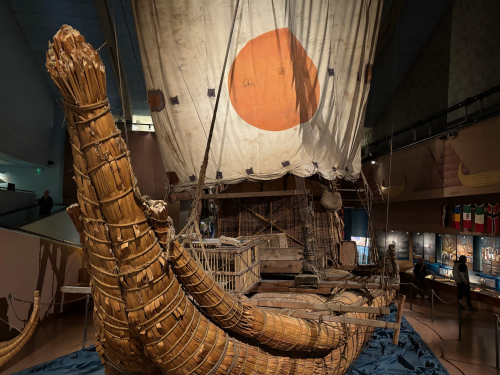
Next up: Sweden Book Notes
—– EXTENDED BODY: —– EXCERPT: —– KEYWORDS: Book Shops, Norway, Knausgaard, Kon-Tiki Museum, Thor Heyerdahl, Oslo, Deichman Library —– COMMENT: AUTHOR: Rachel L EMAIL: releach@gmail.com IP: 163.116.144.106 URL: DATE: 07/30/2024 10:29:36 AM I’ve settled on a trip to Norway for 2025, so I read this with interest! Will check out several of the spots you mention. Also, you’ve inspired me to finally read First Man. I’ll report back… —– COMMENT: AUTHOR: CyndyB EMAIL: Cynthia.Browne@ruhr-uni-bochum.de IP: 84.171.7.211 URL: DATE: 08/01/2024 06:04:33 PM I noticed no mention of Bourne is made… but then he didn’t make it to Norway —– ——– AUTHOR: Murray Browne AUTHOR EMAIL: murray.browne905@gmail.com TITLE: Parisian Book Notes STATUS: Publish ALLOW COMMENTS: 1 CONVERT BREAKS: wysiwyg ALLOW PINGS: 0 BASENAME: parisian-book-notes CATEGORY: Books as Art as Books CATEGORY: Bookstores UNIQUE URL: https://thebookshopper.typepad.com/the_book_shopper_atlantad/2024/07/parisian-book-notes.html DATE: 07/22/2024 05:30:15 AM —– BODY: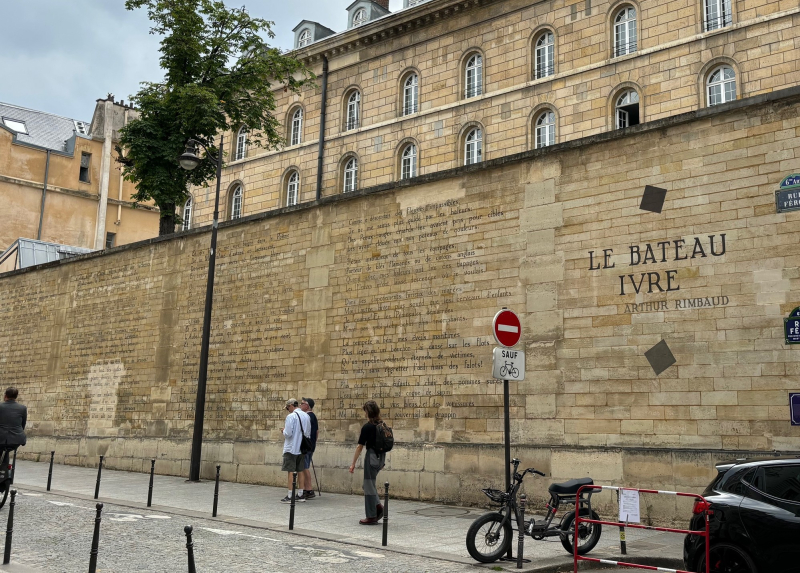
It would be ludicrous to attempt some kind of coherent essay on the book culture of Paris which extends for centuries, but still, I have some musings to share. I was in the City of Light from June 18 to June 25 with my longtime partner Denise Casey who planned our successful trip.
Accompanying Books
On route I took the opportunity to re-read Voltaire’s Candide (1759) a book which I read forty years ago. The only thing I remembered from the classic is Candide’s mentor Dr. Pangloss’ simplistic philosophy “that all is for the best in this best of all possible worlds". And the final line of “we must cultivate our garden.” Furthermore, the book works for this traveler because of its portability, and it provides plenty of quips about the French.
Besides, one never knows when you will be invited to a salon, so you want to be ready to toss out Voltairean zingers such as “the people in Paris are always laughing, but it is with anger in their hearts” or “there is pleasure in having no pleasure.”
Bookshops
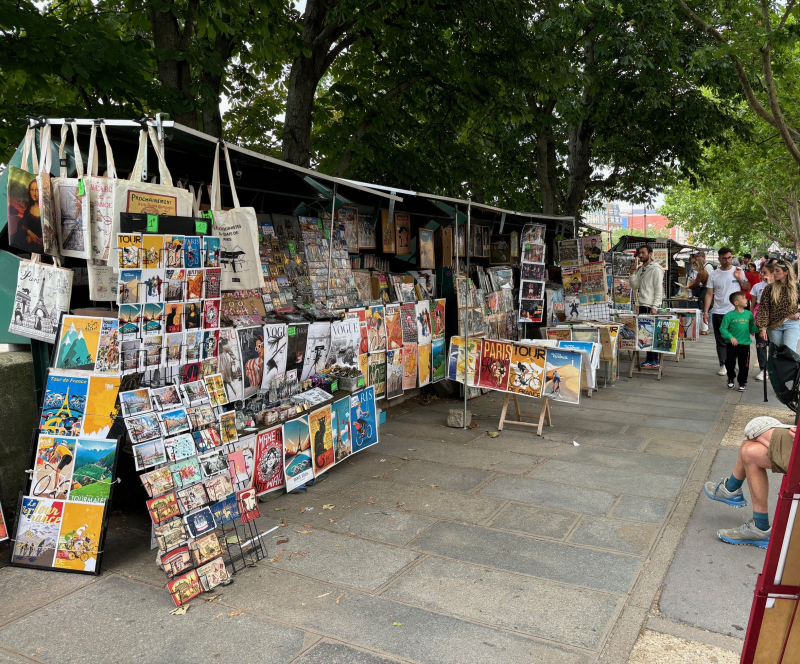
The most famous book buying place are the dozens of forest green metal stalls along the Seine River. Seeing the bouquinists, as they are called, have street and culture credentials (dating back to the 17th century) and they provided me an extra connection to the city since I am a popup bookseller myself (Destination: Books). Unfortunately, I was disappointed as the weather was a little rainy and windy and many of the stalls remained buttoned up while I was there. Of the few stalls I saw, a festoon of postcards, maps, magazines impeded the browsing.
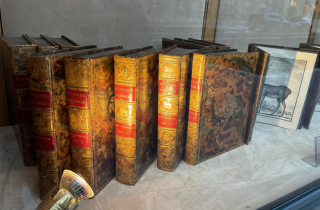 I understand that the bouquinists carry antiquated books too, but I don’t see the how they could compete with all the gallery quality antiquarian bookstores throughout the 6th Arrondissement. I am neither an antiquarian book shopper or a seller, but I still appreciate seeing gorgeous books so deliciously displayed in store windows like pastries.
The lines for the more well-known English language bookstore Shakespeare & Company near the Notre Dame Cathedral (still under repairs) were out the door, but I did visit The Canadian Bookstore, which was small shop but had canyons of books. I had finished Voltaire and needed another similarly-sized replacement, so I selected Albert Camus book of essays The Myth of Sisyphus (1942). I always found the French writer intriguing since he was born in Algeria from the humblest of beginnings.
Unexpected Lit Experiences
In St. Germain district there is a wall where Arthur Rimbaud,s most famous poem Le Bateau ivre ("The Drunken Boat") is engraved for all to see. Along the same street here was a poetry popup marketplace where booths filled with publishers, poets and stacks of poetry books for sale. I will admit my initial feeling about French poetry is similar to Bill Murray’s reaction in motion picture Groundhog Day when Andie MacDowell’s reveals she majored 19th century French poetry in college (“what a waste to time,” he blurts).
But there is a cringe of guilt that my level of appreciation for poetry is subpar.
And finally, Denise and I went to an Eatwith.com dinner booked in a bohemian artist apartment where Karyn Bauer prepared delicious meal with plenty of wine, and you meet other travelers that are looking for a different dining experience. Coincidently her partner is a book artist Cristian Todie who has designed three dimensional books, which are quite amazing. He gave me a demonstration of how his books can effortlessly expand and contract. I cannot begin to describe his work, but you should visit his website at thetodiebook.com.
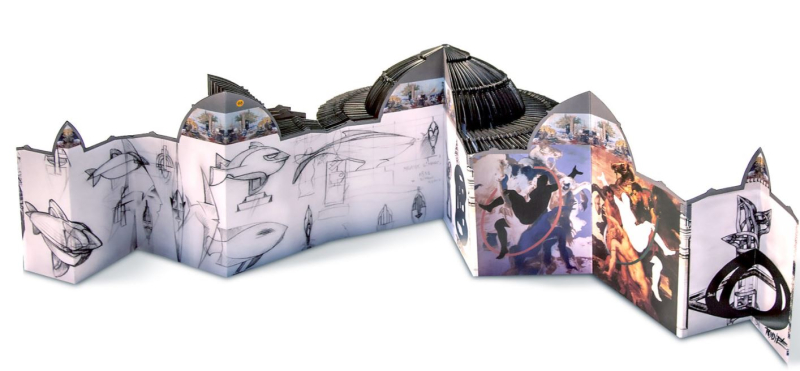
Next up: Norway
—– EXTENDED BODY: —– EXCERPT: —– KEYWORDS: Paris, Book Shopping, bouquinists, Cristian Todie, Candide —– COMMENT: AUTHOR: Cal Gough EMAIL: calgough@bellsouth.net IP: 107.130.113.15 URL: http://www.calgough.wordpress.com DATE: 07/22/2024 10:06:34 AM Glad y’all made it to Paris before the Olympic hordes descend upon the place! The photo of the old books in the window display (“like pastries”) is wonderful, and reminds me of the times I’ve spent in Paris enjoying the window-shopping (pastry shops, bookshops, and other kinds o’ shops – one, I remember sold ONLY playing cards – who knew there would be so many thousands of designs? Looking forward to your account of the trip to Norway! —– ——– AUTHOR: Murray Browne AUTHOR EMAIL: murray.browne905@gmail.com TITLE: Global Dutch Book Art STATUS: Publish ALLOW COMMENTS: 1 CONVERT BREAKS: wysiwyg ALLOW PINGS: 0 BASENAME: dutch-global-book-art CATEGORY: Books as Art as Books UNIQUE URL: https://thebookshopper.typepad.com/the_book_shopper_atlantad/2024/06/dutch-global-book-art.html DATE: 06/13/2024 07:36:55 AM —– BODY: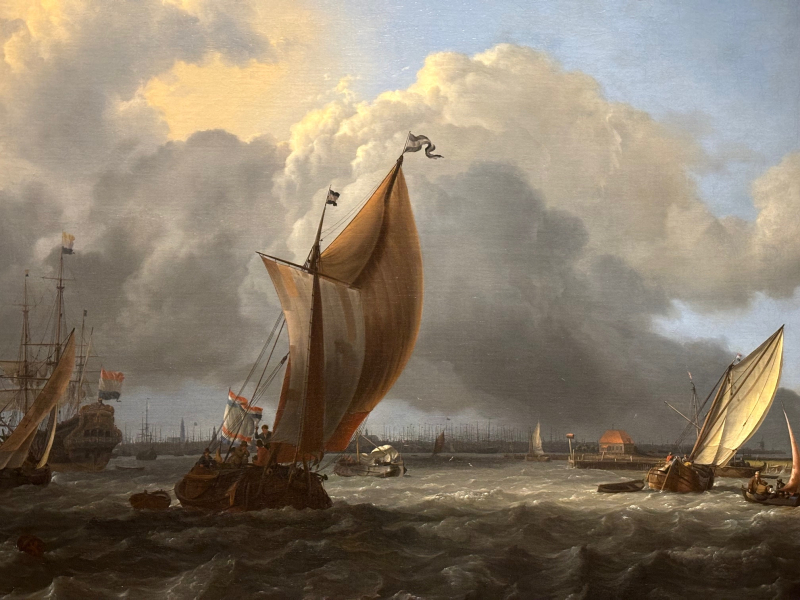
Currently the exhibit at the High Museum in Atlanta "Dutch Art in a Global Age" has it all: the portraits, the stills of beautiful objects, silver and ceramics, and two of my gallery favorites —paintings of sailing vessels on choppy seas (the Netherlands was a naval power in the 17th century) and a few beautifully illustrated books.
 On the left is a gigantic Theatre of the Cities of the United Netherlands which includes hand-colored etchings and engravings by Joan Blaeu (1596-1673). Shown here is Amsterdam (circa 1650) which is a headliner in the town-by-town tour through Flanders and the United Provinces. A precursor to the Lonely Plant guides? I think not.
 On the right, is a woodblock illustration appeared in another guidebook, Pictures of Famous Products of Mountains and Seas (1799). Japanese artist Shitomi Kangetsu's (1747-1797) woodcut of an armed ship from the Dutch East India Company outside of Nagasaki Bay in southwestern Japan. For over two centuries the Dutch were the only Europeans permitted to trade with Japan.
While the exhibition emphasizes the artistic achievement of the Dutch it does remind visitors "to consider the human costs of global commerce." This is somewhat an understatement. I recently read the opening chapters of Amitav Ghosh's The Nutmeg's Curse: Parables for a Planet in Crisis (2021) where the Indian born writer gives a graphic account of Dutch atrocities in the Banda Islands.
"You Can't Lay Down Your Memory Chest of Drawers"
I cannot go to the High Museum without checking out Tejo Remy's "Chest of Drawers" work which is part of the permanent collection. Remy is a Dutch designer who graciously allow me to use his art for the cover of my book A Father's Letters: Connecting Past to Present. When I first saw this work, I had no doubt that I wanted it for my cover and happily the people at the High helped make this happen.
Also it is a nice coincidence that Sunday is Father's Day. Go Dads.

—– EXTENDED BODY: —– EXCERPT: —– KEYWORDS: Murray Browne, A Father’s Letters, Tejo Remy, High Museum in Atlanta, Dutch Art in a Global Age —– ——– AUTHOR: Murray Browne AUTHOR EMAIL: murray.browne905@gmail.com TITLE: Memorial Day Archives STATUS: Publish ALLOW COMMENTS: 1 CONVERT BREAKS: wysiwyg ALLOW PINGS: 0 BASENAME: memorial-day-archives CATEGORY: Civil War Books UNIQUE URL: https://thebookshopper.typepad.com/the_book_shopper_atlantad/2024/05/memorial-day-archives.html DATE: 05/25/2024 09:07:23 AM —– BODY:
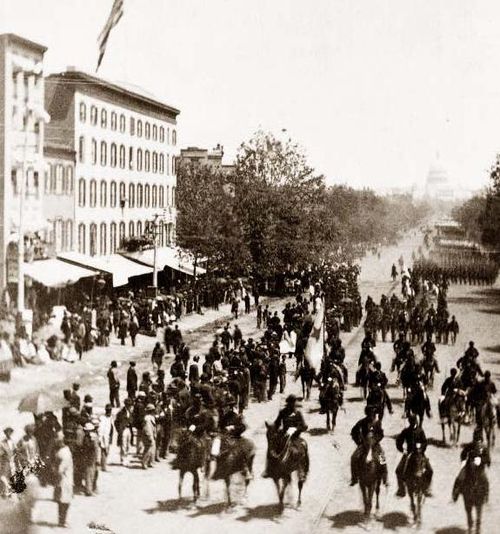
Note: From the archives. This posting originally appeared in May 2015. (Blogger takes a holiday.)
This weekend marks the 150th anniversary of the first Memorial Day Parade before there was even a Memorial Day. On May 23 and 24, 1865 Washington D.C. hosted the two-day Grand Review parade of the Union Troops. The Army of the West led by William T. Sherman had completed its capture of Atlanta and Savannah the previous autumn and had marched through South Carolina and North Carolina in the spring of 1865. They were about to join Grant's Army of the Potomac in Virginia when the war ended, but there was one last military spectacle left.
Here's an account of this extraordinary event from B.H. Liddell Hart's 1958 biography, Sherman: Soldier, Realist, American:
"On the 23rd, the Eastern armies (the Army of the Potomac) marched in review through Washington, an endless column of troops well-clad and well-drilled, their ranks trim and spotless. Returning from the pageant Sherman, with his customary candor, declared: 'It was magnificent. In dress, in soldierly appearance, in precision of alignment and marching we cannot beat those fellows.' Then someone suggested that they should not attempt it but instead should be workmanlike and pass in review 'as we went marching through Georgia.'
Sherman caught up the suggestion and next morning as the people of Washington watched the Grand Army of the West defile before their eyes they saw no glittering pageant, but instead an exhibition of virility. With uniforms travel-stained and patched, colours tattered and bullet riven, brigade after brigade passed with the elastic spring and freely swinging stride of athletes, each followed by its famous 'bummers' on laden mules ridden with rope and bridles. The most practically trained, physically fittest and most actively intelligent army that the world had seen."
—– EXTENDED BODY: —– EXCERPT: —– KEYWORDS: Memorial Day. Sherman, Washington DC —– ——– AUTHOR: Murray Browne AUTHOR EMAIL: murray.browne905@gmail.com TITLE: Exciting New Bookcase STATUS: Publish ALLOW COMMENTS: 1 CONVERT BREAKS: wysiwyg ALLOW PINGS: 0 BASENAME: exciting-new-bookcase UNIQUE URL: https://thebookshopper.typepad.com/the_book_shopper_atlantad/2024/05/exciting-new-bookcase.html DATE: 05/08/2024 05:30:39 PM —– BODY:
 I recently added a new bookcase to my study and I have been enjoying the anticipation of what exactly I should put in it.
This is a custom-made bookcase from Neatnooks Furniture and the sixth bookcase they have made for Denise and me since we moved to Decatur 15 years ago. At first, I could not remember the name Paul Nooks the craftsman behind Neatnooks, but fortunately The Book Shopper blog serves as an archive of my book shopping experiences. The entry Bookcase Testimonial from July 15, 2010 had the information that I needed. With a minimum of back and forth, Paul matched the other bookcase in my study he had built years before.
This new one is slightly different because it houses my circa 1990 media center of VCR tape machine and DVD player. With a strategically placed half-dollar sized hole in the back panel, I can connect to the TV without wires festooning from bookcase and television alike. (You can trust Paul on this because he builds beautiful custom entertainment centers as well.)
Organizing my books is very important since I sell used books and vintage Believer magazines online through my Destination: Books Alibris store. (See catalog of eclectic books here). Any online bookseller—even a small biz like mine—will tell you that searching for inventory while trying to fill an order kills your profit margins.
And moreover, this makes more financial sense than renting a storage room. As a bookseller, I still am a book shopper, but on a larger scale.
It’s one of the perks of the profession.
—– EXTENDED BODY: —– EXCERPT: —– KEYWORDS: Book shelves, Neatnooks Furniture. Paul Nooks —– COMMENT: AUTHOR: Cal Gough EMAIL: calgough@bellsouth.net IP: 107.130.113.15 URL: DATE: 05/08/2024 06:16:46 PM There’s bookcase news in my house also. One of my sisters had painted a bookcase that my parents owned in the house in East Point where we grew up, to use in her pottery studio (now in Amelia Island, where she retired to last December). It’s been on loan to me for several years, and I liked the way it looked, and the fact that it held many of my garden books. Alas, the sister wants her bookcase back, so I’m going to need to replace it soon – either with another bookcase that belonged to one of my Arkansas grandmothers, or another one I’ve kept in my attic for 30 years. Oh well, at least I won’t need to buy a newbie. Enjoy your custom-made new one: having one made for your actual needs is definitely the best option when it comes to bookcases! —– ——– AUTHOR: Murray Browne AUTHOR EMAIL: murray.browne905@gmail.com TITLE: The Irony of Ian Frazier STATUS: Publish ALLOW COMMENTS: 1 CONVERT BREAKS: wysiwyg ALLOW PINGS: 0 BASENAME: the-irony-of-ian-frazier UNIQUE URL: https://thebookshopper.typepad.com/the_book_shopper_atlantad/2024/04/the-irony-of-ian-frazier.html DATE: 04/19/2024 01:56:41 PM —– BODY:
Over 30 years ago, The New Yorker humorist Ian Frazier wrote a short piece entitled "Coyote vs. Acme", which later appeared in a Frazier collection by the same name. The crux of the wonderfully executed joke was Frazier creating a “legal document” where Wile E. Coyote of Roadrunner fame, files a lawsuit against the Acme Company for negligence in the manufacture of their products, which continually malfunction. In short, there is a description of the cartoons written in legalese. Here's a sample:
"The sequence of collisions resulted in systematic physical damage to Mr. Coyote, viz., flattening of the cranium, sideways displacement of the tongue, reduction of the length of legs and upper body, and compression of the vertebrae from base of tail to head. Repetition of blows along a vertical axis produced a serious of regular horizontal folds in Coyote’s body tissues—a rare and painful condition which caused Mr. Coyote to expand upward and contract downward alternately as he walked, and to emit an off-key accordionlike wheezing with every step. This distracting and embarrassing nature of this symptom has been a major impediment to Mr. Coyote’s pursuit of a normal social life."
This same piece resurfaced last week in an article entitled “Lost Art” which appeared in the New York Times Magazine (4/14) Screenland column. The writer T.M. Brown writes that this short five-page piece inspired an animated movie that was made by Warner for $75 million, but then was killed by studio for financial reasons and has not allowed anyone to see it or purchase it.
At the end of the piece, Brown draws the ironic parallel. In Frazier’s satire, Wile E. Coyote is hamstrung that he has “no other domestic source of supply to which to turn”. Likewise, the film’s creators have no recourse to see the film released as Warner has complete control of the work. They have no leverage.
Fortunately, I still have my copy of the Frazier collection, which I paid $2.
Meep-meep
To learn more about the writer Ian Frazier, see pages 80-82 in your The Book Shopper: A Life in Review hymnal. Available here.
—– EXTENDED BODY: —– EXCERPT: —– KEYWORDS: Ian Frazier, Wile E. Coyote, Roadunner. Coyote V. Acme —– ——– AUTHOR: Murray Browne AUTHOR EMAIL: murray.browne905@gmail.com TITLE: Book Event at Tall Tales in Toco Hills STATUS: Publish ALLOW COMMENTS: 1 CONVERT BREAKS: wysiwyg ALLOW PINGS: 0 BASENAME: book-event-at-tall-tales-in-toco-hills UNIQUE URL: https://thebookshopper.typepad.com/the_book_shopper_atlantad/2024/03/book-event-at-tall-tales-in-toco-hills.html DATE: 03/09/2024 02:58:44 PM —– BODY:
Not sure if this qualifies for a book tour, but your blog narrator will be at the Tall Tales Book Shop in Toco Hills, (2105 LaVista Rd #108 Atlanta) holding an informal Monster-in-a-Box workshop. It's just a different approach than your standard book reading-signing event. For more about A Father's Letters and what the deal is with a Monster workshop, visit murray-browne.com and look for the links.
I will bring rare copies of my other books as well —The Book Shopper: A Life in Review and Down & Outbound: A Mass Transit Satire.
—– EXTENDED BODY: —– EXCERPT: —– KEYWORDS: —– ——– AUTHOR: Murray Browne AUTHOR EMAIL: murray.browne905@gmail.com TITLE: More Book-Film Connections STATUS: Publish ALLOW COMMENTS: 1 CONVERT BREAKS: wysiwyg ALLOW PINGS: 0 BASENAME: more-book-film-connections UNIQUE URL: https://thebookshopper.typepad.com/the_book_shopper_atlantad/2024/03/more-book-film-connections.html DATE: 03/07/2024 11:43:36 AM —– BODY:
In keeping with a recent blog theme of Oscar movies and books, I was reminded of another book while I watched Jonathan Glazer's historical drama The Zone of Interest. The plot centers around the mostly mundane domestic life of Auschwitz commandant's family whose garden backs up to one of the walls of the concentration camp. It wasn't Martin Amis' 2014 novel that the film was "loosely-based" upon. (I have not read the book.)
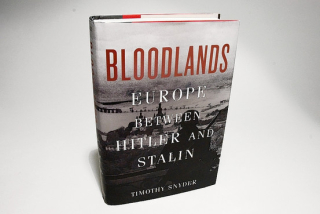 Instead, it was a book that I read last year, which made my 2023 Best Books Read list— Timothy Snyder's Bloodlands: Europe Between Hitler and Stalin (2010)*. Not only can you read my thoughts about the book there, but I added some extensive notes on a separate page, including some excerpts about Auschwitz. You can find those notes here.
* a later 2020 edition includes Snyder's discussion about the 2014 invasion of Ukraine (Crimea).
—– EXTENDED BODY: —– EXCERPT: —– KEYWORDS: The Zone of Interest, Bloodlands, Timothy Snyder —– ——– AUTHOR: Murray Browne AUTHOR EMAIL: murray.browne905@gmail.com TITLE: More Poor Things STATUS: Publish ALLOW COMMENTS: 1 CONVERT BREAKS: wysiwyg ALLOW PINGS: 0 BASENAME: more-poor-things CATEGORY: Book Reviews UNIQUE URL: https://thebookshopper.typepad.com/the_book_shopper_atlantad/2024/02/more-poor-things.html DATE: 02/21/2024 09:02:11 AM —– BODY:
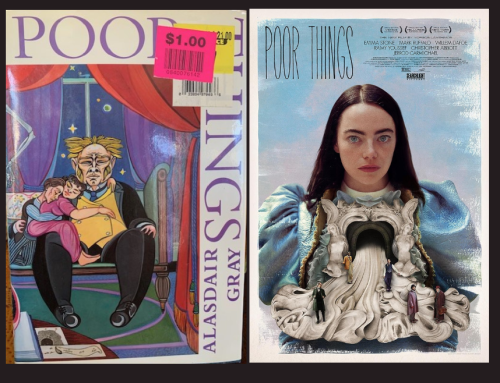
Encouraged by the editors of Tropics of Meta: Historiography for the Masses, I expanded my previous posting about Alasdair Gray's book Poor Things (1992) into the essay, "Re-Visiting Poor Things: The Book vs. the Movie."
This is my eighth essay (listed here) for Tropics of Meta, but who's counting?
—– EXTENDED BODY: —– EXCERPT: —– KEYWORDS: Alasdair Gray, Poor Things, Emma Stone, Oscars, Tropics of Meta —– ——– AUTHOR: Murray Browne AUTHOR EMAIL: murray.browne905@gmail.com TITLE: Books Read in 2023 STATUS: Publish ALLOW COMMENTS: 0 CONVERT BREAKS: wysiwyg ALLOW PINGS: 0 BASENAME: books-read-2023 UNIQUE URL: https://thebookshopper.typepad.com/the_book_shopper_atlantad/books-read-2023.html DATE: 02/11/2024 09:21:45 AM —– BODY: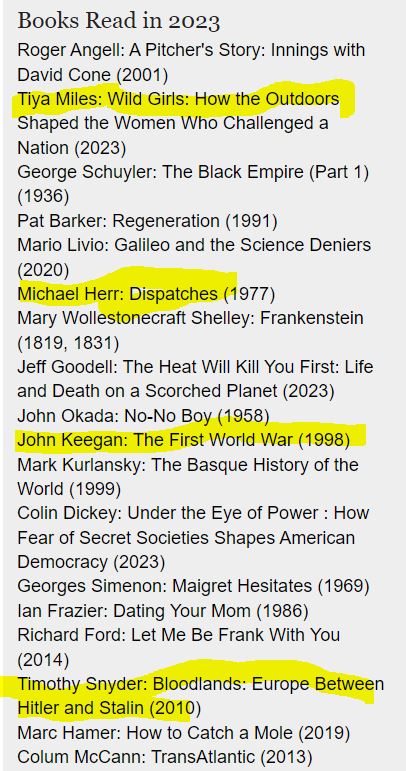
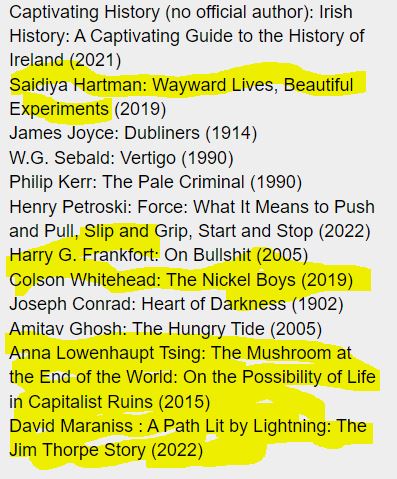
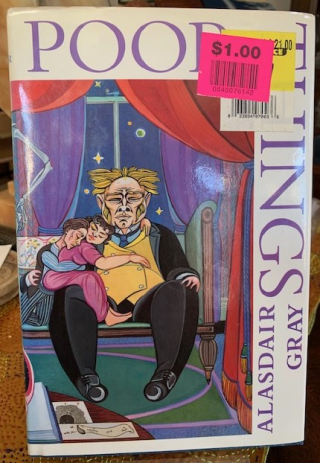 Just when you think a book/author has disappeared from your reading life they show up again— even 30+ years later. Such is the case with the Scottish writer Alasdair Gray (1934-2019) who is riding a revival wave because of Poor Things, the movie starring Emma Stone, Mark Ruffalo and Willem Dafoe. Based on Gray’s 1992 novel. Poor Things has already won several Golden Globes awards and is up for the Best Picture in the Oscars race. I am currently reading the book in hopes of finishing it before I see the movie.
Historically, I go back a ways with Gray. My second published book review was about his book Something Leather (1991) and then there is this anecdote that appeared in this blog’s name sake The Book Shopper: A Life in Review (2008). Here’s an excerpt:
“I am not the only one who admires Alasdair Gray. National Book Award finalist Madison Smartt Bell, in his acknowledges for his novel Doctor Sleep (1991), recognized Gray as one of the people who contributed to his book. However , Bell quipped, ‘Gray will hardly be expecting it.’ For years after I read the acknowledgement, I wondered what it meant. At the Nashville Book Festival I saw Bell on a panel, but I was too shy to quiz him in front of a packed house. Still, it confused me how these two seemingly disconnected writers were linked—Gray, an off the wall writer and illustrator from Scotland, and Bell, a novelist whose trilogy of books about the slave revolt in Haiti is an incredible work of history and imagination.
Finally I had an opportunity to hear Bell give another reading, this time at Maryville College in Maryville, Tennessee. A writer friend of mine was doing the handling of Bell and invited me to attend. After the reading, Bell graciously answered all the standard writing student questions: Where do you get your inspiration? What is your workday like? How do you get a goddamn agent? Since the discourse in the half-filled auditorium was lagging and I did really want to know, I decided to ask my question. Bell didn’t miss a beat in answering that Gray’s bawdy book 1982, Janine (1984) had influenced him while he was writing Doctor Sleep. Bell and my friend were pleased enough by the odd question to invite me to join them for the post-lecture beer and literary chat. Thank you Alasdair Gray.”
Library Book Sale
If you like the possibility of finding great books for a couple of dollars or less, check out the Decatur Friends of the Library Book Sale on Saturday, February 2nd, 9 a.m. to 3 p.m. at the Decatur Public Library, on 215 Sycamore Street, Decatur. Denise and I will be working Saturday morning. Stop by, say hello, quiz me, but please only ask me questions that I can answer.
https://bookshop.org/widgets.js —– EXTENDED BODY: —– EXCERPT: —– KEYWORDS: Alasdair Gray, Poor Things, novel vs. movie, Madison Smart Bell, Something Leater —– ——– AUTHOR: Murray Browne AUTHOR EMAIL: murray.browne905@gmail.com TITLE: The GRSG 2024 Reading Notes STATUS: Publish ALLOW COMMENTS: 0 CONVERT BREAKS: wysiwyg ALLOW PINGS: 0 BASENAME: the-grsg-2024-reading-notes UNIQUE URL: https://thebookshopper.typepad.com/the_book_shopper_atlantad/the-grsg-2024-reading-notes.html DATE: 01/16/2024 08:54:36 AM —– BODY:
Introduction
The Gravity’s Rainbow Support Group (GRSG) began in June 2020 as a “reading group” of two people. It was a support mechanism to plow though Thomas Pynchon’s Gravity’s Rainbow (a book you should never try to read alone) during the pandemic. The GRSG took some of the difficulty out of reading this challenging book and provided a way to keep two now-retired college chums (from Indiana University) Francis Walker of Winston-Salem, North Carolina and Murray Browne of Decatur, Georgia in touch. Basically, we decided to keep this good thing going.
This page is the fifth installment of our reading-discussion notes of books we assigned ourselves in 2024. Our reading notes include favorite quotes and passages and some of our discussion about the book. Don’t expect coherent prose or well thought out arguments, but our musings may provide insights to your own understanding and enjoyment of these books.
Here are the lists of books read and discussed in previous years:
2020 Reading Notes Gravity’s Rainbow by Thomas Pynchon; The Denial of Death by Ernest Becker; Pnin by Vladimir Nabokov
2021 Reading Notes The Republic of Suffering: Death and the American Civil War by Drew Gilpin Faust; Absalom, Absalom by William Faulkner; Stilwell and the American Experience in China, 1911-1945 by Barbara W. Tuchman; Cultural Amnesia by Clive James; The Periodic Table by Primo Levi; The Historian’s Craft by Marc Bloch; An Inventory of Losses by Judith Schalansky; Homeric Moments: Clues to Delight The Odyssey and Illiad by Eva Brann; Homage to Catalonia by George Orwell
2022 Reading Notes The Age of Anger: A History of the Present by Pankaj Mishra; Mountains and a Shore: A Journey Through Southern Turkey by Michael Pereira; The Life and Opinions of Tristam Shandy Gentleman by Laurence Sterne; Grant by Ron Chernow; The Innocents Abroad by Mark Twain; The U.S.A. Trilogy by John Dos Passos (The 42nd Parallel, 1919, and The Big Money); Under the Net by Muriel Spark; Two Wheels Good: The History and the Mystery of the Bicycle by Jody Rosen; Red and Black: A Chronicle of 1830 by Stendhal.
2023 Reading Notes A Path Lit by Lightning: The Life Lit By Lightning by Robert Maraniss; Heart of Darkness by Joseph Conrad; Algorithms to Live By: The Computer Science of Human Decisions by Brian Christian and Tom Griffiths; Force: What It Means to Push and Pull Slip and Grip Start and Stop by Henry Petroski; On Bullshit (2005) by Henry G. Frankfurt; Dubliners by James Joyce; TransAtlantic by Colum McCann; Regeneration by Pat Barker; Under the Eye of Power: How Fear of Secret Societies Shapes American Democracy by Colin Dickey; The First World War by John Keegan; Frankenstein by Mary Wollstonecraft Shelley; Galileo and the Science Deniers by Mario Livio
And now we move on to 2024:
Down and Out in Paris and London (1933) by George Orwell
We began the new year, revisiting an author we thoroughly appreciated in 2021 — George Orwell. In Homage to Catalonia (1938), an account of the Spanish Civil War was a mixture of battlefield/urban fighting and commentary on the political chaos, which led ultimately to the rise the decades of harsh rule under Franco.
In Down and Out, Orwell takes us first to the front lines of the Paris restaurant business during the early part of the Depression where he lived hand to mouth in filthy and infested single occupancy hotel rooms. Accompanied by his Russian friend Boris a former military man before the Bolshevik Revolution, he eventually found work as a plongeur. ( Translated from the French it means “diver” or “pearl diver” which is slang for dishwasher) Orwell is a master of description in his accounts of the conditions, the people, the hierarchy of restaurant personnel. He includes numerous sidebar stories about his fellow down and outers. Orwell is not a writer that evokes pity or outrage, rather he is matter-of-fact in the world he describes in detail (but he is never verbose or judgmental).
In the second half of this short book, the narrator arrives London expecting work from a friend as a caretaker, only to find out that his employment is delayed for a month. With few resources left over from his stint in Paris, Orwell joins the bands of homeless men who roam from church to shelter seeking a place to sleep and food (mostly bad tea and toast). Accompanied by men such as Paddy and Bozo (a screever – one who paints on sidewalks), Orwell goes from city to city as transients are not allowed to stay in a place for more than a night. Orwell gives us the smells of urine, filthy sheets and unwashed men. The book ends with Orwell’s assessment of the situation and suggestions on how to improve the conditions for these men (and they are mostly men).
Poverty & Homelessness
One of the strengths of the books is a look at the mindset of the homeless. It raises many thoughts and questions:
 How has tent living changed the nature of homelessness? (In Orwell’s England, the homeless had to change shelters every night—heading off from one to another–often miles apart). This is in contrast to Atlanta, where the overpasses and train areas are populated with tents from the homeless. In recent years, an interstate overpass and bridge overpass have caught fire. A recent article about the homeless in the Sunday edition (1/14/24) Atlanta Journal-Constitution, how fires are maintained or not maintained makes one wonder this doesn’t happen more often. Just as in Orwell’s day, many homeless refused the restrictions of shelters and refused them for fear of leaving their possessions on the outside.
There is very little mention of mental illness in the book making one wonder was it less of a factor or was Orwell just not picking up on it? Clearly, drug use was limited in this population, presumably due to cost—even alcohol was beyond the means of many. Orwell does mention one incident : ” Paddy and I had scarcely a wink of sleep, for there was a man near us who had some nervous trouble, shell-shock perhaps, which made him cry out ‘Pip!’ at irregular intervals. It was a loud, startling noise, something like the toot of a small motor-horn.”
Quotable Orwell
“The Paris slums are a gathering-place for eccentric people — people who have fallen into solitary, half-mad grooves of life and given up trying to be normal or decent. Poverty frees them from normal standards of behavior, just as money frees people from work. Some of the lodgers in our hotel lived lives that were curious beyond words.” Chap 1
“You thought it (poverty) would be terrible, it is merely squalid and boring.” Chap 3
The great redeeming feature of poverty; the fact that it annihilates the future.” Chap 3
“And there is another feeling that is a great consolation in poverty. I believe everyone who has been hard up has experienced it. It is a feeling of relief, almost of pleasure, at knowing yourself at last genuinely down and out. You have talked so often of going to the dogs–and well, here are the dogs, and you have reached them, and you can stand it. It takes off a lot of anxiety.” Chap 3
“Hunger reduces one to an utterly spineless, brainless condition, more like the after-effects of influenza than anything else. It is as though all one’s blood had been pumped out and lukewarm water substituted.” Chap 7
“A man receiving charity practically always hates his benefactor”
https://bookshop.org/widgets.js
Sidebar Stories
As mentioned earlier, Orwell breaks the narrative with sidebar stories about some of the people he spent time with in Paris and London. One memorable character was the Russian Boris, a former captain in the Second Siberian Rifles who accompanied Orwell to look for work in restaurants and hotels. Boris was philosophical, but seeing things in military terms. When was forced to abandon some of his belongings to escape paying his hotel bill, he says unflinchingly “Besides, one always loses something in retreat. Look at Napoleon and Berezina. He abandoned his whole army!” And when their situation become even more dire and hopeless, Boris encourages Orwell by borrowing (WW I French general) Foch’s maxim. “Attack, Attack, Attack.”
In England Orwell travels from time with Paddy and Bozo. Orwell refers to Paddy as the first tramp that he knew well and spent a fortnight with him going from spike to spike (shelters). Paddy introduced the narrator to Bozo who was a screever – a pavement artist. We learn more about this world through Orwell’s interactions with these two seasoned tramps. Bozo tells stories of popular scams to be mindful of. Bozo’s observation “like most swindlers, he believed a great part of his own lies” reminds one of Donald Trump.
Profanity
The whole business of swearing, especially English swearing, is mysterious. Of its very nature swearing is as irrational as magic– indeed, it is a species of magic. Ch 32
Of course when you toss insults like this — profanity isn’t always necessary
“You call yourself a waiter, you young bastard. You’re not fit to scrub the floors in the brothel your mother came from.”
Questions on Classification
Was this book journalism or a fictional memoir? In other words. True story. or based on a true story?
John Southerland in his book Lives of the Novelists offers some insights. After returning from five years with the Imperial Indian Police in Burma, he returned to England (lived briefly with his aging parents) and “mediated his next step in life (which would appall them). He resolved to become a tramp. Why? It may have been self-punitive – his forty days in the desert.” Southerland doesn’t know whether Orwell was inspired by political views or literary homage to Jack London, W. H. Davies or Henry Miller. Anyway he spent two years slumming in the two cities.
This suggests to me Orwell could have walked away from this life style any time he wanted to. This makes a big difference. This indicates he was more of an embedded journalist than his own biographer. (Similar to Confederates in the Attic by Tony Horowitz?). That is not to detract from Orwell’s veracity, but it does explain the detached matter-of-fact tone of the book.
In his Amazon review of the book, Francis reinforces this opinion:
“Eric Blair (AKA George Orwell), in unadulterated detail, makes you feel as if you were there with him trudging, hungering and eking out an existence in the dives of Paris and London. While the author was better known for characterizing the dystopian world of “1984”, his own life provided him ample experience with interminable ennui, toil, malnutrition, filth, vermin and a society fit to dehumanize all but the most resilient of anyone lacking means. Not for the squeamish, the book delves into the psychology of impoverishment, the odd hierarchy of those it afflicts and barriers to addressing it; parts are still relevant to today’s homelessness crisis. Highly recommended for anyone interested in historical realism and immersive journalism. “
An Honorable Exit (2023) by Éric Vuillard
 Our interest in France continues with Vuillard’s slim history on the country’s withdrawal from Indochina in 1954. However, history may be a stretch because compared to other historians we have read here at GRSG (Marc Bloch, Barbara Tuchman, Ron Chernow), our assessment of this book is that reads like almost like a movie screenplay that someone wants to pitch to a film production company. Vuillard writes from the perspective of the French officials including bankers who propped up the French government and the military even though many of them knew it was lost cause. These officials wanted an honorable exit and that was not going happen. Of course, as we know, the United States learned nothing from the French debacle.
He gives accounts of different officials, but there is no footnote or mentioning of his sources—even the elegant couple on the cover of the book is not identified. This is a similar technique that Vuillard used in his book The Order of the Day about the Nazi Germany invasion of Austria in 1938. A review of Order in the The Guardian by Andrew Hussey captured Vuillard’s unusual style:
“This wry aside is characteristic of Vuillard’s dry and ironic style. Although the book has been described as nonfiction it is not straightforward (which is why it won the 2107 Goncourt, which is a prize for fiction). Instead it takes the form of a récit – a type of essay where the author is always present, zooming in and out on facts, details and marshalling arguments.”
For this reason, conventional historians who are suspicious of historical fictions have not been especially friendly towards this book.
There are several main threads that Vuillard focused on:
The Bankers
The French international bankers had already cut their financial strings from Indochina long before battles and Cao Bang (1949) and Dien Ben Phu (1954) and made enormous profits for their investors.
From Francis: Here is Vuillard going on a tear about those attending the Bank meeting: “Imagine actors who never revert to being themselves but go on playing their parts in perpetuity. The curtain falls, but the applause doesn’t snap them out of their role. Even when the auditorium is empty and the lights out, they never leave the boards. No use screaming at them that that’s enough, we get it, we know the story by heart: they’ll keep right on acting, treading and declaiming…. “
(Here, I just think Vuillard underestimates the necessary role of corporate double-speak, in this case, used here not to confuse the other members of the meeting, who knew well what was going on, but to minimize the potential for any fallout, should minutes of the meeting ever come to light. These are serious businessmen, not like so many of our half-baked politicians who get caught making hot mic comments.)
Relevant Quotes from others: A ‘sound’ banker, alas, is not one who sees danger and avoids it, but one who, when he is ruined, is ruined in a conventional and orthodox way along with his fellows, so that no one can really blame him. — John Maynard Keynes Essays in Persuasion 1933
To others we are not ourselves but a performer in their lives cast for a part we do not even know that we are playing. Elizabeth Bibesco Haven 1951 (posthumously)
Everybody has his own theater, in which he is manager, actor, prompter, playwright, scene-shifter, boxkeeper, doorkeeper, all in one, and audience into the bargain. — Julius Hare 1827
Dien Bien Phu
The Vietminh’s defeat of the French in the battle was described by Vuillard as the French garrison was “living, in the strictest sense, at the bottom of a chamber pot…and the Vietminh are occupying the entire rim of that chamber pot.” The Vietminh led by General Vo Nguyen Giap (who later was lead general against the Americans) made relatively quick work of the French army and its mercenaries. (Francis and I both remember Dien Bien Phu because of we were old enough to remember Khe Sanh the U.S. combat base that was under siege in 1968 and the worries that it would end up like Dien Bien Phu.
Vuillard is graphic in the conditions of the troops when they finally surrendered and the failed commander of that Indochina theatre General Henri Navarre, considering his remote oversight of the failure at Dien Ben Phu: “He was mortified. Dreading the weakness he felt, which actually might have made him more approachable, more human, he professed an ever greater firmness and became even more sectarian and retrograde. Page 114
This reminded Francis of a quote from Marie von Ebner-Eschenbach: We hold onto supports with redoubled strength when we feel them begin to sway
Allen Dulles and John Foster Dulles
“He (Patrice Lumumba, elected Prime Minister of the Belgian Congo) realized how badly he had underestimated the viciousness with they would preserve their power.” – p106
“If we granted rights to our colonized populations, we would be the colony of our colony”- Assembly President Edouard Herriot – p. 27
One of the unexpected sidebars is the chapter that are focused on Eisenhower’s Secretary of State John Foster Dulles and his brother CIA Director Allen Dulles. The former offered the French a couple of atomic bombs to remedy their situation. No surprise as the Dulleses sanctioned part of Lumumba’s torture and assassination in the Congo in 1961. The Dulleses also supported the overthrow of a duly elected pro agrarian government in Guatemala at the behest of the American United Fruit Company and removed the Prime Minister of Iran and replaced him with the Shah.
Why is the airport in Washington D.C. named after this guy?
https://bookshop.org/widgets.js
Poor Things (1992) by Alasdair Gray
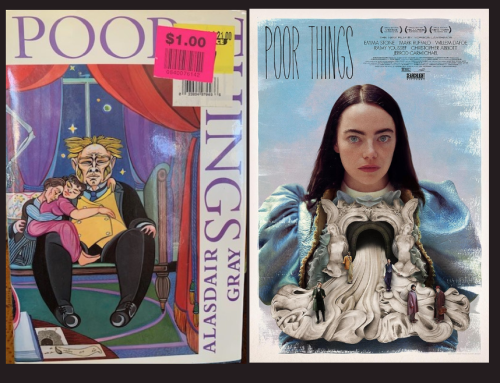 Because Murray was asked to write an essay for the Tropics of Meta comparing Poor Things the novel, to the Oscar-nominated Poor Things the film, Francis joined in with the reading of the book. With his medical background he provided insights into the medical ethical aspects of both works. The essay, “Re-visiting Poor Things: The Book vs. the Movie is found here.
We begin with Francis’ Amazon review because he draws a comparison to earlier English novels including Mary Bysshe Shelley’s Frankenstein which we read last year in the Gravity’s Rainbow Support Group (GRSG). Notes are here.
Poor Things is an inventive reconstruction of the Victorian novel. It modernizes it by discussing health matters and physicians, real and fictional, which captures the most advanced knowledge of the time; incorporating political and social issues without melodrama; and by discussing sexual relationships without being graphic or excessive. While it harbors elements of each of their styles, this book fills a void in the works of Trollope, Dickens, M. Shelley, Austen and Conan-Doyle. George Elliot wrote: “Imagination is a licensed trespasser: it has no fear of dogs, but may climb over walls and peep in at windows with impunity.” The reader is swept up in just such a caper in this story which proves diverting and delivers an insightful yet comic glimpse of the past.
One key observation about the book is that written in somewhat a Victorian-19th century style, but it does differ because it examines topics not usually found in these novels: Medicine, politics and sex.
Medicine
There is plenty of medicine in this book. The three main characters are physicians (Godwin and McCandless of course) if you include Bella who later  becomes a doctor later in the book’s epilogue.
Gray captures some of the absurdity of medicine on page 222 when the doctors are “explaining” Bella’s condition.
“Charcot daringly suggests the amnesia has enlarged her intelligence by making her relearn things when old enough to think about them, which people who depend on childhood training hardly ever do.” They agree that she shows no signs of mania, hysteria, algolagnia, necrophilia, coprophilia, folie de grandeur, nostalgie de la boue, (nostalgia for mud) lycanthropy (transfer into a werewolf), fetishism, Narcissism, Onanism, irrational belligerence, unhealthy reticence and is not obsessively Sapphic.”
The culture of medicine even expands to the grave robbers who provide bodies to experimental surgeons such as Godwin. In the Historical Notes that follow the main novel (page 300) Gray writes about “The Resurrectionists This five-act play about the Burke and Hare murders is no better than the many other nineteenth-century melodramas based on the same very popular theme. Robert Knox, the surgeon who bought the corpses, is treated more sympathetically than usual, so the play may have influenced James Bridie’s The Anatomist.”
Page 306: “She (Bella) accepted Tolstoy’s view that human animals are prone to epidemics of insanity, like many thousands of Frenchmen going into Russia with Napoleon and dying there, when their country would have been no better off if they had conquered it. However, being a doctor she knew epidemics can be prevented if the causes are discovered.” (Well, not if Trump is in charge or the Florida Surgeon General!)
Politics
Although the Victorian novelists dealt with class issues the specifics of politics not much so. This is not true of the Gray novel. One of the characters Mr. Astley, who introduces Bella to his “bitter wisdom” in Chapter 16, provides his views and definitions of communists, socialists, anarchists mixed in with his railings about colonialism.
Sex
In the Victorian novels, sex is barely alluded too, not so much Poor Things. However compared to the graphic sex and nudity of the film version, sex is mentioned, but in broader terms. Or course, Gray is not above has included this woodcut illustrations of a nude Bella.
Wordplay and Humor
 Gray writes with understated with plenty of wordplay. Bella’s creator Godwin is “God” for short, and their are many examples of wit in the dialogue— e.g. “you will find her more interesting that Flopsy and Mopsy put together” (the two rabbits that Godwin severed and reconnected in his early experiments).
Then there is the Who’s Who parody of General Sir Aubrey la Pole Blessington career.
Of course, you wonder is General Blessington, a fictional character or did Gray pull this from some obscure Who’s Who entry and just add a few twists. Or is this an entirely creative exercise?
That is what is so demanding of the novel is that there are many extra notations, chapters and footnotes added to the main plot of Bella Baxter’s life. And one is not sure what is true and what is fabricated. Of course, Gray chimes his opinion in this quote:
“I also told Donnelly that I had written enough fiction to know history when I read it. He said he had written enough hi story to recognize fiction. To this there was only one reply—I had to become a historian.: Page xiii. This reminds one of the HL Mencken 1880-1956 quote : “Historian — An unsuccessful novelist.”
Final Thoughts
This book was a challenging, but worthy read.
https://bookshop.org/widgets.js
I Never Did Like Politics: How Fiorello La Guardia Became America’s Mayor and Why He Still Matters (2024) by Terry Golway
The long title tells it all. Francis definitely liked the biography more than Murray, but after our discussion Francis was very convincing that at the book deserves our GRSG approval. But let’s begin with Francis’ review which he posted on Amazon.
When it comes to airport names, some are bestowed belatedly (i.e. Dulles, JFK) and others are earned. Fiorella LaGuardia, who never did like politics, earned his, after simultaneously serving in WW! as a pilot and in the US government as a congressional representative, and later after fighting for its construction as mayor of New York. The book recounts this and many other episodes in the life of this amazing individual who looked after his constituents and served his country in admirable fashion. More to the point, it describes a world where democrats (e.g. FDR and Harry Truman) and republicans (Fiorella La Guardia) worked together to solve local, national and international problems. Those despairing of today’s political gridlock will find this book refreshing in that it shows how American statesmen of a prior generation cut through red tape and party solidarity to forge the alliances and compromises that led our country out of the Great Depression and two world wars. Highly recommended.
https://bookshop.org/widgets.js
However, we both agreed that Golway’s narrative style was confusing as he skipped around timeframes quite a bit. La Guardia had a plenty of different life experiences besides being a congressman, a mayor, a military man and his final position as the head of the United Nations Relief and Rehabilitation Administration (UNRRA). Although La Guardia was a longtime Republican, he was appointed to the position by the Democratic President Harry Truman because of La Guardia’s reputation and a doer and a no-nonsense administrator.
We also agreed that despite his naysaying of his own position in politics, La Guardia was a demagogue, but “do-good demagogue” (kind of like a benevolent monarchy because that pair of words are not often put together).
Quotable
To Galway’s credit, his writing ability was solid and appreciated. Below are some favorite passages:
Page 26: When his fellow Republicans urged La Guardia to dial it down a notch, he replied that he was simply pointing out that his opponent (Michael Farley) would not be a good congressman. In fact, La Guardia added, he wasn’t even a good bartender. He did not offer any evidence to support this assertion. But he seemed pretty certain of it.
Page 32: During a bombing raid on an Austrian airfield, Negrotto made a sharp turn at about 110 miles an hour just as La Guardia let the bomb loose. “How’d I do,” the American shouted over the plane’s engine noise. “It was the best speech you ever made,” came Negrotto’s reply.
Page 40: His speech marked the beginning of the role he would play over the next decade as one of the country’s most vocal critics of Hitlerism and fascism, and one of its most enthusiastic defenders of democracy at a time when it was in mortal peril.
Page 47: The mayor told White: “It occurred to me that the committee had better divide. You could continue as chairman of the ‘Committee to Defend America by Aiding the Allies with Words’ and the rest of us would join a ‘Committee to Defend America by Aiding the Allies with Deeds.’”
Page 48: Advised that Hitler’s government had demanded extra police protection for German diplomats in New York, La Guardia made sure that the extra cops assigned to the Nazis were Jewish.
Page 61: And such a voice it was: FDR’s resonant baritone and patrician accent were a perfect fit for radio, just as, years later, John F. Kennedy’s youthful good looks and cool demeanor were made for the newborn television age.****
Page 73: Politics may be the only profession in America whose practitioners—sometimes the best of them, often the worst—feel obliged to insist that they are not what they so clearly are****
Page 79: Not without reason, Oliver Wendell Holmes supposedly said that FDR was blessed with a first-class temperament. Fiorello La Guardia, by contrast, had a first-class temper. He was forever raging against the machine, finding nothing of value in political leaders like Sullivan and his successors, several of whom by chance were named … Sullivan.
Page 141: TR’s famously witty daughter, Alice Roosevelt Longworth, said that her father wanted to be the corpse at every funeral, the bride at every wedding, and the baby at every christening.
Page 145: The commanding general insisted that the impetuous captain had violated army regulations. Well then, La Guardia said, perhaps he could arrange to have the army’s regulation changed. “I thought the man would bust with rage,” La Guardia wrote of the general whose name he could not remember years later. “He pounded the desk violently [and] called me insolent [and] impertinent.” A colonel standing nearby mentioned that the impertinent captain also happened to be a member of Congress, and perhaps he could indeed get army regulations changed. The conversation, La Guardia recalled, suddenly took on an entirely different tenor.
Page 185: Historian Joel Schwartz said that NYCHA was looking for “the heroic poor”—in other words, as Kessner writes, “those who overcame trying circumstances to raise decent families and nourish middle-class aspirations.”
Page 147: The aldermen over whom La Guardia presided no doubt were a step or two above their more rapacious predecessors in decades past, the worst of whom were known unaffectionately as the “forty thieves.” Still, few would ever confuse the board of aldermen with the Mormon Tabernacle Choir.***
Page 200: La Guardia Field became the busiest airport in the world within a year of its opening, a development that came as little surprise to the facility’s namesake.
La Guardia Notables
Although he his most well known as the mayor New York and the airport named after him, there are other lesser known aspects of La Guardia.
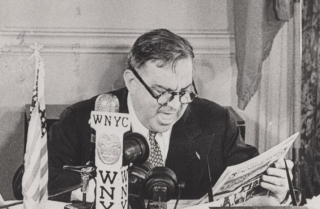 La Guardia read the comics several times during a newspaper strike in July, 1945. Those looking for an explanation for the Little Flower’s success should visit WNYC’s online archives and listen to him read Little Orphan Annie or Dick Tracy. It explains everything. https://www.wnyc.org/story/44460-poor-little-annie/
After serving as mayor, President Harry Truman (not always a political ally) appointed La Guardia as the head of the UNRRA to oversee the distribution of food and aid to refugees after World War II. It made sense because La Guardia had a long history not tolerating bureaucracy and graft–no matter whose feathers were ruffled.
In 1924 as a congressman, La Guardia worked with Senator Frank Norris of Nebraska to keep industrialist Henry Ford from taking over the building of dams on the Tennessee River. La Guardia felt that these should be Federal owned public works instead of private entities. One of the early dams was the Wilson Dam that was completed in 1925. It is located between Muscle Shoals and Florence Alabama and is still operational.
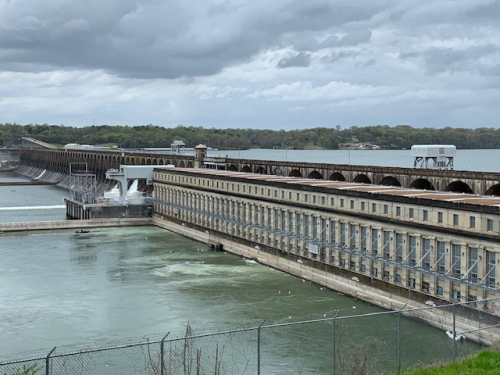
Angle of Repose (1971) by Wallace Stegner
This book had been recommended to Murray by a respected reading friend years ago and when he picked it up at the Decatur Friends of the Library sale for free (with my volunteer dollars), it struck him like a book that may be a good GRSG candidate. The main character of Stegner’s novel, which was awarded the Pulitzer in 1972, is Lyman Ward an aging historian, who is digging deep into his own family history via his grandmother Susan Ward who was an illustrator raised as an East Coast woman of culture who hung with literary types. After marriage, Susan followed her engineer husband Oliver Ward’s “through the American West as he developed mining operations in New Almaden (south of San Jose), Deadwood (South Dakota), Leadville, Colorado (near Denver), Mexico and Boise, Idaho. A great source of photographs and maps of mining to is found at westernmininghistory.com

Stegner impresses both Francis and me in effortless transition (not easy to do) switching from the narrator Lyman and the stories of his grandmother. Lyman has lost a leg due to bone disease and lives by himself near Nevada City, California with assistance from his son Rodman and a caretaker woman and her family who lives nearby. “History is his habit and his wedded wife,” says Lyman. (One thing that struck us odd about Lyman is that initially we think he is older than he really is. He is only 58 years old! A pup, but poor health can age one prematurely.)
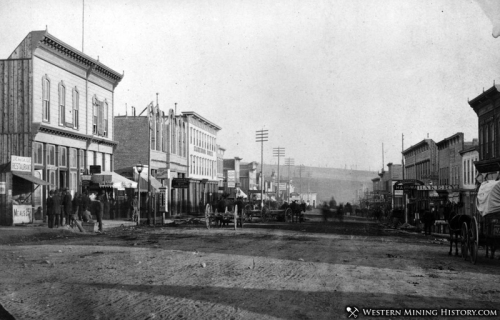
History and the Future
If Henry Adams, whom you knew slightly, could make a theory of history by applying the second law of thermodynamics to human affairs, I ought to be entitled to base one on the angle of repose, and may yet. There is another physical law that eases me, too: The Doppler Effect. The sound of anything coming at you–a train, say, or the future–has a higher pitch than the sound of the same thing going away. If you have perfect pitch and a head for mathematics you can compute the speed of the object by the interval between its arriving and departing sounds. I have neither perfect pitch nor a head for mathematics, and anyway who wants to compute the speed of history? Like all falling bodies, it constantly accelerates. But I would like to hear your life as you heard it, coming at you, instead of hearing it as I do, a sober sound of expectations reduced, desires blunted, hopes deferred or abandoned, chances lost, defeats accepted, griefs borne. I don’t find your life uninteresting, as Rodman (the grandson) does. I would like to hear it as it sounded while it was passing. Having no future of my own, why shouldn’t I look forward to yours?
Passages such as this reminded Francis of similar quotes:
“It is perfectly true, as philosophers say, that life must be understood backwards. But they forget the other proposition, that life must be lived forwards.”–Soren Kierkegaard
Oh, and there is Ambrose Bierce:
Future. future, n. That period of time in which our affairs prosper, our friends are true and our happiness is assured. – The Devil’s Dictionary.
Hope: Desire and expectation rolled into one.
Delicious Hope! when naught to man it left —
Of fortune destitute, of friends bereft;
When even his dog deserts him, and his goat
With tranquil disaffection chews his coat
While yet it hangs upon his back; then thou,
The star far-flaming on thine angel brow,
Descendest, radiant, from the skies to hint
The promise of a clerkship in the Mint.
– Fogarty Weffing (Ambrose Bierce)
– Ambrose Bierce: The Devil’s Dictionary.
Writing Style and Influence on Other Writers
From the Introduction of the book by Jackson Benson page xxix (written in 2000), he cites Joseph Conrad who he thinks influenced Wallace Stegner:
Here is Joseph Conrad: “My task, which I am trying to achieve is, by the power of the written word to make you hear, to make you feel—it is, before all, to make you see. That—and no more, and that is everything.” (We read Heart of Darkness last year.)
( Francis: This resonates with something else I read: “Art does not reproduce what we see; rather, it makes us see.” Paul Klee, he may have based this on Conrad, who was older than Klee by about 20 years).
Stegner also taught at University of Wisconsin, Harvard University, but is most known as a professor who started the creative writing program at Stanford. His students included Larry McMurtry, Thomas McGuane, Edward Abbey and Wendell Berry and Sandra Day O’ Connor (but what did she ever write?)
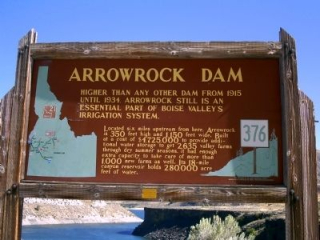 The book is a showcase for Stegner as a writer of the West and environmentalism though I would hesitate to pigeonhole him as such (Lyman Ward remarks that he “is not writing a book on Western History.” ) However, one cannot help think when Stegner/Ward mentions John Wesley Powell (a huge figure in water rights in the West and the namesake of Lake Powell) or Oliver Ward (Lyman’s grandfather) efforts to build canal near Boise, Idaho and to irrigate scrub lands into arable land. (not necessarily a good idea — See the Marc Reisner’s 1993 book Cadillac Desert) . Interesting enough Arrowrock Dam was completed in 1914 and it was tallest dam of its time when completed and the sign boasts how important the dam is to the Idaho irrigation systems.
Stegner’s descriptions of the mountains, the towns the people are sharp especially Oliver taking Susan to Leadville in a wagon over a treacherous trek to Leadville. Their brief foray into Michoacán, Mexico was also descriptive. And Stegner also knows how to plot into the narrative with claim jumpers, treacherous journeys and unveiling of the family secret that he uncovers near the end of book.
Quotes and Passages
What really interests me is how two such unlike particles clung together and under what strains, rolling downhill into their future until they reached the angle of repose where I knew them. –Lyman Ward, Page 288
Jackson Benson cites this passage in his Introduction, and I think it gets at the crux of the novel, which is as much about understanding marriages as it is about understanding landforms, landscapes, engineering or engraving. It leaves open the question if Lyman Ward is capable of forgiveness–which perhaps is the central question of his grandparent’s relationship.
The secretary Shelly talking to Lyman Ward about his grandfather: “I think he must have been a lot like you” she said, with her head on one side and that smiling look of speculation on her face. “He understood human weakness, wasn’t that it? he didn’t blame people. He had this kind of magnanimity you’ve got” . “Oh, my dear Shelly”, I said, “My dear Shelly”.
Page 528: The finished sections, so far hardly more than a half mile, sweeps in a great curve around the shoulder of the mountain, eighty feet wide at the top, fifty at the bottom. The twelve foot banks slope back at the “angle of repose”, which means the angle at which dirt and pebbles stop rolling. (it’s like scree, the rocks and dirt that pile up on the side of an eroding mountain face or cliff, that are only supported by their own weight.)
This last Lyman Ward’s wry observation on protests, in response to an advocate for them, his secretary Shelley. (Jackson Benson in the introduction suggests this reflects Wallace Stegner’s view as well). “Civilizations grow by agreements and accommodations and accretions, not by repudiations. The rebels and the revolutionaries are only eddies, they keep the stream from getting stagnant but they get swept down and absorbed, they’re a side issue. “ – Page 576
Final Thoughts
Overall a very good book but it does read a little long. (I tired of Susan’s letters describing her unfulfilling marriage.) It checks the boxes of many of our type of books: well-written, topics include history and history writing, and touches on other books we have read.
Here is Francis’ review on Amazon.
Viewpoints
Karl Kraus wrote: “Grasping the world with a glance is art. Amazing how much fits into an eye.” I believe he would have appreciated this fascinating, nuanced work, which can be mined for many levels of insight. At one level, it sketches a prose picture of western landscapes and its people; at another, it provides a cross sectional look at landforms and the human psyche, at another level it depicts a timeline of history, both personal and public, showing how it unpredictably folds back on itself; and, finally, it asks to what extent to which humankind is able to escape the forces of social pressure, history, genetics and personal bias. This panoramic novel will appeal to anyone with an appreciation for fine writing and interest in the human condition.
https://bookshop.org/widgets.js
Smoke and Ashes: Opium’s Hidden Histories (2023) by Amitav Ghosh
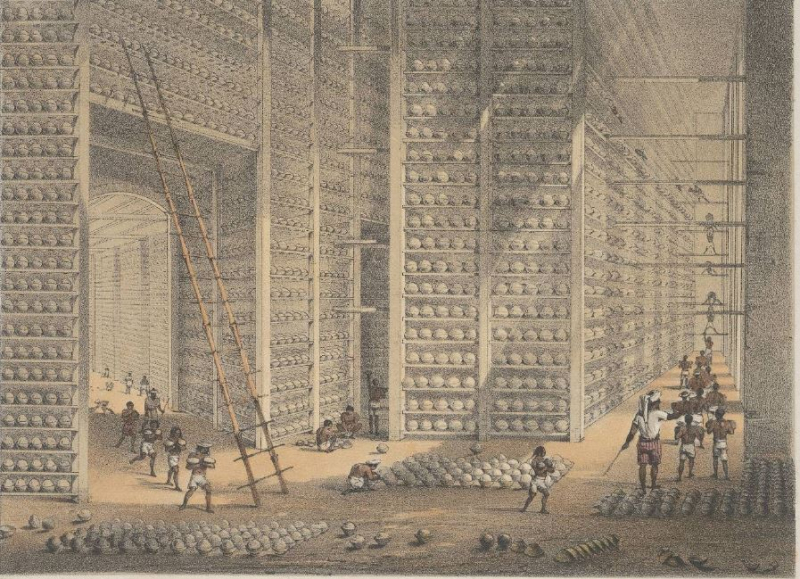
The Economist and The New York Times wrote glowing reviews of the book and Murray had read and liked one of Ghosh’s early novels The Hungry Tide (2003). Coupled with Francis’ personal history on the subject (his wife Deborah’s parents came to the United States from China) this seemed like a good fit. Also, in 2022 we read Barbara Tuchman’s Stillwell and the American Experience in China.
The first half of this book reveals how the Dutch East India Trading Company and the English promoted the cultivation and trade of opium to China. The British were methodical, bureaucratic exploitative in evidence by their two huge opium factories in Patna and Ghazipur.
However, when the British tried to expand to West to the Malwa region they met heavy resistance from local Indian warlords who wanted to keep the opium profits for themselves.
The book goes into detail (maybe too much) about the fighting between the opium warlords and the British, but one of the end results is that Bombay (now Mumbai) was a much more open competitive market with more international involvement whereas Calcutta (now Kolkata) was very regimented by the British. Later we learn about the same international vibe that developed in Guangzhou (aka Canton). This is still somewhat true today.
Midway the book covers America’s involvement in the opium trade with many wealthy families on the Eastern seaboard including the Astors, the Forbes and the Delanos (the grandfather of Franklin Delano Roosevelt). The clipper ships were a big part of their shipping business. Ghosh writes how opium was used as a starter-up money in the banking industry (HSBC). Coincidently Francis and Deborah visited FDR’s Hyde Park home while reading this book. Francis took noted the in the family portrait section that the grandfather’s portrait was noticeably absent.
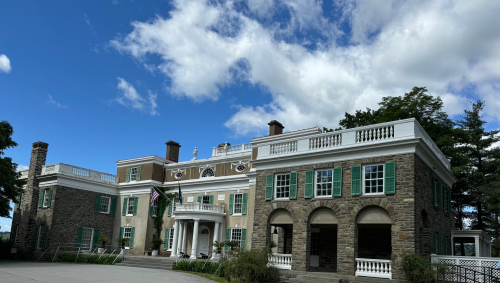
There is a related cornucopia of topics that have been rolled into this book that captured our interest:
Famous Writers
George Orwell
Page 56: It so happened that Osborne had a colleague called Richard W. Blair who also brought his family to live in a small town in Bihar, where he was posted as Sub-Deputy Opium Agent. It was there, in Motihari, near the Nepal border, that Eric Blair, who later took the name George Orwell, was born in 1903. Orwell was still an infant when his mother, prompted by concerns about her children’s education, left for England with him and his sisters.
Page 77: But George Orwell, as the son of an opium agent and an imperial police officer himself, would have been in a good position to know that the dystopia that he had projected into the future had many analogues in colonial practices as well.
(We’ve read two Orwell books here at GRSG. Earlier this year we read Down and Out in London and Paris and a couple of years ago we read Homage to Catalonia)
Rudyard Kipling and his contemporary and fellow Nobel Laureate the poet Rabindranath Tagore.
Page 69: One Indian who could certainly have visited the Ghazipur Opium Factory was Tagore Kipling’s contemporary and fellow Nobel Laureate, the, who spent six months in Ghazipur, living in a bungalow that had been found for him by a relative of his who worked in the factory.12 During his stay, Tagore and his wife were visited by several relations, including his sister, the writer Swarnakumari Devi, who later composed a long piece about her stay in Ghazipur.13 Their bungalow was close to the factory and through their relative the Tagores met many of the local Bengali residents, most of whom would have been employees of the Opium Department.
Page 70: The distaste that is evident in this passage probably derived from Tagore’s guilty awareness that his own grandfather, Dwarkanath Tagore, had traded in opium, and had even petitioned the colonial government for a share of the reparations that China was forced to pay after the First Opium War.
Economics
Page 15: The duty ranged from 75 per cent to 125 per cent of the estimated value, which meant that the customs duty on tea fetched higher revenues for Britain than it did for China, which charged an export duty of only 10 per cent.7 Largely because of tea, China was consistently among the top four countries from which Britain bought its imports. (this was almost 1/10 of British revenue during the period, and they had a monopoly such that the US colonies could not participate in direct trade).
Also keep in mind that sin taxes are revenue generators for the government.
Cigarette tax in Chicago is $7.16 (State and local), the feds charge $1.01; cost of a pack of Marlboros in Chi: $15—the greater part of this 15 dollars is for tax, not profit.) Washington: The state levies a 37 percent excise tax on cannabis sales that is paid by consumers and remitted by retailers. There are no local cannabis taxes in Washington. Legal sales began in July 2014.
Page 113: Bauer estimates that the costs of producing opium in eastern India amounted to more than a third of the gross revenue that the British earned from it, while the costs of administering the transit tax in the west came to a mere 0.17 per cent. So, for the colonial regime the revenue per chest was the same for Malwa and Bengal opium.
Another important economic observation–the value of being a good dinner guest and host: Page 150: Attitudes of that kind would certainly have created insuperable barriers in Guangzhou’s Foreign Enclave, where socializing over shared meals was essential to the conduct of business. Such meals would almost always have included meat, which in itself would have served to exclude conservative Hindu merchants, many of whom were vegetarian: for them even to enter a house where beef was served meant losing caste.
Diasporas
Page 156: Another diasporic group that became enormously important in the colonial opium trade was the community known as Baghdadi Jews. Page 158: Among the Chinese who ran the opium farms, many belonged to the Peranakan community, a diasporic group with deep roots in the region.67 As with the Parsis (who were Zoroastrians from Iran)and Armenians, countless early Chinese migrants in Southeast Asia were displaced by war, rebellion and political turmoil in their homeland, especially during the tumultuous transition between the Ming and Qing dynasties.
Page 159: Across Southeast Asia, Peranakan merchants controlled many plantations and mines, in which thousands of poor Chinese migrants toiled under terrible conditions: “for he dens and outlets from which the workers bought their opium were often run by the same merchants and syndicates who owned the mines or plantations. (and opium was the only thing making the deadly lives of these workers tolerable–…)
Here Ghosh suggests a questionable panacea: Page 30: Indeed, the only effective means of combating the continuing spread of opioids may lie in forging alliances with other plants—that is by making grassroots psychoactive like cannabis and peyote more easily available. (“and where is the evidence?, we ask)
Colonialism
This topic fits well into other books we have read: Joesph Conrad’s Heart of Darkness and more recent Eric Vuillard’s An Honorable Exit a book that centers on French colonialism in Vietnam and to some degree John Foster Dulles support of the Belgian murders of the duly elected president in the Congo.
Calculating the impact of colonialism is not simple, while it was clearly problematic, not all consequences were so and sometimes the colonized shared in the abuse of third parties:
Page 164: The staggering reality is that many of the cities that are now pillars of the modern globalized economy— Mumbai, Singapore, Hong Kong and Shanghai—were initially sustained by opium. In other words, it wasn’t Free Trade or the autonomous laws of the market that laid the foundations of globalized economy: it was a monopolistic trade in a drug produced under colonial auspices by poor Asian farmers, a substance that creates addiction, the very negation of freedom.
While it is difficult to dispute that colonialism was problematic in many ways, it was not as simple as he puts it (colonizer and colonized–page 71: “Page 71: The contrast in the attitudes of Kipling and Tagore, two Nobel Laureates who were almost exact contemporaries, is itself a commentary on the differences in the perspectives of colonizer and colonized:”
Page 117: But the real lesson to be learnt from the commercial world of western India is that political and military support have always been crucial to the flourishing of business and enterprise in the modern era. …Page 118: These practices have remained essential to the functioning of modern imperialism to the present day
Pages 119, 120: In other words, the money generated by Malwa’s opium industry trickled down much deeper, with a larger share of the profits remaining in indigenous hands. A staggering number of ‘princely states’ were sustained by revenues from opium. ‘By the end of the nineteenth century,’ writes Richards, ‘some ninety states engaged in opium production. These ranged in size from the largest in territory and population such as Indore, Mewar, Bhopal, Jaipur, Marwar, Gwalior, Alwar, and Bikaner, to smaller states that dwindled to the size of Sitamau in Malwa with its few thousand inhabitants and one principal town.’
Page 121: The colonial regime’s claim to being the prime agent of ‘Progress’ in the subcontinent was, therefore, completely without foundation.
Page 136 (here is the apology) For the Indians involved in the opium trade, the fact that they were colluding in the smuggling of a substance that was illegal in China, and thereby bringing misery to millions of Chinese, seems to have been even less of a concern than it was to British and American opium traders. As Farooqui notes, no Indian merchants are known to have expressed any qualms about their activities. Yet, it was a Parsi, Dadabhai Naoroji, who became one of the earliest and most important Indian voices to speak out against the colonial opium trade. Born into a poor Parsi family in Navsari, Naoroji became a mathematician, scholar and public figure, both in India and Britain. He spent a good part of his life in London and was even elected to Parliament from 1892 to 1895.37 In his 1901 tract, Poverty and Un-British Rule in India, Naoroji writes: “What Indians would do well to remember these words every time they are assailed by a sense of grievance in relation to China. “
So, it would seem, once the trough of opium trade money filled up, there was no shortage of those willing to benefit from it, regardless of their cities or states of origine and independent of their ethnicity and race. I think the issue has to do with unbridled capitalism, not colonial power, military might or racism–but rather the desire of everyone for money, power and control–however they could be gained–be it monopolies, subjugation of the lower class or caste, and trade routes. The benefits of opening up nations to other and better aspects of civilization, which also followed colonial occupation, cannot be viewed as universally bad.
Heed the title – “A Writer’s Journey”
 I am not sure where I heard this expression about this book, but part of the narrative is Ghosh talking about his Ibis Trilogy (2008-2015) a series of historical novels centered around the opium trade (nothing like maximizing your research efforts), but he does talk quite a bit about his other works.
What We Didn’t Like About the Book
1) Absence of maps and the absence of an index; 2) The tendency to give too much credit to the quality of Chinese civilization as it existed in the 1800s. While China was a pioneer in the development of civil service examinations, it retained many elements of a feudal society with dynastic families, warlords and internecine struggles but little in the way of innovation or acceptance of other cultures and learning. My mother-in-law’s grandmother (born in the 1800s in China) had bound feet and was the daughter of the 4th wife of a warlord. 3) The author tries to blame Europeans for denying their role in spreading infectious diseases (such as smallpox), this is ludicrous because “Germ Theory” was first proposed as a possible explanation for disease in 1878!; 4) The author postulates some sort of mystical role for poppies as a plant with agency, a concept that is little better than the whimsical horror satire: “Little Shop of Horrors”. The author should have simply used the notion as a metaphor. 5) It is annoying to realize that one of the key chapters in the book is available on-line as an extended published essay, one that details the involvement of prominent New Englanders in the USA in the opium trade:
What We Did Like About the Book
1) The clear recognition that opiate supply is what drives its demand. It is one of the few known commodities on earth that violates the typical supply and demand relationship. 2) The recognition that special rules are needed to curtail its abuse, as indicated by his recognition that those states (Idaho, California, Texas, Illinois, and New York, states which could not differ any more on geographical or political measures) which had restrictions on prescription writing for narcotics were the states that had the least problems with the opium epidemic in the last decade. 3) The author rightly is amazed by the ease with which the Sackler family seduced expert institutions and professions which were supposed to safeguard health and pharmaceuticals in the USA–which include medicine, law, the FDA and policing; and 4) His thoughtful suggestion that academics and other experts are often drawn to faddish new ideas that go against traditional teaching, in this case, the faddish new idea was that narcotics were safe and grossly underused by the medical establishment and FDA and that substance use should be legally tolerated and rarely subject to disciplinary action.
And finally when you think about it, Ghosh’s book and does invite discussion. He is not a perfect, but the writers has plenty to say and for the reader to think about. You can learn a lot from reading Opium’s Hidden Histories (while watching Michael Woods’ PBS documentary on China and visiting Hyde Park.)
We finish with Francis’ four-star view Amazon Review
This book enlivens the suppressed economic history of opium with well researched corroborative detail. It begins with British colonial powers in the 1800s who standardized its production in India and then experienced its wealth generating properties in China. This led to a feeding frenzy which even attracted well-connected Americans. In choosing the Far East over the West, where the saying advises them to go, these young men acquired riches that made their names famous: Forbes, Brown, as in the University, and Delano, as in FDR’s grandfather. The book makes painfully striking parallels with the modern day Sackler family and wisely points out how recognizing of the hypocrisy needed to hide the opium economy likely influenced the writing of Eric Blair (a.k.a. George Orwell) and Rabindranath Tagore. Oddly, the author suggests that poppies have agency, along with mushrooms and cannabis (but he ignores tobacco), and posits, without evidence, that their qualities, which border on ‘mystical’, could mitigate the lure of opium. Two chapters wander off on unrelated themes: a “Lost Cause” lament about British military success and a well-argued but superfluous deconstruction of classic English gardens. While the book is imaginative, well written and instructive, this reader could have done without its gratuitous asides.
https://bookshop.org/widgets.js
The Light Eaters: How the Unseen World of Plant Intelligence Offers a New Understanding of Life on Earth (2024) by Zoë Schlanger
 This book arrived at GRSG’s doorstep from several directions. Book reviews, an excerpt in The Atlantic and one of the regulars who visits Murray’s book pop-up at the Freedom Farmer’s Market recommended it. It worked for us on several levels. Francis is always interested in the workings of the brain, nervous system and intelligence and I do some gardening. Many of Schlanger’s investigations helped me further understand some of the day-to-day occurrences that I have experienced as a gardener.
For example, on Page 114 Schlanger explains how climbing vines (like my morning glories, my peas and cucumbers) know where to climb. As a gardener I know that I have to put something nearby for them to climb on, but do I have to actually place the new vines in the proper position? No. I now know that there is a theory that plants utilize a kind of echolocation (sonar –like bats) to sense where to position themselves to grab on something solid.
“So that’s how they do it!” I exclaimed to myself.
The Light Eaters reminds me of some of the books I sell on attracting good insects, and companion plants. But the most similar book to The Light Eaters is Merlin Sheldrake’s very popular book on fungi The Entangled Life. Francis pointed out in his comments that Schlanger has passages on the constant interaction between plants and fungi. He references pages 206 – 208 from the book which includes a mentioning of Sheldrake:
“In some cases fungi has been found to ‘charge’ a plant more carbon in exchange for the transfer of a smaller amount of phosphorus when the mineral is scarce, and to do the opposite when phosphorus is abundant. (A law of supply and demand.)…Yet plants have their own strategies to get the most out of these fungal associations: researchers found that plants can preferentially direct carbon toward fungal strains that are inclined to supply them with greater quantities of phosphorus.”
Most Instructive Passages
We both agreed that this bit of knowledge could be quite handy when we chat with our neighbors about why roots attract underground pipes:
“This would likely not surprise a plumber. Plumbers are accustomed to the frustrating phenomenon of tree roots bursting through sealed water pipes. Cities spend millions each year repairing municipal pipes punctured by “root intrusion.” Most instructive; particularly the part about roots sensing running water in pipes—even without moisture.” Page 112
Another passage that captured both of us was her appreciation of the intricacy of seeds.
Seeds take the gamble of their lives when they decide to emerge. They can often wait months or years for the right conditions. Those conditions are not only things like moisture and heat; their neighbors are also variables that can impact a seed’s potential survival into plant adulthood. Page 205 (like the Parable of the Sower:
The Parable of the Sower is a parable told by Jesus in the Bible in Matthew 13:1-23, Mark 4:1-20, and Luke 8:1-15. The parable is about a farmer who sows seeds in different places, and the results vary depending on the type of soil.

More Fascinating Passages
Francis selected these two:
- The slug digests the cells but keeps the chloroplasts within them intact, spreading them out through its branched gut. Now the slug itself has turned from brown to a brilliant green. After a few algal bubble teas, the slug never needs to eat again. It begins to photosynthesize. It gets all the energy it needs from the sun, having somehow also acquired the genetic ability to run the chloroplasts, eating light, exactly like a plant.” Page 227
- “To develop cultivars in crop breeding, farmers select for the most ‘vigorous’-looking individual plants in a field. But these are actually the most competitive individuals. The plants with more altruistic tendencies will be more reserved, in that they will tend not to grow aggressively into their neighbor’s sun space. (Fascinating observation which has relevance to hiring practices…)… If a farmer were to instead select altruistic plants early in the breeding process, it could steer the crop toward allocating fewer resources into competing for space, therefore presumably putting more energy into reproduction…On the flip side, aggressive plants are useful when the aggression is directed to plants outside the cultivar—non-kin plants, including weeds. Choosing the plants adept at helping their neighbors but fighting off intruders might ultimately result in a highly resilient cultivar. Page 204
Murray’s memorable passage is one of fear.
 This involves invasive species (like the Morning Glory which admittedly, I grew intentionally on my deck). In a late chapter on Inheritance, Schlanger writes about invasive species, a word that it is tossed about a lot in community gardens. (“If he doesn’t take out that Wisteria in his plot, I am gonna do it for him.” threatens one of my fellow gardeners.) But Schlanger writes:
“Invasive species have often been maligned as more aggressive, ruthlessly competitive. These are strangely moralizing concepts to put on a plant, when you think about it. The words we use for invasive species are very often unsubtle in their xenophobia, matching nativist language. We call them “aliens” and drape tropes on them about being unnatural in their abilities, aggressive by nature, like diseases on the land…We’ve caused–and we are still causing!-most of these invasive species to show up in new places to adapt to new scenarios and locations. We literally bring them there. It’s even stranger to fault a plant for its successes with this fact in mind.”
In the next paragraph she gives her personal losing battle with the invasive Japanese knotweed as plant she describes as “no plant more successful on the planet, or more hated.” She gives the details of how it took over a backyard that she rented.
And we finish with Francis’ four-star Amazon Review
Flora and Fancy
In 1919, Eden Philpotts wrote, “The universe is full of magical things, patiently waiting for our wits to grow sharper.” This book, in elegant prose, highlights numerous remarkable discoveries about plants and their interactions with the environment in many ways hitherto unknown. When the author describes them, in essence, the who, what, where, and when, the book is marvelous and accounts for about 80% of its content. Did you know, for example, that plants develop complex interrelationships with fungi in the soil that involve exchanges of carbon and phosphorous subject to the rules of supply and demand? The remainder of the book, an attempt to answer why plants act the way they do, is a discourse on the possibility of plant sentience, a bit of fruitless sophistry. The alternative, modest understatement and skepticism, would have encouraged readers to develop a less prescriptive, and more personal appreciation of plants and their role in the ecosystem. Still, if taken with a pinch of salt, the book is informative and a great resource for plant lovers.
https://bookshop.org/widgets.js
From Empire to Revolution: Sir James Wright and the Price of Loyalty in Georgia (2024) by Greg Brooking
Francis recommended this book, which seemed like a good idea since the GRSG is having its annual meeting in Savannah in October.
Sometimes it slips one’s mind that Georgia was one of the original thirteen colonies. James Oglethorpe founded the British colony of Georgia in 1732 – in part as a buffer between the Carolinas and Spanish held Florida. However, not only this book is about James Wright (1716-1784) who became the governor of Georgia, but Brooking adeptly uses Wright’s life in Georgia as the vehicle to hold the twenty-five year historical narrative of the early days of Georgia together. Wright arrived in 1760 and he remained loyal to the Crown until he forced to leave Savannah as the residents of Georgia demanded to be free on British control, which came to a head in 1775, coinciding with the beginning of the American Revolutionary War. Wright returned/escaped to England for several months but because of his experience returned to the Georgia and was present in the Battle of Savannah before forced to leave again in 1781 after the defeat of the British at Yorktown.
The first half of the book covers Wright’s rise to power and his accumulation of wealth through his plantations and the enslavement of the blacks from Africa. Brooking neither apologizes for Wright nor does he gloss over the high percentage of the populations of Georgia was black (~40% during Wright’s tenure) and its effect on the importance economically to the British empire. Brooking writes:
“His (Wright’s) lifelong quest for familial redemption, private wealth, and, perhaps most importantly, personal respect was grounded in a deep conservatism that required, according to historian Bernard Bailyn, “a stable world within which to work, a hierarchy to ascend, and a formal, external calibration by which to measure where he was.”- page 229
Wright was skilled in his relations with the Cherokee and Creek Nations, which you can see from the map dominated the geography of Georgia. Wright managed the trade with Cherokees, but there were unscrupulous and vicious traders (known as Crackers) that led to most of the unrest in the region before a full-scale war broke out between the British-Loyalists and the American rebels and the French. Make no mistake this was a full scale civil war but hidden in the history books because the numbers of combatants were nothing to the scale of the 1861-65 War Between the States. Brooking writes:
“And during a vicious civil war, it is easy to understand the necessity of riding the fence. One historian characterized the civil war in Georgia as a “fratricidal conflict characterized by ruthlessness and undisguised brutality.”…Another stated that he “was not prepared [to encounter the depth of] the violence and savagery of the partisan warfare” in the Lowcountry. Additionally, he wrote, “The patriotic gore written by contemporaries depicting the brutish villainy of the Tories I had more or less dismissed as gross exaggerations. It was not. What was exaggerated was the purity and nobility of our patriotic ancestors . . . [who] were every bit as vengeful as their enemies.” Pages 169-171
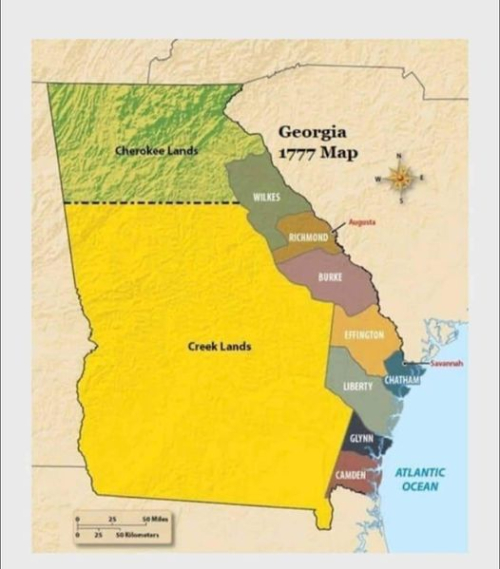
Battle of Savannah
Admittedly, neither one of us knew anything about the Battle of Savannah, but it was “one of the bloodiest during the revolution, exceeded only by Bunker Hill in sustained casualties by one side.” The Loyalists and James Wright were cornered in Savannah with French and American rebels closing in them, but the Loyalist prevailed, but only for a few more years. One takeaway from the book is the diversity of the combatants (a regular Democratic National Convention with muskets):
The battle also may have been the most ethnically and racially diverse of the Revolutionary War. Redcoats, Scottish Highlanders, Hessians, African slaves, Cherokee and Creek Natives, and Loyalists from Georgia, the Carolinas, New York and New Jersey were led by a Swiss-born commander, and all fought under the British banner. Matching up against this foe were French grenadiers, American rebels, Irishmen, Polish hussars, Afro-Caribbean mulattos and Black troops.
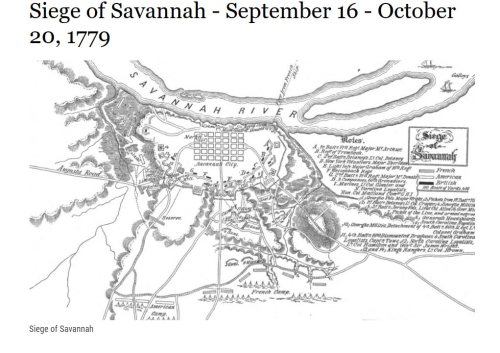
Well Titled
As you begin reading this book you think of it as a biography of James Wright, but Brooking’s scope is much wider than that. By the final pages you somewhat find yourself empathizing with the Loyalists (not necessarily Wright) who were eventually driven from their homes or forced to change their allegiance to a movement they did not believe in to survive — thus the significance of the second part of the title “And the Price of Loyalty in Georgia.”
Other Excerpts of Note
“For the most part, James Wright held the common view of Native Americans during his life: they were savages in need of civilization. His view of backcountry whites was only marginally better. He referred to settlers as ‘a set of almost lawless white people who are a sort of borderers and often as bad if not worse than the Indians.’ …. (page 9)
“Famed author, lexicographer, and bon vivant Samuel Johnson once quipped that oceanic travel was akin to being tossed into jail but with the added prospect of being drowned……There was truth to Johnson’s witticism, however, as 20 percent of eighteenth-century Atlantic voyages ended in disaster. Twenty percent! ….. (page 57) Wright’s wife Sarah and his daughter perished on a 1764 voyage to England.
First, Wright accurately predicted the dire long-term consequences of Parliament’s repeal. Second, this prediction was rooted in Wright’s seemingly inherent paranoia about threats against parliamentary authority, which in turn threatened his own power. Sometimes paranoia can be perceptive prescience”. Page 113
Final Thoughts
You cannot discount how slavery played a part in it (on page 147 the author provides an inventory of Wright owned eight plantations which was being worked by a total of 375 enslaved black men, women and children). And as the historian Bailyn described Wright “as a man who spent a lifetime relentlessly accumulating land wealth, status and power.)”
One of the strengths of the book that we both agreed upon is that Brook avoids the common pitfall of history writing by imposing of tainting current values on past events. We end with Francis’ five Amazon review:
The Revolutionary War–Unframed:
The author of this biography, Greg Brooking, un-swayed by current conflicting narratives of its root causes, chronicles how a key individual experienced the revolutionary war. James Wright was born in England, trained in law and moved to Charleston SC where he climbed the social ladder and cleared a tarnished family name through his legal acumen, marriage, and the acquisition of plantations with enslaved workmen. This led to his royal appointment as British governor of nearby Georgia, and his involvement in an escalating series of disputes involving native American tribes, backwoods settlers, landed gentry, and elected and sometimes dissolved Georgia assembly, British politicians, and the increasingly anti-British sentiments of the population. Perhaps better than any other Georgian, he understood the disparate motives of these parties, which augmented his credibility, but, his implacable loyalist stand, which kept Georgia as the last colony to shed British occupation, ultimately cost him his new world wealth and forced his return to England. For many rank-and-file colonists of Georgia ideology was a luxury they could ill afford. For them, the decision on which side to join was delayed until it was forced on them and based on the likelihood of reprisals (which were not infrequent) or rewards from the forces that were nearest, and which shifted with the conduct of the war. Those interested in a grass roots history of the Revolutionary War or colonial life in Georgia will find this book of interest. Those looking for a paean to liberty, or an exposé of blatant hypocrisy will be disappointed, as the author, content with primary sources, only relates how the people living then saw events, without the bias or benefit of how we see it today.
https://bookshop.org/widgets.js
Hunger (1890) Knut Hamsun
This was a selection that came about because of Murray’s trip to Europe in the summer of 2024, which included stops in Oslo (shoreline shown below) and Stockholm. In preparation for his trip to Norway Murray read some of the works of their internationally known writer Karl Ove Knausgaard (My Struggle Books 2 and 3). See Swedish Book Notes.
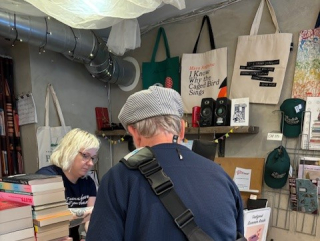 Hamsun is mentioned several times is My Struggle, and Knausgaard himself is ticked off when a guest at this dinner party taunts him by calling him Hamsun. I was curious so I purchased a copy of Norwegian Nobel Prize Winner’s novel at The English Book Shop in the Södermalm District of the Stockholm.
Earlier this year Francis and I read another book about an impoverished writer in Europe–Down and Out in Paris and London by George Orwell. Moreover, we include from time to time some of the classics (Homer, Faulkner, Stendhal, Mary Shelley, Laurence Sterne) in our reading rotation.
Defies Description
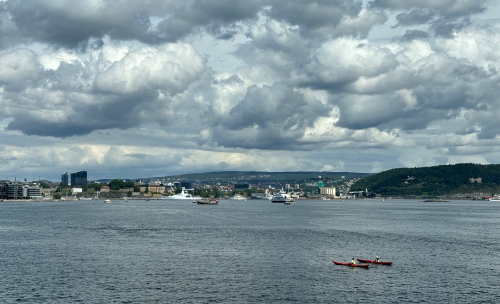
Set in Kristiania (the name of the city before it became Oslo) This novel defies description because not much goes on. In the afterword by Paul Auster (the Canongate edition translated Sverre Lyngstad) describes Hunger:
“It is a work devoid of plot, action and but for the narrator character. By nineteenth-century standards, it is a works in which nothing happens…He gives an account only of the hero’s (a writer) worst struggles with hunger…Historical time is obliterated in favor of inner duration. With only an arbitrary beginning and an arbitrary ending, the novel faithfully records the vagaries of the narrator’s mind, following each though from its mysterious inception through all its meanderings, until it dissipates, and the next thought begins.”
Another way this book is described as the little brother of Fyodor Dostoevsky’s Crime and Punishment (1866) or his novella Notes from the Underground (1864). Francis recalls reading Notes with its manic narrator. Hamsun may have been an influencer of Albert Camus, Franz Kafka and John Fante, (according the book blurbs on the back cover) but this signature work appeared after the publication of Crime and Punishment and Notes.
Too bad for me. I am a big fan of Camus and Fante and Orwell’s Down and Out, but this book not so much. On the other hand, as he often does, Francis encouraged me to finish it after our discussion. He admitted at the book at times was a slog, but one passage did remind of a quote from Primo Levi about discovery:
crashing around in a cave, with the ceiling progressively narrowing as you move forward, until, abashedly you climb out backwards on hands and knees….
Though not in the same class as Primo Levi, but I think they both authors would agree that discovery involves exploring a lot of blind alleys. Hamsun’s maze, however, was the result, not of ignorance or nature’s complexity, but of his own cognitive machinations.
It also reminded Francis of another quote that explains his take on Hamsun from Abba Eban (1915-2002) former Israeli Foreign Minister – History teaches us that men and nations behave wisely once all other alternatives have been exhausted.
Another line from Hamsun reminded me (Murray) of something that might have been written by Orwell: The intelligent poor individual was a much finer observer than the intelligent rich one. But those kind of insights were rare.
As our tradition we finish with Francis’s four star Amazon review:
A world of woe, or whim?
Soren Kierkegaard once wrote: “If I were a pagan, I would say that an ironical deity gave man the gift of speech so that he may be entertained by their self-deceit.” In “Hunger” the author, Knut Hamson, demonstrates the inconsistency of human reason by showing how easily one’s stream of consciousness slips its banks on an impulse, particularly in those enfeebled by isolation and malnutrition. Surprisingly in this short novel, the mental meandering of the protagonist entertains the reader, perhaps because it recapitulates the cerebral gymnastics many readers have experienced in response to the vicissitudes of daily existence. Despite the travails of the main character, his endless generation of possible solutions may not be in vain as he struggles to find a way out his self-imposed labyrinth of conflicting misdirection. Recommended for unhurried readers interested in introspection’s pitfalls and potential.
https://bookshop.org/widgets.js
The Book-Makers: A History of the Book in Eighteen Lives (2024) by Adam Smyth
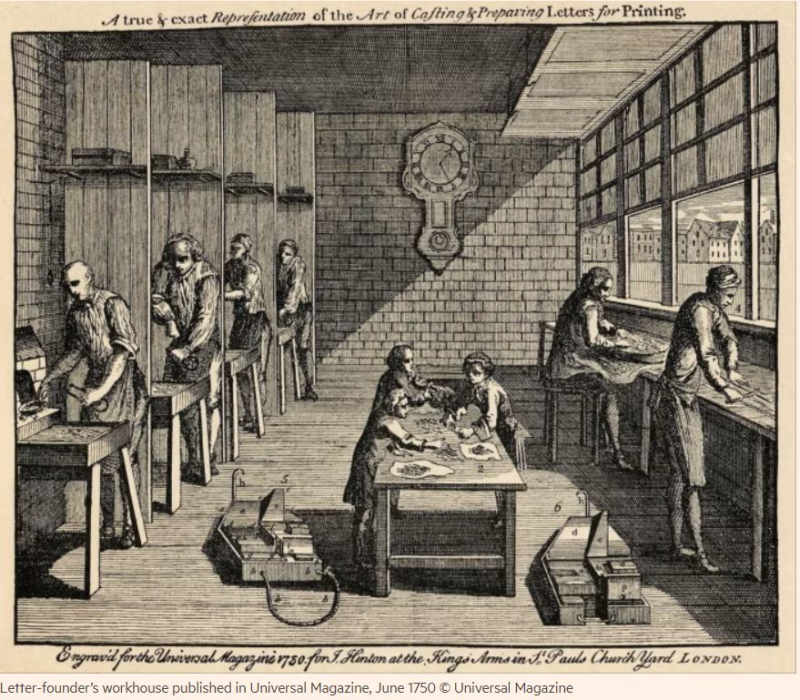
We both read reviews of this book and it sounded interesting so we went for it. Overall it was a good choice –but not without its flaws. For Murray, it reminded him of his personal experiences on the periphery of book creation and book selling. Here’s a chapter by chapter run down.
Introduction
On page 5, Smyth commentary about the history of books/printing reminded Murray of the Marshall McLuhan’s dictum that “at first new media will copy old media” before it finds its own space and stride. Think how early television mimicked radio and how digital newspapers mimicked and still do provide electronic print versions of their content.
Chapter 1 Printing: Wynkyn de Worde
Page 8, We learned what a colophon is.
Page 10, “De Worde was a pioneer who had a new kind of skill that the emerging business of printing made necessary: the ability to understand the desires and aspirations of readers he had never met.”
Page 12: “De Worde loved images and his books express this: his thinking was more instinctively visual than verbal, and, more than any of his rivals, he learnt from the sophisticated visual presentation of text by Continental printers.”
Page 25: “Do you buy new books without reading them?” from the satire The Ship of Fools (1517).
Yes, but not intentionally.
Page 40: DeWorde was the man of the handbook, the guide, the compact volume one could carry and read.
Page 41: Early censorship!
“Page afer page is covered with black ink, added by a reader with care and consistency. It looks like a redacted legal document.
What is happening here? The blocks of black ink obliterate, or nearly obliterate, every appearance of the word ‘Pope’, from Peter I on. These deletions are meticulous and they read like controlled rage: a careful and unswerving attempt to erase a memory.”
Chapter 2 Binding: William Wildgoose
Until we read this chapter, one may not have realized that the printing and binding were TWO separate stages. You purchased the unbound book and then paid someone to bind it. In other words “binding as a first act of first of early act of reception, rather than the final act of production.” (p.56)
Chapter 3: Cut and Paste- Mary and Anna Collett of the Little Gidding (the center of book-making 30 miles from Cambridge)
Page 105 – “Many early modern readers expressed their investment in reading and knowledge and thought not by fetishing books or putting them away in boxes or behind closed doors; to read was to mark, annotate, rebind rearrange, reformat and cut.”
Chapter 4 Typography: John Baskerville and Sarah Eves
This chapter reminded Murray of his days at Mycro-Tek when he worked in the periphery of type with Linotype/Mergenthaler. I remember meeting a fellow whose job consisted of protecting the font Helvetica from infringement.
I loved the samples of the letters – the upper case Q and the lower case g from his Baskerville’s specimen sheet.
Chapter 5 Non Books: Benjamin Franklin
Franklin was kind of a commercial printer who was focused on making money. (He had no problem running advertisement for slaves in the newspapers he printed. (p.150)
Of course Franklin was known for his Poor Richard’s Almanac each page crammed full of information. (p.154) It reminded Murray of the Wallace almanacs.
Franklin’s Death Poem. His decaying body as a book to be food for worms. (p.161)
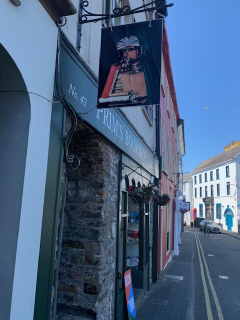 Page 162 – Another metaphor for the person as book – the Giuseppe Arcimboldo’s The Librarian dated 1566. Murray recognized the painting from a book shop sign in Kinsale, Ireland.
Chapter 6 Paper: Nicolas-Louis Robert
A fascinating account of how papermaking was transformed. The history included roots in China in 105 C.E. and how they used to make paper from rags until Nicolas-Louis Robert invented a machine
Page 177: “The problem he saw was the 300 workmen. In Robert’s eyes, they constituted a labour force too aware of its desirable skills, who brought acrimony and argument and clogged up what might somehow – reimagined – be a leaner process of production. Robert started to envision a better version of the Essonnes paper mill without these irksome bodies. An environment of machines – one can almost hear the sighs-to come of William Morris and Thomas Cobden-Sanderson who attempted to reverse an industrialized process of book-making (Chapter 9).
….Robert’s machine-vision had its origins in a kind of business misanthropy, in a desire to eliminate people. ?? Francis comments I’m not sure where this came from, this was a business decision, pure and simple, calling it misguided misanthropy is ludicrous, but perhaps Adam Smyth, the author, is a closet Luddite).
Page 180:- And machines today produce paper at about 70 miles per hour – or about 1,800 metres per minute.
Also, page 180:
Paper had always been used for much more than books: wrapping has been, for much of paper’s history, its primary function, and old pieces of paper had always been used as toilet paper – what John Dryden referred to as ‘Reliques of the Bum’. (The seventeenth-century essayist and courtier William Cornwallis kept what he called ‘pamphlets and lying-stories and two-penny poets’ in his privy, and not for reading.)land
Page 185. The word “palimpsest” which means diverse layers of posters that cover up other posters.
Atlanta Fun Fact: There is a paper-making museum on the campus of Georgia Tech.
Chapter 7 Extra-Illustration: Charlotte and Alexander Sutherland
We both agreed that this chapter was the weakest of the book.
Chapter 8 – Charles Edward Muddle
Murray received kept this bookmark from the American Book Center in Amsterdam.

Page 229 – Another Fun Fact. Murray saw the then blind Borges at Indiana University lecture in the mid-70s. Admittedly as a clueless undergrad he didn’t know what all the fuss was about.
More Borges quote faves (not in the book though):
His many years had reduced and polished him the way water smooths and polishes a stone or generations of men polish a proverb.
Doubt is one of the names of intelligence.
Heaven and hell seem out of proportion to me: the actions of men do not deserve so much.
Here are some of the writers of Mudies day (1818-1915) complaining about his approach to selecting or not selecting someone’s books to become loaners: He didn’t tolerate writing that was erotic or too violent, and his decisions made or broke many writers.
Page 230: Mudie’s Library embodied a humanity that is ‘headless, trunkless, limbless, and is converted into the pulseless, non-vertebrate, jelly-fish sort of thing which, securely packed in tin-cornered boxes, is sent from the London depot and scattered through the drawing-rooms of the United Kingdom’.
Page 232: Wilkie Collins called Mudie ‘an old fool’ and an ‘ignorant fanatic’, but these were really responses to Mudie’s gatekeeping power – his ‘system of Mudie-ation’, as one letter writer put it. The prude, if that’s what he was, and the aggressive businessman, which is certainly what he was, seem in some ways at odds – the first has an instinct for cancellation, the second for accumulation – but Mudie may have combined the two.
Francis found this rather surprising about the delayed development of public libraries in England:
Page 236: The development was unsurprisingly slow and patchy, and it was not until the opening decades of the twentieth century, and the Public Libraries Act of 1919, that the library’s potential as a source of free reading for the working classes blossomed into sustained reality, thanks
Chapter 9 – Anachronistic Books, Thomas Cobden-Sanderson
Another weak chapter.
Chapter 10 – Small Presses, Nancy Cunard
Murray who has published a few books himself thinks it requires the money and influence of her material wealth (linked to Cunard luxury shipping company) to do what she did. It’s kind of an aristocratic indulgence, but she does get credit for introducing some great writers out there. Of course, George Orwell has other thoughts. Page
“Will you please stop sending me this bloody rubbish… I am not one of your fashionable pansies like Auden or Spender, I was six months in Spain, most of the time fighting, I have a bullet-hole in me at present and I am not going to write blah about defending democracy or gallant little anybody.”
GRSG did read Orwell’s Homage to Catalonia, see 2021 GRSG Notes. and earlier this year Down and Out in Paris and London.
Chapter 11 – Zines, Do-It-Yourself, Boxes, Artist’s Books. (The works of 5 Do-It-Yourselfers)
Books in a Box, p 322. “the mind’s non-linear associative wanderings…A better solution to the problem of conveying the mind’s randomness than the imposed order of bound book.”
As one who frequents Book as Art shows I do appreciate how creative these pieces are:

Page 326. A mention of Laurence Stern’s Tristam Shandy. See 2022 GRSG Notes.
And as is our tradition we finish with Francis’ Amazon Review
“Gutenberg was only the first of many key individuals responsible for the evolution of the book, and it is these unsung individuals who are the subjects of this biographical history of bookmaking. The author, Adam Smyth, takes the reader through the stepwise progress of books from their beginning as luxuries for the privileged few to commodities for the common reader. Where he excels is in describing how markets evolved in tandem with creative insights in the technology of paper production, bookbinding, illustration, and type fonts. The book’s slow chapters, 7,9,and 10, detail some odd but unsustainable book developments; these can be skipped at leisure. Chapter 8, proved particularly fascinating, highlighting an era long before Amazon or public libraries in Britain, in which a single company dominated the print industry, by creating a global system of subscription book lending. The last chapter covers unique trends in the use of published handouts and E-zines beginning in the 1960s, which provides the reader with an appreciation of how the internet may continue to change how we access and intermix the printed word with art, photography, video and blogging. Highly engaging, well-researched and informative, this book is recommended to anyone interested in who and what have shaped, and likely will continue to shape, how and why we read.”
https://bookshop.org/widgets.js
The March of Folly: From Troy to Vietnam (1984) by Barbara Tuchman
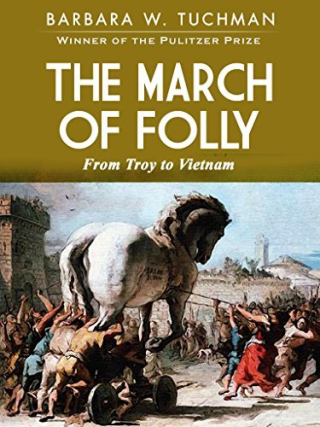 “In analyzing history do not be too profound, for often the causes are quite superficial.” – Ralph Waldo Emerson
There is no better example of Emerson’s observation than Barbara Tuchman’s The March of Folly, a book which popped up on the GRSG radar during a public radio interview with former Georgia Democratic Senator Sam Nunn. In a pre-election interview Nunn warned listeners of the dangers of Donald Trump with respect to his foreign policy. He mentioned the Tuchman book as an example of what can happen. This struck a note with us.
We have read another Tuchman book Stilwell and the American Experience in China, 1911-1945 and she has emerged as a GRSG favorite because she is careful not to project current values on past events. Moreover March covers Troy, the Revolutionary War, and Vietnam which puts it in the GRSG wheelhouse since we have read about the Trojan War in Homeric Moments: Clues to Delight The Odyssey and Iliad by Eva Brann, From Empire to Revolution: Sir James Wright and the Price of Loyalty in Georgia (2024) by Greg Brooking and An Honorable Exit (2023) by Éric Vuillard. The latter two we read earlier this year and Homeric Moments we read in 2021.
To say the least this book is dense and sometimes a slog, but the wisdom of her writing certainly shows through here in November of 2024 after Donald Trump, an insurrectionist, rapist, convicted felon, shyster, a pathological liar, (did we forget something?) was re-elected as the 47th President.
Tuchman follows Emerson’s dictum that the factor usually overlooked by political scientists who, in discussing the nature of power, always treat it, even when negatively, with immense respect. They fail to see it as sometimes a matter of ordinary men walking into water over their heads, acting unwisely or foolishly or perversely as people in ordinary circumstances frequently do. The trappings and impact of power deceive us, endowing the possessors with a quality larger than life.
Let the follies begin.
The Renaissance Popes Provoke the Protestant Secession: 1470 – 1530
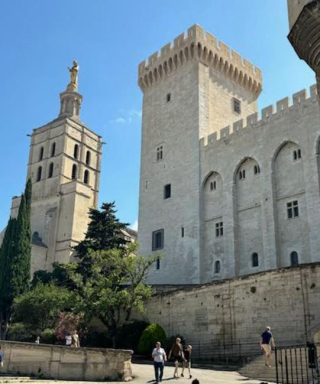
In this epoch, six Popes (five Italians and one Spaniard) through their greed, venality, lack of morals “succeeded” in losing half of the papal constituency to the Protestants. Tuchman gives excruciating pope by pope detail of their follies. As a non-Catholic, Murray struggled to understand all the politics, but Francis (a lapsed Catholic) was better equipped.
But these popes were patrons of the arts in Rome, most notably Michelangelo, Botticelli, and Raphael, but alas their transgressions proved their downfall.
At the end of the chapter, Tuchman summarizes that the popes (a.) “disregarded the movements and sentiments developed around them…fixed in refusal to change, almost stupidly stubborn in maintaining a corrupt existing system;” (b.) their grotesque extravagance and fixation on personal gain (does this sound like any President we know?); (c.) the assumption of permanence that of their invulnerable status.
It is worth mentioning is that you cannot read this book and not draw parallels to the Trump Presidencies, but you also realize—and this may provide some solace—that this kind of malevolence, incompetence, evil, etc. has been going on since the times of the Greeks and the Romans.
The British Lose America: 1763-1783
Earlier this year when GRSG read Brooking’s Empire to Revolution, our perspective was through the Sir James Wright who was appointed by the Crown to govern the Georgia colony. In the Tuchman book we see the same events through the British perspective.

It begins with Britain’s victory in the French and Indian War which left England with such a huge debt that they demanded that the American colonies would pay for. King George and Parliament tried to recover their monies and get the colonists to pay for their protection most notably the Stamp Act and the Tea Act.
The stubbornness of the Crown and to meaningfully budge from their position further entrenched the colonists who were not that keen to fight with the Mother country. For first few years they identified themselves as British citizens (and thus they argued that they could not be taxed without representation), but those in power did not see it that way.
Like the Pope section there were a lot of players in the British government and again Tuchman goes into great detail (who suffers from gout, who doesn’t). It’s not easy to distinguish William Pitt from the 1stEarl of Chatham who are one and the same. He was quoted saying “I know I can save this country and I alone can.” Hmm this sounds familiar.
Tuchman sees England’s’ failure rests on “the intention to retain sovereignty and the insistence on the right to tax in “the face of evidence that the attempt would be fatal to the to voluntary allegiance to the colonies.” England’s ministers had “a sense of superiority so dense as to be impenetrable.” For example, in the decade of the mounting conflict (1763 to 1775) not a single ministers travel to the colonies to see the situation firsthand. They didn’t even send a representative. (Of course, can we blame them as we learned in the Brooking book that 20 % of the 18th century voyages across the Atlantic ended in disaster.)
America Betrays Herself in Vietnam: 1945-1973
This latter third of the book was the more troubling part of the read. Not because the writing and research were not sterling, but Francis and Murray were impressionable teenagers during the end of the Vietnam War. Our initial reactions to the war were that America was winning the war (weekly casualty figures were reported on the nightly news) and we believed the government’s excuse that the U.S. must fight communist aggression in Southeast Asia.
Even though long before we read the Tuchman, we knew what a waste of lives and money the war in Southeast Asia–we just didn’t know the magnitude. While we were in college at Indiana University and we both filed for the draft. However, by then Vietnamization was in full swing and the United States had significantly withdrawn its troops. I remember watching the Fall of Saigon on my dorm TV.
(Before Tuchman, Murray had read other books about Vietnam. The Bright Shining Lie (see essay at Tropics of Meta here), Michael Herr’s Dispatches and Viet Thanh Nguyen’s Nothing Ever Dies: Vietnam and the Memory of War. (description here). Nguyen also wrote The Sympathizer, which is a extraordinary novel set in the last days of Vietnam and those who sought refuge in the United States.
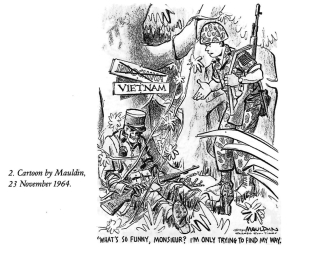
In other words, Tuchman’s chapters on this era pointed out the many follies of the American government perpetuated by John F. Kennedy, Lyndon Johnson, Robert McNamara, John Foster Dulles, Dean Rusk, the American military etc. (“In tribute to his steadfastness, someone in his own department scrawled inside a telephone booth, “Dean Rusk is a recorded announcement.” The others were prime examples of wooden-headness) We also had a precursor of the futility that awaited the United States when we read in GRSG’s An Honorable Exit by Éric Vuillard, a scathing account of France’s colonial tyranny over Vietnam and subsequent defeat at Dien Bien Phu in 1954. Tuchman’s shows how America’s disaster in Vietnam began soon after World War Two.
The flaws were overwhelming and even with knowledge from previous books there were facts/incidents that struck close to home. A couple of examples:
Political Assassinations of Vietnamese president Ng Dinh Diem and his brother Nhu. Tuchman writes “On 1 November (1963) the generals’ coup (backed by the CIA) took place successfully. It included to the appalled discomfort of the Americans, the unexpected assassinations of Diem and Nhu. Less than a month later, President Kennedy too was in his grave.”
The collapse of support of the war. This included Vice President Humphrey’s political threats to any new congressman who didn’t support the Vietnamese policy – the ineffectiveness of the bombing of North Vietnam in terms of thwarting war production and the population’s morale. (bombing of civilians was shown to galvanize result in World II both in Germany and Great Britain during the Blitz).
No matter what the data or the reports that came in from independent advisors and on the ground like Paul Vann, (the subject of the Bright Shining Lie) the government would not change its policy.
Sam Ervin of North Carolina later of Watergate fame. “..working the famous eyebrows, hinted at the lurking uneasiness among some Senators about the whole involvement when he asked, “Is there any reasonable or honorable way we can extricate ourselves without losing our face and probably our pants?” The Sam Ervin of Watergate fame.
America Was No Liberator. “A journalist who had covered the war in Europe recalled the smiles and hugs and joyous offers of wine when GIs came through liberated areas of Italy. In Vietnam, the rural people, when American units passed them on the streets or in the villages, kept their eyes down or looked the other way and offered no greetings.”
McNamara’s folly. McNamara had said, “The greatest contribution Vietnam is making … is developing an ability in the United States to fight a limited war, to go to war without arousing the public ire.” He believed this to be “almost a necessity in our history, because this is the kind of war we’ll likely be facing for the next fifty years.”
See the documentary, The Fog of War about Robert McNamara. The director was Errol Morris the author of Believing is Seeing
Perhaps the most tragic: A contemporary summing up was voiced by a Congressman from Michigan, Donald Riegle. In talking to a couple from his constituency who had lost a son in Vietnam, he faced the stark recognition that he could find no words to justify the boy’s death. “There was no way I could say that what had happened was in their interest or in the national interest or in anyone’s interest.”
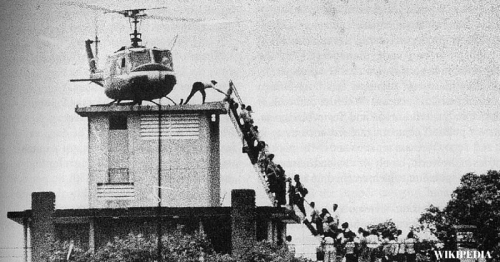
The Greeks
Tuchman’s opening chapter uses the Trojan War—more specifically the fall of Troy—as an early example of follies, which dates back to the antiquities. In the Epilogue she writes:
According to the Stoics, reason was the “thinking fire” that directs the affairs of the world, and the emperor or ruler of the state was considered to be “the servant of “divine reason” (appointed) to maintain order on earth.” The theory was comforting, but then as now divine reason was more often than not overpowered by non-rational human frailties—ambition, anxiety, status-seeking, face-saving, illusions, self-delusions, fixed prejudices.
Another similar passage:
“Infatuation,” as Herodotus suggested, is what robs man of reason. The ancients knew it and the Greeks had a goddess for it. Named Atē, she was the daughter—and significantly in some genealogies, the eldest daughter— of Zeus. Her mother was Eris, or Discord, goddess of Strife (who in some versions is another identity of Atē). The daughter is the goddess, separately or together, of Infatuation, Mischief, Delusion and Blind Folly, rendering her victims “incapable of rational choice” and blind to distinctions of morality and expedience. Given her combined heritage, Atē had potent capacity for harm and was in fact the original cause, prior to the Judgment of Paris, of the Trojan War, the prime struggle of the ancient world.”
The Greek myth of Cassandra resonates with readers of The March of Folly. The Trojan empress had the power to predict the future, but it was limited because no one would believe her. Given the reckless, corrupt, greedy nature of Donald Trump and sycophants we cannot help but wonder if the weight of their folly will sink them.
And we finish with our traditional Francis Walker’s 4 star Amazon Review:
In the March of Folly, Barbara Tuchman explores at length the numerous ways that leadership can go awry—from the Trojan War to Vietnam. Writing about folly, she has ample material from which to draw, and her task is one of selection rather than discovery. (Had she chosen to write about wisdom, the reverse would have been true and the book far shorter.) Her expose of the popes is fascinating, and even though she left out much it still runs long. Her indictment of the idiocy that ensnared us in Vietnam is both more forceful and painful because so many of us lived through that era. It is interesting how Eisenhower, Kennedy, Johnson and Nixon all contributed to the war’s onset, buildup, and its interminable ending. The section on the American revolutionary war provides a uniquely British perspective of their catastrophic mishandling of this conflict. Her trademark of corroborative detail is found in every section and helps confirm an observation by Tacitus: “…Tragic events were the result of accidents and bad decisions, and the depth of the tragedy lay in the fact that the accidents need not have happened, and the decisions might have been good.” Enlightening in conception and execution, the book is recommended for those wishing to learn more about the mythic literature of Troy’s destruction, the abuses of the papacy, the British view of the American revolution, the failure of US policy in Vietnam, and perhaps of greatest import, how to imagine future follies that await.
Death Glitch: How Techno-Solution Fails Us in This Life and Beyond (2023) by Tamara Kneese
We do not content ourselves with the life we have in ourselves and in our own being; we desire to live an imaginary life in the mind of others, and for this purpose we endeavour to shine. We labour unceasingly to adorn and preserve this imaginary existence and neglect the real. – Blaise Pascal, Pensee’s (circa 1600)
This book popped up on the GRSG radar because Murray is a semi-regular contributor to the Tropics of Meta Historiography for the Masses https://tropicsofmeta.com/ and noticed an interview between Death Glitch author Tamara Kneese and Geert Lovink on the ramifications of one’s self on the internet after you die. Murray is also scheduled to do a workshop on his book A Father’s Letters: at the Dekalb History Center and some of the material in Kneese’s book has relevance to the workshop.
Overall
Although there are several interesting points to glean from the book, Glitch reads like a Ph D dissertation that has scissored and pasted into a book. Kneese is an academic and fortunately the book is relatively short ( less than 200 pages) but it has an additional 40 pages of bibliography and notes. The book suffers from a lack of good editing, which in our opinion is not uncommon in many books. Here’s a sample of her thick prose that is unintelligible:
Yet data are not reducible to their uses in structures of oppression: data are also metaphysical, relational objects. Data contain an existential quality, what the media theorist Amanda Lagerkvist calls “digital thrownness,” or gesture toward the mythological and the sublime. The metaphysical, speculative qualities of data imaginaries are essential to understanding how data-as-representation and data-as infrastructure (supply chains, logistics, platformization) do not quite add up to an afterlife, even if there is a feeling or hope that they might. Data are ghostly, but the platforms and the data attached to them yield material effects. …. (page 27)
At this point are you still with us? I hope so because the book does have several observations that struck a chord with us based on our discussion.
Tech never lasts
Kneese writes, “The utopian promise of digital immortality offered by the web is undermined by commercial dependencies and short technological life spans (p.20).” She provides plenty of examples of internet companies and startups promising to keep your digital information in perpetuity. She even has screen shots of some companies that have long since disappeared. (Our favorite digital estate planning site was named iCroak.)
She reminds us that many Silicon Valley capitalists are generally startups that are set up for big investments up front, where most of their money is made before disappearing.
And don’t even think about those expired accounts on the internet especially on Facebook where there is speculation that accounts of dead people are expected to outnumber the accounts of the living by 2070 (p.52)
Ghosts in the Machine
This is a common metaphor used by Kneese whether it be the digital remains (data) that remain attached to everything from Paypal accounts, bitcoin wallets, to wearable technology like Apple watches. “The truth is that data cannot be detached from hardware systems,” writes Kneese (p.10). As one media theorist digital information is “undead.”
Her take on Smart Houses becomes almost comic as she provides examples of “how the smart home, that lives on indefinitely is a horror show, enacting control over the living in perpetuity.” The most memorable is that of Tom West who was the main focus of Tracey Kidder’s Soul of the New Machine about the computer industry in 1970s. When West died his daughter not only found her father’s hidden cache of porn but that the home had fallen into “disarray — becoming a ghost of its former self. (. P.180)
Forgotten Caregivers
As much as we like to believe that the digital world will handle all these problems, Kneese reminds us that behind the internet is the world of caregivers. She writes, “Stephen Hawking was reified as a lone genius while he relied on a combination of machines and other bodies and brains to carry out his research and remain a prominent public figure. This paradox is mirrored in the intersubjective of illness blogs, in which one person’ s digital possession exists and survives thanks to the actions of many…” (p.80)
Least we forget about the caregivers – those essential workers (or in words of Kneese expendable). Part of the million Americans who died during the Pandemic. But apparently national amnesia has set in there is already have been a national amnesia have since Americans recently voted in to power a political party whose platform is opposed to vaccinations. (Don’t get us started, but I guess you have.)
Coincidental Connection
While reading Glitch, Murray was also reading the novel Tremor by Teju Cole. The novelist examines -in W.G. Sebald fashion—one aspect resonated. The main character, a photographer, reminds us that until photography became widespread, the only people who had a likeness of them recorded were the wealthy and powerful – painted portraits of kings, and queens and statemen and before that carved in stone portraits like Helen of Troy. The same can be said for today. Those who are pursing transhuman strategies (living beyond death) are the extremely wealthy.
Kneese writes in her intro “Just like billionaires who plan on fleeing to bunkers on Mars to escape catastrophe here on earth, those who believe in digital immortality also form an exclusive club.”
Conclusion
We finish with Francis’s 3 star Amazon Review
Death Glitch is a book about the disposition of what people, upon their death, leave behind on social media and the internet. It reads like a copy/paste compilation of notes and thoughts, some of which are relevant and informative. It wanders, occasionally vilifying corporate interests and cis-gender male CEOs, at other times it cites literature from Feminist Marxists and Mormons, unaware of the inherent contradictions they possess. It often ignores more useful sources: Pericles (429 BC): “What you leave behind is not what is engraved in stone monuments, but what is woven into the lives of others.”; Miguel Unamuno: “We should strive to be the parents of our future rather than the offspring of our past”; or even medieval phrases such as “Memento Mori” (remember, we all must die). Instead, wordy, redundant passages are used to convey similar thoughts. Nonetheless, it has value. Interspersed throughout are some lively discussions of the history of tech startups designed to retain digital remnants of people’s lives, the frequent failures of these platforms and interviews with people trying to innovate novel ways to memorialize personal information for posterity. As such, it disproves one of Marshal McLuhan’s famous sayings: “People never remember but the computer never forgets.” (apparently it does). Recommended for those with the patience to weed through pricey, patronizing prose, it provides tantalizing nuggets about novel trends in perpetuating the virtual artifacts the dead leave behind.
https://bookshop.org/widgets.js
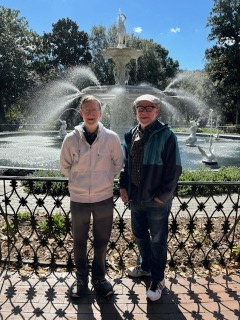
This concludes our twelve book, 17,646 word, 2024 Gravity’s Rainbow Reading Group odyssey. See you next year!
—– EXTENDED BODY: —– EXCERPT: —– KEYWORDS: An Honorable Exit, Down and Out in Paris and London, George Orwell, Eric Vuillard, Alasdair Gray, Poor Things, —– ——– AUTHOR: Murray Browne AUTHOR EMAIL: murray.browne905@gmail.com TITLE: Best Books Read in 2023 STATUS: Publish ALLOW COMMENTS: 1 CONVERT BREAKS: wysiwyg ALLOW PINGS: 0 BASENAME: best-books-read-in-2023 CATEGORY: Best Books Read 2017-2023 UNIQUE URL: https://thebookshopper.typepad.com/the_book_shopper_atlantad/2023/12/best-books-read-in-2023.html DATE: 12/31/2023 10:20:52 AM —– BODY:
Looking through my list of books read this year, (a sidebar on the home page) and comparing it to Best Books Read 2017-2022, this year’s notables share certain characteristics. Besides being compelling reads, they have a thematic unpleasantness (read: misery). Is this just a reflection of 2023 or a pattern of the kind of book I naturally read? Let’s review.
Bloodlands: Europe Between Hitler and Stalin (2010) by Timothy Snyder
 I became a reader of Tim Snyder when a friend directed me to an interview with the Yale historian and a world expert on Eastern European history. In this interview Snyder predicted that things would happen during the 2020 election that would totally surprise us. I quickly read his succinct On Tyranny: Twenty Lessons from the Twentieth Century (2017) but this year I expanded to his tome Bloodlands: Europe Between Hitler and Stalin (2010). In the introduction Snyder writes “that the mass killing of the twentieth century is of the greatest moral significance for the 21st century.” The book has added a new chapter includes an updated view of the 2020 election and The Big Lie, which by the way, was an Adolf Hitler technique.
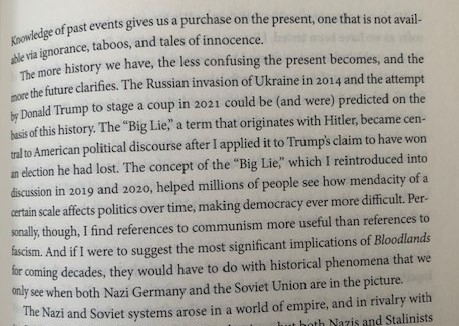
Extensive ramblings can be found at My Random Bloodlands Notes.
Looking back at previous Best Books Read (2017-2022). I had admired similar books: Josef Skorvecky’s The Bass Saxophone and Other Stories (set in Czechoslovakia), Astra Taylor’s Democracy May Not Exist But We Will Miss It When It Is Gone and Eric Vuillard’s The Order of the Day which tells how Germany annexed Austria in 1938.
Dispatches (1977) by Michael Herr
Books on Vietnam seem to be another pattern in my reading. This year’s offering was Michael Herr’s Dispatches. This short book is a mix of Hunter S. Thompson and George Orwell. Based on the Thompson manic writing style Herr’s book could be renamed Fear and Loathing in Vietnam, but the comparison to Orwell’s Homage to Catalonia fits as well. Not only did Orwell write candidly about combat and conditions on the front lines during the Spanish Civil War but he also integrated the politics of the country into the narrative as well. Herr reveals the damaged psyche of the grunt and while questioning the mindset of journalists like himself. He also reveals cluelessness of the commanders in the field. (Ironically, the U.S. Commander William Westmoreland’s was heavily criticized by others in the military for allowing correspondents access to the frontlines.)

Herr was one of the screenwriters for the films Apocalypse Now and Full Metal Jacket. A line from the movie came back to me as I read the book. It’s the point when the Marines have finished basic training and are marching on review. Joker (Matthew Modine) narrates, explaining what he has learned: “The Marines do not want robots. The Marine Corps wants killers.”
Dispatches fits on my shelf with other recently read Vietnam classics like Neil Sheehan’s A Bright Shining Lie: John Paul Vann and America in Vietnam (Vann was not clueless) and more recently the works of Viet Thanh Nguyen including the novel The Sympathizer and Nothing Ever Dies: Vietnam and the Memory of War. He writes in Nothing Ever Dies:
"Apocalypse Now and Herr’s Dispatches converge in their honesty about or perhaps exploitation of the nitty-gritty core of war, which is the fusion and confusion of lust and killing, sex and death, murder and machinery, resulting in homicides that were illegal at home but encouraged overseas in the war zone."
The Nickel Boys (2019) by Colson Whitehead
Historically, (historically?) less than a third of the books I read are fiction, but one of my favorite writers has been Colson Whitehead. I’ve read four of his books, but not his most well-known— Underground Railroad. (My favorite is Sag Harbor.)
In the Nickel Boys two Black teenagers Elwood and Turner struggle to survive in a reform school in Tallahassee during the 1960s. There is plenty of misery and brutality in the book which is more pronounced, because you emotionally become invested in (and root for) the two main characters.
Whitehead’s prose is fast-paced and energetic with description that gives the book some levity. For example:
"After the judge ordered Elwood to Nickel he had three nights home. The state car arrived at 7 o’clock Tuesday morning. The officer of the court was a good ole boy with a meaty backwoods beard and a hungover wobble to his step. He’d outgrown his shirt and the pressure against his buttons made him look upholstered."
Question Answered
I am already anticipating more Whitehead books ahead in 2024 and Eric Vuillard’s A Honorable Exit about the French withdraw from Indochina in the 1950s is already a scheduled read for my book group (GRSG).
It is rather easy to answer that question about my reading tastes. There are definite patterns in my selections. I can only wonder whether types of books will dominate in 2024. With wars raging in the Ukraine and Gaza, I expect I will gravitate to similar titles in the days ahead.
—– EXTENDED BODY: —– EXCERPT: —– KEYWORDS: Timothy Snyder, Colson Whitehead, Michael Herr, Best books of 2023 —– ——– AUTHOR: Murray Browne AUTHOR EMAIL: murray.browne905@gmail.com TITLE: Milestone or Millstone STATUS: Publish ALLOW COMMENTS: 1 CONVERT BREAKS: wysiwyg ALLOW PINGS: 0 BASENAME: milestone-or-millstone UNIQUE URL: https://thebookshopper.typepad.com/the_book_shopper_atlantad/2023/12/milestone-or-millstone.html DATE: 12/06/2023 09:13:02 AM —– BODY:2023 was the year that the Book Shopper blog marked its 500th posting. And in case you missed the celebration; there was no celebration. Admittedly I thought about renting some space and inviting notables who have made tangential cameo appearances throughout the years (Filmmaker James Benning, rapper Killer Mike and author Thomas Chatterton Williams, Book artist Brian Dettmer, essayist David Shields, photographer Emily Berl) and throwing a party on behalf of the blog. I might have called it “Not the Decatur Book Festival Festival.” For now, this remains a fantasy.
The blog premiered on November of 2008 when I reviewed a showing of “Paperback Dreams”, a documentary on the demise of two bookstores in the San Francisco area followed by a panel from the local book selling scene. Ironically, I have been a book seller myself for three years with my book popup Destination: Books. No brick-and-mortar store for me, which was one of the memorable takeaways (financial ruin) from “Paperback Dreams” along what a soulless gorilla Amazon was and still is as a bookseller.
Yet, the blog plods on. In the early years I used to “report” on happenings around the city, but that became tiresome as writer events often become almost cliché. Moreover, the response was underwhelming considering the work I put into it.
However, looking back on the postings about the notables was a fun trip down memory lane and I did learn some things worth sharing. For example, when the poet Billy Collins reminded his readers should not confuse the narrator of his poems with the poet himself. However when my longtime partner Denise and I ran into Collins outside the chapel at Agnes Scott College before showtime, he seemed charming and whimsical like his poems. Another worthy author event featured the historian Rick Atkinson who wrote The Liberation Trilogy. In the Decatur Library Auditorium Atkinson graciously fielded World War II questions from the audience like it was a game show.
Though I continue to march with a one-foot-after-the-other attitude, I have lightened my load by adopting a more wistful format, which I share on a monthly basis. Receiving occasional feedback from you fabled few readers who haven’t unsubscribed me, is always encouraging. But the main motivation of continuing the blog is that it gives me an excuse to generate ideas, to write, knowing I have some hassle-free place to publish it. A few posts have generated other writing ideas and larger essays on other platforms. One of the most notable was The MARTA BOOK CLUB where I listed the books, I witnessed people reading while riding the Metropolitan Atlanta Rapid Transit System for 12 years. It spawned my 2016, Down & Outbound: A Mass Transit Satire, (see video trailer) book.
Well, it’s back to work as I compile my Best Books Read List for 2023. Time to get started on that next 100 to make it to the 600th posting, which I will I expect will drop sometime in 2030. Book your party reservations now.
—– EXTENDED BODY: —– EXCERPT: —– KEYWORDS: James Benning, Brian Dettmer, Thomas Chatterton Williams, Killer Mike, Emily Beryl Celebration, Party, Decatur Book Festival —– ——– AUTHOR: Murray Browne AUTHOR EMAIL: murray.browne905@gmail.com TITLE: Book Launched STATUS: Publish ALLOW COMMENTS: 1 CONVERT BREAKS: wysiwyg ALLOW PINGS: 0 BASENAME: book-launched UNIQUE URL: https://thebookshopper.typepad.com/the_book_shopper_atlantad/2023/11/book-launched.html DATE: 11/10/2023 10:18:21 AM —– BODY:
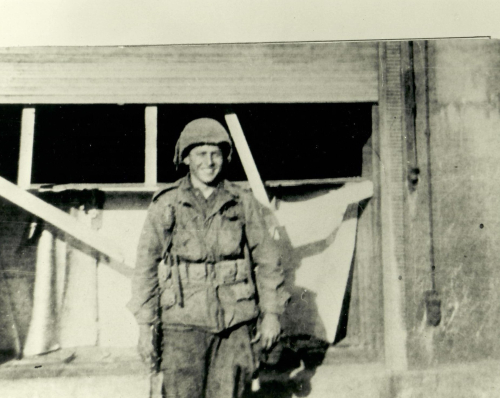
It seems rather fitting that this Veterans Day weekend also marks the launch of my new book, A Father’s Letters: Connecting Past to Present which is finally on the shelves (at least virtually). It follows my writing pattern of publishing a book once every seven years: The Book Shopper: A Life in Review (2009), Down & Outbound: A Mass Transit Satire (2016). At first glance, no three books could be more different from each other.
I began A Father’s Letters after I was blessedly packaged out to retirement from Turner Broadcasting in 2019. The first draft was awful. And on the advice of brave friends who saw the first iteration, I blew it up. However, some of the remnants had a half-life—especially my father’s correspondence which I had kept with me over the decades. This included approximately 600 letters chronicling two distinct periods of his life—as a combat infantryman in World War II Europe and 30 years later as accountant tethered to a desk job at a small Midwestern canning company. (The picture above is my father Glenn R. Browne Jr. as a 19-year-old infantryman near Kaiserlauten, Germany in 1945.)
I am a slow writer and I spent most of 2022 writing a new book, with assistance from some of those same brave friends. It was a great improvement but only five chapters and 63 pages in length.
Not only did I retrace my father’s combat action, but I also examined the letters he wrote me from 1976 when I graduated from college to his premature death from leukemia in 1985. Certain themes emerged—such as how do we define ourselves in retirement. However, what surprised me was discovering how this correspondence shaped my life then and now. Part of the self-discovery was the process itself, which I write about.
Fortunately, this was not a catharsis of trauma that so many books of this type can often be, but the writing of it felt more like a Field of Dreams movie moment of “Hey Dad, do you want to have a catch?” And since I grew up in east central Illinois it has that Midwestern influence as well.

Most of 2023 was spent getting it proofread professionally, designed professionally and finally printed through Ingram Spark and distributed through Ingram with my Muted Horn publishing imprint. The book contains photographs, a truncated map of my East Central Illinois homeland, cartoons (and I had to get permissions) and this cover art which is part of a permanent exhibit at the High Museum in Atlanta. Like Down & Outbound, I wanted the content to determine the physical form of the book.
Limited Availability
By working with Ingram Spark, the book is available online through Amazon and Barnes & Noble or you can purchase it through Ingram’s book direct sales. (Link to the book here.) I have a few “advance copies” here in my study and they will be available at my book popup Destination Books, which makes a monthly appearance at the Carter Center Freedom Farmers Market (Saturday morning, November 18). I expect that after Thanksgiving I will have more copies readily available for purchase directly though my personal website.
It seemed only appropriate that you blog readers should be among the first ones to know. Thanks for your support.
—– EXTENDED BODY: —– EXCERPT: —– KEYWORDS: —– COMMENT: AUTHOR: Cal Gough EMAIL: calgough@bellsouth.net IP: 107.130.113.15 URL: http://atlantareader.wordpress.com DATE: 11/10/2023 11:54:48 AM Congratulations! —– COMMENT: AUTHOR: Jane Browne EMAIL: browne48@gmail.com IP: 71.239.157.127 URL: DATE: 11/11/2023 01:20:58 PM Congratulations Murray! Well Done! —– ——– AUTHOR: Murray Browne AUTHOR EMAIL: murray.browne905@gmail.com TITLE: Grave Significance STATUS: Publish ALLOW COMMENTS: 1 CONVERT BREAKS: wysiwyg ALLOW PINGS: 0 BASENAME: grave-significance UNIQUE URL: https://thebookshopper.typepad.com/the_book_shopper_atlantad/2023/10/grave-significance.html DATE: 10/11/2023 08:21:31 AM —– BODY:
Last month, my longtime partner Denise and I traveled to the Basque region of Spain and Belgium for a couple of weeks. Everyone knows about traveling in Spain (pintxos, wine, beaches), but Belgium is a lesser-known destination unless you are big fan of Colin Farrell movies (In Bruges). Not only did I want to see my older daughter who flew over from Berlin, but Denise planned the trip so I could visit one of my bucket list items, the World War I battlefield at Ypres, Belgium. What initially intrigued me about Ypres is The Last Post ceremony. Held daily since 1928, it commemorates the 500,000 British and Commonwealth soldiers that died in the four major battles fought there between 1914 and 1918, The bodies of 100,000 of those fallen were never recovered. In a brief ceremony held at 8 p.m. three buglers play a haunting homage in front of the Menin Memorial Gate in Ypres. The Menin Gate is undergoing a major renovation, so I attended a considerably scaled down version to the one shown here on YouTube.
The tour I took began with a forty-minute bus ride from Bruges to Ypres (pronounced E-pra,) beginning at 9 in the morning and extending through the Last Post. The tour visits monuments to the British forces, including the Australians, the Canadians, and New Zealanders and some stops where the battlefield has been preserved. Live ordinance is still being unearthed on a regular basis and has to be disposed properly. 
In preparation for my trip, I began reading British historian John Keegan's The First World War (1999), but it is a dense book explaining in detail not only the trench warfare on the Western Front, but he goes into the often-forgotten campaigns of the Eastern Front too where the Russians lost 1.7 million men, and the Hapsburg Empire (Austria) lost another million. Keegan explains why four years of wholesale slaughter was even possible. I did not finish the book until I returned home. Thus, I didn't fully comprehend the significance of the cemeteries until I read this passage in the book's final pages:
"The British chose an entirely different and absolutely standard method of honoring the fallen. Each body was given a separate grave, recording name, age, rank, regiment and place of death; if unidentifiable, the headstone bore the words, composed by Rudyard Kipling, himself a bereaved father, "A Soldier of the Great War Known Unto God." The names of those who had been lost altogether were inscribed on architectural monuments…It was also decided that the cemeteries, large and small, should each be walled and planted as a classic English country garden, with mown grass between the headstones and roses and herbaceous plants at their feet…Over six hundred cemeteries were eventually constructed and given into the care of the Imperial War Graves Commission which, working under a law of the French government deeding the ground as sèpultures perpètuelles, (perpetual military graves) recruited a body of over a thousand gardeners to care for them in perpetuity. All survive, still reverently tended by the Commission's gardeners, much visited by the British, sometimes by the great-grandchildren of those buried within, as poignant remembrance cards testify, but also by the curious of many nationalities. None fail to be moved by their extraordinary beauty. Eighty years of mowing and pruning have achieved the original intention of creating 'the appearance of a small park or garden,' while the passage of time itself has conferred an ageless maturity. In spring, when the flowers blossom, the cemeteries are places of renewal and almost of hope, in autumn, when the leaves fall, of reflection and remembrance."
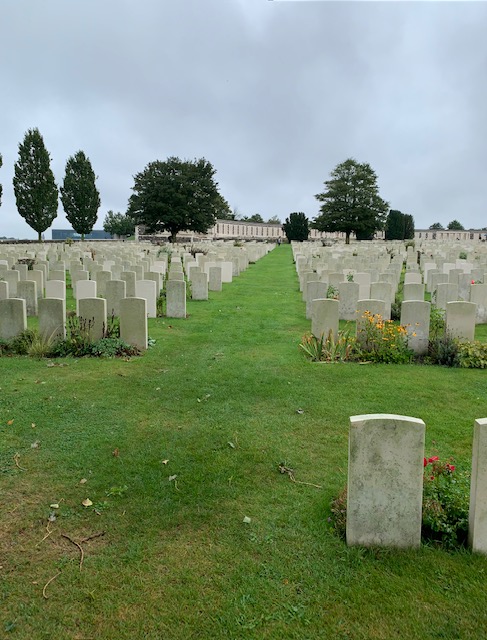 Tyne Cot Cemetery, Passchendale (near Ypres). Contains 12,000 soldiers killed and commemorates 35,000 whose bodies were note found
In Ypres, every day is Veterans/Memorial Day.
—– EXTENDED BODY: —– EXCERPT: —– KEYWORDS: Last Post, Menin Gate, Ypres, John Keegan, The First World War, Tyne Cot cemetery —– ——– AUTHOR: Murray Browne AUTHOR EMAIL: murray.browne905@gmail.com TITLE: Conspiracies Explained STATUS: Publish ALLOW COMMENTS: 1 CONVERT BREAKS: wysiwyg ALLOW PINGS: 0 BASENAME: conspiracies-explained CATEGORY: Book Reviews CATEGORY: Books as Art as Books UNIQUE URL: https://thebookshopper.typepad.com/the_book_shopper_atlantad/2023/09/conspiracies-explained.html DATE: 09/09/2023 05:52:51 AM —– BODY:The Gravity’s Rainbow Support Group (GRSG), is a two-member book club/duo made up a college friend of 50 years and yours truly. Founded during the first months of the Pandemic, the GRSG’s first book was Thomas Pynchon’s 1973 novel Gravity’s Rainbow.
In the three years we have read over 30 books together ranging from classics like Tristram Shandy and The Odyssey to historical tomes such as Barbara Tuchman’s Stillwell and the American Experience in China (1971). We recently finished Colin Dickey’s Under the Eye of Power: How Fear of Secret Societies Shapes American Democracy (2023).
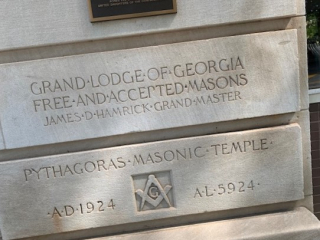 Dickey begins his book about the Freemasons in England and France and their influence in the American colonies. Both Ben Franklin and George Washington were supporters of Masonry. Dickey writes that “Rather than a shadowy organization pulling strings behind the scenes, the Freemasons of the eighteenth century were a prominent, public group who sought to display their power and clout in the open streets.” (Masonic buildings still dot some town and city landscapes like this one in my home town of Decatur, Georgia.)
The book gains momentum as the Civil War approaches.
Dickey points out how the abolitionists of the North used conspiracy theories to taint the Southerners and likewise how the Southerners used conspiracy theories to strike fear and defend being slave owners. Many Northerners complained that free slave labor gave the Southerners an "unfair" economic advantage. This feeling was especially true in agrarian Midwest.
One of the more ridiculous arguments was made by the future 10th President of the United States John Tyler who argued that the abolitionists "were not ‘friends’ to enslaved Americans but instead their 'enemies' since their agitations drove enslavers to crack down on those in bondage." This sounds as idiotic as the current Florida governor Ron DeSantis redefining slavery as on the job training.
Dickey's breakdown of the different eras of the Ku Klux Klan include the marketing strategy of merchandising of robes and hoods in the 1920s. This along with KKK's membership model which was basically a pyramid scheme is nothing short of eye opening.
Towards the end of the book, Dickey gives us examples of how conspiracies and the belief that secret societies and cabals control our society, but he relates them to the current political landscape of Donald Trump, QAnon, January 6th rioters, militias, and replacement theorists. He explains why they endure:
"The morass of global politics is difficult to understand and unpredictable even to experts but conspiracy theories off a straightforward explanation that cuts through all that. They suture all available facts together and do the work of organizing the chaos of history into an explainable, overarching theory."
Coincidently those of at GRSG know only too well that one of major themes in Pynchon’s novels like Gravity’s Rainbow and The Crying of Lot 49 (1966), is that paranoia conveniently provides some kind of framework to explain our world.
The Next Step
The CRSG thought this book was a worthwhile read for all its American history alone, but the author does seem have a point of view (not necessarily an agenda). It’s not a gospel, but it can be the familiar first step, to an education. "DO THE RESEARCH," as they say.
—– EXTENDED BODY: —– EXCERPT: —– KEYWORDS: Thomas Pynchon, Colin Dickey, Under the Eye of Power, Freemasons, conspiracy theories —– ——– AUTHOR: Murray Browne AUTHOR EMAIL: murray.browne905@gmail.com TITLE: Solzhenitsyn Humor STATUS: Publish ALLOW COMMENTS: 1 CONVERT BREAKS: wysiwyg ALLOW PINGS: 0 BASENAME: solzhenitsyn-humor UNIQUE URL: https://thebookshopper.typepad.com/the_book_shopper_atlantad/2023/08/solzhenitsyn-humor.html DATE: 08/07/2023 10:04:53 AM —– BODY: In the previous posting about Milan Kundera*, I made a waggish comment placing Kundera on the humor spectrum next to Alexander Solzhenitsyn (1918-2008) the Russian dissident and Nobel Prize winner. Solzhenitsyn was the author of August 1914 (1971), The Gulag Archipelago (1973-78), Cancer Ward (1968) and many other works.
The reasoning behind that joke was that it reminded me of the work of another writer Ian Frazier who is also mentioned briefly in that same posting. Frazier has been a staff writer for the New Yorker since 1974 and author of gobs of other books. (Many of which I have read and enjoyed, see The Book Shopper, pages 80-82 ).
But one of my favorite pieces of his is "Kimberly Solzhenitsyn's Diary" which comes from one of early collections Dating Your Mom, a copy which I rescued in true book shopper fashion from a discount dolly at the Hoopeston (IL) Public Library.
Enjoy.
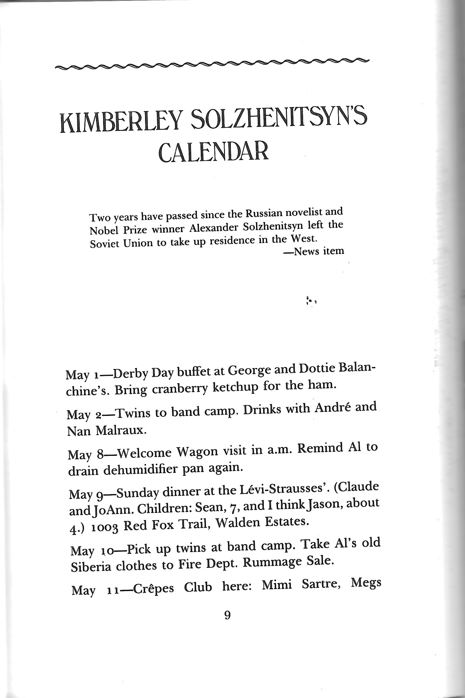
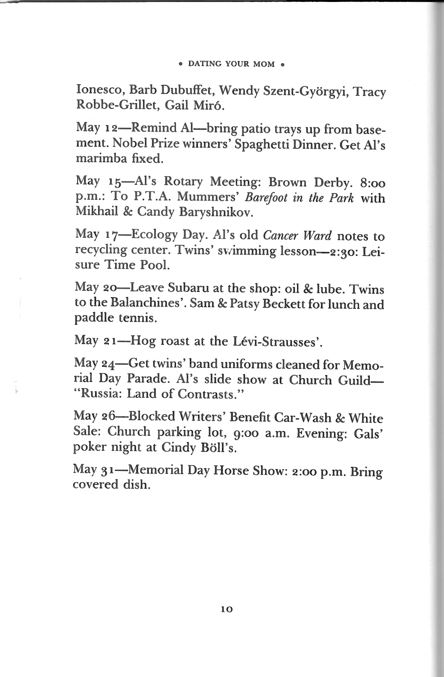
Example of Kundera humor: "Fiction that avoids or denies feces, Milan Kundera has written, is kitsch". – Dwight Garner, New York Times Book Review (7/23/23)
—– EXTENDED BODY: —– EXCERPT: —– KEYWORDS: Milan Kundera, Ian Frazier, Dating Your Mom, Alexander Solzhenitsyn —– ——– AUTHOR: Murray Browne AUTHOR EMAIL: murray.browne905@gmail.com TITLE: My Random Bloodlands Notes STATUS: Publish ALLOW COMMENTS: 0 CONVERT BREAKS: wysiwyg ALLOW PINGS: 0 BASENAME: random-bloodlands-notes UNIQUE URL: https://thebookshopper.typepad.com/the_book_shopper_atlantad/random-bloodlands-notes.html DATE: 08/03/2023 09:04:41 AM —– BODY:

Notes from reading Timothy Snyder’s book Bloodlands: Europe Between Hitler and Stalin. Originally written in 2010, but with a new Afterword that was published after the 2020 election.
Preface – describes the difference between the concentration camps and killing sites. (he makes a big distinction because some times the terms become interchangeable and they shouldn’t be.
Mass killing is usually associated with rapid industrial killing.
xix – the mass killing of the twentieth century is of the greatest moral significance for the 21st century.
p.42 According the propaganda, the Ukrainian peasant was somehow the aggressor and he Stalin was the victim.
p.182. As many Soviet POWs died a single day in Autumn 1941 as did British-American POWs in the course of the 2nd World War
p.390. In the Nazi and Soviet party systems the significance of the word party was inverted: rather than being a group among others competing for power according to accept rules, it became the group that determined the rules.
p. 263. Jews more likely to die in a food shortage less likely in labor shortages. There was always a gruesome calculus balancing the Jewish manpower needed for forced labor and food supplies.
Auschwitz
p. 383. Auschwitz is the coda to the death fugue. I.G. Farben was the corporate sponsor of Auschwitz. Auschwitz had good supplies of water and connectivity to the rail network. (I.G. Farben would produce rubber there.)
Poland
p. 407 More Poles were killed during the Warsaw Uprising alone than the atomic bombing of Japan. The Germans murdered 4 million Poles during World War II.
Final Pages
In the final chapters, Snyder explains the importance of what he has written — he cannot allow people to turn into numbers. (He includes grisly narratives of the few that survived mass shootings and death camps intermixed with his numbers). There numbers were very incomplete until just recently. Until the fall of the Berlin wall, these archives were not available. (Poland, Belarus, Ukraine). Sometimes these numbers were greater than actually were because of those who wanted to claim additional victimhood.
During Stalin’s Great Terror of 1937-38 there were 681,692 killings including 123,421 in Soviet Ukraine.
The Big Lie Quote
Memory Quote

Pictures of Soviet Army Memorials in Germany
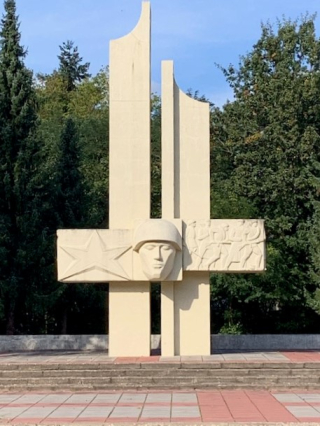
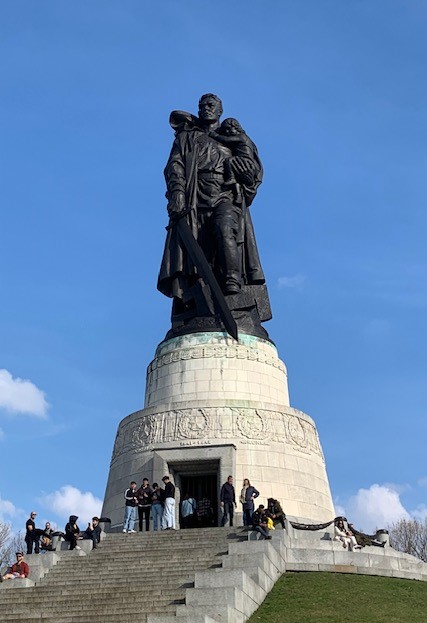
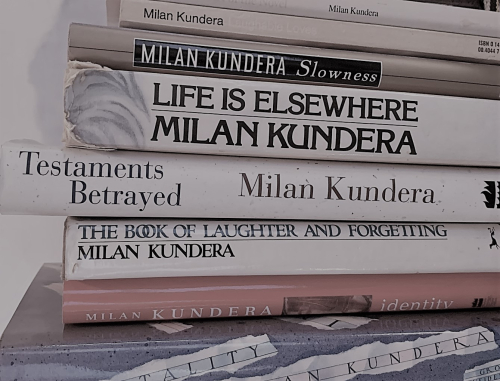 My first thought when reading The New York Times obituary on the Czech ex-pat novelist Milan Kundera (1929-2023) is that if you live and write for decades, not every reader or critic is going to admire your work. (In the obit, he is described as brilliant, witty, with "his poetically prizefighterish* looks, a misogynist, and a traitor to his country, etc.) Of course, if you have read enough of him, I think his rebuttal to these judgments would be an impolite version of "I don't care what you think, idiot."
That's why I never expected a thank you for including him in The Book Shopper's pantheon of notable writers in the chapter, "What Every Good (Used) Bookstore Should Have." In this chapter I included a rundown of contemporary writers I would use to measure the quality of any secondhand book shop I visited. The list in alphabetical order includes: Pat Barker, Julian Barnes, T.C. Boyle, Bruce Duffy, Ian Frazier, Gabriel Garcia Marquez, Jim Harrison, Oscar Hijuelos, Mary Karr, Maxine Hong Kingston, Milan Kundera, Alice McDermott, and E. Annie Proulx.
 In the The Book Shopper (pages 98-101) I gave a rundown of some of his works including a slap-on-the-wrist for recommending an Unbearable Lightness of Being, which after rereading years later I described as "overwrought." The movie version was even worse. As a humorist, I placed Kundera on the funny spectrum next to Alexander Solzhenitsyn.
No wonder he never expressed any appreciation for making my list.
Still, I have a soft spot for him. I read a lot of his books and I still carry two quotes of his forever in my head, which originated with him and that counts. They both come from the book The Art of the Novel and the chapter entitled "Sixty-Three Words":
One the terms is the "Union of Soviet Socialist Republics" (U.S.S.R.), which he describes as "four words, four lies. " **
The second term is that we live on the Planet of Inexperience.
We are born one time only, we can never start a new life equipped with the experience we’ve gained from the previous one. We leave childhood without knowing what youth is, we marry without knowing what it is to be married, and even when we enter old age, we don’t know what it is we’re heading for: the old are innocent children of their own age. In that sense, man’s world is the planet of inexperience.
* The description of "prizefighterish good looks" from a character in Philip Roth's The Human Stain who sees Kundera at a book event.
** Kundera acknowledges that "four words, four lies" originated from the Greek-French philosopher Cornelius Castoriadis.
—– EXTENDED BODY: —– EXCERPT: —– KEYWORDS: Milan Kundera, —– COMMENT: AUTHOR: Cal Gough EMAIL: calgough@bellsouth.net IP: 107.130.113.15 URL: DATE: 07/15/2023 10:05:08 AM Thanks for posting your opinions about Kundera’s work. I have never read him, but saw the movie version of THE UNBEARABLE LIKENESS, which, as we know, doesn’t count (because it’s a movie version). Hope y’all’s trip to Ireland was everything (and more than) you expected. (The test of that: do you hope to return? – as I did after my first trip, and did, and wasn’t sorry!) —– ——– AUTHOR: Murray Browne AUTHOR EMAIL: murray.browne905@gmail.com TITLE: Dublin Book Crawl STATUS: Publish ALLOW COMMENTS: 1 CONVERT BREAKS: wysiwyg ALLOW PINGS: 0 BASENAME: dublin-book-crawl CATEGORY: Bookstores UNIQUE URL: https://thebookshopper.typepad.com/the_book_shopper_atlantad/2023/06/dublin-book-crawl.html DATE: 06/23/2023 08:43:12 AM —– BODY: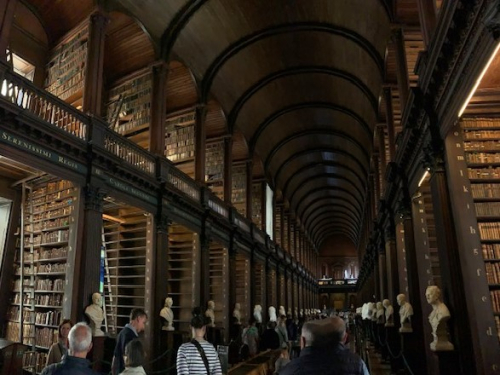
First of all, everything you heard about Ireland is true except the weather. The people are friendly; there is a rich literary tradition; and Irish music is in every pub. Also take note, when they talk about “having a pint,” remember they are not referring to ice cream.
The weather in May-June is supposed to be cloudy and drizzly with temperatures in the mid-60s, but we enjoyed unusually sunny, dry weather with temps in the low 70s, which is unheard of. I hear Spain got all the lousy weather.
Generalities aside, here’s a rundown of my bookish adventures.
Trinity College and the Book of Kells
Fortunately, you can schedule your tour of the Book of Kells ahead of time, so waiting in line was manageable. But before you actually see the 9th century Book of Gospels (the size of a ancient metropolitan phone book in a glass case, no tourist pictures allowed), there is an introductory exhibit and audio tour that gives you a rundown of the different elements of the book and how it was created.
From the exhibit you go directly into the Old Library's Long Reading Room (shown at the top of the posting) which houses ancient volumes of Irish works that are currently being removed individually and cleaned meticulously with a mini-mini vacuum. Judging from the videos that explain the process, these preservationists would never survive as automobile detailers.
 I did purchase a Book of Kells ball cap with monogramed letter M. I used it daily during the entire trip to keep the blazing Irish sun out of my eyes.
National Library of Ireland
 The National Library of Ireland is within walking distance of Trinity College and it currently is hosting the W.B. Yeats exhibit mentioned in my previous post. They have a sitting area, where various narrators recite a Yeats's poem while the poem scrolls on a screen accompanied with images. No Liam Neesem voiceover ☹, but I did learn how to pronounce “Lapis Lazuli”.
In the lobby of the library, they have a Lego version of the building. Admittedly, as my grandchildren can verify, I don’t have the patience to do intricate Lego re-creations, but I do appreciate the effort it took to construct this one.
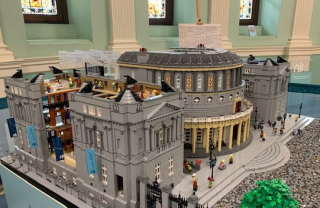
Jonathan Swift and Oscar Wilde
 I did not know that both writers were Dubliners. Swift was born in Dublin and moved to London as child, but later returned to be the dean of St. Patrick’s Cathedral from 1713 to 1745, where he was laid to rest. Oscar Wilde's boyhood home is adjacent to Merrion Square where there is a statue of the poet, playwright and renown wit. Nearby is a pedestal displaying his more well-known quotes.
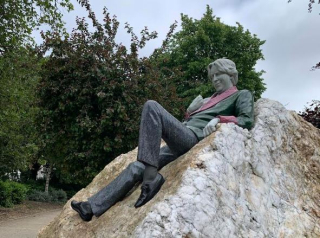
Books Shopping
There are a lot of bookshops in Dublin and all over Ireland, but as we walked the streets (all these places were within walking distance of each other), I was in pursuit of a copy of J.P. Dunleavy’s 1965 novel The Beastly Beatitudes Bathlazar B. Set at Trinity College, I read the novel decades ago and I remember the irreverent voice of the narrator and the peccadillos of his perverted divinity student sidekick Beefy.
We did go to The Gutter Bookshop (so called because of the Wilde quote “We are all in the gutter, but some of us are looking at the stars")”and The Winding Stair Bookshop overlooking the Ha' Penny Bridge. At the latter, I bought another Dunleavy classic The Ginger Man (1955).
Unfortunately, I left my vacation copy of TransAtlantic (2023) by Colum McCann in the hotel room (no substitute for a housekeeping tip, I know), so the rest of trip I obsessed on finding a replacement copy, which I finally did in Kinsale at Prim’s Book Shop. This is an unusual shop because when you go through the back door you are butted up against a drippy, underground seawall.
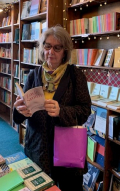
Many thanks to blog readers who sent me their tips and suggestions and a special book shopper thanks to my partner Denise who planned the trip and made sure to include this literary crawl.
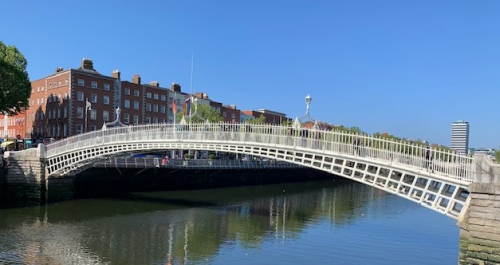
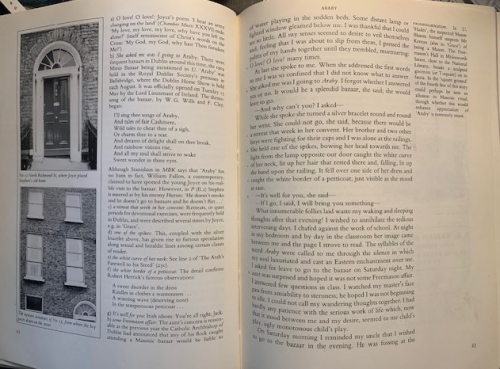
In anticipation of a trip to Ireland next month, I have been trying to familiarize myself with the Emerald Isle, which admittedly is a near foolhardy task given the magnitude of the rich Irish literary traditions.
With the help of our private book group (the GRSG) I was able to read at least one of the books of the Irish canon – James Joyce’s Dubliners, his collection of short stories that was published in 1914. This was my first experience with Joyce and with this help of the James Joyce's Dubliners: An Illustrated Edition with Annotations (1993) edited by John Wyse Jackson & Bernard McGinley (shown above), I was able to get a sense of the complexity of Joyce’s work and definitely an indoctrination into life in Dublin at the turn of the twentieth century.
Joyce wrote the book after he had left Dublin in 1905 and our notes about the book include a review of the 1987 John Huston movie based on the final story of the collection The Dead. It was Huston’s last film and it stars his daughter Anjelica Huston.
Some in our group prefer Joyce’s Portrait of Artist a Young Man or Ulysses (no one favors Finnegan’s Wake), but I will have to take their word for it.
Literary Tours
Other preparation included Zoom tours of the W.B. Yeats (1865-1939) and Seamus Heaney (1939-2013) exhibits that are done through the National Library of Ireland. Admittedly, I knew very little about these two Nobel Prize winning Irish poets, but one important takeaway is how the poetry of each man captured the political upheaval in Ireland at the time. Yeats' poem Easter, 1916, commemorating the uprising led by Irish nationalists for independence of Ireland and Heaney during the more recent violence in Northern Ireland.
I know this preparation sounds paltry, (watching The Banshees of Inisherin and three seasons of Derry Girls doesn’t count) but usually after these kind of trips with my longtime partner Denise, the education continues long past after we return stateside. I am taking Colum McCann’s Transatlantic with me. A tour of the Book of Kells is planned but there are many bookshops in Dublin as well and I intend to perform my book shopping duties.
A Liam Neeson Coincidence
While researching for this piece I stumbled on to a clip of Neeson reading Yeats' Easter, 1916.
The versatile Neeson also appears in Season 3 trailer for Derry Girls
—– EXTENDED BODY: —– EXCERPT: —– KEYWORDS: James Joyce, Dublin, Dubliners, Liam Neeson, W.B. Yates, Seamus Heaney —– ——– AUTHOR: Murray Browne AUTHOR EMAIL: murray.browne905@gmail.com TITLE: Berlin Book Shopping Revisited STATUS: Publish ALLOW COMMENTS: 1 CONVERT BREAKS: wysiwyg ALLOW PINGS: 0 BASENAME: berlin-book-shopping-revisited UNIQUE URL: https://thebookshopper.typepad.com/the_book_shopper_atlantad/2023/04/berlin-book-shopping-revisited.html DATE: 04/26/2023 10:54:14 AM —– BODY:
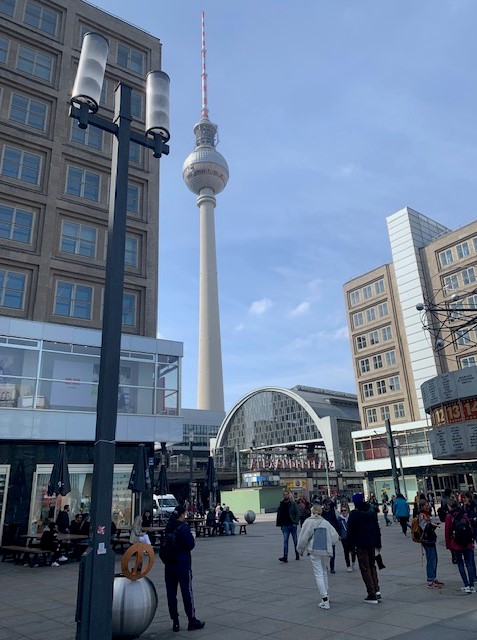
This month I returned to Berlin to see my older daughter Cynthia, which always includes some book shopping. Last time we visited the Another Country Book in the Kreuzberg district (during my 2019 European book shopping tour) and this time it was the Hopscotch in the Tiergarten district of Berlin. Both have plenty of English language offerings.
 It took a little hunting to find Hopscotch which lies inside a large courtyard with no street signage. Inside is a small shop, but it is crammed full of all kinds of books and smaller publications. It would have been an ideal outlet for my earlier works, The Book Shopper and the quirkier Down and Outbound: A Mass Transit Satire, but alas, I had no copies with me.
We spent nearly an hour there. Cynthia replaced her copy of Walter Benjamin's voluminous The Arcades Project and she recommended Saidya Hartman's Wayward Lives, Beautiful Experiments (2019), which I purchased and started reading while I was in Germany.
(For the record, my "in country" books for the trip were: Philip Kerr's' The Pale Criminal (1990) the second novel of his Berlin noir trilogy set on the eve of Kristallnacht 1938 and W.G. Sebald's Vertigo also published in 1990.) 
—– EXTENDED BODY: —– EXCERPT: —– KEYWORDS: Berlin Book Shopping. English Language bookstores, Saidya Hartman, Berlin Noir, Philip Kerr. —– ——– AUTHOR: Murray Browne AUTHOR EMAIL: murray.browne905@gmail.com TITLE: The Force Is Always With You STATUS: Publish ALLOW COMMENTS: 1 CONVERT BREAKS: wysiwyg ALLOW PINGS: 0 BASENAME: the-force-is-always-with-you CATEGORY: Book Reviews UNIQUE URL: https://thebookshopper.typepad.com/the_book_shopper_atlantad/2023/03/the-force-is-always-with-you.html DATE: 03/29/2023 03:22:41 PM —– BODY:
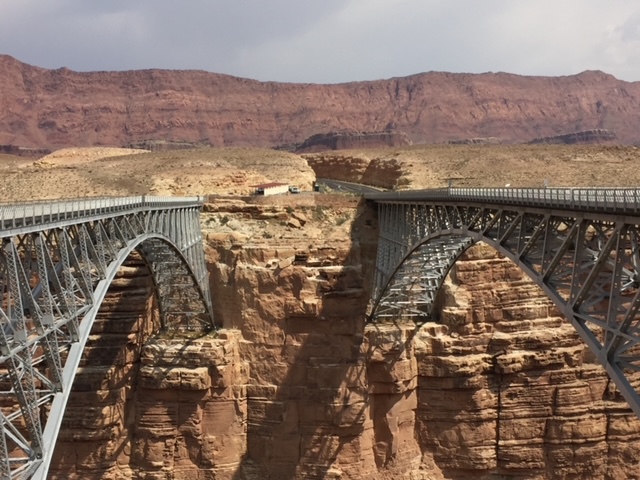 What do binder clips, ballpoint pens, tape measures, can openers and large bridges (like the Navajo Bridge in northern Arizona) have in common? They are all part of the invisible world of forces that impact our daily lives, and they are discussed in Henry Petroski's Force: What It Means to Push and Pull, Slip and Grip, Start and Stop (2022).
Force examines a host of scientific, physical, and mathematical topics without burying us in technical jargon. Petrosky mixes anecdotes about his life extending back to his childhood playing with the Tricky Dog dog magnet (Chapter 2 – Magnetism) or in Chapter 13 when he reminisces about watching a clerk in a bakery slice a loaf of bread and then flawlessly place it inside a plastic bag (pg. 164). He writes:
"The clearance between the contents and container appeared to be as tight as a piston in a cylinder. She left the bag open, lest the fresh bread be crushed in the course of closing it. She did not have to be so careful with a loaf of rye bread because its crust gave it both stiffness and strength to resist. Watching the whole seamless process and imagining the forces involved was to me the greatest thing since sliced bread itself."
 Reading Force will change how one looks at some of the simplest objects like the binder clip and ballpoint pen (Chapter 12 – Stretching and Squeezing), the can opener (Chapter 6, – Lever, Lever, Cantilever), and the tape measure (Chapter 14 – Deployable Structures). You will even feel a little better about yourself when you learn that your fingerprints wear thinner and lose some of their tactile qualities, which explains why I drop more objects (like pens, clips, and tape measures) than I used to.
This doesn't mean that Petrosky doesn't tackle bigger engineering feats like bridges, arches and domes, and obelisks. As he describes the reasons behind famous bridge collapses you may be thankful that bridge repair is part of the Federal infrastructure plan.
—– EXTENDED BODY: —– EXCERPT: —– KEYWORDS: Force, Henry Petroski —– COMMENT: AUTHOR: Cal Gough EMAIL: calgough@bellsouth.net IP: 107.130.113.15 URL: DATE: 03/30/2023 09:55:47 AM The very sort of off-the-beaten-path nonfiction book I enjoy reading! —– ——– AUTHOR: Murray Browne AUTHOR EMAIL: murray.browne905@gmail.com TITLE: Book Art on Broadway STATUS: Publish ALLOW COMMENTS: 1 CONVERT BREAKS: wysiwyg ALLOW PINGS: 0 BASENAME: book-art-on-broadway CATEGORY: Books as Art as Books UNIQUE URL: https://thebookshopper.typepad.com/the_book_shopper_atlantad/2023/03/book-art-on-broadway.html DATE: 03/15/2023 01:44:22 PM —– BODY:
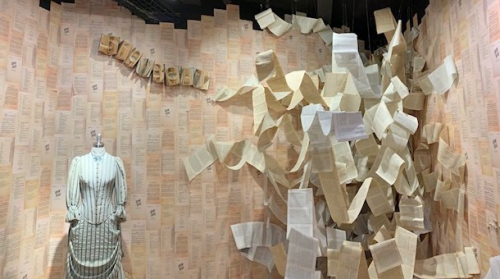
 Earlier this month I visited the newly opened Museum of Broadway in the theatre district of New York City. Included in the many exhibits of history and artifacts on Broadway, was this book art from the musical Show Boat. Premiering in 1927, with music composed by Jerome Kern and lyrics by Oscar Hammerstein II (based on the novel by Edna Ferber), the musical is considered to "have both embodied and propelled the broad advancement being made in musical storytelling in the late 1920s."
To commemorate its importance of Show Boat an entire room is dedicated to the production. American artist Rachel Marks' installation includes a flowing scattering of pages from the novel, music and lyrics wallpaper, and a slice of tree trunk with each paper ring representing a year since its debut.
Volunteering at the Friends of the Decatur Library Book Sale earlier this month provided me the rare opportunity to wear my vintage 2008 Decatur Book Festival shirt. I also did some book browsing while tasked of keeping the tables of books in order (e.g., moving Herman Melville’s Moby Dick from the toxic masculinity section back to Classics).
Amongst the book tables—bibliophiles scouted for that rare find, voracious readers interested in quantity as much as quality filled shopping bags, and parents stocked up for their pre-school children. I especially enjoyed seeing youngsters sprawled on the sales floor absorbed in a colorful book, oblivious to the whirlwind around them.
After the initial onslaught things slowed down and I was able to browse for myself. Even though I haven't done much large venue book shopping in a few years (I still wore my mask), I only brought a couple books home. Most notable was a 50-cent copy of Joseph Conrad’s 1902 novella Heart of Darkness, which we are reading in our book group duo. The extra copy allows me to mark passages for discussion.
The next Friends of the Decatur Library Sale will be the Saturday of Memorial Day weekend, May 27th. In the meantime, you can donate your gently used books at the front desk of the Decatur Library. Take it from me, these books will get a thorough and appreciative examination and the money raised during the sale goes to support the library.
—– EXTENDED BODY: —– EXCERPT: —– KEYWORDS: Friends of the Decatur Public Library, Joseph Conrad, book shopping —– COMMENT: AUTHOR: Cal Gough EMAIL: calgough@bellsouth.net IP: 107.130.113.15 URL: http://atlantareader.wordpress.com DATE: 02/18/2023 11:05:57 AM Nice to see a shout-out to the Decatur library’s book sale(s). This recent one was the best of all I’ve gone to myself (certainly all the ones that used to happen at each Decatur Book Festival, and many before those). I spent a happy hour or so and bought so many more books than usual because of the better-than-usual pricing! I brought home more than 40 books this time! Of course, I’ve no idea where I’ll store the dang things, but that’s a better problem to have than not buying something because it cost more than a dollar or two! So, yay: a fun morning for sure. —– ——– AUTHOR: Murray Browne AUTHOR EMAIL: murray.browne905@gmail.com TITLE: Filling the Sports Void STATUS: Publish ALLOW COMMENTS: 1 CONVERT BREAKS: 0 ALLOW PINGS: 0 BASENAME: filling-the-sports-void CATEGORY: Book Reviews UNIQUE URL: https://thebookshopper.typepad.com/the_book_shopper_atlantad/2023/02/filling-the-sports-void.html DATE: 02/03/2023 09:41:00 AM —– BODY:
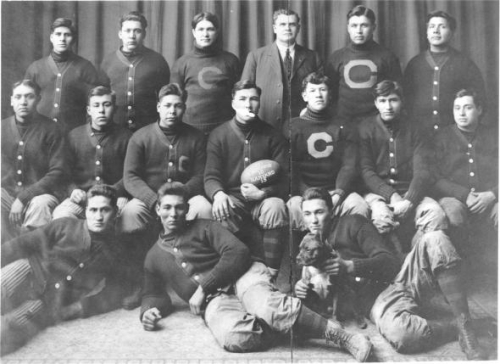
Let’s face it we’re sick of football. College basketball really doesn’t start until March; pro basketball until mid-April. As for my favorite sport baseball, I refuse to fill up on empty Spring Training calories before Opening Day. This leaves a big sports void in the month of February and I usually fill it with a good baseball book, but this year things worked out a little differently. By consensus our two-person book group, selected a sports/history book to kickoff 2023—David Maraniss’s Path Lit by Lightning: The Story of Jim Thorpe (2022).
If you are like me, you were probably familiar with the Thorpe name as some great athlete who played sports early in the 20th Century, residing in the black-and-white team photograph corner of your mind. Reading Maraniss’s detailed biography of Thorpe’s life changed all that. I can now pick Thorpe out of this picture of the Carlisle Indians football team (middle row, third from the right).
Football Days
Thorpe was born in 1887 on a Sac and Fox reservation near Prague Oklahoma, twenty years before Oklahoma became a state. When he was 17, Thorpe was sent to the Carlisle Indian Industrial School in Carlisle, Pennsylvania and ended up playing football for the legendary (albeit somewhat undeserving) Pop Warner in 1907 (top row, wearing a suit). In the early days of football, Carlisle, though it was not a college, played many of the college power houses of the time: Army, Penn, Harvard and Pitt. In 1912 they finished with a 9-1-1 record including an historically significant victory against Army (the pre-game pep talk where Warner reminded his team what the U.S. Army had done to their ancestors). In the game Thorpe was knocked cold by future president Dwight D. Eisenhower. Since there was no such thing as concussion protocol then, Thorpe later returned to the game.
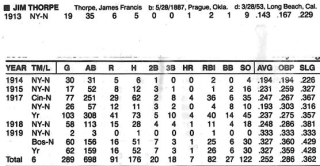 At Carlisle, Thorpe was also introduced to track and field, which matched well with his overall athleticism. By today’s standards he was not that big —about 175-185 pounds, but he was all muscle, speed, toughness, and agility. Thorpe represented America in the pentathlon and decathlon in the 1912 Olympics in Stockholm where he won two gold medals. (Maraniss points out that ironically, even though Thorpe was a Native American he had to sign a form that he was an American before competing.) Sadly, within a year he was stripped of those medals because he had been paid as a professional minor league baseball player. Later Thorpe played 269 games in six seasons at the major league level, mostly for the New York Giants, but this clip from Total Baseball confirms that he had trouble hitting the curveball.
Thorpe was prominent in the early history of professional football along with the likes of Red Grange and George Halas. He was the league’s first president, though mostly because of his athletic fame.
More than Sports
Although the first half of the Path Lit is about the early days of the Olympics, football and some baseball, the book is also about the politics and policies of assimilation, racism towards Native Americans, and several chapters on life in Hollywood in late 40s and early 50s. In 1951, Burt Lancaster starred in a movie made about Thorpe’s life. Michael Curtiz of Casablanca fame directed it.
But Thorpe had many troubles. Maraniss summarizes them all: “his struggles with alcohol, his nomadic lifestyle, his Sisyphean cycle of finding and losing jobs, his bad luck and mistreatment, his [three] dysfunctional marriages, his time away from his sons and daughters when they were young.” However, despite their difficult upbringings Thorpe’s children grew up to become military officers, government workers, college graduates, and Native American activists.
Maraniss is evenhanded in his biography neither completely blaming Thorpe or the white-dominated society for Thorpes woes nor completely absolving either of them. It’s complicated and that is one of the strengths of the book is Maraniss has taken great effort to put the athlete’s life in historical context. (It’s one of the weaknesses too — sometime too much detail.). Perhaps Thorpe summed up his own life best when he said after having his medals unjustly taken away, “Once I had made up my mind to face the world with the truth, I was no longer worried about the matter. I adopted a fatalistic viewpoint and considered the episode just another event on the red man’s life of ups and downs.’
Jim Thorpe died in a trailer park in California from a heart attack in 1953, but the news traveled around the world as fast as communications would allow. After all, just a few years earlier in 1950, sportswriters from the Associated Press voted him by a wide margin the Greatest Athlete in the first half of the 20th century,
Thorpe had quite a sports career and a life, which provided Maraniss with more than enough material to fill my reading off- season.
https://bookshop.org/widgets.js —– EXTENDED BODY: —– EXCERPT: —– KEYWORDS: Jim Thorpe, 1912 Olympics, Stockholm, early days of Football, David Maraniss, Path Lit by Lightning —– ——– AUTHOR: Murray Browne AUTHOR EMAIL: murray.browne905@gmail.com TITLE: The GRSG 2023 – Reading Notes STATUS: Publish ALLOW COMMENTS: 0 CONVERT BREAKS: wysiwyg ALLOW PINGS: 0 BASENAME: grsg-reading-notes-2023 UNIQUE URL: https://thebookshopper.typepad.com/the_book_shopper_atlantad/grsg-reading-notes-2023.html DATE: 01/19/2023 09:16:51 PM —– BODY:
Introduction
The Gravity’s Rainbow Support Group (GRSG) began in June, 2020 as a “reading group” of two people as a support mechanism to plow though Thomas Pynchon’s Gravity’s Rainbow (a book you should never try to read alone) during the pandemic. The GRSG took much of the difficulty out of reading this challenging book and provided a way to keep two now-retired college chums (from Indiana University) Francis Walker of Winston-Salem, North Carolina and Murray Browne of Decatur, Georgia in touch. Basically, we decided to keep this good thing going.
This page is the fourth installment of our reading-discussion notes of books we assigned ourselves in 2023. Like in the Reading Note pages of the past it full of favorite quotes and passages. Don’t expect coherent prose or well thought out arguments, but our musings may provide insights to your own understanding and enjoyment of these books.
Here are the lists of books read and discussed in previous years:
2020 Reading Notes Gravity’s Rainbow by Thomas Pynchon; The Denial of Death by Ernest Becker; Pnin by Vladimir Nabokov
2021 Reading Notes The Republic of Suffering: Death and the American Civil War by Drew Gilpin Faust; Absalom, Absalom by William Faulkner; Stilwell and the American Experience in China, 1911-1945 by Barbara W. Tuchman; Cultural Amnesia by Clive James; The Periodic Table by Primo Levi; The Historian’s Craft by Marc Bloch; An Inventory of Losses by Judith Schalansky; Homeric Moments: Clues to Delight The Odyssey and Illiad by Eva Brann; Homage to Catalonia by George Orwell
2022 Reading Notes The Age of Anger: A History of the Present by Pankaj Mishra; Mountains and a Shore: A Journey Through Southern Turkey by Michael Pereira; The Life and Opinions of Tristam Shandy Gentleman by Laurence Sterne; Grant by Ron Chernow; The Innocents Abroad by Mark Twain; The U.S.A. Trilogy by John Dos Passos (The 42nd Parallel, 1919, and The Big Money); Under the Net by Muriel Spark; Two Wheels Good: The History and the Mystery of the Bicycle by Jody Rosen; Red and Black: A Chronicle of 1830 by Stendhal
And now we begin with our 2023 list:
A Path Lit by Lightning: The Life of Jim Thorpe by Robert Maraniss
Our first book of 2023 was Maraniss’s book of Jim Thorpe, a name we all know that he was a great athlete in the first quarter of the 20th century, but admittedly little else. Perhaps we may have known he was a member of an Indian tribe (the Sac and Fox tribe born on an Indian reservation before Oklahoma became a state). This all ended with the voluminous Maraniss book, published in 2022, about the life of Jim Thorpe (1887 – 1953), put into a context of the times he lived.
This book covered the same time period as John Dos Passos U.S.A. Trilogy which we read last year, but the approach, (Dos Passos’s book was fiction albeit with historical interludes) was different as two books could be, yet they work well together.
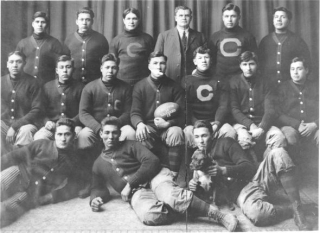
A Path Lit by Lightning book encompasses several themes. One is life for Native Americans in this period where the Indian tribes had reached the end of the sovereignty. The next question became was how best to assimilate hundreds of tribes with different languages and culture to the predominant white culture. Maraniss uses Thorpe’s experiences at Carlisle to explain the various approaches. One was schools like the Carlisle Indian Industrial School. With Jim Thorpe he arrived there in 1904 but it wasn’t until legendary coach Pop Warner (not necessarily an honorable man) recognized Thorpe’s bruising combination, of speed, strength and toughness on the gridiron did Thorpe emerged as force, playing against and defeating the college football powerhouses of that era (Army, Penn, Pitt). Thorpe’s athletic skills also included track and field which eventually led him to win two gold medals at the 1912 Olympics in Stockholm. This makes the book a history of the early days of college and later professional football. Thorpe also played professional baseball with many greats of his era though he was not exceptional (unable to consistently hit the curve ball).
In the second half of the book, is more focused on Jim Thorpe’s sad demise: living hand to mouth, failing health, alcoholism, several failed marriages and tormented by his desire to return to greatness. However, Maraniss also admires Thorpe’s determination.
The Early Days of Football Are Not Unlike Modern Football
Chapter 4, Page 70:
“From 1901 to 1905 there were 71 recorded deaths in football. In 1905 a Union College back, Harold Moore, died of a cerebral hemorrhage after being kicked in the head while trying to tackle a New York University runner. He was one of 18 players who died that year. An unofficial casualty count of the 1905 season read like a military after-action report: deaths, 18; partially paralyzed, 1; eyes gouged out, 1; intestines ruptured, 2; backs broken, 1; skulls fractured, 1; arms broken, 4; legs broken, 7; hands broken, 3; shoulders dislocated, 7; noses broken, 4; ribs broken, 11; collarbones broken, 7; jaws broken, 1; fingers broken, 4; shoulders broken, 2; hips dislocated, 4; thighbones broken, 1; brain concussion, 2. And these numbers were likely an underestimate.”
Chapter 13, Page 235: (regarding the collapse of the stands at one of the games—one person died, many were injured).
The players had been warming up when the disaster unfolded and watched it all, some rushing to assist. What next? The powers that be decided the game must go on, so they played, and more than three thousand fans stayed around to watch “sorrowed by the sad accident that preceded the game.” (Unlike the Hamlin incident involving that the Buffalo Bills player who collapsed during a Monday Night Football game recently).
Chapter 10, Page 197:
He might have been serious, or not, but it was a refrain that would become familiar for the rest of his long career. Every year or two, reliably, Jim would say he was going to chuck it all, and the press would blast out headlines about his imminent retirement, which never followed. (Remind you of any pro football types like Tom Brady?)
Chapter 4, Page 72:
They also had their own dining room stocked regularly with beef, milk, potatoes, and flapjacks—fare the rest of the school was served infrequently…..The fact that football players received elite treatment fostered some resentment among other students, just as it did at many colleges around the nation. (This reminded us of the Gresham middle cafeteria at our dorm at Indiana University, where the football players feasted nightly, while we survived on starches and canned veggies boiled in soap.)
Baseball in the Early 20th Century
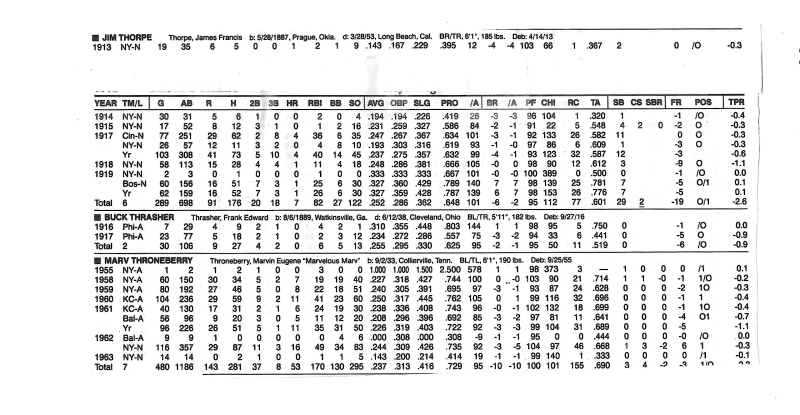
As Maraniss wrote, Thorpe’s professional baseball career was basically upside down. He went directly to the major leagues playing for the John McGraw’s New York Giants. He only played parts of six professional seasons, but for decades later he played in the minor leagues and barnstormed with semi-pro teams for years afterwards.
The highlight of his career was touring with McGraw’s Giants on their World Tour in the offseason of 1913-1914. McGraw signed Thorpe because of his Olympic fame and everyone wanted to see him including the Pope, Sir Thomas Lipton (of Lipton Tea fame). Playing a game in Egypt near the Sphinx, sparked the fertile imagination of E.L. Doctorow, author of Ragtime, (another Dos Passos companion book?) who placed one of his central characters, the financier Pierpont Morgan, at the monument at the same time. “As he passed the great Sphinx and looked back and saw men swarming all over her, like vermin…. The desecrators were wearing baseball suits,” Doctorow wrote.
Then there were the baseball writers of the era. Grantland Rice, Ring Lardner, who wrote the baseball classic, You Know Me, Al And, of course Damon Runyon, who created the stories upon which the musical and movie Guys and Dolls was based (and who was one of the most colorful sportswriters of his era).
Chapter 13, Page 249:
Damon Runyon, then covering baseball for the Hearst newspaper chain, was waiting for them, ensconced in the lobby of the St. James Hotel, ready to follow them for the cushy Paris-London-and-home end of the journey. Runyon wrote in the style of the joyful wise guy in on life’s joke. “Covered all over with foreign labels and all chattering away like Baedekers, the Giant White Sox party of sixty-seven—count them yourself—breezed into this sedate little village tonight with the firm determination of playing a five-night stand.”
Other Famous People
Here are my notes from the first half of the book. I did not clip quotes on his interactions with George Patton, Dwight Eisenhower, or Omar Bradley—or his fateful rides on boats—the USS Finland to Stockholm in 1912 just a few months after the Titanic disaster nor the Lusitania in early 1914 a few months before its disaster (not to mention his tour of all the royals virtually on the eve of WW1)–but they are all well documented in the book and of considerable interest.
The poet Marianne Moore was a teacher at Carlisle and Thorpe was one of her students. She also described the beauty and grace of Thorpe’s athleticism: ‘equilibrium with not stricture…the epitome of concentration, way with an effect of plenty in reserve.”
Since Thorpe lived in California and was involved with the movie about his life he met and hobnobbed with movie stars like Bob Hope and Burt Lancaster who played Thorpe in the 1951 biopic Jim Thorpe–All American directed by Michael Curtiz of Casablanca fame.
Speaking of Hollywood, here’s an except which illustrates the decades long debate of cultural appropriation to gain employment:
Slowly but inevitably the real story started to emerge. Sylvester Long had been born not in the sweetgrass of Montana but in Winston-Salem. He was neither a member of the Blackfeet nation nor a Cherokee from North Carolina or Oklahoma. His parents were African Americans, descendants of slaves, treated as second-class citizens in the Jim Crow South. There might have been an ancestor on his mother’s side of Croatan Indian descent, which was common in an area where oppressed blacks and Indians often mixed, but that was it. … Sylvester Long had reinvented himself as Long Lance and Chief Long Lance and Chief Buffalo Child Long Lance as a means of surviving as a black man in a hostile world. It was how he got into Carlisle, how he made his name and fame, how he was hired in Hollywood and welcomed into the haughty Explorers Club. His skin was too dark for him to try to pass as white, but he could fool people into thinking he looked like an Indian and was talented enough to pull it off for two decades. – Page 388
https://bookshop.org/widgets.js
Discussions
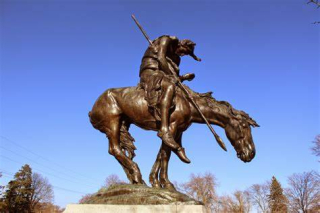 Maraniss’s approach to the racism towards the Indians. We both found that Maraniss seemed very careful and mindful of explaining that certain racist aspects of way society portrayed Native Americans in general and Thorpe. This is not surprising in the times we live in where political correctness is paramount in the media. We don’t condone the way Thorpe was treated and it was wrong, BUT to go on and on (constant references to sculpture The End of the Trail and the Alexander Pope poem and title of the Chapter 11, “Lo the poor Indian”) to make sure “we get it” can be tiresome for the reader. Just sayin’.
Francis adds;
No matter how hard Maraniss pushes the possibility, he marshals little evidence that it was anti-native American sentiment, attacks from an unsympathetic press or unsympathetic coaches, bosses and officials—but rather, Thorpe’s own tragic flaws of neglect, binge drinking and lack of persistence with family and enterprises he undertook that were the cause of his demise. What is far more impressive are the numbers of vocal and influential supporters of Thorpe—who would repeatedly lend him money to be misspent, give him introductions to diverse opportunities to be squandered, and welcome him despite his flaws, compared to the paucity of his generally circumspect detractors. In retrospect, it seems likely that it was the bitter outcome of the second half of his life, perhaps beginning with the irretrievable loss of his first son, that created his need for vindication by beginning the quest for the return of his Olympic medals and trophies, and—in some way these are the same forces which may have pushed his family, and his supporters, half a century later, to bring it to fruition.
 Great Athletes. In 1950, the AP sportswriters voted Jim Thorpe as the greatest athlete in the first half of the 20th century far outdistancing Babe Ruth and Jack Dempsey, but who was the greatest athlete in the second half of the 20th century? Francis thought maybe Muhammed Ali and his Deb his wife — with her affiliation with UNC – suggested Michael Jordan with his basketball greatness and short stint in the minor baseball. I voted for Bo Jackson. (He qualified in the NCAA Collegiate Nations in the 100 meters, won the state decathlon, Heisman trophy winner, and made the All-Star game as both a professional football and baseball player. Was the MVP in 1989 All-Star game. (That year a friend and I drove from Lafayette to Chicago to specifically see Jackson play left field at old Comiskey Park. He did not disappoint. With a runner of first White Sox Pudge Fisk drove a ball into the left field corner. At the 330 mark, Jackson retrieved the ball and threw it on the fly all the way to home plate. The ball’s trajectory was only about 8 feet off the ground. (Think of the arm strength to do that.) The crowd did a collective “Awwwww” as the ball sailed past. Jackson had a career tragically cut short by injury, but he was not bitter about it (See the 30 for 30 ESPN bio on him ) and he went on to be a successful businessman.
The Difference between Obstinacy and Perserverance
Henry Ward Beecher once described the difference between perseverance and obstinacy is, that one often comes from a strong “will” (think Jim Thorpe), and the other from a strong “won’t” (Think his 3rd wife, Patsy).
Obstinacy in a bad cause, is but constancy in a good. — Sir Thomas Browne (see the inverse—Thorpe persevered—but only in being dysfunctional!)
Francis’s’ Summary, which he posted on Amazon:
Four stars
Up and Down
The first half of this biography is written with tempo and pace worthy of the lightening quick moves and remarkable athletic records of its subject. The second half of the book reconstructs, in overdone detail, the subject’s recurrent pattern of hustles, broken dreams, inconstancy and lack of direction. While it makes ample allowance for the tragic flaws of its main character it reads like an exposé of them in organizations and individuals whose paths crossed Thorpe. Noteworthy journalists are spared, except those whose prose is politically incorrect, the citations of which are heralded by spoiler alerts. Despite its excessive prose and editorializing, the book accurately portrays the remarkable strengths and recurring weakness of Jim Thorpe as well as those of the country in which he was born. It is also a remarkable record of global celebrities of the first half of the twentieth century—many who seemed to have made his acquaintance. Recommended for those with an interest in sports and twentieth century Native American history.
Another posting about the book appears on the The Book Shopper blog “Filling the Sports Void”
Heart of Darkness (1902) by Joseph Conrad
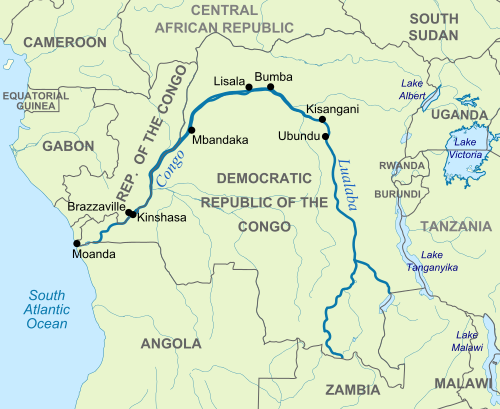
Despite its reputation as a work dripping with racism, this novella is back in vogue especially with the recent publication of Siddarth Kara’s Cobalt Red: How the Blood of the Congo Powers Our Lives.
Similarly, in The Mushroom at the End of the World: On the Possibility of Life in Capitalist Ruins, (2015) Anna Lowenhaupt Tsing when she writes about what she terms as ‘salvage accumulation’ a process that through which leads firms to amass capital without controlling the condition on which commodities are produced, she cites Conrad’s novel as a perfect example.
But the most well-known appropriation of Heart of Darkness is Francis Ford Coppola’s 1979 film Apocalypse Now, which Jocy Carol Oates in the Introduction of the Signet Classics edition, describes as “imaginative in concept and vivid in execution, AN is undermined by the ludicrous overacting of Marlon Brando in the role of Kurtz, which neither he nor his director seems to have understood’.”
However other writers such as Viet Thanh Nguyen are far less kind. In both his novel The Sympathizer (2015) and his Nothing Ever Dies: Vietnam and the Memory of War (2016) he eviscerates Coppola’s vision. In both works Nguyen deAmericanizes the portrayal of the war in Southeast Asia according to the New York Times review which also compares the indifference of the narrator in The Sympathizer to—get this, Joseph Conrad.
Conrad – Bio
Conrad (1857-1924) was born in what is now Ukraine and English was his third language after Polish and French. He was orphaned before age 11 and was put in the car of his uncle and finally was enrolled in the French merchant marine. He spent years at sea, which contributed to his writing because sailors have a unique perspective. Francis commented:
For centuries, weren’t sailors the unacknowledged masters of cultural literacy—experiencing human societies in their myriad forms, even before the creation of written language? And too, weren’t they unacknowledged experts in accepting the unknown ranging from the beauties and terrors of the sea to the good and evil of human nature—as in the allure and dangers of sirens and the lotus plant?
A Word About Editions
Francis as usual prefers the e-book format. I relied on two versions. The Oxford World Classics edition is edited by Cedric Watts. It has extensive annotation, which is most helpful as he explains the history of the European exploitation in the region and in the Introduction, he gives the backstory of how it was considered a racist in an essay by Nigerian novelist Chinua Achebe in 1977. There is also the Signet classics edition (mentioned earlier) with the introduction by Joyce Carol Oates where she gives the same perspective but reminds us “that more literary esoteric novels Joseph Conrad, Virginia Woolf and James Joyce—bear the imprint of their time, place and social perspective; unfair; no art can be universal, for no artist is universal.”
Notable Passages
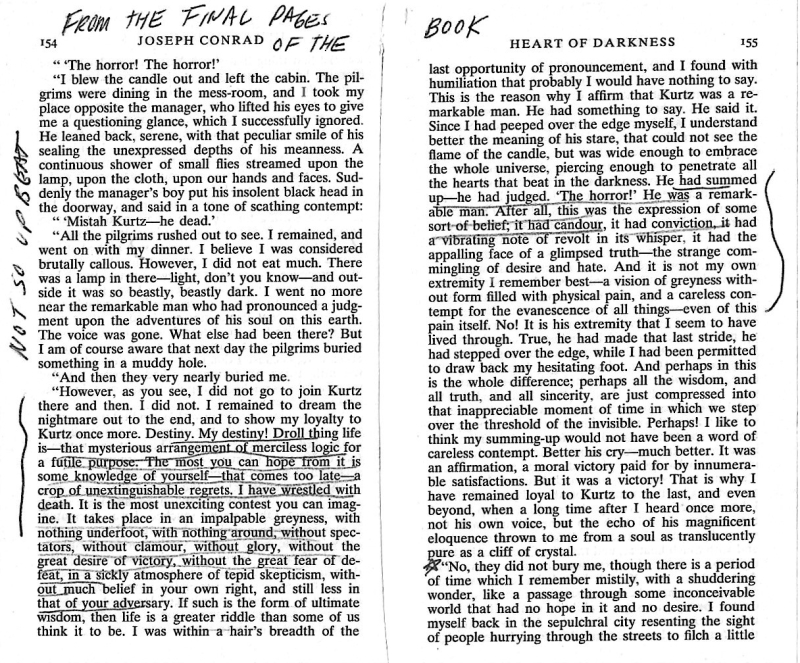
Page 11:
Because triumphant health in the general rout of constitutions is a kind of power in itself.
Page 15:
No, I don’t like work. I had rather laze about and think of all the fine things that can be done. I don’t like work— no man does—but I like what is in the work, the chance to find yourself. Your own reality—for yourself, not for others—what no other man can ever know. They can only see the mere show, and never can tell what it really means.
Page 32:
But the wilderness had found him out early, and had taken on him a terrible vengeance for the fantastic invasion. I think it had whispered to him things about himself which he did not know, things of which he had no conception till he took counsel with this great solitude—and the whisper had proved irresistibly fascinating. It echoed loudly within him because he was hollow at the core.
Page 42: But with every word spoken the room was growing darker, and only her forehead, smooth and white, remained illumined by the unextinguishable light of belief and love.
His face was like the autumn sky, overcast one moment and bright the next.
Final Thoughts
My reaction is that it is an important book – classic — and merits consideration, but I was thankful that it was only 100 pages. Sometimes I would get lost. Who was talking? Marlow the narrator? Or Kurtz? or the Russian who was kind of a Dennis Hopper figure explaining Kurtz to Marlow when he arrived at the outpost. (Hopper plays a photographer in the Apocalypse Now movie who explains Col. Kurtz to the Martin Sheen character who has been sent to assassinate Kurtz.)
Francis has a different take which he share on his Amazon review Behind the Mask:
The narrator, a veritable tsetse fly on a sea-wall, relates the tragedy of the interloper Kurtz in Africa. It is a recursive tale of how Europe infested the Congo and was avenged by its infection of the colonialists with tropical disease and the ultimately painful revelation of our roots in savagery. It too, is the tale of how human darkness can erode the soul, hidden from the light of faith and love in the magnificent folds of eloquent denial. But, is this an unavoidable consequence of human frailty? Fortunately for readers fed up with the tedious moralizing of modern writers, Joseph Conrad lets the story speak for itself and allows us to decide. Highly recommended.
We conclude with the Sheen-Brando clip that is one of the more well-known passages from the movie.
Algorithms to Live By: The Computer Science of Human Decisions (2016) by Brian Christian and Tom Griffiths
Force: What It Means to Push and Pull Slip and Grip Start and Stop (2022) by Henry Petroski
On Bullshit (2005) by Henry G. Frankfurt
In an unprecedented turn of events, Francis and I selected three books to discuss at the same time. Because the GRSG is small book club duo we are able to pivot and reach a consensus on what to read much faster than a conventional book clubs. In this case, Francis had recently read Force on his own and sent it to me as a gift before Christmas. I was anxious to read to it, but he had already read it. (We wouldn’t be able to discover its richness together.) So, to even it out I had been wanting to revisit Algorithms a favorite book of mine (winner of the blog’s coveted Best Books Read in 2018) , so we decided that I would read Force while he read Algorithms.
On Bullshit was added because on my recent trip to New York to visit family I intended to read Force, but had left it home (goddamn it!), but I had a few magazine backups and On Bullshit which is a sliver of a book so I read that instead. However, Frankfurt’s book may be small, but it is mighty and has to be read slowly and lends itself to discussion. (I picked up my copy at the library book sale for $1) I told Francis about it and the replied in an email, “I am a big fan of Harry Frankfurt and have read On B.S. as well as On Truth and On Inequality which follow the format of On BS–short, pithy and well-reasoned. On BS may be the best of the three, but the other two are not far behind. And, they make good travel companions since rereading them is a pleasure.”
So this explains the three books in one session.
https://bookshop.org/widgets.js
Algorithms
Fortunately, several years ago, I posted my notes on the book here, so jogging my memory was relatively easy.
What makes this book so appealing is that it uses computer science as a launching point to discuss how the logic of computing can assist our human thought processes as we try to manage daily problems. I was still working at the time so many of these chapters fit right into my Manager of Metadata Services wheelhouse.
The chapters are: Optimal Stopping – When to Stop Looking; Explore/Exploit – The Latest vs the Greatest; Sorting – Making Order; Caching – Forget about It; Scheduling – First Things First; Bayes’s Rule – Predicting the Future; Overfitting – When to Think Less; Relaxation – Let it Slide; Randomness – When to Leave it to Chance; Networking – How We Connect; and Game Theory – The Minds of Others.
 “Exploration in itself has value since trying new things increases our chances in finding the best…In the long run, optimism is the best prevention for regret…If you’re a baby, putting every object in the house in your mouth is like studiously pulling all the handles at the casino.” (Chapter 2: Explore/Exploit). I know now that when my baby grandchildren put things in their mouths they are just doing some basic classification of the world placing all objects in two simple categories – Things I can fit in my mouth and the things I cannot fit in my mouth.
Here are a few examples of relevant quotes gleaned from my notes that I kept on the backs of postcards stuffed in the book.
“Much as we bemoan the daily rat race, the fact that it’s a race than a fight is a key part of what sets us apart from the monkeys, the chickens–and for that matter the rats.” (Ch. 3: Sorting) Getting to and from work in Atlanta is pure rat race.
“It is really true that the company will build whatever the CEO decides to measure.” (Ch. 7 Overfitting) I thought of this when I am asked to produce Key Performance Indicators (metrics) at work.
“We use the idiom of ‘dropped balls’ almost exclusively in a derogatory sense implying that the person in question was lazy, complacent, or forgetful. But the tactical dropping of balls is a critical part of getting things done under overload. “(Ch. 10 Networking) Hmmm. An excuse worth considering next time I miss a deadline — such as catching up on my posting backlog.
Further Random Discussion on Ideas
(The river meanders because it can’t think -Richard Kenney).
One aspect of our Zoom chat was the discussion of the role of spontaneous thinking and thoughts. Francis began with some quotes from other authors.
“The brain secretes thought as the stomach secretes gastric juice, the liver bile, and the kidneys urine.” –Karl Vogt (circa 1850)
Thoughts arise in the mind spontaneously, without will or deliberation on our part and without producing any effect whatever on our behavior. – Jose Ortega Gassett (1883-1955) This Spanish philosopher also was a precursor to the Peter Principle when he wrote “Every public servant should be demoted to the immediately lower rank,” he wrote, “because they were advanced until they became incompetent.”
Here is what Algorithms to Live By says: Page 202 (William) James thus viewed randomness as the heart of creativity. And …..“A blind-variation-and-selective-retention process is fundamental to all inductive achievements, to all genuine increases in knowledge, to all increases in fit of system to environment.” …..And like James he was inspired by evolution, thinking about creative innovation as the outcome of new ideas being generated randomly and astute human minds retaining the best of those ideas.’
In this section Algorithms mentions Brian Eno, (who I personally admire and I “listen” to his ambient music to quiet my mind when I am agitated and can’t sleep. My sleep doctor referred to it as “an active mind.”)
Definitions in Algorithms in Algorithms to Live By
The upper confidence bound: If you are going to try new things, try to select those with the greatest upside potential over those with average but predictable potential. (Fits into the your description of infants trying out everything by putting it in their mouth–but perhaps a slightly more informed version of it.)
Pruning: The process by which the elderly come to predict outcomes more accurately, allowing them to prune away interactions that are less likely to be positive.
Memory hierarchies. The process by which we retain progressively smaller percentages of our knowledge in active short-term memory and recall caches, but yet we still retain them.
Ping Attack—Disabling an opponent by throwing at them multiple trivial attacks—that make for a major distraction.
Pre-crastination—The tendency for some people to handle tasks too soon.
Pre-emption cost. The cognitive tax imposed by too many interruptions.
Thrashing. The state of immobility that results when accessing and retrieving subroutines or plans cannot keep up with simultaneous demands from multiple sources.
Interrupt coalescing: The benefit of organizing interruptions so they come at predictable times instead of randomly—i.e., weekly meetings.
Buffer Bloat—When the need for too much information in short term memory exceeds capacity—see thrashing.
Constraint relaxation: Dealing with complex tasks by relaxing certain demands made by participants.
Exponential back-off: Dealing with backsliders, by forgiveness—but with an increasing penalty for each infraction.
https://bookshop.org/widgets.js
Force
Algorithms and Force are similar in that they both examine more scientific, physical and mathematical topics in how they impact our daily lives without trying to technically bury us. Petrosky mixes anecdotes about his life extending back to his childhood playing with the Tricky Dog dog magnet (Chapter 2 – Magnetism) or in Chapter 13 when he reminisces about watching a clerk in a bakery slice a loaf of bread and then flawlessly place it inside a plastic bag (pg. 164). Petrosky writes:
The clearance between the contents and container appeared to be as tight as a piston in a cylinder. She left the bag open, lest the fresh bread be crushed in the course of closing it. She did not have to be so careful with a loaf of rye bread because its crust gave it both stiffness and strength to resist. Watching the whole seamless process and imagining the forces involved was to me the greatest thing since sliced bread itself.
Reading Force changes how one looks at some of the simplest objects like the binder clip and ballpoint pen (Chapter 12 – Stretching and Squeezing), the can opener (Chapter 6, Lever, Lever – Cantilever), and the tape measure (Chapter 14 Deployable Structures). You will even feel a little better about yourself when you learn that your fingerprints though they don’t disappear, they do lose some of the tactile qualities which explains why I drop more objects (like pens, clips, and tape measures) than I used to.
This doesn’t mean that Petrosky doesn’t tackle bigger engineering feats like bridges, arches and domes, and obelisks. When he describes the reasons behind famous bridge collapses you may be thankful that bridge repair is part of the Federal infrastructure plan.
Other Discussion Notes
Experienced engineers…never accept outright the results of a computer simulation brought to them by a young associated, they make a hand calculation based on a simple model. (The same point can be found in Algorithms to Live By describing how minor changes in input data or details of modelling systems can lead to profound changes in the outcome of computer models). (p.128)
Gravity…He discusses Roger Babson, who was quite a character and innovative thinker–he also ran for president once. He is credited with the Babson Manifesto: Gravity: Our Public Enemy #1. He saw, correctly, that gravity was critical in all sorts of accidents–airplane crashes, broken bones, and even drownings. The force of gravity is ever present but so taken for granted we rarely consider it. (p.23)
Discoveries…. The author discusses the distinction of technology from science–how many practical discoveries came from trial and error not thinking–the technology involved in brewing alcoholic beverages, baking bread, making bronze and then steel weapons and many other ancient technologies were discovered this way. Further, he points out that even with applied science that often the finishing touches require the art of engineers to make them operational. For more on this topic, interested readers are referred to Terence Kealey’s classic: The Economic Basis of Scientific Research. (p.118)
Small but Mighty
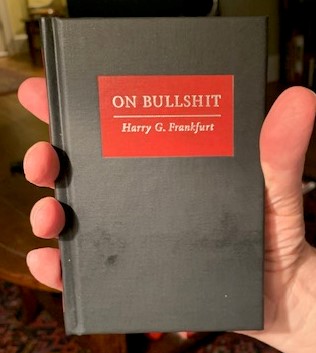 Our discussion also included Frankfurt’s book On Bullshit, which should not be underestimated because of its size. Originally, I purchased the book for $1 at the Friends of the Library book sale thinking it would be easy bedtime reading like Jimmy Breslin’s Can Anybody Here Play This Game about the 1962 Mets, but I was mistaken. Frankfurt book is a lengthy essay about a singular topic: What is bullshit and how does it compare to lying. It requires and merits concentration.
One difference is that in order to lie, one must know the truth, but truth is irrelevant to bullshitters. Another difference is that a lie must be focused (p.51-53).
“It is designed to insert a particular falsehood at a specific point in a set or system of beliefs in order to avoid the consequences of having the point occupied by the truth. This requires a degree of craftsmanship, in which the teller of the lie submits to objective constraints imposed by what he takes to be the truth….On the other hand, a person who undertakes to bullshit has much more freedom. His focus is panoramic rather than particular. He does not limit himself to inserting a certain falsehood at a specific point, and thus is not constrained by the truths surrounding that point or intersecting it….but this mode of creativity upon which it relies is less analytical and less deliberative that than which is mobilized in lying. It is more expansive and independent, with more spacious opportunities for improvisation, color and imaginative play. This is less a matter of craft than of art. Hence the familiar notion of the “bullshit artist.”
Francis also explained how the book ends, when Frankfurt wonders how we can be sincere if you don’t know your motive. (Lying to yourself; bullshitting yourself)
Dubliners (1914) by James Joyce
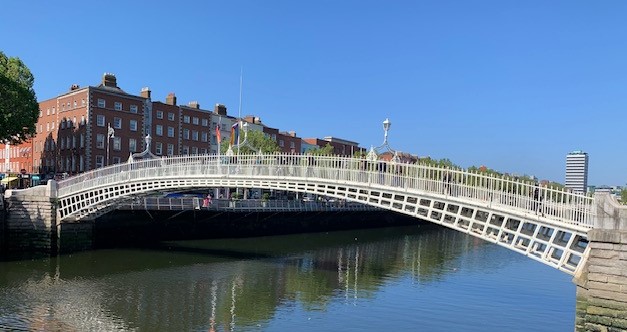
Considering that Murray and his partner Denise were planning a trip to Ireland in the late spring and that Francis was of Irish descent (Francis O’Neill Walker) with a pining for some ol’ time classical-need-some-good-annotation fiction, we select Joyce’s first major work. These 14 stories culminating in single long story (maybe 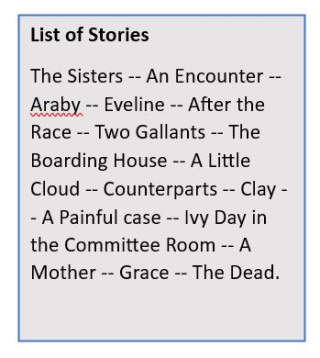 novella – The Dead) are Joyce’s portrayal of the struggles lower middle-class life in turn-of-the-20 century Dublin. The crushing presence of the Catholic church and the fact that Ireland was still under British rule kept the Irish people under their thumb though the Irish independence movement was in full swing. (Bloody Sunday, 1916, Irish Independence 1922)
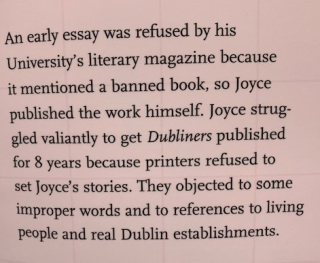
Appreciation was mixed, but we did agree that Denise and Francis with their Catholic upbringing had an “advantage” in understanding Joyce’s work. Still with good annotation such as James Joyce’s Dubliners: An Illustrated Edition with Annotations (1993) edited by John Wyse Jackson & Bernard McGinley. The Penguin Classic edition with the introduction by Terrance Mann also has good annotation and a through introduction explaining the book’s history (Joyce wrote the stories after he had left Dublin in 1905) provides the big picture of Joyce’s work. Denise found a good audio version of the book narrated by XXXXXXX.
Was it Joyce’s master work? Denise found Portrait of an Artist as Young Man (1916), which she read in high school had a profound effect on the view of the Catholic Church. The entire world agree that Joyce’s final work Finnegan’s Wake is for brave academics only, which leaves maybe Ulysses (1922). GRSG may do Portrait at some time, but not for SOME time.
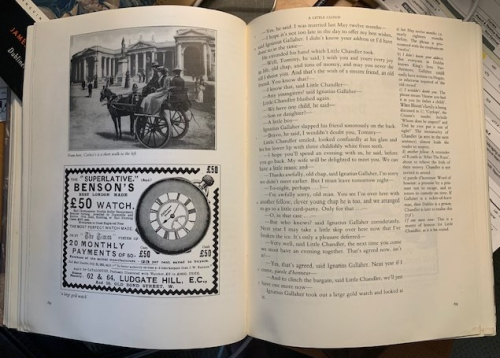
Francis’ Observations
1) Denise may be right about the Irish, by being under the thumb of London and the Vatican (not sure which is worse), are understandably depressed. Perhaps unlike the USA, the blessing and curse of the Irish is that they never could have successfully mounted, much less carried out a revolutionary war.
2) Here is a quote from Goethe, that I think is relevant to many of the stories: “As in Rome there is, apart from the Romans, a population of statues, so apart from this real world there is a world of illusion, almost more potent, in which most men live. “ In the stories, many of the characters have powerful illusions about others around them— potential romantic partners (Araby, A Painful Case, Eveline) the life of literary or musical celebrity (A Little Cloud, A Mother), an independent Ireland (Ivy Day in the Committee Room) , the redemptive ability of a Jesuit revival (Grace), the allure of motion, notoriety and money (After the Race). Faulkner writes about this too: “…so vast, so limitless in capacity is man’s imagination to disperse and burn away the rubble-dross of fact and probability, leaving only truth and dream.” One could certainly apply this to Joyce’s characters.
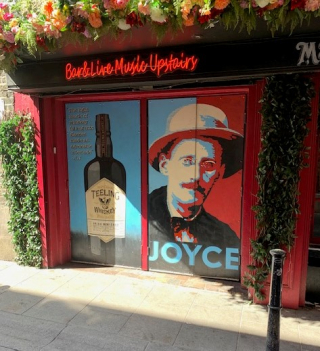 3) Few of the characters handle disillusionment well. Here is how Justice Charles Darling puts it: “We can be of little service to our fellows until we become disillusioned without being embittered.” One of the reviews of Dubliners points out that the stories progress in the age of the main characters, which is most apparent in the final story, “The Dead” perhaps the one that describes a more mature approach to disillusionment.
(from Murray) Similarly a quote from Joy Williams in her book Harrow (2021), “We all lead three lives. The true one, the false one and the one we are not aware of.”
4) Although I am familiar with the term “omniscient narrator” to describe some works of fiction, James Joyce intentionally did the opposite in that he said he wrote with “scrupulous meanness” i.e. avoiding as much as possible any interpretation of events. He also makes the point that writing about the people of Dublin could say a lot about all people. Here is Faulkner making a similar point: “To understand the world you must first understand a place like Mississippi”
5) A few quotes from the stories:
- “She dealt with moral problems the way a cleaver deals with meat: and in this case she had made up her mind.” “The Boarding House”
- “But there was no harshness in the eyes which, looking at the world from under their tawny eyebrows, gave the impression of a man ever alert to greet a redeeming instinct in others but often disappointed. He lived at a little distance from his body, regarding his own acts with doubtful side-glances. He had an odd autobiographical habit which led him to compose in his mind from time to time a short sentence about himself containing a subject in the third person and a predicate in the past tense. “A Painful Case” (It also has one of the “Eye” descriptions)
- An irregular musketry of applause escorted her also as far as the piano and then, as Mary Jane seated herself on the stool, (The Dead)
The Irish Eyes
While reading Dubliners you cannot help but notice Joyce’s descriptions of eyes. It is everywhere. And this has not gone unnoticed. See Stephen Sherman’s essay Dubliners: The Eyes Have It.
Film Adaptation of The Dead
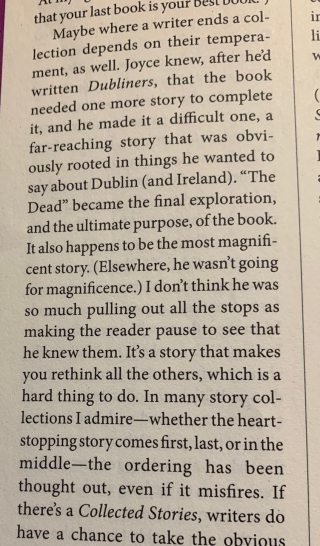
Our final discussion of The Dead was around the John Huston’s 1987 film adaptation of Joyce’s work. The short film was the legendary director’s last production and it starred his daughter Anjelica Huston. The movie is very faithful to the book and in away it consists of just two locations — the house where the aunts held their party which featured piano works. When one of the guests, a tenor sings the song “The Lass of Augheim”, Gretta (played by Huston) stops dead in her tracks and listens, a look of faraway sadness on her face. Later that night, in the hotel room where Gretta tells her husband Gabriel the story of young man she once knew and loved who died at a very young age.
Gabriel (played Donal McCann) is the narrator of the movie and we see the party mostly through his eyes. He is calm and literary (a book critic) and has spent considerable time on the continent and according to Jackson and McGinley is one of the few intellectuals in the book (Duffy in “A Painful Case” is another.). As Francis remarked, “he is disillusioned but not embittered.” The movie ends with Gabriel staring out the window on the winter’s night:
“His soul swooned slowly as he heard the snow falling faintly through the universe and faintly falling, like the descent of their last end, upon all the living and the dead.”
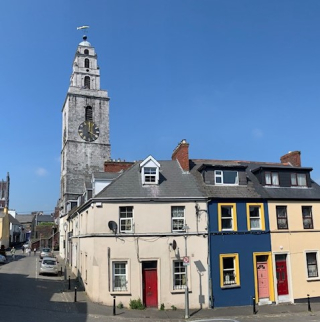
TransAtlantic (2013) by Colum McCann
“No history is mute. No matter how much they own it, break it and lie about it, human history refuses to shut its mouth. Despite deafness and ignorance, the time that was continues to tick inside the time that is.”– Eduardo Galeano (opening quote in TransAtlantic)
This book was kind of journey in itself. Murray took this book with him on his trip to Ireland. Before leaving the States, he read the first part of this historical novel about the two aviators Alcock and Brown who crossed the Atlantic in 1919 in a modified Vickers Vimy bomber. He determined this book would work as a surefire travel book, so he temporarily set it aside. While in-flight he read the second part of the narrative was about Frederick Douglass’ trip to Ireland during the 1840s *around the beginning of the potato famine. On a sleepless night in Dublin he pulled out the book and read about special ambassador George Mitchell historic trip to Ireland at the behest of President Bill Clinton to help negotiate the Good Friday Agreement in 1998. Then Murray left the book tangled in the sheets of the hotel room (does this qualify for a housekeeping tip?). Reading was suspended. Finally he found a used copy of the book in an unusual book store in Kinsale.
Francis read his copy of the book on his Kindle.
We both agreed it was a good, solid book but neither of us were in awe of McCann’s efforts, whose reputation as an award winning writer somewhat proceeds him.
The book covers the intertwined stories of people who crossed back and forth across the Atlantic to Ireland. Seemingly minor characters reappears as a major ones as the narrative spans 150 years. For example, a young female journalist Emily Ehrlich covers the Alcock and Brown takeoff from Newfoundland and asks the aviators to deliver a letter in her behalf. he book ends with her granddaughter now in 70s living out her last years wondering about the contents of the same letter, which remains unopened and addressed to a family that entertained Frederick Douglas. The cover verbiage explains the book most succinctly:
Stitching these stories intricately together, Colum McCann sets out to explore the fine line between what is real and what is imagined, and the tangle skein of connections that make up our lives.
Francis appreciated Emily’s interview techniques, likening them to his own interviews with patients who had been asked dozens of times to explain their condition:
She knew he had probably talked the Vickers Vimy out of himself, hundreds of interviews over the years. And yet the whole of anything was never fully told. She would have to turn away from the obvious, bank her way back into it. – page 221
Frederick Douglas
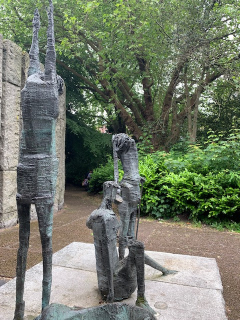
In an interview (from the Kindle edition), Colum McCann said “And I was especially taken by this notion of a young black slave (Douglas) landing in Ireland and having enough experience to say “Lo! The chattel becomes a man!”; Then he looks around and knows that there are many forms of chattledom”
There was only so much he could take upon himself. He had to look to what mattered. What was beyond toleration was the ownership of man and woman. The Irish were poor, but not enslaved. He had come here to hack away at the ropes that held American slavery in place. Sometimes it withered him just to keep his mind steady. He was aware that the essence of proper intelligence was the embrace of contradiction. – p 85
George Mitchell
We both highlighted this passage from the end of the chapter about George Mitchell’s summarization of the events. The words certainly ring true of the day.
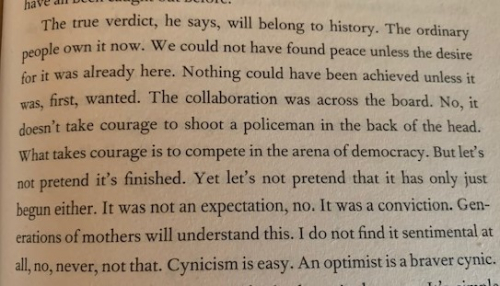
On justice and being Irish
“The Irish abolitionists were known for their fervor. They came from the land of O’Connell, after all. The Great Liberator. There was, he’d been told, a hunger for justice. “- page 42
“He was told once that any good Irishman would drive fifty miles out of his way just to hear an insult—and a hundred miles if the insult was good enough. – Page 118 Parabellum
Final Thoughts
This is a good book if you are planning a trip to Ireland or read while in Ireland, but you still need to read a concise history of Ireland to full appreciate the richness of the country.
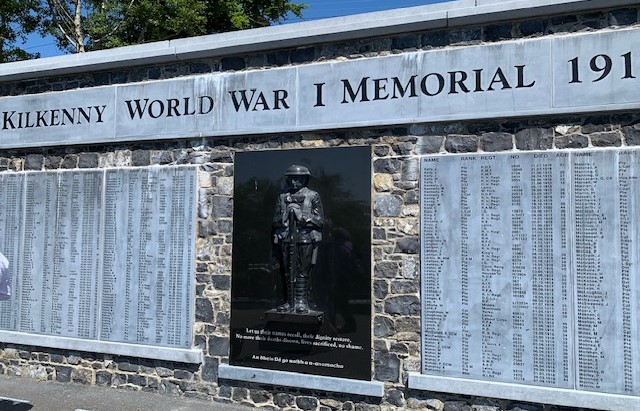
Regeneration (1991) by Pat Barker
Regeneration is the first book of Pat Barker’s World War I trilogy, which also includes The Eye in the Door (1993) and The Ghost Road (1995). Rather than focus on primarily on battlefield events, Barker views the war from behind that lines at Craiglockhart War Hospital in Scotland. At Craiglockhart, the brilliant psychiatrist Dr. William Rivers treats a host of patients with tics and twitches including Siegfried Sasson, the noted poet and war hero who publicly refused to stay at the front. Faced with disgracing the British war machine transfers Sassoon to Rivers’s car where the doctor must determine whether the war is insane or Sassoon is insane for saying it.
Although fiction, the book is seeped with many historical figures: Rivers, Sassoon, the poet Wilfred Owen who is also at Craiglockhart, the British novelist and poet Robert Graves and Charles Dodgson (Lewis Carroll). Another renowned physician in the field is Henry Head. Sassoon was a poet as well and in 1920 he was responsible for publishing Owen’s works posthumously. Owen was considered a major English poet in the first quarter of the 20th Century. (He has his own entry in The Norton Anthology of English Literature.)
But what gives the book its depth is the female characters who unlike their male counterparts who practically domesticated in the trenches, these women work in the munition factories and have the freedom of having their own money and having escape in some cases their abusive husbands who are on the frontlines.
A couple quotes from the book illustrate this:
Though when you looked at what they did. Worrying about socks, boots, blisters, food, hot drinks. And that perpetually harried expression of theirs. Rivers had only ever seen that look in one other place: in the public wards of hospitals, on the faces of women who were bringing up large families on very low incomes, women who, in their early thirties, could easily be taken for fifty or more. It was the look of people who are totally responsible for lives they have no power to save…The war that had promised so much in the way of ‘manly’ activity had actually delivered ‘feminine’ passivity, and on a scale that their mothers and sisters had scarcely known. No wonder they broke down.
The second come from a scene at the factory when the women are talking about home life:
The others were talking about Lizzie’s husband, who’d thrown her into a state of shock by announcing, in this last letter that he was hoping to come home on leave soon.”
” I haven’t had a wink of sleep since, ” said Lizzie…
“Don’t you want to see him?” asked Sarah.
“I do not. I’ve seen enough of him to last me a lifetime…Do you know what happened on August 4th 1914?…I’ll tell you what happened Peace broke out. The only bit of peace I’ve ever had. No, I don’t want him back. I don’t want him on leave. I don’t want him back when it’s over. As far as I’m concerned the Kaiser can keep him.”
Discussion
Because Francis is a neurologist, he was compelled to find more information on PTSD and its treatment, which was part of our talk. Here’s and abstract of one academic article about the subject.
Martin A, Naunton M, Kosari S, Peterson G, Thomas J, Christenson JK. Treatment Guidelines for PTSD: A Systematic Review. J Clin Med. 2021 Sep 15;10(18):4175
Introduction
Post-traumatic stress disorder (PTSD) is a debilitating mental condition that can significantly impact the sufferer’s quality of life [1,2,3]. A study by Rapaport et al. found that 59% of patients suffering from PTSD had severely impaired overall quality of life based on the Quality of Life Enjoyment and Satisfaction Questionnaire [4]. Stein et al. found that 38.9% of patients with PTSD had missed at least one work day in the last month due to emotional problems, compared to only 5.4% of people who did not suffer from a mental health condition, and Kessler reported that a PTSD diagnosis increases the likelihood of being homeless by 150% [5,6]. PTSD is also commonly associated with comorbidities of depression and substance use disorders, and a significantly increased risk of suicide [7].
PTSD comprises four symptom clusters: ‘avoidance’, ‘numbing’, ‘hyper-arousal’ and the hallmark ‘re-experiencing’ or ‘intrusive symptoms’, which include unwanted thoughts, flashbacks and nightmares [8]. Nightmares are often resistant to general PTSD treatment and have been linked with a five-fold increase in suicidality [9]. Nightmares should therefore be considered one of the most important symptoms to treat, yet they are often overlooked as a secondary symptom of PTSD [10,11,12]. In addition, there appears to be few recommendations for the treatment of nightmares in guidelines, even though there are targeted treatments available, such as image rehearsal therapy (IRT) and pharmacotherapies including prazosin, terazosin and some atypical antipsychotics [13,14].
Treatments
Below, are descriptions of two treatments (from Dr. Google) discussed in more detail in the above article:
Imagery rehearsal Therapy
The treatment involves patients selecting a repetitive trauma-related nightmare, describing and writing out the dream in detail, choosing a change to the script or imagery of the dream to allow for mastery and/or completion, writing out this change and mentally rehearsing the changed dream imagery.
Prazosin
Prazosin is a medication used to manage and treat hypertension, benign prostatic hyperplasia, PTSD-associated nightmares, and the Raynaud phenomenon. It is a quinazoline derivative that acts as a competitive alpha1-antagonist.
Final Thoughts
Murray read Regeneration 20+ years ago and he was more impressed now than he was then. (Barker got a shout-out in Chapter 8 of The Book Shopper.) Francis also thoroughly appreciated the book, but quipped it was a little like work for him.
https://bookshop.org/widgets.js
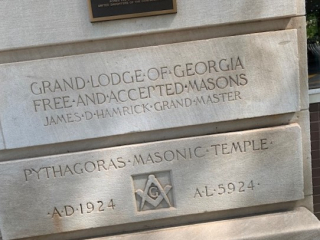 Under the Eye of Power: How Fear of Secret Societies Shapes American Democracy (2023) by Colin Dickey
“Secret societies, for good and for ill, erupted constantly in the U.S. as people lost faith with government–or when they wished to subvert it. (page 201)”
Francis suggested this book and at first when Dickey writes about the Freemasons in England and France it’s a little slow, but the book picks up fast (rituals including drinking wine from human skulls and details on the practically pornographic bestseller that titillated the public with tales of religious lust). Dickey gives us examples of how conspiracies and the belief that secret societies and cabals control our society, but he relates them to the current political scene of Donald Trump, QAnon, January 6th rioters, militias., replacement theorists and Ron DeSantis.
“It is a common misconception about subscribers to conspiracy theories that they are uneducated – 1/3 of Trump voters made of $100 K a year.”
This may not be comforting, but our American history is similar to the chaos, violence and general stupidity that are the foundations of this country (for better or worse).
There is a lot baked into this book and it took us two sessions to discuss many of the topics. Focus was a little of a problem, but it always is. One reason for the breadth of our discussion is that many of the topics touch on earlier books we have read in GRSG through the years.
The Civil War
The point where this book really gets interesting is when Dickey points out how the abolitionists of the North used conspiracy theories to taint the Southerners and likewise how the Southerners used conspiracy theories to strike fear and defend being slave owners. Just as we had read in other books such -as the Grant biography one the arguments that the Northerners used is that free slave labor gave the Southerners and “unfair” economic advantage. (This is especially true in agrarian Midwest — home of Abraham Lincoln).
One of the more ridiculous arguments was the one future 10th President of the United States John Tyler who argued that the abolitionists “were not “friends” to enslaved Americans but instead their ‘enemies’ since their agitations drove enslavers to crack down on those in bondage.” (p.80) This sounds as idiotic as Ron DeSantis redefining slavery as job training.
Thomas Pynchon
One of the major themes of most of Pynchon’s novel, especially Gravity’s Rainbow (it contains the 5 Proverbs for Paranoids – See ). In Chapter 20, Dickey also cites The Crying of Lot 49 which communicates via cryptic symbols including a muted trumpet. See Murray’s website mutedhorncom.com
The Klan
Chapter 15, The (In Visible Society) about the Ku Klux Klan more specifically the second Klan which rose to prominence in the 1920s was one of the more interesting chapters. The initial Klan rose after the Civil War, but gutted by the Grant administration (we read the Chernow Grant biography last year) that sent Federal troops to control organized Southern violence.
The origins of the Second Klan had a resurgence of PR spectacles (including Stone Mountain) and morphed into a multilevel marketing pyramid scheme where every new recruit to the Klan paid $10 and $4 with the recruiter and the remainder going up the pyramid to the leaders’ pockets. There was merchandising too.
Why Do We Believe in Conspiracies
Things that increase the likelihood of ascribing to conspiracy theories:
A) Personal factors:
- Ignorance,
- Historical amnesia,
- Impotence
- Sense of disaffection from society
- Personal failures
B) Exogenous factors:
1. Threats and their drivers:
2. Novelty (previously unexperienced threats are worse)
3. Threat level acceleration (e.g., increased flow of immigrants)
4. Human agency involved (cannot be a natural disaster—comet/volcano
5. Secrecy
Presence or perceived presence of peculiar codes, rituals or symbols (If you have ever been in a Masonic Temple it is loaded with this stuff)
Things that diminish the likelihood of ascribing to conspiracy theories:
A) Transparency
B) Resilience,
C) Success,
D)Historical memory.
E) Education
https://bookshop.org/widgets.js
Relevant Quotes
These are quotes from Francis’s catalog of quotes with commentary.
1) Hypocrisy is the tribute that vice pays to virtue. –La Rochefoucald
(This is why I think hypocrisy is better than autocracy—the autocrat commits far worse deeds as he does not care how his actions appear to the rest of the world, while at least the hypocrite does–FW)
2) A credulous mind . . . finds most delight in believing strange things, and the stranger they are the easier they pass with him; but never regards those that are plain and feasible, for every man can believe such. – Samuel Butler
 3) Reflect on things past, as wars, negotiations, factions and the like; we enter so little into those interests, that we wonder how men could possibly be so busy and concerned for things so transitory. Look on present times, we find the same humor, yet wonder not at all. – -Swift, thoughts on Various Subjects, 1711
4) So obscure are the greatest events, as some take for granted any hearsay, whatever its source, others turn truth into falsehood, and both errors find encouragement with posterity. – Tacitus
5) Modern history had given us enough warning against treating simplifications as real. The totalitarian states….had been propelled by ideologies and what else was an ideology (…) other than a premature synthesis. Clive James Cultural Amnesia (The subsequent two quotes from Goethe, support his contention).
6) The only way to see absurdities of today in proportion is to compare them with great masses of world history. – Goethe
The history of philosophy, of religion, of the sciences all show that opinions are spread about on a quantitative scale and that the leading position always goes to that which is easiest to grasp, that is whatever is easier and more comfortable for the human spirit. Indeed the man who has fully educated and developed himself can always reckon to have the majority against him. Goethe
7) History is the present. That’s why every generation writes it anew. But what most people think of as history is its end product, myth. – E.L. Doctorow
8) Human blunders usually do more to shape history than human wickedness. AJP Taylor 1961
9) Combinations of wickedness would overwhelm the world did not those who have long practiced perfidy grow faithless to each other. Dr. Johnson (On why true conspiracies are so limited, also, see below)
10) Cunning has effect from the credulity of others, rather than from the abilities of those who are cunning. It requires no extraordinary talents to lie and deceive. Dr. Johnson 1781
11.) Conspiracy theories, after all, feed on historical amnesia. p. 128 Colin Dickey
12.) Conspiracy theories are rationally motivated irrational behavior. – p.238 Colin Dickey
Reminders
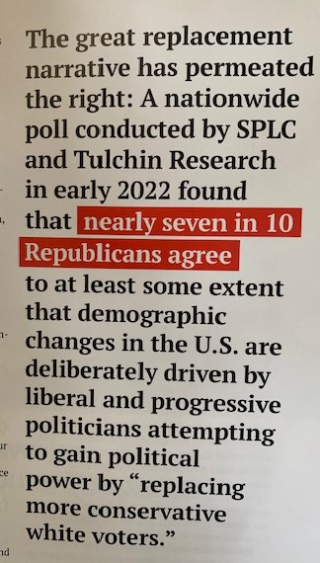 The book also reminds me of other things I have read. Most recently, the Southern Poverty Law Center’s “The Year in Hate & Extremism” 2022 yearbook” which devotes a pull quote in the introduction talk about the prevalence of Replacement Theory. The SPLC agree that the recent mass shootings in Buffalo, Pittsburgh and Christchurch, New Zealand were fueled by Replacement Theory rhetoric.
Another book is Astra Taylor’s Democracy is Not Much, But We’re Going to Miss It When Its’ Gone. Taylor’s book is long and a little meandering but she makes but it makes many similar points and provides a rich historical perspective on our nation’s strange history.
Conclusions
This book presents a thorough historical rendering of Conspiracy’s roots beginning with the Freemasons of Colonial times (including George Washington and Ben Franklin) all the way through the riots of January 6th. We agreed that Dickey is not a rigid historian, and he has a perspective (agenda seems too strong). This book has no index either which is always a negative in a book like this. Still, we devoted two sessions to this book and it provided plenty discussion. If we had human skull wine glasses (as mentioned on page 54) we’d toast Dickey’s efforts.
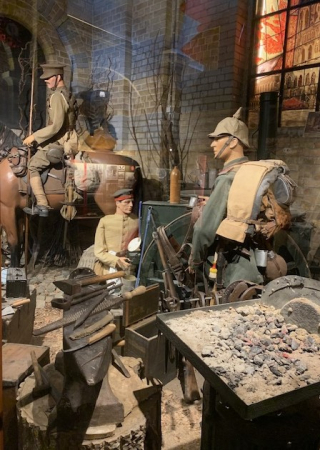
The First World War (1998) by John Keegan
Why this book was selected.
We read Pat Barker’s novel Regeneration earlier this year and we both liked the British historian John Keegan and have read other books by him (e.g. The Face of Battle). Adding to the timeliness, Murray was going to vacation at Ypres in September and he wanted to read up on World War I. His thoughts about his trip to Ypres can be found in the posting “Grave Significance“.
General Observations
We both liked the book and found it worthy of GRSG. Murray said he didn’t know how much he didn’t about The Great War until he read this book. His knowledge about World War 1 is limited to its beginning with the 1914 assassination of Duke Ferdinand in Sarajevo and All Quiet on the Western Front movies and the like. This gap in knowledge became more apparent while reading Keegan’s chapters to on the Eastern Front and Russia’s campaigns versus Germany and Austria. (These were no small engagements as Russia lost 1.7 M dead and Austria-Hapsburg Empire 1 million), He includes details about how the Bolsheviks rose to power (largely through food riots and a lack of loyal home guard troops).
Keegan spends significant time on the first year of the war where the troop movements shaped the following years on the Western Front. This is in contrast to 1918 when America had entered the war when not that much was written. The Germans made a final offensive in 1918 because they knew the American manpower would swing the war to the Allies and the German populace was practically starving on the Homefront.
Keegan surprises us by calling the Great War, a “civilized war” compared to the Second World War, which introduced the war on civilians. Geographically, the battlegrounds are limited in the West to Belgium and France although the trenches stretched from the North Sea to Switzerland. (However, many areas were geographically unsuited for movements of large armies thus the Great Battles were often fought repeatedly over the same ground: Ypres in Belgium, the Somme, and Verdun in France.
Since Francis had been to Gallipoli, he especially appreciated that chapter on the ill-fated Dardanelles campaign, which was relatively short. Winston Churchill, who was the first Lord of the Admiralty was one of the main proponents of the naval engagement followed by the invasion of Australian and New Zealand Army Corp (ANZAC) troops. Earlier in the book Churchill was described by Keegan as “thirsting for action and glory.” (Anzac Day is a commemoration of the anniversary of the landing of Australian and New Zealand troops at Gallipoli, Turkey on 25 April in 1915.)
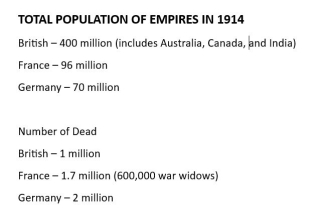
Quotes & Excerpts from Francis
Page 93—the response to the slaughter of non-combatants, perhaps 1500 men women and children rounded up and shot in city squares in Belgium: “Even harder to bear were the expressions of disgust from the world’s great centers of learning and research; American as well as European universities denounced the atrocity and committees were formed in twenty-five countries to collect money and books for the restoration of the Louvain library.
Page 177: All these plans, though particularly those of Ruzski and the Stavka, characterize a distinctively Russian style of warmaking, that of using space rather than force as a medium of strategy. No French general would have proposed surrendering the cherished soil of his country to gain military advantage; the German generals in East Prussia had taken the defense of its frontier to be a sacred duty. To the Russians, by contrast, inhabitants of an empire that stretched nearly 6,000 miles from the ploughland of western Poland to the ice of the Bering Straits, a hundred miles here or there was a trifle of military maneuver. In their wars with the Turks, the Swedes, above all with Napoleon, whole provinces had been lost, only to be regained
Page 269: Troy v Gallipolli: “ It is difficult to say which epic Homer might have thought the more heroic.”
Page 299: “Plans made without allowance for the intentions of the enemy are liable to miscarry.”
Page 347: The problem of command in the circumstances of the First World War was insoluble. Generals were like men without eyes, without ears and without voices, unable to watch the operations they set in progress, unable to hear reports of their development and unable to speak to those whom they had originally given orders once action was joined.
Not that you want to give the benefit of the doubt, but this lack of communication did impact not only battlefield movements, but it partly explained how the assassination in Sarajevo led to the original outbreak of hostilities. Heads of governments and kings could not respond to their ambassadors in a timely manner, so sometimes there was a lag which led to further misunderstanding (and bloodshed). Keegan wrote about Sir Douglas Haig, the supreme British commander: “Haig in whose public manner and private diaries (showed) no concern for human suffering and compensated for his aloofness with nothing whatsoever of the common touch. He seemed to move through the horrors of the First World War as if guided by some inner voice, speaking of a higher purpose and personal destiny.”
Page 450: The chronicle of its battles provides the dreariest literature in military history; no brave trumpets sound in memory for the drab millions who plodded to death on the featureless plains of Picardy and Poland; no litanies are sung for the leaders who coaxed them to slaughter…… The legacy of the war’s political outcome scarcely bears contemplation: Europe ruined as a center of world civilization, Christian kingdoms transformed through defeat into godless tyrannies, Bolshevik or Nazi, the superficial difference between their ideologies counting not at all in their cruelty to common and decent folk. All that was worst in the century which the First World War had opened, the deliberate starvation of peasant enemies of the people by provinces, the extermination of racial outcasts, the persecution of ideology’s intellectual and cultural hate-objects, the massacre of ethnic minorities, the extinction of small national sovereignties, the destruction of parliaments and the elevation of commissars, gauleiters and warlords to power over voiceless millions, had its origins in the chaos it left behind. Of that, at the end of the century, little thankfully is left. Europe is once again, as it was in 1900, prosperous, peaceful and a power for good in the world.
The two key questions posed by Keegan at the end of the book (page 456 gleaned from two paragraphs)
- Why did a prosperous continent, at the height of its success…risk all it had won…In the lottery of a vicious internecine conflict?
- Why did the combatants persist…to…pointless slaughter?
A century later there are no clear-cut answers to those questions.
Frankenstein (1818, 1831) by Mary Wollstonecraft Shelley
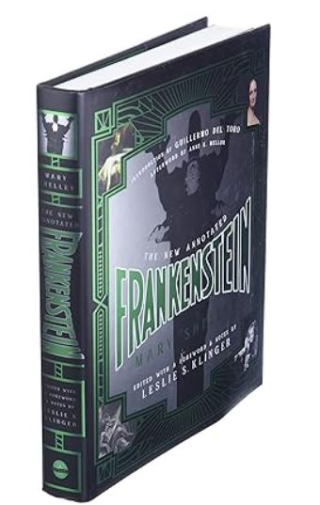 We decided to read this classic novel after Murray visited his cousin in Indiana before Halloween. The cousin mentioned that her granddaughter Jocelyn—a 6th grader and quite a reader—was currently reading Frankenstein. Adding to our decision is that the recent blockbuster movie Oppenheimer (was based on the biography American Prometheus) and Shelley’s novel is often referred as the Modern Prometheus. Anytime a scientist— in the case of Victor Frankenstein —unleashes a new powerful force never before witnessed in humankind, the Prometheus comparison always shows up.
To help us to more fully understand the novel, we both enlisted the help of The New Annotated Frankenstein (2017) edited by Leslie S. Klinger and published by W.W. Norton.
Frankenstein. We Hardly Knew Ye
For starters, the Frankenstein of the title is for Victor Frankenstein the young doctor who created the fiend, the monster, not the name of the monster himself. It is Victor’s story to tell a captain of an icebound vessel that is trapped near the Arctic Circle. Victor tells Captain Walton relates his story of science, creation, murder and madness. How mislead we were by those old black and white Boris Karloff’s movies of the 1930s. 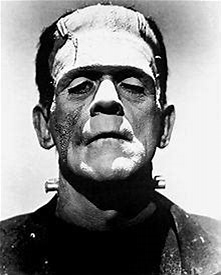
How else is the book differ from the typical Frankenstein movies including our favorite Mel Brooks’ “Young Frankenstein” which enjoyed it’s 50th anniversary this year:
A) There is no castle; B) Victor is very young and naïve when he creates the monster–not a middle-aged mad scientist. C) There is no Igor; D) The Movie monster is barely sentient, unlike the reasoning, scheming and duplicitous creature in the book; E) The monster was not animated by electricity; F) The monster is fleet-footed, agile and can steal along without others noticing him, unlike the lurching, lumbering Klutz in the movies. G) The book is a rather expansive travelogue (London, Scotland, the North Sea, Europe) while the movie is always staged in one locale.
It’s a Classic from the Romantic Era
We certainly agreed that book deserves all the accolades it has received. After all, she wrote the book when she was 19 and the writing is solid. It embodies the Romantic Period times of Percy Bysshee Shelley (who she married at age 19) and Lord Byron. Victor Frankenstein embodies the romantic lifestyle and everything he says or does is wrapped in passion (we both thought he was a little tiresome). Remember he is younger in the book than we are accustomed to seeing in the movies.
In his introduction to the Norton book, Guillermo Del Toro (the actor) writes about Romanticism:
Like all great movements “Romanticism was born out of rage and need…a way to fight the overbearing certainty of science…” (Which is rather interesting in that he wrote that in 2017, which sounds a bit prescient–given all the rage, at least by some, about “science” that followed the pandemic – Francis). “To quote Lord Byron, ‘The great object of life is sensation—to feel that we exist—even though in pain.’ ”

Francis appreciated another aspect of the book and the history of using electricity in medicine from a contemporary of Shelley, Giovannie Aldini:
In 1803 the College invited Professor Giovanni Aldini to carry out galvanic experiments on the body of George Foster, who had been found guilty of murdering his wife and child by drowning them in the Paddington Canal. Aldini required access to the bodies of people who had died very recently, in the belief that these still held their ‘vital powers’. In contrast, those who had died of disease might have ‘humours’ which would resist his experiments. Later, writing up his London work, Aldini admired England’s ‘enlightened’ laws, which provided murderers with an opportunity to atone for their crimes by such uses of their bodies after death. He argued that galvanic experiments were especially in the interests of a British public, for Britain was a commercial and maritime nation filled with rivers and canals. When people drowned there, he wrote, galvanism might provide the necessary ‘means of excitement’ to return them to life.1 Dealing with the dead in controversial ways always requires some form of rationalisation. It is part of the process through which access to bodies is socially negotiated.
Reading the records of this scientist’s work at the College in 1803, it is not difficult to see why others believed such men liked to play at being God. Always conscious of his audience, Aldini made the dead perform tricks. He boasted that in Europe he had once placed the heads of two decapitated criminals on separate tables, then connected them with an arc of electricity to make them grimace to such an extent as to frighten spectators. He had also made the hand of a headless man clutch a coin and throw it across a room.
The College provided Aldini with an opportunity to undertake some new experiments on George Foster, whose body had been left hanging for an hour in temperatures two degrees below freezing point. Aldini applied arcs to various parts of the corpse to make George Foster perform. His jaw quivered, his left eye opened, and his face convulsed. When conductors were applied to his ear and rectum, the resulting muscular contractions ‘almost [gave] an appearance of reanimation’.2 One hand clenched and the heart’s right auricle contracted, amazing Aldini’s audience.
The experiments continued for more than seven hours after the execution. Aldini denied any intention to reanimate the corpses upon which he went to work, but everyone in that room would have considered it a triumph had he managed to do so. The Times noted that a principle had been discovered ‘by which motion can be restored to Dead Bodies.’3
Such possibilities had not been on the minds of England’s legislators when they had worded the Murder Act. Dissection was meant to mutilate the dead, not resurrect them. Bringing murderers back to life might have been a matter of congratulations for the man who achieved it, but it would have been a complicated problem for the law. Aldini himself spoke ambiguously about his intentions. He said the object of his experiments ‘was not to produce re-animation, but merely to obtain a practical knowledge how far Galvanism may be employed … to revive persons under similar circumstances’.4
This is an edited excerpt from Helen MacDonald, Human Remains (Melbourne University Press, Carlton, 2005 and Yale University Press, London, 2006).
Notes
-
Aldini, John, An Account of the Late Improvements in Galvanism, with a series of various and interesting experiments performed before the Commissioners of the French National Institute, and repeated lately in the Anatomical Theatres in London (to which is added an Appendix, containing the author’s experiments on the body of a malefactor executed at Newgate, etc etc), Cathell & Martin, London, 1803, pp. 67-8, 189-90, 191.
-
Aldini, An Account of the Late Improvements in Galvanism, p. 194.
-
Times, 24 January 1803.
-
Aldini, An Account of the Late Improvements in Galvanism, p. 201.
And what discussion of Frankenstein would be complete without including clips of the best Frankenstein movie — Mel Brooks’ Young Frankenstein. The first excerpt features Marty Feldman with Gene Wilder and Terri Garr. The second has Peter Boyle with Gene Hackman. Hackman proves that a good actor can do comedy if the writing is good. (Julia Louise-Dreyfus included.)
Galileo and the Science Deniers (2020) by Mario Livio
Francis and I were in agreement that overall this book was average because it had some serious flaws. You can’t criticize the importance of Galileo Galilei (1562-1642) and his discoveries in astronomy, mathematics and physics, but as advertised much of the book is devoted to his naysayers and his battles with the Catholic Church. The weaknesses were two fold. Since Livio revisits his earlier works about Galileo some of it reads like a rehash of previous material and secondly Livio draws conclusions about Galileo’s battles with the church and comparing them to today’s science deniers seems tacked on.
That being said our discussion was spirited proving that even a less than stellar book can prove to be worthy of GRSG’s time. The book is roughly divided into thirds.
Opening Chapters
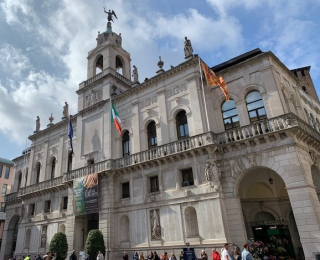
Murray liked the first third of the book when Livio gives an account of Galileo finding himself as a mathematician and philosopher and not as a medical doctor as his father wished. For years Galileo was on the hustle and living in Padua (not too far from Venice) for a dozen years. (Murray spent the day there in the historical city known for its Scrovegni Chapel with the frescos.) Galileo also worked for the Venetian military. His fine telescopes were of use of the military as well as the armaments that could give the city-state an advantage.
In the early pages (p.22-24) there is the quote that caught both of our attention from Einstein:
” How is it possible that mathematics, a product of human thought that is independent of experience, fits so excellently the objects of physical reality?
To Murray that did seem kind of amazing, but Francis had a differing opinion. He cited the story of The Dog That Knew Calculus. Well, the answer can be found with Elvis the dog mentioned in the article. In short, dogs know calculus they can calculate trajectories and arcs every time they follow a frisbee and snag it. Francis reminds us that our brains have been wired, via evolution, to incorporate the physical reality of the world in its ability to function and move the body since time immemorial. Those organisms who couldn’t catch on to this, did not survive.
Also, in the early pages (40-41) there is mention of how in the case of Galileo astronomical discoveries were proven centuries later. Livio writes ” Science progresses sometime by experimental results preceding theoretical explanations, and sometime theories making predictions that are later confirmed (or falsified) experimentally or observationally.” Livio mentions how one Einstein ‘s theories of relativity published in 1915 was not proven until observations were made in 1919 on the remote of islands of Principe (off West Africa) and Sobral (off Brazil) Coincidently in the opening paragraphs Paul Johnson’s Modern Times From the Twenties to the Nineties, he says the expedition to that proved these theories marked the beginning of Modern Times.
There is a lot of scientific explanations of Galileo’s work which the general reader such as Murray have a tendency to glaze over (skimming). Francis was more understanding. He writes in his Amazon review: “There are some good quotations relevant to the history and philosophy of science in the book–which would be of interest to budding scientists, but perhaps not so much for a more general readership.”
Middle Ground
“Galileo’s comments on the human ability to decipher nature’s secrets also echoed in his famous Letter to Benedetto Castelli, when he stated that he did not believe that the same God who has given us our senses, reason, and intelligence wished us to abandon their use.”(p. 81)
Much of the middle chapters of the book are devoted to the detailed arguments between Galileo and other scientist and philosophers and the Catholic Church. It is here that we are introduced to casuistry: the use of clever but unsound reasoning, especially in relation to moral questions; sophistry. (the above from an on-line dictionary). The Jesuits, by the way, were in particular known for their casuistry. It seems Livio was ignorant of this concept, which is OK, but if you are going to write 4 chapters on it, why not just summarize it in one?
Not even the quaint list of Italian insults used by Galileo: “pezzo d’asinaccio” (“piece of utter stupidity”), “bufolaccio” (“buffoon”), “elefantissimo” (“most elephantine”), and “baldordone” (“bumbling idiot”) can save this part of Livio’s book.
Late Rally The ending of the books is a little better for the general reader as we learn about Galileo’s final years under house arrest. But Livio seems to tack on modern relevance as an afterthought in hopes of creating buzz when it compares the life and times of our current society when public health advocates battle with anti-vaxers.
https://bookshop.org/widgets.js
This concludes 2023 GRSG Reading Notes. To continue, go to 2024 GRSG Reading Notes
—– EXTENDED BODY: —– EXCERPT: —– KEYWORDS: Robert Maraniss, Bo Jackson, Jim Thorpe, Path Lit by Lightning, Joseph Conrad, Heart of Darkness, Apocalypse Now, Colum McCann, TransAtlantic, Dubliners, James Joyce —– ——– AUTHOR: Murray Browne AUTHOR EMAIL: murray.browne905@gmail.com TITLE: Mushroom Anthropology Notes STATUS: Publish ALLOW COMMENTS: 1 CONVERT BREAKS: wysiwyg ALLOW PINGS: 0 BASENAME: mushroom-anthropology-notes CATEGORY: Book Reviews UNIQUE URL: https://thebookshopper.typepad.com/the_book_shopper_atlantad/2023/01/mushroom-anthropology-notes.html DATE: 01/17/2023 02:14:17 PM —– BODY:
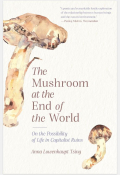 On The Book Shopper's companion blog there is my brief review of Anna Lowenhaupt Tsing's The Mushroom at the End of the World: On the Possibility of Life in Capitalist Ruins (2015). It is entitled "Mushroom Induced Reading."
Or you can take a peek at my reading notes (which are kind of like an index). Click on image of the notes if you wish to enlarge the "fine" print.
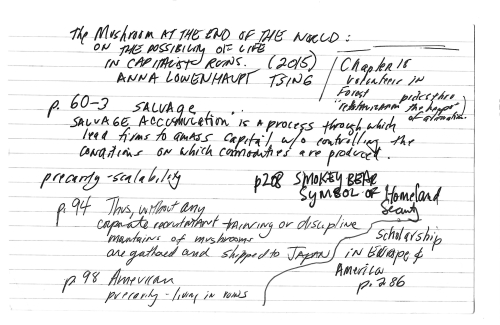
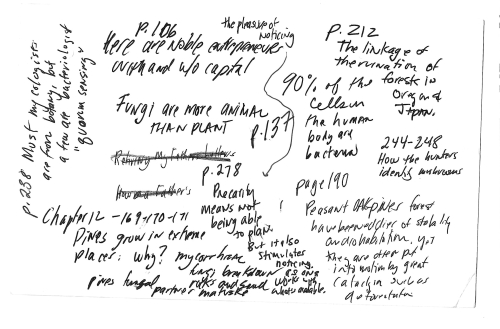
Preface: This posting comes from my longtime friend Dave Dintenfass who lives in Seattle. Our friendship dates back to 1979 while I was training to be a board operator at public radio station WILL in Champaign-Urbana Illinois. Dave was a student who was assigned to train me on the night and weekend shifts. (One advantage of those late hours is that I was paid to read while listening to classical music.)
Dave has influenced my writing, my taste in books and my passion for book shopping throughout the decades. He offered to share his recent thoughts on revisiting Anaïs Nin and Henry Miller. It reminds me of the kind of conversations we have had about books. Dave writes:
I finished Anaïs Nin: A Biography by Diedre Bair (Penguin Books, 1995). This was a borrow from one of the ubiquitous Free Little Library kiosks here in Seattle.
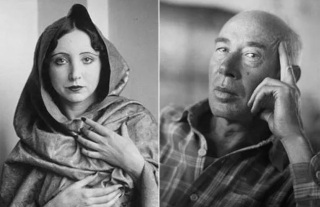 A bit of a slog given its length but very well written and comprehensive in the way that most biographies are not. Of course, there was the benefit of access to the famous diaries so documenting the life of perhaps one of the most outrageously narcissistic literary figures wasn't quite the challenge that you might assume. Or perhaps the challenge here was not for lack of research material but rather for an overwhelmingly generous supply of it. Accordingly, a comprehensive biography like this is not small. Did I mention the book is nearly 700 pages?
I felt Ms. Bair really tried to remain neutral about her subject despite meticulous evidence of just how unpleasant Anaïs Nin was. We are examining the life here of a spoiled, manipulative, monumentally self-absorbed woman—a pathological liar and completely ungenerous person who was clearly morally untethered in just about every regard. Anaïs Nin was clearly her own worst enemy but to her credit, she was not afraid to detail it all in her infamous diaries.
Like most of us, I only knew of her work by association with Henry Miller (which actually was only a very brief time in the Paris of the early 1930s) and some of the works only available posthumously (including The Delta of Venus). I did check out some of her short fiction published during her lifetime (from archive.org) and I have to say, while these short pieces were beautifully written, they lack any sort of compelling story, and they seem actually rather shallow and utterly bereft of any humanity. But then I feel the same way about Lawrence Durrell's fiction—it remains a mystery to me why it is so highly praised; I find it incomprehensible. But Your Mileage May Vary.
All this encouraged me to re-read Tropic of Cancer as it's been many years since I read any Henry Miller. I could say this 1934 novel hasn't held up but after reading it again 45 years later, it's clear to me it didn't hold up the first time I read it. Notwithstanding the long interval between readings, I vividly recall that my youthful impression was the same as now. Despite occasional flashes of dark humor and playful narrative, the book is much too long (over 300 pages in the Castle Books reprint of the famous 1961 Grove edition) and even more rambling and unfocused than The Great White Whale of my literary interest, Saul Bellow's The Adventures of Augie March. (I'm not suggesting here any other equivalence between these two works, just that the Bellow book captivated my interest for years until I had the misfortune to finally read the thing from end-to-end with great disappointment.)
If Miller had boiled it down to 30 or 40 of the best pages, it might be viewed today as a compelling (though youthfully immature) riff on impoverished bohemian aimlessness in depression-era Paris. Curiously, it's when the narrator leaves Paris near the end of the novel (to teach English at a parochial school in Dijon) that some of the most focused and insightful writing emerges. In fact, I would suggest the last 50 pages of the book are probably its best.
I might revisit Miller’s other infamous early work, Tropic of Capricorn, written a few years after Cancer. When I last read it 45 years ago, I recalled it was a much better book. I’m not so sure now but it’s worth a go.
Thanks, Dave, for thinking of the blog and recommending to me which books to read and avoid.
—– EXTENDED BODY: —– EXCERPT: —– KEYWORDS: Anais Nin, Henry Miller, biography, Deidre Bair —– ——– AUTHOR: Murray Browne AUTHOR EMAIL: murray.browne905@gmail.com TITLE: Best Books Read 2022 STATUS: Publish ALLOW COMMENTS: 1 CONVERT BREAKS: wysiwyg ALLOW PINGS: 0 BASENAME: best-books-read-2022 CATEGORY: Best Books Read 2017-2023 UNIQUE URL: https://thebookshopper.typepad.com/the_book_shopper_atlantad/2022/12/best-books-read-2022.html DATE: 12/16/2022 08:09:09 AM —– BODY: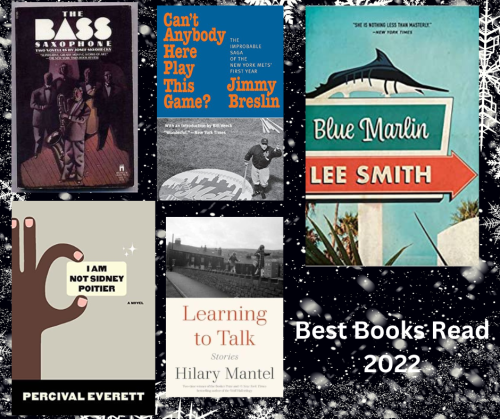
Unlike lists of the past years (Best Books Read 2017-2022), this year’s offerings concentrate on little books – the in-between-ers, the interstitials. These books are like Wordles between the Sunday crossword puzzles. In my book group-duo The Gravity’s Rainbow Support Group, we have read some colossuses this year and they have been quite good, but sometimes they make my head hurt (Laurence Stern’s Tristam Shandy comes to mind). So don't you agree it is equally important to read a “breather” once in a while?
The Best Books Read 2022 edition have provided quality respite and they deserve some kind of honorable mention. They – in the order they were read – are:
Josef Škvorecký, Two Novellas* (1977 – 208 pages). When I went to the former East Germany near the Czech border last, it reminded me of this writer Škvorecký who left Czechoslovakia and resettled in Toronto. The three pieces in this book, the Preface on Red Music, and the two novellas Emöke and The Bass Saxophone were all good reads. The latter demonstrates how art (jazz music) became a "resistance" in the face of authoritarian regimes like the Nazis in World War II followed by the Soviet occupation afterwards.
 Lee Smith, Blue Marlin: A Novella* (2020 – 136 pages). My longtime partner Denise has always admired Lee Smith (especially her novel Fair and Tender Ladies) and she convinced me to read the book. In a tight, elegiac story, the narrator, a thirteen-year-old girl reflects on a trip to Florida she makes with her parents – who are struggling with their marriage. They are on vacation in Key West, staying at the Blue Marlin Motel. Their trip coincides with the filming of the 1959 movie "Operation Petticoat" starring Cary Grant and Tony Curtis. The girl and the mother even became extras in the movie. (Smith calls the book autobiographical fiction, with an emphasis on fiction.)
Hilary Mantel, Learning to Talk* (2022 – 176 pages). I read this collection of stories about her growing up in Ireland in the 1950s just before Mantel died. Mantel’s very precise and understated emotional writing is powerful. You can see why she went on to win all those Booker Prizes. (I may have not read her most well-known work Wolf Hall, but I did watch the five-part series starring Mark Ryland, Claire Foy and Damian Lewis. The novel was set the time of Henry the VIII and Thomas Cromwell – when the British royalty played for keeps.)
 Percival Everett, I Am Not Sidney Poiter (2009 – 272 pages). Speaking of Tony Curtis, he “appears” in Everett’s novel about a black man who resembles Sidney Poiter, but his mother gives the birth name of I Am Not Sidney Poiter. Everett mixes the plot of various Poiter movies into the short novel, including "Lillies of the Field", "Guess Who’s Coming to Dinner" (with Katherine Hepburn and Spencer Tracy), "Buck and the Preacher" (with Harry Belafonte) and of course, "The Defiant Ones"starring Tony Curtis.
Jimmy Breslin, Can’t Anybody Here Play This Game (1963  -126 pages). A fellow bookseller gave me this tattered copy of the history of the inaugural 1962 season of the New York Mets “led” by Marvelous Marvin Throneberry and their future Hall of Famer manager Casey Stengel. Breslin’s had a long, often controversial career as a New York journalist and columnist. In this excerpt, the Giants superstar Willie Mays gets in a fight with Met second baseman after a hard slide at the bag, which escalates into a fracas. Breslin writes:
"[ San Francisco first baseman Orlando] Cepeda promptly charged [Met pitcher] Roger Craig throwing punches. For baseball players, who can’t fight even a little bit, it turned into a pretty good show. Much throwing of batting helmets and charging from the bench and the like. Stengel who knows that baseball players look like girls when they try to fight, remained on the bench. It was bad enough people called him an old man. He sure as hell wasn’t going out and let people say he looked like an old lady."
I realize this is not your normal Best of List, curated to impress, but you can read anyone of these books in just a few hours. Doesn't that count for something?
* available on the Destination: Books Best of the Bookshopper online store.
—– EXTENDED BODY: —– EXCERPT: —– KEYWORDS: Bass Saxophone, Hilary Mantel, Lee Smith, Skvorecky, —– ——– AUTHOR: Murray Browne AUTHOR EMAIL: murray.browne905@gmail.com TITLE: Best Buys STATUS: Publish ALLOW COMMENTS: 1 CONVERT BREAKS: wysiwyg ALLOW PINGS: 0 BASENAME: best-buys- UNIQUE URL: https://thebookshopper.typepad.com/the_book_shopper_atlantad/2022/11/best-buys-.html DATE: 11/27/2022 09:40:44 AM —– BODY: As many as you may know, when I am not shopping for books, I am selling books. It is a blurry line because I often shop for books to sell. Sometimes what I read is determined by what I am interested in carrying for my popup book operation Destination: Books, but I can say that I never read a book that I don't want to read. Life is too short to do that and there is just so much other good material and writers out there that I'd rather seek out.
Even though Destination: Books is a popup and online bookshop and not a bricks-and-mortar store, it is still an independent bookseller and a member of the American Bookseller Association. D:B is an affiliate and a beneficiary of the Bookshop.org program. (Bookshop.org is a collaboration between the ABA and the book wholesaler Ingram.)
For every new book purchased through the bookshop.org portal, money eventually is shared to hundreds of independent bookstore affiliates. If you purchase any new book through my specific Destination: Books portal, the store receives an additional commission.
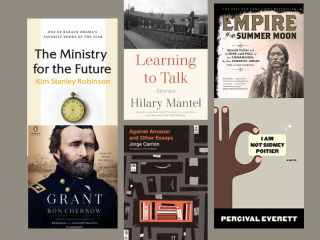 Check out our Destination: Books bookshopper-themed portal. It lists some of the books I have written about in the bookshopper blog or ones we have recently enjoyed. Furthermore Bookshop.org is offering free shipping on book orders until Monday midnight, November 28, 2022.
Thanks for your support of independent reading and thinking.
—– EXTENDED BODY: —– EXCERPT: —– KEYWORDS: Destination: Books, Bookshop.org —– ——– AUTHOR: Murray Browne AUTHOR EMAIL: murray.browne905@gmail.com TITLE: Books Read in 2022 STATUS: Publish ALLOW COMMENTS: 0 CONVERT BREAKS: wysiwyg ALLOW PINGS: 0 BASENAME: books-read-in-2022 UNIQUE URL: https://thebookshopper.typepad.com/the_book_shopper_atlantad/books-read-in-2022.html DATE: 11/26/2022 02:33:27 PM —– BODY:
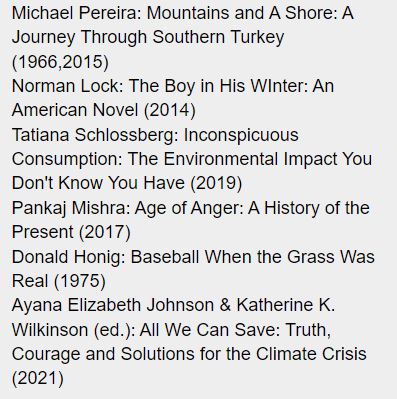
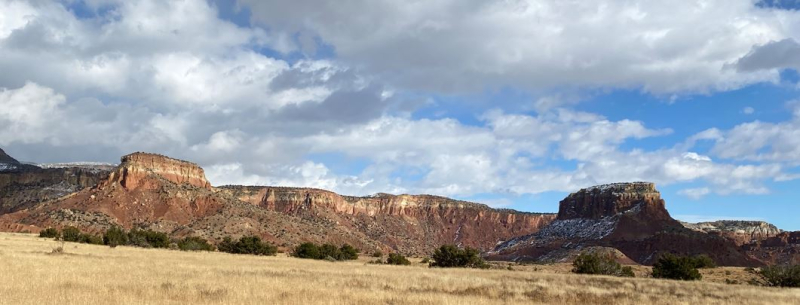
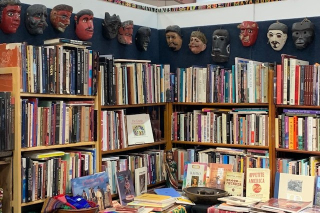 Except for a quick browse of the Maya Jones Books stall in the El Museo Cultural Market adjacent the Santa Fe Farmer’s Market, I did very little book shopping on my recent trip to Santa Fe with my partner Denise and her brother and sister-in-law Mike and Kathy Koslow. (“Excuse me, sir, do you have any margarita recipe books?”)
But other printed matter came into play—maps. And appropriately so, since we road tripped through Abiquiu and Ghost Ranch up Highway 84 in a geological tour or rock formations. I had no idea what they were about until I purchased the exquisitely printed Abiquiu: The Geologic History of O’Keefe Country by Kirt Kempter and Dick Huelster. The detailed map gives a rundown of the rock formations, the type of rock, a timeline and explanation of how the topography was formed.
 Here's an excerpt about the formation near Georgia O'Keefe's Ghost Ranch (shown at the top of the post):
"The Mesozoic Era is represented by the sedentary deposits that surround Ghost Ranch. The basal, mostly red mudstones represent the Triassic Petrified Forest Formation, when broad rivers meandered across a flat landscape in northern New Mexico. The orange-red to yellow overlying cliffs represent the Entrada Formation, petrified sand dunes from the Jurassic Period approximately 165-160 million years ago."
Well, it’s not exactly the map you can follow while you are hiking but it serves well as a memory of what we experienced, not unlike this photograph of us trekking through a slot canyon near the Cerrito Blanco.
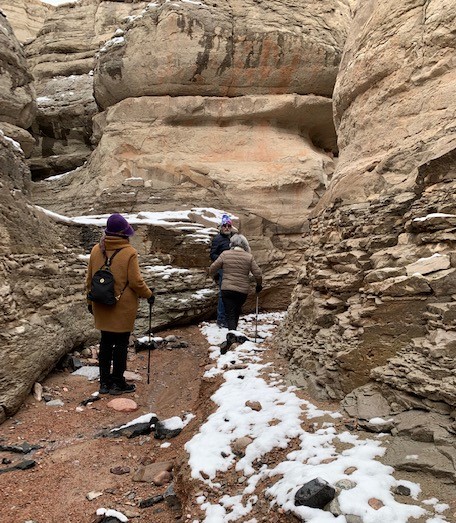
—– EXTENDED BODY: —– EXCERPT: —– KEYWORDS: Geologic History of Abiquiu, Ghost Ranch, book shopping Santa Fe —– ——– AUTHOR: Murray Browne AUTHOR EMAIL: murray.browne905@gmail.com TITLE: Focusing on Dos Passos STATUS: Publish ALLOW COMMENTS: 1 CONVERT BREAKS: wysiwyg ALLOW PINGS: 0 BASENAME: focusing-on-dos-passos UNIQUE URL: https://thebookshopper.typepad.com/the_book_shopper_atlantad/2022/11/focusing-on-dos-passos.html DATE: 11/08/2022 03:32:34 PM —– BODY:

Three months ago, I posted on this blog “My History with The John Dos Passos Trilogy” about my long relationship with the writer and the different editions of the three books, but it didn’t stop there. With encouragement from The Gravity’s Rainbow Support Group, I pushed forward, and reread The 42nd Parallel, Nineteen Nineteen, and The Big Money.
This has led to another longer essay “The Camera Eye of Dos Passos: Looking Back at an America in Turmoil” that has just been published by the Tropics of Meta. Founded in 2010, ToM, as it affectionally known, publishes essays on history, current events and popular culture giving a wide range of latitude—including length—to its contributors. (You don’t have be an academic to write for them.)
This was my seventh essay that they have published. And I must admit all the essays germinated in some degree from The Books Shopper blog postings. A tradition continues.
—– EXTENDED BODY: —– EXCERPT: —– KEYWORDS: —– ——– AUTHOR: Murray Browne AUTHOR EMAIL: murray.browne905@gmail.com TITLE: This Just In STATUS: Draft ALLOW COMMENTS: 1 CONVERT BREAKS: wysiwyg ALLOW PINGS: 0 BASENAME: this-just-in- UNIQUE URL: https://thebookshopper.typepad.com/the_book_shopper_atlantad/2022/11/this-just-in-.html DATE: 11/04/2022 09:51:04 AM —– BODY:Between popups, I have been evaluating two books that may be of interest to our “for-the-adventurous” clientele.
 Dan Chapman in his recently published A Road Running Southward: Following John Muir’s Journey Through and Endangered Land mixes a travelogue with a report card on the Southeast’s various ecosystems from Kentucky to Florida. Chapman follows naturalist John Muir’s 1867 trek from Louisville, through Tennessee and Georgia to Cedarville, Florida but instead of traveling on foot through a war torn South, he goes by Subaru through a growing/sprawling South, which has prospered, depending on one’s definition of prosper, at great ecological cost.
Not only does Chapman reference Muir’s writings throughout, but he uses his journalistic skills to interview those on the front line of the Southeast’s fight against species disappearance, water pollution and habitat loss. His chapter on the 2008 coal ash flood in Kingston, Tennessee is especially poignant, especially when you consider North Georgia has been bringing the toxic coal ash (a byproduct of coal firing plants) from other states.
Likewise, in Two Wheels Good: The History and Mystery of the Bicycle, Jody Rosen takes the reader to distant lands and a journey through history. Rather than try to write a definitive, Pollyannish, account of this newly crowned symbol of green living, Rosen explores the gray areas of the bicycle (or velocipedes as it was known early in 19th century England) mixing in personal experiences and a travelogue.
 Rosen effortlessly (always a good sign of a skilled writer) meshes the bicycles current standing with its checkered and uncertain past including its relationship with the autom0bile and the airplane. (The Wright brothers were bicycle mechanics.)
 In one chapter, Rosen travels to the St. Giles Church in Buckinghamshire-west of London to see a stained-glass window that is graced by an early (biblical?) bicycle. The minister explains why so many make the pilgrimage. “A thing you learn about this job is the people like mysteries, I think as much as they like certainties.”
These words of wisdom explain why this book is so good.
—– EXTENDED BODY: —– EXCERPT: —– KEYWORDS: —– ——– AUTHOR: Murray Browne AUTHOR EMAIL: murray.browne905@gmail.com TITLE: Book Art For Friends STATUS: Publish ALLOW COMMENTS: 1 CONVERT BREAKS: wysiwyg ALLOW PINGS: 0 BASENAME: books-as-art CATEGORY: Books as Art as Books UNIQUE URL: https://thebookshopper.typepad.com/the_book_shopper_atlantad/2022/10/books-as-art.html DATE: 10/14/2022 08:48:07 AM —– BODY: 
This year Decatur Book as Art, Vol.10 Transformation exhibit resides in the lofty 4th floor exhibit room of the Decatur Public Library through October 31. This is the tenth year of the exhibit and for all the details visit the exhibition page for hours etc., which are limited. As I was leaving, the docent said, "Tell all your friends." (Obviously, she didn't know that I was the editor of the blog who has been doing these little writeups for years. See previous Books as Art as Books postings.)
With approximately 65 exhibits it's a kind of overwhelming and I don't know how to do it justice without sounding bored, so I just concentrated on my favorite.
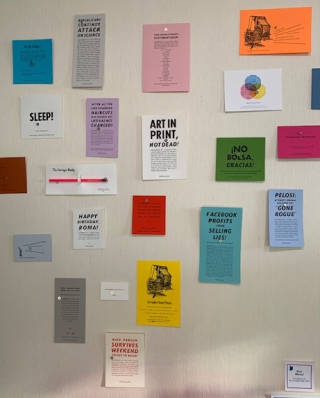 LINOTYPE by Dan Wood of Providence, Rhode Island
Many years ago, I worked for the company Mycro-Tek in Wichita that built front end systems for small newspapers. These specialized word processors were programmed with special coding had to interface with various Linotype typesetters. The gorgeous printing samples displayed on the wall reminded me of those days and the people who worked there.
Another likeable aspect of this piece is that you were actually allowed to touch it. Even though the curators boasted about the "tactile and olfactory" aspects of the exhibition, many of the exhibits were enclosed in glass and signs were posted not to touch anything. Linotype was one of the few exceptions.
The artist's full description of the work follows at the end of the post.

Friends, it has been my pleasure to inform you.
—– EXTENDED BODY: —– EXCERPT: —– KEYWORDS: Dan Wood, Linotype, Book Art v. 10 Transformation, Mycro-Tek, Decatur Public Library —– ——– AUTHOR: Murray Browne AUTHOR EMAIL: murray.browne905@gmail.com TITLE: About The Book Shopper: A Life in Review STATUS: Publish ALLOW COMMENTS: 0 CONVERT BREAKS: wysiwyg ALLOW PINGS: 0 BASENAME: about-the-book-shopper-a-life-in-review- UNIQUE URL: https://thebookshopper.typepad.com/the_book_shopper_atlantad/about-the-book-shopper-a-life-in-review-.html DATE: 10/07/2022 03:14:53 PM —– BODY:
(ASSETS FOR THE BOOK SHOPPER published in July 2009 by Paul Dry Books in Philadelpha. The book is still in print.)
Press Release (Revised in 2011)
Download Press_release_REV_2011
Table of Contents
Cover Photo and Author Photo
Download Photos_Author_Cover (1)
Author Presentation at A Cappella Books in Atlanta, Georgia, Summer 2009.
Reviews
|
|
In preparation for spending a week in Seaside, Florida with my younger daughter Bonnie and her family, I opted to make it a Pirate-themed vacation. I picked up a set of Pirate action figures, but (upon polite understandable request) removed all their weapons, which included pistols, knives, and cutlasses. While this limited the crew’s culinary activities at any bonfire pig roasts it did make things safer if the crew became “jolly-rogered” from too much rum. Weapons and alcohol are not a safe combination even for action figures.
My grandsons Myrick, 5, and Larson, 20 months liked the new toys and they got into the spirit, especially Larson who forced the buccaneers to walk the plank into the backyard pool. The family even assigned them names. Shown in the picture above are six of the crew members left to right: Cannonball, Bones, Burnside Capri, Captain Hook, Scurvy, and Ocean Dancer. (Not shown are Grog and Ponytail who presumably are lost at sea or disappeared in the car ride home.)
Treasure Island
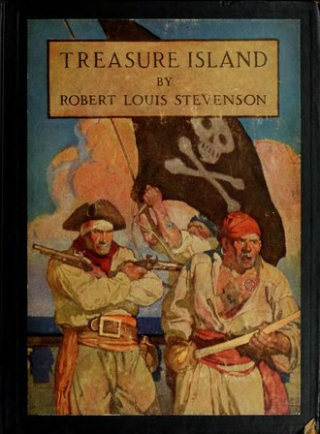 Also in anticipation, I brought along a copy of Treasure Island published by Robert Louis Stevenson in 1883. This was the 100th Anniversary Edition, which has artwork from the 1934, which did not spare any weapon imagery. My selection was based that it was illustrated without being a graphic novel. I read some of this to Myrick in the car and at bedtime, but it was thick with a lot of old-timey language. I did my best pirate accents (aaargh, I’m awful) and tried to edit on the fly while I read to simplify the plot. It’s a good adventure and Myrick indulged me by asking lots of questions like “What is rum?”
Later I drifted down to the center of Seaside and Sundog Books, which had a wide selection of vacation reads, books about Florida, children’s books. I picked up two books one about a duck family who goes to the beach and Margaret Wise’s The Sailor Dog. Both, along with a sticker book of construction equipment, proved invaluable on the trip home
When I Was a Pirate
However, it was Bonnie who found the perfect book at a different shop in Seaside. Tom Silson’s When I Was a Pirate. It is the story of a retired pirate who reflects on his seafaring adventures as a young man. Though he longs for days when he traveled the globe visiting distant lands (no mention of pillaging or mutinies), his “sore back and aching knees” magically disappear as he chases his (well-armed) grandchildren on the sandy beach.
Definitely a pirate story I could identify with.
—– EXTENDED BODY: —– EXCERPT: —– KEYWORDS: Pirate stories, Seaside Florida, Book stores in Florida —– COMMENT: AUTHOR: Rachel EMAIL: releach@gmail.com IP: 216.19.244.41 URL: DATE: 09/15/2022 09:23:26 AM Ha, I love the idea of weaponless pirates! I’m sure you figured out a way to keep them entertaining. —– ——– AUTHOR: Murray Browne AUTHOR EMAIL: murray.browne905@gmail.com TITLE: My History with the Dos Passos Trilogy STATUS: Publish ALLOW COMMENTS: 1 CONVERT BREAKS: wysiwyg ALLOW PINGS: 0 BASENAME: my-history-with-dos-passos-trilogy CATEGORY: Book Reviews CATEGORY: Bookstores UNIQUE URL: https://thebookshopper.typepad.com/the_book_shopper_atlantad/2022/08/my-history-with-dos-passos-trilogy.html DATE: 08/24/2022 04:50:25 PM —– BODY:
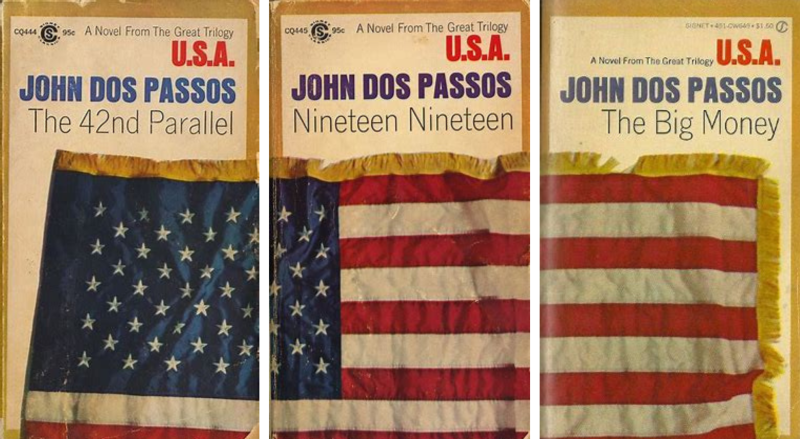
The first thing that captured my imagination about the Dos Passos's U.S.A. Trilogy was the clever artwork of the Signet Classics, which were prominently displayed in the bookstores of my college youth. I finally bought them, and they stayed on my shelves for a number of years. I do not recall when I finally read them, but I did it over a period of years, probably during the 1990s.
The Signet Classics were notable because they each contained an introduction by writer and literary critic Alfred Kazin, who summarized the three books of the trilogy —The 42nd Parallel (1930), 1919 (1932), and The Big Money (1936)— as a portrayal of America before it became a superpower. We grew up thinking of America as that way, but Kazin reminds us that America was a raw and often brutal country in the first quarter of the 20th century. (To better understand significance of Dos Passos's work, check out the essay by James Mustich, author of 1000 Books to Read Before You Die, E Pluribus Unum. On John Dos Passos's U.S.A.)
Kazin writes that Dos Passos shows how the rich men of America (characterized by J. P. Morgan) controlled the lives of working men and women. The average man or woman didn't have a chance against the "mass culture, mass superstition and mass slogans" perpetrated by the powerful.
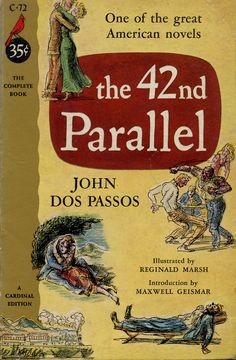 Another memorable aspect of the Signet Classics is that they were illustrated by Reginald Marsh (1898-1954) who drew for The New Yorker in the 1920s but went on to become an artist of some renown and a contemporary of the more well-known Thomas Hart Benton. Marsh was known for his "depictions of life in New York City in the 1920s and 30s." (Wikipedia). A sample of Marsh's work graces the cover of earlier paperbacks, shown at the left.
Flashback and Flashforward – 192 Books
In September 2014, my partner Denise and I did a self-guided bookstore tour in the Chelsea section of New York City, which I wrote about in the posting Chelsea Lit Crawl.
Usually if I like a new bookstore, I will make an effort to purchase something and at 192 Books, I bought the Library of America edition of the U.S.A. trilogy, which wrapped Dos Passo's work into a single volume. I replaced my tattered paperbacks. not knowing whether I would ever pick it up again and reread it.
For those not familiar with the Library of America, it is a nonprofit publisher championed by critic Edmund Wilson (1895 – 1974), which published its first book in 1982. LOA has since then published 300 volumes of works ranging from poetry, novels, crime writing, science fiction, essays and journalism.
 This summer our GRSG book (support) group selected The 42nd Parallel— partly I suspect because I had this book waiting on my shelf. Since the LOA edition is printed on "premium acid-free lightweight opaque paper that…will not turn yellow or brittle for centuries," the book was in mint condition. The Smyth-sewn bindings also ensured "that the books open easily and lie flat without crinkling or buckling."
Though I miss the Kazin commentary and the Reginald Marsh artwork of the Signet paperbacks, this edition more than makes up for it because it includes a Dos Passos's biographical timeline, a chronology of world events, and some annotation (including timely translations of some French phrases). All helpful because the U.S.A. trilogy is a history of America, which included many characters galivanting around Europe during the first World War. (The characters in 1919 spend their time in the Parisian and Italian cafés far away from the front.)
I am not sure that Dos Passos is for everybody but if you look at some of LOA's other offerings, I am sure you can find something of interest. And don't worry, you don't have to read it right away.
—– EXTENDED BODY: —– EXCERPT: —– KEYWORDS: John Dos Passos, U.S.A. Trilogy, Library of America, Signet Classics —– ——– AUTHOR: Murray Browne AUTHOR EMAIL: murray.browne905@gmail.com TITLE: The Field of Dreams Archive STATUS: Publish ALLOW COMMENTS: 1 CONVERT BREAKS: wysiwyg ALLOW PINGS: 0 BASENAME: the-field-of-dreams-archive CATEGORY: Baseball UNIQUE URL: https://thebookshopper.typepad.com/the_book_shopper_atlantad/2022/08/the-field-of-dreams-archive.html DATE: 08/11/2022 04:53:59 PM —– BODY:

If you're going to watch the Field of Dreams baseball game between two National League bottom feeders tonight (8/11), here's a couple of postings from The Book Shopper archive that you can look at when things get a little slow. To celebrate the game, I'm having corn-on-cob for dinner tonight.
From May 2009, "Field of Dream Fanatic" is a review of an appearance by an author who wrote a book about Moonlight Graham and other trivia surrounding the movie.
The second offering "Book Burning Iowans in Field of Dreams" comes from the fine essayist Wilfred Sheed who loved baseball, but in his essay, he was less than kind to Iowans. This May 2013 posting also has a link to a third essay about the Jungian overtones of the movie.
You should time to read all of these. I would bet on it.
—– EXTENDED BODY: —– EXCERPT: —– KEYWORDS: Field of Dreams, Wilfred Sheed, —– ——– AUTHOR: Murray Browne AUTHOR EMAIL: murray.browne905@gmail.com TITLE: A Father’s Letters STATUS: Publish ALLOW COMMENTS: 0 CONVERT BREAKS: 0 ALLOW PINGS: 0 BASENAME: my-fathers-letters-book-proposal UNIQUE URL: https://thebookshopper.typepad.com/the_book_shopper_atlantad/my-fathers-letters-book-proposal.html DATE: 07/16/2022 08:31:26 AM —– BODY:

Your memory is a monster; you forget— it doesn’t. It simply files things away. It keeps things for you or hides things from you—and summons them to your recall with a will of its own. You think you have a memory; but it has you! – John Irving, A Prayer for Owen Meany
Book Summary
After the initial euphoria, one of the potholes along the road as we transition from work to retirement may be the need to discover a new purpose to fill the sudden void. Helpful ideas may be buried in a closet, an attic, or wherever else you store your personal artifacts.
A Father’s Letters: Connecting Past to Present shows how re-evaluating a father’s writings to his family eventually illuminated his son’s life trajectory. The letters chronicle two distinct periods: his days as a combat infantryman in World War II Europe and—30 years later—as an accountant tethered to a desk job at a small Midwestern canning company. Whether in France or rural Illinois, Glenn Browne Jr. always shared his experiences with candor, wit, and wisdom.
A Father’s Letters serves as a reminder of the unique qualities of personal correspondence, and how it can offer new insights into our own lives—past, present, and future.
Book Format
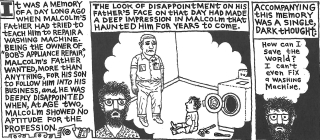 In approximately 18,000 words these three themes intertwine in a format of five chapters written as organized notes rather than full essays. Interspersed within are photographs, cartoons*, and book references, which make the story of my father more than memoir of one individual but of life in the Midwest circa 1980. My Father’s Letters further defines a path that others may want to consider exploring, as they ponder what they should be doing with all this extra time on their hands.
The Author
Murray Browne is author of two books, The Book Shopper: A Life in Review (2009) published by Paul Dry Books and Down & Outbound: A Mass Transit Satire (2016) by Muted Horn Communications. He is also co-author of Understanding Search Engines: Mathematical Perspective (2005) published by the Society of Industrial and Applied Mathematics. Since 2019, he has owned and operated Destination: Books a popup book stall in Atlanta and since 2008 he has edited The Book Shopper blog. You can contact him directly at murray.browne905 AT gmail.com.
*Excerpted from the graphic novel MacDoodle St. (NY Review Comics-2019). ©️1978 & 2019 Mark Alan Stamaty. Reprinted with permission. I also have obtained the rights for the book cover art “You Can’t Lay Down your Memory Chest of Drawers”, 1991, fabricated 2008. Tejo Remy (Dutch Born 1960). High Museum of Atlanta.
https://bookshop.org/widgets.js —– EXTENDED BODY: —– EXCERPT: —– KEYWORDS: —– ——– AUTHOR: Murray Browne AUTHOR EMAIL: murray.browne905@gmail.com TITLE: Bookstore Cinema STATUS: Publish ALLOW COMMENTS: 1 CONVERT BREAKS: wysiwyg ALLOW PINGS: 0 BASENAME: bookstore-cinema CATEGORY: Film UNIQUE URL: https://thebookshopper.typepad.com/the_book_shopper_atlantad/2022/07/bookstore-cinema.html DATE: 07/14/2022 09:11:56 AM —– BODY: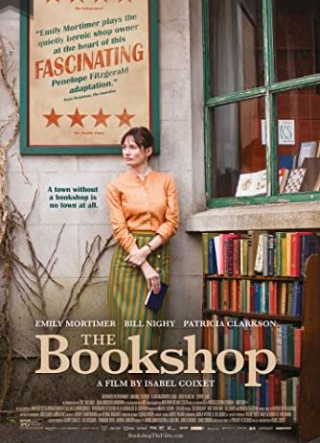 I recently watched two motion pictures about bookstores: The Bookshop (2017) about a war widow Florence Greer (played by Emily Mortimer) who opens a small bookstore at a seaside village in England in the 1950s and the documentary Hello, Bookstore (2022) featuring owner Matthew Tannenbaum who fights to keep his Lenox, Massachusetts business afloat during the pandemic.
Both films romanticize bookstore owners, but there is no love interest to drive the plot (like bookish movies such as Notting Hill or You’ve Got Mail), but Greer and Tannenbaum love books and the written word. Their passion is infectious with many of the townspeople appreciating their expertise. But still, as everyone knows the bookselling business is hard and the financial rewards are almost nonexistent (like blogging).
Further complicating matters for Greer is a wealthy dowager (Patricia Clarkson) who wants the landmark house where Greer has her shop repurposed for an arts center (though there is water in the basement —not so good for books?) Greer becomes friends with an elderly, passionate book reader (Bill Nighy) and upon his recommendation, Greer purchases 250 copies of Vladimir Nabokov’s Lolita. This seems like a big order of literary porn for a small fishing village, but publishers back then probably had more generous return policies.
Hello, Bookstore
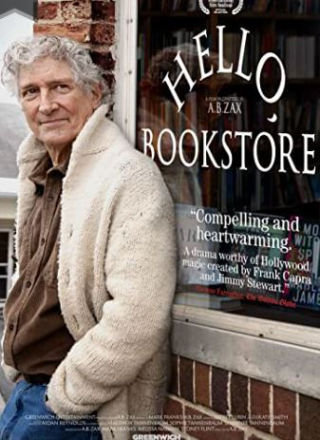 The pandemic poleaxed Tannenbaum’s business especially since he thrived on connecting books to readers as they browsed with violin and classical guitar music gently dominating the soundtrack. You could also get a glass a wine at the adjacent Lit Bar, as long as you don’t use a book as a coaster, but COVID-19 changed all that.
What makes the movie interesting is that the director A. B. Zax started making the film before the pandemic when business was normal. Thus, the story takes a dramatic turn when Tannenbaum is forced to take orders by phone or from his doorstep. He will not allow his customers to come inside and browse. The film juxtaposes the pandemic days with the non-pandemic days. These are tough times for Tannenbaum and his business, but fortunately in Lenox there aren’t any snooty dowagers making his life extra miserable.
Enter the Blog Time Machine
Both films are enjoyable, but I wish I could have watched them in a room of bibliophiles wearing Too-many-books-and-not-enough-time T-shirts. That used to happen. Check out this blog’s very first (very raw looking) posting on November 29, 2008 when I reviewed the 2008 documentary Paperback Dreams about the trials and tribulations of two independent bookstores in the San Francisco area. About 70 people gathered at the then Push-Push Theatre in Decatur to watch the movie followed by a spirited discussion afterwards.
(Insert nostalgic sigh here.)
—– EXTENDED BODY: —– EXCERPT: —– KEYWORDS: Movies about bookstores, Hello Bookstore, Matthew Tannenbaum, Emily Mortimer, Paperback Dreams, films about bookstore, The Bookshop —– ——– AUTHOR: Murray Browne AUTHOR EMAIL: murray.browne905@gmail.com TITLE: Inside Grant’s Tome STATUS: Publish ALLOW COMMENTS: 1 CONVERT BREAKS: 0 ALLOW PINGS: 0 BASENAME: inside-grants-tome CATEGORY: Book Reviews CATEGORY: Civil War Books UNIQUE URL: https://thebookshopper.typepad.com/the_book_shopper_atlantad/2022/06/inside-grants-tome.html DATE: 06/15/2022 09:11:17 AM —– BODY:Our book group has just finished reading Ron Chernow’s voluminous biography Grant (2017), which illuminated a period of American history that we knew little about. Chernow uses the life of Ulysses S. Grant (1822-1888) to give us perspectives on the Mexican War, the coming storm between the North and the South, the Civil War, and the continued strife and violence against blacks who were denied their full rights for decades after the war.
Heretofore, Grant was perhaps best known for two things: the Union General who defeated Robert E. Lee ending the Civil War only because he had superior numbers and resources and secondly, as the two-term 18th President of the United States whose administration was embroiled in corruption and scandal.
Chernow dispels both of these harsh judgements. Although in the early part of his life “Grant had been a failure, battered by life at every turn,” his life changed as dramatically as if it were a fairytale. An 1843 graduate of West Point Grant served in the Mexican War but left the military in 1854 under duress. As an unsuccessful businessman mostly because he was susceptible to being duped, he was barely able to support his family. Suffering from alcoholic binges did not make things any easier. When the Civil War broke out in 1860, he was a shopkeeper in Galena, Illinois. Eight years later he was a war hero and President of the United States.
General Grant
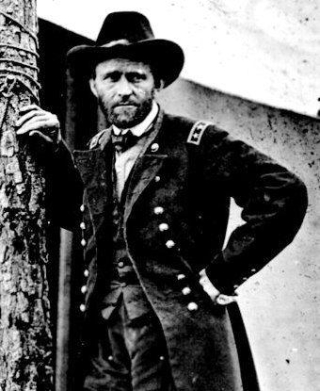 Unlike Lee who was tactician in battle, Grant was a strategist who led the Union to early victories at Fort Donelson, Fort Henry, (Shiloh not so much) and then went on to capture Vicksburg in 1863—a campaign rated by military historians “a masterpiece, the preeminent campaign waged by any general during the war.” His army suffered horrible losses against Lee in Virginia in the summer of 1864, where he was called “Grant the Butcher” by northern critics. Eventually he cornered Lee in an untenable defensive position that ultimately led to the end of the war. Chernow writes:
“Grant was the strategic genius produced by the Civil War. He set clear goals, communicated them forcefully, and instilled them in his men. While Lee stuck to Virginia, Grant grasped the war in its totality, masterminding the movements of all Union armies (including Sherman’s). It was Grant who best apprehended the strategic interactions of the eastern and western theatre.”
President Grant
Unfortunately, the corruption and scandal of Grant’s presidency overshadowed his relentless efforts to give newly freed blacks not only the right to vote, but the ability to do so without risking their lives. Chernow does not gloss over the scandals, but he establishes that it wasn’t Grant who was corrupt himself. But Grant had major flaw in trusting the wrong people who took advantage of him throughout his life (unlike his alcoholism which he controlled through total abstinence).
An abolitionist before the war (more so than Abraham Lincoln) Grant was a fervent believer that blacks should be able to vote without intimidation, hold office and during his first term he enacted laws to strengthen the rights to vote. He used Federal troops to disembowel the nascent Ku Klux Klan “unquestionably the worst outbreak of domestic terrorism in American History” writes Chernow, and he created the Department of Justice to indict and convict over a thousand Klansman. (A reincarnation of the Klan was formed in the 1920s.) In other words, there was only a short period of reprieve before the white Southerners and Democrat power structure formed new militant groups. This coupled with Northern “Reconstruction fatigue” led the evaporation of voting rights for blacks. (During Lincoln and Grant’s tenure it was the Republicans who were the champions of Reconstruction and securing the rights of blacks. The Democrats where the party of the white Southerners who had no intention to succumbing to new order proposed by Lincoln.)
Chernow maintains that it would be another 96 years after Grant (1968) that another fair election would be held in many parts of the South. “Slavery had been abolished,” writes Chernow, “but it had been replaced by a caste-ridden form of second-class citizenship for southern blacks, and that counted as a national shame.”
Post Presidency
After serving two terms in office Grant made a two-year world tour, but upon his return stateside failed to win the Republican party’s nomination in 1880. At the end of his life, he was swindled in a Ponzi scheme that left him penniless. Moreover, he soon he was in declining in health from throat cancer. Fortunately, an important writer and publisher of the time—Mark Twain—understood that he could restore Grant’s wealth by publishing the general’s memoirs. While in intense pain, Grant finished his two volume Personal Memoirs just a month before his death and it eventually sold 300,000 copies which provided Grant’s devoted wife Julia with generous royalties.
More About the Book Group
In the spirit of transparency. our book group—consists of just two people (easy to schedule get togethers and everyone reads the book!) and it began in the summer of 2020 as a way for two college chums and new retirees to “support” each other to read challenging books and avoid inflicting our “intellectual” chatter on loved ones. Our first book was Thomas Pynchon’s Gravity’s Rainbow and have just finished Chernow. We keep notes, ramblings, observations, (sometimes irreverent like a comparison between Ulysses S. Grant and Donald Trump) on our discussion board available here (but you must scroll down).
And you can order the book Grant from our blog partner Destination: Books.
https://bookshop.org/widgets.js —– EXTENDED BODY: —– EXCERPT: —– KEYWORDS: Ron Chernow, Ulysses S. Grant, Reconstruction —– COMMENT: AUTHOR: Cal Gough EMAIL: calgough@bellsouth.net IP: 108.82.142.12 URL: http://atlantareader.wordpress.com DATE: 06/15/2022 10:13:32 AM Interesting, informative post: thank you. My partner wants to read this book, and if he enjoys it as much as you did, I may plunge into it myself. —– ——– AUTHOR: Murray Browne AUTHOR EMAIL: murray.browne905@gmail.com TITLE: Professional Book Shopping STATUS: Publish ALLOW COMMENTS: 1 CONVERT BREAKS: wysiwyg ALLOW PINGS: 0 BASENAME: professional-book-shopping CATEGORY: Books as Art as Books CATEGORY: Bookstores UNIQUE URL: https://thebookshopper.typepad.com/the_book_shopper_atlantad/2022/05/professional-book-shopping.html DATE: 05/24/2022 03:12:02 PM —– BODY: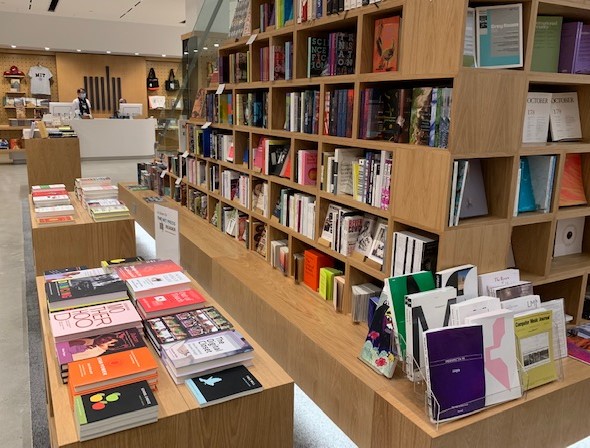
 I was in Boston earlier this month visiting my older daughter Cynthia, which included weeding her book collection. This labor of love took plenty of time, but I did manage to visit my favorite Boston area bookstore – the MIT Press Bookstore.
Considering the past postings in 2010, 2016 and 2017, this has not been my first visit. We have a history.
But this time was markedly different as I entered their new store, which has returned to Kendall Square after a year shutdown during the pandemic. This time I was a professional book shopper representing the interests of my Atlanta-based book pop-up Destination: Books, which has entered its second full year bookselling. (Destination: Books will be at the Freedom Farmer’s Market at the Carter Center on Saturday morning, May 28th, with books on gardening, sustainability, food culture, and anything else eclectic that interests us).
At MIT Press Bookstore, I know I will always serendipitously find new books. My browsing was a great excuse to try out some new publishers like the Kew Publishing (UK) or AdventureKeen (Birmingham AL), but the oddest book that came back with me wasn’t a book – it was an issue of the LA+ Interdisciplinary Journal of Landscape Architecture published by the University of Pennsylvania Stuart Weitzman School of Design.
Reimagining Central Park
 The theme of Issue #10 was based on the fictional premise that in 2018 Central Park in New York was completely destroyed by eco-terrorists. A call went out for designers to reimagine New York’s Central Park to submit their proposals. The issue contains the winning entries, the honorable mentions and a few Salon des Refusés, described by the editors as “entries that caught the jury’s attention and imagination that did not make the final cut.”
As you would expect, all the entries are gorgeously printed in full color. I could not begin to do these presentations justice and I doubt the publishers would appreciate me trying. Fortunately, you can get a sense of the Iconoclast issue by going there directly.
At Destination: Books we are not in the same league as the MIT Press (though we do sell some of their books like Electrify: An Optimist's Playbook for Our Clean Energy Future), but our goal is the same: Showcasing books that are worth "adventuring" across the country or at least the city to hold in your hands.
—– EXTENDED BODY: —– EXCERPT: —– KEYWORDS: MIT Press Bookstore, Book stores Boston, Electrify, LA Plus —– ——– AUTHOR: Murray Browne AUTHOR EMAIL: murray.browne905@gmail.com TITLE: Readers at an Exhibition STATUS: Publish ALLOW COMMENTS: 1 CONVERT BREAKS: wysiwyg ALLOW PINGS: 0 BASENAME: readers-at-an-exhibition UNIQUE URL: https://thebookshopper.typepad.com/the_book_shopper_atlantad/2022/04/readers-at-an-exhibition.html DATE: 04/29/2022 07:38:30 AM —– BODY:
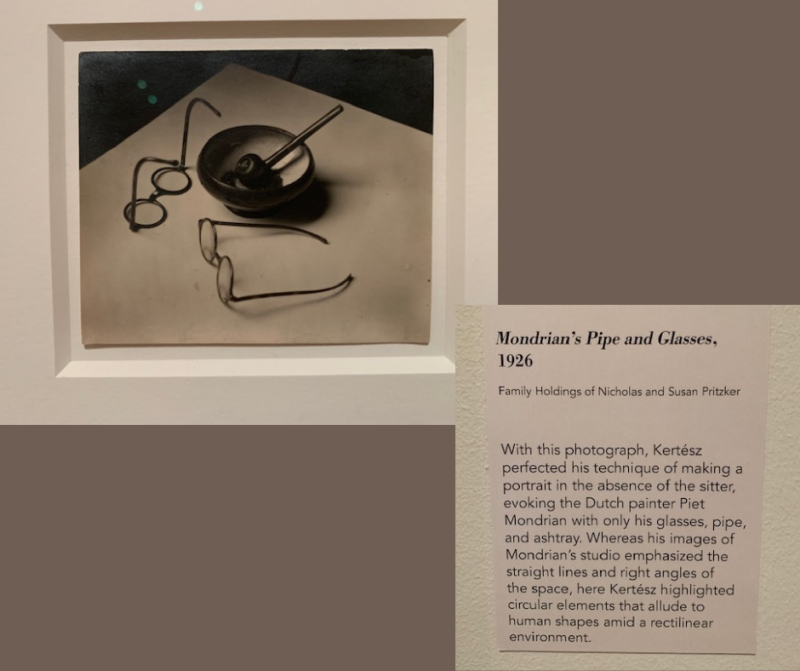
 Currently on exhibit at The High Museum of Art in Atlanta is Postcards from Paris by photographer André Kertész (American, born Hungarian 1894 – 1985). Included in the exhibit are a couple of reading-related photographs. One is of Parisian gallery owner Jan Sliwinsky in his study (circa 1926-27) shown here at the right.
Another notable photograph is that of Dutch painter Piet Mondrian's glasses, which we all know are needed for reading. And the pipe too. Can't read without the pipe.
Kertész on Reading
But what really connects Kertész to books is On Reading (2008), a collection of photographs taken between 1915 and 1970. The book was originally published in 1971, but was it restored and reissued in 2008 (and available online at Destination: Books). It is a pictorial paean to reading with photographs of engaged readers on city rooftops, on crowded streets, and browsing at book shops from Paris to New York.
Note: The Kertész exhibit is at the High until May 29th. It looks much better in person than online, though I will warn you that the "postcards" are sometimes the size of postage stamps.
—– EXTENDED BODY: —– EXCERPT: —– KEYWORDS: André Kertész, High Museum of Art in Atlanta, On Reading, Piet Mondrian, —– ——– AUTHOR: Murray Browne AUTHOR EMAIL: murray.browne905@gmail.com TITLE: Shiloh Anniversary STATUS: Publish ALLOW COMMENTS: 1 CONVERT BREAKS: wysiwyg ALLOW PINGS: 0 BASENAME: shiloh-anniversary UNIQUE URL: https://thebookshopper.typepad.com/the_book_shopper_atlantad/2022/04/shiloh-anniversary.html DATE: 04/07/2022 07:54:31 AM —– BODY: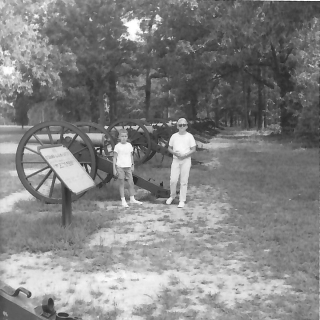 April 6th and 7th is the 160th anniversary of the Battle of Shiloh that was fought in 1862. In this 1965 snapshot my older brother Neil and I are standing in front of Ruggles Battery near the Hornet's Nest. Our parents took us boys on a road trip to Shiloh, Lookout Mountain, Chickamauga and Atlanta. Little did I know then I would end up living in Atlanta,
This trip was the beginning of my lifelong interest in history. Last year, I wrote an essay for the Tropics of Meta about Drew Gilpin Faust's This Republic of Suffering: Death and the American Civil War, which established that the two-day battle with almost 25,000 casualties was unlike anything seen before on the North American continent. The premise of the book is that the Civil War changed America's attitudes towards death. The essay draws a comparison between Faust's book and the struggles this country has coming to terms with the nearly one million deaths from COVID-19.
—– EXTENDED BODY: —– EXCERPT: —– KEYWORDS: Drew Gilpin Faust, This Republic of Suffering, Shiloh, pandemic deaths —– ——– AUTHOR: Murray Browne AUTHOR EMAIL: murray.browne905@gmail.com TITLE: Remembering O’Rourke STATUS: Publish ALLOW COMMENTS: 1 CONVERT BREAKS: wysiwyg ALLOW PINGS: 0 BASENAME: remembering-orourke UNIQUE URL: https://thebookshopper.typepad.com/the_book_shopper_atlantad/2022/03/remembering-orourke.html DATE: 03/28/2022 03:29:20 PM —– BODY:Some may remember political satirist and journalist P.J. O'Rourke who died last month as one of the co-editors of The National Lampoon High School Yearbook, or as the author of Parliament of Whores (1991), or his appearances on the NPR radio show Wait, Wait… Don't Tell Me! But when I think of him, I think of this piece from decades ago, which I kept stashed in my Witty Stuff file.
—– EXTENDED BODY: —– EXCERPT: —– KEYWORDS: P.J. O’Rourke —– ——– AUTHOR: Murray Browne AUTHOR EMAIL: murray.browne905@gmail.com TITLE: Life Under Totalitarianism STATUS: Publish ALLOW COMMENTS: 1 CONVERT BREAKS: wysiwyg ALLOW PINGS: 0 BASENAME: life-under-totalitarianism CATEGORY: Book Reviews CATEGORY: Bookstores UNIQUE URL: https://thebookshopper.typepad.com/the_book_shopper_atlantad/2022/03/life-under-totalitarianism.html DATE: 03/08/2022 09:34:47 AM —– BODY:
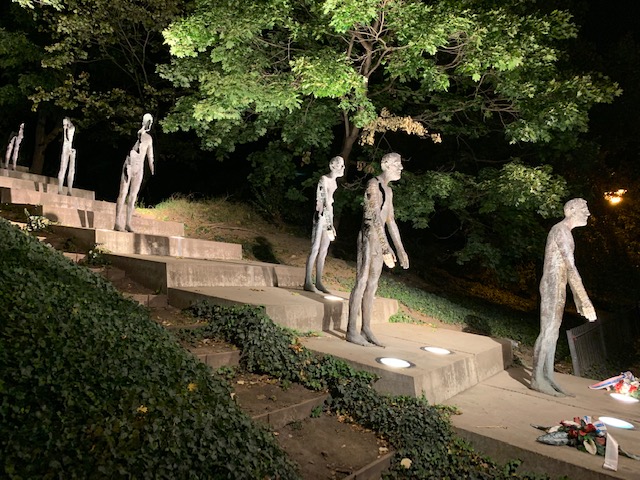
For a better understanding for what life is like under totalitarianism (and what the Ukrainians are fighting for/against) check out the works of Josef Škvoreckؘý (1924-2012). I just finished reading two of his novellas Emὃke (1963, tr. 1977) and The Bass Saxophone (1967, tr. 1977), which are combined in a single volume with an introductory piece "Red Music." Škvoreckؘý played saxophone with a jazz group Red Music growing up in Czechoslovakia. In 1968, the Soviets removed the Czech reformist government with an invasion of a half-a-million troops, crushing the budding Prague Spring. Škvoreckؘý and his wife emigrated to Canada where he became a professor and started a publishing company that made the works of banned Czech writers available throughout the world and to his fellow countryman.
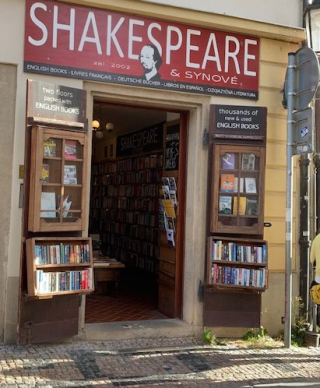 This is not the first time I have read the prolific Škvoreckؘý. When my partner Denise and I were in the Czech Republic in the fall of 2019 on vacation, I took a copy of his short detective novel The End of Lieutenant Bovurka (1975) with me. After reading it and I picked up a copy The Return of Lieutenant Bovurka (1991) at the English language bookstore Shakespeare near the Franz Kafka Museum. In each book the melancholic detective Bovurka must walk a tightrope of solving crimes and resisting the Communist regime. These books reinforced the sentiment expressed by our middle-aged tour guide over drafts of Pilsner Urquell as he described the suppression in Czechoslovakia under the Soviet Union in the 1970s and 1980s.
The Memorial to the Victims of Communism (shown above) in the Lesser Town Area of Prague serves as a reminder who disappeared during the Soviet regime. 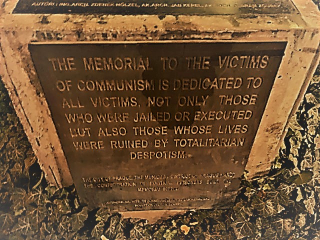
Last fall when I went to Germany (the former East German cities of Cottbus and Dresden) to visit my older daughter Cynthia, I took a copy of Škvoreckؘý’s most well-known work the voluminous The Engineer of Human Souls (1977, tr. 1984) The narrator Danny Smiricky (considered Škvoreckؘý’s alter-ego in many of his novels – like Philip Roth’s Zuckerman) has emigrated from Czechoslovakia and is a professor in Toronto. Smiricky mixes his recollections of living under German occupation with ex-pats in Canada wrestling with their guilt in leaving Europe. Because of all the characters and the time switches, the book is a challenging read and I’ll admit I did not finish it. (More my shortcoming than the book’s).
Despite the grim settings of oppression under totalitarian regimes, there is an element of humor/absurdity in his many of writings and in the links below there is a prime example from The Bass Saxophone.
Related Links
A lengthy tribute to Škvoreckؘý from Paul Wilson in the Guardian who translated The Engineer of Human Souls to English. (Its title refers to Stalin's description of writers),
A Škvoreckؘý passage from the introduction to The Bass Saxophone listing the Nazis 10 Rules to Combat Jazz. Note: The best way to buy this out-of-print book is through Alibris. Make sure you get the copy that includes the Introductory "Red Music". The easiest way to get the correct copy is type the ISBN number 0-671-55681-9 in the search bar at Alibris Books.
And The Book Shopper Blog has a couple of postings that mention similar books. “In Best Books Read of 2019"I write about sending a book about Trump’s impending impeachment over the Ukraine scandal to then Georgia Senator David Perdue. Another posting "Tyranny, Voting and Making Love for the Last Time" is a shoutout to Timothy Snyder’s book On Tyranny (2017). (Since then, a graphic version of the book is available at Destination: Books, a reluctantly proud blog sponsor.)
Be vigilant, especially here in Georgia where they have made it much more difficult to vote.
—– EXTENDED BODY: —– EXCERPT: —– KEYWORDS: Josef Škvoreckؘý, Skvorecky, The Bass Saxophone, The Engineer of Human Souls, Emὃke, Timothy Snyder, On Tyranny —– ——– AUTHOR: Murray Browne AUTHOR EMAIL: murray.browne905@gmail.com TITLE: Two Different Travel Books STATUS: Publish ALLOW COMMENTS: 1 CONVERT BREAKS: wysiwyg ALLOW PINGS: 0 BASENAME: two-different-travel-books CATEGORY: Book Reviews UNIQUE URL: https://thebookshopper.typepad.com/the_book_shopper_atlantad/2022/02/two-different-travel-books.html DATE: 02/21/2022 09:07:37 AM —– BODY: This month I have read two travel books, neither of which you would find on the shelf next to your Fodors, Lonely Planets, or Anthony Bourdains. Both books are not your normal travel fanfare.
Norman Lock’s A Boy in His Winter: An American Novel (2014) is an imaginative revisiting of Mark Twain’s The Adventures of Huckleberry Finn. In Part One (July 2, 1835 to August 29, 2005), the narrator Huck Finn travels down the Mississippi River with his companion the slave Jim, but the two are stuck in a time warp where they don’t age even though the voyage itself lasts for decades. Off the river, time has marched on, as Huck and Jim witness a Civil War battle at Vicksburg, and later meet a veteran of the Great War. Tom Sawyer makes a few cameo appearances along the way but unlike Huck or Jim, Tom grows older.
While Huck and Jim are traveling companions, they are not close friends because of the chasm of race. Jim knows that a black man in the South lives in peril and it is something that the youthful Huck in his ignorance doesn’t understand. In one instance, Huck asks:
“ 'Jim, do you believe in free will?'
'Is there a more ridiculous question to ask a slave?' he said, laughing.
And for a moment I hated him."
In the second part (August, 29, 2005 to September 11, 2005) Huck arrives at the mouth of the river south of New Orleans the same day as hurricane Katrina. His raft is gone (and so is Jim) and he joins a three-man crew of a charter boat who are running drugs from New Orleans up the Atlantic coast during the post-Katrina chaos. Lock is able to capture how a thirteen-year-old boy views the 21st century, who is both innocent yet worldly enough to survive. In Part 3 (September 12, 2005 to March 15, 2077) Huck, since he is no longer tied to the river, is beginning to age and the old Huck reflects more on his young life. Hence the title A Boy in His Winter.
It's an unusual premise, and I am usually skeptical of derivative works (like sequels, prequels), but Lock who has reimagined several other American classics in his The American Novel series (all with Bellevue Literary Press) writes well taking on a time-traveling Huckleberry Finn adventure.
Remembering Turkey
 The other book is Michael Pereira’s Mountains and a Shore: A Journey Through Southern Turkey. Originally published in 1966, Paul Dry Books republished the book in 2015. In this thin travelogue, Pereira combines the history of the country with his solo travels along the southern Mediterranean coastline and Taurus Mountains. Because Pereira speaks Turkish and insists on traveling the way that the locals do: by foot, by donkey if necessary, and the most common mode of transportation— the bus. He writes:
“…the role played by buses is of immense importance, and I came away with nothing but admiration for them and their drivers. For they have to contend with the trains, bridges washed away or simply non-existent, and, by no means the least, other Turkish drivers.
To help them overcome these hazards they very reasonably enlist the help of the Almighty, and in the space above the windscreen is always written some brief prayer or exhortation. Some of these are pious rather than comforting, such as: ‘May God protect you!’ and others, to my mind, needlessly eschatological: ‘Forget not thy God!’… The most popular of all, however, is the single word ‘Maşallah’, which used in much the same way as a Spaniard uses the sign of the cross to avert danger.”
You feel every bump in the road as he travels the mountainous swerving roads often overlooking the Mediterranean. Pereira’s purposely traveled to an area of a country that he believed would be much more developed in the upcoming decades.
 His descriptions of the kebabs, and the centuries-old churches and muezzins’ calls to prayers from the minarets reminded me of my trip to Turkey with my partner Denise in 201o. Books like Pereira’s expand what I normally think of as a travel book. Sometimes you read a travel book with a purpose to plan an upcoming trip or to be a companion while traveling, but Mountains and A Shore, provided a respite from our daily routine by reliving memories of our trip to this fascinating country. (I cannot forget our visit to the Hagia Sophia and the pickle shop in Istanbul.)
It is just as Dave Mason wrote in the Forward to Pereira’s book: “All travel is time travel.”
Both books are available at the Destination: Books Book Shopper portal. When you purchase an independently book through site, we earn an affiliate commission.
—– EXTENDED BODY: —– EXCERPT: —– KEYWORDS: Norman Lock, Bellevue Literary Press, A Boy in His Winter, Mountains and A Shore: A Journey Through Southern Turkey, Michael Pereira —– ——– AUTHOR: Murray Browne AUTHOR EMAIL: murray.browne905@gmail.com TITLE: Novel Reminders STATUS: Publish ALLOW COMMENTS: 1 CONVERT BREAKS: wysiwyg ALLOW PINGS: 0 BASENAME: novel-reminders UNIQUE URL: https://thebookshopper.typepad.com/the_book_shopper_atlantad/2022/02/novel-reminders.html DATE: 02/01/2022 08:46:44 AM —– BODY:
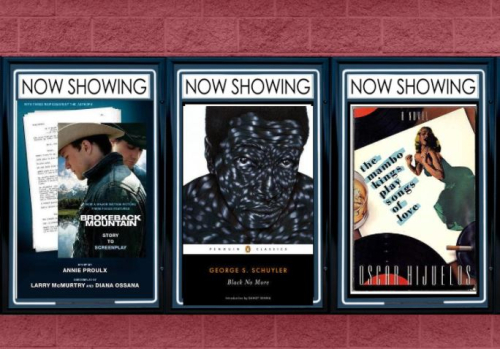
I am a little sheepish to admit in a book blog that I have spent many winter evenings lately watching television or more specifically, watching movies on television. Denise and I haven’t been to the cinema in over two years (sigh). To fill that void, we have been streaming motion pictures that are receiving critical attention. Most of you have probably heard of or watched The Power of the Dog, Passing, and Being the Ricardos. While watching these offerings I was reminded of passages from related books. Some of these books I read a while ago, which is a credit to the strange selective power of reading and memory.
Larry McMurtry and Jane Campion
Based on a 1967 Tom Savage novel of the same name, Jane Campion’s The Power of the Dog is the story of two ranching 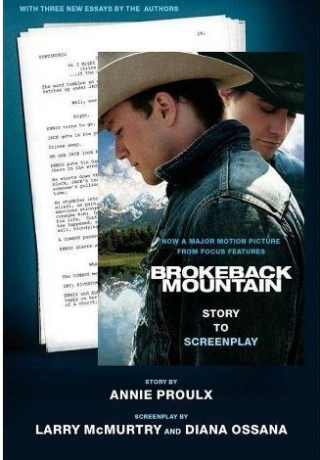 brothers in 1920s Montana. One is a more refined brother (Jesse Plemons) who marries a widow (Kirsten Dunst) and brings her and her sensitive son (Kodi Smit-McPhee) to live with them on the ranch that he shares with his rawhide tough, a man’s-man brother played by Benedict Cumberbatch. (He's right up there with Brad Pitt in Legends of the Fall.) But underneath the grit, the chaps, and the smell of horses, Cumberbatch hides his homosexuality which adds to the tension between him and the widow’s son.
I reminded of Ang Lee’s Brokeback Mountain, the 2005 movie about a rodeo cowboy (Jake Gyllenhaal) and ranch hand (Heath Ledger) who fall in love with tragic, sorrowful results. (Anne Hathaway plays Gyllenhaal’s wife; Michelle Williams is Ledger’s) The story behind the movie is best told in Brokeback Mountain: Story to Screenplay (2007), which includes Annie Proulx’s original 1997 short story that appeared in The New Yorker. It includes the screenplay and essays by Proulx and the screenwriters Diana Ossana and Larry McMurtry.
For those wishing to go back further, read McMurtry’s piece “Eros in Archer County” found In a Narrow Grave Essays on Texas (1968). He is no stranger to writing candidly about the range of the sexual mores of the post-World War II Old West. (With the exception of Lonesome Dove, McMurtry is a better essayist than novelist.)
Passing and George Schuyler
 Passing, based on the 1929 Nella Larsen novel, is set in 1920s New York, when Irene (Tessa Thompson) meets an old girlfriend Clare (Ruth Negga) who passes as white. Irene has misgivings about rekindling their friendship. When Clare asks Irene if she can join her at the Negro League Charity Dance, she explains to Irene that she has a longing. “I so much want to be around Negroes again. Talk with them. Hear them laugh.”
Coincidently this same sentiment appears in George Schuyler’s 1931 novel Black No More which I read just last year. (Isabell Wilkerson recommended the book in an interview.) In Schuyler’s biting satire Black people are able to get an operation that allows people to bleach their skin white—and is advertised as a new way to "solve the American race problem." However, the strategy is flawed as Max the main character who had undergone the Black-No-More operation begins to have remorse for his decision:
"He (Max) was not finding life as a white man the rosy existence he had anticipated. He was forced to conclude that it was pretty dull and that he was bored. As a boy he had been taught to look up to white folks as just a little less than gods’ now he found them little different from the Negroes, except that they were uniformly less courteous and less interesting.
Often when the desire for the happy-go-lucky, jovial good fellowship of the Negros came upon him strongly, he would go down to Auburn Avenue (in Atlanta) and stroll around the vicinity, looking at the dark folk and listening to their conversation and banter."
The Larsen and Schuyler books were published just two years apart.
Lucy, Desi and Oscar Hijuelos
While watching the dynamics between Lucille Ball and Desi Arnaz, in Being the Ricardos, a passage from Oscar Hijuelos’ 1989 novel, The Mambo Kings Play Songs of Love came immediately to mind. Like the movie, there are some behind the scenes description of the I Love Lucy show in Hijuelos book and impressions. Mambo Kings centers on two brother, Cesar and Nestor Castillo, who emigrate from Cuba to New York City in 1949. Both are musicians and their band The Mambo Kings achieve a moderate amount of success during the golden era of mambo. They even land a guest spot on I Love Lucy.
In one scene Desi Arnaz confides to the Castillo brothers his frustration with Lucy:
If you knew what I have to go through every day with this woman. These American women are enough to drive you nuts! My mother told me a million times: Ricky, never marry an American woman unless you are looking for one big headache. And she was right, I should’ve married that girl back in Cuba! Now there was a quiet girl who never bothered me, who knew where her bread was buttered. She wasn’t crazy! She always left me alone, you know what I mean, compañeros?
Whether it be a movie, a novel, or a television program Desi and Lucy’s marriage was complicated.
BTW, they did make a movie based on the Mambo Kings starring Armand Assante and Antonio Banderas. Judging from the clip below it looks like a strong candidate for our next movie night or as a soundtrack for a house party.
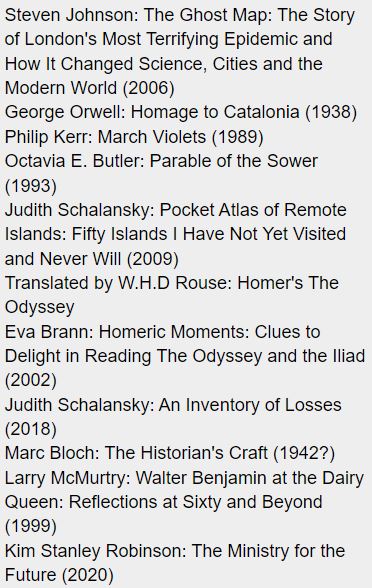
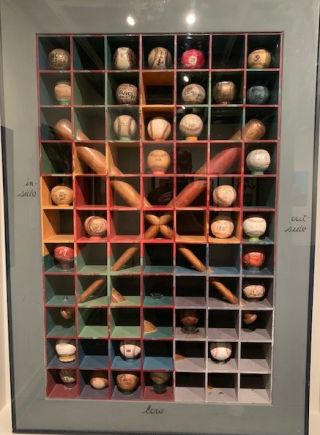 I usually read more baseball books in the off-season than during the summer months. Since the players and the owners are currently at an impasse with no end sight, my needs are even more pronounced. Moreover, baseball books provide me with more relaxed material in contrast to the intense fare that I have been reading lately. Books about climate (the eco-anthology All We Can Save), an explanative history of the rise of nationalism (Age of Anger) and the story of the London cholera epidemic of 1854 (The Ghost Map) have been interesting, but unsettling. None of these books are something you want to read in the evening near bedtime. That’s where a calming book of old-timey baseball stories can be most appreciated. And I miss baseball.
My solution has been Baseball: When the Grass Was Real (1976), by writer-poet Donald Honig who travelled around the country collecting the narratives of the men who played baseball in the 1920s, 30s, and 40s. Earlier Lawrence Ritter put together a similar book, The Glory of the Times (1966), which gathered oral histories of players who played in the early part of the 20th century. (Honig acknowledges Ritter’s efforts in his Introduction). To those viewers of the Ken Burns' documentary, some of the players have familiar sounding names ( e.g., Lefty Grove, Bob Feller). Honig also includes less familiar but melodic names (Big Johnny Mize, Max Lanier) made famous in Dave Frishberg’s musical paean to baseball players, "Van Lingle Mungo".
Honig allows the players to speak in their own vernacular taking advantage of their storytelling skills. But in addition to the 18 players selected, these players also include their personal anecdotes of being teammates and contemporaries of Hall of Famers, Ted Williams*, Joe DiMaggio, Dizzy Dean and Jackie Robinson to name but a few. Some notable stories include:
Billy Herman was a Hall of Famer who played from 1931- 47 mostly for the Chicago Cubs. He was an eyewitness to Babe Ruth's pointing to the centerfield stands and calling his shot before hitting a home run in the 1932 World Series. But from his position at second base Herman confirms that it is a great story but incorrect, because the Cub pitcher that day was the extremely competitive Charlie Root. Herman says that Ruth was pointing two fingers at Root (not at centerfield) and that Root only had two strikes on him. “But he didn’t point," says Herman," “Don’t kid yourself. I can tell you just what would have happened if Ruth had tried that—he would have never got a pitch to hit. Root would have had him with his feet up in the air. I told you Charlie Root was a mean man on that mound.”
Herman also was an eyewitness to boxing match-brawl between Ernest Hemingway and his teammate Hugh Casey when they visited the novelist's mansion in Havana during Spring Training in 1942.
James “Cool Papa” Bell, was a star in the Negro Leagues for nearly two decades but was kept out of the majors because of the color barrier. Bell was a contemporary of Josh Gibson and Satchel Paige and he eventually was inducted into the Hall of Fame in 1974. He describes his experiences in the Jim Crow South that sound all too familiar:
"When we played the Birmingham Black Barons in their park, there were always lots of whites in the crowd, but they were separated by a rope. You could be sitting right next to a white man, but that rope was always there. That was the system they had in those days. That’s what they called states’ rights. States’ rights doesn’t mean much to the Negro. You don’t get justice with states’ rights. Which is a bad thing to happen.”
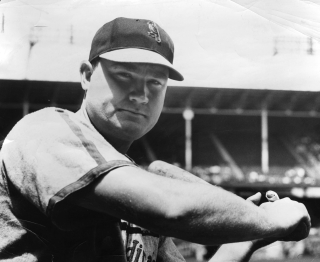
Big Johnny Mize, grew up in Demorest, Georgia and played with the St. Louis Cardinals' Gas House Gang in the 1930s. The Cardinals general manager then was the famous Branch Rickey who later signed Jackie Robinson to the Brooklyn Dodgers breaking the color barrier in the majors in 1947. (One of the chapters is on a lesser-known player Clyde Sukeforth, who after his playing days scouted Robinson and literally introduced him to Rickey.) Mize didn’t think so much of Branch Rickey who low-balled Mize in contract negotiations, which was indicative of the complete control owners had over the players' livelihoods. Mize spent the last five years of his career as a pinch-hitter for the New York Yankees, playing in a string of World Series for the World Champions. He was inducted into the Hall of Fame in 1981.
Honig saves arguably his best for last – the story of Brooklyn Dodger Pete Reiser, who probably would have been a Hall of Famer had he not been injury prone. At his first Spring training, Reiser’s manager Leo Durocher, was the first to recognize Reiser’s speed once bet $100 with Dodgers General Manager Larry MacPhail that Reiser could be beat the fastest man in the Dodgers organization in a foot race. Says Reiser:
“So here all of a sudden I’m running against the fastest guy in the Dodger organization, and the manager and the general manager are betting $100 on it. And all I’d wanted to do was come down there and work out in a big-league camp and mind my business.
Well, I did beat the guy. Yeah, by 10 yards."
We end this posting with a baseball lullaby, "Van Lingle Mungo" by Dave Frishberg:
P.S. The artwork at the top of the post is on display at the Baseball Hall of Fame in Cooperstown. The mixed media piece "Strike Zone" by Mike Ross was inspired by Ted Williams' book The Science of Hitting. The photograph of Johnny Mize is from the HOF archives. Thanks to my former teammate (college intramural basketball team) Tom Bowen for introducing me to this book.
—– EXTENDED BODY: —– EXCERPT: —– KEYWORDS: Donald Honig, Baseball When the Grass Was Reel, Johnny Mize, Pete Reiser, Cool Papa Bell, Billy Herman, —– ——– AUTHOR: Murray Browne AUTHOR EMAIL: murray.browne905@gmail.com TITLE: The GRSG 2022 – Reading Notes STATUS: Publish ALLOW COMMENTS: 0 CONVERT BREAKS: wysiwyg ALLOW PINGS: 0 BASENAME: grsg-reading-notes-2022 UNIQUE URL: https://thebookshopper.typepad.com/the_book_shopper_atlantad/grsg-reading-notes-2022.html DATE: 01/12/2022 03:29:10 PM —– BODY:The Gravity’s Rainbow Support Group (GRSG) began in June, 202o as a “reading group” of two people as a support mechanism to plow though Thomas Pynchon’s Gravity’s Rainbow (a book you should never try to read alone) during the pandemic. The GRSG took the challenge out of reading challenging books and provided a way to keep two now-retired college chums ( from Indiana University) Francis Walker of Winston-Salem, North Carolina and Murray Browne of Decatur, Georgia in touch. Basically, we decided to keep this good thing going.
This page is the third installment of our reading-discussion notes of books we assigned ourselves in 2022. Like in the pages past, (See Gravity’s Rainbow Support Group and Gravity’s Rainbow Support Group – 2021) it is full of favorite quotes and passages. Don’t expect coherent prose or well thought out arguments, but our musings may provide insights to your own understanding of these books.
First up:
The Age of Anger: A History of the Present by Pankaj Mishra
Thanks to our Kansas friend Bruce Woods, this book was recommended. We were left scratching our heads wondering why this book wasn’t already on our radar. Published in 2017, Mishra gives a wide-sweeping historical account explaining the paranoid hatreds that grip our world tracing its roots of the competing thoughts of Voltaire and Rousseau. Interesting that Rousseau became inspired on the road to visit Denis Diderot not unlike the apostle Paul blinded on the road to Damascus. Buckle up because Mishra provides plenty to think about:
Ressentiment
A major theme in the book, Mishra explains ressentiment on pages 13 and 14.
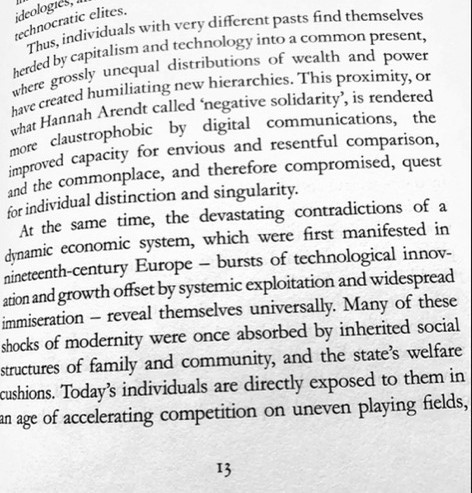
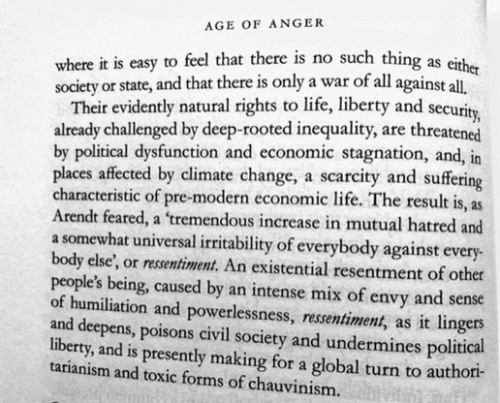
“But in between justice and ressentiment is a rich gray area where schadenfreude can serve a valuable purpose.”
Memorable passages
p. 41 – George Santayana ” (America) has always thought itself in an eminent sense the land of freedom even when covered with slaves.”
p.45 – “The easy availability of assault weapons in the United States was always likely to assist the privatization and socialization of violence.”
p.65 – “The appeal of democracy, broadly defined as equality of conditions and the end of hierarchy would grow to the paradoxical point where Fascists, Nazis and Stalinists would claim to be the real democrats realizing a despair principle of equality.” (Of course, this is true in 2022 as Republicans use the argument that they are preserving democracy as they block the Voting Rights Act and the John Lewis Bill)
This week in Georgia. On Monday (1/10/22) in the Georgia General Assembly praised UGA and predicted an upcoming victory over Alabama in the College Football Championship. My (Murray) reaction on Tuesday was “Now that the Georgia has won the National Football Championship it can get back to the business of suppressing voter’s rights.”

p.68 – Dostoyevsky and the dangers of the Crystal Palace, a glass and iron structure built by Joseph Paxton in 1851 in London. An embodiment of utopian future, but with acute dangers. (Kind of like Disney World)
P.80 – Blue collar Christians in the Rust Belt, post-communist Poland, Muslims in France push Victimhood.
From Francis
Page 90 –This one sounds a bit like social media and its overbearing effect on people.
“Everyone is tyrannized by the fear of other people’s opinion. The airs of politeness conceal a lack of fidelity and trust. Survival in the crowd seems guaranteed by conformity to the views and opinions of whichever sectarian group one belongs to. The elites engage meanwhile in their own factional battles and presume to think on behalf of everyone else.” –It continues–
Page 91 “Such a society where social bonds are defined by a dependence on other people’s opinion and competitive private ambition is a place devoid of any possibility of individual freedom.”
Page 98 – The top-down analogy is a good one—and it does a good job summarizing what a lot of us have felt from time to time about administrative no-nothings that issue dictates to those of us trying to get a job done:
“Voltaire was an unequivocal top-down modernizer, like most of the Enlightenment philosophes, and an enraptured chronicler in particular of Peter the Great.”
Page 56 – The following comment seems relevant since we discussed if Orwell was an ideologue or an idealist—this is a nice take on a dialogue being an ideologist—in which personal viewpoints serve to keep up one’s membership in a group.
“(Not accidentally, one of the philosophes, Helvetius, founded the modern theory of ideology: the notion that ideas express the conflicting interests of individuals or groups.)”
Page 90: – I liked this comment, because it talks about masks—which of course are the current rage in Paris—although not for fashion.
“Take for instance his epistolary novel Julie, ou La Nouvelle Héloïse (1761), whose socially outcast protagonist Saint-Preux is exactly the author’s own age. He arrives in glittering Paris to find in it ‘many masks but no human faces’.”
Page 107: – Finally, this is one of the authors sweeping generalizations (he tries to bury in parentheses) again anti-male and a bit over the top. The book editor should have tamped this one down a bit—but, maybe he is referring to India where maybe it is not that far off within certain subcultures….
“Any equality between the sexes, according to him, should be based on different roles in distinct domains of activity; and the demand for women to be educated like men, and increased similarity between the two sexes, would lessen the influence women have over men. (The rapid overturning of these entrenched prejudices in our time is one major source of male rage and hysteria today.)”
Some of the passages reminds Francis of the conservative writer Roger Scruton that seem to echo themes of the book:
- …Dealing with anger and resentment should not be seen along a liberal-conservative divide, rather they need to be viewed as emotions that can easily deteriorate if are put in place untampered as policies—which then become the enemy of all of us.
- The modern world gives proof at every point that it is far easier to destroy institutions than to create them. Nevertheless, few people seem to understand this truth – “Rousseau & the origins of liberalism,” The New Criterion (October 1998) wikiq
- Liberty is not the same thing as equality, and that those who call themselves liberals are far more interested in equalizing than in liberating their fellows. Roger Scruton “The Limits of Liberty,” The American Spectator (December 2008)
- Conservatism is a philosophy of inheritance and stewardship; it does not squander resources but strives to enhance them and pass them on. “Stand up for the real meaning of freedom,” – The Spectator (January 2014)
- Never in the history of the world have there been so many migrants. And almost all of them are migrating from regions where nationality is weak or non-existent to the established nation states of the West. They are not migrating because they have discovered some previously dormant feeling of love or loyalty towards the nations in whose territory they seek a home. On the contrary, few of them identify their loyalties in national terms and almost none of them in terms of the nation where they settle. They are migrating in search of citizenship which is the principal gift of national jurisdictions, and the origin of the peace, law, stability and prosperity that still prevail in the West.
Second session, Monday, January 31, 2022
“There is nothing new in the world except the history you do not know.” — Harry Truman
This quote seems most appropriate because Mishra shows us clearly that the arguments, the patterns of tyranny, fascism, and radical nihilism etc. has repeated itself over and over from the mid-18th century of Voltaire and Rousseau to the Trump, Modi and ISIS era.
Francis has other notes and quotes:
- “The most fanatical engineers of the human soul, such as Chernyshevsky, Dobroliubov and Stalin, were either children of priests or seminarians (like, remarkably, Al‑e‑Ahmad, Shariati, Qutb and many Islamist ideologues). “—Mishra, page 157
- “They are driven by what Freud once called the ‘narcissism of small difference’: the effect of differences that loom large in the imagination precisely because they are very small.” –Mishra, page 158
An older colleague of mine put it this way: “The fights at University faculty meetings are so intense, because the stakes are so low.”
- “Georg Forster, the writer and activist, who fled a failed mini-revolution in the German city of Mainz to Paris (to die there embittered in 1794), wrote to his wife that ‘the tyranny of reason, perhaps the most unyielding of all, lies yet in store for the world’.” —-Mishra page 186
This statement reminds me of two aphorisms:
We know that the war against intelligence is always waged in the name of common sense.” ― Roland Barthes, Mythologies
“Damn the solar system! bad light — planets too distant — pestered with comets — feeble contrivance; — could make a better with great ease.” —Sydney Smith (letter to a friend who complained about everything, maybe even gravity….)
- “Georges Sorel, the most influential thinker of fin de siècle France, insightfully noted in Reflections on Violence (1908) that Mazzini, while apparently pursuing a ‘mad chimera’, confirmed the importance of myth in revolutionary processes. ‘Contemporary myths lead men,’ Sorel affirmed, ‘to prepare themselves for a combat that will destroy the existing state of things.’ “ –Mishra, page 228
When myth meets myth, the collision is very real, –Stanislaw J. Lec Unkempt Thoughts. 1962
- “The militant Zionist Jabotinsky, who was then a pacifist student in Rome reporting on Italian events to his compatriots in Odessa, spoke of the ‘malcontento’ in Italy and ‘the ‘incredible dissatisfaction’ which ‘would sooner or later lead to rebellion’.” Mishra page 233
- “The modern terrorist tradition has many such instances of zealous pupils exceeding their master.” Mishra page 309,
Here is the concept expressed somewhat differently: One repays a teacher badly if one always remains nothing but a pupil. –Fredrich Nietzsche
- “The violence was aimed at different political ends. But it was inspired by the belief – fundamental to much modern terrorism – that assaults on symbols of political and social order, and the self sacrifice of individuals, had a propaganda value that far exceeded any immediate political ends.” Mishra page 314
https://bookshop.org/widgets.js
Anarchists and Orwell
Interesting that in our previous book Orwell’s Homage to Catalonia, Orwell described himself as a member of the Anarchist party, but the Orwell sided with the anarchists for fundamental changes in Spain (democratic socialists) are not to be confused with the Trotsky-Lenin-Stalinist Communists or the anarchist movement that Mishra writes about. (To the Anarchists “capitalist democracy is no more than a centralized swindling machine.” We did not realize that it was so widespread worldwide most notably the assassination of William McKinley and the assassination of the Archduke Francis Ferdinand in Bosnia which led to World War I.
Speaking more about this, Mishra writes (p116) that “Anarchist spectacles were meat and drink to the newspaper sensationalist media making anarchist militancy more widespread that it was.” (Not unlike the alt-right extremists that stormed the Capital on January 6th.
- “Barcelona, where a series of bombs exploded from 1903 to 1909, causing widespread terror and panic, became known as the ‘city of bombs’. The random attacks caused a precipitate decline in the tourist trade and provoked the city’s affluent class to flee to safer locations.” Mishra page 314
Francis adds – See discussions on Homage to Catalonia by George Orwell, which highlighted the adaptability of the Barcelona elite—during the revolutionary phase in the 1930s they all dressed as commoners and called each other comrade until the tide changed, and then they resumed their distinct social distance and formal mien.)
Then there is quote from Orwell’s 1984 (Mishra 325)
“Heavy physical work, the care of home and children, petty quarrels with neighbors, films, football*, beer and above all, gambling filled
up the horizon of their (the Proletariat) in control was not difficult” (* of course Orwell was referring to soccer, but when nearly 50 million people watch the NFL playoffs with plenty of gambling on the side and beer ads…”
Is there hope in this book?
There is amazing scholarship and synthetization (look at the 25 pages of Bibliography Essay at the end), but no hope. Francis described the author as almost ranting. The final paragraph of: “…that the present order, democratic or authoritarian, is built upon force and fraud; they incite a broader and more apocalyptic mood than we have witnessed before. They also underscore the need for truly transformative thinking about both self and the world.”
Or this quote from page 324 about the destruction of faith “Today, the belief in progress, necessary for life in a Godless universe, can no longer be sustained, except perhaps, in Silicon Valley mansions of baby faced millennials.
Not much hope there BUT WITH ONE TINY EXECEPTION the mention of Gandhi and Simone Weil in the same sentence on page 250: “Gandhi together with Simone Weil was among the 20th century thinkers who questioned the emphasis on rights – the claims of self-seeking possessive individuals against others that underpinned the expansion of commercial society around the world. They too said that a free society ought to consist of a web of moral obligations.”
Hmmm. Further discussion perhaps?
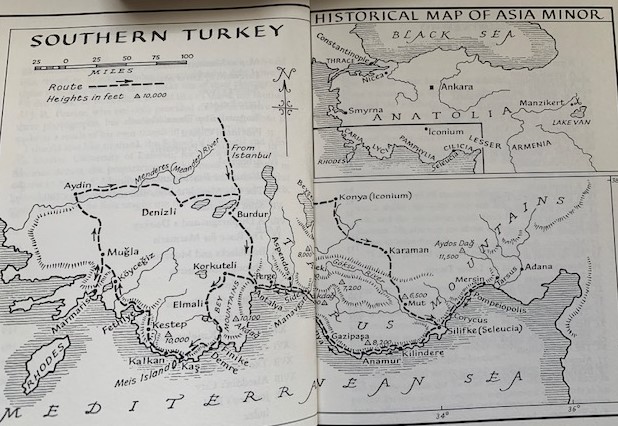
Mountains and a Shore: A Journey Through Southern Turkey by Michael Pereira
After the draining Mishra, book we opted for something lighter and since Francis has plans for a trip to Turkey in the fall, we selected this book, which we discussed on February 21, 2022.
Originally published in 1966, Paul Dry Books republished the book in 2015. In this thin travelogue, Pereira combines the history of the country with his solo travels along the southern Mediterranean coastline and Taurus Mountains. (The map above is from the book.) Because Pereira speaks Turkish and insists on traveling the way that the locals do: by foot, by donkey if necessary, and the most common mode of transportation— the bus. He writes:
“…the role played by buses is of immense importance, and I came away with nothing but admiration for them and their drivers. For they have to contend with the trains, bridges washed away or simply non-existent, and, by no means the least, other Turkish drivers.
To help them overcome these hazards they very reasonably enlist the help of the Almighty, and in the space above the windscreen is always written some brief prayer or exhortation. Some of these are pious rather than comforting, such as: ‘May God protect you!’ and others, to my mind, needlessly eschatological: ‘Forget not thy God!’… The most popular of all, however, is the single word ‘Maşallah’, which used in much the same way as a Spaniard uses the sign of the cross to avert danger.”
You feel every bump in the road as he travels the mountainous swerving roads often overlooking the Mediterranean. Pereira’s purposely traveled to an area of a country that he believed would be much more developed in the upcoming decades.
His descriptions of the kebabs, and the centuries-old churches and muezzins’ calls to prayers from the minarets reminded me of my trip to Turkey with my partner Denise in 201o. Books like Pereira’s expand what I normally think of as a travel book. Sometimes you read a travel book with a purpose to plan an upcoming trip or to be a companion while traveling, but Mountains and A Shore, provided a respite from our daily routine by reliving memories of our trip to this fascinating country. (I cannot forget our visit to the Hagia Sophia and the pickle shop in Istanbul.)
Orhan Pamuk Essays
As a companion to the Pereria book, I pulled the Turkish Nobel Laureate Orhan Pamuk’s collection of essays Other Colors (2007) off the shelf. I skipped around the first two sections “Living and Worrying” and “Books and Reading.” Pamuk’s essays from pages 61 to 104 about living with earthquakes and boat trips on the Bosphorus are good. In the second section his essays about Mario Vargas Llosa’s Death in the Andes and Salman Rushdie’s’ Satanic Verses caught my attention, but it was Pamuk’s republished forward to Tristam Shandy that has given GRSG some direction.
It is time to do a classic work of literature (uh-oh) and we selected the Laurence Sterne’s The Life and Opinions of Tristam Shandy, Gent. written between 1760-1767 as a novel which will require support from a fellow reader.
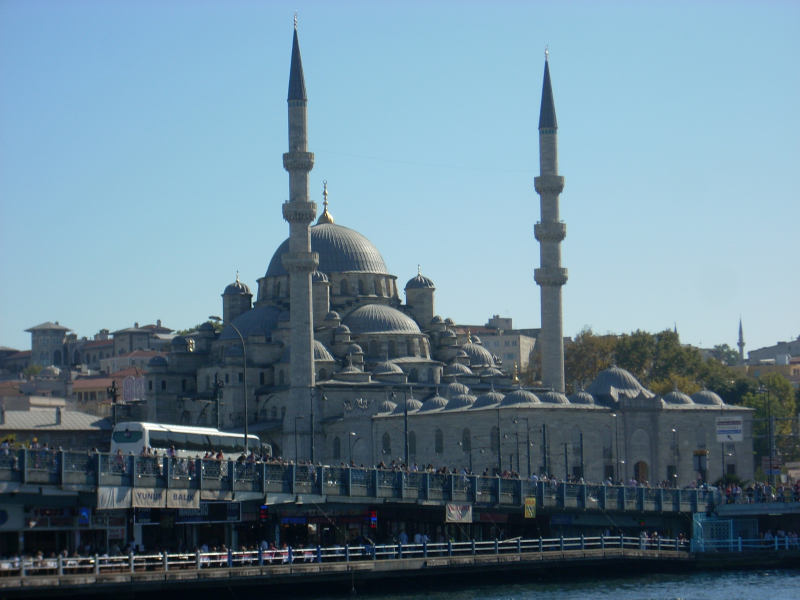
The Life and Opinions of Tristam Shandy Gentleman by Laurence Sterne
We selected this classic of English literature written between 1760 and 1767 for several reasons:
1. We were overdue for another hard-to-read, lengthy book that is worthy of the support group. In 2020 it was Pynchon’s Gravity’s Rainbow and last year it was Faulkner’s Absalom, Absalom. In other words, we need mutual support to get through a book of this nature.
2. While reading some Orhan Pamuk essays for our book on Turkey, one of the pieces on Tristam Shandy.
3.) I already had a copy of the Modern Library edition that I purchased for 30 cents years ago. (Of course, the print was too small) so I purchased a very good hardback copy of the Britannica Great Books edition from Eighth Day Books in Wichita, Kansas which is a great source for ol’ timey literature books.
4.) And we cannot connect Laurence Sterne to one of the stars of The Age of Anger the French philosopher and writer Voltaire. Both Sterne and Voltaire were more than acquaintances with French philosopher Denis Diderot (1713-1784). Sterne and Diderot met in 17??)
Plot
“Digressions, incontestably, are the sunshine;— they are the life, the soul of reading!—take them out of this book, for instance, —you might as well take the book along with them; ” instance,” Book I, Chapter 22. (in Bartlett’s Book of Quotations)
“So long as a man rides his hobby horse peaceably and quietly along the king’s highway, and neither compels you or me to get up behind him–pray sir, what have either you or I to do with it.” Book 1, Chapter 7 (in Bartlett’s) Define: hobby horse.
There is very little plot. The narrator Tristam Shandy gives an account of his life starting from his conception. For details he relies on his Uncle Toby, an ex-military man and the dialogue often the dialogue between Tristam’s father Walter (a scholar) and Pastor Yorick (who represents religion). Our narrator spins digressions and digressions within digressions and often talks to reader directly. At one point in Book IV, Chapter 25 the page numbers skip from page 270 to 283 on purpose. He writes:
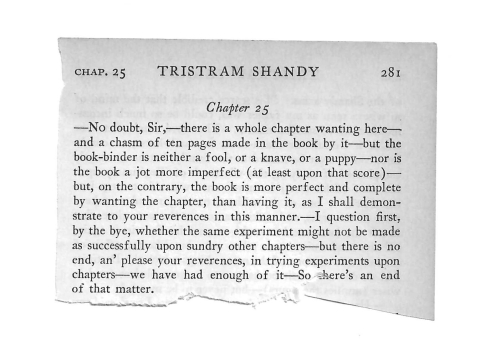
The group (of Francis and me) agreed you could say this book is like Seinfeld “a book about nothing.”
The Humor
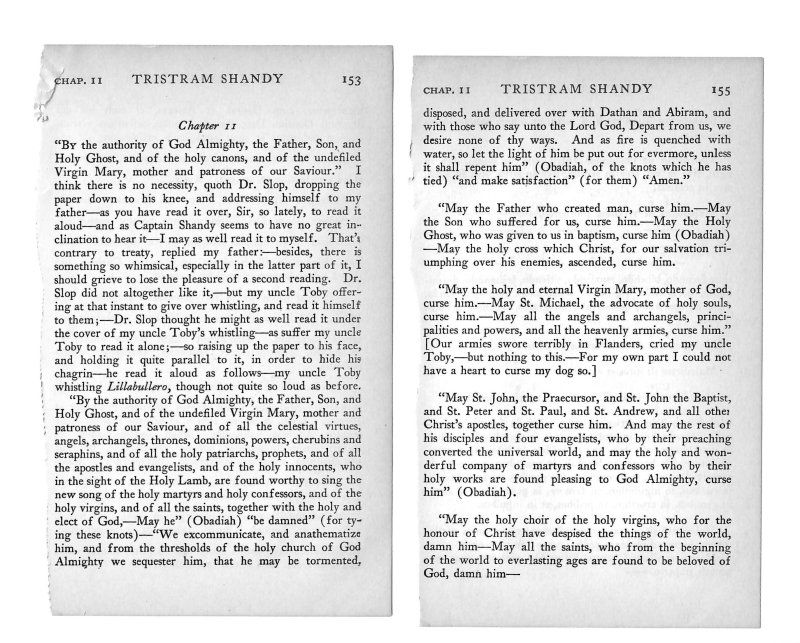
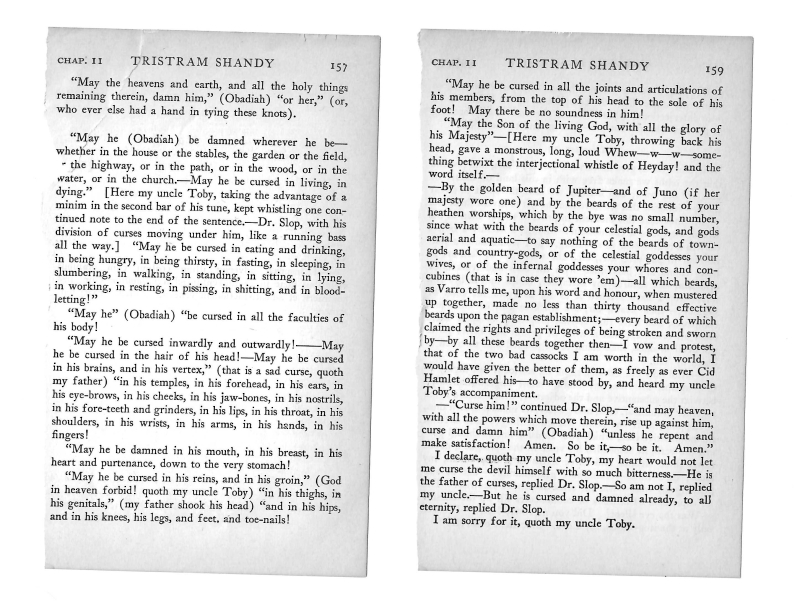
Other Strengths
The Universality of the Human Condition
Examples include:
Corporal Trim’s sermon on conscience, which ends with two or three short rules, including “your conscience is not the law.” Book II, Chapter 17.
“Sterne moves form the problems of ethic into the general theory of knowledge; his satire is moral, but his comedy is epistemological.” — essay, Art & Nature the Duality of Man by Martin Price.
“What a jovial and a merry world would this be, may it please your worship, but for that inextricable labyrinth of debts, cares, woes, want, grief, discontent, melancholy, large jointures, impositions, and lies!” – Book VI, Chapter 14.
The Humor/The Use of Languages
Countless examples of Sterne’s use of language– his wit:
“When one runs over the catalogue of all the cross reckonings and sorrowful items which the heart of man is overcharged.”
“The hand of death pressed heavily upon his eyelids.” – Book VI, Chapter 10
It’s easy to imagine Monty Python quoting some of these passages in a skit where he describes the birth of Tristam: “for it was obstetrical,–scriptural, squirtical, papistical–and as far as the coach-horse was concerned in it–caball-istical–and only partly musical.” Book III, Chapter 8
The nun’s story:
The abbess of Andouillets,…… being in danger of an Anchylosis or stiff joint (the sinovia of her knee becoming hard by long matins), and having tried every remedy—first, prayers and thanksgiving; then invocations to all the saints in heaven promiscuously—then particularly to every saint who had ever had a stiff leg before her—then touching it with all the reliques of the convent, principally with the thigh-bone of the man of Lystra, who had been impotent from his youth—then wrapping it up in her veil when she went to bed—then cross-wise her rosary—then bringing in to her aid the secular arm, and anointing it with oils and hot fat of animals—then treating it with emollient and resolving fomentations—then with poultices of marsh-mallows, mallows, bonus Henricus, white lillies and fenugreek—then taking the woods, I mean the smoke of ’em, holding her scapulary across her lap—then decoctions of wild chicory, water-cresses, chervil, sweet cecily and cochlearia—and nothing all this while answering, was prevailed on at last to try the hot-baths of Bourbon—so having first obtained leave of the visitor general to take care of her existence—she ordered all to be got ready for her journey: a novice of the convent of about seventeen, who had been troubled with a whitloe in her middle finger, by sticking it constantly into the abbess’s cast poultices, &c.—had gained such an interest, that overlooking a sciatical old nun, who might have been set up for ever by the hot-baths of Bourbon, Margarita, the little novice, was elected as the companion of the journey.
The Quotes
“There is a Northwest Passage to the intellectual world,” – Book V, Chapter 42 (in Bartlett’s book of quotations – Bartlett gives him Sterne two pages.)
Sterne on families:
Though in one sense, our family was certainly a simple machine, as it consisted of a few wheels; yet there was thus much to be said for it, that these wheels were set in motion by so many different springs, and acted one upon the other from such a variety of strange principles and impulses—that though it was a simple machine, it had all the honour and advantages of a complex one,—and a number of as odd movements within it, as ever were beheld in the inside of a Dutch silk-mill.
Why Tristam Shandy Is a Classic
People who read only the classics are sure to remain up to date. — Maria von-Ebner Eschelbach
“A classic is something that everybody wants to have read and nobody wants to read.” –-Mark Twain
In John Sutherland’s Lives of the Novelists: A History of Fiction in 294 Lives, he calls Tristam Shandy “English literature’s greatest comic novel.” He further explains why:
Technically what Tristam Shandy bequeathed to English fiction was immediacy – “writing to the moment.” His sign manual is the dash —typically a 5em thing which lubricates the frictionless pace of narrative (speeding up one’s reading of the process). Tristam Shandy, with its expressive typography (super large capitals, different fonts, the creative use of white space and blocked pages) is a tribute to the growing skill of the mid-eighteenth century London printing trade. The fluidity Sterne aimed at was that of speech. “Writing” he wrote, “when properly managed (as you may be sure I think mine is) but a different name for conversation.
In other words, as demonstrated in the examples below, Sterne did things on the printed page that no one had done before as well as things that we accept as normal in writing.
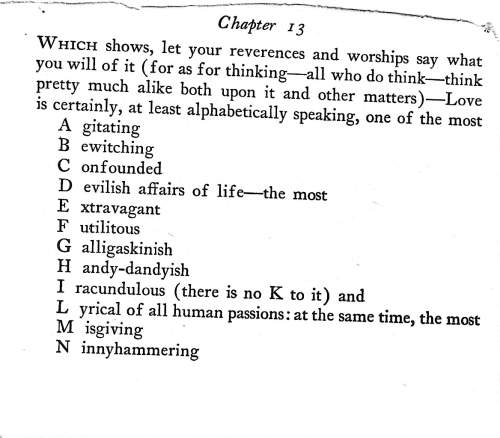
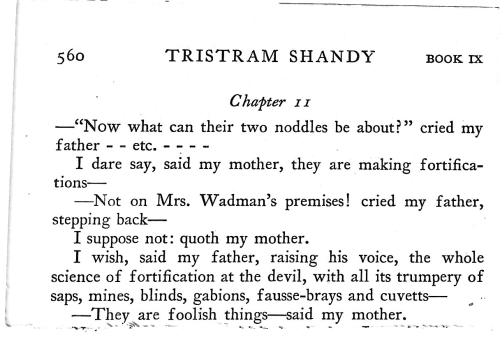
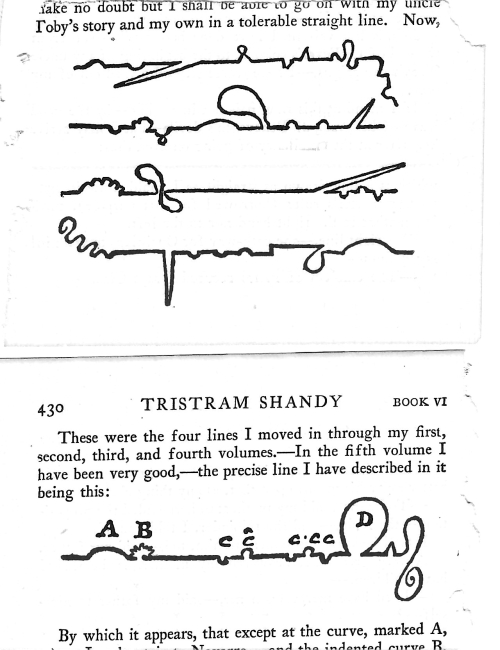
Final Thoughts
Yes, Tristam Shandy qualifies as a classic. With respect to Maria von-Ebner Eschelbach, it is a book that is timeless in its subject matter, because it deals with the foibles of the human condition. And it qualifies because as we discovered its style and point of view was revolutionary for its times.
That’s not say it doesn’t qualify in terms of Mark Twain’s definition of a classic as book that no one reads. Some of us found it much more a challenge (Murray) than others (Francis). A worthy choice for the GRSG.
Grant by Ron Chernow
This 2017 biography hits the vortex of books we’ve read:
- We like voluminous books. (This is one is 1000 pages).
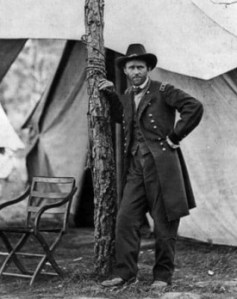
- We like history. (Tuchman on Stillwell, George Orwell on the Spanish Civil War)
- We like study different approaches to history (Marc Bloch, Drew Gilpin Faust – who wrote about Shiloh)
- The 200th anniversary of Grant’s birth was April 27th, 2022
- Francis and I made a day trip to Shiloh around 1999.
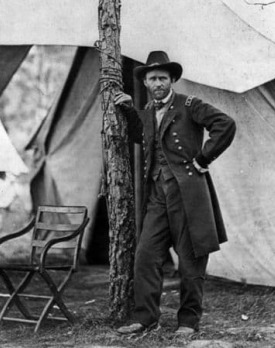
And we must always begin with an Aleksandr Solzhenitsyn from The Gulag Archipelago quote:
“If only it were all so simple! If only there were evil people somewhere insidiously committing evil deeds, and it were necessary only to separate them from the rest of us and destroy them. But the line dividing good and evil cuts through the heart of every human being. And who is willing to destroy a piece of his own heart?”
You can read Chernow’s introduction to get a strong sense of how from the depths of failure (“Grant had been a failure, better by life at every turn.” – beginning to Chapter VI) to the Presidency in less than a decade (similar to Harry Truman). And his toughness, as he persevered through the excruciatingly painful throat cancer to finish his Memoirs. And there were his demons with alcoholism and reoccurring headaches from malaria that he contacted while crossing the isthmus of Panama enroute for his tours of duty in the Pacific Northwest.
In our discussion, which took us to the brink of the Civil War. We couldn’t help comparing our current riven country between the division between the abolitionist North and the slaveholding, States rights South. Well, we all know how that ended.
Some of Francis favorite quotes:
Jesse (Grant’s father) contributed to a lively newspaper called The Castigator that made its local debut in 1826.
About Grant’s first taste in America’s (imperialistic) War Against Mexico where he served with Robert E. Lee, who Grant said “was not endowed with supernatural abilities.” (This would serve Grant well in the Spring of 1864).
“(Zachery) Taylor was not a conversationalist, but on paper he could put his meaning so plainly that there could be no mistaking it. He knew how to express what he wanted to say in the fewest well-chosen words.”
While some nearby officers mocked Grant’s take-charge style of leadership, Taylor promptly endorsed it: “I wish I had more officers like Grant, who would stand ready to set a personal example when needed.” (on Grant–showing his soldiers how to do a menial task)
During his maiden battle, Grant discovered something curious about his own metabolism: he was tranquil in warfare, as if temporarily anesthetized, preternaturally cool under fire.
This early experience made Grant tend to view war as a hard-luck saga of talented, professional soldiers betrayed by political opportunists plotting back in Washington.
Francis Memorable Passages from the book Grant:
Colonel Walter Gresham of Indiana wrote admiringly of Grant: “The grasp General Grant then exhibited in the teeth of the incompetency of Halleck and the inefficiency in the War Department stamped him, at least in the eyes of his subordinates, as a man of force and genius.” Page 196
Gresham is especially meaningful since Francis and I lived in Foster Quad during our undergrad days at Indiana. The dining hall was named after Gresham. – Murray
Grant’s endurance in the face of unexpected setbacks perhaps owed something to having survived the ups and downs of his own improbable life before the war. Page 207
“Grant had been a failure, battered by life at every turn. (p.114). It is a remarkable part of biography of how a man who could not have been a more miserable failure in business, with his father and father-in-law etc. in 1860 could be President of the United States, eight years later.
He (Grant) talked less and thought more than anyone in the service.” Page 364
In Halleck’s topsy-turvy world, it was more important to look and act the part of a general than to win battles and crush the enemy. Esse quam videri. Cicero (To be rather than to seem—(good))
Grant approved it with startling speed. Rusling asked Grant if he was sure he was correct. “No, I am not,” Grant shot back, “but in war anything is better than indecision. We must decide. If I am wrong we shall soon find it out, and can do the other thing. But not to decide wastes both time and money and may ruin everything.” Page 330
Grant broke it open and mutely weighed its meaning. “There was no more expression in Grant’s countenance than in a last year’s bird nest,” observed a journalist. Page 504
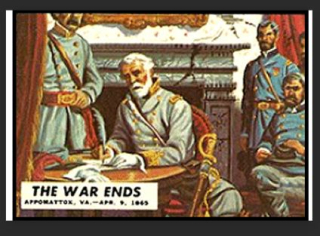 The tone of Grant’s reminiscence (after Appomattox) confirmed the Duke of Wellington’s adage that “next to a battle lost, there is no spectacle more melancholy than a battle won.”page 508
Evidently Lee relaxed when he realized Parker was a Native American. “I am glad to see one real American here,” he ventured, shaking his hand. To which Parker retorted memorably: “We are all Americans.”page 509
As he (Grant) remarked bitterly, “The Southern generals were [seen as] models of chivalry and valor—our generals were venal, incompetent, coarse . . . Everything that our opponents did was perfect. Lee was a demigod, Jackson was a demigod, while our generals were brutal butchers.” Page 516
One aspect of the book is that it really demythologizes Robert E. Lee. Grant met Lee during the Mexican War and they served together. “Lee was not an immortal…was not endowed with supernatural abilities.” (Chapter 3). This would serve Grant well when they faced off in 1864. Grant was not in awe of Lee. Chernow makes the point that Lee was a tactician, but Grant was the strategist. “Grant was the strategic genius produced by the Civil War.” (p.370). (Lee hamstrung himself by always making defending Richmond his main priority.) Chernow debunks arguments that Lee fought for Virginia. He fought for the Southern way of life as well.
 Grant’s brilliance was on display during the Vicksburg campaign, the lifting of the siege of Chattanooga and even the campaign to entrap Lee in Richmond. Vicksburg and the Richmond campaign required handling the many rivers that made Confederate positions strong. As Francis pointed out the Russians have similar difficulties in the Ukraine.
A few relevant aphorisms/adages that might apply to Grant:
One of the unpardonable sins, in the eyes of most people, is for a man to go about unlabeled. The world regards such a person as the police do an unmuzzled dog, not under proper control. – T.H. Huxley, 1893.
Francis adds: I think that lacking prepossessing height or bearing, Grant with his introversion and inscrutability made it possible for others, particularly his enemies, to ascribe to him whatever labels served their interests best.)
How gracefully, or not, one loses in life generally matters much more to one’s present happiness than how spectacularly one succeeds. –Matthew Stewart (The management myth page 145)–(There are other presidents to whom this would apply as well–FW)
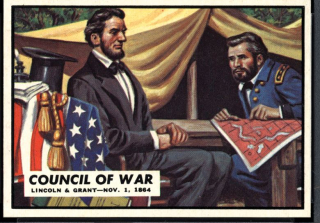 Grant is similar to Lincoln in this manner since Lincoln was judged by his “railsplitter” appearance. According to Shelby Foote, I believe, Lincoln’s true strength is that he understood how individuals judged him and used that to his advantage. In this Topp Civil War trading card from the 1960s. Lincoln makes a mental note that Grant is staring at his hands.
A few relevant aphorisms/adages that might apply to Grant:
One of the unpardonable sins, in the eyes of most people, is for a man to go about unlabeled. The world regards such a person as the police do an unmuzzled dog, not under proper control. – T.H. Huxley, 1893.
Francis adds: I think that lacking prepossessing height or bearing, Grant with his introversion and inscrutability made it possible for others, particularly his enemies, to ascribe to him whatever labels served their interests best.)
How gracefully, or not, one loses in life generally matters much more to one’s present happiness than how spectacularly one succeeds. –Matthew Stewart (The management myth page 145)–(There are other presidents to whom this would apply as well–FW)
Many a man will have the courage to die gallantly, but will not have the courage to say, or even to think, that the cause for which he is asked to die is an unworthy one. -Bertrand Russell
Maria von Ebner Eschenbach Quotes
A true friend contributes more to our happiness than a thousand enemies to our unhappiness. (i.e. Rawlins)
Control of the moment is the control of life.
What people and things are worth can only be determined when they have aged.
Fate hits us with hard or soft blows. It depends on the material we are made of.
It takes less courage to be the only one who finds fault, than to be the only one to find favor.
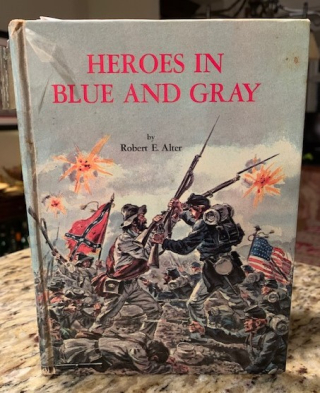
As a youthful Civil War buff, I learned quite a bit about the Civil War, the different generals and their shortcomings. I learned much about the Vicksburg campaign and the year between Shiloh and Vicksburg. This includes the Van Doren raid on the supply depot at Holly Springs Mississippi. (This is mentioned in the Faulkner novel Absalom, Absalom which we read.) Van Doren destroying the Union supply depot changed the war dramatically. It was from that point on that Grant and Sherman decided that they would forage the Southern countryside for livestock, feed etc. to supplement the army. This played a huge roll in Sherman’s March to the Sea.
As a youth in addition to collect Civil War trading cards, I pretty much had memorized Heroes in Blue and Gray and I would say even though the book was scaled down considerably to a 6th grade reading level it did not sacrifice accuracy. The book does mention Grant’s drinking, where Lincoln when confronted about Grant’s drinking he quips, “What brand? I should send it to my other generals” According to Chernow (page 292) Lincoln says he never remembered saying that, but wouldn’t mind taking claim for the quote.
Post Civil War Discussions
We both agreed that the most striking aspect of the book (among many) is the Chernow’s writing about Reconstruction. We both knew very little beforehand and were not aware of Grant’s efforts to “operationalize “Lincoln’s emancipation proclamation (a fine Francis phase).
An abolitionist before the war (more so than Abraham Lincoln) Grant was a fervent believer that blacks should be able to vote without intimidation, hold office and during his first term he enacted laws to strengthen the rights to vote (i.e. the Ku Klux Klan violence, which was “unquestionably the worst outbreak of domestic terrorism in American History.”). He used Federal troops to disembowel the nascent Ku Klux Klan and created the Department of Justice to indict and convict over a thousand Klansmen. (A reincarnation of the Klan was formed in the 1920s.) In other words, this was only a short period of time as the white Southerners power structure reformed new militant groups like the White Rifles. This coupled with Northern “Reconstruction fatigue” contributed the evaporation of black voting rights.
Chernow maintains that it would be another 96 years after the 1872 election (1968) before a fair election would be held in many parts of the South. “Slavery had been abolished,” writes Chernow, “but it had been replaced by a caste-ridden form of second-class citizenship for southern blacks, and that counted as a national shame.”
(We agreed knowing this makes the debate over Critical Race Theory even more shameful. We hope they are teaching the entire story about Reconstruction in the classroom, but we suspect not.)
https://bookshop.org/widgets.js
Grant the Centerpiece
Other pleasures of the book is learning more about Grant’s cohorts: William Tecumseh Sherman, a loyal friend and comrade in arms, but not always sure of Grant’s judgement as a President, a businessman or a parent. (Sherman took one of Grant’s f-off sons under his wing for a while.) We also get good idea what a fireball Phil Sheridan was like and what a bastard the impeached President Andrew Johnson was and how a comparison to Donald Trump – a twice impeached President is most fitting.
On the other contrasts between Grant and Trump are most striking (we sometimes get sidetracked in our discussions):
1.) Grant graduated from West Point in 1843; Trump enrolled in Fordham on a draft deferment.
2.) Grant was an accomplished horseman and at the age of five could ride a horse standing on one leg; Trump cheats at golf.
3.) Grant led soldiers and demonstrated courage under enemy fire; Trump told employees “Yer fired” on a tv show.
4.) While on a military excursion in Panama Grant personally attended to soldiers suffering from malaria; Trump suggested those suffering from COVID-19 might consider drinking bleach.
5.) As a military leader, Grant led the Union to victories at Fort Henry, Fort Donelson, Vicksburg, Chattanooga and eventually forced Lee to surrender at Appomattox; Trump withheld weapons from Ukraine.
6.) Grant was an alcoholic but overcome it by total abstinence; Trump is an uncurable pathological liar.
7.) Grant was impoverished after for being fleeced by partners in questionable business ventures; Trump boasted about fleecing others with dubious business practices that made him wealthy.
8.) Grant operationalized Lincoln’s emancipation proclamation; Trump encouraged restrictions on voting.
9.) Grant won a second term by a landslide; After losing an election for a second term, Trump attempted a coup to overturn the results of the election.
10.) Under duress, Grant vowed to defend Congress from mob attack; Trump incited a mob to attack Congress.
Mark Twain
At the end of his life, Grant was swindled in a Ponzi scheme that left him penniless. Adding to his misery Grant’s health turned for the worse, suffering from throat cancer (too any cigars) which would claim his life. Fortunately, an important writer and publisher of the time—Mark Twain— stepped in. Twain admired Grant and felt that he could restore Grant’s wealth by publishing the general’s memoirs. While in intense pain, Grant finished Personal Memoirs just a month before his death and the book eventually sold 300,000 copies, providing his devoted wife Julia with generous royalties.
Twain did have one complaint about the book Grant had not addressed his struggle with alcohol. It was a contest, Twain reckoned, as huge as any of the titanic battles he had fought and won. “I wish I had thought of it!” Twain exclaimed with frustration. “I would have said to General Grant, ‘Put the drunkenness in the Memoirs—& the repentance & reform. Trust the people.’” But he knew that no hint of that existed in the narrative, that it had been too sore a point with Grant, who, in his quiet, inscrutable way, carried his private thoughts on the subject to the grave.
Not so for Chernow who detailed Grant’s alcoholism throughout the book.
The Innocents Abroad by Mark Twain
Mark Twain’s account June 1867 voyage to Europe, the Mediterranean and Middle East aboard the Quaker City is the source material for his first book The Innocents Abroad published in 1869. The book is basically a compilation of newspaper accounts that Twain wrote for New York and San Francisco newspapers detailing his five-month trip to Spain, Gibraltar, Morocco, Marseille, Paris, Genoa, Rome, Milan, Venice, Rome, Naples, Greece, Constantinople, Smyrna, Lebanon, Jerusalem, and Egypt. The travel group disembarked in Lebanon for a month-long trip by caravan through the Holy Land. (Murray left the book before then, but Francis finished it.)
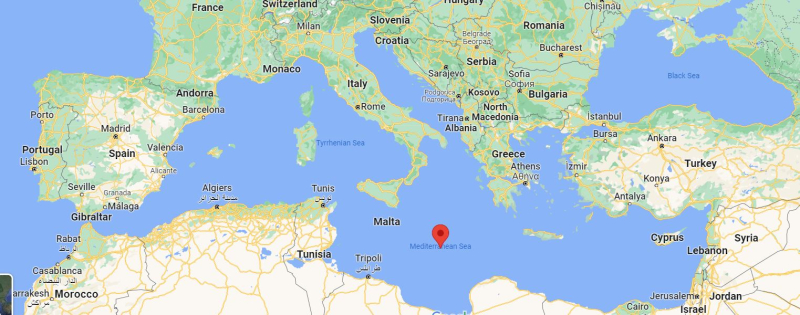
Twain figured prominently in Grant’s by publishing the ailing President’s memoirs. In his 1885 fictional piece “The Private History of a Campaign That Failed” Twain gives an account of his short military career in Confederate army in the early days of the war. The writing of this story coincided with Twain’s editing Grant’s memoirs and the irony, that his Confederate deserter (more or less) was only a few weeks/miles away from Grant’s first command in 1861 Missouri. Apparently, Twain and Grant did discuss how close their paths almost crossed during the war. Twain quipped a false bravado, that had he known Grant was nearby he would have attacked instead of retreating. (Source: Justin Kaplan’s 1969 biography, Mr. Clemens and Mark Twain)
Two things stood out in our only discussion of the book on July 13, 2022.
The Humor of Mark Twain
You would expect that since Kennedy Center presents the annual Mark Twain Prize for American Humor presented to individuals who have “had an impact on American society in ways similar to” that there would be plenty of examples of Twain’s humor.
There are many, many types of examples:
Overwriting and Masterful Comic Cadence
“But we love the Old Travelers (those delightful parrots who have ‘been there before’ ) We love to hear them prate and drivel and lie. We can tell them the moment we see them They always throw out a few feelers; they never cast themselves adrift till they have sounded every individual and know that he has not traveled. Then they open their throttle valves, and how they do brag, and sneer and swell and soar, and blaspheme the sacred name of Truth.!” – Chapter XII
Then this example on Discovery!
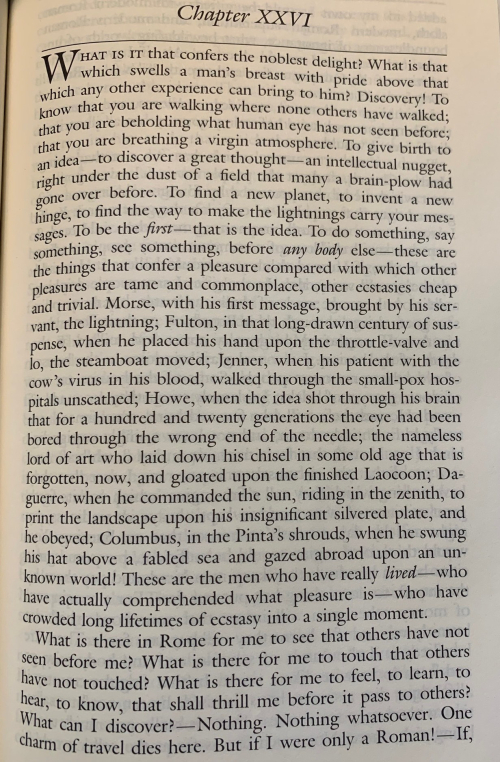
The Fish Out of Water. The American Rube in Sophisticated Europe
The narrator prefers the beauty of Lake Tahoe in Nevada to Lake Como in Italy. (Twain had traveled extensively in Nevada, California and Hawaii before going to Europe. Those adventures were published in Roughing It.)
While in Milan, the narrator refers da Vinci’s The Last Supper as “the mournful wreck of the most celebrated painting in the world.” He mocks “catchy ejaculations of rapture” of the tourists who “stand entranced before it with bated breath and parted lips.”
Calls Michelangelo, “Michael Angelo”
The Quip – Sometimes at the expense of others (Note: Twain was a “product of his times” when he refers to people of other nationalities and races).
“Outside the car a monster headed dwarf and mustached woman inside it. These latter were not show people. Alas, deformity and female beards are too common in Italy to attract attention.”
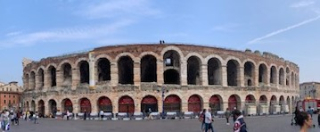
The Straight Satire
A handbill from the Roman Coliseum
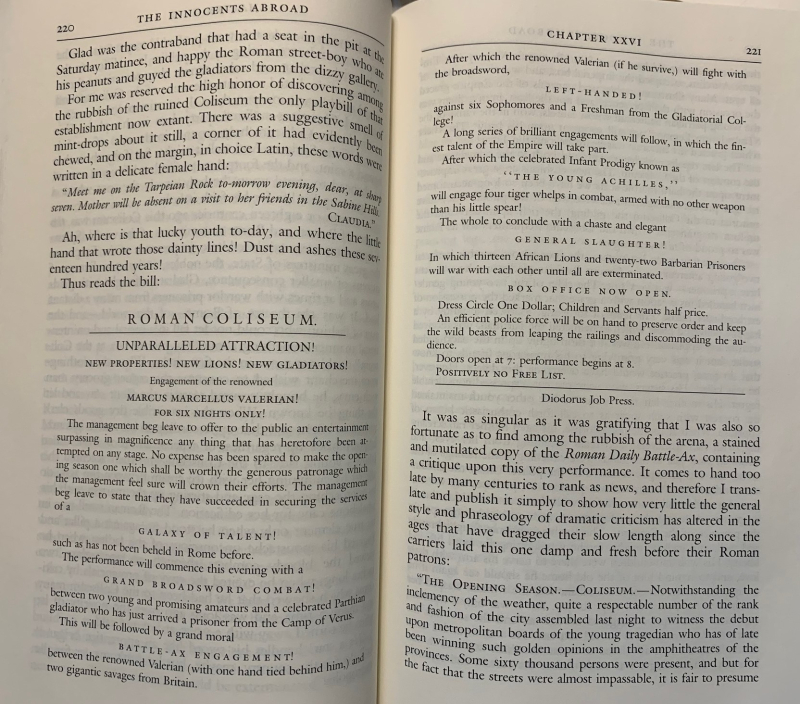
Reliving Travel Experiences
One of the pleasures of reading this travelogue was reliving some or our travels as well. Twain’s description of the Quaker City reminds me of another piece about luxury liners (David Foster Wallace’s “A Supposedly Funny Thing, I’ll Never Do Again”). Basically, The Quaker City was a forerunner for of luxury cruise liners we are so used to today.
But Twain used words for his description, which he is amazingly skilled. Here’s a description from Chapter XXXIII of the Whirling Dervishes which we’ve all seen in travel shows.
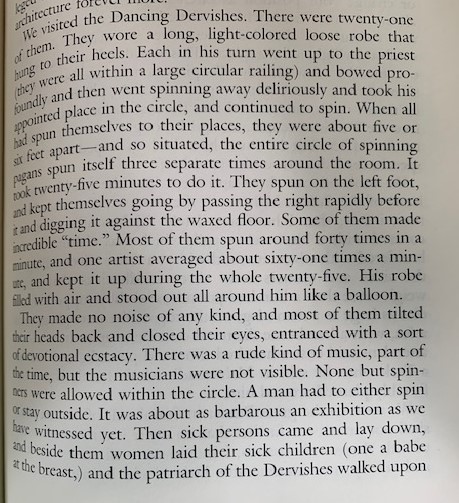
Part of the pleasure of reading The Innocents Abroad reminded me places that I had been like the—
The Bridge of Sighs in Venice
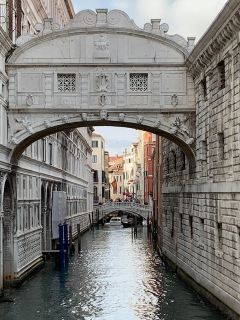
“From the palace to the gloomy prison is but a step–one might almost jump across the narrow canal that intervenes. The ponderous stone Bridge of Sighs crosses at the second story…Down below the level of the water, by the light of smoking torches, we were shown the damp, thick-walled cells where many a proud patrician’s life was eaten away by the long-drawn miseries of solitary imprisonment–without light, air books; naked, unshaven, uncombed, covered with vermin…” Chapter XXIII
The Hagia Sophia – Constantinople

“I do not think much of the Mosque of St. Sophia. I suppose I lack appreciation. We will let it go at that. It is the rustiest old barn in heathendom.” Chapter XXXIII
“I shall never want another Turkish lunch. The cooking apparatus was in the little lunchroom, near the bazaar, and it was open to the street. The cook was slovenly, and so was the table, and it had no cloth on it. The fellow took a mass of sausage-meat and coated it around a wire and laid it on a charcoal fire to cook. When it was done, he laid it aside and dog walked sadly in and nipped it. He smelt it first, and probably recognized the remains of a friend. ” Chapter XXXIV
Despite Twain’s descriptions, it made me long to see them again.
In John Sutherland’s Lives of the Novelists, he questions William Dean Howell’s notion that Twain was “the Lincoln of our Literature” but finally provides the explains Twain’s greatness in three words: “voice, eye and attitude.”
All are on exhibit in The Innocents Abroad.
The U.S.A. Trilogy by John Dos Passos
The first thing that capture my imagination about the Dos Passo Trilogy was the clever artwork of the Signet Classics which were prominently displayed in the bookstores of my college youth. I finally bought them, and they stayed on my shelves for a number of years. I do not recall when I read them exactly, but I did it over a period of years, probably during the 1990s.
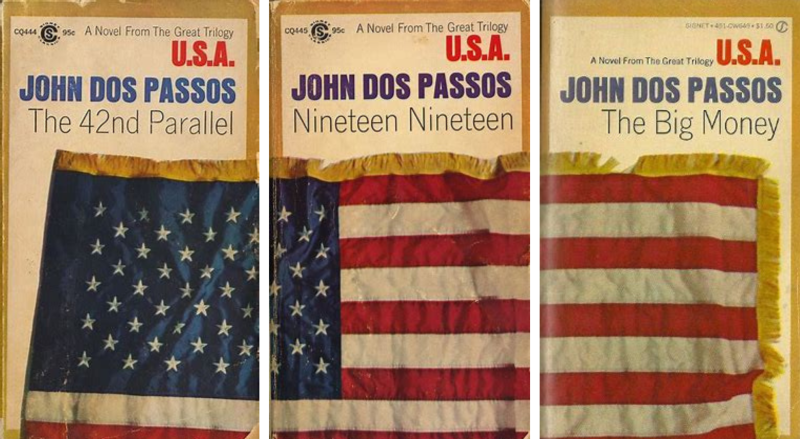
The Signet Classics were notable because they each contained an Introduction by writer and literary critic Alfred Kazin, who summarized the three books of the trilogy —The 42nd Parallel (1930), 1919 (1932), and The Big Money (1936)— as a portrayal of the America before it became a superpower. We grew up thinking of America as a superpower, but Kazin reminds us that it was not always that way.
Kazin writes that Dos Passos shows us through his series of three novels published that the powerful men of American (characterized by J. P. Morgan) and those like made their fortunes on the backs of the working men and women. Furthermore, the average man didn’t have a chance against the “mass culture, mass superstition and mass slogans” and Dos Passos repeats these themes throughout the trilogy.
Another memorable aspect of the Signet Classics is that they were illustrated by Reginald Marsh (1898-1954) who was an illustrator for The New Yorker in the 1920s but went on to become an artist of some renown and a contemporary of the more well-known Thomas Hart Benton. Marsh was known for his “depictions of life in New York City in the 1920s and 30s.” (Wikipedia). A sample of Marsh’s work graces the cover of earlier paperbacks, shown at the left.
The 42nd Parallel
We began in July, 2020 by reading The 42nd Parallel which cover the early years of the 20th Century up through the beginning of World War I and America’s official entry to the war in April 1917.
The main narrative is told through several characters over a period of years. In The 42nd Parallel the main fictional characters are:
Mac (Fainey McGreary), born in Connecticut but raised by an uncle in Chicago. Mac was a printer who drifts all over the country before winding up in Mexico. He is sympathetic to the I.W.W (Industrial Workers of the World) which was established in 1905.
Janey Williams. Janey grew up in Georgetown, Maryland and has an older brother Joe who is one of the main characters in 1919. Janey works her way as a stenographer and ends up in the offices of some of the influencers in the Labor movement.
J. Ward Moorehouse, grew up in Wilmington, Delaware and was a bright boy but grew up in a lower middle class he scrapped and clawed to become a publicist for big business, especially the coal industry.
Eleanor Stoddard grew up in Chicago and showed promise and interest and art at an early age. After working at Marshall Fields in Chicago, she moves to her friend Eveline Hutchins to start a decorating business in New York City. She ends up decorating the offices of J. Ward Moorehouse and becomes romantically infatuated with him, in spite of Moorehouse’s second wife who was an invalid. In a patriotic fervor, Morehouse joins the military propaganda machine. Eleanor offers to France too, “I’ll join the Red Cross,” she said. “I can’t wait to get to France.”
Charley Anderson grew up in Minnesota and acquired some skills as a mechanic, but drifted throughout the middle part of the country before ending up New York City and shipping out to fight in World War I.
As the book progresses some of the characters interact with each other. Interspersed with in these chapters are Newsreels – one or two pages full of headlines and lyrics of popular songs. Another kind of interruption is the Camera Eye (there are 27 of them in The 42nd Parallel — almost free verse descriptions of scenes that Dos Passos makes no attempt to identify (Francis and I found these were our least favorite passages.) Dos Passos also includes thumbnail, all most free verse biographies of key historical figures such as Eugene Debs, William Jennings Bryan and Thomas Edison. (All three volumes are constructed in the same manner.)
Why the book is called The 42nd Parallel.
Not to be confused with the 49th parallel which separates the western United States and Canada, the 42nd parallel extends from the California-Oregon — the Iowa-Minnesota boundry almost running through Chicago, and not far from Pittsburgh, Philadelphia, and New York. All are major cities where are characters grew up and worked. Remember it a latitude not a straight-line. 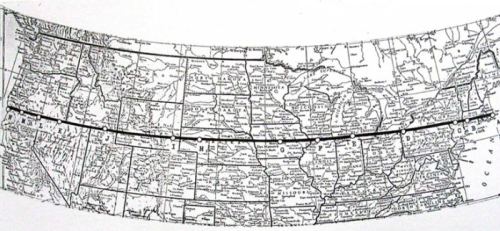
Other Themes or Characteristics of The 42nd Parallel
Capitalism vs Socialism, Communism, etc.
 The Workers/Labor versus Owner/Capitalists is one of the major themes of all the books. Although he grew up in affluence and education, Dos Passos was sympathetic to the worker and critical of the capitalists — although later in life he reversed his stance (but his later works never had the effect and readership of the USA Trilogy.)
The forces of pro-labor forces are manifested in the International Workers of the World (IWW) which was founded in Chicago in 1905. Known as the “Wobblies” (disparagingly the IWW was known as I Won’t Work people) had a rise in power and influence during the novel (but later collapsed). There were many references to the upcoming revolution in Russia, socialism and the anarchists. (and as we know from Age of Anger, those anarchists played a pivotal role in world history.)
However, Dos Passo does see the irony. In this scene Mac (a pro-worker) and his friend Ben (an oil promoter) argue in front of Concha who Mac lives with while he is in Mexico.
“Concha would finish all arguments by bringing on supper and say with a shake of her head, ‘Every poor man socialista…a como no? But when you get rich, quick you all very much capitalista.’ ” (p.269)
Men and Women
“They all (men) drank, and smoked and talked dirty among themselves and had only one idea”
That kind of sums up a lot of the tension between the men and women. Mac and Charley Anderson throughout their travels are always craving sex. They know that they are supposed to see marriage as the way society wants them to behave, but they have strong urges and cannot always control themselves especially when they been drinking. They whore around, which sometimes ends up in a sexually transmitted disease or forced into marriage because they got their fiancé pregnant.
The women want to be married (as they are supposed to) and know the what the men want, how to try to control them, but they have their urges as well. (Such is the world without birth control). Women like Janey and Eleanor are vulnerable to men like J. Ward Moorehouse, who seems to be an up and comer with a career and status even though he had very humble origins. The fate that the women in Dos Passos novels most want to avoid is to be tied down to someone who is “tiresome.”
Page 312:Texas girl . . . she’s a cute little thing. She said you were engaged!” Eleanor’s voice was cool and probing like a dentist’s tool.
Francis Comments:
(Murray, this passage- p.342- sounds like what I was taught in parochial school about how women take a good Catholic boy’s mind off eternal salvation)
“…..but a revolutionist ought to be careful about the girls he went with, women took a class conscious working man’s mind off his aims, they were the main seduction of capitalist society.”
Unseen Influential Forces
At the end of this novel, we see how characters are sucked into being participants in the war in Europe. J. Ward Morehouse, stuck in a second marriage he loathes and a treading water in his publicist career, makes a move to join the Red Cross in France. Eleanor who is in love with Morehouse (we’re not quite sure whether their affair includes sex) decides she wants to go to and join the Red Cross to help the war effort even though her skill set is as an interior decorator.
Some of the minor characters mentioned that the reason America went to war was to secure the J.P. Morgan’s loans to Russia (12 million) and Britian and France (500 million). If Germany had won the war, the House of Morgan would have been on the hook for millions.
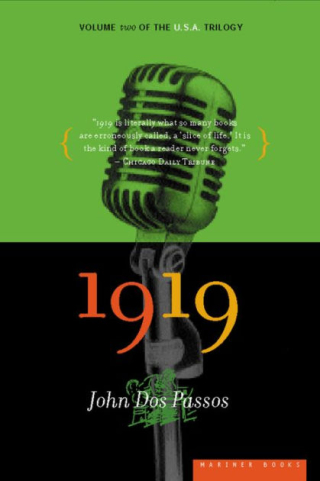 1919 or is it Nineteen Nineteen?
We begin with a fun fact from Townsend Luddington’s John Dos Passos, A Twentieth Century Odyssey (1980). Although the title of the first edition was titled 1919, Dos Passos actually preferred the title Nineteen Nineteen, which is how it appeared in the second edition.
In my reading of the trilogy, I read the Library of America edition, which includes notes from Townsend Luddington.
Francis read the XXXXXX edition, which included a forward by E.L. Doctorow, writer of quality historical fiction, which included Ragtime (1975). A retrospective on that book can be found here.
From the Forward by E.L. Doctorow:
“Given neither to he-man esthetics, like Hemingway, nor to the romance of self-destruction, like Fitzgerald, John Dos Passos, their friend and contemporary—he was born in 1896—was a modest self-effacing person, an inveterate wanderer who liked to hike through foreign places and sit down for a drink with strangers and listen to their stories.”
More from the forward by E.L. Doctorow:
“Edmund Wilson wondered why every one of the ordinary characters of the book went down to failure, why nobody took root, raised a family, established a worthwhile career, or found any of the satisfactions that were undeniably visible in actual middle-class American life. Others objected to the characters’ lack of ideas, Dos Passos’s refusal to give them any consequential thought or reflection not connected with their appetites. And it is true these are beings occupied almost entirely with their sensations and plagued by their longings, given mightily to drinking and fornication while their flimsy thought provides no anchor against the drift of their lives. But for Jean-Paul Sartre, writing in 1938, it was exactly in the novel’s refusal to redeem its characters that he found its greatness. Their lives are reported, their feelings and utterances put forth, says Sartre, in the style of a “statement to the Press.” And we the readers accumulate endless catalogues of individual sensory adventures, from the outside, right up to the moment the character disappears or dies—and is dissolved in the collective consciousness. And to what purpose all those feelings, all that adventure? What is the individual life against history? “The pressure exerted by a gas on the walls of its container does not depend upon the individual histories of the molecules composing it,” says the French existentialist philosopher.”
…..last line of forward: He (Dos Passos) heard our voice and recorded it, and we play it now for our solemn contemplation. — E.L. Doctorow
Of course, here at GRSG we have always been interested in the different perspectives of history.
Wikiquote: E.L. Doctorow
- There is no longer any such thing as fiction or nonfiction; there’s only narrative.
o New York Times Book Review (27 January 1988)
The historian will tell you what happened. The novelist will tell you what it felt like.
Time (26 June 2006)
In the twentieth century one of the most personal relationships to have developed is that of the person and the state… It’s become a fact of life that governments have become very intimate with people, most always to their detriment.
History is the present. That’s why every generation writes it anew. But what most people think of as history is its end product, myth. (Sounds a bit like Faulkner here).
The Big Money
“Gosh money’s a great thing” — Charley Anderson in The Big Money
Characters Return
When reading The Big Money, we begin to see more interaction of Dos Passos characters. The dozen principal characters in the book are:
Janey Williams in The 42nd Parallel has a brother Joe Williams who leaves home and kind of bums around the world on various ships in 1919. The descriptions of life on these freighters that navigate in Europe and the Caribbean (including dealing with German U-Boats) are impressive. Janey ends up working for J. Wardhouse Moore who is player and Richard Ellsworth Savage who is always trying to suck up to Moore. Janey is always “protective” of Moore who dips in and out the entire trilogy.
At the end of The 42nd Parallel we are introduced Charley Anderson grew up in Minnesota and acquired some skills as a mechanic but drifted throughout the middle part of the country before ending up New York City and shipping out to fight in World War I. Anderson reappears as a main character in the final book. He returns as a heroic-fighter pilot hoping to leverage his aviation and engineering skills into some big money. While in New York City he has an affair with Eveline Hutchins who already has a child (not her current husband) while she was in France. Charley craves wealth, but like many of Dos Passos characters he self-serving and self-destructive.
Ben Compton is introduced at the end of 1919 as dedicated to the cause of the workers, much to his own determent. The readers doesn’t see him as a major character until he returns in Mary French’s life who is a main character in The Big Money. Dos Passos describes Compton when he meets up with his family: “They (his family) felt sorry about his radicalism as if was an unfortunate sickness he had contracted.” Mary French also sacrifices her life (to what end) and the memorable descriptions of Boston during the imprisonment of Sacco and Vanzetti.
Dos Passo Later Writings
After The U.S.A. Trilogy Dos Passos wrote for another thirty years but you would be hard pressed to find anyone who could name any of his other works. (Ideologically he did an about face to his earlier work as Dos Passos soured on leftist ideology after the Spanish Civil War.)
Francis was much intrigued on why Dos Passos’s attitudes changed. He writes:
What was impressive to me from reading this is that it provided such a helpful understanding of the labor movement and Marxism as seen from life in the early 1900s. I would submit that the appeal of these movements reflected both the monarchical hierarchy of Europe and possibly the understandable tendency of the USA, which was an aspiring power at the time—but far from a recognized contender, to ape the style and character of the known world powers. Wilson, Morgan, Hearst and their ilk are portrayed almost as monarchical figures—and, I suspect they saw themselves in a similar light to some extent—since they likely envisioned their roles in the mindset of the times—dominated by European power brokers. Since the world’s governments were so feudal at the time, it was then easy to see capitalists on the side of the royals as oppressors of their vassals (aka working class)—again, certainly true in Europe with organizations like Krupp—and likely resonant in the USA as the titans of industry saw themselves more as corporate Czars than stewards.
So, why did Dos Passos change his tune in his later years? I submit it was not just the betrayal of decency and murder of his friend by the Communist party in the Spanish Civil war—but also, I believe it resulted from the toppling of the European monarchies—after all WW1 was their coup de grace. And, after that, American capitalism—which no longer modeled itself on Royal privilege, could then develop into something beyond a grasping extension of regal control and more into an engine of economic growth. Thus, corporations evolved, still as amoral entities, but now governed by efficiency and productivity instead of by robber barons such as Morgan or Hearst. Similarly, a more representative democracy began to replace the autocratic party machines (formerly backed by media moguls of the day) which had ruled up until that time which help further shift the balance of power to the electorate. Paradoxically it was communist regimes that retained the dictatorial remnants of the monarchies they replaced—perhaps because corporate freedom—which, I think, provides some counterbalance of power to governments– was incompatible with their philosophical underpinning—as were regular democratic elections—which would lead to an uncontrolled and intolerable rotation of those in power.
Dos Passos can be forgiven for not envisioning these developments as his imaginative talents were better suited to seeing individuals rather than the sweeping and difficult to predict global upheavals that were going to take place. And I don’t think Dos Passos ever lost his insight or compassion for individuals as decades passed—rather, he saw their lives improving—while the lives and freedoms of those in totalitarian regimes declined—perhaps reinforcing his newfound respect for the promise of a modern USA.
What I see in his characters is that they were so affected by the failure of their hardworking comrades due to the unfairness of the US in the early 1900s, that, like young Dos Passos, they opted for unconventional lifestyles—hoping this would provide them a way to circumvent the stacked deck against them. Notice how often his characters denigrate a “conventional” lifestyle. Dos Passos later, I think, came to realize that the key to thriving did not lie in the unconventionalities they chose, which were harmed not improved by the vicissitudes of alcohol and unstable relationships, but rather by adopting more conventional lifestyles which were increasingly supported by the slow but steady evolution of less malignant and better regulated corporations and responsive government.
The U.S.A. Trilogy is and was GRSG worthy. In way it was similar to Gravity’s Rainbow, a long read, a look at postwar Europe and America, albeit World War I. An intricate mix of fiction and history told in an extraordinary way.

Our discussions led to a long essay “The Camera Eye of Dos Passos: Looking Back at America in Turmoil” which appeared in the Tropics of Meta site on November 8, 2022.
Under the Net by Iris Murdoch
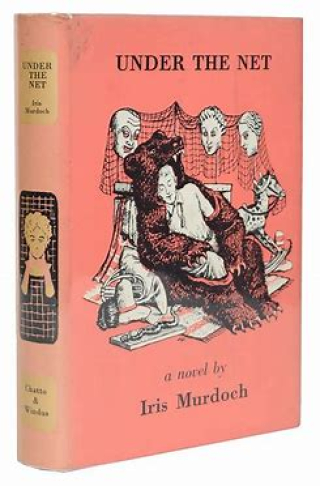 This was Murdoch’s first novel (1954) in what was to be long writing career of “large, extravagantly crowded and ambitious books.” According to Salon’s Reader’s Guide to Contemporary Authors, Murdoch (1919-1999) was “the last of the great nineteenth century novelists. When asked to name the writers who had most influenced her, she listed Dickens, Dostoyevsky, and Tolstoy, ‘wise moralistic writers who portray the complexity of being good.’”
In contrast to Dos Passos in The U.S.A. Trilogy, Murdoch digs deep in the mindset of her protagonist Jake Donahague giving of account of his often everchanging actions and thoughts, which often reverse themselves from page to page. The book is considered a comic novel and the narrator (who is a writer and translator) is witty and observant.
Francis’s Commentary
Iris Murdoch dramatizes what our senses capture with what they filter out. The lead character initially sees things uncritically, viewing the world from a life focused primarily on an avoidance of stress. Soon, though, a combination of necessity and curiosity spur him to change his approach. As he begins to actively explore what the first pass of his perceptual net has failed to capture, in essence, that which lies deep to it, he begins to appreciate that there are flaws in the meshwork. Through a series of engaging yet unpredictable adventures his understanding matures— by navigating these unfamiliar paths he develops insight into the world and himself.
Of interest, the protagonist’s evolution of character follows a trend suggested by other thinkers: Jacob Bronoski: “The world can only be grasped by action, not by contemplation…..The hand is the cutting edge of the mind.”. Goethe: How can we learn self-knowledge? Never by taking thought but rather by action.” and perhaps most aptly by Kant: All our knowledge begins with the senses, proceeds then to the understanding, and ends with reason. There is nothing higher than reason.”
A recurring attraction of the novel is the intermittent appearance of random insights into human nature.
Here is Iris Murdoch’s take on academic life: Page 25: “ Dave does extra-mural work for the University, and collects about him many youths who have a part-time interest in truth.” …”To Dave’s students, the world is a mystery and it should be possible to discover a key. The key would be something of the sort that could be contained in a book of some eight hundred pages. To find the key would not necessarily be a simple matter, but Dave’s pupils feel sure that the dedication of between four and ten hours a week, excluding University vacations, should suffice to find it. They do not conceive that the matter should be either more simple or more complex than that.”
Here, her lead character muses about truth telling—one wonders if Iris Murdoch would have viewed the virtual communities of modern social media as a help or a hindrance to it.: “The substance of my life is a private conversation with myself which to turn into a dialogue would be equivalent to self-destruction. The company which I need is the company which a pub or a café will provide. I have never wanted a communion of souls. It’s already hard enough to tell the truth to oneself.”
An unexpected observation on how two sport activities are related also pops up: “Swimming has natural affinities with Judo. Both arts depend upon one’s willingness to surrender a rigid and nervous attachment to the upright position. Both bring muscles into play throughout the whole body. Both demand, over an exceptionally wide area of bodily activity, the elimination of superfluous motion. Both resemble the dynamism of water which runs through many channels to find its own level. In fact, however, once one has learnt to control one’s body and overcome the primeval fear of falling which is so deep in the human consciousness, there are few physical arts and graces which are not thereby laid open to one, or at any rate made much easier of access.”
Here is her lead character reacting to a gift that might alleviate the unrelenting burden of financial necessity: “I was being offered the key to the world in which money comes easily, and where the same amount of effort can produce enormously richer results: as when one removes a weight from one element to another…..My conscience, I could catch up with that in a few months. In time I could earn my keep in that world as well as the next man. All I had to do was to shut my eyes and walk in.” The lead character’s subsequent response suggests that he will elude a common trap –as described by Logan Pearsall Smith: “Most people sell their souls and live with a good conscience on the proceeds.”
Iris Murdoch’s lead character also denotes a peculiar rift in the ‘Men are from Mars, Women from Venus’ trope—here he is describing the reaction of the nursing staff to him as he takes a job in a hospital : Page 204: “ I noticed with interest that none of them took me seriously as a male. I exuded an aroma which, although we got on so splendidly, in some way kept them off; perhaps some obscure instinct warned them that I was an intellectual.”
The end of the novel provides a guide to pragmatic existentialism: Page 244: “All work and all love, the search for wealth and fame, the search for truth, like itself, are made up of moments which pass and become nothing. Yet through this shaft of nothings we drive onward with that miraculous vitality that creates our precarious habitations in the past and the future. So we live; a spirit that broods and hovers over the continual death of time, the lost meaning, the unrecaptured moment, the unremembered face, until the final chop that ends all our moments and plunges that spirit back into the void from which it came.” And on page 250, The lead character echoes the theme: “Like a fish which swims calmly in deep water, I felt all about me the secure supporting pressure of my own life. Ragged, inglorious, and apparently purposeless, but my own.”

Final Discussion
Another aspect of the Net metaphor is how we use mental nets to understand and develop our own world view. What we gather and what we leave behind (under the net) depends on the gauge of our net and what we are fishing for. This changes with time and where we chose to cast our nets or in the case with the Deadliest Catch crew, your crab cages.
Two Wheels Good: The History and the Mystery of the Bicycle by Jody Rosen
At first Two Wheels Good appeared to be an enjoyable and informative book, and it is, but closer examination (mostly by Francis) revealed some flaws.
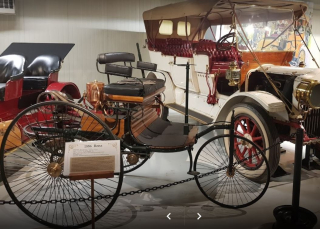 Rosen, a journalist, travels through history and time to give an account of the “a panoramic portrait of the nineteenth-century invention that is transforming the twenty-first century.” In 15 chapters, Rosen covers a variety of topics. Perhaps the most interesting were the chapters of those who cycled in the Yukon and Alaska during winter weather, the popularity of cycling in Bhutan, and the chapter Beast of Burden, where Rosen goes to great length to describe the deplorable conditions of the thousands of rickshaw drivers in Dhaka, Bangladesh. Lesser chapters of interest were the Biking mania of the 1890s and the chapter about sex and the bicycle.
https://bookshop.org/widgets.js
Topping it off is the chapter Cross Country where Rosen introduces to Bill Samsoe and Barb Brushe who met during the 1976 Bikecentinnial where over 4600 cyclists participated in some capacity in a ride from Oregon to Virginia. Bill and Barb would later marry for 40 years. What made this story so captivating, that Murray recognized Samsoe as his brother Neil’s roommate at Illinois Wesleyan University in Bloomington.
In Chapter Two, Dandy Chargers Rosen makes some interesting comparisons between the French-inspired English dandies who were earlier adopters of the velocipede and the spandex-clad elitists that–justified or not justified–get the same vitriol as the English dandies back in the early 19th century. (Rosen goes on a slight tangent in a note about Napoleon: Throughout the Regency period, as much as a third of England’s population faced starvation. Food riots and other rebellions erupted and were met by military crackdowns. More British troops were called up to combat machine breakers during the Luddite uprisings of 1811–13 than had been deployed by Wellington against Napoleon’s forces in the Iberian Peninsula a few years.)
Francis had some specific concerns that somewhat deflated the narrative. He writes:
First, a clip from Iris Murdoch (page 16): Against this ghastly backdrop, the bicycle takes on a virtuous glow. “The bicycle is the most civilized transport known to man. Other forms of transport grow daily more nightmarish. Only the bicycle remains pure in heart.” When Iris Murdoch wrote those words, in 1965, she could hardly have imagined our world, where plutocrats in global capitals rent helicopters to swoop over streets paralyzed by traffic. (Murray, notice that the author cannot resist giving us a sermon on climate change–which he expands on the the paragraph that follows)
Second: The author is obsessed with extremes: The biggest daredevil, the most extreme mountain race, the most extreme city, the most outrageous circus act and the most outrageous bicycle fantasies. This goes against the grain with Elbert Hubbard who wrote: “Little minds are interested in the extraordinary, great minds in the commonplace.” On the other hand, there are some great excerpts of corroborative detail: “Dhaka, a city with 22,000,000 people and 20 stoplights.” Or, his description of the 10 hour bike race up and down mountains in Bhutan—one climb, in particular, goes uphill for 24 miles—which makes the iconic Alpe h’Duez in the Tour de France look like a cakewalk. These do make for great factoids to share with family and friends.
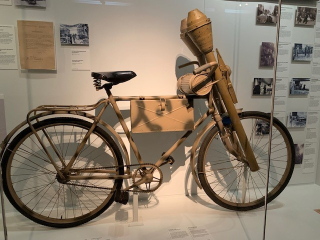 Adding on to Francis’s comments. I was disappointed that there was no mention of bicycle weaponization such as the Panzerfaust which was used by the Germans in the fall of Berlin in the spring of 1945. It was basically a rocket propelled grenade designed to take out Russian tanks. Also, the book did not have an index, which kind of diminishes the book as a “history” book.
Murray read this book while on vacation traveling with family members. A book like Rosen’s works very well in those situations. As Francis says “I like the notion of the book you can read and still carry on a conversation or be attuned to other things around you. I am sure you will be able to coin a term to capture the type of book this is because this is a good example of one.
Perhaps an assignment for future discussions.
Red and Black: A Chronicle of 1830 by Stendhal
 Like the French novelist Marie-Henri-Beyle (1783-1842) who wrote under the pseudonym Stendhal, the title of this classic originally published in 1832, also has an alternate name The Red and the Black. Either way Stendhal’s Red symbolizes the military, and the Black symbolizes the church. In the novel, the protagonist Julian Sorel is the son of a wood mill operator — hardly of high birth – but Julien who a talent for learning Latin sees only two pathways to rise above his impoverished situation through either the military (e.g. the common-birthed Napoleon Bonaparte) or the Catholic church. But as pointed out in the Preface of the latest translation by Raymond N. MacKenzie, red and black are the random choices the of roulette wheel indicating that our lot in life is dictated by chance. Stendhal/Julien says that peasants chose the seminary other it’s “a living on curdled milk and black bread, with meat only several times a year.”
Summing Julien’s egotistical nature, Stendhal describes him “Like Hercules he was torn, not between vice or virtue, but between the mediocrity of a comfortable life and the heroic dreams of his youth.” (Book 1, Ch. 12)
A word about translation. Murray read the MacKenzie translation, which has extensive footnotes (almost 400) that give translations of phrases, and historical backgrounds on names and places from Napoleonic battlefields to actors to playwrights. In his Preface gives us the scorecard of French power. Basically in 1789, Bastille Day the monarchy was removed from power which led to the rise of Napoleon, but his military defeats weakened his power, until the Bourbon monarchy with the support and power of the Catholic Church returned to power from 1814-1830. Of course, these shifts in power are never smooth and there was a lot of back and forth between the monarchy and the Liberals. MacKenzie throughly explains the principal players and events in his Preface and his footnotes, but in the novel the characters “assume” you already know this.
Another note about translation from MacKenzie: Scott Moncreif was a translator of Stendhal to English. Moncreif also translated Proust’s Remembrance of Things Past (a book I have read the first couple volumes) The masterwork is now re-translated as In Search of Lost Time. Proust took issue with Moncreif’s title, but Moncrief stuck with his reference to Shakespeare. “Translate it yourself, Marcel, if you don’t like it”
https://bookshop.org/widgets.js
One of Francis and I’s observations is that Julien/Stendhal spends more time in salons (a precursor to networking) than in seminary or in the military. With the exception of a small tour of duty, you would have to say the influence of Napoleon is the main vehicle of the “Red” portion of the book. The chapters when Julien is in seminary with all its pomp and politics are one the most interesting in the book.
More Observations
Beginning with Francis’s Amazon review:
This novel provides unique insight into life in France after Napoleon. Who knew mercenary clergy used the sacrament of confession the way the Stasi used wiretaps? That subtleties of dress, manners, and expression led to so many distinctions of rank? That the degree of political turmoil was not dissimilar to current times, just along different themes? Although it is called ‘psychological’ because its omniscient narrator includes so much internal dialog, the author overlooks what he tells the reader: “Our true passions are selfish.” It is a thought-provoking read which, by removing the ruminations of the self-absorbed, could be shorter by half.
Yeah, I agree the book is more psychologically driven than plot driven. This is in complete contrast to Dos Passos who manages to almost race through 30 years of narrative not being bogged down with inner character dialogues. The back and forth of passion between Julien’s two main love interests. The first is Mme De Renal, who is the wife of the town’s mayor who gives Julien his first real job as a tutor for his family. He has an affair with her, though she has children, but keep in mind she probably married at 16 and was probably in around 30 years and Julien was 19. She loved him to the very end. Julien waffles back and forth and this makes for tedious reading.

Mathilde de La Mole is the daughter of the Marquis. She is about 19 and is bored with her life and plays a cat and mouse game with Julien, which he willingly participates. Like the major female characters in Dos Passos, she refuses to except a lover or a husband that is perfect “Men too perfect bore me. What good is love it that would makes you yawn, ” she says (Is this why some women like bad boys?)
“The qualities traditionally associated with military valour—decisiveness, defiance, valour, and comradely devotion—were in danger of being drowned in tepid sentimentality. The moral disease of modern civilization was “fear of poverty” and a corresponding dependence on comfort, safety, and reassurance. Flattery and facetiousness were supplanting rigour and honor in conversations between adults and children….. Saintly acetisim could supply valour stripped from militarism.”–William James
“Resigning yourself to what make the world happy: status, wealth, high rank.” or Services! Talents! Merit! Bah!. Get yourself some connections. Book 2, Chapter 27 (A new slogan for Linked In?)
Rating History
As we often do, we talk about historians and history writing. Francis mentioned Eyewitness to History (1987) edited by John Carey, a Merton Professor of Literature at Oxford, he describes his selection process for the vignettes he chooses for his book—or as he calls it “reportage”. It has to be an eyewitness account (or at least someone who had access to multiple eyewitnesses prior to writing an account). He cites Stendhal’s account, in “The Charterhouse of Parma” of naive Fabrizzio in the battle of Waterloo—noticing tiny pieces of mud rising mysteriously from plowed furrows in mud—the character subsequently he realizes this is the result of bullets being fired in his direction! Clearly a piece of corroborative detail suggesting an eyewitness account. While the storyline is sometimes overly dramatic, in The Red and the Black, I think it is safe to say that Stendhal does a good job of capturing the essence of village, seminary and aristocratic life and conversation even if it is not direct reporting.
Perhaps our best eyewitness reporter is George Orwell in Homage to Catalonia, which the CRSG read last year.
Powerful People and Dunces
Francis noticed a recurring theme that powerful people will often surround themselves with inferiors. Such is the case with the mayor of Julien’s home village, M. Valenod, the villain/antagonist of the book
Valenod had, as it were, said to the local tradesmen “Give me the two biggest fools among your number;” to the men of law “Show me the two greatest dunces;” to the sanitary officials “Point out to me the two biggest charlatans.” When he had thus collected the most impudent members of each separate calling, he had practically said to them, “Let us reign together.” (See A Confederacy of Dunces, the book by John Kennedy Toole, or the original quote, from Jonathan Swift: “When a true genius appears in the world you may know him by this sign, all the dunces are in confederacy against him.”
Here is Goethe’s version of the same idea (circa 1790):
“The history of philosophy, of religion, of the sciences all show that opinions are spread about on a quantitative scale and that the leading position always goes to that which is easiest to grasp, that is whatever is easier and more comfortable for the human spirit. Indeed, the man who has fully educated and developed himself can always reckon to have the majority against him.”
Random Quips and Quotes
You cannot call yourself a classic unless you have phrases and quips that merit writing down on one’s notecard.
“I understand every word she speaks, but I don’t understand the point she’s trying to make.” – Book 2, Chapter 25
“He’s devious,” –Madame Derville, Madame Renal best friend, assessment of Julien. Book 1, Chapter 13
So confused that “Did not know which saint to pray to.”
“But I won’t ever complain about fate again,” said Julien to the abbe who replied “You should never say ‘fate’, my boy. Always say ‘Providence’ Book 2, Chapter 1. (One of church plot twists is the Jansenists. (Jansenism was an early modern theological movement within Catholicism, primarily active in the Kingdom of France, that emphasized original sin, human depravity, the necessity of divine grace, and predestination. It was declared a heresy by the Catholic Church. This according to Wikipedia)
“That’s the result of vain worldly pomp. You are apparently accustomed to smiling faces, those veritable theatres of falsehood.” A reminded of the “Smiling Faces Sometimes song by the Undisputed Truth in 1971:
Smiling faces sometimes
Pretend to be your friend
Smiling faces show no traces
Of the evil that lurks within (can you dig it?)
Smiling faces, smiling faces, sometimes…
Beware of the handshake, they hide the snake
“The man who is born wretched stays wretched, and there you are.”
“After moral poisoning, one requires physical remedies and a bottle of champagne.” –The words of Julien’s jailer at the end of the book.
We close 2022 GRSG with this image of Paris salon, which doesn’t exactly capture our regular Zoom meetings to discuss books. We don’t have those huge, framed paintings and harpsichords (It doesn’t matter we loathe harpsichord music), but what we lack in settees and overstuffed chairs we make up for it with a bounty of bon mots.
—– EXTENDED BODY: —– EXCERPT: —– KEYWORDS: Age of Anger, Pankaj Mishra, George Orwell, Gravity’s Rainbow Support Group —– ——– AUTHOR: Murray Browne AUTHOR EMAIL: murray.browne905@gmail.com TITLE: Why I Blog STATUS: Publish ALLOW COMMENTS: 1 CONVERT BREAKS: wysiwyg ALLOW PINGS: 0 BASENAME: why-i-blog-1 CATEGORY: Bookstores UNIQUE URL: https://thebookshopper.typepad.com/the_book_shopper_atlantad/2021/12/why-i-blog-1.html DATE: 12/31/2021 10:49:00 PM —– BODY:
Next year will be the thirteenth year of The Book Shopper blog and if I keep at the current pace of approximately two offerings a month, the 500th posting should appear sometime late next year.
It’s not too early to start pondering how this milestone should it be celebrated. Here are three possibilities that are currently percolating in my brain:
Possibility One. Host a party or gala. Rent out a small exercise room at the local rec center. Invite some of the regular blog readers as an opportunity to meet one another, swap stories and anecdotes. Though I am always apprehensive of putting my friends—even virtual friends together— I have the sense that the typical discriminating Book Shopper reader will peacefully share their thoughts on quirky, demanding books or the oddities of book culture. They would all probably get along unless…
 Negatives thoughts on Possibility One. Since the Number 1 visited page of all time is the Unabomber’s Library Part Two, I could end up with more of a fringe element in attendence. These well-read anarchists might get out of control after quaffing too much Trader Joe’s Two Buck Chuck.
Possibility Two. Invite the more well-known book celebrities to comment on their cameo appearances on the blog. They include writer David Shields, Books-as-Art Artist Brian Dettmer, photographer Emily Berl, avantgarde filmmaker James Benning and rapper Killer Mike (when he appeared at a book event of Thomas Chatterton Williams).
Negative thoughts on Possibility Two. These artists might ask that their names and work be removed from The Book Shopper, which would have a devastating effect on blog traffic.
Possibility Three. Just surf through all the previous 470+ postings and repurpose some of the more timeless entries and then take the year off.
Negative thoughts on Possibility Three: I am not sure that’s a good idea, because as the late Joan Didion wrote in her essay “Why I Write” that she writes to know what she is thinking. This is how I feel about blogging,
If I cease to blog, then I may not be thinking. And if I am not thinking, I am not percolating.
—– EXTENDED BODY: —– EXCERPT: —– KEYWORDS: Joan Didion, blogging, James Benning, Brian Dettmer, David Shields, Emily Berl —– ——– AUTHOR: Murray Browne AUTHOR EMAIL: murray.browne905@gmail.com TITLE: A Review of Best Books Read in 2021 STATUS: Publish ALLOW COMMENTS: 1 CONVERT BREAKS: wysiwyg ALLOW PINGS: 0 BASENAME: a-review-of-best-books-read-2021 CATEGORY: Best Books Read 2017-2023 UNIQUE URL: https://thebookshopper.typepad.com/the_book_shopper_atlantad/2021/12/a-review-of-best-books-read-2021.html DATE: 12/13/2021 01:58:21 PM —– BODY:
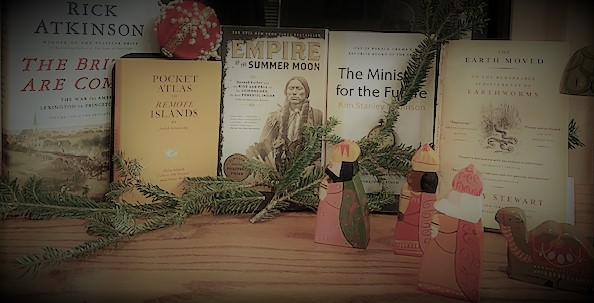
If best book lists were constrained to only books published during the year, The Book Shopper blog (est. 2009) would only have one offering (Connoisseurs of Worms) to share. Historically I have always expanded the selection pool to books that I have read in their entirety, which this year covers just over 30 books. (A complete list of books read is linked to the main homepage of the blog.)
As usual, some patterns emerge when revisiting what I have read this year. One is that I reread five books by some of my favorite authors—Gabriel Garcia Marquez, Primo Levi, Larry McMurtry, Drew Gilpin Faust and David Shields, which seems abnormally high. Was I seeking the comfort of the familiar in the upheaval of pandemic? Is this an epiphany for me?
The major qualification to make the list below is that besides enjoyment, each book influenced me by either a) leading to other books which I eventually read, or b.) slightly changed my thoughts or actions in my little world.
There is no significance in the order and the links go to locations on the blog where I wrote about them in more detail:
The British Are Coming: The War for America (1775-1777) (published in 2018) by Rick Atkinson. In a year when I read books from historians Marc Bloch, and Barbara Tuchman about the practice of writing history, Atkinson always has been a role model. He is a master of storytelling who carefully selects the historical figure (not necessarily a major figure) and the situation that best illustrates what was going on. He relies on a mixture of sources and weaves them seamlessly. What made it especially timely is how The British Are Coming resonates with our own times – handling pandemics (theirs was smallpox) and the bitter and warring factions that founded our nation. (Uh-oh, sound familiar?) Remember before the war, the colonists were all subjects to King George the III.
For more see “A Brief History of Vaccinations in America.”
Pocket Atlas of Remote Islands (2009) by Judith Schalansky. My interest in her work began as a review of her series of essays An Inventory of Losses (2018) in the New York Times. Schalansky’s book atlas is a treasure chest of a book as she mixes short essays and information graphics in her travelogue of "fifty islands I have not visited and never will."
For more see the posting “Airplane Reading.”
Empire of the Summer Moon: Quanah Parker and the Rise and Fall of the Comanches (2011) by S.C. Gwynne. Another fantastic history book relying on a blend of meticulous research and storytelling centering on the life and times of Quanah Parker. Parker was the last great Comanche chief who was the half-white son of a Comanche warrior and Cynthia Ann Parker who was abducted in a raid when she was thirteen. The bloody treachery embedded in the history of Texas and Oklahoma will dispel any notions you ever had about the glory of Manifest Destiny.
For more see the posting, “Timelines.”
 The Earth Moved: On the Remarkable Achievements of Earthworms (2004) by Amy Stewart. After I read this, I replaced my simple plastic tub with a tiered worm tower. The influence of Stewart’s book about these amazing eisenia fetida cannot be discounted. I am proud to be a member of the vermiculture community and to unabashedly say the word “vermiculture” though I cannot pronounce eisenia fetida.
More here at “Upping the Worm Game.”
The Ministry for the Future by Kim Stanley Robinson. This is the only fiction offering on the list and it surprises me that I read only six works of fiction in 2020. (But doesn’t reading William Faulkner’s Absalom, Absalom! [1936] count as 3 books?) Set in the near future, Robinson’s book is considered speculative fiction at that. Robinson follows the lives of several characters who are dedicated to saving the planet for future generations but are often at odds with themselves and with corporate and government powers. What makes to the book so important is that it also includes interludes on possible new technologies and strategies that are intertwined in the plot. Ultimately it gives one hope that we may survive by the skin of our teeth. The Guardian recently published a lengthy critique of Robinson’s ideas.
More about the book itself in “Speculating on the Future.”
 All these books and other Book Shopper blog favorites are available our companion site (destinationbooks.net). When you purchase a new book through the site, we earn an affiliate commission and additional money also goes to support independent bookstores.
 In the Preface of Judith Schalansky’s book of essays, An Inventory of Losses (2018) she writes about the future of permanence in media and books:
"Sometimes I imagine the future thus: generations to come standing baffled in front of today’s data storage media, strange aluminum boxes whose contents, owing to rapid advances in platforms have become not but meaningless codes, and moreover ones that, as an object in themselves, exude less of an aura than the knots of an Inca quipu string, as eloquent as they are mute, or those mystifying ancient Egyptian obelisks that may commemorate triumph or tragedy, one knows."
But later in the Preface as a writer and a book designer (see the previous posting about her Pocket Atlas of Remote Islands), Schalansky offers a defense of the book.
“The book may be inferior in many ways to the new, seemingly incorporeal media that lay claim to its legacy and overwhelm us with information, and may be a conservative medium in the original sense of the word, but it is the only one which, by the very self-sufficiency of its body, in which text, image and design dovetail perfectly with one another, promises to lend order to the world or sometimes even to take its place.”
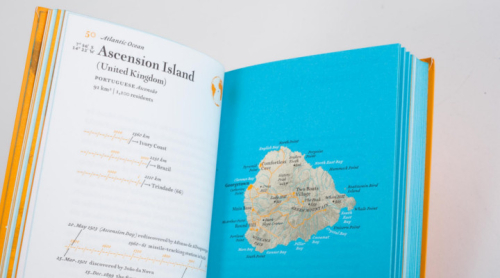
 This month I have made roundtrip plane trips from Atlanta to Berlin and then Atlanta to Los Angeles. Proper reading material is always a critical decision because it can make the difference between a tolerable flight or a miserable flight.
I never trust the entertainment consoles. They may not work (as mine didn't) or they are populated with content that you didn't bother to watch at home. Even if you are interested in one of the inflight movies you will need your magnifying eyewear and a better set of earphones than the airline has provided. (I guess I am supposed to bring my own computer and content…)
The reason I bring this up is that I had the good fortune to hit pay dirt when I brought German author and graphic artist Judith Schalansky's Pocket Atlas of Remote Islands: Fifty Island I Have Not Visited and Never Will (2009) with me on the four hour+ flight from LA to Atlanta.
The book practically fits in your back pocket and can share space your gin and tonic on the wobbly tray table. But the book also takes you to other places far away from the crowded cabin. Schalansky credits the idea when she surveyed a giant globe in the Berlin National Library and began studying the tiny islands names that dot the blue expanses of the ocean. First she collected the facts including their longitude and latitude coordinates, their current population (if any), a timeline of major events and their distance to nearby continents or other remote islands. Some you may have heard of such places as Easter Island, Iwo Jima, or Christmas Island but she gives equal billing to some uninhabited ones like Deception Island (near Antarctica), Bouvet Island (in the South Atlantic) or the cold and barren Lonely Island (near the Arctic Circle).
She dedicates four pages to each entry/chapter. The first two pages provides the facts and the timeline and a detailed map including points of interest such as elevation, bays and any villages. Pages 3 and 4 are very short essays about the history or geological/biological makeup of the place such as the Pacific isle of Banaba, which is made up entirely of phosphate from centuries of bird guano buildup. Schalansky's writing style has been aptly described in The Paris Review " as a prose poem of sorts. Facts sit side-by-side with a kind of highly personal fiction; we are given latitudes and detailed maps, but also lore and speculation."
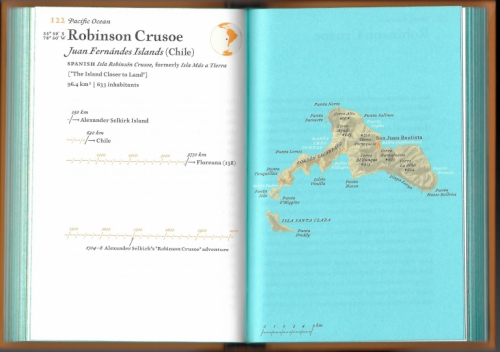
What makes it special for airline travelers is that when reading about hardships like near starvation, or freezing to death while discovering these often hostile piles of volcanic rock, you don't feel so angry when the flight attendant ignores your request to reset your entertainment console. How can you complain? What also makes the book ideal in a plane setting is that my attention span often wanes during the flight, (I'm always checking other passengers viewing habits.) With just four pages per chapter if you start to drift you can easily refocus and return to these compelling stories.
Once you've reached your final destination, and you are greeted with a "How was your trip?" Instead of ranting about the hideous coffee, the sloppy mask wearing of the traveler across the aisle, or the sticky bathroom floors, you can quote Schalansky instead:
"There is no untouched garden of Eden lying at this never-ending globe. Instead, human beings traveling far and wide have turned into the very monsters they chased off the maps."
Something to discuss while you wait for your luggage.
When you purchase a book through our companion site (destinationbooks.net) we earn an affiliate commission.
https://bookshop.org/widgets.js
—– EXTENDED BODY: —– EXCERPT: —– KEYWORDS: Pocket Atlas of Remote Islands, Judith Schalansky, —– COMMENT: AUTHOR: Cal Gough EMAIL: calgough@bellsouth.net IP: 108.82.142.12 URL: DATE: 10/28/2021 10:40:00 AM Sounds like a great read, even if one isn’t airborne! —– ——– AUTHOR: Murray Browne AUTHOR EMAIL: murray.browne905@gmail.com TITLE: Reactions STATUS: Publish ALLOW COMMENTS: 1 CONVERT BREAKS: wysiwyg ALLOW PINGS: 0 BASENAME: reactions UNIQUE URL: https://thebookshopper.typepad.com/the_book_shopper_atlantad/2021/10/reactions.html DATE: 10/06/2021 06:12:45 AM —– BODY:
A short list of thoughts about this advertisement:
1.) It is dangerous to climb a ladder in a gown with a long train.
2.) What is she doing tearing pages out of books?
3.) Why does it matter if you tear pages out of books, if you have that many books?
4.) Books I have plenty of, but that Gregory XL sectional sofa would be ideal for my post lunch/reading naps.
For more about this Flexform Ad social media campaign visit here.
—– EXTENDED BODY: —– EXCERPT: —– KEYWORDS: —– ——– AUTHOR: Murray Browne AUTHOR EMAIL: murray.browne905@gmail.com TITLE: Timelines STATUS: Publish ALLOW COMMENTS: 1 CONVERT BREAKS: 0 ALLOW PINGS: 0 BASENAME: timelines UNIQUE URL: https://thebookshopper.typepad.com/the_book_shopper_atlantad/2021/09/timelines.html DATE: 09/20/2021 08:35:11 AM —– BODY: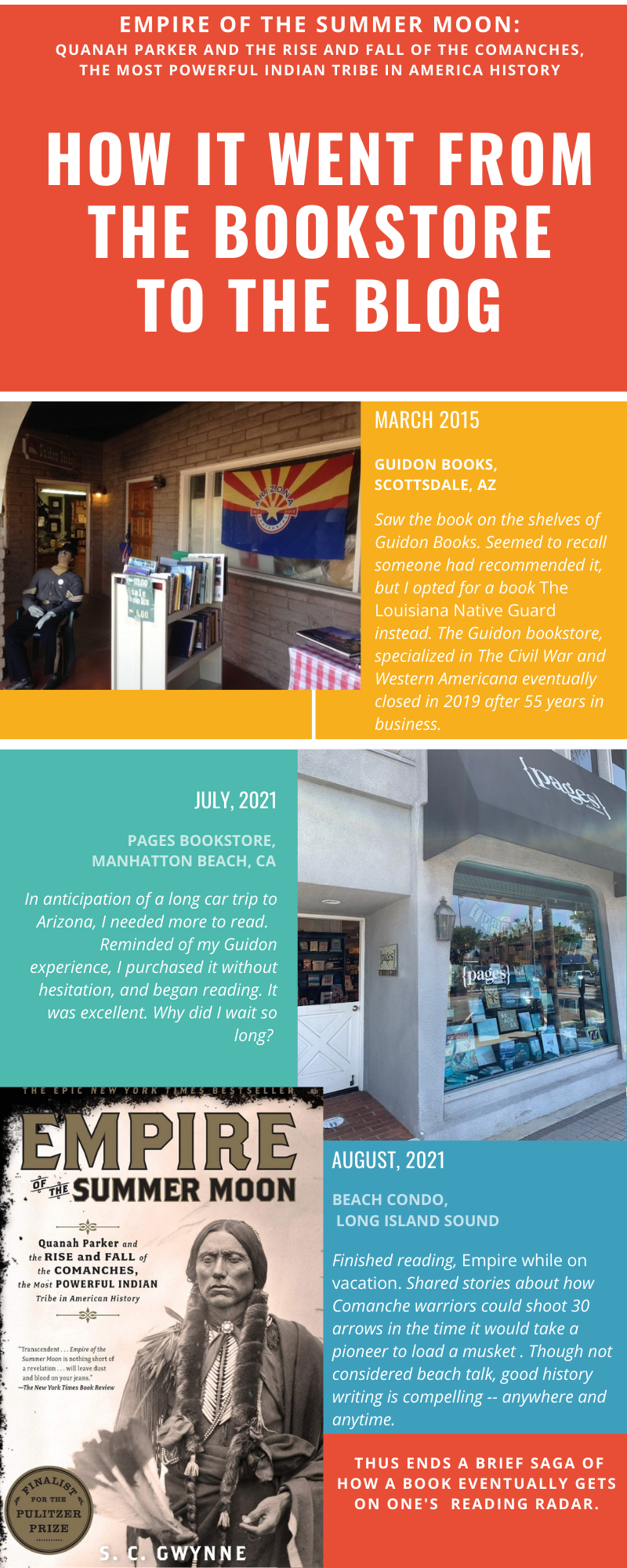
Reading Notes
This detailed book on the role of the Comanches in American History works on several levels. First, I read a lot of history and lately books about writing history (Barbara Tuchman’s Practicing History and Marc Bloch’s The Craft of History*) so I have been primed to appreciate how the author of Empire Moon S.C. Gwynne managed to weave the details of his scholarly research into a riveting saga.
Secondly, you cannot underestimate the blood, slaughter and greed that is an integral part of our nation’s history. ( Oh, Texas, you have such a checkered past.) Because the Comanches were so fierce, brutal and had created their own tactics for fighting on the wide expanses of the Plains in 1830s, they drastically curtailed Mexico’s efforts to expand north of the Rio Grande river.
https://bookshop.org/widgets.js
And finally, as harsh and “uncivilized” as the Comanches were, their culture was partially dictated by their Plains environment (the Buffalo). Moreover Gwynne draws a parallel that they were no more brutal than the white Scotch-Irish settler’s ancestors— if you compared cultural timeline of the Celtics of the 5th century BC who fought against the civilized Greeks and Romans. (Herodotus described them as “fierce warriors who fought with seemingly disregard for their own lives.” ) Like the Celts, the Comanches were superb horseman and did terrible things to their enemies and captives.
When reading about the decline of Comanche nation in the 1880s, you couldn’t help but feel some sadness because their demise was similar to what eventually happened to other indigenous cultures. Gwynne uses the life of their last great chief Quanah as a way to describe the Comanche’s final integration.
* Notes on the Tuchman and Bloch book are buried in some reading notes, elsewhere in the blog here.
—– EXTENDED BODY: —– EXCERPT: —– KEYWORDS: Empire of the Summer Moon, S.C. Gwynne, Commanche —– ——– AUTHOR: Murray Browne AUTHOR EMAIL: murray.browne905@gmail.com TITLE: Book Art V.9 Exhibit STATUS: Publish ALLOW COMMENTS: 1 CONVERT BREAKS: wysiwyg ALLOW PINGS: 0 BASENAME: book-art-v9-exhibit CATEGORY: Books as Art as Books UNIQUE URL: https://thebookshopper.typepad.com/the_book_shopper_atlantad/2021/09/book-art-v9-exhibit.html DATE: 09/06/2021 08:15:45 AM —– BODY: Unlike last year when Book Art V.8 was limited to virtual showings because of the pandemic, this year's Book Art V.9 is open for public viewing by reservation. Book Art is part of the Decatur Book Festival, which is limited in scope this year with the the main event being held on Saturday, October 2, 2021. For all the details on the exhibit including interviews with the artists visit the Decatur Arts Alliance page, which is a sponsor along with the Georgia Center for the Book.
I went to Book Art last month and below are just a few of the pieces that caught my eye, but to do the exhibit justice it's better to see in person rather than rely on my Canva skills.

—– EXTENDED BODY: —– EXCERPT: —– KEYWORDS: —– ——– AUTHOR: Murray Browne AUTHOR EMAIL: murray.browne905@gmail.com TITLE: Speculating on the Future STATUS: Publish ALLOW COMMENTS: 1 CONVERT BREAKS: wysiwyg ALLOW PINGS: 0 BASENAME: speculating-on-the-future CATEGORY: Book Reviews UNIQUE URL: https://thebookshopper.typepad.com/the_book_shopper_atlantad/2021/08/speculating-on-the-future.html DATE: 08/25/2021 08:15:25 AM —– BODY:

In the ten+ years that I have writing the blog, this may be the first posting ever featuring the work of a science fiction writer, so I am confessing to a lot of ignorance about a genre that is also referred to as speculative fiction. However, Kim Stanley Robinson’s The Ministry for the Future (2020) has crossover appeal, because its plot directly addresses the problem of “Can somebody give us hope for averting the oncoming climate catastrophe?” Talk about moving out of your comfort zone.
Set in the near future after a brutal heat wave has killed ten million people in a matter of weeks, an international organization affiliated with the Paris accord known as the Ministry for the Future, is partially empowered to advocate for future generations. A team of international experts, led by the novel’s protagonist Mary Murphy begins to untie the Gordian knot. This includes addressing income inequality, eliminating fossil fuels, (which includes sequestration of carbon), developing technologies to slow the melting of the polar ice caps and getting the global financial powers-that-be on board.
Robinson intersperses small chapters in the main story explaining how these different technologies and strategies would need to work.
There is even a secret militant arm of this movement, that—let’s put it this way—make the Monkey Wrench gang from the Edward Abbey’s 1975 novel look like lightweights. There is a moral dilemma of whether EVERYTHING should be done to speed the process along. Toward the end of the novel Robinson offers a glimpse of what that changed world would be like.
What makes the book “worthy” of breaking through blog’s speculative fiction myopia is not only has Robinson encapsulated what it will take to save civilization and the planet, but he has folded it into a solid work of fiction. Decent characters, interesting settings (Zurich, India, Antarctica) and an old-fashioned plot driven by the ever-present sword of Damocles question of “will the planet survive?”
Links of Interest
A review entitled "Catastrophe and Utopia" by Eric Morales-Franceschini was what put this book on my radar. Thank you, Eric and Tropics of Meta who published it.
Rolling Stone magazine also reviewed the book and includes an interview with Kim Stanley Robinson.
Ezra Klein's 90-minute interview, "A Weird, Wonderful Conversation with Kim Stanley Robinson" July 15 NY Times podcast. Not so much about the book specifically, but Robinson does speak optimistically that the time does seem right for the planet to make real progress.
https://bookshop.org/widgets.js
This blog earns a small commission if you click through to DESTINATION: BOOKS and make a purchase. Part of the purchase price also makes contributions to independent bookstores.
—– EXTENDED BODY: —– EXCERPT: —– KEYWORDS: Kim Stanley Robinson, The Ministry for the Future, —– ——– AUTHOR: Murray Browne AUTHOR EMAIL: murray.browne905@gmail.com TITLE: From the Books-as-Art-as-Books Archives STATUS: Publish ALLOW COMMENTS: 1 CONVERT BREAKS: wysiwyg ALLOW PINGS: 0 BASENAME: from-the-books-as-art-as-books-archives CATEGORY: Books as Art as Books UNIQUE URL: https://thebookshopper.typepad.com/the_book_shopper_atlantad/2021/08/from-the-books-as-art-as-books-archives.html DATE: 08/11/2021 06:54:34 AM —– BODY:
The recent article in The Atlanta Journal-Constitution about Jerushia Graham’s exhibit at the Callanwolde Gallery reminded me of the often overlooked Books-as-Art-as-Books section of the blog. Graham has appeared a couple of times in this section dating back to May of 2012 (oh yes, we have been at this blogging for over a long time) when she was a curator for the Art Institute of Atlanta-Decatur Wallbound exhibit, which was a precursor to the Decatur Book Festival’s Book Art Series.
If you scroll through the 32 entries that make up the Books-as-Art-as-Books section, you should come away with the sense that we have a somewhat loose interpretation of what that exactly means. Enjoy the gallery.
—– EXTENDED BODY: —– EXCERPT: —– KEYWORDS: Jerushia Graham, Callanwolde Gallery, “From Where I Stand” —– ——– AUTHOR: Murray Browne AUTHOR EMAIL: murray.browne905@gmail.com TITLE: Franzen Revisited STATUS: Publish ALLOW COMMENTS: 1 CONVERT BREAKS: wysiwyg ALLOW PINGS: 0 BASENAME: franzen-revisited UNIQUE URL: https://thebookshopper.typepad.com/the_book_shopper_atlantad/2021/07/franzen-revisited.html DATE: 07/28/2021 09:46:25 AM —– BODY: Even though writer Jonathan Franzen and I go back a long way (i.e. the days when I attended his keynote address at the 2010 Decatur Book Festival ), it's been a while since I read of him at length*. I recently wrote a review of his book of essays The End of the End of the Earth (2018) for Destination: Books, my bookselling alter ego.
Destination: Books specializes in books about sustainability/gardening, travel and a few books about book culture. Franzen's book lives at the intersection of all three of these neighborhoods. (Our popup book stall will be at the Carter Center Freedom Farmer's market on Saturday morning, July 31, 2021. )
Franzen remains unrepentantly misanthropic as ever but in the trade paperback copy of End of the Earth, he added a new epilogue to address any doubts on what he thinks about the fragile hopes surrounding the future of the environment. He writes:
"If you care about the planet, and the people and the animals who live on it, there are two ways to think about this. You can keep on hoping that the catastrophe is preventable, and feel ever more frustrated and enraged by the world's inaction. Or you can accept that disaster is coming, and begin to rethink what it means to have hope."
* What brought Franzen back into my reading queue was George Packer's recent article in the July/August issue of The Atlantic. In the excellent article, "How America Fractured into Four Parts," Packer pulls a quote from Freedom (2010), which is the book Franzen was promoting at the Decatur Book Festival.
condescension was self-incriminating.
—– EXTENDED BODY: —– EXCERPT: —– KEYWORDS: The End of the End of the Earth, Jonathan Franzen, Decatur Book Festival. —– ——– AUTHOR: Murray Browne AUTHOR EMAIL: murray.browne905@gmail.com TITLE: Deserted Highway STATUS: Publish ALLOW COMMENTS: 1 CONVERT BREAKS: wysiwyg ALLOW PINGS: 0 BASENAME: deserted-highway CATEGORY: Book Reviews UNIQUE URL: https://thebookshopper.typepad.com/the_book_shopper_atlantad/2021/07/deserted-highway.html DATE: 07/16/2021 08:09:56 AM —– BODY: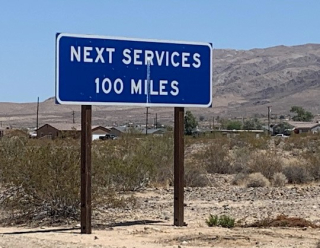 A recent summer trip to catch up with family and friends led me to Joshua Tree, California and its National Park. With its triple digit temperatures and reclusive landscape, Joshua Tree is a quiet venue in the offseason. One cannot plan many outdoor activities, but the Airbnb where we were staying was well-stocked with books about desert life including the photo- essay book Abandoned California: The Mojave Desert (2020) by Andy Willinger.
 As fortune would have it, I was "close" enough to make an overnight trip to visit some longtime friends Tom and Peg who live in Phoenix about 300 miles away. Willinger's book included pictures of Joshua Tree and other remote places that I would be driving through along the north and east boundary of the national park. Inspired by Willinger's vibe of "capturing "the majesty of forsaken buildings, vehicles and artifacts of the Mohave's once vibrant past," I motored along secluded two lane highways (SR 62 & SR 177) from Joshua Tree to Desert Center, stopping a couple of times in the midday heat in an attempt to imitate the book's photos.
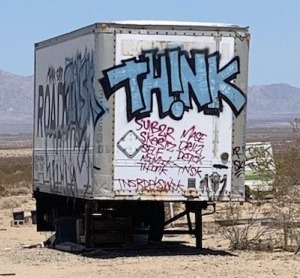
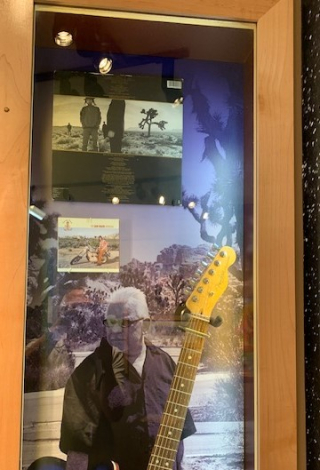 My road-trip soundtrack included U2's critically acclaimed album, The Joshua Tree and there was reference to the recording at the Visitor's Center. Unfortunately, I could not find any of the older residents who may have had a beer with Bono or Edge when they visited the town in 1986 to make the famous album cover. (Eventually the band was actually photographed at the Death Valley Monument.)
The older guy who looks like a retired insurance salesman with the Fender guitar is actually English singer Eric Burdon of the Animals and War fame.
—– EXTENDED BODY: —– EXCERPT: —– KEYWORDS: Abandoned California, the Mohave Desert, U2, Joshua Tree, Desert Center —– ——– AUTHOR: Murray Browne AUTHOR EMAIL: murray.browne905@gmail.com TITLE: Rereading in Solitude STATUS: Publish ALLOW COMMENTS: 1 CONVERT BREAKS: wysiwyg ALLOW PINGS: 0 BASENAME: rereading-in-solitude CATEGORY: Book Reviews UNIQUE URL: https://thebookshopper.typepad.com/the_book_shopper_atlantad/2021/06/rereading-in-solitude.html DATE: 06/29/2021 08:02:45 AM —– BODY:
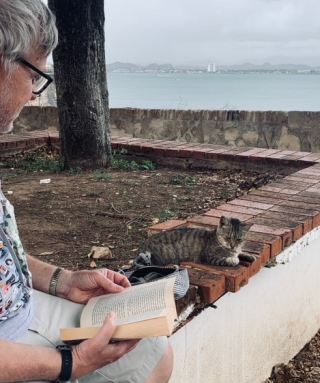 Since the pandemic began I noticed a change in my reading habits. I have been revisiting many books that I have read before – ten titles to be exact. This contrasts with the period of 2017-2019, when I reread only a single book: Walker Percy’s The Moviegoer. I did try to reread Catch-22 in preparation of the Hulu six-episode adaption of the Heller book, but found it unbearable.
Was this just a comfort-in-the-familiar thing, a dearth of books to choose from (doubtful), or was there something else in play?
Rereading The Plague (1948) in the Spring of 2020 made sense, but I should have paid closer attention to the timeline of the bubonic plague in Albert Camus’ Oran. Like many, I thought COVID-19 would recede in the fall, but in The Plague the epidemic lasted over a year. In January, I reread Drew Gilpin Faust’s The Republic of Suffering: Death and the American Civil War (2008) which examined how the young nation coped with the 600,000 deaths in the Civil War. This provided some context to what we are currently experiencing with the fatalities in the United States from the coronavirus. I did some "processing" in the essay “The Current Republic of Suffering.”
Gabriel García Márquez
While visiting family and vacationing in Puerto Rico, I brought a yellowed, trade paperback of Gabriel García Márquez’s classic One Hundred Years of Solitude (1967). In the picture above, I am reading the book to one of the many stray cats who lounge near the Governor's Mansion in old San Juan.
Obviously there are limits to the number of books you can take on trip so you better make sure your selection is a good one. Except for being impressed with García Márquez’s magical realism, I didn’t remember many details from my first reading over 30 years ago. I recalled there was a character who ate soil when she was upset, a lot of characters with close to the same name, and the long, rain which almost wiped out the village of Macondo, Columbia where the book is set.
A new reading revealed much more with several themes that resonate today.
For example, one pivotal plot point in the novel is when the banana plantation owners (representing capitalism) surround the protesting laborers including women and children and machine gun them down. The dead bodies are loaded into boxcars and hauled to the coast where they are dumped into the sea without a trace. José Arcadio Segundo manages to survive and escape back to Macondo, where he tries to keep the memory of those slain alive. But the rich plantation owners obliterate all evidence of the massacre and deny it ever happened (like the Capitol insurrection). As if the gods are angry, the rains descend for years almost washing Macondo into oblivion, but the Word, through the efforts of José Arcadio Segundo lives on.
Solitude Defined
 Since yellow, trade paperbacks are suitable for making notations, I started marking in the book how the characters lived in different types of solitude:
The solitude of grief: “She lost her mind over him (her dead lover). She could not sleep and she lost her appetite and sank so deep into solitude that even her father became an annoyance.”
The solitude of death: “He died of old age in solitude, without a moan, without a protest, without a single moment of betrayal, tormented by memories.”
The solitude of depression: “The need to feel sad was becoming a vice as the years eroded her. She became human in her solitude."
The idea that we have all have a different definition of solitude makes more sense after pandemic enforced isolation. There is a difference between loneliness and being alone. For some it was maddening and unbearable (hence by the rise of alcohol consumption); others admitted they enjoyed hearing the birds when the traffic disappeared for a couple of months. It reminds me of my favorite line in Camus’ The Plague when the character Cottard who early in the novel is prevented from killing himself, admits to finding temporary peace of mind in the chaos. “Well, let’s put it like this, “says Cottard, "I’ve been feeling much more at ease here since the plague settled in.”
The insights gained in reading One Hundred Years of Solitude is not limited to understanding the solitude that envelops many of the characters, but rather in the end, it is the Word that endures as does this powerful, timeless masterpiece. Read on, book shoppers.
—– EXTENDED BODY: —– EXCERPT: —– KEYWORDS: Gabriel García Márquez, One Hundred Years of Solitude. The Plague, Albert Camus, Drew Gilpin Faust, The Republic of Suffering. Reading during the pandemic —– COMMENT: AUTHOR: Cal Gough EMAIL: calgough@bellsouth.net IP: 108.82.142.12 URL: DATE: 06/29/2021 09:13:48 AM I’m glad you got to travel during the lockdown, and I’m glad you wrote this blogpost – you may have convinced me to re-read ONE HUNDRED YEARS OF SOLITUDE myself, or to (finally) read THE PLAGUE. In any case, your musings on solitude were interesting. Aside from assorted frustrating aspects of the pandemic/lockdown, I’ve discovered, to my surprise, that my temperament is apparently more OK with more (nonvoluntary) solitude than I’d imagined. Hard to really tell, as my partner Randy and I continued our routine of spending half the week at his place, half each week at mine: not everyone out there had such a constant, familiar buffer to their solitude these past many months. Still, we were apart a lot during the day, so I did spend/do spend a lot of time at home. I thought I’d read more books during lockdown, but that didn’t happen, alas. However, now that the public library has resumed Interlibrary Loans, I’m getting more stuff I really, really, really want to read, so I expect my reading time will spike again, as in pre-COVID times. Lord knows I’m reading (simultaneously) more titles than ever lately. (And that’s, as Martha Stewart would say, A Good Thing.) —– COMMENT: AUTHOR: Murray Browne EMAIL: IP: 76.20.249.225 URL: https://profile.typepad.com/1227802374s31410 DATE: 06/29/2021 01:49:29 PM Thanks for the comment, Cal. I am glad the posting resonated with you. I had to make a concerted effort to keep my reading up hours-wise after retirement. While I was working I had 45 minutes of reading time each day on MARTA. These days, I try to block out specific times of the day for reading these days, but that is not always possible. Camus and Garcia Marquez are similar because both writers are political and involved with the politics of their region. Camus with Algeria and Garcia Marquez with Columbia (though he’s known more for being friends with Castro in Cuba). However the story and great writing comes first. —– ——– AUTHOR: Murray Browne AUTHOR EMAIL: murray.browne905@gmail.com TITLE: The End of Civilization STATUS: Publish ALLOW COMMENTS: 1 CONVERT BREAKS: wysiwyg ALLOW PINGS: 0 BASENAME: the-end-of-civilization UNIQUE URL: https://thebookshopper.typepad.com/the_book_shopper_atlantad/2021/06/the-end-of-civilization.html DATE: 06/03/2021 10:58:00 AM —– BODY: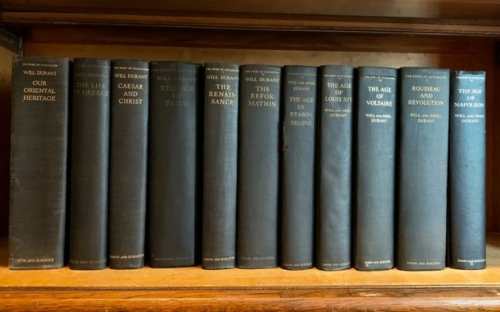
This week marks the End of Civilization. After having a set of Will and Ariel Durant's 11 Volume, The Story of Civilization on the shelves of my glass bookcase for over 40 years, I sold them online through Destination:Books.
The thought process was that even though they are an excellent reference set, I was not going to read them all. ( I only read the first volume Our Oriental Heritage and I am not sure I even finished that. ) When the Pandemic didn't motivate me to crack any of them open, my decision became final.
The set came in my possession in the late 1970s when the handyman of my apartment building approached me about the books that an eclectic tenant, who never talked or made eye contact to anyone, had moved out leaving his possessions to the handyman. (He noticed that I had a lot of books in my place and thought I might be interested.) My roommate and I lived down the hall from the mysterious tenant and we had created a story that this pipe-smoking man who walked nonstop around downtown Danville, Illinois was none other than the reclusive writer Thomas Pynchon. What better place for the novelist who had just finished Gravity's Rainbow to avoid publicity than to live in a small, rust belt, Midwestern city. Moreover, derived from his writings Pynchon is presumed to be a big reader of encyclopedias, almanacs, and history books, which further reinforced our fantasy.
 The handyman kept the man's television and stereo, but I bought the books for a few dollars and saved them from the incinerator (remember the handyman had access). I provided them a decent home for decades and I now hope the set has gone to a good place and not be repurposed into anonymous living room décor.
On the brighter side, this has freed up some considerable space and I restocked my shelves with my collection of Pynchon books. It seemed appropriate. And behold there is space for more of the author's work.
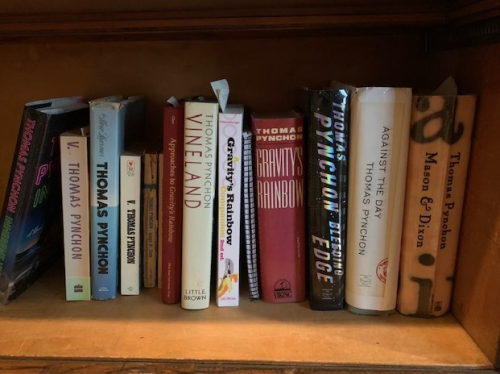
—– EXTENDED BODY: —– EXCERPT: —– KEYWORDS: The Story of Civilization, Destination Books, Thomas Pynchon, recluse —– ——– AUTHOR: Murray Browne AUTHOR EMAIL: murray.browne905@gmail.com TITLE: Upping the Worm Game STATUS: Publish ALLOW COMMENTS: 1 CONVERT BREAKS: 0 ALLOW PINGS: 0 BASENAME: upping-the-worm-game CATEGORY: Book Reviews UNIQUE URL: https://thebookshopper.typepad.com/the_book_shopper_atlantad/2021/05/upping-the-worm-game.html DATE: 05/16/2021 08:49:00 PM —– BODY:
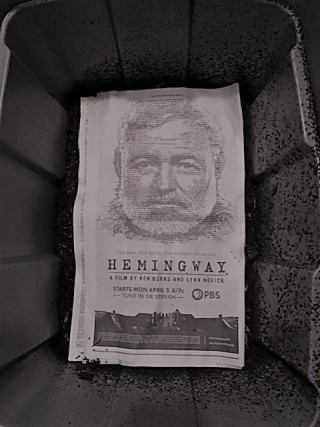 As an amateur vermi-composter – who has been raising worms for his own personal consumption for several years (that doesn’t sound quite right), I have recently been inspired to take my worm works operation to a new level. Heretofore I have been content with a simple, blue plastic tub, drilled with air holes and partially filled with red wiggler worms, selected food scraps, and newspaper. Shown here are the worms enjoying a print advertisement promoting the Ernest Hemingway PBS documentary. Given the novelist’s fear of death, my worms appreciate the taste of irony, as much as avocado and melon rinds.
My renewed commitment began while I was browsing in the section of R.J. Ruppenthal’s Fresh Food from Small Places (2008), where he gives easy-to-follow instructions on how to build a simple worm operation for the home. Ruppenthal also does a shoutout for Amy Stewart’s The Earth Moved: On the Remarkable Achievements of Earthworms (2005), which he describes as “not a ‘how-to book’, but a reflection and synthesis of wisdom on the achievements of earthworms and their importance to human civilization.” Intrigued, I obtained a copy and started reading.
The Earth Moved
Stewart begins her book with a chapter on Charles Darwin, who studied worms with the same diligence exhibited during the naturalist’s famous voyage on the Beagle, which eventually led to his providing additional evidence to the theories of evolution. Just before his death in 1882, Darwin captured this fascination with earthworms and their effects on enriching soil in his The Formation of Vegetable Mould, Through the Actions of Worms.
Stewart goes on to explain how earthworms including the red wigglers or Eisenia fetida (as I now call them) work their magic on nematodes, coffee grounds, manure, bacteria, and fungi. Along the way I was able to glean tips on doing a better job with my bin full of critters.
Folded in throughout the book are interviews with researchers and “field trips” to places such an experimental sewage treatment plant in Pacifica, California where earthworms are part of the process of turning human waste into usable biosolids for agriculture. Along the way, Stewart never loses her light-hearted anecdotal style that makes the book such a pleasure. For example, in this passage she explains why she has not gone into the Big Worm business.
For one thing, I’d run into the same problem selling worm castings that I would if I were to go into the business selling chocolate or tawny port; I’d keep all the inventory for myself. I buy compost by the truckload for my annual mulching of the flower beds. I have to buy it because my worms only produce a few cubic feet of castings each season. If I had enough worms to generate truckloads of castings, my farm would still have only one customer: me.
I will take heed of Stewart’s advice to limit my own personal consumption.
https://bookshop.org/widgets.jsWorm Connoisseurs
Providing some additional inspiration and reflection on our natural world is Deborah Warren’s short book of poems, Connoisseurs of Worms (2021). In her sixty-five poems Warren seamlessly mixes references to Greek mythology, classical paintings, as well as modern life (one poem is even entitled “PETscan”). She deeps dives into all creatures great and small, ranging from zebras, “Titian-haired” orangutans, to moles and a worm dietary favorite – nematodes. A good example of how she can work these seemingly disparate themes into one poem is demonstrated in “Mosquito in the Heart.”
Mosquito in the Heart
There’s nothing viable on the EKG.
So says the cardiologist.
Wrong. Clearly he missed
some small anomaly:
With an incessant and insistent hiss
under my left ribs—a falsetto whine,
whetting its proboscis,
it flits and ricochets around my heart.
The doctor’s diagnosis?
He’d call it a feint of heart—if he had the wit:
He doesn’t. He’s just content to be smart,
and here’s his opinion: It’s anxiety.
It isn’t in your heart—it’s in your mind.
There’s medication; often meditation
helps with tension. And he won’t admit
that coronary insects do exist.
Just paranoia? I’m not buying it:
He’ll give me white lies but—when I insist—
refer me to Cardioentomology.
You don’t have to be a vermi-composter to appreciate her wit and small wisdoms. Just someone who can take time out to examine life all around us, including what is beneath our feet.
https://bookshop.org/widgets.js —– EXTENDED BODY: —– EXCERPT: —– KEYWORDS: Amy Stewart, The Earth Moved, Deborah Warren, Connoisseurs of Worms, R.J. Ruppenthal —– ——– AUTHOR: Murray Browne AUTHOR EMAIL: murray.browne905@gmail.com TITLE: Traveling by Book STATUS: Publish ALLOW COMMENTS: 1 CONVERT BREAKS: 0 ALLOW PINGS: 0 BASENAME: traveling-by-book CATEGORY: Book Reviews CATEGORY: Bookstores UNIQUE URL: https://thebookshopper.typepad.com/the_book_shopper_atlantad/2021/04/traveling-by-book.html DATE: 04/25/2021 08:53:06 AM —– BODY:
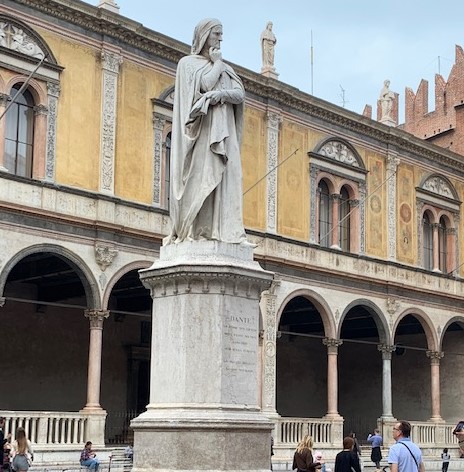
“A travel writer knows that a reader isn’t interested in tourism” – Jorge Carrión
Though I am starting to give serious thought (like the statuesque Dante) about traveling outside the tri-county area, I remain for the time being tethered to home. Undeterred, I recently finished reading two short books that have taken me to places around the country and the globe, but with two different approaches.
American Places
 It does not really matter whether or not you have visited the points of interest in William Zinsser’s American Places: A Writer’s Pilgrimage to Sixteen of This Country’s Most Visited and Cherished Sites (1992, 2007). Zinsser makes it work either way. It has been decades since I visited Mark Twain’s hometown and Zinsser’s descriptions reminded me that Hannibal wasn’t much more than Tom Sawyer’s House, Becky Thatcher’s House and a roadside view of Jackson Island on the mighty Mississippi. And yes, Zinsser’s overall impression of The Alamo was the same as mine: The Alamo is a lot tinier than you would ever expect. (The reason? We grew up seeing it on big movie screens.)
And if you are concerned that it’s been nearly 30 years since its original publication, don’t worry. American Places isn’t a tour guidebook anyway. He examines the fundamentals of why places in our nation’s history continually resonate with us.
Two things that keep the book fresh is that Zinsser interviews National Park Rangers and gift shop employees alike and purposely avoids talking to tourists and official representatives. This allows him to get the insights of those who are there every day and provide a fair amount of background history on the site itself (e.g. Mount Vernon had fallen into serious disrepair just before The Civil War and later during the war both armies agreed not to battle there, treating it as a demilitarized zone).
Also, this not just a compilation of independent pieces published elsewhere, Zinsser builds on the narrative of his trip and circles back on previous stops to draw comparisons between the sites.
As the author of the mega bestseller On Writing Well (1976), Zinsser has set high expectations for tight, evocative prose and he does not disappoint. And as a bonus, there are many passages that have a subtle humor to them. For example, in this excerpt from the Alamo chapter Zinsser watches the tourists buying gift items and lists the items alphabetically: ashtrays, belts, bookmarks, books, buckles, bumper stickers…tote bags, toy guns, and yo-yos. “I was impressed that one small martial shrine could lend its imagery to such a multitude of domestic uses,” he writes. “The items all appeared to be of a certain quality above kitsch, and I walked around the display counters and racks taking notes. As I was finishing, a very tall security guard accosted me and told me to ‘step outside.’ I followed him out the door, my heartbeat racing ( I am about to be arrested at the Alamo!)…”
Unamerican Places
In sharp contrast in style and content, Jose Carriόn’s Against Amazon and Other Essays (2019) acts a guide to book shops and book people in London, Korea, Argentina, Tokyo, Mexico City, Capri and his home country of Spain. Carriόn made this blog’s Best Books Read in 2018 with his 2017 effort —Bookshops: A Reader’s History. (His Certificate of Merit is still waiting to be picked up at the blog offices, sigh.)
His anti-Amazon title essay includes a seven-part manifesto why we should not mindlessly bow to the will of the corporate giant when we buy our books.
Carrión also interviews The History of Reading ’s Alberto Manguel who now is the director of the National Library of Argentina. Manguel tells the story of every booklover’s nightmare— how he was forced to dismantle his 40,000 book library and move it from France to Montreal.
https://bookshop.org/widgets.jsAs Carrión takes you to various book shops and booksellers throughout the globe he reminds readers the value of physicality of the best bookshops inhabited by booksellers who can tell you what is on the shelves without checking their computer. In contrast to Zinsser who is diligent in connecting the dots, Carriόn will refer to many favorite titles and bookshops, many of which you have not heard of, much less visited. But do not be discouraged, just ride his passion.
Besides being “travel books not for tourists” another of commonality of these two books is the author Jorge Luis Borges. The Argentinian-born Borges, known for his writings about labyrinthic book places, figures in one of Zinsser’s American Places—Hannibal, Missouri the boyhood home of Mark Twain.
According to Zinsser, in 1982, the aging, blind Borges accepted an invitation to give a lecture at Washington University in St. Louis on the condition that he could visit firsthand the “the source of the author’s strength.” Zinsser tells the story of the museum curator that accompanied Borges:
“I took him down Front Street and led him across the cinders where some cobblestones go down to the Mississippi. He squatted to where he could reach the river, and he leaned over and let the water run through his hands. Then he said, ‘Now my journey is complete.’”
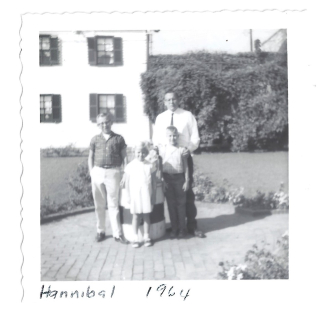 Here’s our American family at Tom Sawyer’s house. From the left is my brother Neil, my sister Kay, our Dad, (wearing his “vacation tie” ) and your narrator. Mom is taking the photo. No Borges photobombing.
—– EXTENDED BODY: —– EXCERPT: —– KEYWORDS: William Zinsser, American Places, Hannibal Missouri, Against Amazon and Other Essays, Jorge Carrion —– ——– AUTHOR: Murray Browne AUTHOR EMAIL: murray.browne905@gmail.com TITLE: Ken Burns’s Hemingway Outtakes STATUS: Publish ALLOW COMMENTS: 1 CONVERT BREAKS: wysiwyg ALLOW PINGS: 0 BASENAME: -ken-burns-hemingway-outtakes UNIQUE URL: https://thebookshopper.typepad.com/the_book_shopper_atlantad/2021/04/-ken-burns-hemingway-outtakes.html DATE: 04/08/2021 02:44:31 PM —– BODY:
I don't consider myself a big fan of Ernest Hemingway, but I've probably read a half-a-dozen of his books, and learned plenty watching the new Ken Burns' series, especially about bullfighting (e.g., the proper placement of hands to emulate horns). But Burns didn't have room for everything in his six hour documentary and I'm glad to help fill in the gaps.
Hemingway and Hunter S. Thompson. One of the more popular posts in this blog is short paragraph about Hunter S. Thompson's 1964 essay "What Lured Hemingway to Ketchum?" Details of the July 2011 post is here. What makes the essay an interesting read in retrospect is the coincidence that Thompson also died by a self-inflicted gunshot in 2005. Thompson prophetically says, "writers who lose their power of conviction lose the willingness to create art out of chaos."
Hemingway vs. his contemporary John Hersey. In 2016, I reread Hemingway's novel The Sun Also Rises (1926), and John Hersey's 1996 collection of short stories Key West Tales (who also lived in Key West). Hersey stories show tremendous range in subject matter with some measure of wit. For example, in the story "To End the American Dream," Hersey pays "tribute" to Hemingway by portraying him as a bar brawler, but also balances his portrayal by showing how Hemingway cares about his sentences and his writing habits.
Hersey also wrote the Pulitzer Prize winning novel A Bell for Adano (1944) about the American occupation of an Italian village in World War II, but his Hiroshima far surpasses any of Hemingway's journalism.
Hemingway & Martha Gellhorn & My Grandmother. My grandmother was very well read, and she loved tossing in quotes from her reading experiences at the appropriate time. When my grandfather was being particularly difficult, she'd say, "Nobody knows the trouble I've seen–except Gellhorn." It was a reference to Ernest Hemingway's fourth wife Mary Welch who once made the remark "Nobody knows the trouble I've seen" in front a what she thought was a dozing Hemingway. Papa woke and replied, "Nobody, but Gellhorn" (his third wife).
I scribbled this memorable note in my copy of For Whom the Bell Tolls (1940).
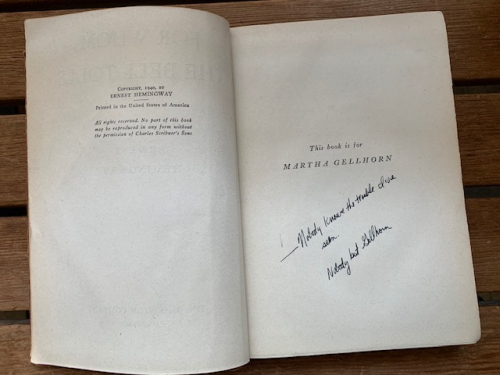
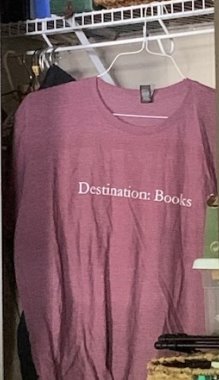 After a year hiatus my book pop-up Destination: Books will be at the Freedom Farmer's Market at the Carter Center here in Atlanta on Saturday morning, March 27, 2021. My longtime partner Denise and I did this once last year just before the COVID-19 pandemic hit and it was fun talking with people about books. It was difficult to shut it down, but things have improved and both of us have had our second vaccinations. (Still, public health protocols will be followed. Denise is retired from CDC. )
Destination: Books (for the adventurous) specializes in history, travel writing, gardening & sustainability, and books about books. As one might suspect, we will be bringing mostly about gardening & sustainability books but with a few surprises (to make it destination worthy). See the pop-up inventory page at the Destination: Books homepage for details.
Naturally, my books The Book Shopper: A Life in Review and the obscure, cult-classic, wannabe Down & Outbound: A Mass Transit Satire will be there too. I guess I have joined the ranks of writer-book retailer, but no one ever confused me with Anne Patchett, Larry McMurtry or Lawrence Ferlinghetti.
Here's hoping for good weather (a rainout is possible) and the t-shirt still fits.
—– EXTENDED BODY: —– EXCERPT: —– KEYWORDS: —– ——– AUTHOR: Murray Browne AUTHOR EMAIL: murray.browne905@gmail.com TITLE: Reading in the Past STATUS: Publish ALLOW COMMENTS: 1 CONVERT BREAKS: wysiwyg ALLOW PINGS: 0 BASENAME: reading-in-the-past CATEGORY: Book Reviews CATEGORY: Civil War Books UNIQUE URL: https://thebookshopper.typepad.com/the_book_shopper_atlantad/2021/03/reading-in-the-past.html DATE: 03/08/2021 09:38:00 PM —– BODY: For the last several weeks I have been reading two books from the 1930s. The first is George S. Schuyler’s Black No More (1931). Isabell Wilkerson recommended it in one of those “By the Book” columns in the New York Times Book Review. She mentioned that the book was a satire, which caught my attention because there are times that I have dabbled in satire (despite the trend that memes are crushing the long-form satire market).
The premise of Schuyler’s short novel is that a black doctor has discovered a process that can bleach a black man’s skin white, which will solve “America’s race problem,” but as one would expect there are many unforeseen complications as blacks rush to turn themselves white thinking this will be a permanent solution. One major shortcoming is that the blacks-turned-white soon begin to miss their black culture, and whites become increasingly nervous about the thought that there are blacks posing as whites. The possibility that the offspring between these two “demographics” could be born black adds to the society's confusion and anxiety.
Naturally, religious leaders and politicians alike take advantage of America’s new race dynamic.
Schuyler’s book drips with tone-sharp, dark humor (I liken it to Ambrose Bierce’s The Devil’s Dictionary – 1911) while making one uneasy since not a whole lot has changed in almost a century. He explains how a demagogue can rise to power. Not only will “people believe anything that was shouted at them loudly and convincingly enough” writes Schuyler, but these demagogues also justify stealing (misappropriating donations) because it was the “rightful reward for their services.” Sound familiar?
Included in the Penguin edition is an illuminating introduction by Danzy Senna, who explains Schuyler’s controversial legacy, which began when he was African-American journalist during the Harlem Renaissance. Because the book is set in the near future (1933), Senna maintains that Black No More is an example of Afrofuturist fiction “before such a term existed.”
William Faulkner’s Civil War
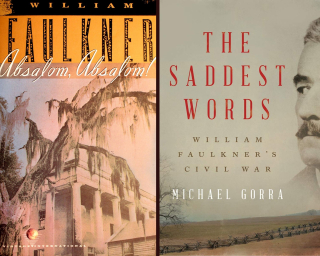 The second book from the 1930s is William Faulkner’s Absalom, Absalom! published in 1936 the same year as Gone with the Wind. This novel came to my attention via Drew Gilpin Faust (see previous posting) who wrote a review of Michael Gorra’s The Saddest Words: William Faulkner’s Civil War (2020), which was published in last September’s issue of The Atlantic (“What to Do About William Faulkner”).
Absalom, Absalom! is considered Faulkner’s most Civil War centric novel, though most of this work deals with the aftermath of the South shortly after the war instead of military engagements. The plot centers around the Sutpen family beginning with Thomas the patriarch who arrives mysteriously in Yoknawpatha County in 1837. He fathers two children Henry and Judith with Ellen Coalfield, the daughter of local merchant but sires another son, Charles Bon with a Haitian woman before he ever arrives in Mississippi. By happenstance Charles and Henry meet in college and become good friends at the precipice of the war, though unbeknownst to Henry, Charles is his half-brother. They fight together in the war and Charles plans to marry Judith. But when Henry finds out about Charles lineage well, bloody hijinks ensue.
Gorra’s book is a great companion to Absalom, Absalom! and as valuable as one of those online chapter-by-chapter summaries (otherwise you'll be buried Faulkner’s stream-of-consciousness prose). But what sets Saddest Words apart is that Gorra also spends time and effort contextualizing Faulkner with other writers of the post-Civil War period (George W. Cable, Ambrose Bierce, Joseph Conrad). Gorra has written kind of a travelogue as well, as he describes visits to Oxford, Vicksburg, and Shiloh – the latter being Faulkner’s “favorite” battlefield as it was less than two hours from his home. Discussion of current hot button issues such as The Lost Cause and Confederate memorials are deftly woven into the book as well.
Gorra does not avoid the difficult assessment of the Faulkner, who is both a white man in the Jim Crow South and winner of the 1949 Nobel Prize for Literature. Gorra writes in the last chapter:
There is never a clear line between the work and the life, many people now judge the tale by the teller, they see the book’s best self in terms of the man at his worst. For some people, the history I’ve detailed in the paragraphs above (where Gorra reveals some of Faulkner more shameful opinions) will be reason enough not to read him. Such decisions are personal and not perhaps subject to argument or exhortation. I have made a different one. I read him despite, and I read him for or because or on account of this difficulty. Not the formal difficulty of his work, however compelling I find it. The moral difficulty, rather, the drama, and struggle and the paradox and power of his attempt to work through our history, to wrestle or rescue into meaning.
With Black Lives Matter, the rise of white supremacy groups, the gerrymandering efforts to restrict voting, and the Meghan Markle-Royal Family saga, the works of Schuyler and Faulkner are as topical today as when they were first penned 90 years ago.
 If you purchase Black No More or The Saddest Words at Destination:Books, part of the purchase price goes to the blog and to independent bookstores.
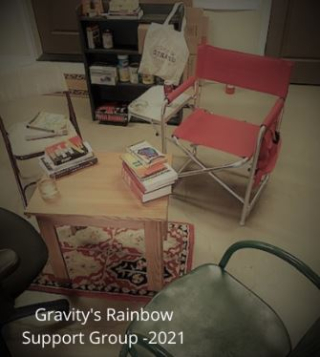 Preamble: The original Gravity’s Rainbow Support Group (GRSG) began in May of 2020 as kind of reading group (more like a duo of college classmates who have recently retired) to mutually encourage each other to read more challenging books that we probably would not have read on our own. Every month, we meet virtually (sigh), but we prefer imagining holding meetings in a a church basement that has all the trappings of a real support groups: bad coffee, stale doughnuts and smoking.
It began last year with Thomas Pynchon’s 1973 novel Gravity’s Rainbow, but it worked so well we extended to two other books; Pnin (1953) by Vladimir Nabokov followed by The Denial of Death (1973) by Ernest Becker. Haphazard reading notes, quotes, and auxiliary sources on these three books can be found here.
This page has similar offerings for books read and discussed in 2020:
This Republic of Suffering: Death and the American Civil War (2008) by Drew Gilpin Faust
One of the reason this book was selected is it also had the word “death” in the title not unlike our previous selection (The Denial of Death). As the death tolls from COVID-19 continued to rise naturally it reminded us of the horrific death tolls of the Civil War. So much so, as we grappled with what is the moral of the pandemic, that it spawned the essay, “The Current Republic of Suffering” which was published by the Tropics of Meta blog in February of 2021. We won’t repeat the theme of that piece here, but there were many other noteworthy observations.
This topic seems especially timely, given that we as Francis says are currently “sentenced to not dying” meaning that our lives are focused on not dying and minimizing exposure to the potential deadly virus. It reminds me of the quote from Woody Allen’s 1975 movie “Love and Death”.
Isn’t all mankind ultimately executed for a crime it never committed? The difference is that all men go eventually, but I go six o’clock tomorrow morning. I was supposed to go at five o’clock but I have a smart lawyer. Got leniency.
Literature of the Civil War
Faust makes the point that there was a dearth of American writers who actually wrote about the war who were actually in it. One exception is Ambrose Bierce, author of the satirical The Devil’s Dictionary and numerous short stories set on the battlefield. Bierce suffered severe head would at the Battle of Kennesaw Mountain just outside of Atlanta (potential field trip?). Coincidentally, Francis and I visited Shiloh almost 20 years ago where there is marker for Bierce at the battle’s infamous Bloody Pond. Faust also writes extensively about the poets Emily Dickinson, Walt Whitman (who served in the hospital in Washington D.C.), and Sidney Lanier.
War Memorials
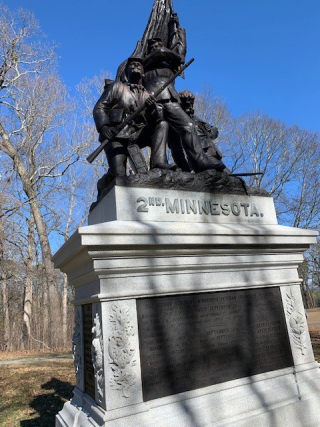 As many Confederate War Memorials are being removed and rightly so because they are sad, cruel, painful reminders for blacks in America, Faust explains why there are more Union memorials than Confederate statues on battlefields is that the North had the money to construct them and no interest in memorializing the Confederates. (The Battle of Atlanta Cyclorama Painting was originally painted for northern veterans). Resources were not available until the early part of the 20th century and as we know that the feelings the South had about the Civil War unresolved and buried in the Lost Cause rhetoric and memories of relatives who fought in the war. (Just like the debate we have today about the Vietnam War.)
This is in contrast the flurry of Confederate War Memorials that were erected in the 1960s, which were more directly in defiance of the Civil Rights Movement. One of the most well-known is the Stone Mountain bas-relief of Jefferson Davis, Robert E. Lee and Stonewall Jackson that was carved into Stone Mountain outside of Atlanta the 1960s (I saw it as a kid “under construction” in 1966 when we visited the city on vacation.) The Park opened exactly on day of the 100th anniversary of Lincoln’s assassination.
The meaning of memorials are both nuanced and loaded and the Faust book provides the origins of those meanings. ( If you really want to read a powerful book about the subject that strikes closer to home read Viet Thanh Nguyen’s 2016 book Nothing Ever Dies: Vietnam and The Memory of War ).
Accounting and Surviving
One of the more moving chapters of the book is the account of the herculean efforts of the Federal government, the military, private organizations and individuals to recover the dead and unaccounted that were spread throughout the South shortly after the war. (See the aforementioned Tropics of Meta piece).
Two quotes come at the end of the book. The first often is attributed to Joseph Stalin: “A single death is a tragedy; a million deaths is a statistic.” Gilpin tempers Stalin’s callous rationale (his Great Purge in the 1930a was responsible for an estimated million dead) when she writes, “how to grasp both the significance of a single death and the meaning of hundreds of thousands.”
Her book does this.
Absalom, Absalom! (1936) by William Faulkner
The aim of every artist is to arrest motion, which is life… and hold it fixed so that 100 years later, when a stranger looks at it, it moves again. – William Faulkner
GRSG selected this book based on a review of Michael Gorra’s The Saddest Words: William Faulkner’s Civil War (2020) by none other than Drew Gilpin Faust which appeared in the September, 2020 issue of The Atlantic. Reading Faulkner is a challenge and his stream of consciousness style is compared to Marcel Proust (the French admire Faulkner) and James Joyce. Like Pynchon, I adopted the same reading strategy of reading the chapter plot synopsis from SparkNotes first followed by read the chapter.
Though I had read Light in August in another book group 40 years ago and I was assigned Absalom, Absalom! in college (which I didn’t read), I really knew very little about him. I didn’t even know how to pronounce Yoknapatawpha, the fictional Mississippi county where Faulkner set many of his books. Here’s a clip from Faulkner himself:
Then there is this clip transcript from the movie, ” Talladega Nights: The Legend of Ricky Bobby” where Ricky’s mother reads Faulkner’s short story, “The Bear” to Ricky’s sons.
Here’s another famous Faulkner quote who worked in the Oxford post office and wrote instead tending to the needs of his customers. Upon quitting he said:
I won’t ever again have to be at the beck and call of every son of a bitch who’s got two cents to buy a stamp.
https://bookshop.org/widgets.js
March 12th. The Reading Group is 2/3 the way through Absalom, Absalom!, the point in the novel where Wash Jones scythes Thomas Supten. Here’s a list of things we discussed:
According to Gorra, Shiloh was Faulkner’s favorite Civil War battlefield and less than a two hour drive from his home in Oxford, Mississippi. As a young Civil War buff I recall that Southerners referred to it as the Battle at Pittsburg Landing.
When the Confederate Cavalry Raider Earl Van Dorn raided and burned the huge Yankee supply depot in Holly Springs, Mississippi in December, 1862, it force Grant to pull back from his Vicksburg Campaign. This started the Yankees foraging and raiding livestock and the farms in the South. Until then they refrained from doing this under orders from Lincoln. Later Sherman adopted the same strategy in his March to the Sea. Speaking of which, Sherman created the “40 Acres and a Mule” for freed slaves, not as a kind of restitution, but to keep freed slaves from following his troops. The irony of ideas.
Faulkner in general did not write stream-of-conscious for his black characters. Also he was the first Southern white writer in the early 20th century to even acknowledge the wide spread miscegenation (white slaveholders/black slaves) that was endemic in the South at that time. This reminded one a quote from Richard Schuyler’s dedication of his 1931 novel Black No More.
This book is dedicated to all Caucasians in the great republic who can trace their ancestry back ten generations and confidently assert that there are no Black leaves, twig, limbs, or branches on their family tree.
For more about Schuyler, check out this posting from The Books Shopper blog.
Discussions of Faulkner include the human propensity and desire to dominate other classes and races. This links back to a previous GRBG book, Ernest Becker’s The Denial of Death, where one of the themes of the book is that human repress their own mortality (instead of sex) by dominating other peoples including killing them to hide from their own inevitable death. Speaking of repression, the South’s repression of the evils of slavery led to the breakdowns and deaths of many Faulkner’s characters. He was brutal in these descriptions.
In Gorra’s book there are a few comparisons to Faulkner and Margaret Mitchell’s Gone with the Wind, which was published in the same year as AA!, he writes:
Faulkner hated the ‘moonlight and magnolia’ tradition to which Margaret Mitchell’s bestseller belongs and claimed he should have gotten twice what she had for the movie rights. He added that his own book was about ‘miscegenation’: there were no takers.
 March 29th. In our final discussion devoted to Faulkner, Francis definitely like the book better than I did. Not to say, I disliked the book or didn’t appreciate its legendary status, but Francis spoke specifically about how he liked the Faulkner stream-of-consciousness style mixed with concrete passages of clarity. Speaking of Faulkner having the stuff of legends, check out this essay by Dave Nash, “How to Make a Myth–A Review of Absalom, Absalom.” Nash explains why Faulkner used the biblical title for the novel (The South parallels Absalom.)
Related quotes about, from and inspired by Faulkner:
He must learn them again. He must teach himself that the basest of all things is to be afraid: and, teaching himself that, forget it forever, leaving no room in his workshop for anything but the old verities and truths of the heart, the universal truths lacking which any story is ephemeral and doomed — love and honor and pity and pride and compassion and sacrifice. Until he does so, he labors under a curse. He writes not of love but of lust, of defeats in which nobody loses anything of value, of victories without hope and, worst of all, without pity or compassion. His griefs grieve on no universal bones, leaving no scars. He writes not of the heart but of the glands.
and
I refuse to accept this. I believe that man will not merely endure: he will prevail. He is immortal, not because he alone among creatures has an inexhaustible voice, but because he has a soul, a spirit capable of compassion and sacrifice and endurance. The poet’s, the writer’s, duty is to write about these things. It is his privilege to help man endure by lifting his heart, by reminding him of the courage and honor and hope and pride and compassion and pity and sacrifice which have been the glory of his past. The poet’s voice need not merely be the record of man, it can be one of the props, the pillars to help him endure and prevail. — both from Faulkner’s Nobel acceptance speech
You write a story to tell about people, man in his constant struggle with his own heart, with the hearts of others, or with his environment. It’s man in the ageless, eternal struggles which we inherit and we go through as though they’d never happened before, shown for a moment in a dramatic instant of the furious motion of being alive, that’s all any story is. You catch this fluidity which is human life and you focus a light on it and you stop it long enough for people to be able to see it.” (The most salient characteristic of life is its coerciveness: it is always urgent ‘here and now’ without any postponement. Life is fired at us point blank.) — Jose Gasset “Faulkner in the University”
Only the descent into the hell of self-knowledge can pave the way to godliness.― Immanuel Kant, The Metaphysics of Morals
Favorite selected quotes from Absalom, Absalom:
- Doubtless the only pleasure which he (Mr. Coldfield) had ever had was not in the meagre spartan hoard which he had accumulated before his path crossed that of his future son-in-law;—not in the money but in its representation of a balance in whatever spiritual counting-house he believed would some day pay his sight drafts on self-denial and fortitude.
- He (Sutpen, the self-made man) had been too successful, you see; his was that solitude of contempt and distrust which success brings to him who gained it because he was strong instead of merely lucky.
- and then Wash Jones sitting that saddleless mule before Miss Rosa’s gate, shouting her name into the sunny and peaceful quiet of the street, saying, ‘Air you Rosie Coldfield? Then you better come on out yon. Henry has done shot that durn French feller. Kilt him dead as a beef.’ ” (like Conrad—Heart of Darkness—”Mr. Kurtz, he dead”).
- …each look burdened with youth’s immemorial obsession not with time’s dragging weight which the old live with but with its fluidity.
- (and thank God you can flee, can escape from that massy five-foot-thick maggot-cheesy solidarity which overlays the earth, in which men and women in couples are ranked and racked like ninepins; thanks to whatever Gods for that masculine hipless tapering peg which fits light and glib to move where the cartridge-chambered hips of women hold them fast);—not goodbye: all right: and one night he walked up the gangplank between the torches and probably only the lawyer there to see him off and this not for godspeed but to make sure that he actually took the boat. Faulkner anticipating the Beatle’s Happiness is a warm gun, or maybe he is just describing how people write history with their loins….
- So they took the steamboat North again, and more gayety and excitement on the boat now than Christmas even like it always is when a war starts, before the scene get cluttered up bad food and wounded soldiers and widows and orphans.
- to talk about wounds in the Confederate army in 1865 would be like coal miners talking about soot.
- Battles lost not alone because of superior numbers and failing ammunition, and stores, but because of generals who should not have been generals, who generals not through training in contemporary methods are aptitude for learning them but by the divine right to say “Go there” conferred upon them by an absolute caste system; or because the generals of it never lived long enough to learn how to fight massed cautious accretionary battles.
- And the unforgettable exchange between Charles Bon and Henry Sutpen, which is perhaps the climax of the novel. “So it’s the miscegenation, not the incest, which you can’t bear.”
Barbara Tuchman
Francis had mentioned Barbara Tuchman’s book Practicing History: Selected Essays (1981) in previous GRSG meetings and even sent me a copy. Francis mentioned that he had used this Tuchman book in teaching his medical students the importance and the techniques of taking patient histories. As one who is working on the history of his father (looking at his war letters), I had an interest in reading this book. Francis had not read the book in decades and revisiting a book can be illuminating. This book did not disappoint either of us.
Meeting Notes of April 16, 2021
https://bookshop.org/widgets.js
Tuchman deconstructs what makes her such a good history writer who enjoyed a wide readership. Thinking of the reader in terms of language and clarity of writing. (She says the research is the easy part; writing is more difficult.) She does not throw the kitchen sink at you, but says the good historian must be selective. There is an element of wit and humor in her writing, but never at the expense of the narrative. Practicing History is divided into 3 parts. Part One is about history writing with many examples of her own work. Part Two is reprints of things she wrote in the late 1960s about Israel and the beginning of the First World War. (She won the Pulitzer for The Guns of August about the first month of the war.) Part Three is more about History.
Francis sent along his favorite Tuchman passages, which reinforced our observations:
1) It is exactly this quality of perceiving truth, extracting it from irrelevant surroundings and conveying it to the reader or the viewer of a picture, which distinguishes the artist.- Tuchman
2) Historians provide a one-way screen on the past through which one can see man, at one time or another, committing every horror, indecency, or idiocy that he is capable of today. Tuchman
3) The best picture and the best history, he said, are those “which exhibit such parts of the truth as most nearly produce the effect of the whole.” Tuchman
4) Especially in an alien setting like China—but the rule should hold true for all historical writing—I try never to introduce a place name without locating it in relation to some place already mentioned, nor introduce a person without describing some attribute that will fix him in the reader’s mind. Tuchman (I noted that both Rick Atkinson and Shelby Foote do this very well.)
5) I think this development is part of the anti-excellence spirit of our time that insists on the equality of everything and is thus reduced to the theory that all facts are of equal value and that the biographer or historian should not presume to exercise judgment.- Tuchman
Her references to another Pulitzer book that she wrote — Stillwell and the American Experience in China, 1911-1945 (1971)- inspired us to include the Stillwell book in our reading regime. (I got my copy for $1 at the Friends of the Library Book Sale when we used to have sales like that.) Tuchman explains that Stillwell was just the perfect entry point to write about the era of China and America. (not unlike Neil Sheehan’s A Bright Shining Lie: John Paul Vann and America in Vietnam). One note is our discussion is that events like The Insurrection at the Capitol on January 6 will be best handle by the historians. Everything is to close and too jumbled. It will take an historian ten or 15 years down the road to sort it all out.
Warning: Stillwell is a long, long read. Sometimes you feel you are hacking through the jungles of Burma. She is a very meticulous researcher and writer and these details while give amazing validity to the diplomacy between China and United States and how it shaped the globe shortly after World War II. You get a strong sense of the Chinese people and how the Communists prevailed over the Nationalist leader Chiang Kai-Shek, who was mostly consumed with staying in power and was more interested in stockpiling resources (U.S military aid) that trying to defeat the invading Chinese.
Stillwell was amazing leader who had brains, courage and the will to see things through against almost insurmountable odds. He might have been a more well-known and esteemed figure like Eisenhower, Patton or MacArthur but he died soon after the war.
Primo Levi, The Periodic Table

Monsters exist, but they are too few in number to be truly dangerous; more dangerous are the common men, the functionaries ready to believe and to act without asking questions. – Primo Levi WQ
Levi (1919-1987) was an Auschwitz survivor who wrote about his experiences soon after the war in If This Is a Man. The Periodic Table was published in 1975. Basically, he tells a story or personal story based of the properties of one the elements in The Periodic Table. I had read the book decades ago and always wanted to revisit it and Francis, being a man of science agreed. We both thought this was one of the best books we had read in the Gravity’s Rainbow Support Group, which has been going on for over a year now.
One strange coincidence about this selection is that Levi, survived Auschwitz by working as a chemist. The company that “owned” the Bono chemical works next to Auschwitz was IG Farben, who Pynchon focuses on somewhat in Gravity’s Rainbow when he refers to the large German corporations that profited from the war.
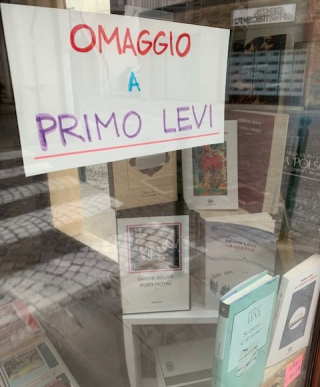
Favorite Passages from The Periodic Table.
He (Dr. Muller) was not the perfect antagonist, but, as is known, perfection belongs to narrated events, not to those we live. Primo Levi—The periodic table page 215 (on page 34, he describes the impurities in zinc as that which gives it life in the real world…something the chemist can work with…)
…And because, where there is damage, there is sin, and where there is sin, there is a sinner. Primo Levi, The Periodic Table page 207 (where there is an …ism, there must be an …ismer) FWalker
Ariadne’s thread. Page 208 Primo Levi, the Periodic table—(the clue, which is followed guides one to the solution/answer). (on page 204—he describes thrashing about in the dark, looking for a solution, until one finds a slight glimmer and follows it…contrasting with crashing around in a cave, with the ceiling progressively narrowing as you move forward, until, abashedly you climb out backwards on hands and knees….On 203, he describes my kind of stories—the foot soldiers who discover solo not in large corporations or group efforts….. Primo Levi, The Periodic Table and see page 76 for his definition of the “glimmer”: “There is nothing more vivifying than a hypothesis.”
Trustworthiness, is the most constant virtue, which is not acquired or lost with the years. One is born, worthy of trust, with an open face and steady eye, and remains that way for life. He who is born contorted and lax remains that way; he who lies to you at six, lies to you at sixteen and sixty. The phenomenon is striking and explains how friendships and marriages can last …Primo Levi The Periodic Table page 20
….and finally their came the customer we had always dreamed of who wanted us as consultants. To be a consultant is the ideal work, the kind you derive prestige and money without dirtying your hands, or breaking your backbone or running the risk of ending up roasted or poisoned. All you have to do is take off your smock, put on your tie, listen in attentive silence to the problem and they you will feel like the Delphic Oracle. You must then weigh your reply very carefully and formulate it in convoluted, vague language so that the customer also considers you an oracle, worthy of his faith and the prices set by the Chemist’s society. (chapter: Nitrogen page 175, Primo Levi The Periodic Table—which then follows with him looking for a source of Uric Acid scrabbling around collecting chicken shit).
Anyone who has the trade of buying and selling can be easily recognized: he has a vigilant eye and a tense face, he fears fraud and considers it, and he is on guard like a cat at dusk. It is a trade that tends to destroy the immortal soul…there have never been philosopher wholesalers or storekeepers. Page 169 Primo Levi the periodic table
Page 44: primo levi—the periodic table. He spoke grudgingly of his exploits. He did not belong to the species of persons who did things to talk about them (like me)..
The sacredness of the recipe….(once established people don’t dare mess with it, particularly those who don’t understand it) 158; page 154: It is the (humans) spirit that dominates matter, is this not so? (this is why he threw himself into his work trying to sort out varnish that had transmuted into orange livers…) Primo Levi The periodic table.
Prometheus had been foolish to bestow fire on men instead of selling it to them: he would have made money, placated Jove, and avoided all that trouble with the vulture. Primo Levi The periodic table page 143
Page 110—Primo Levi disparages A. Starace, who the translator points out was the secretary of the Italian Fascist National Party for many years and who, distinguished himself in his stupid zeal with which he strove “to Purify” the customs of the Italians, particularly their tendency to adopt foreign terms as their own, such as the terms “hotel” or “foyer”. In The periodic table.
Page32; Primo levi describes the person who lives vicariously through his superior—the admin sec, the asst. chemist. Etc. who represent authority without possessing it themselves….
Other quotes from Levi from Wikipedia Quotes (WQ)
Better to err through omission than through commission: better to refrain from steering the fate of others, since it is already so difficult to navigate one’s own. Primo Levi WQ
“A country is considered the more civilized the more the wisdom and efficiency of its laws hinder a weak man from becoming too weak and a powerful one too powerful.” Primo Levi WQ
“We who survived the Camps are not true witnesses. We are those who, through prevarication, skill or luck, never touched bottom. Those who have, and who have seen the face of the Gorgon, did not return, or returned wordless.” Primo Levi WQ
Those who deny Auschwitz would be ready to remake it. Primo Levi wQ (see Voltaire—those who can make you believe absurdities can make you commit atrocities.)
To be considered stupid and to be told so is more painful than being called gluttonous, mendacious, violent, lascivious, lazy, cowardly: every weakness, every vice, has found its defenders, its rhetoric, its ennoblement and exaltation, but stupidity hasn’t. Primo Levi WQ
Finishing on a lighter note- The infamous Element song from Thomas Lehrer.
Clive James, Cultural Amnesia: Necessary Memories From History and the Arts (2007)
Culture memory is difficult: too much detail. Cultural amnesia is easier. — James on Arthur Schnitzler
This book poses challenges because James writes almost 200 essays on over 100 different writers, thinkers, philosophers, dictators, actors and James tangential writing style where he starts on the subject and shifts to another topic. Murray had read parts of the book before in 2011 and used his paperback complete with notations to keep track on his favorite essays. However, after 10 years it was like starting anew.
Introduction-Overture
The polemicist has the privilege of unifying his tone by leaving out the complications. I have tried to unify it while encompassing the whole range of a contemporary mind.
In Austria the quota system was built into every area of society as a set of laws, limits and exclusions. As an inevitable result, in Austria even more than in Germany there was a tendency for scholarship and humanism to be pursued more outside the university than inside it.
Nina Berberova
In the book she tells the story of the Writers’ Library, the bookshop in Moscow where the books of the old intelligentsia were traded for food after the Revolution.
Raymond Aron
The essential trick was to offer the intellectuals the opportunity to continue their careers if they kept their protests suitably muted. The first result was a widespread but tacit collaboration. When you consider the mental calibre of the people involved, Paris under the Occupation thus becomes the twentieth century’s premier field of study in which to reach the depressing conclusion that even the most liberal convictions buckle very easily under totalitarian pressure, unless there are extraordinary reserves of character to sustain them. (Raymond Aron was in England and had escaped)
Hitler had dropped the equivalent of an atomic bomb on at least six million perfectly innocent people—a weapon more than sixty times more powerful than the one that obliterated Hiroshima. Stalin had dropped the equivalent of an atomic bomb a hundred times more powerful on his own citizens. Those bombs had gone off in comparative silence, but Aron had understood the repercussions.
Marc Bloch
It is commonly and truly said that young people who want to set the world to rights learn later to be grateful that the world is not worse than it is; but if they were convinced of that too early, we would lose their critical effect, and the world would be worse still.
Profundity can be attained by embracing principles with no basis in science. The occult and the mystically profound are perennial short cuts to a supervening vision: a world view without the world. Extreme authoritarianism is only a step away.
Chamfort ( who got the guillotine for his efforts at being realistic)
The Revolution had given birth to ideological malice in a form we can now recognize, but it was not recognizable then. Chamfort was the one who supplied the lasting definition of fraternité: “Be my brother or I will kill you.” That, in fact, was the joke that killed him: he was arrested soon after making it.
Murray: I have currently reading Ministry for the Future by Kim Stanley Robinson, which has a similar quote: “You can tell them they must change their ways. If they don’t we will kill them.”
Ideology
Modern history had given us enough warning against treating simplifications as real. The totalitarian states….had been propelled by ideologies and what else was an ideology (…) other than a premature synthesis. (“an oversimplification/slogan, I think” says Francis).
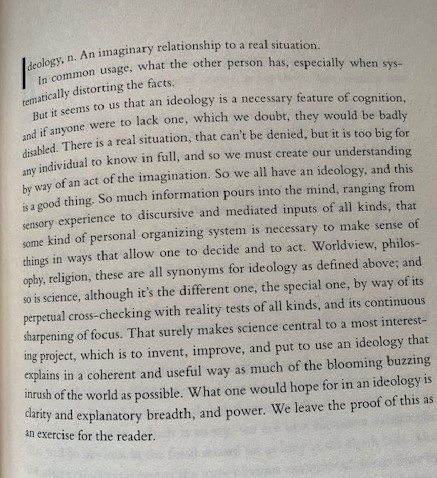
Second Meeting
Our Wednesday, August 18, 2021 there was a lot of discussions about aphorisms.
Francis and I both like aphorisms (and Clive James does too). Francis recommended The Oxford Book of Aphorisms by John Gross, is the one I think is the best on this topic. I recommended Eva Brann’s DoubleThink Double Talk. (reviewed in The Book Shopper blog here).Francis knew about Brann and we have decided to read Brann’s Homeric Moments later this year.
Golo Mann and Tacitus
Clive James, Golo Mann (Thomas Mann’s youngest son) both appreciate the elliptical style of the Greek historian. “They make a desert, and call it peace.”
Clive James on Golo Mann: The true high worth of Tacitus depended on his always being aware that tragic events had been the result of accidents and bad decisions and the depth of the tragedy lay in the fact that the accidents need not have happened and the decisions might have been good.
(Farce is nearer tragedy in its essence than comedy is. Samuel Coleridge 1833)
Also: One becomes a seer in the safest possible way: retroactively. One predicts the past as a dead certainty.
“By an effort of the imagination, the historian must put himself back into a present where the future has not yet happened, even though he is looking back at it through the past. “ Clive James on Golo Mann
“We are all allowed to predict the future: it is one of the imagination’s privileges. But predicting the past is a mischievous habit, and Golo Mann was the first to spot just how pervasive it was becoming, as historians presumed to impose upon events a baleful shape that had stolen into their minds: a shape that was a self protective reaction to the events themselves—one more version of the small man’s revenge for helplessness.” More Clive James on Golo Mann
The final line in the James piece talks about how beliefs can be a weak precursor to ideas. “It’s a belief, and precedes its attendant ideas as the stomach ache precedes the vomit.”
Other Notable Entries from the Book
Lewis Namier
“One would expect people to remember the past and to imagine the future. But in fact, when discoursing or writing about history, they imagine it in terms of their own experience, and when trying to gauge the future, they cite supposed analogies from the past: till, by a double process of repetition, they imagine the past and remember the future.”
Arthur Schnitzler
An essay about stupidity using the movie Where Eagles Dare as a prime example.
Michael Mann
An essay on the poor dialogue in movies (citing movies with DeNiro and Pacino) and the production values and the look of the movie are more important.
W.C. Fields
The master of tight dialogue, which is a lot like aphorisms.
We also talked about Climate Change/Catastrophe ending the call on another aphorism
“We like believing the best because nothing need be done about it, and the worst, because nothing can. “– James Richardson
https://bookshop.org/widgets.js
Next up is Marc Bloch’s The Historian’s Craft.
The Historian’s Craft by Marc Bloch

What we are currently reading often leads to what we read next. Such is the case of Marc Bloch who piqued our interest in Clive James’ Cultural Amnesia. Bloch (1886-1944) was a French historian who served in World War I and then joined the French Resistance in World War II at the age of 55 in 1942 and somehow managed to write this primer of “reflections on the nature and uses of history and the techniques and methods and those who write it.” While many French intellectuals laid low during the occupation (Sartre, Camus) or left the country (Raymond Aron), Bloch stayed in France. Sadly in 1944 he was captured by the Germans, tortured and then executed. Clive James in his essay about Bloch writes extensively about choices the intellectuals made.
This book is for those hard core historians or those who wish to be historians. It’s much more technical than a similar book — Barbara Tuchman’s Practicing History. Fortunately, this book is short (it was uncompleted and gathered up from his notes) but we both found us marking many passages of interest. Here’s a list (everything in quotes is directly from the book. Our comments/thoughts are interwoven with it).
Page 4 and later in Page 110: “Christianity is a religion of the historian (4) and “it was the collation of the stories of the Gospel which gave us a rise to Biblical exegesis.”
Page 14: Quoting first Fustel de Coulanges and then before him Bayle: “History, the most difficult of the sciences”. Much of the book references other historians in the 19th Century historian Michelet (who coined the Renaissance era) and Bloch often mentions Voltaire.
Page 17: “It is useful to ask oneself questions, but very dangerous to answer them.”
Page 19: “I submit it for what it is and no more: the memorandum of a craftsman who has always liked to reflect over his daily task, the notebook of a journeyman who has long handled the ruler and the level, without imagining himself to be a mathematician. “
Page 27: (For some, time is but a measurement or arbitrary dividing line). “In contrast, historical time is a concrete and living reality with an irreversible onward rush. (like life, according to Jose Ortega Gassett, fired at us point blank) It is the very plasma in which events are immersed, and the field within which they become intelligible.”
Page 35—“In a word, a historical phenomenon can never be understood apart from its moment in time. “
Page 29: ….”this idol of the historian tribe may be called the obsession with origins”
Page 31: “Christianity (and Judaism and maybe Islam) are in essence historical religions…”
Page 34: Much to the despair of the historians, men fail to change their vocabulary every time they change their customs.
Page 35: Old Arab Proverb “Men resemble their times more than they do their fathers.”
Page 43: “Misunderstanding of the present is the inevitable consequence of ignorance of the past. But a man may wear himself out just as fruitlessly in seeking to understand the past, if he is totally ignorant of the present”
Page 44: (The order of inquiries into history do not necessarily correspond to the sequence of events). (Maitland says we read history backwards and reconstruct it forwards)
After all: “…..it is always by borrowing from our daily experiences and by shading them where necessary that we derive the elements which help us restore the past.” “It may happen, in a given line, that the knowledge of the present bears even more immediately upon the understanding of the past.” “For the natural progression of all research is from the best (or least badly) understood to the most obscure.”
Page 50: “The student of the present is scarcely any better than the historian of the past.”
Page 65: Cross examination of historical documents—(it doesn’t happen by sitting and waiting for an inspiration….) ”Naturally, the method of cross examination should be elastic, so that it may change its direction or improvise freely for any contingency, yet be able from the outset, to act as a magnet drawing findings out of the document.”
Page 79: “The most naïve policeman knows that a witness should not always be taken at his word… Similarly, it has been many a day since men first took it into their heads not to accept all historical evidence blindly.”
Page 98: The hierarchy of historical fabrications….
- -Outright fraud, forgery, error….. (recognize forgeries and their motivations)
- Advanced notices of a planned event, written ahead of time to be sent in as reports from the field.
- -Innocent interpolation in documents based on missing data that the writer added for either verisimilitude or completeness.)
Page 100: “The absurd rumor was believed because it was useful to be believe it.” (Bloch says we tend to count eras by centuries but that is not necessarily a good practice.)
Page 102: “Whence came the fatal shot which precipitated the riot in front of the Office of Foreign Affairs on 2/25/1848? And, from whence in its turn the revolution was to result? Did it come from the troops or the crowd? We will never know……..”(not unlike the origin of the virus at Wuhan) “But wasn’t the shot simply the last little spark? It is important to understand circumstances—not necessarily every precise detail.” (Does the presence of an accurate eye-witness really matter?)
Page 107 -110: Bloch on the “the role of propaganda and censorship… may be exactly the reverse of what is expected. The prevailing opinion in the trenches of WW1 was that anything might be true, except what was printed. The men put no faith in newspapers, and scarcely more in letters…. for these too were heavily censored. From this there arose a prodigious renewal of oral tradition, the ancient mother of myths and legends…Wiping out bygone centuries (of communication) ….to the means of information and the mental state of olden times before journals, before news sheets, before books. ….(It was the cooks and the carriers who filled in.) They…were situated on the crossroads of all units and could even speak to drivers of the regimental service corps—quartered in the vicinity of staff headquarters (the staff who never communicated with the lower ranks). …Like peddlers, jugglers, pilgrims and beggars of days of yore—…..they create the culture media for false news. (For some reason…) We have faith in that narrator who, at rare intervals, brings us distant rumors over a difficult road.”
Page 112: “There are in the world scholars whose good nature has worn itself out in seeking a middle ground between antagonistic statements.”
Page 138: “There are two ways of being impartial: that of the scholar and that of the judge. They have a common root in their honest submission to the truth. The scholar records, better still, he invites, the experience, which may, perhaps, upset his most cherished theories. The good judge, whatever his secret heart’s desire, questions witnesses with no other concern than to know the facts, whatever they may be. For both this is the obligation of conscience which is never questioned.”
Page 139: “Now, for a long time, the historian has passed for a sort of judge in Hades, charged with meting out praise or blame to dead heroes. We cannot but believe that this attitude satisfies a deep-rooted instinct. The words of Pascal are more to the point: ‘We all play God in judging: this is good or this is evil.’ “
Page 140: “…Are we so sure of ourselves and of our age as to divide the company of our forefathers into the just and the damned? How absurd it is, by elevating the entirely relative criteria of one individual, one party, or one generation to the absolute, to inflict standards upon the way in which Sulla governed Rome, or Richelieu the States of the most Christian King.”
When the passions of the past blend with the prejudices of the present, human reality is reduced to a picture in black and white. Montaigne: ‘Whenever judgment leans to one side, we cannot help distorting and twisting the narrative in this direction.’”
Page 143: “Even in action, we are far too prone to judge. It is so easy to denounce. We are never sufficiently understanding. “
Page 195: Napoleon: ‘There is nothing so rare as a plan.’ “We should seriously misrepresent the problem of causes in history if we always and everywhere reduced them to a problem of motive.”
And finally this recent review in The New York Times of Andrew Bacevich’s book After the Apocalypse:
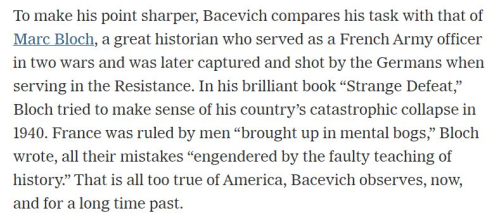
The Odyssey and Homeric Moments
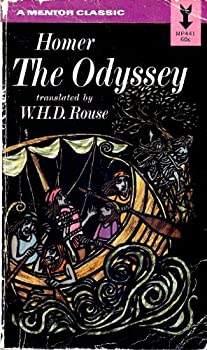 The GRSG agrees that reading Eva Brann’s Homeric Moments: Clues to Delight in Reading the Odyssey and the Iliad (2002) was not as challenging as reading Gravity’s Rainbow. For Murray, it was similar experience to reading the Faulkner’s Absalom, Absalom where you had to read the plot summary, then the chapter and then follow along with analysis like the Gorra book. If only I been such a diligent English major in college, I could have had a B average. While reading Homeric Moments, I was also reading W.H.D. Rouse’s 1937 translation of The Odyssey.
Brann does a lot of riffing in Homeric Moments and as a reader you must accept that. (It’s not a criticism thing it’s just a style you have to be comfortable with.) We think of her as the professor teaching Homer to young students and things are constantly popping into her head – with all kinds of connections. Singling out themes and connections into 48 chapters and then referring those chapters by numbers was a brilliant strategy. You could see the connections and refer to the other chapters without breaking the flow of the text.
On Epic Poetry
“This triplicity of authorship—Muse, Homer, Odysseus—together with the duplicity of the chief actor, makes the Odyssey the most complexly told tale I know. It is complicated though not bottomless, but rather clear and decodable.” — Eva Brann
On Teaching Classics to a Younger Generation
“Anyone who has read the Iliad with young students knows it is glory that grips and puzzles them. It puzzles them because their modernity requires them to think that only the deed and not its large shadow should matter, and it grips them because it is their suppressed longing. And that their glory should become visible in prizes— women (or mutatis mutandis, men), chariots, and golden cups—and audible in songs the world sings—would give them the deepest satisfaction.” Eva Brann
“Learning begins when development ends, for growing into oneself absorbs all the cognitive energies which, once “identity” is achieved, are free to turn to the world. For how can we learn if it is not we who are there to learn? We either change or grow wiser, but not both. “ Eva Brann
Comparing Homer’s World to Ours.
Here is what Eva Brann says about Homer’s world:
The axiom behind such reading, the rather minimal, though by no means uncontroversial working hypothesis, is that the poet made a world that we are authorized to enter and enabled to inhabit by the mere title of our humanity; for all the lands of the imagination live in a territorial union that imposes no passport checks or import duties on the traveler. Less fancifully: If you’re human, Homer is home territory. And later on she says: All this would hardly need saying were it not a serious theoretical claim that other societies and eras do have different mentalities, mind-sets ultimately incommensurable with ours. (Francis: I think Marc Bloch would not dispute this.)
Interesting to note that the Cyclops were a relatively primitive people and society (indigenous?) that were eventually ransacked by the more civilized Greeks. Something that has gone on for time immemorial.
The roles that the Gods play. Gods are immortal, but not eternal. (Brann) They really do what they want to do. We still have people “praying” for the victims. It reminds one of Kurt Vonnegut Jr. who wrote “God is the laziest man in town,” who sits back and does nothing.
Game of Thrones has nothing on The Odyssey in terms of graphic violence. From Book XXII “The Battle in the Hall” when Odysseus’ main rival Aninoős gets his:
Then he (Odysseus) let fly straight at Aninoős: he was holding a large goblet in both hands, an about to lift it for a drink…The arrow struck him in the throat, and the point ran through the soft neck. He sank to the other side, and the goblet dropped from his hands. In an instant a thick jet of blood spouted from his nostrils; he pushed the table away with a quick jerk of his feet, spilling all the vittles on the ground— meat and bread in a mess.”
You can only imagine that the audience liked these action sequences.
Act of Lying
Quote from Brann: Who is there that has managed a lot of life sagaciously and has not told controlled lies? But Odysseus does not lie to himself, as does noble Achilles, nor does he lie for himself in a mean and narrow sense. He lies royally, as a king sometimes must who is returning a people in part run wild to its old and just constitution.
Brann (page 33). “Achilles is, in his own estimation, a man of truth, while Odysseus is an accomplished liar.”
However, Odysseus did NOT lie for his own personal gain. He did it more to protect people. (Penelope, the swineherd)
The Strengths and Weaknesses of Odysseus
Yes, although Odysseus is a hero, we see his faults as well. (All the men that served with him on the ships ended up dead.) And during his Odyssey we see that he was not exactly faithful to his wife Penelope during his “business” trips, but… Not exactly the most merciful guy.
For Achilles, it was good for his hero image as he died young. This is often true of musicians, athletes and movie stars (River Phoenix, James Dean, Kurt Cobain, Heath Ledger, Lou Gehrig). JFK’s allure is because he died relatively young.
Brann says in pages 31-34 that the Iliad and Achilles is for the young man and The Odyssey is about “long life, its multiplicities, experience, and its single-minded purpose is the theme..”
The Women
The Helen thing is, more just a couple of things: (I didn’t realize that Odysseus had made a booty call while in Troy.)
Francis: “I think she reminds me of some of the more pitiable women celebrities of today–privileged but also limited by their appearance in that it blinds them and others as to their weaknesses–and yet, even when they are past their prime they still feel obliged to post selfies of themselves in bikinis–unveiled as it were…”
(This is what the old men think about Helen): “They all wish she (Helen) were gone, danger that she is to Troy, but they also love to see her; she seems to go, contrary to decorum, unveiled.”
“Amidst all this sadness Helen goes to work, witch that she is, with her Egyptian drug, “pain-killing and wrath reducing,” that makes one forgetful of evils. It is only after having dropped this tranquilizer into their wine that she tells the young son and the old husband that risky story of Odysseus the beggar.”
(Also–the tapestry she was weaving was all about her–which captured, who, in her view, was its center.)
Calypso calls out the double-standard that the male gods get to do what they please with women, but women must remain faithful. Should have Penelope be waiting for Odysseus with a rolling pin?
Brann quotes about women: “There is a fame of women as well. Generally speaking, the Iliad is, after all, a memorial to the value an entire people has chosen to place on one of its women. “
“But it is not Helen, Briseis, Circe, Calypso, or even Nausicaa who are the bearers of the “fame of women.” It is Penelope whose fame is particularly sung in the Odyssey.”
“To persuade ourselves that such solid good sense was then and ever after not only compatible with, but a condition for, lovableness, we may leap two and a half millennia forward to Jane Austen’s women.”
Fictitious Places?
For the most part, the places mentioned were imaginary. You can try to figure them out exactly, but really it doesn’t matter. Only Crete and Ithaca are places on the map, but there are probably a few others.
From Judith Schalansky’s Pocket Atlas of Remote Islands
A remote island makes a natural prison. (p.23) “Peaceful living is the exception rather than the rule on a small piece of land; it is far more common to find a dictator exercising a rule of terror than an egalitarian utopia. Islands are regarded as natural colonies just waiting to be conquered.” (p.24)
(Our next book is Schalansky’s An Inventory of Losses)
“….Odysseus picks that up and gracefully names Hermes as his own god, “who endows with grace and glory the works of all men”—surely the most modern words ever spoken by a supposedly feudal king.”—Eva Brann
Memories of Battle
The Odyssey is similar to Drew Gilbin Faust’s The Republic of Suffering, (an earlier GRSG selection) because many of the characters must deal with the memories of war. Those back in Ithaca struggle to define what happen in Ilium.
“…the Odyssey, which is the compensating catchall, a tightly woven container of the whole war as it is relived in the memories of wives, veterans, and singers.” Eva Brann
“The word nostos is familiar to us in “nostalgia,” “return-ache,” a word coined in a medical treatise of 1688 for the debilitating sadness affecting mercenaries long away from home.” Eva Brann
“Thus the Iliad is like a memorial wall on which the warriors, living and dead, of both sides are inscribed. In the Odyssey there are only half that many names; though its world is larger, its population is sparser.” Eva Brann
The discussion of war memorials and the removal Confederate War memorials has always been a topic of discussion with The Republic of Suffering and now with The Odyssey. On the one hand they do cause pain for many and that cannot be trivialized, but to have NO memory of past historical events?
“In this adventure Odysseus has his first experience of three cooperating evils: his own finite energy, his crew’s distrust, and the directed hatred of Poseidon. He learns a strange fact about the world: When authority and trust fail, the elements are freed to become rambunctious.” Eva Brann
Heroes and Legacy
What moves men of genius, rather, what inspires their work, is not new ideas, but their obsessions with the idea that what has already been said is not enough. Delacroix 1822 (genius)
On Character: I think both Odysseus and Penelope were not satisfied with what others might consider good enough. (Francis)
“Odysseus, who is in fact called “hero” only once in the Odyssey (29), is a remarkable exception to glory seeking, being for the ten-year duration of his odyssey quite purposefully out of sight and out of hearing—as Telemachus succinctly says: “unsightable, undiscoverable” (aïstos, apustos). I think he can be so unheroic because he is perfectly secure in the sufficiency of his hero’s fame, as Achilles never seems to be.” When he finally uncovers himself” ….. (we see his)… “flexibility” as we say, and the attendant features of wiliness, tact, ingeniousness, ready charm, and occasional formidableness. For these are all traits for managing circumstances so as to protect the essential Odysseus “ Eva Brann
Penelope: “ …. very own epithet, said of her by others often and by herself once: “thoughtful” (echephron), “mindful” with the fullest force, which signifies being in complete possession and control of one’s mental powers. I think the word has a kind of sober glory about it for Homer.” Brann
Our Discussion: But then there are heroes that live a long time grow in stature: almost become more majestic: Kareem Abdul Jabbar (as opposed to Kobe Bryant) but someone like Michael Jordan and Anthony Bourdain have not grown in stature with age.
Legacy is something that is discussed by news casters, sports pundits, but does the person really have that much control over their legacy or do they think about their legacy when they act. A prime example is Colin Powell who recently died. There were the obituaries of “he was born, he grew here, he was the Secretary of the Defense.” And then there are follow-ups about Powell’s legacy, which according to Maureen Dowd of The New York Times and The Economist is not so sterling.
https://bookshop.org/widgets.js
An Inventory of Losses (2018) by Judith Schalansky
Though she perhaps better known as the award-winning graphic artist for the book Atlas of Remote Islands, the German writer Judith Schalansky is also a novelist and as essayist. An Inventory of Losses is a series of related essays, (not a collection which can be sometimes piecemeal and uneven) where she ruminates about things that have been lost (people, places, buildings, writings) or some combination thereof. “Being alive means experiencing loss,” she writes.
The timeline of how I found about this book is a little unconventional. It began after reading Kate Zambreno’s review of the book in The New York Times and I brought a copy of the book to my daughter Cynthia in Germany in October– who like Schalansky lives in Berlin. (She seems like the kind of person who could have joined Cynthia and me at the Pynchon-inspired Muted Horn bar) Intrigued I also picked up a copy of Schalansky’s Pocket Atlas of Remote Islands, scaled down version of her original full-sized Atlas of Remote Islands (2009).
Upon returning, the GRSG selected Inventory. I did not read the book in its entirety for a second time, but I did reread the Preamble and Preface, which was more meaningful after reading her Pocket Atlas book.
But enough with the chronology, “the most unoriginal of all the organizational principles being only a simulation of order, writes Schalansky (p.20).
As Zambano’s review suggested, the book is uneven. Some pieces are intriguing and powerful. Others leave you scratching your head and not caring. Here are the better ones:
Preface
For us at GRSG, the preface is most interesting since it underlines some of the issues that we have discussed in other books such as the Homer books especially in terms of fame and legacy. “The caesura of death is the point where legacy and memory begin” (p.13). Who knows better than Achilles, Odysseus and Eva Brann who wrote in Homeric Moments, “Death is a sort of lesser life and fame its one enhancement.” (p 175)
“Apparently, in the mid-seventeenth century, the British parliament seriously discussed burning the Tower of London archives to extinguish all memory of the past and start life over again, at least according to Jorge Luis Borges in a passage I have been unable to locate. “
Francis comment: Goethe wrote that “Writing up history is one way of getting rid of the past” but erasing it is also a tempting option and it appears it is not exclusive to totalitarian regimes. But anyone who has ever taken notes for a meeting knows how even a subtle revision can help create an influential result–and one that may or may not accurately reflect the intent of the group.
https://bookshop.org/widgets.jsCaspian Tiger
A gory, gruesome and ultimately sad tale of now extinct tiger, which is closely related to the Siberian tiger. Schalansky details the battle to the death of the two big cats in a coliseum like setting. The piece begins with an impressive almost Faulknerian description of the Caspian tiger’s habitat:
Griefswald Harbor
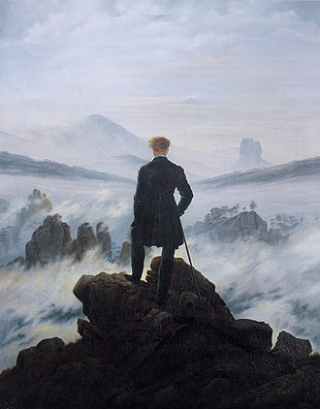 In this piece, Schalansky details the 25 km trek along the Ryck River that empties into the Baltic Sea. She grew up in the area which is also the home of the famous 19th century Romantic landscape painter Caspar David Friedrich whose most well-known painting is the “Wanderer Above the Sea Fog.” Many of Friedrich’s artworks were lost in a fire in Munich and the bombing of Dresden in World War II.
Encyclopedia in the Wood
 The story of Armand Schulthess, who ran a ladies-wear company left Geneva and Zurich and purchase a sizeable grove a chestnut trees which he “gradually transformed into an encyclopedia in the wood organizing human knowledge by subject area and inscribing it on more than a thousand metal plates. ” (Much of the knowledge was sexual in nature).
Kinau’s Selonographs
In this piece, Schalansky narrates in the voice of Gottfried Adolf Kinau, an amateur astronomist-priest, who may have been also a botanist C.A. Kinau a botanist-selenographer (a selenographer specializes in the physical features of the moon.). There is some historical confusion of whether the person is one and the same.
This is the creative aspect of the piece as Schalansky writes from the Kinau that is both botanist and astronomer.
“The study of cryptogamia, long-neglected at the time and admirably revived by Krombholz only a short time previously, was an activity that would prepare me like no other for my subsequent field of endeavor: the unseen work of legacy preservation.” (Crypotgams is a plant or plant like organism that reproduces by spores not seeds.)
Francis quips: It may be quite some time before a sports broadcaster uses the term cryptogamia to describe the function of a Hall of Fame. (sports legacy).

George Orwell: Homage to Catalonia (1938)
The GRSG read the Harcourt trade paperback published in 1952, which include a highly recommended introduction by Lionel Trilling.
Both Francis and I gave this book high marks as one of our favorites of the year. George Orwell (the pen name of Eric Blair ) is someone who from high school since everyone always wanted to do a book report on his classic Animal Farm because of its length and simplicity. We both read 1984 (1949), but I had very weak recollection except for an adaptation as a play, which I saw in Seattle years ago. More recently, Orwell was quoted in The Diary of a Bookseller by Shaun Blythell who quotes Orwell’s experiences working in a bookshop as excerpts (by far the best part of Blythell’s book) from Down and Out in Paris and London. In Homage to Catalonia, my opinion about Orwell has skyrocketed as a writer and a person. Calvin Trilling calls Orwell a “virtuous man who tells the truth.”
Orwell’s original intentions were to report on the Spanish Civil War as a journalist, but soon voluntarily joined the POUM, The Worker’s Party of Marxist Unity, an egalitarian militia that fought against Franco and the Fascists. The short book describes his life in the trenches, a brief leave to Barcelona where hostilities between the POUMs and the Stalinists/Trotskyites ended up in violence in the streets. (Shown above is a damaged church in Barcelona). Orwell returned to the front where he was wounded by a bullet through the neck. He managed to survive, but then was forced to leave Spain because the POUMs were being imprisoned. The book covers a relatively short period of time of time (January 1937 to July 1927) but Orwell’s descriptions of the scenes on the battlefield, his stay in the hospital, and the people of Spain, which he admires even though you wonder why. Chapter XI (pp 151-179) is a challenge to follow because of all the warring factions of Republicans, Nationalist and Communists. You could see that it was very necessary for Orwell to get this down on paper, but it can be a brief challenge for the reader. The rest of the book is riveting.
Francis had questions that he brought to the discussion and appropriate quotes to illustrate.
1) What is it that makes Orwell’s writing so compelling?
- Maybe it’s because he is at peace with reality with all its warts and its complete independence from one’s view of it—a perception which is so easily influenced by one’s own flaws and biases.
- Maybe it’s because of his familiarity of living in circumstances only minimally under his control (like Down and Out in London and Paris or Homage to Catalonia or The Road to Wigan Pier) and how important it is to be in phase with the reality one faces—and independent of the natural desire to see oneself at the center of it. (see below)
In his book Men of War, Alexander Rose writes about the danger of being a rookie soldier on Iwo Jima: “You might be, according to marine lingo “out of phase” (which means being left standing when everyone else dives for cover, walking, when everyone else is crawling, talking loudly when everyone else is whispering—anything that draws attention and fire, or makes one more vulnerable).”
- Maybe it’s because he understands that intellectual freedom is not choosing from a menu of pre-specified ideas but rather observing and interpreting one’s own experience.
“When man acts, he is a puppet, when he describes, he is a poet.” – Oscar Wilde
- Maybe it’s because he understands that plot and story line, so tempting to overlay on any narrative, are dramatic devices better suited to fiction than fact.
“Acumen is least likely to desert clever men when they are in the wrong.” –Goethe
- Maybe one of his techniques it to never describe his expectations of the way things should be before they happen—nor to compare them with how reality surprises or disappoints after the fact. After all, isn’t the gap between expectation and reality simply an epiphenomenon illustrating a writer’s ignorance and lack of imagination— subjects too vast to interest serious readers? And aren’t all writers tempted to cover up these deficits by filling it in with convenient fictions and self-deceit?
“If I were a pagan, I would say that an ironical deity gave man the gift of speech so that he may be entertained by their self-deceit.” –Soren Kierkegaard
2) Is Orwell and Idealist or an Idealogue? What is the difference?
Well, an idealist can be defined as someone guided by ideals, but the connotation is that they are prone to place ideals before practical consideration. (Merriam Webster). An Idealogue is an often blindly partisan advocate or adherent of a particular ideology—sometimes an impractical idealist. The third option, used as an opposite of idealist, is a realist –defined as someone who recognizes what is real or possible in a particular situation and who accepts and deals with things as they really are. So, maybe we should just say Orwell is a realist who is motivated by ideals. One might possibly go as far as to say that Orwell understood that all humans shared common ground in realism and it is from that shared understanding where ideals could be conceived and advanced.
Here is what Orwell wrote that makes it pretty clear he would identify as a realist or idealist rather than an ideologue:
- One had been in a community where hope was more normal than apathy or cynicism, where the word ‘comrade’ stood for comradeship and not, as in most countries, for humbug. –Orwell in Homage to Catalonia.
- We all remember the Daily Mail’s poster: ‘REDS CRUCIFY NUNS,’ while to the Daily Worker Franco’s Foreign Legion was ‘composed of murderers, white-slavers, dope-fiends and the offal of every European country.’ The people who write that kind of stuff never fight; possibly they believe that to write it is a substitute for fighting. It is the same in all wars; the soldiers do the fighting, the journalists do the shouting, and no true patriot ever gets near a front-line trench, except on the briefest of propaganda-tours.
- Factions: But there was this difference, that whereas the journalists usually reserve their most murderous invective for the enemy, in this case, as time went on, the Communists and the POUM came to write more bitterly about one another than about the Fascists.
Murray addition: One of the aspects that gives Catalonia its relevance is his criticism of journalists or the reminder that journalists are not necessarily impartial as we want to believe. (Despite what I am about to say I still hold journalists in high esteem and value their role in society.) Orwell was a journalist but in Catalonia he certainly distinguished between journalists and propagandists.
“Nearly all newspapers around were manufactured by journalists at a distance, and were not only inaccurate in their facts but intentionally misleading…Like everyone who was in Barcelona at the time, I saw only what was happening in my immediate neighborhood, but I saw and heard quite enough to be able to contradict many of the lies that have been circulated. “ (p.149. This passage appears just before his “sidebar” of the previously mentioned chapter XI which attempts to explain all the different factions and their political agendas.)
Would Marc Bloch (who we read earlier this year) agree that the participants in history only know their little part of the narrative?
This chapter XI reminds me of Alastair Horne’s A Savage War for Peace about the Algerian war for Independence. It takes tremendous skill to keep all the participants in order. I am not sure Orwell does, but you cannot fault him for trying.
3) Is Homage to Catalonia Orwellian?
Well, the book is not in the least dystopian—but perhaps, the dystopian writing that followed in 1984 resulted from his imagination—as if he had had to leave his native England where freedom was taken for granted—and the nightmare that would follow if that inalienable right was taken away and he was forced to live in a totalitarian state).
- It was no use hanging on to the English notion that you are safe so long as you keep the law. Practically the law was what the police chose to make it.
- They had the ineradicable English belief that ‘they’ cannot arrest you unless you have broken the law. It is a most dangerous belief to have during a political pogrom.
- This is a take on the individual when not part of a faction: In the next bed to me there was an Assault Guard, wounded over the left eye. He was friendly and gave me cigarettes. I said: ‘In Barcelona we should have been shooting one another,’ and we laughed over this. It was queer how the general spirit seemed to change when you got anywhere near the front line. All or nearly all of the vicious hatreds of the political parties evaporated.
“Just because you do not take an interest in politics doesn’t mean politics won’t take an interest in you.”
Pericles: circa 400 BC
A Book about Spain
Both Francis and I have been to Spain, (including the Alhambra – shown here overlooking Granada) but I have not been to Catalonia and Barcelona. We enjoyed reminiscing.
Boabdil’s lament (or rebuke): “The Moor’s Last Sigh.” Boabdil’s mother is said to have taunted him (after he surrendered the Alhambra, in 1492, without a fight—and then publicly weeping over its loss): “Why do you weep like a woman for the land you could not defend as a man.” (versions of this can be found in Wikipedia)
Orwell is very fond of Spaniards despite some of the cruelties that they inflicted on each other during the war. He very much admires the egalitarianism of his comrades in the POUM militia.
Other comments about the Spanish:
“The Spanish secret police had some spirit of the Gestapo, but not much of its competence.” (p.212)
“Few Spaniards possess the damnable efficiency and consistency that a modern totalitarian state needs.” (p.223).
https://bookshop.org/widgets.js
—– EXTENDED BODY: —– EXCERPT: —– KEYWORDS: William Faulkner, Drew GIlpin Faust, George Schuyler, Michael Gorra, Faulkner and the Civil War, Primo Levi, The Periodic Table. Clive James, Cultural Amnesia, Golo Mann Mark Bloch, The Historian’s Craft, Judith Schalansky, An Inventory of Losses, George Orwell, Homage to Catalonia, —– ——– AUTHOR: Murray Browne AUTHOR EMAIL: murray.browne905@gmail.com TITLE: The Current Republic of Suffering STATUS: Publish ALLOW COMMENTS: 1 CONVERT BREAKS: 0 ALLOW PINGS: 0 BASENAME: the-current-republic-of-suffering CATEGORY: Book Reviews CATEGORY: Civil War Books UNIQUE URL: https://thebookshopper.typepad.com/the_book_shopper_atlantad/2021/02/the-current-republic-of-suffering.html DATE: 02/14/2021 09:30:00 PM —– BODY: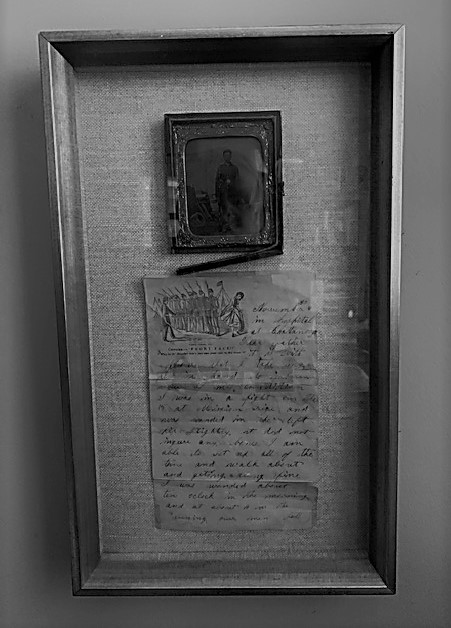 As the U.S. death toll from the coronavirus surpasses the half a million mark, comparisons to the those who died during the American Civil War are sure to follow. Over 625,000 Union and Confederate soldiers perished in the war along with an estimated 50,000 civilians, approximately 2 % of the country’s population at the time.
Rereading Drew Gilpin Faust’s often cited and highly regarded book, This Republic of Suffering: Death and the American Civil War (2008) has a new degree of relevance as we begin year two of the pandemic. Her book is not about specific battles, strategies, or personalities, (she assumes you already know about this) but rather her theme is about how the unprecedented casualties in the Civil War directly affected the entire country and how it shaped our current views of death. The breadth of Faust’s scholarship is overwhelming as she discusses the logistical and emotional nightmares of burying, identifying, and reconciling the staggering losses. Because so many died on distant battlefields and hospitals, she writes that the fallen and their loved ones would not have the comforts of what was known as The Good Death (ars moriendi). No family member could attend to a dying son, husband or brother and any corresponding religious ceremony was severely truncated or non-existent. This sounds strikingly familiar given that those who die in hospitals from COVID-19 are often unable to be joined by family members in their final hours and traditional funerals have been curtailed because their potentiality as super-spreader events.
Here in 2021, amidst the mourning, ignoring, forgetting, obsessing, and despairing over the virus death tolls, one hopes to uncover the significance or meaning of it all. In This Republic of Suffering, Faust writes that though we continue to question “both the humanity of those slaughtered like animals and the humanity of those who had wreaked such devastation” a paradigm change did emerge from the carnage*.
 Soon after the first battles of the Civil War, (most notably Shiloh in April of 1862), both sides realized that they had no mechanisms to deal the emotional devastation as well as the physical bodies themselves. Thousands of corpses rotted on the battlefields; others were buried unidentified in mass graves—and only the “lucky” families received any news of what had happened to a missing loved one. But the war changed all that as the Federal government, the military, philanthropic organizations, and private citizens sought to establish procedures to address this new crisis. By late 1865 a nationwide program began to find, identify and move the bodies of tens of thousands Union soldiers. (Faust details how this came about, which will leave the reader humbled by the dedication of those who took on this monumental task.)
Today, there is an expectation that the military authorities will go to great lengths to recover the remains of a dead U.S. soldier and to properly honor them for their sacrifice. (According to Faust, “The United States expends more than $100 million each year in the effort to find and identify the approximately 88,000 individuals still missing from World War II, Korea, and Vietnam.”) She reminds us that it was the horrors of the Civil War that led to the outcry that the fallen deserve a decent burial in the hallowed ground of a National Military Cemetery, many of which were located near battlefields.**
By reading This Republic of Suffering, one can at least be hopeful that something meaningful will emerge from the millions globally who have died during the pandemic. But for the time being that revelation remains shrouded in grief.
https://bookshop.org/widgets.jsFootnotes
*Thanks to Francis Walker of the GRSG, who has also recently read the Faust book and gave me some good feedback on this posting. With respect of the quote from Faust, (“both the humanity of those slaughtered like animals and the humanity of those who had wreaked such devastation”), Francis poses how these same sentiments translate here in 2021. He writes: “similar questions may haunt us going forward with the pandemic death toll with respect to those who succumbed and the humanity of those who knowingly or unknowingly contributed to its spread.”
** The headstone photo comes from my cousin Jackie Fehrenbach who spends a lot of time delving into our family’s history. Here is a photo from a trip she made a few years ago to the Nashville National Cemetery, which was established in July, 1866.
The framed piece at the top of the posting contains a photograph of my grandmother’s uncle William Henry Kelley who fought with the 12 Regiment of the Indiana Volunteer Infantry and later died from his wounds sustained in the Battle of Missionary Ridge in November, 1863. The letter dated November 30, 1863 was one of his last letters to his family.
—– EXTENDED BODY: —– EXCERPT: —– KEYWORDS: This Republic of Suffering, Civil War and Pandemic, Drew Gilpin Faust, National Military Cemeteries —– ——– AUTHOR: Murray Browne AUTHOR EMAIL: murray.browne905@gmail.com TITLE: A Brief History of Vaccinations in Colonial America STATUS: Publish ALLOW COMMENTS: 1 CONVERT BREAKS: wysiwyg ALLOW PINGS: 0 BASENAME: a-brief-history-of-vaccinations-in-america CATEGORY: Military History UNIQUE URL: https://thebookshopper.typepad.com/the_book_shopper_atlantad/2021/01/a-brief-history-of-vaccinations-in-america.html DATE: 01/25/2021 10:57:34 AM —– BODY:
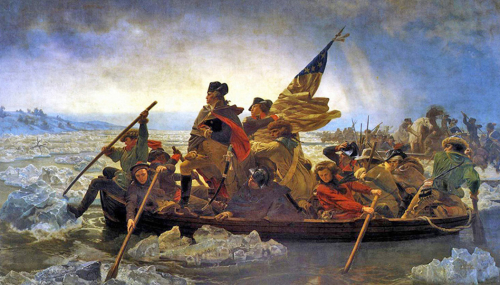
Reading Rick Atkinson’s The British Are Coming: The War for America, Lexington to Princeton, 1775-1777 (2018) struck me in many ways. First, how extraordinarily little I knew about the military campaigns of the Revolutionary War*. Second, this war though small in terms of the size of the military engagements, was no less bloody and full of inhumane acts. These transgressions ranged from the slaughter of slaves who were punished for joining the British in hopes of earning their freedom, to the cruel treatment of American prisoners who surrendered at Fort Washington on Manhattan Island. In a sense it was a civil war, since the combatants at some time were all subjects of Mother England.
But the odd historical fact that resonates in our pandemic times was the role smallpox played in the War for Independence. American troops suffered terribly from outbreaks, which could thin their ranks by as much 50 percent as infected persons often would succumb to the disease. Since the symptoms left heavy rashes on the face and body, survivors were left with noticeable scars (including George Washington) and immunity for life. “Pocked young men” writes Atkinson “were much prized by military recruiters.”
Edward Jenner’s smallpox vaccine was still decades away (smallpox was declared totally eradicated in 1980 ), but some early colonists and the British military experimented with making their own effective vaccinations by taking pus from a smallpox sore and making “an open incision into a healthy patient’s arm or thigh. The consequent interruption was usually milder and far less lethal…”
 It is this kind of historical perspective helps limit my own frustration while waiting in my car for a vaccine. It also underlines that even the colonists 250 years ago understood the live-and-death importance of getting vaccinated.
More Atkinson
This is my fourth Atkinson book I have read. The first three were his Liberation Trilogy about the United States fighting in North Africa, Italy, and Western Europe. Atkinson has an amazing ability to weave stories of individuals into the big picture. He once said at an author reading in 2013 that I attended that one of the historians he most admired was Shelby Foote author of the three volume The Civil War: A Narrative. Atkinson and Foote’s books are lengthy, but reading them is almost effortless, a tribute to their talent, research prowess and perseverance.
* One example of my ignorance is that the battle of Trenton when Washington crossed the icy Delaware River to defeat the British-Hessian mercenaries in a surprise attack, was followed a few days later by a second battle of Trenton/Princeton. In the second engagement, Washington's army drove the British out of New Jersey, thereby protecting the young nation's then capital of Philadelphia.
—– EXTENDED BODY: —– EXCERPT: —– KEYWORDS: The British Are Coming, Rick Atkinson. Smallpox, Smallpox in the Revolutionary War —– ——– AUTHOR: Murray Browne AUTHOR EMAIL: murray.browne905@gmail.com TITLE: Books Read in 2020 STATUS: Publish ALLOW COMMENTS: 0 CONVERT BREAKS: wysiwyg ALLOW PINGS: 0 BASENAME: books-read-2020 UNIQUE URL: https://thebookshopper.typepad.com/the_book_shopper_atlantad/books-read-2020.html DATE: 01/20/2021 12:15:19 PM —– BODY: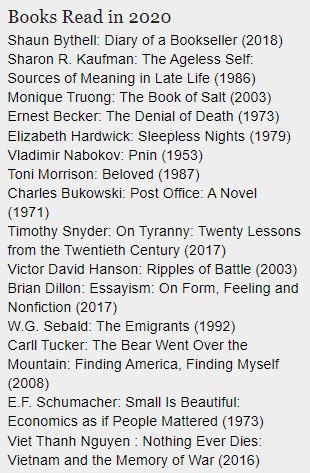
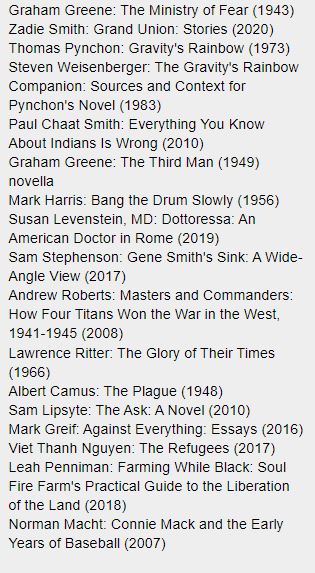

Once in a while I will write a longer essay that doesn’t fit The Book Shopper format, which is surprising because our editorial policy can be a little loosey-goosey at times. These alternative lengthier works often end up at the Tropics of Meta (ToM). Using their words, ToM “offers a fresh perspective on history, current events, popular culture, and issues in the academic world. Founded in 2010, ToM has published (online) over 1000 essays by historians, social scientists, artists, activists, and creative writers both within and outside the academy, giving voice to communities across the United States and the world.”
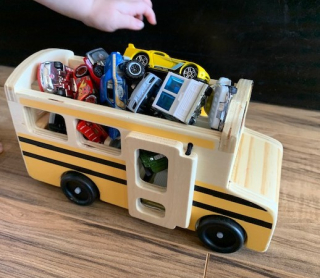 Last month they published my long essay “The Power of the Endless Love of Automobiles” where I weighed the potential of the pandemic changing our car centric culture versus our inbred relationship (using myself as an example) with automobiles.
In addition to “The Power of Endless Love,” I made a couple suggestions in ToM’s end of the year 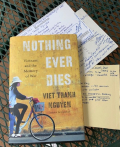 summary on what they consider noteworthy in books, film and television, “What Made 2020 Slightly Bearable For the Tropics of Meta Gang, the Scariest of All Gangs”. I did a shoutout to Viet Thanh Nguyen for his three-index-card-of-notes book, Nothing Ever Dies: Vietnam and the Memory of War (2016), which I have written about earlier in this blog, but there are other worthy book suggestions from the ToM gang.
(Coincidently, my first ToM posting in 2017 was a retrospective look at Neil Sheehan’s 1988 Pulitzer Prize winning A Bright Shining Lie: John Paul Vann and America in Vietnam. The book is a sad reminder of the carnage a government inflicts when it lies and misleads its people. Sheehan died yesterday in Washington D.C. at the age of 84.)
Television Series
On a lighter note, my selection for recommendations for television series are more escapist in nature such as Netflix’s The Norsemen series billed “Game of Thrones meets Monty Python.”
 Also in 202o, I’ve become a big fan Richard Ayoade, the “reluctant” host of Travel Man: 48 Hours in, an amusing show for plagued-with-doubt adventurers such as myself who always worries on “whether they should have come” as Ayoade reminds us in each episode.
Both series rely on dry humor and verbal repartee, which somewhat justifies their cameo appearances in a book blog.
—– EXTENDED BODY: —– EXCERPT: —– KEYWORDS: Tropics of Meta, ToM, Viet Thanh Nguyen, Nothing Ever Dies, Richard Ayoade, A Bright Shining Lie, Neil Sheehan —– ——– AUTHOR: Murray Browne AUTHOR EMAIL: murray.browne905@gmail.com TITLE: A Dickens of a Year STATUS: Publish ALLOW COMMENTS: 1 CONVERT BREAKS: wysiwyg ALLOW PINGS: 0 BASENAME: a-dickens-of-a-year UNIQUE URL: https://thebookshopper.typepad.com/the_book_shopper_atlantad/2020/12/a-dickens-of-a-year.html DATE: 12/26/2020 08:25:52 AM —– BODY:
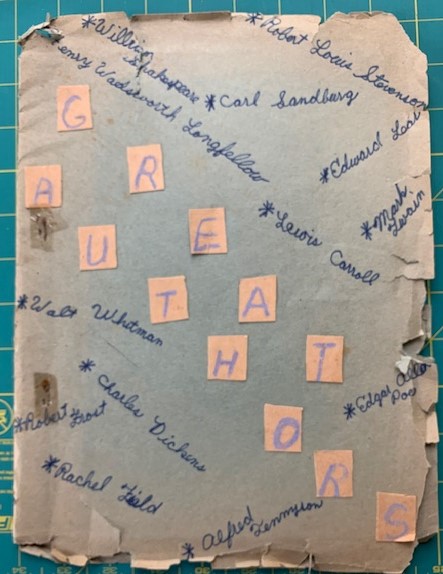
Before "the old year slips away, lamented by no one*," a celebration of the 150th anniversary of the death of Charles Dickens is in order. My memory of Dickens goes back to my school days in the 5th grade when I was assigned the Victorian novelist as part of the class project on the "Great Authors."
 To explain why I kept this report all these years would require much space and deep thought, which is beyond the scope of this blog, but it does serve as physical proof of my lifelong interest in books and authors. The "cover art" — with a grade of A- (see left) — is an early example of grade inflation. The list of authors that were considered "great" is kind of interesting from the perspective of which classic writers were in vogue in the mid-1960s (very few authors from the 20th century and very few women).
I wish I still had that excellent penmanship.
I did go on to read quite a few Dickens novels until I said "enough already" 30 years ago while I was halfway through Oliver Twist. Still, Dickens is in my entertainment mix.
My longtime partner Denise and I always watch A Christmas Carol every December. She prefers the black and white 1951 Alastair Sim version, which is quite good, but I favor the 1984 version starring George C. Scott as curmudgeonly Ebenezer Scrooge. However, this season there is a new up and comer, a "live streaming film version" of Jefferson Mays 's one -man stage performance where he plays all the characters. The richness of Dickens's language really comes through in this filmed theatre version.
We also recently watched the film The Personal History of David Copperfield, a quirky adaptation by Armando Iannucci (Veep, Death of Stalin) and staring Dev Patel as the hero of his own life.
For a more in-depth overall assessment of Dickens, read Charles Gottlieb's recent review of A.N. Wilson's The Mystery of Charles Dickens (2020), but if you're looking for something tighter that captures the crux of the novelist, check out this report from a 5th grader who showed some early promise. 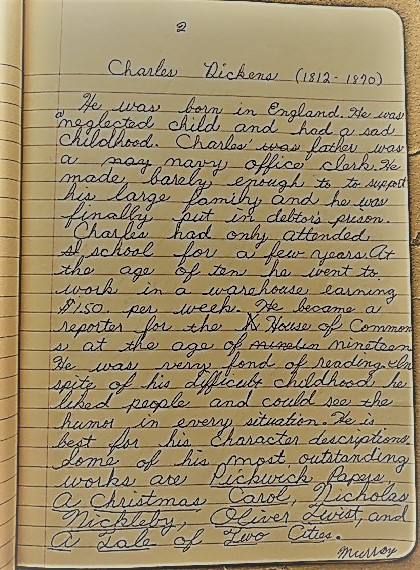
* The expression "the old year slips away, lamented by no one," is from Rick Atkinson's Day of Battle about the United States fighting in Italy during World War II. It was Atkinson's description of 1943 which had been a bloody stalemate that accomplished little at great cost.
—– EXTENDED BODY: —– EXCERPT: —– KEYWORDS: Charles Dickens, Jefferson Mays, the Personal History of David Copperfield —– ——– AUTHOR: Murray Browne AUTHOR EMAIL: murray.browne905@gmail.com TITLE: The Best Books Read 2020 Award STATUS: Publish ALLOW COMMENTS: 1 CONVERT BREAKS: wysiwyg ALLOW PINGS: 0 BASENAME: best-books-read-2020 CATEGORY: Best Books Read 2017-2023 UNIQUE URL: https://thebookshopper.typepad.com/the_book_shopper_atlantad/2020/12/best-books-read-2020.html DATE: 12/04/2020 07:34:43 AM —– BODY: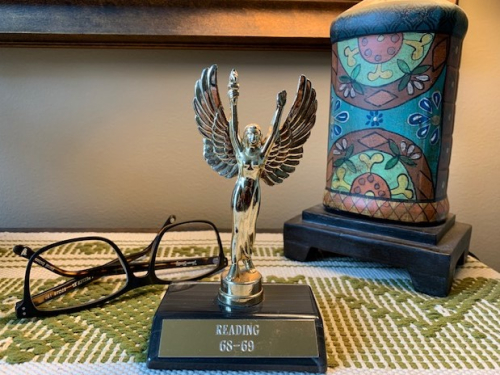
Unlike many book lists that enumerate the best books published during the year, The Book Shopper blog can boast that even though none of the books on our list were published in 2020, at least all the selections have been read cover to cover, and gleaned from a list of 30 books, which is a personal high (but I realize I don't qualify as a "voracious" reader).
The major qualification to make the list below is that besides enjoyment, each book influenced me by either a) leading to other books which I eventually read, or b.) slightly changed my thoughts or actions in my little 2020 world. There is no significance in the order and the links go to other locations on the blog where I wrote about them in more detail.
Brian Dillon. On Essayism: On Form, Feeling and Nonfiction (2017)
Viet Thanh Nguyen. Nothing Ever Dies Vietnam and the Memory of War (2016)
Thomas Pynchon. Gravity’s Rainbow (1973)
Leah Penniman. Farming While Black: Soul Fire Farm Practical Guild to Liberation on the Land (2018)
 On Essayism
Not only does Dillon deconstruct essays to assist in my own writing, but he mentions authors that I have read recently (like W.G. Sebald who made last year's 2019 list), but he pointed me in the direction of Elizabeth Hardwick's Sleepless Nights (1978) a peculiar but interesting read. Dillon's book required 3 index cards of notes to properly document. (The index card system is for people who prefer stars and such to rate stuff.)
Nothing Ever Dies
Nguyen received a shoutout on the 2018 list for his amazing novel, The Sympathizer (2016), which led me to read earlier  this year his collection of short stories, The Refugees, (2017), which did not disappoint. Not only does Nguyen give us a lesson in history and how it favors the victors, but he makes a recommendation for other books, such as Monique Truong's The Book of Salt (2003) which I am reading now. The Book of Salt is about a Vietnamese peasant who learns the basics of French cooking in Vietnam and ends up in 1929 Paris cooking for Gertrude Stein and Alice B. Toklas. Nothing Ever Dies merited three index cards too.
Gravity's Rainbow
When rereading a book requires two to three months to read, and a special notebook and the formulation of a Gravity's Rainbow Support Group (GRSG) , it must be on the list. The GRSG did not disband and we have since read Vladimir Nabokov's Pnin (1953) and are finishing up Ernest Becker's The Denial of Death (1976) just in time for Christmas. The latter rates right up there with Albert Camus The Plague (1948) for not-so-light pandemic reading. By reading The Plague it should have tipped me off that these outbreaks can last a long time.
Farming While Black
 This book qualifies because I spent more time at the community garden in 2020 and I did a pop up book stall called Destination: Books at the Freedom Farmer Market early in 2020. The book introduced me the Chelsea Green Publishing and I did end up carrying several of their books before going into a lockdown mode. The book is a rare mix of the history of black farming, community activism, and how to grow better veggies.
Photo Credit: In 1969, I won a trophy for reading the most books in my 8th grade class, which required keeping a list of everything I read during the school year (so list making goes back to my childhood.) But what this further illustrates is that if you only win a few awards in your lifetime, you hang on to them.
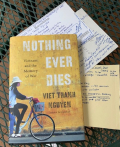 If you purchase any books highlighted here by clicking through to the Destination:Books page, this blog and independent book stores will receive a small commission.
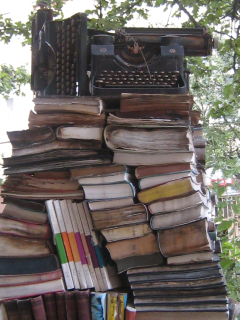 Over at Destination: Books the companion-other-side-of-the-counter blog to The Book Shopper, I recently posted an article about "les bouquinistes" the Paris book vendors who have been selling reading material in book stalls along the Seine River since the Middle Ages. The pandemic has crippled their business because of the lack of tourism and the restrictions placed on local citizens. There are links that can take you to the complete story including fine photos of French booksellers.
This same article has a brief write-up of Shaun Blythell's popular, The Diary of a Bookseller (2018) which is a daily account of selling second-hand books in Wigtown, Scotland. Blythell's book, though entertaining, is not an idyllic portrayal of bookselling because there are many of his descriptions of hauling and processing boxes of books (some covered in cat hair) and the challenging Scottish weather. Dealing with cantankerous customers and staff is never easy either.
For more about reading, bookstores and libraries check out the books available on a shopping list compiled by Emory's Carlos Museum Bookshop. It even includes this blog's namesake, the book that started it all. Impressive.
Fortunately, the cover photo is not a book selling stall or some bizarre Book Jenga game, but rather a sculpture in the Kreuzberg section of Berlin. My older daughter Cynthia Browne took the picture several years ago.
—– EXTENDED BODY: —– EXCERPT: —– KEYWORDS: —– ——– AUTHOR: Murray Browne AUTHOR EMAIL: murray.browne905@gmail.com TITLE: Into the Spinning Void STATUS: Publish ALLOW COMMENTS: 1 CONVERT BREAKS: wysiwyg ALLOW PINGS: 0 BASENAME: into-the-spinning-void CATEGORY: Books as Art as Books UNIQUE URL: https://thebookshopper.typepad.com/the_book_shopper_atlantad/2020/11/into-the-spinning-void.html DATE: 11/06/2020 09:12:45 AM —– BODY: While reading Vladimir Nabokov’s 1953 humorous novel Pnin about the teaching life of a Russian émigré in a fictitious small New England college town, this line stood out among the many noteworthy passages:
“With the help of the janitor, he (Pnin) screwed on the side of a desk (in his new office) a pencil sharpener – that highly satisfying, highly philosophical implement that goes ticonderoga-ticonderoga, feeding on the yellow finish and sweet wood, and ends up in a kind of a soundlessly spinning ethereal void as we all must.”
This reference to the Ticonderoga pencils and those old pencil sharpeners brought back memories of the classrooms of my high school (built in 1912) that mounted similar sharpeners in the back of each room near the “cloudy blackboards.” Also, my father had a similar one mounted in our garage where I could grind a pencil to the finest point of procrastination before tackling my Algebra homework.
Museum Trips
Nabokov’s evocative prose provided additional respite, as I visited the online Made-in-Chicago Museum of Manufacturing to look for pictures of pencil sharpeners. (Thanks to the curator Andrew Clayman for granting me the permission to use the photo of the Giant sharpener made by the Automatic Pencil Sharpener Company.)
 The MICM took me back to a trip I made last year to Berlin, where my older daughter Cynthia took my longtime partner Denise and me to the Museum of Things (Werkbundarchiv – Museum der Dinge), which is dedicated to 20th and 21st century product culture. We spent considerable time there on chilly wet day, soaking in the archive of the German industrial design association Deutscher Werkbund, founded in 1907. Items ranged from tape recorders and furniture to toy soldiers.
Book Shopping Novelty
While at the Museum of Things I purchased the miniature book The Shadow on the Wall (Schottenspiele) (2014), which has illustrations of how to make shadow animals, which is a new game I like to play with my three-year old grandson Myrick.
Moreover, it is skill I can practice in the spinning ethereal void of 2020.
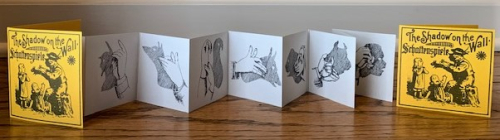
This passage comes from Timothy Snyder’s On Tyranny: Twenty Lessons from the Twentieth Century (2017):
The hero of a David Lodge novel says that you don’t know, when you make love for the last time, that you are making love for the last time. Voting is like that. Some of the Germans who voted for the Nazi Party in 1932 no doubt understood that this might be the last meaningfully free election for some time, but most did not. Some of the Czech and Slovaks who voted for the Czechoslovak Communist Party in 1946 probably realized that they were voting for the end of democracy, but most assumed they would have another chance*. No doubt the Russians who voted in 1990 did not think that this would be the last free and fair election in the country’s history, which (thus far) it has been. Any election can be the last, or at least the last in the lifetime of the person making the vote.
Timothy Snyder is History Professor at Yale University who has written several books on the Eastern Europe, Germany and the Soviet Union. In this short, compact book On Tyranny, Snyder provides terse lessons on how to combat tyranny in our daily lives and what tactics fascist regimes employ to undermine democracies. For example, in Lesson 6, Be Wary of Paramilitaries, Snyder describes how the Nazi Party in Germany rose to power during the elections of 1932 and 1933 with help from the Schutzstaffel (SS), which began as a paramilitary organization. These groups “first challenge the police and military, then penetrate the police and military and finally transform the police and military,” writes Snyder.
Although he has been around a while, I only heard about Snyder recently through my longtime friend and blog subscriber Bruce who recommended that I watch a YouTube interview with Snyder while Snyder was promoting his latest book Our Malady: Lessons in Liberty from a Hospital Diary (2020) . In the Politics and Prose interview, Snyder also talks about the upcoming election in a scary yet calming manner.
*For more about the The Memorial to the Victims of Totalitarianism photograph visit last year’s posting “European Book Experiences.”
https://bookshop.org/widgets.js
—– EXTENDED BODY: —– EXCERPT: —– KEYWORDS: Timothy Snyder, On Tyranny, —– ——– AUTHOR: Murray Browne AUTHOR EMAIL: murray.browne905@gmail.com TITLE: Star Essays STATUS: Publish ALLOW COMMENTS: 1 CONVERT BREAKS: wysiwyg ALLOW PINGS: 0 BASENAME: star-essays CATEGORY: Book Reviews UNIQUE URL: https://thebookshopper.typepad.com/the_book_shopper_atlantad/2020/09/star-essays.html DATE: 09/22/2020 08:26:12 AM —– BODY:
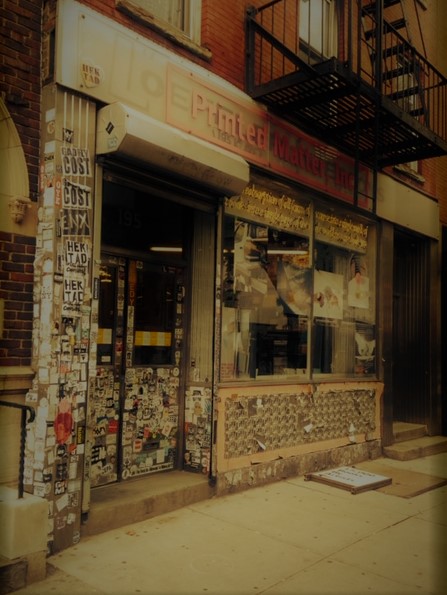 To motivate myself to write more essays, I recently finished Brian Dillon’s Essayism: On Form, Feeling and Nonfiction (2017). As a long-time subscriber to Cabinet magazine, I am familiar with Dillon’s byline as an editor of the quarterly, which sadly is ending its gorgeous print version and going strictly online. A few years ago, while browsing at Printed Matter, Inc. in New York City (Aaah those were the days of book shopping – browsing sans mask with the smell of old books and cats in your nostrils instead of hand sanitizer) I stumbled across Dillon’s Objects in the Mirror: Essays (2011), Oddly enough, I think I recall that the book was shrink wrapped, but I took a chance anyway.
I ended up writing a short, favorable review of Objects and posting it on Amazon, which is a rarity for me, since I have only posted six reviews in my life which explains my reviewer ranking at #17,428,947. I am hesitant to provide free content to the richest man in the world, but if I really admire a book and it suffers from lack of stardom (less than 5 reviews) I will sometimes oblige. As you know, the big publishers control the marketplace. This year’s fad is All Things Trump and the staggering number of books and the numbers of readers' reviews illustrates this: Michael Cohen’s book 2,307 reviews, John Bolton’s book 25,503 reviews, but both are paltry compared to the numbers of Dr. Mary Trump, (the "angry" niece) whose reviews total 44,914.
In comparison, two recent books about Melania Trump totaled to 2500 reviews, and she has a long, long way to go to beat Michelle Obama’s Becoming which has over 58,000 ratings. Oddly enough, 89 % percent of reviews of Becoming were 5 stars with only 3 % one star. No surprise, except in the first six reviews, Amazon listed the 5 one-star reviews with insightful critiques such as “snoozer” or “poorly written” ahead of penta-starred reviews praising the book.
I am skeptical of the veracity of these numbers. I ask myself, "What's the point of adding another review to the a book that has already thousands of review?" I have no special insider information except to say we live in a world of bots. (Be mindful that every time you verify existence to CAPTCHA, you are telling a robot that you are not a robot.) Here at The Book Shopper Blog, I rate the books on how many index cards I need to make notes. I figure if one goes to the trouble to write something on a note card — you're engaged!
On Essayism
 This tight collection of short essays is not a how-to book on writing essays, but rather it examines the qualities found within essays that characterize the form. Dillon sets up each piece with a short title (IN CAPS) to quickly clue the readers in. For example, the second essay entitled, “ON LISTS” Dillon points out that making lists is an acceptable literary technique used by the likes of William Gass and Joan Didion. Thus fortified, I will resort to the same strategy (except this is blog posting not an essay) to enumerate some of the topics explored in Essayism. They include:
ON COHERANCE. Dillion reveals one of his secrets to writing a good essay: “Find the proper guiding metaphor.” He provides an example from the philosopher Theodor Adorno:
Properly written texts are like spider’s webs: tight, concentric, transparent, well-spun and firm. They draw themselves all the creatures on the air. Metaphors flitting hastily through them become their nourishing prey. Subject matter comes winging towards them.
Fortunately, if you cannot unearth the spot-on metaphor, Dillon thinks you can still write a good essay.
ON ATTENTION. For the record, Dillon admires essays that “pays the minutest or most sustain attention to one thing, one time or place, one strain or strand of existence.”
ON FRAGMENTS. Dillon discusses the concept of fragments. He explains how fragments have played role in history of knowledge. Fragments can be relics from an ancient civilization or the surviving passages of the Greek and Roman authors. It is acceptable, to Dillion because disparate fragments can be put together and if not well, it is also permissible “to say many contradictory things at once.”
ON CONSOLATION. Throughout the book Dillon confesses his own bouts with depression, bordering on suicide, but the tone is more melancholic than desperate. He follows his own principles: “I distrust writers who write straight away about their depression or other mental pain…But why this doubt or scruple? I tell myself it is because I want from writing, from literature a more conscious and conspicuously worked evidence of distance and thought, transformation of the raw material.”
But Dillon does not limit himself in this book as a primer on essays, but rather he weaves narratives about his own life and an examination of some the essayists (including a thorough Readings list) whom he admires. If you like essays, expect your list of reading material is going to grow exponentially.
I give it 3 index cards.
Book Shopping Notes: The easiest way to get a copy of Essayism or other Dillon books is to contact Mark Burell (mburell AT emory.edu). Mark is the manager of the Carlos Museum Bookshop on the campus of Emory University and is responsible for my copy of Essayism. The photo of Printed Matter Inc. is circa 2014, before they moved to their current larger and cleaner location.
—– EXTENDED BODY: —– EXCERPT: —– KEYWORDS: Brian Dillon, Essayism, Objects in the Mirror, amazon reviews, Cabinet magazine —– ——– AUTHOR: Murray Browne AUTHOR EMAIL: murray.browne905@gmail.com TITLE: Quote of the Day STATUS: Publish ALLOW COMMENTS: 1 CONVERT BREAKS: wysiwyg ALLOW PINGS: 0 BASENAME: quote-of-the-day UNIQUE URL: https://thebookshopper.typepad.com/the_book_shopper_atlantad/2020/09/quote-of-the-day.html DATE: 09/10/2020 07:59:59 AM —– BODY:
"…there was no end to stupidity, and nothing so dangerous."
W.G. Sebald, The Emigrants (1992)
—– EXTENDED BODY: —– EXCERPT: —– KEYWORDS: W.G. Sebald, The Emigrants —– ——– AUTHOR: Murray Browne AUTHOR EMAIL: murray.browne905@gmail.com TITLE: Remembering Recommendations STATUS: Publish ALLOW COMMENTS: 1 CONVERT BREAKS: wysiwyg ALLOW PINGS: 0 BASENAME: remembering-recommendations CATEGORY: Book Reviews UNIQUE URL: https://thebookshopper.typepad.com/the_book_shopper_atlantad/2020/08/remembering-recommendations.html DATE: 08/24/2020 03:20:23 PM —– BODY:
This year I started keeping a personal list called Suggested Readings linked off the main menu of the blog’s homepage (unbeknownst to you email subscribers) where I keep track of books that have been recommended to me and the source of that suggestion. It can come in handy for ready-reference, but there are other proven methods as well, such as this offering from the Angry Algonquin blog.
This is in contrast to thinking that this blog is just a personal recommendation engine to others. The Suggested Readings list illustrates that book recommendations are coming in much faster than I can read them and that regular blog readers — well, they kind of know what interests me.
Post Gravity’s Rainbow
It was relief to finish Gravity’s Rainbow (See the essay, “A Screaming Comes Across the Sky”) and begin knocking off some smaller fanfare like the short Graham Greene novel, The Ministry of Fear (1943). This suggestion came from a writer friend and subscriber Jim, who encouraged me read this book set in Britain during The Blitz. (Considering that Gravity’s Rainbow (1973) is set in World War II Europe made it seem more timely.) The Greene book had an Alfred Hitchcock feel of humor and intrigue – like another Greene novel, The Third Man, (1949). Set in postwar Vienna I read The Third Man earlier this year and topped it off by watching the film classic based on the novel staring Orson Welles and Joseph Cotton. Thanks, Jim, for encouraging me to look at an author I heard of, but never read.
Nothing Ever Dies
 A big shoutout goes to my friend Maggie who suggested that I read Viet Thanh Nguyen’s book of essays, Nothing Ever Dies: Vietnam and the Memory of War (2016). I had already read Nguyen’s book of short stories, The Refugees (2017) and the Pulitzer Prize winning The Sympathizer (2015), which I wrote about here. Nothing Ever Dies dovetails well with these works of fiction and inspired multiple index cards of notetaking. The book is filled with insights into the relationship between war and memory and most specifically with the War in Southeast Asia. (Nguyen argues that referring to it simply as the Vietnam War makes it too American focused and diminishes the deaths of the 400,000 who died in Laos, the 700,000 who perished in Cambodia, which includes the genocide at the hands of the Khmer Rouge and the 3,000,000 civilians and soldiers who died in North and South Vietnam from 1965-1975.)
Nguyen, who was born in Vietnam in 1971, came to the United States as a refugee with his parents after the Fall of Saigon in 1975. He gives us numerous examples of how the war is viewed and remembered from a Southeast Asia perspective. This outlook varies greatly from the United States in terms of books, art, museums, memorials, and motion pictures (e.g. Francis Ford Coppola’s film Apocalypse Now which Nguyen satirizes in The Sympathizers).
Mixed in with his first-person accounts of his trip back to Southeast Asia to research the book, there are black and white photos that he took while visiting museums, cemeteries, and memorials. It gives the book a kind of W.G. Sebald look and feel. One contrasting set of observations are from outside of Ho Ch Minh City ("or what many still prefer to call, for reactionary, sentimental or simply lyrical reasons Saigon,” writes Nguyen). The first description is of the Truong Son Martyrs Cemetery built by the victors and features a towering grieving mother for the martyrs who won the war. Nearby is an almost forgotten South Vietnamese cemetery covered by little more than graffiti-ed gravestones and desecrated tombs. Nguyen deliberates on who controls the narrative of the Southeast Asia war. There are the victors of course, but what about the defeated South Vietnamese who stayed in the country and the South Vietnamese refugees (and the Hmong in Laos) who fled the country? Or is it the defeated superpower who controls the memory of the war?
This is well-written book presents many ideas and deserves a thoughtful reading, which are too numerous to present here. One takeaway is that there is an ethics of remembering. Nguyen writes:
“Regardless of whether those we remember are saintly or all too human, the ethical force of remembering one’s own reinforces the shared identities of family, nation, religion, or race. In the ethics of remembering one’s own, remembering those of one’s side, even when they do terrible things, is better than ignoring them altogether. Nothing is worse than being ignored, erased, or effaced, as the losers of any war or conflict can affirm. In memory wars, a victory is had in simply being remembered and being able to remember, even if one’s self and one’s own appears troubled, tortured or even demonic.”
Another takeaway is that this book begets other recommendations. Maggie asked if I am interested in Monique Truong's The Book of Salt (2003), which Nguyen hails as "the only major work that focuses on the life of a (Vietnamese) peasant."
Oh no, the list never ends.
Photo Credits: The photograph at the top of the posting is from the Hanoi Military History Museum, which includes this sculpture made up of airplane parts from a B-52 bomber. And if you're wondering about the photograph that graces the email, that picture was taken at Last Book Store in downtown Los Angeles in 2017. My longtime partner Denise Casey was the photographer.
—– EXTENDED BODY: —– EXCERPT: —– KEYWORDS: Nothing Ever Dies, Remembering the Vietnam War, Viet Thanh Nguyen, Graham Greene, The Third Man, Ministry of Fear —– ——– AUTHOR: Murray Browne AUTHOR EMAIL: murray.browne905@gmail.com TITLE: Essay on Gravity’s Rainbow STATUS: Publish ALLOW COMMENTS: 1 CONVERT BREAKS: wysiwyg ALLOW PINGS: 0 BASENAME: essay-on-gravitys-rainbow UNIQUE URL: https://thebookshopper.typepad.com/the_book_shopper_atlantad/2020/08/essay-on-gravitys-rainbow.html DATE: 08/11/2020 05:29:07 PM —– BODY: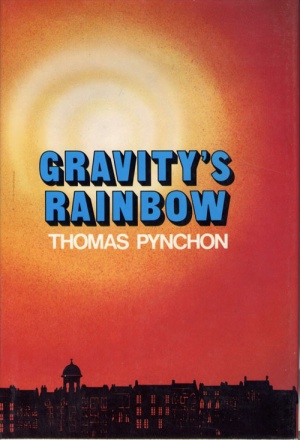 Every summer for the past four years, I have written a long piece for the Tropics of Meta or ToM for short. In their words, ToM "offers a fresh perspective on history, current events, popular culture, and issues in the academic world. Founded in 2010, ToM has published (online) over 1000 essays by historians, social scientists, artists, activists, and creative writers both within and outside the academy, giving voice to communities across the United States and the world."
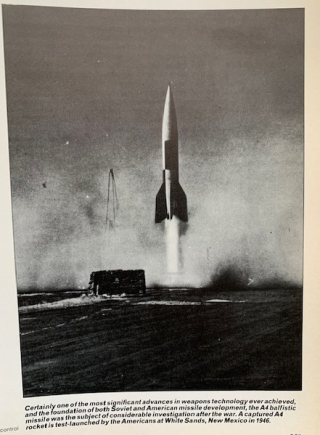 Regular readers of this blog know that I like reading history and thinking about history, and in ToM's section called Dog Day Classics they've published my longer book review essays about the Vietnam War, The Korean War and the grisly Algerian war for independence from France. This year I used my extra pandemic reading time to revisit Thomas Pynchon's 1973 novel, Gravity's Rainbow which I first read 40 years ago and believed influenced my worldview, (maybe to my detriment). I was also became more interested in the end of World War II after visiting Berlin last year and reading Antony Beevor's The Fall of Berlin 1945 (2002). Gravity's Rainbow is set primarily in Germany at the end of war in 1945 and one of the "main characters" is the V-2 rocket.
Photo Credits: I have always had a soft spot for the original Viking edition artwork by Marc Getter. The book photo comes from Thomas Pynchon wiki page which can be helpful along with The Gravity's Rainbow Support Group Page, which is linked off this blog's main page. The gritty photo of the V-2 rocket comes the photo book The Military History of World War II (1986). Note how this is rocket is being fired from New Mexico in 1946. That's right. Obtaining the technical and engineering rocket expertise for the V-2 was extremely important to the United States after World War II (a major plot point of the book.)
—– EXTENDED BODY: —– EXCERPT: —– KEYWORDS: Tropics of Meta, Thomas Pynchon, Gravity’s Rainbow —– ——– AUTHOR: Murray Browne AUTHOR EMAIL: murray.browne905@gmail.com TITLE: Hiroshima and Hersey STATUS: Publish ALLOW COMMENTS: 1 CONVERT BREAKS: wysiwyg ALLOW PINGS: 0 BASENAME: hiroshima-and-hersey CATEGORY: Book Reviews UNIQUE URL: https://thebookshopper.typepad.com/the_book_shopper_atlantad/2020/07/hiroshima-and-hersey.html DATE: 07/16/2020 09:01:00 PM —– BODY:
Next month there will be commemorations* for the 75th anniversary of the atomic bombing of Hiroshima (August 6, 1945) and Nagasaki (August 9, 1945). One writer who is synonymous with that fateful day, which hastened the surrender of Japan and the end of World War II is John Hersey (1914-1993). This isn’t the blog’s first posting about Hersey, who is one of the more underrated and unheralded American writers of the 2oth century. He is best-known for his book Hiroshima (1946) where he used narrative techniques normally found in fiction (a precursor to New Journalism) to describe the accounts of six survivors of the blast. Equally impressive is the way Hersey captured the rhythms of the Japanese speech patterns in his prose. It reminds one of a Haruki Murakami novel.
Hersey was born in China to missionary parents before moving back to the United States at age 10. He spoke fluent Mandarin Chinese and was able to put himself through Yale University based on his intellect and hard work. He became a war correspondent for Time Magazine and spent time in Italy and the Pacific. In 1946, The New Yorker commissioned him to write a piece on Hiroshima.
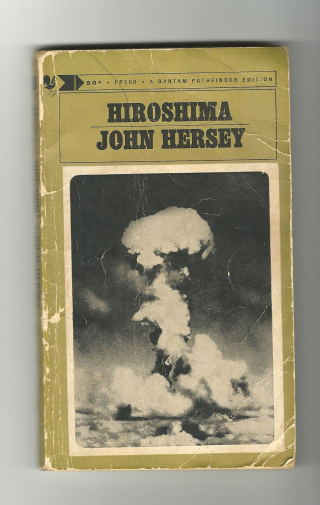 In this book, Lives of the Novelists: A History of Fiction in 294 Lives (2011), the critic and scholar John Sutherland lists the authors who will still be read 100 years from now and why. One of those authors is John Hersey. In Hiroshima, Sutherland admired Hersey's ability to overturn, “ the monolithic image of the subhuman ‘Jap’ promulgated during hostilities. The description of physical effects of the ‘Bomb’ were horrific: melted eyeballs, bone-rotting radiation sickness, and — the image that went around the world –- a victim whose only relic was a shadowy profile on a wall; the rest of him vaporized.”
In other words, at that time the book came out, many Americans still hated the Japanese for their sneak attack on Pearl Harbor, but if you've read Hersey’s account of the grisly suffering and death you could not have had anything but the deepest sympathy for the civilian population of Japan.
A Bell for Adano
 Based on his experiences while he was a war correspondent in Italy. Hersey wrote A Bell for Adano, which was published in 1944 while World War II still raged. Set in an Allied occupied coastal village in Sicily, an Italian-American major is assigned to be the head of the local government. The major must win the trust of the villagers who have been under Fascist rule for years. This is not a blood and guts kind of story at all, but one that focuses on the civilians that were caught between the retreating Fascists and the townspeople’s new conquerors – the Americans. The major has a tough job, especially dealing with his superiors (one based on General George S. Patton) but he is a decent man and goes the extra step to replace the local church’s prized bell that was removed for scrap metal earlier in the war.
Like Hiroshima, A Bell for Adano is a not a lengthy book as Hersey is economic with prose. The book was awarded the Pulitzer prize for fiction in 1945.
Key West Tales
Hersey kept a winter home in Key West, Florida which was a popular hangout for many writers including Ernest Hemingway, who as a "celebrity" novelist, war correspondent, and macho man overshadowed Hersey. (Not that long ago, I reread Hemingway’s A Sun Also Rises and I much prefer Hersey's work.)
 Hersey’s final book was a collection of short stories entitled Key West Tales (1994). His stories show tremendous range in subject matter with some measure of wit and since the collection is lighter in tone and subject matter Key West Tales is suitable for reading while on vacation. (See the posting “Better Book Trips of 2016"). One memorable story is “A Game of Anagrams” an account of a weekly word game between three egotistical poets and a novelist as they vie for word one-upmanship. In the story "To End the American Dream," Hersey pays "tribute" to Hemingway by portraying him as a bar brawler, but also balances his portrayal by showing how Hemingway cares about his sentences and his writing habits.
It is no surprise that Hersey went easy on his rival. The critic John Clute (who I believe wrote the entry in the Sutherland book) summarized in Hersey's life that in everything he did, had a "stylish decency if not a nobility."

* My longtime partner Denise Casey took the photos of Hiroshima when she visited Japan in 2005. The photo at the top of the posting are the ruins that were purposely left as a reminder for future generations and the photo at the end of the posting is Hiroshima Memorial Peace Park. Thanks, Denise.
—– EXTENDED BODY: —– EXCERPT: —– KEYWORDS: John Hersey, Hiroshima, Key West, A Bell for Adano, John Sutherland, Lives of the Novelist —– ——– AUTHOR: Murray Browne AUTHOR EMAIL: murray.browne905@gmail.com TITLE: Something For Late-Night Readers STATUS: Publish ALLOW COMMENTS: 1 CONVERT BREAKS: wysiwyg ALLOW PINGS: 0 BASENAME: something-for-late-night-readers-1 CATEGORY: Books as Art as Books UNIQUE URL: https://thebookshopper.typepad.com/the_book_shopper_atlantad/2020/06/something-for-late-night-readers-1.html DATE: 06/30/2020 08:33:54 PM —– BODY:

Do you like to stay up late at night reading, but get tired of holding the book long before you get sleepy? Then check out the revolutionary Buchor Model C, a device that allows you to lie in perfect repose and read your book without having to hold it.
 Der Buchor Model C*was invented by a German sound engineer-artist for his scholarly night owl partner who likes to read well past midnight. By attaching a music holder to a microphone stand via a strong and adjustable grip head, der Buchor Model C allows for hand-free, gravity defying reading. Your book attaches to the stand, and thin clips keep the pages flat for easier reading. A small lamp with an environmentally-friendly LED bulb clips onto the stand, much healthier than the blue light from a laptop or a phone.
Der Buchor Model C is not available at any store or online. It’s free! You just have to put it together from materials you have lying around the house (if you are a resourceful artist or innovative sound engineer). Reading late at night has never been easier. Accept no IKEA-like knockoffs and you can throw that disgusting Pillow Pad away.
* known originally as die Bucheule 5000
—– EXTENDED BODY: —– EXCERPT: —– KEYWORDS: Reading Aids, Bucheule, die Bucheule, —– COMMENT: AUTHOR: Cynthia EMAIL: cyndyb77005@yahoo.com IP: 188.103.77.35 URL: DATE: 07/11/2020 06:19:10 AM We are already considering a new model (model T, after Thorsten), who suggested a contraption that involves a mirror and rubber bands! —– COMMENT: AUTHOR: Cynthia EMAIL: cbrowne@alumni.rice.edu IP: 188.103.77.35 URL: DATE: 07/11/2020 06:22:03 AM This article about a forgotten language first inspired the idea, though Thomas Jefferson’s book revolver stand was an early example of architectural forays to facilitate reading ventures. https://taz.de/Vergessene-Geheimsprache-Rotwelsch/!5619436/ —– COMMENT: AUTHOR: Boris EMAIL: joens@posteo.de IP: 188.103.77.35 URL: DATE: 07/11/2020 02:12:13 PM The Buchor could possibly also applied in daylight for early birds. Maybe as a rebrand? I like the suggestion of gravity free reading and also the surprising end (“if you want one, build one yourself”). —– ——– AUTHOR: Murray Browne AUTHOR EMAIL: murray.browne905@gmail.com TITLE: Sun Salutations STATUS: Publish ALLOW COMMENTS: 1 CONVERT BREAKS: wysiwyg ALLOW PINGS: 0 BASENAME: sun-salutations UNIQUE URL: https://thebookshopper.typepad.com/the_book_shopper_atlantad/2020/06/sun-salutations.html DATE: 06/18/2020 03:37:17 PM —– BODY: Several of my recent reading choices in the past six months have been a direct result of my subscription to The Sun Magazine out of Chapel Hill, North Carolina. The Sun Magazine is a monthly literary publication of essays, fiction, poetry and photography. Each issue has an in-depth interview with a person who presents a thoughtful perspective on a timely issue whether it is political, cultural, or environmental. Here is list of recent interviewees that may interest you as well as their books.
Interview with Leah Penniman in the July, 2019 Issue
Penniman is an author, educator and activist and co-founder of Soul Fire Farm, which is not only a working farm, but "a training ground for aspiring people of color who come there to learn about sustainable agriculture and reclaim a connection to the land severed by centuries of trauma and oppression.”
I read her Farming While Black: Soul Fire Farm’s Practical Guide to Liberation on the Land which is a rare blend of black history, activism, and practical advice for those interested in community gardening and tips on growing better fruits and vegetables. It inspired me to contact their publisher Chelsea Green to carry some of their books at my Destination: Books popup.
Interview with Paul Chaat Smith in the August, 2019 issue
Smith is an American Indian essayist, activist and cultural provocateur. Smith’s book Everything You Know About Indians is Wrong (2009) is a series of essays expanding over 10 years. Smith ruminates about various related to Indian history and art, his own heritage, and portrayal of Native Americans. The Sun describes his style as" a combination of smart-aleck, freewheeling with thoughtful scholarship." After reading Everything You Know I put the Smithsonian’s National Museum of the American Indian (NMAI) in Washington D.C. on my travel list and so maybe visit Smith who is one of the curators there.
Interview with Astra Taylor in the November, 2019 issue
Her book Democracy May Not Exist, But We’ll Miss It When It’s Gone (2019) gives a history of what democracy really means and how it came to be so threatened here in 2020. It's a thicker book that can occasionally ramble, but it does cover the history of democracy and looks at many of the current systemic threats to democracy. She admits that democracy is a flawed form of government but worth saving.
Since Sun Magazine has temporarily removed its paywall these interviews are available to read online. However, the magazine is gorgeously printed on fine paper with extraordinary black and white photography throughout so you may want to consider subscribing. You will never have to worry about the magazine piling up because you probably have like-minded friends that are always willing to take them off you hands.
Available at Destination: Books
All three of these slightly used books are in my Destination: Books online store where I often place books that I don’t want to read again, but deserve to find a good homes instead being dumped at Goodwill or in the purgatory of one of those Neighborhood Little Libraries. Regular readers of the blog may recall that generally I do not mark in books or eat sticky foods while reading. I prefer to make notes on postcards instead and I readily avoid anything that will get stuck in my teeth except kale. I keep a small inventory with additional descriptions and ordering information at the Destination: Books catalog page.
—– EXTENDED BODY: —– EXCERPT: —– KEYWORDS: The Sun Magazine, Leah Penniman, Astra Taylor, Paul Chaat Smith, Destination Books —– ——– AUTHOR: Murray Browne AUTHOR EMAIL: murray.browne905@gmail.com TITLE: The Gravity’s Rainbow Support Group (GRSG) STATUS: Publish ALLOW COMMENTS: 0 CONVERT BREAKS: wysiwyg ALLOW PINGS: 0 BASENAME: gravitys-rainbow-support-group UNIQUE URL: https://thebookshopper.typepad.com/the_book_shopper_atlantad/gravitys-rainbow-support-group.html DATE: 06/03/2020 09:01:31 AM —– BODY: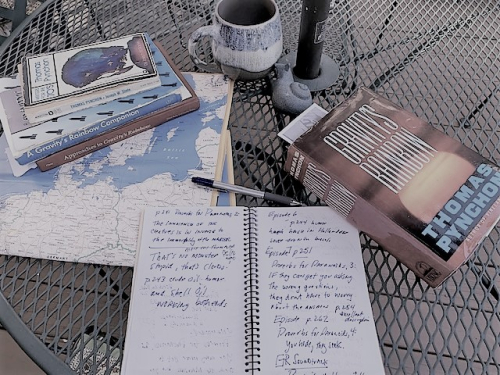
People who only read the classics are sure to remain up-to-date – Maria von-Ebner Eschelbach
Thomas Pynchon’s 1973 novel, Gravity’s Rainbow is a difficult book to read and especially challenging to read alone. Its narrative structure skips around, digresses and requires some understanding of history, science, psychology and mathematics to gain a toehold on its meaning. On the other hand, it’s imaginative, clever, humorous, challenging, and provides insight to the world as we know it. The goal of the reading group is to share the burden of this novel, allowing people to talk about the book without boring spouses and partners, friends, and innocent bystanders who might be foolish to inquire about “what you are reading” while standing in line at the coffeeshop. Also, after reading Gravity’s Rainbow you are allowed to used the adjective “Pynchonesque” at your leisure.
More importantly, the purpose of this page is to collect notes of the Gravity’s Rainbow Support Group (GRSG). Warning: this page will not always be coherent. For a more coherent take on the book, visit the essay, “A Screaming Comes Across the Sky: Rereading Thomas Pynchon’s Gravity’s Rainbow,” which appeared in Dog Days Classics section of the Tropics of Meta, Historiography for the Masses.
Background Sources
There are several recommended sources that assist you in understanding the book:
Writers for the 70s: Thomas Pynchon (1974) by Joseph Slade. This is one of the better guides, a pocket paperback which gives an overview on all of Pynchon’s writing up through Gravity’s Rainbow. I found my copy in a potpourri and antique store in Lindsborg, Kansas of all places. You can find copies on line. Trivia note: the other authors in this series were Kurt Vonnegut, Carlos Castaneda and Richard Brautigan. Hmmm.
Gravity’s Rainbow Companion: Sources and Contexts for Pynchon’s Novel (1983) by Steven Weisenburger. There is a newer edition with about 20 percent more material (I am told) than this highly detailed breakdown from the early 80s that I am familiar with. The episode-by-episode synopses, which I have distributed via postal mail have come from the first book. My copy of the book has been disintegrating, but it is invaluable. I have no idea where I found my copy, but the new edition published in 2006 is available but pricey.
https://bookshop.org/widgets.js
Approaches to Gravity’s Rainbow (1983), edited by Charles Clerc and published Ohio State University Press. This is a series of essays where each contributor (including the aforementioned Joseph Slade) concentrates on some aspect of the novel. A little scholarly. I am not exactly sure where I found this book. Maybe I saw it at the Wichita State University library and ordered it.
 If you can somehow find it read Lawrence C. Wolfley’s Repression’s Rainbow: The Presence of Norman O. Brown in Pynchon’s Big Novel. The scholarly article appears in The Modern Language Association-Publications. October, 1977, Volume 92 #5. You may be able to access or purchase it at JSTOR.
Internet
The major website about Gravity’s Rainbow https://gravitys-rainbow.pynchonwiki.com/ has some valuable resources : The Alphabetical Index includes the 300+ characters who appear in the 760+ page book, and a page by page annotation (but it is not as through as the Weisenburger book), and the character map E-R diagram which shows the relationship of the some of the main characters. Unfortunately, it does not display easily. Also, many of the links on this website are dead and out of date. There is also a link to Richard Poirior’s (Pynchon’s most sensitive critic who wrote the best general introduction to GR according to Wolfley), entitled.”Rocket Power.”
A Word About The Style
One of the aspects of this novel that makes the book a challenge is Pynchon’s style and wide use of the analepsis, “a literary technique that involves the interruption of the chronological of events or scenes of an earlier occurrence” (Merriam Webster’s definition). What makes it even more challenging is that these “shifts in focalization, all without any of the spatiotemporal markers by which writers conventionally signal them to readers (Weisenburger). One GRSG member pointed out that this is the same technique used by William Faulkner in such novels such as The Sound and the Fury. Adding to the confusion is Pynchon’s use of ellipses. I was recently reading an essay by Paul Chaat Smith that complained about a friend’s elliptical writing style: “Stream-of-consciousness rambling and contempt for sentence structure are surefire indications of sloppy thinking and worse writing, of an undisciplined mind, of feckless anarchy.” Even if you don’t think Pynchon is being sloppy (and I don’t), it does make the book more difficult to read.
Warning: Episode 9 (pp. 47-53) and Episode 14 (90-113) are especially nasty with the analepses.
Themes
As Charles Clerc can attest to there are many approaches that one can take to understand the book to chose from:
Historical – Set at the end of World War II, September 1944 to September 1945, the book is kind of an historical novel as many of scenes have a factual correctness to them. (Pynchon studied The London Daily Times and borrowed extensively details about what was going on.)
Paranoia and how multinational corporations control the world – especially IG Farben. In Part Two, Pynchon introduces his Proverbs for Paranoids.
Proverbs for Paranoids, 1: “You man never get to touch the Master, but you can tickle his creatures.”
Proverbs for Paranoids, 2: “The innocence of the creatures is in inverse to the immorality of the master.”
Proverbs for Paranoids, 3: “If they can get you asking the wrong questions, they don’t have to worry about the answers.”
Proverbs for Paranoids, 4: “You hide, they seek.”
Proverbs for Paranoids, 5: “Paranoids are not paranoids because they’re paranoid, but because they keep putting themselves, fucking idiots, deliberately into paranoid situations.”
Science and technology – Werner Von Braun (1912-1977) and rocket scientists and how at the end of World War II, there was a competitive rush by the Soviet Union and the United States to gather as many scientists into their ranks as possible, which was discussed at Yalta in early 1945. There is a joke about the NASA put a man on the moon first — “Our German rocket scientists were better than their rocket scientists.” The book’s opening quote from Von Braun is basically the 1st Law of Thermodynamics.
There were 15,000 rocket designers, engineers and technicians in Germany at the end of the war (Clerc-Tololyan, p.49). Another major player was General Walter Dornberger who led the German rocket-research group as early as 1932 and after the war came to the United States and later became a leading innovator at Bell Aircraft Corporation and influenced the development of the Space Shuttle.
The enlistment of German rocket scientists into the United States (despite their use of death camp labor) was part of Operation Paperclip, which has recently received some new notoriety in the Amazon series “Hunters,” which takes this historical moment and fictionalizes to the extreme.
“The V-2 looms large in GR as the focal point of a ‘grisly romance’ between men and technology.” (Clerc-Tololyan, p 45)
Psychology – The White Visitation, Pavlov, behaviorists.
Notes from the GRSG first gathering on June 6, 2020
Attendees: Francis Walker (two others already dropped out)
This is Francis’s third time reading GR but the first time since the late 1970s and this was my second time. My first reading was in the early 1980s. Good news! We both agreed it’s easier reading the second or third time. Perhaps you know what you are up against or since you know the basic plot its a little easier to hang in. For me, this time I had the guides (mentioned above) and that kept from being totally lost for long passages.
- Gravity. What does the title Gravity’s Rainbow mean? “Gravity is, after all universal: every bit of matter exerts a force on every other.” (Clerc-Friedman, p.75) Does the rainbow just indicate the shape (a parabola like the flight of the V-2 rocket. Gravity is invisible, meaning invisible forces? Rainbows have many colors, so is GR a book of the host of invisible forces that are upon us every moment. From Francis:
So, I have been thinking a bit more about gravity and color and Pavlov. We sometimes use gravity to tell us about time (like an hourglass, or like waiting for a ball or frisbee thrown in the air to come down, or waiting for the other shoe to drop. We, also, sometimes use color to tell us about time. It is hard to do with the gray English skies (a recurring theme you pointed out that helped me see this connection), but at the ocean we can tell by the colors if it is morning, noon or evening and we can tell by the flash of an bomb or lightening that an explosion or thunder will follow–or the red of a rocket burning that a missile is on the way. I think that’s why he likes Pavlov, it is the time locked nature of two stimuli (a bell and food) that creates the conditioned response. He seems fascinated by the possibility that perhaps things could go in reverse.
- How do we cope with these invisible forces? Paranoia (a subset of which is conspiracy theories). Myth and religion, which reminded Francis of a couple of quotes: “There is something feeble and a little contemptible about a man who cannot face the perils of life without the help of comfortable myths.”- Bertrand Russell. And another from Boris Pasternak: “As for men in power, they are so anxious to establish the myth of infallibility that they do their utmost to ignore the truth.” Here in time of COVID-19, we struggle to understand why one person is struck down with the disease and another is not. (like in the battlefield, why is one killed by a bullet and the other person next to him is not.) There are tough things to ponder. William Osler once said, “To be uncertain is to be uncomfortable, but to be certain is ridiculous.”
- A discussion of the evils of large corporations discussion: including IG Farben, Krupp, Anthony Sampson’s The Sovereign State of ITT, which was published in 1973 the same year as GR. Another book that may be of interest is The Order of the Day (2017) by Eric Vuillard, which is a brief history about the titans or German industry who supported Hitler as early as 1933, which solidified his power. An excellent book. William Manchester’s The Arms of Krupp is also highly recommended.
For some good background reading about this same period of history I found these two books most useful:
Johnson, Paul. In Modern Times: The World from the Twenties to the Nineties (Revised) New York: Harper Perennial, 1992 (more specifically the chapter “Superpower and Genocide.”
Roberts, Andrew. Masters and Commanders: How Four Titans Won the War in the West, 1941-1945. New York: Harper Perennial, 2008.
- Brief discussion of the Second Law of Thermodynamics which states that the total entropy of an isolated system can never decrease over time, and is constant if and only if all processes are reversible. Isolated systems spontaneously evolve towards thermodynamic equilibrium, the state with maximum entropy. “Entropy is time’s arrow,” attributed to Arthur Eddington. This reminded me of joke that was posted on the door of physics professor where I worked. “Time flies like and arrow, but fruit flies like a banana.”
Notes from the GRSG second gathering on June 26, 2020
Uhhhh! Lost notes or didn’t take notes but Francis sent this email after our discussion which was mentioned earlier on this page about gravity and color and Pavlov.
Notes from the GRSG third gathering on July 20th, 2020
Much of this discussion centered around the essay I was working for Tropics of Meta entitled “A Screaming Comes Across the Sky: Rereading Thomas Pynchon’s Gravity’s Rainbow,” which was published on August 10, 2010. We talked more about paranoia and what roles multinational corporations
Notes from the GRSG fourth gathering on August 13, 2020
Notes from the GRSG fourth gathering on September 7, 2020
Notes from the GRSG fifth and final gathering on October 2o, 2020
One of the topics discussed was on the nature of time. Francis pointed out these passages from GR:
Three hundred years ago mathematicians ere learning to break the cannonball’s rise and fall into stairsteps of range and height delta x and delta y allowing them to grow smaller and smaller, approaching zero as armies of eternally shrinking midgets galloped upstairs and down again the patter of their feet growing finer, smoothing out into continuous sound. ….They would peer at the Askania films of Rocket flights, frame by frame, delta x by delta y, flightless themselves, ….film and calculus, both pornographies of flight. (p. 566)
Temporal bandwidth” is the width of your present, your now. It is the familiar “Δt” considered as a dependent variable. The more you dwell in the past and in the future, the thicker your bandwidth, the more solid your persona. But the narrower your sense of Now, the more tenuous you are. It may get to where you’re having trouble remembering what you were doing five minutes ago, or even—as Slothrop now—what you’re doing here, at this moment…… (p. 509)
Each moment has its value, its probably success against other moments in other hands, and the shuffle for him is always moment-to-moment. He can’t afford to remember other permutations, might-have-beens—only what’s present, dealt him by something he calls Chance…. (p.613)
..get him a power base in Berlin, he’s already hep to the Strobing Tactic, all you do is develop the knack (Yogic, almost) of shutting off and on at a rate close to the human brain’s alpha rhythm, and you can actually an epileptic fit! ….. –Page 648 This is a reference to the character Byron the Bulb.
https://bookshop.org/widgets.js
Places in Gravity’s Rainbow
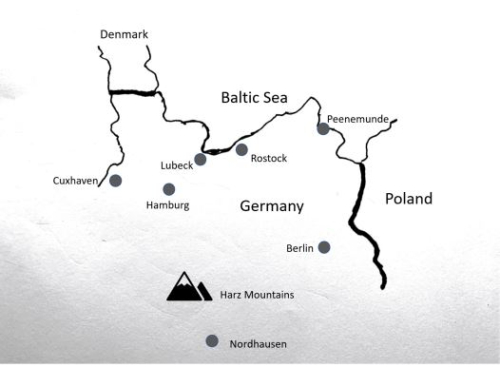
Although the book spends time in London, Nice, France and other locales around the world, the majority of the book is set in northern Germany.
The V-2 Rocket
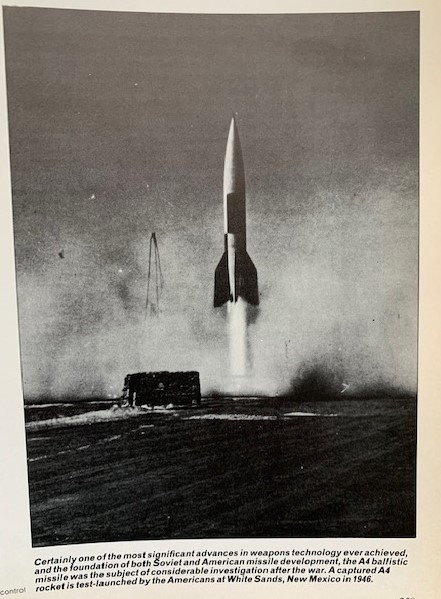 “The V-2 rocket Vergeltungswaffe Zwei) was literally the vengeance weapon.” (p.71 Clerc, Tololyan). “England was struck by 1,115 V-2s, and Antwerp,…was hit by 1,265 more. In London the toll was 2,340 dead and 6,000 wounded… In the end, the most accurate judgment is perhaps that of the British scientist who suggested that ‘the vast A-4 project had been conceived not out of military expediency but to quench the innate German sense for romanticism.’ Pynchon’s vision is predicated on a similar judgement, so that the V-2 looms large in Gravity’s Rainbow as the focal point of a grisly romance between men and technology.” p.45 Clerc, Toylyan).
The V-2 is also known as the A-4 program and that may because it refers to the rocket design itself. V-1 was a different type of weapon more of a cruise missile than a rocket. It was being fired on England beginning of June, 1944 from France, but it did not have a great range and when the Allies overtook France that ended the use of that weapon. But September of 1944 was the first V-2 rocket launch. The V-1 actually caused more death and casualties and was also referred to as the buzz bomb. Ironically, there was replica of the buzz bomb in my hometown of Milford, Illinois. 
Since the V-2 is the focal point – the quest of the book or in the opinion of Slade, “the protagonist of the story…an annunciation of the new technology (p. 178).”
The Rocket has two aspects. Conceived for death, ostensibly evil, it offers life. It is a “star” an “angel” a “Text.” It is the means by which man can escape Gravity and Earth itself. It is the pinnacle of man’s technology, symbol of a new state, or at least, a new city, the Raketen-Stadt.”
Many of the characters are directly involved: Franz Pokler (chemical engineer at Peenemunde and Nordhausen), Lt. Tyrone Slothtrop (Rocketman), Enzian (the Herero pilot of the Schwarzkommandos, and Blicero-Wasserman, one of the main commanders of the project.
More V-2 – At the Military History Museum
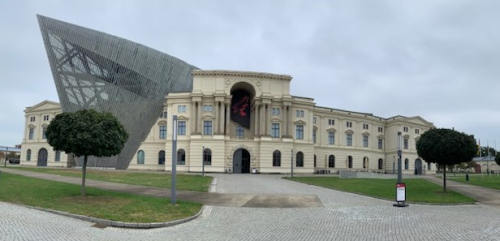
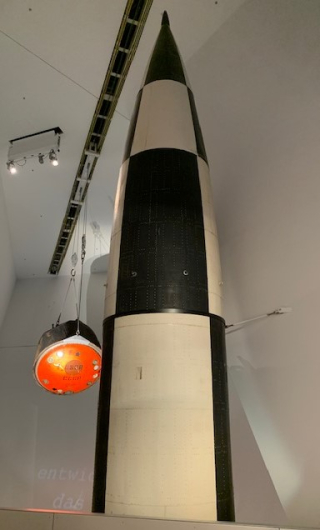 In the fall of 2021, I was visiting my daughter in Berlin and we made a trip to Dresden and visited the Military History Museum of Dresden (more about the unusual architecture here). It ended up being an opportunity to see the V-2 up close. It is much larger than I imagined and though the rocket was unmanned, it certainly looked large enough to squeeze someone into it like Enzian.
Film and Cinema Motifs
Beginning with the ellipsis boxes that designate the different episodes that separate the text in each chapter, there is a heavy influence of films and moviemaking in GR. Beginning with some of the characters of the book:
Gerhardt Von Göll – aka Springer which is German for “chess knight” – the “knight who leaps perpetually across the chessboard of the Zone.” Von Göoll is a German filmmaker, which Pynchon pays homage to classic German expressionist films such as Metropolis. He makes makes a short film for the Allies about the Schwarzcommandos, black tribesman from the Herero tribe in Southwest Africa who worked on the German rocket program. It’s intended as a propaganda film, but turns out to be true.
Before the war Von Göll also makes the erotic film Alpdrücken (German for nightmare) with actress Greta Erdman (aka Margherita and Gretel). The movie has a profound effect as Greta is raped by co-star Max Schlepzig during the filming of the orgy scene filming (Schlepzig could be Von Göll ?) and she ends up having a child Bianca. Another character Franz Pölker is seduced while watching the film. Franz returns home to have sex with his wife Lena and they conceive of a child Ilse. Pölker is a rocket engineer who is forced not to question what he is doing in order to see Ilse.
Imaginative Passages
One key to reading Pynchon is appreciating the imagination, description or the humor (often slapstick) that it is intertwined with the narrative and the larger themes. Here are some of the favorites identified by the GRSG.
A squadron of B-17s in flight (page 87). “Behind these Fortresses the undersides of the cold clouds are blue, and their smooth billows are veined in blue–elsewhere touched without grayed or purple.”
In the lab with Pavlov (page 90). ” Yesterday we got him to go ultrapardoxical Beyond. When we turn on the metronome that used to stand for food–that once made Dog Vanya drool like a fountain–now he turns away.”
Mrs. Quoad’s “wine jellies” (page 116-118). Slothrop sips “herb tea to remove the taste of the mayonnaise candy — oops, but that’s a mistake right, here’s his mouth filling once again with horrible, alkaloid desolation, all the way back to the back palate where it digs in.”
Sex scene with Slothrop and Katje (page 197-) “He dangles two pillows and watches here. ‘One more step,’ she giggles, Slothrop dives in goes to hit her across the ass whereupon she lets him have it with the Seltzer bottle, natch. The pillow bursts against one marble hip, moonlight in the room is choked with feathers and down and soon with hanging spray from jets of Seltzer.
Death camp description (page 431) Pölker walks through the death camp at Dora next to Nordhausen. (Pölker is one of Pynchon’s more multi-dimensional and feeling characters in the novel. And Pynchon’s description reminds one that he can write “just as seriously” as anyone.
Somewhere aboard the hedonistic Anubis (~page 492). “the monkeys drunk holding vodka bottles with feet.”
The rescue of Spring reminds one of a passage out of Stanley Crawford’s novel Gascoyne.
What Happens If You Don’t Read the Assigned Text
Before being allowed entry, you may be asked to read aloud to the calls pages 235-236 the graphic description of Brigadier Pudding chomping on a turd. As grotesque as this sounds (and it is). Wolfley (see background sources) seriously calls it “an incredible tour de force, as powerful as anything in the novel. (p.881, Wolfey).
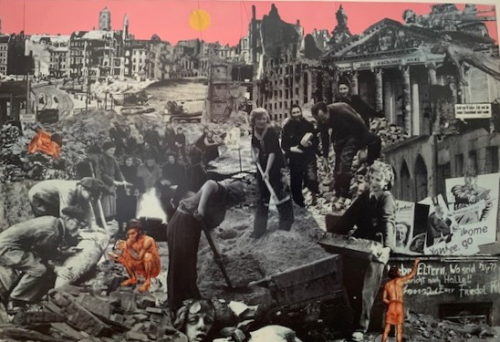
AFTERMATH #1
We finished GR on October 20, 2020, but are you ever really finished with Thomas Pynchon? Sharing and digging deep into books seemed like a worthy continuation of our group.
Nabokov
A writer who knows one human being can portray a hundred – Marie von Ebner Eschelbach
 On November 9, 2020 we opted for Vladimir Nabokov’s Pnin (1953) – a short novel that is similar in tone with Kingsley Amis’s Lucky Jim satire about academia. As expected, Nabokov’s writing was superb and Francis provided some of his favorite quotes from Pnin:
“All three of them stood for a moment gazing at the stars.
”And all these are worlds,” said Hagen.
”Or else,” said Clements with a yawn, ”a frightful mess. I suspect it is really a fluorescent corpse, and we are inside it.”
“His life was a constant war with insensate objects that fell apart, or attacked him, or refused to function, or viciously got themselves lost as soon as they entered the sphere of his existence.”
“―just as she was — with her cruelty, with her vulgarity, with her blinding blue eyes, with her miserable poetry, with her fat feet, with her impure, dry, sordid, infantile soul. All of a sudden he thought: If people are reunited in Heaven (I don’t believe it, but suppose), then how shall I stop it from creeping upon me, that shriveled, helpless, lame thing, her soul? But this is the earth, and I am, curiously enough, alive, and there is something in me and in life —”
―
“…two lumpy old ladies in semitransparent raincoats, like potatoes in cellophane…”
“What chatty Madam Shpolyanski mentioned had conjured up Mira’s image with unusual force. This was disturbing. Only in the detachment of an incurable complaint, in the sanity of near death, could one cope with this for a moment. In order to exist rationally, Pnin had taught himself…never to remember Mira Belochkin – not because…the evocation of a youthful love affair, banal and brief, threatened his peace of mind…but because, if one were quite sincere with oneself, no conscience, and hence no consciousness, could be expected to subsist in a world where such things as Mira’s death were possible. One had to forget – because one could not live with the thought that this graceful, fragile, tender young woman with those eyes, that smile, those gardens and snows in the background, had been brought in a cattle car and killed by an injection of phenol into the heart, into the gentle heart one had heard beating under one’s lips in the dusk of the past.”
“A warm flow of pain was gradually replacing the ice and wood of the anaesthetic in his thawing, still half-dead, abominably martyred mouth. After that, during a few days he was in mourning for an intimate part of himself. It surprised him to realize how fond he had been of his teeth. His tongue, a fat sleek seal, used to flop and slide so happily among the familiar rocks, checking the contours of a battered but still secure kingdom, plunging from cave to cove, climbing this jag, nuzzling that notch, finding a shred of sweet seaweed in the same old cleft; but now not a landmark remained, and all there existed was a great dark wound, a terra incognita of gums which dread and disgust forbade one to investigate. And when the plates were thrust in, it was like a poor fossil skull being fitted with the grinning jaws of a perfect stranger.”
“Because of a streak of dreaminess and a gentle abstraction in his nature, Victor in any queue was always at its very end. He had long since grown used to this handicap, as one grows used to weak sight or a limp.”
“The bowl that emerged was one of those gifts whose first impact produces in the recipient’s mind a colored image, a blazoned blur, reflecting with such emblematic force the sweet nature of the donor that the tangible attributes of the thing are dissolved, as it were, in this pure inner blaze, but suddenly and forever leap into brilliant being when praised by an outsider to whom the true glory of the object is unknown.”
“Both Erica and Liza Wind were morbidly concerned with heredity, and instead of delighting in Victor’s artistic genius, they used to worry gloomily about its genetic cause.”
Another evocative Pnin quote about pencil sharpeners appeared in The Book Shopper blog piece Into the Spinning Void on November 6, 202o.
AFTERMATH #2
Beginning on December 1st we started the first half of Ernest Becker’s The Denial of Death (1973).
There is a connection between GR and The Denial of Death, which were completed within a few years of each other, which extends beyond Woody’s Allen’s reference to the film Annie Hall, when Diane Keaton calls Allen out about how all of his books have the word, “death” in them.
Topics discussed at the December 17, 2020 meeting:
- How did a book like Becker’s ever win a Pulitzer? No one knows for sure. Becker was at Berkeley in the 1960s and was extremely popular among the students (much more than his fellow faculty members.) His book was cross-disciplinary and was a book that also on the radar of the clergy. The book did seem to encapsulate the work of many thinkers — especially psychotherapy and Sigmund Freud.
- What does neurosis mean? We discussed how “neurosis” has been something that has been out of vogue for a quite some time. Part of the reason is that medical professionals were unable to define neurosis. (Something like Woody Allen = neurosis doesn’t really work.) It illustrates that many Becker’s explanation of how our repression of death factors into psychotherapy. Much of it is not really accepted nowadays, but Becker always brings up interesting sources and ideas worthy of discussion.
- Why does a near death experience interrupt our perception of time? There was discussion about various theories including “the speed of thought.”
- Speaking of its relationship to Gravity’s Rainbow, is Slothrop a Becker heroic figure. We think maybe so. More discussion.
- We liked The Denial of Death, but not sure Becker’s posthumous Escape from Evil (which is considered a better and shorter book.) Otto Rank’s Art and Artist is another book that has come recommended.
- The work of Norman Brown factors heavily in Becker’s Denial of Death. Lawrence C. Wolfley’s bridged the gap between Becker and Pynchon in his article “Repression’s Rainbow: The Presence of Norman O. Brown in Pynchon’s Big Novel.” The scholarly article appears in The Modern Language Association-Publications. October, 1977, Volume 92 #5. You may be able to access or purchase it at JSTOR.
For more books, visit GRSG-2021.
After Gravity’s Rainbow, Pnim and The Denial of Death we read and “studied” and discussed other books listed below:
The Republic of Suffering by Drew Gilbert Faust
Absalom, Absalom! by William Faulkner — in conjunction with
The Saddest Words: William Faulkner’s Civil War by Michael Gorra
Practicing History: Selected Essay by Barbara Tuchman, which inspired
Stillwell and the American Experience in China (1911 – 1945) by Barbara Tuchman
The Periodic Table by Primo Levi
Cultural Amnesia by Clive James
The Historian’s Craft by Marc Bloch
The Odyssey by Homer — in conjunction with
Homeric Moments Clues to the Delight in Reading The Odyssey and The Iliad by Eva Brann.
An Inventory of Losses by Judith Schalansky
An Homage to Catalonia by George Orwell
GRSG – 2022 Reading Notes for the Everything Listed Below
The Age of Anger: A History of the Present by Pankaj Mishra
Mountains and a Shore: A Journey Through Southern Turkey by Michael Pereira
The Life and Opinions of Tristam Shandy Gentleman by Laurence Sterne
Grant by Ron Chernow
The Innocents Abroad by Mark Twain
The U.S.A. Trilogy by John Dos Passos
— The 42nd Parallel, 1919, and The Big Money
Under the Net by Muriel Spark
Two Wheels Good: The History and the Mystery of the Bicycle by Jody Rosen
Red and Black: A Chronicle of 1830 by Stendhal
—– EXTENDED BODY: —– EXCERPT: —– KEYWORDS: Thomas PYnchon, How to Read Thomas Pynchon, Reading Thomas Pynchon’s Gravity’s Rainbow, Gravity’s Rainbow —– ——– AUTHOR: Murray Browne AUTHOR EMAIL: murray.browne905@gmail.com TITLE: Baseball Books Blues STATUS: Publish ALLOW COMMENTS: 1 CONVERT BREAKS: wysiwyg ALLOW PINGS: 0 BASENAME: baseball-books-blues CATEGORY: Baseball CATEGORY: Book Reviews CATEGORY: Film UNIQUE URL: https://thebookshopper.typepad.com/the_book_shopper_atlantad/2020/05/baseball-books-blues.html DATE: 05/26/2020 09:00:00 AM —– BODY:

With Hot Stove League extended past Memorial Day because of the pandemic, my ability to maintain an interest in baseball has waned. With few exceptions, I have little interest in watching tired-ass games of the past or baseball players video gaming or repeats of baseball movie standards ad nauseum such “Bull Durham”, “A League of Their Own”, and “Sandlot”. Sports section stories about whether professional baseball will resume and what the games will be like under new rules barely gets my attention though I am expecting a partial refund for my MLB Network package when decisions about the season are resolved.
As reported in the past months, I’ve read two lengthy baseball books this off-season, Volume 1 of Norman Macht’s biography of Connie Mack and reread the 1966 classic The Glory of Their Times by Lawrence Ritter, but I goofed recently when picked up Bang the Drum Slowly (1956) by Mark Harris from my stockpile of baseball books.
I turned to my cache of baseball books and selected Mark Harris’s 1956 novel, Bang the Drum Slowly, which is often mentioned in best novels about baseball*. Set in the mid-1950s, a major league pitcher Henry “Author” Wiggin hides the terminal medical condition of his catcher Bruce Pearson, who hails from the small town of Bainbridge, Georgia. Throughout the season, Wiggin protects Pearson whose neither gifted physically or mentally and was often chastised by his New York teammates for being a rube. At first, I was hopeful that Harris would capture the baseball vernacular similar to Ring Lardner’s classic You Know Me Al (1916) or the language and cadences from old timer ballplayers in the Lawrence Ritter book, but Harris's prose didn’t resonate with me. (An audio version of the Lardner book is available in the public domain.)
I even tried watching the 1973 movie version of Bang the Drum Slowly starring a young Robert De Niro as Pearson and Michael Moriarty (who played the prosecutor in the original Law & Order television series) as Wiggin. There are many editing gaffes in the movie and the baseball action is limited because the main story is not about winning the pennant but how the polyester-clad Wiggin befriends his catcher throughout the season. It was interesting to see Vince Gardenia as the team manager and the late Danny Aiello play a slugging first baseman. Little did they know that they would appear together in a much better film – Moonstruck (1987).
Perhaps the biggest indictment of the quality of the movie is that not even appeared dozens of times on the MLB Network.
I usually refrain from writing about books I don’t like so much, but I wanted to share my melancholia of no baseball. It seems how the harder they try to force lesser forms of the sport, the more I miss it. But there is one saving grace of the book and the movie — hearing “The Streets of Laredo.” The elegiac cowboy tune not only provides the title for the Harris novel, but captures the ambience of our times.
O bang the drum slowly and play the fife slowly,
Play the dead march as they carry me on,
Put branches of roses all over my coffin,
Roses to deaden the clods as they fall.
*Upon further review, I found out that Harris’s previous book, The Southpaw which was published in 1953 is considered the better book. Bang the Drum Slowly references The Southpaw as Henry Wiggin is the narrator of both books. Funny thing Michael Moriarty who plays Wiggin in the movie pitches right-handed.
—– EXTENDED BODY: —– EXCERPT: —– KEYWORDS: Bang the Drum Slowly, Robert De Niro, Michael Moriarty, Mark Harris, The Southpaw, Ring Lardner, audio —– ——– AUTHOR: Murray Browne AUTHOR EMAIL: murray.browne905@gmail.com TITLE: Book Shopping-Hoarding Justifications STATUS: Publish ALLOW COMMENTS: 1 CONVERT BREAKS: wysiwyg ALLOW PINGS: 0 BASENAME: book-shopping-hoarding-justifications CATEGORY: Book Reviews CATEGORY: Bookstores UNIQUE URL: https://thebookshopper.typepad.com/the_book_shopper_atlantad/2020/05/book-shopping-hoarding-justifications.html DATE: 05/13/2020 09:34:47 AM —– BODY: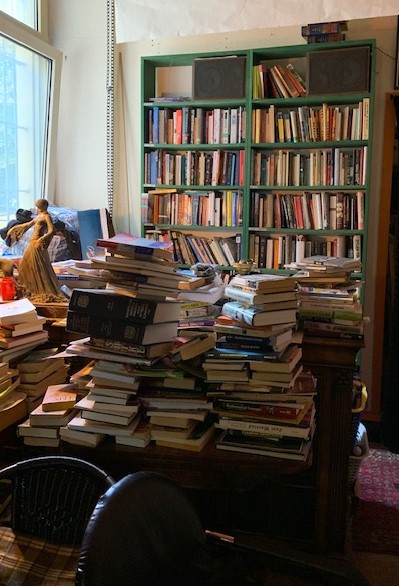
We are living in an era when it is easier than ever to justify purchasing lots of books: a.) the need to support your favorite bookstores b.) more time to read, and c.) more friends are talking about the books they are reading and making more suggestions. It is the perfect storm. Even the Book Shopper blog is experiencing an uptick in monthly traffic and believe me that is big (read: strange) news. Allow me to elaborate. You got the time, right?
A.) Supporting favorite bookstores
For me, I have a had long relationship with Carlos Museum Book Shop on campus of the Emory University here in Atlanta. They are closed temporarily but their store manager Mark Burell is curating lists of excellent books online. My partner Denise and I have been under Burell's influence for quite some time. It was browsing in this eclectic book shop in 2007, where I purchased Gabriel Zaid's So Many Books: Reading and Publishing in the Age of Abundance (2003) published by Paul Dry Books in Philadelphia. This eventually led to the publishing of this blog’s name sake The Book Shopper: A Life in Review in 2009. That’s quite a connection, eh?
 Another bookstore relationship over the years has been with Eighth Day Books in Wichita, Kansas. While on the “World Book Tour” of The Book Shopper, my longtime friend Bruce Woods introduced me to the passion of Eighth Day Books and its owner Warren Farha. Eighth Day carries classics in religion, philosophy, history and literature. They recently published a new catalog of their offerings, similar to the catalog I wrote about in the January 2012 posting “A Spiritual Education Made Easy”. I ordered a copy of E.F. Schumaker’s classic 1973, Small is Beautiful: Economics As If People Mattered, and The Portable Graham Greene (1994) edited by Philip Stratford (a suggestion from friend Jim Simpson) along with an extra copy of the catalog.
B.) More time to read
One of the better books I’ve read so far this year came via The Carlos Museum Bookshop online service is Gene Smith’s Sink: A Wide-Angle View (2017) by Sam Stephenson. Born in Wichita, Kansas in 1918, William Eugene Smith was a master photojournalist and became well known for his pictures of Pacific War and later the haunting image “Tomoko Uemura in Her Bath,” (1971) a shocking photo which appeared first appeared in Life Magazine and later in book that captured the effects of industrial mercury poisoning on the city of Minamata, Japan.
Sink is not a photography book and Smith’s photographs are tightly controlled but you can see many of them online at Magnum, where Smith worked with off and on until he died of a stroke in 1978.
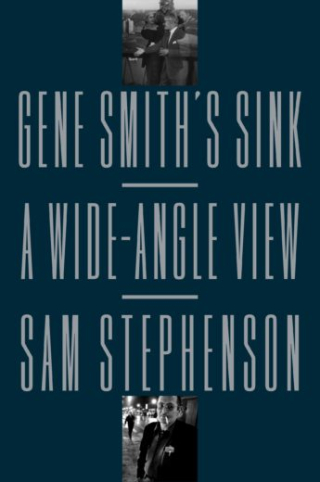 What makes Gene Smith’s Sink a great read is that the author Stephenson concentrates on the fascinating people (ex-wives, jazz musicians, and assistants) who revolved around the Smith universe. Stephenson traveled all over the world including Japan on his quest to talk to those who had first-hand knowledge of Smith’s photojournalist essays. Another aspect of Smith's life, which Stephenson dives into is the loft in New York City where Smith lived. The place was jammed full with photographs, prints and audio recordings of jazz musicians that frequented his apartment including Mose Allison, Thelonious Monk, Hall Overton and Sonny Clarke. I will admit I knew next-to-nothing about these artists, but after reading Sink, I expanded my personal audio playlists.
You can find this book and another great ones (like Cultural Amnesia by Clives James) at the Carlos Museum Bookshop be sure to click on the GREAT BOOKS FOR ADULTS link.
C.) More friend time equals more books suggestions
Part of my down time has been spent connecting with old friends more frequently. I am more of an old school telephone guy than a Zoom personality. If I opt for screen time, I fear friends may be disappointed that I don’t have an impressive bookcase* like PBS New Hour's Judy Woodruff. Or I may be revealing too much like PBS political commentator Amy Walters who had a Hamm's Beer Plaque on her bookshelf that she has since covered up. (See the posting Books in the Background.)
On these calls, in between gulps of Hamm's,** we ask each other what we are reading. This is a little dangerous because you can easily become intrigued about what they are reading. During the pandemic, the suggestions have been overwhelming. So much so that I added the page Suggested Readings as a link of the The Book Shopper flagship homepage to personally keep track of future books-to-read candidates.
I realize that I am doing this at the risk of being bombarded for online ads for the books that have appeared on my Suggested Readings Page? More possibilities in this endless spiral of hoarding ahead, I suspect.
* For the record, the avalanche of books in the photograph aboves comes from bookstore in Berlin not my study.
** I am making a joke here since Hamm's is no longer being brewed. In my youth, it was known as a Pabst Blue Ribbon class of lowbrow beer before PBR became "retro-chic." Also, it has a silly jingle that begins with "From the Land of Sky Blue Waters" and featuring a cartoon bear. This is what makes Hamm's beer sign stand out on the pundit Walters's book case.
Comments for Subscriber Ian – 6/9/20 – Thanks for putting me on to the Smith book. I have mixed feelings about it. The stories of jazz musicians he surrounded himself with are compelling, but I grew tired of the author’s travel narratives, particularly the semi-creepy trip to Japan with the teenage interpreter. I envisioned him growing ever more abusive because 1) she was smarter and more insightful than him, and 2) he couldn’t find a 24 oz. Budweiser or a car to drink it in.
—– EXTENDED BODY: —– EXCERPT: —– KEYWORDS: Carlos Museum Bookshop, Mark Burell, Warren Farha, Eighth Day Books, Eugene Smith, Gene Smith’s Sink, Hamm’s Beer, Amy Walters —– COMMENT: AUTHOR: Cal Gough EMAIL: calgough@bellsouth.net IP: 108.82.142.12 URL: http://calgough.wordpress.com DATE: 05/13/2020 10:23:40 AM Great blogpost! So glad you know about Eighth Day Books and their amazing catalog! Somehow one came unsolicited to me in the mail a few months ago, and after reading its great annotations and salivating about way too many books I decided I wanted to read, yesterday I scootered over to a friends house and gave her the catalog, as many of its recommendations are right up her alley also. (Do you remember, in days of yore, a wonderful outfit/catalog called THE COMMON READER? Gosh, how I miss that.) Also, thanks for creating the Suggested Readings section of your blog. Keep on a-coming with the blogposts! Cal —– ——– AUTHOR: Murray Browne AUTHOR EMAIL: murray.browne905@gmail.com TITLE: An Essay About the Blog STATUS: Publish ALLOW COMMENTS: 1 CONVERT BREAKS: wysiwyg ALLOW PINGS: 0 BASENAME: essay-about-the-blog UNIQUE URL: https://thebookshopper.typepad.com/the_book_shopper_atlantad/2020/04/essay-about-the-blog.html DATE: 04/30/2020 04:11:50 PM —– BODY:
The essay below appeared earlier this month in Everything Typepad, the e-newsletter for users of the platform application Typepad. It's kind of a brief blog history. The original posting appears at https://bit.ly/2VTCTu7.
Blog as Archive
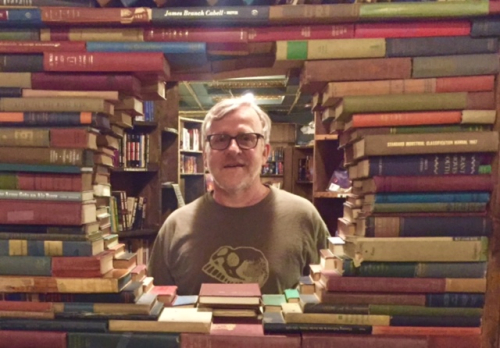
As one who has been blogging for over a decade, musing about books and book culture to a handful of readers, several beneficial aspects have emerged over the years. No, it’s not riches or fame, but I’ve discovered that personal blogging has provided me with a diary of what I have been reading and thinking about since 2008.
The blog has evolved over the years. It began as a promotional tool for my book of essays, The Book Shopper: A Life in Review published by Paul Dry Books in 2009. For a while I even kept a calendar of book activities and did some reportage of author events here in the Atlanta area where I live. I saw some good authors over the years, but then my interests shifted. I broadened my scope to the current musings format, which gives me more leeway to come up with various topics to write for my biweekly postings.
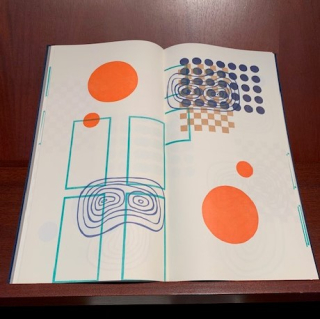 Some of the postings fall into categories like book reviews or bookstores, or some of my favorite subjects like baseball and military history. I also prefer to read older books and lesser-known titles. (Who needs another spin on a bestseller?) Other noteworthy categories are Books-as-Art-as-Books and the MARTA Book Club – a series of 34 postings where on my daily commute I logged the titles of books that people were reading while on the trains of the city’s Metropolitan Atlanta Rapid Transit Authority. (The book art at the right is called Book Chance by Andrew Huot. which appeared in "Book Art in Atlanta" on September 20, 2019)
Using the Typelist feature on Typead, I also keep a running list of what I have been reading throughout the year and display it on the sidebar. I have recently added a new page of “Suggested Readings” so I can keep track of what bookish friends have recommended. (If nothing else, the blog provides a handy jog to my memory, which I can access through my phone on a moment’s notice.)
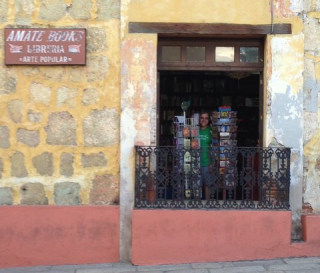
Because the blog has more of personal take on subjects instead an authoritative one, I have been able to combine events – such as vacations and trips – into postings and travelogues. For example, over the years I have visited bookstores in New York, Boston, Los Angeles, New Orleans, Oaxaca, Amsterdam, Nova Scotia, Prague, and the Greek isle of Santorini to name but a few. Accompanying on these excursions is my longtime partner Denise who is always willing to pose as a book browser or snap an “action” picture of me standing in front of a bookstore.
Blog subjects sometimes include other family members too. For example, I wrote about going with my younger daughter Bonnie to the Rickwood Baseball Classic in Birmingham, Alabama to honor the Willie Mays biography I was reading (Mays played for the Birmingham Black Barons in the Negro Leagues in 1948). When the Kansas City Royals played in the World Series in 2014, I wrote about the Kansas native, baseball writer Bill James, reminiscing about the time I lived in the Sunflower State. It included a photograph of my mother pushing my older daughter Cynthia in a swing wearing a toddler-sized George Brett uniform (a future Hall of Famer). Thoughts about my father have been included in numerous postings as well, particularly as I reflected on his service in World War II. All this flooded back to me after I chatted  briefly with historian Rick Atkinson, the author of The Day of Battle: The War in Sicily and Italy, 1943-1944 at a small reading at my local library.
While flipping through my 450+ musings, I noticed that I should be a little more diligent about assigning categories to these postings. This can go a long way to help me find specific things I wrote about. Moreover, it has made me more aware of how topics like certain writers or themes have reoccurred and how my thinking has evolved over the past decade. This digital “paper trail” is like a diary of sorts, but with the added challenge of making it interesting, since I know others are going to be reading it.
A final advantage of the blog archive is that once I’ve taken the time to record my thoughts and observations and add some photos and artwork, I will sometimes stumble upon new opportunities to send that link out to connect with others. An informal conversation or a serendipitous article I’ve come across online reminds me of something I’ve already thought and written about. A quick follow-up is a convenient cut-and -paste away.
While there are rarely riches and fame in blogging, connecting to friends, family members, subscribers, and even oneself can be reward enough.

—– EXTENDED BODY: —– EXCERPT: —– KEYWORDS: —– ——– AUTHOR: Murray Browne AUTHOR EMAIL: murray.browne905@gmail.com TITLE: Books in the Background STATUS: Publish ALLOW COMMENTS: 1 CONVERT BREAKS: wysiwyg ALLOW PINGS: 0 BASENAME: books-in-the-background UNIQUE URL: https://thebookshopper.typepad.com/the_book_shopper_atlantad/2020/04/books-in-the-background.html DATE: 04/14/2020 01:44:02 PM —– BODY:

One of book-related ways I entertain myself in this stay-at-home era is to take quick pix of journalists and experts fulfilling their news responsibilities from their "home studios." First of all, isn't it interesting that we as television viewers now accept grainy videos, bad lighting, up-the-nose angles, audio drops and the digital pixel-repaints that can make someone look as if they just emerged from a Walking Dead makeup trailer? But it's cool. We all understand.
I find myself looking at what the interviewee has selected for their backdrop: potted plants, books, framed awards and statuettes and lots of pictures of family members, which I believe are inversely proportional to the time spent with one's family. (I've observed in the past that those who have dozens of family pictures in their offices are unknowingly indicating that they have not been at home so much, and need photos to jog their memory. But that problem is solved now.)
As one would expect, I am more curious about the quantity and quality of books they have. A reflection on their souls. Did some of these pundits and reporters resort to being like those home decor designers who bring books in for "staging?" Were some of the men forced to hide their Henry Miller and Charles Bukowski collections? And don't try to pass some VCR tapes as library books. Sophisticated readers of The Book Shopper Blog know the difference between a 2004 video of Cold Mountain and its literary progenitor published in 1997.
Who Are These People? How Many Can You Name?
It's no mystery from this collage that I watch CNN and PBS, but I try to limit my news viewing to keep my sanity. And as you can see, part of the coping mechanism is looking at their books and how they are organized and whether they have been dusted in the last year or two. Fortunately for them, the video quality hides most of the titles and their housekeeping standards. Nevertheless, here's a scorecard:
Top (left to right) William Brangham, PBS correspondent; David Brooks New York Times columnist; Amy Walter, political columnist who had Team of Rivals (2005) by Doris Kearns Goodwin on her shelf.
Middle (l to r) Dr. William Shaffner, Infectious Diseases Professor at Vanderbilt and keeper of the ancient medical books; Dana Bash, CNN political correspondent; Dr. Carlos Del Rio, Emory School of Medicine.
Bottom (l to r) David Chalian, CNN political journalist; David Gregory, CNN political analyst and person whose hair color I most envy; Unknown. Yes, I don't know who this woman is, but she made the collage because she had Jonathan Franzen's Freedom (2010) and two Saul Bellow books on her shelf. Who does that?
Heather Cox Richardson
Also worth mentioning is political historian Heath Cox Richardson who has the history books to remove any doubt about the validity of her insights. She posts daily on Facebook @heathercoxricharson. (This screen shot is from her video lecture series.)
—– EXTENDED BODY: —– EXCERPT: —– KEYWORDS: PBS and CNN correspondents, Heather Cox Richardson, —– COMMENT: AUTHOR: Cal Gough EMAIL: calgough@bellsouth.net IP: 108.82.142.12 URL: http://calgough.wordpress.com DATE: 04/14/2020 04:02:05 PM Glad to see you’ve also discovered Heather Cox Richardson, and that you mentioned her in your post: maybe others who haven’t found her will now? —– COMMENT: AUTHOR: E Rose EMAIL: erose@bju.edu IP: 23.151.224.250 URL: DATE: 04/16/2020 01:35:29 PM When Tom Hanks hosted SNL the other night, he (or, rather, a costumed version of Hanks playing a member of the audience asking the Hanks the host a question) stood in front of a bookshelf with what appeared to be the entire multi-volume print edition of the Oxford English Dictionary! —– ——– AUTHOR: Murray Browne AUTHOR EMAIL: murray.browne905@gmail.com TITLE: Blog as Personal Archive STATUS: Publish ALLOW COMMENTS: 0 CONVERT BREAKS: wysiwyg ALLOW PINGS: 0 BASENAME: blog-as-personal-archive UNIQUE URL: https://thebookshopper.typepad.com/the_book_shopper_atlantad/blog-as-personal-archive.html DATE: 04/08/2020 12:09:21 PM —– BODY:
As one who has been blogging for over a decade, musing about books and book culture to a handful of readers, several beneficial aspects have emerged over the years. No, it’s not riches or fame, but I’ve discovered that personal blogging has provided me with a diary of what I have been reading and thinking about since 2008.
The blog has evolved over the years. It began as a promotional tool for my book of essays, The Book Shopper: A Life in Review published by Paul Dry Books in 2009. For a while I even kept a calendar of book activities and did some reportage of author events here in the Atlanta area where I live. I saw some good authors over the years, but then my interests shifted. I broadened my scope to the current musings format, which gives me more leeway to come up with various topics to write for my biweekly postings.
Some of the postings fall into categories like book reviews or bookstores, or some of my favorite subjects like baseball and military history. I also prefer to read older books and lesser-known titles. (Who needs another spin on a bestseller?) Other noteworthy categories are Books-as-Art-as-Books and the MARTA Book Club – a series of 34 postings where on my daily commute I logged the titles of books that people were reading while on the trains of the city’s Metropolitan Atlanta Rapid Transit Authority.
Using the Typelist feature on Typead, I also keep a running list of what I have been reading throughout the year and display it on the sidebar. I have recently added a new page of “Suggested Readings” so I can keep track of what bookish friends have recommended. (If nothing else, the blog provides a handy jog to my memory, which I can access through my phone on a moment’s notice.)
Because the blog has more of personal take on subjects instead an authoritative one, I have been able to combine events – such as vacations and trips – into postings and travelogues. For example, over the years I have visited bookstores in New York, Boston, Los Angeles, New Orleans, Oaxaca, Amsterdam, Nova Scotia, Prague, and the Greek isle of Santorini to name but a few. Accompanying on these excursions is my longtime partner Denise who is always willing to pose as a book browser or snap an “action” picture of me standing in front of a bookstore.
Blog subjects sometimes include other family members too. For example, I wrote about going with my younger daughter Bonnie to the Rickwood Baseball Classic in Birmingham, Alabama to honor the Willie Mays biography I was reading (Mays played for the Birmingham Black Barons in the Negro Leagues in 1948). When the Kansas City Royals played in the World Series in 2014, I wrote about the Kansas native, baseball writer Bill James, reminiscing about the time I lived in the Sunflower State. It included a photograph of my mother pushing my older daughter Cynthia in a swing wearing a toddler-sized George Brett uniform (a future Hall of Famer). Thoughts about my father have been included in numerous postings as well, particularly as I reflected on his service in World War II. All this flooded back to me after I chatted briefly with historian Rick Atkinson, the author of The Day of Battle: The War in Sicily and Italy, 1943-1944 at a small reading at my local library.
While flipping through my 450+ musings, I noticed that I should be a little more diligent about assigning categories to these postings. This can go a long way to help me find specific things I wrote about. Moreover, it has made me more aware of how topics like certain writers or themes have reoccurred and how my thinking has evolved over the past decade. This digital “paper trail” is like a diary of sorts, but with the added challenge of making it interesting, since I know others are going to be reading it.
A final advantage of the blog archive is that once I’ve taken the time to record my thoughts and observations and add some photos and artwork, I will sometimes stumble upon new opportunities to send that link out to connect with others. An informal conversation or a serendipitous article I’ve come across online reminds me of something I’ve already thought and written about. A quick follow-up is a convenient cut-and -paste away.
While there are rarely riches and fame in blogging, connecting to friends, family members, subscribers, and even oneself can be reward enough.
—– EXTENDED BODY: —– EXCERPT: —– KEYWORDS: —– ——– AUTHOR: Murray Browne AUTHOR EMAIL: murray.browne905@gmail.com TITLE: Suggested Readings STATUS: Publish ALLOW COMMENTS: 0 CONVERT BREAKS: wysiwyg ALLOW PINGS: 0 BASENAME: suggested-readings UNIQUE URL: https://thebookshopper.typepad.com/the_book_shopper_atlantad/suggested-readings.html DATE: 03/21/2020 05:02:22 PM —– BODY:
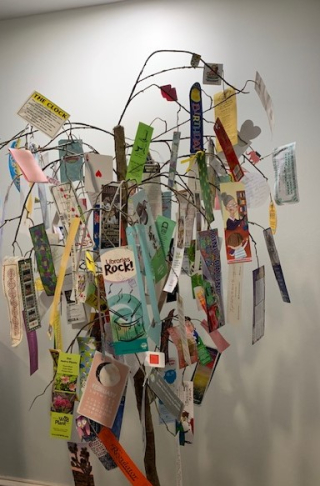 These are books that have been recommended to me lately and a few of them that I have stumbled on serendipitously. Either way I will need to grow more bookmarks. A simple strikethrough means the book was purchased.
Age of Anger by Pankaj Mishra (via Bruce Woods) Read
From the Ruins of Empire by Pankaj Mishra (via Bruce)
Games Without Rules: The Oft Interrupted History of Afghanistan by Tamin Ansary (via Bruce)
Global Crisis: War, Climate Change, and Catastrophe in the 17th Century by Geoffrey Parker (via Bruce)
The East was Read by Vijay Prahsad look for Georgetown Speech (via Bruce)
The Rise of Totalitarianism by Hannah Arendt (via Bruce)
Grand Union by Zadie Smith (NY Times BR) Read It Too!
Interior Chinatown: A Novel by Charles Yu (NY Times BR)
The Emigrants by W.G. Sebald Read
Churchill & Orwell: A Fight For Freedom by Thomas Ricks (Francis Walker)
The Noir Forties: From Victory to the Cold War by Richard Lingeman (Dave Dintenfass)
The Ministry of Fear by Graham Greene (via Jim Simpson) Read It Too!
Killing for Coal: America’s Deadliest Labor War by Thomas J. Andrews (Dr. Cynthia Browne)
A Pitcher’s Story: Innings with David Cone by Roger Angell (Tom Bowen)
Baseball When the Grass Was Real by Donald Honig (Tom Bowen)
New York in the Fifties by Dan Wakefield (Leonard Dintenfass)
Deacon King Kong or The Good Lord Bird by James McBride (NY Times BR)
The Secret Lives of Bab Segi’s Wives by Lola Shonyin (C.N. Adichie, NY Times BR)
Embracing Defeat: Japan in the Wake of World War II by John Dower (Francis Walker)
The Geography of Genius: Lessons from the World’s Most Creative Places by Eric Weiner (Francis Walker)
Self-Portrait in Black and White by Thomas Chatterton Williams (met him virtually through the blog).
Nothing Ever Dies: Vietnam and the Memory of War by Viet Thanh Nguyen (Maggie Carini) Read it, blogged about it!
The Bear Went Over the Mountain: Finding America, Finding Myself (borrowed from Eric Easley) Read it, I guess I should return it.
Seasons in Hell by Mike Shropshire (borrowed from Eric Easley) – read!
Black No More by George S. Schuler (a satire recommended by Isabell Wilkerson in NY Times) – read and blogged about it!
Ripples of Battle by Victor Davis Hanson (recommended by Francis Walker) Read it!
National Geographic Atlas of the World $215 (NY Times BR)
Atlas of Geographic Wonders from Mountain Top by Princeton Archeological Press
In the Distance (2017) by Herman Diaz (recommended by Rachel Leach)
Private Means (2020) by Cree LaFavour (recommended by Bill Gwin)
Every Morning the Way Home Gets Longer and Longer (2016) by Frederik Backman (novella recommended by Bill Gwin)
The Ministry for the Future: A Novel (2020) by Kim Stanley Robinson (recommended Eric Morales-Franceschini of ToM) – read it and blogged about it.
The Saddest Words: William Faulkner’s Civil War by Michael Gorra (2020) – read and blogged about it.
Vineland Reread by Peter Coviello (NYBR) in house
A Place of Everything: The Curious History of Alphabetical Order by Judith Flanders. (NYBR) (in house for Desty)
Girl, Woman, Other by Bernadine Evaristo — West Indian women in Britain, recommended by Denise
Fallen Idols by Alex Von Tunzelman. (NYTBR) – The controversy over statues and how we commemorate
Blood and Ruins: The Great Imperial War 1931-1945 by Richard Overy. Fueled by imperial fantasies, the second world war sounded the death knell of the colonial era.
Aftermath: Life in the Fallout of the Third Reich, 1945-1955 by Harold Jahner (NYTBR)
Exit Zero Family and Class in Post Industrial Chicago by Christine Walley. (Cynthia) Examination of one’s family.
Red and Black by Stendhal (new translation from University of Minnesota Press.) Available in June 2022. (in house GRSG)
Indigo: Essays by Padgett Powell
The Trials of Harry S. Truman by Jeffery Frank
Wonderlands Essays – Charles Baxter – got it
Rickey: THe Life and Legend of an American Original – Howard Bryant
Little Caesar – W.R. Burnett. Crime Novels of the 30s, 40s and 50s. – Dave Dintenfass
Affinities: On Art and Fascination (Essays) by Brian Dillion
In the Steps of Mr. Kurtz by Michaela Wrong A ‘humorous book about the Congo” The Economist
Directions of Myself by Heide Julavits
For Destination Books
Arctic Dreams, and or Horizon by Barry Lopez ( a travel and environment component) (In house)
Encounters with the Archdruid and Annals of the Former World, John McPhee (the latter Annals is 700 pages, so probably not)
The Forest Unseen, David George Haskill – he was in the booth in August, 2021
Lab Girl by Hope Jahren
Inconspicuous Consumption: The Environmental Impact You Don’t Know You Have by Tatiana Schlossberg – Read in house
Weather for Dummies – Bill Gates recommended it
Square Foot Gardening – Mel Bartholomew (in house)
Square Foot Gardening for Kids – Mel Bartholomew (in house)
The Earth Moved on the Remarkable Achievements for Earth Worms by Amy Stewart Read Great! Blogged about it.
The New Climate War by Michael Mann
Animal, Vegetable, Junk by Mark Bittman
Shoddy: From Devil’s Dust to the Renaissance of Rags by Hanna Rose Shell (Cynthia) Check out University of Chicago Press (in house and sold at Farmer’s Market)
Hide and Seek: Camouflage, Photography, and Media of Renaissance by Hanna Rose Shell (Cynthia)
The Forbidden Garden, Simon Barkin The Leningrad Seed Bank
Blood Test: A Comedy by Charles Baxter
The Miraculous From the Material: Understanding the Wonders of Nature by Alan Lightman –Maybe?
The Social Lives of Birds: Flocks, Communes and Families by Joan Strassman Tarcher Press out Sept 23, 2025
Life After Cars: Freeing Ourselves from the Tyranny of the Automobile by Sarah Goodyear et. al Thesis Press – out October 21st
The Long Heat: Climate Politics When It’s Too Late: Andreas Malm and Wim Carton Verso Press – Out October 7th
50 Plants That Changed the World Stephen Harris from Francis and Publishers Weekly.
—– EXTENDED BODY: —– EXCERPT: —– KEYWORDS: —– ——– AUTHOR: Murray Browne AUTHOR EMAIL: murray.browne905@gmail.com TITLE: Viral Re-reading STATUS: Publish ALLOW COMMENTS: 1 CONVERT BREAKS: wysiwyg ALLOW PINGS: 0 BASENAME: viral-re-reading CATEGORY: Book Reviews UNIQUE URL: https://thebookshopper.typepad.com/the_book_shopper_atlantad/2020/03/viral-re-reading.html DATE: 03/19/2020 11:48:41 AM —– BODY:
 Recent events have dictated my current reading choices, but I suppose on some level all reading choices are based directly or indirectly on the internal and external factors in one’s life. But my decision to re-read Albert Camus’s 1948 novel, The Plague has been a little more obvious than usual. I probably read the book 25 or 30 years ago. My Knopf hardback copy was printed in 1958 and there are markings and underlines throughout the book, which is a practice I have long discontinued, but thankful in this instance because it is easier to locate some of my favorite quotes, which I still remember in part. As this blog is my witness, I’ve been a Camus reader ever since*.
Born in Algeria in 1913, Camus was raised by a deaf mother and a grandmother**. His father died in 1914 in World War I at the Battle of the Marne and his childhood is described in detail in Camus’s autobiography The First Man which was published posthumously in 1995, thirty-five years after the author’s death in an automobile accident. The Nobel Prize winning Camus spent much of his adult life in France but traveled back to Algeria for extended periods of time.
Set in the Algerian port city of Oran in the 1940s, the plot of The Plague is simple. It begins with one of the main characters Dr. Rieux, a local physician stepping on a dead rat in his building stairwell. Within a matter of days, rats start to die by the thousands in the streets and alleyways from an infestation of bubonic plague that is transmitted by fleas. As the rats die, the fleas move to human hosts. The authorities are reluctant to refer to it as the plague at first (sound familiar), but soon all travel in and out of Oran is blocked and the 200,000 residents are on their own. Medical facilities and treatments are quickly overwhelmed. An exhausted Dr. Rieux carries on relying on indifference to survive. Camus enlists other characters who interact with Dr. Rieux to tell the story: Grand, a city clerk-statistician and an over-meticulous writer (“Evenings, whole weeks, spent on one word, just think! Sometimes on a mere conjunction.”), Rambert a journalist who is separated in Oran away from his wife in Paris, and the saintly Tarrou who arrives in Oran before the plague and becomes a dedicated relief worker doing whatever he can out of a sense of duty.
Is This the Kind of Book I Really Should Be Rereading Now?
Despite its despairing themes, the book has a few comforting aspects. Camus gives almost poetic accounts of the shifting mind sets of the city and its inhabitants. One example is one of the quotes I remember from decades ago comes from the opportunist Cottard, who early in the novel is prevented from killing himself but later finds temporary peace of mind in the chaos. “Well, let’s put it like this, “says Cottard, "I’ve been feeling much more at ease here since the plague settled in.”
Perhaps an odd thing to admit, but even today outside on my busy street, traffic has slowed considerably. It’s rather pleasant. My partner Denise and I are practicing social distancing – we wisely postponed a trip to Arizona and the West Coast earlier this month. She is working on some new sewing creations and I have been catching up on my gardening and writing lengthy blog posts. This slower than usual pace is a change – even for us retirees, but re-reading Camus gives me some direction. “Thus, each of us had to be content to live only for the day, alone under the vast indifference of the sky,” he writes.
Baseball Bedtime Stories
One of things I miss is baseball. Each winter, I read a lengthy baseball book and this off season I finished Volume 1 of Norman Macht’s biography of Connie Mack. Mack was the owner and manager of the Philadelphia Athletics for a half a century – holding records for both the most games won and most games lost. Macht uses the prism of Mack’s life in baseball as an entry to the sport between the time periods of just before the turn of the century path through 1914. Macht gives accounts of key games and a host of Athletics players with fantastic names and the personalities to match:
Ralph Orlando “Socks” Seybold
John Phalen “Stuffy” McInnis (that’s the stuff kid)
Charles Allen “Chief” Bender (Hall of Famer)
George Edward “Rube” Waddell (Hall of Famer)
Osee Schrecongost (Waddell's personal catcher and fellow hellion) – nicknamed Schreck
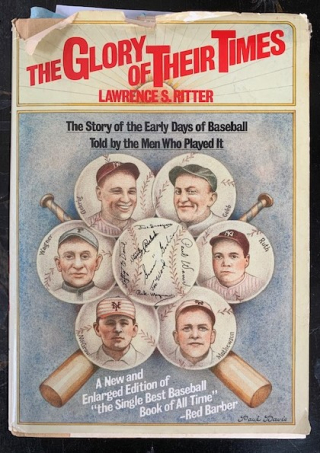 In order to sleep and not get too overworked about current events and while quenching my longing for baseball, I have turned to re-reading stories from Lawrence Ritter’s The Glory of the Times: The Story of the Early Days of Baseball Told by the Men Who Played It (1984), which is on most lists of best baseball books of all time. Here’s a humorous anecdote from Babe Herman who played for the Brooklyn Dodgers in the 1920s. Herman tells the story about his manager William Robinson who affectionally known as Uncle Robbie takes us out on a lighter note:
Oh before I forget, there's one more story I've got to tell you about Uncle Robbie. It's about the time he agreed to catch a baseball dropped from an airplane as a publicity stunt. See, Gabby Street had just caught a baseball dropped from the top of the Washington Monument. So they were going to try to top that in Florida, in spring training, by having someone catch a baseball dropped from an airplane flying over the ball park. With some reluctance, Robbie agreed to put on a mask and chest protector and be the hero of the hour. Heck, anything Gabby Street could do Robbie figured the catcher of the old Baltimore Orioles could do even better.
The first two times the plane flew over the ball park, Dan Comerford the clubhouse man, dropped a baseball and both times he completely missed the field. The ball didn't come with half a mile of the ball park. Unfortunately, Dan had taken only two baseballs up with him, so he either had to come back down and get more or forget the whole thing. However, while he was trying to decide what to do, he noticed a sack of Florida grapefruit in the plane. In the early days of Florida, everybody had a sack of grapefruit. So the pilot circled around and made another approach, only this time Dan dropped a grapefruit instead of a baseball!
Well, down in the ball park, out near second base, Robbie is also circling around, getting a bead on this thing as it falls. As far as he knows–as far as anybody besides Dan knows–it's a baseball that's falling, not a grapefruit, and Robbie is determined to catch it.
"Get away, get away," Robbie yells "I got it, I got it." And then squash, it smacks right into Robbie's mitt and literally explodes, juice and pulp splashing into Robbie's face and all over him. The force of the thing was so great that it knocked Robbie down, and all he knew was that he had all this liquid and stuff all over him.
"Help, help," he shouted, "I'm bleeding to death. Help me!"
Some players called him "Grapefruit" forever after. It was a nickname he never lost.
Footnotes
* Last year I wrote a long essay about Alastair Horne’s A Savage War for Peace: Algeria 1954-1962 for the Tropics of Meta which includes Albert Camus vain attempt the reconcile the warring factions in bloody war of Algerian independence.
 A short shout for a paperback copy of Camus The Stranger in 2018.
A mention of the Henri Cartier-Bresson photography exhibit at the High Museum featuring photos of Camus in 2011.
As you can see Camus is no stranger to the blog.
** In Camus’s autobiography, The First Man (1995) he describes his childhood of poverty in which he was raised primarily by his grandmother. In one account Camus admits that he stole a nickel from his grandmother so he could attend a soccer match and when his grandmother confronted him about it, he lied that the nickel dropped into the family latrine. The family was so poor that his grandmother pulled up her sleeve and reached into toilet to search for the coin. I also recall how a schoolteacher of Camus’s, recognizing the boy’s talent, persuaded his grandmother that young Albert should continue his education instead of going to work – as was expected considering their dire economic condition. This teacher, this moment, changed the trajectory of Camus’s life.
—– EXTENDED BODY: —– EXCERPT: —– KEYWORDS: Albert Camus, The Plague, Norman Macht, Connie Mack, The First Man, Babe Herman, Lawrence Ritter, The Glory of Their Times, —– ——– AUTHOR: Murray Browne AUTHOR EMAIL: murray.browne905@gmail.com TITLE: My Destination: Professional Book Shopping STATUS: Publish ALLOW COMMENTS: 1 CONVERT BREAKS: wysiwyg ALLOW PINGS: 0 BASENAME: my-destination-professional-book-shopping UNIQUE URL: https://thebookshopper.typepad.com/the_book_shopper_atlantad/2020/03/my-destination-professional-book-shopping.html DATE: 03/05/2020 02:39:39 PM —– BODY: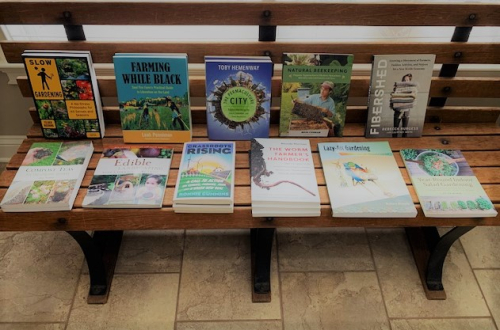
For the last few weeks I have been shifting from book shopper to book seller and Saturday, March 7th and Saturday, April 4th I will be setting up Destination: Books, a popup book stall at the Freedom Farmer’s Market at the Carter Center here in Atlanta. Destination: Books will be carrying about a dozen titles on organic farming and sustainability from Chelsea Green Publishing in Vermont, which I have selected for the booth, which I guess still makes me a book shopper. Here’s a sampler of some of those titles:
 The Worm Farmer’s Handbook: Mid-to Large-Scale Vermicomposting (2018) for Farms, Businesses, Municipalities, Schools and Institutions by Rhonda Sherman. I have been doing vermicomposting for about 5 years and you don’t have to have much more than a tub, selected food scraps and some worms to set something up. This book is written for vermi-culturists who are thinking of a bigger operation, but it has plenty of useful information for the “gentleman” worm rancher as well.
 Farming While Black: Soul Fire Farm’s Practical to Liberation on the Land (2018) by Leah Penniman. I can trace an interview with Leah Penniman in July, 2019 issue of Sun Magazine to this idea of Destination: Books at the Freedom Farmer’s Market. First, I read the interview. Then I checked out the library’s copy and thought Farming While Black was a rare blend of black history, activism, practical advice for those interested in community gardening and tips on just growing better fruits and vegetables. It inspired me to contact Chelsea Green to carry some of their books and here I am.
 Edible Landscaping with a Permaculture Twist (2013) by Michael Judd. This full-color illustrated book is almost like a wish-idea catalog of projects that can replace your lawn with something edible or practical. Why not build an earthen oven for your backyard pizza parties? Why not give up some of your lawn mowing?
Used Books Too
I will have some related titles on the environment and transportation books at the booth too, including Edward Humes’s Door to Door: The Magnificent Maddening World of Transportation (2016), David Owen’s Green Metropolis: Why Living Smaller, Living Closer, and Driving Less are the Keys to Sustainability (2009) and Peter Gorman’s Barely Maps (2019). Anyone who has read Hume’s book knows how interconnected the United States is to factories in China, so when container ship traffic at Long Beach and the Port of Los Angeles harbor terminals begins to decrease dramatically, due to COVID-19 you know that there will be changes afoot. China exports everything from clothes to furniture to auto parts to electronics including the iPhone.*
The Humes book makes a case on why it is important to keep things local, and ideas from Destination: Books can help you do it.
* In the opening chapter of his book, Howe traces a laundry list of components in the iPhone that must travel from all over the world Germany, Kentucky, California, Massachusetts, the Netherlands, Taiwan and Korea to China to be assembled and then shipped back to markets all over the world. When you factor in all the mileage to get the components to China it comes out to approximately 165,000 miles. If you factor in the raw materials being mined and shipped to these component manufacturers the distance traveled is close to 237,000 miles which is close to the distance to the Moon.
—– EXTENDED BODY: —– EXCERPT: —– KEYWORDS: Book Popups Atlanta, Freedom Farmer’s Market, Worm Farmer, Vermicomposting, books for sale, Leah Penniman, Edible Landscaping, Edward Humes, Door to Door —– ——– AUTHOR: Murray Browne AUTHOR EMAIL: murray.browne905@gmail.com TITLE: Book Cleanup STATUS: Publish ALLOW COMMENTS: 1 CONVERT BREAKS: wysiwyg ALLOW PINGS: 0 BASENAME: book-cleanup UNIQUE URL: https://thebookshopper.typepad.com/the_book_shopper_atlantad/2020/02/book-cleanup.html DATE: 02/16/2020 09:19:32 AM —– BODY:
"Many fates befall books other than being read and treasured" – Richard Ford, Independence Day
This quote came to mind when I saw several books soaking in the creek at the park near my house. The creek bank was steep and I wished I had an older version of my mud-loving grandson around (seen below, equipped with his wellies) who might fetch them out in my behalf. But I was only one around on that gray, soggy day. I had to go home first to retrieve a walking stick and a garbage bag because I didn't think the waterlogged copies of Who Let the Gods Out by Max Evans, The Complete Hitchhiker's Guide to the Galaxy by Douglas Adams, The Line Tender by Kate Allen and a John Sandford detective thriller would be salvageable.
This was no small task without a proper net and carrying the heavy, wet books up a muddy slope was a challenge too. As I hauled them out to the nearby trash can, I muttered to myself, "If someone wants to get rid of their books, why don't they just burn them."
My final takeaway: Never underestimate what a blogger will do for something to write about.
—– EXTENDED BODY: —– EXCERPT: —– KEYWORDS: Recycling books, Richard Ford quote, —– ——– AUTHOR: Murray Browne AUTHOR EMAIL: murray.browne905@gmail.com TITLE: Bookmark Findings STATUS: Publish ALLOW COMMENTS: 1 CONVERT BREAKS: wysiwyg ALLOW PINGS: 0 BASENAME: bookmark-findings CATEGORY: Book Reviews CATEGORY: Books as Art as Books UNIQUE URL: https://thebookshopper.typepad.com/the_book_shopper_atlantad/2020/02/bookmark-findings.html DATE: 02/02/2020 08:09:48 AM —– BODY:
 Are you one of those people can’t seem to get rid of a bookmark – as if it were some significant memento of a reading or bookstore experience? Maybe the only time you get rid of a bookmark is when you lose it. For those who may have lost their bookmark during a visit to the Decatur Library, do not despair. Your bookmark has been repurposed as art by Joanna Young of Decatur who made this installation (with help from the Decatur Library Staff) from bookmarks found in the stacks. Closer examination of the tree reveals that people are a loosey-goosey when it comes to what qualifies as a bookmark. It can be simply, anything capable of marking your place in a book – whether that be a playing card, a bookstore advertisement or a bookmark promoting reading. Anything is better than dog-earring a page to mark your reading spot.
I too, have trouble tossing a nice bookmark though I am at a loss to try to come up with something creative (a bookmark wreath?) like Ms. Young. Check out these rarities from my collection of bookmarks that clutter my desk.  *
*
Over the past few years, I have changed my bookmark habits by enlisting postcards to use as bookmarks. I like using the back of postcards to make notes or pulling quotes as I read instead of making pen marks or worse, using yellow highlighter. I usually add the page number too. After I finish the book, I stick the postcard inside the book and leave it as a short index for future reference. Later, if I am listing the book for sale at my Destination: Books Alibris Site or donating it to the Decatur Friends of the Library (Next book sale at the Library is February 8th) I remove the postcard at put it in index card sized box.
Besides as a good excuse to buy an additional postcard or two while traveling or putting one of those postcards from a trendy restaurants to good use, the postcard makes a good bookmark because it is made from more durable card stock that holds your reading progress firmly between the pages. If I am really on my game, I will select a postcard that thematically fits with the book that is has been paired with.
Postcards for Viet Thanh Nguyen
A recent example is the large sized postcard (a gift from younger daughter Bonnie when she visited Southeast Asia) I use with the works of Viet Thanh Nguyen. I recently finished The Refugees (2017), a collection of eight short stories. The stories are linked because the main characters have some connection to Vietnam – most of whom came by boat to the United States after the Fall of Saigon in 1975 (as did Nguyen and his parents). Whether it’s a former military commander who insists taking charge of his son’s marital life, a Vietnam war vet visiting his daughter who teaches in the Vietnamese countryside, or a woman dealing with the dementia of her older husband of an arranged marriage, Nguyen’s refugees not only struggle with daily problems but their lives are further complicated with their conflicted feelings about their homeland. The poignancy and matter-of-fact clarity in which Nguyen tells these tales adds my admiration of his work.
To capture these notes, I enlisted the aid of a large postcard just as I had done when I read Nguyen’s excellent novel The Sympathizer (2016). The Sympathizer has many of the same themes of The Refugees except the narrator has a sense of satirical humor (including a takedown of Francis Ford Coppola’s film Apocalypse Now) deftly mixed with intense graphic passages that will terrify you. I can’t remember who I gave my copy of The Sympathizer to, but at least I still have my notes or should I say a bookmark to remember it by.
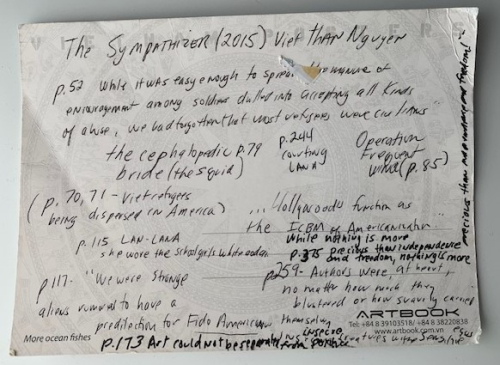
* Bookmarks Annotated. The Borges quote comes from the American Book Center in Amsterdam, The Netherlands (circa 2014), The Watermark Bookstore in Wichita, Kansas (circa early 1980s), which included quotes like "You know how it is in the kid's book world. It's just bunny eat bunny. " and Raven Used Books in Cambridge, Massachusetts (circa early 21st century).
—– EXTENDED BODY: —– EXCERPT: —– KEYWORDS: Bookmarks, Viet Thanh Nguyen, The Sympathizer, The Refugees, bookmark art —– COMMENT: AUTHOR: Cal Gough EMAIL: calgough@bellsouth.net IP: 108.82.142.12 URL: http://atlantareader.wordpress.com DATE: 02/06/2020 10:56:31 AM One of the best things I ever did to support my reading habits was to commandeer a silver, wide-mouthed vase to keep beside the table next to my favorite reading spot – I keep it full of bookmarks instead of flowers. Many of these bookmarks are recycled cutouts from calendars, plus the few that I’ve bought at bookstores (because they were too beautiful to resist) or that were given to me. Like you, however, I will sometimes use postcards – I have zillions of them, and they are, like you say, ideal for bookmarks. (If I could find a way to display them like the skinny bookmarks, I’d prorably replace my current stash of skinnies with a stash of postcards.) —– COMMENT: AUTHOR: Murray Browne EMAIL: IP: 76.20.249.225 URL: https://profile.typepad.com/1227802374s31410 DATE: 02/06/2020 02:29:58 PM Excellent idea about the vase, Cal. It’s a challenge to toss out a serviceable bookmark. Do you weed your home library? —– ——– AUTHOR: Murray Browne AUTHOR EMAIL: murray.browne905@gmail.com TITLE: Books Read in 2019 STATUS: Publish ALLOW COMMENTS: 0 CONVERT BREAKS: wysiwyg ALLOW PINGS: 0 BASENAME: books-read-in-2019 UNIQUE URL: https://thebookshopper.typepad.com/the_book_shopper_atlantad/books-read-in-2019.html DATE: 01/30/2020 07:39:56 AM —– BODY: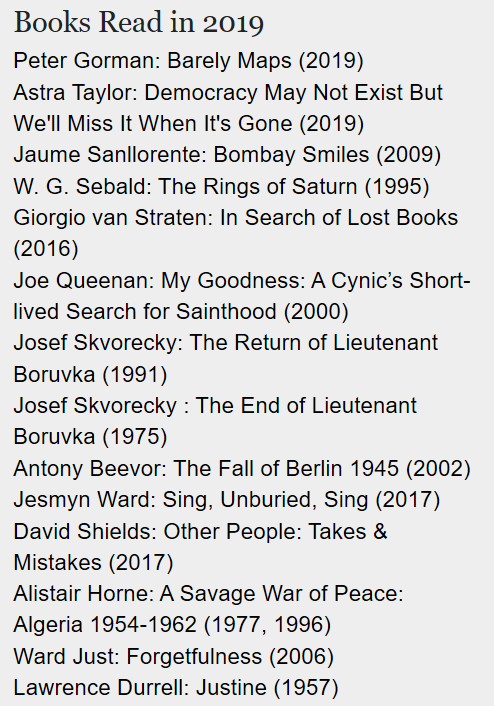
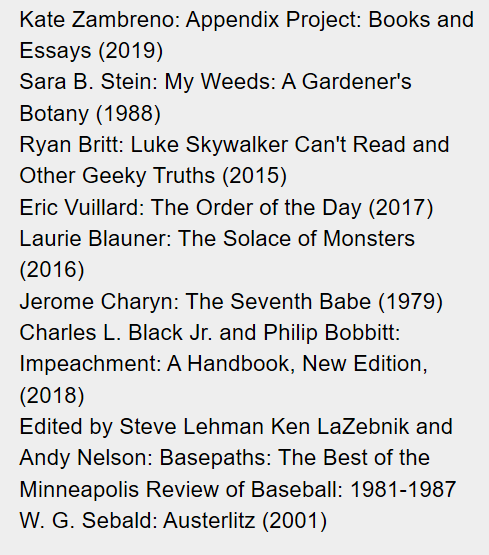
—– EXTENDED BODY: —– EXCERPT: —– KEYWORDS: —– ——– AUTHOR: Murray Browne AUTHOR EMAIL: murray.browne905@gmail.com TITLE: Hot Stove League Intensifies STATUS: Publish ALLOW COMMENTS: 1 CONVERT BREAKS: wysiwyg ALLOW PINGS: 0 BASENAME: -hot-stove-league-intensifies CATEGORY: Baseball UNIQUE URL: https://thebookshopper.typepad.com/the_book_shopper_atlantad/2020/01/-hot-stove-league-intensifies.html DATE: 01/20/2020 08:42:41 AM —– BODY:
 Usually Major League Baseball’s hot stove league is reserved for a few stories about free agents signings and time to catch up on baseball books to pass the time until Opening Day. This year there is no winter snoozing with the Houston Astros and Boston Red Sox scandals about using technology to steal signs pushing baseball to the front page headlines. Three managers have been terminated, and one general manager Houston's Jeff Luhnow was also fired. It makes off my season anxiety concerning the fate of my adopted baseball son, Chicago Cub third baseman Kris Bryant seem trite. (I will always remember Kris' smile just before the final out of the 2016 World Series.)
Coincidently, this scandal mushroomed while I was catching up on my backlog of magazine reading which included baseball. In the July, 2019 issue of Atlantic magazine, Jack Hamilton wrote a review and thought piece on Ben Lindbergh and Travis Sawchik’s book The MVP Machine: How Baseball’s New Nonconformist’s Are Using Data to Build Better Players (2019). The entire piece is available here, but two paragraphs really resonated. One concerns the general atmosphere on the Houston ball club.
I certainly don’t want to be in the position defending millionaire ballplayers, but perhaps the underlying core motivation of stealing signs via technology ( similar to using Performance Enhancing Drugs) is self-preservation — keeping your job. The sentence about how Luhnow fostered a toxic atmosphere of winning at all costs makes me wonder whether pressure from management factored in the complicity of Houston players using technology to steal signs. In the following paragraph Hamilton suggests that one of the trends in professional baseball is that top players can be created from cheaper average players. That notion doesn’t bode well for the star players.
Another coincidence cropped up while I was reading my annual hot stove baseball book, Volume 1 of Norman Macht’s biography, Connie Mack and the Early Years of Baseball. As the owner and manager of the Philadelphia Athletics for a half a century, Mack (real name Cornelius McGillicuddy) the man with the most victories (and the most defeats) in baseball history also had visions of developing perfect ball players. In 1901, while Mack was forming the new American League, he had the hopes of prying a young promising pitcher from the National League – future Hall of Famer Christy Matthewson. Macht writes, “Mack saw this new beginning as an opportunity to fulfill his dream of taking young, intelligent athletes and teaching them, molding them into a perfect baseball machine.”
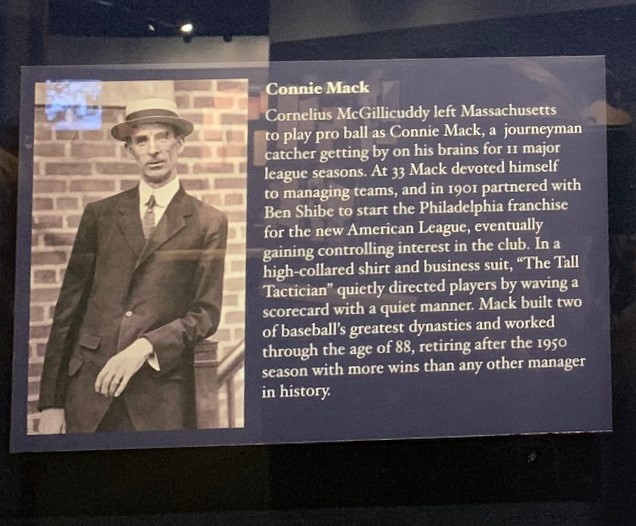
—– EXTENDED BODY: —– EXCERPT: —– KEYWORDS: Kris Bryant, smile, Connie Mack, Sign stealing, Jack Hamilton, book review, Atlantic Magazine, Ben Lindbergh, Travis Sawchik’s, The MVP Machine: How Baseball’s New Nonconformist’s Are Using Data to Build Better Players, Norman Macht, —– ——– AUTHOR: Murray Browne AUTHOR EMAIL: murray.browne905@gmail.com TITLE: Barely Maps: A Cyclist’s Sojourn STATUS: Publish ALLOW COMMENTS: 1 CONVERT BREAKS: wysiwyg ALLOW PINGS: 0 BASENAME: barely-maps-a-bikers-sojourn CATEGORY: Book Reviews CATEGORY: Books as Art as Books CATEGORY: Maps I Love UNIQUE URL: https://thebookshopper.typepad.com/the_book_shopper_atlantad/2020/01/barely-maps-a-bikers-sojourn.html DATE: 01/06/2020 08:08:34 AM —– BODY:
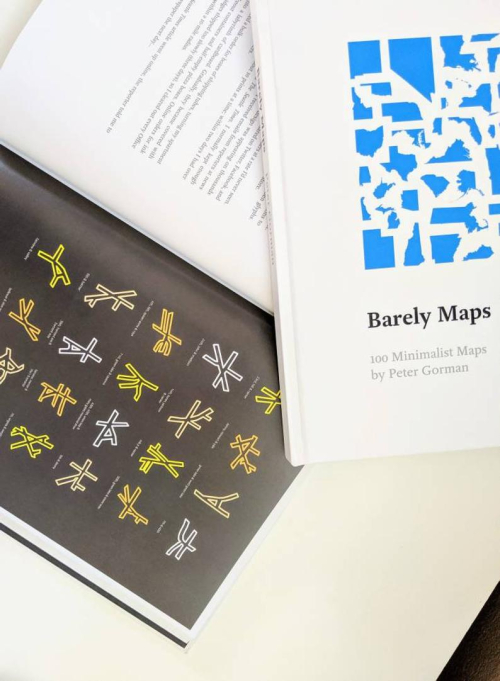
On my companion blog Down & Outbound, I posted a note last fall about my contribution to a Kickstarter project entitled Barely Maps. The project is a personal account of cyclist and graphic designer Peter Gorman's 11,000 mile bike trip across the United States and southern Canada. A signed copy of Barely Maps 100 Minimalist Maps arrived at my door after Christmas including a personal thank you note for being an investor.
The book is gorgeously printed like an artbook with dozens of illustrations including a set of Intersections, where Gorman outlines the quirky, weird intersections of select U.S. cities. Even though Intersections is a popular aspect of Gorman's work (single city posters are available at barelymaps.com) the book is much more. Writes Gorman, "It seemed important to make sense of the trip and what it was all about. I thought it would help to create something, so I opened a blank white page on my computer and started drawing." The result is a series of illustrated memoir-vignettes about his travels and his life before and after the trip.

Gorman's transcontinental bike trip dominates the first section of the book (Maps numbering #1 to #25) . Gorman writes only briefly about the places he visits, preferring to rely on "maps" or more illustrative representations of places (The Great Lakes, Savannah, the Pacific Coast Highway). Some of his efforts work better for me than others. but I will admit, I was hoping something similar to Edward Tufte's The Visual Display of Quantitative Information (1983). My misguided expectation that everything should match Charles Joseph Minard's "Napoleon's March to Moscow" falls on me. Once I put that aside, I could appreciate Gorman's creativity much more.
Part 2 is Intersections which covers 25 maps of intersections of major cities (Maps #26 to #50 although you have to figure that out for yourself). But based on his depiction of Atlanta I appreciate that all metropolises have street oddities that we view with both pride and loathing. One possible shortcoming is whether the reader will care about the petroglyph-like intersections from other cities.
The final two sections of the book Part 3 After (maps #51 to #75) and Part 4 Before (maps #76 to #100) Gorman concentrates on the aftermath of his trip where he spent considerable time in Seattle (#51 to #64). About 80% of the maps in the Before section are dedicated to Gorman's childhood in upstate New York — his early memories of spinning globes in the classroom and riding his bike on his paper route in Syracuse. Included with these illustrations are short paragraphs explaining the significance of how maps have always been an integral part of his life.
Because the last two sections are heavily Seattle and Syracuse centric, they don't work as well as the first section (unless you hail from those two cities). Nonetheless as one who designed and wrote his own book out of an obsession (Down & Outbound: A Mass Transit Satire ) I understand Gorman's need to create and illustrate the book his way.
I will enjoy showing this interesting, quirky book to people at my next Destination: Books popup and I know Gorman is planning another creative endeavor in March of 2020 called Blue Atlas. Long may he ride.
—– EXTENDED BODY: —– EXCERPT: —– KEYWORDS: Barely Maps, Intersections, Peter Gorman, bicycle riding —– ——– AUTHOR: Murray Browne AUTHOR EMAIL: murray.browne905@gmail.com TITLE: Best Books Read 2019 STATUS: Publish ALLOW COMMENTS: 1 CONVERT BREAKS: wysiwyg ALLOW PINGS: 0 BASENAME: best-books-read-2019 CATEGORY: Best Books Read 2017-2023 UNIQUE URL: https://thebookshopper.typepad.com/the_book_shopper_atlantad/2019/12/best-books-read-2019.html DATE: 12/15/2019 11:57:28 AM —– BODY:
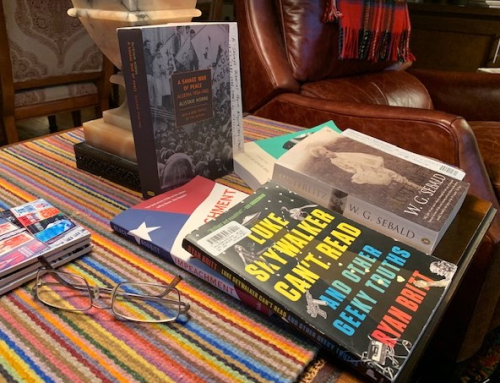
Instead of focusing on the best books published in 2019, my tradition has been to revisit the books I read in 2019 and ruminate about them to see if any theme emerges, no matter if it’s a stretch. A complete list of what has been read is on the sidebar of the homepage. I know its not that many books numbers wise, (barely over 20), but in my defense a couple of them were challenging reads such as A Savage of Peace: The Algerian War 1954-1962 (1977, 1996) by Alastair Horne which I wrote a longer essay about.
W.G. Sebald (1944-2001)
An interesting phenomenon about reading is how some authors must reach a critical mass in your mind before you pick up one of his or her books. My older daughter Cynthia mentioned Sebald in a paper of hers, and then he was mentioned in Jose Carrión’s Bookhops (from last year’s best books list) before I picked up a copy of Austerlitz (2001) at Powell’s City of Books in Portland.
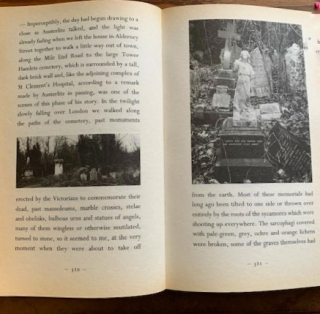 Born in Germany, Sebald spent much of his life in England teaching German literature. He has a most unusual writing style described as “elliptical a combination of “memoir, fiction, travelogue, history and biography.” I read two of what Sebald himself described as documentary fictions . The first was Austerlitz, which tells the tale of man who tries to reconstruct his childhood when he discovers that he was sent by his Jewish parents from Czechoslovakia to England on the eve of the Nazi invasion of the country. In his other book The Rings of Saturn, (1995) the narrator roams throughout the Norwich area of England discovering the connections between his walks and the world at large. Each book is characterized by long passages with very few paragraphs but interspersed with grainy black and white photographs to illustrate his descriptions (kind of like a blog on paper).
Totalitarianism, Democracy
There seems to be a common theme in this year’s Best Books and that has been trying to understand 2019 better through the lens of 20th century history. It began with reading Eric Villiard’s The Order of the Day (2017) a short nonfiction book which looks how Nazi Germany annexed Austria months ahead of World War II and how Adolf Hitler was aided and supported by the German industrial giants of Bayer, IG Farben, and Thyssen-Krupp (and others) who profited and whose fortunes were relatively unscathed by the war.

Going to the Czech Republic, Slovenia and Germany this fall, I did do some “reading ahead” of the history of these countries. Two books by Czech expat Josef Skvorecky captures the dismal society under Soviet control in then Czechoslovakia in the late 1960s. Another book Antony Beevor’s The Fall of Berlin 1945, (2002) which I had written about previously introduces to the ghastly bloody end of World War II and how it set in motion the Cold War. My takeaway: Don’t take the threats from the Soviets/Russians lightly, they are tough, long suffering people who historically know how inflict major suffering on others.
As some sort of counterbalance to totalitarianism fanfare, I read the new edition of Charles Black Jr. and Philip Bobbitt’s The Impeachment Handbook (2018) which without mentioning Donald Trump discusses the history of impeachment, entails impeachable crimes and a discussion of the seven fallacies surrounding impeachment.
It’s a tidy short book and on a lark, I sent one via Amazon to our Georgia U.S. Senator David Perdue. I hope someone will take the lead and send a copy to the newly appointed Kelly Loeffler who is temporarily replacing our other senator. But perhaps she should consider buying her own since she’s contributing $20 million of her personal forture to her campaign in 2020.
I’ve also been reading Astra Taylor, Democracy Doesn’t Exist, But We’re Going to Miss it When It’s Gone (2018) just to put an historical perspective on what democracy really means and how it is distinguished from equality and freedom. You can see how obsessive I’ve become in 2019 even though I have been trying to limit watching the news on television.
One final note to ponder about democracy, in the aforementioned A Savage War of Peace one of the tipping points in that lead to the outbreak of eight years of terrorism and bloodshed was the French denying voting rights to the Algerian Muslim population through intimidation. Something to ponder in the age of gerrymandering and making it more challenging for people to vote whether it’s making it more difficult for college students to vote in New Hampshire or purging voting registrations in Georgia.
Luke Skywalker Can’t Read
I feel I must finish on somewhat a lighter note. I thoroughly enjoyed the cleverness of Ryan Britt's Luke Skywalker Can’t Read and Other Geeky Truths (2015). Britt’ is a great fan of science fiction – looks at some of the oddities of this world: Sherlock Holmes as a sci-fi institution, “looking at Star Trek as a half assed religion” and the of course thinking about Luke Skywalker’s favorite books. Britt writes:
Sadly, Luke Skywalker doesn’t have a favorite book. And even though he’s the ultimate dreamer, a craver of adventure, a wide-eyed Joseph Campbell archetype hero, he’s initially presented to us as a kind of philistine. This supposed pop descendent of Odysseus and Perseus lives in the zip code of a galaxy far, far away, meaning he’s got not no Shakespeare, Homer, Robert Louis Stevenson, J.M. Barrie, or even J.K. Rowling to get him excited about packing up and seeking adventure…As depicted in the first “real” Star Wars film, in 1977, Luke Skywalker—when you consider a substantial amount of evidence—is a functionally illiterate person and his fellow citizens might not be much better off. Not once in any of the existing Star Wars movies does a person, droid, or creature pick up a book or newspaper, magazine, literary journal, or a chapbook of Wookie poetry.
Fear not, blog visitor, because just being here you prove you are a discriminating reader (Our marketing team reports that functional illiterates avoid the blog.) Thanks for visiting and I hope you newcomers will become subscribers in 2020. I will take an oath not to bore you in 2020 and unlike many, I take oaths very seriously.
——————
 If you’d like to purchase online any of the books that you’ve read about here, please begin your shopping at the Destination Books Alibris store at destination.alibrisstore.com. Any Alibris purchase that originates from Destination Books link benefits the blog as a small percentage of the price goes back into supporting this “obsession.”

Yes, ‘tis the season to book shop, but this posting is more than a shopping guide – it is a partial shout out to those booksellers that have supported the blog and related ventures in the past. All three are having holiday sales. Two are brick and mortar stores in Atlanta and the third is a small independent publisher out of Philadelphia.
Located on the campus Emory University, this quaint shop is packed full of books for its holiday sale Friday, December 6, 10-4 and Saturday, December 7, 10-5. Over the years, I have read and wrote about books that came from this place. This year alone some of my favorite reads — Jessym Ward’s Sing, Unburied, Sing (2017), W.B. Sebald’s The Rings of Saturn (1995), Giorgio Van Stratton’s In Search of Lost Books (2016) and Eric Villard’s The Order of the Day (2017) — came from the Carlos Museum Bookshop. This dependency of mine is a little scary.
On Saturday, you can park free at the Visitor’s Parking Deck near the Museum.
The Fall Line Press Moving Sale is Saturday, December 7 Noon to 8 p.m. In addition to Fall Line publications, the sale includes art books, photography books, vintage books, zines, duplicates (maybe a lonely copy of my own 2016 book Down & Outbound) t-shirts, koozies, totes, and posters. And in addition to all of that, Nexus Founder Michael Goodman will be giving a book arts demonstration at 3 p.m. and includes a conversation with Fall Line publisher Bill Boling.
Fall Line is officially moving from its 675 Drewry Street location in Midtown Atlanta by the end of this year.
And now for those who live outside of Atlanta —
Paul Dry Books is a publisher out of Philadelphia who published my The Book Shopper: A Life in Review (2009), but recently partnered with my book popup venture Destination: Books at the Decatur Book Festival. PDB offers a lot of books ranging from travel to fiction, as well as classics and philosophy and they are all at 35% off until December 10th. I especially like some of the work of PDB stalwart Eva Brann who has written to fine books, Open Secrets / Inward Prospects: Reflections on World and Soul (2004) and Doublethink/Doubletalk: Naturalizing Second Thoughts and Two-Fold Speech (2016) which I have written about and sent copies to friends.
—– EXTENDED BODY: —– EXCERPT: —– KEYWORDS: Carlos Museum Book Shop, Fall Line Press, Paul Dry Books, Eva Brann —– ——– AUTHOR: Murray Browne AUTHOR EMAIL: murray.browne905@gmail.com TITLE: The Perils of Reading Ahead STATUS: Publish ALLOW COMMENTS: 1 CONVERT BREAKS: wysiwyg ALLOW PINGS: 0 BASENAME: the-perils-of-reading-ahead UNIQUE URL: https://thebookshopper.typepad.com/the_book_shopper_atlantad/2019/11/the-perils-of-reading-ahead.html DATE: 11/24/2019 09:16:56 AM —– BODY:
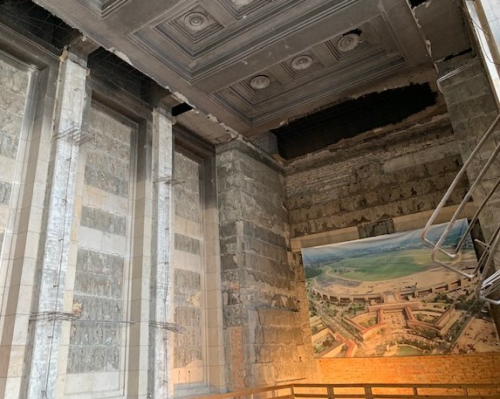
A short write-up of Antony Beevor’s The Fall of Berlin 1945 (2002) appears on my “companion” blog Down and Outbound which is another interest of mine — an irreverent look at related transportation topics. In the posting “European Transportation Observations: Part 2” there is a footnote entitled “Panzerfaust”, (a reference to cyclists who carried rocket-propelled grenades like bazookas) and I mentioned a couple aspects of the book that stuck with me in my recent trip to Europe.
I read the book in preparation of my visit to Berlin and it was a part of World War II history, I knew next to nothing about since Beevor’s primary focus is on the Red Army’s capture of Berlin. It’s was a brutal and horrific campaign and it can sicken one to read Beevor's grisly details.
 The book also inspired me to visit Tempelhof Airport (shown above), which was has been a part of Berlin air travel history for over a century and is mentioned several times in the book. In the 1930s, Hitler pushed to make Tempelhof the crown jewel of European airports and a tribute to Nazi power. Well, the Soviets in their capture of the city on May 1, 1945, disabused that notion. According to the book, the advancing Soviet artillery purposely did not destroy the entire airport and in order to make the airfield operational, the Soviets forced two thousand German women ( Trümmerfrauen*) to clear the airfield of rubble. Within days after the fighting ended, signers of Germany’s unconditional surrender documents were flown into Tempelhof for the official ceremony on May 8, 1945
I brought this to the attention of our English-speaking guide, who gave us the initial impression that he was a funky, free entertaining spirit who looked like he came from a Peter Max poster. On the other hand, he did not know all the historical facts. “Please ask me questions, that I only know the answers for,” he replied half jokingly after I inquired if he would illuminate Tempelhof’s history in the final days of the war. But my interpretation of his answer was that he was really telling me in front of the other tourists to “shut my gob.”
So, as you can see reading ahead, I became one of “those people” that can potentially mess up a tour (at least for the guide). A lesson learned – it’s okay to read ahead, but just keep your smarts to yourself, book people.
Footnote Trümmerfrauen*
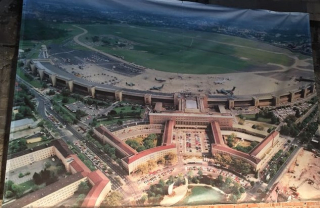 The airport operated until finally being shut down permanently in 2008. It was also the site of the Berlin Airlift in 1948-49 and even more recently has been used as a refugee center. Since it looks like something out of the movies and was used as a film location for The Bourne Supremacy and Bridge of Spies. For a more complete history and photographs check out this article which brought to my attention (unlike my tour guide) that the airport itself is intentionally shaped like an eagle.
Trümmerfrauen* is the German word for the women who removed rubble (Trümmer" means rubble.) after the Allied bombings of Germany. Out of necessity they cleaned up the debris from destroyed buildings in exchange for food ration cards.
—– EXTENDED BODY: —– EXCERPT: —– KEYWORDS: Fall of Berlin, Tempelhof, Templehof, Antony Beevor, Berlin 1945 —– ——– AUTHOR: Murray Browne AUTHOR EMAIL: murray.browne905@gmail.com TITLE: Blog Alumni STATUS: Publish ALLOW COMMENTS: 1 CONVERT BREAKS: wysiwyg ALLOW PINGS: 0 BASENAME: blog-alumni CATEGORY: Books as Art as Books UNIQUE URL: https://thebookshopper.typepad.com/the_book_shopper_atlantad/2019/11/blog-alumni.html DATE: 11/06/2019 09:18:47 AM —– BODY:
If you blog long enough sometimes the people and things you write about reappear. Such has been the case recently where I have reacquainted myself with the works of writers and artists with whom I have crossed paths before.
Cut & Paste: Works of Paper
Since paper has a deep connection to books, it partially explains my sense of comfort whenever I have visited the Robert C. Williams Museum of Papermaking on the campus of Georgia Tech. The last time I was there I walked through their current exhibit, Cut & Paste: Works of Paper (ending November 14th). It is a traveling exhibit* and part of the Highlighting Contemporary Art in Georgia Series featuring the work of eleven Georgia artists who work with paper cutting, folding, and coloring to create unique works. I recognized one of the artists– Jerushia Graham who exhibited a series of delicately cut paper pieces called "From Where I Stand." Shown at the left is one of those pieces, but the digital version on this blog does not reflect the rich details of the work properly.
I first met Ms. Graham back in 2012. She was one of the curators of an exhibit called WallBound, hosted by the Art Institute of Atlanta-Decatur, which has since morphed into an annual event at the Decatur Book Festival called Book As Art.
Book as Art – Flight Edition
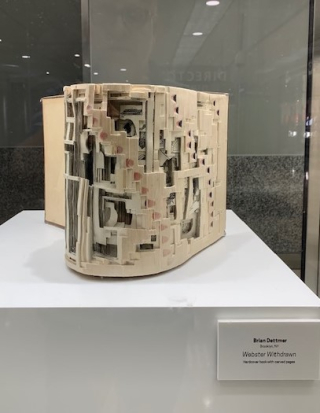 While heading out on a flight at Atlanta’s Hartsfield-Jackson International Airport a couple of months ago, my eye caught the work of Brian Dettmer whose work has appeared earlier in the blog as well. Shown here is his work, "Webster Withdrawn", which was part of the Book As Art – Flight Edition and a subset of the previously mentioned Book Art which was on display at the Decatur Public Library during the Decatur Book Festival.
I recognized Dettmer’s work from when he was at the Saltworks Gallery here in Atlanta in 2011 and later at Atlanta Museum of Contemporary Art in Georgia at the end 2012. As I recall, Dettmer went on to be featured on network television for his unusual work and I occasionally get an email announcing his exhibits in Chicago and more recently in San Francisco.
Thomas Chatterton Williams
 Williams’s new book Self-Portrait in Black and White: Unlearning Race (2019) recently made the front page of the New York Times Book Review, but he is also the subject of one most popular Book Shopper blog postings dating back to June 6, 2010, “Thomas Chatterton Williams Meets Killer Mike.” If you ask Williams, I bet he remembers his stop at the Decatur Public Library while on tour of his first book Losing My Cool (2011): How A Father’s Love and 15,000 Books Beat Hip Hop Culture. The rapper Killer Mike (on the right), emerged from the audience, got into a discussion with Williams (at the left) as they defined Hip-Hop culture. I was impressed that it was lively but, remained amicable. The man in the middle of the photo (referee?) is Joe Davich, who now is the Executive Director of the Georgia Center for the Book and was one of the brick and mortar administrators of the recent Book as Art 7.0. Small world. One other note of interest: Williams' 2011 book has since be retitled Losing My Cool: Love, Literature and a Black Man’s Escape from the Crowd.
* Future venues in 2019 and 2020: Museum of Arts and Sciences, Macon, Albany Museum of Art, Albany and Telfair Museum of Art's Jepson Center, Savannah, Georgia.
—– EXTENDED BODY: —– EXCERPT: —– KEYWORDS: Thomas Chatterton Williams. Jerushia Graham, Brian Dettmer, Books as Art Flight, Robert C. Williams of Papermaking —– ——– AUTHOR: Murray Browne AUTHOR EMAIL: murray.browne905@gmail.com TITLE: European Book Experiences STATUS: Publish ALLOW COMMENTS: 1 CONVERT BREAKS: wysiwyg ALLOW PINGS: 0 BASENAME: european-book-experiences CATEGORY: Bookstores UNIQUE URL: https://thebookshopper.typepad.com/the_book_shopper_atlantad/2019/10/european-book-experiences.html DATE: 10/24/2019 07:23:31 AM —– BODY: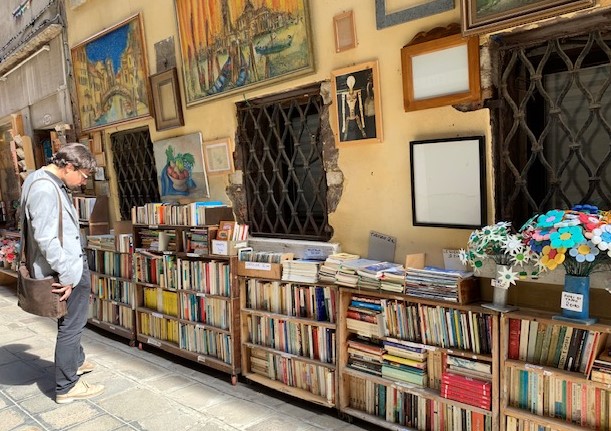
After almost four weeks of traveling in Europe, which included visits to Italy, Czech Republic, Germany, and Slovenia, I am still processing the bookish aspect of this once-in-a-lifetime trip to countries I had only read about. I did not deep-dive into every bookstore since there were a lot of them and only a few of them had English titles. Moreover, I had to be aware that everything I bought had to fit into a small suitcase and to be carried up canal bridge steps, onto trains and through airports. But most importantly, any extensive shopping would cut into my quest for perfect pastries, my pasta and sausage binges washed down with red wine, and just walking around and soaking in sites and neighborhoods with my partner and travel planner extraordinaire Denise Casey.
Here are a few experiences worth mentioning:
Another Country Books – Kreuzberg District, Berlin
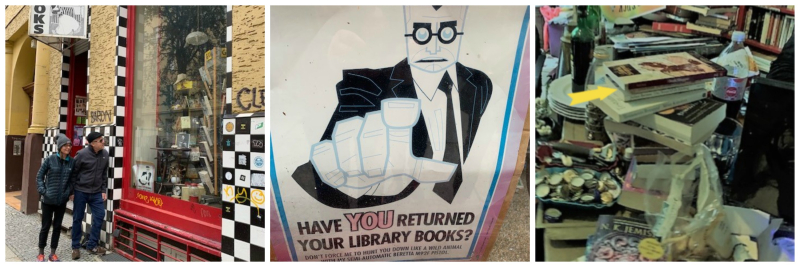 My older daughter Cynthia who lives in Berlin insisted that I bring a copy of my collection of essays The Book Shopper to Another Country Books, which is primarily an English bookstore that carries used books for sale and lending. Yes, their business model includes books that they loan out like a public library (hence the threatening poster). The owner graciously added the book to his stacks (yellow pointer), but there is evidently a back log in shelving the books.
I purchased a used copy of Joe Queenan’s book My Goodness: A Cynic’s Short-lived Search for Sainthood (2000) where Queenan takes a year a off from skewering celebrities and institutions to try and make himself a better person. I finished the book, but it didn’t make it to Customs because of space issues (left behind).
Shakespeare Books in Prague near The Charles Bridge
This was the best bookstore I visited during the trip since it was mostly English language and it had rooms and rooms full of finely curated fiction, non-fiction, art, politics and history. Since I knew beforehand, I was going to Prague, I pulled out a book by Czech writer Josef Skorvecky (who was forced to emigrate to Canada), which I already had on my shelves. While traveling. I read his short detective novel, The End of Lieutenant Boruvka (1979) which I liked so much, that I picked up a copy of his fourth book in the series, The Return of Lieutenant Boruvka (1991) at Shakespeare Books. The first book was much better than the latter, because the protagonist, the melancholic but savvy Czech detective reflects more on the Czechoslovakia’s struggles under Communism. Even though it has been over 30 years since the Velvet Revolution when the Czech Republic became independent from the Soviets, I still got a sense of that era, and life in this difficult period was further underscored by our local tour guide.
 This series of statues (at the right) is known as The Memorial to the Victims of Communism. Located in the Malá Strana district of Prague, it is dedicated not only to those who were jailed or executed but also others whose lives who were ruined by "totalitarian despotism".
Antiquarian Book Stores in Ljubljana, Slovenia
There were many small bookshops located along the Ljubljanica River that flows down center of Ljubljana, the capital of Slovenia. In fear of running out of books to read, I picked up some insurance — a copy of an Amitav Ghosh novel at an outside of one store. Another shop featured a stackable portable display that they set up outdoors by the river during the good weather. The inside of this same store was well-organized, but there were only a few books written in English. Throughout the week we were there, we learned about the history of Slovenia (formerly part of Yugoslavia), I became intrigued about Josep Broz Tito, the post-World War II Communist leader who stood up to both Hitler and Stalin  (but was hardly a choir boy). I asked the book seller to recommend a good biography of Tito but it was available only in Slovene.
Window Displays & More
As the proprietor of Destination Books which had its debut last month at the Decatur Book Festival, I always appreciate unique book displays and here are a few a more that caught my attention. I begin with the stackable portable display in Ljubljana that was mentioned earlier.
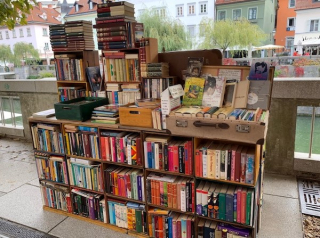
One of my favorite writers is the Italian Primo Levi (1919-1987), so I appreciated this homage to him in Treviso, Italy.
This Venetian book store window makes it very clear that cruise ships are unwelcome and they have strong opinions about climate disruption as well.
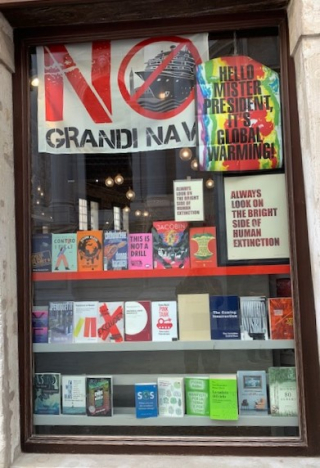
Denise and I never met a book window we didn't feel worth photographing even if we needed to translate Dante's prose . This appeared on a store window in Padua, Italy. Google translation: "Facts were not to live as brutes, but to follow knowledge."
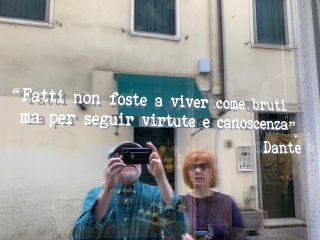
—– EXTENDED BODY: —– EXCERPT: —– KEYWORDS: Book stores Ljubljana, Book stores in Berlin, English language bookstores in Europe, Book stores in Prague, Venice, Another Country Books Berlin —– ——– AUTHOR: Murray Browne AUTHOR EMAIL: murray.browne905@gmail.com TITLE: Links of Interest STATUS: Publish ALLOW COMMENTS: 1 CONVERT BREAKS: wysiwyg ALLOW PINGS: 0 BASENAME: links-of-interest- UNIQUE URL: https://thebookshopper.typepad.com/the_book_shopper_atlantad/2019/10/links-of-interest-.html DATE: 10/01/2019 02:30:00 AM —– BODY:
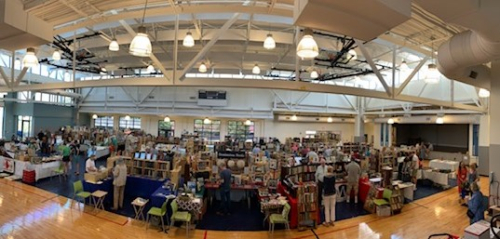
Remember the old links type pages, where people accumulated URLs of places they visited. You still see them around with a lot of dead links. I actually curate this one that resides on the main thebookshopper.org home page. It has an Atlanta flavor and I've recently added a few new ones.
A new blog that deep dives into various book topics such as Nordic Mystery Writers, Jennifer Egan, and Oliver Sacks. The founder and editor, who has channeled her inner Dorothy Parker lives here in Atlanta. She shares her deep passion for books and her love and promotion of independent bookstores.
This has one of the largest used book collections in the area and it is well-maintained and organized. It used to carry copies of my book, Down & Outbound: A Mass Transit Satire.
This is a small, but well-curated shop that most Atlantans don't know about. It's located in the Carlos Museum of the campus of Emory University. It used to carry copies of both my books Down & Outbound: A Mass Transit Satire and The Book Shopper: A Life in Review.
Auburn Avenue Research Library
 Part of the Atlanta-Fulton Country Library System focusing on African-American Culture and History. The AARL Literary Fair and Radical Book Festival is Saturday, October 5, 2019.
Check out this store's events page for major literary events in the Atlanta area.
The Jimmy Carter Library & Museum
Premier venue for author events.
Promotes local artists who uses books or the printed word as a form of art.
An all things bookish blog written by a former employee of Atlanta's Public Library System.
Literary events around Atlanta.
Serious reviews of art, dance, theater and books and I mean SERIOUS.
—– EXTENDED BODY: —– EXCERPT: —– KEYWORDS: —– ——– AUTHOR: Murray Browne AUTHOR EMAIL: murray.browne905@gmail.com TITLE: Book Art Exhibit in Atlanta STATUS: Publish ALLOW COMMENTS: 1 CONVERT BREAKS: wysiwyg ALLOW PINGS: 0 BASENAME: book-art-exhibit-in-atlanta CATEGORY: Books as Art as Books UNIQUE URL: https://thebookshopper.typepad.com/the_book_shopper_atlantad/2019/09/book-art-exhibit-in-atlanta.html DATE: 09/20/2019 07:31:39 AM —– BODY:
No, this isn’t a picture of a bookish me relaxing in my living room, rather I am volunteering at the Book as Art 7.0 exhibit at Decatur Public Library’s Periodical Room. Most of the time, I just walk through exhibits such as this, but this time I spent the whole afternoon there so I had plenty of time to pick favorites. The piece behind me is known as Book by Rosalyn Driscoll of Haydenville, Massachusetts. Good thing it was bolted on the wall otherwise, I would have been tempted to ask the library for a loan.
Here are a few other notables with some minor descriptions:
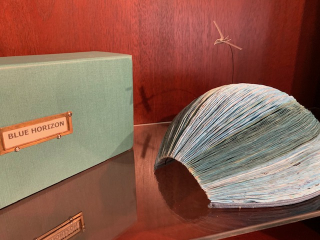
by Peggy Johnston
Des Moines, Iowa
"Inspired by a bundle of aeronautical maps" Note the little plane flying over the book made of maps.
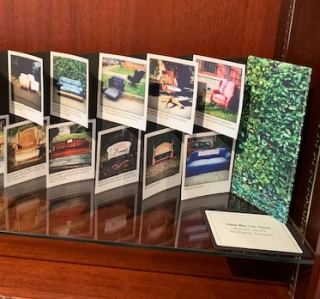 Take Me I'm Yours
by Laura Russell
Portland, Oregon
"In a bit of whimsey, image and text playoff each other to create irrelevant parking of singles pickup lines with intimate portraits (Polaroids) of abandoned furniture that can be cast aside like a bad romance on city streets everywhere."
Chance Operation
by Andrew Huot
Norcross, Georgia
Huot is the owner of Big River Bindery in Norcross.
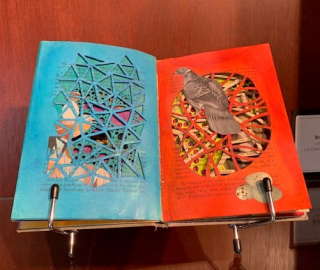
Bird Windows
by Lynn S. Kordal
Conner, Washington
"old style cut and paste collage"
The Gallery Hours for Book as Art 7.0 are from 2 to 6 p.m. daily in the Periodicals Room of the Decatur Library with the final showing at 7 p.m. Friday, September 27th which includes an opportunity for attendees to put on the white gloves and actually touch the pieces. They are for sale (not for loan).
—– EXTENDED BODY: —– EXCERPT: —– KEYWORDS: —– ——– AUTHOR: Murray Browne AUTHOR EMAIL: murray.browne905@gmail.com TITLE: Baseball’s Hall of Fame Grip STATUS: Publish ALLOW COMMENTS: 1 CONVERT BREAKS: wysiwyg ALLOW PINGS: 0 BASENAME: baseballs-hall-of-fame-grip CATEGORY: Baseball CATEGORY: Bookstores UNIQUE URL: https://thebookshopper.typepad.com/the_book_shopper_atlantad/2019/09/baseballs-hall-of-fame-grip.html DATE: 09/14/2019 09:01:49 AM —– BODY:
Heretofore the closest I have been to the National Baseball Hall of Fame was reading Richard Ford’s Pulitzer Prize winning novel Independence Day (1995). Ford’s book is the slow-paced story of a divorced writer-turned-real estate agent who takes his estranged son to both the basketball and baseball Halls of Fame over a 4th of a July weekend.
Considering that Ford describes Cooperstown, New York as a sleepy little burg that closes after 9 p.m. with no mention of late summer crowds, I did not know what to expect. I did have an idea of a few of the plaques that I wanted to see, but for the most part I just went with the flow and allowed the museum, the idyllic New York village (with many dining choices now), and the Ommegang Brewery to take its hold on me.
The Plaques
 The first floor atrium of that contains the plaques has a cathedral like quality where you stroll into each alcove to peruse over the immortalized players. (And I am not hyperbolizing when I use the word "cathedral" since when I was there during the opening hours a couple was getting married.) What makes the plaques especially interesting is the tight summary of each career which includes statistics and some sense of how the person played the game.
Edgar Charles (Sam) Rice
Ever since a feature article by Steve Wulf appeared Sports Illustrateds, July 19, 1993 issue, I have been intrigued by this player. He was born Edgar Charles Rice n 1890 in Morocco, Indiana just a few miles from where I grew up in Iroquois County, Illinois. Rice was married in 1908 and he and his wife had two children and moved to Watseka, Illinois the county seat of Iroquois County. At age 22, while away at baseball tryout in Galesburg, Edgar’s family visited his parents in Morocco and the entire family died in a killer tornado. 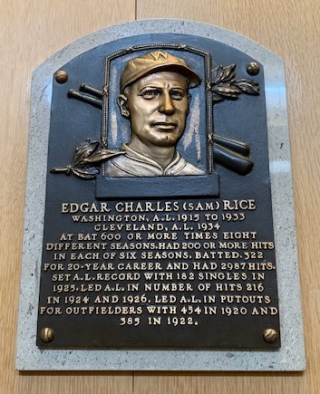
Understandably, Rice drifted for several years before ending up with the Washington Senators as a rookie at age 25. He remarried, but kept his previous life a secret on his way to a Hall of Fame career, which included a famous catch in the 1924 World Series against the Pittsburgh Pirates. Take the link to the Wulf article for the complete and memorable story.
Lee Smith
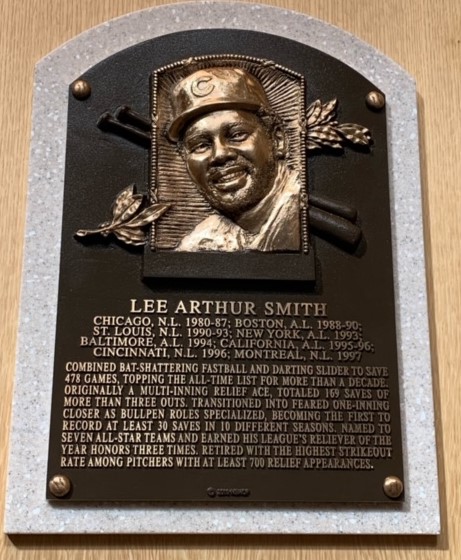 Until I heard Lee Smith humble induction speech earlier this summer, I bared some resentment to Smith for giving up Steve Garvey’s home run in the 1984 National League Championship Series which eventually led to the San Diego Padres victory over my team The Chicago Cubs. Over the years, I had softened especially after the Cubs champsionship in 2016. Smith makes regular appearances at Wrigley Field and Cub broadcasts and he made a simple compelling argument that his lifetime saves record stood for 13 years before it was eclipsed and he is still third on the number of saves behind Trevor Hoffman and Mariano Rivera. I like other Hall of Fame Cubs like Billy Williams, Ryne Sandberg, and Ferguson Jenkins, but now I can add the tall right-hander with the "bat-shattering fastball and darting slider to my list of likeable Cubs.
Connie Mack
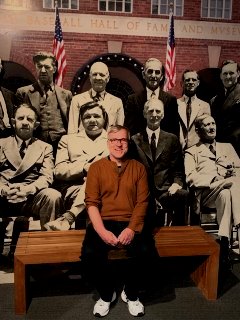 I was even able to feed my new baseball player obsession — Cornelius McGillicuddy (1863 -1956) aka Connie Mack. Mack won more games as a manager than anyone else and LOST more games as a manager than anyone else. At the Willis Monie bookstore on the Main Street of Cooperstown, I picked up the Volume 3 of Norman Macht’s biography of the player, manager and owner who had a half of a century career with the Philadelphia Athletics. My only regret is that I didn’t browse the store, but to my defense I had spent many hours power browsing The Hall of Fame. Here I am posing for a picture at the 1939 induction ceremony with Babe Ruth on my right, and Connie Mack on my left.
—– EXTENDED BODY: —– EXCERPT: —– KEYWORDS: National Baseball Hall of Fame, Cooperstown, New York, Norman Macht, Connie Mack, Sam Rice —– ——– AUTHOR: Murray Browne AUTHOR EMAIL: murray.browne905@gmail.com TITLE: Oddities at Destination Books STATUS: Publish ALLOW COMMENTS: 1 CONVERT BREAKS: wysiwyg ALLOW PINGS: 0 BASENAME: oddities-at-destination-books CATEGORY: Baseball UNIQUE URL: https://thebookshopper.typepad.com/the_book_shopper_atlantad/2019/08/oddities-at-destination-books.html DATE: 08/29/2019 09:12:01 AM —– BODY:
Prep work continues for my pop-up booth Destination Books at the Decatur Book Festival’s Georgia Book and Paper Fair this weekend. This curation can become time-consuming when I run into book oddities that generate memories of days past. Here are some examples:
Carma: A Super-Simple Automotive Manual written by David Rosenblum. This was originally purchased in 1975 – a time in my life when I thought I would try to maintain my own car – a 1961 Buick Electra followed by a 1973 Chevy Malibu. I was terrible at car repairs, but at least I take some solace that I soon realized I would save time and money if I just hired someone else to do the work. Still I have always valued auto maintenance, and stuck inside the book includes repair records and my Sears tire warranty. I will have this yellowing, disintegrating gem with the Courier typeface and homemade drawings of carburetors on display. But can I part with it? Probably won't have to.
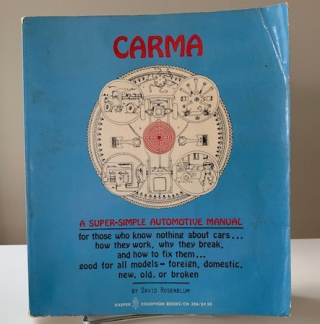

Mark Bennett’s TV Sets: Fantasy Blueprints of Classic TV Homes (1996). Bennett has re-imagined and drawn blueprints of famous TV homes of a bygone era: Lucy and Ricky’s New York apartment and Connecticut home, The Clampetts Mansion in Beverly Hills and The Flintstones stone sided suburban ranch house to name but a few.
The Vanishing American Outhouse. Ronald S. Barlow’s 1989 paean to crescent-moon outdoor facilities will be at Destination Books for examination. No white gloves necessary.
Baseball Techniques Illustrated the 1951 instructional book by Ethan Allen and Tyler Micoleau. This classic has all the fundamentals for any baseball player who wants to improve his or her game. The authors spend an entire chapter on situational hitting. Somebody needs to buy this book and send it to the 2019 Chicago Cubs.
Down & Outbound: A Mass Transit Satire. This quirky book I published myself because I wanted the format to reflect function. The book is designed for the commuter who can read the book with one hand and hold on to the “Oh-shit” straps while riding a bus or train. “In the subterranean world of mass transit there are two separate, yet equally marginalized groups: the riders who use public transportation and the city officials who routinely persecute them.” The video below explains.
—– EXTENDED BODY: —– EXCERPT: —– KEYWORDS: Carma, David Rosenblum, Vanishing American Outhouse, Decatur Book Festival, Georgia Book and Paper Fair, Baseball Techniques illustrated, TV Sets Fantasy blueprints —– ——– AUTHOR: Murray Browne AUTHOR EMAIL: murray.browne905@gmail.com TITLE: Paul Dry Books Visits Atlanta STATUS: Publish ALLOW COMMENTS: 1 CONVERT BREAKS: wysiwyg ALLOW PINGS: 0 BASENAME: paul-dry-books-visits-atlanta UNIQUE URL: https://thebookshopper.typepad.com/the_book_shopper_atlantad/2019/08/paul-dry-books-visits-atlanta.html DATE: 08/27/2019 11:01:03 AM —– BODY:
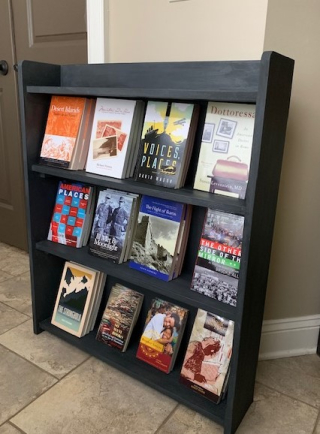 Prep work continues for my pop-up booth Destination Books at the Decatur Book Festival’s Georgia Book and Paper Fair this weekend.
One bookshelf is dedicated to publisher Paul Dry Books in Philadelphia who – in the spirit of Destination Books – has provided numerous travel books about India, Syria, Turkey, Greece, Rome and Crete, which will be available at discounted prices. Another destination aspect of this collection is the topic of books themselves. As we know, good books have a reputation to take us to new places. With this in mind, the booth has copies of Gabriel Zaid’s tidy little book of thirteen essays So Many Books: Reading and Publishing in the Age of Abundance (2003) which questions the necessity of publishing so much material (but then there wouldn’t be a need for book festivals). Copies of this blog’s namesake The Book Shopper: A Life in Review (2009), which was also published by Paul Dry Books will be there in abundance along with its author working feverishly behind the counter.
—– EXTENDED BODY: —– EXCERPT: —– KEYWORDS: Paul Dry Books, The Book Shopper, Gabriel Zaid, Georgia Book and Paper Fair. Destination Books. —– ——– AUTHOR: Murray Browne AUTHOR EMAIL: murray.browne905@gmail.com TITLE: Believer Magazine at Destination Books STATUS: Publish ALLOW COMMENTS: 1 CONVERT BREAKS: wysiwyg ALLOW PINGS: 0 BASENAME: believer-magazine-at-destination-books UNIQUE URL: https://thebookshopper.typepad.com/the_book_shopper_atlantad/2019/08/believer-magazine-at-destination-books.html DATE: 08/21/2019 07:26:01 AM —– BODY: I have been a Believer magazine subscriber-reader for a dozen years. Each issue has surprised me with an interview with some writer, musician, actor or artist who I knew little or nothing about being added to my cultural radar. Rebecca Solnit comes most to mind because ever since I read a Believer interview with her back in 2009, I’ve read about a half a dozen of her books.
Also, The Believer is fun to peruse while on public transportation, as fellow commuters think I am reading some religious periodical like the Jehovah Witness' The Watchtower. People keep their distance like I am ready to proselytize.
Because of their fine mix of design, printing and writing I refuse to commit the magazine to the recycle shredder, so I am trying to find them some good homes. I even found this special magazine carousel to smartly display them at my Destination: Books popup booth at Georgia Book and Paper Art Show at the Decatur Book Festival on Saturday, August 31st and Sunday, September 1st. These issues are $1 each. If you purchase $10 worth of Believer magazines you have your choice of a tattered Charles Burns poster, or a copy of former Believer music columnist Greil Marcus 2014 book , The History of Rock 'N' Roll in Ten Songs, which I wrote about in previous blog posting several years ago.
 On Labor Day weekend, the Book Shopper becomes bookseller as part of the Decatur Book Festival. I will be setting up a popup book booth called Destination: Books at The Georgia Book and Paper Fair, which is organized in part by the Georgia Antiquarian Booksellers Association.
Over 20 vendors from all over the Southeast are there and it is being held inside the AIR CONDITIONED, spacious Ebster Recreation Center, 105 Electric Avenue in Decatur. Think of it as a big book superstore where you can browse among all kinds of curated collections. Hours are 10 to 6, Saturday, August 31st and Noon to 5 on Sunday, September 1st.
Destination: Books ("for the adventurous") will be there stocked with 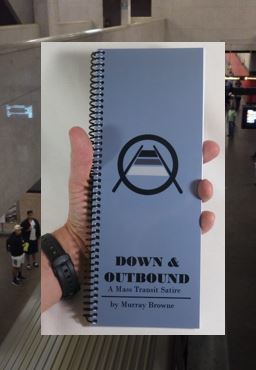 an eclectic mix of books and magazines that I have acquired over the past 40 years. I am also getting some help from some book friends and booth designer friends. More details will follow, but rest assured that I will have on hand plenty of copies of my books: The Book Shopper: A Life in Review and the Down & Outbound: A Mass Transit Satire, a book that strikes fear into the hearts of Atlanta area public transportation professionals while amusing those who ride buses and trains.
—– EXTENDED BODY: —– EXCERPT: —– KEYWORDS: Destination Books, The Georgia Book and Paper Fair, Georgia Antiquarian Booksellers Association, —– ——– AUTHOR: Murray Browne AUTHOR EMAIL: murray.browne905@gmail.com TITLE: Algerian Hiatus STATUS: Publish ALLOW COMMENTS: 1 CONVERT BREAKS: wysiwyg ALLOW PINGS: 0 BASENAME: algerian-hiatus CATEGORY: Book Reviews UNIQUE URL: https://thebookshopper.typepad.com/the_book_shopper_atlantad/2019/08/algerian-hiatus.html DATE: 08/02/2019 09:10:29 AM —– BODY:
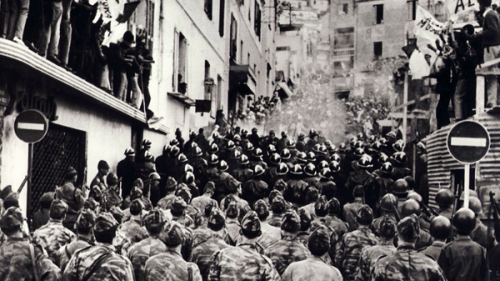
 For the past six weeks I have been spending my blogging and book time on one of my favorite historians Alistair Horne. Previously, I've written about two of his other books on this blog,The Price of Glory, Verdun 1916 (1960)and his 2015 book Hubris: The Tragedy of War in the Twentieth Century.
My latest Horne read is his Savage War of Peace: Algeria 1954-1962 written in 1977 and later revised in 1996. I also selected it for my annual contribution Dog Day Classics a late summer offering from the Tropics of Meta: Historiography for the Masses. ToM explained:
Tropics of Meta aims to offer a fresh perspective on history, current events, popular culture, and issues in the academic world. Founded in 2010, ToM has published over 900 essays by historians, social scientists, artists, activists, and creative writers both within and outside the academy, giving voice to communities across the United States and the world.
The Horne book was somewhat a beast to read and write about, but it is the kind of history that leaves you wanting to vacation in Algeria (not really, but you are left fascinated with the story – albeit a tragic one - and the scholarship it took to write it ). For a better explanation of my whereabouts, just go to the essay "Distant Lessons from Algeria, 1954-1962" itself at ToM. Check the other Dog Day Classics as well.
* The photo comes from the 1966 film, The Battle of Algiers.
—– EXTENDED BODY: —– EXCERPT: —– KEYWORDS: Alistair Horne, Tropics of Meta, Dog Day Classics, Algerian independence, —– ——– AUTHOR: Murray Browne AUTHOR EMAIL: murray.browne905@gmail.com TITLE: Revisiting Catch-22 STATUS: Publish ALLOW COMMENTS: 1 CONVERT BREAKS: wysiwyg ALLOW PINGS: 0 BASENAME: revisiting-catch-22 UNIQUE URL: https://thebookshopper.typepad.com/the_book_shopper_atlantad/2019/06/revisiting-catch-22.html DATE: 06/11/2019 07:00:46 AM —– BODY:
During my initial semester at Indiana University in the early 1970s, I first encountered Joseph Heller’s 1961 novel Catch-22 when a fellow student replaced the nameplate on his dorm door with “The Dead Man in Yosarrian’s Tent.” This certainly fit into the personality of our floor where you could hear Dr. John’s “Right Place, Wrong Time,” playing in an endless loop on someone’s turntable any time day or night. Rest in peace, Mac Rebennack.
It wasn’t still I started working after college that I read Catch-22 and immediately understood why the book appealed those rebellious youth of the 1960s who questioned authority. It made a personal impression especially since the book had what I interpreted as a positive ending – a roadmap for survival. For decades, I kept a hardback copy with intentions of rereading it just in case. But would a book of my young adulthood hold up four decades later? It was time to try. Working for years in layers of crushing corporate bureaucracy, I needed some tips on survival even though my situation wasn’t nowhere as grave as making bombing runs over occupied Italy in World War II.
Recently, I took the book on a brief vacation, but soon found Catch-22 more irritating than comforting with its endless absurdist conversations and countless two-dimensional characters. I left the unfinished book on the shelves of the bed & breakfast buried amongst copies of other bestsellers (Catch-22 eventually sold over 10 million copies). It was a little disappointing like the experience I had with a yellowed paperback of Tom Wolfe’s The Electric Kool-Aid Acid Test (1968) when after umpteenth description of someone getting really f**ked up, I pulled that plug and sent that book to the recycle tub. And “so it goes” in the words of Kurt Vonnegut.
The Hulu Version of Catch-22
I didn’t realize that my renewed interest in Catch-22 coincided with the Hulu six-part dramatization of the Heller’s novel starring George Clooney. After punting on the book, I still was willing to see a version on the home screen. This wasn’t the first time someone tried to bring the novel to the screen. In 1970, Mike Nichols directed a film version of the book with Alan Arkin (as Yossarian), Jon Voight, Bob Newhart, and Art Garfunkel leading a star-studded ensemble. (Currently available on Amazon – see its trailer below.) In the Hulu version, Christopher Abbott plays the main character Captain John “Yo-Yo” Yosarrian. The extra hours — Six 45-minute episodes compared to a movie run time of two hours—were put to good use to develop characters and capture the mood. In contrast, the gorgeous sepia cinematography gives the Hulu version a major edge over the noisy, dusty Nichols movie. Hulu's version is really an Italian vacation postcard with clear blue skies and pristine beaches, but Yosarrian’s ever present fear that his comrades and he will be being splattered inside a B-25 bomber or engulfed in flames is always present. Abbott’s silent countenance of dread speaks volumes in portraying Yosarrian’s pain and desperation.
Alternate Endings
My only major complaint about the Hulu version is the ending which does not follow the book or Nichols' movie. Both the book and Nichols does have an upbeat ending – it shows us a possible way out. Or more specifically, Captain Orr, Yosarrian’s tent mate (he’s not the dead guy), who is a bomber pilot considered even crazier than Yosarrian, figures it out. The Hulu version, which features a lot of screen time for Abbott’s buttocks in the final episode doesn’t work quite as well as a suitable ending. How can I really recommend the Hulu version when I know the original conclusion? How can I erase this memory? My problem is close to a Catch-22, if you watch the Nichols movie or read the lengthy book first, you may be dissatisfied and not even bother with Hulu version. On the other hand, if you watch the Hulu version you’ll probably like it, but the ending will leave you dissatisfied – especially since you now know there is alternative ending.
We can't win. It’s enough to drive a person crazy.
—– EXTENDED BODY: —– EXCERPT: —– KEYWORDS: Catch 22, Hulu Version, Mike Nichols, Joseph Heller, Christopher Abbott, Alan Arkin —– ——– AUTHOR: Murray Browne AUTHOR EMAIL: murray.browne905@gmail.com TITLE: Weeding Memories STATUS: Publish ALLOW COMMENTS: 1 CONVERT BREAKS: wysiwyg ALLOW PINGS: 0 BASENAME: weeding-memories CATEGORY: Book Reviews UNIQUE URL: https://thebookshopper.typepad.com/the_book_shopper_atlantad/2019/05/weeding-memories.html DATE: 05/05/2019 10:48:04 AM —– BODY:
 For decades, I have kept Sara Stein’s My Weeds: A Gardner’s Botany (1987) resting on my shelf before finally pulling it out and putting it to good use. When it was first published, the quirky title itself stuck in my mind and I recall book-shopping it a few years later for a couple of dollars. But for the most part, it sat quietly waiting and surviving those perilous moments such as last year when Denise and I weeded our book collection. Admittedly, this confession could set off a backlash in the Marie Kondo era, but once in a while keeping a book for a long time pays dividends.
My renewed interest in reading this book coincided with our participation in a local community garden plot. Previously, we were restricted to growing flowers and herbs on our deck, but when we qualified for the 11’ by 8’ plot we went wild with tomatoes, eggplant, zucchini, peppers and the mysterious classification-defying purplish kohlrabi.
Since then, I have been studying Stein’s series of essays more than reading them. Although she makes it clear that she is not a botanist, she is certainly at ease with sprinkling Latinate terms along with common names (e.g., Puerta lobata for kudzu vine and Daucus carota for Queen Anne’s Lace). Illustrated in gorgeous detail by Ippy Patterson, each chapter covers some aspects of weeds, using those topics as a launching point for investigations on classification, proper weeding tools, the moral ambiguity of using black plastic, and the myriad hidden interactions between insects and plants. She writes:
One butterfly, the monarch, has a special relationship with the weed. Females lay their eggs on milkweed plants, and the caterpillars feed exclusively on milkweed leaves. The poison accumulates in their tissues, and remains through their metamorphosis into butterflies. Predators know, or soon learn, not to eat them at any age.
Respite from the pressure of predation has allowed monarchs a long life…And there’s more. A butterfly brain is so small that in the effort to learn the way into an unfamiliar species of flower, it forgets how to enter the species it has memorized before. The faithful monarch doesn’t waste the time a fickle butterfly wastes learning a new routine, and so it is better nourished, and the milkweed it pollinates is fertilized all the better by not getting its stigmas clogged with unusable pollen from other flower species. It’s delightful that a butterfly’s intellectual limitations find such happy expression in evolution.
Gardening memories
What is making this recent plunge into gardening more fun is the nostalgic trek down the garden path of memories. My father was an avid gardener and would spend every daylight hour in the spring through the fall growing everything from green beans to broccoli and potatoes. He recruited us kids for watering and weeding, but for the most part it was his way to relax and he preferred to work alone. In the 1991 book about the history of leisure, Waiting for the Weekend (1991), Witold Rybczynski wrote that gardening “fulfills the three criteria for true play: it represents freedom, it stands outside everyday life, at it contains its own course and meaning…The gardener is a solitary figure, who like the book reader withdraws from the real world into one of his own creation.” (This is another book that has lived on our shelves for years until it was recently pulled for reference.)
In her final chapters, Stein describes the approximately 50-year life cycle of how an abandoned garden eventually transforms back into a meadow and eventually becomes a forest. It’s only one of the cycles of life that Stein shares and in the closing moments of her book she writes: “The experience has been like discovering kin with whom both historically and biologically one has unsuspected ties. And then there is my father, again I didn’t know until I picked up my hoe again in my thirties that by laying it down in my adolescence I had for a while lost the thread by which one continues to weave one’s relationship with a parent all through one’s life, long after the parent is dead. Now I’m satisfied that my father and I have an excellent understanding with one another.”
For a guy that tore up a good portion of his yard to add to his garden, I can hear my father harrumphing at my small endeavor, but the flow of memories that has flooded me since working in this little plot and reading Stein has already produced high yields. And he would be pleased with that. 
—– EXTENDED BODY: —– EXCERPT: —– KEYWORDS: My Weeds, Sara Stein, Gardening Books, Waiting for the Weekend, Witold Rybczynski, weeding, weeding a book collection —– ——– AUTHOR: Murray Browne AUTHOR EMAIL: murray.browne905@gmail.com TITLE: Boston Book Shopping STATUS: Publish ALLOW COMMENTS: 1 CONVERT BREAKS: wysiwyg ALLOW PINGS: 0 BASENAME: boston-book-shopping CATEGORY: Bookstores UNIQUE URL: https://thebookshopper.typepad.com/the_book_shopper_atlantad/2019/04/boston-book-shopping.html DATE: 04/12/2019 07:02:28 AM —– BODY:
For over a decade I have been visiting Boston to see my older daughter Cynthia which usually includes visits to Boston bookstores, such as Raven Books, the Harvard Book Store and the MIT Press Bookstore. Also in the past, these trips have included visits to various Boston-area landmarks – the Emerald Necklace, Walden Pond and the Lord Hobo bar.
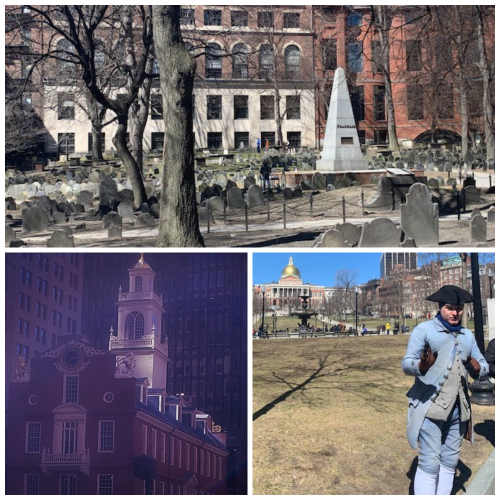
One Boston historical site that has eluded me until recently has been the Walking Tour of the Freedom Trail a 90-minute stroll of historical Boston. Hosted by a guide wearing a three-cornered hat and knee -high compression socks, my tour included the Granary Burial Ground, the Boston Common next to the Massachusetts state house and the scene of the Boston Massacre (all shown in the collage). One caveat, though, is that this is no “trail” per se. When I think of trails, I think of the Oregon Trail, The Trail of Tears, or Roy Rogers (singing “Happy Trails to You”). This “trail” doesn’t have that same vibe, it is buried among the Boston high rise buildings.
In addition to learning about the details of Paul Revere’s ride and that our forefathers were not all choir boys, the Freedom Trail took us near a bookstore that I had not visited in all my years of book shopping in Boston – Commonwealth Books.
Commonwealth Books
After the tour, Cynthia and I walked over and spent considerable time in this used bookstore. This shop embodies the way we like to think about used bookstore: charmingly disheveled and packed but decently organized. Lots of older books of history, biography, fiction of books which I had not seen in years, along with crates of vintage maps, which I always like thumbing through. I found the quotes about writing and books taped to the worn shelves particularly funky and inspirational. It’s a place for book people.
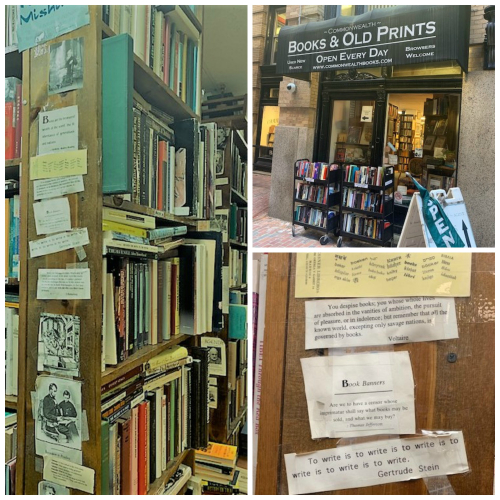
Flush with a renewed interest in American history, I looked for, but failed to find, a paperback copy of Gore Vidal’s Burr. Admittedly I was reluctant to purchase much else as my backpack was already full and heavy, but Cynthia was not to be denied. She found something worth buying and shipping (at minimum expense) as a gift to my longtime partner Denise – a cookbook Mediterranean Vegetables (2001) by Clifford A. Wright. Cynthia knew that Denise and I are now proud stewards of a community garden plot and for the first time we have an opportunity to grow our own vegetables (eggplant, tomatoes and 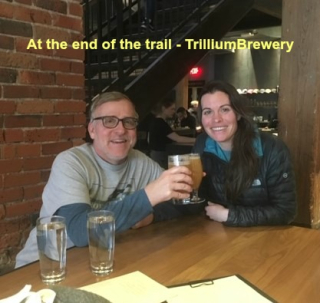 zucchini are already in the ground). We’ve already tried the recipe for roasted, saffron-infused cauliflower. Thank you, Cynthia and Commonwealth Books.
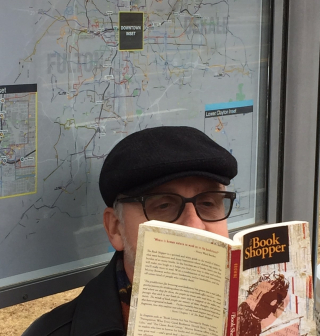 It’s been a year since the last MARTA Book Club posting, which is why you may not remember that the MARTA Book Club is metro Atlanta’s premier transportation book club. Membership is easy. All you need to do is read a book while riding a Metropolitan Atlanta Rapid Transit Authority bus or train. There are no meetings, and no one determines which book everyone must read. Very individualistic.
Here’s a list of what members have been reading while riding MARTA in recent months:
The Storm Before the Storm: The Beginning of the End of the Roman Republic by Michael Duncan
Galapagos: A Novel by Kurt Vonnegut
The Songs of Distant Earth by Arthur C. Clarke
Trouble Brewing by Susan Page Davis
White Death by Clive Cussler
Unshakeable: Your Financial Freedom by Tony Robbins and Peter Mallouk
In Defense of Food: An Eater’s Manifesto by Michael Pollan
85 Days: The Last Campaign of Robert Kennedy by Jules Witcover and Senator Edward M. Kennedy
The Fatal Shore: The Epic of Australia by Robert Hughes
In a Sunburned Country (Australia) by Bill Bryson
Early Riser by Jasper FForde
D-Day Illustrated Edition: June 6, 1944: The Climatic Battle of World War II by Stephen E. Ambrose
The Seventh Babe by Jerome Charyn
The Solace of Monsters by Laurie Blauner
Year One by Nora Roberts
Fidel: A Critical Portrait by Tad Szulc
Infinite Jest by David Foster Wallace
The Bible
Personal: A Jack Reacher Novel by Lee Child
Guards! Guards: A Novel of Discworld by Terry Pratchett
 There is a healthy selection of books, but we are disappointed when nearby Gwinnett County voted down an opportunity to join the MARTA Book Club by 54 to 46 percent margin last Tuesday. We would have welcomed them to the fold, but we guess short-sighted residents there prefer sitting in never-ending traffic and contributing to the deterioration of the environment with their fossil fuel consumption.
But one of best strategies to combat ignorance is to read, (and think) and that’s what MARTA Book Club does.
(This posting appears on both The Book Shopper Blog: Personal Musing About Books and Down and Outbound; The Hub a blog about the transit culture. To peruse the previous 33 MARTA Book Club postings visit here.)
—– EXTENDED BODY: —– EXCERPT: —– KEYWORDS: Book Spotting, the MARTA Book Club, Atlanta public transit, Gwinnett County —– ——– AUTHOR: Murray Browne AUTHOR EMAIL: murray.browne905@gmail.com TITLE: Impeachment 101 STATUS: Publish ALLOW COMMENTS: 1 CONVERT BREAKS: wysiwyg ALLOW PINGS: 0 BASENAME: impeachment-101 UNIQUE URL: https://thebookshopper.typepad.com/the_book_shopper_atlantad/2019/02/impeachment-101.html DATE: 02/26/2019 07:58:48 AM —– BODY: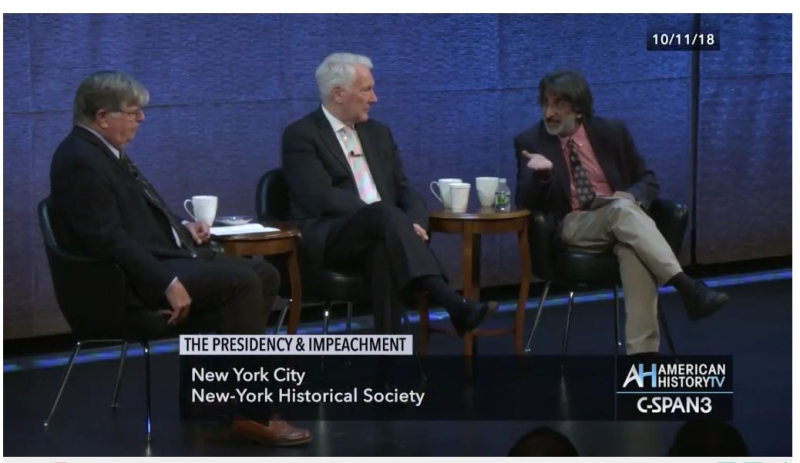
Regardless of your opinion on whether you believe President Donald Trump should be removed from office ( a recent poll* reports that 87 percent of Americans believe that Mueller report should be made public), it is time for all citizens to bone up on the rules of impeachment. What is the impeachment process? Historically, what did the framers of the Constitution mean by “Bribery, Treason and high Crimes and Misdemeanors?” And what are the differences between an impeachment trial in front of the Senate with the Chief Justice presiding and the rules of evidence in the standard trial by jury of your peers? Fortunately, there is an excellent primer available and you don’t have to be a legal scholar to understand it.
Impeachment: A Handbook New Edition
 I was channel flipping in the deep recesses of the cable netherworld when I stumbled on a discussion between constitutional law professors Philip Bobbitt (Columbia) and Akhil Reed Amar (Yale) moderated by Benno Schmidt (formerly of Yale and Columbia) on C-SPAN’s American HistoryTV. I recognized Amar from CNN who makes an occasional appearance when he appears on matters of constitutional law. What impressed me most about the hourlong program was its thoughtful discourse about what constitutes an impeachable offense without acrimonious grand standing of partisan politics and soundbites.
It impressed me so much, that I purchased Bobbitt’s book Impeachment: A Handbook New Edition, which he updated from the original Impeachment Handbook written by Charles L. Black Jr. Black wrote the first edition in 1974 even before Richard Nixon resigned and it is considered a seminal work on the subject. Bobbitt updates the landscape of impeachment post-Nixon, which includes Ronald Reagan-Iran Contra, George W. Bush-Iraq and Bill Clinton-Monica Lewinsky. Though published in the summer before the 2018 midterms, Bobbitt does not mention Trump, but looks at the possibilities of impeachment. I would share more of his observations, but considering the length of this readable, inexpensive book (only 140+ pages) and the availability of the C-Span video online. I will encourage you to seek these on your own.
 You could also read a good summary of the impeachment process in The Atlantic March 2019 issue, the cover story by Yoni Appelbaum is “The Case for Impeachment.” Appelbaum’s article is more opinionated but it does explain the impeachment process and it does a shout out to the Black and Bobbitt book as well:
The Nixon impeachment spurred Charles L. Black, A Yale law professor, to write the original Impeachment: A Handbook, a slender volume that remains a defining work on the question.
Black makes two key points. First, he notes that as a matter of logic as well as context and precedent, not every violation of a criminal statue amounts to a “high crime” or “misdemeanor.” To apply his reasoning, some crimes— say…willfully injuring a shrub on federal property in Washington. D.C. – cannot possibly be impeachable offenses. Conversely, a president may violate his oath of office without violating the letter of the law. A president could, for example, harness the enforcement powers of the federal government to systematically persecute his political opponents, or he could grossly neglect the duties of his office. That sort of conduct, in Black’s view, is impeachable even when it is not actually criminal.
Prepped with teachings of Bobbitt et. al, feel confident that you can enter any nuanced discussion about impeachment — peppering your conversation with Latin phrases "eiusdem generis" and "nemo judex in causa sua." It is so much better than screaming matches and parroting soundbites from the news organization of your choice.
* The CNN poll came out in February and a similar poll by PBS in December of 2018 reported that 76% of U.S. adults were in favor of the Mueller report being made public.
—– EXTENDED BODY: —– EXCERPT: —– KEYWORDS: Books about impeachment, Impeachment A Handbook, Philip Bobbitt, Charles L. Black, Akhil Reed Amar, Impeachment 101, American History TV —– ——– AUTHOR: Murray Browne AUTHOR EMAIL: murray.browne905@gmail.com TITLE: My Off Season: Hot Stove Baseball Books STATUS: Publish ALLOW COMMENTS: 1 CONVERT BREAKS: wysiwyg ALLOW PINGS: 0 BASENAME: my-off-season-hot-stove-baseball-books CATEGORY: Baseball CATEGORY: Book Reviews UNIQUE URL: https://thebookshopper.typepad.com/the_book_shopper_atlantad/2019/02/my-off-season-hot-stove-baseball-books.html DATE: 02/03/2019 11:39:51 AM —– BODY:

These months between the final game of the World Series and Opening Day can be long and cold if you don’t prepare properly. Last November, I taped the entire MLB All-Stars (sans All Star pitchers) vs Japan’s Samurai All-Stars in a six game exhibition series, which was played in Tokyo, Hiroshima and Nagoya in front of packed stadiums of chanting Japanese fans. Japan won the series 5 games to 1, which is no surprise since the MLB pitching staff consisted of “household” names of Scott Barlow (KC), Collin McHugh (HOU) and Kirby Yates (SD) not Clayton Kershaw, Max Scherzer and Jacob DeGrom. Still the series had its moments like Juan Soto’s launching of a ball heading over the fences until it hit the roof of the Tokyo Dome and was caught for an out.
Hot Stove League roster talk cannot sustain an entire winter either, especially since the Manny Machado and Bryce Harper free agency stories quickly grew tiresome, “Harper visits Philadelphia, Machado visits Philadelphia. Washington reps have a nice lunch with Harper in Vegas. Machado tells White Sox to Drop Dead.” Their final destinations will be anti-climatic wherever they land. Hall of Fame talk is fun because it is debatable, but can I respect any organization like the Baseball Writers Association of America that doesn’t give Plácido Polanco more consideration than one vote? According to one pundit, Polanco deserves better.
Last winter, I read Robert Whiting’s You’ve Got to Have Wah, the 2009 book about the history of baseball in Japan and it included how American baseball players have fared playing for teams like the Nippon Ham Fighters (what a name!) and Seibu Lions. Perhaps I was preparing myself for the MLB All-Star/Samurai Classic and didn’t realize that I established a pattern that the best time to read baseball books is in the off season.
The Minneapolis Review of Baseball
This year I dug out a book I have been meaning to read for a longtime – Basepaths: The Best of the Minneapolis Review of Baseball Volume 1: 1981-1987 published in 1991. The MRB began as a mom and pop kind of baseball journal founded in 1980 by Steve Lehman, Ken LaZebnik and illustrator Andy Nelson who became the art director. I first heard about the magazine from an article in Sports Illustrated and followed the publication from a distance. In 1990, William C. Brown publishers bought the journal and re-imagined the publication into the now defunct Elysian Fields Quarterly, which I wrote a tongue-in-cheek column about baseball statistics, but EFQ struggled as well before finally ceasing publication in 2008.
The premise of MRB was like the original The Book Shopper book (this blog’s namesake) it was a place where fans, not insiders or “experts could express their passions:
“We quickly found ourselves publishing a community of eccentric correspondents and baseball lovers: construction workers, professional poets, cab drivers, college professors, a retired diplomat and anyone else who writes well and fervently about baseball.” – Introduction to Basepaths
As one might expect (like in any collection) there is some unevenness to such an endeavor, but there more timeless baseball gems than outdated rocks. Here are a few of my favorites:
 – Wayne Farr's artistic re-creation of baseball relics by "baseball’s true inventor" Leonardo da Vinci.
– "In Memorium: The Winter of 1995, Remembering Burleigh Grimes, Bill Wambsganss, Roger Maris and Bill Veeck."
– An account of the unlikely baseball record where the smae player broke up a no-hitter twice in a 1955 game between the Minneapolis Millers and the Omaha Cardinals.
– An opinion piece on the lack of left-handed catchers.
– A transcript of Ken LaZebnik’s stage play on Calvin Griffith, the longtime owner of the Minnesota Twins. 
The connection between Buddhism and baseball in “The Baseball Player as Bodhisattva: An Inquiry into the National Pastime" by Matthew Goodman with art by Andy Nelson.
Interspersed within these longer pieces are shorter riffs on owner’s greed, the ridiculousness of trying to “speed up the game” and complaints about the designated hitter rule (all still relevant, no?). I especially enjoyed the poetry as well and I am not much of a poetry person. Perhaps why it worked for me is that I didn’t have to “figure out” what these poets were writing about. All things baseball. Here’s an excerpt from one of the offerings — Red Shuttleworth’s, "A Poem to Tell You Why I Named My Son Luke Appling After the White Sox Hall of Fame Shortstop."
When I called Luke
to tell him the boy was born, named
for him, Luke said, “I’m thrilled.”
I told him sheepishly, I was still
teaching English at a junior college,
and he said I am glad somebody’s smart,”
taking the sting out of my
of not being part of the game.
There are four Shuttleworth poems in the collection, including a couple that transform you back the minor league life of the Durham Bulls circa 1980 when Shuttleworth was a bullpen coach. On a whim, I reached out to Red who is still writing and gives high marks to Ron Shelton’s film Bull Durham (What a relief). See the Extra Innings post script for more.
Another poem “Renewal” by Paul Weinman vividly captures that moment between winter and the first spring practice.
Each year we’d come back
and the field would still be there.
Sure, the baselines looked worn
Tired, grass turned grey. Brown.
The batter’s box, sullen.
Mound, slope-shouldered, old.
The baseball off-season is long can seem interminable but books like Basepaths with its “glory of their times” look and feel hones my appreciation of baseball history and lore. So much so that I am in no hurry for Opening Day.
Extra Innings
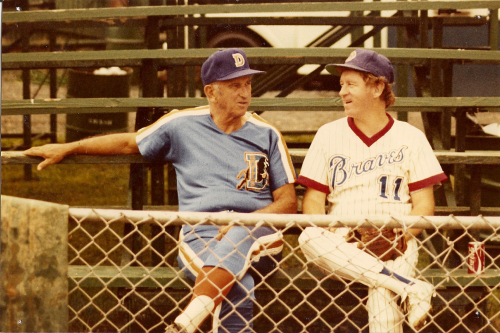
Long after baseball, Red Shuttleworth has had a extensive writing career. To learn more about his writing, visit redshuttleworth.com
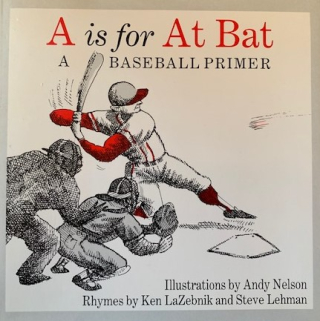
Besides Basepaths, Nelson, Lehman and LaZebnik collaborated on another favorite baseball book of mine: A is for At Bat, A Baseball Primer (1990) a series of short verse. A great way to introduce baseball to your future slugger.
—– EXTENDED BODY: —– EXCERPT: —– KEYWORDS: Minneapolis Review of Baseball, Red Shuttleworth, Winter Baseball Books, Basepaths the Best of the Minneapolis Review of Baseball —– ——– AUTHOR: Murray Browne AUTHOR EMAIL: murray.browne905@gmail.com TITLE: Books Read in 2018 STATUS: Publish ALLOW COMMENTS: 0 CONVERT BREAKS: wysiwyg ALLOW PINGS: 0 BASENAME: books-read-in-2018 UNIQUE URL: https://thebookshopper.typepad.com/the_book_shopper_atlantad/books-read-in-2018.html DATE: 01/26/2019 08:49:53 PM —– BODY:
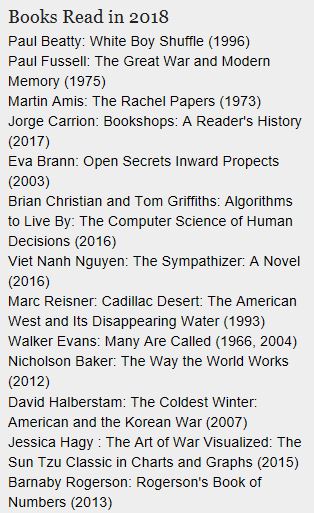
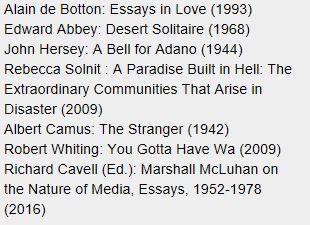
—– EXTENDED BODY: —– EXCERPT: —– KEYWORDS: —– ——– AUTHOR: Murray Browne AUTHOR EMAIL: murray.browne905@gmail.com TITLE: Subscribe to The Book Shopper STATUS: Publish ALLOW COMMENTS: 0 CONVERT BREAKS: 0 ALLOW PINGS: 0 BASENAME: subscribe-to-the-book-shopper UNIQUE URL: https://thebookshopper.typepad.com/the_book_shopper_atlantad/subscribe-to-the-book-shopper.html DATE: 01/21/2019 11:03:31 AM —– BODY: #F13031_sb_container img {max-width:100%} .F13031_sb_fbz_table {border:0;margin:0;border-collapse:separate;table-layout:auto;background-color:inherit !important;} .F13031_sb_fbz_page {margin:0;padding:0;width:100%;background-color:#F8F8F8;} .F13031_sb_fbz_smartform td {display:table-cell;} .F13031_sb_fbz_row td,tr:nth-of-type(even),tr:nth-of-type(odd) {padding-top:0.5em;padding-bottom:0.2em;line-height:1.7em;background-color:inherit!important;} .F13031_sb_fbz_abovelabel, .F13031_sb_fbz_label, .F13031_sb_fbz_div, .F13031_sb_fbz_fieldtext, .F13031_sb_fbz_fieldlabeltext, .F13031_sb_fbz_err {border:0;padding:0.5em;font-family:Verdana, Arial, Helvetica, sans-serif;font-size:14px;} .F13031_sb_fbz_label, .F13031_sb_fbz_abovelabel {color:#000000!important;} #F13031_sb_container a {color:#000000!important} .F13031_sb_fbz_fieldtext, .F13031_sb_fbz_fieldlabeltext {padding-top:0.7em;padding-bottom:0.7em;color:#000000;} .F13031_sb_fbz_fieldlabeltext {color:#000000;} .F13031_sb_fbz_title {line-height:1.3em;padding:0.5em;text-align:center;border:0;font-family:Verdana, Arial, Helvetica, sans-serif;color:#000000;} .F13031_sb_fbz_err, .F13031_sb_fbz_invalid {padding:0.5em;margin:0.5em;color:red;border:3px solid red;background-color:rgba(255,255,255,0.5);font-weight:bold;display:none;} .F13031_sb_fbz_invalid {color:#F80;border:3px solid #F80;} .F13031_sb_fbz_palette, .F13031_sb_fbz_fielddef, .F13031_sb_fbz_input_container, .F13031_sb_fbz_input {padding:0.5em;line-height:1.7em;background-color:#FFFFFF!important;color:#000000 !important;border:1px solid #AAAAAA;border-radius:4px;-moz-border-radius:4px;font-family:Verdana, Arial, Helvetica, sans-serif;font-size:14px;margin-right:2px;} .F13031_sb_fbz_input_container {border:0;padding-left:0;padding-top:0;padding-bottom:0;margin-right:4px;background-color:inherit!important;} .F13031_sb_fbz_button[type=”button”], .F13031_sb_fbz_button {padding:0.5em;line-height:1.7em;background:#E0E0E0;background-color:#E0E0E0;background-image: -webkit-gradient(linear, left top, top bottom, from(#E0E0E0), to(#ffffff));background-image: -webkit-linear-gradient(top, #E0E0E0, #ffffff);background-image: -moz-linear-gradient(top, #E0E0E0, #ffffff);background-image: -ms-linear-gradient(top, #E0E0E0, #ffffff);background-image: -o-linear-gradient(top, #E0E0E0, #ffffff);background-image: linear-gradient(top, #E0E0E0, #ffffff);color:#000000 !important;border:1px solid #AAAAAA;border-radius:4px;-moz-border-radius:4px;font-family:Verdana, Arial, Helvetica, sans-serif;font-size:14px;text-align:center;margin:0.2em;cursor:pointer;} .F13031_sb_fbz_button[type=”button”]:hover, .F13031_sb_fbz_button:hover {background:#ffffff!important;transition: background-color 0.5s ease;} .F13031_sb_fbz_button[type=”button”]:active, .F13031_sb_fbz_button:active {background:#cfcfcf!important;transition: background-color 0.5s ease;} .F13031_sb_fbz_button[disabled=disabled], .F13031_sb_fbz_button[type=”button”]:disabled, .F13031_sb_fbz_button[type=”button”]:disabled:focus, .F13031_sb_fbz_button[disabled]:disabled,.F13031_sb_fbz_button[disabled],.F13031_sb_fbz_button:disabled,.F13031_sb_fbz_button:disabled:focus {opacity:0.5;transition: background-color 0.5s ease;} .F13031_sb_fbz_footer {padding:0.5em;line-height:1.7em;color:#000000 !important;font-family:Verdana, Arial, Helvetica, sans-serif;font-size:14px;text-align:center;border:0;} .F13031_sb_fbz_row:hover {background: rgba(251,248,231,0.5)!important;-o-transition: all 0.1s ease-in-out;-webkit-transition: all 0.1s ease-in-out;-moz-transition: all 0.1s ease-in-out;-ms-transition: all 0.1s ease-in-out;transition: all 0.1s ease-in-out;} .F13031_sb_fbz_row_nohover:hover {background:transparent;} .F13031_sb_fbz_form {border:4px solid #EEEEEE;background-color:#FFFFFF;border-radius:20px;-moz-border-radius:20px;overflow:hidden;padding:0;line-height:1.3em;font-family:Verdana, Arial, Helvetica, sans-serif;font-size:14px;} .F13031_sb_fbz_form div {font-family:Verdana, Arial, Helvetica, sans-serif;font-size:14px;line-height:1.3em;} .F13031_sb_fbz_form tbody {border:0;padding:0;margin:0;font-family:Verdana, Arial, Helvetica, sans-serif;font-size:14px;} .F13031_sb_fbz_form td {border:0;margin:0;font-family:Verdana, Arial, Helvetica, sans-serif;font-size:14px;} @media only screen and (max-width: 420px) {.F13031_sb_fbz_label{display:none !important;padding:0 !important;} .F13031_sb_fbz_abovelabel{display:block;} .F13031_sb_fbz_tabcell {display:block!important;}}
|
|||||||||||||



 Dear Blog Readers:
The Book Shopper blog – now in its 10th year — is in the process of changing how we maintain contact with our small but fiercely loyal group of readers. There are two reasons for the change: a.) Facebook has become tiresome for several reasons — even though we will maintain a limited presence on that platform and b.) we are migrating from Feedburner to Feedblitz to manage subscriptions. Just a better experience for all concerned.
What this means
Not much except you may receive an email asking you to re-subscribe or if you don't receive a notification and want to make sure you continue to get a couple of book-related postings a month, just go to the link on thebookshopper home page (marked in the screenshot). Of course, the subscriber list is not for sale in the likely-as-an-asteroid-hitting-the-earth chance that someone would be interested in such a transaction. But don't think for a moment that we don't appreciate and value your readership.
—– EXTENDED BODY: —– EXCERPT: —– KEYWORDS: —– ——– AUTHOR: Murray Browne AUTHOR EMAIL: murray.browne905@gmail.com TITLE: Best Books Read in 2018 STATUS: Publish ALLOW COMMENTS: 1 CONVERT BREAKS: wysiwyg ALLOW PINGS: 0 BASENAME: best-books-read-in-2018 CATEGORY: Best Books Read 2017-2023 UNIQUE URL: https://thebookshopper.typepad.com/the_book_shopper_atlantad/2018/12/best-books-read-in-2018.html DATE: 12/26/2018 07:36:52 AM —– BODY:
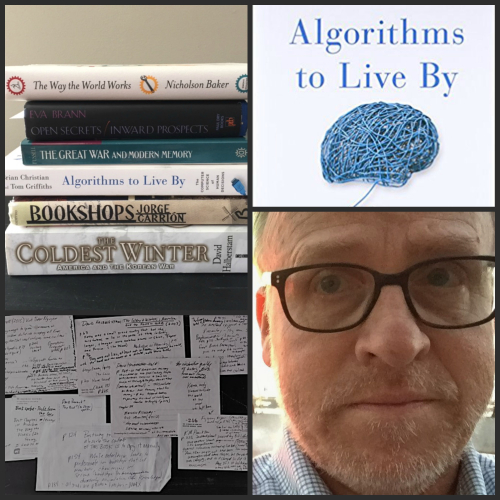
"The best way to absorb the contents of the book is to copy it manually." – Jorge Carrión
Instead of focusing on the best books published in 2018, my tradition is to revisit the best books I read in 2018. To do this I pull out a year's worth of scribbling on notecards that have been repurposed from a variety of sources. These might include promotional postcards from restaurants, travel postcards, etc.
Moreover, if I add a page number to my notes, it works as an index, does it not? Upon completion, I either stick the card in the book for future reference or place it in a card file.
This method looks better than using a highlighter or a pen to mark up the book and when I revisit the cards, it’s like getting a brief refresher on what I read. (The complete list of what I read, examined, skimmed and studied can be found in the right margin of The Book Shopper home page. ) I like to think of it as an eclectic list, but I did discover some shared themes. Here are some topics that emerged. I have embedded some links to relevant earlier postings as well.
Slow-reads. Last year, Doublethink/Doubletalk: Naturalizing Second Thoughts & Twofold Speech (2016) by Eva Brann made the list. This year I am moseying through her earlier and similar book Open Secrets/Inward Prospects: Reflections on World and Soul (2003). This book of aphorisms ranging from travel to ethics to conduct to passion to kookiness breaks the postcard model, so I enter my favorites into a Mead bound notebook. In an ever maddening world (note my worrisome facial expression) Brann offers a seamless mix of wisdom, humor, and philosophy.
A little less demanding but equally entertaining and thought provoking was Algorithms to Live By: The Computer Science of Human Decisions (2016) by Brian Christian and Tom Griffiths, which I wrote about here. What makes this book doubly appealing is that it uses computer science as a launching point to discuss how the logic of computing can assist our human thought processes as we try to manage daily problems.
 Vietnam Books (plus). In 2017, the toughest book to read in length and just general sadness on the destruction and waste in Vietnam was Neil Sheehan’s: A Bright Shining Lie: John Paul Vann and America in Vietnam (1988), which I wrote an essay about for the Tropics of Meta blog. This year, I followed up the experience via two books: Viet Thanh Nguyen's novel The Sympathizer (2016), and David Halberstam's The Longest Winter: America and the Korean War (2008). Admittedly, I am not much of a fiction reader, but as I wrote earlier the Nguyen book is "cutting, emotional, funny and relevant." In the case of the latter, the Korean War was a precursor to the Vietnam war in some respect. The need to stop Communism (North Korea backed by China) from overrunning South Korea and threatening Japan, troops had to be sent in immediately. In Vietnam – though this was the same rationale — the Viet Cong and North Vietnamese in the beginning were more interested in ridding their homeland of colonialists (the French and the United States ) than adhering to Communist doctrine. Like all wars, there was such a waste of lives of combatants and noncombatants alike, but somehow Vietnam when compared to Korea was much worse. A complete essay about the Halberstam book appears in the Tropics of Meta blog as well.
Books about Books. Several books that I read in 2018 fall into this broad category. One of the more obvious is Jorge Carrión's Bookshops A Reader's History (2017), which received a blog shout out last month and another is Paul Fussell's The Great War and Modern Memory (1975), which I read in part after revisiting some books about World War I in remembrance of Armistice Day. Fusssell deep dives into the literature and poetry of The Great War, which is the first major war where the combatants were somewhat educated. And finally, an honorable mention goes Nicholson Baker's The Way the World Works: Essays (2012) which includes his musings on how he keeps track of his favorite passages using his dot method, which I am including below. (Click on the photo to improve readability)
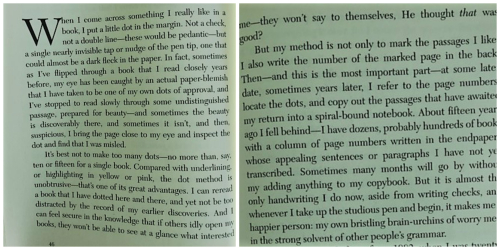
—– EXTENDED BODY: —– EXCERPT: —– KEYWORDS: Best Books 2018, David Halberstam, Eva Brann, Nicholson Baker, Jorge Carrion —– ——– AUTHOR: Murray Browne AUTHOR EMAIL: murray.browne905@gmail.com TITLE: Return from the City of Books STATUS: Publish ALLOW COMMENTS: 1 CONVERT BREAKS: 0 ALLOW PINGS: 0 BASENAME: return-from-the-city-of-books CATEGORY: Bookstores UNIQUE URL: https://thebookshopper.typepad.com/the_book_shopper_atlantad/2018/12/return-from-the-city-of-books.html DATE: 12/11/2018 08:23:31 AM —– BODY:
Despite not being in Jorge Carrión’s list of notable bookshops (see previous posting), Portland, Oregon or should I say Powell’s Books is known unto itself as the City of Books. While making our second visit to Portland, we decided ahead of time that we would at least try to go beyond the Powell’s influence and look for other book places of interest.
Denise and I did spend some time in the architecturally impressive Portland City Library. They were having their Friends of the Library holiday sale, and I had to resist picking up a replacement copy of The Sympathizer (2016). And they had literary socks, if I wanted them. We enjoyed the Beverly Cleary Library Room – a book room that has low shelves of children’s books wonderfully displayed along with a large tree sculpture. I had forgotten that Cleary had grown up in Portland and her Ramona books, which both my daughters read vociferously, were set in Portland. Dana Lynn Louis and Barbara Eiswerth designed the sculpture for “teaching children another way of living.”

We also went to Oblation Papers & Press to look at stationary, vintage typewriters and their letter press printing machines.
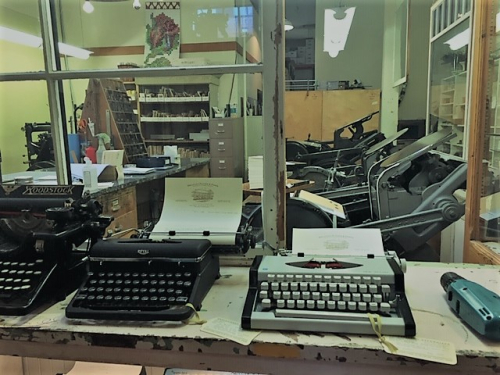
Denise and I also stayed at the historic Heathman Hotel, which prides itself on its reading room where signed first editions from writers who have stayed there filled the shelves. Since I always travel with a copy of Down & Outbound: A Mass Transit Satire, I debated to sneak it onto the shelves, but refrained.
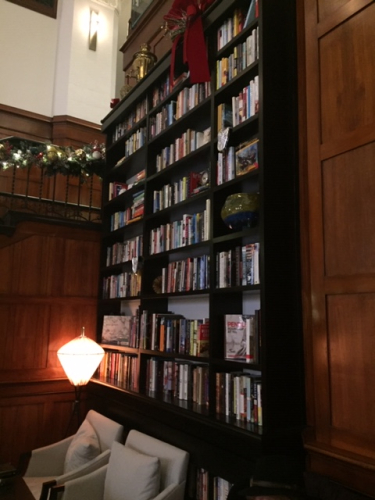
Inside the High-Rise at the City of Books
On the trip I brought a list of books I wanted to review firsthand. Online shopping is no substitute for browsing and I ended up purchasing several books: W.B. Sebald’s Austerlitz, (2001) which Carrión wrote about extensively in his book, a David Shields book of essays, Other People: Takes & Mistakes (2017) and Paul Beatty’s White Boy Shuffle (1996). Shields is one of my favorite writers and reading more Beatty has been on my radar ever since I read The Sellout. I am currently reading White Boy Shuffle and it does not disappoint. You can really tell the difference in the prose when the writer began as a poet. (See the posting about Beatty and Viet Thanh Nguyen’s The Sympathizer.)
Wisely, I did not leave my copy of Down & Outbound at the Heathman. Powell’s has a section for small presses, and I was able to chat with the curator of that section, who warily accepted a copy of D & O for evaluation. I made it as easy as possible for him, leaving him with a self-addressed, Christmas stamped postcard with a quick survey. On the back of the postcard, the curator could check all the boxes that applied:
____ I like D & O as it is and would be interested in stocking it..
____ If D & O had conventional binding I would have been interested in stocking it.
____ I like/ appreciate D & O, the book and idea but not for Powell’s
____ I don’t think this book does not work for me.
Since returning, I’ve been running out to the mailbox every day, but I wonder if it is a futile exercise considering that the Atlanta United defeated the Portland Timbers 2-0 in the Major League Soccer championship. (People in Portland were politely quizzing me about it throughout our visit.) No hard feelings, Portland. Remember you’re still a much, much better book town than Atlanta.
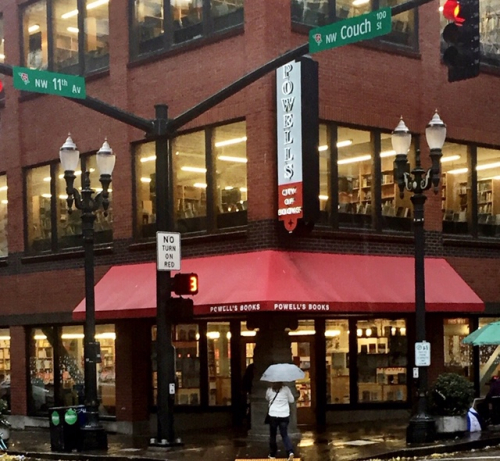
Postscript
UPDATE: January 19, 2019 – Much to my delight I received the aforementioned postcard from Powell’s and though the curator checked the following, I do appreciate getting a response, which I interpret as either a semi-rejection or partial victory depending on my frame of mind
____ I like D & O as it is and would be interested in stocking it..
___X_ If D & O had conventional binding I would have been interested in stocking it. _X__ I like/ appreciate D & O, the book and idea but not for Powell’s ____ I don’t think this book works for me.
—– EXTENDED BODY: —– EXCERPT: —– KEYWORDS: Powell’s, Portland City of Books, Heathman Hotel, Beverly Cleary Library Room, —– ——– AUTHOR: Murray Browne AUTHOR EMAIL: murray.browne905@gmail.com TITLE: Bookshops from Around the World STATUS: Publish ALLOW COMMENTS: 1 CONVERT BREAKS: wysiwyg ALLOW PINGS: 0 BASENAME: bookshops-from-around-the-world CATEGORY: Book Reviews CATEGORY: Bookstores UNIQUE URL: https://thebookshopper.typepad.com/the_book_shopper_atlantad/2018/11/bookshops-from-around-the-world.html DATE: 11/25/2018 07:08:59 AM —– BODY:
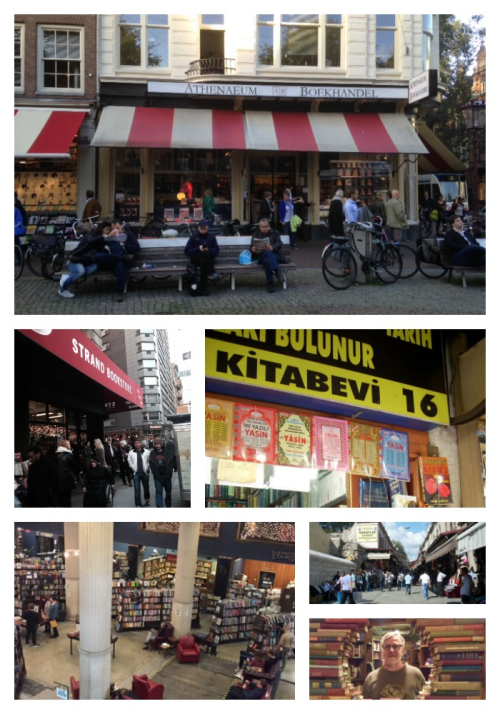 I recently finished reading Jorge Carrión's Bookshops: A Reader's History (2016), a browser's voyage of bookshops from around the world. The voyage includes a passage through time since some of the bookshops cease to exist except in the author's memory. I am not much of a world traveler, but I have shopped in four of Carrión's favorites. Shown above from the top: Athenaeum Amsterdam, two scenes from the book bazaar in Istanbul, two photos from Last Book Store in Los Angeles and The Strand in New York.
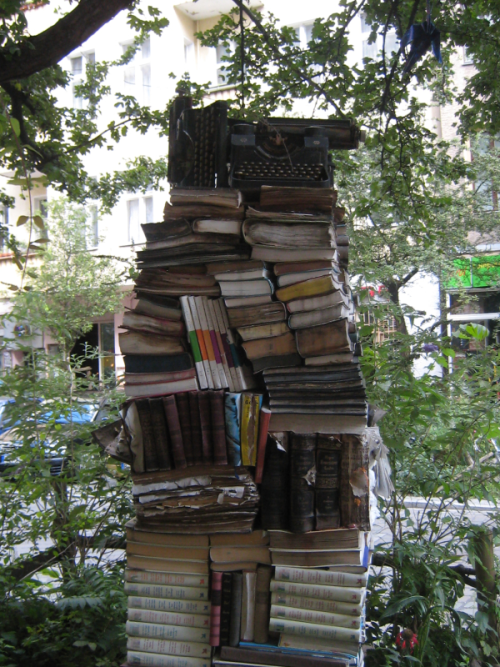 To best enjoy this book (a gift from my older daughter Cynthia who lives in Germany and provided this photo adjacent Another Country in Berlin's Kreuzberg district, a used bookstore mentioned Carrión's book ) you might want to utilize a browsing (not skimming) frame of mind since it is unlikely you are familiar with many of the international writers and historical references that Carrión writes about. When this happens, just take your time and shuffle along to the next paragraph, remembering one of the author's truisms: "While orderliness tends to predominate in bookshops that sell new books, chaos reigns in second-hand shops: the disorderly accumulation of knowledge."
,
—– EXTENDED BODY: —– EXCERPT: —– KEYWORDS: Bookshops: A Reader’s History, Jorge Carrión, bookstores from around the world, Istanbul, Los Angeles, New York, Amsterdam —– ——– AUTHOR: Murray Browne AUTHOR EMAIL: murray.browne905@gmail.com TITLE: Five Notable Books About The Great War STATUS: Publish ALLOW COMMENTS: 1 CONVERT BREAKS: wysiwyg ALLOW PINGS: 0 BASENAME: five-notable-books-about-the-great-war UNIQUE URL: https://thebookshopper.typepad.com/the_book_shopper_atlantad/2018/11/five-notable-books-about-the-great-war.html DATE: 11/16/2018 07:16:46 AM —– BODY: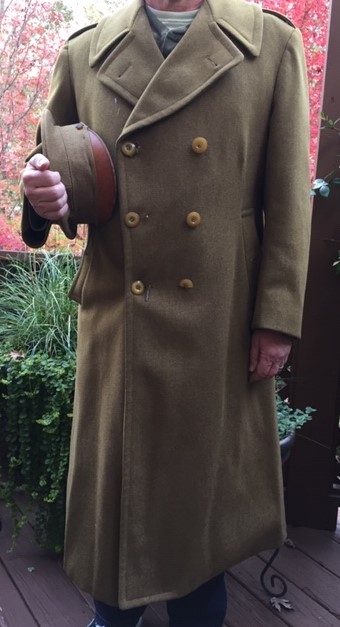 For me, World War I isn’t an event remembered once a century, it was something I grew up with since both of my grandfathers fought in The Great War. Captain Glenn R. Browne was in the 35th Division over in France and my mother’s father Sergeant Harry D. (Pete) Burtis, I believe, fought in Mexico with the 129th Infantry Co. B. (Yes, we’ve been sending troops to the border for a long time.) Twenty years ago, I had a uniform, hat and binoculars of theirs permanently sealed in a museum-quality frame which hangs in my study. I even have a long wool coat that belong to some member of my father’s family, which is in excellent shape as well. My grandmother gave me a bound copy of The Stars and Stripes dating from February 8, 1918 to June 13, 1919.
With my lifelong interest in mind, I would like to share with you five books about World War I that are amazing works of scholarship and readability:
British novelist Pat Barker’s Regeneration Trilogy, a set of three historically-based novels Regeneration (1991), The Eye in the Door (1993) and The Ghost Road (1995) which covers the war’s effects in Great Britain as well as life on the battlefront. I did a short shout out to her in my book of essays, The Book Shopper: A Life in Review (2009), but you can get a quick sense of the books in this article from The Guardian.
Modris Ecksteins' The Rites of Spring: The Great War and the Birth of the Modern Age (1989) put the war in a larger context of how it came about, explains the mindset that led to trench warfare and millions of casualties, and ultimately paved the way to the Second World War II and millions of more casualties. Here’s the original review from The New York Times and a short tribute from a 2014 blog posting. I re-read the book in preparation of a trip to Belgium.
Historian Alastair Horne’s The Price of Glory (1962) an in-depth horrific account of the Battle of Verdun. It was one of my father’s favorite books, and for years I hung on to it. I finally read it and wrote about it here in a 2016 blog posting. My biggest regret is that I never was able to discuss it with him.
Going through this list reminded me that I still haven’t read another classic on the topic, Paul Fussell’s The Great War and Modern Memory. I’ll keep you posted.
—– EXTENDED BODY: —– EXCERPT: —– KEYWORDS: Books about the Great War. Books about World War I, Modris Ecksteins Alastair Horne’s, Pat Barker, Regeneration —– COMMENT: AUTHOR: Jim Adams EMAIL: booksagain@bellsouth.net IP: 68.217.0.32 URL: DATE: 11/17/2018 06:07:49 AM Thumbs up to the Pat Barker trilogy. She is a really fine writer. —– ——– AUTHOR: Murray Browne AUTHOR EMAIL: murray.browne905@gmail.com TITLE: Backlog #2: Words to Live By STATUS: Publish ALLOW COMMENTS: 1 CONVERT BREAKS: wysiwyg ALLOW PINGS: 0 BASENAME: backlog-2-words-to-live-by CATEGORY: Book Reviews UNIQUE URL: https://thebookshopper.typepad.com/the_book_shopper_atlantad/2018/10/backlog-2-words-to-live-by.html DATE: 10/27/2018 08:52:01 AM —– BODY:
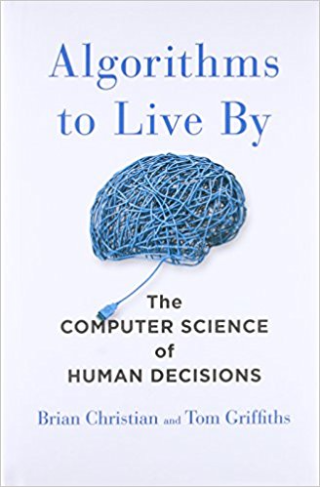 The most noticeable outlier of my Books Read in 2018 list, which is viewable on the blog’s home page, is Brian Christian and Tom Griffith’s Algorithms to Live By: The Computer Science of Human Decisions (2016). This book also caught my attention in the June/July Believer issue (see previous posting about Viet Thanh Nguyen’s 2106 novel The Sympathizer) in a dialogue between journalist Jessica Bruder and computer scientist David Blei. One of their main topics was how artificial intelligence and robots will affect the future of work. In the article Blei mentioned Algorithms to Live By as a book that is “very clear and it’s technically correct, but it’s not technical.” Relevant for me, especially since I am being asked more and more in my day job to assess auto tagging applications, which have a machine learning (artificial intelligence) component.
But what makes this book doubly appealing is that it uses computer science as a launching point to discuss how the logic of computing can assist our human thought processes as we try to manage daily problems.
Each chapter applies one of the fundamentals of computer science to day-to-day decision making. The chapters are: Optimal Stopping – When to Stop Looking; Explore/Exploit – The Latest vs the Greatest; Sorting – Making Order; Caching – Forget about It; Scheduling – First Things First; Bayes’s Rule – Predicting the Future; Overfitting – When to Think Less; Relaxation – Let it Slide; Randomness – When to Leave it to Chance; Networking – How We Connect; and Game Theory – The Minds of Others.
Here are a few examples of relevant quotes gleaned from my notes that I keep on the backs of postcards stuffed in the book.

“Exploration in itself has value since trying new things increases our chances in finding the best…In the long run, optimism is the best prevention for regret…If you’re a baby, putting every object in the house in your mouth is like studiously pulling all the handles at the casino.” (Chapter 2: Explore/Exploit). I know now that when my baby grandchildren put things in their mouth they are just doing some basic classification of the world placing all objects in two simple categories – Things I can fit in my mouth and the things I cannot fit in my mouth.
“Much as we bemoan the daily rat race, the fact that it’s a race than a fight is a key part of what sets us apart from the monkeys, the chickens–and for that matter the rats.” (Ch. 3: Sorting) Getting to and from work in Atlanta is pure rat race.
“It is really true that the company will build whatever the CEO decides to measure.” (Ch. 7 Overfitting) I thought of this when I am asked to produce Key Performance Indicators (metrics) at work.
“We use the idiom of ‘dropped balls’ almost exclusively in a derogatory sense implying that the person in question was lazy, complacent, or forgetful. But the tactical dropping of balls is a critical part of getting things done under overload. “(Ch. 10 Networking) Hmmm. An excuse worth considering next time I miss a deadline — such as catching up on my posting backlog.
—– EXTENDED BODY: —– EXCERPT: —– KEYWORDS: Algorithms to Live By, The computer Science of human decisions, Brian Christian, Tom Griffiths, Jessica Bruder, David Blei —– ——– AUTHOR: Murray Browne AUTHOR EMAIL: murray.browne905@gmail.com TITLE: Backlog #1: Notes on Viet Thanh Nguyen STATUS: Publish ALLOW COMMENTS: 1 CONVERT BREAKS: wysiwyg ALLOW PINGS: 0 BASENAME: backlog-1-notes-on-viet-thanh-nguyen CATEGORY: Book Reviews UNIQUE URL: https://thebookshopper.typepad.com/the_book_shopper_atlantad/2018/10/backlog-1-notes-on-viet-thanh-nguyen.html DATE: 10/07/2018 09:15:14 AM —– BODY:
 The Book Shopper Backlog
The last couple months I have seen the backlog of my unpublished postings really pile up. But my alibis are in order: 1.) The Cubs were in the race for the NL pennant again. This was the fourth year that the team has been relevant in October. I have been watching way too much MLB network and reading daily briefs from The Chicago Tribune, but that all came to an abrupt halt. Rockies 2 Cubs 1 in 13 innings. 2.) I’ve suffered a nasty brush with poison ivy. Not as disfiguring as others have suffered from what I hear, but its constant itchiness has messed badly with my sleep and skin. Despite a couple of steroid treatments, I do have a couple of raw patches that on sight can clear a room. 3.) General malaise from being too busy at my day job (there is no compensation in blogging). Writing is more of a habit or a practice than anything else and once you fall out of it, it takes maximum effort to get “back to the gym.”
Backlog #1
Notes on Viet Thanh Nguyen’s – The Sympathizer (2016)
The book came on my radar via Believer magazine. I have been a subscriber reading this McSweeney’s publication for over a decade and I have all the issues dating back to 2008 even though sometimes the magazine has gone on hiatus and magazine subscription management has been questionable. McSweeney’s has introduced me to new writers and thinkers such as Rebecca Solnit..
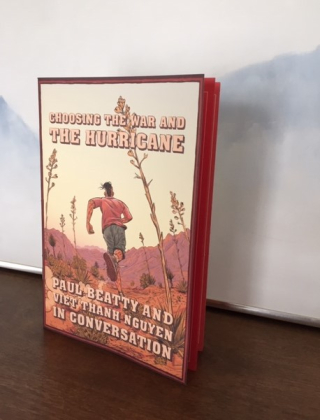 In the June/July 2018 issue, the editors included a pullout pamphlet featuring a conversation between Paul Beatty and Viet Thanh Nguyen. Beatty is the author of The Sellout, an important satirical novel about race which I thoroughly appreciated on several levels and Viet Thanh Nguyen wrote The Sympathizer, a novel where the main character is a Viet Cong sympathizer who is embedded into South Vietnamese/American regime. Nguyen's narrator not only gives a vivid account of leaving Vietnam during the last days before the fall of Saigon, but he also offers biting commentary on America’s attempt to sweep its defeat and the hundreds of thousands of Vietnamese refugees under the rug. Both books are cutting, emotional, funny and relevant. It underscores that we have not come very far on attitudes towards immigration and assimilation in America. Here are my indecipherable reading notes that I kept on the back of a retro Vietnamese political postcard.
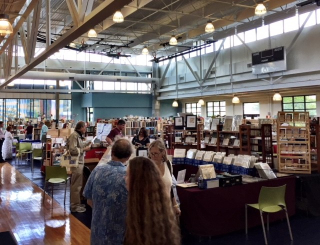 The Georgia Book and Paper Fair is a few blocks away from the Decatur Book Festival, which is currently being held on Saturday, September 1st and Sunday, September 2nd. The event is located at Decatur's Ebster Recreation Center, which is air-conditioned and a welcome relief from the heat and humidity and humanity of the street fair. There were ~30 vendors from around the Southeast including some real book people that are even familiar with this blog. (You don't meet many of those.) I went over after doing my tour of duty as a volunteer on Saturday morning. It's one of the few places where I can wear my Thomas Pynchon-Roz Chast t-shirt.
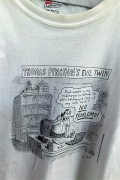
At the Fair, I enjoyed catching up with Jim and Linda at Books Again, Jan and Bob at Atlanta Vintage Books, Megan and Josh from Underground Books, and Andrew at Big River Bindery. All vendors worthy of a shout out.
—– EXTENDED BODY: —– EXCERPT: —– KEYWORDS: Georgia Book and Paper Fair, #DBF2018 —– ——– AUTHOR: Murray Browne AUTHOR EMAIL: murray.browne905@gmail.com TITLE: Western Immersion STATUS: Publish ALLOW COMMENTS: 1 CONVERT BREAKS: wysiwyg ALLOW PINGS: 0 BASENAME: western-immersion UNIQUE URL: https://thebookshopper.typepad.com/the_book_shopper_atlantad/2018/08/western-immersion.html DATE: 08/20/2018 07:18:29 AM —– BODY:
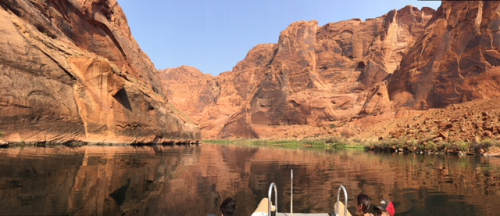
Denise and I recently returned from a 10 day swing through the National Parks of Bryce, Glen Canyon, Grand Canyon (North Rim) and Zion. In addition to the amazing scenery, hikes, raft trips, jeep rides and afternoon gin-'n-tonics, we did do some book reading and book shopping. Our audio book accompaniments included Nevada Barr's The Rope, a 2013 book set in the Glen Canyon Recreational Area and the orchestral soundtrack of the 1960 film The Magnificent Seven. provided by Denise's brother Michael.
I brought along the classic 1993 narrative on the water problems in West, Marc Reisner's Cadillac Desert: The American West and Its Disappearing Water. Outside of Zion, our jeep tour guide reiterated some of the problems Reisner predicted when the population far exceeds the annual rainfall to support it. (It's a desert, people!) I saw the book available in most national park bookstores. Since I left my copy in a motel room, I will have to pick up another copy in order to finish it.
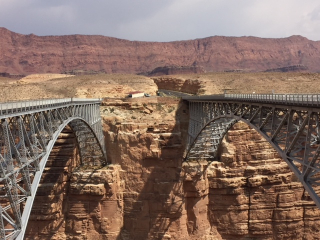 One of the better bookstores was the visitor center bookstore at Navaho Bridge in Marble Canyon, Arizona where a dual steel span bridge crosses the Colorado River. Denise purchased Ellen Meloy's The Anthropology of Turquoise: Reflections on Desert, Sea, Stone and Sky (2002) for our neighbor who watered our plants while we were gone and The End of Night: Searching for Natural Darkness in the Age of Artificial Light (2013) by Paul Bogard. In Page, Arizona, we picked up a copy of Gary Ladd's pictorial Lake Powell Unchained An Authorized Guide to Preposterous Lake (2011) at the quaint John Wesley Powell Museum. In 1869, the one-armed Powell led the first "official" expedition down the Colorado and was a visionary – albeit somewhat disregarded – who proposed regulating water rights by watersheds instead of regulating by state boundaries. (Powell is still revered and his descendants do their family reunions on the river).
 Outside of Zion National Park in Springdale, Utah we stopped at the Worthington Gallery and picked up two books of black and white woodcuts by Royden Card. One book was The Alphabet in Woodcut for our grandson Myrick's upcoming birthday and the other was a book of visual and verbal sketches entitled Desert Dawn (2003).
It wasn't until I arrived back home that I realized that I had left the Reisner book in the motel room. (I can replace the book, but my reading notes on the back of a Glen Canyon Dam postcard are gone forever.) It turned out that it was a somewhat fortunate happenstance since my suitcase weighed in at the checkout counter at 48 pounds and six ounces. No doubt the lengthy Reisner book on this "heavy" subject would have pushed me over the my weight limit.
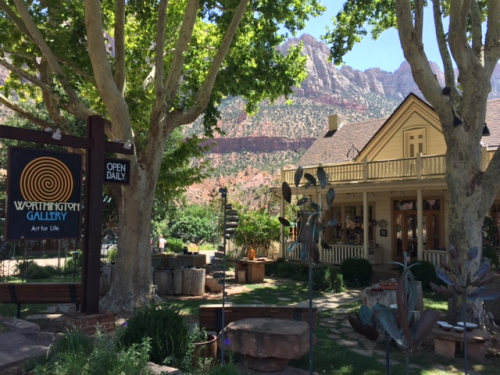
—– EXTENDED BODY: —– EXCERPT: —– KEYWORDS: Marc Reisner, Cadillac Desert, Royden Card, Worthington Gallery, Gary Ladd, —– ——– AUTHOR: Murray Browne AUTHOR EMAIL: murray.browne905@gmail.com TITLE: Sharing the Dog Days of Summer with David Halberstam STATUS: Publish ALLOW COMMENTS: 1 CONVERT BREAKS: wysiwyg ALLOW PINGS: 0 BASENAME: dog-days-of-summer-with-david-halberstam UNIQUE URL: https://thebookshopper.typepad.com/the_book_shopper_atlantad/2018/08/dog-days-of-summer-with-david-halberstam.html DATE: 08/07/2018 06:52:44 PM —– BODY:
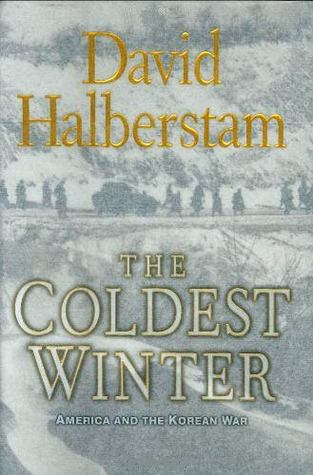 One of my many excuses for not posting in a couple of months is that I had been writing a longer piece for Tropics of Meta, which describes itself as Historiography for the Masses. This political and thought provoking website examines popular culture and current events through an historical lens. Every August they ask readers/contributors to revisit older books in their Dog Days Classics section. Last year, I wrote about Neil Sheehan's A Bright Shining Lie: John Paul Vann and America in Vietnam.
This year my offering is David Halberstam's The Longest Winter: America and the Korean War (2008). Writing longer pieces about certain books and how we react to them is one of the major themes of my The Book Shopper: A Life in Review (2009), which started this whole blog craziness almost ten years ago. But sometimes short postings are not enough to fulfill one's need to write. It is both refreshing and taxing to do something with a little length and thought. Here's hoping that you take time to check out the piece and more importantly want to read the Halberstam book.
Thanks to my partner Denise Casey and the editors of Tropics of Meta for making the essay presentable.
—– EXTENDED BODY: —– EXCERPT: —– KEYWORDS: —– ——– AUTHOR: Murray Browne AUTHOR EMAIL: murray.browne905@gmail.com TITLE: Wolfe and Roth Revisited STATUS: Publish ALLOW COMMENTS: 1 CONVERT BREAKS: wysiwyg ALLOW PINGS: 0 BASENAME: wolfe-and-roth-revisited UNIQUE URL: https://thebookshopper.typepad.com/the_book_shopper_atlantad/2018/06/wolfe-and-roth-revisited.html DATE: 06/09/2018 07:38:23 AM —– BODY: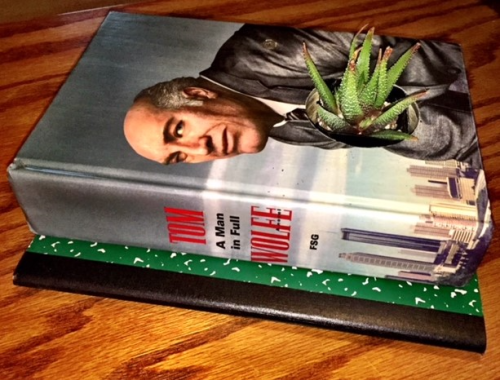
The recent deaths of writers Tom Wolfe and Philip Roth provided me the opportunity to revisit more than just their books and novels, but gave me license to re-examine what I had written about them in The Book Shopper: A Life in Review (2009), this blog's namesake. Rather than force blog readers to order a copy of The Book Shopper on Amazon or wait until I drop a copy in my little neighborhood library, I have posted a few scans of a couple sidebars from The Book Shopper.
Philip Roth
This excerpt is about my longtime friend and collaborator Dave who has been my book shopping mentor since 1979. I am proud to say that Dave and I still keep in touch. He and I even did a brief collaboration on Down & Outbound: A Mass Transit Satire (2016) as well (also available on Amazon). Dave is still a huge Roth fan and below is his account of meeting Roth at a reading in Seattle in 1993.
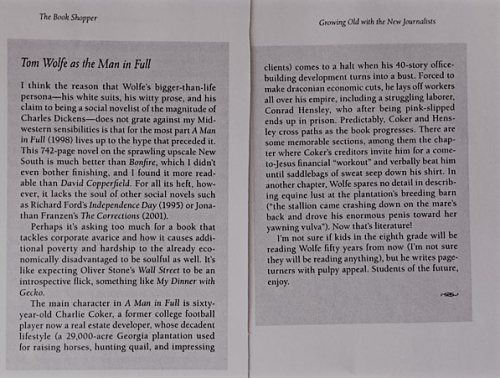
I am not as a big Roth fan as Dave, but I did read Roth's The Plot Against America (2010), which has regained some notoriety because of its haunting similarity to our current political climate. In the novel, the populist Charles Lindbergh is elected President of the United States instead of Franklin Delano Roosevelt and becomes somewhat of a dictator, endorsing the policies Adolf Hitler and removing many civil liberties.
I still have one book on my Roth reading list — The Great American Novel, (1973) which is a whimsical novel about baseball.
Tom Wolfe
I have been reading Tom Wolfe since college in the 1970s and you can still find a tattered paperback of The Electric Kool-Aid Acid Test next to my copy of Kandy-Kolored Tangerine-Flaked Streamlined Baby (1966). My favorite books of his are The Right Stuff (1979) about the Mercury astronauts and the early days of the NASA space program and one of his lesser known works —From Bauhaus to Our House, (1981) his slim primer about twentieth-century architecture.
Now that I live in Atlanta, his A Man in Full (1998) which I read before moving here, has more meaning to me than just as a fancy plant holder.
—– EXTENDED BODY: —– EXCERPT: —– KEYWORDS: Tom Wolfe, Philip Roth, death, The BOok Shopper. Bauhaus, —– ——– AUTHOR: Murray Browne AUTHOR EMAIL: murray.browne905@gmail.com TITLE: History Time for Zoey STATUS: Publish ALLOW COMMENTS: 1 CONVERT BREAKS: wysiwyg ALLOW PINGS: 0 BASENAME: history-time-for-zoey UNIQUE URL: https://thebookshopper.typepad.com/the_book_shopper_atlantad/2018/05/history-time-for-zoey.html DATE: 05/11/2018 06:44:25 PM —– BODY:
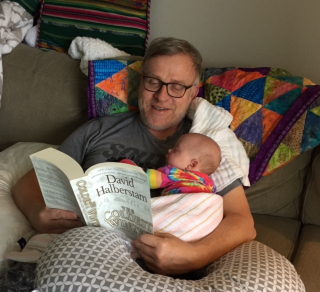 Last year I started reading challenging books to grandson Myrick and now I have a granddaughter Zoey who likes to be read to as well. Here I am sharing David Halberstam's The Coldest Winter: America and the Korean War (2007). Halberstam devotes several background chapters to General Douglas MacArthur the controversial U.S. commander in Korea. Zoey agrees with Halberstam's description of MacArthur as a "mama's boy."
You be the judge:
Of not many American military heroes could it be said that they left home for West Point, their mothers uprooted themselves and moved to that small town on the Hudson. Pinky MacArthur took a room in the best local hotel, Craney's, in order to stand watch over Douglas for four full years at the academy, lest he fall below her expectations and slough off into mediocrity. West Point might been the most rigidly demanding four-year institution in America, but Pinky MacArthur there anyway, just in case the academy's contemporary custodians slipped a bit or did not realize how a remarkable a young man she had bequeathed them.
Zoey rates The Coldest Winter four bottles.




Apparently readers around my adopted Little Library are starved for decent books to read because two days after restocking the library with these offerings, the shelves were empty again.
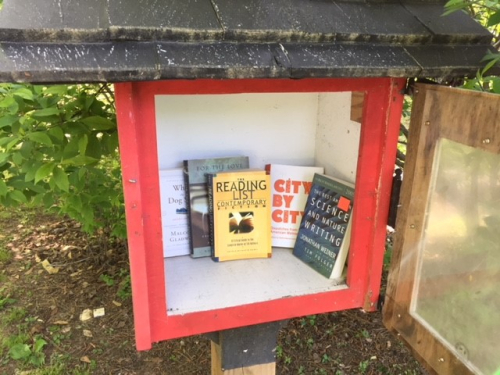
 In a posting from October, 2016 I featured one of the quaint, small libraries in a city park near my house that had fallen in disrepair and suffered from a dearth of books. It's only offering was pro football coach Pete Carroll's treatise on coaching and winning. (Why does it always have to be about winning?) On a recent weekend walk, I noticed that it still suffers a lack of inventory, but at least it has a glass (albeit opaque) protective cupboard door.
As you may recall my partner Denise and I did a purge of books earlier this year, many of which were donated to our local Decatur public library and will be available at the upcoming Friends of the Library sale on Memorial Day Weekend. But I have held a few back to stock my adopted little library. It's adjacent the Glenwood Lake playground and tennis courts and I have selected books that may appeal to bored spectators, whether they are watching children on the monkey bars or a spouse's neverending tennis lesson. Enjoy!
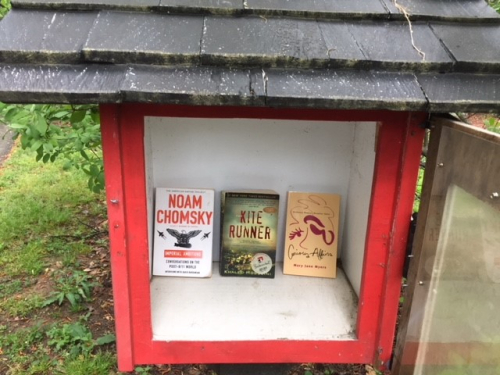
—– EXTENDED BODY: —– EXCERPT: —– KEYWORDS: Little Library, Little Libraries —– ——– AUTHOR: Murray Browne AUTHOR EMAIL: murray.browne905@gmail.com TITLE: Baseball Bedtime Stories STATUS: Publish ALLOW COMMENTS: 1 CONVERT BREAKS: 0 ALLOW PINGS: 0 BASENAME: baseball-bedtime-stories CATEGORY: Baseball UNIQUE URL: https://thebookshopper.typepad.com/the_book_shopper_atlantad/2018/03/baseball-bedtime-stories.html DATE: 03/28/2018 06:51:13 AM —– BODY:
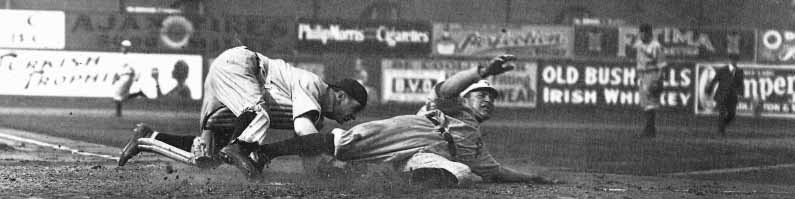
One of the ways I have managed to keep the baseball flames lit in the off season is by revisiting Neal and Constance McCabe’s Baseball’s Golden Age: The Photographs of Charles M. Conlon (1993). I took it off my baseball book shelf after a recent visit to the Joe Jackson Baseball Museum in Greenville and placed it on my nightstand.
One of my favorite anecdotes is the story of Charlie Root, a pitcher for the Chicago Cubs who was known for the being on the
mound when Babe Ruth called his shot in the 1932 World Series. But not so fast! Look at Root’s face, then read the story about Root’s nickname.
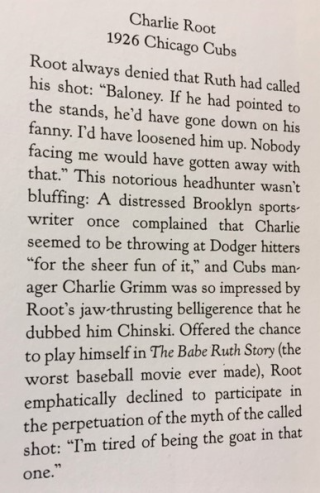
—– EXTENDED BODY: —– EXCERPT: —– KEYWORDS: —– ——– AUTHOR: Murray Browne AUTHOR EMAIL: murray.browne905@gmail.com TITLE: MARTA Book Club #33: In Praise of the Tattered Paperback STATUS: Publish ALLOW COMMENTS: 1 CONVERT BREAKS: wysiwyg ALLOW PINGS: 0 BASENAME: marta-book-club-33-in-praise-of-the-tattered-paperback CATEGORY: MARTA Book Club UNIQUE URL: https://thebookshopper.typepad.com/the_book_shopper_atlantad/2018/03/marta-book-club-33-in-praise-of-the-tattered-paperback.html DATE: 03/17/2018 08:16:19 AM —– BODY:
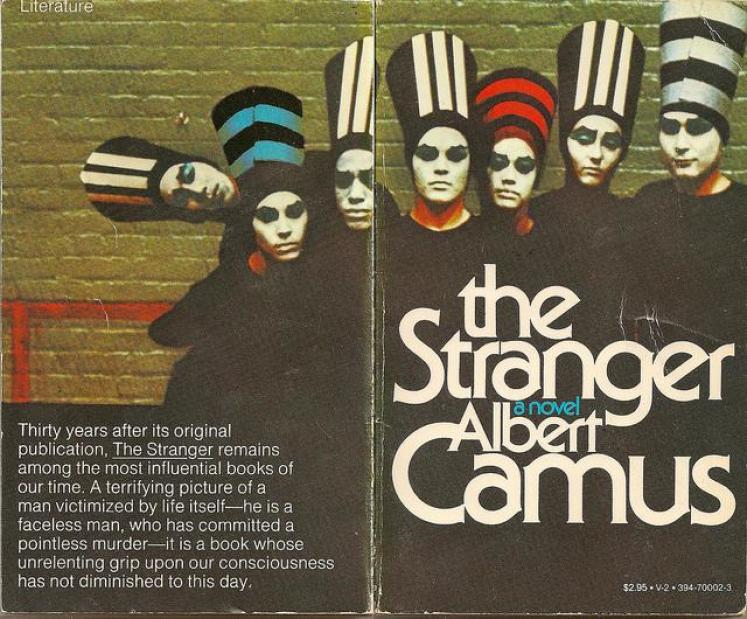
This is a shout out to that tattered paperback — a yellowed time capsule that continues to be in circulation while withstanding the onslaught of E-books and the proliferation of audio books. Unlike more modern fanfare, these evocative paperbacks can bring back memories of our reading youth, do they not?
For my mass transit reading, I prefer the light, feathery disintegrating paperback that is easy to hold like a news magazine or a newspaper. As one who is recovering from carpal tunnel surgery and has developed some chronic ligament damage in the wrist, I have all but abandoned heavier book fare on my MARTA (Metropolitan Atlanta Rapid Transit Authority) commute.
For example in my contributions to this edition of the MARTA Book Club, the club whose sole participatory requirement is to read a book while riding MARTA, I recently finished the ultra- thin Albert Camus' classic, The Stranger (1942) which may be light physically, but a heavyweight in its existential indictment of humanity. And currently I am reading a mass market paperback copy of John Hersey's A Bell for Adano (1944). This is my third Hersey book in the past few years. His writing career expanded over 50 years and he's very underrated as a 20th century American writer.
Another mass market paperback classic that I saw someone reading was Robert Pirsig's The Zen and the Art of Motorcycle Maintenance: An Inquiry in Values (1976). Not surprising, I recognized the book from its almost sepia colored back cover of man, son, and motorcycle all gazing meaningfully at a mountain in the distance. 
Other books spotted recently while riding MARTA include:
The Windup-Bird Chronicle by Haruki Murakami.
Rooster Bar by John Grisham
The Year of Magical Thinking by Joan Didion
How to Raise an Adult: Break Free of the Over Parenting Trap and Prepare Your Kid for Success by Julie Lythcott-Haims
The Subtle Art of Not Giving a F*ck: A Counterintuitive Approach of Living a Good Life by Mark Manson
Gilead by Marilynne Robinson
In the Garden of the Beasts: Love, Terror and an American Family in Hitler's Berlin by Erik Larson
The Romanovs, 1613 -1918 by Simon Sebag Montefiore (Heavy book – you could bludgeon somebody with the 800 page hardback edition)
Go Tell It on the Mountain by James Baldwin
A Paradise Built in Hell: The Extraordinary Communities that Arise in Disaster by Rebecca Solnit. This is a trade paperback that I just finished. Solnit has some fascinating insights about how people and communities really react to disasters in contrast to the misleading portrayals propagated by the movies and the media. Admittedly, it could have used a little editing, because Solnit seemed to bludgeon the topic, but maybe it was lack of this reader's commitment to engage in "heavy reading."
For the previous 32 MARTA Book Club postings, visit here.
—– EXTENDED BODY: —– EXCERPT: —– KEYWORDS: MARTA Book Club, What people read in Atlanta, John Hersey, Get Smart, Rebecca Solnit —– ——– AUTHOR: Murray Browne AUTHOR EMAIL: murray.browne905@gmail.com TITLE: Shoeless Joe Baseball Library STATUS: Publish ALLOW COMMENTS: 1 CONVERT BREAKS: wysiwyg ALLOW PINGS: 0 BASENAME: shoeless-joe-baseball-library CATEGORY: Baseball UNIQUE URL: https://thebookshopper.typepad.com/the_book_shopper_atlantad/2018/02/shoeless-joe-baseball-library.html DATE: 02/25/2018 08:20:48 AM —– BODY:
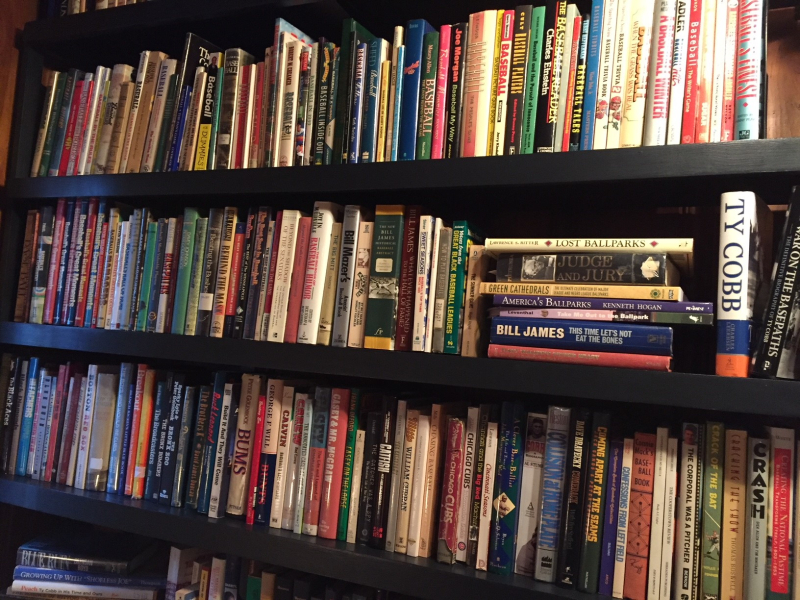
You can cross The Shoeless Joe Jackson Baseball Museum in Greenville, South Carolina off my Let's-Not-Set-the-Bar-Too-High Bucket List. (I think people put a lot of pressure on themselves with exotic Bucket Lists, which can shorten their lives…) Located in Jackson's actual home near the minor league stadium, Fluor Field, the quaint museum is pure bliss for baseball history buffs and those who believe in the magic of the motion picture Field of Dreams — or not.
The knowledgeable and friendly curators were more than willing to field tough questions concerning Jackson's infamous nickname, his culpability in the Black Sox scandal, and the irony of having a baseball library in a player's home who could neither read or write. I could tell you what they said, but you should go and find out for yourself. Be sure and check ahead because the museum is open for a limited number of hours each week, especially in the off-season.
Shown above is just a sample of all the baseball books they have assembled at the Museum. Our guide said that they had so many book donations they had to turn some away. It would be interesting to find out if I had some baseball books on my shelf that they didn't have such as: Flip Flop Fly Ball or Wilfred Sheed's baseball essays, or Confessions from Left Field by Ray Mungo.
That would be a good reason to go back.
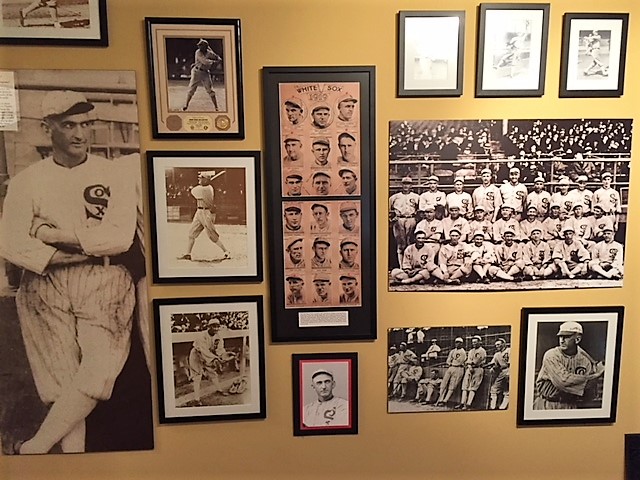
—– EXTENDED BODY: —– EXCERPT: —– KEYWORDS: Shoeless Joe Jackson Baseball Museum, Field of Dreams, Baseball Books, Greenville, South Carolina, tourism —– ——– AUTHOR: Murray Browne AUTHOR EMAIL: murray.browne905@gmail.com TITLE: Weeding the Library STATUS: Publish ALLOW COMMENTS: 1 CONVERT BREAKS: wysiwyg ALLOW PINGS: 0 BASENAME: weeding-the-library UNIQUE URL: https://thebookshopper.typepad.com/the_book_shopper_atlantad/2018/01/weeding-the-library.html DATE: 01/31/2018 06:43:49 AM —– BODY:
"A Weeded Collection is a Used Collection"
This adage comes from one of my favorite professors in library school. Shown here is the approximately 150 books which have been purged from our home library. They include: books we read and liked but won't read again, duplicates, books we are never going to read, books we tried and didn't like. Besides the reduced clutter, another benefit is that you find many books that you forgot you even had, which sets your reading queue for the next few months.
The first delivery stop is the Decatur Public Library. Their Friends of the Library Book Sale is next Saturday, February 3rd. Details here.
—– EXTENDED BODY: —– EXCERPT: —– KEYWORDS: —– ——– AUTHOR: Murray Browne AUTHOR EMAIL: murray.browne905@gmail.com TITLE: Beat Generation Exhibit STATUS: Publish ALLOW COMMENTS: 1 CONVERT BREAKS: wysiwyg ALLOW PINGS: 0 BASENAME: beat-generation-exhibit UNIQUE URL: https://thebookshopper.typepad.com/the_book_shopper_atlantad/2018/01/beat-generation-exhibit.html DATE: 01/24/2018 07:08:31 AM —– BODY:
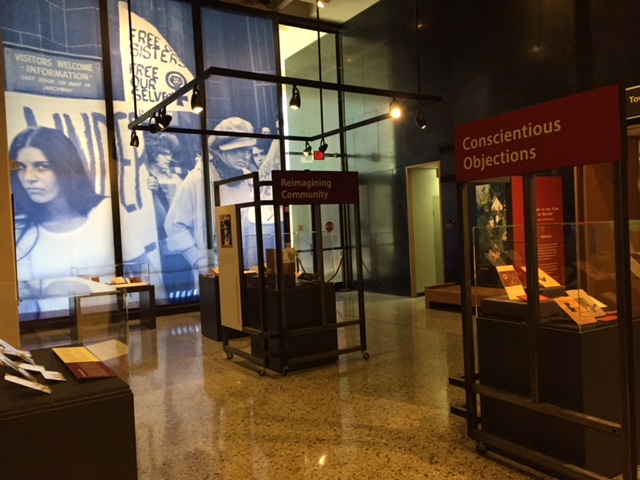
The Dream Machine: the Beat Generation & the Counterculture, 1940 -1975 which is currently on exhibit at the Robert Woodruff Library on the Emory University campus grabbed my attention in unexpected ways when I visited last month. As a baby boomer, I knew some of the basics about the beats – Allen Ginsberg, Jack Kerouac, Lawrence Ferlinghetti, and William S. Burroughs, but I will admit that I have hardly read them. I have not even read Kerouac’s On the Road or The Dharma Bums nor could I finish The Subterraneans. However, one passage of Kerouac’s prose always comes mind when I cross-paths with a person who is that rare combination of energy and wackiness:
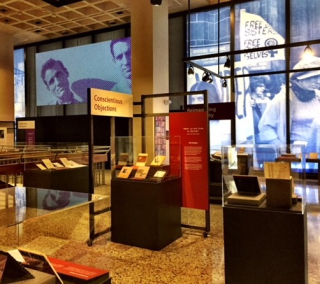 Part of the Dream Machine exhibit is the collection of little hand printed booklets, newsletters in Courier type, mimeographs in that nasty blue ink, and small press runs of poetry books. These still live today as zines and poetry chap books and high-tech sophisticated blogs. What made this exhibit more personally enjoyable is my memories as a youth in high school, college and even post-college typing up little satires and photocopying and distributing them to friends. I have a few of them buried in my file cabinet. Potentially embarrassing, perhaps, but I won’t throw them away. The desire to write and publish runs deep and you could even say that my latest effort Down & Outbound: A Mass Transit Satire was spawned from this same do-it-yourself creative mentality.
The Dream Machine: the Beat Generation & the Counterculture, 1940 -1975 runs until May 15, 2018. One of the best ways to view it is go on the weekends. Parking is free at the Fishburne Parking Deck and the eclectic Carlos Museum Book Shop is open on Saturday and Sunday too. The little book store may even still have a copy of Down & Outbound back in their remainders section. Hurry while supplies last.
—– EXTENDED BODY: —– EXCERPT: —– KEYWORDS: The Dream Machine: the Beat Generation & the Counterculture, 1940 -1975, Jack Kerouac, Down & Outbound, Emory University, exhibits —– COMMENT: AUTHOR: Ian Joyce EMAIL: IP: 45.36.250.170 URL: http://profile.typepad.com/joyceian DATE: 01/25/2018 02:12:51 PM Interesting. I find the history of the Beats a lot more interesting than their creative output, though I am a fan of On the Road and some of the poetry. —– COMMENT: AUTHOR: Murray Browne EMAIL: IP: 73.184.84.184 URL: http://profile.typepad.com/1227802374s31410 DATE: 01/26/2018 07:37:30 AM I am the same. Read more ABOUT them than actually reading them though I do remember browsing thru Lawrence Ferlinghetti’s book of poems Coney Island of the Mind, while in high school, which is so unlike me. —– ——– AUTHOR: Murray Browne AUTHOR EMAIL: murray.browne905@gmail.com TITLE: Celebrating the 400th Posting STATUS: Publish ALLOW COMMENTS: 1 CONVERT BREAKS: wysiwyg ALLOW PINGS: 0 BASENAME: celebrating-the-400th-posting UNIQUE URL: https://thebookshopper.typepad.com/the_book_shopper_atlantad/2018/01/celebrating-the-400th-posting.html DATE: 01/09/2018 06:48:14 AM —– BODY:
Begun in November 2008, the Book Shopper blog has had tweaks in format and content, but has stayed true to its main purpose, a personal outlet about my interest in books and book culture. Originally, it concentrated on the metropolitan Atlanta "literary" scene, but that quickly became a tedious exercise, because the majority of book-related events have tended to be dull and formulaic. (Culturally, football dominates in Georgia, in case you are wondering.) Besides, these days, for many writer events you have to pay an admission or buy the book ahead of time.

However, I have been able to enjoy the company of some local book people along the way and had brushes with some bigger names. The latter have included author William Chatterton Williams (I was there when he shared the stage with the rapper Killer Mike), New York Times columnist Rob Walker, photographer Emily Berl, and filmmaker James Benning, who allowed me to host his Unabomber Library photos in the blog, and these accounts for at least half of my search engine traffic. (Anarchists are trending.) One of my favorite writers, David Shields, and publisher Paul Dry have also graced the blog. If you want to read more about these encounters, just type any of these names into the blog's search bar. And to view highlights of the first 300 postings, visit here.
Perhaps the best thing to come out of the blog is that it has kept me writing over the years and it provides a kind of archive of what I have been experiencing in my personal reading life. Accompanying me on this journey has been my longtime partner, Denise Casey. She edits some of the postings; and when these entries read smoothly she has had a part, and when they don't, well…
The 10th anniversary of the blog comes later in November of 2018 –a kind of Year of Jubilee? I don't think I will need Atlanta's Mercedes-Benz Stadium for the venue, but maybe I can rent a Mercedes-Benz station wagon and I can do a tailgate party.

—– EXTENDED BODY: —– EXCERPT: —– KEYWORDS: —– ——– AUTHOR: Murray Browne AUTHOR EMAIL: murray.browne905@gmail.com TITLE: Books Read in 2017 STATUS: Publish ALLOW COMMENTS: 0 CONVERT BREAKS: wysiwyg ALLOW PINGS: 0 BASENAME: books-read-in-2017 UNIQUE URL: https://thebookshopper.typepad.com/the_book_shopper_atlantad/books-read-in-2017.html DATE: 01/08/2018 08:11:22 AM —– BODY:
Here’s 2017’s list:
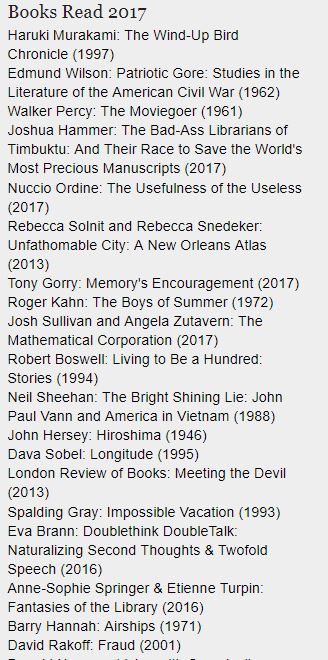
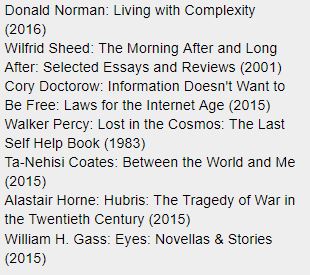
—– EXTENDED BODY: —– EXCERPT: —– KEYWORDS: —– ——– AUTHOR: Murray Browne AUTHOR EMAIL: murray.browne905@gmail.com TITLE: Best Books Read in 2017 STATUS: Publish ALLOW COMMENTS: 1 CONVERT BREAKS: wysiwyg ALLOW PINGS: 0 BASENAME: best-books-read-in-2017 CATEGORY: Best Books Read 2017-2023 CATEGORY: Book Reviews CATEGORY: Civil War Books UNIQUE URL: https://thebookshopper.typepad.com/the_book_shopper_atlantad/2017/12/best-books-read-in-2017.html DATE: 12/19/2017 07:35:12 AM —– BODY:
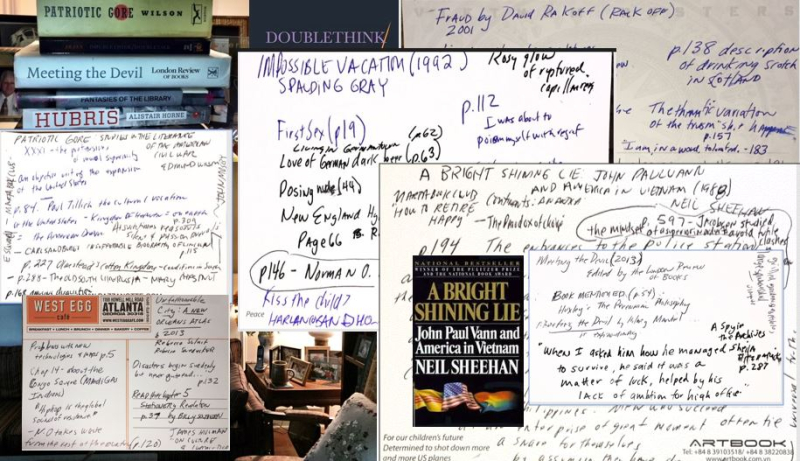
 Instead of focusing on the best books published in 2017, my tradition is to revisit the best books I read in 2017. To do this I pull out a year's worth of scribbling on notecards that have been repurposed from a variety of sources. These might include promotional postcards from restaurants, travel postcards, or my Vietnam Posters-as-Postcards collection (shown at right). Moreover, if I add a page number to my notes, it works as an index, does it not? Upon completion, I either stick the card in the book for future reference or place it in a card file.
This method looks better than using a highlighter or a pen to mark up the book and when I revisit the cards, it’s like getting a brief refresher on what I read. (The complete list of what I read, examined, skimmed and studied can be found in the right margin of The Book Shopper home page. ) I like to think of it as an eclectic list, but I did discover some shared themes. Here are some topics that emerged. I have embedded some links to relevant earlier postings as well.
Slow-reads. Doublethink/Doubletalk: Naturalizing Second Thoughts & Twofold Speech (2016) by Eva Brann. This book of aphorisms ranging from death to kookiness filled so many postcards that I finally switched to 8 ½ by 11 sheets of paper for my notetaking. A seamless mix of wisdom, humor, and philosophy. It will require a re-read in the future.
 Japan-related books. I started out the year reading Alistair Horne’s Hubris: The Tragedy of War in the Twentieth Century which devoted a chapter to the pivotal 1939 battle between the Soviets and the Japanese at Nomonhan on the Mongolian-Manchurian frontier. Horne’s identifies some of the lesser-known historical battles of the 20th century that had wide ramifications to our world geography. (After their defeat at Nomonhan, Japan turned its interests more to the Pacific theatre.) By a strange coincidence, I was reading Murakami’s The Wind-Up Bird Chronicle (1997), which includes a character who was wounded at Nomonhan. I also read John Hersey’s Hiroshima, and in another coincidence Hershey’s prose style reminded me of Murakami’s.
Vietnam Books. The toughest book to read in length and just general sadness on the destruction and waste in Vietnam was Neil Sheehan’s: A Bright Shining Lie: John Paul Vann and America in Vietnam (1988), which I wrote an essay about for the Tropics of Meta blog. Another related Southeast Asia book was on my shelves for decades: Impossible Vacation (1992) by Spalding Gray found its way into my reading queue too. The author was known more for his solo performances, which is the core of the late Jonathan Demme’s film, "Swimming to Cambodia". Billed as a novel, Impossible is an account of how Gray developed as an artist while living in New York City and making pilgrimages to India and Mexico. I loved the book’s dedication: To my “Mother, Creator and Destroyer.”
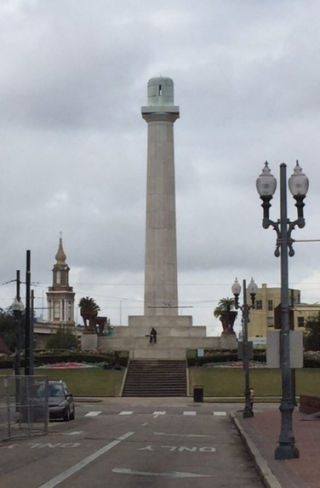 Books about Books. Patriotic Gore: Studies in the Literature of the American Civil War (1962) wins this year’s prize for most serendipitous discovery. I first saw a guy reading this book on a beach vacation while on Long Island in August. This 800-page tome by storied critic Edmund Wilson examines writers ranging from Harriet Beecher Stowe and Ambrose Bierce to generals Ulysses S. Grant, William Tecumseh Sherman, and Confederate cavalry man John S. Mosby. Patriotic Gore caught my attention because this is no beach book. Well, I didn’t think much more of it until a few months later when I was having lunch with book publisher Paul Dry. We were conversing about the new Grant biography by Ron Chernow, and Dry mentioned Wilson’s chapter about Grant in Patriotic Gore. It was then I knew that I needed to check this book out. I have not finished this well-written, brilliant book yet because it is thick and requires meditative reading, but to my Civil War buffs/friends (I won’t embarrass you in a personal callout) you gotta look at this. And for others, if you don't think the Civil War matters any more, why is this statue in Lee Circle in New Orleans suddenly missing something (Robert E. Lee)?
 Fantasies of the Library (2016) edited by Anna-Sophie Springer and Etienne Turpin and published by one of my favorite presses and bookstores (MIT Press) is a collection of essays/research articles on archives and libraries. What makes this book a delight is that it captures some of the physical delights of reading and reading spaces.
Final thoughts. 2017 was a good reading year for me. A little intellectual discourse with a another mind — that one-on-one between writer and reader — always helps me keep a calm perspective in these tumultuous times.
—– EXTENDED BODY: —– EXCERPT: —– KEYWORDS: Best books of 2017, MIT Press, Spalding Gray, Nell Sheehan, Wind-Up Bird Chronicle, Patriotic Gore, Edmund Wilson —– ——– AUTHOR: Murray Browne AUTHOR EMAIL: murray.browne905@gmail.com TITLE: Book Culture in New Orleans STATUS: Publish ALLOW COMMENTS: 1 CONVERT BREAKS: wysiwyg ALLOW PINGS: 0 BASENAME: book-culture-in-new-orleans CATEGORY: Bookstores UNIQUE URL: https://thebookshopper.typepad.com/the_book_shopper_atlantad/2017/12/book-culture-in-new-orleans.html DATE: 12/05/2017 07:12:21 AM —– BODY:
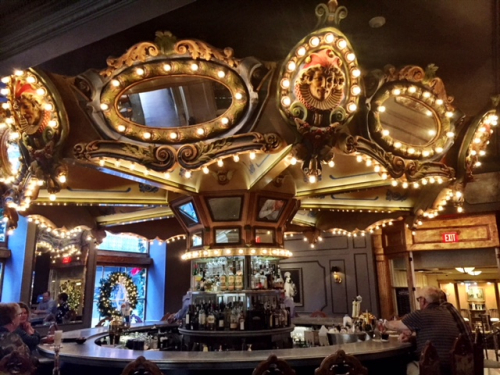
Although we first think of New Orleans as a place of jazz, food, and bacchanalia, my longtime partner Denise and I discovered on a recent trip that the richness of the city includes books as well.
As mentioned in the previous posting, we began our preparation for a trip to the Crescent City by reading Rebecca Solnit and Rebecca Snedeker’s Unfathomable City: A New Orleans Atlas (2013). It’s a book that delves into the intricate history and culture of a city that has been referred to as an “erogenous zone below the Bible Belt of the South.”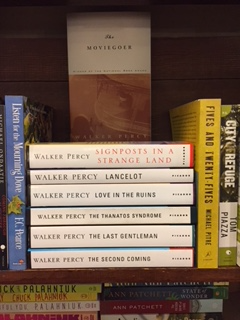 Included in our prep, we also listened to the audio version of Walker Percy’s 1962 Pulitzer prize winning The Moviegoer read by Christopher Hurt. I read the novel twice before, but Hurt’s rendering gave me a whole new sense of the narrator Binx Bolling’s timeless malaise.
Here’s a few of the literary treasures we stumbled upon during our short visit:
 Denise visited this charming store while touring the Garden District. It has extensive inventory on many Southern writers, James Parker, Anne Rice, John Kennedy Toole, and the person who brought O’Toole’s A Confederacy of Dunces from unpublished obscurity to prominence — Walker Percy.
Denise purchased two books while there: All Dat: New Orleans Eating, Drinking, Listening to Music, Exploring & Celebrating in the Crescent City (2018) by Michael Murphy (which we immediately put into good use) and the novel The Mercy of Thin Air (2006 ) by Ronlyn Domingue, which is set in 1920s New Orleans.
This French Quarter luxury hotel, which is has been owned by the same 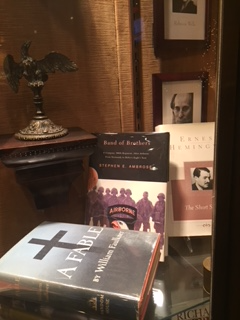 family for five generations may be known as much for its revolving Carousal Bar (pictured above) than literary heritage, but the lobby and the restaurant have permanent exhibits featuring some of the books and manuscripts of literary giants who had stayed there, such as William Faulkner, Tennessee Williams, Richard Ford, and Truman Capote. It seems fitting that Solnit and Snedeker first met at the Carousal Bar to discuss creating Unfathomable City.
The Stacks Art and Design Bookstore
In the Arts district near the colossal World War II Museum, this bookstore is well-curated with all kinds of quirky books including many of Solnit’s recent efforts. Located in the Contemporary Art Center, the shop stocks books that mixes the written word with contemporary art, theory and design. The shop carries cookbooks, children books, magazines and stationery. I purchased a copy of Marshall McLuhan essays edited by Richard Cavell and Denise (shown below as a woman of literary intrigue) purchased Moth Presents All These Wonders: True Stories About Facing the Unknown (2017). As new grandparents, we especially liked one card that read: Although frowned upon, it is not illegal to call a toddler an asshole.
Such is the effect of New Orleans on one’s sensibilities.

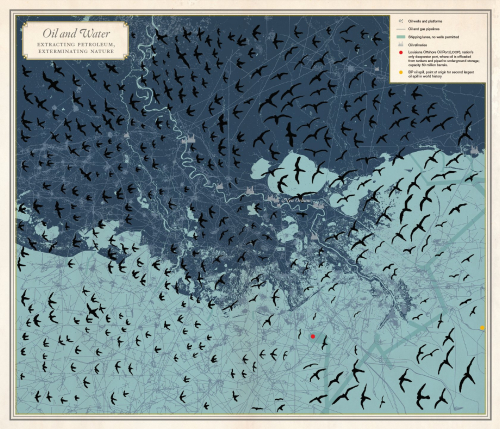
Writing or reading an essay isn’t the only way to stop and ask yourself who you really are and what your life might mean, but it is one good way. – Jonathan Franzen
Admittedly, I haven’t been writing any essays lately (with one exception), but I have been reading some good ones and recently watched the Netflix documentary on the writer Joan Didion. Here’s a quick rundown:
Jonathan Franzen*
Jonathan Franzen’s “Is It Too Late to Save the World” in The Guardian (November 7, 2017) Albeit rambling and containing enough material for three pieces (the role of essays in the social media world, climate change and birding in Ghana during the 2016 election) you can be sure that Franzen’s take on events is personal, insightful, and misanthropic in tone. Franzen’s collection How to Be Alone (2002) is one of my favorite collections of essays.
Rebecca Solnit
In preparation for an upcoming visit to New Orleans, I just finished reading Rebecca Solnit’s Unfathomable City: A New Orleans Atlas (2013) that she co-edited with documentary filmmaker Rebecca Snedeker. This book is a series of essays and corresponding maps about the Crescent City and I read it in part because I am preparing for a trip there before the end of the year. Regular readers of this blog know that I have been a longtime admirer of Solnit’s work. (Just type her name in the search bar and look out!) She recently posted a piece in The Guardian too. “One Year On, Donald Trump Is Still an Illegitimate President” does points out how the system is in place to disenfranchise millions of voters and the perils of social media with respect to future elections as well.
And one other note, Unfathomable City makes another sobering note in the wake of the natural disasters in Florida, Houston, and Puerto Rico. If Katrina, which devastated New Orleans in 2005 (and then followed by the BP oil spill in 2010) is any indication, please note recoveries can take years and forever change a place’s self-identity. (Saying "Be Strong" isn't going to be enough.) The map from the book shown above is entitled: "Oil and Water: Extracting Petroleum and Exterminating Nature."
Joan Didion*
Netflix has recently released a documentary on essayist Joan Didion entitled “The Center Will Not Hold”, which was directed by her nephew Griffin Dunne. I have been reading Joan Didion since my senior seminar on New Journalism in college in the 1970s and I can recall one my fellow students writing her thesis on Didion and imitating Didion’s dry, detached narrative style, which comes across in the film as well. (I opted for a Thomas Pynchon writing style in college– a bad choice which set me back 20 years as a writer.) The film mentions three of her books in detail: Slouching Towards Bethlehem (1968), The White Album (1979) and her book The Year of Magical Thinking (2005) on grief surrounding the death of her husband the writer John Gregory Dunne.
I am still that surprised me is that anyone would do a film about an essayist. Who’s next? Wilfred Sheed*?
*Brief anecdotes about Franzen and Didion appear in my The Bookshopper: A Life in Review (2009), but there is nothing about Sheed who is a fine essayist.
Related articles —– EXTENDED BODY: —– EXCERPT: —– KEYWORDS: Rebecca Solnit, Jonathan Franzen, Joan Didion, Unfathomable City, —– ——– AUTHOR: Murray Browne AUTHOR EMAIL: murray.browne905@gmail.com TITLE: Librarian Storytime STATUS: Publish ALLOW COMMENTS: 1 CONVERT BREAKS: wysiwyg ALLOW PINGS: 0 BASENAME: librarian-storytime CATEGORY: Book Reviews UNIQUE URL: https://thebookshopper.typepad.com/the_book_shopper_atlantad/2017/11/librarian-storytime.html DATE: 11/10/2017 07:30:13 AM —– BODY:
 In this photo I am reading a book to my grandson Myrick about librarians. The Bad-Ass Librarians of Timbuktu (2017) by Joshua Hammer chronicles the clandestine work of archivists led by Abdel Kader Haidera who rescued over 350,000 manuscripts — many which were centuries old — from Islamic extremists who nearly overran the West African country of Mali in 2012-13. Don't be mislead by Myrick's dozing because we agreed that the book is a solid account of an amazing story, but we do share the same criticism of the book, "Is it too much to ask the publisher to include a geographic map of West Africa?"
We rate it four baby bottles.
—– EXTENDED BODY: —– EXCERPT: —– KEYWORDS: The Bad Ass Librarians of Timbuktu, Review, Joshua Hammer, Mali, —– ——– AUTHOR: Murray Browne AUTHOR EMAIL: murray.browne905@gmail.com TITLE: Touring Notes STATUS: Publish ALLOW COMMENTS: 1 CONVERT BREAKS: wysiwyg ALLOW PINGS: 0 BASENAME: notes UNIQUE URL: https://thebookshopper.typepad.com/the_book_shopper_atlantad/2017/11/notes.html DATE: 11/03/2017 08:49:33 AM —– BODY:


A brief follow-up from the previous posting:
In Philadelphia
Last weekend I finally met Paul Dry, the publisher of my earlier book, The Book Shopper. Even though Paul and I have been book friends for 10 years we never had a face-to-face chat. Along with my longtime partner and editor, Denise, we rendezvoused at the Reading Terminal Market (how appropriate) in downtown Philadelphia. We talked books and writing for almost two hours as we feasted on pulled pork sandwiches and beer. Along with a handful of book recommendations, I also received some editorial and publishing advice. Paul suggested that the best strategy for book promotion is to write that next book. This reminded me of an aphorism of one of his other authors, Eva Brann: "Shameful reason for writing no more books: not being read. Fair reason for not being read: being unreadable."
In Carrollton, Georgia
 Also last weekend, I was one of the panelists for a new concept in book events. Hosted by Printer's Ale Brewery and Underground Books of Carrollton, the 90 minute program featured music (songwriter Tyler Key ) and brief readings from three writers. I was joined by Joseph Scott Morgan and Roger Johns. In between talking about our books, the evening adopted a "Wait, Wait Don't Tell Me" type of format as hosts/bookstore owners Josh Niesse and Megan Bell peppered the audience and panelists alike with questions on literary trivia. Like having lunch with Paul Dry, it was a fun experience just to talk books. Reading and writing are usually solitary endeavors and an opportunity to share words and beer was a rare pleasure indeed.
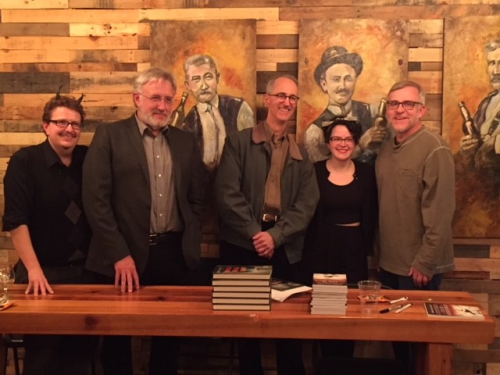
—– EXTENDED BODY: —– EXCERPT: —– KEYWORDS: Joseph Scott Morgan, Underground Books, Roger Johns, Tyler Johns, Paul Dry, Paul Dry Books, Josh Niese, Megan Bell —– ——– AUTHOR: Murray Browne AUTHOR EMAIL: murray.browne905@gmail.com TITLE: Eclectic October Book Tour STATUS: Publish ALLOW COMMENTS: 1 CONVERT BREAKS: wysiwyg ALLOW PINGS: 0 BASENAME: eclectic-october-book-tour UNIQUE URL: https://thebookshopper.typepad.com/the_book_shopper_atlantad/2017/10/eclectic-october-book-tour.html DATE: 10/23/2017 07:01:07 AM —– BODY:
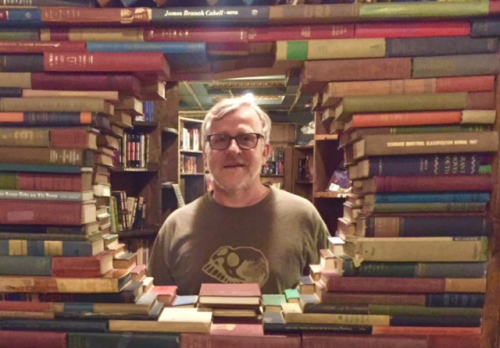
I am in the midst of a book shopping and book promoting tour, which has been somewhat unconventional. Here’s the itinerary of past and future events:
Radical Book Fair, Saturday, October 14, Auburn Avenue Research Library, Atlanta
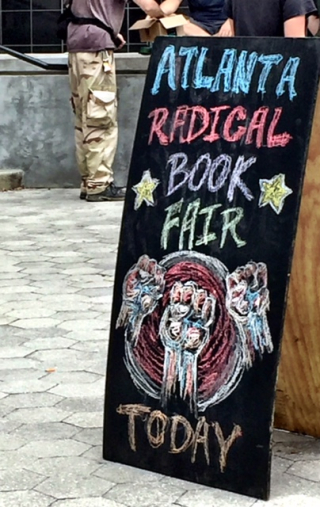 The Radical Book Fair gave me an opportunity to see the AARL for the first time, which is a marvelous venue complete with reading room and exhibits. I chatted briefly with the booksellers at Atlanta Vintage Books, who still carry my “radical” Down & Outbound: A Mass Transit Satire at their store on Chamblee. I also chatted with a book distributor AK Press, to see if they would have room in their catalog for Down & Outbound.
ACP Photobook Fair, Saturday, October 14, Hawthorne Gallery, Atlanta
 As part of the month long Atlanta Celebrates Photography, the Hawthorne Gallery hosted photobook publishers and photobook vendors. One of the vendors include Fall Line Press in Atlanta which carries Down & Outbound at their Beltline Reading Room. I did not expect to see D & O being displayed because is not a photobook per se, but it does include some quirky photographs, such as this opera house-like façade (shown) that for some strange reason is part of the Five Points MARTA swtation in Atlanta.
While at the fair, I thumbed through one of Fall Line’s new offerings, Jeff Rich’s Watershed: The Tennessee River, a collection of photos that capture the conflict between nature and the dams and other structures built by Tennessee Valley Authority. After living in Knoxville for years, I appreciated seeing the Tennessee River in a new light.
Paul Dry Books, Saturday, October 28, Reading Terminal, Philadelphia
 Because I will be visiting the City of Brotherly Love for a wedding, I will finally be able to meet Paul Dry, the publisher of my book of essays, The Book Shopper: A Life in Review (2009), which is the namesake of this blog. We have much to talk about: families, books, publishing, and what the author Eva Brann is really like. Paul Dry has published many fine books and a few months ago, I wrote about some of my favorites, including Brann’s Double Think/DoubleTalk: Naturalizing Second Thoughts and Twofold Speech.
Get Lit West Georgia, Sunday, October 29, Printer’s Ale Manufacturing, Carrollton, Georgia
 Organized by Josh Niesse and Meghan Bell of Underground Books, and in conjunction with a local brewery, this evening includes a literary quiz show, live music, and craft beer. How can that not be fun? I am one of the panelists on the quiz show (uh-oh) along with two other writers. There’s a brief reading and book chat and some giveaways, which include a couple "Thanks For Not Running Me Over" posters (shown).
—– EXTENDED BODY: —– EXCERPT: —– KEYWORDS: Down & Outbound book tour. —– ——– AUTHOR: Murray Browne AUTHOR EMAIL: murray.browne905@gmail.com TITLE: Celebrating This Day in Baseball History STATUS: Publish ALLOW COMMENTS: 1 CONVERT BREAKS: wysiwyg ALLOW PINGS: 0 BASENAME: celebrating-this-day-in-baseball-history CATEGORY: Baseball UNIQUE URL: https://thebookshopper.typepad.com/the_book_shopper_atlantad/2017/10/celebrating-this-day-in-baseball-history.html DATE: 10/04/2017 10:22:09 PM —– BODY:
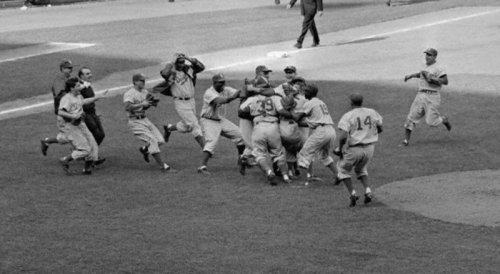 October 4, 2017 marks the 62nd anniversary of the Brooklyn Dodgers’ only World Series Championship in the 75 years that they played in Brooklyn. On October 4, 1955, the Dodgers defeated the Yankees 4 games to 3, after numerous losses to the Yankees in 1947, 1949, 1952 and 1953.
It’s easy for me to remember this day in baseball history because my birthday is one day later. Since my parents lived in Illinois I wasn’t given a catchy name like Duke (Snider), Pee Wee (Reese), or Ebbets (Field).
 This trivia is all fresh in my mind because a few weeks ago, I finished reading Roger Kahn’s baseball classic, The Boys of Summer (1971). Surprisingly, the book is more than just an account of the Brooklyn team’s glory years. Born in 1928, Kahn grew up near Ebbets Field with dreams of playing for his heroes, but settled for covering them as a sports beat writer for The New York Herald Tribune. Although the Dodgers of that era are best known for breaking the color barrier in 1947 with Jackie Robinson, they added other African-American players to their roster such as Roy Campanella, Don Newcombe, Junior Gilliam, and Joe Black (first black pitcher to win a World Series game in 1952). Kahn does not tiptoe around the racial issues in the Brooklyn locker room, and a significant part of the book is devoted revisiting those players years later and asking them to reflect on those golden yet turbulent times. The controversy surrounding race and sports has not seemed to have dissipated much since then.
Anticipation
 Heading into the 2017 postseason, I cannot recall so many fine baseball clubs that have a chance to win the World Series: The New York Yankees (again), the Boston Red Sox, the Houston Astros, and the Cleveland Indians. The latter two won 100 games in the American League as did the Los Angeles Dodgers, who also freaked themselves out by going 47-7 in one stretch of the season and 1 -16 in another. The Arizona Diamondbacks, who swept L.A. twice late in the season are formidable with their relatively unknown MVP-worthy Paul Goldschmidt. Rounding out the list of teams vying for the National League pennant are the Washington Nationals and the reigning World Champion Chicago Cubs.
As a lifelong Cubs fan, I still have not grown accustomed to their World Series win last year but it is a relief to have that 108-year burden removed. I still follow the team with the same kind of daily fervor that Kahn writes about in The Boys of Summer. I think of this as I share the experience with the newest member of the Cub family, my little grandson Myrick who was born last month. Whether the Cubs repeat or not, I am already celebrating.
—– EXTENDED BODY: —– EXCERPT: —– KEYWORDS: Roger Kahn, The Boys of Summer, 1955 Brooklyn Dodgers —– ——– AUTHOR: Murray Browne AUTHOR EMAIL: murray.browne905@gmail.com TITLE: Books As Art Sampler STATUS: Publish ALLOW COMMENTS: 1 CONVERT BREAKS: wysiwyg ALLOW PINGS: 0 BASENAME: book-as-art-sampler CATEGORY: Books as Art as Books UNIQUE URL: https://thebookshopper.typepad.com/the_book_shopper_atlantad/2017/09/book-as-art-sampler.html DATE: 09/23/2017 04:44:12 PM —– BODY:Here's just a few of the pieces from the Books as Art exhibit at the Decatur (GA) Public Library. About the only thing these pieces have in common is that they are books. The month-long exhibit runs through September 29th:
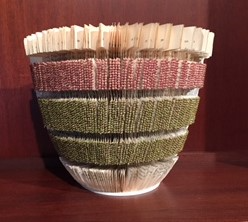
Sconce by Dawn Peterson, of Tybee Island, Georgia
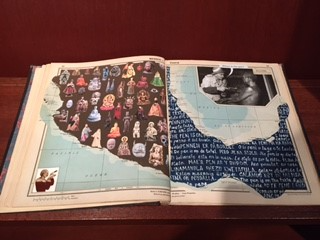
Goode's School Atlas by Lynn Skordal of Mercer Island, Washington.

Internet Knowledge by Megan Mattax of Richmond Virginia.
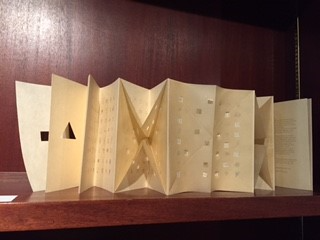
Taxonomy of Shapes by Radha Pandey of Iowa City, Iowa.

Sacred Geometry – Reliquary by Daniel Essig of Asheville, North Carolina.
A list of all the works with artist commentary can be found the exhibit home page.
—– EXTENDED BODY: —– EXCERPT: —– KEYWORDS: —– ——– AUTHOR: Murray Browne AUTHOR EMAIL: murray.browne905@gmail.com TITLE: MARTA Book Club #32: Buried Yet Alive STATUS: Publish ALLOW COMMENTS: 1 CONVERT BREAKS: wysiwyg ALLOW PINGS: 0 BASENAME: marta-book-club-32-buried-yet-alive CATEGORY: MARTA Book Club UNIQUE URL: https://thebookshopper.typepad.com/the_book_shopper_atlantad/2017/09/marta-book-club-32-buried-yet-alive.html DATE: 09/11/2017 09:15:04 AM —– BODY:

It’s been awhile since we posted anything from the MARTA BOOK CLUB, Atlanta’s Premier Public Transportation Reading Club, whose only membership requirement is to read something while riding the Metropolitan Atlanta Rapid Transit Authority. There are no club dues, nor discussion groups and reading tastes can run the entire spectrum. Here’s a book
spotting list of what people have been reading:
Born a Crime: Stories from a South African Childhood by Trevor Noah.
Since we Fell: A Novel by Dennis Lehane and Julia Whelan
A Guide to Those Left Behind in Georgia by Amelia Pohl
The Four Spiritual Laws of Prosperity: A Simple Guide to Unlimited Abundance by Edward Gaines
How to Retire Happy by Stan Hinden.
A Bright Shining Lie: John Paul Vann and America in Vietnam by Neil Sheehan. This was my contribution which I wrote about in depth for the Tropics of Meta blog.
Annihilation: The Southern Reach Trilogy, Book 1 by Jeff VanderMeer and Carolyn McCormack
Antarctica (Continents) by Leila Merrell Foster
High Fidelity by Nick Hornby
Fires and Furies by Lauren Groff
Rising Star: The Making of Barack Obama by David Garrow
Dear Ijeawele or a Feminist Manifesto in Fifteen Suggestions by Chimamanda Ngozi Adichie
Fodor’s Florence & Tuscany: with Assisi and the Best of Umbria
Working by Studs Terkel
No Is Not Enough by Naomi Klein
A lot has happened since our last posting in October of 2016. During the I-85 Bridge collapse there was a brief uptick of riders and readers, but that surge evaporated with the re-opening of the bridge. Also, the resignation of MARTA of CEO Keith Parker comes as a shock.
 The MARTA Book Club will miss Mr. Parker, who once gave the MARTA Book Club a commuter trophy for it contributions to public transportation culture. We also appreciate how Mr. Parker stopped the financial hemorrhaging of the system after he took control in 2012. Service had been on the decline in terms of train frequency and we appreciate that the trend was reversed under Parker’s tenure. Personally, my biggest regret is that I never found a way to get a copy of my book, Down & Outbound: A Mass Transit Satire into his hands. I stalked him once at the Peachtree Station, but he gave me slip
. Nevertheless, Mr. Parker, if you see this posting send me your mailing address, I still have a book with your name on it. You look like a guy who can appreciate a good chuckle.
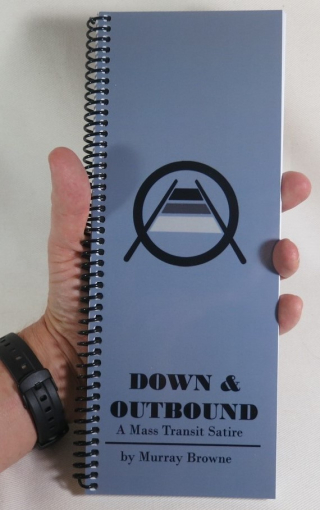 In a rare public appearance, discounted copies of my book Down & Outbound: A Mass Transit Satire will be available for perusing and sale at the Root City booth #528 at the Decatur Book Festival being held September 2nd and 3rd. This is your opportunity to experience a book about the absurdities of public transportation, which has been specifically designed for those who ride buses and subway trains. (You can read it with one hand. See video below.) At the booth, which will also have cards, notebooks and other writerly accessories, you can experience how Down & Outbound's soft plastic comb massages the tender spot between your thumb and index finger while you read. This book tickles.
"Will the reclusive D & O author be available?" you ask.
Only late Sunday afternoon at the Baptist Church venue, but not as an author but as a Festival volunteer during the Ernie Johnson appearance. Maybe I can get the famed sportscaster to hold my book. Hmmm. Good idea.
—– EXTENDED BODY: —– EXCERPT: —– KEYWORDS: —– ——– AUTHOR: Murray Browne AUTHOR EMAIL: murray.browne905@gmail.com TITLE: Vietnam Summer Vacation Posting STATUS: Publish ALLOW COMMENTS: 1 CONVERT BREAKS: wysiwyg ALLOW PINGS: 0 BASENAME: vietnam-summer-vacation-posting CATEGORY: Book Reviews CATEGORY: Military History UNIQUE URL: https://thebookshopper.typepad.com/the_book_shopper_atlantad/2017/08/vietnam-summer-vacation-posting.html DATE: 08/20/2017 09:33:00 AM —– BODY:
I spent most of my summer reading Neil Sheehan's A Bright Shining Lie: John Paul Vann and America in Vietnam (1988), and it deserved more rumination than normal and a few more potential readers so I shared it with another blog that I like: Tropics of Meta. Check out the blog and my essay "Dog Day Classics: My Vietnam Vacation With John Paul Vann," which can be found here.
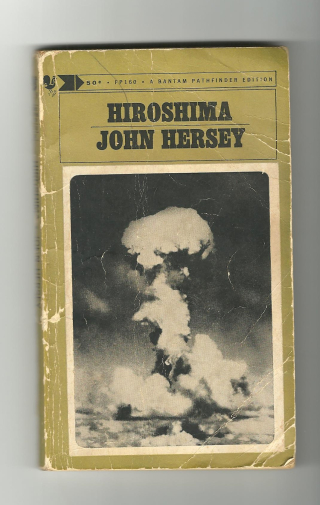 I first read John Hersey last year when a book friend gave me a remaindered copy of Lives of the Novelists: A History of Fiction in 294 Lives (2011). In this book, the critic and scholar John Sutherland chronicles English language fiction dating back to the 17th century. Sutherland’s theme is to list the authors who will still be read 100 years from now and why. He includes some stalwarts, some surprises, but mostly authors I had not read.
Hersey (1914-1993) was a combination of all three for me. I knew about his most famous book, Hiroshima from high school, but as a youth I was reluctant to read such sobering material. However, while planning my books for a vacation to Florida and browsing the Sutherland book, I noticed that I had a copy of Hersey’s Key West Tales (1993) on my shelves. I brought this short collection of Hersey stories to the beach and thoroughly enjoyed them as several of the offerings were light and almost whimsical. (See this posting from last year, which includes a brief comparison of Hersey to Ernest Hemingway.)
More recently, I stumbled across a yellowed, crumbling copy of Hiroshima in one of those neighborhood library kiosks. Its condition didn’t deter me from bringing it home, because feathery-light and portable paperbacks are ideal for my MARTA subway commute. I read the short book in a few days.
The book has renewed relevance, especially now as North Korea and the United States goad each other with threats of destruction as cavalierly as soccer hooligans trade barbs and fists, Hersey’s Hiroshima is a reminder of why the horrors of nuclear attack should be avoided at all costs. As Sutherland summarizes:
Hiroshima follows the experiences of six survivors – all intensively interviewed by the author: a clerk, a doctor, a tailor’s widow, a German priest, a surgeon, and a Japanese minister. The interviewees were chosen to overturn the monolithic image of the subhuman ‘Jap’ promulgated during hostilities. The description of physical effects of the ‘Bomb’ were horrific: melted eyeballs, bone-rotting radiation sickness, and the image that went around the world – a victim whose only relic was a shadowy profile on a wall; the rest of him vaporized.
Published in 1946 as a special piece in The New Yorker, Hersey used narrative fiction techniques to tell these stories. Moreover, he seems to capture the rhythms of his subject’s Japanese speech patterns as well. It reminded me of a Haruki Murakami novel.
The Algiers Motel Incident
 If this were not enough, Hersey is in the news because of a connection to the recent Kathryn Bigelow film, Detroit. Screenwriter Mark Boal mentions Hersey’s book The Algiers Motel Incident (1968) as one of the sources for his screenplay about the 1967 race riots that engulfed the city. In Algiers Motel, Hershey uses some of the same techniques as he did in Hiroshima extensively interviewing eyewitnesses and participants of the event that ignited the riots. Hersey donated the royalties for the book, which sold a half a million copies, to a scholarship fund for African-American students.
Today’s headlines include racial violence in Charlottesville and the threat of thermonuclear war. It seems like we are all living in John Hersey Days.
—– EXTENDED BODY: —– EXCERPT: —– KEYWORDS: John Hersey, Hiroshima, The Algiers Motel Incident, Kathyrn Bigelow, Key West Tales —– ——– AUTHOR: Murray Browne AUTHOR EMAIL: murray.browne905@gmail.com TITLE: Meditative Reading STATUS: Publish ALLOW COMMENTS: 1 CONVERT BREAKS: wysiwyg ALLOW PINGS: 0 BASENAME: meditative-reading UNIQUE URL: https://thebookshopper.typepad.com/the_book_shopper_atlantad/2017/08/meditative-reading.html DATE: 08/06/2017 09:42:12 AM —– BODY:
Sometimes the key of fully appreciating a book is choosing the right place and right time to read it. Such is the case with Eva Brann’s book Doublethink/Doubletalk: Naturalizing Second Thoughts & Twofold Speech (2016). Brann, a classics professor at St. John’s College, normally writes the kind of challenging book that I would be hesitant to buy, but I swapped publisher Paul Dry at Paul Dry Books my own Down & Outbound: A Mass Transit for a copy of the Brann book. Bartering can be as good as cash for writers except the appliance repairman wouldn’t except a boxful of D & Os for fixing my washer last week.
 I’ve always had a fondness for quotes and aphorisms, but Brann’s brief notes on such widespread topics as Death, Home, Kookiness and Morals demands more meditative reading. This is the kind of book where you read a passage, you think, you read again, and tell yourself either, “Oh, I get it!” or “I am not deep enough to understand this. Sigh.” and move on. You cannot do that kind of reading on the train (Sorry MARTA Book Club) or after a day at work, which fills your mind up with all kinds of rubbish. This book must be read before everyone else in the house gets up and you are at your favorite spot with your morning coffee. (Mine is shown here.) It becomes a predawn mediation — sans breathing, stretching or praying. This book deserves that you put yourself in a position to concentrate.
Brann’s book is a series of aphorisms, which comes from the Greek for de-limitation and is defined as, “a brief expression of a much-pondered opinion, succinctly and suggestively phrased.” I could have yellow-highlighted the whole book, but are just a few samples of personal favorites:
On Intellectuals
‘Thinking outside the box’, the mantra of the creativity folks, doesn’t work. As soon as thought leaps out, the box expands and they’re as inside as ever.
On Memoirs
How much sweeter to be serenely sure of having been underestimated than to have to sink through the floor shamed by clueless overpraise.
Respect we deserve to get; adulation we deserve not to forget.
On Home
Two Human Types: It’s better to come home to anybody than nobody/ It’s better to come home to no one than the wrong one.
Other Paul Dry Books (which are on sale)
 Note: Until August 8th, you can get $10 discount at Paul Dry Books for orders over $30.
  (Use code SUMMER2017). I’ve read quite a few of this publisher’s offerings: two books of essays by Gabriel Zaid, Ill Met By Moonlight by W. Stanley Moss, a thriller about the Crete resistance against Nazis in World War II, and humorous fiction by Irish writer Lord Dunsany and a fine book by Margaret Kaufman, the latter which is reviewed in the blog here.
You don't have to tell me it's been a month since I posted something, Facebook reminds me on a weekly basis that I have been a writing slacker. Of course, I just received my first Believer Magazine in two years, so there is slacking and there is major league goofing off.
Ironically, blog statistics remain robust by my modest (very modest) standards. This can be attributed to the Discovery Channel's mini series Manhunt: Unabomber since The Book Shopper Blog is the virtual home to the Unabomber's Library. Every time the Unabomber makes the news, I experience an uptick in interest. If you don't believe me, believe Google:
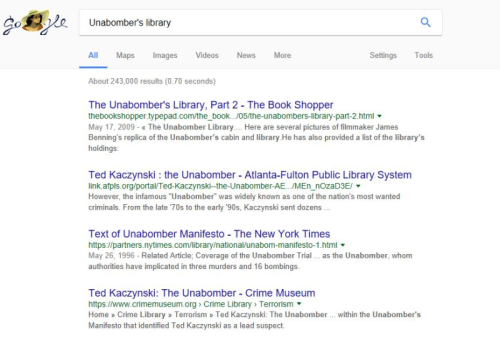
However there are other reasons for my hiatus. The main excuse is that I have been devoting my writing time to a longer essay on Neil Sheehan's voluminous book on Vietnam, A Bright Shining Lie: John Paul Vann and America in Vietnam (1988). But there are small ideas that are swimming around as well, so expect some catch up in the next few weeks.
—– EXTENDED BODY: —– EXCERPT: —– KEYWORDS: Discovery Channel Manhunt Unabomber, Unabomber Library, Believer Magazine, Neil Sheehan, A Shining Bright Lie —– ——– AUTHOR: Murray Browne AUTHOR EMAIL: murray.browne905@gmail.com TITLE: Rescued from Oblivion STATUS: Publish ALLOW COMMENTS: 1 CONVERT BREAKS: wysiwyg ALLOW PINGS: 0 BASENAME: rescued-from-oblivion UNIQUE URL: https://thebookshopper.typepad.com/the_book_shopper_atlantad/2017/07/rescued-from-oblivion.html DATE: 07/04/2017 12:44:52 PM —– BODY:
Facebook and my longtime blog vendor Typepad recently teamed up to obliterate all my 2017 Facebook postings about The Book Shopper blog. Typepad did sort of a mea culpa about it, but after that who are you gonna call?
However, I take some pride that I post new material on a semi-regular basis and so if you happened to drift to The Book Shopper Facebook Page – you wouldn't see much. So for the record here is a listing of all the postings that were purged unceremoniously. They’re still viewable via the flagship website thebookshopper.org. Remember you can always subscribe, which may be more reliable.
 All Things Octopus – June 25, 2017
A Memoir from The London Review of Books – June 20th – a book review
At Fall Line Books – June 1st – info about my author event
Cape Cod Book Shopping – May 30th
Down & Outbound at Printed Matter Inc. – May 15th – A sales call to a well-known bookstore
 Baseball Books of Our Eternal Youth – April 29th
Mini-Review: David Shields at Georgia State University – April 11th
David Shields: An Obsession -March 29th
L.A. Bookshopping – February 23rd
Atlanta Sports Curse – February 11th – a Super Bowl requiem
—– EXTENDED BODY: Percolating Memories - January 29th (a 14 second film featuring the sound of coffee)Half Letter Press – January, 24th (a book “distributor” that ignored me)
Hubris, Overreach, Greed – January 17th – a review of a Alastair Horne’s fine history book
On the Shelf – Atlanta Vintage Books, January 4th – a successful sales call to a local bookstore
That’s 15 postings if you are counting (and I am). You can see why I couldn’t just let that go.
—– EXCERPT: —– KEYWORDS: —– ——– AUTHOR: Murray Browne AUTHOR EMAIL: murray.browne905@gmail.com TITLE: All Things Octopus STATUS: Publish ALLOW COMMENTS: 1 CONVERT BREAKS: wysiwyg ALLOW PINGS: 0 BASENAME: allthingsoctopus UNIQUE URL: https://thebookshopper.typepad.com/the_book_shopper_atlantad/2017/06/allthingsoctopus.html DATE: 06/25/2017 10:11:19 PM —– BODY:

 Other Minds\The Octopus, the Sea, and the Deep Origins of Consciousness (2017) by Peter Godfrey-Smith was heavy-going in parts (whew, philosophy) but I enjoyed it. Because the author takes one step-by-step along the evolutionary path starting from a little blob of life on the bottom of the sea floor to mobile, sentient creatures I now have the tiniest inkling of how consciousness may have developed, something I have always wondered about. I’m fascinated about the idea of different levels and possible types of consciousness and find it mind-blowing to think that the vast majority of octopus nerve cells are in their arms — whatever kind of distributed consciousness might that support, with only a tiny brain as a central processing system?!
I recently finished reading a collection of memoirs compiled by the London Review of Books called Meeting the Devil (2013). It begins with Hilary Mantel's title piece describing in disturbing candor the details of the author's hospital stay while she recovered from stomach surgery. It is a powerful piece because of Mantel's ability to navigate between a patient in pain and a witty observer. A sample:
"When my dressings are stripped off I bob up my head to look at my abdomen. My flesh is swollen, green with bruising, and the shocking, gaping wound shows a fresh pink inside; I look like a watermelon with a great slice hacked out. I say to myself, it's just another border post on the frontier between medicine and greengrocery; growths and tumours seem always to be described as the 'size of a plum' or the 'size of a grapefruit'. Later a nurse calls it a 'a wound you could put your fist into'. I think, a wound the size of a double-decker bus. A wound the size of Wales. It doesn't seem possible that a person can have a wound like that and live, let alone walk about and crack jokes."
After that beginning piece, each memoir offered something different and unexpected ranging from Terry Castle's candid remembrance of her infatuation with Susan Sontag in "Desperately Seeking Susan" to world renown literary critic Edward Said's "Between Worlds." Said gives an account of being born in Jerusalem as the child of wealthy Palestinian parents, (his father was a U.S. citizen) , first educated at an English school in Egypt, and then finishing his formal education in America. "The day in early September 1951 when my mother and father deposited me at the gates of that school ..," writes Said, "was probably the most miserable of my life." Of course, it was these beginnings that gave Said his insights to the complex world of Arab and Western relations.
In the spirit of brevity (read laziness). Here's a more complete (or incomplete) rundown of authors, titles and my personal assessment: the (++) means excellent, (+) means good and (0) means it didn't work for me. I thought this book would be one that I would just read a few pieces and re-shelve, but as you can see below, I went the distance – a testimonial if there ever was one.

—– EXTENDED BODY: —– EXCERPT: —– KEYWORDS: Meeting the Devil, London Review of Books, Hilary Mantel, Memoirs, Edward Said —– ——– AUTHOR: Murray Browne AUTHOR EMAIL: murray.browne905@gmail.com TITLE: At Fall Line Books – Saturday STATUS: Publish ALLOW COMMENTS: 1 CONVERT BREAKS: wysiwyg ALLOW PINGS: 0 BASENAME: at-fall-line-books-saturday CATEGORY: Books as Art as Books UNIQUE URL: https://thebookshopper.typepad.com/the_book_shopper_atlantad/2017/06/at-fall-line-books-saturday.html DATE: 06/01/2017 07:53:55 AM —– BODY:
I will be going to the Fall Line Press 50 Artist Talks on Saturday, June 3rd beginning at 3 p.m. My book Down & Outbound: A Mass Satire falls into the gray area of something related to an artist book because of its unusual format and numerous illustrations. Fall Line Press has been supportive of the book.
It's also a great opportunity to visit the Fall Line Book Shop and Gallery, which has shelves full of photography books and art books. Currently they are featuring 50 world-class self-published photobooks from across the globe. I attended their open house earlier this spring and this collection is worth seeing. People who appreciate what I call "Books as Art as Books" will enjoy seeing the collection and chatting with those who share the same interest. See you there.
Fall Line Press is located at 675 Drewery Lane, Suite #6 in Atlanta near the Beltline and on the border of Midtown and Virginia Highlands.
—– EXTENDED BODY: —– EXCERPT: —– KEYWORDS: —– ——– AUTHOR: Murray Browne AUTHOR EMAIL: murray.browne905@gmail.com TITLE: Cape Cod Book Shopping STATUS: Publish ALLOW COMMENTS: 1 CONVERT BREAKS: wysiwyg ALLOW PINGS: 0 BASENAME: cape-cod-bookshopping CATEGORY: Bookstores UNIQUE URL: https://thebookshopper.typepad.com/the_book_shopper_atlantad/2017/05/cape-cod-bookshopping.html DATE: 05/30/2017 06:39:59 AM —– BODY:
Book shopping and vacationing on Cape Cod don't necessarily mix, because there are quaint book shops everywhere demanding to be browsed. Too much book shopping followed by subsequent reading can cause one to miss hiking through amazing scenery like the Provincetown dunes on the Cape Cod National Seashore (pictured above, where we are being led by my daughter, Cynthia.)
With this in mind, Denise and I planned our book shopping during the rainy and cold part of the week as we visited bookshops in Provincetown, Wellfleet, Chatham, East Sandwich, and Brewster. Shown here, clockwise from the upper left are: Tim's Used Books in Provincetown, R.M. Titcomb Book Seller in East Sandwich, Herridge Books in Wellfleet, and Provincetown Books in Provincetown. (Note the general overcast tone of the photos.)
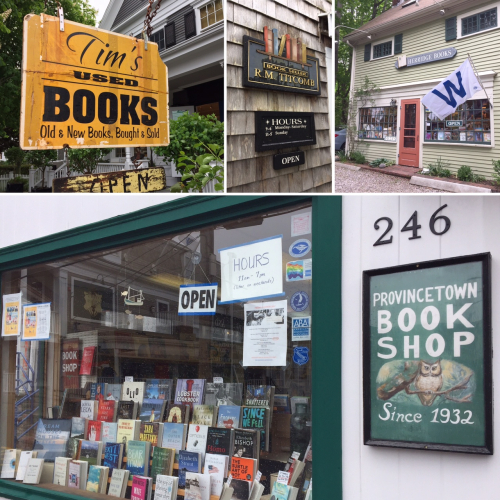 At Herridge's checkout, I mentioned how much I liked the W flag outside the door, and the clerk said, "You must be a Cubs fan", but she quickly set me straight that the flag meant "W for Wellfleet" instead of "W for a Cub win." As a vexillophile, I wanted to take umbrage of the misappropriation of a flag's primary purpose as a symbol, but since Denise had found a copy of her long-sought Compass Rose (2010) by John Casey, the sequel to Spartina (1989), I let it pass.
Book shopping also included the quaint Cap Cod Canal Visitor Center, where I purchased Dava Sobel's Longitude (1995), which tells the 18th century story of how European scientists, mathematicians and astronomers, and finally a skilled and indefatigable carpenter solved the riddle of measuring longitude. Being able to navigate accurately was of paramount importance, and the historical and naval aspects of the book seem to fit my time near the ocean.
Note (once again) the gray sky in the picture of the visitor center below. I am not complaining, though. Cape Cod provides a great mix of all the leisure activities I like, indoors or out: hiking, eating, napping and browsing. Sounds like an idea for a Cape Cod-themed flag.

—– EXTENDED BODY: —– EXCERPT: —– KEYWORDS: Bookshops on Cape Cod, Cape Cod Bookstores, Provincetown Bookstores, —– ——– AUTHOR: Murray Browne AUTHOR EMAIL: murray.browne905@gmail.com TITLE: Down & Outbound at Printed Matter Inc. STATUS: Publish ALLOW COMMENTS: 1 CONVERT BREAKS: wysiwyg ALLOW PINGS: 0 BASENAME: down-outbound-at-printed-matter-inc CATEGORY: Books as Art as Books CATEGORY: Bookstores UNIQUE URL: https://thebookshopper.typepad.com/the_book_shopper_atlantad/2017/05/down-outbound-at-printed-matter-inc.html DATE: 05/15/2017 06:50:19 AM —– BODY:
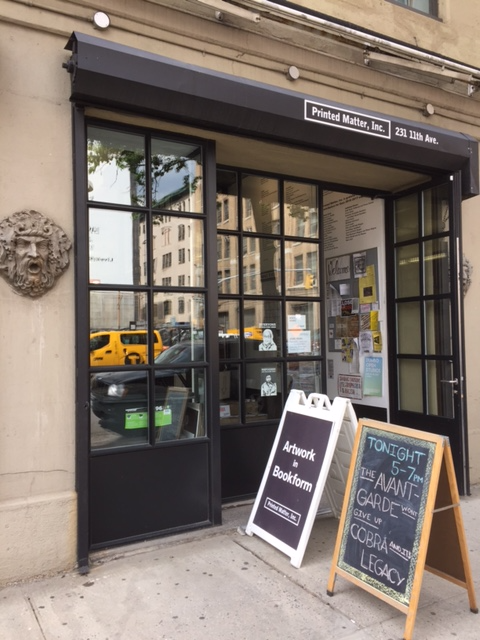 While in New York City, I was able to make a "sales" call on behalf of Down & Outbound at Printed Matter Inc. the world renowned book art store in the hip neighborhood of Chelsea. When I first published Down and Outbound I mailed a submission of the book for their store-gallery, but unfortunately it was rejected. Although no one likes rejection, I appreciated getting a resp0nse, which does not often happen.
I also admire Printed Matter for their book-as-art mentality. Although many of their offerings do have that made-in-the-garage feel, there is an edgy cleverness to many of the books in their store. Two of my favorites have been The High Line: A Field Guide and Handbook (2015?)and Brian Dillon's book of essays, Objects in This Mirror (2014), which, by the way, has been reviewed on Amazon only by me.
Sales Call
But this time I was not buying, I was selling. I brought in a copy of Down & Outbound and interrupted the clerk who was eating his lunch. I confessed that I had submitted the book before, but this time had traveled from Atlanta – and like Dorothy from the Wizard of Oz – I had "come a long, long way" to resubmit in person. Instead of calling security, he took the book and thumbed through it after considerately wiping the mayo and shredded kale from his hands.
"Here is the secret of Down & Outbound " I told him. "It fits so nicely in one's hand; Notice how the soft black comb binding doesn't pinch, it massages the sensual area between the thumb and the index finger, which gives the book a soothing pet-like quality." I could see him falling under its spell. I encouraged him to keep the book and enjoy it: "I am always looking for good homes for the book," I added.
He agreed to keep the book (victory!) and allowed me to add the Down and Outbound promotional postcards to their stack of giveaways. So stop by Printed Matter, and pick up one of the postcards to use as a handsome bookmark or send a note to a friend or better yet, present it to the front desk and ask where you could buy this book.
—– EXTENDED BODY: —– EXCERPT: —– KEYWORDS: bookselling, Book art, Printed Matter inc., High Line, Brian Dillon —– ——– AUTHOR: Murray Browne AUTHOR EMAIL: murray.browne905@gmail.com TITLE: Remembering Spalding Gray STATUS: Draft ALLOW COMMENTS: 1 CONVERT BREAKS: wysiwyg ALLOW PINGS: 0 BASENAME: remembering-spalding-gray UNIQUE URL: https://thebookshopper.typepad.com/the_book_shopper_atlantad/2017/05/remembering-spalding-gray.html DATE: 05/07/2017 11:56:39 AM —– BODY:
By coincidence I finished reading Spalding Gray's Impossible Vacation (1992) the same week Oscar-winning director Jonathan Demme died from cancer at age 73. Although well-known for Silence of the Lambs, I preferred Demme's quirker pictures such as Melvin & Howard, Something Wild and his collaboration with monologist Spalding Gray in the film version of Gray's performance piece Swimming to Cambodia. Demme's 1987 film gave me an opportunity to see a Gray performance, which would otherwise was unavailable to me.
Until now, the two Gray books that I have read Life Interrupted, The Unfinished Monologue published posthumously in 2005 and Monster in a Box (2002), a short book of his herculean writer's block efforts to pen his life story, which tipped the scales at a 1000 pages.
—– EXTENDED BODY: —– EXCERPT: —– KEYWORDS: —– ——– AUTHOR: Murray Browne AUTHOR EMAIL: murray.browne905@gmail.com TITLE: Baseball Books of Our Eternal Youth STATUS: Publish ALLOW COMMENTS: 1 CONVERT BREAKS: wysiwyg ALLOW PINGS: 0 BASENAME: baseball-books-of-our-eternal-youth CATEGORY: Baseball UNIQUE URL: https://thebookshopper.typepad.com/the_book_shopper_atlantad/2017/04/baseball-books-of-our-eternal-youth.html DATE: 04/29/2017 07:41:37 AM —– BODY:
A few weeks ago, I was catching up with an ol' college friend Tom, who shares the same passion about baseball and more specifically, baseball books that I do. We traded reading suggestions, much like boys swapping baseball cards. He remembered I was a Cub fan, but I did not recall that he was a follower of the Yankees. This didn't surprise me because the Yankees were owned by CBS from 1964 to 1973 and the Game of the Week broadcast was usually a Yankees game. ( I didn't become a Cubs fan until probably the mid-60s. I remember starting to dislike the St. Louis Cardinals as early as 1967.) I guess the Yankees did dominate at this time as evidenced in this weird picture of my older brother Neil and I wearing Yankee hats. My younger sister Kay was there too. Our family dog Pepper was looking back at our father who was resting in the shade. In distant background were the cornfields of Illinois, far from the Yankees of the Bronx. Such was influence of that franchise.
I sent Tom a link to my baseball category from the blog, and in exchange he sent me a list of his favorites. Tom who pitched in college also likes books about pitchers such as Lefty Grove, Sandy Koufax, Christy Mathewson, and Sparky Lyle. Here's several others from Tom's list with few of my comments in parenthesis:
- Living on the Black: Two Pitchers, Two Teams and One Season to Remember (2009) by John Feinstein. A book about Tom Glavine and Mike Mussina in 2007. I recall the book alternated between each pitcher as the season progressed. (I have read a few of Feinstein's books including Season on the Brink (1986), the one about Indiana University basketball coach and sociopath Bobby Knight. Tom and I were undergrads at IU when the Hoosiers won the 1976 National Championship.)
- Clearing the Bases (2002) by Allen Barra. I really enjoyed this book. This book "answers" the great baseball questions. (Yes, one of the early practitioners-writers of looking at statistics more closely to resolve baseball debates.)
- The Boys of Summer (1972) by Roger Kahn. A book about the Brooklyn Dodgers of the 1940's and 1950's. ( I am ashamed to say I haven't read it, but I need to since I was born the day after the Dodgers won their only World Series in 1955. )
- The Glory of Their Times (1966) by Lawrence Ritter. A book about the late 1800 and early 1900 baseball stars. ( I have it on my shelves and it deserves a re-reading. This was a book that inspired a lot of writers to find out where a lot of all time greats ended up and then interviewing them.)
- Throwback: A Big-League Catcher Tells How the Game is Really Played (2014) by Jason Kendall and Lee Judge. This book is surprisingly good. I always liked Jason Kendall, and this book didn't change my feelings. (The Pirates catcher with uncommon speed for a receiver always murdered the Cubs.)
- The Baseball Codes: Bean Balls, Sign Stealing and Bench Clearing Brawls: The Unwritten Rules of America's Pastime (2011) by Jason Turbow and Michael Duca. A good book about the "unwritten" rules of baseball.
 I heard and read several of his choices but one of his selections intrigued me, a series of books by Duane Decker about the Blue Sox. Tom writes:
When I was a kid, I read a series of fictional baseball books by Duane Decker. The stories were about a team called the Blue Sox (very much like the Yankees of the 50's). The stories ran for years and the lineup of players were consistent from book to book. Each book was about a new player breaking into the lineup. In fact, if you read the whole series, you can see a player break into the lineup and 10-15 books later the player has aged and will be replaced by a new player. The books are out of print and are very expensive to purchase. I have collected 8-9 of the books.
Tom is not joking. Those Decker books are pricey. Get thee to the attic.
P.S. After posting, Tom sent me additional offerings. I put them in the comments.
—– EXTENDED BODY: —– EXCERPT: —– KEYWORDS: New York Yankees, 1960s, Duane Decker, Blue Sox, Top Baseball books, Jason Kendall, Cubs fan, youth —– COMMENT: AUTHOR: Murray Browne EMAIL: IP: 73.184.84.184 URL: http://profile.typepad.com/1227802374s31410 DATE: 04/30/2017 10:06:06 AM Tom wrote me with some additional baseball book suggestions. Here are some gems…”A Pitcher’s Story, by Roger Angell. This is a book about David Cone. This book has some outstanding pitching tips. Plus, David Cone was a good “pitcher”..not a “thrower”. Another book that I really enjoyed is “Baseball When the Grass Was Real” by Donald Honig. This book is made up of excerpts of interviews the author had with 18 different players of the 1920’s, 1930’s and 1940’s. Some of them are Charley Gehringer, Johnny Mize, Cool Papa Bell, Lefty Grove, Ted Lyons, Billy Herman, Rip Sewell and Bob Feller. Another book I enjoyed was “Lefty Grove: American Original” written by Jim Kaplan. In my opinion, Grove is a vastly underrated pitcher. And, he’s in the Hall of Fame! Last thing. There is a writer named Troy Soos. He has written 8-10 books with the premise of the main character is a major league baseball player back in the early 1900’s (maybe up to around 1930). They are murder mysteries that take place and the main character (Mickey Rawlings) somehow cracks the case while being an average major league ballplayer. The stories are “historical fiction” and have real players involved as well as the fictional Mickey Rawlings. I think I am the only person that has read this author and I see he has 3 or 4 books I haven’t read. —– ——– AUTHOR: Murray Browne AUTHOR EMAIL: murray.browne905@gmail.com TITLE: Mini-Review: David Shields at Georgia State University STATUS: Publish ALLOW COMMENTS: 1 CONVERT BREAKS: wysiwyg ALLOW PINGS: 0 BASENAME: mini-review-david-shields-at-georgia-state-university CATEGORY: Local Reviews UNIQUE URL: https://thebookshopper.typepad.com/the_book_shopper_atlantad/2017/04/mini-review-david-shields-at-georgia-state-university.html DATE: 04/11/2017 07:04:37 AM —– BODY:
Who, Where & When: If you read my previous posting, I think you understand why I took a Monday afternoon off (4/3/17) from my regular job to see David Shields. It was no small task. The weather was lousy and I had to slog thru the rain on the Georgia State University campus to find the Troy Moore Reading Library located high on the 23rd floor of the 25 Park Building (a veritable fortress). He was one of the few authors that I would make that kind of effort to see. I rarely attend readings anymore.
Attendance. I estimate about 3o attendees mostly Georgia State English faculty and graduate students. I probably stuck out since I sat in the back and was soaking wet. The room looked over a gloomy Atlanta cityscape and upon request Shields preferred the main ceiling lights to be turned off — leaving the room shrouded in semi-darkness. Instead of hiding behind the lectern, Shields read in front of the first row of seats, which I appreciated. Lecterns can act as barricades between speaker and audience.
What He Read: Shields read from his new book Other People: Takes & Mistakes (his 20th), which is a collection of essays that range from his prose as a graduate student to more recent work. Shields said that he meditated about his writings and made some revisions, but I am not sure what he meant by that (organizationally?). He read short essays about Philip Roth, George W. Bush and O.J. Simpson. Unlike his prose that can seem brash and provocative, Shields reads slowly and thoughtfully, as if hunting for the right expression. He read about 30-40 minutes leaving plenty time for questions, again answering each interrogative with great care as if finding an answer instead of giving one.
 Photo: Tom Collicott from author website
What Question(s) Did I Want to Ask But Was Too Shy to Ask. Again referencing the previous posting, I wanted to ask him whether I understood a quote from his Reality Manifesto: "Genre is a minimum security prison." Also, as he quietly read his sometimes incendiary prose, I wondered if Shields, who is often autobiographical, distinguishes between his writer personae and David Shields, the son, husband, father and recreational swimmer. I first heard this dichotomy discussed when I went to a Billy Collins poetry reading where Collins told the audience the narrator of his poems and the reader who was before us, weren't necessarily the same Billy Collins. That's a complicated question to ask somebody in front of an audience and I am sure I would have flubbed trying to articulate it.
Did I Buy the Book? When I went to the front to examine the book, Shields came up to me to chat for a bit. I told him I had enjoyed the three books of his that I had read and then I asked him my question about genre (what writer doesn't like when you quote a passage from their book?). He acknowledged my interpretation that genre can be confining, but easy to escape. I apologized for not buying his new book as it was a heavy hardback that did not lend itself to my daily train commute and we agreed that I should wait for the softcover. I gave him a couple promotional postcards from my Down & Outbound book which he accepted gracefully. We ended the conversation with a handshake.
—– EXTENDED BODY: —– EXCERPT: —– KEYWORDS: David Shields. David Shields at Georgia State, Other People, Takes and Mistakes. —– ——– AUTHOR: Murray Browne AUTHOR EMAIL: murray.browne905@gmail.com TITLE: David Shields in Atlanta – an Obsession STATUS: Publish ALLOW COMMENTS: 1 CONVERT BREAKS: wysiwyg ALLOW PINGS: 0 BASENAME: david-shields-in-atlanta-an-obsession CATEGORY: Bookstores UNIQUE URL: https://thebookshopper.typepad.com/the_book_shopper_atlantad/2017/03/david-shields-in-atlanta-an-obsession.html DATE: 03/29/2017 07:20:40 AM —– BODY:
In a previous Facebook posting I mentioned that author David Shields was going to be in Atlanta on Saturday, April 1st at the Lost Southern Voices Revival discussing Barry Hannah's collection of short stories Air Ships (1971)* I "eventbrited" to the Facebook World that I was going to attend, but then discovered I had a conflict. (I have a Down & Outbound book selling booth at the Avondale Estates Rail Arts District Festival on the same day. )
But then I checked David Shields book tour page and discovered that he was also going to be speaking at Georgia State on Monday, April 3rd. According to the GSU Creative Writing Department, Shields will be on campus at 2 pm in the Troy Moore Library, which is on the 23rd floor of 25 Park Place (which used to be called the SunTrust building).
I plan on the afternoon off to see him. Will he be as witty and insightful in person as he is in his books (always a risk with author appearances)? Should I bring him a copy of my genre-busting-novel-wrapped-in political-satire Down & Outbound? Afterwards, should I offer to accompany him on MARTA to the airport as he resumes his tour? We could chat about how he influenced my book because of his quote: "Genre is a minimum security prison," which I interpreted as genre can be a prison for a writer, but it is easy to break out of. If the train breaks down, we would even have time to talk about his new book of essays, Other People: Takes and Mistakes.
According to my blog this is why I like reading David Shields:
February 23, 2011. In this posting, I look at his most well-known book Reality Hunger: A Manifesto (2010) from the perspective of a blogger. September 2, 2012. In this posting I reflect on his book Remote: Reflections on Life in the Shadow of Celebrity (2006), which I found at Books Again in Decatur. My copy was signed by the author, no less. (The scanned autograph is shown at the top of the page.) November 15, 2013. A blog posting where I was paying homage to Books Again as it closed its doors for good. I also found an advance copy of The Thing We Know About Life is One Day We'll Be Dead (2008), at Books Again for $4. The wisdom of this slim book about how we age, outweighs its depressing premise. Will this all happen? I will keep you posted, of course.
* I even bought and am just finishing the Hannah book. Raw southern stuff. More in the Walker Percy style, but the narratives are a challenge to figure out.
—– EXTENDED BODY: —– EXCERPT: —– KEYWORDS: David Shields, David Shield in Atlanta, GSU Creative Writing —– ——– AUTHOR: Murray Browne AUTHOR EMAIL: murray.browne905@gmail.com TITLE: LA Bookshopping STATUS: Publish ALLOW COMMENTS: 1 CONVERT BREAKS: wysiwyg ALLOW PINGS: 0 BASENAME: la-bookshopping UNIQUE URL: https://thebookshopper.typepad.com/the_book_shopper_atlantad/2017/02/la-bookshopping.html DATE: 02/23/2017 07:11:50 AM —– BODY:

Over a long President's Day holiday weekend, I took advantage of the rainy, gloomy weather here in LA to visit a couple of the area's more well-known bookstores: Small World Books in Venice Beach and The Last Book Store in downtown's historic banking district. Both stores are well-stocked with plenty of titles to choose from, but Last Book Store is gigantic with a rare book and art room, a main floor of used fiction and an upstairs section of travel, history and philosophy known as the Labyrinth.
I bought two used books at Last Book Store – a paperback copy of Hitler Moves East 1941-1943 (1965) by Paul Carell. I remember this book because my father kept a copy of it for years on the top of toilet tank in the family bathroom. I have been reading more military history and lately have become nostalgic about the books my father read.
I also picked up a replacement paperback copy of the Bantam edition of Thomas Pynchon's V. (1963). This makes sense. Pynchon readers such as myself cannot travel in SoCal without thinking of the settings of his better books: The Crying of Lot 49 (1966) and more recently Inherent Vice (2010). It is from The Crying of Lot 49 that I came up with the name from my publishing LLC – Muted Horn Communications.
Ironically, the rains ended before leaving Venice Beach and Small World Books (note the red and white roof). No rainbow, but…
—– EXTENDED BODY: —– EXCERPT: —– KEYWORDS: —– ——– AUTHOR: Murray Browne AUTHOR EMAIL: murray.browne905@gmail.com TITLE: Amazon Reviews Needed STATUS: Draft ALLOW COMMENTS: 1 CONVERT BREAKS: wysiwyg ALLOW PINGS: 0 BASENAME: amazon-reviews-needed UNIQUE URL: https://thebookshopper.typepad.com/the_book_shopper_atlantad/2017/02/amazon-reviews-needed.html DATE: 02/20/2017 09:04:17 PM —– BODY:
Amazon recently sent me an email asking that I review a book I purchased online — a collection of Wilfred Sheed's essays, The Morning After… And the Long After: Selected Reviews and Essays. It's not often that you get asked to do review a book anymore, even by an algorithm. Amazon's reasoning is since The Morning After was published in 2001 and covers the esteemed writers non-fiction efforts dating from 1968 to 2001, they were dying to have anyone write something about the book.
I am a strong candidate since I rarely review on Amazon, except for books that nobody else has an opinion on. (See Brian Dillon) As I wrote a few years ago, I don't see the point of writing a review when there are hundreds of other reviews and comments on the same book. A writer that has no reviews seems to be a sad thing, so I like to help out if I find the writing worthy.
Tom Vanderbilt in his recent book, You May Also Like, writes that Amazon reviews have their shortcomings, which Amazon is constantly trying to improve. Shortcomings of Amazon.
—– EXTENDED BODY: —– EXCERPT: —– KEYWORDS: —– ——– AUTHOR: Murray Browne AUTHOR EMAIL: murray.browne905@gmail.com TITLE: Atlanta Sports Curse STATUS: Publish ALLOW COMMENTS: 1 CONVERT BREAKS: wysiwyg ALLOW PINGS: 0 BASENAME: atlanta-sports-curse UNIQUE URL: https://thebookshopper.typepad.com/the_book_shopper_atlantad/2017/02/atlanta-sports-curse.html DATE: 02/11/2017 08:19:16 AM —– BODY:
"Sports can bestow curses as carelessly as blessings and the curses stick."
This is a line from Wilfrid Sheed's 1969 essay "Confession of a Sports Nut." As a Cubs fan, who also remembers the woeful summer of 1969, I know a little about curses. Coincidently, I read this essay the day after the Atlanta Falcons' loss in Super Bowl LI. When the Patriots tied the score and put the game into overtime I was thinking to myself, "The Falcons need an 18 minute rain delay to regroup", but there was no divine intervention.
—– EXTENDED BODY: —– EXCERPT: —– KEYWORDS: —– ——– AUTHOR: Murray Browne AUTHOR EMAIL: murray.browne905@gmail.com TITLE: Percolating Memories STATUS: Publish ALLOW COMMENTS: 1 CONVERT BREAKS: wysiwyg ALLOW PINGS: 0 BASENAME: percolating-memories UNIQUE URL: https://thebookshopper.typepad.com/the_book_shopper_atlantad/2017/01/percolating-memories.html DATE: 01/29/2017 09:20:33 PM —– BODY: Coffeemakers. You can't have enough of 'em. Our kitchen counter looks like something out of Ambrogio Fumagalli's Coffeemakers: Machine Da Caffe (1995). In addition to our Cuisnart, our Melita single cup maker, our French press, our Clever Dripper®, and our new Nespresso, ( #noKeurig), we have recently been enjoying a revival of the vintage stove top coffee percolator that came from Denise's parents. We have been making coffee on the weekends this way, when time allows.
When we used to visit her mother and father in Queens, we always had coffee from this same percolator. They would pre- measure out six heaping tablespoons of coffee (Brown Gold from the local supermarket was their brand) and six cups of water the night before and start it in the morning. It would take about seven minutes to make coffee once the water started to boil and percolate through the basket of coffee, but Denise's mother would never set a timer. She could "feel it her bones" when it was ready and the aroma filled their apartment. It made excellent coffee and it was hot, through and through. Combine it with crumb cakes from the local German bakery and goodies from the nearby Polish and Italian bakeries and there was never any better breakfast.
And who doesn't like the word, "percolate?" Besides the formal definition surrounding the process making coffee using this technique, the word has the connotation of allowing something – an idea, a memory, or a quote from a book to seep into one's thought process and take hold. "Percolate" sounds much better than "drip" any day.
—– EXTENDED BODY: —– EXCERPT: —– KEYWORDS: Ambrogio Fumagalli, Coffeemakers: Machine Da Caffe, coffee percolators —– COMMENT: AUTHOR: Tom Nelson EMAIL: IP: 98.167.190.35 URL: http://profile.typepad.com/6p01b7c7dfb9b6970b DATE: 01/30/2017 07:26:00 PM My grandparents used these, but my parents went high-tech with the electric plug-in version of the percolator. At least with a thermostat to shut off, it wouldn’t percolate until the end of time and burn down the house if one fell back asleep while waiting for the first cup. Another advantage of the percolator: it lasts for years and years and didn’t have to be cleaned with vinegar every couple months. My preferred method, however, is cold immersion. It takes 24 hours and has less acid. Downside the lack of aroma of coffee wafting through the house, but grinding the coffee beans compensates. —– COMMENT: AUTHOR: Murray Browne EMAIL: IP: 73.184.84.184 URL: http://profile.typepad.com/1227802374s31410 DATE: 01/31/2017 07:28:23 AM Yes, the cold immersion method makes a great cup as well — since that is what you served when we visited. You should check out the book mentioned. Available on Amazon for 1 cent plus shipping. Someone with your mechanical interests would enjoy. (Mostly photos). —– ——– AUTHOR: Murray Browne AUTHOR EMAIL: murray.browne905@gmail.com TITLE: Half Letter Press STATUS: Publish ALLOW COMMENTS: 1 CONVERT BREAKS: wysiwyg ALLOW PINGS: 0 BASENAME: half-letter-press CATEGORY: Books as Art as Books UNIQUE URL: https://thebookshopper.typepad.com/the_book_shopper_atlantad/2017/01/half-letter-press.html DATE: 01/24/2017 07:13:51 AM —– BODY:
Today I sent a sample copy of Down & Outbound: A Mass Transit Satire to Half Letter Press. a distributor that appeals to me both as an author and as a book shopper. Check out a screen shot of their catalog of books, zines, periodicals and posters. Will they respond? They should. After all, I sent them a self-addressed, stamped postcard, (below) which I include with every book order.
Don't underestimate the power of the pedestrian.
Hubris, Overreach, and Greed. It sounds like a law firm, but it is the theme of Alistair Horne's book Hubris: The Tragedy of War in the Twentieth Century (2015). In his book, Horne introduces us to the Greek concept of hubris, which is the fallout from a seemingly easy military victory followed by a dramatic downturn. Horne examines several military campaigns (some relatively obscure) and their far reaching effects.
 Tsushima – 1905. The Japanese navy whips the powerful Russian navy. The campaign began with Japanese sneak attack on the Manchurian seaport at Port Arthur. (A precursor of actions to come.)
Nomonhan – 1939. Led by General Georgy Zhukov, the Russians stop the Japanese aggression in Mongolia with a sound defeat of Japanese ground troops. Japan turns its expansionist interests elsewhere (Hawaii and Pearl Harbor).
Moscow – 1941. Zhukov returns to the Soviet capital, followed shortly thereafter by reinforcements from Siberia, who no longer are concerned about Japan's aggression in Mongolia. Beginning in June, 1941 the Germans had advanced hundreds of miles to the suburbs of Moscow only to be turned back in November, 1941 by subzero temperatures and a series of savage counterattacks. You cannot begin to fathom the bloodshed. In six months over 7 million Soviet and German troops fought against each other. It is estimated that the Soviet army lost 950,000 men. 
We usually think of Stalingrad as the turning point of the war on the Russian front, but Horne writes convincingly that Moscow was the real key and if the capital had fallen the Soviet Union probably would have collapsed. Another take away is that the Russian people have a capacity to withstand tremendous suffering (even from their own leaders) and then dish it out to invaders.
Midway – 1942. Japanese expansion in the Pacific is checked by the U.S. fleet. In a shift from conventional naval warfare, these two powerful naval forces never were within firing range of each other. Planes launched from aircraft carriers inflicted the main damage. The Japanese armada got the worse of it. American torpedo bombers sunk three Japanese aircraft carriers – the pride of their fleet.
Korea and Dien Bien Phu - 1950-54. U.S. General Douglas MacArthur overextends American involvement by striking into Chinese territory, which left his troops vulnerable to vicious North Korean and Chinese counterattacks. The war stalls into a bloody stalemate. Later in 1954, the French garrison near the Laotian border at Dien Bien Phu falls to an underdeveloped but impassioned military, which set the stage for America's disastrous intervention in Vietnam. (Some of us remember the comparison between Dien Bien Phu and the siege of Khe Sanh in 1968.)
Another aspect that all these campaigns have in common is that often countries attack other countries because they believe that their adversaries are "inferior." The Russian thought the Japanese where inferior at the time of Tsushima (and Japan was anxious to prove that it was not). The Japanese attacked the Chinese in Manchuria for the same reasons. The Americans and British grossly underestimated the piloting skills and the aircraft of the Japanese air force. The Germans attacked the "subhuman" Russians and when they captured Russian soldiers they didn't even afford them prisoner-of-war rights in accordance with the Geneva Convention. Demonizing or believing in one's superiority over another people, race or culture always leads to prolonged bloodshed.
Personal postscripts: This last year I've become quite the Horne fan. (See an earlier postings on his 1960 book about Verdun, The Price of Glory.) In his acknowledgements, Horne gives kudos to Sir John Keegan and his early mentor, Sir Basil Liddell Hart, who wrote a recent discovery of mine Sherman: Soldier, Realist, American. Horne talks about how Hart and others taught him the basics of "judicious" analysis of history. Lessons on display in Hubris.
—– EXTENDED BODY: —– EXCERPT: —– KEYWORDS: Alastair Horne, Hubris The Tragedy of War in the Twentieth Century,Tsushima, —– ——– AUTHOR: Murray Browne AUTHOR EMAIL: murray.browne905@gmail.com TITLE: On the Shelf – Atlanta Vintage Books STATUS: Publish ALLOW COMMENTS: 1 CONVERT BREAKS: wysiwyg ALLOW PINGS: 0 BASENAME: on-the-shelf-atlanta-vintage-books UNIQUE URL: https://thebookshopper.typepad.com/the_book_shopper_atlantad/2017/01/on-the-shelf-atlanta-vintage-books.html DATE: 01/04/2017 07:46:37 AM —– BODY:
Down & Outbound: A Mass Transit Satire is now on the shelves at Atlanta Vintage Books. Known primarily as a large used book store (70,000 books) that also sells rare collectibles such as first editions, Atlanta Vintage is located at 3660 Clairmont Road near the Chamblee area of Atlanta not far from the Chamblee MARTA station.
I guess you could say that Atlanta Vintage has added another rare first edition. (Down & Outbound). For more about D & O check out the book trailer on YouTube.
I had written about Atlanta Vintage years ago in the blog and browsing the store the other day, I was impressed that it was well-organized, which is not always the case with used bookstores (I like browsing, but…) and their military history section is huge. As regular readers of this blog know, I do appreciate a store that knows how to get "it's Civil War on." See here.
—– EXTENDED BODY: —– EXCERPT: —– KEYWORDS: Atlanta Vintage Books, Down & Outbound, First Editions —– ——– AUTHOR: Murray Browne AUTHOR EMAIL: murray.browne905@gmail.com TITLE: Links of Interest STATUS: Publish ALLOW COMMENTS: 0 CONVERT BREAKS: wysiwyg ALLOW PINGS: 0 BASENAME: links-of-interest UNIQUE URL: https://thebookshopper.typepad.com/the_book_shopper_atlantad/links-of-interest.html DATE: 01/01/2017 10:32:28 AM —– BODY:
Remember the old links type pages, where people accumulated URLs of places they visited. You still see them around with a lot of dead links. I actually curate this one. It has an Atlanta flavor.
A blog that deep dives into various book topics such as Nordic Mystery Writers, Jennifer Egan, and Oliver Sacks. The founder and editor, who has channeled her inner Dorothy Parker lives here in Atlanta. She shares her deep passion for books and her love and promotion of independent bookstores.
This has one of the largest used book collections in the area and it is well-maintained and organized. It used to carry copies of my book, Down & Outbound: A Mass Transit Satire
This is a small, but well-curated shop that most Atlantans don’t know about. It’s located in the Carlos Museum of the campus of Emory University. It used to carry copies of both my books Down & Outbound: A Mass Transit Satire and The Book Shopper: A Life in Review.
Check out this store’s events page for major literary events in the Atlanta area. It partially explains why it was beneath them to carry my book, Down & Outbound: A Mass Transit Satire.
The Jimmy Carter Library & Museum
Premier venue for author events
Auburn Avenue Research Library
Part of the Atlanta-Fulton Country Library System focusing on African American Culture and History.
An all-things-bookish blog written by a former employee of Atlanta’s public library system.
Literary events around Atlanta.
Serious reviews of art, dance, theater and books and I mean SERIOUS.
—– EXTENDED BODY: —– EXCERPT: —– KEYWORDS: Book stores of Atlanta. Atlanta Book Events —– ——– AUTHOR: Murray Browne AUTHOR EMAIL: murray.browne905@gmail.com TITLE: Book Shopping & Book Selling STATUS: Draft ALLOW COMMENTS: 1 CONVERT BREAKS: wysiwyg ALLOW PINGS: 0 BASENAME: bookshopping-bookselling UNIQUE URL: https://thebookshopper.typepad.com/the_book_shopper_atlantad/2017/01/bookshopping-bookselling.html DATE: 01/01/2017 09:56:31 AM —– BODY:The Book Shopper blog has modified it's look and scope. It is now a repository that not only includes the thoughts and whims of author of The Book Shopper: Life in Review (2009), but it also is an online journal for the trials and tribulations of pushing my new book Down & Outbound: A Mass Transit Satire (2016) out into the marketplace. Hopefully, my second solo effort won't be "a Lewis and Clark expedition" – as Michael Chabon once referred to second books — “a long, often dismal tramp through a vast terrain in pursuit of a grand but fundamentally mistaken prize.” But if it is, there is nothing more interesting than a train wreck, no?
—– EXTENDED BODY: —– EXCERPT: —– KEYWORDS: —– ——– AUTHOR: Murray Browne AUTHOR EMAIL: murray.browne905@gmail.com TITLE: Boston Bookstores – Final Thoughts STATUS: Publish ALLOW COMMENTS: 1 CONVERT BREAKS: wysiwyg ALLOW PINGS: 0 BASENAME: boston-bookstores-final-thoughts CATEGORY: Bookstores UNIQUE URL: https://thebookshopper.typepad.com/the_book_shopper_atlantad/2016/12/boston-bookstores-final-thoughts.html DATE: 12/24/2016 10:11:42 AM —– BODY: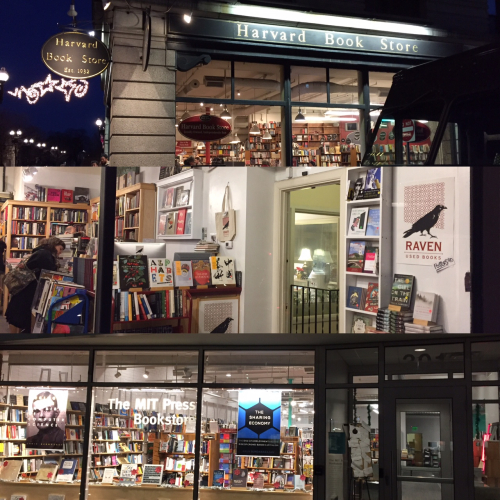
It gets dark early this time of year in Boston, so curb appeal relies as much on magical lighting as it does on store windows chocked full of books. Starting from the top, it's the Harvard Book Store (where shoppers flooded the aisles), Raven Used Books, which had a good number of serious shoppers as well, and the MIT Press Bookstore, which has moved to its new location on Massachusetts Avenue. I loved the quaintness of the MIT Press Bookstore's old location on Kendall Square, but perhaps it will grow into its new space.
I can hear you ask, "What did you buy?" At MIT, I purchased Donald Norman's Living with Complexity (2010) and the Harvard Book Store, I picked up William H. Gass' book of novellas and short stories Eyes (2015) and historian Alistair Horne's Hubris: The Tragedy of War in the Twentieth Century (2015). There was some tempting offerings at Raven, but these books do have to be hauled back to Atlanta in a suitcase. One odd thing about Raven, is that it is next door to the Christian Science Reading Room, where I noticed that the woman on duty had her head on the desk asleep (or passed out? dead?) the entire time I was in Raven. I understand. The holidays can be exhausting.
Another strange coincidence is that everyone one of these authors I purchased is over 80 years old. Donald Norman turns 81 tomorrow on Christmas Day, William Gass is 92 and Alistair Horne is 91. I bet it makes older authors feel youthful when someone buys their books and gives it a serious reading.
Final Thoughts
Coincidently, I always wanted to open a Christian Science Reading room, except I didn't want to particularly carry books about Christianity. It would be a place you could sit quietly and read in a comfy chair or tattered sofa. There would be my books like The Book Shopper: A Life in Review and Down & Outbound: A Mass Transit Satire available to borrow and read. ( I got that market cornered.) No wifi for computers and maybe I would sell cups of average, self-serve coffee payable on an honor system. And if I am "on-duty" I would be allowed to rest my head on my desk for hours if needed and dream of new books to write like Donald Norman, William Gass and Alistair Horne obviously do.
God Rest Ye Merry Gentlemen.
—– EXTENDED BODY: —– EXCERPT: —– KEYWORDS: Boston Book Stores, MIT Press Bookstore, Harvard Book Store, William H. Gass, Eyes, Alistair Horne, Hubris, Donald Norman, Complexity —– ——– AUTHOR: Murray Browne AUTHOR EMAIL: murray.browne905@gmail.com TITLE: Eight Years of Blogging Scorecard STATUS: Publish ALLOW COMMENTS: 1 CONVERT BREAKS: wysiwyg ALLOW PINGS: 0 BASENAME: eight-years-of-blogging-scorecard UNIQUE URL: https://thebookshopper.typepad.com/the_book_shopper_atlantad/2016/12/eight-years-of-blogging-scorecard.html DATE: 12/17/2016 07:01:03 AM —– BODY:
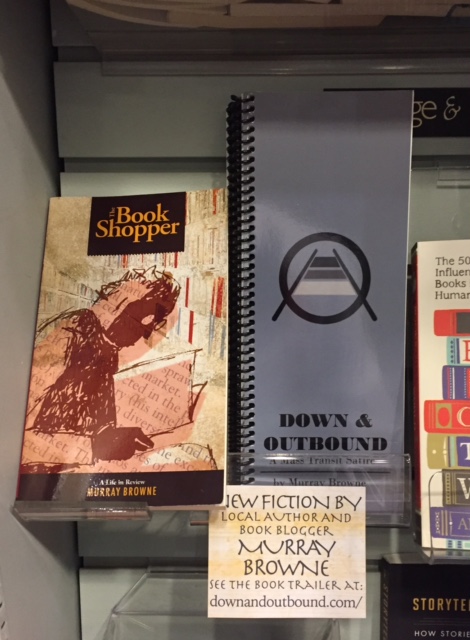
First posting: November 29, 2008
Number of posts: 365
Number of page views: ~30,000 (which is about 10 a day)
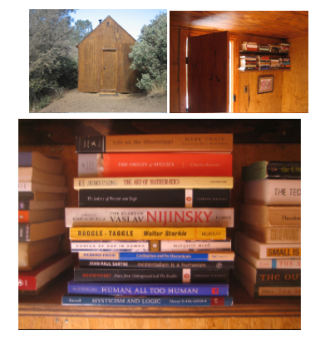 Most popular posting: James Benning's replica of the Unabomber's library in May, 2009. (Shown on the left )
Original reason for blogging: To promote my book of essays The Book Shopper: A Life in Review published in (2009) by Paul Dry Books.
Results: A lot of Book Shopper books still in my closet.
Reason for blogging after 2009: Writing can be a gnawing habit and it was much easier to publish on the blog as opposed to sending author queries to obscure magazines. The pay is the same.
Future: Obviously I haven't been posting like I used to. Not that I don't like books and book chat, but it is time to "move the band into a new direction." I will be keeping the blog up for an occasional posting and archiving purposes, but now I plan on devoting more space to discussion of my new book: Down and Outbound: A Mass Transit Satire (2016), which is now available, wherever fine books are sold online. See downandoutbound.com for details.
(Shown at the top of the posting is the first public appearance of The Book Shopper and Down and Outbound at the Carlos Museum Book Shop on the campus of Emory University.)
—– EXTENDED BODY: —– EXCERPT: —– KEYWORDS: James Benning, Unabomber Library, The Book Shopper blog, —– ——– AUTHOR: Murray Browne AUTHOR EMAIL: murray.browne905@gmail.com TITLE: Best Book Trips – 2016 STATUS: Publish ALLOW COMMENTS: 1 CONVERT BREAKS: wysiwyg ALLOW PINGS: 0 BASENAME: best-book-trips-2016 CATEGORY: Bookstores UNIQUE URL: https://thebookshopper.typepad.com/the_book_shopper_atlantad/2016/11/best-book-trips-2016.html DATE: 11/29/2016 06:38:10 AM —– BODY:
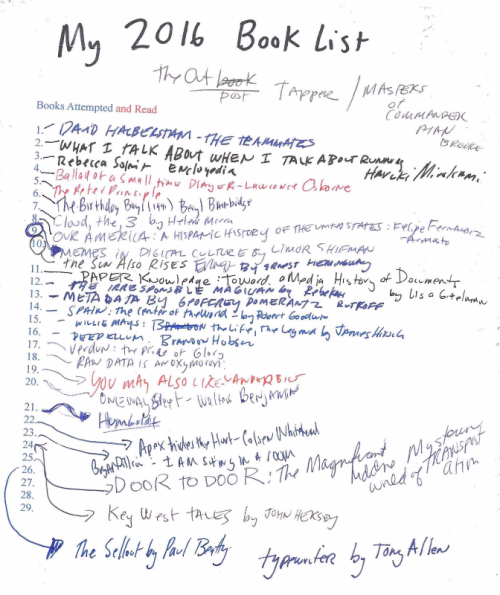
Following a theme that I established last year, this short list of books reflects my association with books and places:
1. Cervantes's Spain
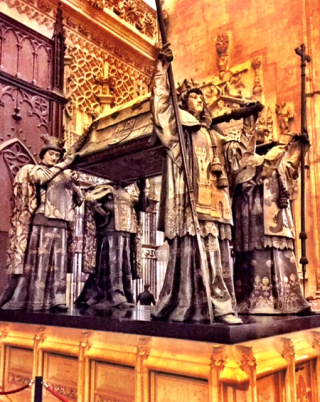 I spent two weeks last Spring in the Andalusian part of Spain between Cordoba, Grenada and Seville. This is one of the areas of Spain where the first modern novelist Miguel Cervantes roamed. It's a rich cultural area, which I knew nearly nothing about, but since I hauled Robert Goodwin's voluminous Spain: The Centre of the World (1519-1682) around with me, I began to get some understanding of what I was I seeing. Worth the heavy lift — like carrying Christopher Columbus' sarcophagus (shown here) at the Grand Cathedral in Seville.
As a precursor to the trip, I read Our America: An Hispanic History of the United States by Felipe Fernandez-Armato, which is an important alternative to the Anglo perspective of the settling of the Americas. It makes the idea of building a wall to keep immigrants out even more ludicrous, since the Spanish settled America in greater numbers before English-speaking peoples.
2. Birmingham, Alabama
 Though my entire month of October was dominated by the Cubs winning the World Series, a near-equal baseball experience was attending my first Rickwood Classic in Birmingham with my daughter and son-in-law. I love the history of baseball (which helped sustain me during the Cubs' decades of drought) and the annual Rickwood Classic, where two teams turn back time to play in the stadium that has been hosting games since 1919. In preparation, I read James Hirsch's fine biography Willie Mays: The Life and the Legend. Mays, who grew up in Birmingham, played on the 1948 pennant-winning Birmingham Black Barons of the Negro Leagues before signing with the New York Giants. The Barons hat is on the left in the photo.
3. MIT Press in Boston
 Nothing affects my reading selections more than browsing the MIT Press bookstore in Boston. Whenever I visit my other daughter in Cambridge, I always carve out time to browse and buy. I even take their catalog home with me and order books later. Here's just a list of books read (with links if I wrote about them): The Irresponsible Magician by Rebekah Rutkoff, Metadata by Geoffery Pomerantz, Memes in a Digital Culture by Limor Shifman, Raw Data is an Oxymoron edited by Lisa Gitelman, One Way Street by Walter Benjamin, Paper Knowledge: Toward a Media History of Documents by Lisa Gitelman, Typewriter: The History, The Machines, The Writers by Tony Allen, and Door to Door: The Magnificent, Maddening, Mysterious World of Transportation by Edward Humes.
Never underestimate how a really good bookstore can influence your reading.
4. Verdun, France
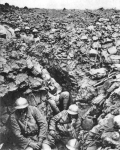 On this 100th anniversary of the World War I Battle of Verdun, which resulted in French and German casualties of over a million men in the period of less than a year, I read Alastair Horne's The Price of Glory. Admittedly, I have not traveled to Verdun, but Horne's book transported me there with its grisly details coupled with clear analysis on how this bloody campaign shaped the history of Europe.
5. Florida
As in 2015, I spent a week at St. George Island on the Florida panhandle. On a whim, I pulled out a remaindered hardback copy of John Hersey's Key West Stories, which he published just before he died in 1994. Hersey was a writer who I had heard of (Hiroshima, The War Lover), but I had no idea how good he was. One might associate him with the Ernest Hemingway era of the 1950s, but after rereading The Sun Also Rises, (part of my Spanish prep) I realize that Hersey is by far the better writer. His stories show tremendous range in subject matter with some measure of wit. For example, in the story "To End the American Dream," Hersey pays "tribute" to Hemingway by portraying him as a bar brawler, but also balances his portrayal by showing how Hemingway cares about his sentences and his writing habits. A Bell for Adano, for which Hersey won a Pulitzer Prize, is on my 2017 book list.
—– EXTENDED BODY: —– EXCERPT: —– KEYWORDS: Best books of 2016, Cervantes, Birmingham Black Barons, Willie Mays, Verdun, The Price of Glory, MIT Press, John Hersey, Key West Stories —– ——– AUTHOR: Murray Browne AUTHOR EMAIL: murray.browne905@gmail.com TITLE: Cub Fatigue STATUS: Draft ALLOW COMMENTS: 1 CONVERT BREAKS: wysiwyg ALLOW PINGS: 0 BASENAME: cub-fatigue- UNIQUE URL: https://thebookshopper.typepad.com/the_book_shopper_atlantad/2016/11/cub-fatigue-.html DATE: 11/05/2016 11:34:06 AM —– BODY:
At the risk of sounding petty like 3rd string Cub catcher Miguel Montero, who already complained about playing time (you had some great hits, Miguel, but you can't throw anybody out) or centerfielder Dexter Fowler who has declared free agency (you can still come back, Dex), I have already reached the point of cynicism or is it just my natural contrarianism. I don't need to see raggedy-ass Bill Murray ever again. And 5 million Cub fans in Chicago? Where were you when I was being picked on by Cardinal fans in grade school? And the Eddie Vedder song? It's sappy. At least, the Chicago cast of Hamilton singing "Go Cubs Go" will obliterate that song from anyone's memory-playlist.
Maybe I was just over stressed from watching 17 late-night postseason Cub games. Here is a photo of me waiting for Game 7 the other night. It was the last time I sat down all evening.
They say that Cub fans are going to change after the World Series. Sadly, they're right.
—– EXTENDED BODY: —– EXCERPT: —– KEYWORDS: —– ——– AUTHOR: Murray Browne AUTHOR EMAIL: murray.browne905@gmail.com TITLE: MARTA Book Club #31: Reading Revival STATUS: Publish ALLOW COMMENTS: 1 CONVERT BREAKS: wysiwyg ALLOW PINGS: 0 BASENAME: marta-book-club-30-reading-revival CATEGORY: MARTA Book Club UNIQUE URL: https://thebookshopper.typepad.com/the_book_shopper_atlantad/2016/10/marta-book-club-30-reading-revival.html DATE: 10/20/2016 07:47:28 AM —– BODY:
 It's almost been ten months since our last book club posting (MARTA Book Club #30) and a few of you have asked:
A.) Is anyone reading on Metropolitan Atlanta Rapid Transit Authority (MARTA) buses and trains any more, or B:) has the secretary of the MARTA Book Club become too lazy to record what people are reading while they are riding public transit?
Quite frankly, it has been a combination of the two. For a while, I just didn't see people reading much in the way of books. E-readers like Kindle seemed to have disappeared from the platforms as well. Time spent watching videos on phones seems to have increased though I don't quite see the pleasure of watching a dazzling dance number complete with stage lighting and gyrating music on a two by three inch screen.
Combine this media consumption trend to my lack of investigative fortitude and you can understand why there has been dearth of titles and subsequent postings.

But enough of the excuses. I have made a concerted effort lately. So here's a list — a small resurrection, if you will, of what people have been reading in Atlanta the past few weeks:
It Can't Happen Here by Sinclair Lewis and Michael Meyer.
Selected Commercial Statutes for Secured Transactions by Carol Chomsky and Christina Kunz (This month's winner of the Hefty Book Award).
Infinite Jest by David Foster Wallace (second place winner of the Hefty Book Award).
Just Mercy: A Story of Justice and Redemption by Bryan Stevenson.
Personal: A Jack Reacher Novel by Lee Child.
Guards! Guards! by Terry Pratchett.
Door to Door: The Magnificent, Maddening Mysterious World of Transportation by Edward Hume. This was my offering. In this book, Hume reveals the intricate and tenuous nature of our transportation network from shipping containers at the Port of Los Angeles to home delivery. He writes about the economic costs, the human costs (16 pedestrians are killed each day in the U.S.) and the environmental costs. Saying our infrastructure needs to be rebuilt is one thing, but doing it is something entirely different. One can start by reading this book.
Flash Point: A Wall Street Revolt by Michael Lewis.
Outcast, Vol. 3: A Little Light by Robert Kirkman and Elizabeth Brietweiser.
The Girl on the Train by Paula Hawkins. (of course, considering it's just been released as a movie)
The Hunger Games by Suzanne Collins
Game of Thrones by George W. Martin
The Glass Castle: A Memoir by Jeanette Walls
Perhaps this is not much of a effort compared past lists but you can can contribute by adding a book in this posting's comments section.
—– EXTENDED BODY: —– EXCERPT: —– KEYWORDS: MARTA Book Club, Door to Door, Edward Humes, —– ——– AUTHOR: Murray Browne AUTHOR EMAIL: murray.browne905@gmail.com TITLE: The Little Library of Football Stories STATUS: Publish ALLOW COMMENTS: 1 CONVERT BREAKS: wysiwyg ALLOW PINGS: 0 BASENAME: the-little-library-of-football-stories UNIQUE URL: https://thebookshopper.typepad.com/the_book_shopper_atlantad/2016/10/the-little-library-of-football-stories.html DATE: 10/02/2016 12:06:52 PM —– BODY:
 So what is the story behind this abandoned, perhaps vandalized, little book library located in a public park near my house? It's been that way for months. It's not filled and curated like many of the little book libraries that you see in nicer neighborhoods. What makes this repository with it's missing glass more pathetic is that the only book in there is Pete Carroll's Win Forever: Live, Work and Play Like a Champion. Originally published in 2011 after a successful tenure as a football coach at University of Southern California (before the NCAA issued heavy sanctions against USC) Carroll extols the virtues of a winning attitude (read: good timing). I am not surprised that this once mighty book had found itself in a lowly state. Even the average football fan knows that later, as head coach of the Seattle Seahawks, Carroll lost to New England when he blundered in the closing seconds of Super Bowl XLIX. More recently Carroll was fined by the NFL while the Seahawks lost a draft pick when the league discovered that Carroll had held illegal off-season workouts.
But then again how many "great football books" are there– really? They all could fit in a well-organized neighborhood book library. Here's a stab at a list though I have not read any of them:
- Jerry Kramer's Instant Replay: The Diary of a Green Bay Packer (1968). Noted sportswriter Dick Schaap co-wrote an account of Kramer's season under legendary coach Vince Lombardi.
- Art Donovan's Fatso: Football When Men Were Men (1987). The ex-Baltimore Colt Hall of Famer, who played in the Johnny Unitas era, was a frequent guest on David Letterman's talk show.
- Peter Gent's North Dallas Forty (1974). This book is more known for the movie adaption starring Nick Nolte. Long before there was any discussion about the effects of concussions, the movie revealed how football players used marijuana and painkillers just to endure the weekly suffering between games — sanctioned by the team owners and winning coaches of course.
P.S. This is in contrast to all the great books about baseball — just mentioned on this blog alone. It is no coincidence that I am posting this on the last day of the regular baseball season.
—– EXTENDED BODY: —– EXCERPT: —– KEYWORDS: —– ——– AUTHOR: Murray Browne AUTHOR EMAIL: murray.browne905@gmail.com TITLE: On Stamps STATUS: Publish ALLOW COMMENTS: 1 CONVERT BREAKS: wysiwyg ALLOW PINGS: 0 BASENAME: on-stamps UNIQUE URL: https://thebookshopper.typepad.com/the_book_shopper_atlantad/2016/09/on-stamps.html DATE: 09/20/2016 06:46:58 AM —– BODY:

Below is an excerpt from the book One-Way Street (1927) by German philosopher and cultural critic, Walter Benjamin (1892-1940). The short book is mostly a montage of random thoughts and observations (kind of like this blog). This quote reminded me of an exhibit at the Museo de la Filatelia (Stamp Museum) in Oaxaca City, Mexico that I visited a few years ago. Good thing I saved these two pictures on my cell phone.
Stamps bristle with tiny numbers, minute letters, diminutive leaves and eyes. They are graphic cellular tissue. All this swarms about and, like lower animals, lives on even when mutilated. This is why such powerful pictures can be made of pieces of stamps stuck together. But in them, life always bears a hit of corruption to signify that is composed of dead matter. Their portraits and obscene groups are littered with bones and riddled with worms.
Earlier in the same piece entitled "Stamp Shop" Benjamin talks about that in a pile of old letters that the stamp "says more than a reading of dozens of pages." Something to consider when you think about writing a letter to an old friend instead of sending an email.
—– EXTENDED BODY: —– EXCERPT: —– KEYWORDS: Walter Benjamin, Stamps, One-Way Street, Museo de la Filatelia —– ——– AUTHOR: Murray Browne AUTHOR EMAIL: murray.browne905@gmail.com TITLE: Summer Clearance STATUS: Publish ALLOW COMMENTS: 1 CONVERT BREAKS: wysiwyg ALLOW PINGS: 0 BASENAME: summer-clearance CATEGORY: Book Reviews CATEGORY: Bookstores CATEGORY: Civil War Books UNIQUE URL: https://thebookshopper.typepad.com/the_book_shopper_atlantad/2016/08/summer-clearance.html DATE: 08/30/2016 07:39:46 AM —– BODY:

My response for not posting in over a month is a late summer recap of small, book-related things:
MIT Press: "facts and Facts" 
I was in Boston again this summer visiting my older daughter Cynthia, which always includes an hour at the MIT Press Bookstore. Coincidentally, while on my trip I was still reading another MIT book Raw Data is an Oxymoron (2013), a series of thought pieces on data, edited by Lisa Gitelman. (Earlier this year I posted a piece on Gitelman's Paper Knowledge: A Media History of Documents 2014 by Gitelman.) Since it can be a little geeky, Raw Data is not for the feint of heart. However, there is one piece that really separated itself from the others — the story of how data was used to fight a horrible social injustice. Ellen Gruber Garvey's "facts and FACTS": Abolitionists' Database Innovation" is the tale of two sisters, Angelina and Sarah Grimke, who left antebellum South Carolina and moved to New Jersey with Angelina's husband Theodore Weld. Based on their knowledge of slavery (which is why they left their home state), they clipped newspaper advertisements and articles about runaway slaves and built a database — compiled of thousands of facts –which began  to illuminate the atrocities that were going on in the South. This database was the basis of the book American Slavery As It Is: Testimony of a Thousand Witnesses (1839) which was later used by abolitionists such as Frederick Douglas and Harriet Beecher Stowe, author of Uncle Tom's Cabin (1851), to support their efforts. American Slavery As It Is, writes Garvey, ""was an important gesture in the move away from theology or exhortation, and toward reliance on documented, factual information to change the minds of white Northerners about slavery."
Walden Pond
 On an overcast Sunday, Cynthia drove me a few miles out of Boston to Walden Pond (shown above), the place where Henry David Thoreau spent two years (1845-1847) building a small cabin on land owned by his friend and mentor Ralph Waldo Emerson. Using his journal notes from the experience, Walden was later published in 1854. Thoreau's motivation behind the experiment was that living simply would give him more time to think and write. Who doesn't need more time to think and write?
It was our good fortune to go on the dismal, gray day because it kept the attendance down (apparently since they restrict the number of visitors to the state park). The park is currently being renovated, which is a good idea because it was a little worn around the edges. We hiked and I took in the healing waters of the pond, only to learn that the waters of Walden do not have any medicinal properties — except to relieve writer's block.
The Battle of Allatoona Pass
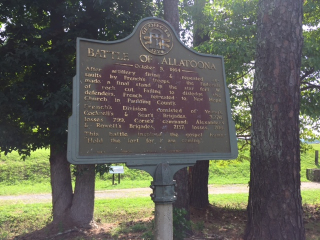 After returning from Boston, I made a quick trip up from Atlanta to Knoxville to see some old friends. Since I was traveling alone, I took the opportunity to visit another one of the small Georgia battlefields on my ever-so-modest bucket list — The Battle of Allatoona Pass. Using my trusty guidebook, Barry L. Brown and Gorden R. Elwell's Crossroads of Conflict: A Guide to Civil War Sites in Georgia (2010), I had no trouble finding the site off I-75/ Exit 283, which is quiet and decently well-preserved. Fought on October 5, 1864, this small, but fierce and bloody battle preserved General Sherman's supply line after he captured the city of Atlanta.
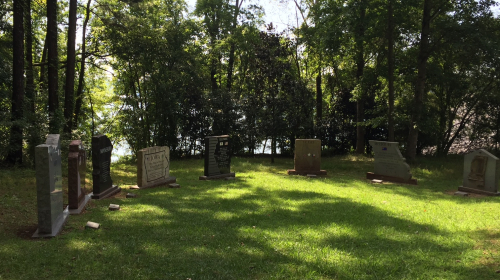
—– EXTENDED BODY: —– EXCERPT: —– KEYWORDS: Lisa Gitelman, MIT Press, Walden Pond, Henry David Thoreau, Battle of Allatoona Pass,Angelina and Sarah Grimke, Ellen Gruber Garvey —– ——– AUTHOR: Murray Browne AUTHOR EMAIL: murray.browne905@gmail.com TITLE: A Father’s Favorite Book STATUS: Publish ALLOW COMMENTS: 1 CONVERT BREAKS: wysiwyg ALLOW PINGS: 0 BASENAME: a-fathers-favorite-book CATEGORY: Book Reviews UNIQUE URL: https://thebookshopper.typepad.com/the_book_shopper_atlantad/2016/07/a-fathers-favorite-book.html DATE: 07/20/2016 07:16:39 AM —– BODY:

I have finally got around to reading one of my father's favorite books, The Price of Glory: Verdun, 1916 (1962) by Alistair Horne, a prolific British historian and journalist who is still writing at the age of 90.
The book had been on my shelves since my father died in 1985. It is not uncommon to dispense with all but a few of a person's books while cleaning out their possessions, however, this one I could not get rid of. I remember him sitting in his chair in the family room and reading and rereading Horne's book. My father even made his own copy of the map to make following the troop movements easier.
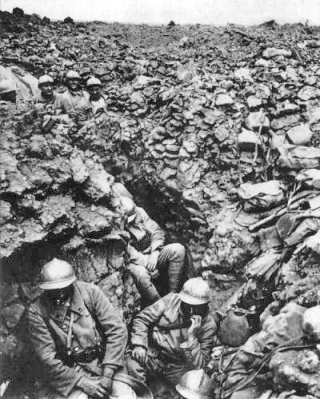 I am not sure what caused me to pick up the book now. Maybe all the current unrest in France or the fact that it is the 100th Anniversary of the 10 month battle. Verdun claimed over a million German and French lives within an area of about 15 square miles. Basically, you think of the Western Front in World War I and you think of scorched earth and men living underground in the mud, but there are additional ghastly details that shouldn't be forgotten either.
The Price of Glory
Your first impression of blood and mud would not be incorrect, but what makes Horne's book an historical classic is attention to the personalities of the French and German commanders and the personalities of the armies. For the French, the directive of surrendering no ground whatever the cost and immediately counterattacking if they did lose territory, dominated their strategy. Horne also delves into the personality of the fighting men on both sides — sometimes in frank, non-politically-correct prose:
On the extreme left of the (German) 2nd Battalion was a section of Pioneers, commanded by a Sergeant Kunze. Kunze at 24 was a regular soldier of Thuringian peasant stock; from his photography one gets the impression of heavy hands and limited intelligence; from his subsequent action, one gets an impression of complete fearlessness, but perhaps of that variety of boldness that often reflects lack of imagination. Men like Kunze were the backbone of any German Army; they would go forwards in execution of what they held to be their orders unquestioningly and unthinkingly, until at last a bullet dropped them.
Horne is even less kind to the French:
Whether due to lack of organization or lack of material, or both, things usually seemed to be a little worse in the French trenches, and rather better than average in those occupied by the Germans for any length of time. French carelessness about hygiene in the trenches never failed shock visiting Britons; though, perhaps immunized by the rusticity of their normal peacetime sanitary arrangements, it rarely appeared to disturb the French.
Any time I read a book about World War I, I ask myself how did the soldiers endure the conditions and put up with the slaughter. The quotes above explain part of national mentalities and in the beginning of the book, Horne writes about how the Franco-Prussia war of 1870 laid some of the groundwork for 1914. There is another excellent book that even further explains the mindset that led to the Great War — Modris Eckstein's Rite of Spring: The Great War and the Birth of the Modern Age (1989).
Horne's ability to roll in the personalities of the commanders and some of the front line troops (like Kunze) remind me of the historical writings of Rick Atkinson's World War II Liberation Trilogy on the United States military campaigns in North Africa, Italy and Western Europe. Atkinson (like his idol Shelby Foote) has a narrative quality to his historical writing as does Horne. No wonder over a half a century later Horne's book is considered one of the major books about the Western Front.
(Horne also remains relevant as a writer for his book A Savage War of Peace: Algeria 1954-1962, originally published in 1977, and was reprinted in 2006 because historians and policymakers saw stark parallels between the French in Algeria and the United States in Iraq.)
Reading Horne
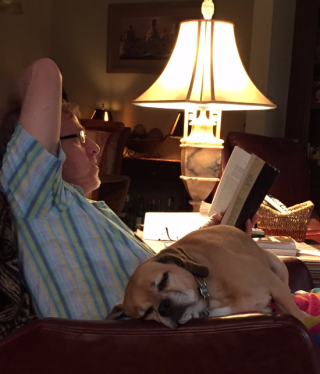 Sitting in my easy chair with my ornery grandpuppy (don't be fooled by his innocent look) and flipping back and forth between battle prose and maps, I guess I have channeled some of my father. Of course, I regret not being able to tell him how much I appreciate one of his favorite books or talking to him about the Atkinson trilogy, but it is rewarding to keep a promise I made to myself 30 years ago.
—– EXTENDED BODY: —– EXCERPT: —– KEYWORDS: Verdun 100th Anniversary, Alistair Horne, Verdun 1916, Rick Atkinson. —– ——– AUTHOR: Murray Browne AUTHOR EMAIL: murray.browne905@gmail.com TITLE: Willie Mays in Birmingham STATUS: Publish ALLOW COMMENTS: 1 CONVERT BREAKS: wysiwyg ALLOW PINGS: 0 BASENAME: willie-mays-in-birmingham CATEGORY: Baseball UNIQUE URL: https://thebookshopper.typepad.com/the_book_shopper_atlantad/2016/06/willie-mays-in-birmingham.html DATE: 06/22/2016 06:59:24 AM —– BODY:
Currently, I am moseying through James Hirsch's fine authorized biography of baseball great Willie Mays and it has a lot of connections for me — especially now since my younger daughter Bonnie and her husband Tim live in Birmingham.
Last year I bought Willie Mays: The Life, The Legend (2010) for $3 on a remainder table at the 2nd and Charles Bookstore in Birmingham. I didn't read much of it at first, but enough to learn that Mays grew up in the coal and steel town of Fairfield on the outskirts of Birmingham. By the time he graduated high school in 1947, Mays was playing professionally and in 1948 played for the Birmingham Black Barons of the Negro Leagues. Jackie Robinson had broken the color barrier in baseball in 1947 and within a year, most of the franchises of the Negro Leagues were already declining in attendance. The pennant-wining 1948 Black Baron team shown above (Mays is on the top row in the middle), lost in to the Homestead (PA) Grays in the Negro League World Series.
One of the strengths of the Hirsch's book is that he does not gloss over the racial indignities and dangers of the Jim Crow era (especially in Birmingham), but he puts into context Mays's ways of coping. Jackie Robinson publicly criticized Mays for not speaking out against racial inequality, but Hirsch explains that it didn't fit into Mays's personality and Southern upbringing. Not that Mays didn't break down barriers — he just did it in more subtle ways.
Mays the Player
But there is a lot of baseball lore as well:
- In 1951, the rookie Mays was on deck when Bobby Thomson hit "the shot heard around the world," which gave the Giants the pennant over the Dodgers.
- In the first game of 1954 World Series, May's famous catch of Vic Wertz's deep fly ball at the Polo Grounds was not his greatest defensive play. "The Catch" as it is known, is considered a secondary feat compared to "The Throw." In a August 15, 1951 game against the Dodgers when the Giants were making their famous run for the pennant, Mays ran from left center to the almost the right field line to snare a line drive by Carl Furillo, and then doing a 180 degree with his back to home plate, whirled and threw a strike to cut down a runner trying to tag up and score from third base. Unfortunately there is no video of "The Throw." If you decide to view the famous video of The Catch instead, pay attention to a couple of things. One, even though it looks like a wall that Mays is heading into it is actually a short fence with a dark screen. (It always looked like a tall wall to me). Secondly, why did Mays plant his foot and throw so early? The reason: Mays knew that Larry Doby, who was on second base, could have scored on a sacrifice — even from second base. Doby was held at third and the score remained tied. This set the tone for the Series as the Giants swept the Indians.
- Outfielder Mickey Mantle was chasing a Mays fly ball when Mantle tore up his knee on a Yankee Stadium sprinkler head in the 1951 World Series. It was also the only time Mays played on the same field as Mantle and Joe DiMaggio, who retired after the season.
- In the winter ball after the 1954 season, Mays played centerfield for the Santurce Cangrejeros (Crabbers). The team was made up many fine players, including a 19 year old rightfielder named Roberto Clemente. And the batboy was Future Hall of Famer Orlando Cepeda.
Rickwood Classic
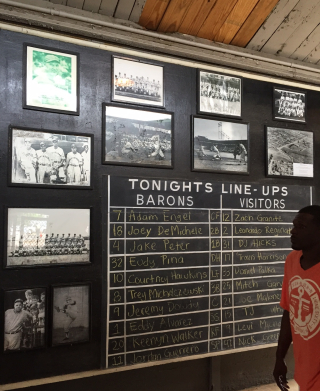 This book coupled with my recent trip to Birmingham for the annual Rickwood Classic, a turn-back-the-clock game where they played a Double A ball in the stadium built in 1910. (This is before they tear down 20 year old stadiums like they do in Atlanta). This game was on my bucket list. (I have a very modest bucket list). It was fantastic to go with my daughter and her husband. As you enter the stadium you can see the black and white photographs reflecting the history of the ballpark, which was the home of the Black Barons. And when you see the mounted photograph of young Willie Mays with his Baron teammates, you are transformed into different time. Not always good. Not all bad. But a reminder that these are the roots of arguably the best all-around player to have ever taken the field.
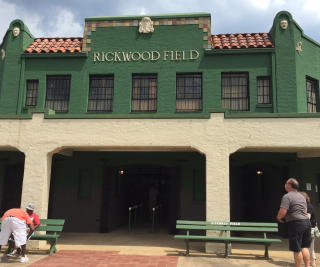
—– EXTENDED BODY: —– EXCERPT: —– KEYWORDS: Willie Mays, James Hirsch. Birmingham Black Barons, The Catch, The Throw, Rickwood Field, Birmingham baseball history —– ——– AUTHOR: Murray Browne AUTHOR EMAIL: murray.browne905@gmail.com TITLE: In Cervantes’ Spain STATUS: Publish ALLOW COMMENTS: 1 CONVERT BREAKS: wysiwyg ALLOW PINGS: 0 BASENAME: in-cervantes-spain UNIQUE URL: https://thebookshopper.typepad.com/the_book_shopper_atlantad/2016/06/in-cervantes-spain.html DATE: 06/03/2016 06:57:45 AM —– BODY:
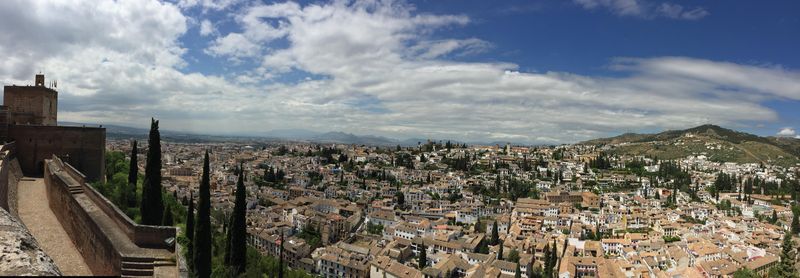
I recently returned from a two-week vacation in Spain. It was a highly personalized trip, masterfully planned by my partner Denise (at left),  which saw us visit Madrid, Cordoba, Granada (shown at top), Seville, and the mountainous white villages of Ronda, Arcos, and Grazalema. Accompanying on my trip–somewhat against my common sense–was a hardback copy of the Robert Goodwin's 2015 tome, Spain: The Center of the World 1519-1682. Since the book is slow reading out of the gate and it is somewhat of a boat anchor to haul around, I debated right up to the day of departure whether I would take the book, but it was decision that I did not regret.
As its title suggests, Goodwin gives an in-depth history of Spain's Golden Age beginning with the rule of Charles V. Heretofore, my knowledge of Spain was limited to Queen Isabella and King Ferdinand's funding of Christopher Columbus's trip to the West Indies in 1492 and the Monty Python skit "No one expects the Spanish Inquisition." 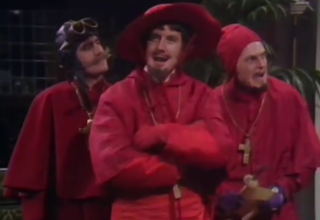 For hundreds of pages over two weeks, I did an immersion in Spanish history (not language). I read about and viewed Spanish art and experienced the history at a different level while walking through cathedrals and palaces — between samplings of the many cheeses, red wines, and tortilla espanolas. ( I defer to Denise's expertise with sherries, olives, and all things Flamenco.)
No tour of Spain can escape the influence of Miguel Cervantes (1547-1616), whose Don Quixote (1605) is considered to be the first modern novel. In lieu of reading the hefty Cervantes classic, which makes Goodwin's book look like a wafer, I took pictures of Cervantes-themed plaques and statues. Here's just a few photos and historical insights about Cervantes.
Number 1 – Cervantes: Captured by Pirates
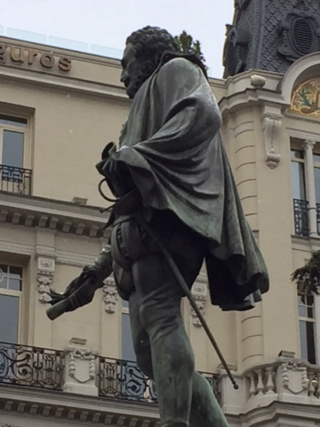 In 1572, Cervantes and his brother Rodrigo enlisted in the Spanish navy and fought in the naval battle of Lepanto (off the coast of Greece) against the Ottoman Turks. Cervantes fought bravely and was finally discharged in 1575, but en route to Barcelona he and his brother were captured by pirates from the Barbary coast. They held Cervantes a prisoner in Algiers for almost 5 years. Cervantes' own report of his captivity was recorded, in the words of Goodwin, as "a thrilling tale of derring-do, of facing danger with Christian stoicism, of pluck and courage and initiative." Shown here is a statue of Cervantes in Madrid near the world famous Prado art museum. Coincidentally, the Prado is the home of Pieter Brueghel's 1562 painting Triumph of Death, which appears briefly in the Monty Python Spanish Inquisition sketch mentioned above.
Number 2 – Cervantes: The Conquistadors
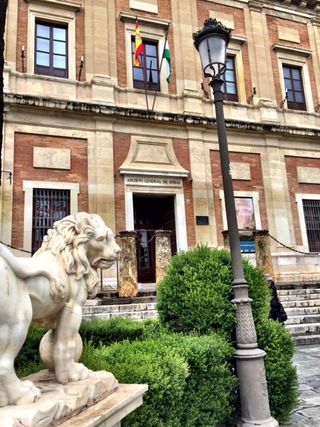 From reading another related book, Our America: Hispanic History of the United States, by Felipe Fernandez-Armesto, I recently learned that Don Quixote satirized what was happening in the New World as well as in Spain. The conquistadors were exploring the Southwest after their conquests of Peru and Mexico and the wealth was supporting the mother country of Spain in the 16th century. But the conquistadors were hardly noble and their conditions brutish as they toiled in less than ideal conditions (hard travels, hostile Indies, disease). Related events in the New World was described meticulously and have been preserved in the impressive Archivo General de Indias near the Grand Cathedral in Seville. The stately archives building didn't take long for us to tour, since all the museum signage is in Espanol.
Number 3 – Cervantes: The Writer
 In 1615, Cervantes followed up Don Quixote (pub.1605) with a second volume on the travels of the Don and his pal Pancho. Apparently, Cervantes was thus not only the originator of the modern novel, but also the progenitor of the literary form still
  with us today known as the sequel. The pair of photos at right shows a space dedicated to the writer in a private patio in Cordoba that was open to the public in a festival that took place when we were visiting. As a youth, Cervantes lived in Cordoba with his family in the city from 1553-1557.
Number 4- Cervantes: The Rascal
 Satirists are ornery and Cervantes was no different. He was imprisoned–not for his writing–but rather as part of a dispute that centered on his work as a taxman for the Crown. At Seville's main plaza there were two prisons. The main facility was called the Royal Prison, which could hold nearly 1500 inmates, and a small series of cell blocks located in the adjacent Palace of the Audienca. Cervantes spent several months in the Royal Prison in 1597-98 and it is believed that is where he began writing Don Quixote. The small statue of Cervantes surrounded by palm trees shown at left is located on a narrow alley near the main plaza, which is still called Entrecarceles or "Between Jails."
Hard to imagine what the trip would have been without the book or the book without the trip, or without my guide Denise for that matter.
—– EXTENDED BODY: —– EXCERPT: —– KEYWORDS: Cervantes, Spain, Cervantes plaques, Cervantes Statues, No One Expect the Spanish Inquisition —– ——– AUTHOR: Murray Browne AUTHOR EMAIL: murray.browne905@gmail.com TITLE: Remembering Civil War Books STATUS: Publish ALLOW COMMENTS: 1 CONVERT BREAKS: wysiwyg ALLOW PINGS: 0 BASENAME: remembering-civil-war-books CATEGORY: Civil War Books UNIQUE URL: https://thebookshopper.typepad.com/the_book_shopper_atlantad/2016/05/remembering-civil-war-books.html DATE: 05/29/2016 08:08:07 AM —– BODY:
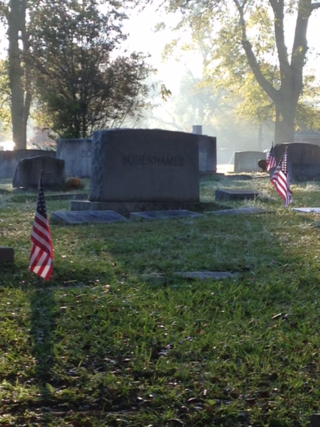 Since it is Memorial Day weekend, I was thinking about the Civil War and how the holiday originated. Since 2011, I've posted numerous articles about various Civil War books. You can go to a single link (here) to browse through some of the fanfare. There are articles about the William Tecumseh Sherman "songbook", Ambrose Bierce (the only major American writer who actually fought in The Civil War), and "travel pieces" about various Georgia battlefields highlighted with a review of Barry L. Brown and Gordon R . Elwell's Crossroads in Conflict: A Guide to Civil War Sites in Georgia.
I am always a sucker for intrigued by books that are unconventional by either format or subject matter or some combination thereof:
 Cloud, The 3 (2007) by Helen Mirra
Mirra is an artist who defies easy classification – visual artist, sculptor, poet, professor and Cloud, The 3 reflects this. In this book, Mirra has indexed John Dewey's Reconstruction in Philosophy (1920)and reformatted it as a collection of short poems. Each page contains an index entry or two. Notice in the samples shown on the left (if you click on it to enlarge you will see it better) how they are alphabetical like an index and how their position shifts with each succeeding page. Clever. I liked this book for several reasons: (a) It is fast reading, (b) I used to index for living (films not books) and (c) I appreciate short bursts of meaningful epigrams. Here's just a few more examples:
Being everything, it was
nothing, 66
Class interest and bias, 35
Default is inevitable
and irremediable, 81
Squirm, dodge, evade,
disguise, cover up,
find excuses, 104
Paper Knowledge: Toward A Media History of Documents (2014) by Lisa Gitelman
In this series of four scholarly thought pieces (but more thoughtful than academic) Professor of English and Media, Culture and Communication, Lisa Gitelman explores the significance of often overlooked paper documents. Gitelman focuses more on how the legacy of such documents as: death certificates, fill-in-the-blank forms and a 1936 printer's manual by Robert C. Binkley entitled Manual on Methods to Reproduce Research Materials.
Though it is demanding to read, it's a pleasurable one too as Gitelman looks at how changes in technology and the business of printing has evolved in the last 150 years. She includes stories and anecdotes about ditto machines and mimeograph machines. (For those who went to school in their sixties can you recall the gluey warm smell of the fresh blue ink — like Proust's madeleine?) In another chapter she focuses on the history of the xerography. Who can forget the early adoption of photocopying, which included xeroxing faces, hands and for the more adventurous — buttocks. In the chapter she details the watershed moment for xerography, when Daniel Ellsburg removed classified Defense Department documents, copied them and then "published" The Pentagon Papers.
In a last full chapter, Gitelman offers a retrospective of Adobe's Portable Document Format (PDF), which was developed in the 1990s and now has become ubiquitous. But what does this page-as-image really mean? For Gitelman, it reflects the culture of the modern office. In this passage Gitelman quotes from the Adobe's 1993 Acrobat manual, Beyond Paper: The Official Guide to Adobe Acrobat.
"Everyone has either launched their own memo grenade at one time or another or has sighted one lobbed over office partitions and across organizational charts." These are the memos sent up the chain of command — to complain, criticize, or aggrandize the writer — that fall flat, "explode" and embarrass him or her instead, with potentially career-damaging results. "And unfortunately, memo grenades will exist as long as there is office communication,"even if Adobe Acrobat exists to deliver them. Employees in this world don't as much bond together at the water cooler and the photocopy machine as they delight in deriding each others foibles and ambitions.
Postscript
For the record, I really resisted trying to scan the couple of pages from the Mirra book. Besides looking kind of horrible, it really doesn't do the book any justice. This book is an art object — if you couldn't already tell from the word jumble front cover. The Gitelman block quote in Paper Knowledge is from page 127. The quotes within the block quote come from the Adobe manual. I wanted to scan this too, because I am a lazy typist, but two ugly scans in the same posting are verboten in the blog style manual.
—– EXTENDED BODY: —– EXCERPT: —– KEYWORDS: Lisa Gitelman, Paper Knowledge, The Cloud, Helen Mirra —– ——– AUTHOR: Murray Browne AUTHOR EMAIL: murray.browne905@gmail.com TITLE: A Humbling Tribute to Jim Harrison STATUS: Publish ALLOW COMMENTS: 1 CONVERT BREAKS: wysiwyg ALLOW PINGS: 0 BASENAME: harrison-tribute UNIQUE URL: https://thebookshopper.typepad.com/the_book_shopper_atlantad/2016/04/harrison-tribute.html DATE: 04/18/2016 07:24:57 AM —– BODY:
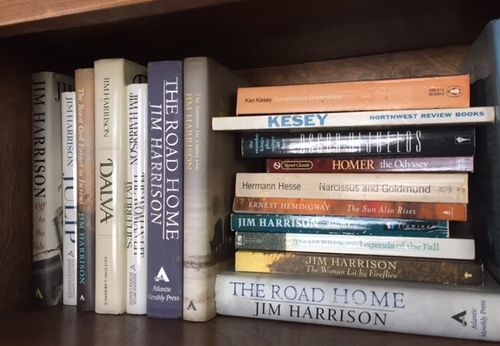
When we die, we are only stories in the mind of others. – Jim Harrison, The Road Home
Unlike pop music stars such as David Bowie or country-western troubadours like Merle Haggard, when relatively well known writers die there is comparatively little fanfare. There are no award show musical salutes or moments of silence in sports arenas for writers who have recently passed. Usually it is just a few retrospective articles, a bump in sales on Amazon and that is about it. But I cannot let the recent death of the writer Jim Harrison at 78, go by unnoticed. When you have read at least ten books by the same author you cannot help feel somewhat connected to the guy. I never met him and I am not even sure if I had, I would have liked him, but that is one of the beauties of being a reader — you can know a writer through his or her work and that is enough.
Jim Harrison Who?
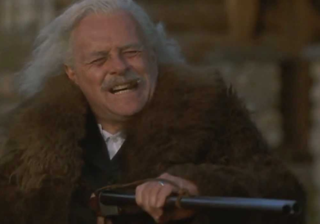 At this point if you haven't heard of Jim Harrison, you've probably moved on, but in case you are still wondering who Harrison is, allow me to quickly explain. He is the author of the book that the 1994 movie Legends of the Fall was based upon. You know, the movie starring Brad Pitt (I pause here to allow my female friends to sigh) and Aidan Quinn. It's the film about two brothers who are in love with the same woman, and a father (the gnarly Anthony Hopkins, shown at the right, who bears a physical resemblance to Harrison), who didn't teach the boys to share. I watched the movie again recently and I appreciated the Montana scenery of the Edward Zwick film, which won the Oscar for best cinematography, but Pitt as the uber-macho and tormented, woman-magnet is a little much at times.
Like Hemingway – Nah!
Harrison is often inaccurately compared to Ernest Hemingway. They do look alike–except Harrison has a more untamed appearance–they both spent considerable time in Michigan, and they both utilize a simple sentence style with a confident, matter-of-fact tone, but Harrison's prose is deceptively rich. Another difference is that Hemingway is known for his "manly man" characters, whereas Harrison's men are equally tough but much better rounded. Yes, Harrison's middle-aged guys hunt, fish, and like dogs but they are not above pointing out their own foibles. Harrison males appreciate birds and animals (instead of always wanting to blast them) and like wine, food and strong women. (In 2001, Harrison has wrote a cookbook as well, The Raw and the Cooked.)
I've read that some that consider Harrison a misogynist (or at least some of his characters), but he has developed several strong, memorable female characters along the way. One is the resourceful twenty-one-year old Julip Durham in the three novella compilation Julip. (1994), who has to get her mentally ill brother Bobby out of a Florida jail and into an institution. Then there is Dalva, the main character of the 1988 novel of the same name, who is complex and free-spirited. She loves the natural world, "the sound of horses eating oats," "floating naked in the Niobrara [River] current on a hot afternoon in August," and the "strange looks of animals making love." Nevertheless, she struggles in her relationships with men throughout her life. In the novel, Dalva goes in search of the son she gave up for adoption when she became pregnant at age fifteen. In an interview shortly before his death, Harrison said, "With Dalva I got to establish my own universe. At the time in my 30's, I largely misunderstood women and it was time to catch up."
Dalva is also one of the main characters in The Road Home (1998), a novel that covers three generations of a Nebraska family. This book unflinchingly tackles life's major conflicts: whom we love, how we decide to live, the role family history plays in our personalities and how we face death. It is some comfort to me that Harrison died with his writing boots on– publishing a book and appearing in the New York Times Book Review the month of his death.
—– EXTENDED BODY:Brown Dog
Harrison also created the orneriest cuss in modern literature, in the middle-aged Brown Dog, an indefatigable Native American who lives in the Upper Peninsula of Michigan, drifting between menial jobs but smart enough, for example, to trade a female anthropologist information on ancestral burial grounds for a roll in the sack and a few hundred dollars (in Julip). Harrison sees Brown Dog's credo as "born not to cooperate with the world."
Brown Dog first appears in The Woman Lit by Fireflies (1990) but Harrison brings him back several times, including in the novella Westward Ho in The Beast God Forgot to Invent (2000), where Brown Dog is thrown out of his natural habitat into the phony world of Hollywood. He manages to adapt to the situation, and if that means breaking into the UCLA Botanical Garden so he camp out for the night, then so be it. Still, not tired of Brown Dog, Harrison makes him the protagonist of the title novella of The Summer He Didn't Die (2005). In this story Brown Dog trades sex with a female dentist ('she's shaped like ans egg") for a tooth extraction, and then rescues from permanent institutionalization a nature-loving child who suffers the after effects of fetal alcohol syndrome. Brown Dog is a great character and Grove Press evidently thought so too, as the publisher compiled all the novellas into one book (an added one new one) into a separate book called Brown Dog (2010).
Final Thoughts
The most important quality of the writer Jim Harrison is that as a reader you could count on any one of his books to pull out of a reading slump. You know what I am talking about — those losing streaks where everything you read is borderline blah. Even his lesser books have vigor, style and wisdom and he has left plenty of books behind — some which I plan on re-reading in the future.
Note: Parts of this posting appeared originally in my book, The Book Shopper: A Life in Review (2009). Shockingly when I pulled the some of the text I found out that I had misidentified the character Brown Dog as Black Dog in the book. How could have I ever f**ked up like that ?!? And how could I ever apologize to Jim Harrison, which now of course, I cannot do. I could only imagine what the crusty, blunt writer probably would have responded to my lame apology. He' d probably borrow a line from the main character John Lundgren in Warlock (1982) whose patented response to whiners was: "Tell it to Anne Frank."
—– EXCERPT: —– KEYWORDS: Jim Harrison, The Road Home, Dalva, Legends of the Fall movie, Warlock, Tributes to Jim Harrison —– ——– AUTHOR: Murray Browne AUTHOR EMAIL: murray.browne905@gmail.com TITLE: The End of A Crusty Bookstore STATUS: Publish ALLOW COMMENTS: 1 CONVERT BREAKS: wysiwyg ALLOW PINGS: 0 BASENAME: crusty_bookstores CATEGORY: Bookstores UNIQUE URL: https://thebookshopper.typepad.com/the_book_shopper_atlantad/2016/03/crusty_bookstores.html DATE: 03/28/2016 06:47:14 AM —– BODY:
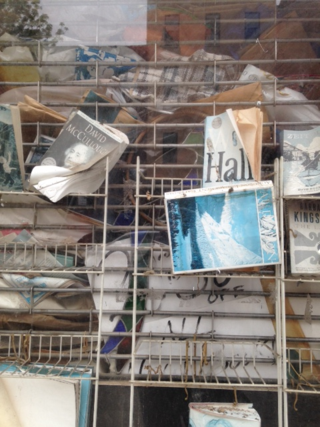 "Books disturb people. They make them anti-social." – Montag, in the movie version of Fahrenheit 451
About a year ago, I posted an account of a book shopping trip to a couple of bookstores in the Carroll Gardens section of Brooklyn. The most notable was Book Court, a spacious bookstore, well-stocked in quality fiction, but there was another store that also left an impression:
"A few blocks from Book Court is The Community Bookstore, which had not opened for the day. Looking through the store window, I must admit, was a little intimidating. My only thought was that this is what happens to books that are tossed in the dumpster."
Well, The Community Bookstore is now closing after three decades of business. The New Yorker posted a short video about the owner John Scioli and the store's impending departure. I watched this feature a couple of times with mixed feelings.
At first, it reinforced my longtime belief that "Book Lovers Are Not Necessarily People Lovers." I have been in stores like Scioli's — "curated" by a crusty owner— but it's not the unfriendly attitude that bothers me as much as the clutter. We're not talking a few unshelved books here, we're talking a stack of books crashing down on your head (which happens more than once in the video). Even more frightening is seeing Scioli smoking in the stacks. The whole place could ignite into one blaze of word and flame — kind of like the famous scene in the movie Fahrenheit 451 (1966) when Montag torches the house of a woman who has a huge collection of books.
My lasting impression from the video is not the sadness of another bookstore closing, but the wistful comments from a young woman who said, "I feel like it's the responsibility of the next generation to make things like this happen. We can't expect them to stick around forever."
Who will lead that next generation of ornery book hoarders? If I am not careful, it could be me.
—– EXTENDED BODY: —– EXCERPT: —– KEYWORDS: The Community Bookstore, Fahrenheit 451, Brooklyn bookstores —– ——– AUTHOR: Murray Browne AUTHOR EMAIL: murray.browne905@gmail.com TITLE: Catalog Speed Reading STATUS: Publish ALLOW COMMENTS: 1 CONVERT BREAKS: wysiwyg ALLOW PINGS: 0 BASENAME: speed-reading CATEGORY: Bookstores UNIQUE URL: https://thebookshopper.typepad.com/the_book_shopper_atlantad/2016/03/speed-reading.html DATE: 03/21/2016 07:00:25 AM —– BODY:
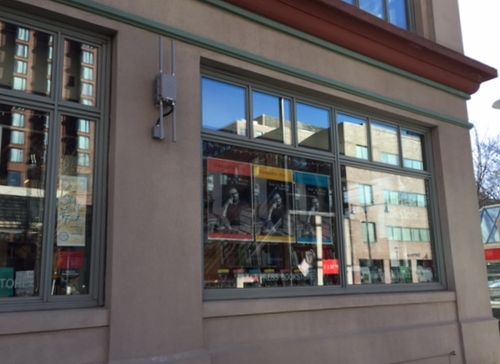
One way to read — or give the appearance of being well read — is to skim through book catalogs from serious or less-than-traditional publishers. Last month when I was in Boston, I picked up the Fall 2015 and Spring 2016 catalogs from one of my favorite bookstores, the MIT Press Bookstore (shown above), which is kind of a direct-to-consumer outlet for the prestigious MIT Press. You can look at their book catalogs online, but it really doesn't replace the glossy look and feel of fine, four-color printing on high quality paper. Their 100+ page catalog rates right up there with the Eighth Day Bookstore catalog, which is no longer being published and I sorely miss.
In addition to picking up the catalogs, I purchased a picture book about typewriters (Typewriter: The History, The Machines , The Writers by Tony Allen ), a book about memes from the MIT Press Essential Knowledge series and a book of essays (Paper Knowledge by Lisa Gitelman). The latter was a recommendation of the knowledgeable fellow working the register.
Bringing home catalogs is a potentially expensive indulgence because the catalog becomes a tempting extension of the bookstore and publisher. Here's just a few of the intriguing catalog entries from the Fall 2015 edition (the descriptions are theirs):
 Fiction: Resentment: A Comedy, a new edition of first book in Gary Indiana's (yes, that is his "real" name and he's kind of well known in some literary circles) trilogy, which chronicles "the more-or-less permanent state of depraved indifference that characterized American life at the millennium's end." Literature: The Irresponsible Magician: Essays and Fiction by Rebekah Rutkoff. "Sharp, acerbic, and often humorous, her writings about contemporary culture reflect the present, in ways reminiscent of Renata Adler's and Joan Didion's writings about urban life in the late twentieth century. " Psychology and language education: Becoming Fluent: How Cognitive Science Can Help Adults Learn a Foreign Language by Richard Roberts and Roger Kreuz. Roberts and Kruez show how older adults can leverage their understanding of their own mental processes in learning a new language. Environment and urban planning: Sharing Cities: A Case for Truly Smart and Sustainable Cities by Duncan McLaren and Julian Agyeman. "Their case for sharing and solidarity offers a powerful alternative for urban futures to conventional 'race-to-the-bottom' narratives of competition, enclosure and division." Environmental justice and public health: Fracking the Neighborhood: Reluctant Activists and Natural Gas Drilling by Jessica Smartt Guillion. Touted as a greener alternative and a means to reduced dependence on foreign oil, natural gas development is an important part of American energy policy. Yet, as this book shows, it comes at a cost to the local communities who bear the health and environmental burdens. Geography and transportation: Transportation and Revolution: Pigeons, Mules, Canals and Vanishing Geographies of Subversive Mobility by Jacob Shell. This book challenges conventional wisdom about the supposed obsolescence of transport methods that have become marginalized in the modern era."
The latter looks like must-reading for Atlanta's own MARTA Book Club.
—– EXTENDED BODY: —– EXCERPT: —– KEYWORDS: MIT Press, MIT Press Bookstore, catalogs —– ——– AUTHOR: Murray Browne AUTHOR EMAIL: murray.browne905@gmail.com TITLE: Thumbnail Reviews STATUS: Publish ALLOW COMMENTS: 1 CONVERT BREAKS: wysiwyg ALLOW PINGS: 0 BASENAME: thumbnail-reviews CATEGORY: Book Reviews UNIQUE URL: https://thebookshopper.typepad.com/the_book_shopper_atlantad/2016/02/thumbnail-reviews.html DATE: 02/29/2016 06:39:47 AM —– BODY:
I am feeling a little guilty that I have not posted anything in two weeks, but I have been reading a couple of relevant books that merit mentioning at least:
The Peter Principle: Why Things Always Go Wrong (1969) by Laurence J. Peter and Raymond Hull
 I picked up a tattered paperback of this classic mix of corporate satire and self-help. The Peter Principle is simply: "In a hierarchy, every employee tends to rise to his level of incompetence." This principle is still meaningful at least to someone like myself who has worked in both a large corporate organization and a supersized educational institution. How often have we seen this in our own work lives, where a person who does their job well, is promoted and becomes ineffective because the qualities that made them productive worker bee, don't translate to the next level? (We could be that person ourselves?!?) Fortunately, the book does offer coping strategies. My favorite, known as "creative incompetence," is doing your job very well, but purposely developing a flaw that keeps you from being considered for promotion such as dressing oddly or sporting a continually bad haircut. Probably riding public transportation (at least in Atlanta) would count as well.
This article from Forbes explains more of the timelessness of this book.
Our America: A Hispanic History of the United States (2014) by Felipe Fernandez-Armesto
 Like most people who grew up in the States, my understanding of the settlement of the New World jumps directly from Christopher Columbus to the first settlements at Jamestown. But Fernandez-Armesto goes to great detail to explain that Spain played an equal if not greater role than the British in colonizing the United States. Spain established settlements as early as 1521 in present-day Puerto Rico and partially settled Florida and New Mexico decades before the signing of the Declaration of Independence. From reviews I have read (I haven't finished it yet), the book's strength is its insights into this fresh perspective of how the United States was settled. However, whether it adequately deals with the current issues is up for debate. See an article from The Wall Street Journal here or The Economist here. Either way, reading A Hispanic History couldn't be more timely considering the interest in courting the Hispanic vote and the heated "debates" surrounding immigration.
—– EXTENDED BODY: —– EXCERPT: —– KEYWORDS: Peter Principle, Hispanic History of the United States, book reviews, relevance, Laurence J. Peter, Felipe Fernandez-Armesto —– ——– AUTHOR: Murray Browne AUTHOR EMAIL: murray.browne905@gmail.com TITLE: About Lincoln STATUS: Publish ALLOW COMMENTS: 1 CONVERT BREAKS: wysiwyg ALLOW PINGS: 0 BASENAME: about-lincoln CATEGORY: Civil War Books UNIQUE URL: https://thebookshopper.typepad.com/the_book_shopper_atlantad/2016/02/about-lincoln.html DATE: 02/12/2016 08:10:45 AM —– BODY:
 Shelby Foote on Abraham Lincoln:
It's almost impossible to overpraise Lincoln. He's beyond our comprehension and as a big a man as anyone wants to think he was. But the sanctification of him has covered up some of his most important points. He had qualities that people don't recognize because they are hidden under saintliness. He had a certain steeliness and an ability to analyze himself that's almost incredible in any human being. And he had absolutely no humility, but he had a covering modesty. He's one of the few men I've ever read about who could abide having another man think he was a fool. If someone thinks I am a fool, I'm going to be very fast to disabuse him of that notion. Lincoln would sit back and wait for his opportunity to demonstrate when it would really count. If an opponent of some sort thought he was a fool, Lincoln had him exactly where he wanted him. He could do things like that. This steely quality to his mind that would enable him to analyze a situation and analyze his own position in that situation is one of the most remarkable things about him.
The saintliness has covered up another side to him. I've forgotten the figures now of how many warrants for execution Lincoln signed during the Civil War. Lincoln was know as the man who wouldn't let a little soldier boy who slept on his post be shot. He signed a great many warrants for execution. Jefferson Davis never signed one…Davis said the poorest use could be made of a soldier is to shoot him.
This excerpt is from an interview that Foote had with Dick Cavett in 1979 from the book Conversations with Shelby Foote, edited by William C. Carter, University of Mississippi Press, 1989.
Happy Birthday, President Lincoln.
—– EXTENDED BODY: —– EXCERPT: —– KEYWORDS: Shelby Foote, Dick Cavett, Abraham Lincoln, Conversations with Shelby Foote. —– ——– AUTHOR: Murray Browne AUTHOR EMAIL: murray.browne905@gmail.com TITLE: Denial in Disgraced STATUS: Publish ALLOW COMMENTS: 1 CONVERT BREAKS: wysiwyg ALLOW PINGS: 0 BASENAME: denial-in-disgraced UNIQUE URL: https://thebookshopper.typepad.com/the_book_shopper_atlantad/2016/02/denial-in-disgraced.html DATE: 02/09/2016 07:00:24 AM —– BODY:
One of the nuances in Disgraced, the 2013 Pulitzer-prize winning play that finishes up a short run at the Alliance Theatre here in Atlanta, is the cameo appearance (photo above) of another Pulitzer Prize winner — Ernest Becker's nonfiction classic on how humans repress the acknowledgement of their mortality — The Denial of Death (1973). After the production I found my yellowed, heavily underlined, paperback of Denial. Here's an excerpt from the book, which explains this repression in more detail. Click on the image to enlarge it for easier reading:
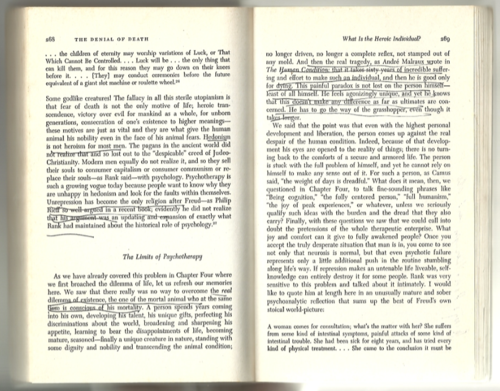
 In the play, which examines Muslim-American identity issues, the Jewish character Issac pulls out a copy of Denial and refers to a scene from the 1977 film Annie Hall where Woody Allen suggests to Diane Keaton that she read the Becker book instead of her selection – a book about cats.
After some thought I understood the playwright's choice in Denial, as the lead character, the Pakistani-born Amir, does initially deny his Muslim roots, which leads to tragic consequences. But I think that there is more worth investigating.
Thanks to the Alliance for providing the promotional photo for the blog and a reminder about an author I should be re-reading in the near future.
—– EXTENDED BODY: —– EXCERPT: —– KEYWORDS: Denial of Death, Disgraced, Alliance Theatre, Ernest Becker, Woody Allen, Annie Hall, Diane Keaton —– ——– AUTHOR: Murray Browne AUTHOR EMAIL: murray.browne905@gmail.com TITLE: More Than Murakami Coincidences STATUS: Publish ALLOW COMMENTS: 1 CONVERT BREAKS: wysiwyg ALLOW PINGS: 0 BASENAME: murakami-coincidences UNIQUE URL: https://thebookshopper.typepad.com/the_book_shopper_atlantad/2016/01/murakami-coincidences.html DATE: 01/30/2016 07:57:31 AM —– BODY:
Since I had just read Haruki Murakami's voluminous 1Q84 (2011) last year I was unexpectedly delighted when a quote from the book showed up on the big screen in the Oscar-nominated film The Big Short.*
Everyone, deep in their hearts, is waiting for the end of the world to come.
I was shushed by my fellow moviegoers before I could tell them that I had just finished reading another Murakami book as well. Even though What I Talk About When I Talk About Running: A Memoir (2008) is correctly billed as a book about running (with a fair dose of pain porn) there are passages about his approach to writing. For example, in this excerpt, Murakami decides to become a writer, but it wasn't while he was running:
I can pinpoint the exact moment when I first thought I could write a novel. It was around one thirty in the afternoon of April 1, 1978. I was at Jingu Stadium that day, alone in the outfield drinking beer and watching the game. Jingu Stadium was within walking distance of my apartment at the time, and I was fairly big Yakult Swallows fan. It was a beautiful spring day, not a cloud in the sky, with a warm breeze blowing. There weren't any benches in the outfield seating back then, just a grassy slope. I was lying on the grass, sipping cold beer, gazing up at the sky, and leisurely enjoying the game…In the bottom of the first inning the leadoff batter for the Swallows was Dave Hilton, a young American player new to the team. Hilton got a hit down the left field line. The crack of the back meeting ball right on the sweet spot echoed through the stadium. Hilton easily rounded first and pulled up to second. And it was that exact moment that a thought struck me: You know? I could try writing a novel. I still can remember the wide open sky, the feel of the new grass, the satisfying crack of the bat. Something flew down from the sky at the instant, and whatever it was I accepted it.
I am thinking after I read this, "Was Murakami just hit by a foul ball? Does this have something to do with April Fool's Day?"
Other Coincidences
Coincidentally Adam McKay who directed The Big Short also directed Talladega Nights: The Legend of Ricky Bobby starring Will Farrell. At the end of Talladega there is a out-take of the characters discussing the difference between the Old South and the New South. For some inexplicable reason, that link is one of the most visited pages on my blog via Google search. Go figure. But I must say the little clip from Talladega, like the Murakami's running book, gives one a glimpse into the creative mind of McKay.
Also, The Big Short book was written by Michael Lewis, who has the touch when it comes of having his books (which aren't huge publishing phenomena like Hunger Games or Harry Potter) being converted into films. Lewis also wrote, Moneyball about the geeky forerunners who used baseball statistics to a competitive advantage, which includes a shout out to one of my favorite baseball writers and statistical visionaries, Bill James. Lewis also wrote The Blind Side, which was made into a movie starring Sandra Bullock. Scenes were filmed on the campus at Agnes Scott College near where I live in Decatur, GA. The Blind Side is the story of Michael Oher who rose from being a homeless teenager to become a highly paid professional football player with the help of a Memphis family. Oher is playing in the upcoming Super Bowl for the Carolina Panthers.
—– EXTENDED BODY: —– EXCERPT: —– KEYWORDS: What I Talk About When I Talk About Running, Haruki Murakami, Adam McKay, The Big Short, The Blind Side, Michael Lewis, Sandra Bullock —– ——– AUTHOR: Murray Browne AUTHOR EMAIL: murray.browne905@gmail.com TITLE: MARTA Book Club #30: Going Rogue STATUS: Publish ALLOW COMMENTS: 1 CONVERT BREAKS: wysiwyg ALLOW PINGS: 0 BASENAME: marta-book-club-30-going-rogue CATEGORY: Book Reviews CATEGORY: MARTA Book Club UNIQUE URL: https://thebookshopper.typepad.com/the_book_shopper_atlantad/2016/01/marta-book-club-30-going-rogue.html DATE: 01/18/2016 07:42:36 AM —– BODY: I really can't explain it, but as the traveling secretary of the MARTA Book Club in charge of tracking what people are reading while riding buses and trains on the Metropolitan Atlanta Rapid Transit Authority, I have little to report since my last installment. I think I saw someone reading Herman Hesse's Siddhartha and a Michael Pollan book, but that was about it.
Is it my laziness? Are people reading less? Or was I just too absorbed in my own books to pay attention to anyone else. It could be the latter since I just finished Rebecca Solnit's absorbing collection of nearly 30 essays, Encyclopedia of Trouble and Spaciousness (2014). In this book Solnit travels throughout the world and gives accounts of some of the ecological crises and political upheavals that we hear about, but rarely know the inside story. Solnit is not a reporter per se, but she seems able to find those activists and other people on the front line who give us the perspectives that we need to know about. Sometimes this is depressing; sometimes uplifting. But always thought provoking.
My favorite pieces were about post-tsunami Japan, the water crisis in the American West, "carnival" resistance in New Orleans, urban gardening and one that does strike close to home to someone in the MARTA Book Club — "The Google Bus: Silicon Valley Invades." In this essay, Solint writes about the ramifications of a private bus exclusively used by high-tech employees. It includes an anecdote about an Apple bus driver who decided he had had enough:
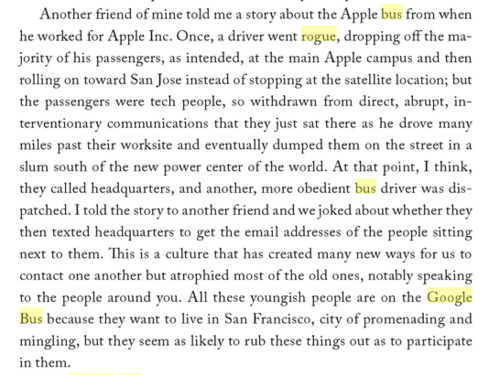
More Solnit
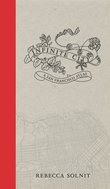 This is not the first time I have written about Solnit. Here's some blog links to other books of hers that I have read and posted something about:
Infinite City: A San Francisco Atlas (2010)
Wanderlust: A History of Walking (2000)
Hope: Untold Histories, Wild Possibilities (2004)
River of Shadows: Eadweard Muybridge and the Technical Wild West (2003)
A Field Guide to Getting Lost (2005)
—– EXTENDED BODY: —– EXCERPT: —– KEYWORDS: Rebecca Solinit, MARTA Book Club, Encyclopedia of Trouble and Spaciousness, Google Bus —– ——– AUTHOR: Murray Browne AUTHOR EMAIL: murray.browne905@gmail.com TITLE: Connecting to the Hall of Fame STATUS: Publish ALLOW COMMENTS: 1 CONVERT BREAKS: wysiwyg ALLOW PINGS: 0 BASENAME: connecting-to-the-hall-of-fame CATEGORY: Baseball CATEGORY: Book Reviews UNIQUE URL: https://thebookshopper.typepad.com/the_book_shopper_atlantad/2016/01/connecting-to-the-hall-of-fame.html DATE: 01/12/2016 06:43:18 AM —– BODY: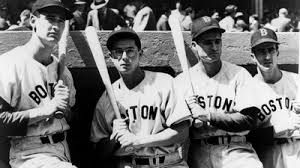
Last week the Baseball Hall of Fame announced enshrinement of catcher Mike Piazza and centerfielder Ken Griffey Jr., which coincided to the same time I finished reading David Halberstam's The Teammates: A Portrait of a Friendship (2004). Halberstam's book covers the baseball careers and continuing friendships of four Boston Red Sox players (shown here left to right): Ted Williams (1939-1961), Dom DiMaggio (1940-1952), shortstop Johnny Pesky (1942-52), and second baseman Bobby Doerr (1937-1951) . Williams and Doerr are in Cooperstown, but Halberstam makes a case that Dom DiMaggio belongs beside his older brother Joe DiMaggio. Dom was physically unimposing and wore eyeglasses but many consider him an equal centerfielder defensively to his famous brother Joe. Dom DiMaggio had a career batting average of .298.
As baseball books go, I would rate The Teammates about a .260 hitter with just a little power (the guys were longtime friends, I get it). The real strength of the book was Halberstam's willingness to address my question, "If these guys were so damn good, why didn't they win a championship?"
The answer is that they did almost win in 1946, but lost to the St. Louis Cardinals in the 7th game — highlighted by the Enos "Country" Slaughter's mad dash to home with the winning run from first base on a long single (ruled a double). Halberstam devotes almost an entire chapter to that series and its aftermath. That group of men did not play in the World Series again, but came very close — losing to the New York Yankees in a one game playoff in 1949. For more specifics about 1946, check out Robert Weintraub's The Victory Season: The End of World War II and the Birth of Baseball's Golden Age (2013) because it was an an amazing era in baseball (my review here). Halberstam also wrote previously about that era in the Summer of `49.
Here are a few other Hall of Fame connections that keep rolling in my mind:
- Ken Griffey Jr. and Stan Musial, who played for the 1946 Cardinals, were both born in the town of Donora, Pennsylvania.
- Ted Williams visited Mike Piazza and watched him hit when Piazza was 15 years old.

2. Baseball writer and data guy Bill James in The New Bill James Historical Abstract (2001) rated Ken Griffey 7th in the list of all time centerfielders (Willie Mays #1, Ty Cobb #2, Mickey Mantle #3, Tris Speaker #4, Joe DiMaggio #5, Dom DiMaggio #24) and prophetically rated Mike Piazza #5. Wrote James, "Too early to rate him with any confidence, but probably the best hitting catcher ever to play the game." James rates Yogi Berra first (who died in 2015), and Johnny Bench second.
3. As a Cubs fan, I noticed that many baseball pundits are picking the Chicago Cubs to win it all in 2016, but doesn't convince me as I read The Teammates. The Red Sox of the late 40s were supposed to be a dynasty as well, but it didn't happen as several of their starting pitchers went down with permanent arm injuries. Of course I hope that the Cubs make it to the World Series, but will those young guys (Kris Bryant, Anthony Rizzo, Jason Heyward and Kyle Schwarber be friends for life like Williams, Doerr, DiMaggio and Pesky even if they don't win it all?
For those of you who crave baseball in these football manic times, check out the blog's baseball links.
—– EXTENDED BODY: —– EXCERPT: —– KEYWORDS: Baseball Hall of Fame, Ted Williams, Bobby Doerr, Johnny Pesky, Dom DiMaggio. The Teammates, Victory Season, —– ——– AUTHOR: Murray Browne AUTHOR EMAIL: murray.browne905@gmail.com TITLE: New York City Book Shopping Traditions STATUS: Publish ALLOW COMMENTS: 1 CONVERT BREAKS: wysiwyg ALLOW PINGS: 0 BASENAME: new-york-city-book-shopping-traditions CATEGORY: Bookstores UNIQUE URL: https://thebookshopper.typepad.com/the_book_shopper_atlantad/2015/12/new-york-city-book-shopping-traditions.html DATE: 12/31/2015 08:39:50 AM —– BODY:
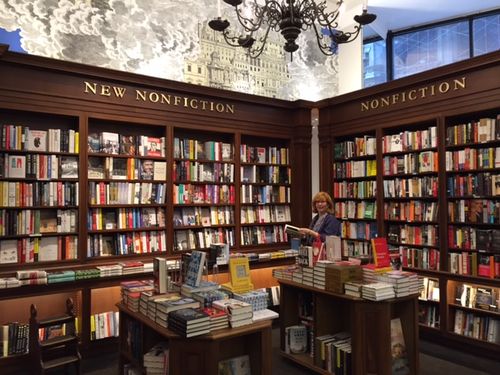
This is the third year in a row (see end-of-the-year postings 2o13, 2014) that Denise and I have closed out December in New York City bookstores of merit. I think of this not so much as a holiday tradition but more like stockpiling books for the 2016 reading campaign. I always bring my potential book shopping list and try to play stump the clerk. Here's this year's quick rundown:
Rizzoli Books, 1133 Broadway (near the Flatiron Building)
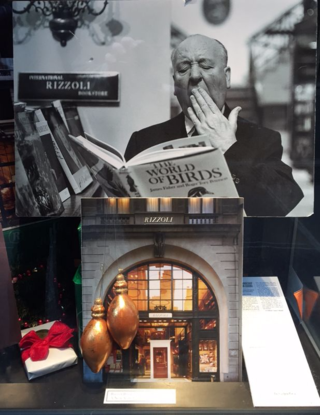 This store moved to this new location earlier this spring after being 30 years on 57th street. This spacious bookstore is gorgeous inside as you can see, (top photo) but it doesn't mean a thing if you can't be tempted with a wide selection of fiction, design books, art books, cook books and nonfiction. I picked up Haruki Murakami's What I Talk About When I Talk About Running (2008) and The Ballad of a Small Player (2014) by Lawrence Osborne. The photo in the store window (shown here) has both Alfred Hitchcock reading a book about birds coupled with a photograph of the old store as well.
192 Books, 10th Avenue in Chelsea
 I received a gift certificate from this favorite store of mine and took no time to begin my post-holiday shopping. Because it was the day after Christmas, there were some gaps in the stacks (good for them). I still found something I was looking for — Our America: A Hispanic History of the United States (2014) by Felipe Fernandez-Armesto.
Kinokuniya, Bryant Park
Since it is just across the street from the New York Public Library on 42nd Street and 5th Avenue, I am surprised I had not been to this bookstore. Known for its anime and Manga selections in Japanese and Chinese, this store also has a huge selection of fiction and high end books on design, maps and art. I liked their stationary section and took home a few Uni-ball Signo pens. It took some self control not bring Phaidon Publishing's new book on maps home with me.
—– EXTENDED BODY: —– EXCERPT: —– KEYWORDS: Bookstore of New York City, 192 Books, Rizzoli Books, Kinokuniya Books, —– COMMENT: AUTHOR: Ian Joyce EMAIL: IP: 174.111.1.151 URL: http://profile.typepad.com/ianjoyce DATE: 12/31/2015 12:49:39 PM Kinokuniya used to be at Rockefeller Center, and moved to Bryant Park in 2008 or thereabouts. It’s a NYC favorite of mine, particularly now that there’s a Blue Bottle Coffee nearby. The browsing at Kinokuniya is always good. —– COMMENT: AUTHOR: Murray Browne EMAIL: IP: 50.155.95.105 URL: http://profile.typepad.com/1227802374s31410 DATE: 01/01/2016 08:00:25 AM Good to know about the coffee and Kinokuniya. BTW, Rizzoli’s is near EatItaly and 192 Books is not far from the Chelsea Market. Books, Coffee, NYC. Have a happy, healthy 2016, friend. —– ——– AUTHOR: Murray Browne AUTHOR EMAIL: murray.browne905@gmail.com TITLE: Best Book Trips – 2015 STATUS: Publish ALLOW COMMENTS: 1 CONVERT BREAKS: wysiwyg ALLOW PINGS: 0 BASENAME: best-book-trips-2015 UNIQUE URL: https://thebookshopper.typepad.com/the_book_shopper_atlantad/2015/12/best-book-trips-2015.html DATE: 12/21/2015 06:58:35 AM —– BODY:

Reflecting back on 2015, there is a strong association between my favorite reads of the year and the places I visited:
- Phoenix and Essays by David Foster Wallace
This was the year that I finally got around to reading Wallace's work. Wallace grew up only about an hour from my hometown in Illinois. A couple of my best friends Tom and Peg also lived in East-Central Illinois, but now spend part of the year in sunny Phoenix. Denise and I went to visit them where they took us to three excellent bookstores (See "Valley of the Sun Book Shopping." ) As part of a thank you gift for hosting us, I gave them a copy of Wallace's A Supposedly Fun Thing I'll Never Do Again: Essays and Arguments (1998), which includes an introduction to the weather of East Central Illinois ("Midwestern life is informed and deformed by the wind."). Another essay is a long, detailed account of the closest thing to a religious festival in that part of the country – The Illinois State Fair. 2015 was a year that I also read parts of Wallace's Consider the Lobster and Other Essays (2007).
I have yet to see the recent film based on a Wallace book tour, The End of the Tour.
2. Nova Scotia and The Ashley Book of Knots (1944)
 Denise and I did a ten day road trip with her brother and sister-in-law in Nova Scotia. We broke in the a new van rental big time, starting out in Halifax and trekking to the Bay of Fundy (shown here at low tide) and around scenic Cape Breton Island. There were plenty of bookstores to visit and it became a quest to find Clifford Ashley's The Ashley Book of Knots since I discovered that Denise's brother was also into knot tying. I thought of Anne Proulx's The Shipping News, which is set in Newfoundland, that uses knots from the Ashley book as themes for each chapter. As part of a journey, I hoped to find the book. You always need a quest when traipsing though bookstores. While book shopping in Nova Scotia near the Bay of Fundy in Wolfville, I picked up a used copy of Joseph Neill's Netherland (2008) — as kind of a "pity purchase" since I spent a lot of time yakking at the bookstore owner. The joke was on me. Netherland was one of the best novels I had read in quite some time.
And what happened to The Ashley Book of Knots? That's what's Amazon is for.
3. San Francisco and Rebecca Solnit
 Sometimes the travel experience of a book can exceed actually going there. I haven't been to San Francisco since 1985, but Rebecca Solnit's Infinite City: A San Francisco Atlas (2010), a collection of essays of history, politics and culture of the City by the Bay, mixed in with a series of interpretative maps, was the best book I read in 2015. (More about it in my August 30th posting.) My daughter Cynthia showed it to me the Harvard Book Store several years ago, but I didn't buy it until I was shopping in the Bookculture bookstore near Columbia University in December, 2013. I really liked a couple of her other books, Wanderlust and Hope In the Dark. Go figure why a book takes so long to finally sit down and read. This year I have loaned it out several times to friends heading to SF, but each time I serve notice that I will ask for its return.
4. Apalachicola, Florida and Haruki Murakami's 1Q84 (2011)
The only thing that a laid back Florida panhandle beach community and 900+ page novel set in 1984 from the world's preeminent Japanese novelist have in common is that I started the book as one of those "beach-reads" during a week long October vacation at St. George Island (shown at the top of the posting). To tackle a large book, I feel like I needed to have a significant chunk of time. Moreover 1Q84 is not a good candidate for the MARTA Book Club, which was where I do a lot of my daily reading. Murakami is an author (like Wallace) who has been swirling around me for years since I bought this book while traveling n Oregon in 2012. Though it took me through Thanksgiving to finish reading, I never wavered. From the get-go Murakami sets a slow, but steady pace as we trace the convergence of Tengo, a young, ghost writer of a novel that sweeps Japan, but puts him at odds with a dangerous religious sect and Anomome, a young woman who is hired to assassinate a leader of the same religious sect.
A shout-out goes to my book buddy Bill Gwin for patiently pointing me in the right direction.
—– EXTENDED BODY:5. Kansas City and Baseball Books
It's a rare year that you can be a Chicago Cubs fan and not be disappointed since the team advanced in the playoffs before being swept by the New York Mets. Moving forward, I will have to be cognizant of taking October vacations at places with limited television reception. Before the 2015 season began I read Jimmy Greenfield's 100 Things a Cub Fan Should Know Before He Dies (2012) as a reminder that a Cub fan should NEVER be any more than cautiously optimistic.
Maybe the Cubs will imitate a another team I like, The Kansas City Royals and finish with a World Series championship in 2016. If you need proof of my interest in the Royals, check out the George Brett Christmas ornament that graces my tree this year (purchased when I lived in Kansas 30 years ago).
I am also a big fan of baseball writer Bill James who is also a longtime Royals fan. I recently picked up a copy of Bill James' Guide to Baseball Managers (1997), which is the book that is currently sustaining me through the hot stove league.
Endnote
2015 was a good year for traveling and reading. In last year's final blog posting, I mentioned that I would be finishing a book in 2015, but this did not happen. The writing has expanded to include photography and art. Down & Outbound: A Mass Transit Satire (2016?) is going well but there are a few days that reminds me of the quote from Micheal Chabon's Maps and Legends about the writing of second books. He describes it as a "Lewis and Clark expedition —an often long, dismal trip though a vast terrain in pursuit of a grand but fundamentally mistaken prize."
—– EXCERPT: —– KEYWORDS: Best Books of 2015, Rebecca Solnit, Joseph O’Neil, Netherland, Ashley Book of Knots, Nova Scotia, Phoenix book stores, David Foster wallace, 1q84 —– ——– AUTHOR: Murray Browne AUTHOR EMAIL: murray.browne905@gmail.com TITLE: Mini-review: Joseph Skibell at A Cappella STATUS: Publish ALLOW COMMENTS: 1 CONVERT BREAKS: wysiwyg ALLOW PINGS: 0 BASENAME: mini-review-joseph-skibell-at-a-cappella CATEGORY: Book Reviews CATEGORY: Local Reviews UNIQUE URL: https://thebookshopper.typepad.com/the_book_shopper_atlantad/2015/12/mini-review-joseph-skibell-at-a-cappella.html DATE: 12/04/2015 07:24:09 AM —– BODY:
 Who, Where & When: Joseph Skibell, author of My Father's Guitar and Other Imaginary Things, read at A Cappella bookstore in Atlanta on Sunday afternoon, November 29th.
Why I Went: Skibell's earlier books of fiction have received some recognition, and I was looking for the opportunity to familiarize myself with his work. I thought My Father's Guitar, which is short collection of personal stories about his extended Jewish family and his growing up in Lubbock, Texas was a good place to start. Moreover, I am a Buddy Holly fan, who also grew up in Lubbock, and since music plays a role in some of Skibell's narratives I was interested on his take of the legendary rock 'n roller, who perished "the day the music died."
Attendance: Given it was a Sunday afternoon during the Thanksgiving holiday, I didn't expect a crowd. There were only eight people in the small reading room at the store, but I am one who thinks the absence of decent crowds reflects more on the (non) reading public than the author.
What He Read: The small turnout did not keep Skibell from reading two pieces, "Irvin in Wonderland" and "International Type  of Guy" with as much verve as if he were in a lecture hall. The Irvin story about being bedside with an ailing father will resonate with anyone who ever has sat beside an aging parent in the hospital. Another aspect that links the pieces is Skibell's ruminations on personal memory. During the reading he emphasized that all the stories are true to the best of his recollection (though a few names have been changed), but that he even realizes that his interpretation may be different from his sisters' or daughter's account of same family event.
What Question Did I Ask That Normally I Would Be Too Shy to Ask: I asked Skibell if he was familiar with the Greil Marcus' essay about Buddy Holly in Marcus' book The History of Rock N Roll in 10 Songs (2014). In the essay, "Crying, Waiting, Hoping," Marcus writes about Holly's major impact in music and specifically the day in 1955 Elvis came to Lubbock. In the photo, shown here, Buddy Holly is the only person wearing glasses and can be seen in the right side of the picture. Skibell was well aware of the history of the photo, which was very rare until, well, er, the internet.
Did I Buy the Book?: I had trouble getting a reviewer's copy of the book from Skibell's publisher in a timely manner and we chatted afterwards about this unfortunate delay. Since as a reviewer I wanted to read some of the Skibell book before attending the reading, I admitted getting a used copy from Amazon, which did arrive in time. To lessen my guilt and to support a fine local independent bookstore like A Cappella, I did purchase a book there of greater or equal value — Padgett Powell's latest book of short stories Cries for Help (2015).
—– EXTENDED BODY: —– EXCERPT: —– KEYWORDS: Joseph Skibell, Buddy Holly, My Father’s Guitar, Lubbock, Texas, Greil Marcus, The History of Rock ‘n Roll in Ten Songs, Padgett Powell, Cries for Help —– ——– AUTHOR: Murray Browne AUTHOR EMAIL: murray.browne905@gmail.com TITLE: MARTA Book Club #29: Dark Streets; Enlightened Minds STATUS: Publish ALLOW COMMENTS: 1 CONVERT BREAKS: wysiwyg ALLOW PINGS: 0 BASENAME: marta-book-club-29-dark-streets-enlightened-minds CATEGORY: MARTA Book Club UNIQUE URL: https://thebookshopper.typepad.com/the_book_shopper_atlantad/2015/11/marta-book-club-29-dark-streets-enlightened-minds.html DATE: 11/21/2015 10:06:19 AM —– BODY:
 Lately I have been somewhat of a slacker as the self-designated official secretary of the MARTA Book Club* but I am not going to apologize. In addition to my recording duties as club secretary, I have been reporting to officials the street lamp outages throughout the metro area. I will spare you the painful details.
I have been reading some Noam Chomsky lately, so I know that I must keep complaining about the lights near the MARTA stations to affect change. For example, all three lights at the busy 10th Street Techwood intersection (shown in the photo) are out. Such poor visibility makes it more likely that Atlanta drivers will not see pedestrians, especially during these daylight-shortened months.
Now back to our regular MARTA Book Club meeting notes.
What People on the Move Are Reading
Now just in time for holiday gift giving is a list of what people have been reading on public transportation since the last posting. And keep in mind this list is just as suitable as any retailer's similar list of end-of-the-year book recommendations.
Southern Wildflowers by Lucille Parker
Dead Doctors Don’t Like by Joel D. Wallach and Ma Lan
Truro: The Story of a Cape Cod Town by Richard F. Whalen
The Crossing by Michael Connelly
American Salvage by Bonnie Jo Campbell
Son of a Witch by Gregory Maguire
Is Elvis Alive? By Gail-Brewer-Giorgio
Super Sad True Love Story: A Novel by Gary Shteyngart
David and Goliath by Malcolm Gladwell
The Water is Wide: A Memoir by Pat Conroy
The Wright Brothers by David McCullough
The Psychology of Selling by Bryon Tracey
The Martian by Andy Weir
Blood and Thunder: The Epic Story of Kit Carson and the Conquest of the American West by Hampton Sides
Like Sheep Gone Astray by Leslie J. Sherrod (The Steamiest cover)
In the Garden of Beasts: Love, Terror and an American Family in Berlin by Erik Larson
The Immortal Life of Henrietta Lacks by Rebecca Skloot
Imperial Ambitions: Conversations on the Post-9/11 World by Noam Chomsky and David Barsmian. As mentioned, this is one of my contributions. Though written in 2005, it's relevance has not diminished especially in light of the political maelstrom that has followed the attack on Paris.
Lucky Alan and Other Stories (2014) by Jonathan Lethem
Why Women Love Jerks by Patrick King
Mission Accomplished by Oliver North
Aging Backwards: Reverse the Aging Process and Look Ten Years Younger in 30 Minutes a Day by Miranda Esmonde-White. Note: Be cautious who you would gift this book to.
Books by Tom Clancy, Dennis Lehane, Lemony Snicket, Cormac McCarthy
*This premier club is open to anyone who reads a book on a Metropolitan Atlanta Rapid Transit Authority bus or train. For a complete history of the club, visit the MARTA book club category link of the blog.
—– EXTENDED BODY: —– EXCERPT: —– KEYWORDS: Noam Chomsky, Street lamp outages, What people are reading in Atlanta, MARTA book club, Metropolitan Atlanta Rapid Transit Authority —– ——– AUTHOR: Murray Browne AUTHOR EMAIL: murray.browne905@gmail.com TITLE: How Low Will It Go STATUS: Publish ALLOW COMMENTS: 1 CONVERT BREAKS: wysiwyg ALLOW PINGS: 0 BASENAME: how-low-will-it-go UNIQUE URL: https://thebookshopper.typepad.com/the_book_shopper_atlantad/2015/11/how-low-will-it-go.html DATE: 11/16/2015 07:16:21 AM —– BODY:
 While book shopping at the super-sized used book store 2nd & Charles in Birmingham, Alabama I saw this heavily discounted book. `Nuf said.
—– EXTENDED BODY: —– EXCERPT: —– KEYWORDS: Bill Cosby, I Didn’t Ask to Be Born —– ——– AUTHOR: Murray Browne AUTHOR EMAIL: murray.browne905@gmail.com TITLE: Mini-Review: Jeff Alworth at Ale Yeah STATUS: Publish ALLOW COMMENTS: 1 CONVERT BREAKS: wysiwyg ALLOW PINGS: 0 BASENAME: mini-review-jeff-alworth-at-ale-yeah CATEGORY: Book Reviews UNIQUE URL: https://thebookshopper.typepad.com/the_book_shopper_atlantad/2015/11/mini-review-jeff-alworth-at-ale-yeah.html DATE: 11/09/2015 08:33:56 AM —– BODY:
 When & Where: Jeff Alworth, author of The Beer Bible at Ale Yeah! Craft Beer Market in Decatur, Georgia. Alworth was there on Friday, November 6th to chat and sign books for those picking up their weekend beer — what became a crappy, rainy few days best suited for staying inside and drinking beer.
Attendance: I don't know for sure, but there was a steady stream of interested beer aficionados of all ages milling through the store. I would not consider myself a beer expert, but I like talking about it. Kind of like conversing about a favorite sport. Alworth is certainly amiable and approachable on the subject.
Why I Went: A. ) Workman Publishing provided me a reviewer's copy, which I appreciate (thus you are reading a book blogger's quid pro quo), B.) Any excuse to stop by Ale-Yeah, which has incredible selection of craft beers, is always welcome, and C.) Maybe–just maybe– Alworth could explain what an I.B.U. (international bittering unit) is and how it factors into a beer's hoppiness.
What He Read: Since the book is encyclopedic in nature with chapters on brewing techniques, ingredients, explanations of beer taxonomy, as well as beer geography and history, it doesn't lend itself well to reading aloud, even though I often think that beer descriptions sound like characters from a book: malty and strong; rustic and complex; effervescent and pleasant to the nose.
This book is ideal for that burgeoning brew master (you know the person who talks about quitting his or her job to open a brewery), but it's also well suited for the beer fan. You can pick up reading anywhere and start learning about some beers you might want to try, or beers from other lands, or something useful as what kind of glass should I use and what temperature I should serve certain beers. It took him four years to go from research to publication and it's an impressive work of "scholarship."
Did I Buy the Book?: As mentioned I already had a reviewer's copy, but in addition to picking up a six pack of Dale's Pale Ale I grabbed a bottle of Lagunitas Hop Stoopid, which is something recommended in the Alworth book. And the I.B.Us on Hop Stoopid? 102.
I'm sounding smarter already. Thanks, Jeff.
—– EXTENDED BODY: —– EXCERPT: —– KEYWORDS: The Beer Bible, Jeff Alworth, beer encyclopedias, Ale Yeah!, Decatur Georgia beer shops —– COMMENT: AUTHOR: Ian Joyce EMAIL: IP: 174.111.1.151 URL: http://profile.typepad.com/ianjoyce DATE: 11/09/2015 09:56:53 AM IMHO, the beer world is moving so fast that books can’t keep pace. I still refer to Michael Jackson’s Beer Companion for info about particular styles, but when it comes to specific beers it’s woefully out of date. I’m guessing Alworth’s book will be out of date in about ten more minutes. I’d have enjoyed asking Alworth about Hop Stoopid, which is to beer as Dave’s Insanity Sauce is to hot sauces. It’s a “because we can” kind of beer, where the hops obliterate any sort of complexity. I love–love!– hoppy beers and am a Lagunitas fan, but this one just annoyed me. Speaking of Dale’s Pale Ale, it’s worth a trip to Oskar Blues Brewery in Brevard, where there are a number of seasonal and one-off beers to taste. I don’t recall seeing any books in the tasting room, but we could meet up there and bring our own. We’d probably get tossed for reading, but it’s worth a shot. —– COMMENT: AUTHOR: Murray Browne EMAIL: IP: 50.155.95.105 URL: http://profile.typepad.com/1227802374s31410 DATE: 11/09/2015 10:45:44 AM Thanks for the heads up about Hop Stoopid. In fairness to Alworth, his book is more about history and processes than making specific recommendations, which should give it more shelf life. Either way we can bring to the Oskar Blues Reading/Quaffing room –hopefully in the near future. —– ——– AUTHOR: Murray Browne AUTHOR EMAIL: murray.browne905@gmail.com TITLE: Florida Bookstore of Yarns STATUS: Publish ALLOW COMMENTS: 1 CONVERT BREAKS: wysiwyg ALLOW PINGS: 0 BASENAME: florida-bookstore-of-yarns CATEGORY: Bookstores UNIQUE URL: https://thebookshopper.typepad.com/the_book_shopper_atlantad/2015/10/florida-bookstore-of-yarns.html DATE: 10/24/2015 08:27:07 AM —– BODY:
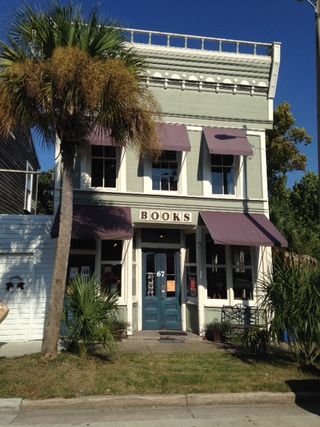 A couple years ago I visited a store that was a unusual combination of yarns and used books in Chattanooga. It's not uncommon for bookstores to sell stationary, literary t-shirts, coffee, pastries, and even music along with their books, but you don't see the yarn shop/book store combo very often.
Well, it's happened again. A quaint bookstore in Apalachacola, Florida is another such place. Located in the heart of this historic Florida panhandle town, Downtown Books and Purl is a bookstore that also has both, except in contrast to the store in Chattanooga, where the books are more of an afterthought, this store has well-curated stock of fiction, Florida fiction, history, nature books, and cookbooks that deserves some serious browsing, but it also has a wide selection of yarn and knitting items.
The friendly owner Dale Julian explained the yarn idea came out of necessity since she liked knitting and she would have to drive to Tallahassee (well over an hour) to purchase yarn. She discovered that yarn vendors are like book vendors and would visit her store bringing product — so instead of her having to drive, she could just stock her store. Also, since many people who stay in the area are snowbirds from New York and New England and like to knit, she found it was great way to generate additional foot traffic.
 Even though I was already well stocked with beach reading (see previous post), I did purchase a copy of The Sunshine State: No Appointments and a Tank of Gas (2014) by Tim Dorsey, a pictorial guide to the funky Florida as seen by the novelist Tim Dorsey. I didn't know this, but Dorsey is quite the prolific Florida writer along the same lines as Carl Hiassen.
The things you can learn by going into a bookstore.
—– EXTENDED BODY: —– EXCERPT: —– KEYWORDS: Downtown Books and Purl, bookstores Florida, Apalachacola, Florida panhandle, Tim Dorsey, Sunshine State, No Appointments and a Tank of Gas —– ——– AUTHOR: Murray Browne AUTHOR EMAIL: murray.browne905@gmail.com TITLE: Troubles With Beach Reading STATUS: Publish ALLOW COMMENTS: 1 CONVERT BREAKS: wysiwyg ALLOW PINGS: 0 BASENAME: troubles-with-beach-reading UNIQUE URL: https://thebookshopper.typepad.com/the_book_shopper_atlantad/2015/10/troubles-with-beach-reading.html DATE: 10/18/2015 10:09:05 AM —– BODY:
 There is a lot of pressure on readers who spend a week at the beach. From May thru September, book marketers pound you with lists and recommendations of what to take with you on your precious vacation – usually suggesting something light and fun.
You can't rely on books at the rental cottage. I've seen a lot of dreck on those shelves. It can be a dumping ground like a church book sale. (See the previous post.)
Thus, I gave some serious thought to what book I should bring — even seeking the advice of a couple of book chums — and opted to take Haruki Murakami's mammoth 900+ page novel 1Q84 published in 2011. This was a risk because I recently punted on Murakami's Hard Boiled Wonderland and the End of the World (1985) since it was too Kafkaesque. For insurance, I brought a couple of backup books knowing that statistically I quit on a fourth of the books I start. I rationalize that life is too short to read something you don't like (or comes at the wrong time). And if I have to force myself to read something I don't like, well, I just quit reading altogether and that seems to be a bad idea. Coincidentally, I bought 1Q84 while vacationing in Oregon in 2012.
Even though I really enjoyed Murakami's epic Japanese novel of intrigue, evil religious cults, the publishing business (not as evil but cultish) spearheaded by two strong characters who I know are going to cross paths, I managed only to get about quarter of the way through the book during the week. This is in contrast to my longtime partner (and book reading model) Denise who read three books in the same time span. I think I get easily distracted and allow my mind to wander (which is part of the relaxation prescription), but I also took a lot of naps, checked constantly on the Cubs' pursuit of a pennant, and then I had deep yearning to become one with the sea and build a sand castle. Shown here is my interpretation of such an edifice: Fort Butterfly.
The Murakami book and the vacation memories will be more everlasting than Fort Butterfly, which was reduced to a couple pieces of driftwood antenna by the relentless overnight surf.
 What is becoming a tradition of mine since 2010, I made it out early to the annual First Baptist Church of Decatur Yard Sale, which includes many boxes of non-curated books. They were ready to cover the books at a moments notice, but fortunately the rain held off and I was able to browse.
I wasn't out the only one out early because as I walked up a few minutes after it opened, I noticed a guy with a smartphone feverishly entering ISBN numbers to determine the monetary value of some of the books.
Unfazed, I did find a few books of interest:
- Cadillac Desert: The American West and Its Disappearing Water (1986) by Mark Reisner.
- Imperial Ambitions: Conversations on the Post 9/11 World (2005) by Noam Chomsky and David Barsamian.
- Elvis is Dead And I Don't Feel So Good Myself (1984) by Lewis Grizzard. (It looks signed, but so many authors have bad handwriting, so how can I tell? I would of asked the guy with the smartphone, but he DID NOT want to be bothered. )
I am hoping the humor of Grizzard will balance the depressing messages of Reisner and Chomsky.
My $5 went to and support the mission projects of FBCD and the scholarship funds for First School and First Camp. The sale ends Saturday afternoon, October 3rd. Go for it. Get in there with your bookshopping brethren.
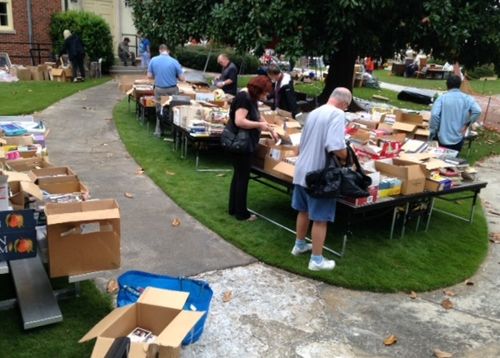
 I have just finished reading Clive James' recently published book of essays, Latest Readings on the books he has revisited since he was diagnosed with terminal leukemia in 2010. "If you don't know the exact moment when the lights go out," writes James, "you might as well read until they do."
When you read James whether it be his Cultural Amnesia: Necessary Memories from History and the Arts (2008) or Cultural Cohesion (2013) you can't help but start making lists of books and writers that require further investigation. This book was no different.
One of the especially enlightening chapters was Sir David Fraser's Alanbrooke, a biography of Alan Brooke, who later became Lord AlanBrooke. I pride myself on having a good working knowledge of World War II history having read Rick Atkinson's The Liberation Trilogy, but Alan Brooke's name drew a blank. Brooke was quite an influential figure (and Atkinson wrote plenty about him including his expertise in ornithology ). As a general, Brooke engineered the miraculous retreat of British forces at Dunkirk and for a time was in charge of England's island defenses, but later Brooke did the greatest service to his country as Winston Churchill's Chief of Imperial Staff, acting as a buffer between Churchill and the French and American allies. James quips, "…He (Brooke) was just in time to help save his nation from the deadly combination of Nazi barbarity and Churchillian enthusiasm."
It is doubtful that I will even get through a first passing at Fraser's voluminous biography on Brooke, but that's why I appreciate James so much. At least I get a taste of what's it like to be well-read.
 At the time of this posting I am still debating whether to hear the international novelist and writer Salman Rushdie's read at the Carter Center or go to Turner Field and watch American League MVP candidate Josh Donaldson (.312 avg, 38 hr, 119 rbis) crush baseballs at the expense of the woeful Atlanta Braves pitching staff. Both events are scheduled to begin on Thursday, September 17 at 7 p.m.
Factors to Consider
- Rushdie will read from his new novel Two Years Eight Month and Twenty-Eight Nights. I am expecting Donaldson (@BringerofRain20) to launch baseballs in the left field seats. Also appearing with Donaldson is fellow Toronto Blue Jay rainmakers Edwin Encarnacion (.271, 32, 99) and Jose Bautista (.252, 35, 101).
- If Rushdie is not sold out it will be standing room only. There are ~30,000 seats available at Turner Field, which you would expect from a team that is 57-89.
- Braves tickets are about $20 for a terrace level seat — the view to watch baseballs sailing into the night. Admission to Rushdie is $30 which includes a signed book. Not much of a chance for an autograph of Donaldson.
- Parking is free at the Carter Center compared to about $15 at Turner Field, but tailgating is not frowned upon at the Ted.
Such a decision for a baseball and book blogger. For a followup see the Postgame Postscript.
Postgame Postscript (September 19th)
I ended up going to the game, but I wasn't the only one because in between innings, former President Jimmy Carter and his wife Rosalynn were on Kiss-Cam (instead of being at The Carter Center ?!?). Their appearance went viral. They received more and louder cheers than the Braves who were shutout by the Blue Jays, 5-0.

The Blue Jay bats did not disappoint. Edwin Encarnacion hit a line drive homer to left center and Cliff Pennington a deep three-run shot to right in Toronto's four-run fourth. It was a school night, so I wasn't there for Josh Donaldson's opposite field homer in the 9th inning.

 I am expecting Donaldson (@BringerofRain20) to launch baseballs in the left field seats. Rushdie will read from his new novel Two Years Eight Month and Twenty-Eight Nights. Also appearing with Donaldson is fellow rainmakers Edwin Encarnacion (.271, 32, 99) and Jose Bautista (.252, 35, 101).
At the time of this posting I am still debating whether to hear the international novelist and writer Salmon Rushdie's read at the Carter Center or go to Turner Field and watch American League MVP candidate Josh Donaldson (.312 avg, 38 hr, 119 rbis) crush baseballs at the expense of the woeful Atlanta Braves pitching staff. Both events are scheduled to begin on Thursday, September 17 at 7 p.m.
Factors to Consider
If Rushdie is not sold out it will be standing room only. There are ~30,000 seats available at Turner Field, which you would expect from a team that is 57-89.
Braves tickets are about $20 for a terrace level seat — the view to watch baseballs sailing into the night. Admission to Rushdie is $30 which includes a signed book. Not much of a chance for an autograph of Donaldson.
Parking is free at the Carter Center compared to about $15 at Turner Field, but tailgating is not frowned upon at the Ted.
Such a decision for a baseball and book blogger.
—– EXTENDED BODY: —– EXCERPT: —– KEYWORDS: —– ——– AUTHOR: Murray Browne AUTHOR EMAIL: murray.browne905@gmail.com TITLE: A History of Decatur Festival Bookshopping 2015 STATUS: Publish ALLOW COMMENTS: 1 CONVERT BREAKS: wysiwyg ALLOW PINGS: 0 BASENAME: a-history-of-decatur-festival-bookshopping-2015 CATEGORY: Civil War Books UNIQUE URL: https://thebookshopper.typepad.com/the_book_shopper_atlantad/2015/09/a-history-of-decatur-festival-bookshopping-2015.html DATE: 09/06/2015 03:19:39 PM —– BODY:
Some people go to the Decatur Book Festival to wait in line to see authors, (like the queue to see Ron Rash, bottom of page) others go take their children to expose them to written word and have their face painted, but I like to watch people search for books like these intense bibliophiles in front of the library.
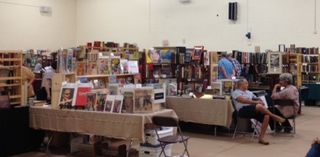 I did most of my book shopping at the Georgia Antiquarian Book Association's (GABA) Fair, which was located in the First Baptist Church gymnasium (shown left). This was a return for GABA who had not been to the festival for several years.
Ironically, my only purchase was from the Dekalb History Center booth near the Old Courthouse where I bought a thin copy of The Battle of Decatur, July 22, 1864 (2003) a small pamphlet written by Albert Rauber. I am becoming more and more interested in the history of Decatur especially events that happened near my doorstep. One unique aspect of the book is that it comes with a mylar map overlay that you can place over a page showing a 1860s map, which gives the reader a sense of where the battle took place in relation to current Decatur landmarks.
Later at the GABA booth I was chatting with Ken Beebe one of the vendors of history books ( had a gorgeous set of Shelby Foote's Civil War trilogy hardbacks), who observed that he could see e-readers being popular with fiction, but with history books — and especially those with maps — he didn't see how the e-book could replace paper. Especially the ability to stick your finger in the book and flip back and forth between map and text with ease. I never thought about it until then, but he's correct. Another history lesson from the Decatur Book Festival (#dbf2015).
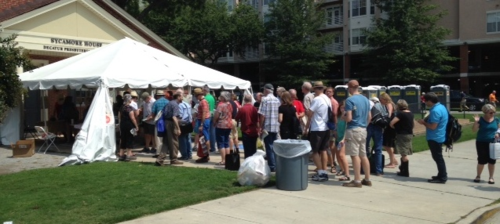
—– EXTENDED BODY: —– EXCERPT: —– KEYWORDS: —– ——– AUTHOR: Murray Browne AUTHOR EMAIL: murray.browne905@gmail.com TITLE: (Frisco) Maps I Love #5 STATUS: Publish ALLOW COMMENTS: 1 CONVERT BREAKS: wysiwyg ALLOW PINGS: 0 BASENAME: frisco-maps-i-love-5 CATEGORY: Book Reviews CATEGORY: Maps I Love UNIQUE URL: https://thebookshopper.typepad.com/the_book_shopper_atlantad/2015/08/frisco-maps-i-love-5.html DATE: 08/30/2015 09:46:46 AM —– BODY:
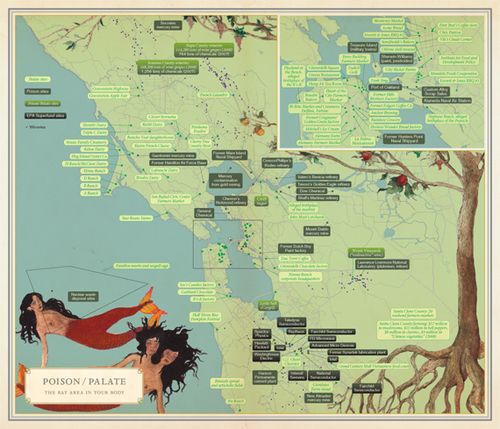
I have another entry for my Maps I Love Collection, a series of blog postings celebrating maps that display in imaginative ways where we are and where we have been. The new addition is Rebecca Solnit's Infinite City: A San Francisco Atlas (2010), a gorgeously published book by the University of California Press.
 I have only been to San Francisco a couple of times and that was decades ago, but that matters little because Solnit's collaborative effort – where she enlists the help of other writers along with cartographers and artists – is more about our relationships to a place than a simple Rand McNally travel guide. Solnit summarizes her atlas in the Acknowledgements as a “valentine of sorts to a complex place…one that tries to see the place whole, with its toxic sites and crimes and tragedies as well as its treasures and cultures.”
Using variations of 22 maps of San Francisco and the San Francisco Bay Area, Solnit and her co-creators deftly juxtapose seemingly disparate subjects: Culinary landmarks with toxic sites, murder statistics with locations of Monterrey Cypresses, butterflies and the gay population (both “come out,” so to speak) or the locations of the area's shipyards and its rich musical heritage, both heavily influenced by the great Southern black migration of World War II that supplied the labor for the building of navy vessels at the rate of one a day. (The Joshua Jelly-Schapiro essay begins with the Otis Redding lyric from “Sitting on the Dock of the Bay”: I left my home in Georgia/Headed for the 'Frisco Bay). Other essays focus on a particular district like the Mission or Fillmore neighborhoods or more singular subjects like the importance of coffee or a tour of film sites via Alfred Hitchcock's Vertigo.
After you have finished savoring this book, which deserves to be read slowly and thoughtfully, you feel like you have been living for decades in San Francisco. And you also wonder, “Doesn't every place deserve such a bittersweet love song?”
—– EXTENDED BODY: Solnit Followup:
In reference to the question about every place deserving such a book. Solnit has also edited a similar book about New Orleans, called An Unfathomable City: A New Orleans Atlas (2013). (You can purchase the books together at a discount from the University of California press.)
Also, this is not the first time I have written about Solnit. Here's links to other books I have read that I posted something about:
Wanderlust: A History of Walking (2000)
Hope: Untold Histories, Wild Possibilities (2004)
River of Shadows: Eadweard Muybridge and the Technical Wild West (2003)
—– EXCERPT: —– KEYWORDS: Rebecca Solnit, University of California Press, Infinite City, Unfathomable city, —– ——– AUTHOR: Murray Browne AUTHOR EMAIL: murray.browne905@gmail.com TITLE: Rethinking with Netherland STATUS: Publish ALLOW COMMENTS: 1 CONVERT BREAKS: wysiwyg ALLOW PINGS: 0 BASENAME: rethinking-with-netherland CATEGORY: Book Reviews UNIQUE URL: https://thebookshopper.typepad.com/the_book_shopper_atlantad/2015/08/rethinking-with-netherland.html DATE: 08/16/2015 04:27:54 PM —– BODY:
One of the best books I've read in a while is Joseph O'Neill's Netherland (2007), which I purchased last month while browsing in a book shop in Nova Scotia.
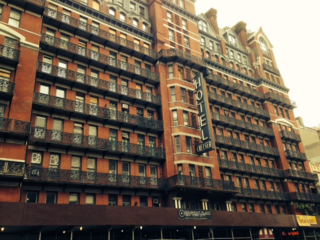 Part of the decision to buy the book was that the narrator Hans van den Brock lives at The Chelsea Hotel in New York (shown left), which is a section of New York I have developed an affinity for while visiting my step-daughter over the past couple years. Hans is sorting out his life after his British wife left him and took their son back with her to London. Hans is a detached narrator – partly because he grew up in the Netherlands and he seems a little on the vanilla side especially when compared to the novel's other main character, the cricket-obsessed, indomitable, but shady Chuck Ramkissoon, an entrepreneur who emigrated from Trinidad as a young man.
What makes this short novel so remarkable is O'Neill's description of a nervous, post 9-11 New York whether it be on Fifth Avenue where Ramkissoon has an office, the lobby of the Chelsea Hotel or the city skyline during the 2003 blackout when New Yorkers feared another terrorist attack was imminent. Since the book was pre-owned with a failing spine, I didn't hesitate to mark the pages with a pen and a highlighter. (I know it sounds terrible!) Usually I make notes on postcards and file them in the book for future reference, but there was just too much good prose here for one or two postcards.
The following scanned (not torn, please!) passage of O'Neill's fine prose describes the aftermath of the Macy's Thanksgiving Day parade as a Ronald McDonald balloon is being deflated:
This excerpt also demonstrates the power of great description. Too often we just snap a picture with our phone and email it, forgoing the opportunity to really describe something or add a touch of wit and reflection to the experience.
—– EXTENDED BODY: —– EXCERPT: —– KEYWORDS: Joseph O’Neill, Netherland, phone photography, Chelsea, Chelsea Hotel, Daily Show, Springsteen —– COMMENT: AUTHOR: Ian Joyce EMAIL: IP: 174.111.1.151 URL: http://profile.typepad.com/ianjoyce DATE: 08/17/2015 10:44:38 AM Netherland is one of my favorite novels. I read it shortly after it was published, when it was described as a “post-9/11 novel.” My sense was that it had little to say about the event itself, but used the time and place to examine macro issues – the changing nature of relationships and a growing sense of estrangement from one another, the economy, and the place of outsiders in society. He tried to take these themes to an extreme in The Dog, which I was anxiously awaiting. Unfortunately, it wasn’t a very good book. —– COMMENT: AUTHOR: Murray Browne EMAIL: IP: 157.166.175.129 URL: http://profile.typepad.com/1227802374s31410 DATE: 08/17/2015 12:24:56 PM Ian, You were probably the one who told me about it years ago and I forgot… Another odd thing about the book is that the lag time between buying and reading the book was less than two weeks. Usually I have such a backlog and it can take months and years to get to reading a book. Netherland was a great book though. Thanks for the additional comment. —– ——– AUTHOR: Murray Browne AUTHOR EMAIL: murray.browne905@gmail.com TITLE: The Book as Art Exhibit STATUS: Publish ALLOW COMMENTS: 1 CONVERT BREAKS: wysiwyg ALLOW PINGS: 0 BASENAME: the-book-as-art-exhibit CATEGORY: Books as Art as Books UNIQUE URL: https://thebookshopper.typepad.com/the_book_shopper_atlantad/2015/08/the-book-as-art-exhibit.html DATE: 08/08/2015 08:33:39 AM —– BODY:
On my day off I stopped by The Book as Art: No Jacket Required exhibit at the Art Institute of Atlanta/Decatur in downtown Decatur. The exhibit is being held through September 18th in conjunction with the Decatur Arts Alliance and is part of the AJC Decatur Book Festival.
It's been a tradition of mine to always check out book art exhibits whenever I stumble across them. (See related posts.) Like these artists, I prefer the tactile qualities of the book over the convenience of audio and digital books. However even a funky book of "mixed fibers and found objects" when nailed to a wall like Susan Lenz's Book I, Book V, and Book VII, (shown above) does limit one of the best product features of the traditional book — portability.
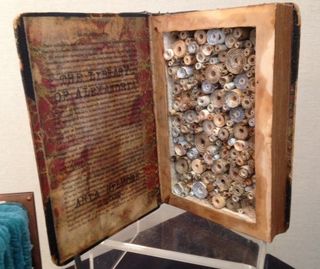 Another favorite of mine among the 33 artists and approximately 40 installations, is Ania Gilmore's Library of Alexandria, (shown left), which is described in the exhibit notes as: an "altered book, (with) rolled and burned pages, wax, shellac ink." From now on, I will think twice before loaning a book to somebody, especially an artist.
If you're going to the upcoming Decatur Book Festival on Labor Day weekend, be sure and check out the Art Alliance gallery on Ponce de Leon. At the DBF, you will need a break from the elements (heat, rain, humidity, maddening crowds of children with sticky faces) and No Jacket Required provides an excellent refuge.
—– EXTENDED BODY: —– EXCERPT: —– KEYWORDS: “The Book as Art: No Jacket Required”, “Ania Gilmore” “Library of Alexandria”, “Susan Lenz” —– ——– AUTHOR: Murray Browne AUTHOR EMAIL: murray.browne905@gmail.com TITLE: Book Shopping in Nova Scotia STATUS: Publish ALLOW COMMENTS: 1 CONVERT BREAKS: wysiwyg ALLOW PINGS: 0 BASENAME: book-shopping-in-nova-scotia CATEGORY: Bookstores UNIQUE URL: https://thebookshopper.typepad.com/the_book_shopper_atlantad/2015/07/book-shopping-in-nova-scotia.html DATE: 07/19/2015 08:54:43 AM —– BODY:

Book shopping while on vacation is a little more of a challenge when you visit a place like scenic Nova Scotia. Activities such as hiking, kayaking, whale watching – not to mention inhaling the sea air and seafood along with drinking Canada Dry* — keep you on the move. Nevertheless I did visit several quaint book shops in Halifax and the town of Wolfville, which is near the Bay of Fundy.
 Early during our trip we visited Bookmark, which is located near the Halifax Public Gardens. This is a well-stocked bookstore with fiction, local fiction, travel, books on spirituality, Nova Scotia history, and current affairs. Since I was looking for a travel book to provide background material of a place where I was vacationing that I knew little about, I purchased A History of Nova Scotia in 50 Objects (2015) by Joan Dawson. (Dawson takes an object found in a local museum and launches into an historical story about Nova Scotia. ) And since I am a longtime fan of Canadian Marshall McLuhan (1911-1980), I also picked up a discounted copy of Everyman's McLuhan (2007) by W. Terrance Gordon, Eri Hamaji & Jacob Albert, a kind of pictorial summary (lots of pictures and art collages mixed in with wacky typography) of the cultural historian's theories and ideas. My longtime travel partner Denise opted for a collection of short stories by Alistair MacLeod and Harry Thurston's A Place Between the Tides: A Naturalist's Reflections on the Salt Marsh (2004).
The Ashley Book of Knots
Visiting the Halifax Maritime Museum reminded me of another book connection, Clifford W. Ashley's Book of Knots (1944), which Anne Proulx immortalized in her 1993 Pulitzer Prize winner, The Shipping News. Of course her book was set in Newfoundland not Nova Scotia, but to one who is challenged when it comes to Canadian geography (but not anymore!) that did not matter so much.
 In her acknowledgement of her novel, Proulx said that the Ashley Book of Knots, which she found for a quarter at a yard sale, inspired her. Several chapters in The Shipping News are named after knots, such as the Slippery Hitch or the Strangle Knot, which have a symbolic tie-in with the plot. The main character's name is Quoyle as in “coil of rope” or someone who is “easily walked upon.”
 As part of my quest, I looked for the book at Halifax's Trident Booksellers & Cafe (shown left), a decent used book store with shelves of fiction, mass market fiction, philosophy, health and Eastern and Western store. It has a perfect ambiance with places to sit, to converse, and to read accompanied by strong coffee, which is not always the norm in Nova Scotia. Denise found a book she liked — a collection of travel pieces, A Woman's World (1994) edited by Maybeth Bond.
In Wolfville, a bucolic, college town (Acadia University) near the Bay of Fundy, I resumed my Ashley Book of Knots quest. Bob, one of the owners of the spacious Box of Delights Bookshop, was very patient and helpful, but he only had a copy of The Shipping News. There were several books that interested me especially the store's section on essays, but hauling a hardback copy of the nearly 1000-page David Foster Wallace Reader seemed to be a logistical bad idea,so I settled for a used and more-transportable paperback of Joseph O'Neill's Netherland (2008).
Final Thoughts
 I did not do Nova Scotia book shopping justice so please don't interpret the small sampler as a reflection of literacy in the province. It is an amazing place steeped in rich history, natural beauty and friendly people. Some things are better than reading.
* Notes: Drinking Canada Dry – more than just a pun
I probably keep better notes on beers than books, so here is a list of my favorite Canadian beers that I sampled:
-
Propeller Bitter from Propeller Brewing. I have been partial to extra special bitter (ESB) type of beers lately. This beer is brewed in Halifax and is similar to the Fullers ESB.
-
Big Spruce Kitchen Party Pale Ale. This is from an organic microbrewery on Cape Breton Island. Unfortunately, I only had it once. Taking a growler on the plane was not logistically feasible.
-
Blackbeer'd IPA – Garrison Red Amber (tied). This IPA comes from the Nook and Cranny pub and microbrewery in the town of Truro. The Garrison Red was a robust amber from another Halifax brewery. I'm always looking for tasty beers with less alcohol content.
-
Alexander Keith IPA, the easiest to find acceptable beer (like Yuengling). It has a lower alcohol content than a regular IPA. I was given a free can by my Air Canada steward because my portable movie screen was inoperable and covered with a barf bag taped up with band-aids. A sad commentary on the in-flight entertainment, methinks. No problem, I had plenty to read.

The award winning MARTA book club*, Atlanta's premier public transportation reading club continues its civic duty of reflecting life in the city by tracking what people are reading on the trains and buses of the Metropolitan Atlanta Rapid Transit Authority.
 The list begins with a book that I have reading during my commute City by City: Dispatches from the American Metropolis (2015) edited by Keith Gessen and Stephen Squibb of the n+1 literary magazine out of Brooklyn. This collection of dispatches (not really essays; not really articles) about life in different cities are often either personal (“Miami Party” Boom by Emily Witt) or more analytical like Dan Albert's history of interstate highways cutting through cities. This discontinuity gives the collection a kind of unevenness instead of something more cohesive.
Three of the articles have metro-Atlanta connections.
One dispatch is Shawn Wen's account of the the Jennifer Wilbanks disappearance on the eve of her wedding back in 2005 near Lawrenceville. Basically, Wilbanks got cold feet (and later returned unharmed) but to Wen, her “kidnapping” and the reaction to the kidnapping was a sign of the changing times in suburban Atlanta. In 1970, Duluth had a population of 2000, of which was 95 percent white. In 2010 that population has increased to 26,600 with a 40 percent white population.
The second piece is Lawrence Jackson “Christmas in Baltimore” about going back to a funeral in his hometown of Baltimore. Jackson, who is a professor at Emory University begins his intensely personal story when he is robbed at gunpoint in Atlanta.
Alex Sayf Cummings who wrote the lengthy “Atlanta's BeltLine Meets the Voters.” about the controversial BeltLine, the comprehensive transportation and economic development plan, which encircles the city. The project includes parks, trails, new housing and a proposed 22 miles of light rail connecting 44 Atlanta neighborhoods. (Boy, will that boost MARTA book club membership!)
Cummings makes every attempt to be fair minded about the BeltLine and goes to great lengths to  explain its funding mechanism that is intertwined with financial support for the Atlanta Public Schools. Gentrification or improving areas has had negative effects on working class and African American families, although there are efforts in the works to provide some affordable housing around the BeltLine. Cummings shows how Atlanta's urbanization problems are not much different than other cities and how Atlanta is a “helpless giant, tied down by suburban Lilliputians on all sides.” ** (In the photo taken during their recent reading at the Carter Center, Jackson is on the left and Cummings is on the right.)
What People Are Reading
And now back to our regular programming where we list what other books people are reading while riding MARTA – another view of the city, so to speak. Even though it has been hot and humid as hell on the platforms and sweat is running down and stinging our eyes, commuters are still reading:
Man and His Symbols by Carl Jung
Underworld by Dom DeLillo
The Surfing Lesson by Elin Hilderbrand
Arctic Dreams by Barry Lopez
East of Eden by John Steinbeck
The Sun Also Rises by Ernest Hemingway
The Client by John Grisham
Don't Make Me Think by Steve Krug
The Mammoth Hunters by Jean Auel
Consider the Lobster (and other essays) by David Foster Wallace
Wanderlust by Danielle Steele
The Bible (not just any Bible, but one of those humongous King James Bible with a zipper and Jesus quotes in red letters.
Jurassic Park by Michael Crichton
Mafia Kingfish: Carlos Marcello and the Assassination of John F. Kennedy by John Davis
NYPD Red by James Patterson
Smokin' 17 by Janet Evanovich
Books by Margaret Atwood, Maya Angelou, and Dean Koontz
If you are interested in past lists visit here, otherwise keep reading and get to work on time.
—– EXTENDED BODY:
* Post script #1 Award Winning?
Yes, check out the last posting MARTA Book Club #27 about being nominated for the Georgia Commutes Honors Road Warrior of the Year. As a follow-up, the book club did win along with several other hard core commuters. A chunk of hardware now rests in my office.
** Post script #2 Acknowledgements
Thanks to the publisher Farrar, Straus to Giroux for providing my reviewer's copy of City By City, which I now am willing to share with any interested book club member. I can leave it in a Free Publications kiosks near one of the MARTA stations.
Last week the Decatur (GA) Book Festival announced that Erica Jong would be the keynote speaker (in a conversation with Roxane Gay) as part of the promotional tour of her new book, Fear of Dying. It's not Jong's first visit to the area. She was here in October of 2013. Here's a posting about her appearance:
When & Where: Monday, October 14th at the Decatur Public Library. The event was originally scheduled for the Carter Center, but the government shutdown forced a change of venue. Jong was on tour to promote the 40th anniversary of the publication of her book Fear of Flying. Published in 1973, Flying was a novel that heightened womens' self-awareness that they could and should be complete persons – not only as mothers and wives, but as artists or scientists. The main character, Isadora Wing, takes charge of her live-out loud, fantasy-rich life. The book sold more than 27 million copies and has been translated into 40 languages.
Attendance: ~ 75 people of mostly women from the generation who remember the book from the 70s. A few men showed up, but can you really expect any more than that on the same evening as Monday Night Football?
Why I Went. My longtime partner Denise encouraged me to go with her, but she didn't have to persuade me as I had read Jong's Fear of Flying and How To Save Your Own Life (1977). The latter came recommended in Anthony Burgess' famous booklist 99 Novels. [The list also included a book Jong referenced during her talk, The Golden Notebook, by Doris Lessing (1963).
What She Talked About. During her 45 minutes on stage, Jong read a very short excerpt from Flying that had become the most famous part of her novel – the zipless f**k. She said a lot of people misunderstood the term: The Z.F. was not a buzz phrase for casual. meaningless sex, (today's “hooking up” ) but rather it was a wistful fantasy. Jong suggests that fantasizing about sex is a woman's Viagra. She cited a few examples of misinterpretation of her book, one being that that women should leave their boring husbands. She admits candidly she has a love/hate relationship with Fear of Flying. It's success and notoriety overshadowed her other novels and eight books of poetry, especially rankling, as Jong sees herself more a poet than a novelist. I'd imagine the love part is that Flying gave her the financial independence and reputation to have a long writing career. Moreover, she knows that the book has had a profound positive influence on women all over the world. (And don't forget some men have changed too, says Jong. )
Jong said she was unsure whether her mother or daughter read the book. She spoke eloquently and at length about the relationship between mothers and daughters. Jong, now 71, noted that “Daughters must distance themselves from their mothers, but then they circle back when they have children.”
Q & A: Jong answered only a few questions from the crowd (she's not much of the short answer type ) for another 15 minutes. One question asked for a further clarification of the Z.F. I have been to a lot of author events over the years, but I have never been one where f-bombs were tossed around so cavalierly.
Question I Would Have Liked to Ask, But I Was Too Shy. Jong's book-in-progress is called Fear of Dying, in which she reflects partially on the death of her mother who died recently at the age of 101. When she talked about our society's denial of mortality, I wondered if she had read Ernest Becker's Denial of Death (1973). A great book, by the way. Not only did it win the Pulitzer in 1974, but it's the book that Woody Allen is holding in Annie Hall when Diane Keaton complains that he reads only books with the word “death” in the title.
Did I Buy A Book? No, I still have an unread copy of Jong's Devil At Large on my shelf, a book where she discusses her relationship to another artist who was labeled a pornographer and often reviled, but later revered – Henry Miller.
And What Was Denise's Reaction? While she had enjoyed reading Flying in the 70s, she hadn't followed Jong's career much after than and attended mostly out of curiosity to see how the author had fared through the decades. She found the lecture more thought provoking than expected and returned home with less of a “fear of seventy.”
—– EXTENDED BODY: —– EXCERPT: —– KEYWORDS: Decatur Book Festival, Erica Jong, Roxane Gay, keynote speaker, —– ——– AUTHOR: Murray Browne AUTHOR EMAIL: murray.browne905@gmail.com TITLE: A Book Planter in Full STATUS: Publish ALLOW COMMENTS: 1 CONVERT BREAKS: wysiwyg ALLOW PINGS: 0 BASENAME: a-book-planter-in-full UNIQUE URL: https://thebookshopper.typepad.com/the_book_shopper_atlantad/2015/06/a-book-planter-in-full.html DATE: 06/15/2015 07:35:31 AM —– BODY:
I am still recovering from attending and selling book products at the Indie Craft Experience (ICE). My main lingering thought is that I have no sense of what people like and don't like, which at least as a writer, I can never be accused of pandering to the masses or the cultural elite. Fortunately, my daughter Bonnie has a much better understanding of what people will buy and she moved some product — earrings, necklaces, and a few book related items such as book hooks and book lanterns, but the books planters in general, stayed put.
I was surprised that we did not sell our two Tom Wolfe A Man in Full planters. Published in 1998, the 742 page hardback is set in the sprawling upscale New South from development in Buckhead, to the daily activities of a 29,000 acre plantation in rural Georgia. If I remember correctly, Wolfe's tome was not particularly well-received in Atlanta. Maybe some found Wolfe's detailed description equine lust at the plantation breeding barn off putting (I now know what poor American Pharoah must be going through).
I thought the irony of reducing the controversial book to a holder for a succulent would be appealing to some. But I was wrong, irony doesn't sell especially when the majority of shoppers at ICE were probably just graduating kindergarten when the book came out.
Our Jonathan Franzen The Corrections planter didn't fly off the shelf either, but Thomas Pynchon's Mason & Dixon did find a new home for reasons I cannot figure. All things to ponder the next time I venture into the capricious world of Indie craft retail.
—– EXTENDED BODY: —– EXCERPT: —– KEYWORDS: Tom Wolfe, A Man in Full —– ——– AUTHOR: Murray Browne AUTHOR EMAIL: murray.browne905@gmail.com TITLE: Bookselling Not Bookshopping STATUS: Publish ALLOW COMMENTS: 1 CONVERT BREAKS: wysiwyg ALLOW PINGS: 0 BASENAME: bookselling-not-bookshopping UNIQUE URL: https://thebookshopper.typepad.com/the_book_shopper_atlantad/2015/06/bookselling-not-bookshopping.html DATE: 06/02/2015 09:31:29 PM —– BODY:

Unlike most of my book experiences, this coming weekend I am selling instead of buying.
On Saturday and Sunday, June 6th and 7th, I will be in a booth with my daughter Bonnie at Atlanta's Indie Craft Experience's show being held at the Georgia Freight Depot, 65 MLK, Jr. Dr SW in downtown Atlanta (map).
 Bonnie will be selling jewelry and book art from her Bonnybee Designs store (booth #70), and we are doing some pre-publication promotion of my new book Down and Outbound: A Mass Transit Satire, scheduled for release sometime later this year. I am also unloading some vintage Believer magazines, a couple of cases of used hardbacks and paperbacks that I have written about over the years, mixed in with a few new and used copies of my last book, The Book Shopper: A Life in Review (2009).
There will be over a 100 vendors there (see the list) and other book-related vendors as well such as Underground Books, Paper Art Trail Center and Literate Lion.
Each day the first 250 visitors receive swag bags. There is a $5 admission.
—– EXTENDED BODY: —– EXCERPT: —– KEYWORDS: —– ——– AUTHOR: Murray Browne AUTHOR EMAIL: murray.browne905@gmail.com TITLE: Revisiting Eighth Day Books STATUS: Publish ALLOW COMMENTS: 1 CONVERT BREAKS: wysiwyg ALLOW PINGS: 0 BASENAME: revisiting-eighth-day-books CATEGORY: Bookstores UNIQUE URL: https://thebookshopper.typepad.com/the_book_shopper_atlantad/2015/05/revisiting-eighth-day-books.html DATE: 05/29/2015 07:12:47 AM —– BODY:
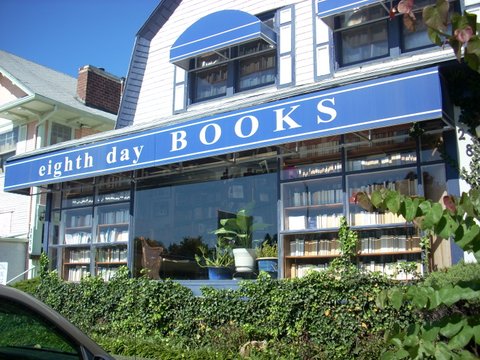
Arranged with the help of my longtime book friend Bruce Woods, I first visited Eighth Day Books in 2009, during my world book tour for The Book Shopper: A Life in Review. Over the years, I have posted several times about this great, independent book store that carries 25,000 titles in philosophy, religion, history and literature. But that doesn't compare to getting a shout-out from The New York Times earlier this month who did a feature article on the bookstore and its owner, Warren Farha. I think the article captures how the bookstore reflects the personality of Farha, but it fails to mention that he bares a striking resemblance to the actor Richard Gere. (Farha is on the left. Your blogger on the right - never confused with Richard Gere.) 
The article also mentions the now defunct Eighth Day book catalog, which I wrote extensively about in the posting "Spiritual Education Made Easy" because if you read the catalog it was like getting a liberal education in itself. Then there is another posting "Bookstores Near and Far," which reminded me of all the books I have bought and read as a result of meeting Farha.
Coincidentally Eighth Day Books is having a summer sale now through Sunday (5/31) with 20 % off on online orders over $65 (Use Code Summer2015). Don't hesitate to call them at 1-800-841-2541 if you have trouble finding a book in their online catalog. Their knowledgeable staff is available to answer questions or make recommendations.
I am getting ready to place my order after I post…
This weekend marks the 150th anniversary of the first Memorial Day Parade before there was even a Memorial Day. On May 23 and 24, 1865 Washington D.C. hosted the two day Grand Review parade of the Union Troops. The Army of the West led by William T. Sherman had completed it's capture of Atlanta and Savannah the previous autumn and had marched through South Carolina and North Carolina in the spring of 1865. They were about to join Grant's Army of the Potomac in Virginia when the war ended, but there was one last military spectacle left.
Here's an account of this extraordinary event from B.H. Liddell Hart's 1958 biography, Sherman: Soldier, Realist, American:
"On the 23rd, the Eastern armies (the Army of the Potomac) marched in review through Washington, an endless column of troops well-clad and well-drilled, their ranks trim and spotless. Returning from the pageant Sherman, with his customary candour, declared: 'It was magnificent. In dress, in soldierly appearance, in precision of alignment and marching we cannot beat those fellows.' Then some one suggested that they should not attempt it but instead should be workmanlike and pass in review 'as we went marching through Georgia.'
Sherman caught up the suggestion and next morning as the people of Washington watched the Grand Army of the West defile before their eyes they saw no glittering pageant, but instead an exhibition of virility. With uniforms travel-stained and patched, colours tattered and bullet riven, brigade after brigade passed with the elastic spring and freely swinging stride of athletes, each followed by its famous 'bummers' on laden mules ridden with rope and bridles. The most practically trained, physically fittest and most actively intelligent army that the world had seen."
—– EXTENDED BODY: —– EXCERPT: —– KEYWORDS: Grand Review, B.H. Liddell Hart, the first Memorial Day Parade, —– ——– AUTHOR: Murray Browne AUTHOR EMAIL: murray.browne905@gmail.com TITLE: Brooklyn Book Shopping STATUS: Publish ALLOW COMMENTS: 1 CONVERT BREAKS: wysiwyg ALLOW PINGS: 0 BASENAME: brooklyn-book-shopping CATEGORY: Bookstores UNIQUE URL: https://thebookshopper.typepad.com/the_book_shopper_atlantad/2015/05/brooklyn-book-shopping.html DATE: 05/11/2015 08:22:07 AM —– BODY:
 This time on our book shopping trip to New York, Denise and I made it out to some of the bookstores in the Carroll Gardens section of Brooklyn. The most notable was Book Court, a spacious bookstore, well-stocked in quality fiction (I purchased The Master and Margarita by Mikhail Bulgarov), children's books, nonfiction, and books about Brooklyn. I also found a discounted copy of a 2011 book exploring perception in photography Seeing is Believing: Observations on the Mysteries of Photography by Errol Morris.
The Community Book Store
A few blocks from Book Court is The Community Bookstore, which had not opened for the day. Looking through the store window, I must admit, was a little intimidating. My only thought was that this is what happens to books that are tossed in the dumpster. But photography, says Morris, can be deceiving, so you and I both should refrain from being too judgmental.
—– EXTENDED BODY: —– EXCERPT: —– KEYWORDS: Brooklyn Book Stores, The Community Book Store, Book Court —– COMMENT: AUTHOR: Ian EMAIL: psyclist@gmail.com IP: 174.111.1.151 URL: DATE: 05/11/2015 09:35:29 AM The Master and Margarita? Nice find! —– ——– AUTHOR: Murray Browne AUTHOR EMAIL: murray.browne905@gmail.com TITLE: New Shelves STATUS: Draft ALLOW COMMENTS: 1 CONVERT BREAKS: wysiwyg ALLOW PINGS: 0 BASENAME: new-shelves UNIQUE URL: https://thebookshopper.typepad.com/the_book_shopper_atlantad/2015/05/new-shelves.html DATE: 05/04/2015 06:54:46 AM —– BODY:
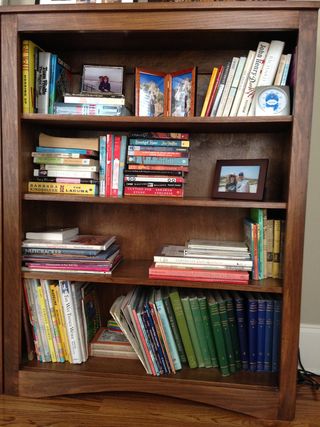 It comes with the territory. You buy enough books and eventually you have to put them somewhere.
My solution was to seek out Paul Nooks of Paul Nooks Furniture. Besides tables, home entertainment cabinetry, Paul makes custom books shelves. He built Denise and I shelves when we first moved into our place five years ago and he still is at it. They are solid, look great, competitively, priced and hold a lot of books. At least I haven't filled these up yet.
If you are experiencing the problem of too many books and not enough space, contact PaulNooks AT yahoo.com.
—– EXTENDED BODY: —– EXCERPT: —– KEYWORDS: —– ——– AUTHOR: Murray Browne AUTHOR EMAIL: murray.browne905@gmail.com TITLE: MARTA Book Club #27: Acceptance Speech STATUS: Publish ALLOW COMMENTS: 1 CONVERT BREAKS: wysiwyg ALLOW PINGS: 0 BASENAME: marta-book-club-27-since-the-metropolitan-atlanta-rapid-transit-area-marta-is-a-finalist-for-the-midtown-alliances-road-w CATEGORY: MARTA Book Club UNIQUE URL: https://thebookshopper.typepad.com/the_book_shopper_atlantad/2015/04/marta-book-club-27-since-the-metropolitan-atlanta-rapid-transit-area-marta-is-a-finalist-for-the-midtown-alliances-road-w.html DATE: 04/27/2015 06:29:10 AM —– BODY:

Since the Metropolitan Atlanta Rapid Transit Authority (MARTA) Book Club is a finalist for the Georgia Commute Options' Road Warrior of the Year award it seems only appropriate as its founder that I post something to acknowledge its nomination. Little did I know when I began the club in 2009 as a spoof on book clubs in general that it would rise to any level of recognition.
I plan on being at the award ceremony on the behalf of the club on April 29th, but I think the chances of winning are highly unlikely. Even though Vegas has the odds at 500 to 1, why not prepare an acceptance speech just in case?
 The Short Speech
The MARTA Book Club, which is open to anyone who reads a book while riding public transportation, has served two main purposes. The 27 postings which lists all the books I have seen people read over the years (I call it "bookspotting") reflects the makeup of those who ride whether they read Bibles, romance novels, textbooks or the occasional outlier such as Plato's The Republic.
The second purpose is more personal. I have used the book club to comment and sometimes rant on the MARTA experience and policies — whether it was complaining about rate hikes, changes in service, or satirizing the Code of Conduct. Coincidentally (or maybe it did a little good), MARTA has improved over the six years and ~10,000 miles I have been riding, although it still does have its bad days. What is a bigger problem is the safety of those on foot and bikes. Being a pedestrian crossing the 10th Street bridge from the Midtown Station has the danger equivalence of rock climbing.
But the MARTA Book Club turned out to only be the beginning. As a writer and a rider, I began to use my experiences and observations of commuter life as an inspiration to write stories, which I am putting together in a book entitled Down & Outbound: A Mass Transit Satire, which will be published sometime this year.
So as you can see, my relationship with MARTA is more than as a daily commuter or even a — shall I dare hope — a Road Warrior. It has influenced me also, not only by the books I read riding to work but by the ways in which it connects me to this city.
Why MARTA, you sound like you're my muse.
What We Are Reading
Here's a list of books being read since the last posting. If you are interested in visiting all the MARTA Book Club postings, go here.
The Fall: Book Two of the Strain Trilogy by Guillermo Del Toro
A Confederacy of Dunces by John Kennedy O'Toole
Death Traps: The Survival of an American Armored Division in World War II by Belton Cooper and Stephen Ambrose
Double Cross by James Patterson
Sonography: Introduction to Normal Structure and Function (textbook)
The Master and Margarita by MiKail Bulgakov and Diane Burgin
Armor and Blood: The Battle of Kursk: The Turning Point of World War II by Dennis Showalter
The Year of the Flood by Margaret Atwood
Blue Highways by William Least Heat Moon
Fall of Giants by Ken Follett
Tears of a Tiger by Sharon Draper
Undercover User Experience Design (Voices that Matter) by Cennydd Bowles and James Box
Borderlands LA Frontera by Gloria Anzaldua
The Republic by Plato
NYPD Red 2 by James Patterson and Marshall Karp
The Alchemist by Paula Coelho
The Plot Against America by Philip Roth
On Writing Well by William Zinsser
Meant to Be by Lauren Morrill
Nine Days by Fred Hiatt
Next Assignment
Keep reading, get to work on time, and watch for puddles on the platform.
—– EXTENDED BODY: —– EXCERPT: —– KEYWORDS: MARTA Book Club, What People in Atlanta are Reading, Midtown Alliance, Road Warrior, Georgia Commute Options —– ——– AUTHOR: Murray Browne AUTHOR EMAIL: murray.browne905@gmail.com TITLE: Subscription Info STATUS: Publish ALLOW COMMENTS: 1 CONVERT BREAKS: wysiwyg ALLOW PINGS: 0 BASENAME: subscription-info UNIQUE URL: https://thebookshopper.typepad.com/the_book_shopper_atlantad/2015/04/subscription-info.html DATE: 04/19/2015 01:38:28 PM —– BODY:
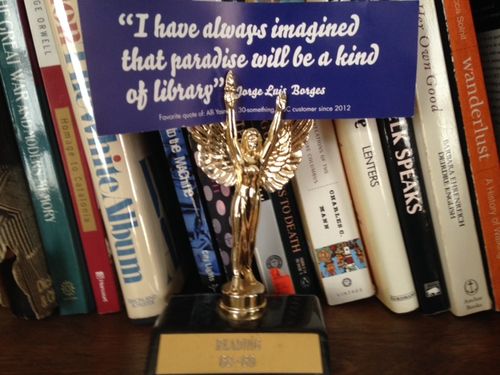
Once in a while I like to remind visitors that you can subscribe to this blog by either doing a like at The Book Shopper Facebook Page or using the Feedburner link for email subscribers. Both are found at the upper right hand corner of the home page. And don't worry, you won't be slammed with lots of additional emails or ads. On my best months, I usually only post something once a week. Think of it as a personal note from your quirky book friend.
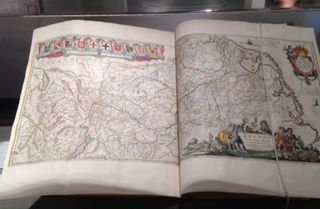 For those of you who either a.) appreciate old books, b.) like maps, c.) relish fine printing, or d) all of the above, make an effort to see the Joan Blaeu's Grooten Atlas, first published in the Netherlands in 1662-1665.
The Grooten Atlas along with framed prints are currently on display at the Robert C. Williams Museum of Papermaking on the campus of Georgia Tech University in Atlanta. Here's the press release from the Museum:
"Georgia Tech’s Price Gilbert Memorial Library and the Robert C. Williams Museum of Papermaking proudly exhibit Joan Blaeu’s Grooten Atlas from February 27 to June 26, 2015. Also called the Atlas major, the atlas was published in Amsterdam between 1662-1665. Blaeu’s nine volume atlas remains the foremost European Atlas published in the seventeenth century. These works are familiar to some faculty and students, but the larger community has been unaware that Georgia Tech has these treasures in the rare book collection. This particular edition is one of the few remaining hand-colored, gold-embossed deluxe editions of the Atlas, bound in Moroccan leather. Original volumes of the Atlas will be on exhibit along with reproductions of select maps from the collection.
Exhibited maps include European views of Africa, the Americas and Asia, depicting important trade routes and ports. Detailed views of European cities and countries provide insight into a continent developing the geopolitical regions known today. The Robert C. Williams Museum of Papermaking map of Virginia and Florida will also be featured in the exhibit.
Explore how the Grooten Atlas came to be produced in 1660s Amsterdam, the culmination of years of research, the development of papermaking and printmaking, and the establishment of the art of map making. Joan Blaeu, a second-generation mapmaker, celebrates the work of Tycho Brahe, mentor to Blaeu’s father. Brahe’s study of astronomy and contributions to celestial navigation provide a solid foundation to the development of the Atlases.
Considered together, the Blaeu’s Grooten Atlas provides important examples of evolving cartographic technologies and rich material exploring the idea of Europe after the Thirty Years War."
Be mindful of the hours since the museum keeps more "business hours" 9-5, Monday to Friday. But there is free, easy access parking in front of the museum on 10th Street, which is important if you ever tried to park near there. Admission is free but the museum appreciates donations. Here's a few more marginal photos of the exhibit that should not preempt you from attending.
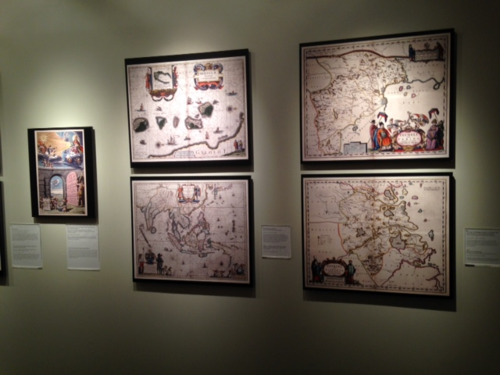
—– EXTENDED BODY: —– EXCERPT: —– KEYWORDS: Joan Blaeu Grooten Atlas, Robert C. Williams of Papermaking, —– ——– AUTHOR: Murray Browne AUTHOR EMAIL: murray.browne905@gmail.com TITLE: Prepping for the Cubs Opening Day with Books STATUS: Publish ALLOW COMMENTS: 1 CONVERT BREAKS: wysiwyg ALLOW PINGS: 0 BASENAME: prepping-for-the-cubs-opening-day-with-books CATEGORY: Baseball UNIQUE URL: https://thebookshopper.typepad.com/the_book_shopper_atlantad/2015/04/prepping-for-the-cubs-opening-day-with-books.html DATE: 04/06/2015 07:42:02 AM —– BODY:
 As a longtime Cub fan dating back to the Ernie Banks days*, I am often asked about my tormented relationship with the Cubs. On the precipice of the 2015 season it is a little different. Some baseball prognosticators actually think that the Cubs will make the playoffs this year with their abundance of young (unproven) talent. I think .500 ball is a more realistic outcome and this is fortified by some of my recent off-season readings, which included three books about the Cubs.
 This winter I received Jimmy Greenfield's 100 Things a Cub Fans Should Know and Do Before They Die (2012), which I appropriated as a nightly bedtime story before turning off the light. In one and two page snippets, Greenfield mixes Cub history, lore, and brief bios of famous players. Some players were known for their athletic ability (Ryne Sandberg, Billy Williams and Hack Wilson) and others for their nicknames (Dave “King Kong” Kingman, Mordecai “Three Finger” Brown, Mitch “Wild Thing” Williams). I know quite a bit about the Cubs, but not everything. For example, I didn't know before Wrigley Field, that the Cubs played at the West Side Grounds between 1893 and 1915. Legend has it that the expression “way out in left field” originated at this site, because of the ballpark's left field proximity to a psychiatric ward. “As the story goes,” writes Greenfield, “ players patrolling left field could overhear patients in the ward. And so the term 'way out in left field' came to mean someone questioning your sanity.”
Greenfield references many books about the Cubs including others in my library: Wrigleyville: A Magical Historical Tour of the Chicago Cubs (1996) by Peter Golenbock and Rick Talley's The Cubs of `69: Recollections of the Team That Should Have Been (1989).
 I revisited both books this winter upon the passing of Mr. Cub, Ernie Banks. I liked Ernie who was on the downside of his career when I was youth, so I don't remember his National League MVP years of 1958 and 1959 and didn't realize that he was the first African-American to play for the Cubs. However, if you re-read Talley's book you realize that there was much more to Ernie than unbridled “let's play two” optimism. Even Ernie had a hard time saying good things about Cubs manager Leo Durocher who managed the Cubs during their greatest collapse (attributed mostly to Durocher playing his starters into the ground) in the summer of 1969.
I certainly remember the Cubs debacle of 1969 and it was my moment when a Cubs fan earns his or Cubby Bear stripes (my younger daughter earned hers in the 2003 Bartman game where the Cubs were five outs away from the World Series). That's what it means to be a Cubs fan – to have tremendous optimism and hope and then have it crushed like so many paper beer cups in the bleachers, paraphrasing folk singer-song writer Steve Goodman, who wrote the Cub National Anthem, A Dying Cub's Fan Last Request in 1981. (See Goodman perform it here on top a left field rooftop before all the modernization.)
Envisioning playoff victories for the 2015 team before the first pitch of the season is a sure recipe for disappointment, and thus my prediction is simply that more Cubs fans will be likely being coming into the fold with heartaches, not celebration hangovers.
* This photo comes from a family trip in 2001. It includes my sister, daughter, niece and nephew. The Cubs lost to the Pirates that day. My first Cub game was sometime in the mid-60s when my Uncle Bill took me to a Cubs double-header. Banks hit two home runs that day.
—– EXTENDED BODY: —– EXCERPT: —– KEYWORDS: Jimmy Greenfield, Peter Goldenbock, Rick Talley, Ernie Banks, Chicago Cubs, Predictions, Wrigley Field, Steve Goodman, Dying Cubs Fan last request, —– ——– AUTHOR: Murray Browne AUTHOR EMAIL: murray.browne905@gmail.com TITLE: Valley of the Sun Book Shopping STATUS: Publish ALLOW COMMENTS: 1 CONVERT BREAKS: wysiwyg ALLOW PINGS: 0 BASENAME: valley-of-the-sun-book-shopping CATEGORY: Bookstores UNIQUE URL: https://thebookshopper.typepad.com/the_book_shopper_atlantad/2015/03/valley-of-the-sun-book-shopping.html DATE: 03/28/2015 08:05:36 AM —– BODY:
Even though Denise and I were only in town for a long weekend to visit our friends Tom and Peg we managed to squeeze in stops at three very good Phoenix-area bookstores (in addition to tours of the Phoenix Botanical Gardens and Frank Lloyd Wright's school at Taliesin West). “Managed” is the operative word here because although we think Tom and Peg like bookstores as much as we do, part of the logistical success came as a result of visiting two of the stores near closing time and the other on the way to the airport. Was this just by accident or pre-planned by our hosts? Either way it was well-executed.
Here is a replay of our bookstore visits:
The Poisoned Pen Bookstore, Scottsdale
 For over 25 years, The Poisoned Pen has specialized in mysteries, thrillers and historical and literary fiction and books about the Southwest. They host over 200 readings and events a year. It seems like anyone writing in these genres makes an appearance at this bookstore. I picked up a signed copy of Jonathan Lethem's latest collection of short stories, Lucky Alan and Other Stories (2015). I was not too surprised to see Lethem books, though I am more familiar with his literary fiction like Chronic City (2009) and The Fortress of Solitude (2003). Nevertheless, I find myself more often than not recommending Lethem's page turner Motherless Brooklyn (1999), about a small-time private detective/hood with Tourette's Syndrome trying to solve the murder of his paternal boss.
Denise purchased an interesting looking book, Jean Claude-Izzo's Garlic, Mint and & Sweet Basil: Essays on Marseille, Mediterranean Cuisine and Noir Fiction (2013). As you know, you can only find these exotic titles by browsing. At my urging Tom picked up a copy of Luis Alberto Urrea's Into the Beautiful North (2010) about a teenage Mexican girl who leads a Seven Samurai-inspired trek in the United States to find her father.
Changing Hands, Two locations (Tempe & Phoenix)
 We visited the Tempe store. Changing Hands has been around 40 years and it is the size of a Barnes & Noble, carrying both new books and used books that are in top condition. I refrained from buying something, but I did play Stump the Courtesy Desk by asking for books by Dan Okrent and Wilfred Sheed (unfair requests, really), but considering the wide selections and size of the store, I felt they might have some of their works in stock. Like Poisoned Pen, the staff was very friendly even when they patiently reminded us that they were about to close.
Denise found two books that she liked: Anna Quindlen's Still Life with Bread Crumbs (2014) and a used copy of Jose Saramago's Skylight (2011). I bought some lip balm because after two days in the dry air my lips were starting to crack like I was in one of the B-Westerns when the parched cowboy is crawling aimlessly around in the desert.
Guidon Books, Scottsdale
 Though it wasn't exactly on our way to the airport, our accommodating hosts took us there anyway. Oh, what a store for a Civil War buff! It also carries Western and Native American themed books. I chatted with the store's owner Shelly Dudley, whose father opened the store 50 years ago, about some of my recent Civil War favorites, such as Crossroads of Conflict: A Guide to Civil War Sites in Georgia (2010), which she had in stock. Most impressive.
I purchased James G. Hollingsworth's The Louisiana Native Guards: The Black Military Experience During the Civil War (1995) because while browsing I was intrigued by the story that the free blacks who lived in New Orleans fought as separate unit very early in the war. 
At the airport we were able to put the books in our suitcase and still stayed under the 50 pound limit. We were thankful that it didn't impact our carry on capacity, which we used for the oranges and grapefruit from the trees in Tom and Peg's backyard.
Much bounty from the Valley of the Sun.

 Yesterday I attended the The Atlanta Record & CD Show. It was my inaugural journey into the underworld of vinyl and (mostly) rock 'n' roll nostalgia. All those records you pitched or left in your parents' closet have somehow resurfaced and are now available at prices ranging anywhere from $1 to $80. In the spirit of full disclosure, I still have about two crates of vinyl records and a working turntable to play them on.
The scene reminded me of a quote from Michael Chabon's Telegraph Avenue, where the author encapsulates, via a vendor known as Mr. Nostalgia, the spirit of antiquarian book shows, vinyl record shows and any other such events that feature dolls, old action figures or the sports cards of our youth:
"Though Mr. Nostalgia loved the things he sold, he had no illusion that they held any intrinsic value. They were worth only what you would pay for them; what small piece of everything you had ever lost that, you might come to believe, they would restore to you. Their value was indexed only to the sense of personal completeness, perfection of the soul, that would flood you when, at last, you filled the last gap on your checklist."
 My only purchase came at the urging of my friend Wally, who pointed me to a record by jazz pianist Vince Guaraldi, that was re-purposed for the Armed Forces Radio & Television Service. “The Latin Side of Vince Guaraldi,” was a re-issue of a Guaraldi 1964 release by the same name. I purchased it for a $1. Not to be outdone, Wally purchased an album of bongo music at the same price point.
As I reflect on this quote and purchase, I can say with confidence that “The Latin Side of Vince Guaraldi” (and I think I can speak for Wally), did not “perfect my soul,” so to speak, but neither can I explain why I bought it.
—– EXTENDED BODY: —– EXCERPT: —– KEYWORDS: Michael Chabon, Telegraph Avenue, Vince Guaraldi, The Latin Side of Vince Guaraldi, Atlanta Record and CD Show. —– ——– AUTHOR: Murray Browne AUTHOR EMAIL: murray.browne905@gmail.com TITLE: The Fate (and Repurposing) of Books STATUS: Publish ALLOW COMMENTS: 1 CONVERT BREAKS: wysiwyg ALLOW PINGS: 0 BASENAME: the-fateand-repurposing-of-books UNIQUE URL: https://thebookshopper.typepad.com/the_book_shopper_atlantad/2015/02/the-fateand-repurposing-of-books.html DATE: 02/22/2015 07:24:10 AM —– BODY:
 When I saw this book scattered across the street in my neighborhood, I thought of the Richard Ford line from Independence Day (1995): "Many fates befall books other than being read and treasured."
Looking a little more closely at this ill-fated book (click on the page to enlarge the text) about "word-of-mouth" marketing, the irony did not escape me. What an interesting concept for marketing your book — detach the pages from its spine and scatter the word to the wind and pavement. You can't do that with an e-book or an audio book.
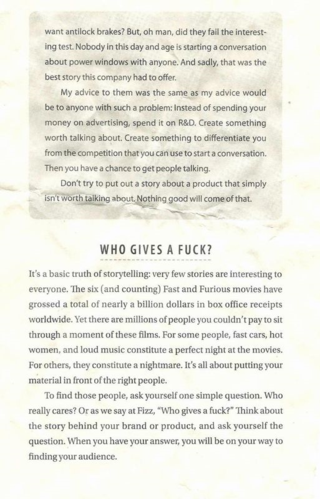
 Since it is I Heart Presidents' Weekend, I revisited the legacy of my favorite President, Abraham Lincoln. Part of this admiration can be attributed to the biographical fact that I grew up in East Central Illinois where everything is named Lincoln – Lincoln School, Lincoln Avenue, and Lincoln Lanes Bowling Alley. Not that I am willing to browse through one of 15,000 books written about him, but I did read with interest Drew Gilpin Faust's review of Richard Brookhiser's A Founder's Son: A Life of Abraham Lincoln, which looks at Lincoln's life and philosophies as a continuation of the ideas set forth in the Declaration of Independence and The Constitution.
By coincidence, I just finished reading Philip Roth's The Plot Against America (2004), with its unusual premise for a novel, which also has Presidential elements. Roth mixes his Jewish boyhood of growing up in Newark, New Jersey, with a “what if” the famous aviator Charles Lindbergh, and friend of Adolph Hitler, had by some strange set of circumstances been elected President of the United States in 1940 instead of Franklin Delano Roosevelt. In Roth's alternative history, he details how America would have stayed out of World War II, coupled with the tense account of a solid Jewish family such as his (it reads like an autobiography – like many of Roth's books, I am told ) would have disintegrated into domestic chaos. In one scene early in the book, after Lindbergh had been elected, Roth's father takes the family on a trip to Washington D.C. Here is the description of the Lincoln Memorial:
This time, while he parked, (our tour guide) Mr. Taylor warned us that the Lincoln Memorial was like no other edifice anywhere in the world and that we should prepare ourselves to be overwhelmed. Then he accompanied us from the parking area to the great pillared building with the wide marble stairs that led us up past the columns to the hall's interior and the raised statue of Lincoln in his capacious throne of thrones, the sculpted face looking to me like the most hallowed possible amalgamation—the face of God and the face of America all in one.
“Gravely my father said, “And they shot him, the dirty dogs.”
 To complete my I Heart President's Day, I pulled out my copy of Long Life Cool White: Photographs & Essays (2008) by Moyra Davey. In addition to her thoughtful writing, Davey is even more well known as a photographer and thanks to my older daughter Cynthia I had the good fortune to see her exhibit 100 Copperheads, where she enlarged photographs of 100 Lincoln pennies that she found in various conditions. The photographs are then mounted as a grid on the wall. An example shown here on the left (Copperhead #6), comes from the Murray Guy Gallery in New York. Davey also likes to take stills of stacks of old books and vinyl records (coated in dust), which looks like they came from my home office.
 Every time I see a celebratory shower of Gatorade I think of the essay Confetti Uncut by D. Graham Burnett, which appeared in Issue 52 of Cabinet Magazine. In the essay, Burnett gives a history of the use of confetti in celebration, which dates back to the ancient Greek custom of phyllbolia defined as tossing leaves, branches or other plant matter on the head of a person in celebratory reverence. I would encourage you to read the essay in its entirety since Cabinet has graciously made it available. Take note of the passage "to the sudden shower of water visited on the head of a beast about to be slain for the gods," where the author compares animal sacrifice to Gatorade showers. (Shown here is Bill Belichick getting his modern day phyllbolia after Super Bowl XLIX*)
This is the way celebrity works in our culture. We are quick to anoint celebrities to the highest status (millions of tweets) only to slaughter them in various ways by taking away their privacy, revealing the seamier undersides of their personal life etc. and then trivializing them into "where-are-they-now" oblivion.
* Photo Credit: AP/Matt Slocum
—– EXTENDED BODY: —– EXCERPT: —– KEYWORDS: Cabinet magazine, Gatorade showers, D Graham Burnett, phyllbolia —– ——– AUTHOR: Murray Browne AUTHOR EMAIL: murray.browne905@gmail.com TITLE: Inherent Vice: Review of the Movie Reviews STATUS: Publish ALLOW COMMENTS: 1 CONVERT BREAKS: wysiwyg ALLOW PINGS: 0 BASENAME: inherent-vice-review-of-the-movie-reviews UNIQUE URL: https://thebookshopper.typepad.com/the_book_shopper_atlantad/2015/01/inherent-vice-review-of-the-movie-reviews.html DATE: 01/26/2015 06:53:40 AM —– BODY:
“As one who's been down that particular exit ramp,” Hope advised, “you can only cruise the boulevards of regret so far, then you've got to get back up into the freeway again.”- Inherent Vice, p.40
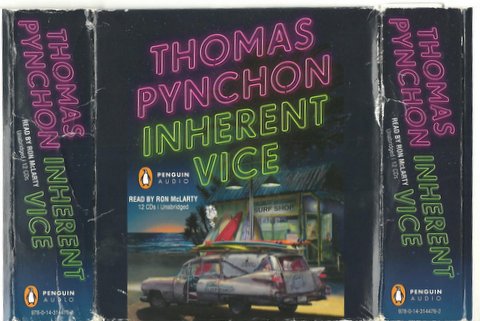
Reading Thomas Pynchon can be a strange ride. Some of his books like Bleeding Edge (2013) can be boulevards of regret, but when a movie based on Pynchon's, Inherent Vice (2010) is released, it is time to get back up on that freeway. When I read the book a few years ago, I found it one of his best efforts, if not his most accessible book next to The Crying of Lot 49 (1966).
I even keep a copy of the audio book in my car at all times to pop in on long trips, just to enjoy the language. Since I've already read it, I can flip in any disc – no need to worry about plot – and just cruise with the narrator Ron McLarty who does all the voices and even sings the surfer tune, "Soul Gidget."
Understandably, I have been reading movie reviews of Inherent Vice with some interest. Not because I was going to rely on some critic to make the call on whether to go or not, but I was curious on whether the reviewers had actually read the book before passing judgment. Moreover, I won a pair of free film passes from A Cappella Books here in Atlanta. (Thanks, Frank.)
Any movie that is based on a book must factor in the reaction from those who have read the book. But we're not talking Harry Potter or Gone Girl in terms of popularity here. I rarely meet anyone who has read more than one of his books and most of the time it is a negative reaction. I have since given up trying to convince anyone that he's worth the effort.
Simply put, with Pynchon there are only two things that you have to appreciate to plow through his books: a.) his erudite, word-playing and world-encompassing style, which riffs on any subject in all-knowing smart-ass tone and b.) the obsessive preoccupation of paranoia, all at the expense of engaging main characters and a driving plot. So what could I expect when I went to see Paul Thomas Anderson's film starring Joaquin Phoenix's as Doc Sportello, the stoned private investigator hired by his ex-girlfriend Shasta to find a missing real estate millionaire?
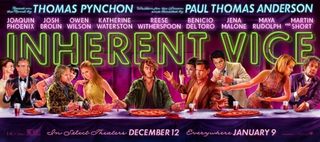 Anderson does an admirable job capturing the spirit of Pynchon's prose on film. Pynchon isn't easy to translate. To help, Anderson incorporated a female narrator Sortilege, which threw me because I didn't remember whether such a character existed in the novel (was I like Sportello and forgetting things?). Anderson uses Sortilege as a device to incorporate Pynchon's vernacular. Later at the exact moment when a characters says the “boulevards of regret” line in the movie, I felt that Anderson was faithful in the area that mattered most – the language. And Doc is more than “The Dude” in a stoner movie as there are some actually touching moments (and a disturbing violent one – so be warned). The part when Doc thinks longingly about Shasta with Neil Young singing the haunting “Harvest” on the soundtrack is especially somber and memorable.
I am glad to see someone appreciate Anderson's efforts because he has been nominated for the Oscar of best adapted screenplay, though several reviewers (one from The Chicago Tribune and another from The Minneapolis Star Tribune insisted that Pynchon devotees would be dissatisfied. There was no indication that either has read the book.
At least Michael Phillips from The Chicago Tribune does a fair assessment of how Inherent Vice works as a movie (he writes later about the lack of plot in Boyhood). I agree that I cannot wholeheartedly endorse the movie – it's long, and there are moments of questionable taste, but the cameo performances by Reese Witherspoon, Benicio Del Toro, Martin Short and Maya Randolph are all zany fun. I didn't even mind Owen Wilson and I think Owen Wilson is the biggest non-talent in Hollywood. A more positive review of the movie comes from Manohla Dargis of The New York Times who indicates she read the book. Dargis even gets additional credibility points by referencing another one my favorite writers, Joan Didion. (Both Didion and Inherent Vice examine "the end of the 60s.")
I will reserve final judgment until I see the movie again at home. If you want to see it on the big screen, and not that you have to, you had better hustle out to the multi-plex because the box office numbers aren't robust. Perhaps the most compelling reason to make the trek is that you might run into a few Pynchon aficionados out there. They will be easy to find – the theatre will probably be nearly empty and they will probably be following along in their books with florescent hi-lighters, and like me, revisiting some of their favorite passages from this polarizing writer.
—– EXTENDED BODY: —– EXCERPT: —– KEYWORDS: Thomas Pynchon, Inherent Vice, audio books, Paul Thomas Anderson, movie reviews of Inherent Vice. Joan Didion —– ——– AUTHOR: Murray Browne AUTHOR EMAIL: murray.browne905@gmail.com TITLE: MARTA Book Club #26: Reading Rules STATUS: Publish ALLOW COMMENTS: 1 CONVERT BREAKS: wysiwyg ALLOW PINGS: 0 BASENAME: marta-book-club-26-reading-rules CATEGORY: MARTA Book Club UNIQUE URL: https://thebookshopper.typepad.com/the_book_shopper_atlantad/2015/01/marta-book-club-26-reading-rules.html DATE: 01/11/2015 10:09:27 AM —– BODY:
Admittedly it's been a long while since the last installment of the Metropolitan Atlanta Rapid Transit Authority (MARTA) Book Club, so perhaps I should provide a refresher on the rules.
 The only membership requirement for Atlanta's premier, impromptu reading club is to read a book while riding public transportation. The MARTA Book Club does accept audio book and e-book submissions though I cannot easily determine what someone is enjoying as an audio book or e-book while doing my book-spotting. Moreover, one of the unwritten rules for the book club is minding your own business (along with watching out for suspicious puddles), so tapping people on the shoulder and asking what they are reading is not recommended. If alternative readers want to participate, they visit The Bookshopper Facebook Page and put their submission there. It's strictly an honor system–kind of like the MARTA Ride with Respect code of conduct.
In this posting I am also introducing the new unauthorized MARTA Book Club logo symbolizing the importance of the word while riding mass transit.
And now for the interesting part–a list of what people have been reading:
Stardust by Neil Gaiman
Man, God, and Civilization by John G. Jackson
The World According to Garp by John Irving
The Heart Is a Lonely Hunter by Carson McMullers (Hunter is this year's National Endowment of the Arts Big Read. Check the out the Georgia Center of the Book for details on local January events).
Monkey by Carl Hiassen
The Book Thief by Markus Zusak
Zealot: The Life and Times of Jesus of Nazareth by Reza Aslan
The 4th Hand by John Irving
The Kite Runner by Khaled Hosseini
Southern Cross The Dog: A Novel by Bill Cheng
Nicolae: The Rise of the Antichrist (Left Behind) by Tim LaHaye and Jerry B. Jenkins
Secrets and Lies by ?????. It is either part of the Truth or Dare series, The Ferro Family series or the Oklahoma Brands Book 3. You get the drift…
Understanding Wood Finishing: How to Select and Apply the Right Finish by Bob Flexner
The Alibi by Sandra Brown
The End of War by John Morgan
Masters of Dragon by Chris Wraight
America by Andrew Huggins
The Coming of Sound by Douglas Gomery
Them by Nathan McCall
Infinite Jest by David Foster Wallace.
A Supposedly Fun Thing I'll Never Do Again by David Foster Wallace. This is my contribution. I would definitely recommend Wallace's excellent book of non-fiction pieces, especially if you are thinking about taking a Caribbean Cruise.
1491 by Charles Mann
Other books spotted include novels by Kurt Vonnegut, Elizabeth George, Janet Evanovich and Stephen King.
For the previous 25 entries, check out the MARTA Book Club category link on the right.
—– EXTENDED BODY: —– EXCERPT: —– KEYWORDS: David Foster Wallace, MARTA Reading Club, What People in Atlanta are reading, The Big Read, Carson McMullers. —– ——– AUTHOR: Murray Browne AUTHOR EMAIL: murray.browne905@gmail.com TITLE: Endnotes STATUS: Publish ALLOW COMMENTS: 1 CONVERT BREAKS: wysiwyg ALLOW PINGS: 0 BASENAME: endnotes-1 UNIQUE URL: https://thebookshopper.typepad.com/the_book_shopper_atlantad/2014/12/endnotes-1.html DATE: 12/31/2014 11:26:59 PM —– BODY:

Finished up 2014 with a flurry of book activity. Went to New York for Christmas and then stayed on a couple days to do some book shopping. Revisited 192 Books and this time my book-loving partner Denise was able to come with me. Picked up another map-related book, Mapping It Out: An Alternative Atlas of Contemporary Cartographies edited by Hans Ulrich Obrist. (I think bookstore owners pull them out when they see me coming.)
Did some book shopping at the famous Strand Books. It was hectic there with people having gift money to burn. (I only managed to buy a calendar.) Much easier for me to browse at a place like 192 Books, where at the Strand I become overloaded. (I didn't prepare a shopping list). Besides always concerned about making weight on the plane ride back to Atlanta.
 On Christmas night, ate at The Cornelia Street Cafe in the Village, which is a restaurant with a small literary venue that hosts readings etc.. On Friday (1/2/15) they are hosting a reading of Charles Bukowski. Why not pose with him? Should "reading more Bukowski" be a New Year's Resolution? (Bukowski Photo Credit: Lizzie Casey)
More Dillion
Still following up from my reading of Brian Dillion's Objects in This Mirror. Edited my review and posted it on Amazon. (I like promoting the relatively unknown, especially when I am the first reviewer). Ordered the book for my daughter Cynthia in Germany. Able to forgo the Amazon route by ordering directly from the German publisher (Sternberg) who lives right down the street from her in Berlin. How often do you get to say "Sprechen Sie Englisch?"
In the final chapter of the Dillion book he writes about the essays of David Foster Wallace, who is the most respected contemporary writer who I have not read, until now. A work colleague loaned me a copy of his nonfiction pieces, A Supposedly Fun Thing I'll Never Do Again (1997), which I read while traveling this past week. His two long pieces on the Illinois State Fair and Taking a 7-night Carribbean Cruise are classics (full of footnotes and offsides) and have me interested in reading more of him, but Infinite Jest (1996) is such a huge book.
More Bookmaking
My other daughter Bonnie gave me a deluxe, presentation binding machine suitable for making books out of discarded beer cartons (see last posting). Also am finishing up writing a new book, which will be available in 2015. It's a resolution I plan on keeping.
Related articles —– EXTENDED BODY: —– EXCERPT: —– KEYWORDS: 192 Books, Cornelia Street Cafe, Charles Bukowski, David Foster Wallace, Brian Dillion, Objects in This Mirror, A Supposedly Fun Thing I’ll Never Do Again —– ——– AUTHOR: Murray Browne AUTHOR EMAIL: murray.browne905@gmail.com TITLE: Beer and Book Pairings: Best of 2014 STATUS: Publish ALLOW COMMENTS: 1 CONVERT BREAKS: wysiwyg ALLOW PINGS: 0 BASENAME: beer-and-book-pairings-best-of-2014 CATEGORY: Food and Drink UNIQUE URL: https://thebookshopper.typepad.com/the_book_shopper_atlantad/2014/12/beer-and-book-pairings-best-of-2014.html DATE: 12/24/2014 07:22:01 AM —– BODY:


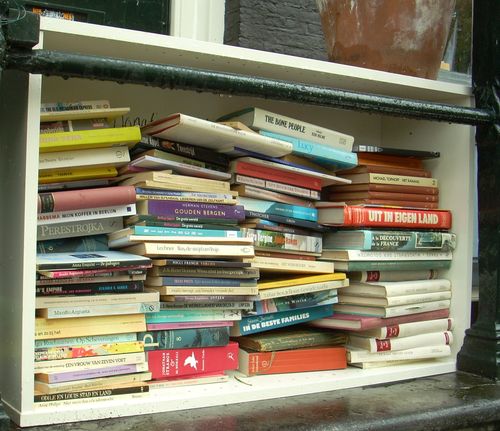
I am always trying new ales, lagers, IPAs and seasonal beers. As a matter of fact — and I can't believe I admitting this – I probably spent more time "browsing" at local Decatur (GA) places like Taps, Ale Yeah and Sherlock's Wine Merchant than browsing in bookstores this year. With this mind, I decided to combine the end-of-the-year tradition of the Best Books in 2014 list with some beers of merit.
Here's a few pairings of authors and books (some have aged a few years) that I read in 2014 matched with some notable brews.
 Rebecca Solnit's A Guide to Getting Lost, & River of Shadows: Eadweard Muybridge and the Technological Wild West (2003). There are certain breweries and writers I rely on when I want something good. Solnit is a San Francisco-based author I turn to when I want to insure that I am going to have something engaging without going over the top – like a good IPA beer from such California breweries as Stone Brewing or Ballast Point (Sculpin IPA). Michael Chabon is another writer who has been equally reliable the past few years. My last year's list included the The Yiddish Policemen's Union (2007), and this year I must add Chabon's novel set in Oakland, Telegraph Avenue, (2012) to my list of better books read in 2014. (Review here.)
John Banville, The Sea (2005). This was my first Banville book where the brooding sea is a major character. And his description of characters can sound like descriptions of beer — "short and top-heavy, all shoulders and chest and big round head." Reminds me of Heavy Seas Brewery, a Baltimore Microbrewery and makers of Loose Cannon IPA, Great'er Pumpkin, and Winter Storm Category 5 Ale, which conversely sounds like a character out of Banville novel, "…a pronounced bitterness, a mix of pale and dark that give it a tawny color and bigger body."
 Modris Ecksteins' Rite of Spring: The Great War and The Birth of the Modern Age (1989). I prepared for my trip to Amsterdam by practicing my Belgian beer drinking with some tutoring from the Brick Store. It made more sense than taking Dutch language lessons from Pimsleur (especially since everyone speaks English there). It is useful to learn whether to order a Gouden Carolus Cuvee Van de Keizer Blauw or Liefman's Goudenbrand and that I prefer quadrupels to tripels. I came back able to read a Belgium beer menu, albeit at a 4th grade reading level.
But I also prepped for the trip by rereading the Modris Ecksteins book. In an early itinerary I thought I might be going to the World War I battle sites at Ypres and Passchendele, so I wanted to review Ecksteins brilliant explanation and scholarship on the psychology that led to the slaughter in the trenches and paved the way to the Second World War as well.
—– EXTENDED BODY:
Elmore Leonard and Simon Garfield. Sometimes you prefer a lighter fair in books. This year two Elmore Leonard crime books - Bandits (1987) and Freaky Deaky (1988) and Simon Garfield's book On the Map: A Mind Expanding Exploration of the Way the World Looks (2013), provided such respite. The latter book inspired my own blog mini-series entitled Maps I Love. You can't always drink the more filling beers or the ones high in alcohol content just like you can't always read heavy hitters. There is always a place for lighter fair like a Yuengling or a Kolsch from Endless River brewery in North Carolina.
And what the crappy books that I didn't finish? Though it is tempting to single out the Bud Lights, Coors Lights and Michelob Ultra of books, isn't it better to focus on the positive and ignore the books and beers that hog all the national advertising, but lack the flavor and robustness I so crave.
And check out what my daughter Bonnie made me for Christmas – a combination of these passions. We call it "Beer Diary (Dear Beer Diary, Today I fell in love with…")
Please read responsibly.
—– EXCERPT: —– KEYWORDS: Best Books of 2014, Beer Diary, Best beers of 2014, Book and Beer pairings, Gouden Carolus Cuvee Van de Keizer Blauw, Lord Dusany, Modris Ecksteins, Rebecca Solnit. —– ——– AUTHOR: Murray Browne AUTHOR EMAIL: murray.browne905@gmail.com TITLE: Objects in This Mirror: A Review STATUS: Publish ALLOW COMMENTS: 1 CONVERT BREAKS: wysiwyg ALLOW PINGS: 0 BASENAME: objects-in-this-mirror-a-review CATEGORY: Book Reviews UNIQUE URL: https://thebookshopper.typepad.com/the_book_shopper_atlantad/2014/12/objects-in-this-mirror-a-review.html DATE: 12/13/2014 02:54:29 PM —– BODY:
Whether he is touring the decrepit sound mirrors near the shingle-laden beaches of Dungeness (see footnotes for photo credit) in southeastern England, or retracing the 1967 sojourn of American artist Robert Smithson's trip to the industrial hinterland of Passaic, New Jersey, or writing his interview with artist Sophie Calle from Calle's perspective, Brian Dillion deftly mixes art and ideas with personal narrative.
In this collection of 20+ essays gleaned from other magazines and journals, including Cabinet where Dillion is an editor, Objects in This Mirror: Essays (Sternberg Press, 2014) reminds those of us who dabble in this literary form why it is a "famously vagrant mode of writing:"
…with license to duck out of disciplinary constraints, to digress into the personal or the universal, to court specifics to the point, if artistic need be of eccentricity and even whimsy. but viewed from another vantage point, that of the jobbing critic or cultural journalist, "essay" names a bid for respectability: an effort to aggrandize occasional squibs, commissioned reviews, and dashed-off articles to the condition of quasi-literary monuments.
 With the only exception being his (too) long essay, on the early 20th century photographer Jarcques Henri Lartigue, Dillion draws you in to any topic he tackles like a list of nine theses on slapstick comedy, or how those maniacs who vandalize art are often sane and more engaged with art than your average museum goer. Like the essayists that he most admires (there is quite a rundown in the last chapter and an entire essay dedicated to Roland Barthes), Dillion is a mix of eclectic erudition and personal history wrapped in unpretentiousness.
A worthy read.
—– EXTENDED BODY:
Footnotes
I picked up my copy while browsing at Printed Matter, Inc. At $25, it was a little pricy considering it looked like it was printed in a garage. I wondered if it would hold through my reading and rereadings. Surprising in a way, because Sternberg is a well-established publisher headquartered in Berlin. Moreover, photo of Dungeness requires a proper accreditation.

Shingle Beach towards Dungeness
© Copyright David Anstiss and licensed for reuse under this Creative Commons Licence.
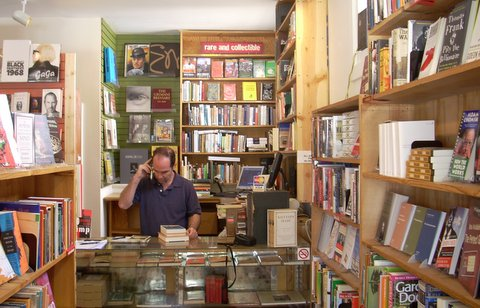
On Friday, December 5 at 6 p.m. at the Carter Library Museum and Library, A Cappella Books, a mainstay of the Atlanta literary scene, is celebrating its 25th Anniversary with a gala and a book launch. (Press release below).
The celebration includes the debut of a book of related essays A Cozy Infinity: 25 (Mostly) Atlanta Writers on the Never-Ending Allure of Books and Bookstores.
The A Cappella bookstore and its owner Frank Reiss are an amazing story. The main ingredient to make a bookstore great is that it has to have a personality and A Cappella reflects Frank's intellect and good judgment. Shown in the photo above manning the phones, Frank has been savvy enough to weather the ever-changing book landscape shifting from just being a traditional book shop to expanding his footprint by selling books at local literary events — most of which he organizes. I date myself when I say that — Frank is like Ed Sullivan ("Ed got us The Beatles, man") in his ability to provide a landing zone for worthy local and national authors. When he recommends a book, I always make a mental note and most of the time when I go to one of his store- sponsored events it to chat with him as much as it is to see the author. That is not easy because understandably, Frank is usually there working the register. Still he's never too busy to say hello and exchange opinions on the Atlanta Braves.
As a dubious honor, I have searched through all my postings and picked out the ones that best reflect my personal relationship with the store and its owner:
1. The Audio Tour. When A Cappella moved to it's latest location on Haralson Avenue in 2012, I did this blog's only audio piece ever– rundown of books mixed with chit-chat.
2. My Appearance at A Cappella. In July, 2009 I did a reading of my book, The Book Shopper: A Life in Review at the Opal Gallery, which was where Frank hosted small readings in his Little Five Points location. There was about 15 people there (but they bought!). It is even immortalized on video. Be the 36th viewer today.
3. Pynchon in Atlanta. A Cappella hosted a midnight party to celebrate Thomas Pynchon's Inherent Vice (when new Pynchon books mattered.) Now they've made in a movie out of Inherent Vice.
4. Billy Collins at the Carter Center. U.S. Poet Laureate Billy Collins is always among the favorites to see and hear. Another exhilarating experiences include meeting Nick Hornby at The Highland Inn and getting a personally signed copy of Richard Ford's Canada. Frank and his store has made that possible.
5. Paperback Dreams. I first met Frank when he led a panel of local bookstore owners in a discussion of a documentary about two independent bookstore owners in the Bay area. It was my first blog posting (November, 2008) and an omen to the challenges that Frank has overcome in the past six years.
—– EXTENDED BODY: Here are more specifics about the book and the event gleaned from the press release:
To celebrate its longevity, A Cappella is publishing a book: A Cozy Infinity: 25 (Mostly) Atlanta Writers on the Never-Ending Allure of Books and Bookstores. Contributors to the volume include Pulitzer-Prize-winner Hank Klibanoff, former Atlanta Magazine editor Rebecca Burns, James Beard-award-winning food writer John T. Edge, popular columnist Hollis Gillespie and celebrated local novelists Thomas Mullen, Susan Rebecca White, Anthony Grooms, and Joseph Skibell. The book's title comes from one of the 25 essays contained in it, penned by Esquire staff writer and Atlanta resident Tom Junod.
On Friday, December 5th, at 6PM, the book's editor, Tony Paris, A Cappella owner Frank Reiss (who wrote a history of the store for the book) and a number of the contributing writers gather at the Jimmy Carter Presidential Library (home to many of A Cappella's author events throughout the years) for the official release of A Cozy Infinity. Copies of the book will be available for sale and signing, as will books by many of the contributors. The event is free and open to the public.
Following the event, the celebration continues at Manuel's Tavern (another favorite venue for A Cappella book signings).
The Carter Library is located at 441 Freedom Parkway, Atlanta, 30307.
Manuel's Tavern is located at 602 N. Highland Ave NE, Atlanta, 30307.
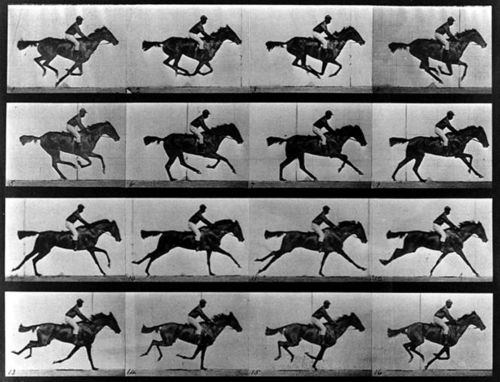
I have just completed reading my fourth book by Rebecca Solnit, which speaks volumes in itself. For most authors I may read a second offering once in while, so when I read the continued efforts by the same writer, well that's says something…
 My latest completed Solnit reading is River of Shadows: Eadweard Muybridge and the Technological Wild West (2003), which considering the timeliness could have been written yesterday. Solnit examines the life and times of Muybridge (1830-1904), who is mostly remembered as the man who was hired by Leland Stanford (the Stanford University Stanford) who photographed a running horse in order to determine whether all the horse's hooves at some point were not touching the ground. Solnit uses Muybridge, who was born in England but arrived in California in 1855 as a way to look at the effects of technology (the telegraph, the locomotive, and photography/motion pictures) in the second half of the 19th century and how California was as the epicenter of those changes — and still is with the emergence of Silicon Valley. In short these technologies “annihilated space and time,” just as it continues to do today. The book is part biography, part history and part a thought piece on technology past and present. It's neither a condemnation or acclamation for technology, Solnit simply forces you to think about the flux we live in – past and present.
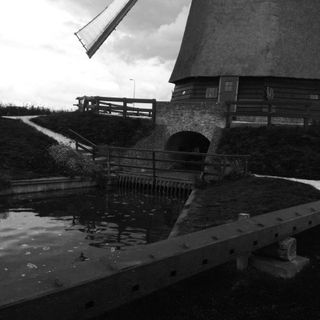 For example, recently when Denise and I were in Amsterdam, we took a day trip with a personal guide to visit some of the outlying towns. While we drove, our guide, a retired school teacher, gave us the history of the land, which was reclaimed from the sea, by an intricate systems of dikes, canals and windmills that pumped the water. Later you are standing inside the top of a working windmill you truly get a sense of the power of those wind-powered turbines.
These windmills were also used to saw lumber, which allowed the Dutch to build ships faster than anyone else, which lead to their dominating navy ( with control Dutch West Indies, New York, Dutch East Indies) and spearheaded their 17th century golden age. Such is the far reaching affect of a technology. It happened then as it happens now, a seemingly simple technology or change can have enormous effects and how we approach the world. And to what end?
Near the closing of her book, Solnit quotes film critic David Denby who provides a peek into the future. “The revolution will end by changing the nature of time itself,” says Denby, “thereby altering the way we live, work, seek pleasure, and gather together: We shall achieve simultaneity, ending the gap between desire and fulfillment; we shall no longer wait.”
Since I mentioned other Solnit books, I've read I will pass on her other worthy efforts.
- Hope in the Dark: Untold Histories; Wild Possibilities (2004). Written during the dark days following George W. Bush's election and the attack on the World Trade Center this thoughtful little book re-thinks how change comes about. We think that it comes top down (like from the President or from laws), but Solnit gives numerous examples throughout recent history that is it is people outside the center who actually can and do facilitate change, albeit slowly and not without setbacks.
- Wanderlust: A History of Walking (2000). A fascinating look at the history of foot travel from early times to present day (it even answers the question:Which came first? Learning to walk upright which developed our brains or is it vice versa?) If you like to walk or think, this book is for you. It's the book of hers I recommend the most.
- A Field Guide to Getting Lost (2005). A book of her related personal essays on what it means to be lost (besides just living in the moment). My favorite pieces were on how old Country-Western songs were like short stories and the artist Yves Klein.
—– EXTENDED BODY: —– EXCERPT: —– KEYWORDS: Rebecca Solnit, Eadweard Muybridge, River of Shadows, Wanderlust, windmills, netherlands, Hope in the Dark, A field guide to getting lost —– ——– AUTHOR: Murray Browne AUTHOR EMAIL: murray.browne905@gmail.com TITLE: Printed Matter, Inc. STATUS: Publish ALLOW COMMENTS: 1 CONVERT BREAKS: wysiwyg ALLOW PINGS: 0 BASENAME: printed-matter-inc CATEGORY: Book Reviews CATEGORY: Books as Art as Books CATEGORY: Bookstores UNIQUE URL: https://thebookshopper.typepad.com/the_book_shopper_atlantad/2014/11/printed-matter-inc.html DATE: 11/02/2014 08:52:56 AM —– BODY:
 As mentioned in the September 8th posting “Chelsea Lit Crawl,” I wanted to dedicate a specific posting to another bookstore that I visited recently when I was in New York City – Printed Matter, Inc.
Printed Matter, Inc. carries tens of thousands of pamphlets, zines, posters, but mainly they stock what they define as artists' books or “publications that have been conceived as artworks in their own right. These ‘projects for the page’ are generally inexpensive, often produced in large or open editions, and are democratically available.” To say the least, there is quite an eclectric collection and you can shop online if you are so inclined.
When I was there I purchased 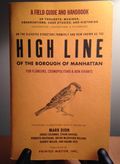 two books. The first was an illustrated book about the High Line, the former elevated rail line that was converted into a greenway beginning in 2006. Its full title A Field Guide and Handbook of Thoughts, Musings, Observations, Case Studies, and Histories (Alternative, Conventional & Otherwise) on the Elevated Structure Formerly and Now Known as the High Line of the Borough of Manhattan (2013) serves not only as a title but practically as a synopis as well. The book looks and feels like one of those nature field guides that you might find at a National Park gift shop with detailed illustrations of birds, insects and plants that live in this reclaimed habitat. There is a also a brief history of the High Line, which is an example of how local activism can effect major changes.
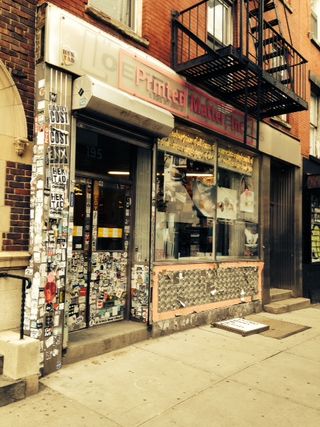
Although Printed Matter, Inc. (shown left) handles thousands of books from other publishers, High Line by Mark Dion, Jorge Colombo, Ethan House, et. al was published by the book store itself.
My second pick was Objects in This Mirror: Essays (2014) by Brian Dillon. Admittedly, the book is still in it's shrinkwrap, so I have not read it yet, but I will get to it before the end of the year. (See my December 13th posting.) It is published by Sternberg Press out of Germany and the display copy looked intriguing with its promotional blurb from Wayne Koestenbaum. Moreover, Dillon is the UK editor of one of my favorite periodicals Cabinet Magazine.
—– EXTENDED BODY: —– EXCERPT: —– KEYWORDS: Printed Matter, Inc. High Line, Field Guide and Handbook, Mark Dion, Jorge Columbo, Ethan House, Brian Dillon, Objects in this Mirror —– ——– AUTHOR: Murray Browne AUTHOR EMAIL: murray.browne905@gmail.com TITLE: Amsterdam Boeken (Books) STATUS: Publish ALLOW COMMENTS: 1 CONVERT BREAKS: wysiwyg ALLOW PINGS: 0 BASENAME: amsterdam-boeken-books CATEGORY: Bookstores UNIQUE URL: https://thebookshopper.typepad.com/the_book_shopper_atlantad/2014/10/amsterdam-boeken-books.html DATE: 10/23/2014 04:30:00 PM —– BODY: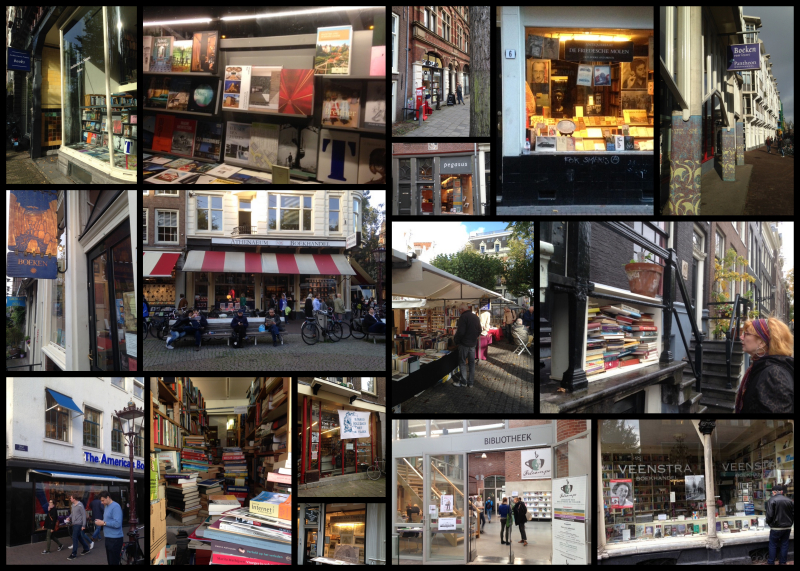
When you think of traveling to the city of Amsterdam in the Netherlands, you often imagine the museums, coffee shops, canals, the red light district, stroopwafels, and the bicyclists that rule the streets, but Amsterdam is a city filled with books and bookstores as well. English is commonly spoken in Amsterdam and many of the titles in the bookstores reflect this.
I couldn't visit all the bookstores and libraries in the city much less take pictures of all of them when I was there last week, but I did make some effort. A couple notables were the American Book Center and Athenaeum Boekhandel in the Spui district of central Amsterdam. (Click on the collage to enlarge.) Two other book shops I liked was the Architecture & Natura and the book section in the gift shop of the Stedelijk Museum.
When traveling you always have to monitor the books you buy because they do have to be carried back to the States. Our tour guide Michael recommended Discovering the Dutch: On Culture and Society of the Netherlands edited by Emmeline Besamusca & Jaap Verheul, which I picked up at the Athenaeum to read during the long flight home. The book is a series of essays and articles about different aspects of Dutch society and history. It's not a travel book per se, but like a good tour guide Discovering the Dutch has already added a little depth to my touristy windmilly view of the Netherlands.
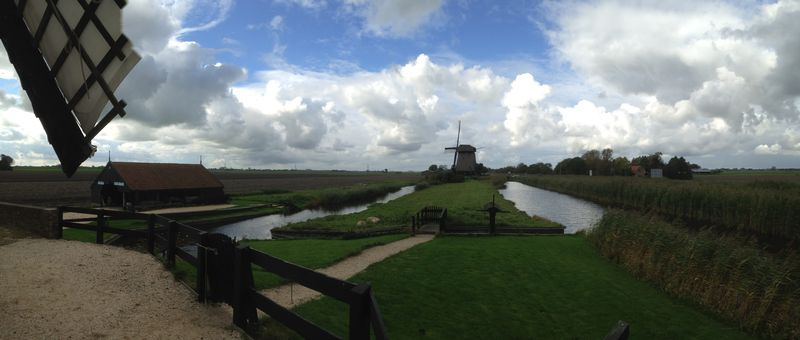
—– EXTENDED BODY: —– EXCERPT: —– KEYWORDS: Bookstores in Amsterdam, American Book Center and Athenaeum Boekhandel, Architecture and Natura, Discovering the Dutch: On Culture and Society of the Netherlands, Emmeline Besamusca, Jaap Verheul, —– ——– AUTHOR: Murray Browne AUTHOR EMAIL: murray.browne905@gmail.com TITLE: Remembering the Royals STATUS: Publish ALLOW COMMENTS: 1 CONVERT BREAKS: wysiwyg ALLOW PINGS: 0 BASENAME: remembering-the-royals CATEGORY: Baseball UNIQUE URL: https://thebookshopper.typepad.com/the_book_shopper_atlantad/2014/10/remembering-the-royals.html DATE: 10/10/2014 07:47:13 AM —– BODY:
Love a place like Kansas and you can be content in a garden of raked sand,
— Earl Thompson, A Garden of Sand
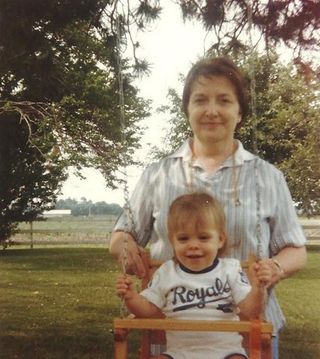 For the first time in three decades people are jumping on the Kansas bandwagon – or more precisely the Kansas City Royals bandwagon. My relationship with the Royals goes back a few years. In this photo circa 1983 shows my daughter Cynthia (age 14 months) wearing a mini-Royals Jersey waiting for a push from my mother. You cannot tell from this photo, but my toddler is wearing the number 5 – the uniform number of Baseball Hall of Famer George Brett. (Later, I purchased a George Brett Christmas ornament.)
It's refreshing to see the Royals and Orioles advancing in the playoffs and even though I have some affections for the Royals, I am hardly a fan (this is a long suffering Chicago Cubs-centric blog). On the other hand, I did live Wichita for several years and in orbit of Kansas City Royal fandom. Kansas City had some fine teams in the 1980s.
Solidfying the connection was my reading of the writer and baseball sabrematician Bill James who wrote prolifically about the Kansas City baseball, reminiscing back to the Kansas Athletics before they moved to Oakland in 1965. Kansas City was awarded a new franchise in the 1969 expansion. James, now 65, is best known for his annual Baseball Abstracts, which began self publishing in late 70s. James is largely responsible how baseball statistics have become a centerpiece of personnel and strategy decisions. (He was has three World Series rings for being an advisor to recent Boston Red Sox championship teams). I even wrote an essay about James that was published 22 years ago, making the argument that James belongs in the writer's wing of the Hall of Fame. (EFQ: Winter, 1992)
 I still keep his Historical Abstracts, which look at players from past eras, on my shelf along with an autographed copy of his “best of” collection, This Time Let's Not Eat the Bones: The Best of the Bill James Baseball Abstract (1989). If the Royals end up playing the Cardinals in a repeat of the 1985 World Series, I will be sure to reread his 45 page recap and analysis of the series. The Bones book is a great refresher on those Royals teams of the 1980s, especially Brett who you can bet, cameras will undoubtedly follow for reactions shots to events on the diamond.
There were other very good players on those teams, Amos Otis, Willie Wilson, Brett Saberhagen, Frank White, and later Bo Jackson. People don't remember that Jackson was reviled for trying to play two professional sports, but James defended Jackson's "hobby" (Jackson's reference to baseball). There was also the relief pitcher with the submarine delivery, the 6'2”, 170 pound (the perfect body type for those stretch uniforms), Dan Quisenberry, who was known for his quips as much as his unusual pitching motion. Later Quisenberry published a book of verse called On Days Like This published shortly before his premature death from brain cancer in 1998. Here's one of the poems from that collection.
SWITCH HITTER
i miss pitching so much
don't miss it at all, sick of it
i'll miss baseball forever, an old high school flame
burnt out, want nothing to do with it
it's part of me, like an extra limb or another ear
cut it off, numbed, like it happened to someone else
gave all of me to the game: head, heart, body, soul
gave nothing to it: zero
baseball was clear, focused, true
baseball was confusion, a roller coaster, a lie
learned so much
discovered nothing
i yearn for the attention, the dance of the big game
it was p.r. events that were meaningless, roars with no passion
i want a hat that tells me who I belong to
the logos were from cities I wasn't from
the game sings its siren song for my soul
i'm a mercenary who wants peace
i don't need another word of it
i'm synonymous with it
i've seen enough, heard enough
wonder who they're playing tonight?
—– EXTENDED BODY: —– EXCERPT: —– KEYWORDS: 1985 Kansas City Royals, Dan Quisenberry, Bill James, Let’s Not Eat the Bones, On Days Like This —– ——– AUTHOR: Murray Browne AUTHOR EMAIL: murray.browne905@gmail.com TITLE: Examining American Military Policy STATUS: Publish ALLOW COMMENTS: 1 CONVERT BREAKS: wysiwyg ALLOW PINGS: 0 BASENAME: examining-american-military-policy CATEGORY: Book Reviews UNIQUE URL: https://thebookshopper.typepad.com/the_book_shopper_atlantad/2014/09/examining-american-military-policy.html DATE: 09/26/2014 06:50:18 AM —– BODY:
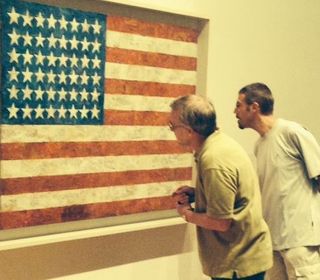 For insights into the current military and political policy that keeps the United States in the quagmire of Iraq and Afghanistan, may I recommend Andrew J. Bacevich's concise and timely Breach of Trust: How Americans Failed Their Soldiers and Their Country (2013).
Bacevich is a retired Army colonel who served in both the Vietnam and Gulf Wars and is now a history professor at Boston University. He convincingly maintains that the severed relationship between the civilians and the military has led to endless conflict, wasteful spending and ineffective global policy.
He reminds us that no amount of “Support for the Troops” corporate-led cheering makes up for the fact that during “wartime” the civilian population sacrifices nothing (no draft, no rationing, no additional taxes). In other words, one percent of the population does the fighting for the other 99%.
 Bacevich traces the current situation back to the Vietnam War and the formation of the All-Volunteer Army, which replaced civilian draftees. ( Military discipline in Southeast Asia had disintegrated to the point that the Army had become an ineffective fighting force.). He maintains that a populace with “skin in the game” is an important part of checks and balances needed for the military.
Referencing hundreds of articles and reports, Bacevich synthesizes the military mindset over the past 50 years—the love of technology, the replacement of the godless Soviet Union with the demonization of Islamic nations and the policy of starting a war to prevent a war—and reminds us as civilians, we are culpable as well:
With his affinity for missile-firing dromes, President Obama established targeted assassination as the very centerpiece of U.S. National security policy. With his predilection for commandos, he expanded the size and mandate of U.S. Special Operations Command, which under Obama maintained an active prescence in some 120 countries…
In the meantime, for the president, the downside of targeted assassination appeared minimal. True, from time to time an errant U.S. Missile might kill the wrong people (to include children) or American commandos might “take out” some bystanders along with Mr. Big. Yet back home, reported incidents of this type elicited a muted response. As far as the American media were concerned, the death of a few nameless Somalis or Pakistanis carried about as much newsworthiness as a minor traffic accident. As a determinant of presidential standing, a U.S. fighter-bomber inadvertently wiping out an Afghan wedding party lagged far behind a slight uptick in unemployment rate.
Breach of Trust is a must primer for those who are willing to examine American military policy and how it reflects our society as a whole.
—– EXTENDED BODY: —– EXCERPT: —– KEYWORDS: Breach of Trust: How Americans Failed Their Soldiers and Their Country (2013), Andrew J. Bacevich, Book review —– ——– AUTHOR: Murray Browne AUTHOR EMAIL: murray.browne905@gmail.com TITLE: 300 Postings: An Anthology STATUS: Publish ALLOW COMMENTS: 1 CONVERT BREAKS: wysiwyg ALLOW PINGS: 0 BASENAME: 300-postings-an-anthology UNIQUE URL: https://thebookshopper.typepad.com/the_book_shopper_atlantad/2014/09/300-postings-an-anthology.html DATE: 09/15/2014 07:11:38 AM —– BODY:
Lost in the media deification of Joan Rivers, is that the Book Shopper blog has reached its 300th posting milestone.
Little did I realize that when I began this blog in 2008 that I would still be cranking out a post at the rate of about once a week. It has evolved from being a shill for my book The Book Shopper: A Life in Review, which was published in 2009, to a Atlanta-Decatur book events review with paying sponsors, to something that is now ill-defined, but always personal. The best thing about blog-writing for me is that it keeps the pen to paper and the ideas flowing. I enjoy writing; I loathe the time-suck of getting published (or getting my thoughts out there). Blogging is a low-cost remedy.
On anniversaries, such as the 250th posting, the 200th posting and the 100th posting, I do a a recap of some of my favorite or popular postings since the last anniversary. Following that precedent, here are some you may have missed:
 –Book Cover the Color of Lipstick. The story behind this photo (shown here) from The New York Times.
–Book reviews of Wilfrid Sheed and Francis Spufford.
–Meeting author of the World World II Liberation Trilogy, Rick Atkinson.
There are also many postings about my obsession with William Tecumseh Sherman and Ambrose Bierce and books about maps, book shopping in Mexico that you can scroll through and find easily.
I can't really say that this book blog was a ground breaker like Joan Rivers (what about earlier comediennes such as Totie Fields, Moms Mabley and Phyllis Diller?), but taking a page from Rivers legacy, sometimes you just have to hang around long enough to get the recognition you deserve–even if it is self-recognition.
Thanks for reading, you fabled few, and don't try to stop me.
—– EXTENDED BODY: —– EXCERPT: —– KEYWORDS: The Book Shopper, William Tecumseh Sherman, Joys of blogging, Totie Fields, Joan Rivers, Ambrose Bierce, Wilfred Sheed, Francis Spufford, Rick Atkinson —– ——– AUTHOR: Murray Browne AUTHOR EMAIL: murray.browne905@gmail.com TITLE: Chelsea Lit Crawl STATUS: Publish ALLOW COMMENTS: 1 CONVERT BREAKS: wysiwyg ALLOW PINGS: 0 BASENAME: chelsea-lit-crawl CATEGORY: Bookstores UNIQUE URL: https://thebookshopper.typepad.com/the_book_shopper_atlantad/2014/09/chelsea-lit-crawl.html DATE: 09/08/2014 07:36:22 AM —– BODY:
 Last month I was in the Chelsea neighborhood of Manhattan and took a few hours to do some book shopping and literary site seeing. My personal tour included walking past the Hotel Chelsea, which has been home to literary notables such as Arthur C. Clarke, Allen Ginsberg, Dylan Thomas, Arthur Miller, to name but a few. The hotel is currently undergoing major rennovations and is not available to tourists or book bloggers.
Fortunately, I was more interested in some of the book  stores. 192 Books is a deceptively small book store, with floor to ceiling shelves of books along with several tables. It is well stocked full of fiction, nonfiction, children's and young adultt fare. I saw plenty of books that interested me including a set of books by the French Conceptual Artist Sophie Calle. After close to an hour of browsing I picked up Rebecca Solnit's River of Shadows: Eadweard Muybridge and the Technological Wild Wild West (2003) because Solnit never disappoints in her insightful musings on landscapes, culture and her own personal history. I also purchased a hardback copy of John Rodrigo Dos Passos's USA Trilogy, which includes The 42nd Parallel, Nineteen Nineteen and The Big Money — all written during The Great Depression.
I read the trilogy in the Signet paperback editions years ago, but remember it well. Dos Passos captures the energy, excitement and corruption of America in its rise to power in the first quarter of the twentieth century. Exploitation of the working class by the capitalists and a willingness to take up arms overseas were just two of the themes of Dos Passos books. Not much has changed. (Dos Passos's storytelling technique of mixing historical figures with fictional characters was groundbreaking as well). Dos Passos was empathetic to the plight of the workers, but later he became disallusioned with radical politics and was more conservative in his views. Still the three books remain as his literary legacy.
After 192 Books, I walked across the street to Printed Matter, Inc., a bookstore for an organization that specializes in the dissemination, understanding and appreciation of artists books. (This experience deserves a posting of its own at a later date.)
 My personal lit tour ended at Revolution Books, a sparsely stocked bookstore (compared to the inventory at 192) that had a selection of books more political in nature, especially those directed at our government's shenanigans. But they had a few that interested me such as Errol Morris' Believing is Seeing: Observations on the Mysteries of Photography (2011). I ended up purchasing 100 Diagrams That Changed the World (2012) by Scott Christianson. The irony of the transaction didn't escape me at the cash register as the bookseller tried to "upsell" me into buying a Revolution newspaper. I told the man that I had already bought The Dos Passos's U.S.A. Trilogy earlier in the day, but that wasn't enough to satisfy him.
—– EXTENDED BODY: —– EXCERPT: —– KEYWORDS: 192 Books, Printed Matter Inc.Revolution Books. John Dos Passos, USA Trilogy, Chelsea Book Shopping, Chelsea Bookstores —– ——– AUTHOR: Murray Browne AUTHOR EMAIL: murray.browne905@gmail.com TITLE: My DBF 2014 Self Assessment STATUS: Publish ALLOW COMMENTS: 1 CONVERT BREAKS: wysiwyg ALLOW PINGS: 0 BASENAME: my-dbf-2014-report-card CATEGORY: Books as Art as Books CATEGORY: Civil War Books UNIQUE URL: https://thebookshopper.typepad.com/the_book_shopper_atlantad/2014/09/my-dbf-2014-report-card.html DATE: 09/01/2014 08:49:32 AM —– BODY:
As always, my Festival plans and my actual participation did not exactly match (see last posting), but this year's Decatur Book Festival (DBF) had a few moments worth reflecting upon.
I did make it to one of the Civil War panels to hear the discussion surrounding the "nefarious" William T. Sherman and the destruction of Atlanta. I was too shy and too Midwestern to rebuke some of grandstanding by Dr. Stephen Davis (author of What the Yankees Did to Us: Sherman's Bombardment and Burning of Atlanta) even when he was giving John Bell Hood a historical pass on the Confederate general's strategy in defending Atlanta.
And as predicted, the University of Georgia Press did have a copies of Brown and Elwell's Crossroads of Conflict: A Guide to Civil War Sites in Georgia for sale. I also found out that they have a new book, The Civil War in Georgia, which was published as a separate piece from the New Georgia Encylopedia.
A late morning beer (a St Bernardius ABT 12) at The Brickstore with a book selling exhibitor friend. It was a little early, but we did beat the crowds.
I chatted with some illustrators and a few self-published authors. Some of those book covers were pretty steamy, especially for such a hot and humid day.
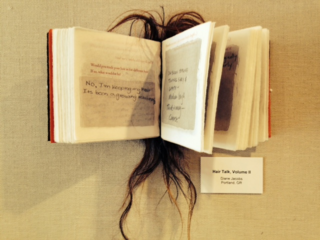 I did make to the Decatur Arts Alliance/ The Art Institute of Atlanta-Decatur Book as Art exhibit. Shown here is Diane Jacobs', Hair Talk, Volume II. You can see the exhibit until September 19th. For more details, including a slideshow of the entire collection, visit here.
At the Georgia State booth I picked a free copy of the literary journal Five Points. Near the booth, I met Julia Eichelberger, the author of Tell About Night Flowers: Eudora Welty's Gardening Letters 1940-1949 but unfortunately I missed her and Pearl McHaney's lecture on Welty. Maybe I would have asked my them to comment on the Welty quote that sticks in my mind:
Whatever our theme in writing, it is old and tried. Whatever our place, it has been visited by the stranger, it will never be new again. It is only the vision that can be new; but that is enough.
 Then again, I would have been too shy and too Midwestern to talk in front of a crowd — unless I had imbibed in a second St. Bernardius ABT 12 beforehand. Remember DBF can also mean Decatur Beer Festival
—– EXTENDED BODY: —– EXCERPT: —– KEYWORDS: Decatur Book Festival, Julia Eichelberger, Diane Jacobs, St Bernardius ABT 12, The Civil War in Georgia, Stephen Davis —– ——– AUTHOR: Murray Browne AUTHOR EMAIL: murray.browne905@gmail.com TITLE: Decatur Book Festival Search Strategy STATUS: Publish ALLOW COMMENTS: 1 CONVERT BREAKS: wysiwyg ALLOW PINGS: 0 BASENAME: decatur-book-festival-search-strategy UNIQUE URL: https://thebookshopper.typepad.com/the_book_shopper_atlantad/2014/08/decatur-book-festival-search-strategy.html DATE: 08/19/2014 09:03:19 PM —– BODY:
 Every year at this time I begin to have a little anxiety over attending the Decatur Book Festival and 2014 is no different. Am I missing someone I really want to see? Or will I be seeing someone I really should have missed?
Sure you can try to have a strategy, but it takes a lot of prep work. Going to the DBF web site and clicking on the various tracks such as Graphic Lit, Business and Economics, or my favorite, The Civil War is one approach. Another strategy is just clicking on the links of various writers, the majority I have never heard of (but I like the little bios of the unknowns). This clicking sensation is like trying to find something good on television, but we all know what a capricious master serendipity can be.
Since regular readers of this blog know that I have been "Getting My Sherman On" all year, you can expect that at some time I will be there arguing with the experts at the Civil War venue. But if you really want some good Civil War info, stop by the University of Georgia exhibitor's booth and ask to see Barry Brown and Gordon Elwell's travel book Crossroads of Conflict: A Guide to Civil War Sites in Georgia. Tell them The Book Shopper blog sent you and then watch them scratch their heads in bewilderment.
Other than checking out the Georgia State University enclave (they have a good size contingent of writers and lit magazines), and the book art exhibit at the Decatur Arts Alliance, I am not sure what else I'll be doing. Perhaps I should take the same approach as I do at the Decatur Beer Festival (as shown below): "Put on your favorite pretzel necklace, line up, and prepare to drink it all in."
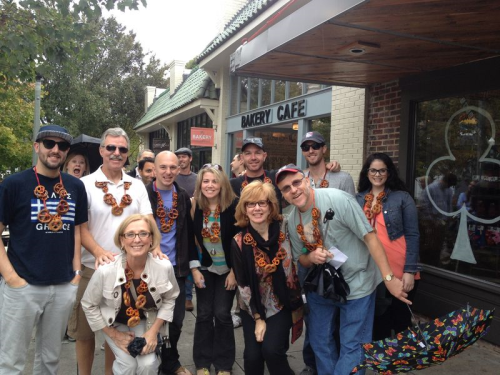
—– EXTENDED BODY: —– EXCERPT: —– KEYWORDS: —– ——– AUTHOR: Murray Browne AUTHOR EMAIL: murray.browne905@gmail.com TITLE: Shopping with Chabon in Mind STATUS: Publish ALLOW COMMENTS: 1 CONVERT BREAKS: wysiwyg ALLOW PINGS: 0 BASENAME: shopping-with-chabon-in-mind CATEGORY: Book Reviews UNIQUE URL: https://thebookshopper.typepad.com/the_book_shopper_atlantad/2014/08/shopping-with-chabon-in-mind.html DATE: 08/11/2014 07:55:47 AM —– BODY:
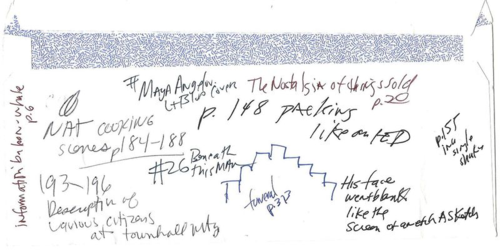
I suspect my moratorium on book shopping will be ending soon. I haven't purchased anything since I bought Michael Chabon's Telegraph Avenue (2012) from Too Tall Tales, a quaint little local book store in Toco Hills (here in Atlanta) earlier this summer. I finally finished Chabon's lengthy novel about two families in the Telegraph Avenue neighborhood between Oakland and Berkeley, which is on the brink of gentrification. The two men Nat Jaffe and Archie Stallings own a used vinyl record store called Brokeland. The men's spouses are midwives who are underfire for a delivery that didn't go well.. It's a book about families, jazz, action movies and to some degree race. Nat is white: Archie is black and they live in neighborhood that has every ethnic group imaginable, “cooked up in the same skillet.”
It took me a shamefully long time to read this book (lots of note taking as shown above.) Along with my recent obsession with maps (see all the July postings). Part of the blame goes to Chabon's descriptive prose, which always deserves slow, appreciative reading whether it be an account of Nat's cooking a big Southern meal to bribe a community leader (“those hard-ass little red beans, rushed into their fatback bathwater, had manage to relax enough to jump on over into a casserole with the rice”) or a roll call of citizens at a community gathering (“…the male Juddhist slurping with a vehement mindfulness from the rubber teat of a water bottle while the female [Juddhist] rummaged with melancholy chopsticks through the strips of flesh-gray tofu skin interleaved into her bento box as if ruing the slaughter of innocent soy plants that her appetite had ordained;”).
 This is the fourth Chabon book that I have read, which is unusual for me, because usually after two books by the same author, the desire to read a third wanes. I thought Chabon's The Adventures of Kavalier and Clay (2000) was great, but I thought The Yiddish Policemen's Union (2007) was even better – a wonderful imaginative effort along with his stellar prose and a whodunit plot. As a switch. I read Chabon's book of essays Maps and Legends and I still remember the essay “Diving into the Wreck” where he describes the “bathyspheric” pressure of writing a second book, especially if the first one had some success. Telegraph Avenue is a fine book, but it reminds me more of Zadie Smith's White Teeth more any other of Chabon's previous works.
Shopping at A Cappella
This Thursday, August 14th, A Cappella Books is hosting a Rare Book Showcase of “rare books documents, ephemera, and other antiquarian items,” which features the wares of several rare book dealers. I am not a collector of anything in particular, but I am a sucker for something that triggers something of my past (like a map).
Chabon captures that feeling in a passage in Telegraph Avenue, when he describes the mindset of Mr. Nostalgia who deals in sports cards, movies and comics.
Though Mr. Nostalgia loved the things he sold, he had no illusion that they held any intrinsic value. They were worth only what you would pay for them; what small piece of everything you had ever lost that you might come to believe, they would restore to you. Their value was indexed only to the sense of personal completeness, perfection of the soul, that would flood you when, at last, you filled the last gap on your checklist.
I am not sure if I will find anything that will “restore” me, but I am willing to go take a look.
—– EXTENDED BODY: —– EXCERPT: —– KEYWORDS: Michael Chabon, Telegraph Avenue, Yiddish Policeman’s Untion, Maps and Legends, Kavalier and Clar, A Cappella Books, Too Tale Tales, Geogia Antiquarian Book Fare —– ——– AUTHOR: Murray Browne AUTHOR EMAIL: murray.browne905@gmail.com TITLE: Maps I Love #4 STATUS: Publish ALLOW COMMENTS: 1 CONVERT BREAKS: wysiwyg ALLOW PINGS: 0 BASENAME: maps-i-love-4 CATEGORY: Maps I Love UNIQUE URL: https://thebookshopper.typepad.com/the_book_shopper_atlantad/2014/07/maps-i-love-4.html DATE: 07/31/2014 07:01:15 AM —– BODY:
Continuing from the previous July postings about Simon Garfield's ode to maps, On the Map: A Mind Expanding Exploration of the Way the World Looks (2013) I am listing personal maps that have stuck in my mind. As Simon writes, “when we gaze a map–any map, in any format from any era — we still find nothing so much as history and ourselves.”
Mercator vs. Peters-Gall
Similiar to making globes representing the spherical Earth on a flat piece of paper presents it's problems. As a youth, our classrooms were always decorated with the Mercator World Map, which at that time seemed to be the map standard. Little did I know that it was based on the work of Gerardus Mercatur (1512-1594) who addressed the sphere problem by bowing the lines at a certain degree. This somewhat distorted the map into making it European and Greenland centric and de-emphasing South America and Africa. Or course, I didn't know this. I kept thinking, "Greenland is damn big."
Then came along Arno Peters (1916-2002) in the 1970s who claimed that his Peters Projection map developed along with James Gall was more accurate portrayal of size of land masses even though the masses themselves are distorted. I keep a Peters Map on my cube wall and it never fails to elicit a response of bewilderment even though this interpertation of the world has been around a long time.
Of course I am always trying really trying get quizzical looks from my cube visitors, so I keep my Jasper Johns print of the United States (a sorry example of museum impulse buying) pinned to my wall . It doesn't have any thing "useful" like state capitals or highways, but it is colorful.
—– EXTENDED BODY: —– EXCERPT: —– KEYWORDS: Mercator, Peters-Gall, Peters, Jasper Johns Simon Garfield, —– ——– AUTHOR: Murray Browne AUTHOR EMAIL: murray.browne905@gmail.com TITLE: Maps I Love #3 STATUS: Publish ALLOW COMMENTS: 1 CONVERT BREAKS: wysiwyg ALLOW PINGS: 0 BASENAME: maps-i-love-3 CATEGORY: Maps I Love UNIQUE URL: https://thebookshopper.typepad.com/the_book_shopper_atlantad/2014/07/maps-i-love-3.html DATE: 07/23/2014 06:51:24 AM —– BODY:
 Continuing from the previous July postings about Simon Garfield's ode to maps, On the Map: A Mind Expanding Exploration of the Way the World Looks (2013) I am listing personal maps that have stuck in my mind. As Simon writes, “when we gaze a map–any map, in any format from any era — we still find nothing so much as history and ourselves.”
Globes Are Maps Too
Garfield dedicates a chapter to some famous globes, which are tricky to build because taking a flat, print representation of the Earth and covering a sphere is no easy task. One of the more famous efforts are the identical globes that were built for Winston Churchill and Franklin D. Roosevelt during World War II. The globes were gifts from Allied Chief of Staff, General George C. Marshall (of The Marshall Plan).
You can still buy globes of this size and magnitude from London-based globemaker Peter Bellerby. Bellerby calls his updated replicas – The Churchill.
 World's Largest Globe
Last summer, I visited world's largest globe known as The Eartha Globe in Yarmouth, Maine. Eartha dominates the atrium of the DeLorme, a maker of GPS software, satellite communication devices, maps and atlases. As you can see from my photo below, getting a shot of the entire globe from pole to pole is not doable with my camera. But you do get a sense, as globe affionados will tell you that, "The bigger the globe, the bigger the blank space in the Pacific."
Yeah, Wrigley may look impressive by reading The New York Times Book Review, but he only does it to sound like he's read the latest books.
—– EXTENDED BODY: —– EXCERPT: —– KEYWORDS: —– ——– AUTHOR: Murray Browne AUTHOR EMAIL: murray.browne905@gmail.com TITLE: Maps I Love #2 STATUS: Publish ALLOW COMMENTS: 1 CONVERT BREAKS: wysiwyg ALLOW PINGS: 0 BASENAME: a-month-of-maps-i-love-2 CATEGORY: Maps I Love UNIQUE URL: https://thebookshopper.typepad.com/the_book_shopper_atlantad/2014/07/a-month-of-maps-i-love-2.html DATE: 07/12/2014 09:25:52 AM —– BODY: Continuing from the previous posting about Simon Garfield's ode to maps, On the Map: A Mind Expanding Exploration of the Way the World Looks (2013) I am listing personal maps that have stuck in my mind. As Simon writes, “when we gaze a map–any map, in any format from any era — we still find nothing so much as history and ourselves.”
Transit Maps
Garfield dedicates a chapter to Harry Beck (1902 – 1974) the London Underground draughtsman who redesigned the London Tube map in the 1930s. Beck's now famous "electrical circuit" design does not reflect it's actual geographic scale between London stations, but organizes and represents the stations such that makes it much easier for commuters to navigate on the Underground. Below is one of the early iterations.
T-Shirt Maps
 Regular readers know that this blog is the virtual home of the Metropolitan Atlanta Rapid Transit Authority (MARTA) Book Club, (see the category list on the right for all the postings about it), and public transportation has long been an interest of mine that extends beyond Atlanta. Visiting Boston, I am always impressed with the Boston T, so much that I used to have shower curtain of the transit map (before it distingrated in mold). I still have a couple T-shirts with the map. Notice the same Beck-like design on the shirt.
When I wear them around Atlanta, I get comments ranging from "I wish we had better public transportation" or "Why don't you just live in Boston, if you love it so much?"
—– EXTENDED BODY: —– EXCERPT: —– KEYWORDS: —– ——– AUTHOR: Murray Browne AUTHOR EMAIL: murray.browne905@gmail.com TITLE: Maps I Love STATUS: Publish ALLOW COMMENTS: 1 CONVERT BREAKS: wysiwyg ALLOW PINGS: 0 BASENAME: a-month-of-maps-i-love- CATEGORY: Maps I Love UNIQUE URL: https://thebookshopper.typepad.com/the_book_shopper_atlantad/2014/07/a-month-of-maps-i-love-.html DATE: 07/06/2014 09:07:59 AM —– BODY:
 I just finished reading Simon Garfield's ode to maps, On the Map: A Mind Expanding Exploration of the Way the World Looks (2013) that covers everything maps, ranging Babylonian clay tablets dating from 600 B.C. to the latest innovations from Google. As I read, I started reminscing about personal memories of all maps I have that stuck in my mind. As Simon writes, “when we gaze a map–any map, in any format from any era — we still find nothing so much as history and ourselves.”
For next few postings I will share some of my favorites and why:
The Battle of Nashville Map
This map of the Battle of Nashville came from the attic of my grandmother who was on the board of her local library. Apparently, the library was going to pitch some of these old Civil War battlefield maps and she rescued a couple dozen of them. Later because of my ( never ending ) interest in the Civil War she gave me the maps, but only one survived the years in our garage. I finally had this map properly framed with museum glass and everything. (Photo courtesy of the Library of Congress, Geography and Map Division)
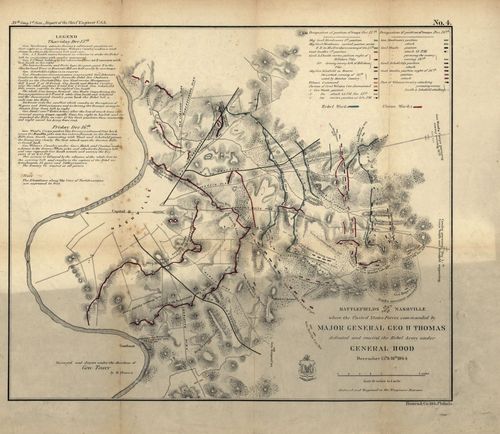
More Civil War Maps
 While the United States War Department's Atlas to Accompany the Official Records of the Union and Confederate Armies was originally published in 1880) is the defining book of Civil War maps, you can learn more about mapmaking in the Civil War by looking at the gorgeously printed Maps and Mapmakers of the Civil War (1999) written by Earl B. McElfresh, which includes many maps not included in the Atlas. I picked up my copy at an antique outlet for about $15.
—– EXTENDED BODY: —– EXCERPT: —– KEYWORDS: Simon Garfield, On the Map A Mind Expanding Exploration of the Way the World Looks Maps and Mapmakers of the Civil War, Earl B. McElfresh, Atlas to Accompany the Official Records of the Union and Confederate Armies —– ——– AUTHOR: Murray Browne AUTHOR EMAIL: murray.browne905@gmail.com TITLE: Revisiting Civil War Reenactors STATUS: Publish ALLOW COMMENTS: 1 CONVERT BREAKS: wysiwyg ALLOW PINGS: 0 BASENAME: revisiting-civil-war-reenactors CATEGORY: Civil War Books UNIQUE URL: https://thebookshopper.typepad.com/the_book_shopper_atlantad/2014/06/revisiting-civil-war-reenactors.html DATE: 06/25/2014 07:01:32 AM —– BODY:
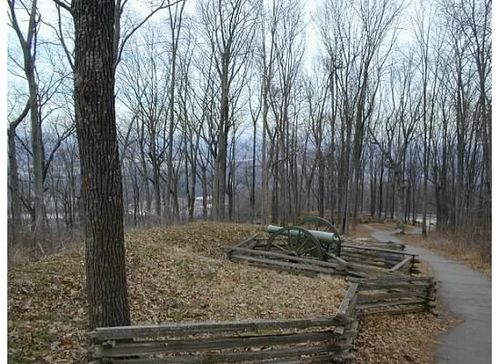
Battle, n. A method of untying with the teeth a political knot that would not yield to the tongue.
– Ambrose Bierce, The Devil's Dictionary
 As the 150th anniversary of the Battle of Kennesaw Mountain (GA) approaches later this week (June 27th) with planned festivities including a re-enactment, I am reminded of Tony Horowitz's 1998 book, Confederates in the Attic: Dispatches from the Unfinished Civil War, which I still have on my shelves.
I wonder if there is still a hierarchy among re-enactors that Horowitz described so well via one hardcore re-enactor Rob Hodge, who tried to do everything authentic except fight in battle with live ammunition. According to Horowitz, it also included dietery restrictions:
Losing weight was a hardcore obsession, part of the never-ending quest for authenticity. “If you look at pension records, you realize that very few Civil War soldiers weighed more than a hundred thirty-five pounds,” Rob (Hodge) explained. Southern soldiers were especially lean. So it was every Guardman's dream to drop a few pants sizes and achieve the gaunt, hollow-eyed look of underfed Confederates.
In this world, chubby re-enactors with spotless gray or blue uniforms are referred to as “farbs” who are looked down upon by the hardcore reenactors. But after rereading a few chapters about hardcore reenactors you realize there is something maniacal about a person who prefers sleeping in leaky tents and eating rancid bacon just to be authentic.
Something to look for about if you go to a reenactment at Kennesaw or any other reenactment around Atlanta. (Thinking of the Union soldiers wearing dark wool uniforms in the Georgia heat is enough to make me cringe and avoid the crowds. My photo was taken in winter.)
Bierce and Baseball
Two well-known people were severely wounded at Kennesaw Mountain, one was the writer Ambrose “Bitter” Bierce who I wrote extensively about in an earlier posting. An interesting aspect about Bierce is that he was the only major literary figure of American letters who actually fought in the Civil War.
No wonder the man was able to produce a work like The Devil's Dictionary.
Another wounded survivor is the father of first commissioner of Major League Baseball, Kenesaw Mountain Landis (1866-1944). Abraham Landis lost a leg at the Battle of Kennesaw Mountain and two years later named his newborn son, Kenesaw (?!?), who later became the commissioner. It was Landis who restored integrity in baseball after the Black Sox Scandal of 1919, which led to the banishment of Shoeless Joe Jackson.
—– EXTENDED BODY: —– EXCERPT: —– KEYWORDS: Confederates in the Attic, Tony Horowitz. The Battle of Kennesaw Mountain, Kenesaw Mountain Landis, Ambrose Bierce —– ——– AUTHOR: Murray Browne AUTHOR EMAIL: murray.browne905@gmail.com TITLE: Getting My Sherman (Alexie) (Amaz)On STATUS: Publish ALLOW COMMENTS: 1 CONVERT BREAKS: wysiwyg ALLOW PINGS: 0 BASENAME: getting-my-sherman-alexie-amazon UNIQUE URL: https://thebookshopper.typepad.com/the_book_shopper_atlantad/2014/06/getting-my-sherman-alexie-amazon.html DATE: 06/09/2014 04:26:14 PM —– BODY:
 Earlier this year I mentioned that I picked up a copy of Leslie Marmon Silko's Ceremony (1977) based on an interview in The New York Times of Sherman Alexie, the author of The Absolutely True Diary of a Part-Time Indian (2007). Alexie said Ceremony was his favorite book of “Native America literature.” Curious about this book, I picked up a copy while book shopping in New York last holiday season.
Well, I did read part of Ceremony, but did not finish it. This is not a reflection of the book, because the writing was fine, and the theme and the portrayal of a young soldier Tayo, who returns to the reservation after World War II seemed authentic, as Alexie suggested.
Sometimes as a reader you know that even though a book is good, you just don't feel like completing it. I am from the school that says “Read what you like or engages you at the moment, if it doesn't work for you, then move on to something else. You can always come back to it.” People can criticize my lack of fortitude attitude, but if I am forced to read something I don't like, then I just quit reading. Not much point in that. (It also explains why I don't do many reviews of books on this blog.)
 The irony is that a longtime friend read the book shopping New York posting and bought me a pre-owned copy of Alexie's novel, which I did finish. It's the story of a middle school-aged boy who leaves his reservation school to go to a white school. All the problems of adolescence combined with the life and despair of growing up as a self-loathing Native American and then being alienated from his own community and family, make this a downer like Ceremony. On the positive, Alexie's breezy narrative style and the illustrations by Ellen Forney– both what you might expect from a boy who is hitting puberty hard – keeps you reading. (You can see the influence of Ceremony on Absolutely True Diary.)
Alexie has been getting attention lately for appearing on The Colbert Report bringing to attention the plight of his publisher Hachette who is fighting Amazon's unfair business practices. I have no doubt that Amazon is a bully and appreciate the importance of independent bookstores, but I doubt throwing a sticker on your book saying you didn't buy the book at Amazon will do much to change that. Besides large publishers and independent bookstores are not above reproach for their practices and policies as well. Ask any published author and he or she will tell you that writing the book is not enough – it is up to you to hump and hustle to sell a few copies during it's short, short, shelf life. 
It's only when an obscure mention in an article or an insignificant blog like this one says something about your past book that you can get another sale or two and be assured that the only likely way you can buy that out-of-print book is thru Amazon.
Note: Another interesting coincidence between Sherman Alexie and William T. Sherman (subject of a lot of posting lately) is that after the Civil War, Sherman was responsible for some of the policies that led to the further placement of indigenous tribes on reservations.
—– EXTENDED BODY: —– EXCERPT: —– KEYWORDS: Sherman Alexie, The Colbert Report, Amazon, Hachette, Leslie Marmon Silko, Ceremony, The Absolutely True Diary of a Part-Time Indian —– ——– AUTHOR: Murray Browne AUTHOR EMAIL: murray.browne905@gmail.com TITLE: Getting My Sherman On: The Soundtrack STATUS: Publish ALLOW COMMENTS: 1 CONVERT BREAKS: wysiwyg ALLOW PINGS: 0 BASENAME: getting-my-sherman-on-the-soundtrack CATEGORY: Civil War Books UNIQUE URL: https://thebookshopper.typepad.com/the_book_shopper_atlantad/2014/05/getting-my-sherman-on-the-soundtrack.html DATE: 05/26/2014 09:19:19 AM —– BODY:
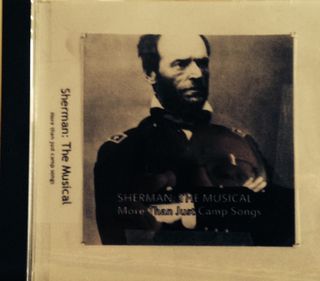 My continued interest in Sherman has not waned since last month's posting. I wrote a short list of “Fun Facts About William Tecumseh Sherman During the 150th Anniversary of His Invasion of Georgia” which I sent to Like The Dew, a website of Southern Culture and Politics. This Dew posting began an exchange with my old friend, writer and composer Alfred Thigpen, who wrote back that another Sherman Fun Fact was that he had a son who became an ordained priest– much to the objections of the older Sherman. When I quipped to Alfred that it sounded like material for a musical he wrote back with these lyrics within a few hours:
I hold in my hoof a strange invitation,
To attend my son’s priestly ordination.
(spoken) Let me ponder this.
War may be Hell, but Heaven is too,
A flameless place with much ado,
About nothing other than “nice.”
It’s not my notion of paradise.
Eternity! Eternity!
Paternity! Paternity!
No!
If invited, I will not attend.
No need to make amends.
If he’s ordained I’ll bid him farewell.
For a warless Heaven is worse than Hell.
Sherman did not attend his son's ordination.
—– EXTENDED BODY: More Thigpen
Alfred who grew up in Milledgeville (Ga.) and now lives in the Washington D.C. area, has made other appearances in The Book Shopper blog over the years – a review of Ann Napolitano's A Good Hard Look, a fictionalized account of the life of Flannery O'Connor and my review of Alfred's book Trapped in the Body of Jesus. As an indication of writing worth remembering I recall another Thigpen lyrical piece. In one of the stories, “Division by Zero Is Possible” from Trapped, Thigpen includes a gospel song (he wrote), where Jesus is likened to a Master Electrician:
Is your cir-cuit break-er ground-ed
at th' foot of Cal-va-ry?
Or does the cur-rent over-load you
So you long to be set free?
Op-en wide your ser-vice pan-el
Before things get too hot,
And he'll tie up all your sins
With his un-der-writ-er's knot.
He's the Mas-ter Eee-lec-tri-cian
With a hot wire to your soul,
So won't you des-ig-nate your cir-cuits
To sal-va-tion's pow-er pole?
O-pen wide your ser-vice panel
Before thing get too –
Is There More "Getting My Sherman On" Ahead?
Yeah, it could happen…
—– EXCERPT: —– KEYWORDS: William Tecumseh Sherman, Alfred Thigpen, James Thigpen, Civil War Musicals, Trapped in the Body of Jesus, —– ——– AUTHOR: Murray Browne AUTHOR EMAIL: murray.browne905@gmail.com TITLE: MARTA Book Club #25: The Silver Jubilee – Ruined? STATUS: Publish ALLOW COMMENTS: 1 CONVERT BREAKS: wysiwyg ALLOW PINGS: 0 BASENAME: marta-book-club-25-the-silver-jubilee-ruined CATEGORY: MARTA Book Club UNIQUE URL: https://thebookshopper.typepad.com/the_book_shopper_atlantad/2014/05/marta-book-club-25-the-silver-jubilee-ruined.html DATE: 05/19/2014 07:23:44 AM —– BODY:
 Though normally I'd be celebrating the 25th installment of the MARTA Book Club it's been hard times for Atlanta's premier, impromptu reading club, whose only membership requirement is to read a book while riding public transportation.
You may not be aware that back in November of 2013, with little fanfare, the Metropolitan Atlanta Rapid Transit Authority (MARTA) reduced the number of rail cars on the Blue Line from 8 to 6, which eliminated my favorite reading spot (one of lesser used cars at the tail end of the train – the caboose position). Since then, if a commuter was taking the Blue Line westbound during morning rush hour he or she was probably standing up if they boarded at the Decatur station or later. This makes it difficult if you're reading a book of any heft.
Beginning today, trains are now running every 10 minutes instead of 15 apart during rush hour. While this is good news for some, it is making me a little apprehensive. Will this mean less time for reading while waiting for trains? Are the number of cars going to be reduced again making it a challenge to read anything, but a magazine? Electronic readers like Kindles already affect MARTA book club membership adversely. I am worried about a further decline in membership.
As you can see from my list below, either fewer people are reading these days or perhaps my observational skills have waned. Nevertheless, here's what I have spotted people reading on MARTA public transportation since my last posting.
Light on Snow by Anita Shreve
Stella Bain by Anita Shreve (not the same reader)
Sherman: Soldier, Realist, American by B.H. Liddell-Hart (See previous posting about this book)
A Genius for War: Life of General George S. Patton by Carlo D'Este (Fun Fact: Did you know that Patton studied Liddell-Hart's book on Sherman? )
The Old Man and the Sea by Ernest Hemingway
Nick Cave: Sinner Saint: The True Confessions, Thirty Years of Essential Interviews by Mat Snow
Fifty Shades of Grey by E.L. James
Infinite Jest by David Foster Wallace (A tough book to carry on the train)
Atlas Shrugged by Ayn Rand (Ditto)
Broken Harbor: A Novel by Tana French
A Taste of Power: A Black Woman's Story by Elaine Brown
Mother Tongue by Bill Bryson
The Starbuck's Experience: 5 Principles for Turning Ordinary into Extraordinary by Joseph Mitchell
The Columbus Affair: A Novel by Steve Berry
Tao Te Ching by Lao Tzu
The Cathedral & The Bazaar: Musings on Linux and Open Source by an Accidental Revolutionary by Eric S. Raymond
Novels by Tami Hoag, Sandra Brown and Janet Evanovich
For those interested in revisiting the past 24 MARTA Book Club spottings, see the MARTA category link on the right
—– EXTENDED BODY: —– EXCERPT: —– KEYWORDS: MARTA, books people read, Atlanta, book clubs —– ——– AUTHOR: Murray Browne AUTHOR EMAIL: murray.browne905@gmail.com TITLE: Getting My Sherman On STATUS: Publish ALLOW COMMENTS: 1 CONVERT BREAKS: wysiwyg ALLOW PINGS: 0 BASENAME: getting-my-sherman-on CATEGORY: Book Reviews CATEGORY: Civil War Books UNIQUE URL: https://thebookshopper.typepad.com/the_book_shopper_atlantad/2014/04/getting-my-sherman-on.html DATE: 04/27/2014 09:52:22 AM —– BODY:
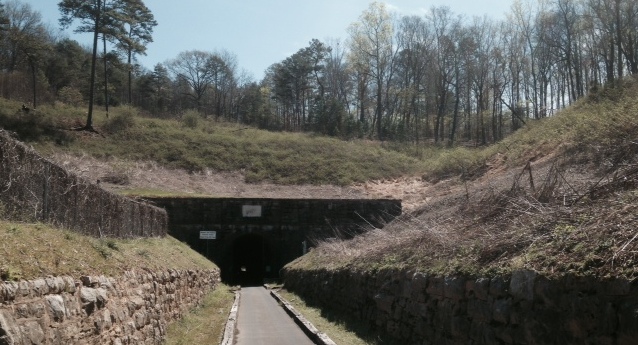
“Even the dumb kids liked the Civil War.”- Willie Smith, Oedipus Cadet (1990)
As one whose interest in the Civil War extends back to the Centennial Year when our family (a carload of no-good Yankees) visited Atlanta in the summer of 1966, it's been an interesting coincidence to be living here in the Atlanta area during the Sesquicentennial anniversary of General William Tecumseh Sherman's 1864 Campaign on Atlanta and subsequent March to the Sea.
 To begin my private festivities, I stopped by Tunnel Hill Heritage Park in north Georgia near Chattanooga, to visit one of the historic sites of the campaign. The park includes the Clisby Austin House (shown left), the place where Sherman alluded to his intentions to wash his feet in the salty waters of the Atlantic Ocean. The old Western & Atlantic rail tunnel through Chetoogeta Mountain (shown above)– from which the park gets its name – is also a significant in the history of Atlanta, because its construction (completed in 1850) opened up the city of Terminus (Atlanta's original name) as a growing rail center.
When I am not traipsing all over Georgia looking for historical sites with my trusty copy of Brown and Elwell's Crossroads of Conflict: A Guide to Civil War Sites in Georgia, I have been reading B.H. Liddell-Hart's Sherman: Soldier, Realist, American originally written in 1929. Liddell-Hart (1895-1970) was considered a prominent military historian of his day and thinks that Sherman was the military genius of the War Between the States.
Because some of Sherman early commissions as officer were in the South and at the outbreak of the war he was president of the Louisiana Military Academy, Sherman unlike most Northerners, did not underestimate the South. Moreover, he understood the role of economics in the impending war. If the South seceded, the Mississippi River would be cut off to Midwesterners who wanted to export goods to other markets. This same attention to economics influenced his early realization that defeat of the South had to be more than a military one.
—– EXTENDED BODY:Liddell-Hart's book is a unique blend of psychological profile of Sherman and an analysis of Civil military strategy. Given Liddell-Hart's British background (he was wounded fighting at the Somme in World War I), there is this perspective you would not get from an American-born historian, especially when he draws comparisons to Vicksburg and Gallipoli. According to Liddell-Hart, Sherman – except with his feelings toward the press and politics – had a heart underneath his gruff exterior. As the military commander of the city of Memphis after it fell into Union hands in 1862, Sherman ignored the ban on selling cotton allowing small farmers to maintain their livelihoods. He also kept the local judges and law enforcement in local hands in order to keep the civil foundations for a faster post-war recovery. But Sherman's demeanor hardened after the death of his nine-year old son, who died of typhoid after visiting his father at the front in 1863.
In his inimitable, borderline-flowery style, Liddell Hart writes about Sherman's approach to the war:
To subdue men without killing them is possible in two ways. First, by holding them in physical bondage, which is trying for the warden—like a master who has to stay in himself in order to keep boys in as a punishment. Second, by the threat or act of destroying their possessions, which is to place them in economic bondage. Sherman appreciated the superior advantage of this method and with relentless logic was now to apply it. Moreover, embracing the doctrine of the survival of the fittest, he was even ready in theory as his letter reveals, to fulfill it by economic sterilization of the unfit. That his practice stopped short of this was because it was not practicable to replace them by more fit producers. Accepting, therefore, the need to preserve them his aim was to press them to the point and not an inch further, that would suffice to wring an acknowledgment of defeat.
In this philosophy of war there was not room for vindictiveness and no excuse for post-war penalization.* To the mass of his countrymen Sherman appeared to be a bundle of contradictions; they could not reconcile his objection to the war with his ruthless conduct of it, not this again with his (liberal) “peace terms” of 1865.
Even though I am only midway through reading Sherman: Soldier, Realist, American, the historical point where Sherman is preparing to begin his Atlanta Campaign, I am more understanding why Sherman is so reviled in Georgia (more so in 1966 than now). His defeat of the South was total to the point of “economic sterilization.” But to Sherman's credit, the Civil War did end after Lee's surrender to Grant at Appomattox. There was no Civil War II, though the hostilities had only just begun. How different things might have been if the victorious North had not been vindictive afterwords. A lesson for all victors?
*This is similar to the bad terms forced upon Germany after World War I, which was a major factor that led to World War II.
—– EXCERPT: —– KEYWORDS: William Tecumseh Sherman, B.H. Liddell-Hart, Sherman Soldier Realist American, Clisby House, Tunnel Hill Heritage Park —– ——– AUTHOR: Murray Browne AUTHOR EMAIL: murray.browne905@gmail.com TITLE: Up in the Hills: A Review STATUS: Publish ALLOW COMMENTS: 1 CONVERT BREAKS: wysiwyg ALLOW PINGS: 0 BASENAME: up-in-the-hills-a-review CATEGORY: Book Reviews UNIQUE URL: https://thebookshopper.typepad.com/the_book_shopper_atlantad/2014/04/up-in-the-hills-a-review.html DATE: 04/16/2014 07:15:11 AM —– BODY: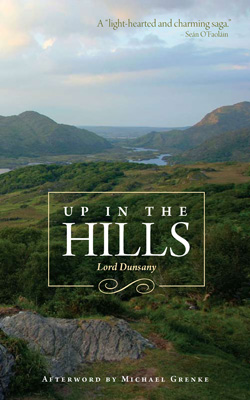 Earlier this month I finished reading Up in the Hills by Lord Dusany, a book first published in 1937 and republished (and sent to me) by Paul Dry Books. Dusany is the pen name of Edward John Moreton Drax Plunkett, a prolific Irish writer who is known as an influencer of J.R.R Tolkien, C.S. Lewis, H.P. Lovecraft and Ursula Le Guin.
Set in 1922 Ireland, shortly after the Great War and after the Ireland's independence from Great Britain (except Northern Ireland), Lord Dusany's satire begins with a contingent of black archaeologists who arrive from the newly independent African country of Liberissima to dig up remains from the bogs (a reversal of Europeans digging around in Africa). This leads to unrest in the small village of Cronague and eventually a “war” between a band of young men led by the young Mickey Connor and the honorable Patsy Heffernan, a former guerilla who fought for Irish independence. It's not really a war, but a series of harmless skirmishes, which satirizes war – or our need for war – even relatively pleasant ones. Though inexperienced, Mickey is clever and willing to seek counsel from his wise Grandfather Mickey. Moreover, Mickey is popular among his troops because he puts their well-being above his own.
The prose has a lyrical quality in the descriptions of the bucolic Irish countryside and the hills around mixed in with understated humor. In this passage, Mickey worries about his men during their first night on bivouac:
“Transport lines over there,” said Mickey pointing, and the donkey (the army's transport) was tied to a tree by Jimmy Mullins a little way off from where the rest were spreading their blankets and softening the hardness of the ground with bunches of bracken. Later they found it better to wrap their blankets round them standing up, and then to lie down; but this was their first night in the hills. At first the wind running cold through the trees and fanning their faces was joy to them, a kind of welcome from the woods and the night to those who hitherto had only known sleep in houses; but soon there came the chill against which the first inventor of house had built his walls. Young Mickey noted that one blanket was not nearly enough. And he watched the sky anxiously. If it rained on the first night, how many would remain with him? He began to feel the anxiety that statesman know when first they fear the defection of an ally. A miniature anxiety, my reader may think. No, it troubled him with all the force with which anxiety can trouble youth, though he showed it no more than a statesman would show it, if every he felt such anxiety. This army of his was everything to him: would it melt away?
While the armies are up in the hills, a secondary plot line develops with the African chief Umbololulu who arrives with archeologists. The townspeople of Cronague try to “civilize” Umbololulu, who speaks no English, and convert him to Catholicism. Lord Dusany tells this story, in his understated satirical way as well, and the when the two plot lines cross it makes for a great ending.
Included in the book is five-page Afterword by Micheal Grenke, a professor from St. John's College who gives the book some historical perspective. When I was floundering in the middle of the book (it's not the pace and writing style I am used to), I skipped to the end. Grenke's brief analysis was most helpful in my understanding the nuances of Lord Dusany's work and gave me the reading strength to finish what I had started.
—– EXTENDED BODY: —– EXCERPT: —– KEYWORDS: Up in the Hills, Lord Dusany, Edward John Moreton Drax Plunkett, —– ——– AUTHOR: Murray Browne AUTHOR EMAIL: murray.browne905@gmail.com TITLE: Book Art at the High Museum STATUS: Publish ALLOW COMMENTS: 1 CONVERT BREAKS: wysiwyg ALLOW PINGS: 0 BASENAME: abelardo-morell-at-the-high-museum CATEGORY: Books as Art as Books UNIQUE URL: https://thebookshopper.typepad.com/the_book_shopper_atlantad/2014/03/abelardo-morell-at-the-high-museum.html DATE: 03/28/2014 07:44:40 AM —– BODY:
Experiencing books as photographs or art objects is almost as fun as reading them and much less time consuming, unless you're visiting the prodigious Abelardo Morell exhibit currently being staged at the High Museum of Art here in Atlanta through May 18.
"The Universe Next Door" displays more than 100 photographs of the Cuban-born Morell's work including his technique known as Camera Obscura, an optical effect where images from the outside (skylines, trees) are projected on the inside of a room, which is better explained on the artist's own website. I didn't allow myself enough time to see it all, especially since I spent the majority of time on the part of the exhibit dedicated to Morell's detailed photographs of paper, books and maps. I plan on returning.
For more about Book as Art as Books check out the link on the right. Thanks to the High Museum for providing the artwork.
—– EXTENDED BODY: —– EXCERPT: —– KEYWORDS: Abelardo Morrell, The Universe Next Door, High Museum of Art —– ——– AUTHOR: Murray Browne AUTHOR EMAIL: murray.browne905@gmail.com TITLE: Rust Cohle’s Reading Group STATUS: Publish ALLOW COMMENTS: 1 CONVERT BREAKS: wysiwyg ALLOW PINGS: 0 BASENAME: rust-cohles-reading-group UNIQUE URL: https://thebookshopper.typepad.com/the_book_shopper_atlantad/2014/03/rust-cohles-reading-group.html DATE: 03/17/2014 07:18:00 AM —– BODY: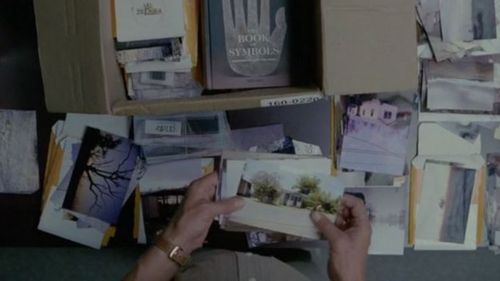
I didn't realize until 25 minutes into Episode 7 of the HBO series, True Detective that Rust Cohle (played by Matthew McConaughey) and I read the same books. Until then, I didn't think we had much in common.
In the scene where Rust and his partner Marty Hart (played by Woody Harrelson) haul his books and files into the offices of Marty's private detective agency, there is a copy of Taschen Publishing's Book of Symbols: Reflections on Archetypal Images (2010) clearly on the top. The scene symbolizes Marty and Rust's relationship, because asking somebody to help you move — much less boxes of books — is a milestone in any serious friendship.
The book was put together by editors from the Archive for Research in Archetypeal Symbolism (ARAS). Below is a good description of the book, but you'll have to visit their website to read the ringing endorsement from supermodel Gisele Bundchen.
Authored by writers from the fields of psychology, religion, art, literature, and comparative myth, the essays flow into each other in ways that mirror the psyche’s unexpected convergences. There are no pat definitions of the kind
that tend to collapse a symbol; a still vital symbol remains partially unknown, compels our attention and unfolds in new meanings and manifestations over time. Rather than merely categorize, The Book of Symbols illuminates how to move from the visual experience of a symbolic image in art, religion, life, or dreams, to directly experiencing its personal and psychological resonance.
Admitted I keep my copy of the book, which I bought at the Carlos Museum Bookshop on the campus of Emory University, on display as a conversation starter, but I have read some of the entries.
In the unlikely event that Rust Cohle and Gisele Bundchen contact me to start a regular reading group, I am not sure what other books that I would recommend. A few come to mind though:
- Denial of Death by Ernest Becker
- Escape from Evil by Ernest Becker
- Life Against Death by Norman O. Brown
- Tom Brady: The Inspirational of Football Superstar Tom Brady by Inspirational Stories
Odd selections perhaps, but I figure the last book may be of special interest to Gisele Bundchen since she is married to New England Patriot quarterback Tom Brady.
—– EXTENDED BODY: —– EXCERPT: —– KEYWORDS: Ernest Becker, Gisele Bundshen, Rust Kohle, Rust Cohle, Book of Symbols, Taschen publishing ARAS, Norman O. Brown, True Detective —– ——– AUTHOR: Murray Browne AUTHOR EMAIL: murray.browne905@gmail.com TITLE: Mexico Lingers STATUS: Publish ALLOW COMMENTS: 1 CONVERT BREAKS: wysiwyg ALLOW PINGS: 0 BASENAME: mexico-lingers UNIQUE URL: https://thebookshopper.typepad.com/the_book_shopper_atlantad/2014/03/mexico-lingers.html DATE: 03/09/2014 08:54:33 PM —– BODY:
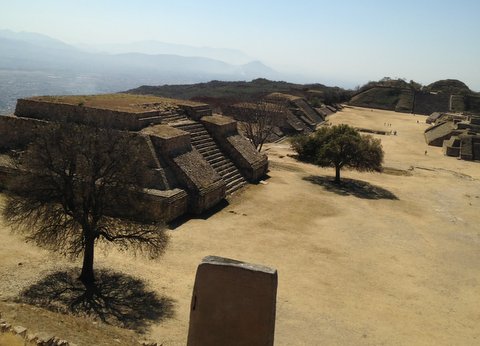
Thoughts from the last posting on Oaxaca, Mexico continue to linger in my mind…
I just finished reading another one of the books I brought back with me — Amy Butler Greenfield's A Perfect Red: Empire, Espionage, and the Quest for the Color of Desire (2005). Greenfield's book gives an historical account of the importance the natural red dye found on the cochineal, a parasite that grows on the nopal (prickly pear) cactus. Because the color red was such in demand in Europe and the sources of red dye were very limited, this little critter played an important role in world history. 
In 1519 when the Spaniards arrived in Tenochtitlan (Mexico City), they immediately noticed the rich red fabrics and feathers that adorned the inhabitants. By 1523, the first shipments of red dye made from the cochineal began to arrive in Spain. The demand for this red dye was so high that Spain was able to finance much of its world empire for the next couple of centuries by controlling this commodity. But Greenfield puts the cochineal in even a greater historical context throughout as she aptly ties in other major events such as the discovery of the microscope (around 1704), the naval war between England and Spain or the rise of the pre-World War I chemical industry, which led to the development of the poisonous mustard gas.
It's a better book than Mark Kurlansky's Salt (2003)– a book that it is often compared to – and though they are written in a similar12th grade social studies style (meaning nothing flashy prose wise), at least I finished Greenfield's book because as I mentioned, she managed to expand the scope of her primary subject to keep it fresh.
Still, if I were recommending one book to read before I went to Mexico, I'd suggest Charles Mann's 1491: New Revelations of the Americas Before Columbus (2005), which looks at the civilizations that dominated the Americas before Columbus, including a few pages on the Zapotecs, the indigenous tribe that began building Monte Alban (shown above) in 500 BC and whose language is still spoken in the artisan villages that surround Oaxaca City. In one chapter, Greenfield makes an interesting point about how the Zapotecs were able to maintain their heritage and status much better than other tribes. Since harvesting parasites off cactus is a difficult, non-scalable agricultural endeavor, the ruling Spaniards granted more independence to the families that grew the valuable cochineal, which was not the kind of agricultural product than lent itself to large plantations like coffee and bananas and the displaced labor who had to work the fields.
I became familiar with Mann when I saw him at Emory University a few years ago. There were a few discussions about the book around our inn's breakfast table as well. And you can bet they had plenty of copies of 1491 at Oaxaca's Amate bookstore next to the shelves filled with Alebrijes, the fantastic wood carved sculptures that are so much a part of the folk art of Oaxaca. From my understanding, there was a recent literacy push featuring animals reading books. (The link takes you to a peacock reading Flanary O'Connor.)
Below is another lingering memory of Mexico which now graces my living room, a reading cat carved by Jesus Calvo-Sosa. Undoubtedly this carving appeals to soccer fans too, which anyone who witnessed 68,000 fans who overran the Georgia Dome last week for an exhibition match between Mexico and Nigeria knows cannot be denied. I am only glad that I saw it first.

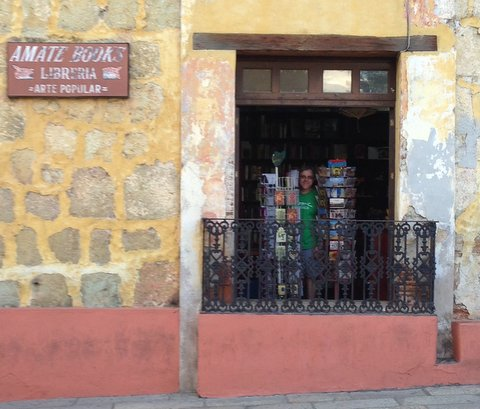
Even though Denise and I traveled to Oaxaca City, Mexico to get away from hearing work phrases such as “core values,” “staying on message,” and the tyrannical “COB,” our book shopper selves never take a vacation. Located in the state of Oaxaca in the lower third of the nation, the city of Oaxaca is known for its cuisine, textiles, pottery, chocolate, mezcal, wood carvings — and that is only the beginning. It is also the home of a fine English language bookstore called Amate Books.
Located on the pedestrian friendly Alcalá between the Zócalo (the central town square) and the gilded Cathedral of Santo Domingo (built between 1570-1608), Amate is a medium sized store filled with books on Mayan and Aztec history along with books about the Zapotecs, the predominant indigenous tribe in the area. It was the Zapotecs who built the ancient city of Monte Alban, dating from 500 B.C. to its peak at 700 AD, just outside of Oaxaca City and ruled the area before being conquered by the Aztecs and later the Spaniards. The store also features many books on art, photography, history, cooking and revolutionary politics including The Zapitista Reader (2002) edited by Tom Hayden. While we browsed, we looked at every title and pulled out dozens of books. As you would expect, there were many Latin America writers represented, such as Gabriel Garcia Marquez, Carlos Fuentes, and Mario Vargas Llosa, but one could also find a few British and American authors as well ranging from George Martin and Michael Chabon to Jane Austen. I was especially impressed when I saw a copy of famed Latin American translator's Gregory Rabassa's book, If This Be Treason: Translation ant Its Dyscontents, A Memoir (2005). Rabassa's interpretation of Garcia Marquez's One Hundred Years of Solitude is considered a masterpiece itself and contributed to the Nobel Prize winner's international success.
After long deliberations, Denise and I made our selections while reminding ourselves that we had weight restrictions (for our luggage) to consider. We selected these titles: Mexican Textiles (2003) by Masakio Takahashi and Toni Cohan, Mexico: A Traveler's Literary Companion (2006) edited by C.M. Mayo, Mexico in Mind: An Anthology (2006) edited by Maria Finn Dominguez, and A Perfect Red (2005) by Amy Butler Greenfield. The last book is a historical account of how red dye made from a parasite that lives on the prickly pear cactus became one of world's most precious commodities. The book came highly recommended from our B & B hostess, who was also an expert on local folk art. (Her home was practically an art museum.)
I already finished reading Mexico in Mind by the time I returned to the States. Unlike the Mayo book, which collected works from writers who were from Mexico, the Dominquez anthology featured some well known writers like Katherine Anne Porter, John Steinbeck and D.H. Lawrence — who had either lived in Mexico or who traveled extensively there. One of the more obscure excerpts came from Charles Macomb Flandrau, who wrote about his experiences on his brother's Chiapas coffee plantation in the 1908 book, Viva Mexico!. Educated at Harvard, Flandrau wrote little after the publication of Viva Mexico!, but his self-deprecating style is humorous, and similar to Mark Twain's and has aged well. Check out this passage where he ruminates on how the coffee bean became so popular.
When I see the brown hands of the pickers fluttering like nimble birds among the branches, and think of the eight patient processes to which the little berries must be subjected before they can become a cup of drinkable coffee, I often wonder how and by whom their secret was wrestled from them. Was it an accident like the original whitening of sugar, when – so we used to be told– a chicken with clay on its feet ran over a mound of crude, brown crystals? Or did a dejected Arabian, having heard all of life that (like the tomato of our grandmothers) it was a deadly thing, attempt by drinking it to assuage forever a hopeless passion from some bulbul of the desert, and then find himelf not dead, but waking? … But no one ever inadvertantly picked, dispulped, fermented, washed, dried, hulled, roasted ground, and boiled coffee, and unless most of these things are done to it, it is of no possible use.
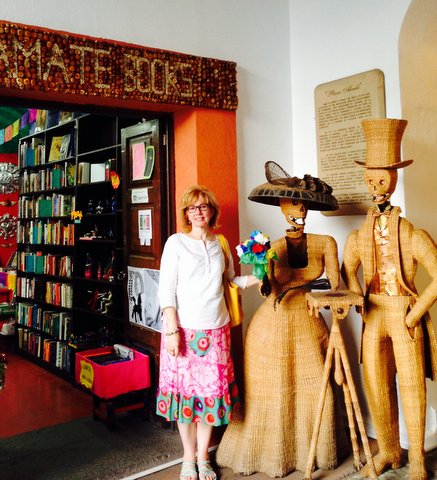 Like many other Oaxacan retailers, Amate also has its Day of the Dead component. We knew that Dias de los Muertos was an important festival observed in early November in Mexico, but we learned its influence is actually seen year round as skullls adorn everything from jewelry to chocolate to T-shirts. It reminded us of the skit in the television program Portlandia where Fred Armisten and Carrie Brownstein pitch their services for “Put a Bird On It,” a store that specializes on products that display painted birds. The feeling is a little the same in Oaxaca, and Amate Books – judging by the full-sized wicker skeletons that greet you as you enter – except the catch-phrase would be “Put a Skull on It.”
For armchair Civil War buffs (is there any other kind?), 2014 is the last full year of getting your “Civil War Sesquicentennial on.” This is especially a big event here in Georgia since it is the 150th anniversary of Sherman's campaign against Atlanta, which began in May,1864 and followed by his March to the Sea, which ended with Union capture of Savannah in December, 1864. As part of the ongoing celebration I have been thumbing through some book possibilities: B.H. Liddell Hart's biography of Sherman, Sherman's March to the Sea 1864 by David Smith, E.L. Doctorow's The March, Barry Brown and Gordon Elwell's excellent Crossroads of Conflict: A Guide to Civil War Sites in Georgia (reviewed here) and a recent addition to my library, The Devil's Dictionary by Ambrose Bierce.
Bierce fought at Shiloh, Chickamauga and was under Sherman's command when he was severely wounded at the Battle of Kennesaw Mountain in July, 1864. According to Drew Gilpin Faust's The Republic of Suffering: Death and the American Civil War, (a Book Shopper Top Book of 2010) Bierce had the distinction as “the most significant and prolific American Writer actually to fight in the Civil War.”
Although he did write fiction, “Bitter” Bierce is best known for his caustic wit, which was prominently displayed in The Devil's Dictionary, a collection gleaned from his newspaper columns written between 1881 and 1906. The first edition published in 1906 was entitled The Cynic's Word Book and a more complete edition which became The Devil's Dictionary with over 1000 entries, was published in 1911, a few years before Bierce's mysterious disappearance in Mexico in 1914. (100th Anniversary!)
I have been thumbing through an abridged edition of The Devil's Dictionary published in 1979, which includes illustrations by J.C. Suares (1942 -2013), whose artwork graced the opinion pages and book reviews in the New York Times for years (and many other publications too). It is impossible to know which quotes best embody Bierce's work, so I will share a few pairings of scanned Suares drawings with some quotes and let you decide whether to join the Bierce jubilee.
—– EXTENDED BODY:
I used to think that Thomas Pynchon wasn't a writer for everybody, but after finishing his latest novel Bleeding Edge (2013), I wonder if he is a writer for anybody. Set in New York City at the time of 9-11, Pynchon's main character is Maxine Tarnow, a fraud investigator who must negotiate being a mother of two along with her on-again-off again relationship with her ex-husband Horst. On assignment, Maxine stumbles into the subterranean world of the deep internet and “the paranoids and trolls” who control it. It's a thin plot line for 477 pages even by Pynchon standards, though some of the bizarre characters and strange incidents like the cameo with the freelance nose detective who has an olfactory sense so strong that dogs “come up to him with inquiring looks,” helps some to carry the reader through the book. The dialogue is mostly banter between Maxine and these type of characters. In short, it's not one of Pynchon's best efforts.
For a better book, I'd suggest Inherent Vice (2010), which is just more fun and easier to read. (I keep an audio CD version of Vice in my car – just to listen to excerpts of his prose.)
Still, with Pynchon, there is always the possibility of a few quotes and one-liners than I can re purpose and edit into my to my own vernacular such as “Colder than penguin shit” (Gravity's Rainbow – [1973]), “I need a vacation from my life” (Vineland [1990]) or “It takes a village, idiot” (Mason & Dixon [1997]). In this case, it's not exactly something quotable, but I did feel a sense of connection to Pynchon when I read on page 298 his take on IKEA:
Like millions of other men around the world, Horst hates the Swedish DIY giant. He and Maxine once blew a weekend looking for the branch in Elizabeth, New Jersey, located next to the airport so the world's fourth richest billionaire can save on lading costs while the rest of us spend the day getting lost on the New Jersey Turnpike. Also off it. At last they arrived a county-sized parking lot, and shimmering in the distance a temple to, or museum of, a theory of domesticity too alien for Horst fully to be engaged by. Cargo planes kept landing gently nearby. An entire section of the store was dedicated to replacing wrong or missing parts and fasteners, since with IKEA this is not an exotic an issue. Inside the store proper, you walk forever from one bourgeois context or “room of the house,” to another, along a fractal path that does its best to fill up the floor space available. Exits are clearly marked but impossible to get to. Horst is bewildered, in a potentially violent sort of way. “Look at this, A bar stool, named Sven? Some old Swedish custom, the winter kicks in, weather gets harsh, after a while you find yourself relating to the furniture in ways you didn't expect?”
Not exactly a reason to pick up the book, but for better and worse, no one else writes like him.
—– EXTENDED BODY: —– EXCERPT: —– KEYWORDS: Thomas Pynchon, Bleeding Edge, IKEA, Quotes by Thomas Pynchon, Inherent Vice —– COMMENT: AUTHOR: Jim EMAIL: jimsimpsonatl@gmail.com IP: 99.141.153.40 URL: http://jimsimpson.tumblr.com DATE: 01/27/2014 10:41:34 PM Just the other day I was re-reading the Pynchon section in your book (http://www.amazon.com/The-Book-Shopper-Life-Review/dp/1589880560) where you mention his one-liners finding their way into your own vernacular, and about how you and a friend suspected a reclusive neighbor was Pynchon himself. Love this section of the book, yet — I sheepishly admit — not enough to brave a Pynchon book. I saw Crying of Lot 49 at Book Nook the other day, actually picked it up, but didn’t buy it. Maybe I need to find a Pynchon reading group. —– ——– AUTHOR: Murray Browne AUTHOR EMAIL: murray.browne905@gmail.com TITLE: Book Covers the Color of Lipstick STATUS: Publish ALLOW COMMENTS: 1 CONVERT BREAKS: wysiwyg ALLOW PINGS: 0 BASENAME: the-state-of-publishing-and-reviewing CATEGORY: Books as Art as Books CATEGORY: Bookstores UNIQUE URL: https://thebookshopper.typepad.com/the_book_shopper_atlantad/2014/01/the-state-of-publishing-and-reviewing.html DATE: 01/15/2014 02:24:20 AM —– BODY:
This week's artwork rivals this blog's all time most captivating photograph.* Shown here is the fashionable Liz Goldwyn who was featured earlier this month in the Style Section of The New York Times. Thanks to the courtesy of professional photographer Emily Berl, I was able to post it here. What struck me most was how the books were organized, mostly by the colors of their covers — especially how the red covers matched her lipstick and the yellow-gold colors complement her mustard-colored dress. I've seen examples in the past where a used bookstore will allow an artist to re-arrange the inventory by color, but the addition of Goldwyn's signature red lipstick takes this experience to a new level.
Judging from the titles, I guessed correctly that most of the books were used. Following up with Ms. Berl, she said that she took the photo on the second floor of the The Last Bookstore in downtown Los Angeles, which is dedicated to used books. One of the used book sections was already color-coded and Ms. Berl said she only had to switch a few titles around to make it work. It does!
* James Benning's re-creation of the Unabomber's Home Libary (May, 2009) draws the most attention to this blog.
—– EXTENDED BODY: —– EXCERPT: —– KEYWORDS: Emily Berl, Liz Goldwyn, The Last Bookstore, New York Times, James Benning, Unabomber’s library. —– ——– AUTHOR: Murray Browne AUTHOR EMAIL: murray.browne905@gmail.com TITLE: Christmas Book Shopping in New York STATUS: Publish ALLOW COMMENTS: 1 CONVERT BREAKS: wysiwyg ALLOW PINGS: 0 BASENAME: christmas-book-shopping-in-new-york CATEGORY: Bookstores UNIQUE URL: https://thebookshopper.typepad.com/the_book_shopper_atlantad/2014/01/christmas-book-shopping-in-new-york.html DATE: 01/06/2014 06:44:40 AM —– BODY: My longtime partner Denise and I were in New York for Christmas visiting her family in Manhattan and Long Island and seeing the sights of Manhattan. In between gorging myself at a Christmas Eve pasta dinner, a French toast brunch on Christmas morning and checking out some of the more famous local eating places, I did make it to a few book-related venues too.
 First we stopped off briefly at the New York Public Library to visit the decorated lions Patience and Fortitude and where I picked up A Book Well Read desk calendar.
Later in the week, Denise's friend Linda took us to one of her favorite bookstores, Book Culture, located near Columbia University. Not only is this area known for being the external shot for the famous Monk's restaurant in Seinfeld (shown here), but it is also just a few blocks away from the Cathedral of St. John of the Divine, one of the largest Christian churches in the world, which is still not completed. It is worth the visit just to see the cathedral, which has several spaces dedicated to poets and writers tucked away near the main sanctuary.
 To add to the New York ambience, I was continuing to read Thomas Pynchon's Bleeding Edge, which is set in the city just before 9/11. But that didn't keep me from picking up a short stack of books at Book Culture, which is a great bookstore if you enjoy browsing through shelves and tables of possibilities (shown below). I picked up two books by one of my favorite authors Rebecca Solnit, Infinite City: A San Francisco Atlas (2010) and her A Field Guide to Getting Lost (2005). I also picked up the novel Ceremony (1977) that was recommended by Sherman Alexie in The New York Times interview as his "favorite work of Native American Literature" written by Leslie Marmon Silko. ( I read the review on the plane trip to LaGuardia.) To top it off Linda gave me a copy of a Nelson Mandela biography written by Anthony Sampson in 1999.
Looks like my reading list is getting in shape for 2014 even if I am not.
—– EXTENDED BODY: —– EXCERPT: —– KEYWORDS: Bookculture bookstore, Rebecca Solnit, leslie marmon silko, bookstores in New York City. —– ——– AUTHOR: Murray Browne AUTHOR EMAIL: murray.browne905@gmail.com TITLE: Lethargy 2013: Best Books and ATL Book Events STATUS: Publish ALLOW COMMENTS: 1 CONVERT BREAKS: wysiwyg ALLOW PINGS: 0 BASENAME: -lethargy-2013-best-books-and-book-events UNIQUE URL: https://thebookshopper.typepad.com/the_book_shopper_atlantad/2013/12/-lethargy-2013-best-books-and-book-events.html DATE: 12/26/2013 09:38:33 AM —– BODY:
“…gray just not coming in, but putting its feet up and making itself at home.” – Thomas Pynchon
Recapping the year, it's been a time when I didn't read as many books as I usually do or attend as many book events as I normally do. But why?
The Best Read of the Year Wasn't a Book
This year, I found myself reading more magazines and fewer books. Part of the reason is that due to a chronic wrist problem, I find carrying larger books on the train more troublesome. Since I have no desire to own an e-reader, I switched to reading more magazines. Taking advantage of low subscription rates, I regulary read The Atlantic, The Economist, Cabinet, The Believer, and Harpers, but the magazine I enjoyed the most was The Sun.
The Sun has been around since 1974 but this is first time I subscribed to it. In a time where print is dominated by slickness and snarkiness, this magazine with its black and white photos takes a personal approach. The short stories and observational pieces seem written by common folk (still they are writers, but the prose is usually simple, direct and touching). Readers contribute with letters and there is a topic of the month where they send in personal anecdotes, which must be deftly edited by founder Sy Safransky. Each issue is anchored with a lengthy interview of someone whom I had never heard of, but has fascinating views on the environment, the prison system, animal rights, etc., This month the interview was with author and couples therapist Esther Perel, who talks about sex, marriage and intimacy.
The Sun does not accept advertising and relies on subscriptions and donations (and shout outs from blogs).
There are a few books that are worth mentioning. Most of them books that were published years ago, but that is one of the themes of the book shopper – not just focusing on “the latest” but looking for gems of the past. Some of my favorites were Zadie Smith's White Teeth (2001), William Styron's Tidewater Mornings (1993), and Micheal Chabon's The Yiddish Policeman's Union (2007), Wilfrid Sheed's Baseball and Lesser Sports (1991) Robert Boswell's Living to Be a Hundred (1994) and David Shields' The Thing About Life Is That One Day You'll Be Dead (2008). A couple notables published this year were Francis Spufford's Unapologetic and Where Somebody Waits by Margaret Kaufman. Currently, I am working my way through Thomas Pynchon's Bleeding Edge, where the opening quote in this posting comes from.
The Best Local Book Event (That I Attended) in 2013
I probably went to less than ten book events this year and mostly at the urging of the my longtime partner Denise. I must say that my interest for going out to see a writer has waned. (Keep in mind the theme of this posting is lethargy.) This year, Denise and I did see the gracious Rick Atkinson for the second time and a repeat performance by former U.S. Poet Laureate Billy Collins. Neither disappointed. Denise thinks that Erica Jong at Decatur Public Library was by far the best event we attended – so that is good enough for me.
My goal for 2014? More rest and a better attitude.
—– EXTENDED BODY: —– EXCERPT: —– KEYWORDS: Books of the Year 2013, Events of the year, Sun Magazine. —– COMMENT: AUTHOR: http://www.facebook.com/profile.php?id=785107809 EMAIL: IP: 99.141.153.40 URL: http://profile.typepad.com/6p012876b6806a970c DATE: 12/27/2013 09:25:40 AM One of the best books I read all year: The Book Shopper. A funny, smart, insightful book by a nice midwestern guy named Murray Brown. #bookshops pic.twitter.com/A87Z9AtgnC Jim Simpson (@JISimpson) December 27, 2013 —– COMMENT: AUTHOR: http://www.facebook.com/profile.php?id=785107809 EMAIL: IP: 99.141.153.40 URL: http://profile.typepad.com/6p012876b6806a970c DATE: 12/27/2013 12:35:23 PM …and I really do know your last name is Browne. —– ——– AUTHOR: Murray Browne AUTHOR EMAIL: murray.browne905@gmail.com TITLE: Bye-Bye Football STATUS: Publish ALLOW COMMENTS: 1 CONVERT BREAKS: wysiwyg ALLOW PINGS: 0 BASENAME: bye-bye-football UNIQUE URL: https://thebookshopper.typepad.com/the_book_shopper_atlantad/2013/12/bye-bye-football.html DATE: 12/15/2013 03:27:06 PM —– BODY:

For the past few months I have been trying to give up watching football, which is not like me trying to give up watching professional bowling or professional poker players. This relationship goes back to my days as a youth. As a kid every Sunday, while playing the fantasy game I invented with football cards, I watched the Chicago Bears and the likes of Dick Butkus, Gale Sayers and later endured the Slow-mo Bob Avellini era. I even tried to play football at our small high school. My father summarized my football skills best by referring to me as “a tackling dummy for the varsity.”
So why goodbye to football? There are a lot of reasons when I think about it. Here they are listed in order of importance.
Reason 1. Once you know the long term health implications for those who play the game I feel complicit in continuing to support the sport with my viewership. I know the pros get paid a lot of money, but the average player's career is short (less than 3 years). College players don't get paid at all supposedly, and the expenses of high school football are a strain on most local education budgets.
Moreover, the hypocrisy of all the sportscasters and commentators who talk about the violence of the game while repeating video clip after video clip of collisions has become too much to endure. Players sacrifice their long term health so I can be entertained. I wonder if some day centuries from now, people will look at football stadiums like we look at the Roman Coliseum and the days of gladiators and Christian-eating lions. Will they wonder how a civilization could be so barbaric?
Reason 2. Speaking of hypocrisy, the relationship to the military and football is troublesome. Every football broadcast honors the veterans who serve and gives them special tickets and camera time. Then there are beer commercials including a promotion that for every bottle cap I redeem 10 cents goes to a veteran's family. I am not criticizing soldiers or helping their families. My complaint is that these “salutes to the military” just mask over the real problems and don't question why we are fighting in Afghanistan and Iraq in the first place. If you've read Ben Fountain's novel, Billy Lynn's Long Half Time Walk (2012) you realize that football celebrations of the combat soldier serve more to disguise our own guilt than to benefit the troubled war veteran. Though I didn't think it was a great novel per se, I thought its message was clear and important.
—– EXTENDED BODY: Reason 3. The way the NFL takes advantage of taxpayers. Basically, we taxpayers pay the bills for ultra-rich owners. Greg Easterbrook took a sobering look at that relationship in the September issue of Atlantic Magazine.
Reason 4. Baseball players get dirtier than football players. Every Boston sports fan knows that second baseman Dustin Pedroia has a dirtier uniform than quarterback Tom Brady. Even though a few weeks ago when players tromped in the snow like school children, it was nothing like when they played in the mud and slop to the point you could not read the numbers on their uniforms. Clear, crisp, non-staining turf sterilizes the sport and hides the danger.
Reason 5. Being a Bears fan requires that person who must always live in denial that for the most part the team is never that good. Even though the team has won it all on twice in the last half century, for the most part the city – drunk, and dressed in Bear hats and furry paws thinks the franchise has a glorious history, but it's really a tradition seeped in mediocrity.
But all this personal reflection maybe for naught. Like the ~16 million other viewers, I too was drawn to the recent Monday night game played in single-digit temperatures between the Chicago Bears and the Dallas Cowboys. At half time they retired the jersey of Mike Ditka who played on the 1963 championship team and coached the 1985 Super Bowl Bears. (The Chicago Tribune did an article earlier this year that many of the players did not end up being honored like Iron Mike, but with health problems). I remember when Ditka played. (His 1963 football card is shown here.) I have been watching football a long time. This is not surprise because for most of us it goes back a long way.
To hear Wilfred Sheed tell it in his essay “The Origin of Football and Other American Species” which appears in his collection Baseball and Lesser Sports (1991), football started at the beginning of human time:
When man's first sport came grunting out of the woods, one fancies it consisted mostly of shoving, gouging, and mauling—very much like American football today. Early man, to judge from the pretty pictures, was superbly designed for football. His head virtually was a helmet, and a pointed one at that; and his thick neck, long arms and grasping fingers suggest that evolution had precisely football in mind for him, and nothing but football.
Yes, I want to say goodbye, but the primordial pull of football will always be there for me. It's our national sport for a reason. But every addiction has it setbacks, it co-dependencies, and feel good moments, why should watching football be any different?
—– EXCERPT: —– KEYWORDS: Billy Lynn’s Long Halftime Walk, Ben Fountain, Wilfrid Sheed, Baseball and Lesser Sports, Mike Ditka, The Chicago Bears, The 1963 Chicago Bears —– COMMENT: AUTHOR: Ian Joyce EMAIL: IP: 75.183.19.133 URL: http://profile.typepad.com/joyceian DATE: 12/16/2013 06:12:08 PM On the money, Murray. —– ——– AUTHOR: Murray Browne AUTHOR EMAIL: murray.browne905@gmail.com TITLE: Wolfe and Coyote: Book Memories STATUS: Publish ALLOW COMMENTS: 1 CONVERT BREAKS: wysiwyg ALLOW PINGS: 0 BASENAME: wolfe-and-coyote-book-memories- UNIQUE URL: https://thebookshopper.typepad.com/the_book_shopper_atlantad/2013/12/wolfe-and-coyote-book-memories-.html DATE: 12/04/2013 08:26:58 PM —– BODY: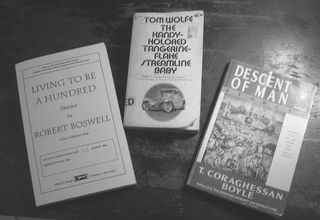 Lately, I have been revisiting a few older books. Usually this is triggered by some random event or small reference and these instances are no different.
The Kandy-Kolored Tangerine-Flake Streamline Baby (1963) by Tom Wolfe.
A few months ago, Sports Illustrated ran a where-are-they-now interview with NASCAR great Junior Johnson.The article mentioned the Tom Wolfe feature story “The Last American Hero” which showed Johnson's driving roots and how they were seeped in the moonshine of Western North Carolina. In the article, published in the 60s, Wolfe explains the South's love affair with the automobile that began after the war: “…the car symbolized freedom, a slightly wild careening emancipation from the old social order. Stock car racing got started about this time, right after the war, and it was immediately regarded as some kind of manifestation of the animal irresponsibility of the lower orders.”
In the Johnson interview in SI, he said that he did not allow Wolfe to interview him, but he did permit Wolfe to talk to any of his friends about him. The feature story is still a fascinating look into the early days of NASCAR.
Descent of Man: Stories (1974) by T. Coraghessan Boyle
Recently there have been articles and blog postings about coyotes in the Atlanta and Decatur area and it reminded me of the work of T.C. Boyle. Even though Boyle made the coyote a symbol of urban encroachment on natural habitats in The Tortilla Curtain, (1995) what I remember best is his short story, “Heart of a Champion” where the noble television collie, Lassie – “balsamed and perfumed; her full chest tapers a lovely S to her sleek haunches and sculpted legs” runs away with a coyote, “puny, runted, half her size, his coat like a discarded doormat.” Boyle writes the story like it was episode of “Lassie” including the “opening strains of the theme song, one violin at first, swelling in mournful mid-American triumph as the full orchestra comes in.”
I think George Saunders reads like early T.C. Boyle.
Living to Be A Hundred (1994) by Robert Boswell
I am still rescuing books from the final days of Books Again's Going Out of Business sale. (Even if you're not going to read them, you should go there buy a favorite book or two just to keep some modern classics in circulation.) This Boswell book of short stories was no rescue. Ever since I read Boswell's short story, “Glissandro” a heartbreaking story of a fourteen-year-old boy's reconciliation of the sadness and goodness of his father, I wanted to find this early Boswell collection. And there it was – a signed uncorrected proof. Joy.
—– EXTENDED BODY: —– EXCERPT: —– KEYWORDS: The Kandy-Kolored Tangerine-Flake Streamline Baby.Tom Wolfe, Descent of Man: Stories, T. Coraghessan Boyle, Living to Be One Hundred, Robert Boswell, —– ——– AUTHOR: Murray Browne AUTHOR EMAIL: murray.browne905@gmail.com TITLE: Thanksgiving Gift List STATUS: Publish ALLOW COMMENTS: 1 CONVERT BREAKS: wysiwyg ALLOW PINGS: 0 BASENAME: thanksgiving-gift-list CATEGORY: Book Reviews UNIQUE URL: https://thebookshopper.typepad.com/the_book_shopper_atlantad/2013/11/thanksgiving-gift-list.html DATE: 11/23/2013 02:43:20 PM —– BODY:Several random book-related thoughts that have ties to the holiday season.
While Somebody Waits: A Review
 I just finished reading Margaret Kaufman's Where Somebody Waits sent to me courtesy of Paul Dry Books. The novel centers around the life of Ruby Davidson who marries an older Jewish man in a small Arkansas town shortly after the end of World War II. Not only is she different from regular folk with her masses of auburn hair and wildly painted nails, Ruby has underlying passion for love and life. Many in her family find Ruby intimidating, but her adoring nieces find Ruby exhilarating. In each chapter a different character gives a perspective on Ruby's life. This is not an unusual plot technique, but Kaufman has executed her plan with skill and her rich prose gets to heart of the matter, without becoming overwrought.
Though the novel's time line spans about sixty years, it's a pocket sized, finely printed book only about 200 pages in length. (You don't see much of that fine printing anymore really). I especially appreciated the selection of cover art by Karen Horton, which captured one of the themes of Ruby's life. “Falling in love is like being suspended on top of the world in that Ferris wheel when the operator has stopped to let someone else on,” explains Ruby to her nieces, “but you're at the top so you can't tell, and you don't care whether anyone down there is getting on or off. There's just you and him.”
C.S. Lewis and JFK 
Bookshopper Blog sponsor Eighth Day Books in Wichita remembered that the day that John F. Kennedy was assassinated was also the day C.S. Lewis died (Aldous Huxley died on November 22, 1963 too). Eighth Day posted a reminder that Cambridge University Press has just published a new collection of Lewis' writings Image and Imagination: Essays and Reviews. Not a bad gift idea.
Notebooks and Journals
 One of my Christmas wishes has been already been fulfilled by Josh Niesse of Underground Books in Carrollton, Georgia. At last September's Georgia Antiquarian Book Association Festival, I talked to Josh about possibly making me some special notebooks since he sells journals made with covers from discarded books. I like long thin notebooks that fit easily into your back pocket. I carry them around with me as a combo To-Do List and Observational Note taking (e.g. The MARTA book club). Because of the odd size, they are much easier to keep track of than a note pad or a phone. I felt guilty bugging him about this, but then he surprised me and made me several prototypes, which I bought. There is now hope that I can organize myself and keep track of my thoughts a little better in 2014.
Underground Books sells a lot of book-related items online suitable for the bibliophile or that someone on your gift list that needs to pull it together.
—– EXTENDED BODY: —– EXCERPT: —– KEYWORDS: Where Somebody Waits, Margaret Kaufman, November 22, 1963, C.S. Lewis and Aldous Huxley, Eighth Day Books, Underground Books, Paul Dry Books —– ——– AUTHOR: Murray Browne AUTHOR EMAIL: murray.browne905@gmail.com TITLE: Homage to Books Again STATUS: Publish ALLOW COMMENTS: 1 CONVERT BREAKS: wysiwyg ALLOW PINGS: 0 BASENAME: homage-to-books-again CATEGORY: Bookstores UNIQUE URL: https://thebookshopper.typepad.com/the_book_shopper_atlantad/2013/11/homage-to-books-again.html DATE: 11/15/2013 07:46:42 AM —– BODY:
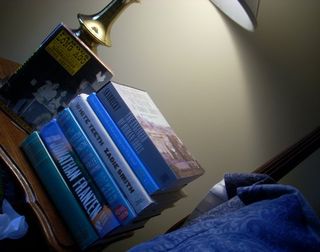 What better way to express the impact that Books Again in Decatur, which is closing its doors soon, has had on my reading life than to list the books I bought there and for the most part, read. These are all books that I did not plan to buy. They were books that I found serendipitously on the shelves or were suggested by Jim Adams and his staff. That doesn't happen online.
Here's the list:
Famous Long Ago: My Life and Hard Times with Liberation News Service (1970) by Ray Mungo. This unusual book about the alternative press in the 60s set the tone of my Books Again experience. It was the first book I remember buying there and I knew after that I would be shopping there regularly.
White Teeth (2001) by Zadie Smith. A colleague recommended it a while ago so when I saw it on the shelves… It is probably the best book I've read this year, though it's been a very good reading year reading.
Remote: Reflections on Life in the Shadow of Celebrity (2006) by David Shields. A signed copy, no less. I ended up reading his Reality Hunger: A Manifesto (2008) as well (though I bought that when I was at Powell's in Portland, OR). I found The Thing We Know About Life is One Day We'll Be Dead (2008), at Books Again for $4. The wisdom of this slim book about how we age, outweighs the depressing premise.
The Yiddish Policeman's Union (2007) by Michael Chabon. I had heard for years what a great book this was and the copy I bought was in fine condition. Jim even added a nice book cover to protect it. Amazing how Chabon can create an alternative fictional reality (Jews settling in Alaska), populate it, and then put the characters in motion in a detective noir.
Freedom (2011) by Jonathan Franzen. I refused to pay $30 for a hardback when Franzen was in town for the Decatur Book Festival when I knew Jim would have it for less than $10, if I waited. Glad I held off — Freedom wasn't nearly as good as Franzen's other fiction and I gave up reading it. Imagine how ripped off I would have felt if I paid full price.
Book On: Work: 1985-2006 (2005) by Chip Kidd. A gorgeously illustrated book in which the book cover designer shares stories about his craft.
Very Old Bones (1993) by William Kennedy. The way Jim talked about this book, I had to give it a go. Worth reading.
The World As I Found It (1987) by Bruce Duffy. I had already read the paperback version of this fictional account of the life of Ludwig Wittigenstein. But Jim had an unmarked pristine first edition hardback and added a protective cover and I was hooked. Irresistable.
I also have an ample stack of to-be-read books as well from the shop:
The Engineer of Human Souls (1999) by Josef Skorvecky
The Plot Against America (2005) by Philip Roth
The Great War and Modern Memory (1975) by Paul Fussell
I more saddened about Books Again closing its doors later this year than the stupid, greedy, wasteful Braves moving to Cobb County. But I know Jim will still be involved in books and will be spending more time with his family. All the best to him and his staff.
For more about the Books Again closing and the reduced prices, call 404-377-1444 or visit here). There's a map too showing the location near downtown Decatur. 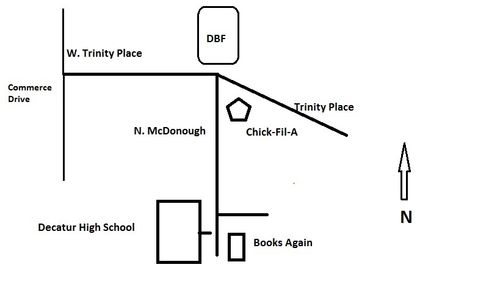
—– EXTENDED BODY: —– EXCERPT: —– KEYWORDS: David Shields, Books Again Decatur, White Teeth, —– ——– AUTHOR: Murray Browne AUTHOR EMAIL: murray.browne905@gmail.com TITLE: Mini-Review: Billy Collins at the Carter Center STATUS: Publish ALLOW COMMENTS: 1 CONVERT BREAKS: wysiwyg ALLOW PINGS: 0 BASENAME: mini-review-billy-collins-at-the-carter-center CATEGORY: Local Reviews UNIQUE URL: https://thebookshopper.typepad.com/the_book_shopper_atlantad/2013/11/mini-review-billy-collins-at-the-carter-center.html DATE: 11/09/2013 10:00:44 AM —– BODY:
When & Where: Wednesday, October 23, 2013 at the Carter Center in Atlanta. Thomas Lux, a poetry professor and poet from Georgia Tech introduced the former U.S. Poet Laureate Collins as “original and accessible.”
Attendance: ~200 people. It was kind of couples night. I will explain later.
Why I Went. My longtime partner Denise is a big Billy Collins fan and after I heard him as the keynote speaker at the Decatur Book Festival a few years ago, I also appreciate his poems and the way he performs them. He does read them, but his delivery and timing are impeccable, which gives the impression that I am experiencing a performance. (Collins admits that as a poet he has a “personal charming” personae that is not exactly himself.) Add the quirky element of humor in much of his poems, it's no surprise that Collins delighted the audience at the Carter Center, except maybe me*.
What He Read. Though he read from his new book of poems Aimless Love: New and Selected Poems, the collection does contain poems from earlier books. Some of the poems that he read included: “A Dog on His Master” and “Hippos” on Holiday, (from Ballistics, 2008), everyone's timeless favorite, “The Lanyard,” from The Trouble with Poetry, (2005), along with many new ones, such as “To My Favorite 17-Year-Old High School Girl,” “Cheerios” and “The Sandbill Cranes of Nebraska” to name but a few. He read for almost an hour. Again, I heard him trip over only one word. That's near perfection.
What He Talked About When He Wasn't Reading Poems. Many things actually. A few of his observations that I can decipher from my scribbled notes and memory, was that good poetry requires more than imagination and choosing the right word, (the right word being defined as “sounds better, means more”). But according to Collins, poetry writing requires a study of the masters of poetry as well. Collins knows how the masters have influenced his own work. He also encourages others to read poetry. He says that learning to read poetry is like learning to do crossword puzzles (or Word Jumbles in my case). The more you do it; the easier it becomes.
Q & A: Collins answered questions from the crowd about whether hip hop lyrics are poetry (yes, but..), and his pinch hitting for Garrison Keillor as the reader on Writer's Almanac last summer. Collins said that he did make the final selection of poems that he read on the air.
Did I Buy A Book? Not necessary. The admission for the event, included the price of the book. One of the price savings is that couples who attend together can share one book. (Blog sponsor, A Cappella sold books at the event). As mentioned earlier, many people seem to have brought their best friends with them and Denise brought me.
* Allow me to explain. As a listener, what I find a little disconcerting is that hearing Collins read before a live audience, puts me at the mercy of the audience who collectively chuckles at the appropriate time– especially during poems like “The Lanyard.” Like a laugh track, you feel a slight pull to smile along even if you're thinking, “Well, it's not that funny.” Collins is very aware of his audiences and like a great comedian, he knows how to pause for the laughter, and then clip it short with his next line. I am not saying that I didn't enjoy myself during the evening, but one of the pleasures of poetry, is that like good novels, the establishment of a one on one relationship between writer and reader is paramount. That relationship seems comprised in those settings. Maybe I just wanted Billy Collins and all his words for myself.
—– EXTENDED BODY: —– EXCERPT: —– KEYWORDS: —– ——– AUTHOR: Murray Browne AUTHOR EMAIL: murray.browne905@gmail.com TITLE: My Personal Atlanta Book Calendar – Nov/Dec 2013 STATUS: Publish ALLOW COMMENTS: 1 CONVERT BREAKS: wysiwyg ALLOW PINGS: 0 BASENAME: my-personal-book-calendar-november-december-2013 CATEGORY: Books as Art as Books UNIQUE URL: https://thebookshopper.typepad.com/the_book_shopper_atlantad/2013/11/my-personal-book-calendar-november-december-2013.html DATE: 11/03/2013 09:57:45 AM —– BODY:

Looking at the combined offerings for November and December (things really shut down for the holidays after the first week of December), I ask myself this question: “Who makes more author visits to Atlanta, Pat Conroy or Anne Lamott?" Well, there is no end in sight, as they are both coming to town again. Conroy is here as part of the Marcus Jewish Community Center Center Book Festival and Lamott will (once again) be at the Decatur First Baptist Church. Admittedly, I did see Lamott once, but not Pat Conroy yet, unless my vacation to Beaufort S.C. (where Conroy lives) counts.
There are other non Lamott-Conroy activities offered between now and the end of the year.
 One event of personal interest is
Georgia State history professor John McMillian discussing his book Beatles vs Stones, the ongoing
debate between the bad-boys Rolling Stones and the lovable Beatles. I have no
expertise in rock 'n roll of the 1960s, since I thought the Dave
Clark Five was the most talented band of that era.
One event of personal interest is
Georgia State history professor John McMillian discussing his book Beatles vs Stones, the ongoing
debate between the bad-boys Rolling Stones and the lovable Beatles. I have no
expertise in rock 'n roll of the 1960s, since I thought the Dave
Clark Five was the most talented band of that era.
McMillian is just one of the authors being hosted by the Georgia Center of the Book. William Sessions will be there as well talking about a new book he edited: A Prayer Journal by Flannery O'Connor. Although she has been dead for decades, books about O'Connor rival the notoriety of Conroy and Lamott in these parts. What will be next? The Grocery Lists of Flannery O'Connor (eggs, bread, Velveeta…)?
Humbler Fare
For those who prefer a more intimate setting, Emory University has a few writerly events in mid November, including a reading by David Samuel Levinson, the new Creative Fiction fellow at Emory.
The Carter Museum and Library is hosting several events of interest: Russell Shorto talks about his new book Amsterdam: A History of the World's Most Liberal City. Bill Minutaglio and Steven Davis will be talking about their perspective on the JFK assassination with their new book, Dallas 1963, and Bret Witter will do a reading and signing on his book, Monuments Men about the men and women who rescued cultural artifacts after World War II.
You can also sign up for a paper making course at the Georgia Tech paper making museum. Book and paper art makes great Christmas gifts for me at least. Check out Brown Dog Paper and Press. I bought a new journal from them at a local craft show last month. I plan on recording my activities in a To Do List Journal, which I hope to publish in 2014. (Sweep garage, fix running toilet, blog…)
—– EXTENDED BODY: —– EXCERPT: —– KEYWORDS: Atlanta Book Events, David Levinson, Russell Shorto, Bill Minutaglio, John McMillian, Bret Witter. —– ——– AUTHOR: Murray Browne AUTHOR EMAIL: murray.browne905@gmail.com TITLE: One Inspirational Independent Bookstore STATUS: Publish ALLOW COMMENTS: 1 CONVERT BREAKS: wysiwyg ALLOW PINGS: 1 BASENAME: one-inspirational-independent-bookstore CATEGORY: Bookstores UNIQUE URL: https://thebookshopper.typepad.com/the_book_shopper_atlantad/2013/10/one-inspirational-independent-bookstore.html DATE: 10/23/2013 06:55:23 AM —– BODY:
Years ago, when I was doing my four-city world book tour for The Book Shopper, a friend of mine from Wichita (I lived there in the 1980s) insisted that I have lunch with Warren Farha, the owner of Eighth Day Books. Since then, Warren and I have kept in contact. He even graciously sponsors the blog (though no money exchanges hands) and I try to give a shout outs on occasion. This weekend is reason enough to make some noise as the store celebrates its 25th Anniversary. Eighth Day Books simply carries books that matter (philosophy, serious fiction, religion) and if you are a discriminating reader you should check out his store. More than likely you cannot visit there, so a virtual visit has to be the next best thing. To keep the faith: order a copy of the anniversary book, find them on Facebook, order their catalog, or buy a book (includes a sale for Internet customers) but do something. Indie Bookstores and the people who love them can still make a difference.
Below is a press release on the festivities:
—– EXTENDED BODY: —– EXCERPT: —– KEYWORDS: Eighth Day Books, Wichita Kansas, 25th Anniversary —– ——– AUTHOR: Murray Browne AUTHOR EMAIL: murray.browne905@gmail.com TITLE: Zipless Flight: Erica Jong at the Decatur Public Library STATUS: Publish ALLOW COMMENTS: 1 CONVERT BREAKS: wysiwyg ALLOW PINGS: 1 BASENAME: zipless-flight-erica-jong-at-the-decatur-public-library UNIQUE URL: https://thebookshopper.typepad.com/the_book_shopper_atlantad/2013/10/zipless-flight-erica-jong-at-the-decatur-public-library.html DATE: 10/17/2013 07:39:27 AM —– BODY:Eighth Day Books marks its twenty-fifth year in Wichita, Kansas this month with author readings and the release of a new book featuring 30 writers and poets. Timely…Timeless: Twenty-five Years at Eighth Day Books goes on sale at the store, 2838 East Douglas, on Friday, October 25.
That evening, Hillsboro (KS) native Jessica Penner will read from her new novel Shaken in the Water, followed by a book signing. On Saturday, October 26, more than a dozen local authors will be on hand to read from the anniversary collection Timely…Timeless. Both events begin at 7 p.m. and include refreshments.
The essays and poems in Timely…Timeless celebrate the lasting affection inspired by Eighth Day Books, a Wichita cultural landmark and one of the country’s great independent bookstores. Carolyn Ballinger, Kingman, calls the store “a haven of peace in a world of sensory overload.” Notre Dame’s Dr. Joshua Seachris likens Eighth Day to “a sanctuary filled with cloth and paper treasures,” while John Traffas, Atchison, describes the “happy combination of a pub and a chapel.”
Other contributors include Kansas Poet Laureate Caryn Mirriam-Goldberg, University of Missouri professor Scott Cairns, and several local writers, including 2011 Newbery Medal winner Clare Vanderpool .
Timely…Timeless also features 62 color photographs and an essay on the store’s founding by owner Warren Farha. Farha began selling classics in religion, literature, and history in 1988. Twenty-five years later, Eighth Day Books enjoys an international customer base and a reputation as “one of the best religious bookstores in the country,” according to Publisher’s Weekly.
Author Jessica Penner sets her novel Shaken in the Water in western Kansas, where a Mennonite woman gives birth to a daughter in 1903. The child bears a birthmark known in Low German as Tieja Kjoaw, the Tiger’s Scar, which portends either greatness or tragedy.
Penner grew up in Hillsboro, attended Eastern Mennonite University, and received her MFA from Sarah Lawrence College. Her essay “Mustard Seed” was nominated for the Pushcart Prize in 2012. She now lives in Virginia.
For more information about the anniversary readings, contact Eighth Day Books at 316-683-9446.
When & Where: Monday, October 14th at the Decatur Public Library. The event was originally scheduled for the Carter Center, but the government shutdown forced a change of venue. Jong was on tour to promote the 40th anniversary of the publication of her book Fear of Flying. Published in 1973, Flying was a novel that heightened womens' self-awareness that they could and should be complete persons – not only as mothers and wives, but as artists or scientists. The main character, Isadora Wing, takes charge of her live-out loud, fantasy-rich life. The book sold more than 27 million copies and has been translated into 40 languages.
Attendance: ~ 75 people of mostly women from the generation who remember the book from the 70s. A few men showed up, but can you really expect any more than that on the same evening as Monday Night Football?
Why I Went. My longtime partner Denise encouraged me to go with her, but she didn't have to persuade me as I had read Jong's Fear of Flying and How To Save Your Own Life (1977). The latter came recommended in Anthony Burgess' famous booklist 99 Novels. [The list also included a book Jong referenced during her talk, The Golden Notebook, by Doris Lessing (1963).
What She Talked About. During her 45 minutes on stage, Jong read a very short excerpt from Flying that had become the most famous part of her novel – the zipless f**k. She said a lot of people misunderstood the term: The Z.F. was not a buzz phrase for casual. meaningless sex, (today's “hooking up” ) but rather it was a wistful fantasy. Jong suggests that fantasizing about sex is a woman's Viagra. She cited a few examples of misinterpretation of her book, one being that that women should leave their boring husbands. She admits candidly she has a love/hate relationship with Fear Flying. It's success and notoriety overshadowed her other novels and eight books of poetry, especially rankling, as Jong sees herself more a poet than a novelist. I'd imagine the love part is that Flying gave her the financial independence and reputation to have a long writing career. Moreover, she knows that the book has had a profound positive influence on women all over the world. (And don't forget some men have changed too, says Jong. )
Jong said she was unsure whether her mother or daughter read the book. She spoke eloquently and at length about the relationship between mothers and daughters. Jong, now 71, noted that “Daughters must distance themselves from their mothers, but then they circle back when they have children.”
Q & A: Jong answered only a few questions from the crowd (she's not much of the short answer type ) for another 15 minutes. One question asked for a further clarification of the Z.F. I have been to a lot of author events over the years, but I have never been one where f-bombs were tossed around so cavalierly.
Question I Would Have Liked to Ask, But I Was Too Shy. Jong's book-in-progress is called Fear of Dying, in which she reflects partially on the death of her mother who died recently at the age of 101. When she talked about our society's denial of mortality, I wondered if she had read Ernest Becker's Denial of Death (1973). A great book, by the way. Not only did it win the Pulitzer in 1974, but it's the book that Woody Allen is holding in Annie Hall when Diane Keaton complains that he reads only books with the word “death” in the title.
Did I Buy A Book? No, I still have an unread copy of Jong's Devil At Large on my shelf, a book where she discusses her relationship to another artist who was labeled a pornographer and often reviled, but later revered – Henry Miller.
And What Was Denise's Reaction? While she had enjoyed reading Flying in the 70s, she hadn't followed Jong's career much after than and attended mostly out of curiosity to see how the author had fared through the decades. She found the lecture more thought provoking than expected and returned home with less of a “fear of seventy.”
 Since Denise and I already have our
tickets for the poet Billy Collins at the Carter Library on
Wednesday, October 23 at the Jimmy Carter Library and Museum, I guess
that means we're committed to attending at least one literary event
in October. Tickets are still available from A Cappella Books.
Anyone who has seen him (we saw him keynoting at the Decatur Book
Festival years ago), knows that Collins will not disappoint even with
our high expectations.
Since Denise and I already have our
tickets for the poet Billy Collins at the Carter Library on
Wednesday, October 23 at the Jimmy Carter Library and Museum, I guess
that means we're committed to attending at least one literary event
in October. Tickets are still available from A Cappella Books.
Anyone who has seen him (we saw him keynoting at the Decatur Book
Festival years ago), knows that Collins will not disappoint even with
our high expectations.
But there are plenty of other good events this month too. The Auburn Avenue Library is hosting some a variety of authors and programs. Bill Bryson (Friday, October 11 at the First Baptist Church in Decatur ), Erica Jong (Monday, October 14) and Lee Smith (Wednesday, October 30) headline a host of October events sponsored by the Georgia Center for the Book.
Since this blog is designated as a Garrison Keillor-Free Blog, I cannot mention that he is coming to town this month as well.
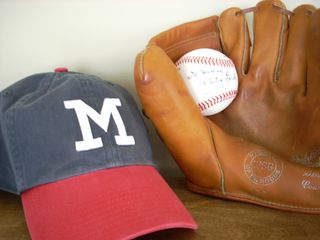 As the Atlanta Braves' season comes to
an abrupt close, I am reminded of a quote from Robert Weintraub's
baseball book 1946 where he
writes, “In the championship caldron, a team's weakness is
invariably, often ruthlessly exposed.”
As the Atlanta Braves' season comes to
an abrupt close, I am reminded of a quote from Robert Weintraub's
baseball book 1946 where he
writes, “In the championship caldron, a team's weakness is
invariably, often ruthlessly exposed.”

It's been a while since the last roll call of the Metropolitan Atlanta Rapid Transit Authority (MARTA) Book Club, an impromptu reading club whose only membership requirement is to read a book while riding public transportation. At first I used the excuse that people weren't reading as much, which may be partially true, but more likely, I have been too preoccupied with MARTA's new code of conduct initiative called Ride with Respect. I am hoping Ride with Respect comes with a new video maybe with an Aretha Franklin soundtrack and replacing the current lame safety video, which features a mascot recruiting commuters who lack the common sense not to stand near doors, or jump in front of buses and trains, to join a rhythmically challenged dance team at the CNN Center station.
I always say that I see more instances of civil behavior on MARTA than I do boorish behavior like smoking, drinking, eating, begging, spitting, littering, panhandling, threatening, or playing loud music. But in the occasional case of incivility, I just focus a little more on my book, which this week has been Michael Chabon's The Yiddish Policeman's Union (2007).
 What makes me a little nervous is that if the new conduct code is successful what other kind of codes could be implemented next? For example, what if MARTA puts into effect a Napoleonic Code, which would forbid riders' privileges based on birth. (No prime reserved seating by the door for seniors anymore.) Enforcing the eye-for-an-eye, a tooth-for-a-tooth, Code of Hammurabi could be a lot more messier than just a little spitting or littering. The Code of the Samurai, which is centered on frugality (since MARTA riders already got that), loyalty and mastery of the martial arts doesn't sound so bad. I would jump at an opportunity to carry a Samurai sword umbrella (shown here) on the train. Kidding aside, the MARTA Club biggest fear is that the MARTA administrators will enforce The Code of the Woosters, where riders can read only the works of P.G. Wodehouse while using Atlanta public transportation.
And you can see why. Just browse this list of what people have been reading on MARTA public transportation lately. It may be brief, but its diverse.
The Goldilocks Enigma: Why Is the Universe Just Right for Life by Paul Davies
The Great Gatsby by F. Scott Fitzgerald
The Long Tail: Why the Future of Business is Selling Less of More by Chris Anderson
The Limpopo Academy of Private Detection: No. 1 Ladies' Detective Agency by Alexander McCall Smith
Booty Call by ??? (Did you know that Booty Call is a very popular title for a book?)
Locked Down: Information Security for Lawyers by Sharon D. Nelson, David G. Ries and John W. Simek.
The Racketeer: A Novel by John Grisham
Every Day a Friday by Joel Osteen
Holy Bible
Holy Quran
Deadly Harvest: A Detective Kubu Mystery by Michael Stanley
Pathophysiology: Concepts of Altered Health States by Carol Mattson Porth and Glenn Matfin
A Piece of Cake: A Memoir by Cupcake Brown
Look Back All the Green Valley: A Novel by Fred Chappell
Merge /Disciple: Two Short Novels by Walter Mosely
The Marriage Bargain by Jennifer Probst
—– EXTENDED BODY: —– EXCERPT: —– KEYWORDS: MARTA Book Club, MARTA Code of Conduct, The Yiddish Policeman’s Union, The Code of the Woosters, —– COMMENT: AUTHOR: JISimpson EMAIL: IP: 72.54.143.70 URL: http://profile.typepad.com/jisimpson DATE: 10/02/2013 05:49:57 PM I always look forward to the MARTA Book Club meeting minutes for this very reason: You managed to incorporate Aretha Franklin, a rhythmically challenged dance team, boorish behavior, and the Code of Hammurabi in one post. Hilariously impressive! Respectfully submitted, Jim S. —– ——– AUTHOR: Murray Browne AUTHOR EMAIL: murray.browne905@gmail.com TITLE: Coincidence? The Appearance of Thomas Pynchon in Rick Atkinson’s World War II Trilogy STATUS: Publish ALLOW COMMENTS: 1 CONVERT BREAKS: wysiwyg ALLOW PINGS: 1 BASENAME: coincidence-the-appearance-of-thomas-pynchon-in-rick-atkinsons-world-war-ii-trilogy UNIQUE URL: https://thebookshopper.typepad.com/the_book_shopper_atlantad/2013/09/coincidence-the-appearance-of-thomas-pynchon-in-rick-atkinsons-world-war-ii-trilogy.html DATE: 09/22/2013 11:39:03 AM —– BODY: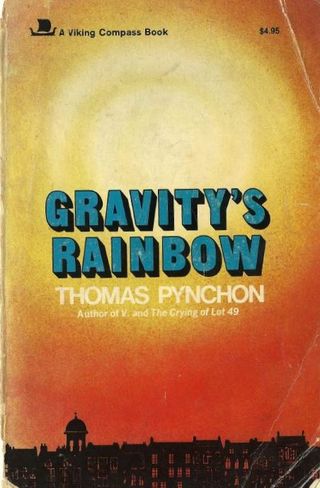 Even before this week's publication of Thomas Pynchon's latest novel Bleeding Edge, (remember this blog is the digital home of the Thomas Pynchon Muted Horn Dinnerware ) I had already been reminded of Pynchon via his early book Gravity's Rainbow, which was published in 1973. The opening sentence of the novel – “A screaming comes across the sky.” refers to the V-2 rocket, which is one of the main characters or symbols of the 760 page tome.
Now the weird thing is that I am currently finishing another tome, Rick Atkinson's The Guns at Last Light, the last book in his World War II Liberation Trilogy and it pays an indirect/ intentional/unintentional veiled homage to Pynchon's book. The Guns at Last Light is a history of World War II in Western Europe, 1944-45.
As you would expect Atkinson gives a more direct historical understanding of the unmanned V-2 rocket, which first stuck London on September 8, 1944. “…the V-2 rocket,” writes Atkinson, “was forty-six feet long, weighed almost thirteen tons, and carried a one ton warhead. Reaching 3,600 miles per hours and an apogee of sixty miles, it had an impact velocity, comparable to fifty big train engines slamming into a neighborhood.” What made the V-2 even more terrifying was that it was difficult to detect and it made no sound as it finished its trajectory. At first, Prime Minister Churchill tried to downplay the unexpected blasts by claiming that gas mains were bursting. But as the death tolls mounted (3000 British citizens) and thousands of homes reduced to rubble, that ruse was abandoned. The strategic Netherlands port city of Antwerp suffered even more destruction in the autumn of 1944. Germany used V-2s (developed by German rocket scientist Wernher Von Braun who later worked in the American space program) in an attempt to prevent the Allies from using the port to supply troops fighting in Europe.
When describing the V-2, Atkinson described the missile as “streaking across the heavens” which reads a lot like “screaming across the sky” to this longtime Pynchon reader. I am probably trying to make too many connections from these seemingly disparate authors. But who can blame me? Making connections, understanding how our personal history is often a combination of strange happenstances, coincidences, and trickle down of decisions by supreme commanders is one of the takeaways for anyone who reads both Atkinson and Pynchon.
—– EXTENDED BODY: —– EXCERPT: —– KEYWORDS: V-2 rocket, Thomas Pynchon, Gravity’s Rainbow, Muted Horn, Rick Atkinson, The Guns at Last Light, Destruction of Antwerp —– ——– AUTHOR: Murray Browne AUTHOR EMAIL: murray.browne905@gmail.com TITLE: The Ghosts of Chickamauga STATUS: Publish ALLOW COMMENTS: 1 CONVERT BREAKS: wysiwyg ALLOW PINGS: 1 BASENAME: the-ghosts-of-chickamauga CATEGORY: Book Reviews CATEGORY: Bookstores CATEGORY: Civil War Books UNIQUE URL: https://thebookshopper.typepad.com/the_book_shopper_atlantad/2013/09/the-ghosts-of-chickamauga.html DATE: 09/17/2013 10:25:13 PM —– BODY: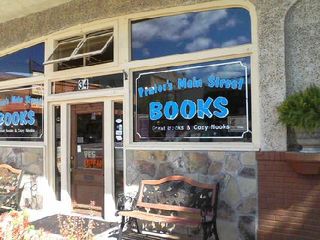 While on a weekend getaway in Northern Georgia, I stopped by Prater's Main Street Books in downtown Clayton, where books meet ice cream. Attached to Prater's is a coffee and ice cream shoppe that serves Mayfield Ice Cream. Is there anything better than sitting outside on a sunny day eating a cup of Moose Tracks and leisurely reading ghost stories?
At Prater's, I had purchased a copy of Jim Miles' Civil War Ghosts of North Georgia (History Press, 2013). It seemed appropriate. A large portion of this thin-wafer of a book, gives accounts of ghost stories near the north Georgia battlefield sites including the Chickamauga National Battlefield. It also reminded me that the 150th anniversary of two day battle that raged on September 19-20, 1863 was just a day or two away. With nearly 36,000 Blue and Gray casualities, if battlefield ghosts exist, you would find them there.
Civil War Ghosts is a collection of local folklore, newspaper articles, and accounts from bored park rangers, over-imaginative Civil War re-enactors, and paranormal professionals. The book is mixture of Halloween like ghost stories, odd humor and a reminder of the horrors of the Civil War. My favorite example is the haunted Gordon-Lee Mansion near Chickmauga, which served as a hospital during and following the battle. Miles writes, “The mansion, said to be haunted by some of the men who died there, is available for weddings, receptions, luncheons and other events.”
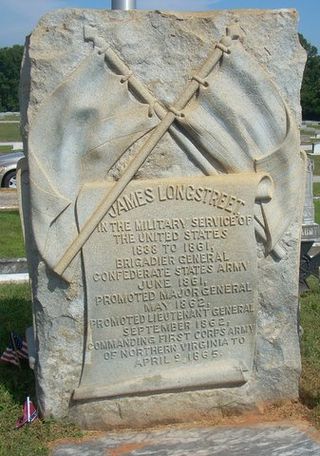 Miles also includes battlefield sites of the Atlanta campaign such as Pickett Mill State Park, Alltoona Pass and Resaca. Miles also includes a few pages on the life of Confederate Lt. General James R. Longstreet, who was one of General Robert E. Lee's finest commanders. Although Longstreet fought mostly in Virginia, he did bring his troops to Georgia for the Battle of Chickamauga. Thanks to Miles, what I didn't know is that after the war, Longstreet settled in Gainesville, Georgia where he died in 1904 of battle wounds he suffered in 1864. Longstreet is buried at Gainesville's Alta Vista Cemetery.
Heading back to Atlanta after a restful weekend in the mountains, which included reading the Miles book, I stopped by Longstreet's gravesite. It seemed like the least I could do.
—– EXTENDED BODY: —– EXCERPT: —– KEYWORDS: Civil War Ghosts of North Georgia, Jim Miles, Longstreet, Chickamauga, Gordon-Lee Mansion —– ——– AUTHOR: Murray Browne AUTHOR EMAIL: murray.browne905@gmail.com TITLE: My Personal Atlanta Area Book Calendar – September, 2013 STATUS: Publish ALLOW COMMENTS: 1 CONVERT BREAKS: wysiwyg ALLOW PINGS: 1 BASENAME: my-personal-atlanta-area-book-calendar-september-2013 CATEGORY: Baseball CATEGORY: Books as Art as Books UNIQUE URL: https://thebookshopper.typepad.com/the_book_shopper_atlantad/2013/09/my-personal-atlanta-area-book-calendar-september-2013.html DATE: 09/08/2013 10:05:55 AM —– BODY:
After the sweaty, inky, commercial mayhem known as the Decatur Book Festival ended, I revisited the Decatur Arts Alliance and Art Institute of Atlanta-Decatur's exhibit on book art in downtown Decatur. Originally, the 47 selected works (one of the jurors was Brian Dettmer) was part of the festival, but those like me, who are adverse to crowds can get another look through September 20th at the Art Institute's Decatur location. Shown above is a hand sewn book by Candace Hicks, called Common Threads Vol. XLVI. Below right is Chris Perry's 123 Ripples: pressure.
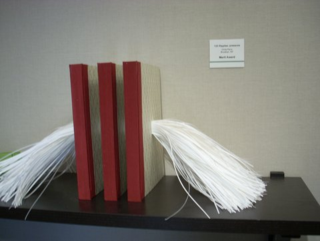
Because I haven't had my fill of unusual books, I will probably head out to Cobb Civic Center in Marietta for the annual Georgia Antiquarian Book Association Book Festival, on Saturday, September 28th or Sunday, September 29th. I always find something interesting to read or someone interesting to talk to while there. It's worth the trip, even though I always seem to get lost as soon as get OTP.
And finally, on the Monday, September 23rd, Atlanta Braves vs Milwaukee Brewers game, it is The Book Shopper Blog Night at Turner Field. Bring any old raggedy-ass baseball book to the ticket window and you are eligible to buy a select Terrace View ticket for only $8. A few book shopper blog contributors and I will be there. I'll be easy to find. I am the fan yelling mercilessly at Dan Uggla.
—– EXTENDED BODY: —– EXCERPT: —– KEYWORDS: GABA, Georgia Antiquarian Book Association Book Festival, Candace Hicks, Chris Berry —– ——– AUTHOR: Murray Browne AUTHOR EMAIL: murray.browne905@gmail.com TITLE: My Abridged Decatur Book Festival Schedule STATUS: Publish ALLOW COMMENTS: 1 CONVERT BREAKS: wysiwyg ALLOW PINGS: 0 BASENAME: my-abridged-decatur-book-festival-schedule- UNIQUE URL: https://thebookshopper.typepad.com/the_book_shopper_atlantad/2013/08/my-abridged-decatur-book-festival-schedule-.html DATE: 08/28/2013 08:26:01 AM —– BODY:
In years past I used to get pumped up for the Decatur Book Festival (2010, 2012) by planning strategies, reading author bios, studying the locations of the exhibitors etc., but this year I would characterize my general attitude as more sedated. Nevertheless I know I will make it to downtown Decatur to see the Books as Art exhibit at the Art Institute of Atlanta-Decatur and visit one of the few destination book stores left in Atlanta – Books Again (click to enlarge map)
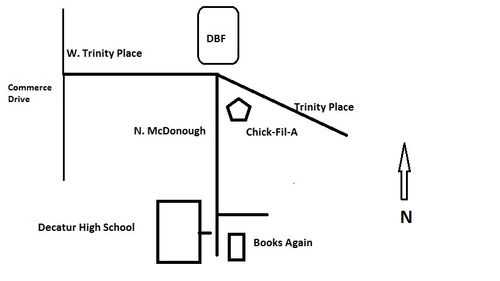 Sure they are a blog sponsor, (see Sponsor Link in the left corner) but if you are a serious book shopper you'll appreciate the wide selection of fiction especially some of the older works penned by Southern authors. Books Again also has shelves full of military history, baseball, religion, philosophy and cookbooks. The store is air conditioned and they will be having their annual Labor Day Weekend sale with 40% OFF: Books $30 & Under and 30% OFF : Books over $30.
Why I know that the Decatur Book Festival is a “celebration of the book” and it is good for the Decatur community, I think of these large celebrations sometimes as the same kind event that is attended by a baseball fan who just goes to opening day. For the true baseball fan and a reader, it's important to settle into the rhythms of the long season.
Reading and watching baseball are something I do and talk about almost every day. (I'm even going to the Braves-Indians game tonight). Let the sunshine fan have their Labor Day Weekend, but I will still be thinking about books after September 1.
—– EXTENDED BODY: —– EXCERPT: —– KEYWORDS: —– COMMENT: AUTHOR: Jim EMAIL: jimsimpsonatl@gmail.com IP: 99.141.153.40 URL: http://jimsimpson.tumblr.com DATE: 08/28/2013 10:23:00 PM I look forward to the DBF every year, but my level of excitement rises or falls with the author lineup — some years are better than others. Still, I nearly always meet some excellent writers I would otherwise have never been aware of. These are the authors I’m excited about this year. FRIDAY Workshop with Amanda Kyle Williams and Peter Farris. SATURDAY 1:45-2:30 — How to Write Short: Word Craft for Fast Times – Book Launch! featuring Roy Peter Clark. 4:15-5:00 — Haldol and Hyacinths: A Bipolar Life featuring Melody Moezzi. SUNDAY (or HOW TO BE IN THREE PLACES AT ONCE) 12:00-12:45 – Do Book Reviews Matter? featuring Teresa Weaver, Gina Webb, Lev Grossman, Charles McNair. 12:00-12:45 — A Deadly Combination: Mystery + Comedy featuring Bill Roorbach, Susan Boyer. 12:00-12:45 — The Returned – Book Launch! featuring Jason Mott. 1:15-2:00 — Fairyland: A Memoir of My Father featuring Alysia Abbott. 2:30-3:15 — The Lost Daughter featuring Mary Williams. 5:00-5:45 — Beneath the Surface featuring Joshilyn Jackson, Gillian Royes (even though they stole the title of my novel). As for Sunday, I’ll probably just skip the first three and hang out at Brick Store Pub. —– ——– AUTHOR: Murray Browne AUTHOR EMAIL: murray.browne905@gmail.com TITLE: Maine Book Shopping STATUS: Publish ALLOW COMMENTS: 1 CONVERT BREAKS: wysiwyg ALLOW PINGS: 1 BASENAME: maine_book_shopping CATEGORY: Bookstores UNIQUE URL: https://thebookshopper.typepad.com/the_book_shopper_atlantad/2013/08/maine_book_shopping.html DATE: 08/18/2013 10:14:14 AM —– BODY:

Although it may surprise some, when on vacation I don't go into every bookstore. My longtime travel companion (life's journeys as well) Denise is more than willing to accompany me. But you can spend your whole vacation browsing, so we try to be selective. While traveling through some iconic small towns in Maine last month from Portland to Acadia National Park (the view from Cadillac Mountain is above) we did shop at two very good independent book shops that are worth the time and effort to visit.
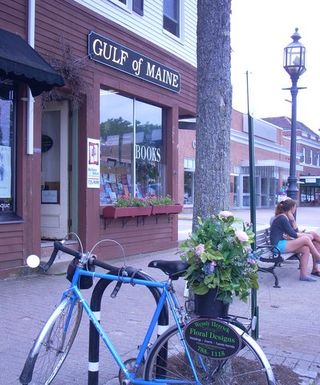 The
first book shop was Gulf of Maine Books in downtown Brunswick, Maine
near the stately campus of the Bowdoin College. It's the kind of town you might expect to
find a good liberal book store and Gulf of Maine owned by the poet
and activist Gary Lawless and Beth Leonard fits that bill. You are
not going to find Bill O'Reilly books at this place. Unlike many
book store owners that keep to themselves, Lawless chats with his
customers and there was a steady flow of conversation. When I
overhead him talking about using the
Billy Lynn's Long Halftime Walk
(2012) in his veterans writing group, I mentioned that I had just
seen Rick Atkinson, author of the World War II Liberation Trilogy
here in Decatur. (Coincidentally, someone just gave me a copy of
Billy Lynn, which I am now reading.)
The
first book shop was Gulf of Maine Books in downtown Brunswick, Maine
near the stately campus of the Bowdoin College. It's the kind of town you might expect to
find a good liberal book store and Gulf of Maine owned by the poet
and activist Gary Lawless and Beth Leonard fits that bill. You are
not going to find Bill O'Reilly books at this place. Unlike many
book store owners that keep to themselves, Lawless chats with his
customers and there was a steady flow of conversation. When I
overhead him talking about using the
Billy Lynn's Long Halftime Walk
(2012) in his veterans writing group, I mentioned that I had just
seen Rick Atkinson, author of the World War II Liberation Trilogy
here in Decatur. (Coincidentally, someone just gave me a copy of
Billy Lynn, which I am now reading.)
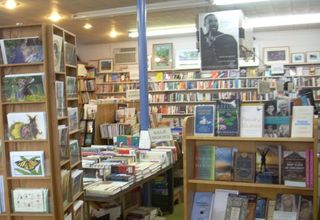 Gulf
of Maine is packed full of books with a large section of books about
the area. There are ample offerings of fiction, current events and a
good sized remainder table where I picked up Gary Shteyngart's Super
Sad True Love Story (2010).
Denise bought Linda Greenlaw's The Lobster Chronicles: Life
on a Very Small Island (2003)
and Rachel Herz's Scent of Desire: Discovering Our
Enigmatic Sense of Smell (2007).
Gulf
of Maine is packed full of books with a large section of books about
the area. There are ample offerings of fiction, current events and a
good sized remainder table where I picked up Gary Shteyngart's Super
Sad True Love Story (2010).
Denise bought Linda Greenlaw's The Lobster Chronicles: Life
on a Very Small Island (2003)
and Rachel Herz's Scent of Desire: Discovering Our
Enigmatic Sense of Smell (2007).
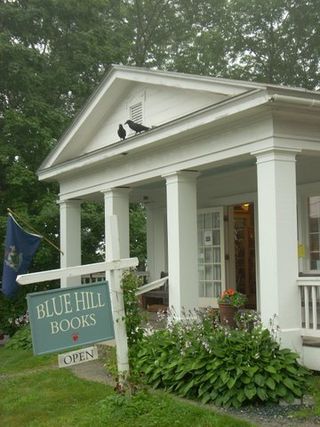 Even
though we had purchased more than enough to read during our vacation
Happy Hours – where we drink, read and nap while overlooking the
water – we stopped by Blue Hill Books in Blue Hill, Maine. Where
Gulf of Maine is a little cluttered but inviting, Blue Hill situated
in a small house, is precisely packed with books not unlike a
library. Again, there were plenty of Maine books (Denise purchased
Joseph Dane's Dogfish Memory: A Memoir
2012), and a large selection of trade paperback fiction. I was
impressed at the selection because it wasn't limited to the latest
releases. There was a wide offering from respected writers who you
know but may not have read yet: Jane Austen, Philip Roth, Joesph
Heller and Christopher Hitchens to name a few. It was a rainy day
when we were there, and the owner and the single staffer were busy,
so I didn't strike up a conversation, but you could see from the
flyers and posters that Blue Hill Books was engaged with the
community, much like Gulf of Maine Books.
Even
though we had purchased more than enough to read during our vacation
Happy Hours – where we drink, read and nap while overlooking the
water – we stopped by Blue Hill Books in Blue Hill, Maine. Where
Gulf of Maine is a little cluttered but inviting, Blue Hill situated
in a small house, is precisely packed with books not unlike a
library. Again, there were plenty of Maine books (Denise purchased
Joseph Dane's Dogfish Memory: A Memoir
2012), and a large selection of trade paperback fiction. I was
impressed at the selection because it wasn't limited to the latest
releases. There was a wide offering from respected writers who you
know but may not have read yet: Jane Austen, Philip Roth, Joesph
Heller and Christopher Hitchens to name a few. It was a rainy day
when we were there, and the owner and the single staffer were busy,
so I didn't strike up a conversation, but you could see from the
flyers and posters that Blue Hill Books was engaged with the
community, much like Gulf of Maine Books.
Of course, what
makes Maine a reader's paradise is that it also provides great venues
for reading. In the picture below, check out the two readers hidden in the rocks near
Acadia's Seawall trail, overlooking the Atlantic Ocean.
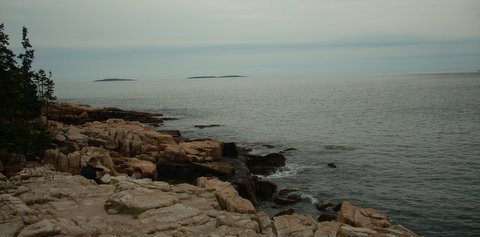
by Jim Simpson
On a recent trip to Books Again in Decatur, I picked up a 1964 hardcover copy of Albert Camus’ novel The Fall. I’ve always admired Camus, but admit to reading only one novel (The Stranger, as a college Freshman) and a few of his essays. I really should read more, and The Fall looks intriguing, especially since the copy I bought has a Honolulu Book Shops label on the inside back cover.
 Having never been to Hawaii, I’ve always thought of it as a lush tropical paradise where nothing ever goes wrong and everyone lives in a state of ambulatory bliss. But, like any scrap of land where human beings congregate, I’m sure Hawaii has its share of troubles – Steve McGarrett would likely concur.
 It was the inscription on the title page that really caught my eye: “Much Aloha!”, a drawing of an evergreen tree and “66” (perhaps a Christmas tree, the book given as a gift in 1966) signed, simply, “G.” Again, like most found objects in books, this makes me wonder: Was the book shipped to the States as a gift or given from one Hawaiian resident to another? Was it actually a Christmas tree or some secret family icon? Why read Camus in paradise? Then again, why not? I was reminded of Paul Theroux’s wonderful novel Hotel Honolulu with its unnamed main character — a “writer in retreat” — toting around a copy of Anna Karenina to keep people at bay, and describing Hawaii as “paradise with heavy traffic.”
The more I thought about it — with Books Again’s feline mascot Eric rubbing my ankles — everything made sense. Camus’ main character in the novel sits in an Amsterdam bar called Mexico City telling a stranger about his fall from grace in the gritty paradise of Paris, so it is only fitting that this copy of the novel has its origins in a bookstore in the lush Hawaiian paradise. Anyway, I can’t wait to dive into this book, following the narrator around and around in the Dantean concentric circles of Amsterdam.
Over at Atlanta Vintage Books I picked up a U.S. first edition (Harcourt, Brace, 1944) of Virginia Woolf’s short story collection, A Haunted House, published posthumously with a forward by her husband Leonard. This collection includes stories originally published in a previous collection, Monday or Tuesday, along with unpublished stories and those appearing in magazines between 1921 – 1944. The title story features a man and wife, long dead, a “ghostly couple,” floating through their former house, peering at the current inhabitants while seeking their own lost joys contained in and around the house.
Since the book was printed a year before the end of World War II, the copyright page tells us this is “A Wartime Book,” assuring us that “Books are weapons in the war of ideas. This complete edition is produced in full compliance with the government’s regulations for conserving paper and other essential materials.” Hats off to you, Greatest Generation.
BIO: Fiction writer and music reviewer Jim Simpson is a regular contributor to the blog with his "Stories Within the Story" where he ruminates on the bookish flotsam of others that he has discovered in his literary hunting and gathering at local bookstores and antique shops. As Simpson writes, "it's for those of you who enjoy discovering that rare used book on a dusty local shelf, where the surprise 'found objects' inside are sometimes just as interesting as the book itself." (If you have any stories you wish to share, contact the blog or post them in comments.)
—– EXCERPT: —– KEYWORDS: Albert Camus, The Fall, Honolulu Book Shops, Virginia Woolf, A Haunted House —– ——– AUTHOR: Murray Browne AUTHOR EMAIL: murray.browne905@gmail.com TITLE: Decatur Festivals: Compare & Contrast STATUS: Publish ALLOW COMMENTS: 1 CONVERT BREAKS: wysiwyg ALLOW PINGS: 1 BASENAME: decatur-festivals-compare-contrast- UNIQUE URL: https://thebookshopper.typepad.com/the_book_shopper_atlantad/2013/08/decatur-festivals-compare-contrast-.html DATE: 08/03/2013 08:03:20 PM —– BODY:
In lieu of my personal August book events calendar (which is normally uneventful anyway because all the local book attention goes to the upcoming Decatur Book Festival), I recreated a New York Times-like compare and contrast between the Decatur Book Festival (DBF) being held over Labor Day Weekend and the Decatur Craft Beer Festival (DBF), which is scheduled for Saturday, October 19th. Which one is your "winner"?

My mother Jean Browne, 85, died in her sleep last week here in Atlanta. She was the parent who read to us as kids and read to her grandchildren as well. I have a tape (somewhere) of her reading the “Little Ginger Bread Boy” from the My Book House Collection to my daughter Cynthia.
There are probably studies that confirm this, but I never could see how a person could learn to enjoy reading without having being introduced to those pleasures as a child. And to this, I attribute part of my interest in books to her, though I believe it was my paternal grandmother who showed me later that a person who did a lot of reading was naturally interesting.
There are sad experiences surrounding my mother's late decline (though she lived independently until this year) but in my memory she will remain the person who read to me as a child and for this, and many other things, I am indebted.
(In this 1959 photo I am the little guy on the left, my sister Kay is on my mother's lap, and my brother Neil is on the right.)
—– EXTENDED BODY: —– EXCERPT: —– KEYWORDS: —– ——– AUTHOR: Murray Browne AUTHOR EMAIL: murray.browne905@gmail.com TITLE: Francis Spufford is an Unapologetic Christian: A Review STATUS: Publish ALLOW COMMENTS: 1 CONVERT BREAKS: wysiwyg ALLOW PINGS: 1 BASENAME: francis-spufford-is-an-unapologetic-christian-a-review CATEGORY: Book Reviews UNIQUE URL: https://thebookshopper.typepad.com/the_book_shopper_atlantad/2013/07/francis-spufford-is-an-unapologetic-christian-a-review.html DATE: 07/20/2013 08:17:31 AM —– BODY: The best metaphor for describing how I relate to Christianity comes from Jack Miles who wrote God: A Biography (1995). It goes something like this: A young man raised in wealth, who for some reason ends up in poverty. Nevertheless, the basic character of the man “will remain that of man raised in wealth for he can't give his history away.”
As a youth, I was immersed “in the watery grave” so to speak (our poetic reference to baptism) and spent a lot of time going to church every Sunday. I can still recite the lyrics to “In the Garden” or “How Great Thou Art” even though I haven't heard the songs in decades. These days, it's not like I am opposed to going to church (though it would probably be Unitarian), it's just when you work full time the free time on the weekends is so short.So when I happened upon a brief review of British writer Francis Spufford's Unapologetic: Why, Despite Everything Christianity Can Still Make Surprising Emotional Sense, I thought to myself, “ The pull of Christianity is still there. Why not investigate the religion of my youth while riding to work on MARTA (good time management). The Bible is one of the hands-down favorites of the book club for people who ride public transportation in Atlanta (See the line to MARTA Book Club postings on the right). Moreover if people see what I am reading, maybe they will give me their seat during rush hour.
What sold me on giving this book a try was not that I was going to get a regurgitation of that old time religion, but a thoughtful discourse about what Christianity can and should mean as opposed to something experienced in a mega church with big screens. The reviewer Nick Hornby sums it up this way, “…the best reason to read the book is that it enables thought, specifically thought about who we are and what we're doing here and how we intend to negotiate the difficulties and tragedies that are unavoidably a part of being human.” Handling difficulties and tragedies? I'm in.
But Spufford is no dry, pontificating theologian. He begins the book with this:
My daughter has just turned six. Some time over the next year or so, she will discover that her parents are weird. We're weird because we go to church.
This means- well, as she gets older there'll be voices telling what it means, getting louder and louder until by the time she's a teenager they'll be shouting in her ear. It means that we believe in a load of bronze-aged absurdities. It means we don't believe in dinosaurs. It means that we are dogmatic. That we're self-righteous. That we fetishise pain and suffering. That we promise the oppressed pie in the sky when they die. That we're bleeding hearts who don't understand the wealth-creating powers of the market… That we build absurdly complex intellectual structures, full of meaningless distinctions, on the marshmallow foundations of a fantasy…
In Chapter 2, Spufford writes about sin, but he calls it HptFtU instead – the human propensity to f— things up. Our normal state of being is messing things up and to think that it all began with this wonderful blissful state of grace creates many problems. A major one is guilt because we are not perfect. Once we recognize that and we realize that God (who is not the white-beard old man, according to Chapter 3 Big Daddy) and Jesus (topic of Chapter 5 Yeshua) are here to show forgiveness. Maybe we can think about forgiving others more. Forgiveness can help us heal and as Spufford writes at the end of the book, “Far more can be mended than you know.”
I am not even going to try to cover some of Spufford's arguments, some of which you probably won't agree with. But if you're a little beaten up, pick up your tattered cloak of Christianity, and check out this short well-written, uplifting book.
Postscripts. Don't assume I ever finished the Jack Miles book, which I did not. The only thing I remember is the wealthy man and religion metaphor, but if you remember ONE thing out of every book you read isn't that good enough? Currently, I have also been reading Clive James' Cultural Cohesion: The Essential Essays (1968 -2002) (2013) a kind of prequel to Cultural Amnesia (2003). Coincidentally , James opens his book with this quote from French essayist Alain Finkielkraut which sounds a lot like HptFtU: “Barbarism is not the prehistory of humanity, but the faithful shadow that accompanies its every step.” Nick Hornby's review of Unapologetic appears in the March/April 2013 of The Believer magazine, another periodical you can read on MARTA unapologetically.
—– EXTENDED BODY: —– EXCERPT: —– KEYWORDS: Francis Spufford, Unapologetic: Why, Despite Everything Christianity Can Still Make Surprising Emotional Sense, Nick Hornby, Jack Miles, God: A Biography —– ——– AUTHOR: Murray Browne AUTHOR EMAIL: murray.browne905@gmail.com TITLE: In Book Towns, the Books Come to You STATUS: Publish ALLOW COMMENTS: 1 CONVERT BREAKS: wysiwyg ALLOW PINGS: 0 BASENAME: in-book-towns-the-books-come-to-you CATEGORY: Bookstores UNIQUE URL: https://thebookshopper.typepad.com/the_book_shopper_atlantad/2013/07/in-book-towns-the-books-come-to-you.html DATE: 07/12/2013 06:10:55 PM —– BODY:I was up in Boston over the Fourth of July weekend visiting my daughter. Traditionally, Boston is a great book shopping town for me, but I didn't make it out like I normally do.
 I did squeeze in a couple of my normal stops. Raven Used Books and the Harvard Bookstore, but ran out of time before I could make it down to the M.I.T Press Bookstore. I took some solace in my poor time management since I haven't read the book I bought at M.I.T. last December on my last visit. (This photo comes from the storefront of a used bookstore near M.I.T. )
At Raven, I found a copy of a Charles Portis' 1966 novel, Norwood, but another book Lie Down in Darkness (1951) by William Styron found me. I was staying at the Irving House, a bed & breakfast near the Harvard campus. According to the in-room brochure the general manager is a book shopper and she has stocked her rooms with plenty of books and not just bestsellers. In my room among other literary offerings, was Richard Ford's Canada (which I read last year) and the Styron book. Just a few weeks ago I had finished Styron's Tidewater Mornings, a book of three long short stories. I found the prose exquisite and his portrayal of the South fascinating – no surprise that he was such an intense and troubled writer. A work colleague told me that Darkness was worth the read as well and she knows something about books since she recommended Zadie Smith's White Teeth to me earlier this year, which I thought was fine book.
The management at Irving House makes it very clear that guests are allowed to take books with them. Good thing, since this is a book shopping blog, not a book stealing blog.
—– EXTENDED BODY: —– EXCERPT: —– KEYWORDS: —– ——– AUTHOR: Murray Browne AUTHOR EMAIL: murray.browne905@gmail.com TITLE: Young Men and Fire: From Montana to Arizona STATUS: Publish ALLOW COMMENTS: 1 CONVERT BREAKS: wysiwyg ALLOW PINGS: 1 BASENAME: young-men-and-fire-from-montana-to-arizona UNIQUE URL: https://thebookshopper.typepad.com/the_book_shopper_atlantad/2013/07/young-men-and-fire-from-montana-to-arizona.html DATE: 07/03/2013 09:15:22 PM —– BODY:
 The raging Arizona wildfire that claimed the lives of 19 men of an elite firefighting team earlier this week may remind some of a book that was published over twenty years ago. Norman Maclean's Young Men and Fire (1992) was a detailed account at the tragedy of another special group of 16 firefighters, 13 who perished during a Montana wildfire. Having grown up in Montana and having worked for the U.S. Forest Service as a teenager, Maclean re-creates the tragedy — the perfect storm of nature's fury and miscalculation. I can't remember why I unloaded my copy (it happens), but I do remember the meditative quality of Maclean investigation of the fire and the questioning his own mortality. (Maclean died two years before the book was published.) Later the book was reviewed on the front page of New York Times Book Review.
Maclean is probably better known for his 1976 book of short stories, A River Runs Through It and Other Stories, which was made into a 1992 movie directed by Robert Redford and starring Brad Pitt.
I hope that in the future some writer honors those who died in Arizona, the way Maclean remembered those who burned to death in Montana in 1949.
—– EXTENDED BODY: —– EXCERPT: —– KEYWORDS: Norman Maclean, Young Men and Fire, Arizona Wildfire, —– ——– AUTHOR: Murray Browne AUTHOR EMAIL: murray.browne905@gmail.com TITLE: My Personal Atlanta Area Book Calendar – July, 2013 STATUS: Publish ALLOW COMMENTS: 1 CONVERT BREAKS: wysiwyg ALLOW PINGS: 1 BASENAME: my-personal-atlanta-area-book-calendar-july-2013- UNIQUE URL: https://thebookshopper.typepad.com/the_book_shopper_atlantad/2013/06/my-personal-atlanta-area-book-calendar-july-2013-.html DATE: 06/29/2013 11:19:39 AM —– BODY: Usually I devote this space to
book-related events, but since I am not particularly intrigued about
any upcoming July book readings, except for Pulitzer Prize winner
Adam Johnson's appearance at the Carter Museum and Library on July
16, I will leave you to do your own searching for worthwhile
events. Just visit the links that grace the borders of the blog.
Usually I devote this space to
book-related events, but since I am not particularly intrigued about
any upcoming July book readings, except for Pulitzer Prize winner
Adam Johnson's appearance at the Carter Museum and Library on July
16, I will leave you to do your own searching for worthwhile
events. Just visit the links that grace the borders of the blog.
Instead, since I am still buzzed from the Georgia Shakespeare Company's summer production of Metamorphoses, an episodic play based on the myths of Ovid, I will re-appropriate this month's calendar to something theatrical, but still literary.
My longtime partner Denise and I went the company's opening weekend performance at the campus of Oglethorpe University. Denise had already seen this interpretation written by Mary Zimmerman when it was staged here in 2007 and she has never stop talking about it as the best thing she's seen in Atlanta theatre. She was especially captivated by the set design.
Despite the high expectations, she was not disappointed this year and either was I, even though we sat in the balcony discount seats where you look down on the 24 foot pool where the central action takes place. Being a little removed from the waterfront didn't bother me, I just pretended I was Zeus. After the performance, we stayed to listen to director Richard Garner and several cast members talk about Metamorphoses. Garner says that the enormous pool is “eleventh cast member” and he talked about all the daily care required to keep the enormous pool maintained at a comfortable 94 degrees for the actors. Moreover, they must avoid using pool chemicals that would wreck the costumes.
The pool figures prominently in many of
the myths such as King Ceyx's voyage which ends when his ship is
attacked by Poseidon. The setting also provides some of the most erotic
splashing around you'll see this side of Debra Kerr and Burt
Lancaster in From Here to Eternity. (Check out the Metamorphoses promotional video below– but beware of the Quentin Tarantino soundtrack. Fortunately, that music isn't in the play. )
Laps Interrupted
 You know how sometimes you like a movie
better the next day, when you kind of ruminate about it. That's the
way this production worked for me. I kept enjoying it and
thinking about how things were staged (I would like to see it again, just to
follow the dialogue closer). The next day while I was at the park
pool, it was all I could do to keep from acting like Poseidon and
pulling down unsuspecting teenagers to the icy depths of Glenlake
Pool for interrupting my lap swimming. The temptation was there. Were the gods testing me or was it just the residual pleasure of
the Georgia Shakespeare production? .
You know how sometimes you like a movie
better the next day, when you kind of ruminate about it. That's the
way this production worked for me. I kept enjoying it and
thinking about how things were staged (I would like to see it again, just to
follow the dialogue closer). The next day while I was at the park
pool, it was all I could do to keep from acting like Poseidon and
pulling down unsuspecting teenagers to the icy depths of Glenlake
Pool for interrupting my lap swimming. The temptation was there. Were the gods testing me or was it just the residual pleasure of
the Georgia Shakespeare production? .
Metamorphoses plays until July 21.
—– EXTENDED BODY: —– EXCERPT: —– KEYWORDS: Georgia Shakespeare, Mary Zimmerman, Ovid, Atlanta book events, Atlanta book calendar, —– ——– AUTHOR: Murray Browne AUTHOR EMAIL: murray.browne905@gmail.com TITLE: Revisiting Wilfrid Sheed’s Baseball and Lesser Sports STATUS: Publish ALLOW COMMENTS: 1 CONVERT BREAKS: wysiwyg ALLOW PINGS: 1 BASENAME: revisiting-wilfrid-sheeds-baseball-and-lesser-sports CATEGORY: Baseball CATEGORY: Book Reviews UNIQUE URL: https://thebookshopper.typepad.com/the_book_shopper_atlantad/2013/06/revisiting-wilfrid-sheeds-baseball-and-lesser-sports.html DATE: 06/23/2013 09:27:56 PM —– BODY:
 Just like fans of professional hockey
and basketball are ending their long seasons and resting their
bleary, red eyes from lack of sleep, I have closed the book on
Wilfrid Sheed's collection of essays Baseball and Lesser Sports,
which I began several months ago (I was briefly sidetracked by
another baseball book Robert Weintraub's The Victory Season).
Besides I had already read Sheed's sports-related memoir, My Life
as a Fan (2001) and found his prose rich and fun to read. I
was confident I would return to finish it.
Just like fans of professional hockey
and basketball are ending their long seasons and resting their
bleary, red eyes from lack of sleep, I have closed the book on
Wilfrid Sheed's collection of essays Baseball and Lesser Sports,
which I began several months ago (I was briefly sidetracked by
another baseball book Robert Weintraub's The Victory Season).
Besides I had already read Sheed's sports-related memoir, My Life
as a Fan (2001) and found his prose rich and fun to read. I
was confident I would return to finish it.
This collection of sports writing published in 1991, (Sheed died in 2011) spans 30 years of Sheed's sports-related essays and though he devotes much of the book to baseball figures such as Ted Williams, Joe DiMaggio, Jackie Robinson, Connie Mack, and Branch Rickey, I was equally impressed with his take on Howard Cosell, John McEnroe, Muhammad Ali and Jack Nicklaus. Most of these are names from the past, I know, but if you are familiar with them at all, Sheed will give you fresh perspectives.
One of Sheed's essays, “Sports Talk” explains the difficulties of sports writing in the modern era citing that some of the master journalists were Damon Runyon, Heywoud Broun, Ring Lardner and Red Smith. Sheed devotes separate essays to baseball Hall of Famer Smith and Ring Lardners' baseball novel You Know Me, Al, which Sheed maintains is a polished novel (though it reads like a serial) and despite Lardner's denial that he (Lardner) didn't consider himself a novelist.
—– EXTENDED BODY:
Another aspect of Sheed that I find so relevant is that he writes so timelessly about sports. Then, I ask myself are there any sports writers that write with such elegance still around?” Despite the volume of online prose that is available, rehashing the daily onslaught of 24/7 sports programming, is there anyone writing anything that provides a refreshing insight or a phase worth repeating. I eventually may stand corrected on this, but as one who has read Sports Illustrated for dozens of years, I rarely pull anything out (much less scan and post) that I would call “great writing.” (The same could be said of blogs too, I suppose).
Because it is intimidating to describe Sheed, I leave you with an excerpts electronically ripped from the pages of the Sheed book. This is from an essay about Jack Nicklaus as he triumphs in 1986 Masters at the age of 46. Of course, this is almost 10 years before Tiger Woods would begin to challenge Nicklaus' record for winning the most majors, but note the strange coincidental mention of “tigers.” As long as I am deconstructing, notice on the second scan how Sheed gives a tight, brief comparison of watching other sports faces on television. He often likes to compare sports to each other, but in a succinct, nonjudgmental way. Take note of the highlighting on the second scan about the value of a face. In a world of botox and maintaining the appearance of youth, there is a reminder that there is some appreciation of having a face that has been lived in. (P.S. No books were harmed to scan this copy. Take comfort in knowing that before lodging a complaint about the quality.)
Enjoy and appreciate and then go hunting for your own copy.
—– EXCERPT: —– KEYWORDS: Wilfred Sheed, Baseball and Lesser Sports, Jack Nicklaus, Masters, 46, 1986, My Life as a Fan, Ring Lardner, Red Smith —– ——– AUTHOR: Murray Browne AUTHOR EMAIL: murray.browne905@gmail.com TITLE: Mini-Review: Remembering Your Father with Rick Atkinson STATUS: Publish ALLOW COMMENTS: 1 CONVERT BREAKS: wysiwyg ALLOW PINGS: 1 BASENAME: -mini-review-remembering-your-father-with-rick-atkinson CATEGORY: Book Reviews UNIQUE URL: https://thebookshopper.typepad.com/the_book_shopper_atlantad/2013/06/-mini-review-remembering-your-father-with-rick-atkinson.html DATE: 06/16/2013 03:42:39 PM —– BODY:When & Where: Pulitzer prize winning author Rick Atkinson lectured for about 35 minutes about his new book, The Guns at Last Light: The War in Western Europe, 1944-1945 at the Decatur Public Library on June 12, 2013 (just four days before Father's Day). The word “lecture” is a little misleading because although Atkinson provided attendees an overview about World War II, he fills in the facts with so many small narratives from the book that you see Atkinson more as a storyteller than a journalist-historian.
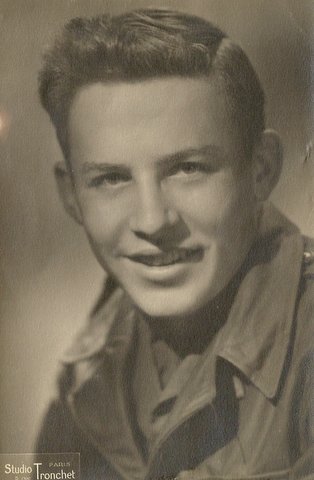 Attendence:
Almost a full house of ~150 people, which was double the number of
several years ago (September, 2008), when Atkinson was on tour with
the paperback release of Day
of Battle: The War in Italy, 1943-1944.
Both my longtime partner, Denise and I went last week. It was an
older crowd. We are not talking World War II vets (they are in their
90s and disappearing at rate of about 800 veterans a day), but more
like us – sons and daughters of World War II vets. Denise's father
Mickey Koslow (lower left) was in the Army Air Corp in North Africa and Italy and
my father Glenn R. Browne (top left) fought in Western Europe. I remember once,
when asked about his tour of duty, my Dad remarked jokingly “that
he broke the back of the Wehrmacht
taking the port of Marseille.” After I read The
Guns at Last Light, I
will know more what he meant.
Attendence:
Almost a full house of ~150 people, which was double the number of
several years ago (September, 2008), when Atkinson was on tour with
the paperback release of Day
of Battle: The War in Italy, 1943-1944.
Both my longtime partner, Denise and I went last week. It was an
older crowd. We are not talking World War II vets (they are in their
90s and disappearing at rate of about 800 veterans a day), but more
like us – sons and daughters of World War II vets. Denise's father
Mickey Koslow (lower left) was in the Army Air Corp in North Africa and Italy and
my father Glenn R. Browne (top left) fought in Western Europe. I remember once,
when asked about his tour of duty, my Dad remarked jokingly “that
he broke the back of the Wehrmacht
taking the port of Marseille.” After I read The
Guns at Last Light, I
will know more what he meant.
Why I Went. I've
read the other two books of Atkinson's The Liberation Trilogy: the
aforementioned Day of
Battle and An
Army at
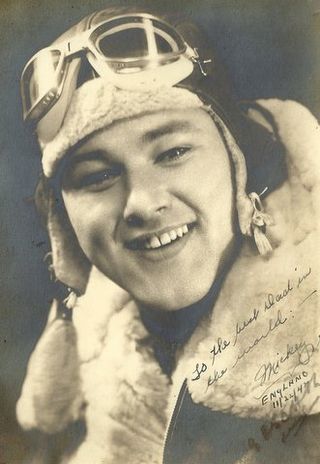 Dawn: The War in North Africa, 1942-1943. Both
books are extraordinary and there is a graciousness and confidence
about Atkinson that is refreshing. His books are as he says, take you
from the foxhole to the tactics of the commanders, which the latter
is influenced by their own personal histories and temperaments.
Atkinson often shows us how “the small catastrophe illuminates the
major disasters.” I compare him to Shelby Foote, a writer that
Atkinson matches in his storytelling prowess. I have personally given
many copies of his books to friends, they all read him and are not
disappointed. (When Denise's father Mickey was reading Day
of Battle, he'd call her
daily to tell her not only how much the book brought back his own
memories, but clarified the big picture of what was going on.)
Dawn: The War in North Africa, 1942-1943. Both
books are extraordinary and there is a graciousness and confidence
about Atkinson that is refreshing. His books are as he says, take you
from the foxhole to the tactics of the commanders, which the latter
is influenced by their own personal histories and temperaments.
Atkinson often shows us how “the small catastrophe illuminates the
major disasters.” I compare him to Shelby Foote, a writer that
Atkinson matches in his storytelling prowess. I have personally given
many copies of his books to friends, they all read him and are not
disappointed. (When Denise's father Mickey was reading Day
of Battle, he'd call her
daily to tell her not only how much the book brought back his own
memories, but clarified the big picture of what was going on.)
Q & A. Before signing books, Atkinson fielded questions for about 45 minutes from the crowd ranging from the particulars of the mutilation of Italian dictator Benito Mussolini's body to speculating on what strategy British Field Marshall Bernard Montgomery would have implemented if had lead the campaign in Europe instead of U.S. General Dwight Eisenhower. When a woman asked where she could find research information about her father who was awarded the Silver Star for fighting around Rennes, France in August, 1944, Atkinson asked, “Was he in the 4th Armored Division?” When the woman said he was, Atkinson received a round of applause. We were all amazed — knowing we were in the prescence of a man who was both “archival rat” (Atkinson's self-reference) and parlor magician.
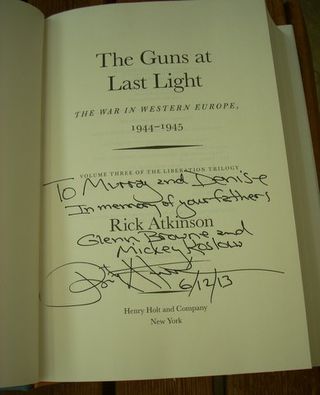 Worth Mentioning. In
2008, when Denise and I saw Atkinson we had a book signed for her
father. This time we had the book signed in the memory of our fathers
since Mickey died in 2011 and my father died in 1985. As we have come
to expect, Atkinson was warm and accomodating. He knew that Denise,
myself and the others who attended were following Atkinson's only
mandate from the evening: “That it is our first duty to remember.”
Worth Mentioning. In
2008, when Denise and I saw Atkinson we had a book signed for her
father. This time we had the book signed in the memory of our fathers
since Mickey died in 2011 and my father died in 1985. As we have come
to expect, Atkinson was warm and accomodating. He knew that Denise,
myself and the others who attended were following Atkinson's only
mandate from the evening: “That it is our first duty to remember.”

Unlike the 100th and 200th
posting milestones of The Book Shopper – Atlanta blog, this week's
posting marks the 250th attempt to inform and entertain. It all
began with my first posting back in November of 2008 as a companion
blog to my long ago book, The Book Shopper: A Life in Review,
which by the way, is available electronically or by a long-odds happenstance in some used book store.
 There was a quite a celebration for
#250: booze, dancing, and flowers. But there were books involved
(mostly as decorate accents to the shabby Southern chic décor) in
the gala too. Admittedly, to save money, I piggybacked my daughter's wedding on top
of the event. My daughter Bonnie is shown here flanked by her sister Cynthia and her
virtual step sister Lizzie Casey (my Denise's daughter). These
three are more than friends to the blog. They are family. I will
admit the wedding event did overshadow the blog celebration, but I
have made my peace with that .
There was a quite a celebration for
#250: booze, dancing, and flowers. But there were books involved
(mostly as decorate accents to the shabby Southern chic décor) in
the gala too. Admittedly, to save money, I piggybacked my daughter's wedding on top
of the event. My daughter Bonnie is shown here flanked by her sister Cynthia and her
virtual step sister Lizzie Casey (my Denise's daughter). These
three are more than friends to the blog. They are family. I will
admit the wedding event did overshadow the blog celebration, but I
have made my peace with that .
If you check the links to the #100 and #200 you'll see kind of Greatest Hits list of Bookshopper Blog entries. In keeping with that tradition, Since #200 there have been some good material in the past year, the Talledega Nights Meets William Faulkner posting, and more real book art featuring the work Brian Dettmer and Jim Simpson's reviews of Jamie Quatro, Claire Bidwell Smith and his series on things found in books.
I hope to be kicking off the next set of 250 postings (collect them all!) as I plan on seeing Rick Atkinson on Wednesday and George Packer the following week. I can't remember since I've been doing the blog a more exciting month in Atlanta. Most of the time it's a little too much for one blog to handle, but I will keep writing if you – the few, the discerning, the irreverent – keep reading.
—– EXTENDED BODY: —– EXCERPT: —– KEYWORDS: —– ——– AUTHOR: Murray Browne AUTHOR EMAIL: murray.browne905@gmail.com TITLE: Book and Paper Artists, Are You Ready to Create? STATUS: Publish ALLOW COMMENTS: 1 CONVERT BREAKS: wysiwyg ALLOW PINGS: 1 BASENAME: book-and-paper-artists-are-you-ready-to-create CATEGORY: Books as Art as Books UNIQUE URL: https://thebookshopper.typepad.com/the_book_shopper_atlantad/2013/05/book-and-paper-artists-are-you-ready-to-create.html DATE: 06/01/2013 07:54:44 AM —– BODY:

Sure it's short notice, but Monday,
June 3rd is the deadline to submit an application to The Decatur Arts
Alliance, who in conjunction with the gallery of The Art Institute of
Atlanta-Decatur, is bringing the first juried exhibition of Artists’
Books to the AJC
Decatur Book Festival. According to the organizers, “the exhibition
introduces a new and exciting visual component to the largest
independent book festival in the country.” The exhibit runs from
July 19 – September 20, 2013, which includes the Labor Day Weekend Decatur Book
Festival. Last year The Art Institute of Atlanta -Decatur hosted a
similar exhibit called Wallbound and you can bet The Book Shopper will check it out
again. (Shown at the top is a partial image from Ruth Bardenstein's Geometry/Galileo which was in Wallbound). You can find more details to apply
here.
 If you need an quick,craftier idea, you can
always make paper lanterns from paperback books. It's easy. Check out
the instructions on my daughter's craft blog. They make excellent
patio decorations, especially if creating competitive book art is too demanding.
Either way, make a note on your calendar to see the exhibit.
If you need an quick,craftier idea, you can
always make paper lanterns from paperback books. It's easy. Check out
the instructions on my daughter's craft blog. They make excellent
patio decorations, especially if creating competitive book art is too demanding.
Either way, make a note on your calendar to see the exhibit.
If it's paper and not the entire book is all your interested in, check out the Japanese Papermaking Class being held at the Robert C. Williams Papermaking Museum on the campus of Georgia Tech. The classes are being held from June 17 to June 21 and the registration deadline is Friday June 7th. Contact Virginia Howell at virginia.howell@ipst.gatech.edu or call 404-894-5726.
—– EXTENDED BODY: —– EXCERPT: —– KEYWORDS: Robert C. Williams Papermaking Museum, Japanese paper making, Ruth Bardenstein, —– ——– AUTHOR: Murray Browne AUTHOR EMAIL: murray.browne905@gmail.com TITLE: My Personal Atlanta Area Book Calendar: June, 2013 STATUS: Publish ALLOW COMMENTS: 1 CONVERT BREAKS: wysiwyg ALLOW PINGS: 1 BASENAME: my-personal-atlanta-area-book-calendar-june-2013 UNIQUE URL: https://thebookshopper.typepad.com/the_book_shopper_atlantad/2013/05/my-personal-atlanta-area-book-calendar-june-2013.html DATE: 05/29/2013 09:41:34 PM —– BODY:
 It's been a while since I have been
excited about an author coming to town. Maybe I've just become
hardened or bored about the whole publishing-marketing fanfare that
surrounds many books over the past few years. Maybe my enthusiasm has been rekindled by admiration for a particular author. Such is the case with Rick Atkinson who
will be at the Decatur Public Library on Wednesday, June 12th
on tour with The Guns at Last Light: The War in Western Europe,
1944-45, the third and final book of his World War II Liberation
Trilogy. His first book, An Army at Dawn covered the North
African campaign and Day of Battle, was a heartbreaking book
about the bleak campaign in Italy. Both books are written as
narratives, reminiscent of Shelby Foote – an author that the
gracious Atkinson admires and deserves to be compared to (See my 2009
posting about Atkinson's previous reading).
It's been a while since I have been
excited about an author coming to town. Maybe I've just become
hardened or bored about the whole publishing-marketing fanfare that
surrounds many books over the past few years. Maybe my enthusiasm has been rekindled by admiration for a particular author. Such is the case with Rick Atkinson who
will be at the Decatur Public Library on Wednesday, June 12th
on tour with The Guns at Last Light: The War in Western Europe,
1944-45, the third and final book of his World War II Liberation
Trilogy. His first book, An Army at Dawn covered the North
African campaign and Day of Battle, was a heartbreaking book
about the bleak campaign in Italy. Both books are written as
narratives, reminiscent of Shelby Foote – an author that the
gracious Atkinson admires and deserves to be compared to (See my 2009
posting about Atkinson's previous reading).
Even though my views about Memorial Day in general are similar to the political cartoonist who opined that the best way to honor the fallen would be to find ways not send others to join them, I've had an interest in military history since childhood. I think I know quite a bit, until I read a book by someone like Atkinson. I plan on being there and gladly paying full price for his latest offering!
Atkinson's visit may be overshadowed by the Georgia Center of the Book's big headliner coming the following day, as Khalid Hosseini of Kite Runner fame will be promoting his new book And the Mountains Echoed at the Baptist Church in Decatur on June 13th.
There are other authors and books of interest coming to the are in the month of June, especially the Carter Library and Museum. George Packer, author of The Unwinding (June 19th); Denise Kiernan, author of The Atomic City: The Untold Story of the Women Who Helped Win World War II (June 4th); Colum McCann, author of Transatlantic: A Novel and to balance all this “wore, wore, wore” as Scarlett O'Hara might say, Glennon Doyle Melton speaks about her book Carry On Warrior: Thoughts on Life Unarmed (June 25th) will be at the Carter Center to name but just a few.
—– EXTENDED BODY: —– EXCERPT: —– KEYWORDS: —– ——– AUTHOR: Murray Browne AUTHOR EMAIL: murray.browne905@gmail.com TITLE: So Many Books STATUS: Publish ALLOW COMMENTS: 1 CONVERT BREAKS: wysiwyg ALLOW PINGS: 1 BASENAME: so-many-books UNIQUE URL: https://thebookshopper.typepad.com/the_book_shopper_atlantad/2013/05/so-many-books.html DATE: 05/23/2013 08:27:03 AM —– BODY:
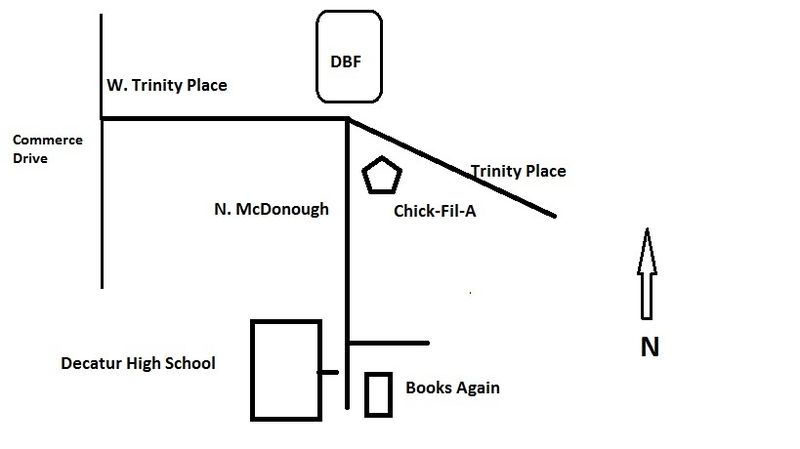
"A book lost in the Chaos is hopelessly lost. Who will undertake a costly expedition to find and restart it." – Gabriel Zaid, So Many Books.
To find books sometimes you need a map. Books Again, a so many books kind of place is having their Memorial Day weekend sale during the Decatur Arts Festival (just substitute Decatur Arts Festival for Decatur Book Festival – DBF on the map). Below is a banner with the details.

Books Again is one of our blog sponsors. Check out the Sponsors Link on the upper left.
—– EXTENDED BODY: —– EXCERPT: —– KEYWORDS: —– ——– AUTHOR: Murray Browne AUTHOR EMAIL: murray.browne905@gmail.com TITLE: MARTA Book Club #23: You Gotta Believe STATUS: Publish ALLOW COMMENTS: 1 CONVERT BREAKS: wysiwyg ALLOW PINGS: 1 BASENAME: marta-book-club-23-you-gotta-believe CATEGORY: MARTA Book Club UNIQUE URL: https://thebookshopper.typepad.com/the_book_shopper_atlantad/2013/05/marta-book-club-23-you-gotta-believe.html DATE: 05/19/2013 07:16:34 PM —– BODY:
 If you doubt that people are taking
note of what you are reading, check out the Underground New York
Public Library, “featuring the Reading-Riders of the New York City
subways.”
If you doubt that people are taking
note of what you are reading, check out the Underground New York
Public Library, “featuring the Reading-Riders of the New York City
subways.”
Just as the Underground New York Public Library is not affiliated with New York Public Library, the MARTA Book Club which has been surveying the reading habits of Atlanta commuters since November of 2009 (see MARTA book club link on the right). Likewise, the MARTA book club has no affiliations with the Metropolitan Atlanta Rapid Transit Authority, any reputable library, or with any literacy slash transportation advocacy group. The MARTA book club is an informal, decentralized book club, whose only requirement is reading something while riding a MARTA bus or train.
Compared to previous offerings, membership is down with only a few offerings. This could be attributed to fewer people reading books, more people reading on their e-readers or most likely, my lack of record keeping diligence (read laziness). My notes show I spotted people reading a few books since my last posting two months ago. They are:
Infinte Jest by David Wallace
Les Miserables by Victor Hugo
The Book of Spiders by David Wong
Castles in the Air by Christina Dodd
Same Kind of Different as Me: A Modern Slave, An International Art Dealer and the Unlikely Woman Who Bound Them Together by Ron Hall, Denver More, and Lynn Vincent.
The Gathering Storm by Winston Churchill
A Short History of the World by Bill Bryson
The Holy Bible
The Power of the Praying Parent by Stormie Ormartian
A Tidewater Morning: Three Tales from Youth by William Styron
 I am always cognizant of what I am
packing bookwise. One my recent reading selections was the 10th anniversary issue of The Believer magazine. I suspect that normally, my
fellow commuters think I am reading some religious tract like The
Watchtower, which I've seen distributed regularly at the Avondale
Station. This is understandable since riders do read a lot from the
Christian genre.
I am always cognizant of what I am
packing bookwise. One my recent reading selections was the 10th anniversary issue of The Believer magazine. I suspect that normally, my
fellow commuters think I am reading some religious tract like The
Watchtower, which I've seen distributed regularly at the Avondale
Station. This is understandable since riders do read a lot from the
Christian genre.
Of course, Believer is almost the opposite of religious writing unless you think articles about art, music, books, and oddball topics ranging from an interview with swimmer Diana Dyad to "The Anatomy of Melancholia." Obviously, the editors know this since the 10th Anniversary cover shown here with a group partying in a bathtub is “a play” on its name. (According to the editors was almost titled The Optimist.) I love dissonance. I keep subscribing to The Believer because in each issue there is some article that introduces me to a new writer (Rebecca Solnit, and Julie Hecht come to mind) or an idea.
Ironically, in the March/April issue I was introduce to both (via Nick Hornby's column on books) Francis Spufford's Unapologetic: Why, Despite Everything, Christianity Can Still Make Surprisingly Emotional Sense. That's right. I am reading about a book about the forgotten strengths of Christianity. Could it rekindle my interest to become a believer? I will keep you posted.
—– EXTENDED BODY: —– EXCERPT: —– KEYWORDS: —– ——– AUTHOR: Murray Browne AUTHOR EMAIL: murray.browne905@gmail.com TITLE: Book Burning Iowans in Field of Dreams STATUS: Publish ALLOW COMMENTS: 1 CONVERT BREAKS: wysiwyg ALLOW PINGS: 0 BASENAME: book-burning-iowans-in-field-of-dreams CATEGORY: Baseball UNIQUE URL: https://thebookshopper.typepad.com/the_book_shopper_atlantad/2013/05/book-burning-iowans-in-field-of-dreams.html DATE: 05/09/2013 07:42:57 AM —– BODY:After finishing Robert Weintraub's The Victory Season, (April 21 posting), I reverted back to the other baseball book I've been reading Wilfred Sheed's series of essays, Baseball and Lesser Sports (1991) which makes a good companion book to Weintraub's history of the 1946 baseball season. In addition to think pieces about Joe DiMaggio, Ted Williams, and Jackie Robinson, Sheed scoffs at the film Field of Dreams, which is my favorite baseball movie. Here's an excerpt about the scene about the literacy of the local Iowans.
…the only other scene involving local Iowans, we find that their literacy has merely turned them into book burning fascists, whom Costner's wife Amy Madigan easily routs with a few high-spirited cliches about books and the human spirit that astoundingly haven't reached this part of the country yet (how did they find this place?). Obviously, the Costner-man subscribes to the Mark Twain ruling "Heaven for scenery. Hell for company," because the human inhabitants of this earthly paradise seem to have barely made it out of the swamp. If I was Iowa, I'd sue.
I not sure I will ever be able to watch Field of Dreams the same way again – despite all the Carl Jung overtones in the flick.
—– EXTENDED BODY: —– EXCERPT: —– KEYWORDS: Wilfred Sheed, Carl Jung, Field of Dreams, Baseball and Lesser Sports. —– ——– AUTHOR: Murray Browne AUTHOR EMAIL: murray.browne905@gmail.com TITLE: Notable Atlanta Book Events – May 2013 STATUS: Publish ALLOW COMMENTS: 1 CONVERT BREAKS: wysiwyg ALLOW PINGS: 1 BASENAME: notable-atlanta-book-events-may-2013 UNIQUE URL: https://thebookshopper.typepad.com/the_book_shopper_atlantad/2013/05/notable-atlanta-book-events-may-2013.html DATE: 05/02/2013 07:53:20 AM —– BODY: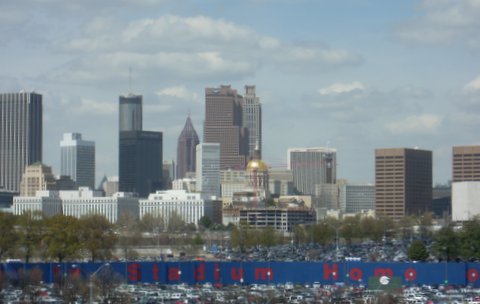
If Atlanta wants to stay on Amazon's Top Twenty Most Well-Read Cities in America, which sounds a little like Dos Equis' The Most Interesting Man in the World (what does he read besides a menu? Garcia Marquez, Bukowski, Henry Miller?) it's important to get out to a book event once in a while. Admittedly, I have been remiss myself lately, but I can't blame ignorance and neither can you. Just click on the links below and there are some additional links on the left side of this blog
Here's few venues that are hosting events for these authors this month:
The Jimmy Carter Library & Museum
Jim Wallis, On God's Side: What Religion Forgets and Politics Hasn't Learned about Serving the Common Good (May 15); Saru Jayaraman, Behind the Kitchen Door (May 16); Larry Colton, Southern League: A True Story of Baseball, Civil Rights, and the Deep South's Most Compelling Pennant Race (May 20)
The Georgia Center for the Book hosts Robert Morrell, Eden Rise (May 6); Josh Hanagame, The World's Strongest Librarian (May 9), and a series of 3 author readings celebrating the Decatur Arts Festival, May 20-22.
Margaret Mitchell House/Atlanta History Center
As well as these local bookstores:
A Cappella Books is hosting book events throughout the city including Daniel Wallace author of The Kings and Queens of Roam at Ivy Hall (May 16), and David R. Gilliam, author of City of Women at Ivy Hall (May 24).
Tall Tales Book Shop (in Toco Hills) is hosting Pam & Randy Golden, 60 Hikes Within 60 Miles: Atlanta (May 18)
Peerless Books – Atlanta author Robert Finch's debut novel, Skin in the Game (May 31)
Stay thirsty for books, Atlanta-Decatur.
 When & Where: Weintraub did
a slide presentation for his new book, The Victory Season: The End
of World War II and the Birth of Baseball's Golden Age at the
Decatur Public Library on April 15, 2013, which was also Jackie
Robinson Day and sadly, the day of the Boston Marathon bombing.
When & Where: Weintraub did
a slide presentation for his new book, The Victory Season: The End
of World War II and the Birth of Baseball's Golden Age at the
Decatur Public Library on April 15, 2013, which was also Jackie
Robinson Day and sadly, the day of the Boston Marathon bombing.
Attendence: ~ 75 people which included the final appearance of Director of the Georgia Center for the Book's Bill Starr who is stepping down as director.
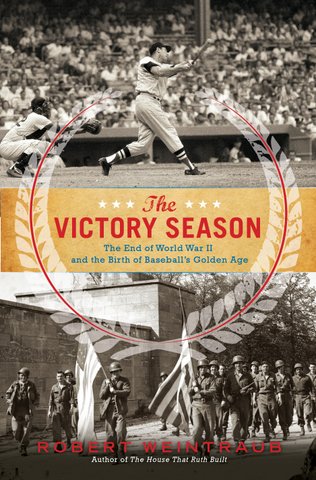 Why I Went. I
am currently finishing up Weintraub's book about the
history of the game, which focuses specifically on the 1946 season.
It was the year, many future Hall of Fame stars (Ted Williams, Joe
DiMaggio, and Stan Musial ) returned to the game after service in the
Armed Forces. It was also the year that Jackie Robinson played for
the Montreal Royals in the Triple A International League on the brink
of breaking baseball's color barrier in 1947. The season ends with a
thrilling seven game World Series between the Musial's St. Louis
Cardinals and Williams' Boston Red Sox. (Even though I was to find
out neither Musial or Williams had a particularly good Series at the
plate.)
Why I Went. I
am currently finishing up Weintraub's book about the
history of the game, which focuses specifically on the 1946 season.
It was the year, many future Hall of Fame stars (Ted Williams, Joe
DiMaggio, and Stan Musial ) returned to the game after service in the
Armed Forces. It was also the year that Jackie Robinson played for
the Montreal Royals in the Triple A International League on the brink
of breaking baseball's color barrier in 1947. The season ends with a
thrilling seven game World Series between the Musial's St. Louis
Cardinals and Williams' Boston Red Sox. (Even though I was to find
out neither Musial or Williams had a particularly good Series at the
plate.)
By checking the baseball link on the side of this blog, you will know that I read a lot of baseball books especially historical ones (Stengel, The Bill James Historical Abstract, essays by Wilfred Sheed) and I will admit is that there is a lot I didn't know, which speaks well of Weintraub's thorough research. (He even interviewed Jackie Robinson's widow, Rachel Robinson). For example, I had no idea that after the defeat of Germany, the Nuremburg Hitler Youth Stadium was converted to the 50,000 seat Soldier's Field where a kind of Armed Forces World Series was held in September, 1945. In a five game series, the Overseas Invasion Service Expedition (OISE) Allstars led by Negro Leaguers Leon Day and Home Run Brown (yes, the team was integrated) defeated the all-white 71st Division Red Circlers, representing General George Patton's Third Army, in a five game series.
Q & A. Weintraub's slide presentation lasted about 40 minutes and he covered a lot of territory, except in the book you get the complete back story of equally important figures like New York Yankees owner Larry MacPhail, Dodgers manager Leo Durocher and the millionaire Mexican magnate Jorge Pasquel who competed for American stars with his upstart Mexican League. During the Q & A, I asked Weintraub about Braves Hall of Famer Warren Spahn. Weintraub mentioned in his presentation and wrote his book that only two active major leaguers died in action during World War II – Elmer Gedeon and Harry O'Neill. A kind of amazing number, but many of the players were not at the front. One exception was Warren Spahn who was in an engineering battalion in Germany and barely avoided being killed during the bridge collapse at Remagen. Spahn attributes his war experiences to his success as the winning-est left-hander of all time. Spahn said, “After what I went through overseas, I never thought of anything I was told to do in baseball as hard work. You get over feeling like that when you spend days on end sleeping in frozen tire tracks in enemy threatened territory.”
—– EXTENDED BODY:
Worth Mentioning. There is no doubt that Weintraub's book is solidly written and researched. At the end of the book, there is a complete index and bibliography and a chapter by chapter list of companion notes (or footnotes). These are informative and quirky (e.g. the scientific term for fear of flying is pteromerhanophobia), but they are not specifically referenced in the main text.
I am hesitant to say that this book is written for the casual fan, because most casual fans I see at Turner Field are more interested in jamming nachos down their pie hole or betting on the Home Depot tool race than watching the game. But reading Weintraub's book, I just shrug all that off knowing no matter how clubowners have been trying new ways of getting fans interested in the game there is no subsitute for a good' ol' baseball history.
—– EXCERPT: —– KEYWORDS: Robert Weintraub, The Victory Season, The Victory Season; The End of World War II and The Birth of Baseball’s Golden Age, Stan Musial, Ted Williams, 1946 World Series, OISE, Red Circlers —– COMMENT: AUTHOR: Holiday Gift Baskets EMAIL: nicolaijackson@hotmail.com IP: 110.93.93.145 URL: http://www.glittergiftbaskets.ca DATE: 04/29/2013 07:34:00 PM I liked the premise of this book, but found that the story was lacking because of the over kill of facts. If you are a baseball history buff you will love this book. —– ——– AUTHOR: Murray Browne AUTHOR EMAIL: murray.browne905@gmail.com TITLE: Bookstore Sales in Atlanta/Decatur – This Weekend STATUS: Publish ALLOW COMMENTS: 1 CONVERT BREAKS: wysiwyg ALLOW PINGS: 1 BASENAME: bookstore-sales-in-atlantadecatur-this-weekend CATEGORY: Bookstores UNIQUE URL: https://thebookshopper.typepad.com/the_book_shopper_atlantad/2013/04/bookstore-sales-in-atlantadecatur-this-weekend.html DATE: 04/18/2013 07:51:05 AM —– BODY:This is a gentle reminder to check the Sponsor Links in the left corner of the blog. Books Again, A Cappella, and Eighth Day Books (located in Wichita KS), all provide gift certificates to the blog, which allows us to provide a small "honorarium" (makes us sound so literary), to our contributors.
Both Books Again and A Cappella have books sales coming up. Books Again is having a deal with sewer construction on MacDonough Street, which makes getting there a challenge, but they are making it worth the effort with 25% off every book in the store. (Sale Dates: Wed. 4/17/13 – Wed. 4/24/13.)
A Cappella is having a used book sale on Saturday, April 20th from 11 to 4 p.m. to support Literacy Alliance of Metro Atlanta. Weather permitting, they will be setting up on the patio behind their store. An author event is also scheduled as Randy Cohen, co-author of 60 Hikes Within 60 Miles: Atlanta will be at the store at 1 p.m, Saturday.
—– EXTENDED BODY: —– EXCERPT: —– KEYWORDS: —– COMMENT: AUTHOR: scooters EMAIL: adalberto_repass@freenet.de IP: 37.59.247.43 URL: http://www.allseasonsscooters.com/electric-bikes-uk/ DATE: 10/20/2013 01:21:18 PM You’re so awesome! I don’t suppose I’ve truly read something like this before. So good to find another person with a few unique thoughts on this subject. Seriously.. thanks for starting this up. This website is something that is required on the internet, someone with some originality! —– ——– AUTHOR: Murray Browne AUTHOR EMAIL: murray.browne905@gmail.com TITLE: Mini-review: Jamie Quatro’s Decatur Reading STATUS: Publish ALLOW COMMENTS: 1 CONVERT BREAKS: wysiwyg ALLOW PINGS: 1 BASENAME: mini-review-jamie-quatros-decatur-reading CATEGORY: Book Reviews CATEGORY: Jim Simpson Postings UNIQUE URL: https://thebookshopper.typepad.com/the_book_shopper_atlantad/2013/04/mini-review-jamie-quatros-decatur-reading.html DATE: 04/11/2013 07:11:36 AM —– BODY:
Reviewed by Jim Simpson
 Book & Author: I Want to Show You More by Jamie Quatro (2013, Grove/Atlantic)
Where & When: Decatur Public Library Auditorium, April 8, 2013. Sponsored by the Georgia Center for the Book.
Attendance: ~50 people ranging in age from early 20s to mid-70s.
Her Work: On the surface Jamie Quatro’s fiction focuses on things most people would rather not talk about: sex, religion, death, infidelity, phone sex. But Quatro almost immediately pulls you in, writing with such intense clarity, intelligence, deep wit and beauty about characters who give themselves over entirely to the physical as well as the spiritual in their unfulfilled lives.
Throughout the connected stories, we follow a woman in her late 30s as she begins and ends a long-distance phone-sex relationship with a friend of her husband. The stories range from traditional to fabulist, casting an unflinching and brutally honest eye on the nature of judgment, guilt, faith, family and death, while seeking their reflections in forgiveness, redemption, doubt, and perseverance. This dualism is strikingly evident in the location — all of the stories take place in and around Lookout Mountain, Georgia, a town straddling the Georgia/Tennessee border (almost a fairytale land with whimsical street names), where Quatro lives with her husband and four children.
In “Decomposition: A Primer for Promiscuous Housewives”, a husband and wife are faced with the corpse of the woman’s would-be lover rotting in their bed after the long-distance affair has been broken off. Quatro compares the sense of loss and grief at the relationship’s end to the stages of decomposition: “III. Active Decay: in which the greatest loss of mass occurs. Purged fluids accumulate around the body, creating a cadaver decomposition island (CDI).” Reading this, I found it equally repulsive and hilarious, but I couldn’t turn away. In a nod to Flaubert’s Madame Bovary, Quatro describes the dead lover with black goo oozing from its crumbling jaws. It’s a story that sticks with you.
“Ladies and Gentlemen of the Pavement” is one of the more fabulist in the collection, about a near-future marathon race where entrants — depending on their running prowess — are given (mostly phallic, mostly heavy) statues that they must carry in backpacks throughout the entire race. This was one of the more surprising in the book, and one I can imagine being studied and dissected and discussed at length in any graduate writing program workshop.
Two of the stories pay homage to Eudora Welty and Steven Millhauser in style (she couldn’t have chosen two finer writers to emulate), but with Quatro’s own unique twists.
What She Read: She remarked that this was her first public reading in Georgia, seemed understandably a bit nervous, but read well, pausing at just the right places. She read “Caught Up” and “Relatives of God” the first and last pieces in the book, and two of the shortest. Both reveal God in the produce aisle with the apples, as well as some heady sexual references, hence the dramatic pauses.
Q & A: Questions ranged from those about Quatro’s religious upbringing and how that affected certain stories (she didn’t provide much personal detail, but noted that there is something in the scriptures that is inherently erotic about the way we’re supposed to think of God); the influence of Flannery O’Connor on her fiction (both wrestle with religious faith, Quatro even more so it seems, but with a Protestant perspective); her relationship with Jill McCorkle, who was her MFA mentor at Bennington College; the process of publishing after the completed manuscript (vague question, valiant answer); how her work changed after completing her MFA (no longer insulated, had to learn to “kill my darlings”); what do the statues in “Ladies and Gentlemen of the Pavement” represent? Quatro quoted T.S. Eliot, in short, why ask why?
Question I asked: The Jill McCorkle question was mine, and Quatro gushed about what a great writer, teacher and human being she is, and I couldn’t agree more. McCorkle is a favorite writer of mine and wonderful in person (I met her at the Conference of Southern Literature in Chattanooga a few years ago).
Other Questions I Wanted to Ask But Didn’t Get To Ask Because Time Ran Out: What surprised you the most in writing these stories? Were there connected themes that you hadn’t planned but noticed later or were pointed out by other writers, readers?
Did I Buy Something?: I brought my review copy, which she signed. Thanks to Grove/Atlantic for providing me a reveiwer's copy.
Worth Mentioning: She’s a runner, but will not be running the Peachtree this year due to an injury.
Editor's Note: Jim
Simpson is an award-winning fiction writer and freelance music critic. A
native of the wilds of Florida's Gulf Coast, he now resides on the
scruffy fringes of Atlanta. He
has been at work on his first novel for longer than he originally
planned, and if all goes well the book should be in stores sometime
before his death.

Even though Atlanta is now inundated with
Final Four March Madness and I can proudly wear my vintage Wichita
State sweatshirt (I remember “classmates” Antoine Carr and Cliff
Levingston, but my favorite whizz u player was “X”), my
attentions always turn to baseball in April. Since the baseball season is plenty long, I ignor Spring
training, except I usually start the season with a baseball book.
Currently, I am reading Wilfrid Sheed's collection of essays Baseball
and Lesser Sports (1990). Last year, I read his fine memoir, My
Life as a Fan, (1993), which I wrote about in a posting called "The Joys of Losing."
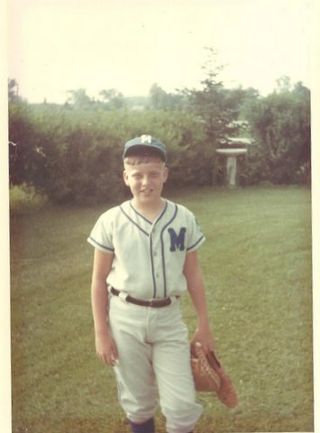 Coincidently, checking through my
calendar of links (see below), I noticed that another baseball writer
Robert Weintraub is at the Decatur Public Library on April 15th to talk about his new book The Victory Season: The End of World
War II and the Birth of Baseball's Golden Age. I
hope Weintraub wrote that the Golden Age actually began in 1945, the
last year that my Chicago Cubs were in the World Series. Little did I know in 1968 (shown here), that the Cubs — a consensus pick for Central Division cellar-dwellers in 2013 — would cause such a lifetime of misplaced loyalty. As Steve Goodman sang in "The Dying Cub Fan's Last Request," my hopes have been "crushed like so many paper beer cups."
Coincidently, checking through my
calendar of links (see below), I noticed that another baseball writer
Robert Weintraub is at the Decatur Public Library on April 15th to talk about his new book The Victory Season: The End of World
War II and the Birth of Baseball's Golden Age. I
hope Weintraub wrote that the Golden Age actually began in 1945, the
last year that my Chicago Cubs were in the World Series. Little did I know in 1968 (shown here), that the Cubs — a consensus pick for Central Division cellar-dwellers in 2013 — would cause such a lifetime of misplaced loyalty. As Steve Goodman sang in "The Dying Cub Fan's Last Request," my hopes have been "crushed like so many paper beer cups."
—– EXTENDED BODY: For those of you not interested in baseball, but prefer lesser blood sports like politics, check out the events at the Carter Library or on the A Cappella bookstore events page. Holy Cow!
Here's a few other book event venues.
The Jimmy Carter Library & Museum
The Georgia Center for the Book
Margaret Mitchell House/Atlanta History Center
Emory University Creative Writing Program and the Carlos Musuem
Georgia State University Creative Writing Events
Also note: GSU is having a special night on April 11th celebrating Five Points Magazine
Local Bookstores
Peerless Books – Alpharetta
—– EXCERPT: —– KEYWORDS: Wichita State Shockers, Atlanta, Wilfred Sheed, Baseball and Lesser Sports, Robert Weintraub —– COMMENT: AUTHOR: facultyrow.com EMAIL: marilynn_dipietro@inbox.com IP: 192.161.174.220 URL: http://www.prweb.com/releases/2012/4/prweb9363288.htm DATE: 10/23/2013 07:20:40 AM Awesome things here. I am very happy to look your post. Thanks so much and I’m taking a look ahead to touch you. Will you kindly drop me a e-mail? —– ——– AUTHOR: Murray Browne AUTHOR EMAIL: murray.browne905@gmail.com TITLE: MARTA Book Club #22: Where Pope Francis Meets Zadie Smith STATUS: Publish ALLOW COMMENTS: 1 CONVERT BREAKS: wysiwyg ALLOW PINGS: 1 BASENAME: marta-book-club-22-where-pope-francis-meets-zadie-smith CATEGORY: MARTA Book Club UNIQUE URL: https://thebookshopper.typepad.com/the_book_shopper_atlantad/2013/03/marta-book-club-22-where-pope-francis-meets-zadie-smith.html DATE: 03/18/2013 07:35:32 AM —– BODY:There's been no shortage of praise for Pope Francis as a passionate preacher and pragmatic man who prefers public transportation to private cars. – CNN, March 15, 2013

Optimistic that someone will finally do something about “mass” transportation, I was motivated to pull together another installment of the MARTA Book Club, a list of what people are reading on Atlanta area buses and trains. His Holiness knows that waiting and waiting for transportation in the grimy underbelly of a city affords the perfect opportunity for reading, self-reflection and practicing patience. It's great that one of our own has gone on to bigger and better things so I am not taking offense that public transportation continues to sound like something for (working) poor, simple-minded, and humble folk. This is in comparison to the majority of commuters in Atlanta who ride their version of the Popemobile every day to work.
Thus inspired, here's a list of what people have been reading since our last installment of the MARTA Book Club:
Cold Hit by Linda Fairstein
Vampires in the Lemon Grove: Stories by Linda Russell
Dark Harbor by Stuart Woods
The Centurion's Wife (Acts of Faith, Book 1) by Janette Oke and Davis Bunn
The Bible (a perennial favorite of the MARTA faithful)
The Joy Luck Club by Amy Tan
Fifty Shades of Grey by E.L. James
Her Sky Cowboy: The Glorious, Victorious Darcys by Beth Ciotta
Beautiful Chaos (Beautiful Creatures) by Kami Garcia and Margaret Stohl
Miracle at Midway by Gordon W. Prange, Donald M. Goldstein and Katherine V. Dillion
White Teeth by Zadie Smith (my contribution)
Books by H.P Lovecraft, Farley Mowat, and David Baldacci.
Zadie Smith's White Teeth (2000) is partially to blame for the lack of titles in MARTA Book Club #22. I have almost finished reading her novel about two “non-traditional” British families living in North London headed by the middle-aged Archie Jones who marries a Jamacian woman half his age and his Muslim Bengali friend, Samad Iqbal who has twin sons — one of which Samad sends back to Pakistan to fortify his Muslim heritage. It is a book that I have found absorbing and her witty prose is rich without being oppressive. The book is full of interwoven short sidebars that add to the completeness of narrative. It's a style and scope that I find similar to Jonathan Franzen, but I certainly think this is a much more enjoyable novel than Freedom, which I did not finish. (I did like Corrections though). Smith's White Teeth takes us into the multicultural world of our own backyard (kind of like riding MARTA) with intellect, grace and humor. And I picked it up for $8 at Books Again in Decatur.
For a complete history of the MARTA Book Club, visit the category link on the right and check out our Sponsor's link on the left for info about Books Again.
—– EXTENDED BODY: —– EXCERPT: —– KEYWORDS: —– ——– AUTHOR: Murray Browne AUTHOR EMAIL: murray.browne905@gmail.com TITLE: From the Mailbox: March 2013 STATUS: Publish ALLOW COMMENTS: 1 CONVERT BREAKS: wysiwyg ALLOW PINGS: 1 BASENAME: from-the-mailbox-book-info-march-2013 CATEGORY: Books as Art as Books UNIQUE URL: https://thebookshopper.typepad.com/the_book_shopper_atlantad/2013/03/from-the-mailbox-book-info-march-2013.html DATE: 03/08/2013 08:10:42 AM —– BODY:
Sometimes personal responsibilities encroach to the point where even blogging has to take a back seat. Without going into details, I just wanted to say I appreciate Jim Simpson filling in last month with his series Stories Within the Story, which I hope will become a regular feature on the blog. Be sure and check the comments that his work inspired.
Despite my attentions being elsewhere, a few other stories have trickled in through the past few weeks. One is that Decatur Arts Alliances is calling for entries for The Book as Art exhibition being held July 19th to September 20th and in conjunction with the 2013 Decatur Book Festival. Regular readers of this blog know it is a subject of interest for me. (See Books as Art As Books link on the right) This will be an opportunity for book fiends and artists to "get their Brian Dettmer on." And if you're having trouble coming up with
 a fresh idea, I have just come into possession a complete set of the 1966 World Book Encyclopedias. Think of the stuff you can build with those volumes. And if you need a large wall unit book case to store them on interim, I have one of those for sale.
If you're looking for more inspiration, check out this link courtesy of one of our readers (SM Wallace) about the work of Frank Halmans or last year's Wallbound exhibit hosted the the Atlanta-Decatur Art Institute.
—– EXTENDED BODY: —– EXCERPT: —– KEYWORDS: —– COMMENT: AUTHOR: german translator adelaide EMAIL: daviddrainey@gmail.com IP: 115.241.206.105 URL: http://www.dammann.com.au/german-translator-adelaide.php DATE: 03/13/2013 12:02:53 PM I totally agree with you that without going into details,I just wanted to say I appreciate Jim Simpson filling in last month with his series Stories Within the Story.Nice blog. —– COMMENT: AUTHOR: Tony Lama Cowboy Boots EMAIL: nicolaijackson@hotmail.com IP: 121.97.205.104 URL: http://www.tonylamaboot.com DATE: 03/15/2013 03:31:20 AM I love Jim Simpson.The overall blog is great. Thanks for sharing. —– ——– AUTHOR: Murray Browne AUTHOR EMAIL: murray.browne905@gmail.com TITLE: Stories Within the Story #4: Monastery STATUS: Publish ALLOW COMMENTS: 1 CONVERT BREAKS: wysiwyg ALLOW PINGS: 1 BASENAME: stories-within-the-story-4-at-the-monastery CATEGORY: Jim Simpson Postings UNIQUE URL: https://thebookshopper.typepad.com/the_book_shopper_atlantad/2013/02/stories-within-the-story-4-at-the-monastery.html DATE: 02/24/2013 08:58:26 AM —– BODY:
by Jim Simpson
Occasionally, I attend the Sunday teaching and meditation sessions at The Drepung Loseling Buddhist Monastery in Chamblee with my wife and daughter. Near the lobby there is a table loaded with used books, hardcovers and paperbacks covering all topics: contemporary and classic fiction, non-fiction, self-help guides, poetry, Buddhist writings and Christian Bibles. All books are available for purchase with a one- to three-dollar donation. I picked up a 1954 Scribners trade paperback copy of The Sun Also Rises by Ernest Hemingway, one of my favorite novels and one I’ve read many times. What struck me most about the book was the sheer number of post-it notes stuck onto nearly every page — the book appears to be exploding! Most of the notes refer to the symbolism of the drinking, the impotence, the fights, the bulls, the irony, the pity, and more drinking. But it was the final notation shown here that made me laugh.
Well?” indeed.
Editor's Note: Jim Simpson is an award-winning fiction writer and freelance music critic. A native of the wilds of Florida's Gulf Coast, he now resides on the scruffy fringes of Atlanta. He has been at work on his first novel for longer than he originally planned, and if all goes well the book should be in stores sometime before his death.
—– EXTENDED BODY: —– EXCERPT: —– KEYWORDS: —– COMMENT: AUTHOR: german english translator EMAIL: daviddrainey@gmail.com IP: 115.240.1.253 URL: http://www.dammann.com.au/ DATE: 03/06/2013 04:30:34 AM Thanks for the information that all books are available for purchase with a one- to three-dollar donation.So that willing person can get it or is informed through this post. —– ——– AUTHOR: Murray Browne AUTHOR EMAIL: murray.browne905@gmail.com TITLE: Stories Within the Story #3: The Bookmark STATUS: Publish ALLOW COMMENTS: 1 CONVERT BREAKS: wysiwyg ALLOW PINGS: 1 BASENAME: stories-within-the-story-3-the-bookmark CATEGORY: Jim Simpson Postings UNIQUE URL: https://thebookshopper.typepad.com/the_book_shopper_atlantad/2013/02/stories-within-the-story-3-the-bookmark.html DATE: 02/22/2013 06:40:47 AM —– BODY:
by Jim Simpson
I found this bookmark in a 1940s copy of the complete works of John
Keats at the Book Nook on N. Druid Hills Road in Decatur. Written on the back of the bookmark are notes that mirror, to a
much lesser extent, Keats’ own battles with ill health — his issues,
unfortunately, proved to be fatal.
I
imagine this person reading Keats while on a cruise, jotting down
helpful hints at combating seasickness. It's a good thing it was Keats
and not Byron: “Roll on, thou deep and dark blue Ocean — roll!” Also, I
believe this bookmark is from the Borders Book Shop that was at the
corner of Roswell and Piedmont, and eventually moved to the corner of
Peachtree and Wieuca, finally closing a few years ago. (If any
careful readers know for sure, please leave a comment.)
I don’t know if Sarah found David’s little note amusing or not, but I don’t really get it. Is it actually a joke? David either truly liked rap music and was upset that “white people” weren’t properly credited with creating the genre when it was first played to accompany square dancing, or he was miffed that some “black people” claim that Elvis stole rock ‘n’ roll from them. Was “David” the note-writer’s real name, or was he playfully crediting the note to Dickens’ eponymous character in an attempt to endear himself to the gorgeously aloof and unattainable Sarah? Upon closer inspection, the combinations are quite Biblical, and the shouted advice is sound: “DO NOT LOSE.”
—– EXCERPT: —– KEYWORDS: —– ——– AUTHOR: Murray Browne AUTHOR EMAIL: murray.browne905@gmail.com TITLE: Stories Within the Story #2: Kudzu Antiques Market STATUS: Publish ALLOW COMMENTS: 1 CONVERT BREAKS: wysiwyg ALLOW PINGS: 1 BASENAME: stories-with-the-story-2-kudzu-antiques-market CATEGORY: Jim Simpson Postings UNIQUE URL: https://thebookshopper.typepad.com/the_book_shopper_atlantad/2013/02/stories-with-the-story-2-kudzu-antiques-market.html DATE: 02/20/2013 06:34:57 AM —– BODY:By Jim Simpson
Located just down the street from the DeKalb Farmer’s Market, this antique shop features vintage clothing, furniture, vinyl albums, books, objet d’art, musical instruments, old-timey soda pop, jewelry — you name it, you can find it here. I tend to seek out the books, naturally. I’ve found partial collections of the Harvard Classics from the early 20th century, French biographies from the late 19th century, and this:
 A shorthand dictionary published in 1919. I’d always been intrigued by shorthand ever since a good friend took a class years ago, but I’d never studied it. Could this little book help me learn now after all these years? My own handwriting is so terrible, it probably wouldn’t be worth it. As I flipped through the pages, an index card fluttered out: “Margie — I found this little volume at the Book Sale in the park – thought it might be ‘interesting’ if not helpful. John.” Another story. Which park? What Book Sale? Why would Margie find this ‘interesting’? Did John have ulterior motives?
Also at Kudzu, I found a copy of The Herbert Huncke Reader.
Huncke was a writer and poet, and a member of the Beat Generation and is reputed to have coined the term. Fittingly, I found this business card tucked inside the book. It’s from Caffe Vivaldi in the Village in NYC. Looking at the place’s website, it appears to be as stylish as Huncke himself (he died in 1996), but not as gritty and working-class as many of the Beats.
—– EXCERPT: —– KEYWORDS: Herbert Huncke, The Beats —– COMMENT: AUTHOR: Snazal Com EMAIL: IP: 1.22.230.197 URL: http://profile.typepad.com/snazal DATE: 03/01/2013 02:06:28 AM Nice blog….check out i fount Most rarest antiques books. —– COMMENT: AUTHOR: Personal Injury Attorney Anchorage EMAIL: nicolaijackson@hotmail.com IP: 108.62.70.28 URL: http://www.denalilaw.com/anchorage-personal-injury-attorneys DATE: 03/14/2013 06:27:18 AM I love antiques and I think this book will be perfect for me. 🙂 —– ——– AUTHOR: Murray Browne AUTHOR EMAIL: murray.browne905@gmail.com TITLE: Stories Within the Story #1: Beginnings STATUS: Publish ALLOW COMMENTS: 1 CONVERT BREAKS: wysiwyg ALLOW PINGS: 1 BASENAME: stories-within-the-story-1 UNIQUE URL: https://thebookshopper.typepad.com/the_book_shopper_atlantad/2013/02/stories-within-the-story-1.html DATE: 02/17/2013 09:53:49 PM —– BODY:by Jim Simpson
It all began with this photo.
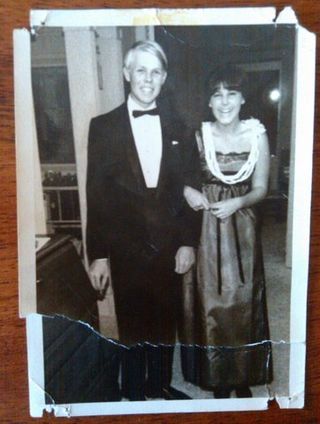
The handwritten caption in black magic marker on the back reads “Tom and Amy – April ‘65.” They appear to be in their late teens or early 20s, perhaps attending a school prom or a wedding. The background suggests the back room of a country club or a school — you can see an upright piano in the foreground. Amy seems positively giddy while Tom oozes confidence as he discreetly tries to hold his cigarette out of camera shot without appearing ashamed — perhaps his family didn’t know he smoked yet (because everyone eventually started smoking back then).
I found this tucked into the pages of a 1944 hardcover copy of W. Somerset Maugham’s The Razor’s Edge, a book I picked up in 1989 at a used bookstore in St. Petersburg, Florida, in my late 20s, and it’s one I still own. Yes, I am the type of shopper who finds it difficult to part with certain books. I wonder where Tom and Amy are now, if they married each other, if Tom went into finance, if his family had money and whether Amy really loved him or was simply glad to have married a rich man. Or, as in Maugham’s novel, did Tom go off to war and did his experiences in combat affect him as they did Larry Darrell in The Razor’s Edge, seeking enlightenment in India and elsewhere, his interest in money waning to nothing.
I take this book off the shelf once or twice a year, slip the photo out and look at it, and I wonder. Stories within a story. To me, it’s magic.
This is one of the reasons why I am a book shopper: you never know what you’ll find between the covers of used books. Over the years I’ve found love letters, airline ticket stubs, postcards, cookie crumbs (I hope the brown stuff was chocolate chips), unopened (thankfully) band aids, and postage stamps, all tucked between the many yellowed and brittle pages.
Editor's Note: Jim Simpson is an award-winning fiction writer and freelance music critic. A native of the wilds of Florida's Gulf Coast, he now resides on the scruffy fringes of Atlanta. He has been at work on his first novel for longer than he originally planned, and if all goes well the book should be in stores sometime before his death.
—– EXTENDED BODY: —– EXCERPT: —– KEYWORDS: —– ——– AUTHOR: Murray Browne AUTHOR EMAIL: murray.browne905@gmail.com TITLE: STATUS: Publish ALLOW COMMENTS: 1 CONVERT BREAKS: wysiwyg ALLOW PINGS: 0 BASENAME: throughout-this-week-jim-simpson-kicks-off-a-new-idea-for-the-blog-called-the-story-within-the-story-where-he-ruminates-about UNIQUE URL: https://thebookshopper.typepad.com/the_book_shopper_atlantad/2013/02/throughout-this-week-jim-simpson-kicks-off-a-new-idea-for-the-blog-called-the-story-within-the-story-where-he-ruminates-about.html DATE: 02/17/2013 09:41:15 PM —– BODY:Throughout this week Jim Simpson kicks off a new idea for the blog called "Stories Within the Story" where he ruminates on the bookish flotsam of others that he has discovered in his literary hunting and gathering at local bookstores and antique shops. As Simpson writes, "it's for those of you who enjoy discovering that rare used book on a dusty local shelf, where the surprise 'found objects' inside are sometimes just as interesting as the book itself." (If you have any stories you wish to share, contact the blog or post them in comments.)
—– EXTENDED BODY: —– EXCERPT: —– KEYWORDS: Jim Simpson, The Story Within the Story —– COMMENT: AUTHOR: Bonnie EMAIL: bonnybeedesigns@aol.com IP: 164.111.99.108 URL: DATE: 02/19/2013 04:57:44 PM My favorite was a book of CS Lewis devotionals I picked up at a Nashville bookstore that had a gift note written by a former pastor of mine. I guess whoever he gave it to didn’t enjoy it but I sure did. —– COMMENT: AUTHOR: Bonnie EMAIL: bonnybeedesigns@aol.com IP: 164.111.99.108 URL: DATE: 02/19/2013 04:58:06 PM Oh and i like this idea for the blog! —– COMMENT: AUTHOR: Wallace EMAIL: smwallace56@gmail.com IP: 96.32.82.108 URL: DATE: 03/04/2013 11:28:53 PM This is a fine idea. The Story Within the Story is one many collectors know well. I have several but my favorite are the two weeks worth of menus typed on small order pad paper from a restaurant in Guatemala found in a book on Guatemala published in the 1930’s. —– ——– AUTHOR: Murray Browne AUTHOR EMAIL: murray.browne905@gmail.com TITLE: Store of Yarns STATUS: Publish ALLOW COMMENTS: 1 CONVERT BREAKS: wysiwyg ALLOW PINGS: 1 BASENAME: store-of-yarns CATEGORY: Bookstores UNIQUE URL: https://thebookshopper.typepad.com/the_book_shopper_atlantad/2013/02/store-of-yarns.html DATE: 02/09/2013 04:31:56 PM —– BODY:
 Earlier this month Denise and I drove
over slick roads to Chattanooga to visit some Knoxville friends who
were willing to meet us halfway (that's what friends do). Our
friends, Maggie, Judy, Susan, and Susie belong to a book group
that has been together for over 20 years. Of course, I know that
I am always welcome to join the conversation in these reunions, but I
am also free to leave for a few hours for some personal guy time so
the women can catch up. On my way to see Quentin Tarantino's Django
Unchained (a decent movie along the order of Inglourious
Basterds, but not one of his best works like Jackie Brown
or Pulp Fiction), I stopped by a used book store near the
Chattanooga Aquarium called All Books.
Earlier this month Denise and I drove
over slick roads to Chattanooga to visit some Knoxville friends who
were willing to meet us halfway (that's what friends do). Our
friends, Maggie, Judy, Susan, and Susie belong to a book group
that has been together for over 20 years. Of course, I know that
I am always welcome to join the conversation in these reunions, but I
am also free to leave for a few hours for some personal guy time so
the women can catch up. On my way to see Quentin Tarantino's Django
Unchained (a decent movie along the order of Inglourious
Basterds, but not one of his best works like Jackie Brown
or Pulp Fiction), I stopped by a used book store near the
Chattanooga Aquarium called All Books.
By checking online reviews I was forewarned that this is a polarizing book store. Some people are appalled by the clutter and lack of services; others react positively. Not that I am that surprised by stories of surly book store owners and employees. I once published an essay entitled “Book Lovers Are Not Necessarily People Lovers,” the premise of which was that to some bookstore staff books are more interesting than people, and it can take a lot to get attention in those places.
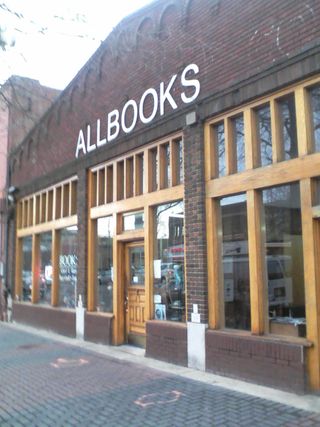 Eighty-year-old Polly Henry owns All
Books, and though books may been a former passion, that interest has
clearly shifted to textiles. The book store is covered in yarn,
crocheted hats, scarves, weaving machinery and (I am not going to
mislead) a selection of books that can described most generously as
antiquated. The only book that intrigued me was Lance Armstrong's
It's Not About the Bike: My Journey Back to Life (2001),
mainly because I wondered if had been heavily discounted due to his
fall from grace. There may have been something else worthy of my
attention, but based on my initial findings, I didn't want to risk
being late for Django.
Eighty-year-old Polly Henry owns All
Books, and though books may been a former passion, that interest has
clearly shifted to textiles. The book store is covered in yarn,
crocheted hats, scarves, weaving machinery and (I am not going to
mislead) a selection of books that can described most generously as
antiquated. The only book that intrigued me was Lance Armstrong's
It's Not About the Bike: My Journey Back to Life (2001),
mainly because I wondered if had been heavily discounted due to his
fall from grace. There may have been something else worthy of my
attention, but based on my initial findings, I didn't want to risk
being late for Django.
Upon returning to the hotel, I told our friends about the store (witholding my description of the Tarantino blood fest) and the next day before returning to Knoxville they spent hours there, being (as Judy described) “intoxicated by fiber.” I will leave it to them to comment more about the store.
My only remaining question is: Do I still get book shopper recommendation points for leading them to a bookstore, even though it resulted only in the purchase of yarn and knitted products?
Photo credit for inside of store: Judy Barnette
—– EXTENDED BODY: —– EXCERPT: —– KEYWORDS: All Books Chattanooga, Quentin Tarantino, Django Unchained, Book stores and yarn shops —– COMMENT: AUTHOR: Bonnie EMAIL: bonnybeedesigns@aol.com IP: 164.111.99.108 URL: DATE: 02/13/2013 02:52:52 PM books and yarn? yes please…..now if only they had books about yarn/fiber/crafts too! —– ——– AUTHOR: Murray Browne AUTHOR EMAIL: murray.browne905@gmail.com TITLE: Notable Atlanta Book Events – February 2013 STATUS: Publish ALLOW COMMENTS: 1 CONVERT BREAKS: wysiwyg ALLOW PINGS: 1 BASENAME: notable-atlanta-book-events-february-2013 UNIQUE URL: https://thebookshopper.typepad.com/the_book_shopper_atlantad/2013/01/notable-atlanta-book-events-february-2013.html DATE: 01/29/2013 07:51:08 AM —– BODY:
Instead of monthly calendar, I am providing the links (at the end of this posting) to build your own calendar for reasons I explained earlier. This is just a reminder of where I look for area book events and you can too. It's just click away. If you do right now, you'll know that Richard Ford and Colson Whitehead will be in Atlanta in the month of February.
Unfortunately by the time you read this you probably will have missed Steve Wozniak, the co-founder of Apple Computer who is at Georgia State University. At his lecture, I wonder if Wozniak would sign a copy of Walter Issacson's Jobs, the lengthy biography of the other co-founder, Steve Jobs. In Issacson's fine book, which I almost finished last year, Wozniak comes off as a decent, likeable and brilliant guy (in direct contrast to Jobs), so he might be cool and sign it.
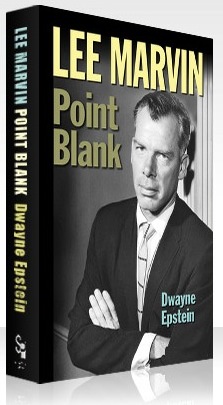 Another intriguing possibility is the
book signing of Dwayne Epstein's biography of Lee Marvin entitled
Point Blank. The event takes place at the Plaza Theatre, (an A
Cappella Bookstore Event) which includes a showing of Marvin's
Oscar-winning 1965 performance in Cat Ballou, which stars Jane Fonda
as well. I checked my copy of David Thomson's The New Biographical
Dictionary of Film (a fine reference book) and who writes this
about Marvin:
Another intriguing possibility is the
book signing of Dwayne Epstein's biography of Lee Marvin entitled
Point Blank. The event takes place at the Plaza Theatre, (an A
Cappella Bookstore Event) which includes a showing of Marvin's
Oscar-winning 1965 performance in Cat Ballou, which stars Jane Fonda
as well. I checked my copy of David Thomson's The New Biographical
Dictionary of Film (a fine reference book) and who writes this
about Marvin:
—– EXTENDED BODY:He had such a way of looking—gazing, even—when blank hostility faded into hopeless desire…Marvin was so strong, he leaves alleged rocks like Wayne and Schwarznegger looking artificial.
Here's a few other book event venues.
The Jimmy Carter Library & Museum
The Georgia Center for the Book
Margaret Mitchell House/Atlanta History Center
Emory University Creative Writing Program and the Carlos Musuem
Georgia State University Creative Writing Events
Local Bookstores
Peerless Books – Alpharetta
—– EXCERPT: —– KEYWORDS: Steve Wozniak, Colson Whitehead, Richard Ford, Atlanta Book Events —– ——– AUTHOR: Murray Browne AUTHOR EMAIL: murray.browne905@gmail.com TITLE: The Prose on Earl Weaver STATUS: Publish ALLOW COMMENTS: 1 CONVERT BREAKS: wysiwyg ALLOW PINGS: 1 BASENAME: the-prose-on-earl-weaver CATEGORY: Baseball UNIQUE URL: https://thebookshopper.typepad.com/the_book_shopper_atlantad/2013/01/the-prose-on-earl-weaver.html DATE: 01/20/2013 10:43:50 PM —– BODY:
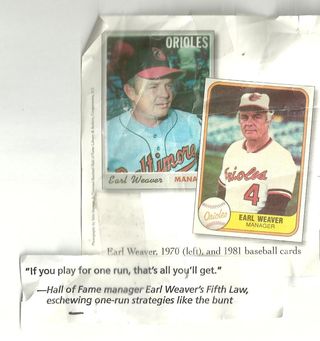 Friday's passing of Hall of Fame
manager Earl Weaver struck a book shopping chord with me as soon as I
heard the news on sports radio. Although St. Louis Cardinal
Hall-of-Famer (player and nice guy) Stan the Man Musial also died
this weekend, it is a quote from the crusty Weaver, who managed the
Baltimore Orioles for 17 years, that I have taped near my desk,
which reads: “If you play for one run, that's all you'll get.”
Friday's passing of Hall of Fame
manager Earl Weaver struck a book shopping chord with me as soon as I
heard the news on sports radio. Although St. Louis Cardinal
Hall-of-Famer (player and nice guy) Stan the Man Musial also died
this weekend, it is a quote from the crusty Weaver, who managed the
Baltimore Orioles for 17 years, that I have taped near my desk,
which reads: “If you play for one run, that's all you'll get.”
No matter what is written about Weaver, it won't match the prose of Tom Boswell, a sports columnist for The Washington Post. Boswell has already written a couple of eulogy-columns about Weaver, but some of the best anecdotes about Weaver come from Boswell's two collections of pieces How Life Imitates the World Series (1982) and Why Time Begins on Opening Day (1985). I am dumbfounded that I cannot find my copy of the How Life book (did I loan it out to someone, sell it?) , but it contains many chapters about the great Oriole teams on the 70s (Brooks and Frank Robinson, Boog Powell, Mike Cuellar) that Weaver managed. The Orioles were a juggernaut and Boswell devotes many chapters to Weaver strategy (one of the first managers to platoon players based on lefty-righty matchups) and managerial style, which was described as (if I can remember correctly) “primal scream therapy.”
In the chapter “Palmer vs. Palmer” in the Opening Day book, Boswell writes about the enigmatic Baltimore Hall of Fame Pitcher (and Jockey Ad spokesperson) Jim Palmer and his long contentious relationship with the Oriole skipper – even though after baseball, Weaver and Palmer briefly shared a broadcast booth. Palmer once said that all Weaver knew about pitching was “that he couldn't hit it” – a reference to Weaver's baseball playing career, which never included a stint in the majors. Weaver thought Palmer was a hypochondriac and a whiner and said that when he wanted to talk Palmer, “I'll send (Oriole pitching coach) Ray Miller to drag him back by his diaper.”
—– EXTENDED BODY:
Returning to the aformentioned Weaver's quote about playing for one run, refers to the intricacies of baseball. Basically, Weaver loathed the strategy of bunting runners into scoring position and surrendering an out because he thought such a strategy eliminated the chance for a big inning (the three-run homer). Weaver managed his last game in 1986 long before baseball statistics had become sophisticated as they are today. Weaver turned out to be correct. Sacrifice bunting does lessen a team's chances at a big inning and big innings usually lead to victories.
Not that I live my life that way, playing for the big inning, but Weaver's quote always does serve as a reminder that playing things safe or conservatively (or writing safely, conservatively, worrying too much about pissing people off) is okay, but if you don't try to something bold once in a while in your life or your prose – well, one run is all you are ever going to get.
—– EXCERPT: —– KEYWORDS: Earl Weaver, obituary, Tom Boswell, Why Time Begins on Opening Day, How Life Imitates the World Series, Jim Palmer —– COMMENT: AUTHOR: Rube Ambler EMAIL: rube@atlalist.com IP: 24.30.96.234 URL: http://atlalist.com DATE: 01/25/2013 04:58:49 PM I had the pleasure of meeting Thomas Boswell many years ago. He autographed my copy of “Life Imitates.” We spoke at length about the great Oriole teams of the 70s and what we both considered at the time to be the great unlikelihood that Washington, D.C. would ever again field an MLB team. We were wrong on that latter point. I can only second your recommendation of these two great books and Mr. Boswell’s work in general (he is great on golf as well). Love the baseball card shots as well. Great post Murray! We’re still reading.. —– ——– AUTHOR: Murray Browne AUTHOR EMAIL: murray.browne905@gmail.com TITLE: Mini-review: Claire Bidwell Smith’s Decatur Reading STATUS: Publish ALLOW COMMENTS: 1 CONVERT BREAKS: wysiwyg ALLOW PINGS: 1 BASENAME: mini-review-claire-bidwell-smiths-decatur-reading CATEGORY: Book Reviews CATEGORY: Jim Simpson Postings CATEGORY: Local Reviews UNIQUE URL: https://thebookshopper.typepad.com/the_book_shopper_atlantad/2013/01/mini-review-claire-bidwell-smiths-decatur-reading.html DATE: 01/13/2013 08:51:39 PM —– BODY:
By Jim Simpson
Where & When: Decatur Public Library Auditorium on January 8, 2013. Sponsored by the Georgia Center for the Book.
Attendance: ~100 people, many of whom were family and friends of the author.
 What Claire Bidwell Smith Read: Nearly a dozen pages from her debut book, The Rules of Inheritance, a “grief memoir” as she calls it, about her life from the time she was 14 when both of her parents were diagnosed with cancer, until 2011. (The book was published in February 2012; this reading coincided with the paperback release.) The author, an Atlanta native who grew up in Sandy Springs, would be parentless by the time she was 25 years old. The book jumps around in time covering a period of roughly 18 years and is divided into five parts, following Elisabeth Kubler-Ross’ five stages of grief. The excerpt she read takes place in 2003 when she is 25 years old and on assignment in the Philippines for Student Traveler magazine in Los Angeles. She is on her way to the remote island of Malapascua to dive with thresher sharks. This episode is one of many describing semi-dangerous and questionable decisions on Claire’s part (destructive relationships and alcohol abuse, to name but two) that she will later discover are subconscious attempts to bring her dead parents back in order to save her. This diving trip is a climactic event because, as she and her guide are descending into 80 feet of dark, shark-filled water, she suddenly cancels the dive and surfaces. With tears streaming down her face, she sits slumped in the front of the boat heading back to shore. “This is the very place — with my tear-soaked face, at the front of this little boat in the middle of the great Pacific Ocean — where I ind a truth that I will test over and over in my life. Nothing is ever going to bring either of them back.” Some parts of the book are almost too much to bear, but you find yourself forging ahead, cheering her on, hoping she will be okay in the end.
Why I Went: Claire and I have both written for the literary collective The Nervous Breakdown for six years, and I have always admired her writing.
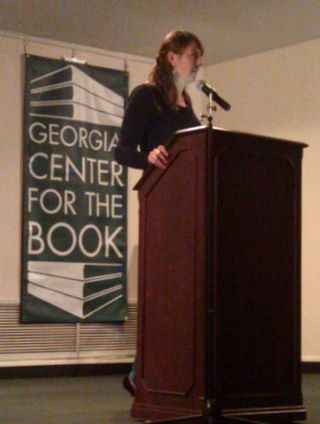 Q & A: Questions ranged from those regarding grief (she is a licensed therapist), writing routines, the book title’s origin, to compliments about Claire’s delivery and voice during the reading. I thought she seemed a bit stiff and nervous, but that could be attributed to the hometown crowd and sheer number of family and close childhood friends in the audience; she seemed to be trying to keep her emotions in check, which makes perfect sense.
Question I Didn’t Get To Ask Because Time Ran Out But Asked Her When She Signed My Book: “I’ve never been to L.A., but I imagine there are a bunch of motorcycles around. Do you and your husband, (Greg Boose, a freelance/ghost writer) still go around touching motorcycles that don’t belong to you?” Claire responded, “Danger Touch? Not lately, but we were disappointed that it never caught on.” We were referring to a game she and Greg played during a cross-country correspondence (Claire in L.A., Greg in Chicago, the two meeting as writers for The Nervous Breakdown). He invented a game that involved taking cell phone pictures of his hand reaching out and touching strangers’ motorcycles on the street and sending them to Claire; she in turn would do the same and send them to him, and the person with the most “danger touches” would win the game.
—– EXTENDED BODY:
Did I Buy Something?: Yes. I bought the paperback copy of her book. Eagle Eye Bookstore was offering copies of the paperback and hardcover for sale. By the end of the night, they had sold every copy. While holding her six-month-old daughter in one arm, Claire signed my copy: “To Jim — Danger Touch! With love, Claire.”
Worth Mentioning: This was an emotional signing as it was a homecoming of sorts for Claire. She grew up in Atlanta, and many of her childhood friends as well as friends of her parents were there. Pearl McHaney, Claire’s high school English teacher at the Galloway School here in Atlanta, gave a very emotional and heartfelt introduction, recalling Claire as the school poet, even parsing her name: Claire — clarity, clear vision. Bidwell — good will, I bid you well. Smith — craft, wordsmith. I sat next to an older man who, I would later learn, is Claire’s half brother (twice her age), a son from her father’s first marriage. After the reading and signing, I rode the elevator up to the parking deck with a regal-looking woman in her 70s clutching a hardcover copy of the book, and when I asked her what she thought of the reading she said she loved it, and has known Claire since she was a baby. As the woman and I parted ways, a wistful smile on her face, I felt as though I’d been privy to a sort of family reunion. In essence, I guess it had been.
Editor's Note: Jim Simpson is an award-winning fiction writer and freelance music critic. A native of the wilds of Florida's Gulf Coast, he now resides on the scruffy fringes of Atlanta. He has been at work on his first novel for longer than he originally planned, and if all goes well the book should be in stores sometime before his death. (This is his first posting of what I hope is many more.)
—– EXCERPT: —– KEYWORDS: Claire Bidwell Smith, Rules of Inheritance, Pearl McHaney, Jim Simpson —– ——– AUTHOR: Murray Browne AUTHOR EMAIL: murray.browne905@gmail.com TITLE: The Do-It-Yourself Atlanta Area Book Event Calendar STATUS: Publish ALLOW COMMENTS: 1 CONVERT BREAKS: wysiwyg ALLOW PINGS: 1 BASENAME: the-do-it-yourself-atlanta-area-book-event-calendar UNIQUE URL: https://thebookshopper.typepad.com/the_book_shopper_atlantad/2013/01/the-do-it-yourself-atlanta-area-book-event-calendar.html DATE: 01/06/2013 10:29:07 AM —– BODY:

2013 marks another change to the scope of the blog as I have decided to punt on doing a monthly calendar of book events. It wasn't doing the calendar research so much, as that I had to process all the events and then avoiding cutting and pasting links with blurby descriptions, which is not my style. It was time consuming and I am now devoting energies to other writing projects besides the blog. Besides I also discovered that even after making contact with bookstores, libraries, universities, book publishers etc. over the years that those in charge of “spreading the word” either didn't think the blog was worth the bother (understandly our readers are small in numbers, but mighty in influence) or more likely, they just lacked the wherewithal to follow through.
Besides, I can be biased about my promotional preferences and admittedly, I have missed paying attention to some writers and local venues that deserved a shout out. Also, these times and venues can change at the last minute so I usually just provided links of information anyway.
Instead of monthly calendar, I have provided the links I checked to build the calendar. From now on, I will remind you from time to time where I look for Atlanta area book events and you can just click away. If you do that right now, you'll know that Richard Ford and Colson Whitehead are coming soon as well as Elmore Leonard, Dave Barry, and former Vice President Al Gore. Here are the links. Happy hunting.
- A Cappella Bookstore Event Page – I consider Frank Reiss, the owner of A Cappella, as the Ed Sullivan of book event promoters (Remember Ed got us The Beatles, man). Check his store's events page for major literary acts in the area.
- The Jimmy Carter Library & Museum
- The Georgia Center for the Book
- The Auburn Avenue Library
- SCAD Ivy Hall Writers Series
- Margaret Mitchell House/Atlanta History Center
- Emory University Creative Writing Program and The Carlos Musuem
- Georgia State University Creative Writing Events
Local Bookstores
- Eagle Eye Books
- Claris Books and More
- Peerless Books – Alpharetta
P.S. And finally, hats off to those who
attend events. It takes a lot of effort to attend an event at night
or on the weekend. I am tired at the end of the work day/week (can
you hear the sound of my ass dragging on the ground?), so I
understand. (Banner artwork designed by Caitlin Salmon.)
—– EXTENDED BODY: —– EXCERPT: —– KEYWORDS: —– ——– AUTHOR: Murray Browne AUTHOR EMAIL: murray.browne905@gmail.com TITLE: End-of-the-Year Quote STATUS: Publish ALLOW COMMENTS: 1 CONVERT BREAKS: wysiwyg ALLOW PINGS: 1 BASENAME: end-of-the-year-quote UNIQUE URL: https://thebookshopper.typepad.com/the_book_shopper_atlantad/2012/12/end-of-the-year-quote.html DATE: 12/31/2012 11:52:44 AM —– BODY:
"The old year slipped away, lamented by no one."
 This quote comes from Rick Atkinson's book, The Day of Battle: The War in Sicily and Italy, 1943-1944. It succinctly captures the sentiments of year that one would prefer to forget than review. It happens. You move on.
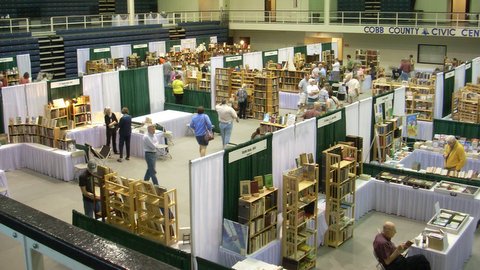
One of my holiday traditions like
overeating, amassing credit card debt and deflating inflatable Christmas decorations is to reflect back on what book events I
attended that were the most fun or interesting. I really didn't get
out to many book events
 in 2012, but I didn't see many plays, movies
or music concerts either. I did attend a few readings: Isabell
Wilkerson, Charles Seabrook, and Janisee Ray at the Decatur Book
Festival; Kevin Wilson and Robert Craig at the Decatur Public Library
and Rob Walker and Lawrence Millman at Emory University.
in 2012, but I didn't see many plays, movies
or music concerts either. I did attend a few readings: Isabell
Wilkerson, Charles Seabrook, and Janisee Ray at the Decatur Book
Festival; Kevin Wilson and Robert Craig at the Decatur Public Library
and Rob Walker and Lawrence Millman at Emory University.
Sometimes there is a significant time lapse between an author event and reading his or her book. For example, I saw Charles Mann at Emory in 2011 promoting 1493: Uncovering the World Columbus Launched, and am just now– over the holidays – reading one of his book's 1491: New Revelations of the America's Before Columbus. A fascinating book even though talking about the diseases that wiped out millions of people in Western Hemisphere after Columbus arrived doesn't make for the best yuletide dinner conversation.
In order to supplement my meager book
event attendance his year, I did attend a couple of book art shows:
Brian Dettmer's work (still at MOCA until January 5th),
and the book art exhibit at the Art Insitute of Atlanta-Decatur back
in May. On a lesser artistic scale there was the Georgia Antiquarian
Booksellers Association (GABA) Fine and Collectible Book Fair, which
was held last September in Marietta. Not only did I do some book
shopping there, but I enjoyed chatting with vendors like the folks
at Kouyoumdjian Miniature Books
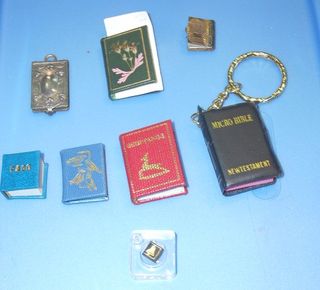 of Columbia, Indiana, Lee and Bob
Linn of Ridge Books in Calhoun Georgia who shared some their interest
African-American fiction writer Donald Goins (Coincidently, I was reading Charles
Perry's Portrait of a Young Man Drowning at the time), and
Josh Niesse of Underground Books of Carollton, Georgia, who had a
selection of book related novelties. For an hour, it felt great to be
among “my people.” I am a book shopper; they are book shoppers
too even though they pretend to be book sellers.
of Columbia, Indiana, Lee and Bob
Linn of Ridge Books in Calhoun Georgia who shared some their interest
African-American fiction writer Donald Goins (Coincidently, I was reading Charles
Perry's Portrait of a Young Man Drowning at the time), and
Josh Niesse of Underground Books of Carollton, Georgia, who had a
selection of book related novelties. For an hour, it felt great to be
among “my people.” I am a book shopper; they are book shoppers
too even though they pretend to be book sellers.
It is for this reason, I am awarding the less-than-coveted Book Shopper Best Local Event (That I Attended) to the 2012 GABA Fine and Collectible Book Fair. GABA joins a distinguished list that includes Andisheh Nouree (2011) the four poets Kevin Young, Thomas Lux, David Bottoms, and David Kirby (2010), the late E. Lynn Harris (2009) and Chandler Burr (2008).
—– EXTENDED BODY: —– EXCERPT: —– KEYWORDS: —– COMMENT: AUTHOR: holiday decorations EMAIL: stefanandrus@gawab.com IP: 173.213.98.46 URL: http://cheapholidaydecorations.com/ DATE: 09/18/2013 01:37:12 PM It’s perfect time to make some plans for the long run and it is time to be happy. I have read this put up and if I may I want to counsel you some attention-grabbing issues or tips. Maybe you can write subsequent articles referring to this article. I want to learn more issues about it! —– ——– AUTHOR: Murray Browne AUTHOR EMAIL: murray.browne905@gmail.com TITLE: Dettmer at the MOCA GA STATUS: Publish ALLOW COMMENTS: 1 CONVERT BREAKS: wysiwyg ALLOW PINGS: 1 BASENAME: dettmer-at-the-moca-ga CATEGORY: Books as Art as Books UNIQUE URL: https://thebookshopper.typepad.com/the_book_shopper_atlantad/2012/12/dettmer-at-the-moca-ga.html DATE: 12/10/2012 09:32:14 PM —– BODY:
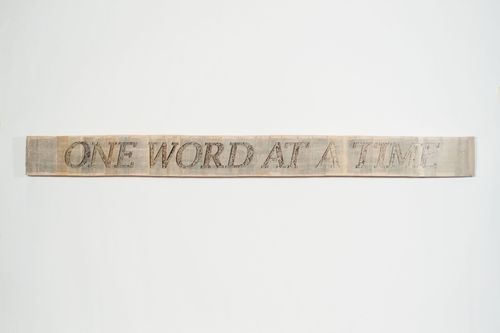
On my lunch hour last week I drove over to see Brian Dettmer's art exhibit at the Museum of Contemporary Art of Georgia in Atlanta. I am always interested in new ways to re-purpose used books (beyond reading them). I had my first taste of Dettmer's work at New Worlds to Conquer exhibit at Saltworks Gallery last year. This new exhibit, which contains fifteen pieces, shares some of the similarities in the New Worlds pieces in the way Dettmer carves up older illustrated books to reveal new meanings about the subject manner and richness that the printed word provides.
 What I enjoyed about Dettmer's current
exhibit of works that he completed this year is the variety. Yes, he
has the “standard” carved out illustrated encyclopedias like the
volumes of Encyclopedia Britannica shown here in Tower 1 (shown at the left , but
he also has added some new interpretations. An entire wall is devoted
to Altered States, where
Dettmer has cut up and reassembled 50 pages of the 50 state flags,
framed them, and placed them in the shape of the United States map.
There is also a huge print entitled Chaos where
Dettmer shows how the word, “Chaos” is visually linked to other
words. Then there is Emergency Exit, which
is a fire door made of partially charred paperback books. In One
Word at a Time, (shown at the
top), a series of paperback books are glued together.
What I enjoyed about Dettmer's current
exhibit of works that he completed this year is the variety. Yes, he
has the “standard” carved out illustrated encyclopedias like the
volumes of Encyclopedia Britannica shown here in Tower 1 (shown at the left , but
he also has added some new interpretations. An entire wall is devoted
to Altered States, where
Dettmer has cut up and reassembled 50 pages of the 50 state flags,
framed them, and placed them in the shape of the United States map.
There is also a huge print entitled Chaos where
Dettmer shows how the word, “Chaos” is visually linked to other
words. Then there is Emergency Exit, which
is a fire door made of partially charred paperback books. In One
Word at a Time, (shown at the
top), a series of paperback books are glued together.
I am not even going to pretend that I can interpret the works as art or adequately describe them, but I would encourage those of you (and I know you are out there) that appreciate the possibilities of the printed word to check out the Dettmer's exhibition, which is at the MOCA between now and January 5, 2013. The gallery is located in an enclave of antique stores in the Tula Art Center complex, so you can make an afternoon of it, instead of just taking a longer lunch hour.
Note: Images courtesy of Brian Dettmer.
—– EXTENDED BODY: —– EXCERPT: —– KEYWORDS: Brian Dettmer, Elemental, MOCA, Museum of Contemporary Art of Georgia, Saltworks, Atlanta, Altered States, Chaos —– COMMENT: AUTHOR: Wallace EMAIL: smwallace56@gmail.com IP: 96.32.82.108 URL: DATE: 03/05/2013 01:43:36 PM I am a fan of Brian’s work and have used an image of one of his works on a catalog cover. Here is a link you may enjoy exploring concerning books as art. http://www.designboom.com/art/built-of-books-by-frank-halmans/ —– ——– AUTHOR: Murray Browne AUTHOR EMAIL: murray.browne905@gmail.com TITLE: Beyond Hype: A Book Shopper’s Best Books of 2012 STATUS: Publish ALLOW COMMENTS: 1 CONVERT BREAKS: wysiwyg ALLOW PINGS: 1 BASENAME: beyond-hype-a-book-shoppers-best-books-of-2012 CATEGORY: Book Reviews UNIQUE URL: https://thebookshopper.typepad.com/the_book_shopper_atlantad/2012/12/beyond-hype-a-book-shoppers-best-books-of-2012.html DATE: 12/03/2012 07:36:37 AM —– BODY:
 Unlike other “best” book lists, my
criteria for excellence is somewhat different. To make the list
requires a combination of value (how much I paid for the book) and
good reading. Whether the book was published in 2012 is of little
significance to me as I am a person who likes to think of himself as
immune to book hype while preferring to shop for books at used
bookstores, independent book stores, book festivals, church lawn
sales and even online (gasp!). I crave the process. In no particular
order, here’s my list of most notable finds/reads in 2012:
Unlike other “best” book lists, my
criteria for excellence is somewhat different. To make the list
requires a combination of value (how much I paid for the book) and
good reading. Whether the book was published in 2012 is of little
significance to me as I am a person who likes to think of himself as
immune to book hype while preferring to shop for books at used
bookstores, independent book stores, book festivals, church lawn
sales and even online (gasp!). I crave the process. In no particular
order, here’s my list of most notable finds/reads in 2012:
Marshall McLuhan: You Know Nothing of My Work (2010) by Douglas Coupland. This is an unconventional and fascinating biography because Coupland (Generation X; Microserfs) interjects his own story and cultural critiques while delving into both McLuhan's brilliance and personal flaws. The pinnacle of McLuhan's career (besides a cameo appearance in Woody Allen's Annie Hall) was his 1964 book Understanding Media. I still pick up Understanding Media from time to time and am amazed of its relevance. Coupland feels the same way.
I picked my copy browsing the shelves of Emory University's Carlos Museum Book Shop, which has many unconventional offerings. At the Carlos, I was also introduced to John Jeremiah's Sullivan's The Pulphead Essays, an excellent collection which includes several essays about the South.
Casey Stengel: His Life at Times (1984) by Robert Creamer. This sports biography starts out slow in the early innings of Stengel's life as a ballplayer, but by the late innings when Stengel is the manager of the powerhouse New York Yankee teams of the 1950s, you can fully appreciate his contribution to the game of baseball. Included in the biography are portraits of Mickey Mantle, Billy Martin and Joe DiMaggio (along with references to such baseball names as Pickles Dilhoefer, Eppa Jeptha Rixey, and my favorite name — Bevo LeBourveau). Stengel was also the first manager of the abysmal and lovable New York Mets and coined the phrase “Can anyone here play this game?” which according to Creamer, Stengel actually said, “Can anyone play this here game?” If you are a fan of baseball history, check out Creamer's biography of George Hermann Ruth, Babe: The Legend Comes to Life (1992).
I picked up my copy off the shelf at Books Again (see sponsor link) for $7. Another fine book I read this year that revisits baseball's past is Wilfrid Sheed's memoir, My Life as a Fan (1993), but you'll probably have to order this online like I did.
—– EXTENDED BODY:The Secret of Fame: The Literary Encounter in an Age of Distraction (2008) by Gabriel Zaid and Reality Hunger: A Manifesto (2010) by David Shields. Both books look at writing and the publishing business in compelling ways (If I see one more tiresome article about e-reading I'm going to scream…). In addition to short, witty essays about quoting authors or the complexities of footnotes, one of the ongoing themes of Zaid's book is the many aspects of writing fame, which is fraught with pitfalls. Mass media, (and now the fragmenting social media) skips so rapidly from one topic/writer/bestseller to another, that anything of substance is difficult to find. Zaid reminds us that in books as in works of music and art, notoriety and big sales are secondary and that the work is what really matters. I wrote about David Shields earlier this year and he was on the 2011 list as well for his book Remote: Reflections on Life in Shadow (1995).
My publisher friend Paul Dry provided me a copy of the Zaid book gratis and I picked up a used copy of the Shields book from Powell's while I was book shopping in Oregon.
Perhaps I should
include fiction this year as well, but I will admit that less of the
third of the books I read nowadays are fiction. I finally got around
to reading Ron Rash's Serena. Everyone kept saying this book
about the villianeous lumber baroness was unforgettable including the
owner at Blue Elephant Books here in Decatur who made the comment as
she rang up the sale on the final days that her store was in
business. She was absolutely correct, but what I found more
interesting was the depiction of working conditions in the lumber
industry. It was kind of John Dos Passos meets the Disney movie The
Journey of Natty Gann. Another good fiction book that brings to
life the conditions of those who cross our borders from Mexico
seeking a better life (or in this case recruiting people to return to
make a better Mexico) is Luis Alberto Urrea's Into the Beautiful
North (2009), a story that is told with the right amount of
compassion and amusement.
I was disappointed in Richard Ford's Canada (2012) though it was kind of cool to have a signed copy of the book via A Cappella Books (see sponsor links). I gave up on reading Jonathan Franzen's Freedom (2011) and didn't think much of Denis Johnson's much acclaimed Train Dreams (2012) or Nobody Move (2010). I am fan of earlier books of Ford, Franzen and Johnson, which makes my lukewarm reception to their later efforts so troubling for me.
It was a really a good reading year for me as I enjoyed other books as well (George Steiner's My Unwritten Books (2008), Just My Type (2012) by Simon Garfield, Jobs (2011) by Walter Issacson and Rebecca's Solnit's profound Hope in the Dark: Untold Histories, Wild Possibilities (2005) The first three were gifts, so pricewise it doesn't get any better.
My final recommendation is: Some of the best stuff you read you have to search for, browse for, read references and footnotes, listen to knowledgeable book people and such. The really good material is usually beneath the hype, the book jacket blurbs and the best seller lists (or best book lists).
Note: The book cards were a Father's Day gift from my crafty daughter Bonnie, who often makes me book-related gifts. (She designs and sells jewelry, book paper lanterns and furniture as well and writes about it. ) This set of cards from re-purposed paperback books have some personal significance. The horn card is a symbol of the muted horn from Thomas Pynchon's The Crying of Lot 49. Note the card with my initials MB…the stitches resemble those of a baseball. And I love baseball.
Currently I have been reading Essays by E.B. White and this evocative excerpt from his 1955 essay, "Home-coming" about the Maine Christmas trees struck a chord:
Maine sends about a million Christmas trees out of the state every year, according to my latest advices. It is an easy figure to remember, and an easy one to believe as you drive about the county and see the neatly tied bundles along the road, waiting to be picked up, their little yellow butts so bright and round against the darkling green.
I know my photograph of trees on N. Decatur Road doesn't quite pick up the 'bright, yellow butts" component; however the next time you see a stack of trees waiting to be delivered you'll know what I am talking about.
—– EXTENDED BODY: —– EXCERPT: —– KEYWORDS: —– ——– AUTHOR: Murray Browne AUTHOR EMAIL: murray.browne905@gmail.com TITLE: Salt Marsh: A Review STATUS: Publish ALLOW COMMENTS: 1 CONVERT BREAKS: wysiwyg ALLOW PINGS: 1 BASENAME: salt-marsh-a-review CATEGORY: Book Reviews UNIQUE URL: https://thebookshopper.typepad.com/the_book_shopper_atlantad/2012/11/salt-marsh-a-review.html DATE: 11/14/2012 06:12:26 AM —– BODY:

 Charles Seabrook's The World of the
Salt Marsh certainly qualifies as one of those books that every
Georgian should read because: a.) it's a thorough account of the
threatened ecosystem which includes 100 miles of Georgia coastline,
b.) it includes many portraits of Georgia men and women whose
economic and spiritual livelihood depend on a healthy salt marsh
environment and c.) as one might expect of all things “good for
you,” it requires a certain amount of suffering. In this case, the
reading of the book is a painful indictment on human shortsightedness.
Charles Seabrook's The World of the
Salt Marsh certainly qualifies as one of those books that every
Georgian should read because: a.) it's a thorough account of the
threatened ecosystem which includes 100 miles of Georgia coastline,
b.) it includes many portraits of Georgia men and women whose
economic and spiritual livelihood depend on a healthy salt marsh
environment and c.) as one might expect of all things “good for
you,” it requires a certain amount of suffering. In this case, the
reading of the book is a painful indictment on human shortsightedness.
Because marshes are pungent (“the smell of the South in heat, a smell like new milk, semen and spilled wine, all perfumed with seawater,” Seabrook quoting Pat Conroy”), muddy and mosquito friendly, one usually doesn't think of salt marshes as a national treasure. But Seabrook said during his panel discussion with Janisse Ray at the 2012 Decatur Book festival, that he wanted to make “the salt marsh sexy ” – a bold self-directive.
Seabook's book is as a wealth of information about all things salt marsh. He explains in great detail the transitional zones of the marsh that are defined on how long they remain under sea water, depending on the flow of the tides. Then there is the wildlife that inhabit the marshlands: the endangered diamondback terrapin, the declining population of oysters and periwinkle snail, the latter which climbs the spartina grasses to eat fungi off the upper leaves. Much of Seabrook's knowledge comes first hand as he grew up in John's Island, just twenty minutes from Charleston, South Carolina.
Seabrook mixes in stories of those who live there such as his fisherman friend, 82 year old Edgar “Sonny” Timmons and Cornelia Walker Bailey who has taken it upon herself to actively preserve the Gullah-Geechee culture on Sapelo Island.
 Leveraging his years as a journalist
for The Atlanta Journal-Constitution, Seabrook provides an
ongoing history of the litigation between developers and
industrialists who destroy these critical natural habitats and the
environmental scientists and activists who want to preserve it. (I
especially liked the chapter on the history of the University of
Georgia Marine Institute.) All in all, Seabrook has created quite a
gumbo of writing: history, biology, ecology and ethnography served a
soup stock of personal experience and memoir. He's not above taking
shots at developers, golfers, Yankees, and owners of strip malls that
have contributed to declining habitat. It sometimes can make for
disjointed reading and having a few detailed maps in the book would
have been appreciated as well.
Leveraging his years as a journalist
for The Atlanta Journal-Constitution, Seabrook provides an
ongoing history of the litigation between developers and
industrialists who destroy these critical natural habitats and the
environmental scientists and activists who want to preserve it. (I
especially liked the chapter on the history of the University of
Georgia Marine Institute.) All in all, Seabrook has created quite a
gumbo of writing: history, biology, ecology and ethnography served a
soup stock of personal experience and memoir. He's not above taking
shots at developers, golfers, Yankees, and owners of strip malls that
have contributed to declining habitat. It sometimes can make for
disjointed reading and having a few detailed maps in the book would
have been appreciated as well.
I am not sure that Seabrook accomplishes his goal of making salt marshes sexy, but any Georgian (or Southerner) who reads this book won't be able to get the beauty of salt marsh and the importance of preserving it out of his or her mind.
Notes: Book, book cover art, and author photo provided courtesy of The University of Georgia Press. James Holland was the photographer of the Seabook photo.
 Members of the MARTA Book Club,
Atlanta's Premier Public Transportation Reading Club, welcome Keith
Parker as the new MARTA General Manager/Chief Executive Officer, but
even if he improves the lighting at the stations and maintains
MARTA's schedule of long waits between trains and buses (allowing us
more time to read), we hope that he doesn't expect to automatically be elected as
the GM/CEO of our reading group.
Members of the MARTA Book Club,
Atlanta's Premier Public Transportation Reading Club, welcome Keith
Parker as the new MARTA General Manager/Chief Executive Officer, but
even if he improves the lighting at the stations and maintains
MARTA's schedule of long waits between trains and buses (allowing us
more time to read), we hope that he doesn't expect to automatically be elected as
the GM/CEO of our reading group.
You know how reading groups can be sometimes. The strong willed and the vociferous can start recommending books that you don't want to read. That's the beauty of the MARTA reading club. It is very decentralized. The only membership requirement is that you have to read a book while riding Metropolitan Atlanta's Regional Transportation Authority (apartment hunting guides, backs of lottery tickets and word search magazines do not count).
 Here's a list of what people have been
reading since the last MARTA #20 posting (for the complete list see
the link of the right of the homepage). Please note that people who
use electronic readers are not included in this list. As you can see
from this Amazon's re-creation of what it looks like to read on
public transportation ascertaining the title on an e-reader is
impossible. Nevertheless, the most unrealistic aspect of this photo
is that no one smiles on MARTA. It's up to Keith Parker to fix that.
If he can, we will consider making him our book club's GM/CEO. And now the List:
Here's a list of what people have been
reading since the last MARTA #20 posting (for the complete list see
the link of the right of the homepage). Please note that people who
use electronic readers are not included in this list. As you can see
from this Amazon's re-creation of what it looks like to read on
public transportation ascertaining the title on an e-reader is
impossible. Nevertheless, the most unrealistic aspect of this photo
is that no one smiles on MARTA. It's up to Keith Parker to fix that.
If he can, we will consider making him our book club's GM/CEO. And now the List:
Art Beyond the West by Michael Kampen-O'Riley
Black Girl in Paris by Shay Youngblood
The Gods of Eden by William Bramley
Louis Armstrong: An Extravagant Life by Laurence Bergreen
Information Architecture for the World Wide Web: Designing Large-Scale Web Sites by Peter Morville and Louis Rosenfeld
It Worked for Me: In Life and Leadership by Colin Powell and Tony Koltz
Atlas Shrugged by Ayn Rand
The Round House by Louise Erlich
Steal Like an Artist by Austin Kleon
Fundamentals of Database Systems by Ramez Elmasri and Shamkan Navathe
—– EXTENDED BODY: A Storm of Swords by R.R. Martin
Heart of Darkness by Joseph Conrad
Children of the Mind by Orson Scott Card
The Time Travelers' Wife by Audrey Niffennegger (Thanks, E.B.)
The Quickie by James Patterson and Michael Ledwidge
Midnight in Peking by Paul French
Train Dreams by Denis Johnson
Hope in the Dark: Untold Histories; Wild Possibilities by Rebecca Solnit. This is my personal contribution to the club and this 2003 book is a thoughtful little book on how change comes about. We think that it comes top down (like from the President), but Solnit gives numerous examples that is it is people outside the center who actually can and do facilitate change, albeit slowly and not without setbacks.
The Bible
The Adventures of Kavalier and Clay by Michael Chabon
1Q84 by Haruki Murakami
Maintenance Man by Micheal Baisden
Beautiful Disaster: A Novel by Jaime McGuire
Black Hole by Charles Burns
Black Wind by Clive Cussler
Attitudes of Gratitude: How to Give and Receive Joy Everyday of Your Life by M.J. Ryan
City of Thieves by David Benioff
Books by Jude Deveraux, Molly Harper, Stephen King, T.D. Jakes, Mahfouz Naguib, Lee Child, and Janet Evanovich
More Book Spotting
For more the Atlanta book spotting movement, check out this essay at Like the Dew or you can check the MARTA Book Club link on the right for the complete list.
—– EXCERPT: —– KEYWORDS: MARTA Book Club, Keith Parker, Kindles, book spotting, Atlanta, —– ——– AUTHOR: Murray Browne AUTHOR EMAIL: murray.browne905@gmail.com TITLE: Atlanta Area Calendar of Book Events – November, 2012 STATUS: Publish ALLOW COMMENTS: 1 CONVERT BREAKS: wysiwyg ALLOW PINGS: 1 BASENAME: atlanta-area-calendar-of-book-events-november-2012 CATEGORY: Books as Art as Books UNIQUE URL: https://thebookshopper.typepad.com/the_book_shopper_atlantad/2012/10/atlanta-area-calendar-of-book-events-november-2012.html DATE: 10/31/2012 10:23:48 PM —– BODY:
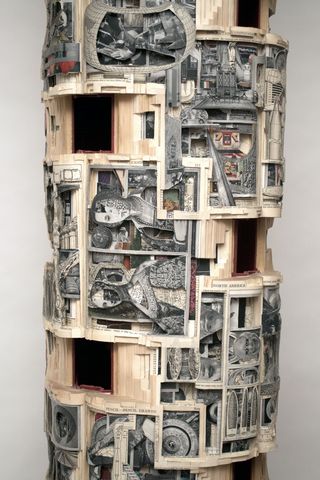 A new exhibit “Elemental” from
bibliocentric artist Brian Dettmer has opened at the Museum of
Contemporary Art of Georgia. Shown at the left is a piece carved from a set of Britannica Encyclopedias (photo courtesy of Brian Dettmer). I saw Dettmer's exhibit at the Saltworks
Gallery early last year and will make it over there in the near
future. Regular readers of the blog know that I am always interested
in things that people do with books besides read them (See “Books
as Art as Books” link at the right).
A new exhibit “Elemental” from
bibliocentric artist Brian Dettmer has opened at the Museum of
Contemporary Art of Georgia. Shown at the left is a piece carved from a set of Britannica Encyclopedias (photo courtesy of Brian Dettmer). I saw Dettmer's exhibit at the Saltworks
Gallery early last year and will make it over there in the near
future. Regular readers of the blog know that I am always interested
in things that people do with books besides read them (See “Books
as Art as Books” link at the right).
Speaking of repeat performances, on November 19 Anne Lamott returns to the Decatur's First Baptist Church. A few years ago, I went to a Lamott event in front of a packed house and I would say that I was nonplussed at what the big fuss was about. She mostly rambled on and on with no apparent narrative structure (I also heard from my Knoxville blog correspondents that her recent appearance in Knoxville was much the same), so I wonder what kind of turnout she will get from people who know better. The Georgia Center of the Book is also presenting Dana Greene author of Denise Levertov: A Poet's Life (November 5), and Jeff Clemmons author or Rich's: A Southern Institution, a book about the famous Atlanta department store (November 13).
If you like history, the Jimmy Carter Library and Museum is hosting Jon Meachem author of Thomas Jefferson: The Art of Power (November 19 – $$ required) and Kevin Phillips author of 1775: A Good Year for Revolution (November 30).
 Michael
Nye will be reading from his short story collection, Strategies
Against Extinction on November 9. Georgia State University's
literary magazine New South is sponsoring the event.
Michael
Nye will be reading from his short story collection, Strategies
Against Extinction on November 9. Georgia State University's
literary magazine New South is sponsoring the event.
The Marcus Jewish Community Center's 21st Annual Book Fair gets into full swing beginning November 1 and continues through November 18 ($$ required.)
—– EXTENDED BODY: —– EXCERPT: —– KEYWORDS: Anne Lamott, MJCC Book Fair, Marcus Jewish Community Center Book Fair, Michael Nye, Strategies Against Extinction, Brian Dettmer, Museum of Contemporary Art of Georgia —– ——– AUTHOR: Murray Browne AUTHOR EMAIL: murray.browne905@gmail.com TITLE: William Faulkner, Talladega Nights and the Old South STATUS: Publish ALLOW COMMENTS: 1 CONVERT BREAKS: 0 ALLOW PINGS: 0 BASENAME: william-faulkner-talladega-nights-and-the-old-south UNIQUE URL: https://thebookshopper.typepad.com/the_book_shopper_atlantad/2012/10/william-faulkner-talladega-nights-and-the-old-south.html DATE: 10/24/2012 07:08:01 AM —– BODY: 
The next time — the next umpteenth time — you watch the Will Farrell comedy Talladega Nights: The Legend of Ricky Bobby (airing this weekend on TBS) note at the very end of Talladega Nights, past the credits, past the outtakes (depending on which version you are watching) there is a scene where Ricky Bobby’s mother Lucy (played by Jane Lynch) finishes reading William Faulkner’s The Bear to her grandsons J.R. and Walker Texas Ranger. In the scene, Lucy finishes reading and sets down the book:
Lucy: So what do you think that story is about?
J.R.: The Bear symbolizes the Old South and Lion the new dog symbolizes the creeping industrialization of the North.
Walker: Duh, but the question is “Shouldn’t Boon feel the relief or sadness at the passing of the Old South?”
Lucy: Well, How about both?
Walker: Oh, I get it. Moral ambiguity. The hallmark of all early 20th Century American fiction.
J.R.: Great analysis, Walker.
Walker, William Faulkner and Talladega Nights all agree: There is both relief and sadness in the passing of the Old South.
Postscript 2021. Ten years later this page is one of the most visited on the blog. If you are interested more about Faulkner, consider reading Michael Gorra’s book The Saddest Words: William Faulkner’s Civil War (2020), which we relied heavily on at our reading/support group. See here. We now partner with Destination: Books, an indie bookstore that supports this blog so if you’re interested in purchasing the book… Thanks for visiting.
https://bookshop.org/widgets.js—– EXTENDED BODY: —– EXCERPT: —– KEYWORDS: William Faulkner, Talladega Nights, Ricky Bobby, Jane Lynch, Old South, New South, Michael Gorra, The Saddest Words —– ——– AUTHOR: Murray Browne AUTHOR EMAIL: murray.browne905@gmail.com TITLE: Blog Redux STATUS: Publish ALLOW COMMENTS: 1 CONVERT BREAKS: wysiwyg ALLOW PINGS: 1 BASENAME: blog-redux CATEGORY: Bookstores UNIQUE URL: https://thebookshopper.typepad.com/the_book_shopper_atlantad/2012/10/blog-redux.html DATE: 10/18/2012 06:13:06 PM —– BODY:
Following up on some books and I've
written about before and have recently factored into my personal
experiences.
Fort McAllister
 Earlier this month while I was
vacationing near Savannah, I revisited the more well known Fort
Pulaski, but I also drove south of the city to take in another Civil
War fort – a series of earthworks known as Fort McAllister. The
only reason I knew about McAllister (bitter rivals of Fort Pulaski
for tourist affections, I reckon) is that I referenced my copy of
Barry Brown and Gordon Elwell's Crossroads of Conflict: A Guide to
Civil War Sites in Georgia which is an indispensable companion
to lesser known Civil War sites in Georgia. Fort McAllister was the
scene of a naval battle in 1862 where the Federal ironclad Montauk
sunk the blockade runner Nashville, while the Confederate vessel was
stuck on sandbar on the Ogeechee River. Later, General William
Sherman's forces captured the fort in December of 1864, just
before the fall of Savannah. Though it is a little drive off the
beaten path, the well-maintained grounds of Fort McAllister State
Historical Park feature scenic views of the river, well preserved
earthworks and a sizable museum, which includes a short film starring
some of the plumpest Civil War rein-actors in cinema.
Earlier this month while I was
vacationing near Savannah, I revisited the more well known Fort
Pulaski, but I also drove south of the city to take in another Civil
War fort – a series of earthworks known as Fort McAllister. The
only reason I knew about McAllister (bitter rivals of Fort Pulaski
for tourist affections, I reckon) is that I referenced my copy of
Barry Brown and Gordon Elwell's Crossroads of Conflict: A Guide to
Civil War Sites in Georgia which is an indispensable companion
to lesser known Civil War sites in Georgia. Fort McAllister was the
scene of a naval battle in 1862 where the Federal ironclad Montauk
sunk the blockade runner Nashville, while the Confederate vessel was
stuck on sandbar on the Ogeechee River. Later, General William
Sherman's forces captured the fort in December of 1864, just
before the fall of Savannah. Though it is a little drive off the
beaten path, the well-maintained grounds of Fort McAllister State
Historical Park feature scenic views of the river, well preserved
earthworks and a sizable museum, which includes a short film starring
some of the plumpest Civil War rein-actors in cinema.
Union Avenue Books, Knoxville
In 2009, a few close friends
helped set up “the four city world tour" for my book, for The Book
Shopper,”
 (before this blog there was a book) included a book
signing at the Carpe Librium Book Store in Knoxville, Tennessee.
Since then the store closed, but the owner opened Union Avenue Books
a couple blocks from the revitalized Market Square district in
downtown Knoxville. My longtime fiance Denise and I were in Knoxville
for a wedding (not ours) and we did some browsing before embarking on
our social commitments. The store has a great feel inside and a good
assortment of books for the discriminating reader. (Georgia
writer-activist Janisse Ray was doing a reading there the next day.)
I apologize that the photo shown here doesn't do it justice but I did
buy a copy of E.B. White essays. If you're driving through Knoxville
on a non-football weekend, I'd encourage you stop the Market Square
district – just a few minutes off I-40 – and get some lunch, a
beer and do some browsing.
(before this blog there was a book) included a book
signing at the Carpe Librium Book Store in Knoxville, Tennessee.
Since then the store closed, but the owner opened Union Avenue Books
a couple blocks from the revitalized Market Square district in
downtown Knoxville. My longtime fiance Denise and I were in Knoxville
for a wedding (not ours) and we did some browsing before embarking on
our social commitments. The store has a great feel inside and a good
assortment of books for the discriminating reader. (Georgia
writer-activist Janisse Ray was doing a reading there the next day.)
I apologize that the photo shown here doesn't do it justice but I did
buy a copy of E.B. White essays. If you're driving through Knoxville
on a non-football weekend, I'd encourage you stop the Market Square
district – just a few minutes off I-40 – and get some lunch, a
beer and do some browsing.
E.B. White
The essay is probably my favorite genre and I will even read books about essays such as Ned Stuckey-French's The American Essay in the American Century (he was at the Decatur Book Festival in 2011) and G. Douglas Atkins', Tracing the Essay. Both French and Atkins devote a lot space to the essays of Elywn Brooks White, and yet, I am not that familiar with White's writings. There is one exception – White's The Elements of Style; however the wags who read this blog regularly know that I am not familiar enough with The Elements of Style.
—– EXCERPT: —– KEYWORDS: Crossroads of Conflict, Fort McAllister, Union Avenue Books, Knoxville, Carpe Librium, Ned Stuckey-French, American Essay, G. Douglas Atkins. E.B. White —– ——– AUTHOR: Murray Browne AUTHOR EMAIL: murray.browne905@gmail.com TITLE: Savannah Book Shopping – Beyond The Garden of Good and Evil STATUS: Publish ALLOW COMMENTS: 1 CONVERT BREAKS: wysiwyg ALLOW PINGS: 1 BASENAME: savannah-book-shopping-beyond-the-garden-of-good-and-evil CATEGORY: Books as Art as Books CATEGORY: Bookstores UNIQUE URL: https://thebookshopper.typepad.com/the_book_shopper_atlantad/2012/10/savannah-book-shopping-beyond-the-garden-of-good-and-evil.html DATE: 10/11/2012 07:36:27 AM —– BODY:

For book shoppers interested in going beyond visiting the bookstores dedicated to John Berendt's Midnight in The Garden of Good and Evil, there are places worth checking out within walking distance of each other in Old Savannah.
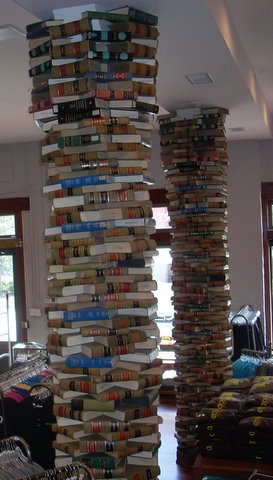 From the Savannah Visitor's Center and
Museum you can walk across Martin Luther King Boulevard to the
Savannah College of Art and Design's Ex-Libris, a bookstore and art
supply store where they demonstrate a funky use of “load bearing”
books. There are some other books and magazines there, but if you
are a writer who is looking for that perfect journal to collect your
thoughts and a pen to go with it. This is the place.
From the Savannah Visitor's Center and
Museum you can walk across Martin Luther King Boulevard to the
Savannah College of Art and Design's Ex-Libris, a bookstore and art
supply store where they demonstrate a funky use of “load bearing”
books. There are some other books and magazines there, but if you
are a writer who is looking for that perfect journal to collect your
thoughts and a pen to go with it. This is the place.
From Ex-Libris, take King Boulevard to
Liberty Street and then
 head east four or five blocks to The Book
Lady Book Store at 6 East Liberty, where they sell new and used books
and coffee. Don't be fooled by the small entrance, this little nook
is crammed with books including a “shrine” to Flanery O'Connor.
My longtime fiance Denise bought two books there: Paul Theroux's
Fresh Air Friend (2000) and an obscure travel book From A
Chinese City (1955) by Gontran
De Poncins. Later in the week, she returned there and bought Mark
Twain's The Adventures of Huckleberry Finn (more later.)
head east four or five blocks to The Book
Lady Book Store at 6 East Liberty, where they sell new and used books
and coffee. Don't be fooled by the small entrance, this little nook
is crammed with books including a “shrine” to Flanery O'Connor.
My longtime fiance Denise bought two books there: Paul Theroux's
Fresh Air Friend (2000) and an obscure travel book From A
Chinese City (1955) by Gontran
De Poncins. Later in the week, she returned there and bought Mark
Twain's The Adventures of Huckleberry Finn (more later.)
—– EXTENDED BODY:
From The Book Lady take nearby Bull
Street up to Madison Square, home of E. Shaver Books, a longtime
Savannah book seller. When I was in Savannah two years ago, I missed
going in the store because it is closed on Sunday. On that day,
shaking my fist in the sky, I swore in my best Scarlett O'Hara
impersonation (am I mixing my literary allusions here?), “as God as
my witness, I will return to this bookstore.” E. Shaver Books has
twelve rooms of books specializing in architecture, decorative
arts, regional and Savannah history, and fiction. I picked up a
re-issued copy of Robert Pirsig's Zen and the Art of Motorcycle
Maintenance (1974) as a gift and Denis Johnson's recent novella Train
Dreams, based on my admiration
of Johnson's Tree of Smoke.
From E. Shaver, it's just a little further to ShopSCAD on 340 Bull Street, which is a Savannah College of Art and Design retail shop. Normally, these kind of shops are beyond this book shopper's interest, but ShopSCAD has book art as well as (a favorite topic of mine– see the Books as Arts as Books link on right) Note the various types shown here at the top of this posting. Denise and her sister-in-law tried to buy "the book fan" as a birthday gift for your narrator, but those were not for sale, but the sales associate suggested they make one themselves by folding the pages in different directions. Denise and her sister-in-law later returned to The Book Lady and purchased the Huckleberry Finn book, did some quick craft work, and now the book fan graces my living room.

It's a big month in Atlanta if you like big name authors and bestsellers: James Patterson and R.L. Stine at the Marcus Jewish Community Center, David Sedaris at Atlanta Symphony Hall, Patricia Cornwall at the Carter Library, Elmore Leonard and Camile Paglia at SCAD's Ivy Hall Writing Series, and the Georgia Center for the Book has already hosted Jasper Fforde and Chris Cleave. (I will defer to the linked venues to provide you the details.)
Both Georgia State University and Emory University are offering alternative reading events. On October 11, the literary magazine Five Points is sponsoring a reading of fiction writer Hugh Sheehy and poet Anya Silver. Meanwhile Carlos Reads explores themes of madness and delusion in four works by Euripides in a class that is being taught by classics professor Peter Bing.
Unbroken Thoughts
I am not much of a reader of best sellers and the more popular writers, but after two friends suggested I read Laura Hillenbrand's Unbroken (to the point of loaning me the book) I had take a chance on book that has been on the bestseller list for over a year.
Hillenbrand's account of Olympian Louis Zamperini, who as a crewman on B-24 bomber in World War II crashed into the Pacific, and subsequently spent over a month on a raft only to be captured by the Japanese. In captivity under horrible conditions, the Japanese guards brutalized and humiliated Zamperini, but he survived.
The narrative is nothing short of compelling, but I am still scratching my head on the popularity. The book is rather grisly in its descriptions. I wonder if this kind of book is what David Shields (previous posting) refers to as “misery porn.” Or is it Zamperini's conversion to Christianity after he returned stateside that makes this popular with the church crowd? My takeaway from the book was its description of the perilous conditions for the pilots and crews. (More Air Force personnel was lost in accidents and mishaps than from combat with the Japanese.) Hillenbrand's account of life in the cockpit makes me interested in revisiting Joseph Heller's Catch-22.
—– EXTENDED BODY: —– EXCERPT: —– KEYWORDS: Unbroken, Bestsellers, Laura Hillenbrand, Jasper Fforde, David Sedaris, Atlanta Book Events, Book Calendar, October 2012, R.L. Stine, Patricia Cornwall, Elmore Leonard —– COMMENT: AUTHOR: Rose EMAIL: rosestorm@fastmail.cn IP: 46.249.58.237 URL: http://packref.seopowa.com/en/18-youtube DATE: 09/17/2013 01:08:05 AM I am regular reader, how are you everybody? This paragraph posted at this site is actually good. —– ——– AUTHOR: Murray Browne AUTHOR EMAIL: murray.browne905@gmail.com TITLE: Reality Blogging STATUS: Publish ALLOW COMMENTS: 1 CONVERT BREAKS: wysiwyg ALLOW PINGS: 1 BASENAME: reality-blogging CATEGORY: Book Reviews UNIQUE URL: https://thebookshopper.typepad.com/the_book_shopper_atlantad/2012/09/reality-blogging.html DATE: 09/27/2012 06:17:00 AM —– BODY:
 One of the major
advantages of blogging besides a future of large royalty checks and
spam emails from virtual admirers, is the freedom to write about
anything you want to in a manner that is not necessarily restricted
by form. As David Shields writes in his literary montage Reality
Hunger: A Manifesto (2010), forms and genres have become such
hybrids, that there is little distinction between fiction and
nonfiction. This is especially true with one of the more slippery
genres – the memoir, which is really fiction considering the
vagaries of memory. “Anything processed by memory is fiction,” writes Shields.
One of the major
advantages of blogging besides a future of large royalty checks and
spam emails from virtual admirers, is the freedom to write about
anything you want to in a manner that is not necessarily restricted
by form. As David Shields writes in his literary montage Reality
Hunger: A Manifesto (2010), forms and genres have become such
hybrids, that there is little distinction between fiction and
nonfiction. This is especially true with one of the more slippery
genres – the memoir, which is really fiction considering the
vagaries of memory. “Anything processed by memory is fiction,” writes Shields.
The book is divided into twenty-six chapters of six hundred and eighteen sequences of varying in length from a short sentence to several paragraphs. Shields describes his work as taking: “various fragments of things—aborted stories, outtakes from novels, journal entries, lit crit– and build a story out of them. I really had no idea what the story would be about; I just knew I needed to see what it would look like to set certain shards in juxtaposition to other shards.” Shields makes it even more interesting by choosing not to include attributions for his material; however, to avoid possible legal problems, Shields' publisher forced him to list of source material in the appendix. (Thankfully so, because there are other authors and articles, worth checking out.)
Not only is Shields entertaining as much as he is insightful, but the book serves a manifesto to bloggers that is more important for the prose be energetic, succinct, and not boring (the greatest sin according to Shields) than to worry about the exact slot your writing falls into. Or in the words of Sheilds: "Genre is a minimum security prison."
Note: Another one of Shields book worth looking at is Remote: Reflections on Life in the Shadow of Celebrity The artwork comes from the author's website though I don't really think he cares if we do the attribution or not.
—– EXTENDED BODY: —– EXCERPT: —– KEYWORDS: David Shield, Reality Hunger: A Manifesto —– ——– AUTHOR: Murray Browne AUTHOR EMAIL: murray.browne905@gmail.com TITLE: Subscription Information STATUS: Publish ALLOW COMMENTS: 1 CONVERT BREAKS: wysiwyg ALLOW PINGS: 1 BASENAME: subscription-information UNIQUE URL: https://thebookshopper.typepad.com/the_book_shopper_atlantad/2012/09/subscription-information.html DATE: 09/26/2012 07:00:39 AM —– BODY:
You can now keep track of new postings on the blog by setting up an email notification. Visit the link in the upper right hand corner of the main page. If you prefer a reader, a link is located there for that method as well. There's also The Bookshopper homepage on Facebook.
I post about once a week as to amuse, not inundate.
—– EXTENDED BODY: —– EXCERPT: —– KEYWORDS: —– ——– AUTHOR: Murray Browne AUTHOR EMAIL: murray.browne905@gmail.com TITLE: Contact Info STATUS: Publish ALLOW COMMENTS: 0 CONVERT BREAKS: wysiwyg ALLOW PINGS: 0 BASENAME: contact-info UNIQUE URL: https://thebookshopper.typepad.com/the_book_shopper_atlantad/contact-info.html DATE: 09/20/2012 09:39:24 PM —– BODY: You can reach me at murray.browne905 (AT) gmail.com —– EXTENDED BODY: —– EXCERPT: —– KEYWORDS: —– ——– AUTHOR: Murray Browne AUTHOR EMAIL: murray.browne905@gmail.com TITLE: Oregon Book Shopping STATUS: Publish ALLOW COMMENTS: 1 CONVERT BREAKS: wysiwyg ALLOW PINGS: 1 BASENAME: oregon-book-shopping CATEGORY: Bookstores UNIQUE URL: https://thebookshopper.typepad.com/the_book_shopper_atlantad/2012/09/oregon-book-shopping.html DATE: 09/20/2012 06:44:45 AM —– BODY:Last month my longtime fiance Denise and I spent a week in Oregon to get away from the Atlanta summer heat. We flew into Portland for a couple nights and drove through the wineries of Yamhill County before finally making our way to the central Oregon coast. Book shopping is important to us, but admittedly the box we brought back with us was filled with wine and spirits not books. Here's our some pictures from the book portion our trip.
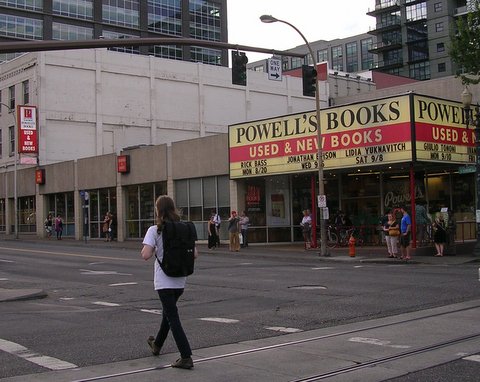
—– EXTENDED BODY:
Small Town Book Stores
We also noticed that many of the small towns that we drove though had book stores.
—– EXCERPT: —– KEYWORDS: Powell’s, Third Street Books, Book stores in Oregon, Chuck Palahniuk —– ——– AUTHOR: Murray Browne AUTHOR EMAIL: murray.browne905@gmail.com TITLE: More Chipper STATUS: Publish ALLOW COMMENTS: 1 CONVERT BREAKS: wysiwyg ALLOW PINGS: 1 BASENAME: more-chipper CATEGORY: Baseball UNIQUE URL: https://thebookshopper.typepad.com/the_book_shopper_atlantad/2012/09/more-chipper.html DATE: 09/11/2012 08:06:17 AM —– BODY:
Since my obsession with the retiring Chipper Jones continues, I had to continue to write about it even though it doesn't quite fit The Book Shopper blog brand. So I sent a brief thought piece, “Is There Happiness After Chipper Leaves?” to Like the Dew, A Journal of Southern Culture and Politics.
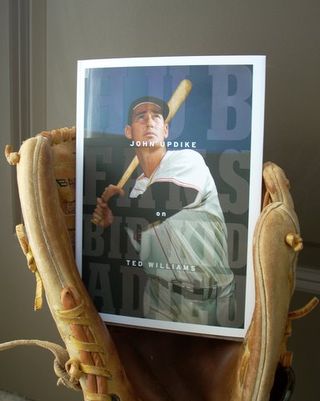 For those of you who have may have
straggled from Like the Dew to here, click on the “Baseball” link
on the right for other books about baseball. One baseball book that
seems appropriate in light of Chipper's retirement is John Updike's
Hub Fans Bid The Kid Adieu, which is basically a long essay
about Updike being at Ted Williams' last game for the Boston Red Sox.
I think every great ball player should have such a literary send-off.
For those of you who have may have
straggled from Like the Dew to here, click on the “Baseball” link
on the right for other books about baseball. One baseball book that
seems appropriate in light of Chipper's retirement is John Updike's
Hub Fans Bid The Kid Adieu, which is basically a long essay
about Updike being at Ted Williams' last game for the Boston Red Sox.
I think every great ball player should have such a literary send-off.
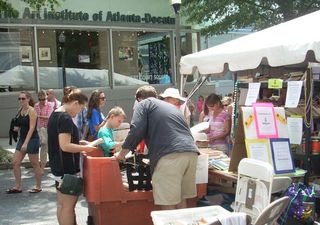 If you didn't get your fill of book
shopping and authors at the Decatur Book Festival (DBF) over Labor
Day weekend, there is a calendar full of events scheduled for
September in the Atlanta area. Here's a select few. The dollar signs
($$) indicate there is some kind of admission fee involved.
Traditionally, I link to the general information because you should
double check the time and venue because they can change at the last
moment.
If you didn't get your fill of book
shopping and authors at the Decatur Book Festival (DBF) over Labor
Day weekend, there is a calendar full of events scheduled for
September in the Atlanta area. Here's a select few. The dollar signs
($$) indicate there is some kind of admission fee involved.
Traditionally, I link to the general information because you should
double check the time and venue because they can change at the last
moment.
Emory University Professor of Art History Sarah McPhee discusses and signs her new book Bernini's Beloved: A Portrait of Costanza Piccolomini, at the Carlos Museum Reception Hall on Tuesday, September 11th.
One of my favorite local book events is
the Georgia Fine and Collectible Book Fair. I felt a little sad at
the DBF when as a volunteer, I had to tell a gentleman that the
Georgia Antiquarian Booksellers Association 20th Annual
Book Fair is no longer at the festival. The fair ($$) is Saturday
and Sunday, September 22-23 at the Cobb County Civic Center in
Marietta where it was held last year (see photo). For more specifics, visit
here.

On Friday, September 21st, the Carter Center hosts Junot Diaz ($$), who is on the road promoting his new novel This Is How You Lose Her. (I posted some thoughts about Diaz' visit to Agnes Scott a couple years ago.) Local bookseller and author, Cliff Glaubert will also be the Center promoting his book, The Curious Vision of Sammy Levitt and Other Stories. Also in attendance at the Glaubert signing are his friends, the well-known writers Terry Kay and Pat Conroy.
The Fulton County Library brings Miami Heat basketball superstar Dwayne Wade to their library on Monday, September 10th. Wade has written a new book about fatherhood entitled, A Father First.
Yuri Taylor and Jake Austen authors of Darkest America: Black Mintrelsy from Slavery to Hip Hop will be at the Atlanta History Center ($$) on Thursday, September 6th and the Auburn Avenue Library on Friday, September 7th.
The Georgia Center of the Book is back into full swing in the month of September with: novelist Ayad Akhtar and his American Dervish (Tuesday, September 18th), baseball historian, Tim Darnell and his The Crackers: Early Days of Atlanta Baseball (Monday, September 24th) and journalist Jeanne Marie Laskas author of the nonfiction Hidden America from Coal Miners to Cowboys, an Extraordinary Exploration of the Unseen People Who Make this Country Work (Wednesday, September 19th).
—– EXTENDED BODY: —– EXCERPT: —– KEYWORDS: Sarah McPhee, Georgia Fine and Collectible Book Fair, Georgia Antiquarian Booksellers Association, Junot Diaz in Atlanta, —– ——– AUTHOR: Murray Browne AUTHOR EMAIL: murray.browne905@gmail.com TITLE: Wish List STATUS: Publish ALLOW COMMENTS: 1 CONVERT BREAKS: wysiwyg ALLOW PINGS: 1 BASENAME: wish-list CATEGORY: Books as Art as Books CATEGORY: Bookstores UNIQUE URL: https://thebookshopper.typepad.com/the_book_shopper_atlantad/2012/08/wish-list.html DATE: 08/27/2012 08:57:06 AM —– BODY:Several notes of interest:
 I recently wrote a short synopsis of
George Steiner's excellent book of long essays, My Unwritten
Books (2008) for Eighth Day Books in Wichita, Kansas. Eighth Day
is more a friend than a sponsor of the blog and I have written
about them in the past. They are a book store who appeals to a
certain clientele, those with serious interests in philosophy,
literature, religion, and the arts. I wish I could get the word out
more to the Atlanta community especially the students and faculty at
Candler School of Theology at Emory University School of Theology and
Columbia Theological Seminary in Decatur. You don't have to be a
divinity student to appreciate Eighth Day Books, but you do have be
willing to take on a more challenging read from time to time (like
the Steiner book).
I recently wrote a short synopsis of
George Steiner's excellent book of long essays, My Unwritten
Books (2008) for Eighth Day Books in Wichita, Kansas. Eighth Day
is more a friend than a sponsor of the blog and I have written
about them in the past. They are a book store who appeals to a
certain clientele, those with serious interests in philosophy,
literature, religion, and the arts. I wish I could get the word out
more to the Atlanta community especially the students and faculty at
Candler School of Theology at Emory University School of Theology and
Columbia Theological Seminary in Decatur. You don't have to be a
divinity student to appreciate Eighth Day Books, but you do have be
willing to take on a more challenging read from time to time (like
the Steiner book).
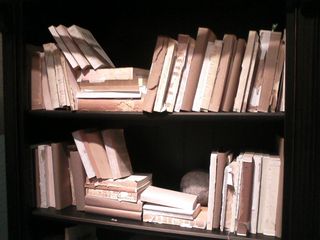 A couple of months ago, I wrote about
the Art Institute of Atlanta-Decatur book art exhibit entitled
Wallbound, which featured 23 local, national and international
artists who accepted the challenge of creating of book art that had
to be hung on a wall. One of the faculty members at the Art
Institute, Alicia Griswald, sent me an email letting me know that
there is now an organization called the Atlanta Book Arts Collective
which “provides opportunities, through programs, workshops, and
sharing, to learn more about both paper and book arts.” And my wish? I think it would be cool, if the
Art Institute did their next book art exhibit during the Decatur Book
Festival. The school is located in the heart of the festival already.
Just a thought.
A couple of months ago, I wrote about
the Art Institute of Atlanta-Decatur book art exhibit entitled
Wallbound, which featured 23 local, national and international
artists who accepted the challenge of creating of book art that had
to be hung on a wall. One of the faculty members at the Art
Institute, Alicia Griswald, sent me an email letting me know that
there is now an organization called the Atlanta Book Arts Collective
which “provides opportunities, through programs, workshops, and
sharing, to learn more about both paper and book arts.” And my wish? I think it would be cool, if the
Art Institute did their next book art exhibit during the Decatur Book
Festival. The school is located in the heart of the festival already.
Just a thought.
Speaking of this weekend's festival, Miranda Parker, author of the Angel Crawford series of novels will be on the "Housewives of Literature" panel, Saturday, September 1 at 5:30 p.m. at the Decatur Convention Center. Through social media, Miranda keeps me informed on books that I would not necessarily know about and I appreciate her input. I wish that more blog readers would shoot me an email or comment – especially local writers. You can find the blog on Facebook, (facebook.com/thebookshopper) which is probably the easiest way to get updates.
—– EXTENDED BODY: —– EXCERPT: —– KEYWORDS: Miranda Parker, Atlanta Book Arts Collective, Eighth Day Books, George Steiner, My Unwritten Books. —– COMMENT: AUTHOR: alicia griswold EMAIL: agriswold@me.com IP: 99.32.190.116 URL: http://sendingpagesouttodry.blogspot.com DATE: 08/28/2012 09:23:57 AM Your wish is about to be granted. We’re meeting tomorrow with our campus president to discuss this very subject! Alicia —– ——– AUTHOR: Murray Browne AUTHOR EMAIL: murray.browne905@gmail.com TITLE: My DBF 2012 Festival Strategy and Preview STATUS: Publish ALLOW COMMENTS: 1 CONVERT BREAKS: wysiwyg ALLOW PINGS: 1 BASENAME: my-dbf-2012-festival-strategy-and-preview CATEGORY: Bookstores UNIQUE URL: https://thebookshopper.typepad.com/the_book_shopper_atlantad/2012/08/my-dbf-2012-festival-strategy-and-preview.html DATE: 08/18/2012 01:18:03 PM —– BODY:
Because of the size of the 2012 Decatur Book Festival, I take a faceted view of the festivities. First, I go online to check to see if some of my favorite book vendor/ friends have scheduled to return and then randomly sift through the links to sort out a few authors of interest. I am scheduled to work at the marketplace on Saturday morning and that's usually a good way for me to find out if there is any new book vendors.
Fortunately, a few friends are returning:
 University of Georgia Press. In the past, this blog has published several reviews of UGA Press authors: Robert Craig, Barry Brown, Sara Roehen. This year the publisher along with the Nature Conservancy is hosting a discussion at the festival, Portraying the Natural South through Photography and Writing featuring Janisse Ray (shown), Charles Seabrook and photographer Wayne Morgan. Over the years, John McLeod and the UGA press staff has gracefully provided books for me to review, so it's always worth a visit to see their other offerings.
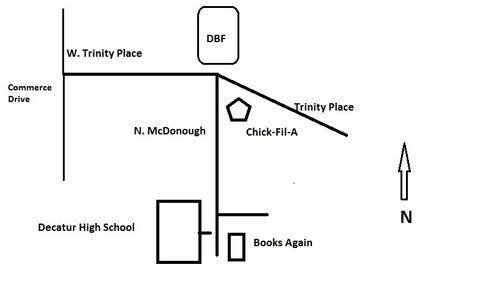 Books Again. You never have to worry about whether Books Again is going to the festival because they are always there. If you're attending one of the programs at the City Hall Stage, be sure to walk the long block south on North McDonough to Books Again, which is right across the street from Decatur High School (click on map to enlarge). I consider Books Again one of the “destination” used book stores in Atlanta. Sure they are a blog sponsor, (see Sponsor Link in the left corner) but if you are a serious book shopper you'll appreciate the wide selection of fiction especially some of the older works penned by Southern authors. Books Again also has shelves full of military history, baseball, religion, philosophy and cookbooks. The store is air conditioned and expect a Labor Day Weekend sale.
Carlos Museum Bookshop. Another favorite bookstore of mine, the Michael C. Carlos Museum Bookshop is located in the Carlos Museum on the Emory Campus, but festival goers will have opportunity to sample some of their offerings in history, anthropology and travel. The bookshop will have a tent at the festival in the Emory University enclave. Carlos isn't a sponsor, per se, but manager of the store Mark Burell knows that I “blog for beer.”
Authors. This year I hope to finally see Isabel Wilkerson, Pulitzer Prize winning author The Warmth of Other Suns, and since this blog favors Civil War books, Adam Goodheart author of 1861: The Civil War Awakening, would be someone I would like to see too. While rambling through the links I saw that National Book Award Finalist, Julie Otsuka, author of the novel, The Buddha in the Attic will be in attendance. In the past, I've had some good chats with a few authors while waiting in line (Bill Cotter, Grant Jerkins, and Ned Stuckey-French to name a few) capitalizing on the serendipitous nature of the event.
—– EXTENDED BODY: —– EXCERPT: —– KEYWORDS: Decatur Book Festival 2012 preview, Isabel Wilkerson, Books Again, UGA Press —– COMMENT: AUTHOR: Miranda Parker EMAIL: mparkerbooks@gmail.com IP: 108.195.17.103 URL: http://www.mirandaparker.com DATE: 08/27/2012 12:18:16 AM Come see me, too. I speak Saturday at 5:30 at the Decatur Convention Center “The Housewives of Literature” Panel. Would be great to meet you face to face. —– ——– AUTHOR: Murray Browne AUTHOR EMAIL: murray.browne905@gmail.com TITLE: Goodbye London Olympics (Font) STATUS: Publish ALLOW COMMENTS: 1 CONVERT BREAKS: wysiwyg ALLOW PINGS: 1 BASENAME: goodbye-london-olympics-font UNIQUE URL: https://thebookshopper.typepad.com/the_book_shopper_atlantad/2012/08/goodbye-london-olympics-font.html DATE: 08/12/2012 12:24:35 PM —– BODY:
 For some people like author Simon Garfield, the Olympics cannot end soon enough – especially if you find the London 2012 Olympics Typeface hideous looking. In Garfield's Just My Type: A Book About Fonts (2010), Garfield includes a chapter The Worst Fonts in the World. Included in the list includes Gill Sans Light Shadowed, Brush Script (I'm guilty of using this) and Ransom Note, but at the head of the list is London 2012 Olympic Font (click on font family at left to enlarge). Garfield is candid about opinion:
Like the logo, the uncool font is based on the jaggedness and crudeness, not usually considered attributes where sport is concerned. Or maybe it's an attempt to appear hip and down with the kids – it looks a little like the sort of tagging one might see in 1980s graffiti. It also has a vaguely Greek appearance, or at least the UK interpretation of Greek, the sort of lettering you will find at London kebab shops and restaurants called Dionysus. The slant to the letters is suddenly interrupted by a very round and upright o, which may be trying to be an Olympic Ring. The font does have few things going for it: it is instantly identifiable, it is not easily forgettable, and because we'll be seeing so much of it, it may eventually cease to offend. Let's hope they keep it off the medals.
Of course, one of the themes of the book is that what is an ugly font to some is beautiful to others. If this is the way you feel about the London 2012 Olympics Typeface, you can license it here.
—– EXTENDED BODY: —– EXCERPT: —– KEYWORDS: Just My Type, Simon Garfield, London 2012 Olympics Typeface, Olympic font —– ——– AUTHOR: Murray Browne AUTHOR EMAIL: murray.browne905@gmail.com TITLE: Local and Universal: A Conversation with Translator Lisa Dillman STATUS: Publish ALLOW COMMENTS: 1 CONVERT BREAKS: wysiwyg ALLOW PINGS: 1 BASENAME: local-and-universal-a-conversation-with-translator-lisa-dillman UNIQUE URL: https://thebookshopper.typepad.com/the_book_shopper_atlantad/2012/08/local-and-universal-a-conversation-with-translator-lisa-dillman.html DATE: 08/05/2012 07:47:32 AM —– BODY: 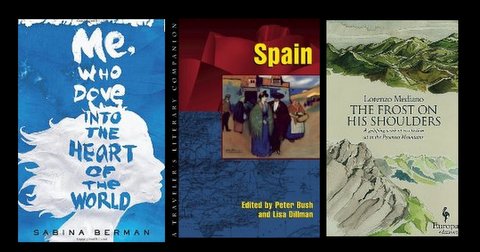
Interviewed by Chantal James
Decatur's Lisa Dillman is a lecturer at Emory University's Department of Spanish and Portuguese and translator of many literary and scholarly works (examples above). Her latest translation is the novel, The Frost on his Shoulders, by Spanish author Lorenzo Mediano, which was just published by Europa Press this June. In her English translation, the novel reads like a lyric myth, or an Old Testament fable. Its characters are farmers, peasants and landowners locked into an eternal class tension. It's a story of star-crossed love, of a rich girl and a poor boy and their ill-fated love against the backdrop of rural life in the hills of Spain, with the looming wilderness of the Pyrenees an ever-present specter.
In her own words, Dillman speaks about her path in translating a book so grounded in its locality into the English language.
A Translator's Background
“I grew up in LA, in a very multicultural area. I had friends when I was younger who would speak perfect English to me and then turn around and speak perfect Spanish to their parents. I thought, that's not fair…I studied in Barcelona, and then after college–I studied there for a year, and then after college I moved back to Madrid. And then I came back here for three years, and then I moved back to Barcelona.
And when I was living abroad I would have experiences where maybe there would be a movie or something that was translated, and I would say, well that's not what the title means! And people would think that there should be a word-for-word equivalent, between languages [like Spanish and English], like you just take one word from one language, and put the word in from the other language and it will have the same meaning, without realizing that it has to do with culture, and context and things like that, and so I was intrigued by the fact that it doesn't work that way.” 
The Frost on His Shoulders
“I think that even though [The Frost on His Shoulders is] very, very grounded in the Pyrenees, and the local land, it's also a very universal story. Because it deals with, you know, issues of class basically, and injustices, and change, a modernization of society, and old-timers being unwilling to accept change, and human emotions, like greed and that sort of thing. I think that the kind of contrast between the universal side that anyone can relate to, and the very idiosyncratic stuff that you know, if you're not in the Pyrenees right after the [Spanish] Civil War, who knows about all these different roots and berries that can be used for this and that?”
“So, to me at least, it was fascinating as something that I knew nothing about, all these mushrooms, and oh, if you're really cold in the winter you can drink the blood of a living animal and then staunch the blood. So all of these sorts of things are, I think fascinating, and incredibly different from anything that we live, or even imagine. You know, so I think that between them there's a sort of altercation between something that you can totally relate to–class issues, social justice, rich versus poor, sexism, all these sorts of things–and there are things that you really can't relate to but that are fascinating to read about.”
The Challenge of Translation
“There were a huge number of terms that were mostly related to food and plants, and different animal parts and different ages of animals and things like that…and many of them were unknown to the majority of Spanish speakers. They're so localized…Many times, those were the sorts of things that I would e-mail Lorenzo about, and you know he was very patient in all of his replies…But the number of things that were not available on the internet or in specialized dictionaries was very surprising to me. I would have had a [much] larger struggle than I did if he had been unavailable.”
Chantal James is a writer who lives in Atlanta and is working on her second novel. Her reviews have also appeared in Paste Magazine and she keeps a blog at called Globalsouth and she can be found on Twitter as well. James is on staff at A Cappella Books. (To read her other postings, visit the Chantal James link on the right.)
—– EXTENDED BODY: —– EXCERPT: —– KEYWORDS: Chantal James, Lisa Dillman, The Frost on his Shoulders, the art of translating, Lorenzo Mediano —– COMMENT: AUTHOR: German translator perth EMAIL: daviddrainey@gmail.com IP: 202.191.203.34 URL: http://www.dammann.com.au/german-translator-perth.php DATE: 12/05/2012 04:32:20 AM Quite educative and helpful information by you Lisa!It was interesting to know the various facts about latest translation book.Thanks. —– ——– AUTHOR: Murray Browne AUTHOR EMAIL: murray.browne905@gmail.com TITLE: Atlanta Area Book Events Calendar – August 2012 STATUS: Publish ALLOW COMMENTS: 1 CONVERT BREAKS: wysiwyg ALLOW PINGS: 1 BASENAME: atlanta-area-book-events-calendar-august-2012 UNIQUE URL: https://thebookshopper.typepad.com/the_book_shopper_atlantad/2012/08/atlanta-area-book-events-calendar-august-2012.html DATE: 08/02/2012 07:27:09 AM —– BODY:
 One of the literary traditions of Atlanta in August is that the book events calendar is a little leaner than usual because of the upcoming Labor Day weekend Decatur Book Festival. (See link on the left for details). Nevertheless there are a few out-the-ordinary outings to think about.
 Atlanta fiction writer Marc Fitten delivers the remaining three lectures about writing and publishing at Manual's Tavern on Monday, August 6, Monday, August 13 and Tuesday, August 21 beginning at 7 p.m. Fitten originally delivered these lectures as part of the Yale University Writing Series. For details including admission ($$) requirements (and benefits) visit here.
 Sip and Sign is a literary reception featuring popular African American authors to discuss their new books, read excerpts, conduct a Q & A session and book signing. Its sponsored by V103/WAOK. The August featured author is Victoria Christopher Murray, author of Destiny's Divas. The next scheduled reception is August 19 at 2:00 p.m. at Lowes Atlanta Hotel 1065 Peachtree Street Northeast, Atlanta.
Even the Georgia Center for the Book is opting for a light month, with only one reading and signing. Decatur author Josh Russell will be at the Decatur Public Library on Tuesday, August 14 to debut his new novel. A True History of the Captivation, Transport to Strange Lands, & Deliverance of Hannah Guttentag. Nothing ordinary about that title.
—– EXTENDED BODY: —– EXCERPT: —– KEYWORDS: Atlanta Book Events, Marc Fitten, Yale Lectures, Destiny’s Divas, Josh Russell, A true history of captivation, transport to strange lands —– ——– AUTHOR: Murray Browne AUTHOR EMAIL: murray.browne905@gmail.com TITLE: MARTA Book Club #20: On the Eve of the Referendum STATUS: Publish ALLOW COMMENTS: 1 CONVERT BREAKS: wysiwyg ALLOW PINGS: 1 BASENAME: marta-book-club-20-on-the-eve-of-the-referendum CATEGORY: MARTA Book Club UNIQUE URL: https://thebookshopper.typepad.com/the_book_shopper_atlantad/2012/07/marta-book-club-20-on-the-eve-of-the-referendum.html DATE: 07/25/2012 07:30:56 AM —– BODY: Like most riders, members of the MARTA book club have mixed – if not hostile – feelings about the current transportation referendum. Club members who have read such books as David Owen's Green Metropolis: Why Living Smaller, Living Closer, and Driving Less Are the Keys to Sustainability (2010) or Tom Vanderbilt's Traffic: Why We Drive the Way We Do (and What it Says About Us) (2008) know that building more roads is not the solution, but driving less is. But driving less requires better public transportation and anyone who uses public transportation in metro Atlanta (about 4 percent of the 2 million workers) knows that the “user experience” has a lot to be desired (stations that feel like Turkish baths in the summer, long waits for trains and buses, and the worse thing – tortuous Muzak versions of “I Could Have Dance All Night” and “The Long and Winding Road” playing in the background).
Still the biggest plus for public transportation in Atlanta is all the time you get to read, which is the only membership requirement for the MARTA Book Club. There are no meeting times, no organizational rules, no t-shirts, and no dues. Very convenient.
What We Have Been Reading
It's been a couple months since our last MARTA Book Club compilation (see the links category for all the lists) and there is much reading on the train to report. We regret since we cannot determine the title, electronic books are not tabulated.
A New Earth: Awakening to Your Life's Purpose by Eckhart Tolle
Lies My Teacher Told Me: Everything Your American History Textbook Got Wrong by James W. Loewen
World War Z: An Oral History of the Zombie War by Max Brooks
Brave New World by Aldous Huxley
1Q84 by Haruki Murakami
7 Steps to Better Chess by Eric Schiller
Gone with the Wind by Margaret Mitchell
Game Change: Obama and the Clintons, McCain and Palin, and the Race of a Lifetime by John Heilemann and Mark Halperin
Love in the Time of Cholera by Gabriel Garcia Marquez
Canada by Richard Ford My offering this month. Ford's lengthy book about a fifteen year old's long journey from a Montana childhood to young adulthood in Saskatchewan has the page count, but not intellectual oomph and satisfaction of his other novels, Independence Day or Lay of the Land.
East by Edith Pattou
The Book Thief by Markus Zusak
Black Robes, White Justice by Bruce Wright
The Witch Tree Symbol (Nancy Drew Mystery Stories, No 33) by Carolyn Keene
Judgment Day: Zombie Apocalypse by J.E. Gurley
Big Sky Mountain by Linda Lael Miller
A Game of Thrones (A Song of Ice and Fire, Book 1) by George R.R. Martin
Saving CeeCee Honeycutt: A Novel by Beth Hoffman
The Girl with the Dragon Tattoo by Stieg Larsson
The King's Speech: How One Man Saved the British Monarchy by Mark Logue and Peter Conradi
Black Like Me by John Howard Griffin and Robert Bonazzi
SEAL Team Six: The Novel by Chuck Dixon
Now You See Her by Linda Howard
The Bible
Fifty Shades of Grey by E L James (4 times) I never sit by anyone who is reading this book unless I can see their hands.
Novels by Harlan Coben, Mike Carey, Dean Koontz, Danielle Steele, Stephen King, Stuart Woods and Clive Cussler.
Next Assignment
Get the facts, get out to vote, and send us your book contributions and observations via comment or visit our Facebook page at facebook.com/thebookshopper. To visit past book club postings, click on the “MARTA Book Club” link at the right.
—– EXCERPT: —– KEYWORDS: MARTA Book Club, TSPLOST, Atlanta Transportation problems, Tom Vanderbilt, David Owen, Green Metropolis, Traffic Why We Drive —– ——– AUTHOR: Murray Browne AUTHOR EMAIL: murray.browne905@gmail.com TITLE: Chipper Dreams STATUS: Publish ALLOW COMMENTS: 1 CONVERT BREAKS: wysiwyg ALLOW PINGS: 1 BASENAME: chipper-dreams CATEGORY: Baseball UNIQUE URL: https://thebookshopper.typepad.com/the_book_shopper_atlantad/2012/07/chipper-dreams.html DATE: 07/18/2012 07:44:44 AM —– BODY:
 When I am asked “What book is on your nightstand?” that is not necessarily a place of honor for books at my house. Most books that have been relegated to my nightstand are not books that are likely to be read cover to cover, because it only takes a few paragraphs at bedtime before I get sleepy. This explains why encyclopedias and reference books are my preferred genre of nighttime reading. Entries are short. You don't feel like your offending an author who has put his or her heart and soul into the prose. And at the end the day, you've learned something new.
For months I have been falling asleep to the Bill James' Historical Baseball Abstract, which was first published in 1988 and then revised in 2003. James, who belongs in the writer's wing of the Baseball Hall of Fame (being mentioned in the film Moneyball should seal the deal), divides his encyclopedia into three sections. Part One is called The Game and is about how baseball was played in each decade from the 1870s through the 1990s. In Part Two he rates the Top 100 players at each position and finishes the book with a reference section. I spent most of my time reading Part Two.
Of course unless you've been hiding under home plate, you know that this is Larry “Chipper” Jones final season and so the big question on Atlanta fans' mind: is “Where does Chipper Jones rate in the pantheon of all time third baseman?”
 The Braves organization is constantly reminding us this season that it is important to share this historical experience with Chipper and that t-shirts and uniforms emblazoned with Jones name and number could become endangered (like my Biff Pocoroba jersey). It is imperative to get to Turner Field during Chipper's farewell season. I've been out three times to see Chipper this year. Until he was named to the 2012 All-Star team, I think Chipper's nickname should have been Crapper since he seemed “down in the toilet” about being hurt, his impending retirement at the end of the season, and problems at home, while being obsessed that the front office needs to add another starting pitcher for the pennant run (which it does). From the stands, I saw him just hang his head walking from the dugout to the middle of the field between innings. At home watching Brave broadcasts, there seem to be constant camera shots of Chipper sitting in the dugout with his head buried in a towel. Lately though, Chipper has been perkier. I think it is smart for him to retire when he is still a very good baseball player (except for his range) and allow players and fans alike in other cities to pay their respects to a future Hall of Famer.
Moreover once he retires, baseball fans can begin to speculate on where Chipper ranks in the all-time list of third baseman?
In the Historical Baseball Abstract using his intricate methods that allows players to be compared in different eras, James ranked Jones 28th right after Tim Wallach, who James considered the poor man's Brooks Robinson. James readily updated the ranking in his postscript that Chipper had a lot of years left and he expected Chipper to move up significantly though James didn't speculate whether Chipper would move into the mid-teens near Craig Nettles (#13) or Ron Cey (#16) or in the Top Ten of all time great third basemen. But here's the weird statistic. According to Bill James, Chipper may be only the third best Brave third baseman of all time.
—– EXTENDED BODY:
Here's the list of the Top Ten Third Baseman that James compiled in 2003:
- Mike Schmidt (Hall of Fame)
- George Brett (HOF)
- Eddie Matthews (HOF)
- Wade Boggs (HOF)
- Home Run Baker (HOF)
- Ron Santo (inducted this year, so you can see what a egregious error of omission that was)
- Brooks Robinson (HOF)
- Paul Molitor (HOF)
- Stan Hack (not in the HOF, but James says Hack is better than Pie Traynor who is in the HOF)
- Darrell Evans
Darrell Evans? This is the same Darrell Evans who played third base for the Atlanta Braves between 1969 to 1979 before moving on to the San Francisco Giants, and then on to the World Champion Detroit Tigers, before finishing his career in Atlanta in 1989. James calls Evans, “the most underrated player in baseball history” and cites that despite a low batting average, Evans was exceptional in other offensive categories (walks, RBIs and Runs scored) and at 38 years old he hit 40 homers for the Tigers. Defensively, Evans played both third and first base.
Darrell Evans better than Chipper Jones? It's just the kind of baseball lore to keep you up at night,
—– EXCERPT: —– KEYWORDS: Chipper Jones, Final Season, Darrell Evans, Bill James, Historical Abstract —– ——– AUTHOR: Murray Browne AUTHOR EMAIL: murray.browne905@gmail.com TITLE: Book Gifts Received STATUS: Publish ALLOW COMMENTS: 1 CONVERT BREAKS: wysiwyg ALLOW PINGS: 1 BASENAME: book-gifts-received UNIQUE URL: https://thebookshopper.typepad.com/the_book_shopper_atlantad/2012/07/book-gifts-received.html DATE: 07/09/2012 08:40:48 PM —– BODY:
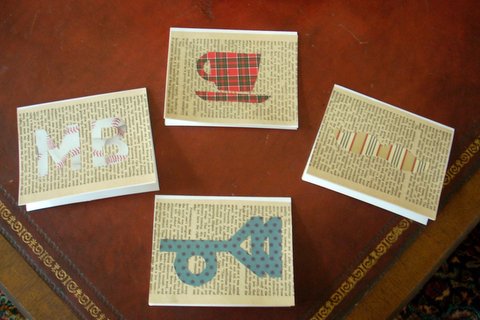 These clever greeting cards were a gift from my crafty daughter Bonnie who gave me these four cards for Father's Day last month. The problem, of course, is that they are really too personal and classy to part with. (I especially like the "muted horn" card.) But since Bonnie provides specific directions at her craft blog on how to make my own stationery, I could make more.
 My older daughter also gave me a book related present for Father's Day– the gift of subterfuge. Before leaving Harvard University for studies in Germany, she placed (“donated”) a copy of my book The Book Shopper: A Life in Review in the Fansworth Reading Room at the Harvard Library. (Enlarge to see the photographic proof.)
But there's more. Denise, my longtime pardner and sometime editor gave me two books as part of the festivities: Eats Shoots & Leaves by Lynn Truss and Just My Type by Simon Garfield. In future blog entries, expect better use of commas, semicolons and the Comic Sans font.
 Here are some links for book-related events during the month of July in the Atlanta area.
I purposely don't include all the details, so you will be forced to double-check times and places before heading out. It's a relatively light month event-wise. Maybe everyone is at the beach reading.
On Saturday, July 14th, The Auburn Avenue Research Library is hosting a discussion and signing with Dr. Charlotte Pierce-Baker, author of This Fragile Life: A Mother's Story of a Bipolar Sun.
On Wednesday, July 19th, Marc Wortman, author of The Bonfire: The Siege and Burning of Atlanta will do a reading and sign books at the Carter Presidential Library & Museum Theater.
 On Wednesday, July 11th, Atlanta author, Marc Fitten will be debuting his new novel Elza's Kitchen at the Carter Presidential Library. Fitten is just one of the authors appearing through The Georgia Center for the Book during the month of July. Other Georgia Center for the Book events include Ann Uhry Abrams' nonfiction book, Explosion at Orly: The Disaster That Transformed Atlanta on Monday, July 16th, and Stephen L. Carter's novel The Impeachment of Abraham Lincoln on Monday, July 23rd. These two events will be held at the Decatur Public Library.
Local Bookstores Have Readings Too
Local bookstores are also hosting events. Atlanta's Miranda Parker will be promoting her second novel Someone Bad and Something Blue at the Barnes & Noble at Camp Creek Parkway on Saturday, July 14.
Check these other local bookstores for other events:
Peerless Bookstore – Alpharetta
A Cappella Books (now in Inman Park)
Bound to be Read (East Atlanta)
Eagle Eye Books (Decatur)
Charis Books and More (Near Little Five)
—– EXTENDED BODY: —– EXCERPT: —– KEYWORDS: July Atlanta Calendar Book Events, Marc Fitten, Anne Uhry Adams, Marc Wortman —– ——– AUTHOR: Murray Browne AUTHOR EMAIL: murray.browne905@gmail.com TITLE: Pulphead Confessional STATUS: Publish ALLOW COMMENTS: 1 CONVERT BREAKS: wysiwyg ALLOW PINGS: 1 BASENAME: pulphead-confessional CATEGORY: Book Reviews UNIQUE URL: https://thebookshopper.typepad.com/the_book_shopper_atlantad/2012/06/pulphead-confessional.html DATE: 06/27/2012 10:56:59 PM —– BODY:I just finished John Jeremiah Sullivan's Pulphead Essays (2011), a collection of essays, which came recommended by a couple of friends in the space of a month. Not only was it good reading, but it caused me to ask myself, "Why haven't heard of this guy before?"
That's the way it goes as a reader, there are always new writers that you have never heard of, but end up liking a book of theirs. But what is worse, is knowing that there are certain contemporary writers who you should have read already, but for some reason haven't got around to it. For me, Dave Eggers and David Foster Wallace, come to mind as two writers I must sheepishly admit I haven't read. Probably I should add Toni Morrison to the list as well. More shame on me. (Feel free to use the comments to let me know which book I should read and why, or you can use the comments to make your own confession.)
I connected to the Pulphead Essays in several ways. As one who spent a lot of years in Knoxville, I am familiar with some of the geography that Sullivan writes about especially in the essay "Unnamed Caves" about the amazing number of caves (a virtual civilization) that make up the Cumberland Plateau. For those familiar with Atlanta's Dust-to-Digital Records, there is an essay "Unknown Bards" that included a conversation Sullivan had with guitarist and composer John Fahey, who was instrumental in preserving pre-war country blues. Last year, Dust-to-Digital issued Fahey's Your Past Comes Back to Haunt You (Fontone Recordings 1958 -1965).
What impressed me about Sullivan as an essayist is that in essays such as "Upon This Rock" and "Peyton's Place" he leads you to thinking that you are reading a feature article (about a large outdoor Christian rock concert or about how his house was used for the filming of the One Tree Hill ) and then he shifts inward and writes a personal essay within the feature article.
So check out Sullivan if you haven't already. You can no longer feign ignorance.
—– EXTENDED BODY: —– EXCERPT: —– KEYWORDS: John Jeremiah Sullivan, Pulphead Essays, John Fahey, Dust-to-Digital —– ——– AUTHOR: Murray Browne AUTHOR EMAIL: murray.browne905@gmail.com TITLE: The 200th Posting: Greatest Hits 2010-12 STATUS: Publish ALLOW COMMENTS: 1 CONVERT BREAKS: wysiwyg ALLOW PINGS: 1 BASENAME: the-200th-posting UNIQUE URL: https://thebookshopper.typepad.com/the_book_shopper_atlantad/2012/06/the-200th-posting.html DATE: 06/20/2012 09:41:54 PM —– BODY:
This week's posting marks the 200th entry for The Book Shopper blog, which began with its first posting back in November of 2008 as a companion blog to The Book Shopper: A Life in Review, which by the way, is now available electronically.
One does have to enjoy this sort of thing in order to keep doing it and I like the challenges of writing something almost every week. Moreover, I find the picture taking and laying out the blog even more fun. (Sometimes I spend more time driving to get the picture than I do writing the posting, which is something I probably should not admit) .
I've also benefited in building relationships with some of the bookstore folks: Monique, Elizabeth and Jim at Books Again, (a blog sponsor- see left corner for sponsor links) Frank and Chantal at A Cappella Books (another sponsor), Warren at Eighth Day Books (sponsor), as well as Mark and Brent at Carlos Museum Book Shop (they should be a sponsor, but I've been unable to close that deal). A few publishers have been helpful as well: University of Georgia Press, National Geographic and Paul Dry Books have contributed books when I have made a request. Reading is often a solitary sport, but the blog has been something that connected me to others.
This is starting to sound like a swan song, but that is not the case. Just a brief acknowledgment of a personal milestone.
Below are postings from the July 2010 to July 2012 era that people have visited the most. At the end of the list is a link to the first set of greatest hits.
Nora Ephron on Blogging & Essay Writing
Book Shopping Santorini Greece My leveraging a vacation to Turkey and Greece.
Touting the Istanbul Book Bazaar Ibid.
The postings of Chantal James. She has written several offerings covering books and authors I know practically nothing about, but now I do. I have a link to her reviews on the right.
Hunter S. Thompson on Hemingway's Death Always a continuing fascination with both of these authors — unless you saw HBO's Hemingway and Gelhorn, which may have cured you of all things Hemingway.
Sarah Vowell's Unfamiliar Fishes: A Review A complementary piece to her visit to the SCAD.
—– EXTENDED BODY:
Crossroads of Conflict: A Review A review of a book that anyone who is tracking the Civil War in Georgia during the Sesquicentennial should check out.
Brian Dettmer's Exhibit at Saltwork's Gallery Part of the Books as Art as Books section of the blog. (See link at the right.) How books are used as art objects is always blogworthy.
Pynchon's Muted Horn Dinner Ware More artwork. This symbol appears prominently in Pynchon's The Crying of Lot 49 (1966).
Blog's 100th Posting and Greatest Hits Check out other reader favorites from November 2008 to July 2010.
—– EXCERPT: —– KEYWORDS: The Book Shopper, Murray Browne, Pynchon’s muted horn, Brian Dettmer, Nora Ephron on Blogging —– COMMENT: AUTHOR: Bonnie EMAIL: bonnybeedesigns@aol.com IP: 164.111.99.108 URL: http://www.creationsbybonnybee.blogspot.com DATE: 06/21/2012 01:39:57 PM I am honored to make the greatest hits! —– ——– AUTHOR: Murray Browne AUTHOR EMAIL: murray.browne905@gmail.com TITLE: Common Reading STATUS: Publish ALLOW COMMENTS: 1 CONVERT BREAKS: wysiwyg ALLOW PINGS: 1 BASENAME: common-reading UNIQUE URL: https://thebookshopper.typepad.com/the_book_shopper_atlantad/2012/06/common-reading.html DATE: 06/11/2012 07:24:25 AM —– BODY:
Last month when I was in Boston visiting my older daughter, Cynthia, I spent an hour at the recently renovated Brewer Fountain Plaza in the Boston Common. During the lunch hour, a food truck is on site along with live piano music, chess tables and a lending library consisting of several carts full of books and periodicals. The library is staffed by The Friends of the Public Garden.
 After I ate my energy bar ( I still honor the days when libraries wouldn't let food near books), I relaxed and thumbed through a hardback copy of Great Civil War Battles and Their Heroes edited by Walton Halls, which is compilation of famous generals of both sides and the battles they fought. It has a lot of Courier and Ives-like sepia toned lithographs artwork reclaimed from a book published in 1891. It's a decent book suitable for browsing, but not buff-worthy.
Atlanta has a similar Outdoor Reading Room at Woodruff Park, which I have not visited, but Baby Got Books has.
—– EXTENDED BODY: —– EXCERPT: —– KEYWORDS: Boston Common, Reading, Lending Library, Walton Halls, Great Civil War Battles and Their Heroes, —– ——– AUTHOR: Murray Browne AUTHOR EMAIL: murray.browne905@gmail.com TITLE: Atlanta Area Book Calendar – June 2012 STATUS: Publish ALLOW COMMENTS: 1 CONVERT BREAKS: wysiwyg ALLOW PINGS: 1 BASENAME: atlanta-area-book-calendar-june-2012 UNIQUE URL: https://thebookshopper.typepad.com/the_book_shopper_atlantad/2012/06/atlanta-area-book-calendar-june-2012.html DATE: 06/05/2012 07:20:42 AM —– BODY:
Here are some of the local book events during the month of June in the Atlanta area. I basically scout around various sites looking for what interests me and provide the links. (I purposely don't include the details, in case there is a last minute change of schedule, etc.)
Andy Cohen, author of Stories from the Front Lines of Pop Culture will be at the Savannah College of Art And Design on Wednesday, June 6th ($10 admission or free with book purchase).
On Thursday, June 14th, Jen Marlowe, author of The Hour of Sunlight, will read and sign books at the Carter Presidential Library & Museum Theater. Other authors visiting the Carter Library in the month of June include Thom Reilly (Rethinking Public Sector Compensation: What Ever Happened to the Public Interest?) on June 21st and Leonard Pitts (Freeman) on Monday, June 25th.
Journalist and historian David Maraniss, author of the upcoming biography Barack Obama: The Story will be at Agnes Scott College on Tuesday, June 26th. Claire Cook, (author of Must Love Dogs) will be reading her new book, Wallflower in Bloom at the library on Monday, June 11th. Maraniss, Cook and others are just a few of authors brought in by The Georgia Center for the Book in the month of June.
The Auburn Avenue Research Library is hosting several events in June including a reading and signing of author's Ruth P. Watson's latest book, Blackberry Days of Summer on Thursday, June 28th.
Book Sales Worth Mentioning
 The First Baptist Church of Decatur will be having their huge yard sale on Thursday, Friday and Saturday, June 7-9. Of course, their are many household items, but they usually have boxes upon boxes of books for sale as well. Also note that the Georgia Antiquarian Book Sale originally scheduled for Saturday, June 9th and Sunday, June 10th has been moved to the weekend of September 23rd.
Check these local bookstores for other events:
Peerless Bookstore – Alpharetta
A Cappella Books (now in Inman Park)
Bound to be Read (East Atlanta)
Eagle Eye Books (Decatur)
Charis Books and More (Near Little Five)
—– EXTENDED BODY: —– EXCERPT: —– KEYWORDS: David Maraniss, Atlanta Book Events, Decatur Book Events, Georgia Antiquarian Book Sale, Jen Marlow —– ——– AUTHOR: Murray Browne AUTHOR EMAIL: murray.browne905@gmail.com TITLE: Mini-review: Robert Craig’s Lecture at the Decatur Public Library STATUS: Publish ALLOW COMMENTS: 1 CONVERT BREAKS: wysiwyg ALLOW PINGS: 1 BASENAME: mini-review-robert-craigs-lecture-at-the-decatur-public-library CATEGORY: Book Reviews CATEGORY: Local Reviews UNIQUE URL: https://thebookshopper.typepad.com/the_book_shopper_atlantad/2012/05/mini-review-robert-craigs-lecture-at-the-decatur-public-library.html DATE: 05/27/2012 09:10:20 PM —– BODY:
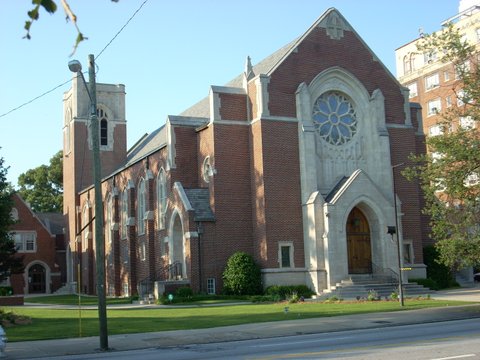
Where & When: Decatur Public Library Auditorium on May 23, 2012. Sponsored by the Georgia Center for the Book.
Attendance: ~40 people with so many architects and preservationists present that Robert M. Craig, a professor emeritus of architectural history at the Georgia Institute of Technology, quipped that he was quite intimidated by the distinguished audience (excluding me, of course).
 What He Read: Craig didn't read. Instead he presented an extensive slide show based on his new book from the University of Georgia Press, The Architecture of Francis Palmer Smith: Atlanta's Scholar Architect. For a half a century, Francis Palmer Smith (1886-1971) either designed or influenced dozens of commercial buildings, hotels, elegant homes and churches. Smith was the first department head of the Georgia Institute of Technology's architecture program.
Why I Went: I've always had an interest in history, architecture and gorgeously printed books like Architecture. Craig is correct in saying his book is no coffee table book – though it has over 400 color and black and white photos. The book is chocked full of building descriptions and detailed history about the architecture and architects of Atlanta. I especially liked the appendix that has the list of all the houses, buildings, and churches including addresses where you can drive by and see them for yourself. (Shown at the top of the posting is the Druid Hills First Presbyterian Church on Ponce De Leon Avenue built in 1939-40. And don't worry, Craig's photos are much better than mine.)
What Craig Talked About: Everything. The lecture was divided into four parts: 1.) The early influences of the Ecole des Beaux-Art on Smith ( who grew up in Cincinnati and studied architecture at the University of Pennsylvania). 2.) Smith's partnership with another influential Atlanta architect, Robert Pringle. (1922-1934), which included many beautiful homes – many in the Druid Hills area. 3.) Smith's commercial work which began with Pringle and included hotels and Coca-cola bottle plants all over the Southeast. The bottling plant construction supported Smith's work during The Great Depression. 4.) Smith's design of churches including his crowning achievement, The Cathedral of St. Philip, here in Atlanta. Preliminary sketches were began in 1937, but the church wasn't built until 1960-62.
—– EXTENDED BODY: Q & A: There was no Q & A, because Craig's lecture lasted almost 90 minutes and the library was closing for the evening. But I didn't see anyone leave early.
Question-I-Was-Too-Timid-to-Ask-But-Didn't-Have-To. Did the library auditorium get new chairs or do the olds ones seem unusually hard and uncomfortable? Other than that, Craig answered all my potential questions during the lecture. Craig did sign books afterwords.
Did I Buy Something? No, I have a reviewer's copy, courtesy of The University of Georgia Press.
Worth mentioning: I have provided you only an inkling of what Craig's lecture covered, but the book has much, much more.
—– EXCERPT: —– KEYWORDS: Francis Palmer Smith, Robert M. Craig, University of Georgia Press, Architecture in Atlanta —– ——– AUTHOR: Murray Browne AUTHOR EMAIL: murray.browne905@gmail.com TITLE: The Trouble with Book Shopping STATUS: Publish ALLOW COMMENTS: 1 CONVERT BREAKS: wysiwyg ALLOW PINGS: 1 BASENAME: the-trouble-with-book-shopping UNIQUE URL: https://thebookshopper.typepad.com/the_book_shopper_atlantad/2012/05/the-trouble-with-book-shopping.html DATE: 05/22/2012 07:32:59 AM —– BODY: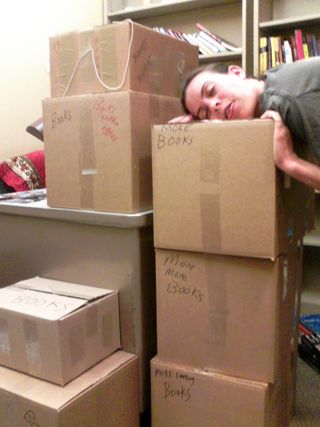 The trouble with book shopping is the exhausting work of having to move them, which is what I did last weekend.
Shown here is my older daughter Cynthia after we packed about ten boxes of books out of her graduate school office at Harvard.
—– EXTENDED BODY: —– EXCERPT: —– KEYWORDS: —– ——– AUTHOR: Murray Browne AUTHOR EMAIL: murray.browne905@gmail.com TITLE: MARTA Book Club #19: Yes, It Exists STATUS: Publish ALLOW COMMENTS: 1 CONVERT BREAKS: wysiwyg ALLOW PINGS: 1 BASENAME: marta-book-club-19-yes-it-exists CATEGORY: MARTA Book Club UNIQUE URL: https://thebookshopper.typepad.com/the_book_shopper_atlantad/2012/05/marta-book-club-19-yes-it-exists.html DATE: 05/14/2012 07:46:01 AM —– BODY:
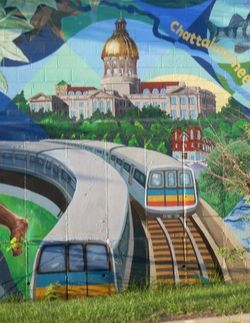 The other day I was reading Gabriel Zaid's fine book about the pitfalls of author-as-celebrity worship, The Secret of Fame: The Literary Encounter is an Age of Distraction (2008), and a young man sitting next to me stares unabashedly at the cover of my book. I look up and I was slightly taken aback, because in book spotting, there is a unwritten rule of viewer discretion. So the man says to me, “I am always interested in finding out what people are reading.” I show him the Zaid book and told him that there is a secret brotherhood and sisterhood of readers and riders called The MARTA Book Club.
“Really, you mean there is a MARTA book club!?!” he asked.
I gave him the website address, (just type MARTA Book Club in Google) and you can find us. The only membership requirement is to read a book while riding Atlanta public transportation.There are no meeting times, no organizational rules, no t-shirts, and no dues. Very convenient.
What We Have Been Reading
It's been a couple months since our last MARTA Book Club compilation (see the links category for all the lists) and there is much reading on the train to report. We regret since we cannot determine the title, electronic books are not tabulated. Here's the last offerings:
Everything is Miscellaneous: The Power of the New Digital Disorder by David Weinberger
Sorting Things Out: Classification and Its Consequences (Inside Technology) by Geoffrey C. Bowker and Susan Leigh Star
A Clash of Kings by George R.R. Martin
The Fiery Trial: Abraham Lincoln and American Slavery by Eric Foner
Home: A Memoir of My Early Years by Julie Andrews
Agent X by Noah Boyd
Living Crazy Love: An Interactive Workbook for Individual or Small-Group Study by Francis Chan and Mark Beuving
Hundred Years of Solitude by Gabriel Garcia Marquez
The Hunger Games by Suzanne Collins
Finding the Favor of God: A Discovery That Will Change Your Life by Ronnie W. Floyd
The Bill: How Legislation Really Becomes Law: A Case Study of the National Service Bill by Stephan Waldman
Research Methods in Information by Alison Jane Pickard
Fire and Ice by Julie Garwood
Schism and Continuity in an African Society a Study of Ndembu Village Life by Victor Turner and Bruce Kapferer
God Speaks to Me: Stories of Triumph Over Tragedy from Women Who Listened to God by Valerie Love
It by Stephen King
Structure in Architecture: The Building of Buildings by Mario George Salvadori
Susanna's Choice by Sara Luck
Elizabeth Taylor: The Last Star by Kitty Kelley
Water for Elephants by Sara Gruen (thanks Emily Britt)
The Boss's Survival Guide by Bob Rosner, Allan Halcrow and Alan Levins
—– EXTENDED BODY: The Help by Kathryn Stockett
Shakey: Neil Young's Biography by Jimmy McDonough
A Man in Full by Tom Wolfe
The Holy Bible
The Four Noble Truths by The Dali Lama
The Host: A Novel by Stephenie Meyer
Corelli's Mandolin: A Novel by Louis De Bernieres
The Alchemist by Paulo Coelho and Alan R. Clarke
A Divine Revelation of Hell by Mary K. Baxter
Letters for Litigators: Essential Communications for Opposing Counsel,Witnesses, Clients and Others by Daniel J. Small.
A Piece of Cake: A Memoir by Cupcake Brown
The Lathe of Heaven by Ursula K. Le Guin
Daddy Loves His Girls: Discover a Love Your Heavenly Father offers that an Earthly Father Can't by T. D Jakes.
Hardluck Ironclad: The Sinking and Salvage of the Cairo by Edwin C. Bearss
Novels by James Patterson, Stuart Woods, Nora Roberts, E Lynn Harris, Janet Evanovich, Sister Souljah, Ruth Lewis, Brenda Jackson, Gena Showalter (steamiest covers), some books about serial killers (disconcerting), guerrilla marketing (equally disconcerting), and creative visualization.
Disclaimer: No rider was pestered to compile this list.
What Members Thought About Each Book
Despite my recent experience, readers are encouraged to keep their thoughts (and eyes) to themselves. No time is wasted talking about books when you could be reading.
Next Assignment
Keep reading, get to work on time, watch for wet spots (of all kinds) and send us your book contributions and observations via comment or visit our Facebook page at facebook.com/thebookshopper. To visit past book club postings, click on the “MARTA Book Club” link at the right.
—– EXCERPT: —– KEYWORDS: Gabriel Zaid, MARTA Book Club, Bookspotting, —– ——– AUTHOR: Murray Browne AUTHOR EMAIL: murray.browne905@gmail.com TITLE: Sample Book Art in Decatur STATUS: Publish ALLOW COMMENTS: 1 CONVERT BREAKS: wysiwyg ALLOW PINGS: 1 BASENAME: sample-book-art-in-decatur CATEGORY: Books as Art as Books UNIQUE URL: https://thebookshopper.typepad.com/the_book_shopper_atlantad/2012/05/sample-book-art-in-decatur.html DATE: 05/07/2012 07:43:01 AM —– BODY:
This next week if you're in downtown Decatur and you like books, check out the Art Institute of Atlanta-Decatur's book arts exhibit, Wallbound. The exhibit opened in March (how did I miss it?!?! I walk past the building all the time) and closes Monday, May 14th , so don't delay. Wallbound features the work of 23 local, national and international artists who accepted the challenge of creating of book art that had to be hung on a wall. The gallery coordinator Angus Galloway, Institute faculty members Jerushia Graham and Alicia Griswold, all who are bookmakers, artists and paper makers as well, curated the exhibit. (Gallery hours are at the end of this article.)
Wallbound is an exquisite mini-celebration of the book and serves as a reminder that books are something we can touch and hold and enjoy visually. (Insert your disparaging comment about e-readers here.)
Books can also have a narrative that extends beyond the content. For example, in Claire Siepser's, Survivor Jacket (collage, lower right) she has transferred photocopied book jackets of plant and insect guides to a Size 6 field jacket to create something that practically belongs in a L.L. Bean catalog. Another artist who also appreciates word play and fashion is Johanna Renbeck. Her wearable book — made from curly paper leaves is called Every Leaf (collage, center) and another wearable book – a tiled breast plate - both belong on the runway, albeit at the American Library Association fashion show.
The geometric properties of words are investigated in Ruth Bardenstein's Geometry/Galileo, a large digital print on mylar, (partially shown, in the lower left). At first, the large print looks like abstract wallpaper from a chic boutique, but when your gaze deepens, letters emerge and then you begin to read the embedded words as well. (I appreciate the gallery permitting me to take these photographs even though they were warned ahead of time, that my camera skills are limited. )
Before the exhibit closes, Joey Hannaford (collage, upper right – the piece is called Red X) is lecturing on “The Use of Proportion in Book Forms,” on Wednesday, May 9th at 6 p.m.
Don't misinterpret my pathetic descriptions and pictures, these are fascinating and enjoyable pieces of art to see and if you're near downtown Decatur near the Old Courthouse (One West Court Square, Suite 110, on Ponce De Leon Avenue), be sure to check them out.
The exhibit will be on view in The Art Institute of Atlanta-Decatur Gallery, One West Court Square, Suite 110, Decatur, GA 30030, through May 14. Gallery hours are Monday-Thursday, 9 am to 8 pm; Friday, 9 am to 5 pm, and Saturday 9 am to 3 pm. For information or directions, visit http://www.artinstitutes.edu/decatur or call 1. 866.856.6203.
—– EXCERPT: —– KEYWORDS: Art Institute of Atlanta-Decatur, Wallbound, Claire Siepser, Johanna Renbeck, Ruth Bardenstein, Joey Hannaford, Julie Newton —– COMMENT: AUTHOR: Full Body Suit EMAIL: corbee12345@yahoo.com IP: 112.200.127.56 URL: http://www.jaskins.com.au/ DATE: 05/08/2012 01:44:52 AM Great work of your creativity here. I admire your work in every possible way. Keep em coming! —– COMMENT: AUTHOR: Linda Albert EMAIL: IP: 183.83.165.190 URL: http://profile.typepad.com/lindaalbert DATE: 05/08/2012 03:26:42 AM This sound very interesting. I’m happy that you shared this helpful info with us. Please stay us up to date like this. Thanks for sharing. http://www.sample.net/ —– COMMENT: AUTHOR: alicia griswold EMAIL: agriswold@me.com IP: 99.32.190.116 URL: http://www.sendingpagesouttodry.blogspot.com DATE: 08/24/2012 09:16:16 AM Thanks for reviewing this show. I appreciate the care and effort of your very thorough review. Alicia Griswold AID You might like to visit this site. Both Jerushia and I are members of the Atlanta Book Arts Collective, a relatively new group. http://www.atlantabookarts.org/ —– ——– AUTHOR: Murray Browne AUTHOR EMAIL: murray.browne905@gmail.com TITLE: Atlanta Area Book Calendar – May 2012 STATUS: Publish ALLOW COMMENTS: 1 CONVERT BREAKS: wysiwyg ALLOW PINGS: 1 BASENAME: atlanta-area-book-events-calendar-may-2012 CATEGORY: Books as Art as Books UNIQUE URL: https://thebookshopper.typepad.com/the_book_shopper_atlantad/2012/04/atlanta-area-book-events-calendar-may-2012.html DATE: 04/29/2012 08:19:26 PM —– BODY:

Here are your local opportunities for literary discourse during the month of May in the Atlanta area. I basically scout around various sites looking for what interests me and provide the links. (I purposely don't include the details, in case there is a last minute change of schedule, etc.)
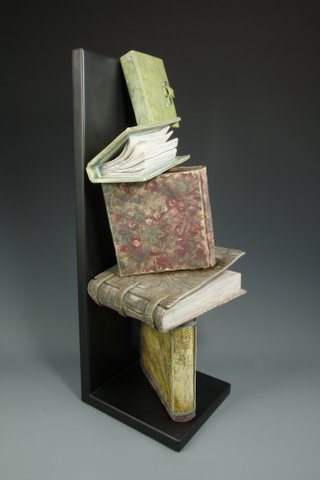 It's the final two weeks for The Art Institute of Atlanta-Decatur's exhibit, Wallbound where a number of national and international artists rethink the idea of the bound book. For more information, check the comments section below. ("Precarious Balance" by Serey Andree is shown at the left.)
Austen Burroughs, author of the novel This is How will be at the Savannah College of Art and Design's Ivy Hall on Saturday, May 12th ($10 admission or free with book purchase).
On Thursday, May 17th, Jonathan Odell, author of the novel The Healing, will read and sign books at the Carter Presidential Library & Museum Theater. Other authors visiting the Carter Library in the month of May include Steve Coll (Private Empire: ExxonMobil and American Power) on May 23rd and Nancy Gibbs & Michael Duffy (The Presidents' Club) on May 24th.
 Ron Rash, author of Serena and Michel Stone will be at the Decatur Public Library on Tuesday, May 15th. Rash celebrates the publishing of his new book The Cove and is joined by his friend Stone whose first novel The Iguana Tree has recently been published. Robert Craig who has written a new book about architecture in Atlanta, The Architecture of Francis Palmer, Atlanta's Scholar Architect will be at the DPL on May 23rd. Craig, Rash and others are just a few of authors brought in by The Georgia Center for the Book in the month of May.
The Auburn Avenue Research Library is hosting several events in May including a reading and signing of author's Javon Brothers latest book, A Deadly Night in the Harbor of Hospitality on Saturday, May 5th.
—– EXTENDED BODY: Check these local bookstores for other events:
Peerless Bookstore – Alpharetta
A Cappella Books (now in Inman Park)
Bound to be Read (East Atlanta)
Eagle Eye Books (Decatur)
Charis Books and More (Near Little Five)
Artwork of the Atlanta Skyline: Courtesy of Caitlin Salmon
Photo of "Precarious Balance," courtesy of Art Institute of Decatur
—– EXCERPT: —– KEYWORDS: Precarious Balance, Atlanta, Readings, Book Events, Javon Brothers, Ron Rash, Robert Craig, Austen Burroughs, Jonathan Odell, Michel Stone, Serey Andree —– ——– AUTHOR: Murray Browne AUTHOR EMAIL: murray.browne905@gmail.com TITLE: Mini-review: Kevin Wilson’s Performance at the Decatur Public Library STATUS: Publish ALLOW COMMENTS: 1 CONVERT BREAKS: wysiwyg ALLOW PINGS: 1 BASENAME: mini-review-kevin-wilsons-performance-at-the-decatur-public-library CATEGORY: Local Reviews UNIQUE URL: https://thebookshopper.typepad.com/the_book_shopper_atlantad/2012/04/mini-review-kevin-wilsons-performance-at-the-decatur-public-library.html DATE: 04/21/2012 09:30:29 AM —– BODY:Where & When: Decatur Public Library Auditorium on April 18, 2012. Sponsored by the Georgia Center for the Book.
Attendance: ~30 people including one woman who was doing her knitting.
Why I Went: Both Kevin Wilson's 2011 novel The Family Fang and his collection of short stories Tunneling to the Center of the Earth have received considerable critical acclaim the past few years. (The Family Fang was one of the finalist for this year's Pultizer in fiction.) I missed his earlier visits to the Atlanta area.
 What He Read: A somewhat unconventional selection. For about 25 minutes, Wilson read an excerpt from The Family Fang and three freshly written scenes for the Fang book that didn't appear in the book (requested by his publisher for promotional purposes?). The Family Fang is the story of two performance artist parents who use their children as part of their act with consequences that are detrimental to the children.
Q & A: At first, the unassumming Wilson nervously zipped and unzipped his hooded sweatshirt, but then relaxed when members of the audience asked specific questions about The Family Fang. (Something comforting when a writer connects to his or her readers.) Wilson also talked about how he first became intrigued by performance art of Chris Burden as a fifteen year old growing up in Winchester, Tennessee. Wilson admires the work of performance artist Joesph Beuys and network of artists known as Fluxus as well, but said he was careful not to study their work too much because he didn't want to risk tainting the imaginative performances he created for characters in his book.
Question-I-Was-Too-Timid-to-Ask-But-Didn't-Have-To-Because-Someone-Else-Did (thankfully). One audience member asked about the recent decision of the Pulitzer committee not to award a Pulitzer Prize for fiction in 2012. Wilson said that naturally he was disappointed that he didn't win (Ann Patchett wrote that Wilson was certainly worthy), but thinks Denis Johnson's Train Dreams was definitely a book that deserved the prize.
 Did I Buy Something? Yes. I picked up a copy of his collection of short stories and had it signed. I debated whether to have him pose for a picture for the blog, but Wilson who thanked everyone repeatedly for attending, seemed shy about the whole “reading” experience. I didn't want to be pushy.
Worth Mentioning: Wilson has a different approach to writing that you don't often hear. Unlike some writers who insist that you have to put on a tie and write every day like it is a job, Wilson, who teaches fiction at the University of the South, says he will go months without writing. He lets the story “spend time in my head.” When it's time, he will write continuously for six or seven days, breaking only for meals.
—– EXTENDED BODY: —– EXCERPT: —– KEYWORDS: Kevin Wilson, Atlanta, Decatur, Family Fang, Tunneling to the Center of the Earth, Ann Patchett, Train Dreams, 2012 Pulitzer —– COMMENT: AUTHOR: Jim S. EMAIL: jimsimpsonatl@gmail.com IP: 99.141.153.40 URL: http://jimsimpson.tumblr.com DATE: 04/21/2012 11:54:35 AM I knew he was reading on Wednesday, but unfortunately I had other plans so I missed it. Thanks for the virtual highlights. I’ve read his story collection and I’m reading Family Fang now — brilliantly disturbing, although the potato cannon chapter is comedic genius. —– COMMENT: AUTHOR: Essay Writing EMAIL: alenmartin05@gmail.com IP: 14.192.145.68 URL: http://www.Affordablewriting.net/ DATE: 07/03/2012 01:29:54 AM This is really interested blog can you plese give me more details or link from where I can get more information about this topic. Thanks. —– ——– AUTHOR: Murray Browne AUTHOR EMAIL: murray.browne905@gmail.com TITLE: The Joys of Losing: My Life as a Baseball Fan STATUS: Publish ALLOW COMMENTS: 1 CONVERT BREAKS: wysiwyg ALLOW PINGS: 1 BASENAME: the-joys-of-losing-my-life-as-a-baseball-fan CATEGORY: Baseball CATEGORY: Book Reviews UNIQUE URL: https://thebookshopper.typepad.com/the_book_shopper_atlantad/2012/04/the-joys-of-losing-my-life-as-a-baseball-fan.html DATE: 04/13/2012 07:39:37 AM —– BODY:The English won all the battles but the Irish went home with all the songs.– Wilfred Sheed
 Books such as Wilfred Sheed's baseball-laden 1993 memoir, My Life as a Fan eloquently rekindles one of sports' ongoing debates, “Is there happiness rooting for a perpetual loser?” As a Cubs fan, who has allowed his daughter (shown here with her fiance) to go down this mine-filled base path, this is a topic I'm always interested in.
With prose that rivals John Updike's short account of Ted Williams' last game for the Boston Red Sox, Sheed addresses this question. As a nine-year old, Sheed arrived in Philadelphia from England in 1940 in the wake of a possible German invasion and found that baseball was a way to assimilate into his new country. Sheed's first allegiances were with Connie Mack's hapless Philadelphia Athletics. Slowly, Sheed switched leagues to become a Brooklyn Dodgers fan, expecting the glory to begin immediately.” Little did the young Sheed know that there would be a delay in gratification.
Sheed's years of disappointment began when Dodger catcher Mickey Owens dropped a third strike leading to a loss in Game Four of the 1941 World Series. Sheed writes, “Anyone can root for a winner, but it takes a stab of pain to initiate you all the way."(My daughter's initiation was the Bartman game during the Cubs loss to the Marlins in the 2005 NLCS. Young Atlanta Braves fan were baptized last year during their September collapse.)
However the book is much more than a fan's love of baseball, which is a subject that often borders on the cliché. Sheed illuminates the often forgotten baseball played during the World War II. 1941 was a memorable season with Joe DiMaggio's 56 game hit streak, and Ted Williams hitting over .400 for the season. Though Sheed maintains that Williams was willing to put his .400 batting average in jeopardy on the last day of the season, because he was facing the miserable Athletics. In general, the quality of play suffered during the war. Sheed writes, “the shortage of baseball talent was critical, and even more painfully noticeable than the substitution of phony meat in the frankfurters—a a hot dog still looked like a hot dog and you could paint your margarine yellow, but there was no hiding that chunk of Spam you had playing shortstop or a pitching staff made of powdered eggs.”
—– EXTENDED BODY: No doubt that Sheed is certainly qualified to weigh in on whether it is better to love a perpetual loser or to win once, taste it and never taste victory again (citing how miserable the 1987 Met fans were after winning it all in 1986). In contrast, the Brooklyn Dodgers lost to the Yankees in the World Series five times in fifteen years before defeating them in the 1955 Series. But in 1958, the Dodgers moved to Los Angeles, an unparalleled heartbreak for loyal Brooklyn fans. Still, I think Sheed answers the question of whether it is easier to root for a team that wins and loses, than for a team that hasn't won in over a century by capturing the moment that Gil Hodges snapped his mitt shut sealing the 1955 Dodger World Series win. “Victory has,” writes Sheed, “a way of letting you down, of not tasting quite as good as it looked on the menu. But not this one—this one tastes sweet even today, despite the bitter aftertaste that comes a second later.”
Ahhhh! To think of that day ahead, Cub fan. But probably not this year.
—– EXCERPT: —– KEYWORDS: Wilfred Sheed, My Life as a Fan, Baseball during the War, —– ——– AUTHOR: Murray Browne AUTHOR EMAIL: murray.browne905@gmail.com TITLE: A Trip to Shiloh STATUS: Publish ALLOW COMMENTS: 1 CONVERT BREAKS: wysiwyg ALLOW PINGS: 1 BASENAME: a-trip-to-shiloh CATEGORY: Civil War Books UNIQUE URL: https://thebookshopper.typepad.com/the_book_shopper_atlantad/2012/04/a-trip-to-shiloh.html DATE: 04/03/2012 07:39:22 AM —– BODY:
 Inspired by reading Winston's Groom's latest book Shiloh, 1862 and the fact that Friday is the 150th Anniversary of the Battle of Shiloh, I wrote up a list of other Shiloh-related works and sent it to Like the Dew, A Journal of Southern Culture. You can read the article here.
Check the April Calendar of Events for details about Groom's appearance in Atlanta on April 11th.
If by chance you have migrated from Like the Dew to this blog, you can check other Civil War related books by typing "Civil War" in the search box.
Photo: Courtesy of National Geographic
—– EXTENDED BODY: —– EXCERPT: —– KEYWORDS: —– ——– AUTHOR: Murray Browne AUTHOR EMAIL: murray.browne905@gmail.com TITLE: Atlanta Area Book Events Calendar – April 2012 STATUS: Publish ALLOW COMMENTS: 1 CONVERT BREAKS: wysiwyg ALLOW PINGS: 1 BASENAME: atlanta-area-book-events-calendar-april-2012 UNIQUE URL: https://thebookshopper.typepad.com/the_book_shopper_atlantad/2012/03/atlanta-area-book-events-calendar-april-2012.html DATE: 03/29/2012 09:35:16 PM —– BODY:

Here are your on-ramps for literary discourse during the month of April in the Atlanta area:
The Auburn Avenue Research Library is hosting many events this month ranging from a signing and reading of acclaimed journalist and civil rights icon Charlyne Hunter-Gault's To the Mountaintop: My Journey through the Civil Rights Movement ( Monday, April 2nd) to Langston Out Loud: Celebrating the Power of Langston Hughes' Poetry in the Modern World (Saturday, April 21st).
 Lauren Groff, author of the novel Arcadia will be at the Savannah College of Art and Design's Ivy Hall on Tuesday, April 3. Stephen King, Lorrie Moore and Richard Russo have all praised Groff's fiction. Groff is part of this spring's SCAD Ivy Hall Writer Series. Andre Dubus III will be there April 12th. Admission ($$) is charged.
On Wednesday, April 11th, Winston Groom, author of Shiloh 1862, (and Forrest Gump) will read and sign books at the Carter Presidential Library & Museum Theater. Other authors in the month of April include syndicated columnist Rheta Grimsley Johnson, author of the memoir Hank Hung the Moon…and Warmed Our Cold, Cold Hearts appears at the library on April 30th.
On Wednesday, April 18th Kevin Wilson author of the novel The Family Fang and the book of short stories Tunneling to the Center of the Earth (he was at the Decatur Book Festival a couple of years ago) will be at the Decatur Public Library. Wilson's appearance is just one of authors appearing locally via the Georgia Center of the Book. Austin Kleon author of Steal Like and Artist: 10 Things Nobody Told You about Being Creative appears at the library on Wednesday, April 11th.
—– EXTENDED BODY:Check these local bookstores for other events:
Peerless Bookstore – Alpharetta
A Cappella Books (now in Inman Park)
Bound to be Read (East Atlanta)
Eagle Eye Books (Decatur)
Charis Books and More (Near Little Five)
—– EXCERPT: —– KEYWORDS: Winston Groom, Shiloh 1862, Lauren Groff, Atlanta Book Events, Charlyne Hunter-Gault, Kevin Wilson, —– COMMENT: AUTHOR: Labor Posters EMAIL: shelenacopeley@gmail.com IP: 121.97.74.130 URL: http://www.allinoneposters.com/ DATE: 04/18/2012 01:37:58 AM Nice! Calender don’t make me fool this time I will mark it so that I won’t mistake anymore. —– ——– AUTHOR: Murray Browne AUTHOR EMAIL: murray.browne905@gmail.com TITLE: Different Worlds: On Reading Ben Okri’s The Famished Road STATUS: Publish ALLOW COMMENTS: 1 CONVERT BREAKS: wysiwyg ALLOW PINGS: 1 BASENAME: different-worlds-on-reading-ben-okris-the-famished-road- UNIQUE URL: https://thebookshopper.typepad.com/the_book_shopper_atlantad/2012/03/different-worlds-on-reading-ben-okris-the-famished-road-.html DATE: 03/24/2012 09:00:34 AM —– BODY:
by Chantal James
 Ben Okri's The Famished Road (1991) is a novel about being caught between two worlds. Maybe we all know the feeling; compelling books disorient us, don't they? They hook us. As we wrench our eyes away from an unfinished book for a few hours, to go about our daily lives, it can feel like having the left foot in one world and the right foot in another.
Books weave spells, so that the very rooms we read them in fall away from us. They spin visions in our minds more real, for the moment, than quotidian reality.
And so, The Famished Road enchants. At its center is the narrator Azaro, a very young child in Nigeria on the eve of its national independence. Azaro has not yet lost his memory of the spirit world in which he lived before birth. In fact, the world of the spirits is still more real to him than the world of the living. The book so far is dreamlike, full of ghosts.
This novel is sectioned into several "books." I've now finished the first of these. I am securely past The Famished Road’s point of no return. Most novels have one: the point after which you know you won't escape it, and that it will pull you deeper through its tunnels, until emerging on the other side, you shake yourself from its hold and re-enter the world.
Azaro, floats into and out of the world of the dead, unsure if he really wants to be here with us, and tempted by friends of his from the spirit realm. His spirit “buddies” literally set death traps for him, hoping that he will be killed and so return to them. He narrowly escapes several times. At one point the young boy is kidnapped by a couple whose son has died. He is given the dead boy's clothes to wear, while his parents across town search high and low for him, fearing the worst. For Azaro, the spirit dimension is superimposed on the physical. He does not easily distinguish between the things he sees that are invisible to everyone else: he can see the dead, the unborn, and forms that will never live or die. Because the child who tells the story cannot tell the difference, the reader doesn't always either.
—– EXTENDED BODY:
In a real way, to read a novel is to be possessed. For awhile the words someone else has written co-opt the machinery of our minds. I know I will finish this one, because I am the book's own now. It has seized me. I belong to it. But though I am still compelled onward it's worth stopping for a moment, to pay homage to the power a written story has to hold us captive.
As visitors to the world of any story, we are like the little boy Azaro in The Famished Road. We readers ourselves come from far beyond the tiny, intricate universe that exists between the two covers of a book. When the story is done, we’ll return from whence we came. But for now, while we're reading, we find ourselves bound to live out the terms of another embodied life—until the last page is turned, and one whole world is left behind.
Chantal James is a writer who lives in Atlanta and is working on her second novel. Her reviews have also appeared in Paste Magazine and she keeps a blog at called Globalsouth and she can be found on Twitter as well. James is on staff at A Cappella Books. (To read her other postings, visit the Chantal James link on the right.)
—– EXCERPT: —– KEYWORDS: Ben Okri, Famished Road, Chantal James —– COMMENT: AUTHOR: William Gwin EMAIL: wgwin@knology.net IP: 97.67.105.226 URL: DATE: 03/27/2012 08:52:05 PM Good stuff, Murray! —– COMMENT: AUTHOR: Essay Writing EMAIL: alenmartin05@gmail.com IP: 14.192.145.68 URL: http://www.Affordablewriting.net/ DATE: 07/03/2012 01:33:32 AM about The Famished Road is blog is very nice i like this story thanks for sharing. —– ——– AUTHOR: Murray Browne AUTHOR EMAIL: murray.browne905@gmail.com TITLE: Nora Ephron on Blogging and Essay Writing STATUS: Publish ALLOW COMMENTS: 1 CONVERT BREAKS: wysiwyg ALLOW PINGS: 1 BASENAME: nora-ephron-on-blogging-and-essays UNIQUE URL: https://thebookshopper.typepad.com/the_book_shopper_atlantad/2012/03/nora-ephron-on-blogging-and-essays.html DATE: 03/18/2012 08:52:18 PM —– BODY:I just finished reading Kathyrn Borel's interview with Nora Ephron in the March issue of The Believer Magazine. In the brief excerpt, Ephron talks about the relationship between blogging and essay writing. Later on in the article (you will have to buy the magazine ) she mentions that looking back, a pivotol essay in her career was the "A Few Words About Breasts" published in 1973, which appeared in Esquire Magazine. In retrospect, Ephron views that essay as something that defined her as a writer who could either successfully shock readers with candidness or run the risk of being judged as writer who has crossed the boundary of "who needs to know this?" As she finished the Breasts piece, Ephron admits to Borel she didn't know how readers would react. 
Coincidently bookshoppingwise, you can find the Breasts essay in the 1983 collection, The Best of Modern Humor edited by Mordecai Richler. The book includes pieces by Woody Allen, Ian Frazier and E.B. White. Knopf printed a lot of these books and you can sometimes find them for a few dollars at a used book store. (Check out the price tag on this photo.)
—– EXTENDED BODY: —– EXCERPT: —– KEYWORDS: A Few Works About Breasts, Nora Ephron, The Best of Modern Humor, Believer Magazine —– COMMENT: AUTHOR: Custom Essay Writing Service EMAIL: Oliviasophiamia@gmail.com IP: 182.178.51.207 URL: http://essayglory.com/ DATE: 05/31/2012 03:15:04 PM It’s very interesting, enjoy it’s reading http://www.essayglory.com/ —– COMMENT: AUTHOR: Essay writing tips EMAIL: authorsmania1@gmail.com IP: 58.65.149.165 URL: http://www.authorsmania.com DATE: 06/22/2012 02:19:49 PM Blogging and essay writing are somehow interrelated to writing, and writing requires creativity, time and skills to perfect. —– COMMENT: AUTHOR: Essay Writing EMAIL: alenmartin05@gmail.com IP: 14.192.145.68 URL: http://www.Affordablewriting.net/ DATE: 07/03/2012 01:20:50 AM this is very nice & intrusting blog i like this. —– COMMENT: AUTHOR: Research paper writing service EMAIL: dheeraj@theseoz.com IP: 49.249.1.218 URL: http://www.universityessayexperts.com/research-papers DATE: 01/02/2013 01:40:39 AM i tried to find Breasts essay written by her but i am not able to find that —– COMMENT: AUTHOR: Best writing service EMAIL: dheeraj@theseoz.com IP: 49.249.188.199 URL: http://www.universityessayexperts.com/ DATE: 02/15/2013 04:54:56 AM form where we can have this breast essay —– COMMENT: AUTHOR: review of essay writing services EMAIL: Harce1956@gmail.com IP: 49.145.36.225 URL: http://www.whowritesbest.com/ DATE: 02/24/2013 09:35:10 PM Awesome! when I first saw your blog, I got some good interest on it because I have noticed that it was full of very wonderful thoughts which I can be use for my future essay writing works. thank for sharing me this wonderful essay which makes me feel good. —– COMMENT: AUTHOR: Weiter EMAIL: we89@gmail.com IP: 91.221.66.160 URL: http://www.bancdeswissde.com/ DATE: 10/01/2013 07:00:15 AM Nora Ephron is amazing! —– ——– AUTHOR: Murray Browne AUTHOR EMAIL: murray.browne905@gmail.com TITLE: A Cappella’s New Store: A Browser’s Audio Tour STATUS: Publish ALLOW COMMENTS: 1 CONVERT BREAKS: wysiwyg ALLOW PINGS: 1 BASENAME: a-cappellas-new-store-a-browsers-audio-tour- CATEGORY: Bookstores UNIQUE URL: https://thebookshopper.typepad.com/the_book_shopper_atlantad/2012/03/a-cappellas-new-store-a-browsers-audio-tour-.html DATE: 03/12/2012 10:55:25 PM —– BODY:
Just off Dekalb Avenue on Harolson Avenue– not far from the spot where Scarlett's second husband Frank 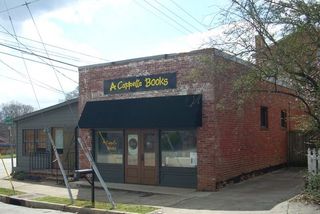 Kennedy was killed in Gone with with Wind – near the Inman Park MARTA station – is the new home of A Cappella Books, a mainstay of the Atlanta book scene for over twenty years.
A Cappella is owned by Frank Reiss. I stopped by to visit with Frank (you can hear him in the background) and do a walk through of the new store. Here's the raw recording ( a little over three minutes) but you can get a sense of what it means to browse at a good bookstore.
Download Audio Tour of A Cappella (Windows)
Audio Tour of A Cappella (mpg)
—– EXTENDED BODY: —– EXCERPT: —– KEYWORDS: A Cappella Books, Frank Reiss, —– ——– AUTHOR: Murray Browne AUTHOR EMAIL: murray.browne905@gmail.com TITLE: Mini-review: Rob Walker in Atlanta STATUS: Publish ALLOW COMMENTS: 1 CONVERT BREAKS: wysiwyg ALLOW PINGS: 1 BASENAME: mini-review-rob-walker-in-atlanta UNIQUE URL: https://thebookshopper.typepad.com/the_book_shopper_atlantad/2012/03/mini-review-rob-walker-in-atlanta.html DATE: 03/02/2012 05:01:24 PM —– BODY:
 Where & When: Reception Hall at the Carlos Museum on the campus of Emory University, February 29, 2012
Attendance: ~250 people, which packed the house.
Why I Went: I've read and reread Walker's (2008) book Buying In: The Secret Dialogue Between What We Buy and Who We Are. Walker is a former columnist for The New York Times Magazine. The book examines how marketing and advertising have changed their approach and how consumers have changed their mindsets or think they are immune to the machinations of advertisers.
What He Read: The evening consisted of Walker and Department of Religion Professor Bobbi Patterson sitting in big comfy chairs and conversing about what desire means in Buddhism. The Buddhism perspective was the dominant theme (as advertised), so I have a no right to be disappointed, but I was. (I should have managed my high expectations better.) From reading his book, I know Walker has interesting perspectives about consumerism, but all I remember from the evening is that Walker drives a 1999 Jeep Cherokee and Patterson used to own a Jeep Cherokee too (not kidding).
—– EXTENDED BODY: Q & A: At the 75 minute mark, I left before the Q & A finished.
Question I Was Too Timid to Ask: What brand of beer do you drink?
Did I Buy Something? No, as I had two hardback copies of Buying In already, but I did get a nifty poster promoting the current museum exhibit Mandela: Sacred Circle in Buddhism.
Worth Mentioning: Although the reading was well-attended, I wonder if most of the attendees found the lack of a stage platform in the front room a problem. Basically anyone who wasn't sitting in the first few rows could not see or Walker or Patterson. The program might as well been on the radio or closed circuit television. After an hour people began to drift out the door except those in the back rows who were still practicing their meditation (sleeping).
—– EXCERPT: —– KEYWORDS: Rob Walker, Buying In. Emory University —– ——– AUTHOR: Murray Browne AUTHOR EMAIL: murray.browne905@gmail.com TITLE: Atlanta Area Book Events Calendar – March 2012 STATUS: Publish ALLOW COMMENTS: 1 CONVERT BREAKS: wysiwyg ALLOW PINGS: 1 BASENAME: atlanta-area-book-events-calendar-march-2012 UNIQUE URL: https://thebookshopper.typepad.com/the_book_shopper_atlantad/2012/02/atlanta-area-book-events-calendar-march-2012.html DATE: 02/28/2012 07:35:18 AM —– BODY:
Here's are some of your best bets for literary discourse during the month of March in the Atlanta area:
Wednesday, March 7 – Alexandra Styron daughter of William Styron (you know, the author of Sophie's Choice) will be discussing her book Reading My Father: A Memoir as part of the Savannah College of Design's Ivy Hall Writing Series. There is an admission charge.
Throughout March – in celebration of Women's History Month 2012 – the Auburn Avenue Research Library is hosting many, many events ranging from a book discussion of Geographies of the Haitian Diaspora (Dr. Regine O. Jackson, on March 8) to Time Served: My Days and Nights at Death Row Records (a memoir by photographer Simone Greene – March 29). There is a wide variety of lectures and films as well.
 Wednesday, March 21 – Poet Kevin Young, previous co-winner of this blog's prestigious Best-Local-Reading-That-I-Attended Award (and Graywolf Press' NonFictionPrize) will be celebrating the publication of Young's first book of non-fiction essays, The Grey Album: On the Blackness of Blackness. The party and signing will be at the Highland Inn Ballroom.
Tuesday, March 27 – Yangzum Brauen, author of Across Many Mountains: Three Daughters of Tibet will be doing a reading and signing at the Carter Library and Museum.
The Georgia Center of the Book is promoting a variety of authors throughout the month including equal pay advocate Lilly Ledbetter (March 6) and nationally known author Anne Lamott (March 23 ).
Also several local bookstores are hosting events:
-
Peerless Books in Alpharetta
Banner design by Caitlin Salmon
—– EXTENDED BODY: —– EXCERPT: —– KEYWORDS: Atlanta Book Events, Rob Walker, Emory University, Lilly Ledbetter, Yangzum Brauen, —– ——– AUTHOR: Murray Browne AUTHOR EMAIL: murray.browne905@gmail.com TITLE: MARTA BOOK CLUB #18: What Atlanta is Reading STATUS: Publish ALLOW COMMENTS: 1 CONVERT BREAKS: wysiwyg ALLOW PINGS: 1 BASENAME: marta-book-club-18-what-atlanta-is-reading CATEGORY: MARTA Book Club UNIQUE URL: https://thebookshopper.typepad.com/the_book_shopper_atlantad/2012/02/marta-book-club-18-what-atlanta-is-reading.html DATE: 02/20/2012 04:54:12 PM —– BODY:
For where there is innovation, there is no security — Procopius*

Are you looking to join the Atlanta book reading community without actually having to be involved? Then the MARTA Book Club might be the organization for you.
The MARTA Book Club is a loose— very loose— confederation of people who read while riding the Metropolitan Atlanta Rapid Transit Authority’s public transportation. There are no meeting times, no organizational rules, no t-shirts, and no dues. Very convenient. The only requirement to be a member of MARTA Book Club is to read a book while riding public transportation, which for most riders seems to be a steep admission price.
What We Have Been Reading
It's been a couple months since our last MARTA Book Club compilation and there is much reading on the train to report. We regret since we cannot determine the title, electronic books are not tabulated.
The Roman Way by Edith Hamilton
Last Night in Twisted River by John Irving
Little Bee by Chris Cleave
The Rogers & Littleton Guide to America's Douchiest Colleges by H. L. Rogers and Peter Littleton
Steve Jobs by Walter Issacson* (I am currently reading this book at home because carrying it on the train is cumbersome and I don't e-book. So far, I think the book is much more interesting because it chronicles the early days of the personal computer industry. Jobs' obnoxiousness, brilliance and manipulative nature is of secondary interest to me. Hats off to Issacson's readable narrative. Issacson prose seems effortless, which is usually means a lot of hard work into it.
Infinite Jest by David Wallace
The Name of the Wind by Patrick Rothfuss
The Art of Racing in the Rain: A Novel or was it Racing in the Rain: My Life as a Dog (both) by Garth Stein (not to be confused My Life as a Dog by Reider Jonsson and Eivor Martinus, which was made into a fine movie by the director Lasse Hallstrom of Chocolat and Gilbert Grape fame).
Successful Public Meetings: A Practical Guide by Elaine Cogan
Where the Girls Are: Growing Up Female with the Mass Media by Susan J. Douglas
Divine Inspiration: A Home Kelly Mystery by Jane Langton
AIDs, Opium, Diamonds, and Empire by Nancy Turner Banks
Just for You (Arabesque) by Doreen Rainey
The Great Controversy by Ellen G. White
Up to No Good by Carl Weber
A Highlander Christmas by Janet Chapman
No Disrespect by Sister Souljah
The Black Panther Party (Reconsidered) by Charles E. Jones
The Georgia Commercial Driver's License Manual (it's thicker than you think)
The Day of Battle: The War in Sicily and Italy, 1943-1944 by Rick Atkinson. My personal contribution to the book club. I heard him speak (he's both authoritative and humble) at the Decatur Library a few years ago when he was promoting the paperback release of The Day of Battle which is Part Two of his Liberation Trilogy. Atkinson writes in a narrative style that reminds me of Shelby Foote. The war in Italy is often pushed into the distant background, but it was a sad and bloody campaign and did serve a strategic purpose. (Rome fell a day before the landings in Normandy). Atkinson gives homage to those who bravely fought there and calls out both the good commanders and the shamefully incompetent ones.
Take the Cannoli: Essays from the New World by Sarah Vowell
Juicing, Fasting, and Detoxing for Life: Unleash the Healing Power of Fresh Juices and Cleansing Diets by Cherie Calbom and John Calbom
—– EXTENDED BODY: The Adventures of Cavalier and Clay by Michael Chabon
Dosage Calculations by Gloria D. Pickar and Amy Pickar
Portnoy's Complaint by Philip Roth
Cataloochee: A Novel by Wayne Caldwell
Speaker for the Dead by Orson Scott Card
Books by JoAnn Ross, Ann Patchett, Nora Roberts, Barbara Taylor, Neal Stephenson, Chetan Bhagat, Carla Nevers, The Black, and James Patterson
What Members Thought About Each Book
Readers are encouraged to keep their thoughts (and eyes) to themselves. No time is wasted talking about books when you could be reading.
Next Assignment
Keep reading, get to work on time, watch for wet spots (of all kinds) and send us your book contributions and observations via comment or visit our Facebook page at facebook.com/thebookshopper. To visit past book club postings, click on the “MARTA Book Club” link at the right.
* Procopius was to the Byzantine Emporor Justianian as Walter Issacson was to Steve Jobs
—– EXCERPT: —– KEYWORDS: MARTA, book clubs Atlanta, Walter Issacson, Steve Jobs, The Day of Battle, Rick Atkinson —– COMMENT: AUTHOR: Emily EMAIL: ebritt@midtownalliance.org IP: 64.207.63.58 URL: DATE: 02/24/2012 03:56:05 PM I’m reading It by Stephen King, which is a little tough to bring on the train because it’s so bulky. It is really good though! —– COMMENT: AUTHOR: GUIDO MATTIONI EMAIL: guido.mattioni@hotmail.it IP: 2.230.51.144 URL: DATE: 05/13/2012 08:29:53 AM Good morning y’all! This is Guido Mattioni, I’m an Italian writer, and I would like to draw your attention to a press release concerning me and my novel WHISPERING TIDES, a touching and funny tale set in Savannah, GA. Thank you so much for your kindliness. I hope you’ll have a good read. Ciao. Guido http://www.facebook.com/pages/Whispering-Tides/162120427216558 guido.mattioni@yahoo.it http://www.amazon.com/Whispering-Tides-Touching-Memorable-Savannah/dp/1469934817/ref=sr_1_3?ie=UTF8&qid=1336285369&sr=8-3 http://www.amazon.com/Whispering-Tides-ebook/dp/B006YDPV7Y/ref=sr_1_1?s=books&ie=UTF8&qid=1336285423&sr=1-1 http://www.authorsden.com/visit/viewwork.asp?id=52448 Press Release A NOVEL SET IN SAVANNAH NOMINATED FOR A GLOBAL EBOOK AWARD (AND THE AUTHOR IS ITALIAN) Italian writer Guido Mattioni’s Whispering Tides, a novel set in Savannah, Georgia has been accepted in nomination by The Global eBook Awards of Santa Barbara, CA (Popular Literature Fiction category http://www.youtube.com/watch?v=t92wWp1a9Oc ). The prize will be awarded in Santa Barbara on August 18th, 2012. Mattioni, a Milanese in his late fifties who recently retired after 33 years as a respected name in Italian journalism, is still an active columnist and freelancing contributor to Italian national dailies and magazines. Bringing him to set his debut as a novelist right in Savannah was the mix of an intimate story and his long lasting “love affaire” with the Georgian City. It’s a love story (Guido says) that blossomed in a memorable early Savannah spring in 1991 amidst gorgeous blooming azaleas. It was his very first visit there and it was to be just the first of an ongoing never ending series of yearly visits. More than this: it’s a love story that is nourished by a growing number of solid local friendships that pinnacle in 1998 with honorary Savannah citizenship being granted to him by Mayor Floyd Adams, Jr. Quoting Alberto Landi, the novel’s main character, he felt “this place hidden deeply inside, something already familiar…” and “since then the city of Savannah has become something intimate, an inseparable part of me, like a vital organ or my second skin”. One of the yet few Italian “Indie” writers (http://www.indiesunlimited.com/2012/04/16/sneak-peek-guido-mattioni%E2%80%99s-whispering-tides/#more-12126 ), utterly convinced about the positive impact of this revolutionary wave that is giving full meaning to the expression “freedom of press”, Mattioni is the Author and the Publisher of his novel, downloadable both in the English and Italian languages. Whispering Tides – Ascoltavo le maree is available from main digital libraries such as Amazon, Apple, Diesel, Sony, and Kobo, as well as Barnes and Noble, and it is also available in paperback edition from Amazon.com (here’s the Goodreads review by Chicago novelist Susan Russo Anderson: http://www.goodreads.com/review/show/302291877 ) and Lulu.com. Synopsis When his beloved wife Nina suddenly dies – after 23 years of life together – Alberto Landi understands he has to leave Milan Italy, where he has always lived and worked. He leaves his friends, colleagues, a good job and the polluted big city he has never loved which has now become even more intolerable to him. He is fifty, he is totally alone and he is confused, but he definitely knows that he has to escape very far away, across the ocean to the only place he and Nina had always loved together. He lands in Savannah, Georgia. There, in a natural paradise governed by the breath of the tides and with the help of many dear friends – colorful human characters as well as wise animals – he starts to rebuild his new life. His dream is coming true until the day he wakes up one morning and discovers that… Bio Born in Udine, Italy in 1952, Guido Mattioni has lived and worked in Milan since 1978. Writing has always been his job and his life as well. During 33 years of journalism, he has worked for daily newspapers and weekly and monthly magazines while holding almost every professional title possible, from reporter to editor-in-chief and deputy editor to special correspondent. He has traveled all over the world, especially in the USA, where he has visited almost every state. When he was younger he wrote two non-fiction works. Whispering Tides is his first novel, and it is also available in its Italian version – Ascoltavo le maree. He is married to Maria Rosa, an Oncologist who is as Guido says, someone much more socially useful than he is, apart from being definitely a much more beautiful person too. If he could be reincarnated he would like to do it as a chef because cooking is the pastime he is most fond of. He is an atypical Italian because he suffers an incurable allergy to soccer. ### —– ——– AUTHOR: Murray Browne AUTHOR EMAIL: murray.browne905@gmail.com TITLE: Book and Parking Services STATUS: Publish ALLOW COMMENTS: 1 CONVERT BREAKS: wysiwyg ALLOW PINGS: 1 BASENAME: book-and-parking-services UNIQUE URL: https://thebookshopper.typepad.com/the_book_shopper_atlantad/2012/02/book-and-parking-services.html DATE: 02/12/2012 10:04:20 AM —– BODY:
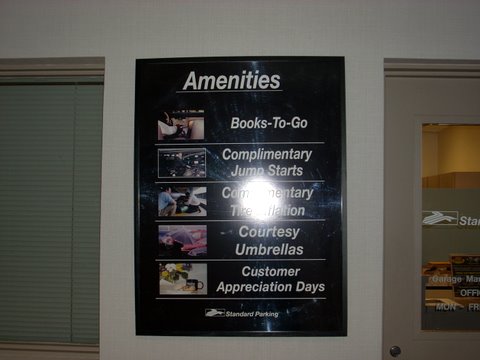
Despite the flash sunburst in the middle of the photo (thankfully this is not a photography blog), you can see that this parking garage in Midtown Atlanta not only offers complimentary jump starts, complimentary tire inflation, and courtesy umbrellas, but they offer audio books as well. (Another shortcoming of audio books– you can't use them for rain protection.)
I was too timid to go inside the office and ask what kind of books they offer. On the Road? Zen and the Art of Motorcycle Maintenance? Or just outdated Chilton auto repair manuals? I do like the idea of a good book being the equivalent in terms of travel necessities of a jump start or the repair of a deflated tire.
—– EXTENDED BODY: —– EXCERPT: —– KEYWORDS: —– COMMENT: AUTHOR: car storage EMAIL: TheChad88@aol.com IP: 61.14.189.130 URL: http://www.koalastorage.com.au/ DATE: 06/01/2012 04:12:19 AM It’s rare to find any parking garage with any amenities – let alone five. These should become standard everywhere. It would sure make those high fees they charge well worth it. —– COMMENT: AUTHOR: Discount Parking EMAIL: imalone2012@yahoo.com IP: 182.182.52.50 URL: http://www.expressoparking.com DATE: 06/27/2012 01:56:39 PM If you’re looking for cheap parking at Gatwick Airport, or the most convenient Gatwick parking, then look no further. We offer a wide range of Gatwick parking options, with some car parks available exclusively for prebooking on our website. —– COMMENT: AUTHOR: phoenix airport parking EMAIL: alamgeerhassan1@yahoo.com IP: 182.182.104.46 URL: http://www.parkbluesky.com DATE: 07/02/2012 03:16:16 AM you can see that this parking garage in Midtown Atlanta not only offers complimentary jump starts, complimentary tire inflation, —– ——– AUTHOR: Murray Browne AUTHOR EMAIL: murray.browne905@gmail.com TITLE: Mini-review: Lawrence Millman’s Reading in Atlanta STATUS: Publish ALLOW COMMENTS: 1 CONVERT BREAKS: wysiwyg ALLOW PINGS: 1 BASENAME: mini-review-lawrence-millmans-reading-in-atlanta UNIQUE URL: https://thebookshopper.typepad.com/the_book_shopper_atlantad/2012/02/mini-review-lawrence-millmans-reading-in-atlanta.html DATE: 02/07/2012 07:47:06 AM —– BODY:
Where & When: The Jones Room in the Woodruff Library on the campus of Emory University, Feburary 6, 2012. The reading was part of the Creative Writing Program's Reading Series.
Attendance: ~100 people with about 40 note-taking Emory creative writing students and a few mushroom aficionados since Millman is a noted author and mycologist.
Why I Went: My longtime fiance Denise is interested in the sciences and likes biology including fungi. We went at the last minute. I didn't even bring my camera.
What He Read: Millman read a couple of short pieces and then the lengthy title essay from his collection Lost in the Arctic: Explorations On the Edge. He has written 11 books.
Q & A: Several audience members asked what walrus meat and seal liver tasted like. Millman says that walrus meat – like horse meat – is a little bland, unless you “cure” it in a special way, which I believe involved burying it underground in a barrel for a few months. Seal liver according to Millman tastes like calf liver, but with a more pronounced liver taste.
Question I Was Too Timid to Ask: “How do you get your ball cap stay cocked so jauntily on your head?” Millman wore this long billed outdoors man ball cap during the reading and it stayed perfectly in place. Along with his cargo pants, it fit his image as an adventurer.
Did I Buy Something? No, but we ordered mushrooms for our takeout Farm Burgers on our way home.
Worth Mentioning: Although the reading went well over an hour Millman is a very good reader with a timely cadence. He uses short pauses to emphasize his words and bring out his sense of humor. Millman admits that collecting the stories of the Inuit Tribes of the Arctic regions has helped hone his oral storytelling abilities.
—– EXTENDED BODY: —– EXCERPT: —– KEYWORDS: Lawrence Millman, Lost in the Arctic, Emory Creative Writing Series —– ——– AUTHOR: Murray Browne AUTHOR EMAIL: murray.browne905@gmail.com TITLE: Atlanta Area Book Events Calendar – February 2012 STATUS: Publish ALLOW COMMENTS: 1 CONVERT BREAKS: wysiwyg ALLOW PINGS: 1 BASENAME: atlanta-area-book-events-calendar-february-2012 UNIQUE URL: https://thebookshopper.typepad.com/the_book_shopper_atlantad/2012/02/atlanta-area-book-events-calendar-february-2012.html DATE: 02/01/2012 07:41:09 AM —– BODY:
Here's are some of the Atlanta area book highlights for the month of February:
Wednesday, February 9 – McEver Poetry Reading at Georgia Tech will feature the works of poets Theresa Davis, Chris Forhan and H. Bruce McEver at 7:30 p.m. at the Kress Auditorium, Robert C. Williams Paper Museum.
Most of the month of February – In celebration of Black History Month 2012 the Auburn Avenue Research Library is hosting many events ranging from the Introduction of the Black Age of Comics: Past, Present and Future (Feb 9) to Black Stars in Orbit: NASA's African American Astronauts (Feb. 11). The Georgia Center for the Book also has many similar events scheduled throughout February.
Tuesday, February 28 – Peggielene Bartels author of King Peggy: An American Secretary, Her Royal Destiny, and the Inspiring Story of How She Changed an African Village will be doing a reading and signing at 7:00 p.m. at the Carter Presidential Library and Museum Theatre. The Bartels book is being compared to the Alexander McCall Smith series, the No. 1 Ladies Detective Agency. I can't say that I've read the McCall book, but I certainly enjoyed the screen adaptation of Ladies Detective Agency by Anthony Minghella who directed The English Patient.
Wednesday February 29 – Rob Walker a former columnist for The New York Times Magazine will appear with Bobbi Patterson from Emory University's Department of Religion in an informal conversation about Buddhism and Desire. Walker is the author of Buying In: The Secret Dialogue of What We Buy and Who We Are. I didn't read Buying In when in was published in 2008; I studied it. It is a fascinating book and his Times column “Consumed” was insightful and is now sorely missed. The conversation between Patterson and Walker begins at 7:30 p.m. at the reception hall of the Carlos Museum on the campus Emory University. 
And don't forget February is also Read Your Favorite Abraham Lincoln Biography Month.
—– EXTENDED BODY:
Local Bookstores that are hosting events this month include:
- A Cappella Books (they have a new location in Inman Park)
- Eagle Books in Decatur
- Blue Elephant Books in Decatur (local author Grant Jerkins will be there Feb. 8)
- Peerless Books in Alpharetta
- Bound to Be Read Books
- Charis Books and More
Unfortunately, Outwrite Books will no longer be hosting any events anymore since they ceased operations on January 26th.
Since this blog began over three years ago the following bookstores have closed: Wordsmiths, Borders, Atlanta Book Exchange and now Outwrite Books. Did you know that since 2002, five hundred independent book stores have closed nationwide?
Banner art: Designed by Caitlin Salmon
—– EXCERPT: —– KEYWORDS: Atlanta Area Book Events, Rob Walker, Bobbi Patterson, McEver Poetry —– ——– AUTHOR: Murray Browne AUTHOR EMAIL: murray.browne905@gmail.com TITLE: A Spiritual Education Made Easy STATUS: Publish ALLOW COMMENTS: 1 CONVERT BREAKS: wysiwyg ALLOW PINGS: 1 BASENAME: a-spiritual-education-made-easy UNIQUE URL: https://thebookshopper.typepad.com/the_book_shopper_atlantad/2012/01/a-spiritual-education-made-easy.html DATE: 01/24/2012 09:37:25 PM —– BODY: If you desire a spiritual education from an expensive liberal arts college or seminary and cannot afford one, now you can!
For a mere $7 you can order the 170-page book catalog from Eighth Day Books in Wichita, Kansas. Then after reading the descriptions of the approximately 1300 entries you will sound knowledgeable in religion, philosophy, history and literature. Imagine the scholar you will become if you actually read some of these books. Here's a run-on list of the different categories and some sample titles from each:
Of Books, Culture and Learning – Shop Class as Soulcraft An Inquiry into the Value of Work by Matthew B. Crawford; Devices of the Soul: Battling for Our Selves in an Age of Machines by Steve Talbott; Standing by Words: Essays by Wendell Berry; The Presence of Grace and Other Book Reviews by Flannery O'Connor. The Spiritual Life – Prayer: A History by Philip and Carol Zaleski; The End of Suffering: Finding Purpose in Pain by Scott Cairns. On Spiritual Direction – In the Fire of the Burning Bush: An Initiation to the Spiritual Life by Marko Ivan Rupnik. Athletes of Prayer – A Dictionary of Early Christian Beliefs: A Reference Guide to More than 700 Topics Discussed by the Early Church Fathers, edited by David Bercot. Theology and Patristics – St. Augustine: Confessions by Serge Lancel; Justinian the Great: Emperor and Saint by Asterios Gerostergios. Ecclesiography – Medicine and Health Care in Early Christianity by Gary B. Fregen; Religion and the Rise of Western Culture by Christopher Dawson. Biblical Studies and Sources – The Historical Reliability of the Gospels by Craig L. Blomberg. Liturgy and Worship – In Tune with the World: A Theory of Festivitity by Josef Pieper. (Are you getting a sense of what an amazing collection of books this catalog is?) Eastern Christendom – In the Image and Likeness of God by Vladimir Lossky. Luminous Lives ( or The Saint Section) – Saint Thomas Aquinas/Saint Francis of Assisi by G.K. Chesterton; About 20 books about Thomas Merton. Ways of Seeing (or The Art Section) – Art and Scholasticism with Other Essays by Jacques Maritain; The Limits of Art: Two Essays by Tzvetan Todorov. Philosophy and Religion – The Complete Works of Aristotle: The Revised Oxford Translation edited by Jonathan Barnes; Belief: Readings on the Reason for Faith edited by Francis C. Collins. The Modern World Science and God – Absence of Mind: The Dispelling of Inwardness from the Modern Myth of the Self by Marilynn Robinson (author of Gilead and Housekeeping); Galileo Goes to Jail and Other Myths about Science by Ronald L. Numbers. C.S. Lewis and Friends – C.S. Lewis: A Complete Guide to His Life and Works edited by Walter Hooper; Understanding the Lord of the Rings: The Best of Tolkien Criticism edited by Rose A. Zimbardo and Neil D. Isaacs. Books of Timeless Interest – Books about and by: Leo Tolstoy, Fyodor Dostoevsky, Alexander Solzhenitsyn, Czeslaw Milosz, Evelyn Waugh, Graham Greene, Walker Percy, Flannery O'Connor and Murray Browne.
—– EXTENDED BODY: The Eighth Day Catalog is a major publishing event (it doesn't happen every year) and the new catalog is
available for purchase or online. The catalog is only a sample of the 25,000 titles available from Eighth Day Books. And don't be shy about calling them up with your questions at 1-800-841-2541. Their knowledgeable staff is available to guide you to make the right selection of your particular subject interest, translation etc. (For example, did they steer me to the right books about The Peloponnesian War and essayist William Hazlitt? Damn straight they did!)
Eighth Day is a sponsor of this blog, but one of the credos of the blog is that we only “do business with people who we like doing business with.” Order your catalog today.
—– EXCERPT: —– KEYWORDS: Eighth Day Books, Wichita, KansasCatalog of Religious Books, Flannery O’Connor, Walker Percry, Wendell Berry —– ——– AUTHOR: Murray Browne AUTHOR EMAIL: murray.browne905@gmail.com TITLE: Civil War Bedtime Stories: A Review STATUS: Publish ALLOW COMMENTS: 1 CONVERT BREAKS: wysiwyg ALLOW PINGS: 1 BASENAME: civil-war-bedtime-stories-a-review CATEGORY: Book Reviews CATEGORY: Civil War Books UNIQUE URL: https://thebookshopper.typepad.com/the_book_shopper_atlantad/2012/01/civil-war-bedtime-stories-a-review.html DATE: 01/16/2012 10:37:16 AM —– BODY: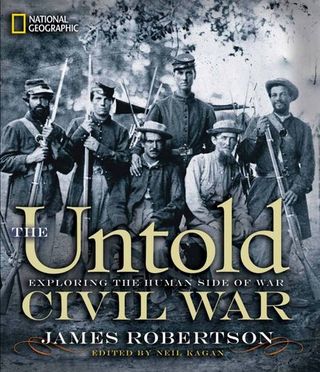 Finding the right book to read before bedtime is always a little challenging. Knowing that I will read for only a couple minutes before dozing off, I don't want anything long or complicated. Nor do I want to read a book with much of a narrative because taking one and two page bites from a book doesn't do justice to the storytelling or storyteller. But certain books can work well that way.
Currently this has not been the problem as I read n' snooze through The Untold Civil War: Exploring the Human Side of War by James Robertson (and edited by Neil Kagen). The publisher National Geographic graciously provided me a copy in advance of Robertson's visit to the Carter Library & Museum here in Atlanta last month, but Christmas time is a busy time and I missed the event. Robertson is a well respected Civil War historian most noted for his biography of Stonewall Jackson.
This gorgeously printed book (like a National Geographic magazine) is so big and heavy that it wouldn't fit on my nightstand, but that is my only criticism. In between the almost 500 photographs and images, the book contains 132 brief stories about 800 to a 1000 words in length, covering some of the nuances of the Civil War. Even a self-proclaimed Civil War buff such as myself (type in “Civil War” in the blog's search box) has learned many things about The War Between the States that I previously knew little  about such as: the mail service, the not-so pleasant aspects of camp life, and the recruitment by the Confederacy (yes, it is true). Robertson and Kagen include anecdotes about the generals (Robert E. Lee, Ulysses S. Grant, George Pickett), but important noncombatants as well (Frederick Douglass, Louisa May Alcott, and Julia Ward Howe).
The Untold Civil War is an impressive, mammoth collection of stories, photographs, maps, and quotes. It even includes the musical notation of “Taps” (written during the 1862 Pennisular Campaign) thus making it a worthy addition to any buff's library or nightstand. 
Photo credits: Both photos are courtesy of and copyrighted by the National Geographic.The mail wagon photo is an Army of the Potomac's II Corps mail wagon photographed at Brandy Station, Virginia in 1864. The troops shown at the right are the men of Company E, Fourth U.S. Colored Infantry Regiment who fought in Petersburg, the Bermuda Hundred and Forts Fisher and Harrison.
—– EXTENDED BODY: —– EXCERPT: —– KEYWORDS: Untold Civil War, National Geographic, James Robertson, —– ——– AUTHOR: Murray Browne AUTHOR EMAIL: murray.browne905@gmail.com TITLE: Birmingham Book Store STATUS: Publish ALLOW COMMENTS: 1 CONVERT BREAKS: wysiwyg ALLOW PINGS: 1 BASENAME: birmingham-book-store CATEGORY: Bookstores UNIQUE URL: https://thebookshopper.typepad.com/the_book_shopper_atlantad/2012/01/birmingham-book-store.html DATE: 01/07/2012 10:58:02 AM —– BODY:Late last year I drove over to Birmingham to visit my daughter and she insisted that we check out Jim Reed Books/The Museum of Fond Thought located in the historic downtown district. She knows what I like.
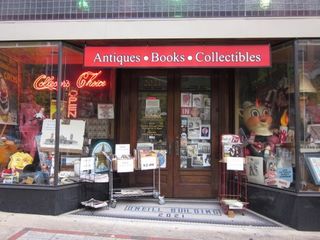 In business since 1980, the store boasts a collection of about 50,000 books, magazines and posters along with another 250,000 undocumented items. It's a great place to browse down memory lane. Many of the books that fill the shelves I hadn't seen in a while, but I recall as being quite popular in their heyday. (How soon the bloom of popularity can fade.) I ended up purchasing a copy of Jim Harrison's 1984 novel Sundog. When I am in a reading rut, I always turn to Harrison to get out of it. His novels are spirited and meaningful without being pretentious (kind of like Reed Books).
It is worth stopping by Reed Books when you're in Birmingham, if for no other reason than to get on their mailing list. Since I signed up, I now get weekly, quirky, emails from the owner Jim Reed promoting the store, which includes a list of items people purchased throughout the week (Kind of like the MARTA book club). Reed, who is also a writer, edits the Birmingham Arts Journal.
—– EXTENDED BODY: —– EXCERPT: —– KEYWORDS: Jim Reed Books, Birmingham Book Stores, Jim Harrison, Sundog, Birmingham Arts Journal —– COMMENT: AUTHOR: Bonnybee EMAIL: bonnybeedesigns@aol.com IP: 71.45.12.104 URL: DATE: 01/11/2012 11:48:27 PM You sure are lucky to have a cool daughter to take you fun places! —– ——– AUTHOR: Murray Browne AUTHOR EMAIL: murray.browne905@gmail.com TITLE: Best Local Reading of 2011 (That I Attended) & January 2012 Calendar of Events STATUS: Publish ALLOW COMMENTS: 1 CONVERT BREAKS: wysiwyg ALLOW PINGS: 1 BASENAME: best-local-reading-of-2011-that-i-attended-january-2012-calendar-of-events UNIQUE URL: https://thebookshopper.typepad.com/the_book_shopper_atlantad/2012/01/best-local-reading-of-2011-that-i-attended-january-2012-calendar-of-events.html DATE: 01/02/2012 05:26:38 PM —– BODY:
Before saying a final farewell to 2011 –- as we recycle our dead trees (they gave their all, so you could have Christmas) — it’s time to recognize the “Best Local Reading of the Year of 2010” or more specifically, the “Best Local Reading of the Year (That I Attended), ” which does narrow the field considerably. My rating criteria are rather simple and subjective:
-
Did I learn something that otherwise I would not have learned, even if I read the book?
-
Did the author and the audience seem to engage with each other?
-
Did I come away with a little buzz (or buy the book) after the reading?
 Some of this year’s candidates include well known authors such as Sarah Vowell, Charles Mann (technically his reading was a slide show), Thomas Lynch, Brian Dettmer (art exhibit), Tayari Jones along with Lang Whitaker, Ned Stuckey-French, Barry Brown, and Gordon Elwell. I realize it it is not much of a list for a blog that “muses about book-related events,” but what can I say? It's a challenge for anyone to get out to some literary event at least once a month, so when you are rewarded with something worthy of the effort, it deserves some recognition.
This year’s Best Local Reading of 2011 (That I Attended) goes to Andisheh Nouree's appearance at Eddie's Attic last August for his book Americapedia: Taking the Dumb Out Freedom (co-authored with Jodi Lynn Anderson, and Daniel Ehrenhaft). Basically the afternoon was a romp and it included Nouree singing a medley of “America” themed music. Moreover, who can resist having a much-needed beer (hence the buzz) when hearing about the shortcomings of the American political system during the budget gridlock. (The book's raisons de'tre is to help people get informed and then get involved.)
Nouree joins previous winners, which includes the four poets (Kevin Young, Thomas Lux, David Bottoms, and David Kirby) from last year, who read from the University of Georgia Press Anthology Seriously Funny. Other winners were the late E. Lynn Harris (2009) and Chandler Burr (2008). 
January 2012 – Atlanta Calendar of Book Events
If your New Year's resolution needs more refinement — more than just using fancy sounding phrases like raisons d'etre in a sentence — then examine the following book related events for the month of January. I purposely don't put the times in the announcements, so you will have double check each website before heading out. All events are in Atlanta unless noted otherwise and the ($$) indicates their is a small admission fee required.
Monday, January 9. Janny Scott author of A Singular Woman: The Untold Story of Barack Obama's Mother. Georgia Center for the Book at Dekalb Public Library, Decatur.
Thursday, January 12. Heather Donaghue author of How My Life Changed After the Blair Witch Project and Went to Pot. ($$) Pizzeria Vesuvius (an A Cappella Books event)
—– EXTENDED BODY: Saturday, January 14. James Stevens, author of Listening to Van Gogh. Eagle Eye Books, Decatur.
Friday, January 20. Georgia State University Professor Layli Phillips Maparya, author of The Womanist Idea. Charis Books & More.
Monday, January 23. Brad Taylor, author of All Necessary Force. Peerless Books, Alpharetta.
Thursday, January 26, Lori Beard-Daily, author of Destination D. Auburn Avenue Research Library.
Sunday, January 29. Billy Collins reading at Emory University, but tickets to the event are no longer available.
Tuesday, January 31. Gin Phillips, author of Come In and Cover Me. Savannah College of Art and Design's Ivy Hall.
To subscribe to the blog, friend us at facebook.com/thebookshopper
—– EXCERPT: —– KEYWORDS: Andisheh Nouree, Americapedia, Atlanta Calendar of Book Events, —– ——– AUTHOR: Murray Browne AUTHOR EMAIL: murray.browne905@gmail.com TITLE: Flowerpot of Life: A Book Shopper’s Top Books of 2011 STATUS: Publish ALLOW COMMENTS: 1 CONVERT BREAKS: wysiwyg ALLOW PINGS: 1 BASENAME: flowerpot-of-life-a-book-shoppers-top-books-of-2011 CATEGORY: Books as Art as Books UNIQUE URL: https://thebookshopper.typepad.com/the_book_shopper_atlantad/2011/12/flowerpot-of-life-a-book-shoppers-top-books-of-2011.html DATE: 12/21/2011 09:30:51 AM —– BODY:
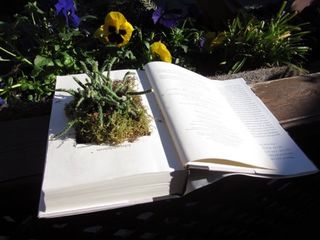 Unlike other “best” book lists, my criteria for excellence is somewhat different. To make the list requires a combination of value (how much I paid for the book) and good reading. Whether the book was published in 2011 is of little significance to me as I am a person who likes to think of himself as immune to book hype while preferring to shop for books at used bookstores, independent book stores, book festivals, church sales and even online (gasp!). I crave the process. Here’s my list of most notable finds/reads in 2011:
Remote: Reflections on Life in the Shadow by David Shields (1996). It's a “collection” of essays, anecdotes, bumper sticker compilations, advertisements and photos (sounds like a blog) that examine how celebrity culture manifests itself in our daily lives. I found a signed copy of this book at Books Again (see sponsor link on upper left) for a fiver. You can read more about Remote here.
The Conversations: Walter Murch & The Art of Editing Film by Michael Ondaatje (2002). Nick Hornby mentioned this book in one of his Stuff I Am Reading columns in The Believer and since I have a small book allowance at work to buy books about the media, I made the transaction. This book is a fascinating conversation of the artistic and creative choices (not much gossip) that went into the editing of some of my favorite movies: Apocalypse Now, The Conversation, The Godfather, The Talented Mr. Rigley and of course, a film adaptation of Ondaatje's own book, The English Patient.
The Peloponnesian War by Donald Kagen (2003). Ever since I saw Kagen on Book TV drawing parallels between the war between Sparta and Athens and America's hegemony in Iraq and Afghanistan, I was interested in reading the book. I found a copy at Eighth Day Books in Wichita (see sponsor link) a couple years ago and finally got around to reading this lengthy tome. Before I read it, I didn't know squat about the war (431 BC to 404 BC) between Athens and Sparta and now I do.
Unreliable Memoirs by Clive James (1980). Any reader of this blog knows I am obsessed with James' book Cultural Amnesia: Necessary Memories from History and the Arts. (I've corner the market on many discounted hardback copies. See here), but decades ago I was first introduced to James when I read his autobiography about growing up in post-war Australia. While browsing through the $1 shelves that insulate the outside of the Eagle Eye Book Shop in Decatur, I found a severed copy of the book Unreliable Memoirs (literally split in half). Seizing the opportunity, I reread some of it before it completely disintegrated. It's amazing how this Tasmanian devil kind of kid who grew up without a father (killed when returning from Japanese POW camp) later became an insightful political and culture critic.
Thinking in Systems: A Primer by Dana Meadows (2008). Our friend Maggie was reading this book when she visited my longtime fiance Denise and I earlier this year. Maggie is responsible for introducing me to one of the books from last year's list, The Republic of Suffering: Death and the American Civil War (2009), so anything she is scribbling notes in, I am interested. At first this book, which examines the fundamentals of how systems work or don't work, seems simplistic. However, as the book progresses you realize that the knowledge of these fundamentals can help one get a better grip personal as well as global problems. I ordered my copy from Eighth Day Books because they always have these kind of smart books in stock and they can ship them to my door immediately.
—– EXTENDED BODY: The Imperfectionists by Tom Rachman (2010). Someone discarded this book in our employee lounge and after a couple days (or was it hours?) I gave it a home. The “novel” is a series of the intertwining stories about the reporters, stringers, copy editors and publishers of a fictitious English Language newspaper headquartered in Rome. I liked the book and it is well-written, but don't believe all the praise from the newspapers that grace its book jacket. Think about it. It's a novel about newspapers. Of course, newspaper reviewers are going to be gaga for this book.
Green Metropolis: Why Living Smaller, Living Closer and Driving Less are the Keys to Sustainability. by David Owen (2009). A book for anyone who is remotely interested in regional transportation issues, which includes someone like myself – the Creator and Destroyer of the MARTA Book Club. I bought my paperback copy at the Carlos Museum Book Shop during one of their sales.
Gascoyne by Stanley Crawford (1966). A friend loaned my a tattered copy of this book back in the 70s, which I read. This year, I became interested in reading a parody noir – something a little more fast paced – I wanted to revisit it, so I ordered a used copy online. The main character is Gascoyne who is a powerful businessman, who runs his empire from his car as he races around L.A. trying to solve a murder. A good feeling to know that I was reading quality books years ago.
In short, 2011 was a good reading year so don't be mislead that I listed only eight books instead of ten (these eight books had better anecdotes to accompany them). For the 2010 list, visit here and for the 2009 list, visit here.
P.S. The Flowerpot of Life artwork comes from my younger daughter Bonnie, who gave me a copy of Marcel Proust's In the Shadow of Young Girls in Flower(pot) as a birthday gift.
—– EXCERPT: —– KEYWORDS: Top Ten Books of 2011, Remote, David Shields, Gascoyne, Stanley Crawford, Green Metropolis, Cultural Amnesia, Clive James, Unreliable Memoirs, Young Girls in Flower, Thinking in Systems, The Flowerpot of Life —– ——– AUTHOR: Murray Browne AUTHOR EMAIL: murray.browne905@gmail.com TITLE: From the Mailbox STATUS: Publish ALLOW COMMENTS: 1 CONVERT BREAKS: wysiwyg ALLOW PINGS: 1 BASENAME: from-the-mailbox UNIQUE URL: https://thebookshopper.typepad.com/the_book_shopper_atlantad/2011/12/from-the-mailbox.html DATE: 12/12/2011 09:48:40 PM —– BODY: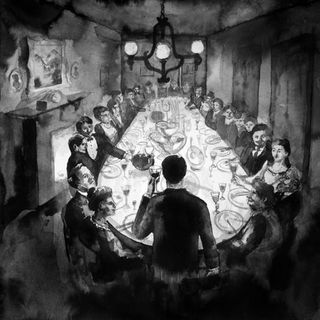 There aren't too many book-related email lists I don't sign up for, so it is not unusual to get information that is worth passing on. Such notables:
Paravion Press, which I wrote about earlier here is offering a special Christmas book – a limited illustrated edition of James Joyce's short story, "The Dead." The illustrator is James Bock. (a sample shown here) For more about it, visit Paravion's website.
A blog reader sent me a note about a nationally syndicated radio show that airs on WAFS 1190 AM at 11 a.m. on Sunday mornings here in Atlanta called The Book Report. I caught a few minutes of the show the other day and I liked what I heard. Unfortunately, that's the not always the most convenient time for me to listen as I am out nourishing my inner self (i.e. buying fresh fruits and vegetable at the Dekalb Farmer's Market).
Paul Dry Books is having their holiday book sale from now through December 15th. The publisher has a range of books including my book The Book Shopper (which spawned this blog). One of my favorite books on Paul Dry's list and worth checking out is Gabriel Zaid's book of essays So Many Books. Before I went to Greece earlier this year, the publisher — as kind of a bon voyage gift –provided me a copy of Ill By Midnight, which is the true story of the British commandos who captured a German general in 1943. It has a plucky-hip-hip-cheerio style, but it does give one a sense of the mountainous terrain and the courageous generosity of the people of Crete. Earlier this year, I reviewed Right off the Bat, a book for hardcore cricket fans who want to learn about baseball or is it vice versa? The book is kind of both.
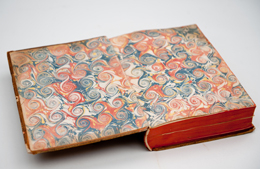 The Robert C. Williams Paper Museum on the campus of Georgia Tech is offering two five-hour Book Art Workshops: Book Arts l, The Wonderful World of Marbling: Marbling Techniques, will be held on Saturday, February 4, 2012 from 10:00AM-3:30PM and Book Arts II Workshop, Bookbinding: Small Book Structures, will be held on Saturday, March 10, 2012 from 10:00AM- 3:30PM. Workshops cost $85 each. For details, email Fran Rottenberg (franrottenberg.ipst.gatech.edu) or call 404-894- 5726.
Don't forget to subscribe for regular updates by signing up for an RSS feed or visiting us at facebook.com/thebookshopper
—– EXTENDED BODY: —– EXCERPT: —– KEYWORDS: Paul Dry Books. The Book Report, So Many Books, Gabriel Zaid, Paravion Press, Robert C. Williams Paper Museum classes, Ill by Midnight —– ——– AUTHOR: Murray Browne AUTHOR EMAIL: murray.browne905@gmail.com TITLE: Ha-ha Tom Friedman: The Charles Mann Lecture at Emory STATUS: Publish ALLOW COMMENTS: 1 CONVERT BREAKS: wysiwyg ALLOW PINGS: 1 BASENAME: charles-mann-at-emory UNIQUE URL: https://thebookshopper.typepad.com/the_book_shopper_atlantad/2011/12/charles-mann-at-emory.html DATE: 12/08/2011 10:06:58 PM —– BODY:
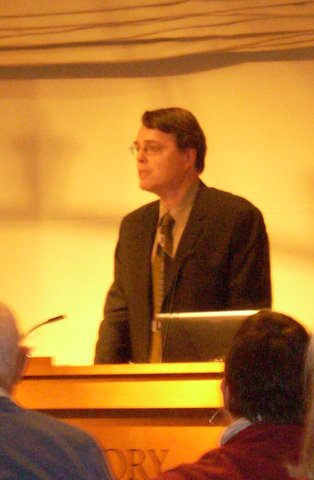 Here's the gist of author Charles C. Mann's recent lecture at Emory University in Atlanta. Mann was in town promoting his latest book, 1493: Uncovering the New World Columbus Created, which is a followup from his much-acclaimed 1491: New Revelations of the Americas Before Columbus.
Where & When: Held at the Reception Hall, William Carlos Museum on Emory's campus on December 7, 2011.
Attendance: I'd estimate ~125 people with only about 20 Emory Students.
Why I Went: I've been a real slacker lately when it comes to attending local book events (guilt). Moreover, last summer Mark Burell, the manager at the Carlos Musuem Book Shop, gave me the heads up about Mann and he highly recommended 1491.
What He Read Aloud: Nothing. Instead Mann lectured for about 45 minutes touching on, what I assume, are the highlights of his new book. Accompanying the lecture were gorgeous slides with illuminating infographics about how plants, diseases, and foods (especially the sweet potato) were exchanged back and forth from the New World to Europe, Africa and China. This explains the significance of Mann's quip about the alternative title for his book: “Ha-ha, Tom Friedman. The World Has Been Flat for 400 Years.”
His Q & A: Most people had their questions answered in the fifteen minute Q & A period. Mann knows what he knows, but he isn't afraid to admit that he is not an expert in everything. Mann also gives complete answers, but doesn't get bogged down with long explanations ( more time for more questions). The audience asked intelligent questions as well.
Did I Buy Something? Yes, a trade paperback of 1491, but I had no interest in waiting in the long line to have the book signed.
Worth Mentioning. In a short period of time I learned a lot of things: How the Chinese grow three-quarters of the world's sweet potatoes and how it contributes to their constant flooding in China. I learned about the silver mines of Potosi, that the Mason-Dixon line really should be named the Malaria-Dixon line and the days for invasive kudzu are numbered. I can't explain all this, but if you attended Mann's fine lecture you would know.
You can re-create the Charles Mann experience by purchasing one of the several signed copies of 1493 that the Carlos Museum Book Shop has available. You can check ahead for book availability by calling 404-727-0529.
—– EXTENDED BODY: —– EXCERPT: —– KEYWORDS: Charles C. Mann, Emory University, William Carlos Museum, Thomas Friedman, 1491, 1493 —– ——– AUTHOR: Murray Browne AUTHOR EMAIL: murray.browne905@gmail.com TITLE: MARTA Book Club #17: Welcome Clean Air Commuters STATUS: Publish ALLOW COMMENTS: 1 CONVERT BREAKS: wysiwyg ALLOW PINGS: 1 BASENAME: if-youre-visiting-because-of-the-newsletter-article-from-the-midtown-alliance-you-are-at-the-right-place-i-appreciate-the-sh CATEGORY: MARTA Book Club UNIQUE URL: https://thebookshopper.typepad.com/the_book_shopper_atlantad/2011/11/if-youre-visiting-because-of-the-newsletter-article-from-the-midtown-alliance-you-are-at-the-right-place-i-appreciate-the-sh.html DATE: 12/01/2011 03:27:29 PM —– BODY:If you're visiting because of the newsletter article from the Midtown Alliance you 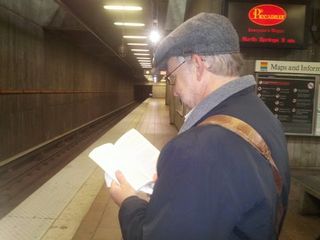 have come to the right place. I appreciate the shout-out for the MARTA Book Club even though I am kicking myself for not trimming my beard for the photo opportunity. I guess I fit the stereotype of the scruffy reader. (Photo credit: John Cann)
If you're a commuter and you read on the bus or train, I hope you'll let add to the list via comment and sign up for blog updates at facebook.com/thebookshopper. If you want to see all the MARTA book club postings (and fully comphrehend the madness ) just click on the link in the right column.
Here's a list of book spottings since the last posting.
Siddhartha by Herman Hesse
The Great Shark Hunt by Hunter S. Thompson
Thinking in Systems by Donna Meadows
Choices: Discover Your 100 Most Important Life Choices by Shad Helmsetter
Big Girls Do Cry by Carl Weber
The 5 Lessons Millionaires Taught Me About Life and Wealth by Richard Paul Williams
The Age of Wonder: The Romantic Generation and the Discovery of the Beauty and Terror of Science by Richard Holmes
Jeff Shaara's Civil War Battlefield's: Discovering Hallowed Ground by Jeff Shaara
The Red Garden by Alice Hoffman
The Purpose Driven Life by Rich Warren
—– EXTENDED BODY: In Harm's Way: The Sinking the U.S.S. Indianapolis and The Extraordinary Story of the Survivors by Doug StantonBroke U.S.A.: From Pawnshops to Poverty Inc. – How the Working Poor Became Big Business by Gary Rivlin
The Film School Confidential: The Insider's Guide to Film Schools by Tom Edgar and Karin Kelley
Misfit by Jon Skovron
Novels by Katherine Coulter, John Grisham, K'wan,
—– EXCERPT: —– KEYWORDS: MARTA Book Club, Book Spotting, Clean air commuters, Midtown Alliance. —– COMMENT: AUTHOR: alex EMAIL: recycle@brotherstv.com IP: 112.204.89.192 URL: DATE: 12/28/2011 11:29:12 AM Check out this video… His honorable Jim Dear speaks with Melissa McGinnis from Greenopolis TV about the 1000th trash truck to be ran off of liquefied natural gas, which services his community of Carson California. This momentous effort helps to keep the air clean by reducing green house gases and carbon, since the harvested gas from landfills burns at a much cleaner rate than regular diesel gas. http://youtu.be/rbhIiwtmUks —– COMMENT: AUTHOR: kamagra EMAIL: josephpineda96@gmail.com IP: 180.190.157.230 URL: http://www.kamagracentre.com DATE: 03/24/2012 01:29:11 PM The Purpose Driven Life by Rich Warren fits into a much larger, cosmic purpose that God has designed for eternity. —– ——– AUTHOR: Murray Browne AUTHOR EMAIL: murray.browne905@gmail.com TITLE: Atlanta Book Event Calendar – December STATUS: Publish ALLOW COMMENTS: 1 CONVERT BREAKS: wysiwyg ALLOW PINGS: 1 BASENAME: atlanta-book-event-calendar-december UNIQUE URL: https://thebookshopper.typepad.com/the_book_shopper_atlantad/2011/11/atlanta-book-event-calendar-december.html DATE: 11/29/2011 09:59:35 PM —– BODY: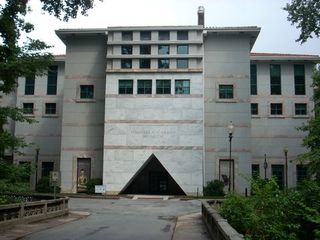 Here's a sampler of book related events for the month of December. As you can because of the holidays, it's a light month. I purposely don't put the times so you will have double check each website before heading out. All events are in Atlanta unless noted.
Tuesday, December 6. Lt. Col. Steve Russell (Retired), author of We Got Him! A Memoir of the Hunt and Capture of Saddam Hussein. Peerless Books, Alpharetta.
Tuesday, December 6. Jennie Knight, author of Feminist Mysticism and Images of God. Charis Books & More.
Wednesday, December 7. Charles Mann, author of 1493: Uncovering the New World That Columbus Created. William Carlos Museum, (shown above) Emory University. For details on this event and others visit here.
Wednesday, December 7. Scott Wallace, author of The Unconquered. Eagle Eye Books, Decatur.
 Saturday, December 9. Annual Friends of the Auburn Avenue Research Library Book Sale. Details here.
Tuesday, December 13. James Robertson, author of The Untold Civil War: Exploring the Human Side of War. Carter Presidential Library & Museum. For details on this event and others at the library, visit here.
—– EXTENDED BODY: —– EXCERPT: —– KEYWORDS: James Robertson, Charles Mann, Atlanta, Book events, —– ——– AUTHOR: Murray Browne AUTHOR EMAIL: murray.browne905@gmail.com TITLE: Holiday Advertorial (and Gift Guide) STATUS: Publish ALLOW COMMENTS: 1 CONVERT BREAKS: wysiwyg ALLOW PINGS: 1 BASENAME: holiday-advertorial UNIQUE URL: https://thebookshopper.typepad.com/the_book_shopper_atlantad/2011/11/holiday-advertorial.html DATE: 11/21/2011 09:16:12 PM —– BODY:One of the favorite jobs I ever had was working as an “editor” at a weekly shopper newspaper in Michigan. A shopper isn't exactly like a newspaper, but I had free editorial reign to collect any news and information I thought fit to break up the glut of ads. I also wrote feature stories for monthly senior paper with the publisher's only directive being: “Make sure there is a pretty picture on the front page.” I could write a feature story about anything I wanted: baseball, antique cars, and Lake Michigan's winter mariners. (I was inspired by the “Wreck of the Edmund Fitzgerald”). Who cared if journalists scoffed at my professional credentials? I loved the creative freedom (one of the advantages of blogging).
Part of the job including writing what they called “advertorial” which is advertising that looked liked a short feature article. I'd drive around town and interview our major advertisers and write up something interesting about their establishments. The work included taking pictures.
 So with this in mind, this week I want to remind readers that we do have a few sponsors (link in the upper left corner) for the blog and to revisit the writing form known as the advertorial. So I asked owners of two reputable book sellers, Books Again and A Cappella Books to give me a list of books that would make an excellent gifts for the holiday season.
My criteria was that it had to be an autographed book, moderately priced, and a book/or author that many people have heard of. I think picking a book for a person is a risky endeavor, but the autographed book is a safe and personal gift if you know a person likes a particular writer. In keeping with spirit of advertorial, the words are lifted from mouths and websites of the two owners (with permission of course). Here are their lists:
First from Books Again's Jim Adams:
Pat Conroy, My Reading Life. His latest book about the books and literary experiences that affected his life and writing. $32
Herschel Walker, Breaking Free. His personal story of living with Dissociative Identity Disorder. $20
Salman Rushdie, The Enchantress of Florence. His ninth novel, set during the Renaissance in Florence and the subcontinent of India. $20.
Jeffrey Lent, In the Fall. His outstanding debut novel set at the end of the Civil war. $15
Jeff Shaara, The Last Full Measure. Second book and sequel to his father’s classic The Killer Angels. $30.
Larry McMurtry, Some Can Whistle. Novel set in Texas, a setting that McMurtry knows all too well. $30.
Robert Stone, Outerbridge Reach. Underrated American novelist, this excellent novel pits man against the sea. $25
William Kennedy, Very Old Bones. Another greatly underrated novelist, this book once again uses Albany as the setting for the story. $25
Carl Hiaasen, Basket Case. Another excellent example of Hiassen’s dark humor. $20
James Lee Burke, Dixie City Jam. Robicheaux is once again solving crimes in southern Louisiana. $20
From Frank Reiss at A Cappella's
Roseanne Cash, Composed. The daughter of music legend Johnny Cash, writes candidly about her upbringing, her development as an artist, and her current life. $27
David Sedaris, Squirrel Seeks Chipmunk: A Modern Bestiary. A unique blend of hilarity and heart, this new collection of keen-eyed animal-themed tales is an utter delight. $20.
Rita Dove, Sonata Mulattica. In the Pulitzer Prize-winning poets's suite of linked poems, Dove dramatizes the life of George Polgreen Bridgetower (1780–1860), son of a European woman and a self-proclaimed "African prince." $25
David Byrne, Bicycle Diaries. Byrne's thoughts on world music, urban planning, fashion, architecture, cultural dislocation, and much more, all conveyed with a highly personal mixture of humor, curiosity, and humility. $26
—– EXTENDED BODY: Salmon Rushdie, Luka and the Fire of Life. Rushdie revisits the magic-infused, intricate world he first brought to life in the modern classic Haroun and the Sea of Stories. $25Nick Hornby, Juliet Naked. What happens when a washed-up musician looks for another chance? And a childless woman looks for a change? $26
Eric Snow, Leading High Performers: The Ultimate Guide to Being a Fast, Fluid and Flexible Leader. An account of the blisteringly-paced world of professional sports (Snow had a 14 year NBA career) as well as Snow's post-retirement "trial by fire" initiation into the world of instant entrepreneur, investor and businessman. $18
Rheta Grimsley Johnson, Enchanted Evening Barbie and the Second Coming. Johnson, winner of the Ernie Pyle Award for human interest reporting, turns her sharp eye on herself in this frank, exhilarating, wise, poignant, and brave memoir. $25
Check out A Cappella's other signed offerings here.
—– EXCERPT: —– KEYWORDS: —– ——– AUTHOR: Murray Browne AUTHOR EMAIL: murray.browne905@gmail.com TITLE: Back To The Lighthouse STATUS: Publish ALLOW COMMENTS: 1 CONVERT BREAKS: wysiwyg ALLOW PINGS: 1 BASENAME: back-to-the-lighthouse UNIQUE URL: https://thebookshopper.typepad.com/the_book_shopper_atlantad/2011/11/back-to-the-lighthouse.html DATE: 11/15/2011 05:40:37 AM —– BODY:by Chantal James
 For whatever reasons, we abandon novels. We leave them half-finished; we discard them after only twenty pages, we drift apart from them after the first hundred.
Often we'll never pick up where we left off. Sometimes it'll be a season or two later, sometimes a year, a few years, when the book nudges it way back into our line of sight, begging to be reconsidered.
It does not attract this time for the same reason it did long ago. You're no longer the same person as you were then, when it was on the sidewalk cart of a used book store in some city you can't remember why you were visiting, to which you never returned. Or when someone left it at your house years ago, to be shuffled along forever with the rest of your things, eventually crated away to be unpacked in the next apartment, and then the next.
I don't know how a paperback copy of Virginia Woolf's 1927 novel To the Lighthouse first ended up in my house–whether I bought it, scavenged it, borrowed it. I can't give an exact estimate as to how long it has sat among my things, how often it has been shifted from stack to stack. I finally cracked it open for the first time a year ago, and put it down after about fifteen pages. At that glance, it seemed to be about a family of rich people in England, whose dramas unfold against this human backdrop of mostly silent, mostly invisible servants. I knew it was supposed to be a classic, but I couldn’t forgive the prejudices of its time, or the privilege of its author.
But as mysteriously as we abandon them, we return.
I spotted To the Lighthouse on a shelf last week, and picked it up. Why did it single itself out in my vision? ) I won't pretend that I know what had changed in me, what opening had grown for it. I am not convinced that we ever understand why a book reaches us—how it snags us at one time, but not another, or misses altogether. Words on a page are illuminated by something inside us, or else they remain just that. In this case it was the committed decision to continue even after my heart ached, that pushed me until I had reached the final page, awed.
When it’s all told, what's not to admire in this book?
The story’s telling is so exact, and so free. We seem to be able to read every expression on the faces of the family, houseguests, staff and neighbors of Mrs. Ramsay, characters that the book captures over the course of just two days, many years apart. It reads like a meticulous drawing in pencil, lines growing darker and lighter, lines erased, then re-traced. I admired its symmetry: how the first half of it perfectly resolved, how the trip to the lighthouse, decades-delayed, becomes a triumph for characters that the years have defeated. The book broke through to me.
But I continue to wonder about all those subtleties (and they are cultural, developmental, emotional, historical, random) that tint the lens through which we regard a book, no matter how well it was written. Do books choose us? Maybe a beautiful story, beautifully told, reaches for us, hoping we can brush back its cobwebs.
Chantal James is Writer-in-Residence at A Cappella Books in Atlanta. Her previous contribution to the blog was a posting about the novelists Amitvav Ghosh and Naguib Mahfouz. (Photo credit: Chantal James)
 Currently, I am reading Allison Hoover Bartlett's The Man Who Loved Book Too Much: The True Story of a Thief, a Detective, and a World of Literary Obsession. (A book seller gave me a reviewer's copy a couple years ago as complimentary swag for doing a reading. I greedily accepted.)
The subtitle of the book kind of says it all, but the main plot of the book centers around John Charles Gilkey, a notorious book thief and the antique book seller Ken Sanders who tracks him down. It's an easy reading book and not too demanding, but the most enjoyable part is the peek into the world of book collecting. Not only are Gilkey and Sanders passionate about books (though on opposite sides of the law) but they both began their love of rare books by collecting comic books.
 In the book, there is a memorable anecdote about book selling when Sanders was hosting a book signing for cartoonist Robert Crumb and environmental writer and novelist Edward Abbey. Crumb had illustrated the 10th anniversary edition of Abbey's most famous book, The Monkey Wrench Gang and the two were signing books at a promotion. Here's Sanders story:
There were Crumb and Abbey dutifully scribbling their names. One guy walks up to Crumb and says, "Mr Abbey?" And Crumb before he answers, looks at Abbey and they exchange this glance. Crumb looks back at the guy and says "Yes?" And he signs that copy of the book, 'Edward Abbey!' Then he passes it to Abbey, who signed it, 'R.Crumb!' I would kill for that copy…I'm sure to this day, that guy doesn't know of the deception. I keep praying that someday that book will wonder in here. I've been searching for that book for twenty years.
Something to look for when you are attend you next antiquarian book fair (such as the Georgia Antiquarian Booksellers Association Book Fair sale, shown above).
—– EXTENDED BODY: —– EXCERPT: —– KEYWORDS: Robert Crumb, Edward Abbey, The Man Who Loved Books Too Much, Allison Hoover Bartlett —– ——– AUTHOR: Murray Browne AUTHOR EMAIL: murray.browne905@gmail.com TITLE: Atlanta Book Event Calendar – November 2011 STATUS: Publish ALLOW COMMENTS: 1 CONVERT BREAKS: wysiwyg ALLOW PINGS: 1 BASENAME: heres-a-sampler-of-book-related-events-for-the-month-of-november-think-of-it-as-a-collection-of-links-of-different-venues-s-1 UNIQUE URL: https://thebookshopper.typepad.com/the_book_shopper_atlantad/2011/10/heres-a-sampler-of-book-related-events-for-the-month-of-november-think-of-it-as-a-collection-of-links-of-different-venues-s-1.html DATE: 10/31/2011 10:59:14 PM —– BODY:
Let this bumpersticker serve as a reminder that there's a variety of book related events for the month of November here in Atlanta — opportunities to expand your mind.
Think of this page as a collection of links of different venues, so you can surf and plan your month ahead. I purposely don't put the times so you will have double check each website before heading out. The dollar sign designation ($$) indicates some kind of admission fee is charged. All events are in Atlanta unless noted.
Wednesday, November 2. Bobbi Kornblitt, author of Shelter of the Texas Heat. Tall Tales Book Shop. For details, call 404-636-2498.
Thursday, November 3. Anne Emanuel, author of Elbert R. Tuttle: Chief Jurist of the Civil Rights Revolution. (A UGA Press Book) Blue Elephant Books, Decatur.
Saturday, November 5. Cameron McWhirter, author of The Summer of 1919: The Awakening of Black America. Book signing and discussion. Auburn Avenue Research Library.
Saturday, November 5, Timothy P. Spira, author of Wildflowers and Plant Communities of Southern Appalachian Mountains and Piedmont: A Naturalists Guide of the Carolinas, Virginia, Tennessee, and Georgia. Atlanta Botanical Gardens. Details here.
Beginning November 5 thru November 20. The Book Festival of the MJCCA. ($$) Details here.
Sunday, November 6. Southern Showcase for Listening. Jessica Handler, Sam Starnes and Tony Grooms, World Improv Theatre. For details, visit Bound to Be Read Books.
Georgia Center for the Book: David Bottoms (November 7), Terry Kay (November 9), George McGovern (November 14), Winston Groom (November 15) and more. Check all their November events here.
—– EXTENDED BODY: Monday, November 7. Natasha Trethewey. Reading and signing. Woodruff Library, Emory University. Details here.
Wednesday, November 9. Virginia Willis, author of Basic to Brilliant. Dinner and book signing at Restaurant Eugene ($$). An A Cappella Book event. Details here.
Wednesday, November 9. Mark Montano, author of The Big-Ass Book of Crafts Vol.2 at Outwrite Bookstore and Coffeehouse. Details here.
Thursday, November 10. 40th Anniversary Roundtable & Discussion of Our Bodies Ourselves. Rollins School of Public Health, Emory University. Details here.
Wednesday, November 16 and Thursday, November 17. Harry Belafonte, author of My Song and Tom Brokaw author of The Time of Our Lives respectively. Carter Presidential Library & Museum. ($$) Details here.
Thursday, November 17. Grant Jerkins author of At the End of the Road. Book signing and Discussion. Yawn's Books. Canton. Details here.
Saturday, November 12. Bett Norris, author of What's Best for Jane. Reading and book signing. Charis Books & More.
Saturday, November 19. Readings and authors' tables featuring a number of local writers. Atlanta-Fulton County Central Library. Details here.
Saturday, November 19. Sally Williamson, author of The Hidden Factor: Executive Presence. Eagle Eye Books.
—– EXCERPT: —– KEYWORDS: Atlanta Book Events, Atlanta Book Calendar. —– ——– AUTHOR: Murray Browne AUTHOR EMAIL: murray.browne905@gmail.com TITLE: Book Shopping: Santorini, Greece STATUS: Publish ALLOW COMMENTS: 1 CONVERT BREAKS: wysiwyg ALLOW PINGS: 1 BASENAME: book-shopping-santorini-greece CATEGORY: Bookstores UNIQUE URL: https://thebookshopper.typepad.com/the_book_shopper_atlantad/2011/10/book-shopping-santorini-greece.html DATE: 10/26/2011 07:27:07 AM —– BODY:

Only an obsessed book shopper would forgo the famous scenery and sunsets on the Greek island of Santorini to go book shopping, but it was my vacation too, right? While my longtime fiance Denise spent the early evening in jewelry shops and the like, I ducked into Atlantis Books in the town of Oia. ( I can be very patient when I want to.)
 Inside Atlantis Books there are tall shelves books in several languages including English and a few touches of design elegance like the light fixture. I talked to one of the owners Chris Bloomfield, who grew up in Tennessee and went to school in Memphis. Chatting books, we shared the common ground of being Thomas Pynchon readers and if you meet someone who has read Pynchon you latch on to them. Chris highly recommended the challenging Mason & Dixon and we both are in awe of Against the Day. (I wonder if he was envious of my muted horn decorative plate.)
Of course while traveling I am always reluctant to buy heavy items to lug back to the States. Little did I know that before returning stateside, Denise and I would buy a suitcase just to carry our shishes home. ( A shish is the stick portion of the shish kabob). But Chris showed me this series of small reprints from their own Paravion Press. The reprints are postcard sized editions of short works that are tailored to be sent by mail. One set includes stories by O Henry, Anton Chekhov and Mark Twain and their recent offering features stories about New York City. Since they are very clever and lightweight, I bought a set to bring back with me. These small illustrated books are gorgeously printed –again like ones displayed in the bookstore in Chania (previous posting)—books worth holding on to.
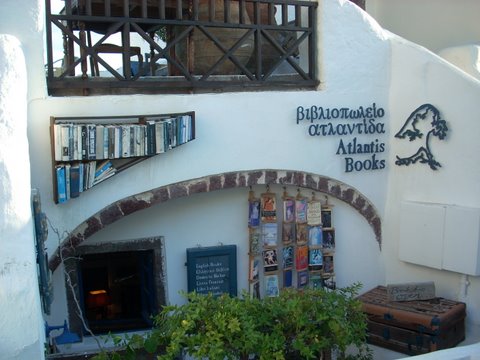
Thanks in part to reading John Freely's Crete, (more about travel books in a later posting), my longtime fiance Denise and I did a self-guided walking tour of city of Chania, which is port city on the west side of the island. This city dates back to the time of Homer's Odyssey and the city's architecture reflects the mix of Venetian and Ottoman influences.
 According to Freely, one of of best streets for walking is the Odos Theotokopoulou, which is near the old Venetian fort that dominates the west side of the harbor. By walking on one of the side streets of Theotokopoulou, I found a book and art store called Exantas. Notice the tempting display of books in glass cases that drew me inside (the proprietor politely requested that I not take photos inside the store). In addition to many art and architecture books, the store carried jewelry and old prints of the city and maps. I purchased a few postcards instead of books (the weight of books is a major deterrent to buying books when I travel), but Denise purchased a decorative pin (light and easy-to-carry).
I talked to the clerk/sale rep briefly and from what I could understand, the book store was owned by a publisher, who carried their offerings (especially prints and photographs) and other books as well. What I appreciated about store was that the books were as much artifacts as prints and jewelry – worthy of beholding and worthy of reading.
—– EXTENDED BODY: —– EXCERPT: —– KEYWORDS: Exantas, Chania Crete, John Freely, Odos Theotokopoulou —– ——– AUTHOR: Murray Browne AUTHOR EMAIL: murray.browne905@gmail.com TITLE: Touting the Istanbul Book Bazaar STATUS: Publish ALLOW COMMENTS: 1 CONVERT BREAKS: wysiwyg ALLOW PINGS: 1 BASENAME: touting-the-istanbul-book-bazaar CATEGORY: Bookstores UNIQUE URL: https://thebookshopper.typepad.com/the_book_shopper_atlantad/2011/10/touting-the-istanbul-book-bazaar.html DATE: 10/17/2011 09:10:42 AM —– BODY:

Following the theme established in the last posting and leveraging my recent vacation to Turkey and Greece, I'm posting several photos of the few bookstores I checked out during my recent travels. My trip was hardly intended to be a “literary tour,” but books always play a role in my journeys (along with food, incessant photo taking and airport delays).
 These photos are from the Istanbul Book Bazaar Sahaflar Carsisi, which is just outside the more well known Grand Bazaar. On both of my brief visits to the book bazaar, I observed plenty of shoppers hovering around the tables and shelves of books, but unlike The Grand Bazaar and the nearby Egyptian Spice Bazaar there was a noticeable absence of what are called, “touters.” In Istanbul, it is common for an outside salesman called a “touter” to stand outside the entrance of their business and aggressively but politely solicit you to enter their establishment.
But why shouldn't book sellers use touters too? I think it would be an idea worth trying at next year's Decatur Book Festival.

—– EXTENDED BODY: —– EXCERPT: —– KEYWORDS: Istanbul Book Bazaar, Sahaflar Carsisi, book shopping, Turkey —– ——– AUTHOR: Murray Browne AUTHOR EMAIL: murray.browne905@gmail.com TITLE: Book Signage STATUS: Publish ALLOW COMMENTS: 1 CONVERT BREAKS: wysiwyg ALLOW PINGS: 1 BASENAME: book-signage CATEGORY: Books as Art as Books UNIQUE URL: https://thebookshopper.typepad.com/the_book_shopper_atlantad/2011/10/book-signage.html DATE: 10/08/2011 01:31:00 PM —– BODY:
 This unusual “stack of books as signage” can be found promoting a used bookstore in the Berlin neighborhood of Kreuzberg. The borough has a reputation as one of the cultural centers of the city with a large percentage of immigrants and second generation immigrants. Photo credits go to my older daughter Cynthia who took these photos while doing research in Germany this summer.
—– EXTENDED BODY: —– EXCERPT: —– KEYWORDS: —– ——– AUTHOR: Murray Browne AUTHOR EMAIL: murray.browne905@gmail.com TITLE: MARTA Book Club #16: Money to Burn STATUS: Publish ALLOW COMMENTS: 1 CONVERT BREAKS: wysiwyg ALLOW PINGS: 1 BASENAME: marta-book-club-16-money-to-burn CATEGORY: MARTA Book Club UNIQUE URL: https://thebookshopper.typepad.com/the_book_shopper_atlantad/2011/09/marta-book-club-16-money-to-burn.html DATE: 09/30/2011 08:02:29 AM —– BODY:
 Even though mass transit fares are going up on October 2 for a second year in a row with single fares rising from $2 to $2.50 (25% increase), 30 day trip passes rising from $68 to $95 (40 % increase), and 20 trip passes rising from $34 to $42.50 (25% increase), the annual dues for MARTA Book Club remain the same – nil.
For those unfamiliar with the group, the MARTA Book Club is a loose— very loose— confederation of people who read while riding the Metropolitan Atlanta Rapid Transit Authority’s public transportation. There are no meeting times, no organizational rules, no t-shirts, and no dues. Very convenient. The only requirement to be a member of MARTA Book Club is to read a book while riding public transportation, which for most riders seems to be a steep admission price.
If rising fares weren't enough, have you seen the movie “Contagion” where this mysterious virus spreads throughout the world killing millions? Did you see how the virus spread? Through human contact on public transportation (and Gwynth Paltrow's adulterous character eating some snacks while sitting at a bar). Oh yeah!
Nevertheless, the MARTA book club marches on just as it always has. We just don't burn our card in protest and quit riding public transportation, (which is what the civic leaders want, judging from the oppressive rate hikes), we just get on that train or bus, put our nose in a book, and read.
What We Are Reading
Either our main book spotter hasn't been doing his job or the admission price to belong to the club is becoming too high, but the latest offering is a noticeably short list of what we have seen people have been reading since the last posting: (See link on the right for a history of MARTA book club postings)
Characters of Lust by Karlyn LeBlanc
Light on Yoga by B.K.S. Iyengar
The Portrait of an Artist as a Young Man by James Joyce
The Hiding Place by Carl Weber
The Help by Kathryn Stockett
American Corrections by Todd Clear
A Road More or Less Traveled by Stephan Otis and Colin Roberts
Chi Running: A Revolutionary Approach to Effortless, Injury-Free Running by Danny and Katherine Dreyer
Norton Anthology of World Literature
Small Business Management: An Entrepreneurial Emphasis by Justin Longenecker et. al
Novels by George R. Martin, John Grisham
Next Assignment: Keep reading, get to work on time, watch for wet spots (of all kinds) and send us your book contributions and observations via comment or visit our Facebook page at facebook.com/thebookshopper.
—– EXTENDED BODY: —– EXCERPT: —– KEYWORDS: MARTA Book Club, MARTA rate hikes, Book clubs Atlanta, —– COMMENT: AUTHOR: Bonnybee EMAIL: bonnybeedesigns@aol.com IP: 71.45.12.104 URL: DATE: 10/01/2011 12:19:53 AM Seriously words didn’t do it justice, that picture is awesome. Also ever since seeing Contagion I am afraid of touching things in public places. —– COMMENT: AUTHOR: Jenna EMAIL: jenna.dimaria@gmail.com IP: 157.166.167.129 URL: DATE: 10/03/2011 01:07:10 PM i like the picture! As big of a public transportation advocate as I am, my parking pass is free and I have to pay $50 for MARTA. Last month, the MARTA machines ate my $20, and the staff promised me a check that I never received. I drive to work now, and sadly, haven’t looked back. That means I’ll have to carve out a different time of day to read. —– COMMENT: AUTHOR: Anne Smith EMAIL: IP: 41.30.135.255 URL: http://profile.typepad.com/annesmith1 DATE: 11/27/2011 10:51:57 AM In Atlanta it is well worth tuning in to WAFS 1190AM on Sundays at 11:00 to noon for The Book Report. The show is a lively, fun and interesting combination of author interviews, readings and reviews. Hopefully you don’t find yourself on MARTA at that time, lol! If you are not in Atlanta you could always check http://bookreportradio.com to see if the show is being broadcast near you. —– COMMENT: AUTHOR: Jonna EMAIL: bconstance87@yahoo.com IP: 108.41.207.165 URL: DATE: 12/27/2011 08:34:52 PM Ahhh Anne Smith thanks for that link. I always try and catch the show but NEVER get too. I should have checked for the website of course but it always slipped my mind. So funny I’m really about marta and saw a link for that show. I used to read the host’s work in the Miami Herald. Thats how I know about it. —– ——– AUTHOR: Murray Browne AUTHOR EMAIL: murray.browne905@gmail.com TITLE: Books as Signposts STATUS: Draft ALLOW COMMENTS: 0 CONVERT BREAKS: wysiwyg ALLOW PINGS: 0 BASENAME: books-as-signposts UNIQUE URL: https://thebookshopper.typepad.com/the_book_shopper_atlantad/books-as-signposts.html DATE: 09/27/2011 10:07:20 PM —– BODY:
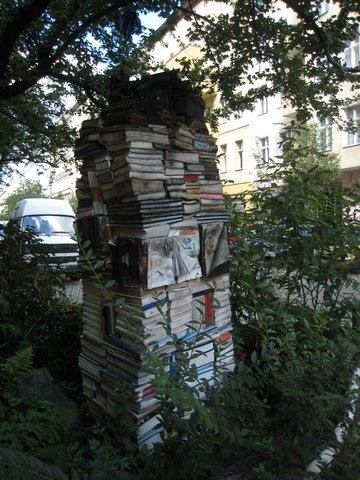 This unusual “stack of books as signage” are outside a used bookstore in the Berlin neighborhood of Kreuzberg. The borough has a reputation as one of the cultural centers of the city with a large percentage of immigrants and second generation immigrants. Photo credits go to my older daughter Cynthia who took these photos while doing research in Germany this summer.
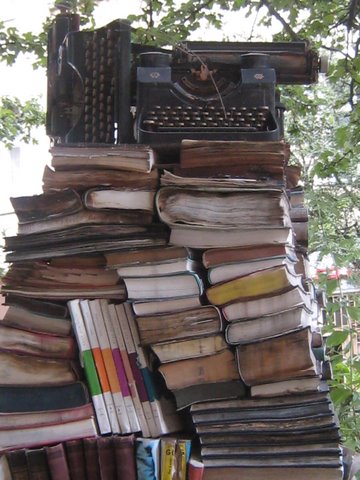

Here's a sampler of book related events for the month of October. (Check out all the activity on October 5 alone.) Think of it as a collection of links of different venues, so you can surf and plan your month ahead. I purposely don't put the times so you will have double check each website before heading out. The dollar sign designation ($$) indicates some kind of admission fee is charged. All events are in Atlanta unless noted.
Friday, September 30. Sesquicentennial Civil War evening. Nell Dickerson, architect photographer and author of Gone: A Photographic Plea for Preservation and Robert Hicks, author of A Separate Country. Peerless Books. Alpharetta.
 Tuesday, October 4. Don Goodman and Thomas Head, authors of The Happy Table of Eugene Walter. Book signing and refreshments by Chef Linton Hopkins of Restaurant Eugene. A Cappella Books.
Wednesday October 5 thru Sunday, October 9. American Association of University Women (AAUW) book sale at Perimeter Mall in Dunwoody. Details here. (Banner photo courtesy of AAUW)
Wednesday, October 5. A reading from short story writer and novelist Richard Bausch. Robert Woodruff Library, Emory University. Details here.
Wednesday, October 5. Charles Frazier, author of Nightwoods (and Cold Mountain), Georgia Perimeter College. Clarkston. Details here.
Wednesday, October 5 and Thursday, October 6. Dr. Siddharta Mukherjee author The Emperor of All Maladies: A Biography of Cancer at the Atlanta History Center ($$) and the Arena at the Gwinett Center respectively. Call A Cappella Books at 404-681-5128 about the Mukherjee's History Center appearance and Eagle Eye Books at 404-486-0307 about the Arena. (Tell `em who sent ya.)
—– EXTENDED BODY:
Wednesday, October 12. Soraya Mire, author of Girl with Three Legs will lead a discussion on the complicated issue of female genital mutilation. Charis Books & More.
Tuesday, October 18. Southern Poets Reading. Janisse Ray, John Lane & Thomas Rain Crow. Georgia Center for the Book. Decatur Public Library. Check all their October events here.
Monday, October 24, Julie Klam, author of Love at First Bark. Eagle Eye Books.
Thursday, October 27 thru Sunday, October 30. Alien Encounters II: Speculative and Imaginative Fiction by Writers of Color. In collaboration with Black Science Fiction Society, Auburn Avenue Research Library. Details here.
Friday, October 28. Actress Meredith Baxter, author of Untied: A Memoir of Family, Fame and Floundering. Outwrite Bookstore and Coffeehouse.
Beginning November 5 thru November 20. The Book Festival of the MJCCA. Details here.
—– EXCERPT: —– KEYWORDS: Siddharta Mukherjee, Charles Frazier, Atlanta, Book Events, William Kennedy, Richard Bausch, Events, Auburn Avenue Research Library —– ——– AUTHOR: Murray Browne AUTHOR EMAIL: murray.browne905@gmail.com TITLE: Bidding Adieu to the Baseball Season STATUS: Publish ALLOW COMMENTS: 1 CONVERT BREAKS: wysiwyg ALLOW PINGS: 1 BASENAME: bidding-adieu-to-the-baseball-season CATEGORY: Baseball UNIQUE URL: https://thebookshopper.typepad.com/the_book_shopper_atlantad/2011/09/bidding-adieu-to-the-baseball-season.html DATE: 09/20/2011 07:48:26 AM —– BODY:Even though there are a few games left in the season, I did make it out to Turner Field last week on a cool summer evening for a long (12 innings, but I left after nine) unceremonious farewell to 2011. Even though the final score was Florida 6, Atlanta 5, there was no disappointment for me. Emotionally, my team is the Cubs, which I characterize as “monotonous seasons of losing punctuated with several interludes of spirit-crushing defeat (1969, 1984, 1989, 2003).” This year, the Cubs punched out early. If there was a highlight of the Cubs season, it was probably winning two of three here in Atlanta on Bobby Cox tribute weekend. (shown here). 
I don't consider myself a Braves fan, but like many, I developed an appreciation of the ball club during the 1980s when the WTBS was the only way to watch a game daily on television. I tell people I am a Braves follower, because I like the rhythm of tracking a team throughout the season and it's easier to do since I live in the Atlanta metro. This season is no different. Full of ups and downs – Jair Jurrjens All-Star performance before falling victim to a knee injury, the emergence of a lights out bullpen of Eric O'Flaherty, Craig Kimbrel and Jonny Venters (well, almost lights out), and Chipper Jones has been amazing this year with his clutch hitting. Conversely, I am sympathetic to the situation of the classy Martin Prado as he continues to wait until Chipper retires. This doesn't means I don't root for Atlanta from time to time, especially if it means making the playoffs and eliminating from post season competition the Cubs' arch rivals – the St. Louis Stinkin' Cardinals.
The same mixture of highs and medium lows has been characteristic with the baseball books that I have read this year. By far, my favorite was the reissue of Hub Fans Bid Kid Adieu, John Updike's classic of Ted Williams final game with the Boston Red Sox. The slender book is a reprint of the essay Updike wrote after he sat in the stands and witnessed Williams' last at bats (See earlier posting).
Right Off the Bat
 Coincidentally, the two other baseball books that I looked at over the summer were both penned by Englishmen. In the case of Evander Lomke & Martin Rowe's Right Off the Bat: Baseball, Cricket Literature & Life, it was Martin Rowe who grew up overseas. The premise of the book is simple as the authors explain to cricket lovers about baseball and likewise to baseball fanatics the rudiments of cricket. Since I consider myself quite knowledgeable about baseball (after all Hall of Famer Sam Rice was born near my hometown,) I was anxious to learn more about cricket, but sometimes a book just isn't the way to learn about a sport. I appreciated what the authors were trying to do, but if you're a baseball guy, reading an the explanation about baseball is redundant and the cricket explanation need more diagrams (the first illustration of a cricket field appears on page 184 in the Glossary and some of the artwork left me scratching my head).
But the book, like any baseball season, had its fine moments, more specifically the chapter on Race and Empire, which gives a brief history of the players of color. At first these players, ranging from black players of the Caribbean to the Parsees, Hindus and Muslims who played for India, could only play for England but later competed against the mother country. It was a struggle, reminiscent of Jackie Robinson's integration of major league baseball.
Flip Flop Fly Ball
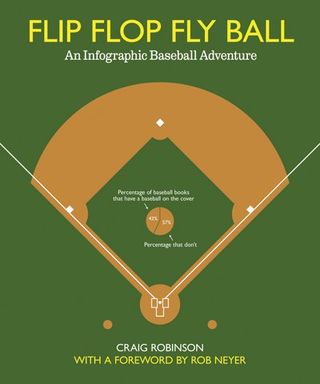 There is no shortage of diagrams or infographics in Flip Flop Fly Ball: An Infographic Baseball Adventure by Craig Robinson who grew up in England, but didn't begin become an obsessive fan of the game until he moved to Berlin and then finally to New York in 2007. Though there are a few short narratives, the main emphasis of the book is Robinson's quirky graphics illustrating certain aspects of the game: different managers of all the teams during Bobby Cox's tenure with the Braves, the uniform number that clubs have retired the most (after Jackie Robinson), and the longest championship droughts (it's the Cubs of course, by almost 40 years over the Cleveland Indians). Check out his website for more examples. Fun stuff to look at, but the type is so small that Robinson has should have included a coupon for a magnifying glass.
Perhaps complaining about the size of the type qualifies as old fart talk, but judging from the average age of hardcore baseball fans who say good bye to every baseball season, it's a statistic that Robinson should include in his next book.
Disclaimer: Paul Dry Books (who published my book The Book Shopper) provided me a reviewer's copy of Right Off the Bat. I bought my own copy of Flip Flop Fly Ball, but the author himself provided the artwork.
By Alfred Thigpen
 Bless her heart. Ann Napolitano has attempted to fictionalize the great Southern writer, Flannery O’Connor, and embed her facsimile in her novel, A Good Hard Look. The reviews are out, as is the book, and people will take what they wish from Napolitano’s voyeuristic story, including the impression that it might actually bear any resemblance to early 1960’s Milledgeville, much less O’Connor.
Milledgeville (circa1963)
I grew up in O’Connor’s Milledgeville. My parents owned a discount dry goods store so similar to the one in the film version of Wise Blood that Hazel Motes could just as easily have bought his suit from us. From the store front window I would watch as occasional mule carts driven by old black men vied for the right-of-way with a displaced locomotive that ran down the centerline south toward the state mental asylum. Just one block west of the store was O’Connor’s alma mater, Georgia State College for Women, with its elegant Corinthian columns. You could set your clock by the whistle at Bone’s Brick Yard, or the bugle at Georgia Military College located in the old capitol, the country’s first public neo-gothic building.
To Napolitano, Milledgeville was just another southern town. No such thing. With a population of only 7,500 the former state capital was inhabited by other fascinating historic figures such as longtime U.S. Congressional Representative Carl Vinson, father of the Two-Ocean Navy Act, (which led to the build up of the U.S. Navy before Pearl Harbor) along with the legacy of silent film star Oliver Hardy, a young projectionist at the movie theater where he picked up an idea or two and set a precedent for every other truly gifted local with a future, namely to leave town. Napolitano misses the unique multi-racial tapestry when she digitally remasters O’Connor’s Milledgeville into various shades of white. Yet Milledgeville had a significant Cuban population owing to families of doctors fleeing Fidel Castro to practice medicine at the asylum, and unlike the common perception, black and white residents commonly interacted, whether intimately, out of spite, or both.
Around the corner from my parents’ store was the Campus Theater (circa 1930’s), and above it, the offices of a prominent lawyer, Marion Ennis. During the town’s much-anticipated sesquicentennial in 1953, a local loan shark burst into Ennis’ office and shot him dead. From there, the shooter strode to the law office of Pete Bivins, and likewise murdered him. This wild man is clearly reincarnated as Singleton, an asylum inmate in O’Connor’s short story “Partridge Festival.” There was a major difference in O’Connor’s version. Singleton, a sort of Hannibal Lector precursor, lived to be locked away. When our local madman learned the town’s tough Irish cop was in pursuit, he immediately shot himself. It was the same policeman who once explained to my mother why he sometimes shot people by saying: “That’s how I get my ginger.”
—– EXTENDED BODY: Clearly, Napolitano did not research her setting very well. “Who else has a personal library in Milledgeville?” a character in her novel asks. Napolitano and her editor seem oblivious to the faculty members at O’Connor’s college alma mater. We also learn that O’Connor graduated not from Peabody High School, but rather from Baldwin High, which did not exist until eight years prior to her death. I can’t hold Napolitano totally accountable for the inaccuracies as that problem is an editorial concern that her publisher could have easily confirmed.O’Connor’s Milledgeville
Admittedly, Napolitano is allowed some license, as O’Connor herself did write about local types and places, some more transparently than others. In “A Good Man is Hard to Find,” Red Sammy’s is, to any local, Pat’s Place, a pork barbecue joint located east of Milledgeville. It had a jukebox, a wiggly funhouse mirror, and irresistible barbecue plates. By O’Connor’s own admission, John Wesley (the boy kicking the back of the driver’s seat) is J.L. Sibley Jennings, Jr., who later became a distinguished Washington, DC architect. O’Connor often anti-cast her friends into her stories, and usually they had the sense to understand the humor behind it. Sibley’s only lasting complaint is that O’Connor had another character wearing his “Precious,” his very own parrot-covered shirt of which he was inordinately proud.
In 1964, Sibley Jennings Jr. sent Ms. O’Connor an arrangement of silk flowers, the only type allowable at Baldwin County Hospital’s ICU where O’Connor’s breathing was being closely monitored. Only days later, Jennings found himself head pallbearer at O’Connor’s funeral. After the service and still a little stunned, he checked his post office box. In it was a letter written in a hand he knew well. It read, “Thank you for the permanent flowers from a permanent friend.”
I talked recently to Sibley Jennings and Dr. James O. Tate, a Milledgeville native and English Professor at Dowling College in New York. They still speak of O’Connor in fond but reverent tones. There is, after all, a growing laity push for O’Connor’s canonization in the Catholic Church. Understanding O’Connor the person is better arrived at by reading her numerous correspondences in A Habit of Being. My biggest complaint about the portrayal of O’Connor was her pettiness in Napolitano’s book. But more importantly, she was the personification of what it meant to be a practicing Pre-conciliar Catholic. The idea that she would be seen in public with a married man, much less jealous of his wife and child, is beyond poetic license.
The peacock that graces the front of Napolitano’s book serves as a reminder of her portrayal of my Milledgeville. Napolitano’s peafowl are velociraptors in drag, able to crush vital organs and possessing the agility and body mass of great apes. Their screeches are so prodigious that they carry from the north of town to five miles south through the brick walls of the asylum. Obviously, this did not happen, but it is typical of the same skewed reality that Napolitano has applied to the town of my childhood. Bless her heart.
Editor's disclaimer: A longtime writer friend of mine, Alfred Thigpen is the author of Trapped in the Body Jesus (details here). Alfred currently resides in suburban Washington D.C. where he freelances music reviews for The Washington Post. Ultimately, he’d like to see someone do an annotation of O’Connor’s works.
—– EXCERPT: —– KEYWORDS: A Good Hard Look, Ann Napolitano, Flannery O’Connor, Milledgeville GA, Wise Blood, Carl Vinson, A Good Man is Hard to Find. —– COMMENT: AUTHOR: http://roofrepairlosangeles.weebly.com EMAIL: dominik-pate@wildmail.com IP: 142.234.104.117 URL: http://roofrepairlosangeles.weebly.com DATE: 09/12/2013 03:25:57 AM Their staff is licensed and certified for most types of roofing products including single-ply, changedblacktop, developed and metal. In the southwest United States, roofing kingston ny as well as firm for many years. Therefore, it is good to do it yourself installation, so keep that in mind. It can also be installed over most existing surfaces. —– COMMENT: AUTHOR: Best Flashlight App EMAIL: kristenhartley@gmail.com IP: 188.165.152.88 URL: https://play.google.com/store/apps/details?id=com.flashlight.illuminus DATE: 09/14/2013 08:39:34 PM I seriously love your site.. Pleasant colors & theme. Did you build this website yourself? Please reply bak as I’m looking to create my own personal blog and want to find out where you got this from or what the theme is called. Kudos! —– COMMENT: AUTHOR: age of empires 3 download EMAIL: debyounger@freenet.de IP: 46.105.231.173 URL: http://ageofempires3download.blogspot.com/, DATE: 09/15/2013 06:01:33 AM May I just sayy what a comfort to find somebody who reawlly understands what they’re talking about on the net. You certainly know how to bring an issue to light and make it important. More and more people have to look at this and understand this side of the story. I can’t believe you’re not more popular since you most certainly possess the gift. —– COMMENT: AUTHOR: Black Handjobs EMAIL: marcelo_simmonds@t-online.de IP: 91.108.182.157 URL: http://www.redbookclassified.com/blog/7030/relationship-strategies-for-black-fellas-and-white-ladies.html DATE: 10/18/2013 10:19:39 PM Heya! I’m at work browsing your blog from my new apple iphone! Just wanted to say I love reading through your blog and look forward to all your posts! Keep up the excellent work! —– ——– AUTHOR: Murray Browne AUTHOR EMAIL: murray.browne905@gmail.com TITLE: DBF 2011 Postscript & September Calendar of Book Events STATUS: Publish ALLOW COMMENTS: 1 CONVERT BREAKS: wysiwyg ALLOW PINGS: 1 BASENAME: dbf-2011-postscript-september-calendar-of-book-events UNIQUE URL: https://thebookshopper.typepad.com/the_book_shopper_atlantad/2011/09/dbf-2011-postscript-september-calendar-of-book-events.html DATE: 09/05/2011 08:58:25 AM —– BODY:Postcards from the DBF
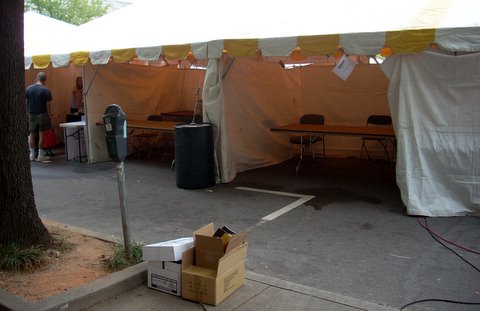
Strike the tents. Pitch a few unwanted books into the dumpster. The Decatur Book Festival 2011 is now over as the rain from Tropical Storm Lee washes away the ink and funnel cake residue off Ponce de 
Leon Avenue. I am still processing the event, but my favorite moment of irony, besides the book vendor who disappeared from his booth with customers waiting cash in hand, was the Saturday morning festivities near the Children's Stage. There was a long queue of parents and children wanting to have a book signed and it was hot (as if Bookzilla was belching steam) and the line was long and  some of the kids were not feeling any love for reading. The dedicated parents looked a little tired. Not all the zombies were at DragonCon in downtown Atlanta this weekend.
My favorite addition to the Festival was the Kudzu Readers Lounge south of the Old Courthouse. It was shaded and they brought their inventory of vintage lawn furniture to share. I didn't see a lot of people sitting and reading, but a few weary book shoppers used the respite as a place to rest or chow down on festival food and beverage.

Atlanta Area Book Events Calendar – September 2011
But as all dedicated book shoppers know, the DBF is just opening day for the fall season. Here's a sampler of book related events for the month of September. Think of it as a collection of links of different venues, so you can surf and plan your month ahead. The dollar sign designation ($$) indicates some kind of admission fee is charged. All events are in Atlanta unless noted.
Wednesday, September 7. Madeleine Albright, author Read My Pins. Lecture. Cecil B Day Chapel. Carter Presidential Library & Museum Theater.
Thursday, September 8. Marsha J. Peters, counselor and author of He Said, She Said, I Said: 7 Keys to Relationship Success. Blue Elephant Books. Decatur.
Thursday, September 8. Linda Niemann, author of Boomer: Railroad Books. Charis Books and More.
Sunday, September 11. Local poets and writers share their works of commemoration on the tenth anniversary of 9/11 attacks. Bound to be Read Books.
Tuesday, September 13. Heywood Smith, author of Wife in Law. Peerless Books, Alpharetta.
Thursday, September 15. Jeffery Wells, author of The Atlanta Ripper, The Unsolved Case of the Gate City's Most Infamous Murders. Manuels Tavern (and A Cappella Books).
—– EXTENDED BODY: Thursday, September 22. Lonz Cook, author of When Love Evolves. Reading and book signing. Central Library, Atlanta Public Library.
Saturday, September 24. Casi McClain, author of Wingless Butterfly. Talk and book signing. Eagle Eye Books, Decatur.
Tuesday, September 27. Poetry Atlanta Presents. Georgia Center for the Book. Decatur Library Auditorium.
Thursday, September 29. Kendra Wilkinson, author of Being Kendra, Cribs Cocktails and Getting My Sexy Back. Outwrite Book Store and Coffee house. ($$)
Thursday, September 29. Martha Southgate, author of Taste of Salt. Book signing and discussion. Auburn Avenue Library.
And looking ahead: October 5-9, American Association of University Women (AAUW) big book sale at Perimeter Mall in Dunwoody. Details here.
—– EXCERPT: —– KEYWORDS: Atlanta Area Book Events Calendar, August 2011, Kudzu Readers Lounge, Madeleine Albright, Heywood Smith, AAUW Book Sale, —– COMMENT: AUTHOR: richard williams EMAIL: rwilliamsmultimedia@gmail.com IP: 24.30.98.46 URL: DATE: 10/07/2011 12:57:59 PM http://www.youtube.com/watch?v=d73Uxr1GrL4 decatur book fest video featuring georgia perimeter authors, 2011 edited and filmed by local videographer , richard williams —– ——– AUTHOR: Murray Browne AUTHOR EMAIL: murray.browne905@gmail.com TITLE: DBF 2011 Preview #3: The Fine Print STATUS: Publish ALLOW COMMENTS: 1 CONVERT BREAKS: wysiwyg ALLOW PINGS: 1 BASENAME: dbf-2011-preview-3-the-fine-print UNIQUE URL: https://thebookshopper.typepad.com/the_book_shopper_atlantad/2011/08/dbf-2011-preview-3-the-fine-print.html DATE: 08/31/2011 09:19:17 PM —– BODY:The third and final in the series…
As the big weekend approaches, I’ve been checking the fine print of my AJC-Decatur-Book-Festival-presented-by-the-Dekalb-Medical-Center newspaper insert to see if some of those little vendors, which I like to visit, have a booth in the Book Market. (Complete Book Market listings are here.) 
There are a few of my favorites that are missing this year (WMLB-The Voice of the Arts and McSweeney’s) but some of the Georgia-based literary journals will be around: The Georgia Review (Booth 508), New South (Booth 259) Five Points (Booth 262) and The Chattahoochee Review (Booth 301). The Georgia Review celebrates its 65th anniversary with a special presentation on Saturday, at the Decatur Conference Center stage (details here).
Another tradition is stopping to check the offerings of the Michael C. Carlos Museum Bookshop (Booth 205 – near the Old Courthouse). First and foremost, I have to see if they have more copies of Cultural Amnesia (previous posting here) available. Even if CA is unavailable, I can expect a lot of sale books and plenty of nonfiction titles on such topics as ancient history (especially ancient Egypt, Greece & Rome), folktales, fairy tales, mythology, art, religion, archeology.
The festival is also a good place to check out different book-loving organizations ( e.g. Emory Libraries, IVY-Hall SCAD, Atlanta Fulton Public Library System.) to find out what literary events are scheduled for the fall. I’ve added a monthly calendar posting to the blog that highlights the different organizations hosting readings and exhibits. Past calendars are located at the link at the right. I’ll be posting a new September calendar early next week.
(To subscribe, use the RSS feed at the right corner, or join the blog by becoming a friend at facebook.com/thebookshopper.)
—– EXTENDED BODY: —– EXCERPT: —– KEYWORDS: Decatur Book Festival, 2011, The Georgia Review, The AJC Decatur Book Festival, Carlos Museum Bookshopp, —– ——– AUTHOR: Murray Browne AUTHOR EMAIL: murray.browne905@gmail.com TITLE: DBF 2011 Preview #2: A Festival Strategy STATUS: Publish ALLOW COMMENTS: 1 CONVERT BREAKS: wysiwyg ALLOW PINGS: 1 BASENAME: dbf-2011-preview-2-a-festival-strategy UNIQUE URL: https://thebookshopper.typepad.com/the_book_shopper_atlantad/2011/08/dbf-2011-preview-2-a-festival-strategy.html DATE: 08/28/2011 11:33:07 AM —– BODY:The second in a series…
In order to maximize the balance between book shopping (job #1) and attending author appearances (job #3), and not getting cooked by the Georgia heat (job #2) may I suggest this strategy: If you're attending one of the programs at the Decatur High School Auditorium, be sure and stop by what I consider one of the “destination” used book stores in Atlanta – Books Again on North McDonough Street, just across the street from the high school. Sure they are a sponsor, (see Sponsor Link in the left corner) but if you are a serious book shopper you'll appreciate the wide selection of fiction especially some of the older works penned by local and regional authors (This year they will be featuring earlier works by Decatur Book Festival authors such as Robert Olen Butler, Clyde Edgerton, Melissa Fay Greene, Janisse Ray and a couple of earlier books from poets Rosemary Daniell and Natasha Trethewey). Books Again also has shelves full of military history, baseball, religion, philosophy and cookbooks. And the store is air conditioned!
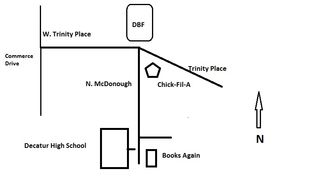 Even though Decatur High School can seem a little bit of trek from the main festival (note on my pathetic, but well-intentioned, click-on-it-to-enlarge, map that it's only a long city block) its large seating capacity makes it a great venue for several festival headliners: On Saturday, Robert Olen Butler, will be reading from his new book The Small Hotel followed by theatrical excerpts from two works by Calvin Ramsey: Theatrical Outfit's “The Green Book” and the Center for Puppetry Arts' “Ruth and the Green Book.” Finishing up on late Saturday afternoon it's Write Club, with host Ian Belknap featuring Atlanta favorites Andisheh Nouraee (see posting here), Patti Callahan Henry and Jessica Handler among others. In the Write Club, teams of writers match wits and quick writing skills to produce the best prose live in front an audience. (Pretty gutsy — writing without an editor.)
—– EXTENDED BODY:
On Sunday, The Decatur High School has quite a range of offerings: First you have the Ellen Brown's story of how Gone with the Wind became a blockbuster movie, followed by Jack Wilkinson's 100 Things Braves Fans Should Know and Do Before They Die (does it include managing this year's high expectations?). Sunday concludes with a preview of the Atlanta Opera's adaptation of Brer Rabbit moderated by Lain Shakespeare, Executive Director of the Joel Chandler Harris House Museum.
Because it's not in the heart of the square, North McDonough can be easily overlooked, but it is definitely a side trip worth taking. For more details, on the festival schedule go here.
—– EXCERPT: —– KEYWORDS: 2011 Decatur Book Festival, Decatur High School, Books Again, Andishe Nouraee, Calvin Ramsey, Janisse Ray —– ——– TITLE: DBF 2011 Preview #1: UGA Press DATE: 08/25/2011 07:58:51 AM —–Editor's Note: As the 2011 Labor Day Weekend Decatur Book Festival draws near, I start to become more anxious than usual. Trying to capture the pulse of all the writers, vendors, and activities that make up the festival, along with the my own anxieties of wearing a volunteer's t-shirt emblazoned with such a scary festival mascot (last year's shirt  shown here) sends my blood pressure skyrocketing. Hand me my Lisinopril. Still I am one of those persons, who at least tries to plan a few things ahead, and in a series of postings between now and the Festival. I will try to impart a few things that an energetic version of someone like myself might try to do. For a complete listing, check the DBF link at the left. Happy hunting. There is something at the festival for everyone.
University of Georgia Press
Historically, I've had good experiences with books and authors that have had a UGA Press imprint on them. In the last year three superb books that have made it to the blog: Crossroads of Conflict: A Guide to Civil War Sites in Georgia, The Southern Foodways Alliance Community Cookbook and Seriously Funny: Poems About Love, Death, Religion, Arts, Sex and Everything Else. (The links will take you to the postings). The latter book won the “uncoveted” 2010 Best Local Reading (That I Attended) Award.
 This year UGA Press is located at booths #501 and #502 at corner of Ponce de Leon and Clairmont and will be launching Janisse Ray's latest book Drifting into Darien: A Personal and Natural History of Altamaha River,(Disclaimer: UGA provided me a reviewer's copy along with the photos too) which I just finished reading.
The book is divided into two parts. The first half of the book is 127 mile kayak trip Ray took with her husband and six others from the headwaters of the Altamaha River near Lumber City, Georgia to the town on Darien on the Atlantic Ocean. Along the way, Ray mixes personal anecdotes with observations about the birds, fish and trees that inhabit the region. The second half of the book is a series smaller, diverse, chapters. Ray expands on different trips that she has taken on the Altamaha over the years: the people she has met, the importance 
of river stewardship, the evils of nuclear power, and additional reflections on her own life. The book includes river photographs by Nancy Marshall and resources for those who wish to be more involved with protecting and improving “Georgia's Little Amazon.” The Altamaha is a unique river because it is free flowing for 137 miles (no dams) and it drains 14,000 square miles of land, almost a quarter of Georgia's land mass.
Ray is doing a reading from her new book on Saturday (9/3) at 5:30 p.m. at Decatur Conference Center Stage. Details here.
“You read too, but you aren't an exhibitionist.” — Tayari Jones, Leaving Atlanta
 For those unfamiliar with the group, the MARTA Book Club is a loose— very loose— confederation of people who read while riding the Metropolitan Atlanta Rapid Transit Authority’s public transportation. There are no meeting times, no organizational rules, no t-shirts, and no special fares. Very convenient. The only requirement to be a member of MARTA Book Club is to read a book while riding public transportation.
Since we cannot determine the title of a book from a Kindle, they are not tabulated even though more and more electronic readers are being seen on the trains.
What We Are Reading: The list seems a little on the light side even though MARTA provides plenty of unscheduled opportunities for additional reading time. If you want to see all the past MARTA Book Club postings, just visit the MARTA Book Club link on the right side of this web page. Here's what people are reading since our last posting:
Native Tongue by Carl Hiassen
Dragons of Eden by Carl Sagen (Thanks, John)
Gone with the Wind by Margaret Mitchell
Deception Point by Dan Brown
Freakanomics by David Leavitt and Stephen Dubner
Dance with Dragons by George R.R. Martin
Expect to Win by Carla A Harris
The 48 Laws of Power by Robert Greene
Compromised: Clinton, Bush and the CIA by Terry Reed
Cutting for Stone by Abraham Verghese
Child 44 by Tom Rob Smith
First Offense by Nancy Taylor Rosenberg
What's His is Mine by Daaimah S. Poole
The Dog of the South by Charles Portis.
Leaving Atlanta by Tayari Jones (see earlier posting)
—– EXTENDED BODY: The Mis-education of the Negro by Carter Godwin Woodson
Handmade electronic music: The Art of Hardware Hacking by Nicolus Collins
Tomorrow When the War Began by John Marsden
The Vixen Manual: How to Find, Seduce & Keep the Man You Want by Karrine Steffans
The Pillars of the Earth by Ken Follett (Thanks,Emily)
The Glass Castle: A Memoir by Jeanette Walls (Thanks, Jenna)
Webster's Thesaurus for Students by Merriam-Webster (What?!? You can read a thesaurus)
Works by Elizabeth Phillips, David Ignatius, Fern Michaels, Jeffery Deaver, Kristin Hannah, Simon Winchester
Next Assignment: Keep reading, get to work on time, forget that you didn't get to do any beach reading, watch for wet spots (of all kinds) and send us your book contributions and observations via comment or visit our Facebook page at facebook.com/thebookshopper.
P.S. MARTA Book Club in the News Like the Dew, A Journal of Southern Politics and Culture posted my essay earlier this year, entitled “Book Spotting.” The piece summarizes the thoughts on my informal monitoring of what people read while riding MARTA.
* The expression “need a vacation from your life” is a quote from Thomas Pynchon's Vineland.
—– EXCERPT: —– KEYWORDS: MARTA book club, Tayari Jones, book spotting, Atlanta —– ——– AUTHOR: Murray Browne AUTHOR EMAIL: murray.browne905@gmail.com TITLE: They’re Coming to Americapedia and Andisheh Nouraee Is Why STATUS: Publish ALLOW COMMENTS: 1 CONVERT BREAKS: wysiwyg ALLOW PINGS: 1 BASENAME: theyre-coming-to-americapedia-and-andisheh-nouraee-is-why CATEGORY: Local Reviews UNIQUE URL: https://thebookshopper.typepad.com/the_book_shopper_atlantad/2011/08/theyre-coming-to-americapedia-and-andisheh-nouraee-is-why.html DATE: 08/07/2011 09:05:26 PM —– BODY:If the melodic refrains of Neil Diamond's “America” stays in my head any longer I must remember to  “thank” Andisheh Nouraee, the next time I see him. Nouraee, a former columnist for Creative Loafing kicked off the local tour of his book, Americapedia: Taking the Dumb Out of Freedom, with a medley of songs about America. In front of a full house at Decatur's Eddie's Attic, Nouraee boldly sang his personal Ode to America, which included bits of “El Paso,” “California Girls,” “By the Time I Get to Phoenix,” “Wichita Lineman,” the theme from the Broadway show “Oklahoma,” “Doraville,” “Jackson,” and the “America” from “West Side Story” to name but a few). The unaccompanied singing was richly apropos considering it was A Cappella Books who partnered with Eddie's Attic to host this book launch (some of the proceeds of the book sales going to the Decatur Education Foundation.)
Americapedia is actually the work of three authors: Jodi Lynn Anderson, Daniel Ehrenhaft, and Nouraee. The book is kind of a humorous junior high level civics textbook, which not only has a satirical edginess that appeals to teens, but to some adults as well. The crowd ranged from junior high students to people who say they remember the political upheaval of the sixties (but have forgotten the adage, “If you remember the sixties, you probably were not there.”). Nouraee believes that history coupled with humor can remove the confusion of how government works or doesn't work. Once that barrier is removed, says Nouraee people will be more likely to get involved. “The heart of the book is activism,” says Nouraee and part of the book (and its website) are dedicated to providing links and information to a multitude of organizations where a reader can connect to like-minded individuals.
 The book is divided into seven chapters, which include topics such as economics, American dynasties (e.g., the Kennedy and the Bush families) foreign affairs, and a chapter devoted to hot topics such as religion, gay marriage and global warming. The book is a breezy read with lots of sidebars (“more sidebars than bars,” quipped Nouree) and is printed with colorful photographs and illustrations. One impressive aspect of the book is that the styles of the three writers have been melded into one consistent voice. Nouree explained (he and I chatted briefly at the bar before showtime) that even though the writers were based in different cities, (Anderson in D.C.; Ehrenhaft in New York; Nouree in Atlanta) that they edited each others' contributions, which added to the seamless quality of the book.
—– EXTENDED BODY: Nouraee admits that the book is similar to Jon Stewart's brand of humor found on The Daily Show or the show's 2004 textbook parody, America. However there are no naked pictures of Supreme Court Justices in Americapedia, which is probably too bad because, if I recall correctly, that is something every seventh grader finds funny.
For those who missed Nouraee's live August 6th performance (music, part reading, and reminiscing with his Creative Loafing readers) check him out at the upcoming Decatur Book Festival on Labor Day weekend. Nouraee appears at the Decatur Library at noon on Sunday, but he also goes head-to-head in a prose death match with other writers called the Write Club on Saturday at 5 p.m. at Decatur High School. The Write Club features teams of different writers competing to produce the most compelling prose in the shortest time, which promises to showcase Nouraee's quick and high spirited wit. Of course, if he gets stumped he could start singing, so heads up. If you're not protected, you could be stuck with one of those Neil Diamond ear-worms for weeks.
—– EXCERPT: —– KEYWORDS: —– ——– AUTHOR: Murray Browne AUTHOR EMAIL: murray.browne905@gmail.com TITLE: Tayari Jones: Review & Preview STATUS: Publish ALLOW COMMENTS: 1 CONVERT BREAKS: wysiwyg ALLOW PINGS: 1 BASENAME: tayari-jones-review-preview CATEGORY: Book Reviews CATEGORY: Local Reviews UNIQUE URL: https://thebookshopper.typepad.com/the_book_shopper_atlantad/2011/07/tayari-jones-review-preview.html DATE: 07/31/2011 09:01:20 PM —– BODY:
Even though Tayari Jones' current promotional tour (which included six different appearances in Atlanta!) is focused on her latest book Silver Sparrow, I just finished reading her first novel, Leaving Atlanta, published in 2002.
I have been impressed with Jones essays (see earlier posting), but I will admit I was slow picking up this book. The thought of reading about the 1979 Atlanta child murders, a two year time period where over 20 African-American children were murdered, is not an inviting subject matter, but I now realize that although the deaths and the fears of abduction cast a shadow, the book is as much about the lives and expectations of three particular fifth grade schoolmates: Tasha Baxter, Rodney Green, and Octavia Harrison.
This book does what all good serious fiction does, it takes you into the world of these middle-school kids who, in addition to the tense atmosphere created by the abductions, also struggle with the usual awkwardness of puberty, classroom rivalries, and relationships with mothers and fathers (or absent fathers). Jones presents the different strata of the black working class – where people may be defined by whether they live in the projects or near them, can afford good clothes or not, or have brown skin pr “black, black as night” skin. (One student hangs the nickname “Watusi” on Octavia because she resembles a black African with unruly hair that “stuck out around her face like rays of the sun in a children's drawing.”) The book is divided into three sections following each child, but Jones melds these separate lives with skill. Jones' crafted prose is simple and strong and once a while she poleaxes you with a line that crushes then numbs you. (“You lose your child not like you lose your watch. You lose your child like you lose your sight. Lose your mind,” says one of the mothers.)
—– EXTENDED BODY:
I did make it to Jones' reading last week at Eagle Eye Book Shop along about 25 others. She read from Silver Sparrow for about twenty minutes. Silver Sparrow is the story of two half sisters, Dana Lynn Yarboro and Chaurisse Witherspoon, who share the same bigamist father, James Witherspoon but live as two separate, yet unequal families. As Jones read, you could hear the similarities between Silver Sparrow and Leaving Atlanta. Jones has depth of understanding when it comes to family dynamics and is able to reveal the inner most feelings of her characters. During her question and answer, Jones mentioned something she had written about in her blog — the large number of people that they too, discovered that a father had an entire separate family. (For a complete and thoughtful review about Silver Sparrow, read Chantal James' essay in Paste Magazine.)
There is still time to see Tayari Jones before she leaves Atlanta again to resume her book tour and responsibilities as a professor. She will be at the Decatur Book Festival on Labor Day weekend (details here). I hope they will have copies of Leaving Atlanta on hand and, if so, don't wait as long as I did to pick it up and read it.
—– EXCERPT: —– KEYWORDS: Tayari Jones, Decatur Book Festival, Leaving Atlanta, Silver Sparrow, —– —– ——– TITLE: Cavett (circa 1974): A Review DATE: 07/09/2011 12:03:46 PM —– I first read about the Dick Cavett biography in cultural historian Clive James' Cultural Amnesia: Necessary Memories from History and the Arts (2007). James refers to Cavett as “One of the best books about show business ever published, there is nothing quite like it…” Thus primed, I picked up a used hardback copy of Cavett's 1974 book while at Atlanta Vintage Books a few months back. (The book jacket was tattered but the book itself was in fine shape.)
The Cavett autobiography, written by Dick Cavett and Christopher Porterfield, utilizes an interview format instead of a narrative one. Cavett talks about his boyhood in Nebraska and his college years at Yale, (but you can skip that). If you do read it, pick up the narrative at Chapter 5 (page 127) when Cavett is struggling as an actor and writer in New York. Cavett got his start writing jokes with for Jack Parr and was a writer for Johnny Carson as well before getting his own talk show in 1968. Cavett explains the difference between Parr and Carson, the twin pillars of late-night television for over thirty years.
—– EXTENDED BODY: Cavett talks about his approach to interviewing guests and some of his most memorable experiences. He downplays his label as an intellectual and talks about the importance of timing and cadence in writing for other people.
If you interested in history of television it's worth checking out, or you can take a shortcut and read an excerpt from Clive James essay on talk show hosts at Slate.
—– EXCERPT: —– KEYWORDS: Dick Cavett, Christopher Porterfield, Clive James, Cultural Amnesia, —– —– ——– ——– TITLE: Hunter S. Thompson on Hemingway’s Death DATE: 07/02/2011 09:49:52 AM —–Are you obsessed with the 50th anniversary of the death of Ernest Hemingway? If so, check out Hunter S. Thompson's 1964 essay, "What Lured Hemingway to Ketchum?" A perfect rational Thompson (remember this  is 1964) visits the Idaho town where Hemingway killed himself with a shotgun on July 2, 1961. It became a more interesting read in light of Thompson's own suicide by gunshot at his Colorado home in February, 2005.
In the Ketchum story, Thompson prophetically says that writers who lose their power of conviction lose the willingness to create art out of chaos.
You can find the essay in the Thompson collection, The Great Shark Hunt (1979) Note the discount sticker that graces the cover — a kind of book shopper's book plate.
Update 2021 – Why Thompson Still Matters
Celebrating the 50th Anniversary of the publication of Fear and Loathing in Las Vegas, The August 14, 2021 issue of The Economist did a retrospective look at Thompson's best known book. Here's an excerpt:
—– KEYWORDS: Hemingway’s death, Hunter S. Thompson, Ketchum, Idaho, Ernest Hemingway —– TITLE: MARTA Book Club #14: Green and Read Metropolis DATE: 06/23/2011 07:26:31 AM —– BODY:Thompson claim that "gonzo" journalism–a person, scabrous, avowedly subjective style which he pioneered—was inspired by William Faulkner's view that "the best fiction is far more true than any kind of journalism". Fifty years after its publication, and despite its many distortions, Fear and Loathing retains its own twisted kind of truth.

For anyone remotely interested in regional transportation issues check out the MARTA Book Club's Book of the Month, David Owen's Green Metropolis: Why Living Smaller, Living Closer and Driving Less are the Keys to Sustainability. Now that Oprah's Book Club will soon be sunk into anonymity, the MARTA Book Club – a loose— very loose— confederation of people who read while riding the Metropolitan Atlanta Rapid Transit Authority’s public transportation – is ready to fill the void.
The premise of Owen's book is that the greenest city in America is New York City, because the population density and smaller domiciles coupled with the availability of alternative methods of transportation makes it — based on energy consumption per capita – a model metropolis (in terms of its environmental sensibilities) . Owens looks at cities throughout the world (including Atlanta), talks about the paradoxes of green consumerism and that the real solutions are relatively simple, except they require a change in mindset of a planet and their relationship with the automobile (not so simple).
 If you read this book while riding MARTA you will feel very good about yourself and you will be eligible to join the MARTA Book Club. There are no meeting times, no organizational rules, no t-shirts, and no special fares. Very convenient.
What We Are Reading: Here's what other people just are reading since our last posting. We regret since we cannot determine the title of a electronic book they are not tabulated. If want to see all the MARTA Book Club postings, just visit the links to the category MARTA on the right side of this web page.
The Girl with the Dragon Tattoo by Stieg Larsson
Sense & Sensibility by Jane Austen
The Immortal Life of Henrietta Lacks by Rebecca Skloot
The Whole World Over by Julia Glass
Grace (Eventually) Thought on Faith by Anne Lamott
Debt Cures They Don't Want You to Know About by Kevin Trudeau
Wolf Hall: A Novel by Hilary Mantel
Interpreter of Maladies by Jhumpa Lahiri
Animal, Vegetable, Miracle: A Year of Food Life (P.S.) by Barbara Kingsolver
Doo Hickey: A Novel by Pete Hautman
The Lost by J.D. Robb, et.al
—– EXTENDED BODY:Tick Tock by James Patterson
Heaven is for Real: A Little Boy's Astounding Story of His Trip to Heaven and Back by Todd Burpo and Lynn Vincent
Les Frares Karmazov by Fyodor Dostoevski (the French version of The Brothers Karamazov)
Blindspot: A Novel by Jane Kamensky and Jill Lepore
Hunting Upland Game and Waterfowl by Durwood Hollis
Unconditional Parenting: Moving from Rewards and Punishments to Love and Reason by Alfie Kahn
Zen Speaks: Shouts of Nothingness by Tsai Chih Chung and Tsai Chih Chung
The Automatic Millionaire: A Powerful One-Step Plan to Live and Finish Rich by David Bach
Books by such authors as: Zane (steamiest sex covers, for sure), Debbie Macomber, Patricia Cornwall, Kristen Hallerick, Carolyn Hart, Lee Child, George Martin
What Members Thought About Each Book. Readers are encouraged to keep their thoughts (and eyes) to themselves. No time is wasted talking about books when you could be reading. Don't make the mistake of the woman reading a David Balducci book who felt obliged to tell a youth to turn down his music. Lots of cussing, train stopped, a visit from the MARTA police. End result? No much reading done.
Next Assignment: Keep reading, get to work on time, watch for wet spots (of all kinds) and send us your book contributions and observations via comment.
P.S. MARTA Book Club in the News Like the Dew, A Journal of Southern Politics and Culture recently posted my essay entitled “Book Spotting.” The piece summarizes the thoughts on my informal monitoring of what people read while riding MARTA.
—– EXCERPT: —– KEYWORDS: MARTA Book Club, Book Spotting, Atlanta, bookspotting, David Owen, Green Metropolis —– COMMENT: AUTHOR: Emily EMAIL: ebritt@midtownalliance.org IP: 64.207.63.58 URL: DATE: 06/27/2011 09:47:15 AM I’m currently reading Let the Great World Spin by Colum McCann, and highly recommend it! —– ——– AUTHOR: Murray Browne AUTHOR EMAIL: murray.browne905@gmail.com TITLE: Book Shopping with Oscar Hijuelos STATUS: Publish ALLOW COMMENTS: 1 CONVERT BREAKS: wysiwyg ALLOW PINGS: 1 BASENAME: book-shopping-with-oscar-hijuelos UNIQUE URL: https://thebookshopper.typepad.com/the_book_shopper_atlantad/2011/06/book-shopping-with-oscar-hijuelos.html DATE: 06/15/2011 10:05:40 PM —– BODY:Oscar Hijuelos, famed Cuban-American novelist who will be at Oglethorpe University 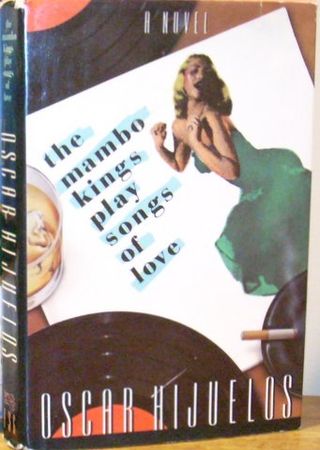 next Monday, June 20th may be most known for the Mambo Kings Play Songs of Love, but Hijuelos also knows the economic pleasures of book shopping. Check out this passage from Mr. Ives Christmas (1995) when Mrs. Ives purchases used books for Pablo, the boyfriend of her daughter, Caroline:
And because Pablo had always liked books and treated Caroline so well, and liked to show her the essays he wrote in school, she insisted upon buying him paper back novels, five or six at a time, crumbling moldy, second-hand inexpensive editions that hardly made a dent in her budget. How could she resist a twenty-five cent edition of Sons and Lovers, Dubliners, Bleak House, Moby Dick or for that matter, Don Quixote or Sonnets of Shakespeare for the same price as a slice of pizza?
Hijeulos will be talking about his new book Thoughts Without Cigarettes. Hijuelos' appearance includes both music and food and the proceeds to the event benefit the Decatur Book Festival. For more information and to order tickets (they are still available), visit the A Cappella Books website.
Also be informed if you book shop for Hijuelos' Mambo Kings, make sure you get the original hardback cover (shown here), it's by far the coolest.
—– EXTENDED BODY: —– EXCERPT: —– KEYWORDS: Oscar Hijuelos Atlanta, Oglethorpe University, —– ——– AUTHOR: Murray Browne AUTHOR EMAIL: murray.browne905@gmail.com TITLE: Charitable Books STATUS: Publish ALLOW COMMENTS: 1 CONVERT BREAKS: wysiwyg ALLOW PINGS: 1 BASENAME: charitable-books UNIQUE URL: https://thebookshopper.typepad.com/the_book_shopper_atlantad/2011/06/charitable-books.html DATE: 06/12/2011 11:58:37 AM —– BODY: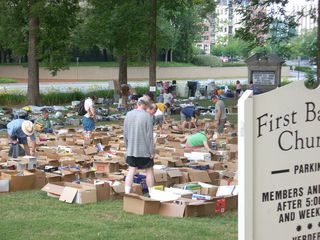 Beyond “just” reading, books have other value, as evidenced in their recent ability to raise money and help people around the world. The First Baptist Church of Decatur held their annual yard sale fundraiser on the church lawn last week (to support youth ministry). Items included appliances, housewares, lawn mowers, clothes and my raison d'etre — books. I went over about 7:30 a.m. on the first day to book pick with my book shopping brethren (shown).
I am always impressed how fast seasoned book shoppers can scan through boxes of books. The speediest connection searching for books on the internet cannot beat an experienced shopper sizing up aisles of paperbacks and hardbacks. It's the same speed you have when go through your kids' full trick or treat bag and pick out all the Snickers while they are getting their sugar-hyped selves ready for bed.
I didn't have the good fortune that I had last year's sale, but I did notice numerous works of Tom Wolfe,
Garrison Keillor and Pat Conway to name but a I few. I made two “donations” by purchasing a book of Terry Kay's, the recent winner of the Lifetime Achievement Award from the Georgia Writers Association and Nobel Prize Winner Jose Saramago. What can I say? I am influenced by the experts.
Better World
If you think the Baptist Church had a lot of books, it was a drop in the bucket compared what a hundred 
local community volunteers and supporters gathered in behalf for Books For Africa. On June 4th, the Atlanta-based online bookseller Better World Books and volunteers gathered at a BWB warehouse in Smyrna, Georgia to celebrate an impressive milestone: the shipment of over 1.4 million books to Africa through the BFA and BWB partnership. The group waved goodbye to a shipping container filled with 40,000 donated books. (Do I feel remorse that I didn't get to look through them? Slightly.)
Better World Books collects discarded books and resells them online, contributing a portion of all revenues to literacy causes like its longtime partner Books for Africa. To date, BWB has raised $2 million for BFA. (Photo and information courtesy of BWB).
As a contributor to NPR'S This American Life, and with appearances on Jon Stewart and David Letterman, it is no surprise Sarah Vowell has accumulated a legion of fans over the years along with a string of bestsellers. Her most recent book is Unfamiliar Fishes, a history of Hawaii that focuses on the Protestant missionaries who brought religion to Hawaii in 1820, which eventually led to the islands' 1898 American annexation.
My question is: Does anyone who isn't already a big fan of Vowell's thinks this is a very good history book? I liked her Assassination Vacation, but Unfamiliar Fishes sounded like a continuation of The Wordy Shipmates and I had enough of that book during her reading here in Atlanta a few years ago.
 In short, Unfamiliar Fishes reads like one big riff on Hawaiian history reminiscent of the “native Hawaian” Ula's (played by Rob Schneider) rant in 50 First Dates (“Okay you haole you think you can come to this island, eat our pineapple, bang our women, and make my sister clean your hotel rooms.”) Coincidentally both the movie and the book pay homage to late Isreal Kamakawiwo'ole's (known more as Iz) rendition of “Over the Rainbow.”
Comparing to Unfamiliar Fishes to 50 First Dates may be silly, but the book has a few shortcomings as a history book, especially for an author who has made it her mission to translate history to the masses. It's has structural faults: The book has only one map (but I am a map junkie). The book has no chapters, no subheadings, no index, no chronology of events, and no family tree of the Hawaiian Royal Family (which would have been really helpful). I know it's unfair to criticize a book for what it doesn't have, but if Vowell's impetus to write the book is to educate us why not provide us with a few reading aids? (See Comments)
—– EXTENDED BODY: It's not that I'm don't admire Vowell's willingness to study at the Hawaiian archives (forgoing the beach) and I appreciate her story about David Malo, the Hawaiian who converted to Christianity and is still revered in the islands for his book Hawaiian Antiquities, written in 1839. But Vowell is no Malo—in the sense, I never get a feeling of what it is like to live in Hawaii then or now. Vowell's purpose in writing the book is to remind us of our American hegemony. As Vowell tells her nephew Owen at the end of the book “It's about how people like us wrecked this place.”
The Atlanta Journal Constitution labeled Vowell as a “punky historian,” even though Vowell admitted during her Fishes tour stop at the Savannah School of Art & Design (April 5th) that she is not a historian, but a journalist, who in her own words “makes mountains out of mole hills.” In short, she focuses on some minute fact or detail and extrapolates it into something meaningful and funny.
The reason it took me so long to write this review was that I debated whether I wanted to sound like one of those sour despoilers of the popular culture. But inspired by Kathryn Lofton's thoughtful essay about Vowell, and the pitfalls of popularizing history, I just think Vowell fans should demand better (or challenge themselves to read more history). Otherwise, they too will fall prey to the same government slogans and catch phrases that push Americans to go forth and “wreck places” all over the world.
Disclaimer: Riverhead Books provided me a review copy, upon my own request. Thus I felt doubly obligated to write up something about Vowell's new book.
—– EXCERPT: —– KEYWORDS: Sarah Vowell, Atlanta, Unfamiliar Fishes, Kathryn Lofton, 50 First Dates, Ula, Rob Schneider, —– —– ——– TITLE: Bookstore News: Near and Far #3 DATE: 05/26/2011 07:49:00 AM —– BODY:This the third in a short series about bookstores.
Books Again, Decatur
Books Again in downtown Decatur celebrates its 10th anniversary with a huge book sale this Memorial Day weekend. I will probably stop by sometime during the Decatur Arts Festival. The owner Jim Adams is always friendly to talk books with. Monique who works the register is also very knowledgeable. (We share an appreciation of Believer Magazine). The store carries a lot of quality fiction, especially Southern fiction – some of its autographed, but you don't have to be a collector. See comments for sale hours and location. (Photo courtesy of Books Again).
Peerless Books, Alpharetta
A new book store has opened in the Atlanta area – Peerless Books in Alpharetta. One of the co-owners  George Scott is a tireless promoter of books and writers who I met when he was at Eagle Eye Books here in Decatur. George is a high energy guy and has a wealth of information about the Atlanta writing scene. (Peerless offers writing classes as well.) Check their website here.
Georgia Antiquarian Booksellers Association, Marietta
The Georgia Antiquarian Booksellers Association Sale is being held at the Cobb County Civic Center on Saturday and Sunday, June 11 and 12th. For details visit here. It used be a lot easier for me to visit them in the Holiday Inn during the Decatur Book Festival, but the opportunity to see the wares of 60 book dealers from all over the Southeast is still worth a longer trip.
—– EXTENDED BODY: TITLE: Shteyngart & Camus in Atlanta DATE: 05/24/2011 08:01:07 AM ALLOW PINGS: 1 BASENAME: shteyngart-camus-in-atlanta —– BODY:
Gary Shteyngart
I missed Gary Shteyngart's recent Atlanta visit as part of the Savannah College of Art and Design's Ivy Hall Writers Series, but fortunately Parul Kapur Hinzen of the ArtsCriticsATL interviewed the author of Super Sad True Love Story and Absurdistan while he was in town. In her interview Shteyngart talks about growing up in the former Soviet Union and how it has influenced his writings about America. Read it here.
Albert Camus
The Henri Cartier-Bresson photo exhibit at the High Museum ends Sunday, May 29th. It's a large exhibit worth seeing and it includes author photos of William Faulkner, Truman Capote, Jean Paul-Sartre, and Simone de Beauvoir, but my favorite is Albert Camus, circa 1944. My respect for copyright keeps me from posting the photo, which is available all over the internet. (I am not going to tell you which Camus is hung at the High, you'll have to go and see for yourself.)
My respect for copyright also explains why there are so many badly staged photos on this blog. I take most of the photos on this blog myself, so I can keep my mind free from copyright anxiety. Obviously, Cartier-Bresson's legacy as the father of modern photo journalism has nothing to fear from me.
The second of a short series on bookstores. (Scoll down to see the first installment.)
Carlos Museum Book Shop, Emory University
Another bookshop that also carries books in art, science and the humanities is the Carlos Museum Book Shop. Both the manager Mark Burrell and Brent Tozzer, who handles the register on the weekends, dropped me notes to stop by for their book sale earlier this month. (They know I am an easy mark.) I was ecstatic to pick up a couple hardback copies of one of my favorite books in the last couple years, Clive James' Cultural Amnesia: Necessary Memories from History and the Arts. It has even influenced my book shopping (e.g. Purchasing the Cavett biography at Atlanta Vintage Books).
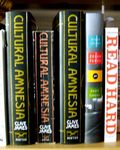 Now I can mark up my paper back copy with impunity (and save the new copy for show) and gift a copy for my older daughter who just celebrated a birthday.
In behalf of the MARTA book club, I also picked up Green Metropolis: Why Living Smaller, Living Closer and Driving Less Are the Keys to Sustainability by David Owen. (I liked his other books The Walls Around Us and My Usual Game, the latter I found at A Cappella's outside discount shelf). In Metropolis Owen describes Atlanta as a “city that has probably been the source of more bad transportation policy than any other city in America.” (I will be sure to shout “We're Number One !!! We're Number One !!!” the next time the train runs late.)
—– EXTENDED BODY: TITLE: Bookstore News: Near and Far #1 —–This is the first of a short series about bookstores of interest:
Eighth Day Books: Wichita, Kansas
I received a promotional email from one of my favorite book stores – Eighth Day Books in Wichita, Kansas, which I visited a couple of years ago (see here). Eighth Day has specialized in the classic books of art,  science and the humanities since 1988. Every year they publish a fantastic catalog (cover art shown) and if you contact them they will put you on their mailing list for next month's release. In the meantime you should visit their website and check out their blog, which contains information about their current Spring sale (15% off and free shipping thru Sunday, May 22) and has a link to Eighth Day owner Warren Farha's essay, “Why Bother with Books”
In Farha's essay, he begins with a few experiences of how he loved books as a youth (reinforcing the consensus that it is passion that is nurtured in the young). But Farha also draws on the works of Mark Bauerlein, Nicholas Carr and one of my favorite writers Neil Postman making a compelling argument about the pitfalls of reading books digitally. It reminds me of Marshall McLuhan who wrote in Understanding Media (1964) that how we process information (the format of the information) is as important as the content. Hence, the phrase the “Medium is the Message.”
Coincidentally, I am reading the book I bought at Eighth Day, 18 months ago – Donald Kagen's The Peloponnesian War, about the thirty years war between Sparta and Athens, which lasted from 431 to 404 BC. Admittedly it takes me time to get around to reading what I thought would be challenging book, but I've been pleasantly surprised how readable Kagen's history has been (the book is promoted as such). So far I've found it fascinating and relevant to our world today, especially when he writes about what qualities are necessary for a great leader. An erudite friend teased me that Kagen version was like drinking scotch with ginger ale, but my comeback was, “Well, if I were to drink Scotch, I'd probably have start with ginger ale.”
If I survive the Kagen book, I might hold the ginger ale and take a look at Landmark Thucydides : A Comprehensive Guide to the Peloponnesian War by: Robert B. Strassler, which has been highly recommended by Farha and my friend.
—– Eighth Day Books, Donald Kagen, Why Bother With Books, Mark Bauerlein, Nicholas Carr, Landmark Thucydides —– ——- TITLE: Instructions for Living: A Review DATE: 05/04/2011 07:52:13 AM —– Laurie Blauner's Instructions for Living, her third novel—or novella (a form better suited to our shortening attention spans) tells the story of Gabrielle, a young woman who manages to keep her life together while the world crumbles around her. Gabrielle stays at home with her dysfunctional mother and her dying father who suffers from MLS. One day, Gabrielle meets the one-armed Miguel, crushed gardenia in his shirt pocket, rifling through her trash looking for objects to make toys for his children. They shake hands, his large chafed hand engulfing hers. After Miguel leaves, Gabrielle remembers: “Later that night I could smell gardenias as I made my parents' dinner, as I swatted at flies. I stopped my housework and smelled. He was still with me.”
Normally, these kind of passionate books are not my favorites (see disclaimer at end). But what makes Blauner such a good writer is that she not only gets in the head of Gabrielle, but Gabrielle has these poetic sensibilities—mainly a heightened sense of observation and skill of using her words evocatively and economically. This comes as no surprise since the Seattle-based Blauner has published six books of poetry.
What also makes this book intriguing is the setting of the story. The narrative goes back and forth from two time periods: 1978 and 1998 (using the chapter titles Blauner gives the reader guidance – but you need to pay attention). The locale is an unknown country that is in the midst of a low-level civil war. There is sporadic violence in the streets, intermittent losses of electrical power, but the television blathers on with mindless entertainment. An evil urban guerrilla named Sharp harasses Gabrielle's father, who engaged in political activities before becoming ill. All in all, these are not times conducive to love, but Gabrielle and Miguel combine to give each other something they need.
That's a lot going on—love, politics, family— all in less than a hundred pages, but Blauner satisfies by ending the novella on a sweet note. It's a simple little book, well done.
To order Instructions for Living, visit the new release section of The Main Street Rag books. (I purchased my copy – which is printed on quality stock paper — but be careful, the "add to cart buttons" are not aligned with the books well).
—– EXTENDED BODY: Disclaimer: I've known Laurie Blauner personally for years. Not only is she is married to a longtime book shopping friend of mine, but we've been out book shopping together where she introduced me to the works of Michael Chabon and Amy Bloom. We both like Denis Johnson too. Moreover, this blog likes to champion writers such as Laurie who don't get the attention that they deserve. It's important for discriminating readers to seek out good writers, not just the ones on the bestseller lists or featured that morning on NPR. —– EXCERPT: —– KEYWORDS: Laurie Blauner, Instructions for Living, review, Main Street Rag Books, —– ——– AUTHOR: Murray Browne AUTHOR EMAIL: murray.browne905@gmail.com TITLE: Tayari Jones’ Question for Kathryn Stockett STATUS: Publish —– —– ——– TITLE: The Blue and the Gray Go Green
To commemorate last week's 150th anniversary of the firing on Fort Sumter and Earth Day, which is Friday April 22nd , I am recycling some recent postings about a few Civil War books. We take our Civil War just as serious as we do public transportation. Here they are:
- A review of Crossroads of Conflict, a comprehensive guide to the Civil War sites in located in Georgia.
- A review of This Republic of Suffering: Death and the American Civil War by Drew Gilpin Faust.
- Savannah Book Shopping. A look at some Civil War sites near Savannah and Tybee Island.
- Battle of Atlanta Coincidences. More about the Drew Gilpin Faust book and a trip down memory lane with Topps Civil War bubblegum cards.
And for those interested in living green, there's the MARTA Book Club (just scroll down).
—– . TITLE: The Gist of Thomas Lynch’s Reading in Atlanta DATE: 04/12/2011 07:56:34 AM —– 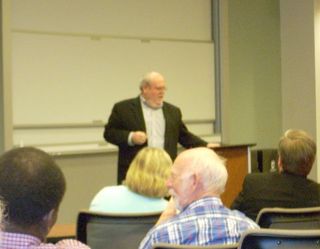 Where & When: A classroom in the Candler School of Theology on the campus of Emory University. Monday, April 11, 2011.
Attendance: ~100 people with about 20 note-taking Emory students.
Why I Went: I admire his book of essays The Undertaking: Life Studies from the Dismal Trade and he is credited for inspiring the HBO series Six Feet Under, which I also like, but there was no guest appearance from Alan Ball (Atlanta born, BTW).
What He Read: Two poems wrapped around an excerpt from Apparition and Late Fictions: A Novella and Other Stories (2010). Lynch described his reading strategy as “a root canal–thirty minutes and it's over.”
His Q & A: Surprisingly short. Lynch fielded only three or four questions. You could tell he had done this plenty of times before.
Question I Was Too Timid to Ask: Are you familiar with Ernest Becker's Denial of Death?
Did I Buy Something?: No, I already had a hard copy of the Undertaking, which I have gifted on more than one occasion. It's a great book and Lynch's appearance gave me a reason to revisit the book.
Worth Mentioning: Lynch did sing a few lines from the Beatles' Let It Be (part of the novella) which invites more comparison between Lynch and Garrison Keillor (see Lynch's website). I do think Lynch sings as “well as Keillor,” but what does that really mean?
TITLE: MARTA Book Club #13: Atlanta Reads DATE: 04/06/2011 10:29:02 PM —–
For those unfamiliar with the group, the MARTA Book Club is a loose— very loose— confederation of people who read while riding the Metropolitan Atlanta Rapid Transit Authority’s public transportation. There are no meeting times, no organizational rules, no t-shirts, and no special fares. Very convenient. The only requirement to be a member of MARTA Book Club is to read a book while riding public transportation.
Since we cannot determine the title of a book from an electronic reader they are not tabulated, but we have notice an increase in their use.
What We Are Reading: Either our data collection skills have improved or people just are reading more since our last posting. Here's the list:
Creative Community Builder's Handbook by Thomas C Borrup
Holidays on Ice by David Sedaris
The Velvet Rope by Brenda Thomas
The Girl with the Dragon Tattoo by Stieg Larsson (twice)
Law of Nines by Terry Goodkind (courtesy of Emily Britt)
The Rainmaker by John Grisham
The King of Torts by John Grisham
Life by Keith Richards and James Fox. Someone told me they picked a copy up of the Richards autobiography at Goodwill for a couple bucks.
The Freud Reader by Sigmund Freud and James Gay
The Warmth of Other Suns: The Epic Story of America's Great Migration by Isabell Wilkerson
The Devil in the White City: Murder, Magic and Madness at the Fair that Changed America by Erik Larson
Anthill by Edward O. Wilson
Liar's Poker by Michael Lewis
Utopia by Lincoln Child
Sex & Sensibility by ??? (unsure which author: but it's a popular catchy title)
In Between Men by San Culberson
Midnight's Children by Salman Rushdie (First book spotting for the Emory Writer in Residence)
Freedom by Jonathan Franzen
Hamlet's Blackberry A Practical Guide for Building a Good Life in the Digital Age
A Preacher's Passion by Lutisha Lovely (looked more interesting than what I was reading)
Snow by Orhan Pamuk. My contribution to the club this month. Good book from the Turkish Nobel Prize winner, but not much sex.
Hot to Touch by Kimberly Kay Terry (Again, more interesting than what I was reading.)
Tortured for Christ by Richard Wurmbrand
Still Guilty by Pat Simmons
Recipe for Love by Shamara Ray
The Inner Circle by T.C. Boyle
The Glorious Cause by Jeff Sharra
Underworld by Dom Delillo
The Glass Castle by Jeanette Walls
Liar's Club by Mary Karr
Catch 22 by Joesph Heller
Bridget Jones' Diary by Helen Fielding
—– EXTENDED BODY:
The Book Thief by Markus Zusak
Cider Beans, Wild Greens and Dandelion Jelly by Joan Aller
Sexy Forever: How to Fight Fat after Forty by Suzanne Somers and Michael Galitzer
Swan Thieves by Elizabeth Kostova
Persuasion by Jane Austen
A Thousand Splendid Suns by Khaled Hosseini
Ashes of Dreams by Ruth Ryan Langan
Confessions of an Economic Hit Man by John Perkins
The Glass Castle by Jeannette Walls
Battlefield of the Mind by Joyce Meyer
The Quickie by James Patterson and Michael Ledwidge
The Girl Who Played with Fire by Stieg Larsson
Destiny Kills by Keri Arthur
The Immortal Life of Henrietta Lacks by Rebecca Skloot
Run to Win: Vince Lombardi on Coaching and Leadership by Donald T. Phillips
Lord Carlton's Courtship by Debbie Raliegh
A Wizard of Earth and Sea by Ursula K. LeGuin
Books by Mary Higgins Clark, Sue Grafton, Frederick Forysth, Ashley Antionette, Susan Elizabeth Phillips, Neil Olson, Charlaine Harris, Austen Burroughs, Harlan Coben
What Members Thought About Each Book. Readers are encouraged to keep their thoughts (and eyes) to themselves. No time is wasted talking about books when you could be reading.
Next Assignment: Keep reading, get to work on time, watch for wet spots (of all kinds) and send us your book contributions and observations via comment.
P.S. MARTA Book Club in the News Like the Dew, A Journal of Southern Politics and Culture recently posted my essay entitled “Book Spotting.” The piece summarizes the thoughts on my informal monitoring of what people read while riding MARTA, the Metropolitan Atlanta Rapid Transit Authority.
—– EXCERPT: —– KEYWORDS: MARTA Book Club, book spotting, book spotting Atlanta, reading habits Atlanta —– TITLE: Sarah Vowell in Atlanta DATE: 03/29/2011 08:16:00 AM —–This week I am preparing for Sarah Vowell's upcoming visit to Atlanta. I have my reviewer's copy of her latest book about the Americanization of Hawaii, Unfamiliar Fishes. I saw Vowell when she was at the Carter Center two years ago promoting The Wordy Shipmates (read about it here) and am curious to compare the performances. She's part of the Savannah College of Art Design's (SCAD) Ivy Writers Series. The reading and signing is scheduled for Tuesday, April 5th at 6:30 p.m. at the SCAD Atlanta Events Space, 4th floor Building C., 1600 Peachtree St. NW. Check out the A Cappella Books website for details about getting a signed book.
For a taste of the book, check out this promotional video narrated by Vowell:
Also, I've never seen an event at the SCAD, and one of my blog goals this year to see authors in venues that I have not been to before. Though it maybe surprising to some, last month I made my first visit to Manuel's Tavern for Lang Whitaker's launch of the Bobby Cox book. Such dedication.
—– EXTENDED BODY: —– EXCERPT: —– KEYWORDS: Sarah Vowell Atlanta, SCAD Atlanta, Unfamiliar Fishes —– TITLE: Atlanta Vintage Books STATUS: Publish DATE: 03/21/2011 10:37:38 PM —–I finally made it over to Atlanta Vintage Books on Clairmont Road. Admittedly I only had a vague notion about the place, but since I was out doing a few errands (recycling, 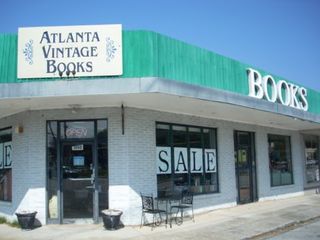
picking up shrimp at Crawfish Shack Seafood on Buford Highway), I stopped in. Shame on me for not going sooner because it is the kind of book store I like to browse at: plenty of fiction/literature, military history (they had two of Rick Atkinson's books from The Liberation Trilogy in tempting hardback) and a wide selection of books on various topics. You can wander from room to room and get easily lost in the stacks. (Good thing I hadn't picked up the shrimp first or the small herd of Atlanta Vintage Cats might have mauled me and left me in the book store basement.)
I found a Dick Cavett biography that I have long been interested in since I read about it briefly in Clive James' Cultural Amnesia: Necessary Memories from History and the Arts (2007). James refers to Cavett (1974) as “One of the best books about show business ever published, there is nothing quite like it…” Written by Dick Cavett and Christopher Porterfield, the book utilizes an interview format instead of a narrative one.
—– EXTENDED BODY:Since I had a Braves cap on, the owner Bob Roarty chatted me up about the Braves prospects for 2011 (little did he know about my recent obsession with Bobby Cox) and we talked books for awhile. Bob gave me a brief history of the store,which he and his wife Jan bought about five years ago from the previous owner. He also showed me his signed, limited-number, first edition of James Joyce's Finnegan's Wake. (Joyce has nice handwriting, by the way.)
One other noteworthy aspect of Atlanta Vintage Books is that it is open on Sunday afternoons, which is not always the case with many used or independent bookstores.
Other Local Book Biz Notes. Glad to hear that Tall Tales Book Shop in Toco Hills is keeping its doors open. There was confusion that the owner Marlene Zeiler was going to retire and sell the store, but she has since reconsidered her decision. In her email-newsletter she wrote, “ I am forging ahead and buying for the Spring. So Tall Tales is alive and well and marching into the future.” Tall Tales is another good local book shop with a helpful, friendly staff, which is also open on Sunday.
—– EXCERPT: —– KEYWORDS: Atlanta Vintage Books, Bob Roarty, Dick Cavett, Tall Tales Book Shop —– ——– TITLE: Who Doesn’t Miss Bobby Cox? DATE: 03/13/2011 11:19:26 AM —–Like Lang Whitaker, author of In the Time of Bobby Cox: The Atlanta Braves, Their Manager, My Couch, Two Decades and Me, I too, think about Cox's legacy, but not nearly to the degree of Whitaker who has 
written a book about it. On my way home last week, I stopped by Manuel's Tavern in the Highlands for a beer and an opportunity to ask Whitaker, who was there signing his book, my burning question: “Can you think of five players who didn't like playing for Bobby Cox?” I based my question on the assumption that you couldn't be a manager—even a player's manager—and not have some players dislike you.
But this wasn't your normal reading, as a matter of fact, there was no reading or question and answer session at all. It was more like a baseball card signing show, where you buy something and have it signed, just to ask a question (an expensive but fair exchange). This is not a complaint—I often think book readings should just cut to the chase of signing books where members of the audience can get a book signed and ask their question. Since I just bought a Roger Angell's book Late Innings the other day and since Whitaker was swarmed with well wishers (and autograph hounds?), I opted for a Yuengling draft and a chat with Frank Reiss, the owner of A Cappella books, who was managing the signing that evening.
Since I've been in Atlanta, Frank has introduced me to several fine books Nami Mun's Miles from Nowhere and two books by Padgett Powell, Edisto and The Interrogative Mood (though we still differ about a couple books ). Frank highly recommends Emory University professor Joseph Skibell's recent book A Curable Romantick and if he'd had a copy there I might have bought it and had Whitaker sign that.
Our conversation shifted to baseball so I asked Frank, a longtime fan of the Braves which former players were not saddened by Cox's retirement. Without explanation, Frank understood my question and replied that “word on the street has it” (Frank knows a few local sports writers) that if anybody was glad to see Cox retiring it would have been the long relievers. The Atlanta skipper was notorious for his belief that long relievers were expendable. To Cox, they were arms to chew up innings, if need be.
—– EXTENDED BODY: I confessed to Frank that I had prepared my list of players who may have disliked Cox—just in case. It's like taking your mitt to the game. My list? Kenshin Kawakami (now the highest paid long reliever in the majors), Kenny Lofton, Deion Sanders, Yunel Escobar and Dave Stieb, a talented but high-strung pitcher for the Toronto Blue Jays in the 1980s, where Cox managed between his stints in Atlanta.
It turned into one of those evenings that resembled sitting in the stands at a game—drinking a beer, swapping stories and paying attention to what is going on, just enough to catch any foul balls that came my way.
—– EXCERPT: —– KEYWORDS: Lang Whitaker, In the Time of Bobby Cox: The Atlanta Braves, Their Manager, My Couch, Two Decades and Me, Bobby, Frank Reiss, A Cappella Books, Nami Mun, A Curable Romantick, Joseph Skibell —– COMMENT: AUTHOR: Merchant cash Advance EMAIL: leonardo-negrete@zoho.com IP: 198.143.143.58 URL: http://merchantcashadvance1x24x5.postbit.com/some-interesting-truth-about-merchant-cash-advances.html DATE: 09/13/2013 01:17:24 AM Hmm is anyone else encountering problems with the images on this blog loading? I’m trying to determine if its a problem on my end or if it’s the blog. Any responses would be greatly appreciated. —– TITLE: Book Spotting: An Essay UNIQUE URL: https://thebookshopper.typepad.com/the_book_shopper_atlantad/2011/03/book-spotting-an-essay.html DATE: 03/02/2011 07:59:33 AM —–  Like the Dew, A Journal of Southern Politics and Culture recently posted my essay entitled “Book Spotting.” The piece summarizes the thoughts on my informal monitoring of what people read while riding MARTA, the Metropolitan Atlanta Rapid Transit Authority. For those visiting this site from Like the Dew, details about the MARTA Book Club can be found here or by just scrolling down through the blog.
The unusual photograph that graces this posting was not taken at a MARTA station, but comes from renown sculptor and photographer Gabriel Orozco. Notice how the wall is stained from the heads of people who have sat waiting and waiting for something important — like a train. I hope they had something good to read.
—– TITLE Shields on Writers (circa 1996) DATE: 02/23/2011 07:32:38 AM —–I have just finished reading Remote: Reflections on Life in the Shadow of Celebrity (1996), David Shields “collection” of essays, anecdotes, bumper sticker compilations, advertisements and photos that examine how celebrity culture manifests itself in our daily lives. I cannot begin to explain this unruly book– I just read it, enjoyed it, and am now just appropriating it to my own needs, which I believe, Shields advocates in his more recent well-known work, Reality Hunger: A Manifesto (2010).
Here's a few quotes about writers worth sharing from the chapter entitled “Always:”
“American writers residing in and writing about the tri-state area are always understood to be adumbrating a universal spiritual condition, whereas writers residing in the other forty-seven states are always congratulated for being gifted regionalists. Writers always say, “Show Don't Tell.” Writers always say they don't read their own reviews. Forced by social circumstance to praise novels they haven't read always say they are `wonderfully evocative.'… Writers who complain most vociferously about the way their work has been pigeonholed because of a particular personal attribute—their race, say, or sexual orientation, or even their physical beauty—are always the writers whose work (the reception to whose work) has most directly benefited from this attribute…Writers who are most eloquent on the subject of the death of the novel are always writers who were once mildly popular and no longer read.” (p. 67-68; italics mine)
The irony about Remote is that I found this book just trolling though the aisles at Books Again here in Decatur and picked it up on a whim. The book is autographed no less, so I ask myself does that change my relationship with the book, with Shields, or the guy known as John, who Shields originally inscribed “best wishes” on the title page fifteen years ago?
(Also in the spirit of appropriation, this week's artwork comes from his website, which I also borrowed because I thought it was great use of a bald head.)
—– EXTENDED BODY: —– EXCERPT: —– KEYWORDS: —– TITLE: MARTA Book Club #12: Tunnel of Readers ALLOW PINGS: 1 BASENAME: marta-book-club-12-tunnel-of-readers DATE: 02/13/2011 12:11:47 PM —– BODY:
 For those unfamiliar with the group, the MARTA Book Club is a loose— very loose— confederation of people who read while riding the Metropolitan Atlanta Rapid Transit Authority’s public transportation. There are no meeting times, no organizational rules, no t-shirts, and no special fares. Very convenient. The only requirement to be a member of MARTA Book Club is to read a book while riding public transportation.
(Note: The Huffington Post recently posted a similar book spotting piece. See it here. And if you're visiting from Huffington, thumb through this blog you'll see we've been posting Atlanta's offerings the past year.)
What We Are Reading: Either our data collection skills (the furtive glance) have diminished or people just aren't reading as much since last month's posting, but MARTA book club offerings are a little thin this month.
Mockingjay by Suzanne Collins
Testimony: A Novel by Anita Shreve
CPT 2009 Standard Edition (CPT/ Current Procedural Terminology) by the American Medical Association. (The woman was carrying two volumes of these phone-book sized reference tomes.)
The Bible. A standard for the MARTA faithful
KnockOut by Catherine Coulter
Haunted Pensacola by Alan Brown
Miles from Nowhere by Nami Mun. This is my contribution this month to the book club. Frank Reiss from ACappella Books brought Mun to Atlanta a couple years ago. I didn't go then, but later in the year I met her briefly at a book event in Cleveland where I picked up a copy of Miles. I finally got around to reading this novel about the life of a Korean-American teenager who lives on the streets in the Bronx in the 1980s. Not the cheeriest of subject matter. I felt Mun's gritty portrayal of the mindset of the people who flip in and out from life on the street and squatting in abandoned buildings to finding a way for a better life (“ a mailbox and a toaster” ) was authentic and worth reading. It is an especially relevant book for regular MARTA riders who see the homeless on a daily basis.
Tunnel People by Tuen Voeten. Similiarly, I saw a man at Five Points reading this book. It appears to be a fascinating book. Check out the details here.
Babylon Revisited And Other Stories (2 Volumes) by F. Scott Fitzgerald
Blue Helmets and Black Markets: The Business of Survival in the Siege of Sarajevo by Peter Andreas
Whistling Dixie: Dispatches from the South by John Shelton Reed
—– EXTENDED BODY: Every Last One: A Novel by Anna Quindlen
Naked Cruelty by Colleen McCullough
Southern Lights: A Novel by Danielle Steele
Novels by Sister Souljah, Terry McMillan
What members thought: Readers are encouraged to keep their thoughts (and eyes) to themselves. No time is wasted talking about books when you could be reading.
Next assignment: Keep reading, and get to work on time. If you have anything you'd like to add please add it to the comments. (It is strictly an honor system.)
—– EXCERPT: —– KEYWORDS: Tunnel People, MARTA book club, Nami Mun, Huffington Post, book spotting, reading in public —– ——– TITLE: Crossroads of Conflict: A Review DATE: 02/07/2011 10:08:17 PM —–To mark the beginning of the Civil War sesquicentennial commemoration, almost hundred buffs came out on a chilly night last month to hear Barry L. Brown and Gordon R. Elwell at the Decatur Public Library introduce their book Crossroads of Conflict: A Guide to Civil War Sites in Georgia. It was a seasoned crowd who has been going to the Cyclorama since they were kids, (Elwell made a solo bus trip from Orlando when he 11 years old to see the large oil painting) and an audience who knows the real story on whether Confederate President Jefferson Davis was wearing his wife's dress when the Federal cavalry captured him near Irwinville, Georgia on May 10, 1865. (Davis was wearing Mrs. Davis' shawl.)
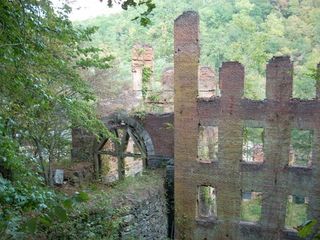 Published last fall by the University of Georgia Press, in association with the Georgia Civil War Commission, the Georgia Department of Economic Development, and the Georgia Humanities Council, Crossroads of Conflict is a comprehensive guide to the battlefields, markers, houses, relief maps, monuments, statues, museums, mills (mill ruins at Sweetwater Creek shown here), churches, depots, cemeteries, bridges, forts, parks, visitor centers, ferries, courthouses, capitols, prison sites, campsites, trenches, plantations, archives, arsenals, and lighthouses located in Georgia. All is all, 350 sites are included in the book, an increase from the last compilation, which listed 150 sites.
What is impressive is that Brown and Elwell's expansion of Crossroads' scope means the book covers more than just generals and campaigns. For example, they include the site where Atlanta barber and freed black, Solomon Luckie, died from injuries when a Union shell landed near him in July, 1864. (Luckie Street was named after him.) Another story, which Brown and Elwell told at their presentation, features Theophile Roche, a French national and mill owner in Roswell who tried to declare neutrality by hoisting a French flag as the Federal cavalry approached his mill. (Nice try, but to no avail as the Yankees torched the mill anyway.)
Book Organization
The sites are divided by the nine tourism regions of Georgia where individual sites and towns are grouped together geographically. For example, the Historic High Country region features the battlefield at Resaca (which has recently been expanded), and the surrounding areas of interest: the Duncan Norton House, the Resaca Confederate Cemetery and the Oostanaula River Bridge.
—– EXTENDED BODY:This organization takes a little getting used to (though a detailed index and table of contents helps), but the strategy does make sense because if you are traveling to see a battlefield, you certainly want to know which related areas of interest are close by. Brown and Elwell envision people putting this book in their car seat as they drive the roads of Georgia during the Civil War sesquicentennial (GPS coordinates and street addresses are included). If that is the case, sightseers need to bring an atlas as well as the maps in this book were not intended to be used as road maps.
Even if you don't plan on driving around Georgia anytime soon, this book is enjoyable just to thumb through with its many photos and paintings. However, the artwork is not so overwhelming that you don't want to see these places for yourself. The artwork piques your interest without crushing it.
Crossroads is an important catalog of a pivotal time in Georgia and our nation's history. Hats off to all those who played a part in creating this impressive work that combines scholarship, tourism, and some old-fashioned storytelling.
Disclosure: UGA press graciously provided me a reviewer's copy upon my request. And for more information about my own Civil War buff credentials, visit here.
—– EXCERPT: —– KEYWORDS: Crossroads of Conflict, Crossroads of Conflict a Guide to Civil War sites in Georgia, Georgia Civil War sites, Barry Brown, Gordon Elwell, UGA Press —– TITLE: An Updike Baseball Keeper DATE: 01/30/2011 10:41:12 AM —–After finishing reading a tattered copy of a Walker Percy book (see last posting), I shifted 180 degrees and switched to a recently purchased copy of John Updike's account of Hall of Fame slugger Ted Williams' final game at Fenway Park in Boston.
Published last year, Hub Fans Bid Kid Adieu is a re-issue of an essay that John Updike wrote for the New Yorker in October, 1960 a few weeks after witnessing Williams' exit from baseball. Less than fifty pages long, Updike's writing is superb and worthy of all the praise from notable sportswriters such as Roger Angell and Peter Gammons that grace the back dust jacket.
What struck me about this slender $15 book, which you can read entirely over your Saturday morning coffee, is how physically wonderful it is to hold. Designed by Chip Kidd, the book jacket is shiny with the title hologram over the picture of Williams and the subtitle, “John Updike On Ted Williams.”
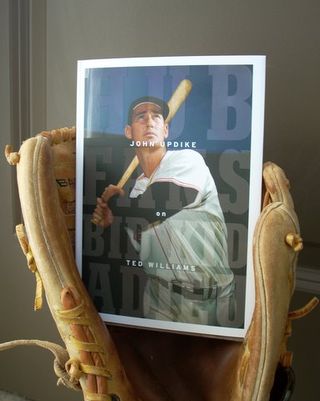 The inside art (known as the endpapers) has a reprint of Updike typewritten manuscript complete with edits and minor changes. If you remove the jacket, you'll see a second cover – a sepia tinged, black and white photo of Ted Williams' perfect swing, which Updike describes as “a grand motion, never a lunge or a hasty fending, with a graceful follow-through that left his body yearning toward first base.”
I almost decided not to include my pathetic photograph with this posting, because it doesn't do the look and feel of this book justice (and baseball is a tactile sport: the leather of the mitt, the red stitches of the baseball, the grip of the bat….) Stop by your local bookstore ( I picked up my copy at Blue Elephant) and check it out. Hold it in your hand. Can you resist taking it home?
—– EXTENDED BODY: And don't balk about the price, as the proceeds of the book go to The Library of America, which according to their website uses :
-
Notch binding (much stronger than the adhesive binding used by most trade publishers)
-
The same flex-board used for volumes in the series, covered with either a vibrantly colored cloth or printed four-color sheets that have been strengthened by a recently developed double lamination (nearly all such books issued by other publishers are laminated only once)
-
Premium-grade, acid-free, smooth-finish paper that meets the requirements for permanence set by the American National Standards Institute
Aren't you sorry you bought your Kindle?
—– EXCERPT: —– KEYWORDS: John Updike, Ted Williams, Hub Fans Bid Kid Adieu, —– ——– TITLE: Revisiting Walker Percy Thru Emory DATE: 01/23/2011 11:32:56 AM —–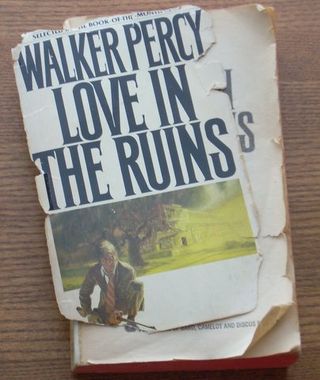 Sometimes what we choose to read at a particular time comes from the unlikeliest sources. Case in point, I'm finishing up a read of Walker Percy's 1971 apocalyptic, satirical novel, Love in the Ruins: The Adventures of a Bad Catholic at a Time Near the End of the World. Though I am already familiar with Percy's work (The Moviegoer, Lancelot and Lost in the Cosmos: The Last Self Help Book) what motivated me to dig up my disintegrating paperback copy (shown) is that the Emory Center for Lifelong Learning is offering a six week course on the book beginning on February 10th (See here for details). The course catalog arrived in the mail last month.
If I had the time and money I'd take the course, but I will have to be content in just reading the book and looking over some sources already at my disposal. Here's a few things I like about Percy and his work:
-
Percy (1916-1990) did not publish his first book until he was 45 years old and it (The Moviegoer) won the National Book Award, which gives hope to any writer in their 40s who hasn't published yet.
-
Percy was responsible for bringing John Kennedy Toole's A Confederacy of Dunces to print after Toole had died. Again, reinforcing the romantic notion that unpublished writers may eventually get their material published – – even if it is posthumously,.
-
Percy's fiction is ( in his own words), “a philosophical conviction with novelistic art," which means the narrators speak intellectually over social issues. (In Ruins, a troubled physician Thomas More — named after the 16th century lawyer and philosopher opines about race relations (in language that readers must put in the proper context), the death of the Auto Age, American imperialism, and religion.
-
Percy's narrator reminds me a lot of Richard Ford's narrator Frank Bascombe of Independence Day and The Lay of the Land, two of my favorite books.
-
Percy is worthy of an entry in David Thomson's The New Biographical Dictionary of Film. Thomson writes, “The movies owe much to novelists. Dickens, Conan Doyle, Graham Greene, Raymond Chandler, Mario Puzo to name some notable examples, have provided inspiration, direction, material. Moviegoing owes a similar debt to just one novelist. Percy's first and best novel, The Moviegoer…”
Just a few tidbits to take to class with you if you sign up. Please take good notes and pass them on.
—- —– —– KEYWORDS: Walker Percy, Center for Lifelong Learning, David Thomson, New Biographical Dictionary of Film, Love in the Ruins, The Moviegoer, —– TITLE: MARTA Book Club #11: The Warmth of Reading UNIQUE URL: https://thebookshopper.typepad.com/the_book_shopper_atlantad/2011/01/marta-book-club-11-the-warmth-of-reading.html DATE: 01/16/2011 11:13:44 AM —–
It’s been a strange turn of events since the last compilation of the MARTA Book Club — the loose confederation of people who read while riding Metropolitan Atlanta Rapid Transit Authority’s public transportation. Opportunities for book reading may been curtailed over the holidays, but last week–because of the Winter Storm of 2011–we saw quite an influx of new riders and new club members (remember the only requirement to be in the club is to read a book while riding public transportation).
 Even though the trains ran throughout the week (albeit on the weekend "schedule," which means only three stops at unspecified times per hour for some routes) it wasn’t until Wednesday that I left home and returned to the rails myself. At that point, I’d seen enough winter suffering on television, especially those pitiful sleep-deprived weather reporters assigned to the frozen guardrails at Spaghetti Junction, while the warm studio anchors quipped endlessly at the Jackass-worthy photos and video that viewers at home so generously provided.
Despite the perilous conditions, I was ready to return to the warmth of the MARTA book club (ice removal at the stations consisted mainly of yellow caution cones and conductors warning us not to fall on our collective asses), if for no other reason than to find out what books people got for Christmas.
What We Are Reading. Here’s a list of what we’ve been reading since the last posting:
The Pecan Orchard: Journey of a Sharecropper's Daughter by Peggy Vonsherie Allen
Beach Music by Pat Conroy (two spottings)
Art by Committee: A Guide to Advanced Improvisation by Charna Halpern and Adam McKay
Eat Pray Love by Elizabeth Gilbert
Guns, Germs, and Steel: The Fates of Human Societies by Jared Diamond
Black Postcards: A Memoir by Dean Wareham
Double Pleasure, Double Pain by Nikki Rashan (a steamy cover for a cold commute…)
The World is Flat by Thomas Friedman
The Last Templar by Raymond Khoury
Arthur & George by Julian Barnes
Lacuna by Barbara Kingsolver
Blink by Malcolm Gladwell
Homeboyz by Alan Lawrence Sitomer
Battlestar Galactica and Philosophy by Josef Steiff and Tristan D. Tamplin
Total Eclipse of the Heart: A Novel by Zane (just one name)
The Other Wes Moore: One Name, Two Fates by Wes Moore
The Mis-Education of the Negro by Carter Godwin Woodson
Plainsong by Kent Haruf
The Apocalypse Watch by Robert Ludlum
The Fountainhead by Ayn Rand (submitted by Emily Britt)
My contribution is Tree of Smoke by Denis Johnson. which I finally finished. As I mentioned in an earlier posting, Johnson’s lengthy novel is a combination of the movie Apocalypse Now (because a renegade colonel who becomes a threat to the U.S. military), the novel From Here to Eternity (because it provides a background stories on the soldiers who were anxious to leave their wretched lives in the States) and Tim O’Brien’s The Things They Carried (doesn’t forget about the grunts in front lines, except there was no front in Vietnam.). Well written, but wide in scope with lots of characters which can make it challenging at times. I saw used hardback edition the novel at Eagle Eye Books yesterday.
Run with the Horsemen by Ferrol Sams
Cutting for Stone by Abraham Verghese
The 48 Laws of Power by Robert Greene (I thought there were 49)
The Help by Kathyrn Stockett
Liar’s Poker by Michael Lewis
Too Much Happiness: Stories by Alice Munro
The Botany of Desire: A Plant's-Eye View of the World by Michael Pollan
Novels by Janet Evanovich, Mary Janice Davidson, E. Lynn Harris, Sandra Brown, Mary Higgins Clark, Dennis Lehane, Sandra Brown, Nevada Barr, F. Scott Fitzgerald, Clive Cussler, Ted Bell
What Members Thought About Each Book. Readers are encouraged to keep their thoughts (and eyes) to themselves. No time is wasted talking about books when you could be reading.
Next Assignment: Keep reading, get to work on time, and send us your book contributions and observations via comment. (It’s strictly an honor system.)
—– EXCERPT: —– KEYWORDS: Reading in public, MARTA Book Club, MARTA Book club, book clubs Atlanta, Denis Johnson, Tree of Smoke, —– —– Cp> TITLE: Brian Dettmer’s Exhibit at Saltworks Gallery DATE: 01/08/2011 12:10:51 PM —–
Don’t despair if you didn’t see the Salvador Dali exhibit at the High Museum before it left town. (If it makes you feel any better, I rated the Dali exhibit up there with the Leonardo Da Vinci “doodles” from the previous year, but I am no critic— strictly a poseur, and not a very good one at that.)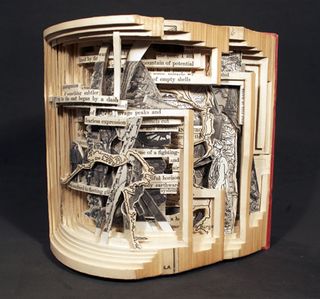 But if you are interested in books as art objects or more specifically sculpture, there is still time for you to see Brian Dettmer’s New Worlds to Conquer exhibit at the Saltworks Gallery (located near the west side Six Feet Under). The exhibit closes Saturday, January 15th.
Dettmer, who lives here in Atlanta, takes hard-cover books—older books with elaborate illustrations (e.g. Military Preventative Medicine, Encyclopedias of World Travel)—and carves through them page by page, pulling out words and pictures from the book. This creates a stunning visual and reminds us how the richness of books can convey new meanings beyond just reading them. A better description and interpretation of Dettmer’s work and technique can be found at the Art Critic Atlanta website.
Shown here is Dettmer’s carving of the book, The War on All Fronts (photo courtesy of Brian Dettmer and the Saltworks Gallery), but photos really don’t do the work justice. As mentioned earlier, it’s the perfect exhibit for those who like books and for those who don’t like books—I guess it can be one of those 101 Uses for a Dead Cat type of experiences.
Admittedly I am not easy to shop for when it comes to books for Christmas and only the brave even make an attempt. Nevertheless, knowing of my interest in essays as a writing form, my older daughter Cynthia scouted out numerous books before selecting G. Douglas Atkins’ Tracing the Essay: Through Experience to Truth (2005) published by the University of Georgia Press, which I have already started reading. (I hope my study of the book results in a noticeable improvement in my writing.)
 My younger daughter Bonnie took a different approach. As the creator of the pedestrian book bag, she designed and made a decorative plate featuring the muted horn symbol from Thomas Pynchon’s 1966 novel The Crying of Lot 49. Bonnie had read the book in college, understands the significance of the symbol (she even used a sgraffito decorating technique) and knows that I have a goal of someday starting a local Thomas Pynchon book club. (A New Year’s Resolution? I think not.) During our holiday get together, I used the plate to serve hors d’oeuvres along with my opinions about Pynchon.
Before saying farewell to 2010, it’s time to recognize the “Best Local Reading of the Year"  or more specifically, the “Best Local Reading of the Year That I Attended,” which does narrow the field considerably. My rating criteria are rather simple and subjective:
- Did I learn something that otherwise I would not have learned even if I read the book?
- Did the author and the audience seem to engage with each other?
- Did I come away with a little buzz (or buy the book) after the reading?
Some of this year’s candidates include well known authors such as Deborah Blum, Jonathan Franzen, Thomas Mullen, Nicky Hornby, and first timers Thomas Chatterton Williams and Grant Jerkins. When you think about it is not much of a list for a blog that “muses about book-related events, but what can I say? I try to get out to some literary event at least once a month.
This year’s Best Local Reading of 2010 That I Attended goes to the four poets who read from the University of Georgia Press anthology Seriously Funny: Poems About Love, Death, Religion, Arts, Sex and Everything Else during the Decatur Book Festival. The poets were: Kevin Young of Emory University, Georgia Poet Laureate David Bottoms, Georgia Tech’s Thomas Lux and Florida State’s David Kirby. (Unfortunately Barbara Hamby who is the co-editor of the Seriously Funny along with Kirby could not attend because of the death of her mother.) For over an hour they entertained with humor, but the book’s offerings are not limited to just a few yucks, but the spectrum of the human condition. Each of the poets had a flair of performance (especially the theatrical Lux ) and I can still remember Kevin Young reading his own poem, “Ode to Pork,” (the first poem he wrote, Young said, after the death of his father), and Kirby reciting Jim Daniel’s poem, “Outdoor Chef” about a high school barbecuing class. Having great material to work with always helps.
That sounds a labor of love for them (but still a labor), but fortunately for us, we get it all in one book.
Previous Winners
Admittedly, I forgot to award a 2009 winner, but that should have gone to the late E. Lynn Harris for his reading at the Decatur Public Library in February, 2009. You can read about that experience here. The 2008 winner was The New York Times perfume critic Chandler Burr for his one of a kind “scratch-n-sniff” reading.
Unlike other “best” book lists, my criteria for excellence is somewhat different. To make the list requires a combination  of value (how much I paid for the book) and good reading. Whether the book was published in 2010 is of little significance to me as I am a person who likes to think of himself as immune to book hype (purposely avoiding this year’s darlings Jonathan Franzen, Patti Smith, Sarah Palin) while preferring to shop for books at used bookstores, independent book stores, book festivals, church sales and even online (gasp!). I crave the process. Here’s my list of most notable finds:
Detective Story (2008) by Imre Kertesz. I picked up a hardback copy of this small novel from the Nobel  Prize winner at Raven Used Books in Cambridge for $5 while I was visiting my daughter in Boston. I thought his earlier Fateless, was a fantastic book and this one did not disappoint. Without graphic details, Kertesz captures the terror of living in a totalitarian state and the subtle ways that those who commit tortuous acts can justify their actions.
State by State: A Panoramic Portrait of America (2008) edited Matt Weiland and Sean Wilsey. I continue to use this collection of 50 writers writing about 50 states for my bedtime book (requirements: short chapters, not too demanding). Some marketing book publicist gave me a complimentary copy at a book fair in 2009. There is an unevenness to the essays as you would expect, but Louise Erdich (on North Dakota), Ha Jin (on Georgia), Jhumpa Lahiri (on Rhode Island) Jack Hitt (on South Carolina – specifically Charleston), Joshua Harris (on Florida), and Susan Orlean (on Ohio) were either insightful or entertaining and it’s a great travel guide to new writers before venturing into the Land of Nod.
Wanderlust: A History of Walking (2000) by Rebecca Solnit. A fascinating look at the history of foot travel from early times to present day (it even answers the question: Which came first? Learning to walk upright which developed our brains or is it vice versa?) If you like to walk or think, this book is for you. I paid full price at the Harvard Book Store and was not sorry in the least and as I have already purchased two copies for those on my Christmas List.
Sag Harbor (2009) by Colson Whitehead. I was always a little pissed at myself for missing him at SCAD last year, but reading this novel has made it up for it. Set in 1985, Whitehead writes with great energy about being a black teenager and trekking out from the city every summer to join his buddies on Long Island. It’s mostly about being a kid and growing into a young man and figuring out how to fit in. My friend Denise bought this book discounted through the Better World Books as part of the Better World — Whole Foods book club (a book club that is similar to the MARTA book club in name only). I liked the book better than she did. More of a guys book of serious fiction, if there is such a thing.
—– EXTENDED BODY:This Republic of Suffering: Death and the American Civil War by Drew Gilpin Faust. My Knoxville book friend Maggie recommended this one as did my book friend Bruce in Wichita. A perfect book for the Civil War buff who thinks he knows everything. Expect to be flummoxed by her unique approach to the war as she examines how the overwhelming, unprecedented carnage of the war changed society’s views on death and honoring those who died. I picked up an additional hardback copy at the Decatur Book Festival for ten bucks.
Chronic City (2009) by Jonathan Lethem. Denise gave me a copy last year for Christmas (can’t beat that price) and it has been a book I continue thinking about — meriting a possible reread. I shared some thoughts about this novel on Rube Ambler’s Atlalist blog. Rube is one of the few people around willing to collaborate blog-wise, which I think makes for a richer cultural scene.
The Empire of Illusion: The End of Literacy and The Triumph of Spectacle by Chris Hedges. The folks at Emory University’s Michael C. Carlos Museum Bookshop knew I was interested in this 2009 Pulitzer Prize Winner and found me a discounted hard back copy, which I was glad to have. This sobering book on our dying culture attacks reality television, the pornography industry, academia and the Wall St. corporate mentality responsible for our latest economic troubles. Nevertheless, we are all responsible for the rise of spectacle, if we fail to examine ourselves and the world around us.
Tree of Smoke by Denis Johnson. I zoned out while shopping at Book Nook on North Druid Hills, and thought I was purchasing Johnson’s crime noir, Nobody Move, but instead I was buying his 2007 National Book Award epic book about Vietnam. I am halfway through Tree of Smoke and even if I don’t finish it (highly unlikely) it’s been a great bargain for the fiver I paid for it. I tell people it’s a combination of the film Apocalpyse Now, the book version of From Here to Eternity and Tim O’Brien’s classic The Things They Carried.
The Cleveland Indian: The Legend of King Saturday by Luke Salisbury. My book shopper friend Dave from Seattle sent me this 1992 book in a package of suggested reading last year and I finally got around to reading it. Set near the turn of the 20th century, Salisbury gives a fictionalized account of Louis Sockalexis, a Penobscot Indian who dominated the baseball with his physical prowess, but remained an enigma to those closest to him.
21 Dog Years: Doing Time @ Amazon.com by Mike Daisey. One of the top theatre experiences I’ve been to in Atlanta was Mike Daisey‘s, performing his latest monologue The Last Cargo Cult at the Alliance Theatre earlier this spring. A colleague at work let me borrow a copy of 21 Dog Years, so I could partially relive the Daisey experience. Not a bad book, but not a substitute for seeing Daisey live.
To visit last year's list, see here.
—– —– KEYWORDS: Southern Foodways Alliance, David Tanis, Atlanta —– TITLE: MARTA Book Club #10: The Pedestrian Book Bag CATEGORY: MARTA Book Club DATE: 11/11/2010 08:00:25 AM —–
Here at the MARTA Book Club—a loose confederation of people who read while riding the Metropolitan Atlanta Rapid Transit Authority’s public transportation— we are not limited to just filling our heads with book learning. The MARTA book club is now designing fashion accessories. Behold the Pedestrian Book Bag, which made its debut on the streets and trains of Atlanta this week.
 Designed by BonnyBeeDesigns, the Pedestrian Book Bag is a lightweight, waterproof, single strap, over-the-shoulder, ripstop nylon bag with a reinforced bottom. The designer (my daughter) actually consulted a real urban commuter before sewing the prototype bag (shown here) and she has provided instructions on how to make one for yourself on her blog. The long thick strap won’t cut into your shoulder and it frees your hands for reading if you are forced to stand up while riding on the train (which happens more frequently after the fall budget cuts). A light zipper on the top keeps your book and lunch from spilling onto the train floor during sudden stops. The orange reflective material makes it easier for motorists to see pedestrians during the evening commute especially with the earlier onset of darkness.
The slogan “Thanks! for not running me over” can be interpreted two ways: 1.) As a thank you to the motorist who does slow down and respect the pedestrian’s right of way or 2.) As a brusque, sarcastic reminder to the motorist that does not slow down when a pedestrian exercises the right of way. For the illiterate driver, a pictograph has been included to explain the gist of the message.
What We Are Reading: For those unfamiliar with the group, the MARTA Book Club is more than a group of well-read fashionistas. There may be no meeting times, no organizational rules, and no special fares, but we are greater than the sum of our parts. Here’s a new list of what people are reading on the MARTA since our last posting:
Getting to Happy by Terry McMillan
Extreme Danger by Shannon McKenna
Darkly Dreaming Dexter by Jeff Lindsay
Lamb by Christopher Moore (as reported by Emily Britt)
Island Beneath the Sea: A Novel by Isabel Allende
Lover Man by Geneva Holliday. This month’s steamiest cover
Double Pleasure, Double Pain by Nikki Rashan A close second to this month’s steamiest cover sweepstakes.
The World Is Flat: A Brief History of the Twenty-first Century by Thomas L. Friedman
Lie by Midnight by Amanda Quick
Next by Michael Crichton
—– EXTENDED BODY:Naked by David Sedaris
Having Our Say: The Delany Sisters' First 100 Years by Sarah L. Delany, A. Elizabeth Delany, and Amy Hill Hearth
Divine Misdemeanors: A Novel by Laurell K. Hamilton
Cruel Shoes by Steve Martin
Secret Source: The Law of Attraction Is One of Seven Ancient Hermetic Laws: Here Are the Other Six by Maja D'aoust and Adam Parfrey
Surgical Technology for the Surgical Technologist: A Positive Care Approach, AST
Twilight by Stephenie Meyer
Ted Turner: A Biography by Michael O'Connor
Becoming a Helper by Marianne Schneider Corey and Gerald Corey
Ranger's Apprentice, Book 9: Halt's Peril by John Flanagan
Shattered by Karen Robards
Lenin's Tomb: The Last Days of the Soviet Empire by David Remnick
Who Moved My Cheese?: An Amazing Way to Deal with Change in Your Work and in Your Life by Spencer Johnson and Kenneth Blanchard
Dead Aid: Destroying the Biggest Global Myth of Our Time by Dambisa Moyo
The Book Thief by Markus Zusak
A Very Simple Crime by Grant Jerkins. This book was my contribution. For more about this steamy crime novel see the previous posting.
Theories of Personality: Understanding Persons by Susan C. Cloninger
Shadow Tag: A Novel by Louise Erdrich
The Angelic Darkness: A Novel by Richard Zimler
Casanegra: A Tennyson Hardwick Novel (A Tennyson Hardwick Story) by Blair Underwood, Steven Barnes, and Tananarive Due
Books by Stephanie Meyer, Dan Brown, Agatha Christie, Mary Jane Davidson, F. Scott Fitzgerald, Homer Hickman, Graphic novels by Scott Pilgrim
What members thought about each book: Readers are encouraged to keep their thoughts (and eyes) to themselves. No time is wasted talking about books when you could be reading.
Next assignment: Keep reading, and get to work on time
—– EXCERPT: —– TITLE: Nick Hornby at the Highland Inn DATE: 10/19/2010 10:21:31 PM —–

 Novelist, essayist and now song lyricist Nick Hornby was in Atlanta promoting the paperback release of his latest novel Juliet, Naked and his current work with singer/musician Ben Folds on the release of Lonely Avenue, a collaborative album of short stories. Hornby’s reading on Monday, October 18 was the kickoff event for the A Cappella Books’ Ballroom Bash.
Hornby read three excerpts from Juliet, Naked for about 40 minutes, before taking questions from the packed house for another half hour. The crowd wasn’t shy about asking questions, and Hornby used his storytelling ability to answer them.
Here are my notes—not everything is verbatim, but it was a dark room (I don’t how Hornby read so flawlessly from his book) and so my notes –like my photography aren’t crystal clear. Here’s the gist of what Hornby talked about:
On Juliet, Naked
“This book (which centers on the legacy of an aging reclusive singer-songwriter – not necessarily Bob Dylan, but a composite figure of songwriters of that era) represents the split within me as a music fan, an author and an artist."
On Collaborating with Ben Folds
Hornby told the story of how he met Ben Folds after he wrote an essay about the Ben Folds Five song, “Smoke” in his 2002 book of essays Songbook, which is a great book about the many ways we relate to music. (Both Rube Ambler from ATLalist and I brought our original copies, which Hornby graciously signed.) Apparently this was the beginning of his current working friendship with Folds, which has included along the way, trying to write songs for—get this—the actor William Shatner. (For more on Ben Folds and the William Shatner Gonzo Ballet, I must refer you to other sources.)
On When to Quit Writing
“One of the most profound questions about the arts is when to decide to quit. You’re convinced you’re a genius, but that doesn’t really help either. I’ve come to the conclusion that artists are childish. Once you grow up, you realize that you are not that special. But all the famous ones didn’t grow up.”
—– EXTENDED BODY: On the Film Version of About a Boy
“I didn’t like the ending to my book. It was pathetic. I liked the film.” (which changed the ending)… “ Still books are books. They remain the same even after they are made into movies.”
On his Writing Habits
Hornby says that he has a small apartment near his house. He drops his child off to school and then works. Hornby says with the internet at your finger tips “It is harder to write than it used to be” and has even begin to use a software program, that temporarily suspends the internet on his computer to reduce the number of distractions.
Hornby commented on how the internet and the choices for entertainment have changed the nature of reading. “I read while growing up because there was nothing else to do…Nowadays, having to persuade your children to read makes a difference in profound ways.”
—– EXCERPT: —– KEYWORDS: Nick Hornby, Highland Inn —– ——– TITLE: James Thigpen’s Trapped in the Body of Jesus: A Review DATE: 10/12/2010 08:28:19 AM —–Prologue
The only reason I know anything about James Alfred Thigpen’s collection of short stories Trapped in the Body of Jesus is that about twenty years ago Alfred and I became good friends. Our wives were faculty members at Hope College (MI) and we shared a bond of being spouse ne’er-do-wells. We socialized regularly and even joined a writing group together. The day we were introduced, Alfred told me he was from Milledgeville, Georgia and I said, “I’ve heard of Milledgeville—home of Flannery O’Connor.” A sense of relief came over his face and he said in his manner, which was both serious yet light spirited: “When most people hear where I am from, they start making jokes about the state asylum.” (In the photo, Thigpen reads at O’Connor’s gravesite in October, 1999. Little did we know…)
No doubt that growing up in town known for being the home of O’Connor and the location of the state’s largest mental hospital would taint any writer, just as my personal recollections of Alfred taint this review. You are forewarned.
In Trapped in the Body of Jesus, James Alfred Thigpen has written three distinct stories that examine the foibles of religion—not as mockery of religion, but revealing the feet of clay of those who inhabit that institution.
The first story, set in the late 50s is “Soapwoman,” which follows the unbaptized 13 year-old Spec Jordan who attends the First Baptist Church and who must wrestle with his family’s pressure for him to be immersed in the watery grave. Moreover, there are the gallons of testosterone that are continually coursing through his body. One Sunday, the dam bursts. Spec’s lust, Mary Lil Soseby, the cute daughter of a lapsed Catholic is scheduled to be baptized. As he sits in his pew, Spec senses the Soapwoman, an apparition who later appears to Spec as a large black woman wearing a flour sack around her head and a ring of chicken bones around her neck. She turns white boys into bars of lye soap for thinking impure thoughts. “Mister Spec, you been weighed in the balance and found a wantin.’ Daniel 5:27.” says the Soapwoman. But the Soapwoman in no ordinary specter, as Thigpen writes, “Unlike the devil, limited by God to merely quoting scripture, Soapwoman possessed the capacity for interpretation.” When Spec climbs the rope that controls church bell, which had become knotted (and must be rung to celebrate Mary Lil’s baptism) Spec is confronted by the Soapwoman directly. Calamity ensues making it a memorable Sunday for the church and Spec.
—– EXTENDED BODY: The second story, “A Bishop of the True Church’ is about the Bishop Orvis Hedgepath, who rejects his rural Mississippi Southern Baptist roots to become a high profile bishop, however, Hedgepath cannot escape his past, nor can his parishioners as he excommunicates many of them on a whim. It is a well-constructed story, where Thigpen, takes advantage of his long affiliation with both the Catholic and Episcopalian churches to give a detailed account of a marriage ceremony that goes completely awry. It is subtly hilarious, but Thigpen makes his point that the religion of our childhood often goes with us in our adult lives, no matter how much we try to renounce it.The final story, (which I still remembered after reading earlier drafts 15 years ago) “Division By Zero is Impossible” follows Mullis Pickman to fictitious Fulmen County, Georgia, home of the annual Lightning Festival, where men and women who have been struck by lightning (like Mullis) parade through the streets. It is a bizarre event sponsored and televised by The Disaster Channel, which even provides a dirigible of its’ mascot for the festivities –a scale model of the Hindenburg. In the end of the story, Mullis and other lightning victims share their near death experiences in a group therapy session. This story is not as strong as the other two stories, but it includes gospel song about Jesus as the Master Electrician that is worth the price of admission. (By the way, Thigpen is also a composer and a freelance music critic for The Washington Post.)
Epilogue
I know personally that Thigpen has spent years trying to get these stories and others published, but to no avail and as a self-published book Body of Jesus suffers from a few grammatical errors and typos (like a blog). And I’ll admit a title like Trapped in the Body of Jesus, and a dedication to “The Millions of Americans who were not allowed to be born,” are not exactly marketing hooks for attracting a wide readership, but the book deserves the attention of discriminating readers. (It is available at Authorhouse through Amazon.)
For me, I am relieved to have bound copies of the stories that I read and liked years ago, and a chance to revisit the talent of my good hearted friend. Like Alfred, these are not mean spirited or cynical stories (but the influence of Flannery O’Connor is definitely there), but funny stories that handle the serious topic of organized religion in a humorous, intelligent and respectful way.
Murray Browne lives in Decatur, Georgia and is author of the The Book Shopper: A Life in Review published by Paul Dry Books.
—– EXCERPT: —– KEYWORDS: James Thigpen, Trapped in the Body of Jesus —– TITLE: MARTA Book Club #9: Budget Crunch DATE: 10/04/2010 10:58:15 PM —– BODY:Thanks to the recent cuts in public transportation, members of the MARTA Book Club—the loose 
confederation of people who read while riding the Metropolitan Atlanta Rapid Transit Authority’s public transportation—have more time to read while waiting for trains and buses (unless their bus line has been cut entirely).
What We Are Reading: Perhaps we will start to see thinner offerings as many MARTA book club members (the only requirement to be a member of MARTA Book Club is to read a book while riding public transportation) must hold and read their book with one hand while standing on the crowded rush hour trains. Purchasing a Kindle is not exactly an option. Here’s a list of books and authors observed since our last MARTA Book Club posting:
Hide by Lisa Gardner
No Fluff Guide To Copywriting: Spend More Time Writing Copy That Gets Results, Less Time Learning How To by Derek Franklin
The Royal Marriages: What Really Goes on in the Private World of the Queen and Her Family by Lady Colin Campbell
Tess of the d'Urbervilles by Thomas Hardy
Ham on Rye: A Novel by Charles Bukowski,
Disciple of the Dog by Scott Bakker
—– EXTENDED BODY:Novels by Iain Banks, Harlan Coen, Stephen King, Alice Walker, Robert Parker, Stephanie Meyer, Stieg Larsson and Maya Angelou.
My contributions this month are Colson Whitehead’s Sag Harbor, Monster in a Box by Spalding Gray (I picked up a copy for 99 cents at The Book Nook in Decatur), and James Thigpen’s self-published trio of short stories Trapped in the Body of Jesus, which I will be writing more about soon.
What members thought: Readers are encouraged to keep their thoughts (and eyes) to themselves. No time is wasted talking about books when you could be reading.
Next assignment: Keep reading, get to work on time, and complain to anyone who will listen about the short sightedness of our government leaders, MARTA officials and the car-loving public who fails to see the connection between public transportation and congestion on the roads.
—– EXCERPT: —– KEYWORDS: James Thigpen, MARTA Book Club —– —– TITLE: Savannah Book Shopping DATE: 09/19/2010 09:45:45 PM —–All my vacations usually include book shopping and our recent trip to Savannah and Tybee Island earlier this month was no different. Coincidentally, our trip was the result of book shopping activities. At first, Denise and I planned a long weekend to Edisto Island in South Carolina (any place that has shrimp ‘n’ grits is fine by me), but chatting with Polly Wylly Cooper author of the Kennesaw State Press’ Tybee Days at the Decatur Book Festival influenced us to consider Tybee Island.
There are basically four types of book shopping experiences in the Savannah-Tybee area: books and bookstores featuring Midnight in the Garden of Good and Evil by John Berendt, Civil War books, tattered beach books, and cook books from Paula Dean. Unfortunately, one bookstore, E. Shaver Booksellers, 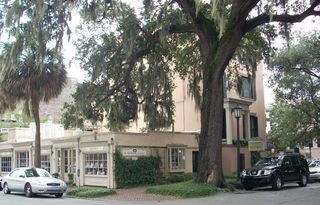 (click on photo ) in the heart of the city looked promising, but unfortunately was closed on Sunday.
I won’t even approach discussing Midnight or Paula Dean as their legions of fans have already covered those reading and foodie experiences respectively ad infinitum, but I saw several bookstores carrying Civil War books including The Savannah  Visitor Center, and two stores at the Fort Pulaski National Monument.
As one who always looks for opportunities to learn more about the Civil War, especially the engagements here in Georgia, I purchased David Smith’s brief history Sherman’s March to the Sea 1864, Atlanta to Savannah. I hoped the book would answer my question: Why did Sherman burn Atlanta, but not Savannah? I am not sure, but my understanding is that Atlanta had more facilities to wage war than Savannah and that according to Smith, the outnumbered Confederate military had already decided to evacuate Savannah even before Sherman issued a threat that if the city resisted, it would be burned. Besides Sherman was anxious to invade South Carolina. He wrote “we can punish South Carolina as she deserves, and as thousands of the people in Georgia hoped we would do.” (Georgia, really!)
—– EXTENDED BODY:
As far as beach books go, Denise and I were not unprepared. She was finishing up Pat Conroy’s South of Broad and I made progress on Colson Whitehead’s Sag Harbor, which is the best fiction book I’ve read this year. However, for others not so prepared it seemed like every little gift shop, and local department store in Tybee had beach paperbacks– some for as little as a dollar (though some shops had Tybee Days as well.) Aaah, these beach books were perfect—not too demanding and moreover, they were stained and scented by the sand, the salty ocean and the guano. Can you get that experience with an electronic reader? I think not.
—– EXCERPT: —– KEYWORDS: —– COMMENT: AUTHOR: Rube Ambler EMAIL: atlalist@atlalist.com IP: 71.204.25.58 URL: http://atlalist.com DATE: 10/17/2010 08:00:19 PM I’ve had the opportunity to shop at E. Shaver and it is a quite nice independent book shop. I would recommend making a point of visiting if you make it to Savannah again. —– COMMENT: AUTHOR: Jane Browne EMAIL: browne48@gmail.com IP: 24.136.26.82 URL: DATE: 12/06/2010 09:27:41 PM Hey Murray, can’t believe you went to Savannah and didn’t stop to see the Browne’s at Callawassie Island!! Jane B —– ——– AUTHOR: Murray Browne AUTHOR EMAIL: murray.browne905@gmail.com TITLE: Decatur Book Festival Wrap-up STATUS: Publish ALLOW COMMENTS: 1 CONVERT BREAKS: wysiwyg ALLOW PINGS: 1 BASENAME: decatur-book-festival-wrap-up UNIQUE URL: https://thebookshopper.typepad.com/the_book_shopper_atlantad/2010/09/decatur-book-festival-wrap-up.html DATE: 09/08/2010 10:42:39 PM —– BODY:
Strike the tents! The 5th Annual Decatur Book Festival (DBF) is over, but before my book shopper memories began to mix with the other DBFs, I’ll recap with a few observations.
Friday Night with Franzen
Under the warm stage lights, Jonathan Franzen read from his new book Freedom: A Novel for about thirty minutes. The selection was a series of excerpts from Chapter Two, a background story for one of the main characters, Patty, who is date raped by the son of a wealthy influential family, but at the urging of her parents Patty is convinced not to press charges. When he finished reading this passage, Franzen said “That’s the end of that cheery little reading.”
I thought it was kind of an odd selection. It certainly didn’t make me want to go out and buy the book, but I’m also an experienced Franzen reader who knows, that this selection may not be indicative of the rest of the book or that it’s just not something that works at a reading or maybe Franzen purposely read something unpleasant. My current strategy: Wait until the hype abates and then buy the book.
On the other hand, the question and answer period which lasted another thirty minutes was painful to watch. Franzen appeared totally uncomfortable. I am not sure whether the questions were too ambiguous, but Franzen rambled endlessly. He could take a lesson from the Toastmaster’s playbook. (If you can’t answer a tough question, change the subject and reply with something else. It works, because politicians do it all the time.)
Saturday morning
This is the third year I’ve worked at the book market as a volunteer and hats off to the organizers and especially the volunteer coordinator Lee Ann Harvey who assigns meaningful tasks without  overworking us. For the record, on the Saturday morning before the book market opened, many of the vendors voiced their appreciation of how well things were organized. While working you discover who is selling what and my friend Denise bought some long-sought-after book earrings. Now she can be properly attired at the festival even though the volunteer’s shirt featuring the monster Bookzilla is not easy to coordinate.
Saturday afternoon
I didn’t catch the entire roundtable of Tom Key’s moderation of the panel on the influence of the novel Confederacy of Dunces on novelists Bill Cotter and Doug Crandell, but I was there long enough to appreciate the dry wit and observations of Cotter. The Austin based writer joked that the failures in meaningful employment prepared him for “failure as a writer.”
—– EXTENDED BODY:While waiting to get a copy of Cotter’s Fever Chart signed, I chatted about used books (he is an antiquarian dealer) overheard writer Grant Jerkins (author of the upcoming A Very Simple Crime due out in November) swap writing war stories with his writing buddy Crandell These guys aren’t household names, but they were all accessible and it's one of the true pleasures to hear writers talk when they are unplugged.
(Shown in the photo is Cotter sitting on the far right, Crandell sitting in the center, and Jerkins standing off to the left.)
P.S. Key’s theatrical adaptation of A Confederacy of Dunces ends September 12th.
Late Saturday afternoon
One thing I tried to do and is to see some of our nationally recognized local and regional poets. On late Saturday, four of them were gathered at the First Baptist Church (scene of a hell of a book sale earlier this year). They included Kevin Young of Emory University, Georgia Poet Laureate David Bottoms, Georgia Tech’s Thomas Lux and hosted by Florida State’s David Kirby. The four men read from a collection of poems entitled Seriously Funny edited by Kirby and the poet Barbara Hamby (who could not attend because of the death of her mother.). Denise and I weren’t the only ones who thought the reading was both entertaining and enlightening. Eagle Eye sold out of the books at their booth afterwords.
Sunday & Future Success
For me, I can’t measure the success of Festival by numbers attended (though Sun day seemed packed even late in the day), the commerce (UGA Press' John McLeod told me that they had to go back to Athens overnight to retrieve more books. Bill Cotter said he sold more books at this reading than anywhere else he has been. Books Again was packed when I was there).
Of course I want the festival to do well and the writers and vendors to keep coming, but ultimately the proof of the success of such an event is a personal one—determined by whether I get hooked up with a new writer or book that I really like. It’s too soon to tell whether the Franzen book (which I haven’t even purchased yet), the Cotter book or Seriously Funny qualify because I haven’t read through all my bounty. For that final report, I must defer to a later post – sometimes years later (so don’t wait up).
—– EXCERPT: —– KEYWORDS: Decatur Book Festival, Jonathan Franzen, Bill Cotter, Tom Key, Doug Crandell, Kevin Young, Tom Lux, David Hamby, David Bottoms, Seriously Funny, Fever Chart —– COMMENT: AUTHOR: Grant Jerkins EMAIL: grantjerkins@hotmail.com IP: 67.191.210.200 URL: http://www.grantjerkins.com DATE: 09/13/2010 03:49:52 PM Murray! Thanks for the shout out. It was a pleasure to meet you. November 2nd (when A Very Simple Crime comes out) I’ll be doing a reading/signing at Decatur Library. Stop by if you’re in the neighborhood. And yes, Doug and Bill were so very funny. – Grant —– ——– AUTHOR: Murray Browne AUTHOR EMAIL: murray.browne905@gmail.com TITLE: My Decatur Book Festival (DBF) Schedule STATUS: Publish ALLOW COMMENTS: 1 CONVERT BREAKS: wysiwyg ALLOW PINGS: 1 BASENAME: my-decatur-book-festival-dbf-schedule UNIQUE URL: https://thebookshopper.typepad.com/the_book_shopper_atlantad/2010/09/my-decatur-book-festival-dbf-schedule.html DATE: 09/01/2010 07:55:38 AM —– BODY:Friday, September 3 – 7:00 p.m. Scalp my tickets for the Jonathan Franzen keynote address. Show support for Jodi Picoult.
Friday, 7:45 p.m. Rethink my scalping strategy. As a Midwesterner (like Franzen) “my moral seriousness” tells me not to take advantage of those less fortunate. 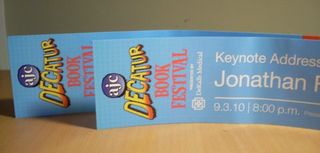
Friday, 8:45 p.m. Ask Franzen, during the question and answer session, “What’s with that psychedelic turd scene (p. 316) in The Corrections?”
Saturday, September 4 – 9 a.m to Noon. Report for my stint as a volunteer for the Festival. Double check that my book festival service gets me dibs on working at the Decatur Beer Festival, (on October 16).
Saturday, 12:01 p.m. Remove DBF volunteer shirt, so I don’t have to ask questions such as: “Where is the Antiquarian Book Fair?” Replace with my vintage DBF Blogzilla shirt from last year. Start looking for a food tent that sells turkey legs.
Saturday, 12:01 to 12:30 p.m. Visit some of the book exhibitors. Upon request, go back to the tent that sells turkey legs and get more napkins.
Saturday, 12:30 to 2:15 p.m. Check out the tribute to the A Confederacy of Dunces at the Decatur High School. Tell one of the panelists Bill Cotter, a former antiquarian book dealer, to go across McDonough street and check out Books Again. (They are having a sale this weekend.)
Saturday 3 p.m. Stop by McSweeney’s (Booth 526) and recycle my extra Believer magazines, compliment them about using an Atlanta studio to produce their music CD (Vol 8. No. 6) and complain that the print is too small in their cartoons.
Saturday, 4 p.m to 6 p.m. Start reading some of the books I purchased. Nap.
—– EXTENDED BODY:Sunday, September 5 - 1:00 to 3 p.m. Check out the Emerging Authors at the Gazebo. Commiserate with authors who try to get their works out in the public. (I understand, believe me). Shouldn’t it be comforting to the authors knowing that someone listening in the audience is not a family member?
Sunday, 4 p.m. Stop by the AJC (Booth 503) and ask how the Sunday paper keeps getting thrown into my geraniums. Join the Book Fest-On-a-Budget crawl with Bargain Hunter blogger and columnist Rana Cash to look for a discounted copy of Franzen’s new book Freedom. (Publisher’s suggested retail price $28)
Sunday, 6 p.m. Resume reading some of the books I purchased. Nap.
—– EXCERPT: —– KEYWORDS: Decatur Book Festival Schedule, DBF, Jonathan Franzen, Bill Cotter, McSweeney’s Decatur Book Festival, Rana Cash, Books Again —– ——– AUTHOR: Murray Browne AUTHOR EMAIL: murray.browne905@gmail.com TITLE: MARTA Book Club #8: Summer Wilting STATUS: Publish ALLOW COMMENTS: 1 CONVERT BREAKS: wysiwyg ALLOW PINGS: 1 BASENAME: marta-book-club-8-summer-wilting CATEGORY: MARTA Book Club UNIQUE URL: https://thebookshopper.typepad.com/the_book_shopper_atlantad/2010/08/marta-book-club-8-summer-wilting.html DATE: 08/25/2010 10:16:38 PM —– BODY:
For those unfamiliar with the group, the MARTA Book Club is a loose— very loose— confederation of people who read while riding the Metropolitan Atlanta Rapid Transit Authority’s public transportation. There are no meeting times, no organizational rules, no t-shirts, and no special fares. Very convenient. The only requirement to be a member of MARTA Book Club is to read a book while riding public transportation.
 What We Are Reading: Sightings of books were down since my last MARTA posting. There are two reasons for this: a.) In the summer I ride the train less because the Atlanta heat and humidity will soak my shirt before I get to work and b.) I lost one of my note cards that I use to record books. If anyone has found it an index card with scribbles on it, just add it in Comments. Here’s an abridged version of what MARTA riders are reading:
A Hand to Guide Me by Daniel Paisner
Controlling the Tongue: Mastering the What, When, & Why of the Words You Speak by R. T. Kendall
The Amazing Adventures of Kavalier & Clay by Michael Chabon
The Body Farm (Scarpetta) by Patricia Cornwell
Hot Blooded by Lisa Jackson
The Strain by Guillermo Del Toro, Chuck Hogan, and Ron Perlman
Act Like a Lady, Think Like a Man: What Men Really Think About Love, Relationships, Intimacy, and Commitment by Steve Harvey
Eat, Pray, Love: One Woman's Search for Everything Across Italy, India and Indonesia by Elizabeth Gilbert
The Ikea Catalog by Ikea. Why not? It’s thick and a great companion book to the Steig Larsson series
The Fountainhead by Ayn Rand
Atlas Shrugged by Ayn Rand
Take It By Force by Judy Jacobs
—– EXTENDED BODY:
The Gentle Art of Blessing: A Simple Practice That Will Transform You and Your World by Pierre Pradervand
The Help by Kathryn Stockett
A People's History of the United States: 1492 to Present by Howard Zinn
The Truth about Leadership: The No-fads, Heart-of-the-Matter Facts You Need to Know by James M. Kouzes, Barry Z. Posner
My contributions are This Republic of Suffering and the American Civil War by Drew Gilpin Faust and The Unprofessionals by Julie Hecht. Hecht is funny writer but in a dry, understated way. I liked her book of short stories Does the Window Open better, but The Unprofessionals deals with some serious issues such as the inability of professionals to help those who suffer from mental duress.
What members thought: Readers are encouraged to keep their thoughts (and eyes) to themselves. No time is wasted talking about books when you could be reading.
Next assignment: Keep reading, and get to work on time
—– EXCERPT: —– KEYWORDS: MARTA, Metropolitan Atlanta Rapid Transit Authority, Julie Hecht, The Unprofessionals, —– TITLE: Preparing for Franzen DATE: 08/04/2010 07:55:24 AM —–We’re still a month away from Jonathan Franzen’s keynote at the Decatur Book Festival, which includes a launch of his new book, Freedom: A Novel, so it’s still not too late to bone up on some of Franzen’s previous works.
Of course, there is the well-known and weighty The Corrections, which was published
almost ten years ago. As you may remember, The
Corrections focuses on a normal, miserable middle-class Midwestern family,
the Lamberts, but broadens to include commentary about the whirlwind economic
boom of the 1990s. Against the backdrop of relative prosperity, people were
still psychologically impoverished, depressed, and struggling to connect to
each other. I guess the relative prosperity has passed, but we’re still
psychologically impoverished, depressed, and struggling to connect to each
other.
Franzen’s first novel, The Twenty-Seventh City (1988) is a pot-boiler crime novel set in St. Louis, with political intrigue fueled by the conflicts of the different social classes in the city. It doesn’t have the style, wit and strength of voice of The Corrections, but it does have a driving plot that carries the book. (Admittedly, I haven’t read his second novel Strong Motion published in 1992.)
—– EXTENDED BODY:
Franzen’s compilation of essays How to Be Alone (2002) came out after The Corrections and it includes “Why Bother?” the essay where Franzen muses compellingly about why one should bother writing novels, when television and movies so dominate the culture and “Meet me in St. Louis” which his rebuttal essay to all the brouhaha surrounding being selected as an Oprah author (The Corrections is still an Oprah book designee, by the way).
I can’t speak too much to Franzen’s book of memoirs The Discomfort Zone: A Personal History (2006) as I never finished the book, but you can get a sense of the book AND what Franzen might be like on stage by checking out this clip from the 2006 Miami Book Fair International. (Warning: The website hosting this Book TV clip is a little flaky.)
Franzen is scheduled to appear on Friday evening, 8 p.m. September 3rd at Agnes Scott College's Presser Hall.The event is ticketed, and free tickets are available at Agnes Scott Box office, Blue Elephant Books, Charis Books, Eagle Eye Book Shop and Little Shop of Stories.
This posting is a brief, very brief excerpt from the essay, “Big Social Book Shopping Novels” from Murray Browne’s book, The Book Shopper: A Life in Review.
—– EXCERPT: —– KEYWORDS: Jonathan Franzen, Decatur Book Festival, DBF, —– ——– AUTHOR: Murray Browne AUTHOR EMAIL: murray.browne905@gmail.com TITLE: Battle of Atlanta Coincidences STATUS: Publish ALLOW COMMENTS: 1 CONVERT BREAKS: wysiwyg ALLOW PINGS: 1 BASENAME: battle-of-atlanta-coincidences CATEGORY: Civil War Books UNIQUE URL: https://thebookshopper.typepad.com/the_book_shopper_atlantad/2010/07/battle-of-atlanta-coincidences.html DATE: 07/26/2010 10:20:38 PM —– BODY:
 I may be relatively new to this area, but I have had an interest in the Battle of Atlanta dating back to 1966 when our family took a trip south to visit the Civil War battlefields at Shiloh, Chickamauga, Kennesaw Mountain and concluding with a stop at the Cyclorama in Atlanta. The trip cemented my burgeoning interest in the War Between the States, which began with the Topps Civil War trading Cards that my brother and I collected in the early 1960s. (You can still see the entire set of wonderfully gruesome cards at the Authentic History Center. This card image comes courtesy from their website.)
That’s why for the second year in a row, I made it over to East Atlanta’s B*ATL which “commemorates the Battle of Atlanta in the neighborhoods which it was fought.” I tried to get a ticket for the OaklandCemetery tour, but it was already sold out, but the drive was not in vain as I  did see “Gone with the Wind in 20 Minutes” by performance artist Doug Lothes, (shown), which was nothing short of hilarious.
Part of my interest in B*ATL can be attributed to the book I am currently reading: Drew Gilpin Faust’s This Republic of Suffering: Death and the American Civil War, which I heard about through a friend on my last trip to Knoxville. Faust’s book is not about specific battles, strategies or personalities, (she assumes you already know about this) but her theme is how the unprecedented death toll in the Civil War directly affected everyone in the country and how it shaped our current views of death. I really don’t seek out Civil War books and novels too much any more—even though that is certainly a popular topic for fiction and nonfiction here in Atlanta—but Faust’s book is not only well researched and tightly written but when she introduced me to aspects of the war I had never given much thought about, I was hooked.
—– EXTENDED BODY:This last weekend also marked the end of a long campaign where I helped my 82 year-old mother move to the Clairmont Oaks in Decatur. She’s never lived anywhere else but central Illinois and it is a major change for her (and me). It’s not easy uprooting someone and the obstacles are formidable. When things got tough for us, I quoted her the words of General Ulysses S. Grant, who said during the Wilderness Campaign of 1864 – “We’ll fight it out on this line, if it takes all summer.”
What a strange turn of events. Our family enjoyed our trip here in 1966, but we never imagined that we’d someday be living —as Scarlett O’Hara says with a breathless sigh, — in “At-lannnta.”
—– EXCERPT: —– KEYWORDS: Battle of Atlanta, B*ATL, A Republic of Suffering, Drew Gilpin Faust, Doug Lothes, —– ——– AUTHOR: Murray Browne AUTHOR EMAIL: murray.browne905@gmail.com TITLE: Bookcase Testimonial STATUS: Publish ALLOW COMMENTS: 1 CONVERT BREAKS: wysiwyg ALLOW PINGS: 1 BASENAME: bookcase-testimonial UNIQUE URL: https://thebookshopper.typepad.com/the_book_shopper_atlantad/2010/07/bookcase-testimonial.html DATE: 07/15/2010 07:59:16 AM —– BODY:At some point all prolific book shoppers have to decide how to manage their books. Weeding is a possibility, but when you merge your library with another’s (like Denise and I did last year,) getting rid of a few duplicates is not enough. (But having duplicates in the first place is a good sign of compatibility, don’t you think?)

Fortunately our new townhouse has a long wide hallway on the top floor that we thought would work for a library, but getting the right bookcases (solid wood, not costing a small fortune) required a fair amount of deliberation.
After shopping from everywhere from Ikea to Crate & Barrel to Room & Board, we tried Craigslist, where we found Paul Nooks’ Neatnooksfurniture. (His email is paulnooks AT yahoo.com) Working out of his home, Paul designs and builds custom furniture. Comparing price and quality, we thought his shelves were a great value.
Not only are we very pleased with our bookcases, but we enjoyed working with Paul. You’ll notice that our shelves haven’t all been filled in yet, but that’s the beauty of partially filled bookshelves. Think of the possibilities.
—– EXTENDED BODY: —– EXCERPT: —– KEYWORDS: —– ——– AUTHOR: Murray Browne AUTHOR EMAIL: murray.browne905@gmail.com TITLE: Blog’s 100th Posting & Greatest Hits STATUS: Publish ALLOW COMMENTS: 1 CONVERT BREAKS: wysiwyg ALLOW PINGS: 1 BASENAME: blogs-100th-posting-greatest-hits UNIQUE URL: https://thebookshopper.typepad.com/the_book_shopper_atlantad/2010/07/blogs-100th-posting-greatest-hits.html DATE: 07/07/2010 11:13:56 PM —– BODY: To celebrate the hundredth posting since I began writing the blog in November 2008, I am taking the week off and taking a trip down memory lane to revisit five of the postings that readers unofficially frequented the most:The Unabomber's Library, Part 2
May 17, 2009. This is probably my most visited page, because if someone wants to see a replica of the Unabomber’s Library, Google sends them here. I appreciate that the filmmaker James Benning let me host the photos and that my older daughter Cynthia made the connection in my behalf.Readings: Rita Mae Brown and Padgett Powell
November 2, 2009. One upside to all this blogging is that it does motivate you to get out and see some authors. I didn’t write about every author I saw, but these two were worth the effort. I’ve really become a big reader of Padgett
Powell’s work. I ended up reading both The
Interrogative Mood and Edisto and I thought were
tremendous books for different reasons. I didn’t get finish Mrs. Hollingsworth’s Men, even though I
picked up an autographed copy at Books Again. Sometimes you just have to re-shelve
a book and try it another time.
My biggest regret is not introducing Rita Mae Brown to a
buddy of mine who went with me to the reading at the Margaret Mitchell House.
My friend was plowing through her recommended booklist that she published 20+
years ago. He started at Beowulf and
he’s now working his way through Edith Wharton. Maybe she would have bought him
a beer.
Padgett
Powell’s work. I ended up reading both The
Interrogative Mood and Edisto and I thought were
tremendous books for different reasons. I didn’t get finish Mrs. Hollingsworth’s Men, even though I
picked up an autographed copy at Books Again. Sometimes you just have to re-shelve
a book and try it another time.
My biggest regret is not introducing Rita Mae Brown to a
buddy of mine who went with me to the reading at the Margaret Mitchell House.
My friend was plowing through her recommended booklist that she published 20+
years ago. He started at Beowulf and
he’s now working his way through Edith Wharton. Maybe she would have bought him
a beer.
T.C. Boyle at the Margaret Mitchell House
February 7, 2010. Nothing like a photo of a famous author in a Valentine’s Day red suit to generate some interest. I’d always heard that Boyle was flamboyant at the lectern and I had to go see for myself (he was). I always like a reading when one a longtime reader of a writer
grills an author. It’s really a sign of appreciation. At the Boyle reading, one
woman (in a kind and respectful way) pointed out that a character from Boyle’s
new book had appeared earlier in another book – a fact he failed to mention.
I always like a reading when one a longtime reader of a writer
grills an author. It’s really a sign of appreciation. At the Boyle reading, one
woman (in a kind and respectful way) pointed out that a character from Boyle’s
new book had appeared earlier in another book – a fact he failed to mention.
Thomas Chatterton Williams Meets Killer Mike
June 6, 2010. The popularity of this posting can be attributed to Facebook. I sent the link to the writer Thomas Chatterton Williams and he put the link on his Facebook page. He’s an author with a lot of friends, hence a lot of traffic.
November 8, 2009 to present. I’ve made seven postings documenting anecdotally (since there is no methodology) of what I observe people reading on MARTA. It started as a light satire on those book clubs mentioned in the Sunday AJC, but as since graduated to an obsession on what people really read.
—– EXTENDED BODY: —– EXCERPT: —– KEYWORDS: —– ——– AUTHOR: Murray Browne AUTHOR EMAIL: murray.browne905@gmail.com TITLE: MARTA Book Club #7 Your Ticket to Summer Reading STATUS: Publish ALLOW COMMENTS: 1 CONVERT BREAKS: wysiwyg ALLOW PINGS: 1 BASENAME: marta-book-club-7-your-ticket-to-summer-reading CATEGORY: MARTA Book Club UNIQUE URL: https://thebookshopper.typepad.com/the_book_shopper_atlantad/2010/06/marta-book-club-7-your-ticket-to-summer-reading.html DATE: 06/29/2010 10:41:02 PM —– BODY:
 For those unfamiliar with the group, the MARTA Book Club is a loose— very loose— confederation of people who read while riding the Metropolitan Atlanta Rapid Transit Authority’s public transportation. There are no meeting times, no organizational rules, no t-shirts, and no special fares. Very convenient. The only requirement to be a member of MARTA Book Club is to read a book while riding public transportation, which will become more difficult to do when the budget cuts take affect. Still, we read on!
What We Are Reading: No books from the Georgia Center for the Book List of What Georgians Should Read were sighted. Instead, here’s a list of what Atlantans are reading since my last MARTA posting on May 23rd:
Catch-22 by Joseph Heller. Spotted two of these, which made me wonder if some college class had assigned the book.
Almost Forever: Almost Forever\For the Baby's Sake by Linda Howard and Christine Rimmer.
The Mephisto Club by Tess Gerritsen
Clinically Oriented Anatomy by Keith L. Moore, Arthur F Dalley, and Anne MR Agur
Secrets of Power Negotiating by Roger Dawson
Some Love, Some Pain, Sometime: Stories by J. California Cooper
Where Keynes Went Wrong: And Why World Governments Keep Creating Inflation, Bubbles, and Busts by Hunter Lewis
Change Your Brain, Change Your Life: The Breakthrough Program for Conquering Anxiety, Depression, Obsessiveness, Anger, and Impulsiveness by Daniel G. Amen
The Demon-Haunted World: Science as a Candle in the Dark by Carl Sagan and Ann Druyan
To Try Men's Souls: A Novel of George Washington and the Fight for American Freedom by Newt Gingrich, William R. Forstchen, and Albert S. Hanser
Wealth of Nations by Adam Smith.
The Guernsey Literary and Potato Peel Pie Society by Mary Ann Shaffer and Annie Barrows
The Bible
A Sticky Situation by Kiki Swinson
Storm Prey by John Sanford
Reckless: A Novel by Andrew Gross
Master Your Metabolism: The 3 Diet Secrets to Naturally Balancing Your Hormones for a Hot and Healthy Body! by Jillian Michaels and Mariska van Aalst. Steamiest cover, but not worth looking up.
Gone Too Far by Angela Winters
The Soccer Book by David Goldblatt
Dead Sleep by Greg Iles
The Girl with the Dragon Tattoo by Steig Larson
Wanderlust: A History of Walking by Rebecca Solnit. This is my contribution to the book club this month. Solnit gives a cultural history of walking mixed in withher personal experiences. Great book for those who don’t believe so much in the Allure of the Automobile. I picked it up when I was in Boston last month. I’m also finishing up Peace Like a River by Leif Enger.
—– EXTENDED BODY:The White Queen: A Novel (Cousins' War) by Philippa Gregory
Black Blizzard by Yoshihiro Tatsumi
Dirty Old Men (And Other Stories) by Omar Tyree
Sweet Tibby Mack (Matchmaker, Matchmaker) (Harlequin Superromance #746) by
Roz Denny Fox. No. 746?!?
The Tutankhamun Prophecies: The Sacred Secret of the Maya, Egyptians, and Freemasons by Maurice Cotterell
Son of a Snitch by Michael Evans
The Bourne Sanction by Robert Ludlum and Eric Van Lustbader
Echoes of a Distant Summer by Guy Johnson
Mama Dearest by E. Lynn Harris
What members thought: Readers are encouraged to keep their thoughts (and eyes) to themselves. No time is wasted talking about books when you could be reading.
Next assignment: Keep reading, and get to work on time
—– EXCERPT: —– KEYWORDS: —– COMMENT: AUTHOR: Brian Carr EMAIL: bcarr@cleanaircampaign.org IP: 12.51.114.30 URL: http://www.cleanaircampaign.org DATE: 06/30/2010 12:02:50 AM Way to go, MARTA riders! I am the communications director for The Clean Air Campaign and I applaud the efforts of commuters who make better use of their time on the way to and from work. I’m a non-fiction reader on my Blue Line journey into Five Points each day. There are only so many hours in the day. It’s incredible what we can do when we don’t have to spend as much of our time behind the wheel, fighting through Atlanta traffic. We can show up to work refreshed and better informed. There’s also cash and prizes available for transit commuters from The Clean Air Campaign. http://www.cleanaircampaign.org Worth a look if you want to offset the costs of your next hardcover bestseller. Keep up the great work and stay in touch. —– ——– AUTHOR: Murray Browne AUTHOR EMAIL: murray.browne905@gmail.com TITLE: Blue Elephant Book Shop STATUS: Publish ALLOW COMMENTS: 1 CONVERT BREAKS: wysiwyg ALLOW PINGS: 1 BASENAME: blue-elephant-book-shop CATEGORY: Bookstores UNIQUE URL: https://thebookshopper.typepad.com/the_book_shopper_atlantad/2010/06/blue-elephant-book-shop.html DATE: 06/20/2010 02:58:16 PM —– BODY:
As someone who enjoys shopping for books, I certainly like the new location and layout of Blue Elephant Book Shop, which as moved from the busy intersection at Claremont and North Decatur to downtown Decatur near Dancing Goats Coffee Bar. Even though previously it was just across an intersection from Eagle’s Eye, you would risk your life walking from one bookstore to the other.
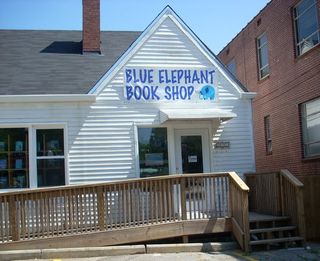 Bookstores seem like a natural fit for re-purposed houses (like Eighth Day Books in Wichita, Kansas or Atlanta Book Exchange on Highland) as each room can host a different genre of books (contemporary fiction, history, local interest books and children’s books). Even though I would order an occasional book, or stop by to grab something as a quick gift at the old Blue Elephant location, it always seemed too wide open for the intimate activity of browsing.
This week Denise and I experienced for the first time the
book sale on the front lawn at the First
Baptist Church
in Decatur, which is just a
fraction of their huge legendary yard sale that ended Saturday.
Earlier in the week—in the quiet cemetery-like surroundings—we scouted out the thousands of book offerings. You can easily imagine what was there—the usual books that are laid to rest: War and Peace, The Thorn Birds, The DaVinci Code, Rhett Butler’s People, Pat Conroy books, The Magic of Sex (?), and a complete hardback set of Louis L’Amour westerns.
Denise went back for the opening ceremonies on Thursday and not only picked up some Sunshine Biscuit tins (reliving the fresh baked goodness of her youth), but she brought home some great hardbacks for our library: The Year of Magical Thinking by Joan Didion, That Old Ace in the Hole by Annie Proulx, and a copy of Jonathan Franzen’s essays, How to Be Alone. Franzen is headlining the Decatur Book Festival on Labor Day weekend, so I am stockpiling inventory.
—– EXTENDED BODY: —– EXCERPT: —– KEYWORDS: Jonathan Franzen, Decatur Book Festival, Joan Didion, Annie Proulx, —– ——– AUTHOR: Murray Browne AUTHOR EMAIL: murray.browne905@gmail.com TITLE: Thomas Chatterton Williams Meets Killer Mike STATUS: Publish ALLOW COMMENTS: 1 CONVERT BREAKS: wysiwyg ALLOW PINGS: 1 BASENAME: thomas-chatterton-williams-meets-killer-mike CATEGORY: Local Reviews UNIQUE URL: https://thebookshopper.typepad.com/the_book_shopper_atlantad/2010/06/thomas-chatterton-williams-meets-killer-mike.html DATE: 06/06/2010 09:52:19 PM —– BODY:
It’s not often do go to a reading and a Grammy-award winner makes a guest appearance, but on June 1 at the Decatur Public Library, Thomas Chatterton Williams, author of Losing My Cool: How a Father’s Love and 15,000 Books Beat Hip-Hop Culture ended up sharing some of the spotlight with Killer Mike (aka Mike Bigga), an award-winning rapper who is based in Atlanta.
The well attended reading of approximately sixty people got a little more than just Williams reading his book, which is a personal account of the author reconciling a double life of “keeping it real,” which meant playing hoops and not appearing to be successful in school and his parallel journey to be a learned man – the result of a determined father who oversaw his son’s education. Losing My Cool began as an op-ed piece in the Washington Post that Williams wrote in 2007 as a graduate student at New York University. 
After the mild-mannered Williams finished the reading, (the less mild-mannered) Killer Mike–who sat in the front row–introduced himself during the question and answer session and almost commandeered the reading. (Williams who was familiar with the rap star’s music skillfully prevented the takeover.) For several minutes, the two men debated articulately about the use of the phrase “hip-hop culture” in the subtitle of the book. Killer Mike felt that it was “disingenuous” for Williams to use “hip-hop culture” in a negative connotation that ignored the poetic, intellectual and social roots of the music form, which originated in the South Bronx around 1977. Williams admitted he didn’t necessarily embrace the subtitle of his book, but defended using “hip-hop culture” because black culture and hip-hop are usually (though erroneously) perceived as being the same. Williams believes that while “Black street culture is authentic, it should not be the end all and be all,” noting that blacks should be familiar with the works of Ralph Ellison, Zora Neale Hurston, James Baldwin, Miles Davis and John Coltrane, to name but a few.
—– EXTENDED BODY:
After the reading and before the book signing, the two men talked briefly as shown here. (Williams on the left, Killer Mike on the right and in the middle Joe Davitch, an assistant at the Georgia Center of the Book) Not your common library fare for sure, as authors aren’t usually taken to task while on stage, but an interesting exchange, and anyone who attended probably felt like they witnessed some good ol’ fashioned public discourse.
Note: If you would like to be emailed a notification of blog updates (usually updated once a week), send an email to murray.browne905 AT gmail.com. This information will not be used for any other purposes.
—– EXCERPT: —– KEYWORDS: Thomas Chatterton Williams, Killer Mike, Losing My Cool —– ——– —– ——– AUTHOR: Murray Browne AUTHOR EMAIL: murray.browne905@gmail.com TITLE: MARTA Book Club #6 Goes to Boston STATUS: Publish ALLOW COMMENTS: 1 CONVERT BREAKS: wysiwyg ALLOW PINGS: 1 BASENAME: marta-book-club-6-goes-to-boston CATEGORY: MARTA Book Club UNIQUE URL: https://thebookshopper.typepad.com/the_book_shopper_atlantad/2010/05/marta-book-club-6-goes-to-boston.html DATE: 05/23/2010 10:27:33 PM —– BODY:
For those unfamiliar with the club, MARTA book club is a loose, very loose, confederation of people who read while riding the Metropolitan Atlanta Rapid Transit Authority’s public transportation. There are no meeting times, no organization, no t-shirts, and no special fares. The only requirement to be a member of MARTA Book Club is to read a book while riding public transportation. (See related posts)
This month I visited our sister book club — the Metropolitan Boston Transit Authority, (MBTA) or “The T” for short. (Remember the Atlanta Braves came from Boston via Milwaukee). While riding the subway between book stores, I observed what Bostonians were reading at least during one rush hour. As you can see by this short video of “The T” (courtesy of my daughter), you have to look fast to find out what people are reading.
http://vimeo.com/moogaloop.swf
What Bostonians Were Reading
The Island of the Day Before by Umberto Eco
In the Company of Soldiers: A Chronicle of Combat by Rick Atkinson
Food Rules by Michael Pollan
T.H.U.G. L.I.F.E. by Sanyika Shakur
Lush Life: A Novel by Richard Price
Heavenly Days by James Wilcox
The Summer Hideaway (The Lakeshore Chronicles) by Susan Wiggs
Little Bee: A Novel by Chris Cleave
What We (Atlantans) Are Reading: Here’s a list of what Atlantans are reading since my last MARTA posting in April:
Consciousness Explained by Daniel C. Dennett
Sister Outsider: Essays and Speeches by Audre Lorde and Cheryl Clarke
Oprah by Kitty Kelley
The Shack by William P. Young
The Fine Print on a Georgia Lottery Ticket
Little Bee: A Novel by Chris Cleave
The Girl with the Dragon Tattoo by Stieg Larson
—– EXTENDED BODY:Honolulu by Alan Brennert
The Story of Edgar Sawtelle: A Novel (P.S.) by David Wroblewski
The Blind Side by Michael Lewis
Bury Me Standing: The Gypsies and Their Journey by Isabel Fonseca
The White Tiger by Arvind Adiga
Midnight: A Gangster Love Story by Sister Souljah
The Little SAS Book: A Primer by Lora Delwiche and Susan Slaughter
Of Love and Other Demons by Gabriel Garcia Marquez (this month’s sexiest cover)
The Worldly Philosophers by Robert Heilbroner
Young Wives by Olivia Goldsmith
Chelsea Chelsea Bang Bang by Chelsea Handler
Alpha Teach Yourself Black & White Photography in 24 Hours by Thomas McGovern
Edisto by Padgett Powell. This is one of my contributions to the reading club. My other contribution this month is Bright-Sided: How the Relentlesss Promotion of Positive Thinking Has Undermined America by Barbara Ehrenrich.
Blue Like Jazz by Donald Miller
Anansi Boys by Neil Gaiman
What members thought: Readers are encouraged to keep their thoughts (and eyes) to themselves. No time is wasted talking about books when you could be reading.
Next assignment: Keep reading, and get to work on time
—– EXCERPT: —– KEYWORDS: MARTA, MBTA, The “T”, MARTA Reading Club —– ——– AUTHOR: Murray Browne AUTHOR EMAIL: murray.browne905@gmail.com TITLE: Boston – Cambridge Running Out of Good Books STATUS: Publish ALLOW COMMENTS: 1 CONVERT BREAKS: wysiwyg ALLOW PINGS: 0 BASENAME: boston-cambridge-are-out-of-good-books CATEGORY: Bookstores UNIQUE URL: https://thebookshopper.typepad.com/the_book_shopper_atlantad/2010/05/boston-cambridge-are-out-of-good-books.html DATE: 05/16/2010 03:28:30 PM —– BODY:I am up near the Harvard campus for a long weekend and so far I've been on a personal crusade to wipe out the area of some of its good books. Too bad Boston – Cambridge! You've had your chance to buy these gems long enough. I am bringing them back to Atlanta. 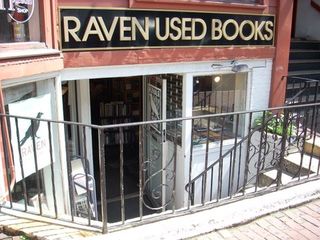
So far here's the list of the books that are now leaving Boston:
Proust Was A Neuroscientist by Jonah Lehrer, $5
Detective Story by Imre Kertesz, $6
Salt by Mark Kurlansky, $3
Leaves of Grass by Walt Whitman, $1 (daughter's birthday gift)
Wanderlust, by Rebecca Solnit (full price)
I am Not Sidney Poiter by Percival Everett (full price)
The Unprofessionals by Julie Hecht, $8
In a Narrow Grave: Essays on Texas by Larry McMurtry,$1(found on sidewalk cart)
This Republic of Suffering: Death and the American Civil War By Drew Gilprin Faust (full price)
Tomorrow, I hit the MIT Press bookstore and then on Tuesday it's back to Atlanta. If I were a flight attendant, I would avoid helping me put my carry-on into the overhead.
—– EXTENDED BODY: —– EXCERPT: —– KEYWORDS: —– ——– AUTHOR: Murray Browne AUTHOR EMAIL: murray.browne905@gmail.com TITLE: Book Sale for the Military STATUS: Publish ALLOW COMMENTS: 1 CONVERT BREAKS: wysiwyg ALLOW PINGS: 1 BASENAME: book-sale-for-the-military UNIQUE URL: https://thebookshopper.typepad.com/the_book_shopper_atlantad/2010/05/book-sale-for-the-military.html DATE: 05/08/2010 09:51:25 AM —– BODY:
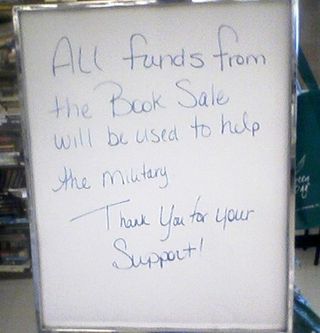
Although well intentioned, I doubt this impromptu book kiosk featuring
mostly paperbacks with purple covers will generate much revenue for the military. The kiosk can be found inside a Schnucks supermarket in Savoy,
Illinois.
Last year, my book friend Dave in Seattle sent me a personally autographed copy of Luke Salisbury’s The Cleveland Indian: The Legend of King Saturday (Black Heron Press, Seattle). Each spring I try to read at least one baseball book to mark the beginning of the new season (last year it was Robert Coover’s The Universal Baseball Association). Salisbury and I are connected by two degrees of separation as we both were contributors to the now defunct baseball literary review, Elysian Fields Quarterly.
Originally published in 1992, The Cleveland Indian is a solid historical novel and centers around the King Saturday, a Native American who played for the Cleveland Spiders in 1898 and is based on the real life Penobscot Indian Louis Sockalexis. The story is told from the perspective of a Harvard educated Harry Harrison, who admires Saturday’s athletic prowess and keen sense of “hustle.” (The phenomena of Saturday’s athleticism reminded me of Bo Jackson’s incredible 1989 season with the Kansas City Royals.) But the book is more than just a glimpse into old timey baseball – though there are insights to all time greats John McGraw and Cy Young — there is love, murder, and several underlying political messages. Not only are there examples of racism, but the book reminds us of U.S. hegemony that dates back to the Spanish American War.
If you interested in used baseball books, check out Books Again in downtown Decatur. According to owner Jim Adams they’ve recently required some autographed books via Atlanta Braves trainer, Dr. John 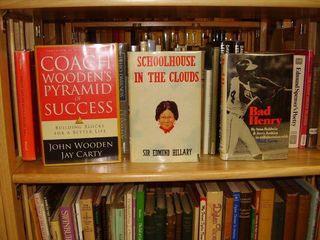 Cantwell. Included in the Cantwell collection is autographed copy of Henry Aaron’s Bad Henry (1974) autographed by Aaron himself. There are also signed copies of Coach John Wooden’s Pyramid of Success: Building Blocks for a Better Life (2005) and Sir Edmund Hillary’s School House in the Clouds (1964). (Photos courtesy of Books Again)
While I was visiting with Jim, he also pulled out his latest major acquisition, an autographed copy of Martin Luther King’s Stride Toward Freedom: The Montgomery Story. Albeit, this is not a baseball story, but those interested in American history cannot help but being in awe when seeing this autographed book.
—– EXTENDED BODY: —– EXCERPT: —– KEYWORDS: Luke Salisbury, Henry Aaron, Cleveland Spiders, Louis Sockalexis, Martin Luther King autograph, Books again, —– COMMENT: AUTHOR: free bookmaking software EMAIL: michael.walker@hostpph.com IP: 74.122.164.27 URL: http://www.hostpph.com/gaming-software/index.aspx DATE: 06/01/2012 03:08:35 PM oh that is so cool, I have a baseball book autographed by Thomas McGuire, he was my idol and I could not believe I got it on eBay, it is my most precious baseball possesion —– ——– AUTHOR: Murray Browne AUTHOR EMAIL: murray.browne905@gmail.com TITLE: Literacy Numbers for Knoxville STATUS: Publish ALLOW COMMENTS: 1 CONVERT BREAKS: wysiwyg ALLOW PINGS: 1 BASENAME: literacy-numbers-for-knoxville UNIQUE URL: https://thebookshopper.typepad.com/the_book_shopper_atlantad/2010/04/literacy-numbers-for-knoxville.html DATE: 04/17/2010 08:01:08 AM —– BODY:
Earlier this week I was back in sunny
Knoxville as a guest of a book
 group that had picked The Book Shopper: A
Life in Review as their April selection. One topic of discussion was
literacy in the United States
and I presented some figures, which people (even myself) found hard to believe.
With this in mind, I double-checked my source, Chris Hedges’ The Empire of Illusion: The End of Literacy
and the Triumph of Spectacle (2009, Nation Books). Here’s the passage:
group that had picked The Book Shopper: A
Life in Review as their April selection. One topic of discussion was
literacy in the United States
and I presented some figures, which people (even myself) found hard to believe.
With this in mind, I double-checked my source, Chris Hedges’ The Empire of Illusion: The End of Literacy
and the Triumph of Spectacle (2009, Nation Books). Here’s the passage:
In the United States, there are 7 million illiterate Americans. Another 27 million are unable to read well enough to complete a job application, and 30 million can’t read a simple sentence. There are some 50 million who read at the 4th or 5th grade level. Nearly a third of the nation’s population is illiterate or barely literate – a figure that is growing by 2 million a year. A third of the high school graduates never read another book for the rest of their lives, and neither do 42 percent of college graduates. In 2007, 80 percent of the families in the United States did not buy or read a book. (p.44)
Hedges documents his sources and given his scholarly pedigree, I feel fairly confident in using them. Empire is a concise, riveting, and sobering book about our shift from a literate culture to an image based culture. This was also a topic of discussion at the Knoxville book club.
I appreciated being invited to be with this group and so was my publisher Paul Dry of Paul Dry Books. The next day I chatted with Paul and he was unfazed about my stories of how people purchased the book (stores, online, library sale discards). Paul believes the way books are ultimately sold is by word of mouth. People rarely recommend books they haven’t read and having twenty people read The Book Shopper is good for the book’s life span. To show his appreciation Paul wants to offer members of the group a 30 % discount (shipping is always free) on any book they order from Paul Dry Books. You can use the discount code SHOPBOOKS at checkout.
—– EXTENDED BODY: —– EXCERPT: —– KEYWORDS: —– ——– AUTHOR: Murray Browne AUTHOR EMAIL: murray.browne905@gmail.com TITLE: Join MARTA Book Club #5 STATUS: Publish ALLOW COMMENTS: 1 CONVERT BREAKS: wysiwyg ALLOW PINGS: 1 BASENAME: join-marta-book-club-5 CATEGORY: MARTA Book Club UNIQUE URL: https://thebookshopper.typepad.com/the_book_shopper_atlantad/2010/04/join-marta-book-club-5.html DATE: 04/11/2010 10:27:12 PM —– BODY:
For those unfamiliar with the club, MARTA book club is a loose, very loose, confederation of people who read while riding the Metropolitan Atlanta Rapid Transit Authority’s public transportation. There are no meeting times, no organization, no t-shirts, and no special fares. Very convenient. The only requirement to be a member of MARTA Book Club is to read a book while riding public transportation.
Newspapers do not qualify and those with Kindles and other electronic reading devices are not welcome (because how in the hell am I supposed to figure out what you’re reading if I can’t see the book cover!)
What We Are Reading: Here’s a list of what Atlantans are reading since my last MARTA posting:
Lunar Park by Bret Easton Ellis
Heinerman's Encyclopedia of Juices Teas & Tonics by John Heinerman
Down to the Wire: Confronting Climate Collapse by David W. Orr
Devices and Desires (Adam Dalgliesh Mysteries, No. 8) by P. D. James
The Debt: What America Owes to Blacks by Randall Robinson (two sitings)
The Razor's Edge by Somerset Maugham
1 Corinthians (Baker Exegetical Commentary on the New Testament) by David E. Garland
The Lost Symbol by Dan Brown
The Time Traveler's Wife by Audrey Niffenegger. Atlanta’s A-List Book Club is discussing this book on May 24th.
Night's Pleasure by Amanda Ashley
Chronic City by Jonathan Lethem. Stay tuned a review of this book is coming to this blog.
Into Thin Air: A Personal Account of the Mt. Everest Disaster by Jon Krakauer. While in Decatur on April 9th promoting her new novel about the crisis surrounding teenagers, Imperfect Birds, Anne Lamott gave kudos to Krakauer. My takeaway from Lamott’s 90 minute lecture and reading was that parents of teenagers should lock up their children until their neo-cortexes fully develop.
—– EXTENDED BODY:The Influential Leader: 12 Steps to Igniting Visionary Decision Making by John Edmund Haggai.
Foolproofing Your Life: How to Deal Effectively with the Impossible People in Your Life by Jan Silvious
One Hundred Years of Solitude by Gabriel Garcia Marquez
The Bible. A standard for many MARTA faithful.
My Usual Game by David Owens This is my personal contribution to the club this month. I’m also finishing up Mrs. Hollingsworth’s Men by Padgett Powell. Owens’ 1995 book about golf started out well with stories about his obsession with golf and a chapter on Ping club inventor, Karsten Solheim, but it tailspinned badly into stories about golf outings at Myrtle Beach. As mentioned earlier, I picked up for $2 at ACappella on the night, Owens was in town promoting his latest book Green Metropolis.
Edge Of Fear by Cherry Adair
Come on People: On the Path from Victims to Victors
By Bill Cosby (Author), M.D. Alvin F. Poussaint
Bobby Brown: The Truth, The Whole Truth and Nothing But… by Derrick Handspike
The Kalahari Typing School for Men by Alexander McCall Smith
The Darkest Kiss by Keri Arthur. This month’s steamiest cover.
Master Your Metabolism: The 3 Diet Secrets to Naturally Balancing Your Hormones for a Hot and Healthy Body! by Jillian Michaels and Mariska van Aalst.
What members thought: Readers are encouraged to keep their thoughts (and eyes) to themselves. No time is wasted talking about books when you could be reading.
Next assignment: Keep reading, and get to work on time
—– EXCERPT: —– KEYWORDS: —– ——– AUTHOR: Murray Browne AUTHOR EMAIL: murray.browne905@gmail.com TITLE: Poison & Golf STATUS: Publish ALLOW COMMENTS: 1 CONVERT BREAKS: wysiwyg ALLOW PINGS: 1 BASENAME: poison-golf UNIQUE URL: https://thebookshopper.typepad.com/the_book_shopper_atlantad/2010/04/poison-golf.html DATE: 04/06/2010 12:03:11 AM —– BODY:
Yes, they seem unrelated, but they both are at least noteworthy:
Last week, I attended Deborah Blum’s reading of her new book The Poisoner’s Handbook at the Decatur Public Library. For those who like forensic crime stories, you may want to check out Handbook. Blum, a Pulitzer prize winner, gives an historical account of two early pioneers of forensic science chief medical examiner Charles Norris and toxicologist Alexander Gettler and their trailblazing adventures in New York City circa 1918.
Blum assured us that even though there is a lot of
information about detecting poisons from arsenic to carbon monoxide, specific
recipes are not included. After sharing stories from the book, Blum spent 30
minutes fielding questions from the audience of about fifty attendees. Some of
the discussion shifted to toxins in food and home products. Blum keeps an
extensive blog on related topics including her experiences with Georgia
moonshine.
With respect to golf, I read David Fulmer’s review of Steve Eubank’s book To Live & Die in Dixie about the 1921 murder of golf pro J. Douglas Edgar (not poisoned – punctured femoral artery) on the streets of Atlanta. The review ran last Sunday in the Atlanta Journal Constitution. Usually book reviews in the AJC are a little thin, but Fulmer gave specific criticisms of the book (a trace of venom, perhaps) and I appreciated seeing some depth in the book review section.
TITLE: Books as Art DATE: 03/29/2010 08:09:07 AM —–This weekend I was visiting my daughter in Nashville, Tennessee. Part of my time was spent shopping in the quaint downtown of Franklin which is full of antique shops and the like. At the Iron Gate, I noticed several books that had been “repurposed” into art objects. Some books had been decoupaged with old maps and other books had their covers removed and tied into bundles with string. 
For the most part, I have no issue seeing books forged into other uses besides reading, except one time years ago. I had stopped for lunch at the General Morgan Inn and Conference Center in Greenville, Tennessee and the dining room had been decorated as a faux “library.” Instead of shelves being lined with books, the owners just tacked up thin boards like ornamental baseboards, to look like shelves. Moreover, they had torn the cloth spines off the books and glued them on the fake shelves to make a grand fake library. This was disturbing and it made it difficult for me for me to eat in such a room.
Both incidences remind me of the writer Richard Ford’s quote: “Many fates befall books other than being read or treasured.”
—– AUTHOR: Murray Browne AUTHOR EMAIL: murray.browne905@gmail.com TITLE: Padgett Powell Revisited STATUS: Publish ALLOW COMMENTS: 1 CONVERT BREAKS: wysiwyg ALLOW PINGS: 1 BASENAME: padgett-powell-revisited UNIQUE URL: https://thebookshopper.typepad.com/the_book_shopper_atlantad/2010/03/padgett-powell-revisited.html DATE: 03/22/2010 07:41:25 AM —– BODY:Last November, on the recommendation of a friend of a friend, I went to hear novelist Padgett Powell read from his latest book The Interrogative Mood: A Novel? at the Decatur Public Library, I came away with mixed emotions about the experience. (Read earlier posting). I wasn’t sure if I liked the book and doubted that I would ever read it. But I certainly appreciated the respect Powell paid to his hard core readers who numbered about thirty strong that evening. Afterward, thoughts about the evening continued to linger – was it the quirkiness of Powell’s imagination, or the perhaps hidden meaning of his questions? Still unwilling to make a financial commitment, a couple of weeks ago I picked up a copy at the library.
Powell’s short book is nothing but one question after another
(such as “Do you remember the custom automotive gas pedal that resembled a
large bare chrome foot?”). The Powell-like narrator, a curious  man who wrestles
with the banality of modern life, yearns for certain aspects of simpler times
and things, but knows that he suffers from chronic nostalgia. Powell’s
character asks, “When you hear the expression ‘Those were the days’ or any
equivalent allusion to the good ol’ days, are you inclined to dismiss the
speaker as a sentimentalist, or do you credit that there indeed were better
days?”
man who wrestles
with the banality of modern life, yearns for certain aspects of simpler times
and things, but knows that he suffers from chronic nostalgia. Powell’s
character asks, “When you hear the expression ‘Those were the days’ or any
equivalent allusion to the good ol’ days, are you inclined to dismiss the
speaker as a sentimentalist, or do you credit that there indeed were better
days?”
Powell’s tight prose – he doesn’t waste words — makes The Interrogative Mood an easy but challenging book to read. I found myself constantly jotting down passages on separate bits of paper, and I really can’t shut up about it.
My next step is to return the book to the library and pick up my own copy. Isn’t it strange how books start out in some distant orbit (sadly, the friend of the friend has since died) but then some inexplicable gravity draws a book to us?
—– EXTENDED BODY: —– EXCERPT: —– KEYWORDS: —– COMMENT: AUTHOR: little wit EMAIL: cyndyb77005@yahoo.com IP: 140.247.250.216 URL: DATE: 03/28/2010 12:43:56 AM Is that exhibit B? —– ——– TITLE: Join the MARTA Book Club #4 STATUS: Publish ALLOW COMMENTS: 1 CONVERT BREAKS: wysiwyg ALLOW PINGS: 1 BASENAME: join-the-marta-book-club-4 CATEGORY: MARTA Book Club UNIQUE URL: https://thebookshopper.typepad.com/the_book_shopper_atlantad/2010/03/join-the-marta-book-club-4.html DATE: 03/06/2010 09:53:04 PM —– BODY:
For those unfamiliar with the club, the MARTA book club is a loose, very loose, confederation of people who read while riding the Metropolitan Atlanta Rapid Transit Authority’s public transportation. There are no meeting times, no organization, no t-shirts, and no special fares. Very convenient. The only requirement to be a member of the MARTA Book Club is to read a book while riding public transportation.
Newspapers do not qualify and those with Kindles are not welcome (because how in the hell am I supposed to figure out what you’re reading if I can’t see the book cover!) For the record, I’ve started to notice a few electronic reading d evices on MARTA, which matches the numbers of newspapers I’ve seen lately.
What We Are Reading: Unfortunately, no one was reading How to Fix an Escalator which anyone who has been riding the MARTA trains lately knows how this expertise is sorely needed. See the story in the AJC.
Here’s a list of what Atlantans are reading since my last MARTA posting:
The Girl Who Played with Fire by Stieg Larsson and Reg Keeland
Stories of the Prophets by Hafix Ibn Kathie
Lessons from a Younger Lover by Zori Day (this month’s steamiest cover)
Infinite Jest by David Foster Wallace (though the young helmetless cyclist might have been using this thick book as protection to strap on his head)
The Many Deaths of the Firefly Brothers by Thomas Mullen. This is my personal contribution to the club this month. A more detailed review can be read here . I’m also finishing up Chronic City by Jonathan Lethem.
The Second Coming of Lucy Hatch by Marsha Moyer. (Courtesy of Inga Long who summarizes the book as “Not very deep and sometimes annoyingly predictable and boarding on Romance Novel-like but I'm sticking with it until the end. It surprised me with wisdom when I least expect it.”)
The Bible. A standard for many MARTA faithful.
The Relationship Principles of Jesus by Tom Holladay
The God That Failed by Arthur Koestler, et. al.
Adopted for Life: The Priority of Adoption for Christian Families and Churches by Russell Moore and C.J. Mahaney.
The Assassin by Stephen Coonts
Assassination Vacation by Sarah Vowell
Pride and Prejudice by Jane Austen
Sense and Sensibility and Sea Monsters by Jane Austen and Ben H. Winters
—– EXTENDED BODY:
Les Miserables by Victor Hugo
Just After Sunset: Stories by Stephen King
Dirt Roads to Dixie: Accessibility and Modernization in the South, 1885-1935 by Howard Lawrence Preston
The Debt: What America Owes to Blacks by Randall Robinson
The Last Oracle by James Rollins
Digital Fortress: A Thriller by Dan Brown
Hot Rocks by Nora Roberts
A New Earth: Awakening to Your Life's Purpose by Eckhart Tolle
All the King’s Men by Robert Penn Warren
Einstein: His Life and Universe by Walter Isaacson
A Twelve Pack of Negra Modelo by Crown Imports. A beer that goes with any book.
The Corrections by Jonathan Franzen. Well, actually I didn’t see someone reading the book, but I did see someone who was a dead ringer for Franzen.
What members thought: Readers are encouraged to keep their thoughts (and eyes) to themselves. No time is wasted talking about books when you could be reading.
Next assignment: Keep reading, and get to work on time
—– EXCERPT: —– KEYWORDS: —– COMMENT: AUTHOR: Steve240 EMAIL: ikdgnot@yahoo.com IP: 66.173.131.234 URL: DATE: 03/07/2010 06:41:13 AM You might find the following blogs of interest about C.J. Mahaney and the group he leads, Sovereign Grace Ministries: http://www.sgmsurvivors.com http://www.sgmrefuge.com They tell another side. Hope this helps. —– COMMENT: AUTHOR: Rube Ambler EMAIL: atlalist@atlalist.com IP: 71.204.25.58 URL: http://atlalist.com DATE: 03/18/2010 10:50:22 PM We hope you might take time to share your thoughts about Chronic City when you get done. Best, Rube —– ——– AUTHOR: Murray Browne AUTHOR EMAIL: murray.browne905@gmail.com TITLE: Book Report from Seattle STATUS: Publish ALLOW COMMENTS: 1 CONVERT BREAKS: wysiwyg ALLOW PINGS: 1 BASENAME: book-report-from-seattle- UNIQUE URL: https://thebookshopper.typepad.com/the_book_shopper_atlantad/2010/03/book-report-from-seattle-.html DATE: 03/01/2010 07:58:12 AM —– BODY: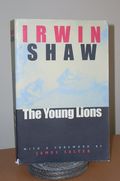 Periodically, I get book shopping updates from my longtime friend Dave in Seattle. Dave has been reading the works of Nelson Algren, John O’Hara and Irwin Shaw. Below are some of his recommendations:
Nelson Algren
I started with The Last Carousel (1973) which is a collection of short stories and essays. Rather uneven but some are quite good. If you like boxing stories (they don't do much for me), there are some good ones in there.
I finished The Man with the Golden Arm (1949). This was a new edition, which included some good essays on Algren and biographical info and found it interesting. Algren had an outstanding ear for dialog — possibly among the best of that era — and there's not a false note in the entire book. My only complaint is that the book seemed too long. Not that I was not captivated, but it could have used some editing near the end. (Everyone's a critic…)
Right now I'm reading A Walk on the Wild Side (1956) and am about 3/4 of the way into it. It's set in the depression, 1931, and follows a drifter named Dove who is just trying to get by. It's not like any other novel I've read; it's darkly comic and gritty but not without hope. I highly recommend it.
On deck is The Neon Wilderness (1947), a collection of short stories. This is reportedly his best work of short stories.
—– EXTENDED BODY:
John O’Hara
For short novels, I recommend Appointment in Samarra (1934) by John O'Hara. The cheap book shopper recommendation would be the Modern Library edition (was in print for many years) which is what I found for $5 recently. Also outstanding is the nice Modern Library edition of BUtterfield 8 (1935). Both novels represent the best of what O'Hara had to offer; razor-sharp dialog and a lean, supple style filled with wise observation.
Speaking as a book shopper, O'Hara's books are plentiful and cheap, as his literary star had fallen hard and fast by the 1970s. He was a drunk, a bully, and insufferably preoccupied with class and status and not a very nice man by all accounts. The man had talent though and these two early novels are some of his best work.
Irwin Shaw
And now we come to Irwin Shaw. Another much-maligned writer (many never forgave him for his success with Rich Man, Poor Man and the television mini-series craze this book inspired).
I just read his collection of stories, Act of Faith (1947) and found all of them good and a few among the best I have ever read. Highly recommended. All are war-related.
Shaw wrote what I think was the best novel to come out of World War II — The Young
Lions (1949). I read it a few years ago and was very impressed. The emotional maturity and keen observation in that novel ultimately makes it more interesting that Mailer's The Naked and the Dead, though it's been so many years since I read Mailer's book that it likely deserves another shot. The difference was that Shaw was older (born 1910) and what he saw while in the army during WWII was through the more mature eyes of a man already in his 30s. Mailer was considerably younger (born 1923).
Shaw wrote The Troubled Air (1951) which deals with radio broadcasting and blacklisting. Should be interesting; I have it but have not read it yet. It goes cheap these days, as does Lucy Crown (1956) which is somewhat lightweight, but has its moments.
I read Tip on a Dead Jockey (1957) and other stories years ago; I remember these as quite good too.
On Saturday, I had some time to do some serious book shopping, which includes finding homes for my old books, in preparation for my ongoing Big Read.
I began by trading several novelty baseball books with Jim
Adams at Decatur’s Books Again for
an autographed copy of Padgett Powell’s Mrs.
Hollingsworth’s Men as I became interested in Powell  after this recent
reading. I also found out that on Wednesday February 24th, Books
Again is hosting Literacy Volunteers of Atlanta’s, Executive Director Victoria
Kingsland for her discussion of Zora Neale Hurston’s 1937 novel Their Eyes Were Watching God. This is part
of National Endowment of the Arts’ The Big Read initiative. I am not that familiar with the Hurston, but
the complimentary NEA Reader’s Guide (available at Books Again) provides a thorough
overview of the significance of her writing.
after this recent
reading. I also found out that on Wednesday February 24th, Books
Again is hosting Literacy Volunteers of Atlanta’s, Executive Director Victoria
Kingsland for her discussion of Zora Neale Hurston’s 1937 novel Their Eyes Were Watching God. This is part
of National Endowment of the Arts’ The Big Read initiative. I am not that familiar with the Hurston, but
the complimentary NEA Reader’s Guide (available at Books Again) provides a thorough
overview of the significance of her writing.
Next I went to Eagle Eye Books in Decatur to unload a few more books including my reviewer’s copy of Michael Gates Gill’s How to Save Your Own Life. Sometimes a publisher hears about blogs like this one and sends me a book. But unless it has some local angle, I usually stay away from reviewing (too time-consuming). Gill was here last month in Atlanta promoting his perky self-help book.
—– EXTENDED BODY:
From Eagle Eye, I drove over at the William C. Carlos Museum BookShop where Director Mark Burell had left me a book for pickup — Chris Hedges’ Empire of Illusion The End of Literacy and the Triumph of Spectacle. I asked him earlier to be on look out for the book when it came out in paperback, but when the hard copy went on sale, Mark dropped me an email and said he’d hold a copy for me.
Instead of grocery shopping (not nearly as much fun) I stopped by Too Tall Tales in Toco Hills Shopping Center. Too Tall is a quaint store with an eclectic selection and I hadn’t been in there in a while. In the bargain room in the back they had hardback copies of Thomas Pynchon’s Inherent Vice (see my thoughts) and a Mark Kurlansky book, The Food of a Younger Land, which Atlanta foodies should be interested in. (Coincidently, Kurlansky’s book includes excerpts from the writings of Hurston.) They also had a reviewer’s copy of R. Frank Daniel’s FutureProof, but I opted for Barbara Ehrenreich’s Bright-Sided: How the Relentless Promotion of Positive Thinking Has Undermined America as I am still trying to wash the taste of the Gill book out of my mouth.
My final destination was the Decatur Public Library where I donated a few quality (in my opinion) duplicates from my library for the upcoming Friends of the Library book sale: This included Oscar Hijuelo’s The Mambo Kings Play Songs of Love, Tom Wolfe’s The Right Stuff and Ann McDermott’s That Night. My offerings were squat compared to the woman ahead of me with the shopping cart who was unloading several grocery bags full of paperbacks. Jim Adams of Books Again said he donated about 10 boxes of books as well. There’s plenty for everyone. The sale is being held from 9 a.m. to 4 p.m. on Saturday, February 27th..
If all that wasn’t enough, my recent order from Eighth Day Books in Wichita, Kansas was waiting for me in the mailbox when I got home. Since reading Clive James’ Cultural Amnesia, I’ve been interested in the early 19th century English essayist William Hazlitt, Eighth Day owner Warren Farha recommended the Oxford edition of Selected Writings.
It looks like I am well stocked for the next few months (but I’m always well-stocked), but it’s refreshing to do a little tour of local book stores and see what’s out there. It’s also important to try to find a home for my old books, so they don’t end up in the dumpster.
—– EXCERPT: —– KEYWORDS: —– COMMENT: AUTHOR: Elizabeth Wilson EMAIL: ewilsonpr@yahoo.com IP: 12.52.185.30 URL: DATE: 02/23/2010 09:03:37 AM Thanks for “publicizing” The Big Read at Books Again!!! —– ——– AUTHOR: Murray Browne AUTHOR EMAIL: murray.browne905@gmail.com TITLE: The Many Deaths of the Firefly Brothers: A Midwesterner’s Perspective STATUS: Publish ALLOW COMMENTS: 1 CONVERT BREAKS: wysiwyg ALLOW PINGS: 1 BASENAME: the-many-deaths-of-the-firefly-brothers-a-midwesterners-perspective CATEGORY: Book Reviews CATEGORY: Local Reviews UNIQUE URL: https://thebookshopper.typepad.com/the_book_shopper_atlantad/2010/02/the-many-deaths-of-the-firefly-brothers-a-midwesterners-perspective.html DATE: 02/15/2010 10:55:01 AM —– BODY:
At his well-attended reading on February 3rd at the Decatur Public Library, Thomas Mullen provided insights that were helpful in understanding his new book The Many Deaths of the Firefly Brothers, a novel set in the Midwest during The Great Depression. The main plot of the book centers around Jason and Whit Fireson, two notorious bank robbing brothers (and the women who loved them) who steal from not only banks but from death itself—by being able to be resurrect themselves even after being perforated by bullets.
One question for readers of the book is whether they can buy the supernatural premise “of crooks that death cannot hold,” which pushes Firefly from a historical novel similar to Mullen’s first book The Last Town on Earth (which I wrote about earlier) more towards the zombie genre. 
Perhaps since I grew up in the Midwest, (near a small city that bank robbers allegedly avoided because the railroad trains prevented quick getaways), I noticed there was little texture of the Midwest. I just found myself wanting more details and anecdotes than just a laundry list of towns and bank jobs – things like the weather and terrain, the crops (corn is king), the iconic radio stations, and examples of the dry humor of the no-nonsense rural types who inhabited my childhood.
After attending a couple of Mullen’s appearances and emailing with him, I do believe the hard-working author is capable of reaching that next level of writing that he professes to admire — that of the literary page turner (books like Jonathan Lethem’s Motherless Brooklyn, and Michael Chabon’s The Yiddish Policeman’s Union). But with Firefly Brothers, he’s just not there—yet.
P.S.: Mullen’s publisher Random House provided me with a review copy of Firefly Brothers. Coincidently, this week’s photo comes from the movie Road to Perdition. I happened to be in Chicago on the day they were filming some street scenes.
—– EXTENDED BODY: —– EXCERPT: —– KEYWORDS: —– ——– AUTHOR: Murray Browne AUTHOR EMAIL: murray.browne905@gmail.com TITLE: T.C. Boyle at the Margaret Mitchell House STATUS: Publish ALLOW COMMENTS: 1 CONVERT BREAKS: wysiwyg ALLOW PINGS: 1 BASENAME: tc-boyle-at-the-margaret-mitchell-house CATEGORY: Local Reviews UNIQUE URL: https://thebookshopper.typepad.com/the_book_shopper_atlantad/2010/02/tc-boyle-at-the-margaret-mitchell-house.html DATE: 02/07/2010 10:08:29 PM —– BODY:
Last week (Feb. 2), T.C. Boyle, the writer formerly known as T. Coraghessan Boyle, drew a crowd of about two hundred loyal readers—mostly middle aged types like Boyle himself, except he was the only one wearing a red Valentine’s Day suit. After quipping about the suit—noting that it was a fashion statement akin to Tom Wolfe’s white suit—Boyle did twenty minutes of one liners, followed by a half hour reading of the story, “The Lie” from his latest book Wild Child and Other Stories.
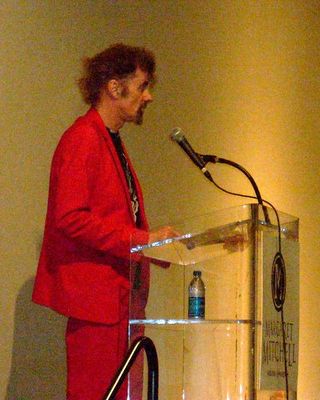 Boyle admits to his reputation as a showman, “I love to perform stories aloud…a service of turning people on to literature.” Patterning himself after a middle school teacher that he admired, Boyle performs like an amateur actor, reading expressively and constantly gesticulating. However, thirty minutes is a long time to be read to, and unless someone gives me milk and cookies and a mat I can lie down on, I get restless and bored no matter how good the prose.
Boyle followed his reading with a lengthy Q & A. He respects and appreciates his readers, including the woman who caught him off guard when she pointed out that one of the characters in “The Lie” appeared in one of his earlier stories. I guess if you write long enough like Boyle, who published his first book of short stories, Descent of Man, in 1979, (a book now available for pennies and still worth reading) you are bound to repeat characters.
—– EXTENDED BODY:
With a crowd of long-time readers, I was curious to know which of the approximately 20 books he’s published are the fan favorites (it’s unfair to think you’d like his every effort.) Some people mentioned Tortilla Curtain (1995) and The Road to Wellville (1993), the latter which was made into a movie. Boyle says he likes the money and increased exposure that comes with having a book made into movie, but has no desire to be involved with the screen writing process.
Boyle stayed around to sign books and chat with his fans, but it was a long line and I didn’t bring my favorite Boyle book, World’s End (1987), with me. Besides I had no money for a new book (a line prerequisite) as I blew my book allowance on the $10 Margaret Mitchell admission ticket, which did not include complimentary milk and cookies.
—– EXCERPT: —– KEYWORDS: —– ——– AUTHOR: Murray Browne AUTHOR EMAIL: murray.browne905@gmail.com TITLE: What Would Donna Seaman Do? STATUS: Publish ALLOW COMMENTS: 1 CONVERT BREAKS: wysiwyg ALLOW PINGS: 1 BASENAME: what-would-donna-seaman-do UNIQUE URL: https://thebookshopper.typepad.com/the_book_shopper_atlantad/2010/01/what-would-donna-seaman-do.html DATE: 01/31/2010 08:40:36 PM —– BODY:Sometimes the book shopping life can be a little
overwhelming and this week is one of them. First of all, it’s Abraham Lincoln
month and I have nothing prepared, so either enjoy my little Lincoln
bust or refer to last year's posting about our 16th President.
As I write this, I’m debating whether to see Robert Pinsky at Emory later on today or T.C. Boyle at Margaret Mitchell on Tuesday, or Thomas Mullen on Wednesday, February 3rd at the Decatur Public Library (I’m currently reading the Mullen book in preparation). It’s great to have so many choices, but frustrating that you can’t do it all and work a forty-hour week.
Also worth mentioning was the nomination of book critic Donna Seaman for the National Book Critics Circle Award (a winner has already been announced). In this brief online interview from Chicago Public Radio, she talks about the importance of reviewing to the Chicago book community, which I think should provide food for thought to Atlanta literary community as well.
Ms. Seaman is a personal favorite of mine. I have her book Writers on the Air: Conversations about Books (2005) from Paul Dry Books which has interviews with various writers including T.C. Boyle and Margaret Atwood (who is here on February 23rd at the Savannah College of Art and Design.) When I was working on my book for Paul Dry Books, Paul sent me Writers as a template of what a well-organized book looks like.
—– EXTENDED BODY: —– EXCERPT: —– KEYWORDS: Seaman, Mullen, Boyle, Atwood —– ——– AUTHOR: Murray Browne AUTHOR EMAIL: murray.browne905@gmail.com TITLE: Join the MARTA Book Club #3 STATUS: Publish ALLOW COMMENTS: 1 CONVERT BREAKS: wysiwyg ALLOW PINGS: 1 BASENAME: join-the-marta-book-club-3 CATEGORY: MARTA Book Club UNIQUE URL: https://thebookshopper.typepad.com/the_book_shopper_atlantad/2010/01/join-the-marta-book-club-3.html DATE: 01/24/2010 02:42:39 PM —– BODY:Even though new book clubs are sprouting up all the time such as the new Eddie’s Attic A-1 book club and the Better World/Whole Foods Book Club, the MARTA book club remains Atlanta’s book club of choice for individual readers.
For those unfamiliar with the club, the MARTA book club is a loose, very loose, confederation of people who read while riding the Metropolitan Atlanta Rapid Transit Authority’s public transportation. There are no meeting times, no organization, no t-shirts, and no special fares. Very convenient. The only requirement to be a member of the MARTA Book Club is to read a book while riding public transportation. Newspapers do not qualify. Those with Kindles are not welcome (because how in the hell am I supposed to figure out what you’re reading if I can’t see the book cover!) 
What We Are Reading: Of course, we have no way of knowing what EVERYONE is reading, but here’s a sample of what I have observed since last month's posting.
The Red Badge of Courage by Stephen Crane
The Stranger by Albert Camus
Encyclopedia of Major Saints and Fathers of the Orthodox Church by Basil E. Eleftheriou. Amazon is waiting for its first customer review on this one.
Heaven is a Playground by Rick Telander. This is my contribution to the club. Considered a sports book classic, this 1974 book chronicles life on the several young teenage basketball players as they struggle to move from the mean playgrounds of Brooklyn to college and possibly the pros.
2001 by Arthur C. Clarke
White Is a State Of Mind by Melba Pattillo Beals. (courtesy of Inga Long)
The Host by Stephenie Meyer. Twilight Series author’s first adult novel. (courtesy of Inga Long)
Them by Nathan McCall. A book about the gentrification in Atlanta’s Old Fourth Ward.
Unfinished Business by Brenda Jackson
How Starbucks Saved My Life by Michael Gates Gill. Coincidently, I saw someone reading this (and talking about his appearance in Atlanta), the day after I posted my blog review of his followup book (See January 17th posting). No harsh words were exchanged as all opinions are welcome.
Bicycle Diaries by David Byrne
I Have Chosen to Stay and Fight by Margaret Cho
Googled: The End of the World as We Know It by Ken Auletta
—– EXTENDED BODY:
Just after Sunset by Stephen King
A Touch of Dead (Sookie Stackhouse: The Complete Stories) by Charlaine Harris
The Relationship Principles of Jesus by Tom Holladay
Dreams Made Flesh (Black Jewels, Book 5) by Anne Bishop
Mythology by Edith Hamilton
Act of Treason by Vince Flynn
Secrets and Lies by Selena Montgomery
After All These Years by Susan Issacs
A Time to Kill by John Grisham
Shattered Chains (Magic: The Gathering) (No 3) by Clayton Emery
The Prometheus Deception by Robert Ludlum
The Lost Symbol by Dan Brown
Them by Nathan McCall. A book about the gentrification in Atlanta’s Old Fourth Ward.
Unfinished Business by Brenda Jackson
How Starbucks Saved My Life by Michael Gates Gill. Coincidently, I saw someone reading this (and talking about his appearance in Atlanta), the day after I posted my blog review of his book. No harsh words were exchanged as all opinions are welcome.
Realistic Architectural Visualization with 3ds Max and Mental ray, Second Edition (Autodesk Media and Entertainment Techniques) by Roger Cusson and Jamie Cardoso
The Bible. A standard for many MARTA faithful.
What members thought: Readers are encouraged to keep their thoughts (and eyes) to themselves. No time is wasted talking about books when you could be reading.
Next assignment: Keep reading and get to work on time.
—– EXCERPT: —– KEYWORDS: —– COMMENT: AUTHOR: Rube Ambler EMAIL: atlalist@atlalis.com IP: 71.204.25.58 URL: http://atlalist.com DATE: 01/25/2010 06:39:37 AM Thanks for the mention. We’re still doing the group thing, but of course love the individual book club concept too. Hope you can join us at Eddie’s. Best, Rube —– ——– AUTHOR: Murray Browne AUTHOR EMAIL: murray.browne905@gmail.com TITLE: Michael Gates Gill in Atlanta: A Preview STATUS: Publish ALLOW COMMENTS: 1 CONVERT BREAKS: wysiwyg ALLOW PINGS: 1 BASENAME: michael-gates-gill-in-atlanta-a-preview CATEGORY: Book Reviews CATEGORY: Local Reviews UNIQUE URL: https://thebookshopper.typepad.com/the_book_shopper_atlantad/2010/01/michael-gates-gill-in-atlanta-a-preview.html DATE: 01/17/2010 06:20:14 PM —– BODY:
Michael Gates Gill, author of the bestselling How Starbucks Saved My Life will be in Atlanta on Monday, January 18th. Gill is on tour to promote his new book How to Save Your Own Life: 15 Lessons on Finding Hope in Unexpected Places.
Gill’s New York publisher Gotham Books/Penguin has been so proactive in promoting his new book that they’ve even supplied small-tater bloggers such as myself with advance copies of the book. Always a sucker for a free book, I obliged.
Gill’s new book picks up where I assume (no one gave me a complimentary Starbucks book) where his last book left off, with Gill at retirement age happily working as a coffee barista. He’s apparently much more satisfied serving people 20 ounce Starbucks Venti White Chocolate Mochas (580 calories and 15 grams of saturated fat) than he was as a corporate advertising executive at J. Walter Thompson, his former life of wealth and prestige that he reminds us of many, many times. 
Gill’s new book is a response to the thousands (yes, thousands) of people who have sought his advice (including the actor Michael J. Fox). Thus inspired, Gill has boiled down his advice into 15 lessons/chapters of wisdom that he has gleaned over the past couple of years. Some came from his family like his famous writer-father Brendan Gill of The New Yorker.
In each chapter, Gill keeps his teachings simple with a lot of one-sentence paragraphs.
But if the topic is complicated —such as what it means to be a late bloomer — he might expand his thoughts to two or even three sentences. A good example is when he explains that the term late bloomers originates from “the garden term used to describe flowers that bloom late in the season.”
If you still can’t get the message, Gill drops in a few helpful adages at the end of each chapter such as “Your life is like the weather: You can talk about it a lot, but in the most profound way, you can never completely control it.”
Gill has a kitchen-sink, percolating writing style as he tosses in passages from the Bible, verses of songs, verses of songs that he wrote himself, the poetry of William Butler Yeats, lines from James Joyce’s Ulysses, and proverbial clichés such as “laughter is the best medicine.” I am guessing his scattershot prose style can partially be attributed to his taking advantage of one of his employee “perks” (his quotes, not mine) that include a weekly free pound of high octane coffee.
—– EXTENDED BODY:I think what surprises me most about this book is that effort that went into bringing it fruition. In the acknowledgements, Gill thanks his publisher, his editor, his Hollywood agent, (there are efforts to make the Starbucks book into a movie), his publicity people and his agent slash creative catalyst (I need one of those) for “publishing books that help people."
With all this marketing and brainpower, I am surprised no one remembered to include Lesson 16, the most important lesson of all when it comes to managing your time and setting priorities: Avoid crappy self-help books.” I guess after reading How to Save Your Own Life, that message is understood
—– EXCERPT: —– KEYWORDS: —– COMMENT: AUTHOR: Jane EMAIL: byjane73@yahoo.com IP: 71.193.29.185 URL: http://midlifebloggers.com DATE: 01/31/2010 10:40:46 PM If nothing else, Gill’s book gave the two of us opportunities to have a bit of fun. —– ——– AUTHOR: Murray Browne AUTHOR EMAIL: murray.browne905@gmail.com TITLE: Noteworthy STATUS: Publish ALLOW COMMENTS: 1 CONVERT BREAKS: wysiwyg ALLOW PINGS: 1 BASENAME: noteworthy UNIQUE URL: https://thebookshopper.typepad.com/the_book_shopper_atlantad/2010/01/noteworthy.html DATE: 01/09/2010 06:20:22 PM —– BODY:A few notes on the Atlanta-Decatur scene:
Tom Mullen
The January issue of Atlanta Magazine ran a preview of Decatur novelist Thomas Mullen’s upcoming The Many Deaths of the Firefly Brothers along with a brief interview with the author. You can download the whole issue on the magazine’s website for under a dollar or you can see Mullen’s book tour opener at the Decatur Public Library on Wednesday, February 3rd. Mullen also keeps a blog on some of his activities. I am still waiting on his follow-up response to the Atlanta Magazine interview or perhaps read his thoughts about Boston Red Sox revamping the left side of their infield (he’s big fan of the BoSox since he grew up in Rhode Island). I’ve heard Mullen at the library before and he has kind of dry Yankee wit, which can be entertaining.
Kymaerica
While pounding through the backlog of my Believer magazines, I read a fine article entitled “Discover Kymaerica” in the November-December Art issue by Emory University’s Michael A. Elliott. Kymaerica is a mythical parallel universe that intersects our planet at various locations. Elliot begins his article about an Kymaerican historical marker located on the Atlanta industrial West side, but the feature story evolves into an essay on the timelessness of past civilizations (real and fictitious). Elliot is a professor of English and author of Custerology: The Enduring Legacy of the Indian Wars and George Armstrong Custer.
Gilbert vs. Phillips
And finally, The Battle of the Big Name Authors is set for Monday, January 11th in Decatur. Elizabeth Gilbert of Eat, Pray and Love fame makes a tour stop for her new book Committed at Agnes Scott College while National Book Award Finalist Jayne Anne Phillips, is at the Decatur Public Library at approximately the same time. Again, a kind of intersection of two universes. These collisions are bound to happen once in a while, I guess, especially when the orbits of some writers are so big.
—– EXTENDED BODY: —– EXCERPT: —– KEYWORDS: —– ——– AUTHOR: Murray Browne AUTHOR EMAIL: murray.browne905@gmail.com TITLE: Zoo Story: Play or Reading? STATUS: Publish ALLOW COMMENTS: 1 CONVERT BREAKS: wysiwyg ALLOW PINGS: 1 BASENAME: zoo-story-play-or-reading UNIQUE URL: https://thebookshopper.typepad.com/the_book_shopper_atlantad/2009/12/zoo-story-play-or-reading.html DATE: 12/31/2009 11:46:02 AM —– BODY:
December is a barren time for author readings and subject matter for postings is usually limited to “Best Books” and “Worst Books” and “Most Underrated Books.” With this in mind, I’ve temporarily expanded the scope of the blog to local theatre. It’s still all about words, right?
Earlier this week my older daughter and I checked out Decatur’s PushPush Theatre's final performance of the Edward Albee’s 1958 one-act play, Zoo Story. Sheepishly I’ll admit it’s the first time I’ve been there since PushPush hosted a screening of the documentary Paperback Dreams.
My daughter who attends plays regularly in Boston (she has a secret ambition of starting a Moliere theatre troupe so graduate students can practice their French) appreciated the performances of Tim Habeger and Charlie Adair who play two men whose opposite worlds collide at a picnic bench in Central Park.
I’m not sure why only six people attended (holiday week, chilly temperatures, a strong local dislike of the Americanization of The Theatre of the Absurd?), but that made no difference to me or the actors as they remained unfazed even when one of the patrons spilled his M & Ms onto the stage. In a way, the sparse short play like Zoo Story is similar to a reading – and in this case better than most readings — because at the most basic level it is about the words and who knows better how to say the words than someone with a little stage experience.
Important Note: Zoo Story is the first of what PushPush calls its The Working Masterpiece Series. According to their website, PushPush “will produce a series of low-budget, classic plays to give theater and film people a chance to gain experience with some of the greatest writers of stage and screen.” Next play is Harold Pinter’s The Caretaker.
—– EXTENDED BODY: —– EXCERPT: —– KEYWORDS: —– ——– AUTHOR: Murray Browne AUTHOR EMAIL: murray.browne905@gmail.com TITLE: A Book Shopper’s Top Ten Books of 2009 STATUS: Publish ALLOW COMMENTS: 1 CONVERT BREAKS: wysiwyg ALLOW PINGS: 1 BASENAME: a-book-shoppers-top-ten-books-of-2009 UNIQUE URL: https://thebookshopper.typepad.com/the_book_shopper_atlantad/2009/12/a-book-shoppers-top-ten-books-of-2009.html DATE: 12/21/2009 09:39:17 PM —– BODY:As a book shopper who always weighs price vs. literary merit, my top ten list usually doesn’t include books published in 2009 as I rarely purchase the latest, fashionable book. I prefer to experience those connections that put me in contact with the right book at the right time. Here are the books that fill up my Christmas Story Book Bag this year:
Famous Long Ago: My
Life and Hard Times at Liberation News Service by Ray Mungo (1971). Books
Again in Decatur had a hard back
copy first edition that I been drooling over not unlike Ralphie gazing through the storefront
window at a Red Ryder BB gun. Books
Again owner Jim Adams made me a good deal on some trade in and I was able to
add to my collection of hardbacks from the New Journalists (Tom Wolfe, Joan
Didion, Hunter S. Thompson).
Oedipus Cadet (1990) by Willie Smith, and the Cleveland Indian: The Legend of King Saturday (1992) by Luke Salisbury. My book shopping compatriot Dave in Seattle sent these two books as gifts. Cadet was a bizarre book in the way it mixed baseball with the Civil War and a teenage boy’s sex fantasies. I’ll probably get to the Cleveland Indian book in the Spring when my fancy turns to baseball.
My Usual Game (1995) by David Owen. I picked this up for a couple bucks on ACappella’s discount shelf outside their store on the same night Owen was speaking at the Carter Center. What a coincidence! I intended to give Owen’s book about golf to my brother as a Christmas gift, but it still sits in my to-be-read queue.
Cultural Amnesia (2007) by Clive James. My book friend Bruce in Wichita highly recommended it and so I used all my store credit at Eagle Eye to order a copy. I’ve been reading it off and on throughout the second half of the year. A fascinating collection of essays about mostly 20th century artists, writers, thinkers, and film directors who enrich the spirit of humanism, as James says “by increasing the variety of the created world rather than reduce it.”
Absurdistan (2006) by Gary Shteyngart. At the Book Nook in Decatur, I picked up this much-acclaimed novel about a rich, sarcastic overweight young Russian man, who returns to his homeland to see his father only to be swept up into one of those small ugly civil wars that seem to be only too commonplace in Central Asia. It’s kind of like Dr. Zhivago meets A Confederacy of Dunces. At five dollars, it was a solid read.
—– EXTENDED BODY:
The Man Who Loved Books Too Much by Allison Hoover Bartlett (2009). After doing a reading in Knoxville, the book store owner gave me this uncorrected proof of this book as a kind “honorarium.” Her thinking was probably something like this: “He likes books and this book has the word “book” in the title. Why not free up some shelf space?”
A sack full of Books by various authors. For participating at the Great Lakes Independent Bookseller’s Association trade show in Cleveland in October. I received a huge sack of books gratis, which I could not bring back with me on the airplane. Nevertheless an autographed copy of Nami Mun’s Miles from Nowhere (we chatted in the hallway briefly; she likes ACappella.) made it into my carryon. The classiest author I met that weekend was Daniel Roth who edited his father’s Depression-era diaries and turned it into The Great Depression: A Diary. I gave the book to my friend Denise’s father who turns 90 next year. Flashing back to the days of his youth, he found the book thoroughly engaging.
And finally, my own book The Book Shopper: A Life in Review (2009). You try for ten years to get a book published and it finally gets published; it deserves to be on somebody’s Top Ten list.
– AUTHOR: Murray Browne AUTHOR EMAIL: murray.browne905@gmail.com TITLE: Join the MARTA Book Club #2 STATUS: Publish ALLOW COMMENTS: 1 CONVERT BREAKS: wysiwyg ALLOW PINGS: 1 BASENAME: join-the-marta-book-club-2 CATEGORY: MARTA Book Club UNIQUE URL: https://thebookshopper.typepad.com/the_book_shopper_atlantad/2009/12/join-the-marta-book-club-2.html DATE: 12/14/2009 07:56:05 AM —– BODY:
The MARTA book club is a loose, very loose, confederation of people who read while riding the Metropolitan Atlanta Rapid Transit Authority’s public transportation. There are no meeting times, no organization, no t-shirts, and no special fares. Very convenient. The only requirement to be a member of the MARTA Book Club is to read a book while riding public transportation. Newspapers do not qualify. Those with Kindles are not welcome (because how in the hell am I supposed to figure out what you’re reading if I can’t see the book cover!) 
What We Are Reading: Of course, we have no way of knowing what EVERYONE is reading, but here’s a sample of what I have observed since last month's posting:
The Archaeology of Knowledge & The Discourse on Language by Michel Foucault
Absurdistan: by Gary Shteyngart. One of my contributions to the group. I picked up my copy for $5 at The Book Nook in Decatur.
Going Rogue: An American Life by Sarah Palin et. al. Despite over a half million books published; no sightings to report.
Dreams from My Father: A Story of Race and Inheritance by Barrack Obama.
Little Dorrit by Charles Dickens. Not everyone gets sucked into A Christmas Carol hype.
Our Choice: A Plan to Solve the Climate Crisis by Al Gore. Motivation for the public transportation commuter.
State by State: A Panoramic Portrait of America edited by Matt Weiland and Sean Wilsey. A repeat from last month.
Total Money Makeover by Dave Ramsey Tips on how to save money, so you can buy a car?
The Bible. A standard for many MARTA faithful.
Five Points The Journal of Literature and Art (Vol 9 No. 1) from Georgia State University. I picked up my copy at the Decatur Book Festival but am disappointed that it contained no stories about life at MARTA’s main transportation hub.
Atlas Shrugged. by Ayn Rand
Preaching with Passion by Alex Montoya and John MacArthur.
More Stories from the Heart by Alice Gray.
The Disappearance by J.F. Freedman.
16 Lighthouse Road by Debbie Macomber. Coincidently, she was in town at the Decatur Public Library last month.
The Law of Success by Napoleon Hill.
Frankenstein Dead and Alive: A Novel by Dean Koontz
Small Wonder: Essays by Barbara Kingsolver
Water for Elephants: A Novel by Sara Gruen
What members thought: Readers are encouraged to keep their thoughts (and eyes) to themselves. No time is wasted talking about books when you could be reading.
Next assignment: Keep reading and get to work on time.
—– ——– TITLE: 10 Time Saving Tips for the Holidays DATE: 11/29/2009 09:33:30 AM —– BODY:The pressure to get all the book shopping, wrapping, cooking and entertaining done over the holidays is tremendous. Try these time savers to relieve some of that yuletide anxiety:
- Place gifts in boxes and then spray paint them instead of wrap them. Be sure and avoid an open flame, i.e., fireplace, candle.
- Look
for discarded end-of-the-year newsletter near the office copier or in the
recycle bin at your neighborhood copy center. This can easily be repurposed
as your own communiqué. Don’t worry if your annual yuletide biography
doesn’t match up. No one reads them that close anyway.
- Shorten
holiday cooking time, by foregoing constant washing of your hands while
preparing the feast. Take enough shortcuts and it’s doubtful you’ll be
asked to host next year’s celebration.
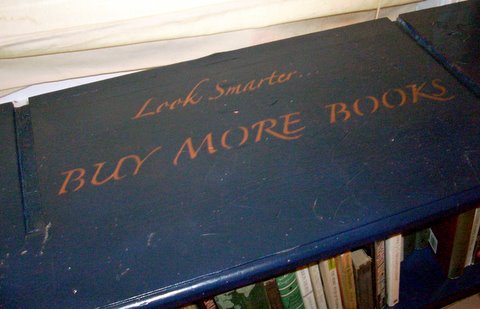
- In gift exchange settings, instead of choosing names for gifts, chose a single place where ALL the gifts must be purchased. Make it more creative (and easier) by limiting the designated retailer to the neighborhood convenience store or perhaps, a hospital gift shop.
- Before watching a holiday movie, fast forward it to the dénouement. For example, in It’s a Wonderful(ly Dull) Life began watching at the point where George Baxter (Jimmy Stewart) receives the best Christmas gift ever – lots of tax free cash.
- Leave up Christmas lights year round. Explain to neighborhood critics that you leaving the lights festooning from the gutters in order to celebrate when an estranged relative returns from some ancient family spat.
- Holiday music can be rerecorded at a faster speed. Don’t be too over-zealous, otherwise, “Silent Night” begins to sound too much like the Chipmunks’ “Christmas Don’t Be Late.”
- For churchgoers, arrive late, leave early. Stay long enough just to show some contempt for once-a-year Christians who have “forced” you to stand in the back near the exit.
- Instead
of decorating and redecorating a tree every year, just drag the artificial
tree—ornaments, lights and all, into the corner behind that pile of unused
exercise equipment. Everyone will pretend it doesn’t exist.
- Print this article or better yet spam it to your friends and associates by email. Expressing your true feelings about the holidays will eliminate you from their holiday lists — perhaps the greatest gift you can give anyone.
—– EXCERPT: —– KEYWORDS: —– COMMENT: AUTHOR: College Research Papers EMAIL: flash.papers@gmail.com IP: 221.120.250.103 URL: http://www.flashpapers.com DATE: 03/08/2010 02:23:16 AM Such a nice post, it is really interesting, want to admire you, you are really done a nice work, Thanks. —– ——– AUTHOR: Murray Browne AUTHOR EMAIL: murray.browne905@gmail.com TITLE: Eighth Day: A Book Store Worth Visiting STATUS: Publish ALLOW COMMENTS: 1 CONVERT BREAKS: wysiwyg ALLOW PINGS: 1 BASENAME: eighth-day-a-book-store-worth-visiting CATEGORY: Bookstores UNIQUE URL: https://thebookshopper.typepad.com/the_book_shopper_atlantad/2009/11/eighth-day-a-book-store-worth-visiting.html DATE: 11/21/2009 08:24:54 AM —– BODY:
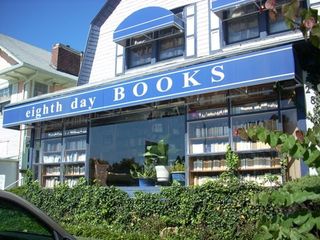
Last month when I was in Wichita, Kansas to visit my book friend Bruce Woods and do a little self promotion, Bruce set up a lunch with Warren Farha, the owner of Eighth Day Books.
For twenty years, Farha has been in the business of selling books. His store, a converted three story house, holds about 40,000 books specializing in the timeless classics in religion, philosophy, history and literature. It is one most impressive book stores I’ve browsed through in a long time. Fortunately, you don’t have to visit the store to get a sense of Farha’s vision. The store’s 170 page catalog describing over 1200 books provides a well-rounded education in itself, as each listed book has a long paragraph that captures the essence and importance of the book.

What strikes me as much as Farha’s thoughtful passion for books that refresh the soul (and his resemblance to the actor Richard Gere) is the underlying hardworking business ethic that he learned from working in the family grocery business. He understands the daily rituals required for successful retail sales, which includes in his case, gleaning book ideas from customers (on my suggestion, he ordered a copy of Andres Kertesz book, On Reading for his store). Several times a year he takes his offerings on the road to strategic conferences and book fairs. As we ate lunch, he would talk without fear about the new paradigms of book selling. He understands that selling books online (whether it be through Amazon or his own website) is a trend that is not going away.
—– EXTENDED BODY:
Farha and his staff do a sizeable part of their business online and by mail order. And if you call them at 1.800.841.2541 during business hours, you will, as their brochure boasts “get to talk to a real, live person.” My recommendation is if you can’t make the drive to Wichita, order that catalog.
Fortunately for us, Farha deals in books that endure. And his store serves as a reminder that there is a market for those who read for more than just entertainment.
—– EXCERPT: —– KEYWORDS: —– COMMENT: AUTHOR: BookWhirl EMAIL: mramos@bookwhirl.com IP: 222.127.145.35 URL: http://www.earthtimes.org/articles/press/service-starter-video-caign,1406308.html DATE: 08/11/2010 02:06:28 AM It looks elegantly classic! Where’s the exact location of this store? Do they have a website where i can browse more information? —– COMMENT: AUTHOR: BookWhirl EMAIL: donharold@bookwhirl.com IP: 110.55.115.161 URL: http://www.facebook.com/pages/Book-Marketing-Services-BookWhirlcom/114852370417 DATE: 01/22/2013 09:18:57 PM That’s a lot of books. Many readers would interest to visit this store. I am so amaze of what I’ve read! —– COMMENT: AUTHOR: BookWhirl EMAIL: donharold@bookwhirl.com IP: 110.55.115.161 URL: https://twitter.com/bookwhirl DATE: 04/09/2013 10:52:46 PM The ambiance are so good! I also like to position of your books. It is a style… —– ——– AUTHOR: Murray Browne AUTHOR EMAIL: murray.browne905@gmail.com TITLE: WVIK & The Book Shopper STATUS: Publish ALLOW COMMENTS: 1 CONVERT BREAKS: wysiwyg ALLOW PINGS: 1 BASENAME: wvik-the-book-shopper UNIQUE URL: https://thebookshopper.typepad.com/the_book_shopper_atlantad/2009/11/wvik-the-book-shopper.html DATE: 11/16/2009 08:12:47 AM —– BODY:This weekend NPR affiliate WVIK (from the campus of Augustana College in Rock Island, Illinois) broadcast an interview with me for their About Books radio program. Listen here. During the course of the interview, I did some shout outs for several local Atlanta area new/used book stores, so if book shoppers from the Quad Cities wander into A Cappella or Eagle Eye in the next few weeks, those booksellers will know who to thank.
—– EXTENDED BODY: —– EXCERPT: —– KEYWORDS: —– ——– AUTHOR: Murray Browne AUTHOR EMAIL: murray.browne905@gmail.com TITLE: Join the MARTA Book Club STATUS: Publish ALLOW COMMENTS: 1 CONVERT BREAKS: wysiwyg ALLOW PINGS: 1 BASENAME: join-the-marta-book-club CATEGORY: MARTA Book Club UNIQUE URL: https://thebookshopper.typepad.com/the_book_shopper_atlantad/2009/11/join-the-marta-book-club.html DATE: 11/08/2009 08:51:14 PM —– BODY:The MARTA Book Club is a loose, very loose, confederation of people who read while riding the Metropolitan Atlanta Rapid Transit Authority’s public transportation. There are no meeting times, no organization,  no t-shirts, and no special fares. Very convenient. The only requirement to be a member of the MARTA Book Club is to read a book while riding public transportation. Newspapers do not qualify.
What We Are Reading: Of course, we have no way of knowing what EVERYONE is reading, but here’s a sample observed over the last month:
The Lost Symbol, Dan Brown (3 spottings). Not unexpected since advertisements are all over Kroger shopping kiosks.
State by State: A Panoramic Portrait of America edited by Matt Weiland and Sean Wilsey. The book’s premise is 50 different writers writing about 50 different states. Impressive since it is such a thick book to carry around.
The Road Less Traveled by M. Scott Peck. Published in 1978, it was on the bestseller list for about a gazillion years. (Perhaps mistaken for a travel guide.)
—– EXTENDED BODY:All the Pretty Horses by Cormac McCarthy. Can’t help notice Chip Kidd book cover art,
Exodus by Leon Uris. First published in 1958.
Traffickers by W.E.B. Griffin and William E. Butterworth IV.
The Killing Hour by Lisa Gardner
Faceless by Debra Webb
The Throne of Bones by Brian McNaughton
Islam in Focus by Hammudah Abd Al-Ati
Granta: The Magazine of New Writing, Issue 106 – Not really a book, but a literary magazine. Includes one of those standard my-immigrant-mother-is-driving-me-crazy stories from Ha Jin. Also includes a very good short story from Amy Bloom, but the best piece is Nicola Barker’s “For the Exclusive Attn of Ms Linda Withycombe. This lengthy British humor piece is a 25 page letter of a man complaining to the authorities about a woman who collects waste from offending dog walkers and then hangs the plastic bags of feces in trees.
Oedipus Cadet by Willie Smith. Written in 1990, Oedipus Cadet is the story of a middle school boy Randy Cruikshank who wrestles with puberty while dealing with a difficult home life. Set in 1957, Randy fantasizes about being a World War II pilot and sees his father as Adolf Hitler.
What members thought: Readers are encouraged to keep their thoughts (and eyes) to themselves. No time is wasted talking about books when you could be reading.
Next assignment: Keep reading and get to work on time.
—– EXCERPT: —– KEYWORDS: —– COMMENT: AUTHOR: Ian Joyce EMAIL: IP: 24.136.183.15 URL: http://profile.typepad.com/ianjoyce DATE: 11/09/2009 01:03:33 PM Are you making your move to become the Oprah of the mass transit masses? Or is this as democratic as it seems? Btw, I learned my lesson about mixing Mark Helprin and mass transit. His books seem to cause the crazies to gravitate in my direction. —– ——– AUTHOR: Murray Browne AUTHOR EMAIL: murray.browne905@gmail.com TITLE: Two Local Readings: Rita Mae Brown and Padgett Powell STATUS: Publish ALLOW COMMENTS: 1 CONVERT BREAKS: wysiwyg ALLOW PINGS: 1 BASENAME: two-local-readings-rita-mae-brown-and-padgett-powell CATEGORY: Local Reviews UNIQUE URL: https://thebookshopper.typepad.com/the_book_shopper_atlantad/2009/11/two-local-readings-rita-mae-brown-and-padgett-powell.html DATE: 11/02/2009 08:05:44 AM —– BODY:
Last week I attended two readings: Rita Mae Brown at the Margaret Mitchell House on October 27th, and Padgett Powell two days later at the Decatur Public Library.
Part One: Rita Mae Brown
I’m still mad at myself for not asking Rita Mae Brown my stock-in-trade question about Southern books, which goes something like this: “If William Faulkner and Flannery O’Connor are the twin pillars of Southern literature, where does that leave Margaret Mitchell?”
It’s not an unfair question for Ms. Brown who offered some strong opinions about literature in her 1988 book, Starting from Scratch: A Different Kind of Writer’s Manual. Ms. Brown, who was promoting her new book, Animal Magnetism My Life with Creatures Great and Small (Move over James Herriot) spoke to an older crowd of approximately 50 pet lovers, who were content to ask questions like “How do you name your pets and do you ever eat them?” (Actually the latter question was framed more like: “Are you a vegetarian?”) 
The energetic, self-winding Ms. Brown (I should have used a high speed film to capture the movement of her hands) riffed on an array of subjects: Growing up in the South, the sophisticated forms of communication between animals (when dogs wag their tails that’s good; when cats curl their tails that’s bad), the broken contract between humans and domesticated animals (millions of pets are euthanized each year), 10,000 years of patriarchy that define human history (men’s efforts to control female sexuality), and the how we’ve become more intolerant because we don’t ride the bus and mingle with other people. (I take the train, but I keep to myself.) It’s pretty safe to say there was no discernable thread to all of Ms. Brown’s observations, (not to say she isn’t observant and witty). I don’t think it mattered to the majority of attendees who paid for the opportunity to join the stampede at the book signing table afterwards for a brief chat with an author either about pets or perhaps to express their continued appreciation of Ms. Brown’s most influential book, Rubyfruit Jungle (1973).
Part Two: Padgett Powell
Like Rita Mae Brown, Padgett Powell goes all over the place, except with Powell he was reading from his new “experimental” novel The Interrogative Mood: A Novel? – a 170+ page book written entirely as a series of seemingly unrelated questions. Of course to the uninitiated like myself, (admittedly unfamiliar with his work) what may seem random and disjointed at first, may upon further investigation reveal a theme or pattern to this work. (My unasked question to Mr. Powell was: How should a reader approach this book?)
—– EXTENDED BODY:For a half an hour, a Mr. Powell read question after question in a dry, detached tone to a crowd of what appeared to be his core readers—many had several books of his with them The questions were sometimes related to each other, sometimes not. At the risk of violating the “narrative,” here’s a sample of some of the questions:
Would you eat animal crackers? (a good question for Rita Mae Brown)
Who is the best quarterback of all time?
Can you ride a bicycle well?
What is the ideal complexion of a cow?
Do you know the distinction between moss and lichen?
Why am I asking all these questions?
Would you wear someone else’s underwear?
Am I wasting your time? Are you wasting mine?
Do you have more fears than hopes? Or more hopes than fears?
In the dimmed light of the library auditorium, the glow of a florescent light shining upon his face and glasses. Mr. Powell read in a dry, monotonous voice that shifted only perceptibly, thus creating a tension in his “narrative.” The audience laughed appreciatively at the questions, perhaps sometimes nervously at the dark humor. And although the questions may seem nonsensical at times, there is no doubt that the prose is precise.
As aloof as Mr. Powell might have seemed during the reading I was impressed during the Q & A afterward, not only by the intelligent questions of his readers, but with the candor, wit and respect evident in his replies. Mr. Powell shared his thoughts about the difficulties of getting his work published, suggested that the main characters of his 2002 book, Mrs. Hollingsworth’s Men (Voices of the South) were based on Jane Fonda and Ted Turner, and joked about his hopes that Parker Brothers would develop a board game from his book of questions and pay him beaucoup of royalties. Powell also paid homage to his mentor, the writer Donald Barthelme.
I doubt that I’ll pick up The Interrogative Mood: A Novel? any time soon but Mr. Powell’s other works including Mrs. Hollingsworth’s Men seems worth a serious look in the future. That’s what always surprises me about readings. You go to hear about a new book and maybe you’re unsure about it, but still you realize that the evening and the prose engaged you enough to think about it for the next day or two. It reminds me of an adage Rita Mae Brown once wrote, “If you’re not reading books that challenge you, you’re reading the wrong books.”
—– TITLE: Pynchon Post Party DATE: 10/25/2009 07:04:54 AMBack in August, A Cappella Books hosted a little coming out party for Thomas Pynchon’s latest book, Inherent Vice. I didn’t make it to the late night festivities, but I did stop by and pick up a copy of the book. It took me almost three months to read it (no reflection of the book), but I did finish it.
As a Pynchon fan, who likes most of his writings, Inherent Vice, a crime noir set in the seedy section of LA called Gordita Beach in the late 60s, is solid Pynchon. The book is certainly a worthy addition to my dream of a Thomas Pynchon book club, along with my other Pynchon favorites Gravity’s Rainbow, The Crying of Lot 49 and Against the Day.
The main character of Inherent Vice, Larry “Doc” Sportello, is a perennially stoned private investigator who at the request of his ex-girlfriend looks into the disappearance of a millionaire real estate mogul. Doc isn’t a gumshoe; he’s a “gumsandal” and hardly a tough guy but a persistent one and somewhat fearless since his faculties for making good decisions are often impaired.
“Pot jokes” are usually as lame as “fart jokes,” but the marijuana and drugs in Inherent Vice is really tertiary. It’s a fun book that playfully satirizes the detective story and is suitable for those (like me) who rarely read that genre. There are many cultural references: TV and movies (Godzilla’s Island), beach music (see the playlist) and of course, California traffic patterns (“The kindest thing anybody ever called the parking lot in Gordita Beach was nonlinear.”) The book is peppered with those hip Pynchon one-liners as well (“Her hair was styled by someone who was trying to give up smoking.”) that I can easily drop into my own vernacular.
—– EXTENDED BODY:
But that doesn’t mean the book doesn’t have its political side as Pynchon writes about the early days of the Internet and includes a prediction that era of total surveillance will soon be upon us. However for an investigation of any deeper meaning will require a second reading. A task more suited for a Thomas Pynchon book club.
Again I’m sorry I missed the party back in August, but I still appreciate the invitation. I hope to be invited back in a couple of years.
– TITLE: Wichita Connections DATE: 10/19/2009 07:55:30 AM —– BODY:Last weekend, I was in Wichita
to visit my longtime friend, Bruce Woods, and do a reading at a local
independent shop, Watermark Books.
As an author you think you’re on the road to “sell” your book, but on a good trip that task becomes a distant responsibility – you’d rather just talk books. Over a two day period, Bruce introduced me to members of the 20-years-and-running book group he founded as well as other Kansas readers. My job was made easier since he purchased books for many of his book colleagues and all I had to do was provide individual inscriptions. (I told Bruce that I’m setting up a policy that I will stay at the home of anyone who buys more than twenty books.)
A couple of the more influential books Bruce introduced me to over the years are David Shi’s A Simple Life and, more recently, Clive James’ Cultural Amnesia. We don’t always agree (Wendell Berry’s Jayber Crow comes to mind), but there is plenty of common ground. His friends are fascinating as well and in a future posting I’ll provide an account of my time at Eighth Day Books another wonderful independent bookstore in Wichita.
 In the photo, Bruce and I pose after the Watermark reading.
Notice that I am holding a trophy, which served as a gag prop I used that
evening. Of course there is a story behind it, and if you didn’t make it out
you can read about it here (See Chapter Two).
In the photo, Bruce and I pose after the Watermark reading.
Notice that I am holding a trophy, which served as a gag prop I used that
evening. Of course there is a story behind it, and if you didn’t make it out
you can read about it here (See Chapter Two).
This week at BiblioBuffet: Writing Worth Reading, Reading Worth Writing About, the web site has published an essay adapted from one of the chapters of my book, The Book Shopper: A Life in Review AND a review about the book by Nicki Leone (uh-oh) AND an editor's note explaining how this came about.
TITLE: Missed Pat Conroy? DATE: 08/16/2009 04:46:36 PM —–No surprise that the Pat Conroy reading next Wednesday at the Carter Center
is sold out, but don’t despair
too much if you didn’t make it. One alternative is to make a trip to Beaufort,
South Carolina. Denise and I went there a
couple years ago and noticed that several book shops stocked signed  copies of
his books. According to the bio on his website, (and I don’t exactly envy that
successful writer’s personal life, but that’s a story unto itself) Conroy lives
on nearby Fripp Island .
copies of
his books. According to the bio on his website, (and I don’t exactly envy that
successful writer’s personal life, but that’s a story unto itself) Conroy lives
on nearby Fripp Island .
While you are there take a walking tour in Beaufort. Our guide showed us where Conroy lived and wrote one of his early novels and the house where they filmed The Great Santini. You can also stop by the shop that sells those boxes of chocolates so shamelessly promoted in Forrest Gump. (Oops—started to confuse Winston Groom with Pat Conroy…) Anyway, if you want a recommendation for a tour guide in Beaufort let me know. Ours kept us entertained for hours with stories of Conroy’s Low Country.
—– TITLE: WILL Radio Interview DATE: 08/12/2009 06:58:57 AM —–Last
week I was in Champaign,
Illinois to visit
family and friends. While I was there I was invited by public radio WILL-AM 580
for a brief interview about my book, The Book
Shopper: A Life in Review. Coincidentally, I worked at that station as a
night operator thirty years ago, a very productive reading period that appears
as an anecdote in the book. You can listen to the interview here.
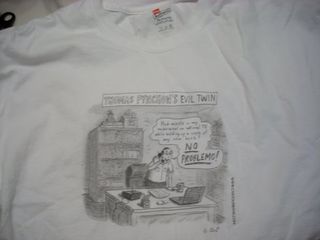 I’m excited about the Thomas Pynchon party that A Cappella Books is hosting tomorrow night (August 3rd) to celebrate the release of his new book, Inherent Vice. The book becomes available for purchase at midnight and A Cappella will be open then to appease those Pynchonesque readers who can’t wait until the next day to buy the book. (I guess I need to hurry up and finish reading the last 600 pages of Against the Day.)
I’m not sure I’m motivated enough to stay up until midnight to get my copy, but it would provide me with an opportunity to wear the Pynchon-Roz Chast t-shirt (shown).I bought a few years ago from the New Yorker Cartoon Bank. Even more importantly, it will give me a chance meet potential enrollees for a local Pynchon book club. I’m hesitant to even mention such an idea, however, in the fear(paranoia) that someone might ask me to organize it.
—– TITLE: The Book Shopper Video STATUS: Publish DATE: 07/26/2009 03:54:35 PM —– Normal 0 MicrosoftInternetExplorer4 <!– /* Style Definitions */ p.MsoNormal, li.MsoNormal, div.MsoNormal {mso-style-parent:””; margin:0pt; margin-bottom:.0001pt; mso-pagination:widow-orphan; font-size:12.0pt; font-family:”Times New Roman”; mso–fareast-font-family:”Times New Roman”;} @page Section1 {size:612.0pt 792.0pt; margin:72.0pt 90.0pt 72.0pt 90.0pt; mso-header-margin:36.0pt; mso-footer-margin:36.0pt; mso-paper-source:0;} div.Section1 {page:Section1;} –> /* Style Definitions */ table.MsoNormalTable {mso-style-name:”Table Normal”; mso-tstyle-rowband-size:0; mso-tstyle-colband-size:0; mso-style-noshow:yes; mso-style-parent:””; mso-padding-alt:0pt 5.4pt 0pt 5.4pt; mso-para-margin:0pt; mso-para-margin-bottom:.0001pt; mso-pagination:widow-orphan; font-size:10.0pt; font-family:”Times New Roman”;}Earlier this month, I did a reading of The Book Shopper:
A Life in Review at A Cappella Books. You can view the video at
Georgia Public Broadcasting’s Atlanta Forum Network (Click here).
The 35-minute video opens with storeowner Frank Reiss
saying a few kind words about the book followed by my reading of a couple of
chapters. At approximately the 23-minute mark is a Q&A session, where I
failed miserably at repeating the questions from the audience for the viewers
at home (so much to learn).
One technical note: I had trouble playing the clip on RealPlayer (if that’s your default player), but it worked fine fine with Windows Media Player.
As mentioned in earlier posts, I finally watched the film version of Wise Blood, John Huston’s film adaptation of the Flannery O’Connor novel of the same name. The movie was released in 1979, but until recently it was available only on VHS.
The film adaptation is faithful to the O’Connor book about the war vet Hazel Motes (played by Brad Dourif of "Deadwood" fame) who returns to the South to begin his own Church of God Without Jesus Christ. Movie goers will also recognize a couple of the huckster street evangelists played by Ned Beatty and Harry Dean Stanton. The film also includes my favorite line of the book: “…her brown hair was so thin it looked like ham gravy trickling over her skull.”
Although the book was originally published in 1952, the film time frame (judging by the cars, the store advertisements, dress and hair styles) has been updated slightly to the late 60s or early 70s. (The movie was filmed in Macon.). I can’t say that this bleak film makes for an entertaining evening, but if you are curious to see a glimpse of the South about 40 years ago, it’s worth renting for the cinematography alone. If that is too much effort, you can always visit Greg Germani’s website Atlanta Time Machine, which is filled with photos of Atlanta’s past.
—– TITLE: The Book Shopper at A Cappella in Atlanta DATE: 07/01/2009 07:37:56 AM —– BODY:On Wednesday, July 8th at 7 p.m. I will be doing a reading and book signing of my book, The Book Shopper: A Life in Review at the Opal Gallery, which is next door to A Cappella Books. (Click on the link for directions.) See you there?
—– EXTENDED BODY: TITLE: The Book Shopper in Knoxville STATUS: Publish ALLOW COMMENTS: 1 CONVERT BREAKS: wysiwyg ALLOW PINGS: 1 BASENAME: the-book-shopper-in-knoxville UNIQUE URL: https://thebookshopper.typepad.com/the_book_shopper_atlantad/2009/06/the-book-shopper-in-knoxville.html DATE: 06/29/2009 08:24:37 AM —– BODY:When I attend readings I usually am taking notes for future blog reports, but last weekend, I was on the other side of the lectern, reading two selections from The Book Shopper: “How I Became a Reader”
and “ Classic Book Clubs.” Here are a few
photo s to jog the memory of all the friends who stopped by Carpe Librum book
store in Knoxville last Saturday. I am also inviting them to share their observations and questions here on The Book Shopper blog.
s to jog the memory of all the friends who stopped by Carpe Librum book
store in Knoxville last Saturday. I am also inviting them to share their observations and questions here on The Book Shopper blog.
Special thanks to Maggie Carini, Marissa Mills, Judy
Barnett, Suzanne Freeman and Susie Hunter for setting up the reading and
hosting the post-event cookout. And thanks to Carpe Librum for hosting the
event.
for hosting the
event.
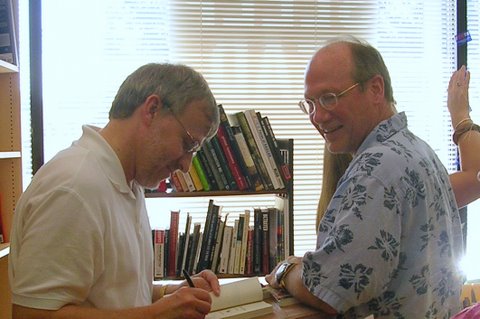
This week’s entry comes from Paul Dry of Paul Dry Books, a small publisher out of Philadelphia. Last month, Paul published my book, The Book Shopper: A Life in Review, and recently returned from New York’s BookExpo America. Below, he shares his thoughts about the annual convention from a publisher’s perspective:
Last weekend we attended the controlled frenzy
known as BookExpo America,
where publishers and “book people” meet to talk about the season’s upcoming
books. We have participated in these gatherings since 2000 and each year have a book
or two we particularly tout. This year, The Book Shopper led the list.
Since everyone at BEA is a book shopper, Murray’s
book interested all who came by our booth. 
And who were these “book people,” the happy warriors eager to weigh themselves down with giveaways of all kinds? Well, you name it: librarians from institutions large, small, and very small (and friends-of-librarians hoping for free books), writers promoting their published work, writers looking for publishers, cut-rate printers selling services in China, publicists offering to generate buzz for books, software designers specializing in the book trade, delivery men from Chinese restaurants passing out menus (every hour or so), media people from small and big markets—obscure blogs to national networks, and remainder folks who will buy for pennies the overrun copies of last year’s would-be hit.
—– EXTENDED BODY:
Last, but by far the most important, were the bookstore buyers (yes, actual buyers of books) looking for new books that their customers back home in Portland or Cincinnati or Austin might want to read. While we enjoy schmoozing with all kinds of book people, these are, of course, the folks we most want to meet. But alas, their numbers were outweighed by those pitching to us. As for the work of the fleet-footed couriers from the Chinese restaurants, by the end of the show we had acquired a library of menus whose offerings were almost as extensive as the quantity of books on display at the show.
Heading home we were satisfied with the reception for The Book Shopper and eagerly await the thoughts of those who took copies home with them. It’s an exciting time when a new book moves out of our hands and into the world to find its readers.
—– TITLE: Coover or the Cubs? STATUS: Publish ALLOW COMMENTS: 1 CONVERT BREAKS: wysiwyg ALLOW PINGS: 1 BASENAME: coover-or-the-cubs CATEGORY: Baseball CATEGORY: Book Reviews UNIQUE URL: https://thebookshopper.typepad.com/the_book_shopper_atlantad/2009/06/coover-or-the-cubs.html DATE: 06/02/2009 07:38:49 AM —– BODY:
It’s baseball week for me as the ill-fated Chicago Cubs come to Turner Field for three games against the Atlanta Braves beginning tonight. I have already taken my Cubs 1908 World Champions T-Shirt out of the storage closet in preparation for attending Thursday night’s game.
As a Cubs fan, I have learned that it is critical to focus on other aspects of baseball besides cheering the team from Wrigley Field. Thus, I recently finished reading a baseball classic – if peculiarity counts – Robert Coover’s 1968 book, The Universal Baseball Association, Inc., J. Henry Waugh, Prop.
—– EXTENDED BODY:
Coover’s book centers on Henry Waugh, a lonely accountant who created a baseball league of fictitious teams and players. After work and on weekends, Waugh uses dice and statistical sheets, to play out entire seasons — even going as far to write up the results in a league history. Waugh becomes so connected to his creations that he becomes emotionally unraveled when one of his favorite players dies. (Waugh’s game is similar to Strat-O-Matic baseball board games and the online fantasy leagues of today. Coincidently, Jack Kerouac was a big fan of fantasy baseball and his notebooks are now on display at the New York Public Library. See article.)What makes the book interesting is Coover’s underlying theme of exploring the relationship between creator and creation.
Unfortunately, what kept this book from becoming a personal classic is that the plot lines between Coover’s Waugh and Waugh’s Universal Baseball Association (UBA) blur more and more as the book progresses. It eventually became difficult to follow the interactions among the dozens of UBA players – especially since there was no “scorecard” of characters.
While reading, I briefly entertained the thought of creating a cheat sheet of Coover/Waugh characters to assist myself and future readers of this ultimately disappointing book. But that would take time – lots of time that would interfere with watching baseball. Of course, if the Cubs don’t play well in Atlanta this week, I may rethink my priorities.
—– TITLE: Field of Dreams Fanatic DATE: 05/25/2009 10:47:58 AM —–
Mention anything about the movie Field of Dreams and I am there. So when Brett Friedlander stopped by the Opal Gallery on Moreland Avenue last Thursday to talk about the book he co-authored, Chasing Moonlight: The True Story of Field of Dreams’ Doc Graham, I showed up to swap FOD trivia with the North Carolina sportswriter. (In case you haven’t seen the 1989 movie a dozen times like me, Doc Archibald “Moonlight” Graham was the character played by Burt Lancaster. In the movie and in real life, Graham played in one major league game, but never got to bat.)
Unfortunately for Friedlander, I was one of the few non-family members in attendance. But a supportive, friendly family is nothing to sneeze at (ask Ray Kinsella) and for a moment I found myself wishing they’d invite me along for a celebration burger at the nearby Vortex. Instead of a full, aching stomach, here’s what I did take home with me from his presentation:
- After being banned from playing Major League Baseball, Shoeless Joe Jackson (one of the main characters in FOD) continued to play baseball, barnstorming through small towns that included Graham’s adopted hometown of Chisholm, Minnesota, where they played against each other.
- Graham met Ted Williams in an exhibition game while Williams was a minor leaguer playing in Minnesota in the 1930s.
- The author W. P. Kinsella (FOD was based on his book Shoeless Joe)declined to write an introduction to Friedlander’s book, having retired from writing after a debilitating accident.
- The town of Galena, Illinois (hometown of Ulysses S. Grant) was used as a location for filming instead of Chisholm, Minnesota.
If you’re interested in learning more – and you may be because the FOD phenomena should not be underestimated – see a review of Friedlander’s book at the California Literary Review.
Following up from the last posting…
Here are several pictures of filmmaker James Benning’s replica of the Unabomber’s cabin and library.


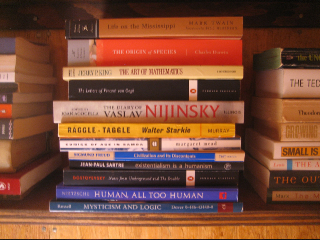
He has also provided a list of the library’s holdings:
—– EXTENDED BODY:
Fiction:
Edward Abbey, The Monkey Wrench Gang, 1975
Ivo Andric, The Bridge on the Drina, 1945
Albert Camus, The Stranger, 1946
Joseph Conrad, The Secret Agent, 1907 *
James Fenimore Cooper, The Deerslayer, 1823 *
Charles Dickens, A Tale of Two Cities, 1859 *
Emily Dickinson, Selected Poems & Letters, 1959
Fyodor Dostoevski, Brothers Karamazov, 1878 *
T.S. Eliot, The Wasteland, 1930
https://bookshop.org/widgets.jsWilliam Faulkner, The Sound and the Fury, 1929
Thomas Hardy, Far from the Madding Crowd, 1874 *
Ernest Hemingway, The Complete Short Stories of Ernest Hemingway, 1987
Hermann Hesse, Siddhartha, 1951
Aldous Huxley, Brave New World, 1932
James Joyce, A Portrait of the Artists as a Young Man, 1916
Franz Kafka, The Trial, 1925
Arthur Koestler, Darkness at Noon, 1941 *
Richard Lattimore, The Revelation of John, 1962 **
Jack London, Martin Eden, 1913
W. Somerset Maugham, Razor’s Edge, 1944 *
Eugene O’Neill, The Iceman Cometh, 1946
Alexandra Orme, Comes the Comrade!, 1949 *
George Orwell, 1984, 1949 *
Horacio Quiroga, The Decapitated Chicken and Other Stories, 1935 *
Ernest Seton-Thompson, Wild Animals I Have Known, 1898
William Shakespeare, Merchant of Venice, 1596 *
Upton Sinclair, The Jungle, 1906
John Steinbeck, Of Mice and Men, 1937 *
Leo Tolstoy, The Cossacks and The Raid, 1862 *
Ivan Turgenev, Fathers and Sons, 1862
Don Armando Palacio Valdes, Maximina, 1888 *
H.G. Wells, The War of the Worlds, 1898
Sloan Wilson, Ice Brothers, 1979
Non-Fiction:
Arthur Bremer, An Assassin’s Diary, 1973
Dee Brown, Bury My Heart at Wounded Knee, 1970
Allan R. Buss, Individual Differences: Traits and Factors, 1976 *
FC, Industrial Society & Its Future, 1995 *
Norman Cousin, Modern Man is Obsolete, 1945
Robert V. Daniels, Red October, The Bolshevik Revolution of 1917, 1967 **
Charles Darwin, On the Origin of the Species, 1859
L. Sprague De Camp, Ancient Engineers, 1960 *
Bernard DeVoto, The Journals of Lewis and Clark, 1953
Frederick Douglass, Narrative of the Life of Frederick Douglass, 1845
Jacques Ellul, The Technological Society, 1964 *
H.J. Eysenck, Sense and Nonsense in Psychology, 1957 *
Richard Flacks, Making History, 1988
George W. Scotter & Halle Flygare, Wildflowers of the Canadian Rockies, 1986 **
Food and Nutrition Board, Recommended Dietary Allowances, 1974 *
Sigmund Freud, Civilization and Its Discontents, 1930
Euell Gibbons, Handbook of Edible Wild Plants, 1979 *
Richard Gombin, The Radical Tradition, 1978*
Paul Goodman, Growing Up Absurd: Problems of Youth in the Organized
System, 1956 *
Al Gore, Earth in the Balance, 1992
Robert Gurr, Violence in America, Vol I & II, 1979, 1989 *
Osborne Russell & Aubrey L. Haines, Journal of a Trapper, 1965 *
William Least Heat-Moon, PrairyErth, 1993
Eric Hoffer, The True Believer, 1951 *
Henry Jacobwitz, Electronics Made Simple, 1958 *
Glen R. Johnson, Tracking Dog, 1975 *
Kenneth Keniston, The Uncommitted: Alienated Youth in American Society, 1966
Horace Kephart, Camping and Woodcraft, 1988 *
Irving Kohn, Meteorology for All, 1946 **
R.W,B. Lewis, The American Adam: Innocence, Tragedy, & Tradition in 19th
Century America, 1955
Tom McIver, Anti-Evolution: A Reader’s Guide to Writings Before and After
Darwin, 1992 **
Karl Marx, Das Kapital, 1848
Leo Marx, The Machine in the Garden: Technology and the Pastoral Ideal in America, 1964
Margaret Mead, Coming of Age in Samoa, 1928
Arthur P. Mendel, ed., Essential Works of Marxism, 1961 *
Jules Michelet, History of the French Revolution, 1967 *
Jean Baker Miller, Toward a New Psychology of Women, 1976 *
David A. Conway and Ronald Munson, The Elements of Reasoning, 1990
National Rifle Association, The Basics of Rifle Shooting, 1987 *
M.H.A. Newman, Elements of the Topology of Plane Sets of Points, 1964 *
Friedrich Nietzsche, Human, all too Human, 1878
Vaslav Nijinsky, Diary of Vaslav Nijinski, 1937
Evan Hendricks, Trudy Hayden, and Jack D. Novik, Your Right to Privacy,
1980 *
Stephen B. Oates, To Purge This Land With Blood: A Biography of John
Brown, 1970
Betty Owen, Typing for Beginners, 1976 *
Anthony Gooch and Angela Garcia de Pareded, Spanish-English/
English-Spanish Dictionary, 1978 *
Lila Pargment, Beginner’s Russian Reader, 1977 *
William H. Prescott, History of the Conquest of Mexico, 1843 *
Richard Rhodes, The Inland Ground, 1969
Louise Dickinson Rich, We Took to the Woods, 1942
David Riesman, Abundance for What?, 1964 *
Andrew Robinson, Lost Languages, 1957 *
Theodore Roszak, Where the Wasteland Ends, 1972
Bertrand Russell, Mysticism and Logic, 1917
Jean Paul Sartre, Existentialism is a Humanism, 1947
J.W. Schultz, My Life as an Indian, 1935 *
E.F. Schumacher, Small is Beautiful, 1973
https://bookshop.org/widgets.jsRobert Silverberg, The Pueblo Revolt, 1970
Guide to North American Birds, 1966 **
Albert Speer, Spandau: The Secret Diaries, 1976 *
Oswald Spengler, The Decline of the West, 1918
Micheal Spivak, Calculus On Manifolds, 1966
Walter Starkie, Raggle-Taggle: Adventures with a Fiddle in Hungary, 1933 *
William Strunk, Jr., Elements of Style, 1959 *
Henry David Thoreau, Walden, 1854
Mark Twain, Life on the Mississippi, 1883 *
United States Department of Justice, The Science of Fingerprints, 1973 *
Frank Waters, Book of Hopi, 1963
William Whyte, The Organization Man, 1956 *
William Carlos Williams, In the American Grain, 1925
Colin Wilson, The Outsider, 1956
* book found in Kaczynski’s cabin
This blog is an affiliate of Bookshop.org and it earns a commission if you click through to the Destination: Books portal and make a purchase of any books. (Bookshop.org also makes contributions to independent bookstores).
On her visits, my daughter Cynthia always introduces me to the work of some intriguing artist or writer. Last year she introduced me to visual artist-photographer and writer Moyra Davey who has written extensively about books and the book experience. Last weekend she talked about the photographs of documentary filmmaker James Benning, who is working on recreating the famous cabins of Henry David Thoreau and Unabomber Ted Kaczynski. Included in the collection is a photo of a small shelf hung about eye-level and represents Kaczynski’s library of about 20 books.
It is unclear to me whether these are books Benning thought Kaczynski might have owned or whether it was a re-creation of Kaczynski’s actual library. Either way, it includes the following titles and authors (at least the ones that I can make out from the photo):
- Mark Twain, Life on the Mississippi
- Vaslav Nijinsky, The Diary of Vaslav Nijinsky
- Jean Paul Sartre, (title unrecognizable)
- Robert Starkie, Raggle-Taggle: Adventures with a Fiddle in Hungary and Roumania
- Charles Darwin, The Origin of the Species
- Bertrand Russell, Mysticism & Logic
- E.F. Schumacher, Small is Beautiful
- Theodore Roszak, The Making of a Counter Culture
P.S. #1 I might post the photograph later, but not unless I obtain proper permissions,
P.S. #2 There is another connection between Benning and Atlanta via Hank Aaron. See comments.
—– EXTENDED BODY: —– EXCERPT: —– KEYWORDS: —– COMMENT: AUTHOR: Murray Browne EMAIL: IP: 208.61.22.211 URL: http://profile.typepad.com/1227802374s31410 DATE: 05/14/2009 08:05:32 AM As mentioned in the post, Benning is also a filmmaker, which includes a 1983 work entitled AMERICAN DREAMS that centered around Atlanta/Milwaukee Brave Henry Aaron. Here’s a description from a web site (http://www.canyoncinema.com/B/Benning.html)that sells his work: American Dreams “… A description of the form of AMERICAN DREAMS is deceptively simple: along a narrow border at the bottom of the screen a handwritten transcription of Arthur Bremer’s diary crawls from right to left; a series of chronological baseball cards from the career of Hank Aaron are shown in a steady cadence, first the front (usually a photo), then the reverse side (batting statistics, etc.). Finally, overtitles indicate by year the sources of the soundtrack’s fragmentary speeches and songs. … AMERICAN DREAMS is far from unrestricted in its horizons. A clear ‘sense of the ending’ is limited by two inevitable acts: Bremer will shoot Wallace; Aaron will break Babe Ruth’s record. As a work energized by an autobiographical impulse, Benning nonetheless hides himself in the shadows of time. It isn’t necessary to know that Bremer was Benning’s neighbor in Milwaukee or that the filmmaker counts among his greatest achievements pitching batting practice to the Milwaukee Braves in 1962. As externally shaped and motivated as it appears to be, AMERICAN DREAMS is marked by a dark and self-conscious meeting of personal and public desires ….” – Paul Arthur, The Appearance of History in Recent Avant-Garde Film —– ——– AUTHOR: Murray Browne AUTHOR EMAIL: murray.browne905@gmail.com TITLE: Revisiting Rick Atkinson STATUS: Publish ALLOW COMMENTS: 1 CONVERT BREAKS: wysiwyg ALLOW PINGS: 1 BASENAME: revisiting-rick-atkinson UNIQUE URL: https://thebookshopper.typepad.com/the_book_shopper_atlantad/2009/05/revisiting-rick-atkinson.html DATE: 05/05/2009 08:13:09 AM —– BODY:Part I: An Army at Dawn
Heavy days of travel may keep me from blogging, but it does help free up time for reading in airports and on planes, as I am just finishing up a book that has been near the top of my queue for awhile – Rick Atkinson’s An Army at Dawn: The War in North Africa, 1942-1943, the first volume of his World War II Liberation Trilogy,
Last September, my friend Denise and I saw Atkinson when he was at the Decatur Public Library discussing the second book of the trilogy, The Day of Battle, The War in Sicily and Italy, 1943-1944. For some one as knowledgeable and celebrated as Atkinson (he won the Pulitzer for An Army at Dawn) the author was a humble and gracious man perhaps from the realization that his work as a military historian will always be secondary to those brave men who fought.
Atkinson’s book reminded me of Shelby Foote’s The Civil War: A Narrative trilogy because his ability to seamlessly mesh the facts (the troop movements, the geography, the generals, the type of armament the armies needed and used) with epic storytelling. In Army at Dawn, he uses the personalities of the commanders including General Dwight D. Eisenhower, General George S. Patton and German Field Marshall Erwin Rommel — none who were flawless in North Africa – to give the reader “hooks” into the main plot which is a “coming of age” story about a fighting force that launched the U.S. as a world power.
I somewhat pride myself at being better than average military buff, but Atkinson’s detailed book showed me how very little I really knew about Allies efforts in North Africa. I’ve purchased several copies for friends already.
—– EXTENDED BODY:
Part II: Beyond the Call of Duty
Coincidently, my friend Denise’s father was in the air corps in North Africa in World War II and after Atkinson’s reading we waited in a short line (surprisingly a lightly attended reading…) with a copy of The Day of Battle as a gift for her father Mickey who is now 87 years old. (Mickey had already read An Army at Dawn.) Though he still has a very sharp mind, Denise’s father suffers from excruciating chronic back pain.
After listening to the brief stories about our fathers (my father who died in 1985 fought in France) Atkinson signed the book with “Mickey, Thanks for your service — Rick Atkinson.” Denise sent the book to her father who devoured it in a few days. For the next week, he talked continuously about the book and the flood of memories that its reading had brought back to him. In the midst of his endless pain, the book had provided Mickey with some relief and pleasure in the way only a great book can do.
—– EXCERPT: —– KEYWORDS: —– ——– AUTHOR: Murray Browne AUTHOR EMAIL: murray.browne905@gmail.com TITLE: Somebody Get Molly Haskell A Drink STATUS: Publish ALLOW COMMENTS: 1 CONVERT BREAKS: wysiwyg ALLOW PINGS: 1 BASENAME: somebody-get-molly-haskell-a-drink UNIQUE URL: https://thebookshopper.typepad.com/the_book_shopper_atlantad/2009/04/somebody-get-molly-haskell-a-drink.html DATE: 04/23/2009 07:58:25 AM —– BODY:Last Saturday night, the Margaret Mitchell House (MMH) burst with insatiable Gone With The Wind fans. Driving up to 10th & Peachtree I found the streets overflowing with traffic-stopping pedestrians and a full MMH parking lot— but I guess some of the congestion could be attributed to the Dogwood Arts Festival.
The attraction at the MMH was a panel sponsored by the Atlanta History Center featuring Turner Classic Movies’ host Robert Osborne, Michael Sragow, film critic of the Baltimore Sun and author of a voluminous biography of Victor Fleming (one of the GWTW directors), and Molly Haskell, author of the recently published Frankly My Dear: Gone With The Wind Revisited.
A recent review of Haskell’s book piqued my interest enough to get me to fight the traffic and attend the talk. But after a few initial questions from Osborne to Sragow and Haskell, the evening turned into a rambling question and answer session as the audience traded glowing (OK, gushing) GWTW anecdotes and opinions with the panelists. For those who weren’t there, you should know that everyone in the room agreed that Leslie Howard was generally considered a dud as Ashley Wilkes. Not that the WWII hero Howard wasn’t a good actor; rather, his style was more suited to playing a 19th century romantic poet than the love interest of the ripe and lively Scarlett.
—– EXTENDED BODY:Although everyone appreciates the gracious Mr. Osborne and his encyclopedic film knowledge, I was more impressed with the speed of his recall. As one who stumbles a moment to recall an author’s name or movie title, I admired his ability to answer questions rapidly before the words had hardly left his interlocutor’s mouth. Ms. Haskell made some interesting points and seemed to be ready to launch into some themes from her new book. Unfortunately, she never got the chance, as Mr. Sragow hijacked the microphone and much of the hour-long talk with a seemingly endless recitation of overlong anecdotes about this favorite director. As the minutes ticked away, Ms. Haskell seemed to fade into the background, so much so that I was tempted to bring her some Dixie cups of Merlot in hopes she’d “go Scarlett” and re-assert herself, but this did not happen.
—– EXCERPT: —– KEYWORDS: —– ——– AUTHOR: Murray Browne AUTHOR EMAIL: murray.browne905@gmail.com TITLE: The Residual Effects of Book Readings STATUS: Publish ALLOW COMMENTS: 1 CONVERT BREAKS: wysiwyg ALLOW PINGS: 1 BASENAME: the-residual-effects-of-book-readings UNIQUE URL: https://thebookshopper.typepad.com/the_book_shopper_atlantad/2009/04/the-residual-effects-of-book-readings.html DATE: 04/18/2009 10:57:46 AM —– BODY:Going to book readings can have unexpected impacts that linger long after the authors leave the stage. This happened to me recently.
While sitting in the audience of the Junot Diaz reading at Agnes Scott College last month, a friend told me about Rita Mae Brown’s 1988 book, Starting from Scratch: A Different Kind of Writer’s Manual. Later he loaned me a copy of this shoot-from-the-hip discourse on writing and the writing life, which I just finished reading.
—– EXTENDED BODY:The book begins with a brief biography of Brown (best known for Rubyfruit Jungle and Sneaky Pie cat mysteries), and goes on to provide persuasive arguments for studying Latin and the classics, lesson plans for writing teachers, and some now-outdated chapters on the writing and publishing business (much as changed in 20 years).
The most intriguing aspect of the guide comes at the end, where Brown offers a 25-page annotated reading list that starts with the ancient Beowulf and continues into the early 1980s. Brown writes, “Reading is an active moral and intellectual exchange. If you’re not reading books that challenge you, you’re reading the wrong books.”
Her recommendations are not necessarily what she considers the best in literature, but books that demonstrate many of the ideas presented earlier
in her book. The list includes authors who are now on the Southern Writers Literary Trail: Joel Chandler Harris, Erskine Caldwell, Carson McCullers, Zelda and F. Scott Fitzgerald and Margaret Mitchell, to name but a few. About Mitchell, Brown says “Don’t laugh, if you pay attention, you might learn something.”
Brown’s comments about Mitchell can also apply to experiences
we have at readings in general. You may not be enamored with the writer on
stage, but if you stay open minded— well, you might learn something you weren’t
expecting.
Even though the AJC
gave the Alliance Theatre’s production of Quiara Alegria Hudes’ 26 Miles a lukewarm review and a B-
grade, it didn’t keep me away and, in fact, reaffirmed my view that B’s are often
good enough. The play is about a precocious 15 year-old girl named Olivia who
slips away from her American father and stepmother’s troubled suburban home to join
her estranged, biological mother – the passionate, Cuban Beatriz – on a road
trip to Wyoming.
I was curious about the play, because Hudes, like Junot Diaz (see below), was in town recently for the Agnes Scott Writer Series. For the record, Hudes takes no back seat to Diaz when it comes to dropping f-bombs on her audience. (I can only imagine what kind of “blue streak” stories the Agnes Scott students will be writing next semester).
—– EXTENDED BODY:I’ll admit I’ve seen better (and worse) plays since I’ve been in Atlanta, but I was impressed that the actresses who played Olivia (Bethany Anne Lind) and Beatriz (Socorro Santiago) made me believe – despite their vast differences in appearance and personality – that they were no different than any other mother and daughter who must reconcile a troubled past before they can determine what their future will be together.
The Hertz Stage audience—which was filled to about 4/5 capacity—must have believed also. They were engaged all the way – laughing at Beatriz’s tirades and Olivia’s cerebral observations and respectfully silent during the play’s more intense moments. You still have a few days to turn in your grades. This production ends April 12th.
—– EXCERPT: —– KEYWORDS: —– ——– AUTHOR: Murray Browne AUTHOR EMAIL: murray.browne905@gmail.com TITLE: Eyes on Flannery STATUS: Publish ALLOW COMMENTS: 1 CONVERT BREAKS: wysiwyg ALLOW PINGS: 1 BASENAME: eyes-on-flannery UNIQUE URL: https://thebookshopper.typepad.com/the_book_shopper_atlantad/2009/04/eyes-on-flannery.html DATE: 04/03/2009 07:45:10 AM —– BODY:Following through from last month’s posting on Flannery O’Connor, I finished rereading her novel Wise Blood about a World War II vet Hazel Motes who returns to the South to wander among the street evangelists and to begin his own Church of God Without Jesus Christ. To say the least, O’Connor’s macabre characters still make me a little uncomfortable, but you have to smile the way she describes people like the woman whose “brown hair was so thin it looked like ham gravy trickling over her skull” or the “tall bony woman, resembling the mop she carried upside down.”
And the eyes—the eyes are critical for O’Connor especially in this book since two of the main characters are blind. Some examples:
– The eyes “were the color of pecan shells and set in deep sockets.”
– The eyes “glittered on him like two chips of green glass.”
– “One eye was a little smaller and rounder than the other.”
– "Her eyes took in everything whole like quicksand."
Next up: renting a copy of John Huston’s 1979 movie adaptation of Wise Blood.
—– EXTENDED BODY: —– EXCERPT: —– KEYWORDS: —– ——– AUTHOR: Murray Browne AUTHOR EMAIL: murray.browne905@gmail.com TITLE: Anita Desai and Junot Diaz at Agnes Scott STATUS: Publish ALLOW COMMENTS: 1 CONVERT BREAKS: wysiwyg ALLOW PINGS: 1 BASENAME: anita-desai-and-junot-diaz-at-agnes-scott UNIQUE URL: https://thebookshopper.typepad.com/the_book_shopper_atlantad/2009/03/anita-desai-and-junot-diaz-at-agnes-scott.html DATE: 03/28/2009 09:32:04 AM —– BODY:
Three questions came to mind while I was on my way to hear
Anita Desai and Junot Diaz at the 38th Annual Writers’ Festival last
Thursday at Agnes Scott College:
- Would Desai & Diaz outdraw Billy Collins, the keynote speaker at last year’s Decatur Book Festival?
- Would Diaz’s selection be as graphic as the bulk of his Pulitzer Prize winning novel The Brief Wondrous Life of Oscar Wao?
- And would Memphis beat Missouri, keeping my hopes for winning the NCAA basketball office pool alive?
The answers were: no, (but close), yes, and no (not even close).
—– EXTENDED BODY:
After the announcement of the winners of Agnes Scott Festival Competition, Diaz read excerpts from his short story, “The Sun, the Moon, the Stars” (which appeared in the New Yorker a decade ago). Diaz has a unusual style of reading in short bursts and pauses, allowing the crowd a moment laugh almost on cue with Diaz’s every colorful phrase —with responses stronger from the student section toward the front as opposed to the back of the auditorium where mature types like myself smiled politely.
Desai followed Diaz and read her story “The Man Who Saw Himself Drown” I’ll admit I knew nothing of Desai’s work until I arrived on campus, but considering that she published her first novel in 1963, the Indian-born Desai is impressive in her body of work. In contrast to Diaz, Desai, read quietly and flawlessly for about 25 minutes – her diction reminding me of those strong female characters out of a Mira Nair film (like Namesake).
After the readings, Desai and Diaz sat on comfy chairs on stage, and allowed the crowd to interrogate them as they shielded their eyes from the klieg lights. (I was envious of their chairs as my theatre seat was lumpy and sinking to the floor.) Their most revealing comments were in response to the question of “What are you writing now?” Desai said she had believed that her last novel would be her final work (she’s in her seventies), but she changed her mind when she realized “I was not very happy.. I didn’t feel fully alive” and has since returned to her desk. Diaz confessed that for the last two years he has been “feeding the beast” – a reference to his new life as a famous writer on tour – and admitted that he had not been writing. To me it was a troubling irony of the evening—the thought that a well known author (telling me at a Writer’s Festival, no less) can become sidetracked by his own success.
—– EXCERPT: —– ——– AUTHOR: Murray Browne AUTHOR EMAIL: murray.browne905@gmail.com TITLE: Pollan and the American Food Paradox STATUS: Publish ALLOW COMMENTS: 1 CONVERT BREAKS: wysiwyg ALLOW PINGS: 1 BASENAME: pollan-and-the-american-food-paradox UNIQUE URL: https://thebookshopper.typepad.com/the_book_shopper_atlantad/2009/03/pollan-and-the-american-food-paradox.html DATE: 03/22/2009 10:10:39 PM —– BODY:
There was plenty of food for thought at Michael Pollan’s talk this week at CDC.* Pollan, an environmental journalist and author of several books focusing on food culture and policy, took a break from his gig at the Georgia Organics Conference in Atlanta this week to speak to a packed crowd at CDC’s Clifton Road headquarters. His topic: America’s dysfunctional relationship with food – including our obsession over nutrients that neither we nor the science world yet understand. The irony, he says, is that our focus on “nutritionism,” as he calls it, coincides with skyrocketing rates of obesity, diabetes, and heart disease in this country. Pollan calls this the American Paradox, in contrast to the better-known French Paradox, meaning the ability of the “cheese-chomping, red-wine swilling” French to enjoy relatively good health.
—– EXTENDED BODY:The food problem in the U.S. is complex, of course, and includes the megamillions that food industries make from selling heavily processed foods rather than simple foods like oatmeal or oranges. Foods that are packaged, Pollan points out, attract more consumers by shouting about their superiority, be they added nutrients (“more omega-3 fatty acids!”), their lack (“fat-free!”), or convenience (“fully cooked!”).
So what’s a hungry, confused consumer to do? Pollan recommends a return to viewing foods as – well, foods, and not merely vehicles for miracle nutrients. A few of his sensible maxims include “Don’t eat anything your grandmother or great-grandmother wouldn’t recognize as food” and “Shop around the edges of the grocery store,” meaning go for the produce, milks, fish and other fresh foods. The middle aisles of the store are chock full of processed foods (or “edible foodlike substances” as Pollan likes to call them) that will last years, which should ring some alarm bells for us. As an illustration, he told the group about a package of twinkies he tacked up on his office wall some two years ago, which is still as squishily fresh as the day he put it there. He encourages people to pay attention to the fact that bacteria and fungi don’t attack this – maybe they have an inner wisdom we should pay attention to, he says. For much more on these fascinating topics, see his book, “In Defense of Food, An Eater’s Manifesto,” published last year to much acclaim. The cover features his bottom-line mantra: Eat Food – Not Too Much – Mostly Plants.
Important Note: Denise Casey is the author of this entry.
*Centers for Disease Control and Prevention, Atlanta, GA
—– EXCERPT: —– KEYWORDS: —– COMMENT: AUTHOR: Margaret Murray Kolk EMAIL: mkolk@mindspring.com IP: 24.196.233.32 URL: DATE: 05/16/2009 03:39:29 PM Denise: Nice article. Articulates the Pollan philosophy succinctly and accurately. It was nice meeting you and Murray today at Moringside Farmers’ Market. Look forward to reading more of your work. Hope to see you at a Slow Food ATL event soon. Margaret Kolk —– COMMENT: AUTHOR: Term Papers EMAIL: flash.papers@gmail.com IP: 221.120.250.108 URL: http://www.flashpapers.com DATE: 02/02/2010 05:39:00 AM The irony, he says, is that our focus on “nutritionism,” as he calls it, coincides with skyrocketing rates of obesity, diabetes, and heart disease in this country. —– ——– AUTHOR: Murray Browne AUTHOR EMAIL: murray.browne905@gmail.com TITLE: Disclaimer STATUS: Publish ALLOW COMMENTS: 1 CONVERT BREAKS: wysiwyg ALLOW PINGS: 1 BASENAME: disclaimer UNIQUE URL: https://thebookshopper.typepad.com/the_book_shopper_atlantad/disclaimer.html DATE: 03/22/2009 09:57:49 PM —– BODY:
This weblog expresses the opinions of Murray Browne and from time to time, other writers who are invited to contribute. The information provided in this blog is on an “as-is” basis with no guarantees of completeness or accuracy. This weblog does not represent the thoughts, strategies, and plans of my employer or the blog’s sponsors and advertisers. For writers who contribute to this weblog, their words do not represent the thoughts, strategies and plans of their employers either or the sponsors and advertisers of the blog. Moreover, the opinions by contributors do not necessarily represent the the thoughts and opinions of Murray Browne.
—– EXTENDED BODY: —– EXCERPT: —– KEYWORDS: —– ——– AUTHOR: Murray Browne AUTHOR EMAIL: murray.browne905@gmail.com TITLE: A Trip to Bountiful, Midwest-Style STATUS: Publish ALLOW COMMENTS: 1 CONVERT BREAKS: wysiwyg ALLOW PINGS: 1 BASENAME: a-trip-to-bountiful-midweststyle UNIQUE URL: https://thebookshopper.typepad.com/the_book_shopper_atlantad/2009/03/a-trip-to-bountiful-midweststyle.html DATE: 03/20/2009 07:52:38 AM —– BODY:I just returned from a brief trip to see my family in Champaign, Illinois. Unfortunately, I didn’t make it to one of my favorite used bookstores – the Jane Addams Book Shop in downtown Champaign. However, my nephew did give me a tour of the new public library that opened in January 2008. It’s an impressive facility that is a library, a media rental center, a computer lab, a coffee shop and even a used book store located in the basement (where you can buy a grocery sack of romance novels for $2).
On a sad note, one of my favorite independent book stores in Champaign, Pages for All Ages, unexpectedly closed its doors after 20 years of business. Just as with the closing of Wordsmiths in Decatur and other independent bookstores throughout the country, I suspect these closings are combinations of circumstances: the economy, competition from online businesses, new libraries (perhaps), or an error in judgment. No matter if it is just one thing or a combination of different factors, you miss them just the same.
—– EXTENDED BODY: —– EXCERPT: —– KEYWORDS: —– ——– AUTHOR: Murray Browne AUTHOR EMAIL: murray.browne905@gmail.com TITLE: Auto & Arts STATUS: Publish ALLOW COMMENTS: 1 CONVERT BREAKS: wysiwyg ALLOW PINGS: 1 BASENAME: auto-arts UNIQUE URL: https://thebookshopper.typepad.com/the_book_shopper_atlantad/2009/03/auto-arts.html DATE: 03/11/2009 08:05:52 AM —– BODY:The AJC newspaper section Arts & Leisure is changing its name again. (It had changed from Arts & Books to Arts & Leisure late last year.) It’s combining the Arts & Leisure, Living & Style and Travel Sections to save manufacturing and paper costs. I would have preferred to combine Arts & Leisure with the car section (that’s where we spend too much of our time anyway) and then it could have been called the catchier “Auto & Arts” or “Triple-A” for short.
—– EXTENDED BODY: —– EXCERPT: —– KEYWORDS: —– ——– AUTHOR: Murray Browne AUTHOR EMAIL: murray.browne905@gmail.com TITLE: Everything Flannery Converges STATUS: Publish ALLOW COMMENTS: 1 CONVERT BREAKS: wysiwyg ALLOW PINGS: 1 BASENAME: everything-flannery-converges UNIQUE URL: https://thebookshopper.typepad.com/the_book_shopper_atlantad/2009/03/everything-flannery-converges.html DATE: 03/06/2009 07:28:31 AM —– BODY:
A strange week, as everything seemed to point to Flannery
O’Connor:
Saturday – Took an out-of-town friend and his teenage son book shopping at A Cappella. I picked up a copy of Flannery O’Connor’s Wise Blood — it was on my mind since I saw that Emory was showing the John Huston film adaptation of that book on Monday night. The teenager, an amazing reader and history buff, bought Greek Fire, Poison Arrows, and Scorpion Bombs: Biological & Chemical Warfare in the Ancient World by Adrienne Mayer. And to think this kid was staying at my apartment. Took them to the Atlanta Book Exchange on North Highland also. Lots of Flannery O’Connor books there too, but no “pre-loved” copy of Wise Blood so I congratulated myself on buying it earlier.
Sunday – Read the AJC interview with Brad Gooch who was at the Margaret Mitchell House promoting his biography Flannery: A Life of Flannery O’Connor.
—– EXTENDED BODY:Monday – Watched part of Pretty Woman with Julia Roberts, whose character, an ambitious prostitute with low self-esteem, hails from —where else? O’Connor’s hometown of Milledgeville, Georgia. Heard about Wordsmiths in Decatur closing. The last time I was there was to attend a reading by Peter Selgin, a Flannery O’Connor Award winner. (See December 23 posting)
Tuesday – Writers Jack Riggs, Renee Dodd, and Tom Mullen discussed the perils of writing a second book. (More about this in another posting.) Dodd teaches at Georgia College & State University located at —where else? Milledgeville. During the discussion Riggs mentions O’Connor’s “provenient grace,” the inspiration that comes from God tapping you on the shoulder and saying “Do This!”
Wednesday – Began reading Wise Blood. Provenient Grace?
—– EXCERPT: —– KEYWORDS: —– ——– AUTHOR: Murray Browne AUTHOR EMAIL: murray.browne905@gmail.com TITLE: Bye-Bye Lincoln STATUS: Publish ALLOW COMMENTS: 1 CONVERT BREAKS: wysiwyg ALLOW PINGS: 1 BASENAME: byebye-lincoln UNIQUE URL: https://thebookshopper.typepad.com/the_book_shopper_atlantad/2009/03/byebye-lincoln.html DATE: 03/02/2009 07:40:19 AM —– BODY:
Perhaps since I’m originally an Illinoisan, I’m a little sad at first to see the end of Abraham Lincoln Month. When March begins, the book stores return those Lincoln biographies along with related histories like Doris Kearns Goodwin’s Team of Rivals to the shelves next to books on other 19th century Presidents. The onslaught of NPR feature stories about the Lincoln Memorial, Lincoln’s assassination, etc. begin to fade as well.
 Fellow Illinoisans and perhaps some others bemoan the
passing of Lincoln month (Why can’t
every day be Lincoln’s birthday?) but my initial sorrow soon changes to relief.
Not only can I more easily find a copy of Andrew
Ferguson’s Land of Lincoln at a reduced price, but the natural
rhythm of my Lincoln appreciation
can return to its normal cadence. Instead of reading everyone else’s take on
him, I can gaze at my little desk bust of Lincoln when my mind drifts up from
my work, or if the spirit moves me, pull out the Moyra Davey book featuring an
excerpt from her exhibit 100 Copperheads
(a photo array of a 100 Lincoln pennies in various states of oxidation). Or
maybe I’ll finally go on that long-promised, off-season trip with my mother to Springfield
to take in the Abraham Lincoln Presidential Library and Museum.
Fellow Illinoisans and perhaps some others bemoan the
passing of Lincoln month (Why can’t
every day be Lincoln’s birthday?) but my initial sorrow soon changes to relief.
Not only can I more easily find a copy of Andrew
Ferguson’s Land of Lincoln at a reduced price, but the natural
rhythm of my Lincoln appreciation
can return to its normal cadence. Instead of reading everyone else’s take on
him, I can gaze at my little desk bust of Lincoln when my mind drifts up from
my work, or if the spirit moves me, pull out the Moyra Davey book featuring an
excerpt from her exhibit 100 Copperheads
(a photo array of a 100 Lincoln pennies in various states of oxidation). Or
maybe I’ll finally go on that long-promised, off-season trip with my mother to Springfield
to take in the Abraham Lincoln Presidential Library and Museum.
It’s like what sportswriter Tom Boswell’s says about baseball’s opening day: “Sure, opening day is baseball’s bandwagon. Pundits, politicians and every prose poet on the continent jumps on board for a few days. But they’re gone soon, off in search of some other windy event worthy of their attention. Then, once more, all those long slow months of baseball (or in my case, history) are left to us. And our time can begin again.”
—– EXTENDED BODY: —– EXCERPT: —– KEYWORDS: —– ——– AUTHOR: Murray Browne AUTHOR EMAIL: murray.browne905@gmail.com TITLE: Striking Out STATUS: Publish ALLOW COMMENTS: 1 CONVERT BREAKS: wysiwyg ALLOW PINGS: 1 BASENAME: striking-out UNIQUE URL: https://thebookshopper.typepad.com/the_book_shopper_atlantad/2009/02/striking-out.html DATE: 02/23/2009 07:32:32 AM —– BODY:Not an easy week getting out to something blog worthy. Not that I didn’t try:
Strike One – Tuesday: Planned on going to hear Jane Marie Law’s lecture at Agnes Scott College, "Memories of World War II” – a talk about the legacy of World War II that continues to influence contemporary Japanese culture. I got jammed at work. What can I say? The blog is not my day job.
Strike Two – Thursday: Inspired at the Decatur Cook’s Warehouse/ Sherlock’s Wine Merchant class on how to read wine labels (from the outside, not the inside, I thought about an intriguing comparison between those who recommend wines and those (like me) who recommend books. Unfortunately, when the effects of the wine wore off, this metaphor seemed hopelessly misguided.
—– EXTENDED BODY:Strike Three – Sunday: Tried to check out Salmon Rushdie’s lecture at Emory about how art adapts from one form to another. However, despite the $10 ticket price, lack of a book signing, and probable searches of all large backpacks, the event sold out. Thought trying to crash it was in poor taste.
Next week – Plan better.
—– EXCERPT: —– KEYWORDS: —– ——– AUTHOR: Murray Browne AUTHOR EMAIL: murray.browne905@gmail.com TITLE: At the Carlos Museum Bookshop STATUS: Publish ALLOW COMMENTS: 1 CONVERT BREAKS: wysiwyg ALLOW PINGS: 1 BASENAME: shopping-at-the-carlos-museum-book-shop CATEGORY: Bookstores UNIQUE URL: https://thebookshopper.typepad.com/the_book_shopper_atlantad/2009/02/shopping-at-the-carlos-museum-book-shop.html DATE: 02/14/2009 09:23:57 AM —– BODY:
Last weekend for a change of pace I was in the mood for some ol’ fashioned bookstore browsing and visited one my favorites—The Bookshop in the Michael C. Carlos Museum on the main campus of Emory University . It’s not your most conventional book store, which is what I like about it. It has an eclectic feel, full of different titles representing various aspects art, history and culture.
For example, I picked up three books – a discounted copy of Shank’s Mare, a comic novel written in 1802 by Japanese comic novelist Ikku Jippensha (a gift for my friend’s Denise’s son who studies Japanese culture and lives near Osaka), Michael Kimmelman’s, The Accidental Masterpiece: On the Art of Life and Vice Versa (discounted) and Buying In: The Secret Dialogue Between What We Buy and Who We Are by New York Times Magazine columnist Rob Walker (who lives in Savannah, no less).
These are three books that I would probably not have ordered on line, but given the opportunity to thumb through them, read a few pages here and there and directly support a local business, my decision became much easier. One word of advice: Unless you work on the campus, it’s best to visit the shop on the weekend. There’s a map on their website, but the best way to get there is to enter the campus on Clifton Road and turn onto Fishburne Drive (near North Decatur Road) and park for free at the Fishburne parking deck. From there you can walk easily to the back entrance of the museum and take the elevator to the first floor where the book shop is located.
—– EXTENDED BODY: —– EXCERPT: —– KEYWORDS: —– COMMENT: AUTHOR: Anu EMAIL: anuak007@yahoo.com IP: 65.82.46.209 URL: DATE: 01/28/2010 08:52:35 AM I love that place too!!! Cafe Antico upstairs is a nice place to get a nice cup of coffe and read your newly purchased book. The Emory Campus is somewhat “charmed” if you ask me. It is soo clean and serene… reminds me of visiting another place and time. I used to work at Emory back in 2000. The Pitts Theological seminary has lots of treasures as well. I found alot of Voltaires writings there. Peace and blessings!! —– ——– AUTHOR: Murray Browne AUTHOR EMAIL: murray.browne905@gmail.com TITLE: Washington Post Book World Going Out of Print STATUS: Publish ALLOW COMMENTS: 1 CONVERT BREAKS: wysiwyg ALLOW PINGS: 1 BASENAME: washington-post-book-world-going-out-of-print UNIQUE URL: https://thebookshopper.typepad.com/the_book_shopper_atlantad/2009/02/washington-post-book-world-going-out-of-print.html DATE: 02/06/2009 07:36:38 AM —– BODY:In this article about the Washington Post Book World going from a separate standalone section to being folded into the regular newspaper is just another sign of the times as newspapers continue to try to re-invent themselves. This is not unlike the AJC’s recent changing of the name and focus of the Books & Leisure section to Arts & Leisure in an effort to “reflect a new look at how we spend our downtime.” It’s no coincidence that the shrinkage of newspaper coverage for books has led to blogs like this one who fill a need (in my case a personal need) to think and write about books and authors.
—– EXTENDED BODY: —– EXCERPT: —– KEYWORDS: —– ——– AUTHOR: Murray Browne AUTHOR EMAIL: murray.browne905@gmail.com TITLE: E. Lynn Harris: Identity over Stereotype STATUS: Publish ALLOW COMMENTS: 1 CONVERT BREAKS: wysiwyg ALLOW PINGS: 1 BASENAME: e-lynn-harris-identity-over-stereotype UNIQUE URL: https://thebookshopper.typepad.com/the_book_shopper_atlantad/2009/02/e-lynn-harris-identity-over-stereotype.html DATE: 02/01/2009 12:26:32 PM —– BODY:Shunning the typical performance of reading thirty or forty minutes and then answering a few questions, bestselling author E. Lynn Harris read only briefly from his latest novel Basketball Jones last Thursday at the Decatur Public Library. Set in post-Katrina New Orleans, Basketball Jones is a novel about the relationship of a gay NBA star and his longtime lover. It must be quite graphic, as Mr. Harris paused mid-sentence and said, “This is pretty steamy stuff and the older I get, the more easily embarrassed I become—you’ll have to read this book yourselves.”
—– EXTENDED BODY:For the remainder of the hour, Mr. Harris fielded questions from the audience, who seemed familiar with his previous works (10 novels, a memoir, and editor of 2009 Best African American Fiction) and his willingness to talk about social issues (e.g., same sex marriage ) and the recent election, as well as his own reading influences (James Baldwin) and writing habits (at least a 1000 words everyday). Mr. Harris, a writer-in-residence at the University of Arkansas didn’t even shirk the “toughest” question of the night about Bobby Petrino’s exodus from his position as head coach of the Atlanta Falcons to the Arkansas Razorbacks. (Harris liked Arkansas’ former coach, but conceded that his football team needed a change.)
What impressed me about Mr. Harris is that when he says he “reaches for the heart, not the head” in his writing, that same attitude comes across when he talks with (not lectures to) his readers. When a woman from the audience asked a question that tried to intellectualize Mr. Harris’ work, the author laughed and said, “I’m not deep.” I’m not sure I agree with Mr. Harris’ self-assessment: besides the display of his obvious talents for writing prolifically and profitably about the powers of the flesh, we also could see flashes of the insightful editor who recognizes and celebrates the work of other writers of contemporary black fiction. I look forward to reading 2009 Best African American Fiction.
—– EXCERPT: —– KEYWORDS: —– ——– AUTHOR: Murray Browne AUTHOR EMAIL: murray.browne905@gmail.com TITLE: Wine v. Books STATUS: Publish ALLOW COMMENTS: 1 CONVERT BREAKS: wysiwyg ALLOW PINGS: 1 BASENAME: wine-v-books UNIQUE URL: https://thebookshopper.typepad.com/the_book_shopper_atlantad/2009/01/wine-v-books.html DATE: 01/24/2009 12:28:33 PM —– BODY:Instead of attending a reading of my choice this week I took a beginner’s class on wine appreciation at Cook’s Warehouse in Decatur. As a kind of warm up for the event, a friend loaned me his copy of Jay McInerney’s Bacchus & Me: Adventures in the Wine Cellar (2000). I’m not usually a big McInerney fan (well known for his 1984 novel Bright Lights, Big City), but if you skip around the book there are some good pieces — most notably ones about the wine-points guy Robert Parker and a brief history of the Mondavi family.
—– EXTENDED BODY: —– EXCERPT: —– KEYWORDS: —– COMMENT: AUTHOR: William Gwin EMAIL: wgwin@knology.net IP: 69.1.48.238 URL: DATE: 02/18/2009 08:26:38 PM How about bourbon vs. wine? wg —– ——– AUTHOR: Murray Browne AUTHOR EMAIL: murray.browne905@gmail.com TITLE: Thoughts on Jack Riggs’ Reading STATUS: Publish ALLOW COMMENTS: 1 CONVERT BREAKS: wysiwyg ALLOW PINGS: 1 BASENAME: thoughts-on-jack-riggs-reading UNIQUE URL: https://thebookshopper.typepad.com/the_book_shopper_atlantad/2009/01/thoughts-on-jack-riggs-reading.html DATE: 01/17/2009 10:44:22 AM —– BODY:Despite a cold, cold night last Thursday, listeners filled the warm (very warm) Decatur Library Auditorium to hear Jack Riggs, the writer-in-residence at Georgia Perimeter College, read several excerpts from his new novel, The Fireman’s Wife. Riggs prefaced his half-hour reading with an explanation of the origins of his book about a disintegrating marriage.
While the excerpts were fine, what really intrigued me was Riggs off-handed mention of the five-year period between his first, award-winning novel, When the Finch Rises, and his latest. From my understanding, Riggs did write a different follow up to Finch but it was rejected by his publisher Ballantine. Obviously, he has rebounded from that crushing experience.
His comments reminded me of an essay I just finished reading by Michael Chabon in his collection, Maps and Legends. (I got my cleverly designed hardback copy at last year’s Decatur Book Festival at the Believers booth). Chabon described the pressure to write a second novel, especially if the first had some success as “bathyspheric.” With a first novel there is no contract, no reputation – just the internal pressure of learning to be a writer. The second attempt is not only fraught with your expectations but those of a publisher as well as the reading public. Chabon described the experience of a writing the rejected novel as a Lewis and Clark expedition, “a long, often dismal tramp through a vast terrain in pursuit of a grand but fundamentally mistaken prize.”
I’m thinking that the evening served two purposes: giving Riggs' readers an introduction to his new book, and giving himself the satisfaction of completing the long expedition from the first to the second novel.
—– TITLE: A Book about Book Shopping DATE: 01/12/2009 07:59:38 AM —–I’ve been working steadily on the edits for my upcoming book, The Book Shopper: A Life in Review to be published by Paul Dry Books of Philadelphia later this spring. Good thing, since the publisher already posted a description of the book, including the cover. I think the artist has captured my natural disheveled appearance.
I left the post office wondering if the multiple stabbing of the same package is some post office code to tell co-workers to search the package for violations later on down the line. But I was in the clear. Inside the package there was only a book, but if the government gets sticky with regulations they could re-classify it as a gift (since it was wrapped in holiday paper) and send it back to me with a heavy fine.
At least my goddaughter likes a good story — and either way, she’ll get one.
—– EXTENDED BODY: —– EXCERPT: —– KEYWORDS: —– ——– AUTHOR: Murray Browne AUTHOR EMAIL: murray.browne905@gmail.com TITLE: 2008 Reading of the Year STATUS: Publish ALLOW COMMENTS: 1 CONVERT BREAKS: wysiwyg ALLOW PINGS: 1 BASENAME: 2008-reading-of-the-year UNIQUE URL: https://thebookshopper.typepad.com/the_book_shopper_atlantad/2009/01/2008-reading-of-the-year.html DATE: 01/02/2009 08:19:21 AM —– BODY:Before completely saying goodbye to 2008, it’s time to recognize the “Best Local Reading of the Year” or more specifically the “Best Local Reading of the Year That I Attended,” which does narrow the field. My rating criteria are rather simple and subjective:
- Did I learn something that otherwise I would not have learned even if I read the book?
- Did the author and audience engage each other?
- Did I come away with a “little buzz” from the reading?
—– EXTENDED BODY:
With this in mind, I give the nod to Chandler Burr’s February scratch `n’ sniff reading at the Decatur Public Library. Formerly an international economics journalist, Burr is now The New York Times scent critic (now there's a career switch) and author of the books The Emperor of Scent and his latest The Perfect Scent. Admittedly, this is not the topic I am normally interested in, but my friend Denise had liked The Emperor of Scent and she always appreciates the company. The pleasure ended up being mine.
What I liked so much at that reading was that Burr made sure we all huddled together close to the stage so he could pass out sample sticks of perfume and test our olfactory senses while he described the scents using a range of often fantastical metaphors that were pure entertainment in themselves — "smells like a wonderfully ripe, fruity, full scent, smooth and strong as a swimmer's naked back" or, more visceral: "like blood macerated in peony with an electrical current running through it, giving the polished sheen of a champagne-colored BMW 7-series." I enjoyed the interaction between the author and audience, and learned that Sarah Jessica Parker likes a hint of male body odor in her perfumes, which may explain why her husband, actor Matthew Broderick, has a mysterious effect on so many people.
—– EXCERPT: —– KEYWORDS: —– ——– AUTHOR: Murray Browne AUTHOR EMAIL: murray.browne905@gmail.com TITLE: Book Shopping in the News STATUS: Publish ALLOW COMMENTS: 1 CONVERT BREAKS: wysiwyg ALLOW PINGS: 1 BASENAME: book-shopping-in-the-news UNIQUE URL: https://thebookshopper.typepad.com/the_book_shopper_atlantad/2008/12/book-shopping-in-the-news.html DATE: 12/31/2008 07:58:39 AM —– BODY:
The New York Times ran an article earlier this week about the moral dilemma of buying books dirt cheap on the internet. See Bargain Hunting, And Feeling Sheepish About It. One note of interest is that the writer David Streitfeld interviewed Andy Ross, the former owner of Cody’s Books. As you may recall, Cody’s Books was one of the bookstores featured in the documentary Paperback Dreams. (See the November 29th posting.)
—– EXTENDED BODY: —– EXCERPT: —– KEYWORDS: —– ——– AUTHOR: Murray Browne AUTHOR EMAIL: murray.browne905@gmail.com TITLE: Peter Selgin STATUS: Publish ALLOW COMMENTS: 1 CONVERT BREAKS: wysiwyg ALLOW PINGS: 1 BASENAME: peter-selgin UNIQUE URL: https://thebookshopper.typepad.com/the_book_shopper_atlantad/2008/12/peter-selgin.html DATE: 12/23/2008 07:06:38 AM —– BODY:I just finished reading Peter Selgin’s collection of short stories Drowning Lessons, winner of the Flannery O’ Connor Award from UGA press. I picked up the book a couple of months ago when Mr. Selgin was here for a reading at Wordsmiths along with a fellow O'Connor winner (Andrew Porter for The Theory of Light and Matter). My friend Denise and I knew of Mr. Selgin because he was the writing teacher of a friend who lives in New York.
—– EXTENDED BODY:Unfortunately, I would imagine that the event might go down as Mr. Selgin’s Reading-I-Would-Most-Like-to-Forget (at least he didn’t blog about it). It began with an apology from Wordsmiths that copies of Drowning Lessons had not arrived from the publisher. Adding to the misery of the moment was that outside the store window (clearly visible behind the authors) there were more people unloading port-a-johns for the next day’s Decatur Beer Fest than people attending the reading. In these small debacles, I guess a writer’s best strategy is to gut it out and be professional, as Mr. Selgin was. Afterward, out of pity and respect for our friend’s writing teacher, Denise and I bought his book. Of course, Mr. Selgin couldn’t sign our copy as there were none to sign. Instead, he good-humoredly signed a book plate (to be placed inside our future book that was mailed free of charge) which read, “Thanks for your support.”
It may have been a pity buy, but it wasn’t a pity read (I don’t read anyone’s material out of pity…). The collection of thirteen short stories was excellent – a reminder that good short story writing is a craft that prides itself in using an economy of words to convey a wealth of meaning. I especially liked “The Wolf House,” a story about a young man who returns home for a funeral to confront the death of one of his boyhood chums (and his own family’s failings). A lighter story is “Boy B,” about a young man who evens the score with his obnoxious identical twin brother – a brother who has been leaving him behind his entire life. One of the more imaginative efforts in the collection is “Driving Picasso,” which Mr. Selgin read at Wordsmiths that night. Set in 1952, it's a recounting by an obese man of his job as a driver for Pablo Picasso on his Pan-American road trip. Another excellent offering in the collection is "The Sinking Ship Man." It's a tale about the last survivor of the Titanic, told through the eyes of his African-American caregiver. All is doom for the 95-year-old survivor, but the caregiver refuses to abandon ship, much as Mr. Selgin refused to capitulate when the odds for a good reading were solidly against him.
—– EXCERPT: —– KEYWORDS: —– ——– AUTHOR: Murray Browne AUTHOR EMAIL: murray.browne905@gmail.com TITLE: The End of Arts & Books STATUS: Publish ALLOW COMMENTS: 1 CONVERT BREAKS: wysiwyg ALLOW PINGS: 1 BASENAME: the-end-of-arts-books UNIQUE URL: https://thebookshopper.typepad.com/the_book_shopper_atlantad/2008/12/the-end-of-arts-books.html DATE: 12/21/2008 12:06:58 PM —– BODY:
Today the Atlanta Journal-Constitution changed the name of its Arts & Books section to Arts & Leisure. See explanation. I have no major problem with the elimination of the antiquated sounding “B-word,” however, in the same section of today’s paper you can read an interesting feature article about novels of the new South (as opposed to the lovable crusty ol' South) which ends with a quote from novelist Marc Fitten who says that Atlanta has everything it takes to be a literary town “except now maybe what we need is an audience."
—– EXTENDED BODY: —– EXCERPT: —– KEYWORDS: —– EXCERPT: —– KEYWORDS: —– ——– AUTHOR: Murray Browne AUTHOR EMAIL: murray.browne905@gmail.com TITLE: Sarah Vowell STATUS: Publish ALLOW COMMENTS: 1 CONVERT BREAKS: wysiwyg ALLOW PINGS: 1 BASENAME: sarah-vowell-week UNIQUE URL: https://thebookshopper.typepad.com/the_book_shopper_atlantad/2008/12/sarah-vowell-week.html DATE: 12/10/2008 07:34:24 AM —– BODY:
I just finished reading humorist and social commentator Sarah Vowell’s Assassination Vacation. I picked up a copy at her reading at the Carter Presidential Library & Museum on October 27th when Vowell was in town promoting her latest book The Wordy Shipmates about the influence of the Puritans in New England. Because I had several disparate thoughts as I read the book, I decided to parse my commentary accordingly.
Thought 1 – Sarah Vowell at the Carter Presidential Library
I skipped dinner and arrived almost an hour early at the Carter Center since it promised to be a big crowd. By seven o’clock the Carter Center had filled to near capacity and Vowell walked briskly on stage to a warm reception. She’s not a tall woman and her head barely cleared the lectern.
Vowell — with her squeaky thin voice and comedic timing — made the expected witty asides, but the burden of turning Puritan personalities such as Roger Williams, Anne Hutchinson and John Winthrop into riveting stories may have been too much even for Vowell, at least on that particular night. It takes a lot of effort and background information to connect Puritans to our current political and social climate even to someone like myself who has a better-than-average knowledge of American history. Moreover, Vowell seemed tired. More than once she mentioned that the rigors of the book tour was taking its toll and said that doing readings was “at odds with her personality.”
During the meandering question and answer period that followed (like many authors she probably feels the responsibility to answer all questions thoroughly), I debated whether to ask Vowell if she was familiar with another book that examines the influence of the Puritans on modern times: David E. Shi’s The Simple Life: Plain Living and High Thinking in American Culture. (1985). But on that night, hunger trumped curiosity and I exited the building rather than wait in line to get my book signed and ask my question. I left without feeling any buzz — just empathy for Vowell for what must have been a long night on stage.
—– EXTENDED BODY:
Thought 2 – Assassination Vacation
Although I liked Sarah Vowell’s macabre travel book Assassination Vacation fine – again some good witticisms mixed in with history (especially the spooky fact that Robert Todd Lincoln was in the vicinity of his father’s assassination in 1865, Garfield’s in 1881 and McKinley’s in 1901) it reminded me of another book I liked even better: Andrew Ferguson’s Land of Lincoln: Adventures in Abe’s America. Vowell’s book came out in 2005 and Ferguson's in 2007, so I guess we know who copied whom. (I’m kidding…) There are two big differences between the books. One is that Ferguson covered Lincoln’s life well beyond the assassination, including comprehensive accounts of the Lincoln museum in Springfield and in his birthplace in Kentucky. Also, since Ferguson grew up in Illinois, and, like myself, was baptized in Lincoln lore (part of our grade-school curriculum), he was able to integrate his own life story more seamlessly than Vowell, who grew up in Oklahoma.
Thought 3 – Vowell’s Impact
As it turned out, Vowell's appearance in Atlanta impacted my reading selections somewhat unexpectedly. Since I had to go to ACappella's to get the ticket to attend her reading, I felt an obligation to buy at least something there (besides the $30 The Wordy Shipmates). So I picked up a pristine used copy of Joan Didion’s A Year of Magical Thinking and Witold Rybczynski’s Waiting for the Weekend, the latter which I found on the discard table outside the store. Ironically, I read both of them before Assassination Vacation and thought both books superb. Perhaps I will write more on Rybczynski later, because he does have some interesting observations about the concept of reading and leisure, but there actually is a connection between Sarah Vowell and Joan Didion. In Salon’s Reader’s Guide to Contemporary Authors it was Sarah Vowell who wrote the entry for Joan Didion.
—– EXCERPT: —– KEYWORDS: —– ——– AUTHOR: Murray Browne AUTHOR EMAIL: murray.browne905@gmail.com TITLE: To Ted or Not to Ted STATUS: Publish ALLOW COMMENTS: 1 CONVERT BREAKS: __default__ ALLOW PINGS: 1 BASENAME: to-ted-or-not-t UNIQUE URL: https://thebookshopper.typepad.com/the_book_shopper_atlantad/2008/12/to-ted-or-not-t.html DATE: 12/05/2008 07:25:27 AM —– BODY:
I am still debating whether to go and see Ted Turner at the Jimmy Carter Presidential Library on December 10th, as he stumps for his new book, Call Me Ted. Putting my tasteless questions about Jane Fonda aside, I am curious enough to ask him about his decision to put the Atlanta Braves’ home games on local television, which, if I recall correctly, was quite a break from broadcasting traditions at that time. Mr. Turner’s reasoning was that if you saw people at the local ball park having fun, you would be inclined to go and do the same. This is similar to the reasoning behind this blog – if I show you that there is more to book readings and lectures than just sitting and listening to someone read, then you might be more likely to attend and engage, and we will all enjoy a growing Atlanta-Decatur book scene, which is kind of my goal. Of course, if I do go, ask the question, and then Mr. Turner says, “No, you have it all wrong,” then where am I?
—– EXTENDED BODY: —– EXCERPT: —– KEYWORDS: —– ——– AUTHOR: Murray Browne AUTHOR EMAIL: murray.browne905@gmail.com TITLE: Obama the Bookseller STATUS: Publish ALLOW COMMENTS: 1 CONVERT BREAKS: __default__ ALLOW PINGS: 1 BASENAME: obama-the-books UNIQUE URL: https://thebookshopper.typepad.com/the_book_shopper_atlantad/2008/12/obama-the-books.html DATE: 12/04/2008 07:58:35 AM —– BODY:During the panel discussion following Paperback Dreams (see posting below), Outwrite’s Philip Rafshoon remarked (maybe tongue-in-cheek, maybe optimistically) that the election of Barack Obama could have a positive effect for independent booksellers. At the time he said this I thought to myself, “Boy, everyone sure has a lot of expectations for Obama.” But who is to say this isn’t so? Check out the Associated Press’ story from the 59th annual National Book Awards where much of the buzz centered around Obama. Not only is the President-elect an author of books himself, but books such as Doris Kearns Goodwin’s A Team of Rivals about the Lincoln cabinet (did I loan my copy to my mother?) have enjoyed a surge in popularity as well.
—– EXTENDED BODY: —– EXCERPT: —– KEYWORDS: —– ——– AUTHOR: Murray Browne AUTHOR EMAIL: murray.browne905@gmail.com TITLE: Paperback Dreams Documentary – Reviewed STATUS: Publish ALLOW COMMENTS: 1 CONVERT BREAKS: 0 ALLOW PINGS: 1 BASENAME: a-review-paperb CATEGORY: Bookstores UNIQUE URL: https://thebookshopper.typepad.com/the_book_shopper_atlantad/2008/11/a-review-paperb.html DATE: 11/29/2008 11:48:31 AM —– BODY: &amp;amp;amp;amp;amp;amp;lt;!– /* Font Definitions */ @font-face {font-family:&amp;amp;amp;amp;amp;amp;quot;MS Mincho&amp;amp;amp;amp;amp;amp;quot;; panose-1:2 2 6 9 4 2 5 8 3 4; mso-font-alt:&amp;amp;amp;amp;amp;amp;quot;MS 明朝&amp;amp;amp;amp;amp;amp;quot;; mso-font-charset:128; mso-generic-font-family:roman; mso-font-format:other; mso-font-pitch:fixed; mso-font-signature:1 134676480 16 0 131072 0;} @font-face {font-family:&amp;amp;amp;amp;amp;amp;quot;Arial Unicode MS&amp;amp;amp;amp;amp;amp;quot;; panose-1:2 11 6 4 2 2 2 2 2 4; mso-font-charset:128; mso-generic-font-family:swiss; mso-font-pitch:variable; mso-font-signature:-1 -369098753 63 0 4129279 0;} @font-face {font-family:&amp;amp;amp;amp;amp;amp;quot;\@Arial Unicode MS&amp;amp;amp;amp;amp;amp;quot;; panose-1:2 11 6 4 2 2 2 2 2 4; mso-font-charset:128; mso-generic-font-family:swiss; mso-font-pitch:variable; mso-font-signature:-1 -369098753 63 0 4129279 0;} @font-face {font-family:&amp;amp;amp;amp;amp;amp;quot;\@MS Mincho&amp;amp;amp;amp;amp;amp;quot;; panose-1:0 0 0 0 0 0 0 0 0 0; mso-font-charset:128; mso-generic-font-family:roman; mso-font-format:other; mso-font-pitch:fixed; mso-font-signature:1 134676480 16 0 131072 0;} /* Style Definitions */ p.MsoNormal, li.MsoNormal, div.MsoNormal {mso-style-parent:&amp;amp;amp;amp;amp;amp;quot;&amp;amp;amp;amp;amp;amp;quot;; margin:0pt; margin-bottom:.0001pt; mso-pagination:widow-orphan; font-size:12.0pt; font-family:&amp;amp;amp;amp;amp;amp;quot;Times New Roman&amp;amp;amp;amp;amp;amp;quot;; mso-fareast-font-family:&amp;amp;amp;amp;amp;amp;quot;MS Mincho&amp;amp;amp;amp;amp;amp;quot;; mso-fareast-language:JA;} @page Section1 {size:612.0pt 792.0pt; margin:72.0pt 90.0pt 72.0pt 90.0pt; mso-header-margin:36.0pt; mso-footer-margin:36.0pt; mso-paper-source:0;} div.Section1 {page:Section1;} –&amp;amp;amp;amp;amp;amp;gt;PushPush Theatre – East Decatur
Some of Atlanta’s leading independent book stores hosted a November 21st screening of “Paperback Dreams,” a documentary about the trials and tribulations of two independent book sellers in the San Francisco Bay area – Cody’s Books and Kepler’s Books & Magazines. According to its promotional blurb, the movie is about “independent book sellers and the people who love them.” Unfortunately, it could be more accurately rewritten as “independent book sellers and the people who do not love them enough.” It’s a story that can resonate with any local business owner who must constantly compete with the internet, big box stores and the consumer who (understandably) is often fixated on price.
Watch the film
The documentary has been airing on various PBS stations throughout the country, and these upcoming times in the Atlanta area:
December 3, 2008 2:00 a.m. – GPB TV – Atlanta
December 7, 2008 6:00 p.m – GPB Knowledge – Atlanta
December 11, 2008 2:00 a.m. – GPB TV – Atlanta
Unfortunately, these are not the most convenient viewing times,
unless you quit your late night partying early on a Tuesday night. But you can
also buy a DVD of the documentary at the website Paperbackdreams.com.
Lively panel discussion
Following the film, the documentary’s director/producer Alex Beckstead joined a panel of local book store owners ( representing A Cappella, Blue Elephant, OutWrite and Little Shop of Stories) in front of an audience of about 50 book-loving souls. Several aspects of this event stand out. One was the lively discourse that took place between the audience and the panel. They weren’t shy about peppering the headliners with comments as well as questions.
A main line of discussion was how the big box stores and the internet juggernaut squeezes the independent book store. Another vein of discourse was how the audience loved book stores, with some lamenting the loss of the Oxford shop in Buckhead (which unfortunately closed before my time in Atlanta).
Mr. Beckstead respectfully pointed out (both in the discussion and the documentary) that while local people do patronize independent book stores, they also tend to buy a lot of books elsewhere. This contributes as much to an independent book store’s demise as does the internet and the big box stores’ strategy of selling bestsellers at below cost (according to one audience member) as loss leaders to create the illusion of discount utopia where everything from tires to moon pies are priced at near cost as well. And then there’s the added competition from large bookstore chains like Barnes & Noble and the now financially troubled Borders that pepper my inbox with discount coupons on an almost daily basis.
Interestingly, Mr. Beckstead doesn’t do a lot of Amazon bashing; rather, he says that Amazon provides a way for used bookstores to stay afloat by selling their stock online and it also allows us to get out-of-print books.
Importance of buying local
Of course, independent book stores are not alone in competing with the big chains; all other local businesses (hardware stores, jewelry stores etc.) face the same challenges today. Mr. Beckstead reminded the audience that 70 percent of the dollars spent in a local store stay in the local economy as opposed to 30 percent spent in a chain store. (You’ll have to take his word and my memory on this). But he points out that not all is grim, as he sees a renewed interest in supporting local businesses.
Mr. Beckstead does remind those of us in the choir that we should always consider how our book shopping dollars affect not only book shops but also our communities. The bottom line is that book buyers must think of book stores as more than one just a place to buy books.
 murraybrowne.org