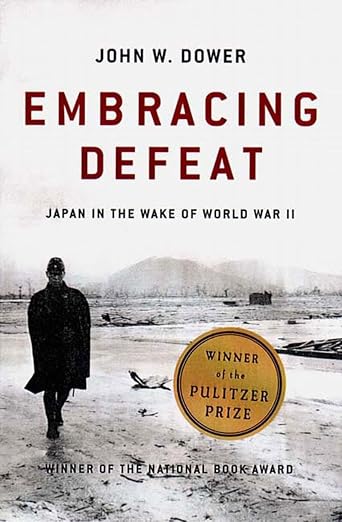
While preparing for a trip to Japan, my book group/duo and I took on John W. Dower’s 1999 Pulitzer Prize winning book Embracing Defeat: Japan in the Wake of World War II. (For the Gravity’s Rainbow Support Group’s full notes you can scroll down at the bottom of this webpage.)
The book is a wide sweeping history of America’s occupation of Japan from 1945 to 1952 which includes General Douglas MacArthur and how he chose to use the defeated Emperor Hirohito. Instead of trying their Deity for war crimes, MacArthur used Hirohito to transition the country to a (victor’s) democracy. The book also explains how Japan managed to become the economic powerhouse that flooded the U.S. market with electronics and Toyotas and Datsuns in the 1980s.

There are a lot of quirky historical footnotes as well with none so surprising on how Japan identified with Margaret Mitchell’s 1936 bestseller Gone with the Wind . The novel was translated into many languages including Japanese. Dower writes:
For two years beginning in 1949, the “top ten” list included Margaret Mitchell’s blockbuster 1936 novel Gone With the Wind. It did not take great imagination to read Japan itself into this portrayal of the defeated Confederacy, where romantic evocations of a genteel civilization “gone with the wind” were counterpoised against the vicissitudes of a war-torn landscape and a postbellum society plagued by Yankee interlopers and groping for a new identity. Even Mitchell’s sharply contrasted heroines could be viewed as figures in a Japanese mirror: the pure, submissive, domestic Melanie and pragmatic, opportunistic, sensual Scarlett. Victimization, struggle for survival, Scarlett’s defiant vow that “I’m never going to be hungry again”—all made Mitchell’s saga of the American South seem very familiar indeed.


Leave a Reply