GRSG 2026 Reading Notes

This is our sixth year of two-person book club known as the Gravity’s Rainbow Support Group (GRSG) which began with our first book Gravity’s Rainbow by Thomas Pynchon during the Pandemic. Our notes are filled with observations, sidebars, anecdotes and usually conclude with an insightful Francis’ Amazon Review,
Links to Murray’s online bookshop (Destination: Books) have been provided in case visitors want to purchase the book and support Murray’s addiction to blogging.
Patina: A Profane Archaeology by Shannon L. Dawdy
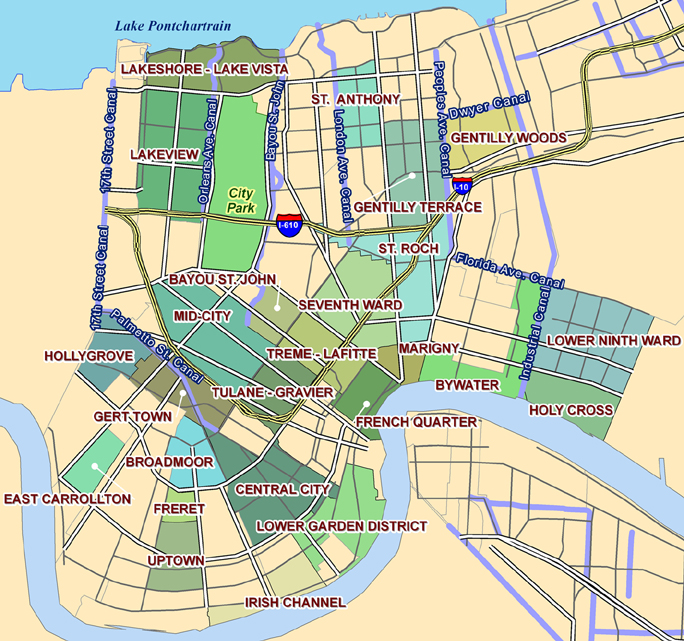
This book came about when Murray visited New Orleans last fall to catch up his daughter Cynthia who was in the Crescent City for an anthropology conference. Dawdy who is an associate professor of anthropology at the University of Chicago was a speaker at the conference. Cynthia thought I would like the book and sent it to me afterwards.
Published in 2016, Patina is centered in New Orleans where Dawdy has done much archeological work digging through layers of New Orleans history and then combining her findings with her academic musings. Here’s some of main areas of the book, which is a relatively short work (150 pages) but it is chocked full of revelations and speculations depending on your point of view. Either way it is a challenging and thought- provoking work.
Patina and Pastness Defined
In the first chapter, Dawdy defines patina in contemporary English as:
(1) ” a surface appearance of something grown beautiful esp. with age or use” (2) “an appearance or aura that is derived from association, habit or established character” and (3) “superficial covering or exterior” Patina thus has an aesthetic quality with connotations of age, is a signifier of certain social habits, and can be artificially created or fakes.”…’it is these three meanings that imply some ambivalence”
It is ambivalence and connotations about patina that acts as starting point giving Dawdy a license to riff.
One particularly redolent phrase, “Katrina Patina,” referred to the multihued encrustation that water and mold left in horizontal strata upon houses, possessions, and even the people sullied by the hard work of cleanup.” (Chapter 1)
Ruins and Heterogenous Time
IF you’re going to talk about ‘pastness’ you cannot due so without talking about time. Dawdy writes, “Time for him (Walter Benjamin) was not a series of linear strings laid end to end but a twisted knot.” She defines ‘pastness” as a quality that is sensed (not remembered not narrated) and experience filter through the flux of time.” (page 25 – page numbers represent the University of Chicago Press print edition)
Of course, some of these passages can be described–as Francis put it–as doosies:
Edmund Husserl argued that time understood as a steady sequence of linear events is a highly abstracted representation of what our consciousness experiences as a sensual flux of echoes, cycles, and retentions, akin to multipart music. In the phenomenological view, the content of experience matters more than the form of timekeeping (seconds, days, years). The phenomenological intervention of the early twentieth century marked a radical break with Western beliefs in objective and progressive time, or what Walter Benjamin called empty, homogeneous time. (Page 29)
As you can gather, Dawdy synthesizes from many sources, which is not always clear but they worth trying to comprehend. One of the more straightforward sections of this chapter is her deep dive into the House of the Rising Sun.
Certainly, all of us at a certain age can remember the Animals version of the song but did you know that the song descended from an English ballad and was recorded by folksingers in the 1830s a century earlier in Appalachia.
The hotel or house of the Rising Sun is a much sought after location for New Orleans visitors.
…the well-known folk song “House of the Rising Sun,” popularly interpreted as the lament of a fallen woman who surrendered to fate in a New Orleans bawdy house. (It’s been the ruin, of many a poor boy….don’t spend your time in sin and misery, in the house of the Risin’ Sun). This is a case of a beloved old story in search of a material home—of the satisfying verification provided by tactility. It was a yearning shared by many of my archaeological colleagues, who were disappointed with my hesitancy to authenticate the site as the House of the Rising Sun. Page 69 (She makes a good point here, it applies to myth or song and why people wanted to find the Wreck of the Edmund Fitzgerald, the lost city of Atlantis, and of course Noah’s Ark – Francis).
The hotel closed between 1838 and 1840 to make substantial repairs. Given the youth of the building, but also the great weight of its four stories of brick, we can infer that the building suffered considerable subsidence due to the instability of the rotting Rising Sun Hotel debris and the soft soils upon which it was built. This would have led to sloping floors, bent door and window frames, and cracking plaster, among other problems. – Page 73
The song fits perfectly with the dens of inequity we associate with New Orleans.
A Haunted House Society
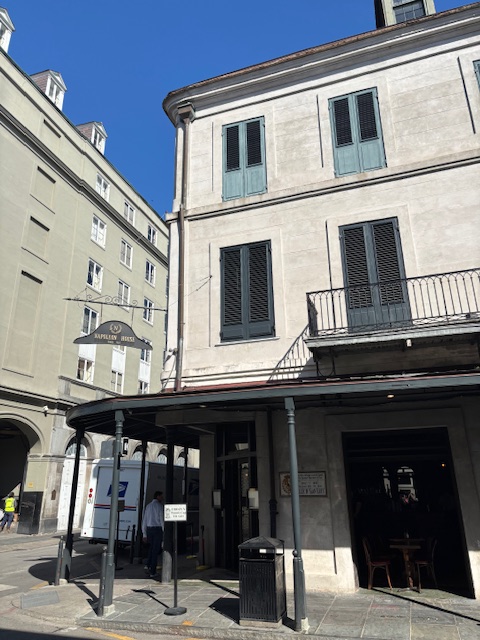
The Napoleon House in the French Quarter. Originally built in 1794 and expanded in 1814 to accommodate Napoleon Bonaparte in exile. It was part of Murray’s walking tour. Dawdy refers to the restaurant as “among the most patinated in the French Quarter.”
In the book we learned about why the ghost of Walt Disney and others remain a part of the city and its numerus ghost tours. (Walt Disney wanted to build Disney World in nearby Slidell, Louisiana but would not succumb to the shakedown by Louisiana politicians.)
Antique Fetishes
A couple of worthy passages about antiques:
“As cultural capital, antiquities and antiques are mobile and fungible but not necessarily available for public display. Their illicit route disqualifies them from becoming what Malinowski called “objects of parade.” Their stories cannot be told, at least not too loudly. They represent a highly rarefied form of inconspicuous consumption.” – Page 135
“For Ann and other New Orleanians, participating in the antique market is akin to attending a jazz funeral—it is a local pastime that creates a sense of community and requires local knowledge to fully appreciate. “- Page 128
Mardi Gras

In this chapter Dawdy includes Mardi Gras souvenirs and the significance of the cheap beads that are thrown to tourists. There worth is based on that it marks an event and how gauche for a tourist to buy beads at a shop.
A case in point. This necklace belongs to Murray’s stepson Sean who was cleaning out closets in his last trip home. Most things were tossed but unsolicited he kept this necklace from his trip to Mardi Gras when he was in high school.
Francis’ Review
We finish with another tradition Francis’ Amazon Review. (It had a lower rating, but Murray who liked the book convinced him otherwise.)
Overflowing
Karl Popper wrote that aiming at simplicity and lucidity is a moral duty of all intellectuals and that lack of clarity is a sin. If so, Shannon Lee Dawdy’s “Patina”, has both saintliness and sin. Her descriptions of archeologic excavations, interviews and public records are straightforward, informative and engaging. However, her asides based on her notions of the space-time continuum, psychoanalysis and 19th century economics baffle and befuddle. Contravening the law of supply and demand, she cites Marx to posit that the value of a commodity can only be reliably measured by the labor-time that went into its manufacture. In explaining physical patina, she cites Husserl, who “…. argued that time understood as a steady sequence of linear events is a highly abstracted representation of what our consciousness experiences as a sensual flux of echoes, cycles, and retentions, akin to multipart music. In the phenomenological view, the content of experience matters more than the form of timekeeping (seconds, days, years).” One wonders if the molecules on the oxidized surface of houses and antiques are properly acquainted with this definition. Readers willing to dig through the crust of such academic meanderings, will be rewarded by her descriptive passages on the remains of saintly old churchyards, the sinful “House of the Rising Sun”, the devastation of Katrina, and the unextinguishable beliefs in local ghosts which provide insight into the zeitgeist of the city. While the book has limited appeal to a general audience, those with an academic bent and a taste for extended metaphor will find it has much to like.
The Sea Captain’s Wife: A True Story of Mutiny, Love, and Adventure at the Bottom of the World by Tilar J. Mazzeo
It seemed only natural or destined that GRSG this book because it fit so well with other books that we have read the past couple of years. For example:
- Billy Budd by Herman Melville (a short maritime novel set in mid-19th century)
- The Gales of November by John Bacon (The Wreck of the Edmund Fitzgerald)
- Smoke and Ashes: Opium’s Hidden Histories by Amitav Ghosh (Lots of clipper ships delivering the goods)
- Under the Eye of Power: How Fear of Secret Societies Shapes American Democracy by Colin Dickey (e.g. The Masons)
- The Magic Mountain by Thomas Mann (tuberculosis was a “player” in both books)

Mazzeo who grew up in Camden, Maine wisely selected Mary Anne Patten (1837-1861) and her ship captain husband Joshua Patten (1827-1857) as the central focus of this maritime adventure. Not only was Mary Anne Patten extraordinary and heroic, but she was uncanny in her mathematical/navigational skills, and it turns out able to withstand the worse possible conditions (ailing husband, pregnancy and handling the crew that teetered on mutiny. She was nineteen years old at the time.
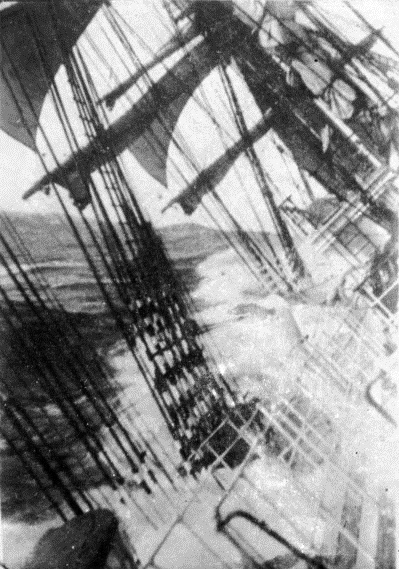
Mixed in with her story is a glimpse of the world of clipper ships and two perilous trips from New York harbor through the Cape Horn and the Drake passage to San Francisco. Mary accompanied her husband on both voyages and adding to the compeling narrative is that it was also a race between clipper ships on which vessel would reach San Franciso first. (This photo of an unidentified ship around Cape Horn comes from Wikimedia Commons)
“There are old captains and there are old captains but there aren’t old and bold captains.”
(such is the case with Joshua Patten who was bold but died young.
Combine this with her husband being stricken with tuberculosis and later meningitis and her bouts later with typhoid fever you get a fair dose of misery porn, but Francis appreciated the medical aspects of The Sea Captain’s Wife. However, Patten did not keep a diary or wrote letters to her husband so Mazzeo had to fill in the blanks the best she could relying on newspaper accounts and birth and property records. This contributed to slight lack of depth surrounding the dutiful Mary especially when compared to Louisa May Alcott of Little Women fame who wrote a book entitled Hospital Sketches (more about this in Francis’ final review later).
Fun Facts
One of the strengths of the book is Mazzeo is how she will interweave related lore to the story whether it be the origins of the word “nauseous” and the words origin pertains to sea-sickness or why women’s bare breasts often grace the bow of a ship (superstitious sailors believe “they can calm ferocious waters.)
Francis and I agree that the story about Matthew Maury who published Wind and Current Chart of the North Atlantic in 1847 soon changed the way sea captains plotted their courses across oceans. Mazzeo writes:
Matthew Maury’s charts no longer hold the public in thrall. But perhaps they should. The charts were among the most important technological and scientific advances of the nineteenth century, and, while they represent the first “big data” project in the United States, Maury’s charts quickly became, as well, an astonishing example of what crowdsourcing and citizen science could accomplish – p242
On the Downside
There is nothing particularly noteworthy about Mazzeo’s prose, but one does question how she likes to interject current thinking into history (i.e. the Maury quote about big data project and what about the census which began in 1790.) can stick out. She also expands the importance of Mary Patten’s fame in her final years and does go on and on about her son Joshua, who suffered from epilepsy and other misfortunes.

There are only two maps at the beginning of the book (in contrast to the Gales of November which had several detailed maps. Also, there was no real detail of the Cape Horn and Drake’s Passage which played such an important role in the narrative. (So we included one here.) There was no index, but Mazzeo did provide extensive notes which was quite impressive.
Francis’ Review
We finish with Francis’ Amazon Review. (Originally it was higher, but Murray who liked the book less convinced him to take it down a notch.)
GRSG 2026 Reading Notes This is our sixth year of two-person book club known as the Gravity’s Rainbow Support Group (GRSG) which began with our first book Gravity’s Rainbow by Thomas Pynchon during the Pandemic. Our notes are filled with observations, sidebars, anecdotes and usually conclude with an insightful Francis’ Amazon Review, Links to Murray’s…
The Austrian writer, Maria von Ebner-Eschenbach (1830-1916) wrote: “Unbending stamina and uncomplaining self-denial are the two extreme poles of human strength.” It is possible she wrote this thinking of the grit of her contemporary, Mary Patten (1837-1861), the heroine of this book whose story made headlines across the world. At 19 (see image), while pregnant, she faced off a mutinous first mate on board a clipper ship as her husband, its commander, was waylaid by tuberculous meningitis, and as the ship was crashing through the waves of a stupendous storm at Cape Horn, one of the most dangerous seas of the world. She won over the crew, and with her own leadership and navigational skills, guided the ship safely to San Francisco, while tending to her deathly ill spouse. But the gale was only the first of a series of metaphorical storms that she faced, which in rapid sequence, included icebergs, typhoid, malaria, childbirth and financial duress. Another contemporary of hers, Louisa May Alcott (1832-1888) grew up nearby in Massachusetts, and wrote: “Simple sincere people seldom speak much of their piety. It shows itself in acts rather in words, and has more influence than homilies or protestations”, which could also have described Mary Patten, who left behind few records of her own words for historians to gauge her thoughts. The author of this book, Tilar Mazzeo, does a remarkable job reconstructing this young woman’s life from the material available without succumbing to the temptation of embellishment. She describes in detail, at times too much, her and her husband’s predecessors and their environs, to give readers an idea of the people and customs that shaped the development of this remarkable woman. Nathaniel Hawthorne, a distant relative of Mary Patten’s husband even makes a cameo appearance, as a custom’s officer in London. This approach sets the scene for her intrepid actions, which, as described by Sebastian Junger in The Perfect Storm, were almost forced upon her by seaborn circumstance. In describing the aftermath of her remarkable achievement, and the celebrity that ensued, the author suggests how it was one of many factors that contributed to society’s evolving recognition of the equality of women. This book is ideal for people interested in learning how even those of the most unprepossessing backgrounds in 19th century New England could surmount incredible odds and become accomplished at an early age. Those wishing for more psychological insight into Mary Patten’s mindset may benefit by reading “Hospital Sketches” by the Louisa May Alcott, quoted above, as she describes first-hand a ship journey to Washington DC, nursing injured Civil War soldiers back to health in the Union Hotel Hospital, and surviving a bout of typhoid fever. In any case, “The Sea Captains Wife” is a well-written account of a thrilling adventure and the challenge of living in the pre-Civil War era. Highly recommended.
The Forbidden Garden: The Botanists of Besieged Leningrad and Their Impossible Choice by Simon Parkin
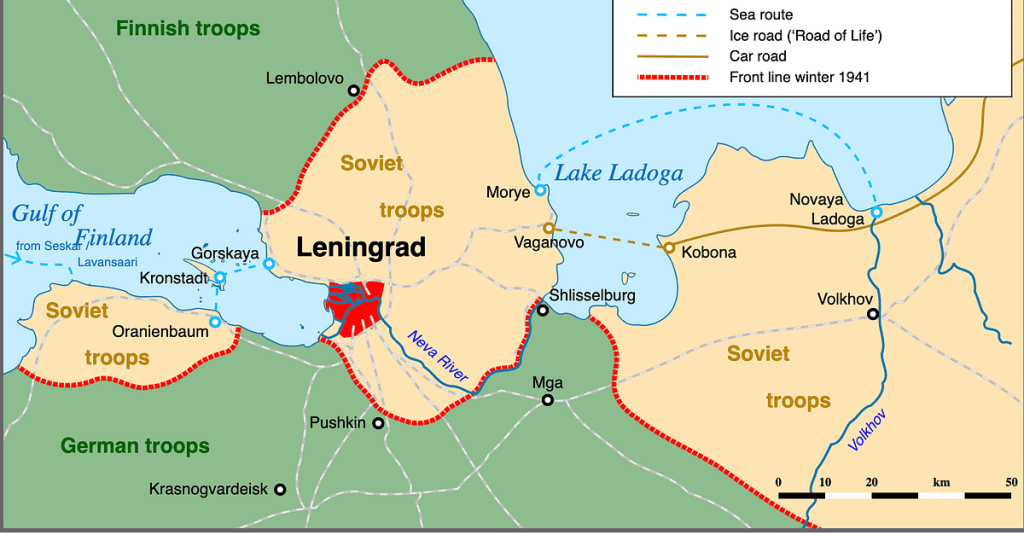
This book caught our attention when it was published with some acclaim in 2024. It moved to the head of the queue because Murray wanted to evaluate the book as a possibility for his Destination: Books pop-up ( I carry many garden-related books and my customers also like history.)
Founded by world renown botanist Nikolai Vavilov, the Plant Institute of Leningrad was the flagship of seed and botany research, which began in the 1920s. Eventually it held hundreds of thousands of seeds, but when the Germans invaded Russia in June of 1941, they laid siege to Leningrad. The driving plot was “As employees of the world’s first seed bank, the botanists were the only people to have been faced with this ultimate and fundamental dilemma: to save a collection built to eradicate collective famine, or to us the collection to save themselves.”(p.155)
But there were also other thick threads that ran throughout the book, which was well-written and compelling.
Stalin
This book reminded Murray of Timothy Snyder’s Bloodlands: Europe Between Hitler and Stalin (2010) an in depth and graphic history of how the policies of these two dictators were responsible for the mass murder of 14 million combatants.
In The Forbidden Garden, Parkin zeroes in on how Stalin and Hitler starved and murdered the citizens of Leningrad.
Lysenko
Trofim Denisovich Lysenko (you must learn to roll with the long Russian names in this book) was as Francis points out – the RFK Jr. of his time. In this assembly of quotes you can see the parallels.
Page 21; Lysenko argued that genetics, represented a waste of time and resources: one simply had to train plants to meet one’s goals, a theory he named vernalization. Lysenko’s outlier theory resonated with the country’s leader, Joseph Stalin, who approved of the idea that plants, like workers, could be transformed by an act of political will…… Page 21; Stalin also liked that, unlike Vavilov, Lysenko came from peasant stock, and that his theories did not rely on academic laboratory work. Better still, at a time when millions of Russians and Ukrainians were perishing from starvation caused, in part, by poor crop yields, Lysenko promised Stalin that he could meet the demand for improved crop varieties within three years, seven fewer than Vavilov estimated his work required to produce results. )
Page 23 Later that year, while Vavilov was away on a scientific expedition, Lysenko replaced the twenty-seven senior scientists who served on the Plant Institute’s scientific council with his own followers. One such follower was Isaak…”Prezent who coauthored articles with Lysenko and coedited the journal Vernalization, which dismissed the entire field of genetics as a “pseudoscience.” Prezent helped Lysenko organize vast experiments and publish the dubious results and crafted compelling statements designed to uplift Lysenkoism, denigrate his opponents, and propel his protégé from the sphere of science to that of politics—to each man’s mutual benefit. (Page 63)
Starvation: Eating Famous Dogs
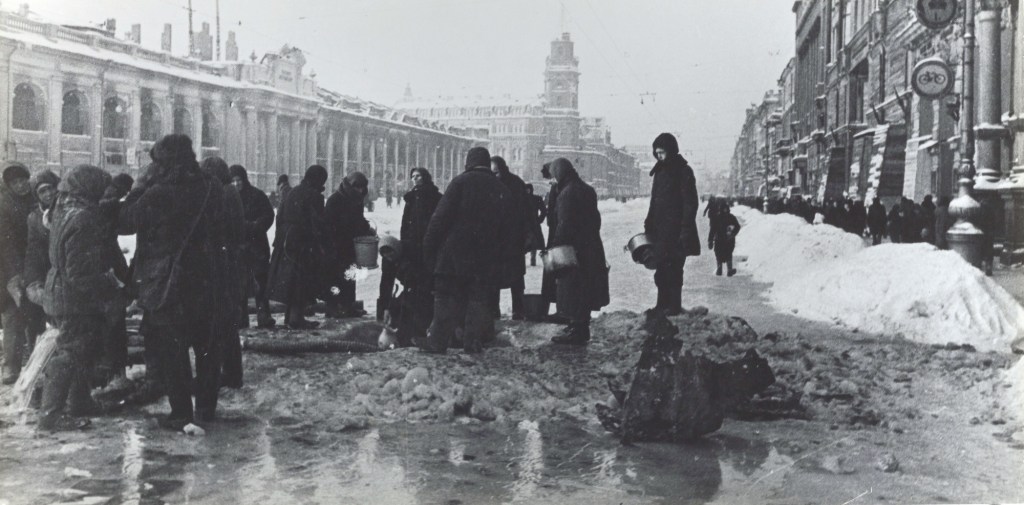
Parkin graphically writes about how exactly people starve to death and how the body slowly eats away any fat and then when that is gone how it attacks the organs, which is fatal. Coupled with the sub-zero temperatures of the Winter of 1941-2 when temperatures reached -40 degrees Fahrenheit it is estimated that at least 649,000 had succumbed to starvation.”
In one of the more poignant examples was the degree of how dogs and cats were devoured. “The smallest Leningrad children,” one journalist recorded, “grew up not knowing what cats and dogs were.” The siege wiped out urbanite sentimentality toward animals. At the Physiological Institute, famished researchers ate physiologist Ivan Petrovich Pavlov’s renowned dogs.
Strong Endings
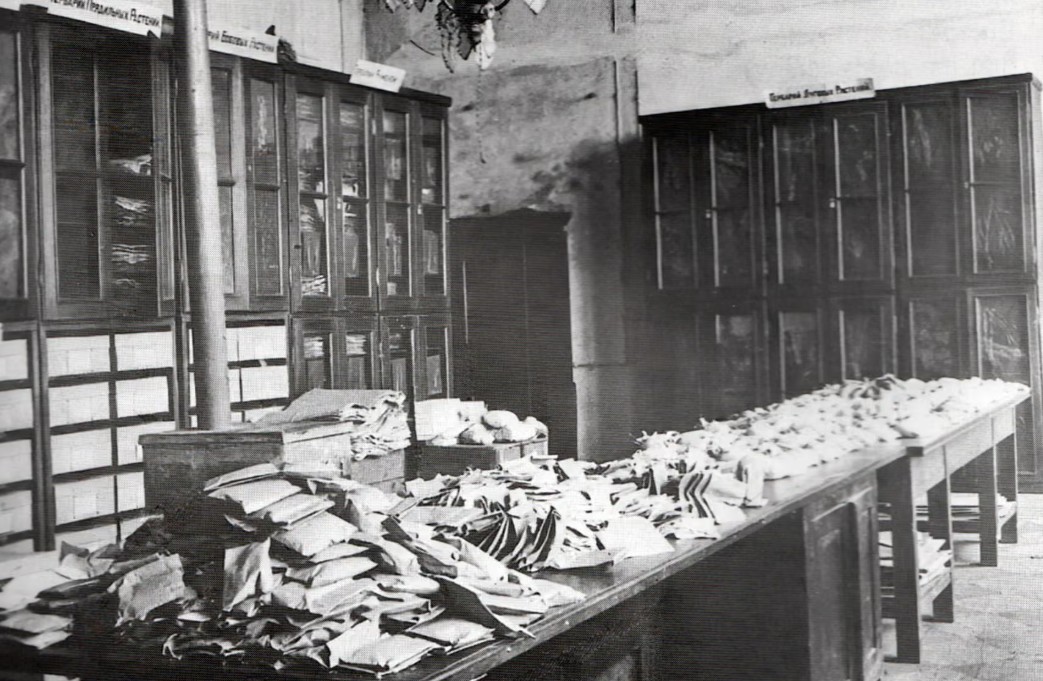
Like any good non-fiction book, Forbidden Garden ends strong with Parkin providing background on how he found source materials and his indebtedness to Ukrainian writer and academic Mark Popovsky who began gathering materials and files on in the mid-1960s. Popovsky had the Soviet Union’s attempts to hide the truths about Stalin’s Reign of Terror and the fate of Nikolai Vavilov.
Following Parkin’s lead we finish strong with Francis’ Amazon review. Also, the book is available for purchase on the GRSG section of the Destination Books online store.
GRSG 2026 Reading Notes This is our sixth year of two-person book club known as the Gravity’s Rainbow Support Group (GRSG) which began with our first book Gravity’s Rainbow by Thomas Pynchon during the Pandemic. Our notes are filled with observations, sidebars, anecdotes and usually conclude with an insightful Francis’ Amazon Review, Links to Murray’s…
GRSG 2026 Reading Notes This is our sixth year of two-person book club known as the Gravity’s Rainbow Support Group (GRSG) which began with our first book Gravity’s Rainbow by Thomas Pynchon during the Pandemic. Our notes are filled with observations, sidebars, anecdotes and usually conclude with an insightful Francis’ Amazon Review, Links to Murray’s…
Hubris: The Tragedy of War in the Twentieth Century by Alistair Horne
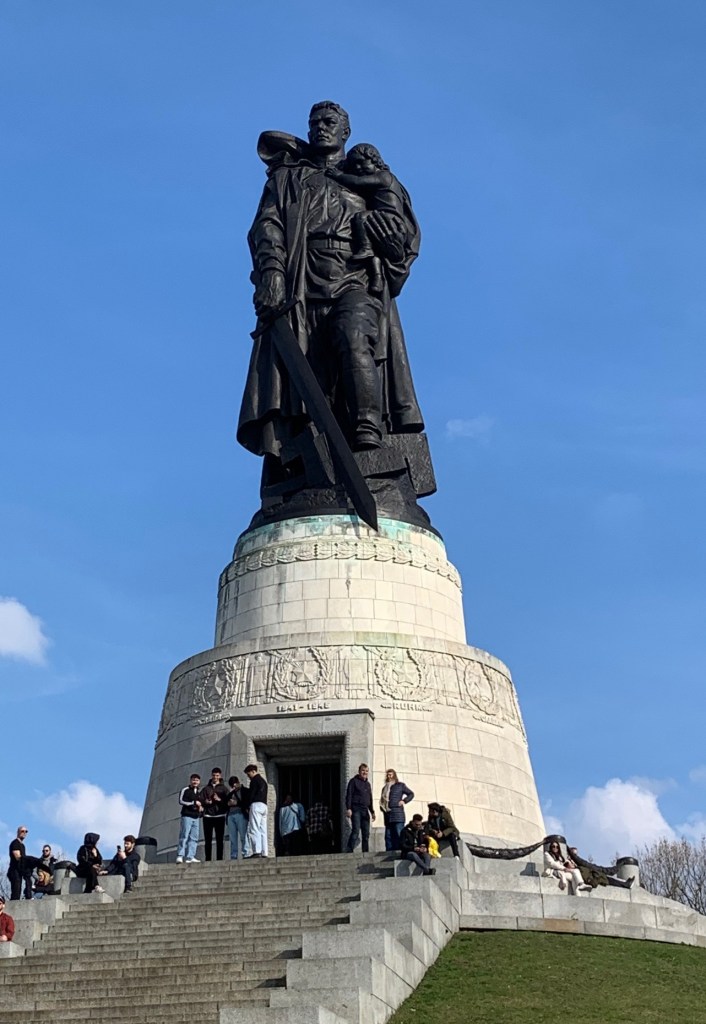
This 2015 book was the final work of British historian and academic Alistair Horne’s (1925-2017) long writing career, which included two other books that Murray had read — A Savage War of Peace: Algeria, 1954-1962 (which Murray wrote a piece about in Tropics of Meta) and The Price of Glory: Verdun 1916 his book about Verdun (which was one of Murray’s father’s favorite books). Murray first read Hubris waaaay back in 2017 and this book came up in our discussion of our previous book The Forgotten Garden about Leningrad. Germany’s invasion of Russia is central to the Leningrad, but the siege coincided with Hitler’s assault on Moscow at the same time, which is one of main campaigns highlighted in this book.
Horne defines hubris throughout the book, but one characteristic is overreach. Knowing when to stop whether it be MacArthur at the 38th parallel in Korea, Japan invading Russia, Hitler’s invasion of Russia. Another aspect of hubris is racism. Thinking your culture and intellect is superior to others: Germans to Russians, Japanese to the Chinese, Americans over the Japanese. Hubris coupled with complacency is a recipe for disaster.
There were five main parts to the book:
Part I: Tsushima 1905
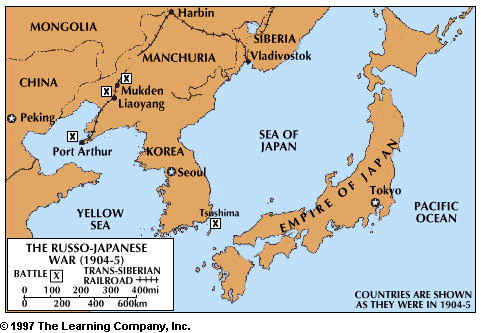
The book opens opening with Japan’s surprise attack on Port Arthur (a major deep seaport and the subsequent Tsushima naval battle between Russia and Japan fought in the straits between Japan and Korea, which no one in the West knows anything about.
As Horne writes:
“Have these Americans never heard of Port Arthur?” But, to the dismay of us historians, our leaders tend not to read history, or, worse, they pay no attention to its lessons……Yet it does seem extraordinary that, in 1941 with tensions rising between the United States and Japan, Franklin Delano Roosevelt did not seem aware of the dangerous precedents; after all, he himself had been assistant secretary of the navy in the First World War, only a decade after the attack on Port Arthur, and was well read in history.”
In October 1904 Russia retaliated by sending its Second Fleet from the Baltic around the Cape Horn of Africa, past the Indian Ocean towards Japan. A miserable Christmas was spent in the wretched conditions off the Madagascan Isle of Nossi-Bé (now a leading holiday resort), with its sweaty, well-named port of Hell-ville.
The Russian fleet’s 18,000 mile seven-month voyage was so ill-fated at times it sounded comical. It was doomed from the beginning since the Russian ships were fueled by coal and thus “had to be stocked with thousands of tons of coal.” With no Russian base enroute, the whole issue of coaling was crippling. “Every spare man and officer was brought in to do the coaling; stokers often died of heart failure in the heat…the coaling filled the whole ship with dust, which penetrated even the cabins and wardrooms of the officers.”
Admiral Heihachiro Togo, who trained at Britain’s Royal Naval Academy (also his fleet made up of superior ships built by Britain), sunk nearly the entire Russian fleet in a naval battle that lasted little more than a day.
Part II: Nomonhon, 1939
This was a land battle between the Soviet Union and Japan on the border of Manchuria and Korea held on the eve Hitler’s invasion of Poland in September, 1939 (again no one knows much of this battle). Horne adeptly shows those seeds for this battle were planted at the turn of the 20th century at Port Arthur. In this later campaign, the Soviets were led General Gregory Zhukov who stopped the Japanese advance in Manchuria.
Part III: Moscow, 1941
Because Stalin had spies in high place is Japan, he was able to pull his hundreds of thousands of troops early from Siberia frontier to reinforce Moscow. The spies assured Stalin that the Japanese were turning their attentions to the South Pacific (Pearl Harbor). Zhukov used the tactics he learned at Nomomahan to halt the Wehrmacht outside the gates of Moscow and later did the same in Stalingrad.
Horne gives much credit to super spy Richard Sorge, born a German but with communist sympathies that later landed him in Tokyo in 1933. Sorge fed Stalin secrets on Tokyo’s military ambitions. Incidentally according to Wikipedia, Horne was a spy for the British posing as journalist, no less)
Part IV: Midway, 1942
The U.S. Pacific Fleet halted the expansion of the Japanese in a naval battle that became known as the Miracle of Midway, which was made into two excellent war films Midway (2019) starring Patrick Wilson and Woody Harrelson and Midway (1976) starring Charleton Heston, Henry Fonda and Tashiro Mifune –the legendary Japanese actor who appeared in many Kurasawa films. The latter inclluded actual film footage of the battle spliced in. Adding to the plot, Heston’s pilot son falls in love with a Japanese woman. “Six months after Pearl Harbor, son? You have one bad sense of timing.”
Part V: Korea and Dien Bien Phu, 1950-1954
One chapter is devoted to the American Caesar General Douglas MacArthur who made a drastic miscalculation on the Korean peninsula.
MacArthur gets a lot of ink in this book – some of it good (his handling of Japan after the war, the gutsy invasion of Inchon that drove the North Koreans out of the South) and some if not so good (his drive past the 38th parallel which triggered the Chinese to attack his exposed troops, and his insubordination of President Truman, which led to Truman becoming the most hated man when he sacked the general. Truman had an approval rating in low 20s.
The second chapter covers the French’s resounding defeat at the hands of the Viet Minh led by Ho Chi Minh on the Laotian Vietnamese frontier – thus ending the French colonialism in Indochina and opened the door for a similar American miscalculations in the War of Southeast Asia.
This was familiar history to the GRSG, which read An Honorable Exit by Eric Vuillard in 2024. (Scroll here to read our notes.
Francis’ Amazon Review
There was some discussion about whether Francis would give it 4 or 5 stars. “I’m going to stick with 4 stars,” says Francis, ” but as long as I warn people that he isn’t too big on the details and, that the book is a bit of a morality play, calling it ‘highly recommended’ seems fair enough in that I warn off those looking for something a bit more rigorous–but that’s just me.
Pride and Arrogance:
The strength and weakness of Allistair Horne’s “Hubris: The tragedy of war in the twentieth century” lies in its unity of its stated theme. Focusing on hubris, he covers a great deal of military history with accessible prose and simplicity, which skirts a great deal of dreary detail, but, by necessity, omits some of other critical contributing factors. Tacitus, who made the observation that while “victory had many fathers, defeat was an orphan” recognized its intrinsic irony, in that the reverse is often more true, with multiple factors responsible for failure and rarely that of hubris alone. Nonetheless, Horne’s approach works well, providing a unitary overview of seemingly disparate events, by showing their unexpected connections spanning conflicts spread out over 5 decades and 5 continents He depicts multiple versions of hell on earth, beginning in 1905 at the port of “Hellville”, a coaling stop in Madagascar for Russian vessels steaming from the Baltic to rescue the embattled Pacific Russian Fleet from annihilation by the Japanese. Coaling was a brutal process, covering the ship in noxious black dust during loading with the risk of heat stroke and death for stokers as they fed boilers to the maximum to furnish mobility during battle. He ends in 1954, with a description of the battlefield of Dien Bien Phu, which was christened by the journalist Bernard B. Fall as “Hell in a Very Small Place”—and yet, all of the battlefields, including those in Korea, Manchuria, and Europe were no less nightmarish for soldiers and citizens alike, making a mythical location for Hades immaterial, as Shakespeare put it so eerily in The Tempest: “Hell is empty and all the devils are here.” In the Epilog, Horne reminds us that hubris is contagious, infecting the military, as well as the political leaders and the people of their countries—creating a reservoir which keeps the threat of hubris ever present. Although skeptical of the ability of modern leaders to learn from history, Horne is no defeatist, gamely diving into the darkness of our shared past to mine it’s valuable lessons. His approach follows that suggested by Kant: “Only the descent into the hell of self-knowledge can pave the way to godliness.” One envisions Horne, along with his fellow historians, like driven soldiers in the battles he describes, repeatedly dosing mankind with the precepts of the past, fueled by the belief that these, one day, will render mankind resistant to the scourge of hubris. Highly recommended.
A Short Walk in the Hindu Kush by Eric Newby
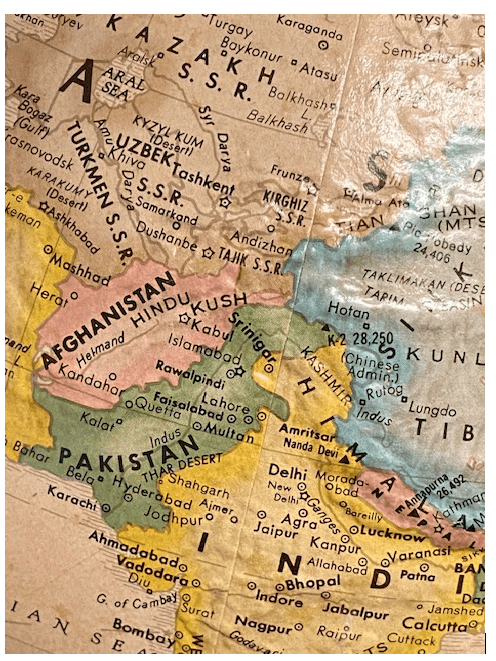
The GRSG adventures into the dangerous and distant mountains of the Hindu Kush, but rather risking life and limb we accompany Eric Newby and Hugh Carless in the 1958 travel classic A Short Walk in the Hindu Kush. Francis had read and enjoyed Newby’s Love and War in the Apennines and recommended this book. Besides set in Afghanistan and Persia/Iran, this region of the world remains in the forefront of the news. (Every time one fills up their automobile.)
The book begins with Newby leaving his job in the British fashion industry and joining his friend Hugh who is in the foreign service. The duo journeys through Turkey and Persia (Iran) to Kabul where they eventually work their way up to Nuristan to attempt to climb Mir Samir (elev. 19888′).
The book is at its best when describing the people and the mountainous region, but the maps in the book are barely adequate and the author tosses in Nuristani language words willy-nilly without clarification and the several locals who accompany them seem to blur together.
Here are a couple of good desciriptions:
“….I had done some hill walking and a certain amount of scrambling in the
Dolomites with my wife, but nowhere had we failed to encounter ladies twice our age
armed with umbrellas. – Page 12
(Newby met his wife in World War II which is chronicled in the Apennines book. She began the trip but stomach issues got the best of her)
: …..and so up the Darra to Kuh-i-Mir Samir itself. And there the last ibex took refuge on the very top. And the water followed up to the very belly of the ibex. Then it rose no more and after a while began to sink; ever since that time the belly of the ibex has been white.- Page 138

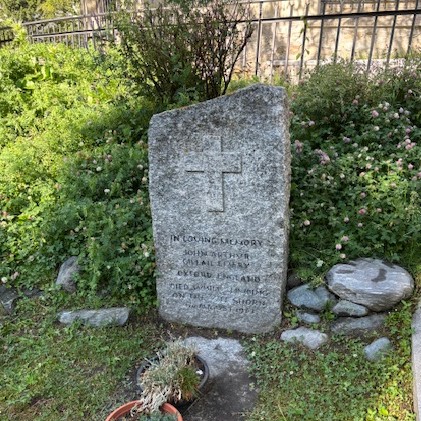
What is clear is all the suffering hunger, freezing conditions, storms, jagged rocks and ice, bad footwear, bad food, dysentery, threatening Mullah. This willingness to subject themselves to such conditions makes one wonder what motivates them (adrenalin addiction) and reminded Murray of his 2025 trip to Zermatt, Switzerland home to the Matterhorn and populated with gravestones of young plucky British explorers who died on the slopes.

As us tradition we finish with Francis’ Amazon Review
Not Short Enough
Eric Newby’s: “Love in the Apennines” is a better read, but “A short walk in the Hindu Kush” has its own attractions. The first few chapters are perhaps the most entertaining, and discuss, with good humor, his woefully inadequate preparation for climbing mountains; it also describes the stultifying career which he gladly left (after making enough money with his writing to afford it) –however, this period of dull work was perhaps a much needed respite from his stressful time in WW2 escaping from German and Italian prisoner of war camps and hiding out in enemy territory in between, which he recounts in his other book mentioned above.
Although the origin of the term “Hindu Kush” is left out of the book, Ibn Battuta, a 14th century Islamic scholar who travelled widely and wrote about his journeys, explained the name “Hindu Kush” which can be translated as ‘Hindu slayer’, because those who transported Hindu slaves across this mountain occasioned the death of many due to their forcible transportation. The challenges of glaciers, sustenance, cliffs, ravines, freezing cold, and falling rocks in crossing them even centuries later is made clear in Eric Newby’s book. It also manages to capture a rare calm period in the history of Afghanistan and Iran which contrasts with the political tumult and warfare which have preceded and followed it. One of my favorite passages is a village elder who explains how the Ibex got its abdominal coloring in a “Just-So” type anecdote: He had heard it passed down that one such animal climbed the highest peak in the Hindu Kush to escape inundation from Noah’s flood and even still the water reached so high it lapped up against its belly but no higher—and so ever since the abdomen of the ibex has been white. The books is recommended for those with an interest in mountain climbing and the history of the region of the Hindu Kush—others, however, may find that this short walk a read too long.
Football by Chuck Klosterman
This book captured Murray’s attention for several reasons: a.) Father’s Day is coming up and he’s looking for a books that appeal to men for his Destination Books popup booth b.) The NYTBR review “Is Football Doomed? Chuck Klosterman Thinks So” by one his favorite critics Dwight Garner c.) the book devotes a chapter to Jim Thorpe whose biography received the coveted GRSG read five-star sports rating in 2024, and most importantly, d.) In the GRSG book group sports is often talked about.
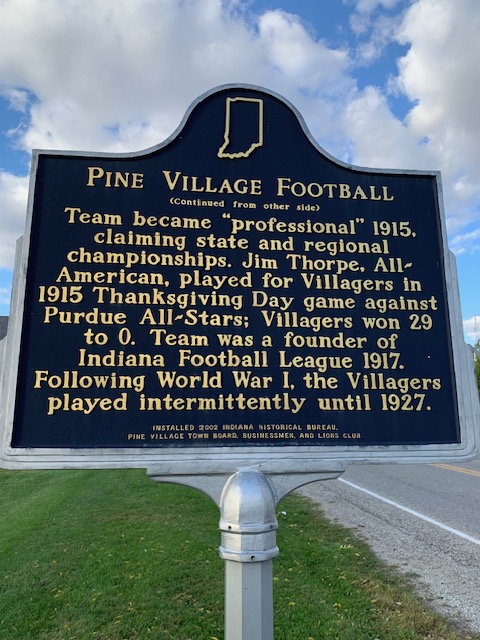
Jim Thorpe’s influence and athleticism even reached this small town in Indiana (just 20 miles from where Murray grew up.) We read David Maraniss’ excellent biography of Thorpe A Path Lit by Lightning in 2021.
But the main premise of this recently published book is Klosterman’s prediction that my mid-century football will be no more popular than boxing and horseracing is now. (Those two sports dominated the sports scene in the 1930s). This argument comes at the end of the book but before that he gives us fair warning in the introduction of what the book is not about:
- This will not be a book about how football builds character. (but it does include the author’s football hero Roger Staubach)
- This will not be a book about toughness and masculinity. (but includes analysis of the book and film North Dallas Forty)
- This will not be a book about the pleasure of escapism. (but it does explain why football works so well for television)
- This will not be a “love letter to the game. “Because that shit is for babies. I love football, but I don’t want to take it to the prom.”
Topics also include the silly discussion of GOATs, (Greatest of All Time), –but we at GRSG already know its Jim Thorpe– racism in the NFL, the debilitating concussions and a host of football related topics. Klosterman puts all of this under the umbrella of ” the premise that understanding what society loves is a way to understand what society values. (p.243)”
Francis Finds Flaws
As entertaining as all this sounds as Klosterman’s prose is swift and engaging partly because he mixes in his own personal experience (the book has a bit of a memoir quality). Nevertheless, there are passages and statements that sent Francis’ skepticism meter into the red zone, so to speak. Here are a few examples:
- Page 24: The visual imprinting of television is more overpowering than the visual imprinting of life; a TV screen presents an enclosed reality inside the preexisting reality of your house, and that manufactured reality overwrites both your memory and your imagination. (????—Murray, I’m not sure he’s right about this at all—FW)
- Page 33: The fact that we can’t replicate what we see democratizes a fascist experience, placing every variety of viewer the same social distance from hard reality.????? (see above, this sentence makes no sense. FW)
- Page 66: Memories are like dreams: Even the good ones are sad.????? (Murray, I don’t agree with this either, and have no clue where he got that from. FW).
- Page 91: Greatness is about the creation of archetypes. ???? (Murray, This statement really makes no sense either, FW)
- Page 258: (comment from Klosterman’s father after watching a storied comeback by Roger Staubach) “Well, there you go,” he said without affect, still staring at the screen. “I gave up, but he did not. And that’s why he is who he is, and that’s why I am who I am.” (Murray, we probably should have discussed this line, as I think it explains why he wrote this book; of course, it’s hard to know how well this ties in with everything else without knowing more about his father and if this was just a one-off kind of statement, or something more telling about his life—F.W.)
Judging a Book by Its Cover
Before Francis’ final review there is one final observation.
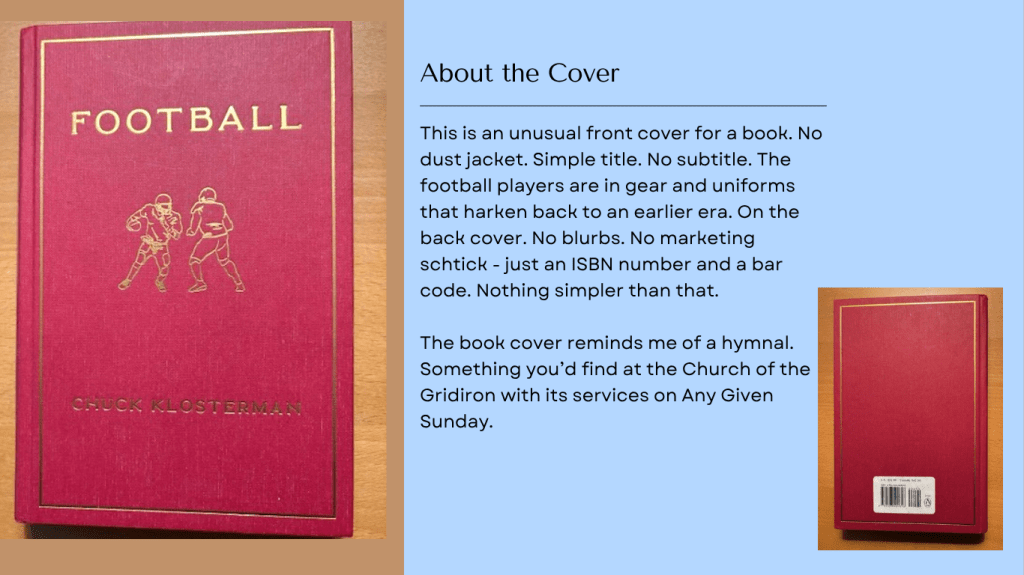
When Pigskins Fly
George Santanyana wrote: “For an idea ever to be fashionable is ominous, since it must afterwards always be old-fashioned.” Chuck Klosterman’s ‘Football’ makes a convincing case that the sport is currently fashionable, and predicts its ultimate demise using a similar, but perhaps overly extended, argument. In between, he sandwiches sports stories, including an ode to Roger Staubach, his own, self-admittedly unexceptional experience with organized football, the storied history of high school football in Texas, The Dallas Cowboys, the acceleration of payment for football players, both at the college and professional levels, its benefits and its drawbacks. He writes well and makes some interesting observations: He notes that in the same way football is always better on television, hockey is always better live– and that the structure and tempo of football is especially well suited for persuading people to sit through commercial ads. He echoes Joubert’s sentiment: “Ask the young, they know everything” but he aptly rebuts it, by saying that if one asks any 50-year-old if they were more intelligent and more ethically sophisticated at 25, no one ever says yes. In the process he also swings for the fences generating the occasional bon mot: On describing the inevitability of exceptions: He writes: “There are atheists even in Vatican foxholes but other times he strikes out: On Goats: “Greatness is about the creation of archetypes.” Believing that one can understand what society values by what it loves, he explores society’s obsession with football and if it can be likened to fascism (no), autocratic indoctrination (no), or the callous manipulation of sly marketers (maybe). His analysis seems overwrought in that all of us dream of escaping to a mythical world in which talent is rewarded, rule-breaking penalized, and no hero goes unsung—a world that businesses, athletes, and sportswriters try to recreate. Here is Lichtenberg describing from 200 years ago: “The journalists have constructed for themselves a little wooden chapel, which they also call the temple of fame, in which they put up and take down portraits all day long and make such a hammering you can’t hear yourself speak.” A few, good sportswriters, think Jason Gay of the Wall Street Journal, employ a mock-epic style, which satisfies our need for myth and pardons us for our tendency to relish it. Unabashed fans and sports lovers, comfortable consuming something other the traditional fodder plied by sports shows and podcasts, will enjoy this pastiche of essays on football. Less devoted fans, however, will find the book in need of a lighter touch and more rigorous editing.
London: The Biography by Peter Ackroyd

Since Murray was heading to London for 10 days in May he included the Ackroyd book, written in 2000, in his preparation. He soon realized the book is extraordinary in its breadth and depth about the history of London, focusing not on kings and queens and palaces, but how the city has grown and changed throughout the centuries, focusing more on the commoner, than the aristocracy.
Ackroyd divides and conquers by mixing 79 chapters into rough 30 categories in this 750 page book (or 1100 if you’re reading on the Kindle. Some topics bleed into other topics and a few times you wonder if you haven’t already read about it. Nevertheless, the scholarship and his approach is impressive and Francis being the sporting chap that he is, willingly signed on (and he wasn’t even vacationing there.)
Ackroyd relies on the English writers to give accounts of life in London. Passages from the work of Charles Dickens, Henry Fielding, William Makepeace Thackery, William Hazlitt, Sir Arthur Conan Doyle, Virginia Woolf, Daniel Defoe, Thomas DeQuincy, Samuel Johnson, and Samual Pepys are interwoven seamlessly into the narrative. One gets a visceral sense the chaos, bustle, the stink of the city.
Here’s just a few examples:
Pungent
From Chapter 36, Waste Matters
“What voracious city devours, it must eventually disgorge in rubbish and excrement.”
“Londoners are fascinated by excrement. Sir Thomas More, in the early sixteenth century, uses five names of shit—cacus, merda, stercus, lutum,co-enum—in his polemical work. These are Latin terms but in the English of the samecentury homage was paid to human excrement with the nickname of “Sirreverence.” Inthe late twentieth century those quintessentially London artists, “Gilbert and George” ofSpitalfields, arranged large exhibitions of their Shit Paintings.
One of London’s personality traits repeated throughout the book (and its history) was the poverty, filth and terrible smells.
The Drinking Life
From Chapter 38
Clubbing …William Hickey was returning from a drinking club at the Red House. “Clubbing” is first used as a term in the seventeenth century; in July 1660, Pepys wrote that “We went to Wood’s, our old house, for clubbing.” But it was in the succeeding century that a variety of clubs emerged for a variety of members.
From Chapter Five, Loud and Everlasting.
In this chapter about the din and noise of London. Samuel Johnson once remarked upon the subject of taverns, “Sir, there is no other place where the more noise you make, the more welcome you are.”
Chapter 12, The Crossroads.
Another calamity was visited by drink upon St. Giles-in-the-Fields in 1818. A great vat of the Horseshoe Brewery, situated just north of the crossroads, exploded and released approximately ten thousand gallons of beer; stalls, carts and walls were washed away in the flood and the beer quickly filled the cellars of the vicinity, drowning eight people. Gin Lane and Beer Lane met in confluence. The cellars that proved so fatal have their own history. “To have a cellar in St. Giles” was a catchphrase for squalor and misery.
Chapter 37, A Little Drink or Two
The names for drunkards and drunkeness in London are many and various– “soaks,” “whets,” “topers,” “pissheads and piss artists are “boozy,” “fluffy,” well-gone,” “crocked,” “wrecked”…
Prisons and Executions
“London is the home of the spectacle, whether living or dead.”

Ackroyd devotes considerable attention to the prisons of London such as The Tower of London (shown here) and Newgate. (There were only six executions in the Tower of London according to our guide, but one was Anne Boylyn) .
From Chapter 24, A Newgate Ballad
“Newgate rose five storeys, spanning the entry to Newgate Street from Giltspur Street and the steep incline of SnowHill. There were now five “sides” for various felons and debtors, together with a newly designed press room (the object of “pressing to death” was to extort confessions), condemned holds, a chapel and “Jack Ketch’s kitchen.” (Well, pressing to death is better than waterboarding, but not by much! FW)
“This is the yard to which Daniel Defoe consigned Moll Flanders in his narrative of her adventures; since the author himself spent some time incarcerated in Newgate in 1703, his account bears the mark of genuine remembrance. It is “impossible to describe the terror of my mind, when I was first brought in, and when I looked round upon all the horrors of that dismal place … the hellish noise, the roaring, swearing and clamour, the stench and nastiness, and all the dreadful afflicting things that I saw there, joined to make the place seem an emblem of hell itself, and a kind of an entrance into it.”
“One of the most famous prisoners was Jack Shephard It is indeed a familiar and often an accurate analogy, and the history of Jack Sheppard suggests another aspect of it. He hardly ever left London, even with the opportunity and indeed the pressing necessity of doing so; after three days “on the run” in Northamptonshire, for example, he rode back to the city. After his penultimate escape from Newgate he returned to Spitalfields, where he had spent his earliest days. After his final escape he was determined to remain in London, despite the pleas of his family.”
Newgate is where prisoners were held before execution and tours “Newgate became a kind of theatre when on Wednesdays and Thursdays between the hours of twelve and three, it was open to visitors.”
Both Dickens and Thackery wrote about public executions as they were considered “entertainment” for the masses. (We’ve come a long way-now its UFC on the White House Lawn – MB). Included in the festivities is the cart ride for the condemned between prison and gallows.
Newgate was demolished in 1902, but Francis and I agreed that the Tower of London is worth a visit for more than just seeing the Crown Jewels.
Final Thoughts
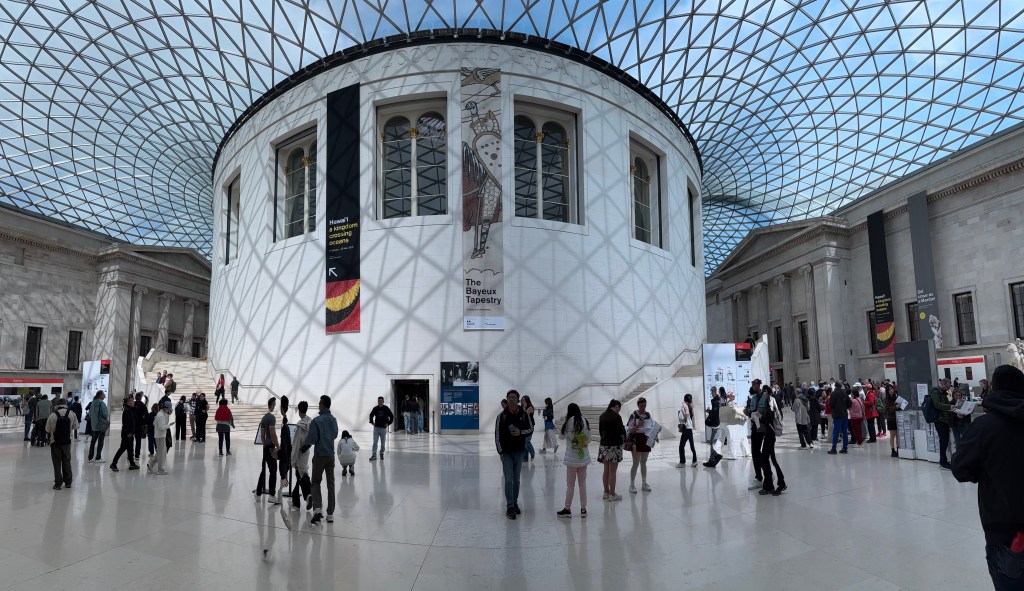
These are just a few of the topics Ackroyd and they are too many mention. Nonetheless, this a biography of a city. The city itself has its own personality. Based on Murray’s recent trip. It is an enormous sprawling metropolis full of life and history, which will “never come to an end.”
Like the inside of the British Museum, the book certainly enhanced Murray’s understanding London.
Francis’ Amazon Review
London: Its Biology
Peter Ackroyd is more of a biologist than a biographer in this book in that he dissects the history, neighborhoods, topography, waterways, architecture, gibbets, pillories, prisons, churches, disasters, smells, green spaces, dark corners, fogs, and layers of London and depicts the customs, habits, festivities, depravities, castes, comestibles, theatrics, privies, superstitions, folk heroes, argot, cheats and entertainments, high, low and gruesome, of its inhabitants. Most of it is entertaining and instructive; it slows a bit at the end, where it tries to sign off on a high note. This proves difficult because London’s zenith, the years when the sun never set on England’s empire, has long since passed. Since, even though London continues to evolve, it has done so in a fashion similar to other urban centers.
Strengths of the book are to be found in its corroborative detail, lucid prose, and source selection from observant writers and painters, which provides compelling eyewitness impressions of the city at different stages in its past. The book also adopts a helpful thematic approach, tackling one distinctive trait of the city at a time and how it changed over centuries, and sometimes even millennia. As a result, the book readily maintains one’s focus and interest.
Anyone who has read Dickens, DeFoe, Lamb, Arthur Conan Doyle, Hazlitt or Samuel Johnson, will come to learn how the city’s environment shaped their writing and opinions. And while much English literature has focused on the outward and inner lives of its upper class, this book typically follows the crowds, tradespeople and underprivileged and does not shy away from how necessity, the climate and commercial demands shaped their existence, and how the Thames, the city, and its neighborhoods defined the geographical extent of the known world for many of its inhabitants. Throughout, he highlights the resilience of Londoners and their neighborhoods and their ability to survive and remake themselves through plagues, fires, riots, wars, bombings and major civic renovations. Highly recommended for fans of British history, future tourists, and anyone intrigued by the role of cities in the history of the modern world. Given the book’s length, a tolerance for skipping around and redundancy will add to its enjoyment as does its bargain price: Encyclopedic information for one halfpenny per page on Kindle.
The Hardest, Longest Race by Eric Moskowitz
With an official title (The Hardest, Longest Race: Henry Ford and the Cross-Country That Changed America) this recently published book of the 1909 Ocean-to-Ocean Race between the fledgling automakers of that time, is a gritty, lengthy account of America at turn of the 20th century.
The race began in New York on June 1, 1909 and ended at the Seattle’s Alaska-Yukon-Pacific Exposition and when a Model T Ford crossed the finish line on June 23, 1909. (Photo is from Wikipedia Commons)
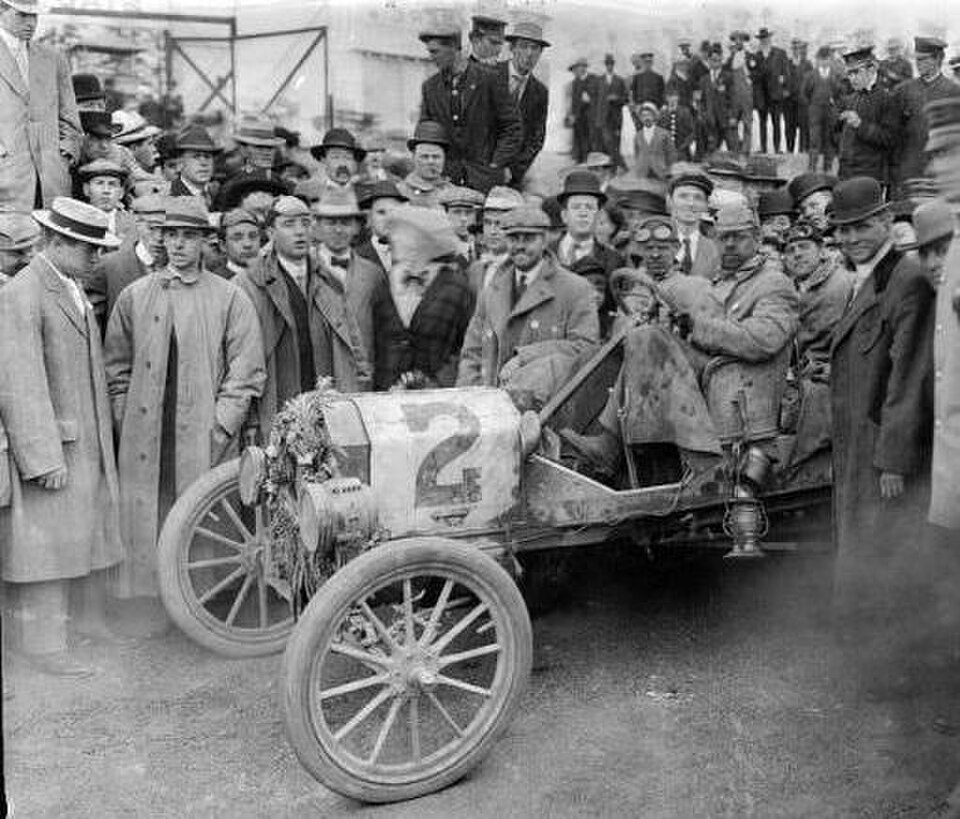
In between the lines Moskowitz gives a background on the five automobiles that began the race. Two were sponsored by Henry Ford as he pushed to have the first affordable car on the domestic market. A second manufacturer, Shawmut based out of Springfield (MA) had perhaps the “stronger” vehicle but its journey was ill-fated (their home base factory burned down just a few months before the beginning of the race.) The other manufacturers were the Italian based Itala and Acme, a Reading, Pennsylvania based carmaker.
Robert Gugganheim, the son of the wealthy Daniel Guggenheim (mining, real estate and railroad magnate) was the sponsor of the race which fit into his “lifetime of bobbing from one misadventure to another.”
Surprisingly this book reminded us of other books we read. Most notably, the John Dos Passos’ U.S.A. Trilogy about America before it became an industrial and military superpower. Much of the trip centered on the more challenging on the West and Great Plains wagon ruts turned “roads” of Colorado, Wyoming, Montana and Snoqualmie Pass through the Cascade Mountains. These reminded us of the mining towns we were introduced to in Wallace Stegner’s Angle of Repose.
Moskowitz relies heavily on newspaper accounts of the journey. This was the mass media of the time and Ford realizing the importance hired a marketing man to oversee and control the messaging (successfully since Ford still dominates the American auto market). These accounts and its Western theme reminded us of another GRGG book — Deadwood: Gold, Guns, and Greed in the American West by Peter Cozzens.
Moskowitz’s writing was okay, but nothing sparkling, which is something we notice when we read books written by journalists. The scope of the books with its thorough accounts of minor incidents and participants alike is both impressive but somewhat tedious as well.
Here are some passages selected by Francis that are indicative of the book’s subject matter and the style of the author:
Page 19. Colorado Senator Simon Guggenheim (Robert’s forty-one-year-old uncle), the three shared a hope that one day a continuous motorway would connect the coasts, benefiting both commerce and the military. Though few in Congress yet believed the federal government should pay for road improvements, the anti-auto caucus was rapidly shrinking. Arguing against that $12,000 for Taft, Tennessee Representative Thetus Sims had blasted automobiles as “a dangerous means of travel” and “a genuine all-around nuisance,” contending that even “Tennessee mules” would be better for the president.
Page 21. The sprawling Springfield Armory, the military’s foremost arms supplier, had pioneered a system of interchangeable parts and division of labor among factory workers that spread first to private gunmakers and then to a panoply of industries, mass-producing affordable consumer goods for a modernizing nation— sewing machines, typewriters, steam radiators, pocket watches, bicycles, and now automobiles.
Page 54. … but they called this twenty-four-page pamphlet the “Blue Book,” because that was the cover’s color, but also because that had become shorthand already for any directional guide, the way yellow pages would take hold for commercial telephone directories. Blue books of varying qualities dated nearly to the birth of the automobile, their name and color a nod to the existing social-register “blue books” that served as guides for the upper crust and those striving to reach it.
Page 91. That wheat-and-cattle community of four thousand was known less for the Eisenhower brothers (decorated scholar-athletes Dwight and Edgar had just graduated together from the local high school a few days before) than for America’s youngest motorist, six-year-old Bessie Coulson. The apple-cheeked daughter of a local Buick dealer had been driving for over a year, a promotional stunt conceived by her father to demonstrate that people should not be intimidated by the training or skill needed to operate an automobile—so simple that even a child could do it, literally. When Bessie buzzed around Abilene with a car full of playmates, her father typically stood on the running board to monitor the proceedings.
Page 108. ,,He did it again two weeks later, finessing the Ford into the story of the biggest sporting event to hit Colorado. Pop Warner’s Carlisle Indian Industrial School football team, boasting all-around athlete Jim Thorpe and spiral-pass pioneer Pete Hauser, was in from Pennsylvania to play the ascendant University of Denver, best in the West. The game was so big, one wag claimed that Roosevelt would referee, Taft would assist, and the “crowned heads of Europe will be given sideline privileges.”
Page 144. The race was the biggest thing to hit Montpelier in thirteen years, since Butch Cassidy and two associates waltzed into the Bank of Montpelier without disguises, wielding six-shooters and making off with about $7,000 in a sack. They’d rushed off on horseback, hastening their getaway by picking up fresh horses near the Wyoming line
Page 170. the dreaded “automobile face”—also “auto face,” or “motoring face”—that had gotten considerable press of late, with magazine wags and medical doctors warning that the nerves, muscles, and skin of the face were not meant to be thrust into the wind at high speed atop a vibrating contraption for long periods, with supposedly telltale effects. Instead, autointoxication—as it was more commonly spelled—was a popular theory, not yet discredited as quackery, that the body was prone to poisoning itself.
Page 234. |Guard Fred Bloom towered over everyone at six foot seven, an ex-military officer and champion wrestler from Finland, then a duchy of Russia. He’d even been a bodyguard for Czar Nicholas II, before fleeing when it emerged that Bloom was involved in activity opposing increased Russification of Finland.
Francis’ Amazon Review
Roughing it with Henry and Edsel
Traversing the American continent has been a popular literary theme beginning with published accounts of Lewis and Clark’s expedition of 1806, Mark Twain’s Roughing in 1867 and John Steinbeck’s “Travels with Charlie” in 1961. Now, in between, in 1909 there is “The Longest Hardest Race” which took place between New York to Seattle. It characterizes a period in American History, just after the taming of the wild west, before the radio and common use of telephones and just before squabbles in Europe would bubble over into the global conflict of WW1. Moskowitz captures the zeitgeist of this age, exploring the unique personalities of the racers and their sponsors in words and photographs, how their hometown industries influenced their career choices, and how the single mainstream media of the time, newspapers, fired the imagination of everyday Americans. Along the way, he gives us a unique glimpse of American life as it then spanned the continent, along rivers, on farms, and in small towns and how it was punctuated with unexpected events the near drowning of a mother of six and her horse, a giant Finn at the finish line in Seattle, who was a former bodyguard of Czar Nicholas, the shenanigans of Henry Ford (and his son, Edsel) greasing the palms of race officials, and an early version of an American highway atlas, albeit of notorious quality, known as ‘The Blue Book” (the term derived from the blue books used as social registry guides). Roads at the time were primitive, poorly marked, and often little more than dirt paths mainly used as routes for recreational tours popular among new car owners. After reading this book, those who have travelled any segment of the race route will appreciate the Roman saying: “nec de salibris cogitant, ubi via strata” (No one remembers how rough it used to be, after the road is built). The story, as much about America as about the race, will appeal to those interested in the history of the automobile, how it changed the country and eventually the world by catapulting the USA from also ran in the race of nations to a global military and economic powerhouse.
Red Harvest by Dashiell Hammett
This book came to GRSG via a list published in June by The Wall Street Journal. Book critic Sam Sacks put together a list of books and authors that represents America over the last 250 years. He admits it’s not the list of best books or influential books, but books that “offer one narrative of our national history.”
According to Sacks the list would not be complete without the crime novel and Hammett was the cornerstone of that genre. He is more known for The Maltese Falcon and The Thin Man, which were made into classic movies. It sorta reminds one of the Raymond Chandler quote:
If my books had been any worse, I should not have been invited to Hollywood; and if they had been any better I should not have come.
Written in 1929, Red Harvest is all crime noir. Pages upon pages of tough guy detective action, which includes lots of gangsters, double crosses, gun play, hard drinking and over twenty murders. (Just like this book cover which comes from the Standard E Books website.)

Initially our unnamed narrator from the Continental Operations comes to Montana mining town pockmarked with graft to solve the murder the city’s grumpy patriarch’s son. Here’s is highly detailed description, which to Murray was one of the few strong aspects of Hammett’s writing:
“The old man’s head was small and almost perfectly round under its close-cut crop of white hair. His ears were too small and plastered too flat to the sides of his head to spoil the spherical effect. His nose also was small, carrying down the curve of his bony forehead. Mouth and chin were straight lines chopping the sphere off. Below them a short thick neck ran down into white pajamas between square meaty shoulders. One of his arms was outside the covers, a short compact arm that ended in a thick-fingered blunt hand. His eyes were round, blue, small and watery. They looked as if they were hiding behind the watery film and under the bushy white brows only until the time came to jump out and grab something. He wasn’t the sort of man whose pocket you’ d try to pick unless you had a lot of confidence in your fingers.”
Of course there are “dames”
She was an inch or two taller than I, which made her about five feet eight. She had a broad-shouldered, full breasted, round-hipped body and big muscular legs. The hand she gave me was soft, warm, and strong. Her face was the face of a girl of twenty-five already showing signs of wear. Little lines crossed the corners of her big ripe mouth. Fainter lines were beginning to make nets around her thick-lashed eyes. They were large eyes, blue and a bit bloodshot.
Francis wondered if a book like Red Harvest was written in this day and age it probably would have been published as a graphic novel.
Murray thinks reading Thomas Pynchon’s latest Shadow Ticket (link leads to the plot synopsis) is much more entertaining, but maybe Red Harvest helps him appreciate Pynchon’s satirical mastery of the genre.
We finish with Francis’ Amazon review (Murray thinks he’s been generous but understands that the book did inspire Francis to try his hand at a noir-styled review.)
Bleak Hovels
I picked up my Kindle, and the more I got into “Red Harvest”, the heavier it felt. Dark mode helped cut the glare from Dashiell Hammet’s sentences which peppered me like sharp jabs, the haymaker never came. The plot? Everyone plays patty-cake with the truth, only the saps and suckers buy it. What a place, Poisonville, i.e. Personville, Montana; the local tobacco, opium and gin, were legit, but nothing else. It was here that Mother Nature sold off some of her mineral rich rocks to be repaid with slag heaps and enough dump sites to hold a score of stiffs. As for Mother Nurture, the Pinkertons had silenced any hint of her, along with those Bolshevik strikers of IWW about a decade earlier. For novelty, the current mining Czar called on the Continental company for this new job of silencing, rumor had it that their tecs were an uppercut above. The town sorely needed it–rigged top to bottom, from the big shots to the lowlifes each plying their own special grift. There was a woman there too, knees scarred from the cinder track of life, undyed roots, and an ear to every cellar wall, listening in on the sewer pipes that flowed by. She knew frailties, her own included, and the only thing she couldn’t crack were the shells of the truly hard boiled. A French guy, Victor something, once said that virtue wears a veil, vice a mask. Maybe so, but the only drapery she ever hung was crepe. OK, enough; if you want to know how this all ends up, pony up and buy the book. For those who find this style of writing their cup of tequila, they’ll get a four star read, even if milquetoasts and highbrows don’t see it that way.
The American School of Spies: The Archeologists Who Fought the Nazis and Saved the Treasures of Ancient Greece by Stephan Talty
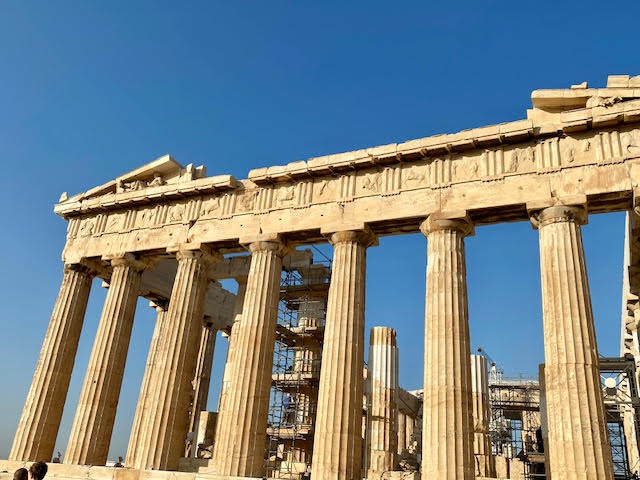
Based on favorable book reviews, Francis and I selected this book. In our discussion we realized that it dovetailed with other books we have read at the GRSG: The Forbidden Garden: The Botanists of Besieged Leningrad and Their Impossible Choice (another book with a lengthy subtitle) and The Stronghold: Four Seasons in the White Mountains of Crete.
Adding to our interest was Francis’ trip to Greece a couple years ago (that’s his photo of the Parthenon).
The book is divided into three parts:
Part One
In anticipation of Germany and Italy’s invasion of Greece in 1940 and 1941, the curators of the National Archeological Museum decide to bury many of Greece’s most important antiquities into the floor of the museum itself. Talty writes:
“The government ordered archaeologists to draw up a master list of relics and to rank them from most important to least, then to find a way to keep them safe. The Ancients at the top of the list would be preserved at all costs, while the ones at the bottom would be left exposed to destruction or theft.”
Meanwhile stateside, the Princeton educated Rodney Young, with a PhD in Classics and Archeology was doing work in Athens at the time of the invasion. Eventually he would lead “the Greek Desk” supported by William Donavan of the newly formed OSS ( a precursor to the CIA).
We are also introduced to Dorthea Cox who “escaped her hometown of Terre Haute, Indiana, to study ancient coins before becoming the Desk’s tetchy, brilliant intelligence expert.” Being the only woman who had a significant role in the desk, she had to constantly fight the headwinds that her intel would be taken seriously.
Talty goes into detail about other who were selected—many with Greek-American backgrounds who were marginalized in the U.S. and underwent rigorous preparations in a very short period of time. One memorable trick in their training was their intelligence grading system to evaluate intel:
“Alpha: I saw this with my own eyes. Beta: A trusted source saw this with his own eyes. Gamma: My sources and I didn’t see it, but believe it to be true. Delta: Doubtful but worth mentioning.”
Part Two
The majority of the chapters were accounts in the how the undercover spied and the trained saboteurs infiltrated Greece and joined the resistance fighters creating havoc the against the occupying German invaders. The narrative flipped back and forth between Young and the OSS who were running the show out of Turkey and the individuals “in country” who risked their lives. Greece was a very poor country and over 300,000 Greek citizens perished – mostly from starvation.
Part Three

In the final quarter of the book Talty gives a detail account and the negotiations between the retreating Germans and the Greek resistance. One major event was saving the Marathon Dam which if destroyed would have caused an avalanche of waters to flood into Athens. An important player in this negotiation was Roland Hampe a German-born classicist who had first come to Greece as a student in 1932.
Photo of Athens from the Acropolis , Francis Walker
Further complicating matters as the British led by Churchill were keen to keep the advancing Soviet Union led by Josef Stalin for taking over the country and turning it into a Communist satellite.
The Americans were caught in the middle between the Soviet and British interests until 1950 replacing England as the country’s main external patron. Rodney Young had moved to the United Nations Relief and Rehabilitation Administration, “which shipped in 1.2 metric tons of wheat, legumes, and sugar, saving hundreds of thousands from starvation. The U.S. also covertly supported the postwar repression of the Communists, known as the ‘White Terror,’ in which thousands of men and women were arrested, tortured, and sometimes executed.”
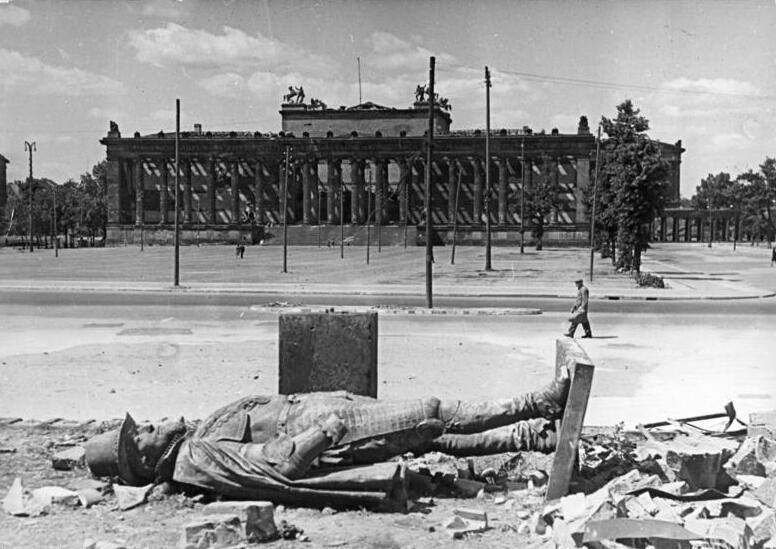
Altes Museum circa 1950
Attribution: By Bundesarchiv, Bild 183-M1204-0307 / Otto Donath / CC-BY-SA 3.0, CC BY-SA 3.0 de, https://commons.wikimedia.org/w/index.php?curid=5366673
Overall Thoughts
We agreed that Talty has brought a lesser known aspect of World War II to light—a story of bravery and espionage which gave the book a natural energy. However, the writing itself was solid, but not necessarily much above college freshman level. For example, when one reads, “He walked up to the platform to the end and back. He felt an unnamable dread rise up in his thoughts like air bubbles, ” one wonders if some license had been taken.
And yes, the book had an index, but no map. What is it with these publishers not providing a map?
It was for these reasons, that Francis pulled back from a five star to a four- star review. And here it is:
Francis’ Review
Parallel lives
What happened to those who fought Nazi aggression in Greece during the second world war? Steve Talty, taking a page from Plutarch, dramatizes this question by comparing the before and after lives of three groups of people: A team of American archeologists, fluent in the language, who were recruited to form spy networks spanning the ancient Mediterranean; Greek American youths, trained as soldiers to aid the resistance in their ancestral home country; and the workers in charge of hiding precious antiquities from Nazi depredations. Courage abounds, including that of an adolescent shepherdess who, possibly reenacting a role of her ancient maternal ancestors, provides nocturnal support to a lost and wounded fighter fleeing a determined enemy. Danger, massacres, ruses, unexpected contretemps with allies and cooperation from Germans, and an unimaginable near catastrophe add to this well researched and stirring account. A recurring theme is that conflict, like excavation, can uncover character. Highly recommended.
Trash! A Garbageman’s Story by Simon Parè-Poupart

When this short book was published earlier this year it received considerable attention from mainstream reviewers including Dwight Garner of The New York Times Book Review.
Simon Parè-Poupart was (or is he still?) a garbageman in Montreal for twenty years, but what sets him apart from the trash-toting colleagues is that he has graduate degrees in sociology and business. Not does give you the subterranean feel about the men and the filthy, physically demanding, and demeaning (if you allow it and he doesn’t), but he takes a broader perspective on understanding society by it how throws away things.
Francis and I both liked the book and we shared our own experiences with trash pickup in Winston-Salem (NC) and Decatur (GA) respectively in our discussion of the book. Here’s just a few other themes we touched upon.
Real Men
Pare-Pourt has many anecdotes about the men he has worked with over the years. He rides the streets with nicknames such Frank the Runner, Cat, the patriarchal Papy, Spandex, Rock Machine and Ti Chris AKA Little Shit who would drop everything and run if a policeman came near the hopper. They all had some degree and combination of super Herculean strength, with a history of alcohol or /and drug abuse, He writes:
“I’m a garbageman. Day after day, I heave and haul the detritus of the most polluting civilization in human history. My fellow garbagemen and I scrub clean the stains of our consumer society.” Page 3.
“The garbageman is the Sisyphus of our consumer society, a hapless laborer condemned to go from house to house picking up bags, swept along day after day in the never-ending flow of refuse we produce….”.
“When he was thirty, Spandex robbed a convenience store with a sawed-off shotgun. Or at least tried to. The owner disarmed him and beat him up. As you can imagine, that dealt a serious blow to his street cred.” Page 43

The Environment
One of the aspects of the book we both appreciated was the educated garbageman common sense with respect not only on trash, but recycling and composting. In short, Parè-Poupart loathed recycling because the extra effort and he provides the numbers and economics that very little gets recycled properly and often oceans of plastic gets dumped on unsuspecting poor countries. He thinks even less of composting (the bags heat up an explode in the summer), but thinks more efforts should be put forth to reuse.
” …. on some runs you get the chance to find stuff worth keeping for yourself or valuable scrap metal. There’s money to be made there! It’s even not unheard of to get tips—something that’ll never happen on the compost route, and only very rarely on recycling. I guess the less environmentally friendly the activity, the more generous people are… “(Page 76)
The author introduced the word “Freeganisms” to our vocabulary which broadly interpreted as an activist lifestyle that who scavenges for free food and materials (such as furniture, clothing and appliances). He explains:
“Freeganism is the term for this lifestyle. It’s based on a fundamental rejection of the premises of consumer society. Freeganism is a philosophical, ethical, economic, and political stance, and after twenty years of filling garbage dumps, it’s the only one that makes sense to me…There’s nothing revolutionary about being a freegan. It’s a way of life and an economic practice that has the merit of truly limiting the orgy of commodities that is our capitalist society. (Page 165-6)”
The History
Throughout the book Parè-Poupart provides us with the many facets of sociological history of trash, but one of the most important is the reminder of the Memphis, Tennessee garbage strike of 1968.
Two black garbage workers died when they sought refuge from a thunderstorm in their hopper and were crushed. (They were not allowed to seek shelter) This led to a sanitation workers strike and Martin Luther King arrived in the city to lend his support. He delivered his famous “I’ve Been to the Mountaintop,” speech and the following day was assassinated on the balcony of the Lorraine Motel.
As a final note, Murray’s agreed that overall this was an interesting read. Parè-Poupart and his translator Pablo Strauss put the energy of the street and alleys into the prose. And the book was the proper length. Any longer and it might have started to repeat itself. And now for Francis’s take.
A Different Kind of Work
In recounting “One Day in the Life of Ivan Denisovich” (1962) Alexander Solzhenitsyn describes how his small group of poorly fed Gulag inmates thaw frozen mortar in the frigid Siberian wilderness for bricklaying the foundation of a brutal Soviet building they still find surprising camaraderie in treacherous conditions. One senses similar synergy in Pare-Poupard’s descriptions of un-incarcerated garbagemen working together in Montreal, fighting icy winters and baking summers and coping with condescending citizens who intermittently obstruct their efforts and well-being. Bertrand Russell once wrote: “It is mere sentimentality to aim, as some people do, at extracting the very uttermost drop of misery from misfortune.” Perhaps he should instead, credit to those capable of the reverse. The author points out that despite its many downsides, garbage work also has pertinent positives—physical fitness, elimination of the fear of demotion or the need to measure up to arbitrary standards, egalitarian acceptance by one’s peers, the satisfaction of teamwork on a time sensitive, measured task and job security. Unlike bank employees or newspaper columnists, garbagemen, should they go on strike, create an immediate public stink. Essential reading for air conditioned office workers bemoaning their imaginary economic shackles and recommended for anyone looking to acquire a novel perspective on a unique occupation.
Orbital by Samantha Harvey

NASA, Wikipedia Commons
This novel came our way via Murray’s partner Denise who raved about the book which received The Booker Prize in 2024.
Though originally founded by the Pynchon novel Gravity’s Rainbow, GRSG doesn’t select many novels, but considering it is “a moving elegy to our environment and planet” this short book also fits the inventory of Murray’s popup book biz, Destination: Books. (He doesn’t carry much fiction either.)
During the pandemic the author Samantha Harvey became obsessed with life on the Space Stations and dug deep into the daily lives of the astronauts and cosmonauts. She went as far as monitoring their communications and their daily schedules (which included multiple sunrise and sunsets – e.g. like the one above from Expedition 46).
From this beginning she wrote a work of fiction, but the book is considered to be accurate portrayal of those who looking above the planet nonstop and the profound effect on their lives. Orbital’s crew is made up of six women and men from America, Russia, Italy Britain and Japan who orbit around the Earth and in this fictional world it is one of the last missions of its kind.
A key to understanding the book is realizing that each chapter covers one of the 16 orbits the space station makes around the earth in a twenty-four period. A small diagram in the beginning of the book marks the path of each orbit as it relates to the spinning planet. Each chapter refers one of the orbits: Africa (Chapter/Orbit 10) or Indonesia (Chapters/Orbit 3, 14). One can better understand the narrative by matching the trajectories of the space station to its respective chapter.
Life on the Space Station in Quotes
She finds she often struggles for things to tell people at home, because the small things are too mundane and the rest is too astounding and there seems to be nothing in between, none of the usual gossip, the he-said she-said, the ups and downs; there is a lot of round and round. There’s a lot of contemplation of how it’s possible to get nowhere very fast. – Page 26
They might listen to the news and feel instantly tired or impatient. The stories a litany of accusation, angst, anger, slander, scandal that speaks a language both too simple and too complex, a kind of talking in tongues, when compared to the single clear, ringing note that seems to emit from the hanging planet they now see each morning when they open their eyes. – Page 109
….that when you first came here you were baffled by the lack of gravity because your body kept wanting to decide which way was up, and nothing gave it any clue. It kept craving resistance and there was nothing to resist. – page 165.
Another poignant scene is when two astronauts ponder who will write the future of humanity. One astronaut replies cynically, that the history be written by the “gilded pens of billionaires.”
But Francis and I beg to differ (and we are not that optimistic of a duo) because Harvey’s book is worthy of all its accolades and far exceeds anything written by billionaires and their AI slop machines.
Francis’s Review
A Unique Lens
George Eliot (Marianne Evans) once wrote that “Imagination is a licensed trespasser: it has no fear of dogs but may climb over walls and peep in at windows with impunity.” Samantha Harvey’s research-informed imagination takes us inside a space station and gives us an in depth look at a group of fictional astronauts and how they spend one 24 hour day of their many months together. A central theme of the book is looking through windows, those of time, space, distance, and the windows of the mind as they flashback to images of their pasts and dream of their possible futures. Harvey cleverly uses Velasquez’s “Las Meninas” painting, which shows a scene from many points of view, to illustrate the concept. As for the astronauts, their daytime routine is as scheduled as of a child of helicopter parents, which enables them to become intently focused mono-taskers as they tackle each assignment. Once, those are completed, free from gravity and other human responsibilities, they are free to dream. Their mundane indoor world of negotiating cramped quarters, grunting through necessary daily resistance training, dealing with the challenges of zero gravity feeding, sleeping and hygiene is rewarded by the ever-present panoramic views of earth, sun and stars from their edge of the atmosphere. Haunting, eerie, and compelling, this book will be appreciated by all with interests in space travel, astronomy, and the experience of human life in a unique environment.
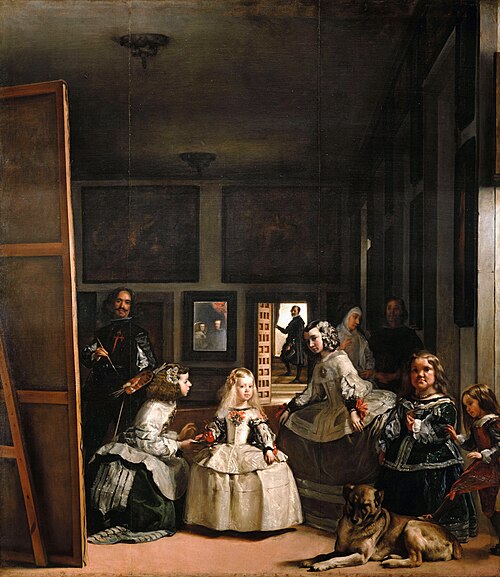
Public domain, via Wikimedia Commons
Hospital Sketches by Louisa May Alcott
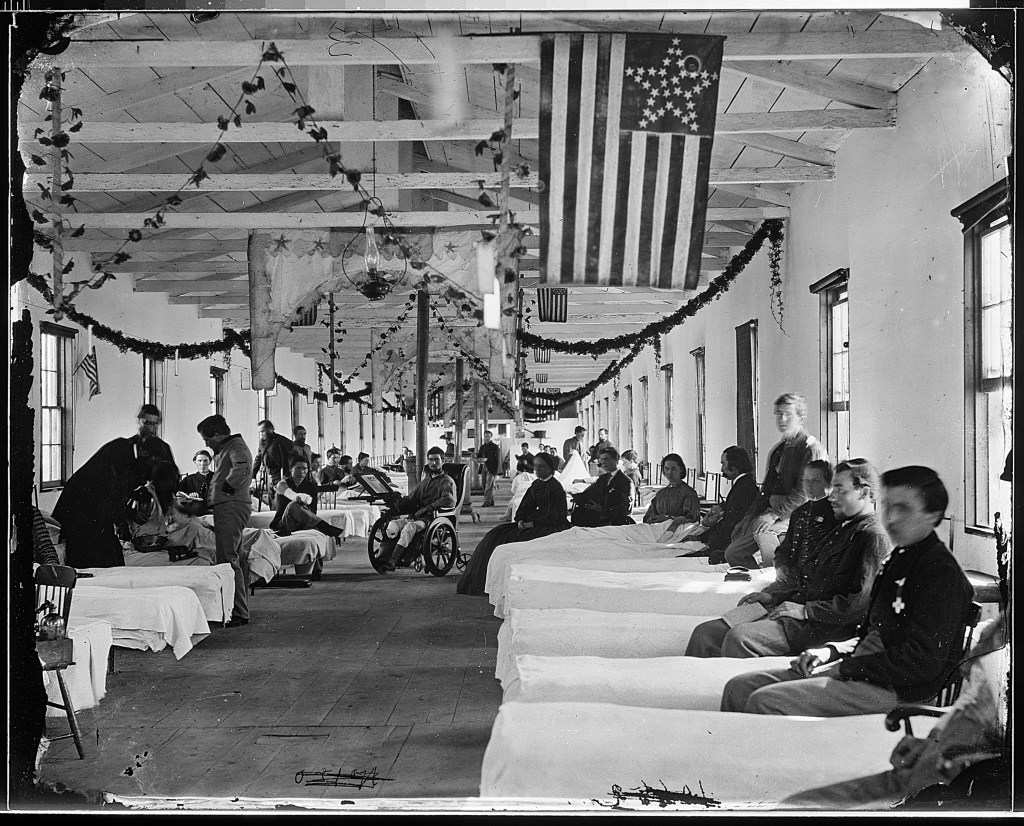
Mathew Benjamin Brady, Public domain, via Wikimedia Commons
One of the more unexpected selections for the GRSG came about when Francis mentioned in passing that he sent a copy of Alcott’s 1863 account of her experiences as a nurse in Washington D.C. to his granddaughter Fiona. She is 14 and taking American History and Francis remembered an earlier favorable review in The Wall Street Journal.
But the book works for us in other ways in well. One of the earlier books we read in 2021 was The Republic of Suffering by Drew Gilbert Faust. In this book Faust gives us the staggering numbers of death during the War Between the States which was unprecedented at that time and still is (when considering this was fought on American Soil). Numbers can be abstract, but Alcott’s meticulous and graphic description of her service in the Union hospital begins to give us a stark sense of what it was like.
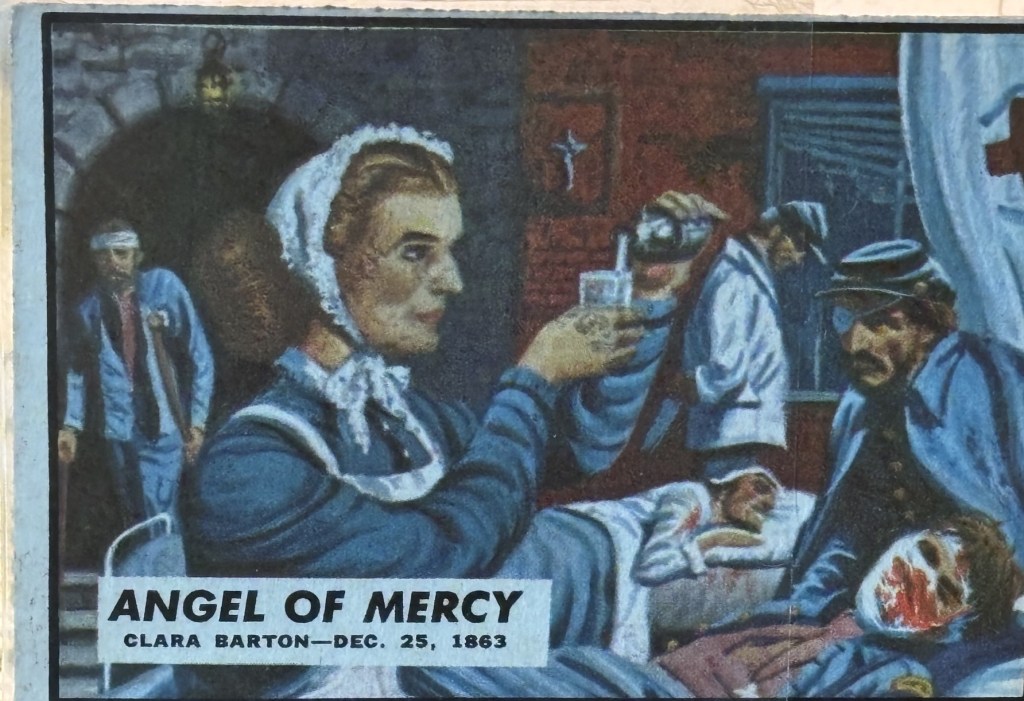
Moreover, this Civil War Trading Card featuring Clara Barton (circa 1965) doesn’t quite do enough. And yes, Topps Civil War trading cards were a thing in 1965 – marking the centennial of the War.
Another book that it reminded us was Pat Barker’s 1991 historical novel Regeneration about a hospital in Scotland that described the shell-shocked horrors of British officers who “survived” the trench warfare.
Alcott descriptions match Barker’s work and one can see her writing bona fides, though she mostly known for her 1868 novel Little Women, which put her in the pantheon of 19th century America Writers. (Alcott was also featured in Tyra Miles’ Wild Girls: How the Outdoors Shaped the Women Who Challenged a Nation. )
Some Exemplary Passages
The sight of several stretchers, each with its legless, armless, or desperately wounded occupant, entering my ward, admonished me that I was there to work, not to wonder or weep; so I corked up my feelings, and returned to the path of duty, which was rather “a hard road to travel” just then.
I’m done for; won’t there be a thunderin’ scar? and what on earth will Josephine Skinner say?” He looked up at me with his one eye so appealingly, that I controlled my risibles, and assured him that if Josephine was a girl of sense, she would admire the honorable scar, as a lasting proof that he had faced the enemy, for all women thought a wound the best decoration a brave soldier could wear. I hope Miss Skinner verified the good opinion I so rashly expressed of her
“No, miss; I’ve been in six scrimmages, and never got a scratch till this last one; but it’s done the business pretty thoroughly for me, I should say. Lord! what a scramble there’ll be for arms and legs, when we old boys come out of our graves, on the Judgment Day:”
Poor John! it did not matter now, except that a shot in the front might have spared the long agony in store for him. He seemed to read the thought that troubled me, as he spoke so hopefully when there was no hope, for he suddenly added:
“This is my first battle; do they think it’s going to be my last?”
“I’m afraid they do, John.”
It was the hardest question I had ever been called upon to answer; doubly hard with those clear eyes fixed on mine, forcing a truthful answer by their own truth. He seemed a little startled at first, pondered over the fateful fact a moment, then shook his head, with a glance at the broad chest and muscular limbs stretched out before him:
“I’m not afraid, but it’s difficult to believe all at once. I am so strong I didn’t think a little wound could kill me. (Page 46)
Since this book is in the public domain it has been reprinted on demand by Cedar Lake classics.
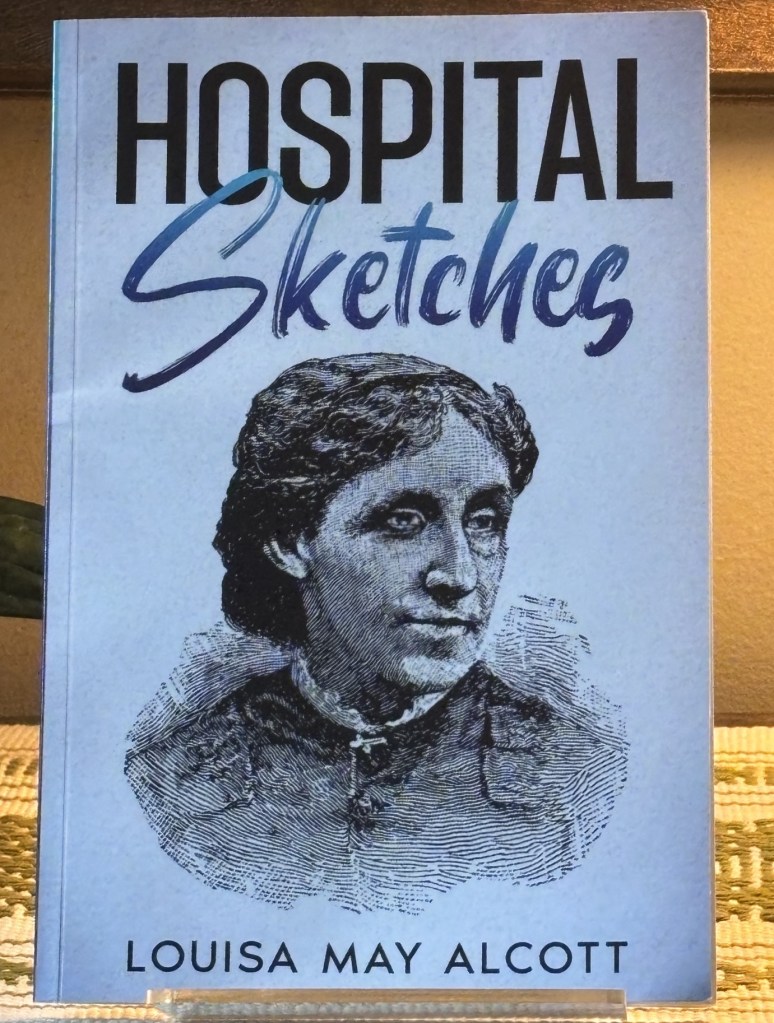
Francis’s Review
An American Nightingale
At the age of 30, Louisa May Alcott, wanting something to do, decided to make herself useful. Write a book? She chose to first live, then compose. Leaving the comfort of her family behind in Massachusetts, she headed off alone to Washington DC to help nurse wounded Civil War soldiers. Families who had sent their sons to fight for the Union were desperate for information about what was happening and what would happen to them if wounded. Her book, Hospital Sketches, began as a series of letters to the abolitionist paper “The Boston Commonwealth” to address that need and they were later compiled in book form. The first chapter is choppy, but the next quickly pulls the reader in where she describes facing 80 casualties at dawn following a Union loss at Fredericksburg. “The sight of several stretchers, each with its legless, armless, or desperately wounded occupant, entering my ward, admonished me that I was there to work, not to wonder or weep; so I corked up my feelings, and returned to the path of duty, which was rather “a hard road to travel” just then”. Soap, nutrition, a touch of ether, and the good humor of a gifted nurse put help her tend to the wounded, assist surgeons, and give solace to those destined never to leave. As the more fortunate make their slow recovery, so begins the healing of a divided nation. Recommended for civil war buffs, those curious about the lives of young women or soldiers in the 1800s, and the demands of caring for the victims of war. Compelling, comedic, at times heartbreaking, this is an eyewitness account from an astute observer of human nature.

